International Journal of Research (IJR)
e-ISSN: 2348-6848, p- ISSN: 2348-795X Volume 2, Issue 09, September 2015Available at http://internationaljournalofresearch.org
The Cellular Saving System in Networks Smartphone on
Data offloading Energy
A.Anoosha
1& Dr. Shaik Abdul Muzeer
21M-Tech Dept. of CSE Megha Institute of Engineering & Technology for Women 2Professor & principal Dept. of CSE Megha Institute of Engineering & Technology for Women
ABSTRACT
In cellular networks, due to practical deployment issues, some areas have good wireless coverage while others may not. This results in significant throughput (service quality) difference between wireless carriers at some locations. Through extensive measurements, we have validated the existence of such service quality difference. Then, through peer to peer interfaces such as Wi-Fi direct, a mobile device (node) with low service quality can offload its data traffic to nodes with better service quality, to save energy and reduce delay. To achieve this goal, we propose a Quality-Aware Traffic Offloading (QATO) framework to offload network tasks to neighboring nodes with better service quality. QATO can identify neighbors with better service quality and provide incentive mechanisms to motivate nodes to help each other. To validate our design, we have implemented QATO on Android platform and have developed web browser and a photo up loader on top of it. Experimental results show that QATO can significantly reduce energy and delay for both data downloading and uploading. Through trace-driven simulations, we also show that all users can benefit from data offloading in the long run.
Keywords- Data offloading; Energy Saving; Cellular Networks; Smartphone
I. INTRODUCTION
According to Cisco forecasts [1] and practical experiences of mobile operators, we are now facing the “mobile data apocalypse”. Mobile data traffic grows at a compound annual growth rate (CAGR) of 131 percent between 2008 and2013, and will exceed two Exabyte per month in 2013. At the same time, cellular operators in Europe are investing a large amount of money to push machine-to-machine (M2M) communications for billions of machines and smart devices (e.g., automobile and sensors), which will create additional mobile traffic. However, currently cellular networks do not have enough capacity to accommodate such an exponential growth of data. Thus, there is urgency for the research community to look for new solutions. Operators are rolling
International Journal of Research (IJR)
e-ISSN: 2348-6848, p- ISSN: 2348-795X Volume 2, Issue 09, September 2015Available at http://internationaljournalofresearch.org
Owing to the proliferation of sophisticated mobile devices(i.e., smart phones, tablets), a 20-fold increase in data traffic is expected over the next few years, compelling mobile operators to find new ways to significantly boost their network capacity, provide better coverage, and reduce network congestion [3].In this context, the idea of heterogeneous networks (HetNets),consisting of a mix of short-range and low-cost small cell base stations (SCBSs) under laying the macro cell network, has recently emerged as a key solution for solving this capacity crunch problem [4]. However, reaping the potential benefits of heterogeneous and small cell deployments is contingent upon: a) developing innovative interference management, load balancing, and traffic offloading mechanisms, and b) integrating different radio access technologies (RATs), tiers (femto pico-, micro, metro, and macro cells), and licensed/unlicensed frequency bands.
2. RELATED WORK
Our work aims to save energy and delay by offloading traffic to neighbors with better service quality. It is related with three categories of work.
Power saving in cellular networks: In cellular
networks, including GSM, UMTS, HSPA, and LTE, the radio interface on smart phone is kept in the high power state for a long time (called the long tail problem) after data transmission. One advantage of this approach is that it can reduce the latency for next possible data transmission, but it also wastes lots of energy. To solve this problem, some researchers introduce methods to aggregate the network traffic to amortize the tail energy [5], or turn the radio interface off quickly by predicting the end of communication [3, 6]. The tail energy can also be saved by aggregating
traffic together, if the application is delay tolerant [4].
Quality aware data access: The service quality
difference of cellular network within an area has drawn researchers’ attention. The Bartend project [7] studies the relationship between signal strength, throughput and energy. It indicates that the energy of cellular network interface increases and the data throughput decreases when the signal is weak. Based on this finding, they propose to predict the signal strength considering both location and moving direction, and then defer data transfer until reaching a location with better signal. By moving one step further, a travel trip can be planned considering network quality [8]. However, these approaches allrequire the knowledge of users’ movement, which is not easy to achieve in many cases. There are also studies on helping static users to improve the signal quality [9] or increasing network capacity [10] of cellular network via the P2P links. Different from them, we leverage users’ cooperation to save energy and reduce delay.
Offloading: In the past several years, there has
International Journal of Research (IJR)
e-ISSN: 2348-6848, p- ISSN: 2348-795X Volume 2, Issue 09, September 2015Available at http://internationaljournalofresearch.org
limited to simulations. Third, our work considers many practical scheduling issues related to the long tail problems, which are not considered in UCAN. There are also works on mobile clouds [5, 9] which aim to offload complex computations to cloud to save energy. Recently, many researchers also consider offloading computations to nearby mobile devices to save energy. Their idea of leveraging neighbors’ resource inspires our work, but their works focus on computation offloading whereas our work focuses on communication offloading.
3. PROBLEM STATEMENT
Germans et al. [14] proposed an architectural and protocol framework that allows 3G providers to offload cellular traffic while distributing the content efficiently. In this work, the offload is performed by caching the content in the infrastructure of “resident subscribers” (i.e., almost static users). Despite our work shares the adoption of a fixed infrastructure, the authors’ contribution is focused on game theoretical aspects of user cooperation rather than on effects resulting from the metropolitan mobility of the nodes. Also, a scenario in which the users can produce and upload contents is not addressed. The scenario discussed in our paper is similar to Unified Cellular and Ad-Hoc Network (UCAN) [15]. UCAN was designed to increase the throughput of the cell and maintain fairness between users. Similarly to our work, UCAN mobile clients rely on the combination of Wi-Fi andcellular networks. However the paper focusses on improvingthe throughput of cellular networks by evaluating specificprotocols, rather than trying to offload the traffic in a staticinfrastructure. Wiffler [8] is a system to augment 3G withWiFi for vehicular networks, which is evaluated mainly for asmall and sparsely populated city and does
not show system scalability when the number of users scales up to several hundreds. Overall, it is expensive to deploy a city-wide Wi-Fi network only to offload cellular data. As we mentioned in our previous work, the cellular network operators, Wi-Fi service providers, and end-users (with already deployed residential Wi-Fi) should cooperate to support mobile data offloading, as it is win-win-win for them.
4. SYSTEM DESING
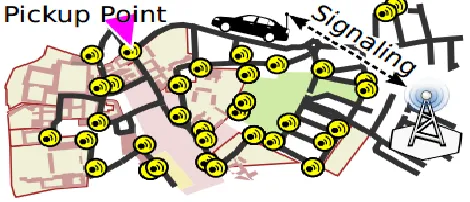
Figure 1. Signaling and pickup scenario
4.1 Cellular Traffic Offloading
In this section, we discuss the general solutions forcellular traffic offloading, which include femtocells for indoor offloading, and WiFi and peer-to-peer opportunisticoffloading for outdoor and mobile environment. MADNetprovides an integrated solution for the latter two cases anduses the cellular network as signaling channel for controllingdeliveries.
A. Femtocells for Indoor Offloading
International Journal of Research (IJR)
e-ISSN: 2348-6848, p- ISSN: 2348-795X Volume 2, Issue 09, September 2015Available at http://internationaljournalofresearch.org
femtocells. The disadvantages include the need to install short-range basestations in residential or small-business environments, andthe solution is usually for indoor environments and cannothandle macroscopic mobility.
B. Opportunistic Peer-to-Peer Offloading
Han et al. [6] proposed to offload traffic from the cellularnetwork to opportunistic peer-to-peer mobile network byselecting k users as the initial set to push the contents.Afterward, the initial set of users aids the propagation ofthe contents to further users through short-range wireless connectivity’s (e.g., Bluetooth and ad hoc Wi-Fi). To improve the delivery efficiency, the system can identify the social networks of the users and deliver specific contents to a particular social group [7]. Han et al. have shown that even through the simple heuristic of selecting the initial set based on past history, a large fraction of data can be offloaded from the cellular network.
C. Wi-Fi for Outdoor Offloading
Wi-Fi networks operate on the unlicensed frequency bands and cause no interference with 3G cellular networks. Wi-Fi is usually ubiquitously available in urban areas, either deployed by operators as commercial hotspots, shared out as community network (e.g., FON), or deployed by users for residential usage. Meanwhile, there are already several offloading solutions and applications proposed from the industry. For example, the Line2 i-Phone application can initiate voice calls over Wi-Fi networks. Recently, Balasubramanian et al. [8] proposed a scheme called Wifelier to augment mobile 3Gusing Wi-Fi for delay-tolerant applications. Our focus here is on evaluating the potential costs and gains for providing Wi-Fi offloading in metropolitan area
by using large scale real mobility traces for empirical emulation. Lee et al. showed promising results of using Wi-Fi for cellular traffic offloadingwith empirical pedestrian traces [9]. In this paper, we focuson the performance of WiFi offloading on environments withhigh mobility.
5. EVALUATION RESULTS
In this section, we compare the performance of MADNetagainst 3G networks when users download and uploaddata. We report the results of the two cases separately,characterizing the system, considering the satisfaction ofusers, delays and network load.
International Journal of Research (IJR)
e-ISSN: 2348-6848, p- ISSN: 2348-795X Volume 2, Issue 09, September 2015Available at http://internationaljournalofresearch.org
Figure3. Request satisfaction delay distribution of download requests
Figure 4. Satisfied requests ratio across different settings
6. CONCLUSION
In this article, we studied the strategic coexistence
between3G/LTE and Wi-Fi networks in a heterogeneous network, in which multi-mode SCBSs transmit simultaneously on both licensed and unlicensed bands. The tight integration of both technologies is seen as crucial for supporting the unrelenting growth in data traffic. In view of this, we developed a cross system learning framework aiming at optimizing the long term performance of SCBSs, in which delay-tolerant traffic is steered towards Wi-Fi. Our approach is totally distributed with low signaling overhead, and shows significant improvements in terms of cell-edge UE throughput, especially in high load conditions. In our future investigations, we will extend the current formulation to the case of backhaul sharing, which is also gaining significant importance.
7. REFERENCES
[1] (2009, January) Cisco visual networking index: Global mobiledata traffic forecast update.
[2] N. Laoutaris, G. Smaragdakis, R. Sundaram, and P. Rodriguez, “Delay-Tolerant Bulk Data Transfer on the Internet,”in ACM SIGMETRICS 2009, June 2009.
[3] Juniper, “WiFi and femtocell integration strategies 2011-2015,” Whitepaper, [Online]. Available : http://www.juniperresearch.com/, Mar. 2011.
[4] Qualcomm, “A Comparison of LTE Advanced HetNets and WiFi,”Whitepaper, [Online]. Available:
http://www.qualcomm.com/media/documents/file
s/a-comparison-of-lte-advanced-hetnets-and-WiFi.pdf,Sep. 2011.
[5] W. Hu and G. Cao. Energy Optimization Through Traffic Aggregation in Wireless Networks. In IEEE INFOCOM, 2014.
[6] F. Qian, Z. Wang, A. Gerber, Z. Mao, S. Sen, andO. Spatscheck. TOP: Tail Optimization Protocol for Cellular Radio Resource Allocation. In IEEE ICNP, 2010.
[7] A. Schulman, V. Navda, R. Ramjee, N. Spring, P. Deshpande,C. Grunewald, K. Jain, and V. N. Padmanabhan. Bartendr: APractical Approach to Energy-aware Cellular Data Scheduling. In ACM MobiCom, 2010.
[8] C. Shi and H. Xie. Go This Way: Navigation for Better Access Quality in Mobile Networks. In ACM MobiArch, 2013.
International Journal of Research (IJR)
e-ISSN: 2348-6848, p- ISSN: 2348-795X Volume 2, Issue 09, September 2015Available at http://internationaljournalofresearch.org
[10] B. Radunovic and A. Proutiere. On Downlink Capacity of Cellular Data Networks With WLAN/WPAN Relays. IEEE/ACM Transactions on Networking, 21(1):286–296, 2013.
[11] N. Ristanovic, J.-Y. Le Boudec, A. Chaintreau, and V. Erramilli. Energy Efficient Offloading of 3G Networks. In IEEEMASS, 2011.
[12] K. Lee, J. Lee, Y. Yi, I. Rhee, and S. Chong. Mobile Data Offloading: How Much Can WiFi Deliver? IEEE/ACM Transactions on Networking, 21(2):536–550, 2013.
[13] H. Soroush, P. Gilbert, N. Banerjee, M. D. Corner, B. N.Levine, and L. Cox. Spider: Improving Mobile Networking with Concurrent Wi-Fi Connections. In ACM SIGCOMM,
2011.[14] M. Goemans, L. E. Li, V. S. Mirrokni, and M. Thottan “Market sharing games applied to content distribution in adhoc networks,” in ACM MobiHoc ’04, May 2004.
[15] H. Luo, X. Meng, R. Ramjee, P. Sinha, and L. E. Li,“The design and evaluation of unified cellular and ad hocnetworks,” IEEE Transactions on Mobile Computing, vol. 6,no. 9, pp. 1060– 1074, 2007.
Author Profile
Dr.Shaik Abdul Muzeer
Professor & Principal
Megha institute of Engineering & Technology for
Women
Dr.S.A.Muzeer, at present working as a principal of
Megha institute of engineering & Technology has
completed his PG and P.HD in Electronics &
Communication Engineering and published around
25 Papers in National & International Journals. His
area of research is Digital signal processing and