A Comparative Survey on Data Dissemination Techniques Utilized As a
Part of Vanets
Manyam Sukesh
1, Dr.Challa Lokanatha Reddy
2, Dr. Arvind Kumar Sharma
31
Research Scholar, Department of Computer science, OPJS University, Rajasthan.
2Professor, Computer Science Department, Dravidian University,Kuppam,A.P.
3Associate Professor in Computer Science, OPJS University, Rajasthan.
Abstract:
The primary target of this work is to study different
methods utilized as a part of the field of
information spread in Vehicular Ad-hoc Network
(VANET). In vehicular specially appointed systems
information exchange is regularly finished with the
assistance of multi-hop correspondence in which
the fast vehicles are going about as the information
transporter. The vehicles are obliged to proceed
onward distinct way relying upon the street design
and the activity conditions. In vehicular specially
appointed system multi-hop information
conveyance is extremely convoluted occupation
due to the high portability and regular separations
happening in the vehicular systems. The greatest
test in vehicular impromptu systems is the
gathering of data like mishap, speed restricts, any
impediment on street, street condition, movement
condition, business ad, and so on, for the security
and accommodation reason. In numerous spread
strategies, the vehicle conveys the parcel until it
finds whatever another vehicle in his range which
is moving towards the bearing of the goal and
afterward it advances the bundle to that vehicle.
Since the street formats are now characterized, the
vehicle chooses the following street having least
inactivity to forward the parcel to the goal. We can
just compute the probabilistic gauge what way
ought to be taken after for limiting postpone so that
restricted accessible transmission capacity can be
effectively used.
Keywords: Vehicular Ad hoc Networks; Road Side
Unit; convey and forward; information spread;
dispersal limit; vehicular thickness.
1.
Introduction:
VANET is considered as the multi-hop specially
appointed system in which vehicles can impart
among themselves through remote innovation [1].
Vehicles in VANET are outfitted with On-Board
Units (OBUs, for example, situating frameworks,
processing assets, detecting gadgets and remote
specialized gadgets. It ought to be noticed that,
vehicles does not speak with Road Side Units
(RSUs) that has settled foundation and present
along the street sides. There are two groupings of
correspondence to be specific Vehicle to Vehicle
(V2V) correspondence and Vehicle with Roadside
framework (V2R) correspondence.
The essential issue in this VANET is information
dispersal. There were a few information spread
techniques [3], for example, group based message
scattering, request based area subordinate
information dispersal and unicast pull based
approach for information spread have been
produced. In bunch based message dispersal
approach, group head at first sends a ready message
to different bunches. At that point the hub that gets
the ready message educated every single other hub.
In any case, this approach brought about most
extreme overhead. Popular based area subordinate
information scattering, a structure was proposed in
of drivers, to comprehend information spread
condition and plan for picking information to be
sent in light of the accumulated requests and
information dispersal condition. Be that as it may, a
system was not all that explained. In unicast
pull-based information spread approach, bona fide
vehicles were distinguished and used for dispersing
the information.
There is two kind of the correspondence in
VANETs, first in which the deferral could be
endured and in others, it couldn't be. The
information like business promotions, stopping
condition at them stopping place, staying stock
status at the business stores, evaluated entry time of
transport at the stop, calendar of the meeting and so
forth are a portion of the illustrations where slight
postponement is decent. The forecast of accessible
parking spot data sharing model has been proposed
in [10]. By utilizing bury vehicle correspondence
vehicles can gather road turned parking lot data by
ascertaining the inexact landing time of vehicles at
any area proposed in [11]. Notwithstanding, these
sorts of administrations are now accessible in third
era portable frameworks yet these administrations
are exorbitant and are not accessible on the
foundation less condition or foundation harmed
condition. The cost of vehicular specially appointed
systems is high, however, the offices acquired on
movement wellbeing, business applications given
in [12, 13, 14] can demonstrate the prerequisite of
VANETs. Then again, there are many spots where
slight postponement might be in charge of the death
toll. Ex-During the war time frame vehicle may
locate some toxic gasses or identifies a few mines
or whatever other perilous substance or action then
it needs to forward this message to different
individuals from the mission and spare many lives.
This has been communicated that with the
assistance of the transfer, convey and forward the
message can be sent to a goal without building up
to end to end availability. There was the issue of
the effective conveyance of information. Vehicle
helped information conveyance (VADD) has been
proposed [1] for those vehicles whose solicitations
can endure some deferral on their demand.
Therefore parcel conveyance proportion,
information bundle delay, convention overhead was
discovered exceptional.
VANET is confronting many difficulties with
respect to Media Access Control (MAC),
information conglomeration, information approval,
information dispersal, directing, organize clog,
execution examination, protection and security
[16]. The more mainstream information (push
information) needs more transmission capacity than
less well-known information (pull information) is
proposed in [17]. The range of 75 MHz in the 5.9
GHz band has been apportioned by Federal
Communications Commissions (FCC) for
Dedicated Short Range Communication (DSRC)
[18]. This upgrades the transfer speed and lessening
inertness for the vehicle to vehicle and vehicle to
foundation correspondence.
The rest of this paper is organized as follows:
Section-2 describes several data dissemination
techniques in the vehicular ad hoc networks and
finally, section-3 concludes this paper and explains
the future.
2. Data Dissemination Techniques:
Data dissemination is a testing assignment in light
of the fact that by using constrained transfer speed,
greatest information needs to spread over the
vehicular system. Numerous analysts have given a
few systems to spread information so that the
information can be gotten to all the more
effectively. A portion of the procedures is depicted
scattering issues in the VANET in the plan called
opportunistic dissemination (OD) conspire [19] and
comparable sort of approach has been examined in
[20, 21, 22]. In this approach, the server farm is
occasionally communicating the information, and
the vehicles which are going through the scope of
the data center, they are getting and putting away
the information. At whatever point two vehicles
will venture into the transmission scope of each
other, they trade information. There is no need for
any framework and henceforth, is appropriate for
exceptionally unique VANETs. Yet, the downside
of this plan is that the information can't be
proficiently refreshed in the urban regions where
the vehicle thickness is too high since utilizing this
planned media get to control (MAC) layer crash
[23] happens. In push based data dissemination
scheme information is overseen by server farm
which gathers the information from the outside
world and makes it prepared to convey to the
vehicles. The server farm can be a PC having a
remote interface; it might be a remote get to point,
or an information station [24]. Server farm makes a
rundown of the information things that must be
dispersed over a system. It transmits this data out
and about with header which stores all the essential
data like source id, source area, forwarding
direction, packet generation time, and so on.
Information thing additionally has two traits.
1. Scattering zone in which parcel can transmit.
2. Close time after which time the parcel will
terminate.
Fig 1. Directional broadcast
Zhao, Cao [8] have proposed Data Pouring and
buffering plan for push-based data dissemination.
The Data Pouring (DP) plot chooses one or some
street having high density and portability of
vehicles i.e. axis street (A-street) and data center
conveys information on that street as well as on the
crossing (C-roads)if the vehicles are close to the
crossing point on C-roads as clarified in figure 1.
The Data Pouring Intersection Buffering (DP-IB)
system utilizes transfer and communicates stations
which are really the supports (IBer) [25, 26]. These
IBers are set at the crossing point indicates and
utilized store information at the convergences. In
the DP-IB plot the information has been exchanged
from server farm to the supports exhibit at the
convergences by along these lines the accessibility
of the information is expanded at the crossing point
and the heap on the server is decreased and
information conveyance proportion is expanded.
IBers intermittently rebroadcast information with
the goal that vehicles going through C-road can get
information parcels. IBers refresh themselves with
the refreshed information sent by the data center.
There might be a probability of impact between the
new information thing send by the data center and
broadcast data by IBer. To maintain a strategic
distance from this crash, the broadcast period is
isolated into two sections.
1. Busy period in which IBer can just broadcast
data
2. Idle period in which IBer just listen to the
forwarded data
The communicate process duration at the crossing
point Ti is utilized to decide DC, conveyance
proportion of DP and DP-IB conspire. This Ti
ought to be not as much as the time taken by
ensure that every one of the vehicles moving from
the crossing point can get the communicate
information. The postponement in the DP plan is
more on the grounds that many time beneficiary
can't get information bundles in a solitary cycle and
in Reliable DP (R-DP) conspire, vehicles utilizes
request to send/clear to send (RTS/CTS)
handshakes to diminish impact and concealed hub
issue yet because of this handshake, deferral is
more as it obstructs the stream until it gets the
recognize of the past parcels and in DP-IB plot the
postponement is more as IBer uses just sit without
moving cycle to get the sent bundles. The
conveyance proportion of DP is useful for a little
arrangement of information yet as a size of
informational index expands it diminishes. The
R-DP and R-DP-IB have high information conveyance
proportion for restricted informational collection
estimate however as the informational collection
measure builds progressively the conveyance
proportion of R-DP falls while DP-IB plot keeps a
similar conveyance proportion. The carry and a
forward mechanism are utilized to convey the
information in this approach. In this component
information bundles are conveyed by the vehicles
and when they found and other vehicle moving
toward a goal in his range, it forward that packet to
this vehicle. This mechanism takes bearable
postponement to exchange information to the goal.
In this approach information bundles are for the
most part exchanged utilizing remote channels yet
in the event that the packet must be exchanged
through the streets then those streets will be
decided for information exchange through which
profoundly portable vehicles are moving. Since the
vehicular specially appointed system are eccentric
in nature, so ideal way for fruitful directing can't be
processed before sending the packet. So the
dynamic way choice is done all through the bundle
sending process. Since pull based mechanism is by
and large utilized for making questions and
accepting the reaction. So this whole process is
typically divided into two sub-processes.
A. Requesting data from moving vehicle to fixed
location-
This mechanism is explained in Vehicular Assisted
Data Dissemination (VADD) protocol and
forwards packet either in Intersection mode or in
straightway mode until it reaches the destination.
B. Receiving response from fixed location to
moving Vehicle-
If the GPS system is used then using this exact
location of the vehicle may be calculated and the
trajectory of a vehicle could be calculated and this
trajectory could be included with the query
response packet and forward to the intermediate
vehicles and these intermediate vehicles will
calculate the destination position.
Fig 2. Find a path to the destination.
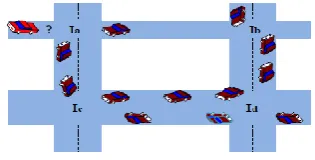
Assume any vehicle is coming nearer to the
crossing point Ia and it will send a demand to his
companion at the edge of convergence Ib (as
appeared in figure 2). To forward the demand
through Ia → Ic, Ic → Id, Id → Ib would be speedier than through Ia→Ib despite the fact that
the last gives geologically most limited conceivable
way. The reason is that in the event of separation,
the parcel must be conveyed by the vehicle, whose
moving pace is essentially slower than the remote
correspondence. VADD takes after the
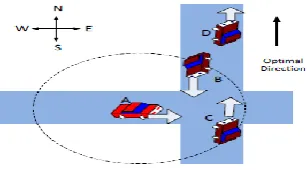
A. Vehicle in Intersection Mode
As appeared in figure-3 vehicle A has a parcel to
forward to the certain goal. There are two
accessible vehicles for conveying the bundle; B
moving south and C moving north. A has two
options on choosing the following bounce for the
parcel: B or C. In the event that B is chosen then it
is geologically nearer to D and can without much
of a stretch and instantly forward parcel to D,
though C could likewise be chosen in light of the
fact that by choosing C bundle will move in the
north course as the vehicle C is moving towards the
north bearing.
Fig 3. Select the next vehicle to forward the packet.
These two decisions prompt two diverse sending
conventions: Location First Probe (L-VADD) and
Direction First Probe (DVADD). In area initially
test, the vehicle coming to the crossing point
checks the need request of the heading of the
stream of a data packet and advances the bundle to
the vehicle having high need arrange. In any case,
in the L-VADD there are odds of the directing
circle in which the vehicle is sending some bundle
to the vehicle in its range and that parcel is sending
a similar packet back to the vehicle from which he
understood that packet as the following bounce
sending. This steering circle is kept away from by
essentially utilizing a mechanism in which each
vehicle is utilizing the past bounce data and never
exchanges the bundle to that vehicle from which it
has taken the packet as a past hop. Presently toward
the path initially test the packet is sent to the
vehicles which are moving toward coveted bundle
sending course. The D-VADD convention is free
from directing circles. In Multi-Path Direction First
Probe (MD-VADD) parcels might be sent in more
than course. In this plan, the bundle transporter
advances the packet utilizing D-VADD convention
yet it doesn't erase the bundle from its cushion and
sits tight for any vehicle which is moving in the
higher need bearing and advances the packet as it
finds any such vehicle. The procedure of
information buffering proceeds until it finds any
vehicle having the most noteworthy need. LVADD
indicates preferable execution over all other VADD
conventions when there is no steering circle
happens yet when the directing circle happens then
the execution influences seriously and information
conveyance proportion diminishes. So Hybrid test
H-VADD is produced in which both L-VADD and
D-VADD conventions are utilized. Right off the
bat bundle is sent utilizing L-VADD convention
however as the directing circle happens the
L-VADD convention is dropped and D-L-VADD
convention is utilized.
B. Vehicle in straightway mode
In this mode, a simple greedy approach is used to
forward the packet to the destination in which
packets waits for vehicles moving in the direction
of the destination and as it finds such vehicle it
forwards the packet to that vehicle. The
conveyance proportion of the H-VADD convention
gives best conveyance proportion of every other
convention. Delay in H-VADD is proportionate to
the MD-VADD when the vehicle thickness is low
as it depends more on D-VADD convention to
maintain a strategic distance from the steering
circles and when vehicle thickness is more,
postpone ends up noticeably equivalent to
LVADD. H-VADD has preferred standpoint of
Vehicle Density Dependent Data Delivery (VD4)
[28] convention that arrangements with effective
data delivery in VANETs. As the bundle can be
sent through numerous ways however that way
ought to be picked which will take the least middle
of the road delay. In this manner, at each
convergence information parcels are exchanged to
RSU and RSU advances this packet to the vehicle
which is moving to the ideal street to the goal with
least deferral. In this convention, the packet is
transmitted from source to goal utilizing the middle
hub. The vehicle needs two sorts of transmission
1. In which packet is sent to the vehicle which is
most distant to this vehicle in its range.
2. In which packet is conveyed by the vehicle until
it is getting any vehicle in its range as appeared in
figure 4.
This transmission is slower than past one yet
critical amid the sending procedure. As the vehicle
ranges to the RSU, the season of entry of a vehicle,
the speed of a vehicle, the course of development
and information bundles are acquired by RSU. In
the event that this packet is as of now present at
that RSU then it is dropped else the packet is sent
to the most remote vehicle display in its range
going towards the goal.
Fig4. Packet carried partially by a vehicle and
partially wirelessly transmitted
So also, if the packet is found as recognize parcel
then it is erased from the memory of RSU yet in the
event that it is absent then its entrance is made in
the memory of RSU and the additionally the packet
is sent to the most remote vehicle display in its
range going towards the goal. These packets are
conveyed to every one of the vehicles moving
towards the goal until one of the packets is
conveyed to the RSU at the following bounce. At
the point when this packet is conveyed at next
bounce, the affirmation is sent by that RSU to the
source RSU by means of going in a similar course.
At the point when the recognize parcel is gotten by
source RSU, the packet transmission prevents and
packet erased from the memory of the RSU. On
account of high-density vehicular conditions, the
VD4 execution is about like the execution of
Hybrid-VADD. In any case, if there should be an
occurrence of high-density street conditions VD4
execution is superior to the execution of
Hybrid-VADD. X. Yang et al. have proposed Vehicle
Collision Warning Communication (VCWC) [13]
convention for sending cautioning messages to
different vehicles proceeding onward the street. At
the point when any vehicle is enduring some sort of
mechanical disappointment or any mishap has
happened headed straight toward any vehicle. At
that point, this vehicle is a threat to alternate
vehicles that are going through a similar street. The
vehicles that are acting unusually are Abnormal
Vehicle (AV) vehicles (figure 5) and they produce
Emergency Warning Messages (EWMs) which
incorporates speed, the course of movement and
area of an occasion. In VCWC convention, EWM
message is sent by the AV's and this message is
over and over transmitted as the each vehicle
drawing closer to AV needs that message.
However, this retransmission of similar data packet
Fig 5a. N3 sends EWM and A becomes a
non-flagger AV.
Fig 5b. N3 drives away; A identifies itself as a
flagger.
Each AV might be in one of the three
states, beginning AV, non-flagger AV and flagger
AV. As the vehicle ends up plainly unusual it is an
underlying AV. Beginning AV moves toward
becoming non-flagger AV by taking out excess
EWMs and this transmission of message will be
additionally conveyed by just that vehicle which
has over headed the AV vehicle and relying out and
about circumstances non-flagger AV can be
changed over into flagger AV If non-flagger AV is
not getting any EWM message from its adherents
after the Flagger Timeout (FT) clock lapses that
were set by non-flagger AV. furthermore, resumes
the EWM messages transmissions at the base
required rate. As appeared in figure 5a, trailing
vehicle N3 stops by getting EWM messages from
vehicle A. and after that N3 begins transmitting
EWM messages. Since both A and N3 are
informing a similar cautioning so A informing and
enter in the non-flagger state. After a certain time
when the vehicle N3 is getting path on some other
path then vehicle A has again to begin EWM
informing and will go into flagger state (As
appeared in Figure - 5b).
In VCWC distinctive sort of messages have diverse
need levels and EWMs have the most elevated
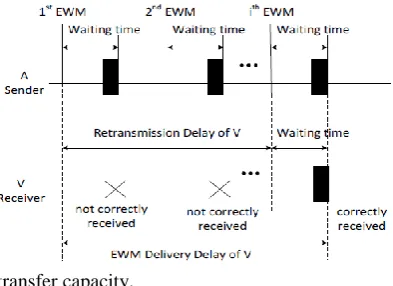
need. EWM conveyance postponement is the time
taken between the events of the crisis at An and
first fruitful gets of EWM message at V. EWM
message may endure some deferral because of
lining postponement, channel distribution delay and
may confront some retransmission delay because of
impact, and so on. Holding up time can be seen in
figure - 6. In this mechanism, the deferral in
retransmission of the bundle relies on upon the kth
retransmission and starting transmission rate λ.
This VCWC convention can full fill crisis
cautioning conveyance prerequisites and bolster
countless at the minimal effort of channel data
transfer capacity.
Fig 6. Waiting Time and Retransmission Delay.
3. CONCLUSIONS
Contingent on specific street circumstance and the
vehicle condition, the convention is changing as
each convention has its own points of interest and
hindrances. Some convention needs high need as
they are giving wellbeing to the vehicles in which
bundle sending deferral is not permitted, then again
a few different conventions might be utilized at the
circumstance where slight postponement is
bearable. At the same time since there is
constrained transfer speed, convention utilized
information can be dispersed over the system,
which is a major test. In future, we will attempt to
gadget a calculation which can work for both
pushes and pull-based information transmission
and which can diminish the excess information
exchange so that greatest information can be
scattered over the street and proficient use of
accessible transfer speed should be possible. In
future, we will deal with the determination criteria
that in which case the vehicle ought to take an
interest in the telecom. We trust that this succinct
work will improve comprehension to those
scientists who are new to utilizations of VANETs
and clear their way to develop new thoughts to
upgrade the working of these systems.
4. REFERENCES
[1] J. Zhao and G. Cao, “VADD: Vehicle-assisted
data delivery in vehicular ad hoc networks,” IEEE
Transaction Vehicular Technology, Vol. 57, No. 3,
pp. 1910–1922, May 2008.
[2] T. Arnold, W. Lloyd, J. Zhao, and G. Cao, “IP address passing for VANETs,” in Proceedings
IEEE International Conference PerCom, pp. 70–79,
March 2008.
[3] A. Skordylis and N. Trigoni, “Delay-bounded
routing in vehicular ad-hoc networks,” in Proc.
ACM MOBIHOC, pp.341–350, 2008.
[4] Y. Toor, P. Muhlethaler, A. Laouiti, and A.
Fortelle, “Vehicular ad hoc networks: Applications and related technical issues,” Commun. Surveys
Tuts., Vol. 10, No. 3, pp. 74–88, 2008.
[5] B. Ducourthial, Y. Khaled, and M. Shawky,
“Conditional transmissions: Performance study of a new communication strategy in VANET,” IEEE
Transaction Vehicular Technology, Vol. 56, No. 6,
pp. 3348–3357, November 2007.
[6] S. Das, H. Pucha, and Y. Hu, “Performance
Comparison of Scalable Location Services for
Geographic Ad Hoc Routing,” in Proceedings
IEEE INFOCOM, Miami, FL, pp. 1228–1239,
2005.
[7] B. Ducourthial, Y. Khaled, and M. Shawky,
“Conditional transmissions: Performance study of a new communication strategy in VANET,”
Transaction Vehicular Technology, Vol. 56,
Number 6, pp. 3348–3357, November 2007.
[8] J. Zhao, Y. Zhang, and G. Cao, "Data Pouring
and Buffering on the Road: A New Data
Dissemination Paradigm for Vehicular Ad Hoc
Networks," in IEEE Transaction on Vehicular
Technology, Vol. 56, No. 6, pp. 3266-3276, 2007.
[9] G. Korkmaz, E. Ekici, F. Ozguner, and U.
Ozguner, “Urban multi-hop broadcast protocol for
inter-vehicle communication systems,” in
Proceedings of VANET, October 2004.
[10] Murat Caliskan, Andreas Barthels,
BjrnScheuermann, and Martin Mauve, “Predicting
Parking Lot Occupancy in Vehicular Ad Hoc
Networks”,65th IEEE Vehicular Technology
Conference, (VTC2007), pp. 277-281, April 2007.
[11] Naoki Shibata, et. al., “A Method for Sharing
Traffic Jam Information using Inter-Vehicle
Communication”,http://itolab.naist.jp/themes/pdffil
es/060725.shibata.v2vcom06.pdf.
[12] Q. Xu, T. Mark, J. Ko, and R. Sengupta,
“Vehicle-to-Vehicle Safety Messaging in DSRC,”
in Proceedings of VANET, October 2004.
[13] X. Yang, J. Liu, F. Zhao and N. Vaidya, “A
Vehicle-to-Vehicle Communication Protocol for
Cooperative Collision Warning,” International
Conference on Mobile and Ubiquitous Systems:
Networking and Services (MobiQuitous 2004),
Aug. 2004.
[14] J. Yin, T. Eibatt, G. Yeung, B. Ryu, S.
Habermas, H.Krishnan, and T. Talty, “Performance
Evaluation of SafetyApplications over DSRC
Vehicular Ad Hoc Networks,” in Proceedings of
[15] Giovanni Resta, Paolo Santi, Janos Simon,
“Analysis of Multi-Hop Emergency Message
Propagation in Vehicular
Ad Hoc Networks”, Proceedings 8th ACM
international symposium on Mobile ad hoc
networking and computing pp.140-149, 2007.
[16] S. S. Manvi, M. S. Kakkasageri, Issues in
mobile ad hoc networks for vehicular
communication , IETE Technical Review, Vol. 25,
No. 2, pp. 59-72, March-April, 2008.
[17] NavratiSaxena, KalyanBasu, and Sajal K. Das,
“Design and Performance Analysis of a Dynamic
Hybrid Scheduling Algorithm for Heterogeneous
Asymmetric Environments”, 18th International
Parallel and Distributed Processing
Symposium, (IPDPS 2004), pp. 26-30, April 2004.
[18]http://www.leearmstrong.com/DSRC/DSRCHo
meset.htm
[19] B. Xu, A. Ouksel, and O. Wolfson,
“Opportunistic resource exchange in inter-vehicle ad hoc networks,” in Proceedings IEEE
International Conference MDM, pp. 4–12, 2004.
[20] A. Demers, D. Greene, C. Hauser, W. Irish, J.
Larson, S.Shenker, H. Sturgis, D. Swinehart, and
D. Terry, “Epidemic algorithms for replicated database maintenance,”Oper. Syst. Rev., Vol. 22,
No. 1, pp. 8–32, 1988.
[21] Z. Haas, J. Halpern, and L. Li, “Gossip-based
ad hoc routing,” in Proceedings IEEE Infocom, pp.
1707–1716, 2002.
[22] G. Karlsson, V. Lenders, and M. May, “Delay-tolerant broadcasting,” in Proceedings SIGCOMM
Workshop CHANTS, Pisa, Italy, pp. 197–204,
2006.
[23] Wireless LAN Media Access Control (MAC)
and Physical Layer (PHY) Specifications, IEEE
Std. 802.11, 1999. [Online]. Available:
http://grouper.ieee.org/groups/802/11
[24] D. Goodman, J. Borras, N. Mandayam, and R.
Yates, “INFOSTATIONS: A new system model for
data and messaging services,” in Proceedings IEEE
VTC, Rome, Italy, Vol. 2, pp. 969–973, May 1997.
[25] A. Nandan, S. Das, G. Pau, M. Gerla, and M.
Sanadidi, “Cooperative downloading in vehicular
ad-hoc wireless networks,” in Proceedings 2nd
Annual Conference WONS, pp. 32–41, 2005.
[26] Y. Zhang, J. Zhao, and G. Cao, “On scheduling vehicle road side data Access,” in
Proceedings. ACM VANET, pp.
10–19, 2007.
[27] “GB Traffic Volumes,”
www.mapmechanics.com, May 2005.
[28] A. Gupta, V. Chaudhary, V. Kumar, B.
Nishad, S. Tapaswi, “VD4: Vehicular
Density-dependent Data Delivery Model in Vehicular Ad