ISSN 2286-4822 www.euacademic.org
Impact Factor: 3.4546 (UIF) DRJI Value: 5.9 (B+)
Descriptive and correlation in intellectual capital
variable: Case study from Indonesia
SINDIK WIDATI Lecturer STIE Pelita Bangsa Cikarang, Bekasi Jawa Barat, Indonesia
Abstract:
This study was conducted to investigate the four variables of intellectual capital such as variable value added capital, value added human capital, Value Added Intellectual Coefficient, and structural capital. This study is conducted on companies listed on the IDX, which consists of 21 companies that have registered their financial statements on the BEI during the period 2011-2017 This study uses descriptive statistical test and correlation test to see the relationship between the variable intellectual capital. From the study conducted can be concluded that there is a strong correlation, moderate and weak among the variables intellectual capital in doing research, thus this research can add evidence empirically about studies related to intellectual capital in Indonesia.
Key words: intellectual capital, descriptive statistic, correlation.
PRELIMINARY
improve the performance of the company can then be categorized as Intellectual Capital see Bontis, N., et, all, (2000), Firer, S. and M Williams (2003).
According to the International Federation of Accountants quoted by the author on Intellectual Capital, Intellectual Capital is a term that is almost similar to what is called intellectual capital, such as intellectual property, intellectual assets, knowledge assets that all have the intention as sahat or modal which base on existing knowledge of the company. Intellectual capital is generally identified as the difference between the market value of the firm and the book value of the firm's assets. According to the results of an observational study, Intellectual Capital has existed since the early 70s. Intellectual Capital can be interpreted also as the market value of larger companies in the value reported in the financial statements based on calculations performed by the accountant.
LITERATURE REVIEW
Intellectual Capital Components
Pulic, A. (2004) classifies the intellectual capital in the value added obtained from the firm's revenue difference with all costs. In particular, intellectual capital is divided into capital employed (VACA), human capital (VAHU), and structural capital (STVA)
Human Capital (VAHU)
Structural Capital (STVA)
According to Pulic, A. (2004) and Baroroh, N. (2013) states that structural capital is the ability of the organization to include infrastructure, information systems, routines, procedures and organizational culture that support employees' efforts to produce optimal intellectuals. Structural capital as a company infrastructure that helps increase employee productivity. The million are databases, organizational, charts, process manuals, strategies routines, and all the things that make the company's value bigger than the material.
Capital Employeed
Is a harmonious relationship / association network that exist in the company with its partners, both from reliable and qualified suppliers, come from loyal customers and feel satisfied with the service of the company concerned, originally from the company's relationship with the government or with the surrounding community . The VAIC (Value Added Intellectual Coefficient) method is designed to provide information on the value creation efficiency of tangible assets and intangible assets in the company.
VAIC is an instrument to measure the performance of intellectual capital of the company. This method is to measure how and how the efficiency of intellectual capital and capital employeed in creating value according to the relationship of three main components namely Human Capital, Capital Employeed, and Structural Capital.
revenue. The important thing in this model is that the expense of employees is not included in IN. Because of its active role in the value creation process, the intellectual potential described by the labor expense is not calculated as cost (cos) and not the IN component. Therefore, the key aspect in the Pulic model A. (2004) is to treat labor as a value creating entity in Tan, P.H, et, all, (2007).
RESEARCH METHODOLOGY
This research was conducted in March 2018 at companies listed on the BEI during the period 2011-2017. This research uses 4 variable of intellectual capital such as variable of value added capital, value added human capital, Value Added Intellectual Coefficient, and structural capital. This study uses descriptive statistical test and correlation test to see the relationship among the variable intellectual capital. This study was conducted on 21 companies that have registered their financial statements on BEI during the period of 2011-2017.
RESEARCH RESULTS AND DISCUSSION
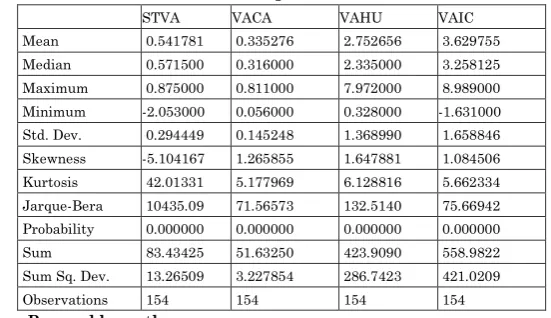
variable or independent. Both of these tests are presented in tables 1 and 2 below:
Table 1 : Result for statistic descriptive
STVA VACA VAHU VAIC
Mean 0.541781 0.335276 2.752656 3.629755 Median 0.571500 0.316000 2.335000 3.258125 Maximum 0.875000 0.811000 7.972000 8.989000 Minimum -2.053000 0.056000 0.328000 -1.631000 Std. Dev. 0.294449 0.145248 1.368990 1.658846 Skewness -5.104167 1.265855 1.647881 1.084506 Kurtosis 42.01331 5.177969 6.128816 5.662334 Jarque-Bera 10435.09 71.56573 132.5140 75.66942 Probability 0.000000 0.000000 0.000000 0.000000 Sum 83.43425 51.63250 423.9090 558.9822 Sum Sq. Dev. 13.26509 3.227854 286.7423 421.0209
Observations 154 154 154 154
Source : Proceed by author
Table 2 : Result for correlation analisys
STVA VACA VAHU VAIC
STVA 1
VACA 0.4395078360366533 1
VAHU 0.6362463758854046 0.551874296625829 1
VAIC 0.7410544049516184 0.6210266837138478 0.9864867007734859 1 Source : Proceed by author
Based on the results of table 1 and table 2 presented above, the authors can conclude that the descriptive statistical test is the activity of collecting, grouping, processing, analyzing and presenting research data in one group of research sample which includes standard deviation test, variance, data range, , the highest value, the amount of data and the average of research data.
CONCLUSION
In this study we can draw the conclusion that the test of descriptive statistics and correlation test must first meet a series of assumptions. Correlation test assumptions are: Normality. That is, the distribution of variables to be correlated should be normally distributed. Linearity. This means the relationship between two variables must be linear. For example shown through straight-line. Ordinal. That is, variables should be measured with a minimum of Ordinal scale. Homoscedasticity. That is, variability score in variable Y must remain constant in all values of variable X. But the authors take the data that will be proposed for the test of descriptive statistics and correlation test has met these requirements, so that the study did conclude that the correlation between the variables in the per some have strong percentages, moderate and weak percentages.
REFERENCE
1. Baroroh, N. (2013). Analisis Pengaruh Modal Intelektual Terhadap Kinerja Keuangan Perusahaan Manufaktur Di Indonesia. Jurnal Dinamika Akuntansi. Vol. 5, No. 2, pp. 172 - 182.
2. Bontis, N., et, all, (2000), Intellectual Capital And Business Performance in MALAYSIAN Industries. Journal of Intellectual Capital, 1 (1), 85-100.
3. Belkaoui, R. A. (2003). Intellectual Capital and Firm Performance of US Multinational Firms: a Study of The Resource-Based and Stakeholders Views. Journal of
Intellectual Capital. Vol. 4 (2): 215-226.
4. Firer, S. and M Williams. (2003). Intellectual Capital and Traditional Measure of Corporate Performance.
5. Pulic, A. (2004), “Intellectual Capital – Does It Create or Destroy Value?”, Measuring Business Excellencence, Vol. 8 No. 1, pp. 62-68.
6. Tan, P.H, et, all, (2007), “Intellectual Capital and Financial Return of Companies”, Journal of Intellectual Capital, Vol. 8 No. 1, pp. 76-95.
Additional website:
1. http://www.spengetahuan.com/2018/01/pengertian- intellectual-capital-karakteristik-komponen-pengukuran-teori.html
2. http://sangid-com.blogspot.com/2013/12/makalah-akuntansi-intelektual-kapital.html
3. https://www.kajianpustaka.com/2017/09/intellectual-capital.html
4. www.stat.wmich.edu/s160/hcopy/book.pdf
5. https://www.mv.helsinki.fi/home/jmisotal/BoS.pdf