Western University Western University
Scholarship@Western
Scholarship@Western
Electronic Thesis and Dissertation Repository
12-11-2012 12:00 AM
Error Correction in Next Generation DNA Sequencing Data
Error Correction in Next Generation DNA Sequencing Data
Michael Z. Molnar
The University of Western Ontario
Supervisor Dr. Lucian Ilie
The University of Western Ontario
Graduate Program in Computer Science
A thesis submitted in partial fulfillment of the requirements for the degree in Master of Science © Michael Z. Molnar 2012
Follow this and additional works at: https://ir.lib.uwo.ca/etd
Part of the Bioinformatics Commons, and the Computer Sciences Commons
Recommended Citation Recommended Citation
Molnar, Michael Z., "Error Correction in Next Generation DNA Sequencing Data" (2012). Electronic Thesis and Dissertation Repository. 991.
https://ir.lib.uwo.ca/etd/991
This Dissertation/Thesis is brought to you for free and open access by Scholarship@Western. It has been accepted for inclusion in Electronic Thesis and Dissertation Repository by an authorized administrator of
ERROR CORRECTION IN NEXT GENERATION DNA SEQUENCING
DATA
(Spine title: RACER)
(Thesis format: Monograph)
by
Michael Molnar
Graduate Program in Computer Science
A thesis submitted in partial fulfillment
of the requirements for the degree of
Masters of Science
The School of Graduate and Postdoctoral Studies
The University of Western Ontario
London, Ontario, Canada
c
THE UNIVERSITY OF WESTERN ONTARIO
School of Graduate and Postdoctoral Studies
CERTIFICATE OF EXAMINATION
Supervisor:
. . . . Dr. Lucian Ilie
Examiners:
. . . . Dr. Sylvia Osborn
. . . . Dr. Stuart Rankin
. . . . Dr. Roberto Solis-Oba
The thesis by
Michael Molnar
entitled:
Error Correction in Next Generation DNA Sequencing Data
is accepted in partial fulfillment of the requirements for the degree of
Masters of Science
. . . . Date
. . . .
Chair of the Thesis Examination Board
Abstract
Motivation: High throughput Next Generation Sequencing (NGS) technologies can sequence the genome of a species quickly and cheaply. Errors that are introduced by NGS technologies limit the full potential of the applications that rely on their data. Current techniques used to correct these errors are not sufficient due to issues with time, space, or accuracy. A more efficient and accurate program is needed to correct errors from NGS technologies.
Results: We have designed and implemented RACER (Rapid Accurate Correction of Errors in Reads), an error correction program that targets the Illumina genome sequencer, which is currently the dominant NGS technology. RACER combines advanced data structures with an intricate analysis of data to achieve high performance. It has been implemented in C++and OpenMP for parallelization. We have performed extensive testing on a variety of real data sets to compare RACER with the current leading programs. RACER performs better than all the current technologies in time, space, and accuracy. RACER corrects up to twice as many errors as other parallel programs, while being one order of magnitude faster. We hope RACER will become a very useful tool for many applications that use NGS data.
Keywords:bioinformatics, DNA sequencing, next-generation sequencing, high-throughput technology, error correction, genome assembly
Contents
Certificate of Examination ii
Abstract iii
List of Figures vi
List of Tables vii
1 Introduction 1
2 Next Generation Sequencing 3
2.1 Sanger Method . . . 3
2.2 454 Genome Sequencer . . . 4
2.3 Applied Biosystems SOLiD . . . 4
2.4 Illumina Genome Analyzer . . . 6
3 Current Programs 7 3.1 EULER . . . 7
3.1.1 Spectral Alignment Problem . . . 7
3.2 Coral . . . 8
3.2.1 Indexing Reads . . . 8
3.2.2 Multiple Alignments . . . 8
3.2.3 Correcting Reads . . . 9
3.2.4 Complexity . . . 9
3.2.5 Choosing Parameters . . . 10
3.3 Quake . . . 10
3.3.1 Countingk-mers . . . 10
3.3.2 Localizing Errors and Correcting Reads . . . 11
3.3.3 Heuristics . . . 11
3.4 Reptile . . . 11
3.4.1 Methods . . . 12
3.5 HSHREC . . . 12
3.5.1 Methods . . . 12
3.5.2 Data Structures . . . 12
3.5.3 Algorithm . . . 13
3.6 HiTEC . . . 14
3.6.1 Correcting Errors . . . 14
3.6.2 Statistical Analysis . . . 15
3.6.3 HiTEC Algorithm . . . 15
4 RACER 17 4.1 Implementation . . . 17
4.1.1 Storing the Reads . . . 17
4.1.2 Threshold andk-mer Length Calculation . . . 20
4.1.3 Hash Table and Hashing Function . . . 20
4.1.4 Storingk-mers and Counting Adjacent Bases . . . 21
4.1.5 Correcting Reads . . . 23
4.1.6 Heuristics . . . 23
4.2 Testing . . . 23
4.2.1 Data Sets . . . 23
4.2.2 Evaluation . . . 24
4.2.3 Results of Raw Data Sets . . . 26
4.2.4 Results of Mapped Data Sets . . . 26
5 Conclusion 33
Bibliography 34
Curriculum Vitae 35
List of Figures
2.1 Pyrosequencing in the 454 Genome Sequencer [7]. . . 4
2.2 Sequencing by ligation used by SOLiD [7]. . . 5
2.3 Colour space encoding used by SOLiD [7]. . . 6
2.4 Reversible terminator imaging from Illumina [7]. . . 6
3.1 Multiple sequence alignment in Coral [10]. . . 9
3.2 Correcting a substitution error [9]. . . 13
3.3 Correcting indels [9]. . . 13
3.4 Suffix array showing supp(u,T)=5 and supp(u,A)=1 [2]. . . 14
4.1 An example of FASTA and FASTQ format. . . 18
4.2 2-bit encoding of TACGTCGA. . . 19
4.3 Hash function example. . . 21
4.4 Findingk-mers and adjacent bases. . . 22
4.5 From top left by rows; Escherichia coli, Pseudomonas aeruginosa, Haemophilus influenzae, Saccharomyces cerevisiae. . . 25
4.6 Drosophila melanogaster and Caenorhabditis elegans. . . 25
List of Tables
2.1 Details of NGS technologies [5][15]. . . 3
4.1 Data sets used for testing. . . 24
4.2 Accuracy in % using raw data. . . 27
4.3 Run time in seconds using raw data. . . 28
4.4 Peak space used in MB for raw data. . . 29
4.5 Accuracy in % using mapped data. . . 30
4.6 Run time in seconds using mapped data. . . 31
4.7 Peak space used in MB for mapped data. . . 32
Chapter 1
Introduction
Our ability to determine the genome of any species has revolutionized our understanding of biology. The Sanger method [11], developed by Frederick Sanger in the 1970’s, was the first widely used method to determine the genome of a species. This technique has been refined and automated over the years but is still costly, time consuming, and produces a small amount of data per run. Recently, the use of Next Generation Sequencing (NGS) technologies has been replacing Sanger sequencing as the preferred method of genome sequencing [6]. One reason is that NGS technologies have a much lower cost per DNA base, as low as 40,000 times cheaper [5]. They also produce as much as 600,000 times more information per run than the Sanger method [5]. The disadvantage is that NGS technologies produce shorter pieces of a genome, calledreads, and have more errors than the Sanger method [1].
There are two types of errors that are predominant in NGS technologies; substitution errors happen when a single base has been changed to a different base, and indels which are stretches of the genome that have been inserted or deleted from a read. Correcting these errors can greatly increase the performance of applications that use this data such asde novogenome se-quencing, re-sese-quencing, and metagenomics. The companies that produce NGS technologies include 454 Life Sciences, Applied Biosystems, Helicos BioSciences, Illumina, and Ion Tor-rent. The most prevalent NGS technology is Illumina, due to its low cost and high throughput. The Illumina platform tends to make substitution errors [6], and for this reason most software developed for correcting errors focuses on substitution errors [6]. Some of the most successful error correction programs that correct substitution errors include Coral [10], HiTEC [2], Quake [3], Reptile [16], and SHREC [12].
Most of the other NGS technologies produce indels, which cannot be corrected by most of the current software [15]. SHREC has been updated to handle indels, and the new program is called Hybrid-SHREC (HSHREC)[9]. The only other stand alone program that can correct indels is Coral. Another important update in HSHREC is the ability to handle mixed data sets from multiple NGS technologies. Coral can correct one type or the other, but not a mixed input file.
Genome assembly software can also correct errors in reads, but most do not correct the reads directly. Most programs build a graph using overlaps in the reads, or parts of the reads, and search the graph for errors. One of the first genome assembly programs designed to use short reads from NGS technologies was EULER [1]. EULER breaks the reads into small chunks, calledk-mers, and uses theirk−1 overlaps to determine the sequence of a genome. The
2 Chapter1. Introduction
data structure used to find the overlaps in thek-mers is called ade Bruijngraph. Another type of genome assembly software uses overlaps between entire reads to determine the sequence of the genome. This approach is referred to as theoverlap-layout-consensusmethod. Both methods are sensitive to errors in the reads, and correcting the errors before running the programs can significantly improve their performance [6].
All read error correction programs require a certain level of coverage in order to make ac-curate corrections: ifGis the length of the genome being sequenced, andNis the total number of bases that were sequenced, then the coverage is the interger value of N/G. Theoretically, if the coverage of a data set isc, then each DNA base in the genome should be representedc
times in the data set, assuming the coverage is uniform. In practice, the coverage of the genome is not uniform, some regions will be represented more than others. For all programs to be able to make significant corrections the coverage needs to be above a certain threshold [9]. If the coverage is high and errors are infrequent, then the correct base is the one that appears the majority of the time [10]. The minority base at that position is considered an error and changed to the base most seen at that position [10].
RACER uses thek-mer approach to correcting substitution errors, and uses a fast and space efficient data structure to make corrections. The statistical analysis of the data provides the information needed to make highly accurate corrections. Testing has shown RACER to be the best performing software in terms of time, space, and accuracy.
Chapter 2
Next Generation Sequencing
NGS technologies are massively parallel sequencing machines that have provided an im-mense increase in DNA sequencing throughput. Current technologies produce high quality short reads of 25-700 base pairs (bp) in length, which is much shorter than the Sanger method which produces read lengths ≈ 1000bp [5]. The details of the current NGS technologies are listed in Table 2.1. The advantage of the NGS technologies is that the total number of base pairs sequenced in a single run is as many as 600,000 times more than the Sanger method. The most commonly used NGS technologies include the Genome Sequencer from 454 Life Sciences, the SOLiD system from Applied Biosystems, and the Genome Analyzer from Illumina [8].
2.1
Sanger Method
Before sequencing a genome it must be copied many times for it to been seen on the gel that separates the DNA fragments. This is accomplished by using the polymerase chain reaction (PCR), which makes many copies of the genome. After PCR the Sanger method uses inhibitors that terminate synthesized DNA chains at specific nucleic acids to determine the last letter of the DNA fragments. The procedure is run once for each letter of DNA, so that all the fragments will end in the same letter for each run. The fragments are fractionated in parallel by gel electrophoresis, and the pattern of bands that appears represents the sequence of the DNA fragment [11]. Methods were later developed to automate the process using phosphorescent chain terminators, and a capillary system to separate the fragments [14].
Table 2.1: Details of NGS technologies [5][15].
Company Read Length (bp) Throughput Technique Dominant Error Type Illumina 36, 50, 100 105-600Gb Reversible terminator Substitution
Applied Biosystems 35, 60, 75 7-9Gb Sequencing by ligation Substitution Helicos BioSciences 25-55 21-35Gb Single molecule sequencing Insertion Deletion 454 Life Sciences 700 700Mb Sequencing by synthesis Insertion Deletion IonTorrent 200 1Gb Ion semiconductor sequencing Insertion Deletion
4 Chapter2. NextGenerationSequencing
Figure 2.1: Pyrosequencing in the 454 Genome Sequencer [7].
2.2
454 Genome Sequencer
The 454 Genome Sequencer uses a technique called pyrosequencingto read DNA sequences. This technique relies on the firefly enzyme luciferase to emit light to detect the DNA bases that are incorporated. The fragments are amplified by a technique called emulsion PCR. Repeated rounds of emulsion PCR result in about one million copies of each DNA fragment [6].
This technique cannot interpret six or more consecutive stretches of the same nucleotide, which causes insertion and deletion errors in the reads. Since each round is nucleotide specific the amount of substitution errors is low. This method produces reads 250bp long which are screened to remove poor quality sequences. The final output results in approximately 100Mbp of data per run. An assembly algorithm called Newbler is incorporated which can assemble viral and bacterial genomes with high quality [6].
2.3
Applied Biosystems SOLiD
The SOLiD system uses an adapter ligated fragment library and emulsion PCR similar to the 454 Genome Sequencer to amplify DNA fragments. Instead of the luciferase enzyme, the SOLiD system uses DNA ligase to detect the nucleotides that are incorporated into the DNA fragment. This procedure is shown in Figure 2.2. This technique can produce fragments 25-35bp long, with approximately 2-4Gbp of data per run. Quality values are assigned to the base calls and poor quality reads are removed [6].
deter-2.3. AppliedBiosystemsSOLiD 5
6 Chapter2. NextGenerationSequencing
Figure 2.3: Colour space encoding used by SOLiD [7].
mined. The SOLiD genome sequencer outputs reads in colour space, which determines bases in overlapping pairs so that each base is sequenced twice [6]. An example of the colour space encoding is shown in Figure 2.3.
2.4
Illumina Genome Analyzer
The Illumina Genome Analyzer relies on an adapter library that is attached to a surface called acluster station. The fragments are amplified in a process calledbridge amplification, which uses DNA polymerase to make copies of the DNA fragments. Each cluster of fragment copies contains approximately one million copies of the original fragment. This is needed in order to produce an image that is strong enough to detect with a camera [6].
The system adds all four nucleotides simultaneously to the fragments. Each nucleotide contains a unique fluorescent label and a chemical that blocks any other base from being incor-porated. An image is taken of the incorporated base before the next nucleotide is added. After each imaging step the chemical block is removed so that the next nucleotide can be added. This procedure is repeated to determine the sequence of the fragment. An example of the imaging is shown in Figure 2.4. The current model can read fragments up to approximately 36-100bp long [15].
Chapter 3
Current Programs
3.1
EULER
The EULER [1] program was developed to assemble genomes using short reads from NGS technologies. EULER breaks reads into smaller pieces, called k-mers, which are all of equal length, and builds a de Bruijn graph to detect errors in reads and assemble the genome. A de Bruijn graph is a directed graph of overlaps betweenk-mers with the length of the overlap equal tok-1. In the graph eachk-mer is represented by a node and an edge is an overlap with another node. Errors complicate a de Bruijn graph, which increases running time and space, so EULER tries to correct the reads before building the de Bruijn graph.
3.1.1
Spectral Alignment Problem
If we letGkbe the set ofk-mers in a genomeG, then a read has errors if it containsk-mers that
are not inG. EULER tries to change all reads so that everyk-mer in a read is found inG. This transformation is referred to as the spectral alignment problem (SAP).
In the SAP there is a collection ofk-mers, T, and a string. A string is called aT-string if all the k-mers in the string are in T. The goal of the SAP is to find the minimal number of corrections to change all strings to T-strings. Error correction is done by settingT toGk and
finding the spectral alignment of each read.
If the genome of a sample is known, then determining whichk-mers are in the genome is a trivial task. Inde novogenome sequencing the sampled genome is not known, so EULER uses the number of times ak-mer appears to determine if it is inGk. A thresholdMis approximated
and anyk-mer that appears more than Mtimes is referred to assolid, and less than M times is calledweak. A read that contains all solidk-mers is referred to as asolid read, and the goal of EULER is to correct the reads so that they are all solid reads.
Low coverage data sets require that M be set low so that valid k-mers are not considered weak, but this will cause correct reads to be considered incorrect. Increasing the length of
k will help reduce the rate of false positives, but makes it more difficult to determine which changes are correct to transform a read to a solid read.
EULER uses a dynamic programming solution that chooses a small M while eliminating many false positives by considering multiple changes to find the optimal solution. Since the
8 Chapter3. CurrentPrograms
genome is not known, the set of allk-mers in the genome is approximated.
The ends of reads tend to have more errors than the rest of the read, and it is difficult to determine the correct changes to the ends of reads, so reads with erroneous ends are trimmed. The set of allk-mers is updated after each iteration of corrections, and reads are deleted if they are not able to be corrected after the last iteration. The assembly of the genome begins after the error correction.
3.2
Coral
Coral [10] is able to correct both substitution errors and indels. This is accomplished by using multiple sequence alignments (MSA) between short reads to detect errors. The parameters for scoring the alignments can have a significant impact on the quality of the alignments, and therefore the quality of the corrections. The parameters that can be set are gap penalty and mismatch penalty. Coral also provides default parameter selection based on the platform that is used. For substitution errors the gap penalty needs to be set very high to prevent indels in the alignments. For indels Coral suggests to set the gap and mismatch penalties to be equal.
3.2.1
Indexing Reads
Coral starts by indexing all the k-mers in each read and their reverse complements. A hash table is used to store thek-mers and the reads that contain eachk-mer. It is redundant to save both thek-mer and its reverse complement, so to save space only the lexicographically smaller of the two is used to store the information. Coral also does not store any k-mers that contain ambiguous letters.
3.2.2
Multiple Alignments
After indexing the k-mers, the next step is to build the MSA between reads. Each alignment starts with one read which is called thebase read. All the reads that share at least one k-mer with the base read are found using thek-mer hash table. This set of reads, along with the base read, is called theneighbourhoodof the base read.
Computing the MSA of large data sets can be very time consuming. Coral uses some heuristics to speed up the alignments. If the neighbourhood of the base read is very large or very small then Coral does not perform any alignments. If the neighbourhood is very large then the reads likely came from different regions in the genome and the MSA will take a long time to compute because the alignments will be very poor. If the neighbourhood is small then there is likely not enough coverage to make any significant corrections.
Another heuristic used saves time by not correcting reads that have been corrected before. A read can be in several neighbourhoods, so if a read has already been corrected in a previous alignment, then Coral tries to align it to the consensus without errors in the region of thek-mer. If it aligns perfectly then the rest of the read is not aligned to save time.
3.2. Coral 9
Figure 3.1: Multiple sequence alignment in Coral [10].
one. Finally, if gaps are not allowed then a gap-less alignment is performed between a read and the consensus sequence.
3.2.3
Correcting Reads
To correct the reads Coral calculates the number of misaligned positions for each read com-pared to the consensus sequence. If the quality of the alignment is above 1 - e, where e is the expected error rate, then it will be used to correct the aligned reads. Figure 3.1 shows an example of a MSA. For each position in the consensus sequence, the support threshold for each position is calculated by the number of times each letter occurs, divided by the total number of reads aligned at that position. If a read differs from the consensus at any position, then the letter is changed in the read provided the support is above the threshold.
If quality scores are available then an extra check is made before correcting. If there is a gap in an aligned read, then the quality score of the gap is set to the average of the quality scores of the bases flanking the gap. A weighted support is then calculated by dividing the sum of the quality scores of the bases that agree with the consensus, with the sum of all the quality scores at that position. A correction is made if a base is above the quality threshold. The quality score of a corrected base is set to the average of the quality scores of the bases that agree with the consensus at that position.
3.2.4
Complexity
The MSA is the dominant part of the time complexity for Coral. Assume the combined total length of the reads is M, the maximum number of reads in a neighbourhood is L, and the longest read length isr. The worst case runtime isO(MrL) if gaps are allowed, andO(ML) if only mismatches are allowed. Since the total number of bases isM, then there cannot be more than O(M) k-mers. Therefore, the space for the hash table that stores the k-mers is bounded by O(M). The space complexity for computing the MSA is O(Lr + r2). The overall space
10 Chapter3. CurrentPrograms
3.2.5
Choosing Parameters
The choice ofkhas a significant impact on the quality of the corrections. The value ofkshould be set so that each k-mer appears in the genome only once. The authors suggest that k ≥
[log4G], whereG is the length of the genome. The value of the error rate eshould be set to
the expected error rate of the input data. If the value ofeis set too high then Coral could over correct reads because even a poor MSA will be corrected.
The support threshold can also be set, and should be related to the coverage of the data set. If the coverage iscthen the support threshold should be set to (c- 1)/c. If the threshold value is set too low Coral will over correct, and if it is set too high it will under correct. The quality value threshold should be set in a similar way. Coral has predefined settings for Illumina data sets to correct substitution errors, and for 454 data sets to correct indels. Coral is not able to correct mixed data sets that contain both substitution errors and indels.
3.3
Quake
Quake [3] relies onk-mer coverage and quality scores to correct reads. Quake uses a method of evaluating the quality of a k-mer based on the associated quality scores for each base. The reasoning behind this approach is that coverage alone does not take into account high coverage regions with errors, and low coverage regions without errors. This can have an effect on the choice of cutoff values for correcting k-mers. Weighing the k-mers based on quality scores helps since low coverage truek-mers will still have high quality scores, and high coverage k -mers with errors will have low quality scores. Evenk-mers that appear once with high quality scores will be trusted with this approach, whereas normalk-mer counting would consider this to be an erroneousk-mer.
3.3.1
Counting
k
-mers
Quake begins by counting all the k-mers in the data set. The user must select the value of
k, which has a significant impact on the performance of Quake. An equation is provided to determine an appropriate choice fork. IfGis the size of the genome then the authors suggest setting the value forksuch that:
2G
4k ≈0.01 (3.1)
Which simplifies to:
k≈ log4200G (3.2)
3.4. Reptile 11
3.3.2
Localizing Errors and Correcting Reads
Once the cutoffhas been set, all reads with untrustedk-mers are considered for correction. In most cases the errors are localized in a small region of a read. To find an error in a read, an intersection of the untrustedk-mers is used to localize the search. This works for reads with a few errors, but not for reads with many errors, or low coverage regions that are below the cutoff. There is also a problem when the errors are near the end of a read. If this is the case, Quake considers every base covered by the right most trustedk-mer, and left most trustedk-mers to be correct. These localizing heuristics are used to reduce the run time need to find errors in the reads.
Once the region of a read that needs to be corrected is found, Quake tries to find the correc-tions that make allk-mers in that region trusted. To define the likelihood of a set of corrections let O represent the observed nucleotides of the read, and A represent the actual nucleotides of the sequenced fragment. Quake tries to evaluate the conditional probability of a potential assignment ofA, given the observed nucleotidesO.
Quake models errors to allow for biases in base substitutions that are known to exist for Illumina data sets. The initial pass of the reads only makes unambiguous corrections, and leaves low quality reads for the next pass. After the first pass, modifications are made to reduce the variance of the error model to correct the remaining ambiguous errors.
3.3.3
Heuristics
Quake uses some heuristics to reduce space and running time. Reads from repeat regions may have multiple sets of valid corrections, with a small difference in the likelihood of each correction, so a true correction is ambiguous. To address this issue Quake continues past the threshold to ensure that another valid set does not exist. Another likelihood threshold of 0.01 is used in this situation.
A large majority of computation time is spent on the lowest quality reads, which have many potential sets of corrections to consider. Quake saves time correcting low quality reads by pre-screening the erroneous region, and stops correcting if the region is filled with low quality scores. Reads with a region containing≥ 13 positions with a probability of error>1% are not corrected. For reads with regions containing≥ 9 such positions, the likelihood ratio threshold is increased to 10−3.
3.4
Reptile
12 Chapter3. CurrentPrograms
3.4.1
Methods
Reptile tries to create approximate multiple alignments which allows for substitutions. This could be done by considering all reads with pairwise Hamming distance less than a set thresh-old, but such alignments are difficult. Reptile finds the multiple alignments by only aligning
k-mers in the reads. The size ofkis chosen so that the expected number of occurrences of any
k-mer in the genome should be no more than one.
Reptile uses contextual information to help resolve errors without increasing k. It is ex-pected that if a read contains errors then there should be a tiling of reads that cover the true read. The tiling is done by taking the reads that share a k-mer and aligning them from the location of thek-mer. The locations in the tiling that have higher coverage than those of lower coverage are used to make corrections.
The main disadvantage of Reptile is that the user is required to set the parameters. This requires running scripts and analyzing the results to determine the proper parameters. The input must also be changed to the format that is accepted by Reptile. Most other programs set the parameters automatically, aside from the size of thek-mer, and most accept the standard formats of read files.
3.5
HSHREC
HSHREC is an updated version of SHREC [12]. SHREC was designed to correct substitution errors, and HSHREC is able to correct both substitution errors and indels. It is also able to correct data sets that have a mix of both types of errors.
3.5.1
Methods
HSHREC [9] assumes that the input containskreads randomly sampled from a genome with read length n, where n can vary in length. The errors can be substitutions, or indels. It is assumed the errors are randomly distributed and that the coverage is sufficient for correction.
Errors are detected in a read by aligning it to the other reads using a generalized suffixtrie, which is a graph that contains all the suffixes of the reads. It is assumed that most reads that overlap an erroneous read will not have the same error. The erroneous region of the read has a low weight in the trie and this is the area that will be corrected.
Single nucleotide polymorphisms (SNPs) are single nucleotide changes that differ between individuals of the same species. SNPs can appear as errors in the multiple alignment since they create columns in the alignment where reads do not match. Since errors at the SNP location will only be in a few reads, and SNPs will be present in several reads, it is possible to differentiate them.
3.5.2
Data Structures
3.5. HSHREC 13
Figure 3.2: Correcting a substitution error [9].
Figure 3.3: Correcting indels [9].
each node may only have one child labeled with the same character. The concatenation of edge labels from the root to a node is called apath-label. For any suffix of a sting in R, there is a
path-labelthat contains that suffix. Theweightof a node in the trie is the number of leaves in the subtrie that is rooted at that node, and is the number of suffixes in that subtrie. Thelevelof a node is the length of the path from the root to the node.
In the top levels of the trie almost all nodes have four or five children, and further down the trie almost all nodes have only one child. If a child at this level has more than one child then it is likely an error. The node with the lower weight is likely the erroneous base. Below this level the weight can be close between each child, and it is too difficult to distinguish between the correct base and the erroneous base. The HSHREC algorithm traverses the trie to identify errors at the intermediate levels of the trie. It first tries to correct each error with a substitution, and the remaining errors are treated as insertions or deletions.
3.5.3
Algorithm
The original SHREC algorithm starts by building the generalized suffix trie and tries to cor-rect substitution errors starting at an intermediate level in the trie. To corcor-rect a node that is determined to have an error, SHREC compares the subtrie rooted at the low weight node to the subtries rooted at the siblings of the node. This is shown in Figure 3.2. If a correction cannot be made then the read is marked as erroneous.
14 Chapter3. CurrentPrograms
weight node and deleting the node causes the children rooted at the node and their siblings to be merged. A comparison of the subtries before and after the deletion determine if the deletion was a proper way to correct the node. If it is then the reads that contain that suffix are changed to reflect the changes in the subtrie. Deletions are handled in the same manner, as long as there is another node at the same level with a higher weight. These two situations are shown in Figure 3.3.
3.6
HiTEC
HiTEC (High Throughput Error Correction) [2] uses a similar type of data structure as SHREC, but instead uses a suffix array that is built using a string of the reads and their reverse com-plements. This is a more time and space efficient data structure than the suffix trie used in SHREC. HiTEC uses less space than SHREC, and the serial HiTEC is faster than SHREC in parallel. HiTEC has been shown to be the most accurate algorithm for correcting substitution errors. This is accomplished by automatically setting its parameters using statistical analysis, and varying the length of the sections it corrects in each read.
The suffix array can be computed in linear time and space. However, HiTEC uses a subopti-mal algorithm that works better in practice than the optisubopti-mal solution. HiTEC uses an array that stores the length of the longest common prefix (LCP) between consecutive suffixes in the suffix array. Since HiTEC only requires bounded LCP values, the LCP array is computed directly.
3.6.1
Correcting Errors
To correct errors HiTEC assumes that for a genomeG with length L, each read is a random string overΣ with length l. The readsr1,r2, ...,rn are produced fromG with a per-base error
rate ofp. Any read with a letter not inΣis discarded. The reads and their reverse complements are stored in a stringR=r1$¯r1$r2$¯r2$...rn$¯rn$, where $ is a letter not inΣ.
The correction algorithm for HiTEC assumes that a read ri, starting at position j of the
genome, contains an error in positionkand that the previouswpositions,ri[k−w..k−1], are
correct. When there is an error in a read at a location in the genome, it is assumed that most
3.6. HiTEC 15
of the other reads will have sampled that location in the genome correctly. If there is enough of a majority of one base at that position, then the erroneous base is changed to the base that appears most at that position. Fora∈Σ, the support ofuforais supp(u,a), which is the total number of occurrences of the stringuainR. An example of this is shown in Figure 3.4.
3.6.2
Statistical Analysis
It is easy for HiTEC to calculate the support values, given the suffix array, since all occurrences ofusupporting the same letter are consecutive in the suffix array. The clusters correspond to witnesses of a given lengthw, and can be found easily using the LCP array.
Repeats in the genome can cause problems with a small u. Since u could be present in many places, there is a higher chance of an error not being detected. A long u will be less likely to appear in the genome, but will be covered by fewer reads, thus reducing its support. HiTEC first estimates the support given by a witness u. A witness is considered correct if it occurs above a threshold, and erroneous otherwise.
Statistical analysis helps compute a threshold,T, that is used to detect errors. There is often an interval of values where everyT is good. This interval grows when the error rate decreases. To cover the case when low coverage causes very low values forT, the value ofT is increased by a constant of two.
Some reads will have nowconsecutive correct positions, which makes it impossible to fit a correct witness at any position. Therefore, such reads cannot be corrected, so the number of such reads is approximated and then the algorithm is adjusted to correct most of those reads. The number of uncorrectable reads decreases as the length ofwdecreases, but the probability of seeing the witness increases, which causes correct positions to be changed incorrectly. The number of incorrect changes, or destructible reads, is approximated by HiTEC.
Since lowering the witness lengthwdecreases the number of uncorrectable readsU(w), but increases the number of destructible reads D(w), a value forwmust be found that minimizes
U(w)+D(w). Theoretically, this provides the highest accuracy, but in practice a combination of values that are close to the optimal witness length causes almost no correct reads to be changed. HiTEC uses a variation of witness lengths based on the optimal witness length to achieve high accuracy. The details of how these values are computed is discuss in the HiTEC paper.
3.6.3
HiTEC Algorithm
The user must supply the length of the genome and the error rate of the data set. An approxi-mation of the length of the genome is probably known by the user, and an approximate value of the error rate should be provided by the sequencing machine.
For each witnessu, if there is no ambiguity in the correct letter then the correction is made. If there is ambiguity, then the next two letters are checked in order to decide how to correct the read. After a certain number of iterations of corrections there are very few bases that are corrected. This will take extra time but adds little accuracy, so HiTEC stops correcting when the number of bases changed during one iteration is less than 0.01% of the total number of bases, or after nine iterations or corrections.
16 Chapter3. CurrentPrograms
Chapter 4
RACER
The most accurate read error correction program to date is HiTEC. Unfortunately, the time and space used for the suffix array in HiTEC are not the most efficient. The goal of this thesis is to correct reads with the same level of accuracy as HiTEC or higher, but reduce the time and space needed to make the corrections. A pilot implementation to accomplish this task, called HiTEC2, was previously completed by Lankesh Shivanna [13]. This thesis presents the fully functioning tool, called RACER (Rapid and Accurate Correction of Errors in Reads).
4.1
Implementation
RACER uses the same approach as HiTEC to correct reads, but the implementation is different, dramatically improving the running time and space, but also increasing the accuracy. RACER replaces the suffix array approached used in HiTEC with a more time and space efficient hash table. The hash table stores thek-mers in each read, and the total times each base appears before and after eachk-mer. The optimalk-mer length is calculated with a similar statistical analysis as HiTEC. After the k-mers and the counters have been calculated, the reads are corrected based on the counts. The way RACER has been implemented allows the reads to be corrected repeatedly without having to recalculate thek-mers and counters after each iteration, as long as the samek-mer length is used.
To save space, RACER encodes the input sequences using two bits to represent each base. Storing the bases as characters would require eight bits per bases, so this approach is four times more space efficient at storing the reads. Thek-mer and its reverse complement must be searched, and only the one with the smaller encoding key is stored. This decreases the amount of space needed in the hash table by half. Finally, RACER is able to correct data sets that have varying read lengths, and runs in both serial and parallel mode.
4.1.1
Storing the Reads
The reads from NGS technologies contain the four letters of the DNA alphabet, and bases that could not be determined are usually represented by the letter N. Any character in the input that is not from the DNA alphabet is randomly replaced by a letter from the DNA alphabet. RACER assumes the input files are either in FASTA or FASTQformat. An example of both
18 Chapter4. RACER
@ SRR123456.789 length=36
TAAATCCTCGTACAACCCAGATGGCAACCCATTACC
+ SRR123456.789 length=36
IIIIIIIIIIIII3IIII$I-IIBCIEIE8*??=)1
>SRR123456.789 length=36
TAAATCCTCGTACAACCCAGATGGCAACCCATTACC
FASTA
FASTQ
Figure 4.1: An example of FASTA and FASTQ format.
types of input is shown in Figure 4.1. If the reads are in FASTA format then there are two lines for each read. The first line of each read always begins with the ”>” symbol, followed by a string that identifies the read. The second line contains the DNA letters of the read, which can vary in length. If the reads are in FASTQ format then each read will occupy four lines. The first two lines for each read are similar to FASTA files, except that the first character is the ”@” symbol instead of the ”>” symbol. The first character in the third line of each read is either a ”+” or ”-” symbol to indicate if the read is in either the 50 → 30 direction, or the
30 → 50 direction. The fourth line for each read is the quality score of each base. The quality score is a quantitative way of determining how likely the base at that position is correct. Each sequencing platform has a unique numbering system for their quality scores.
Performing bit operations on data is much faster than using operations on characters. The logical bit operations used in RACER are AND, OR, and NOT. The AND operation is used in RACER with a mask to extract k-mers from the reads. A mask is a sequence of bits used to filter out unwanted bits from another sequence of bits. A mask contains zeros in positions that are not wanted, since the results will always be zero regardless of what is in the other sequence of bits. A mask is set to one in positions that are wanted, since the results will be whatever was in that position in the sequence of bits.
The 2-bit encoding of the DNA bases in RACER represents A as 00, C as 01, G as 10, and T as 11. Any ambiguous base is randomly converted to one of the four DNA bases before encoding it. Some other programs replace ambiguous bases with a single DNA letter, but we found that this can create problems when correcting. If there are many long stretches of ambiguous bases in the reads, then replacing them by all A’s will cause ak-mer with all A’s to be above the set threshold. Therefore, the stretch of A’s will not be corrected even when they should, causing problems for programs that use the corrected data such as de novo genome assemblers. This is avoided by randomly replacing the ambiguous letters.
The bases are encoded in such a way that finding the reverse complement of a base or
4.1. Implementation 19
DNA read: TACGTCGA
1 1 0 0 0 1 1 0
1 1 0 1 1 0 0 0
0
1
Binary Reads Array Array Index
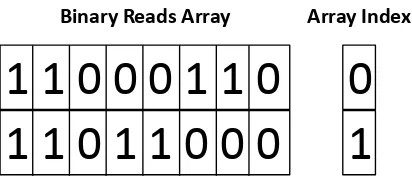
Figure 4.2: 2-bit encoding of TACGTCGA.
to determine the reverse complement.
The reads are stored sequentially in an unsigned 8-bit integer array, which is initialized to zero for each element. This means that each element of the array can store up to four DNA bases from a read. Most machines are byte addressable, which means the smallest number of bits they can access is eight bits, so storing each 2-bit base requires a mask and bit shifting.
Consider a read that contains the DNA letters TACGTCGA. Each element in the array that will contain the encoded read initially contains all 0’s. The first letter is a T and is encoded to 11, then shifted left 6 positions and logically OR’d with the array element. The OR operation will put a 1 in the result if either of the operands contains a 1, and 0 otherwise. This array element will now contain 1100 0000. The next base is an A and is encoded to 00, then shifted left 4 positions and logically OR’d with the array element. This array element will now contain 1100 0000. The next base is a C and is encoded to 01, then shifted left 2 positions and logically OR’d with the array element. This array element will now contain 1100 0100. The next base is a G and is encoded to 10, then logically OR’d with the array element. This array element will now contain 1100 0110. The result of storing TACGTCGA in the binary reads array is shown in Figure 4.2.
At this point the 8-bit integer value holds 4 bases and is now full, so the index value of the array is incremented. The process is repeated until all the bases in the read are encoded. If the read length is not a multiple of 8 then the last element of the array will not be filled. The rest of the bits of that element will be left as 0’s. At most there will be 6 unused bits for each read, which is still a much more space efficient way to store reads compared to using a character array. An integer array is used to store the length of each read so that the number of bits not used in the last array element for each read can be calculated.
20 Chapter4. RACER
4.1.2
Threshold and
k
-mer Length Calculation
In order to correct the reads with high accuracy, RACER requires three parameters to be calcu-lated; a threshold for determining and correcting an error, ak-mer lengthKthat will minimize the number of false positives, and ak-mer length kthat will maximize the number of correc-tions. RACER uses statistical analysis to determine the best possible values of the parameters similar to HiTEC. A first improvement is that all statistical computations of RACER are per-formed by the program itself, eliminating the previous need for a C++statistical library being installed.
One of the main reasons that HiTEC is able to produce such high accuracy is that it varies the witness length used to correct the reads. RACER does the same with thek-mer length to achieve a high level of accuracy. The combination ofk-mer lengths was chosen experimentally based on the accuracy results from the testing data sets. RACER uses a maximum of eight iterations of corrections with the followingk-mer lengths:
k+1,k+1,K+1,K+1,k−1,k−1,K+1,K+1 (4.1)
The first step to correcting the reads is to build the hash table with the k-mers and the counters for the letters before and after eachk-mer. The next step is to correct the reads with the information from the hash table. The way RACER has been implemented, the hash table can be used again without rebuilding it, if thek-mer length stays the same. RACER uses the samek-mer length for two iterations to save time building the hash table.
4.1.3
Hash Table and Hashing Function
Different strategies are used to store and retrieve information for all applications. It is best if any piece of stored information can be accessed in constant time. It is also important to use the smallest possible space to store the information. An array could be used to store thek-mers, but once the array is full it would have to be rebuilt, and if the array was sorted then inserting the new element would cause the index where some elements are stored to change. For a small data set with no sorting this is not a significant problem, but in our applications the data sets are very large and need some way to access the data quickly.
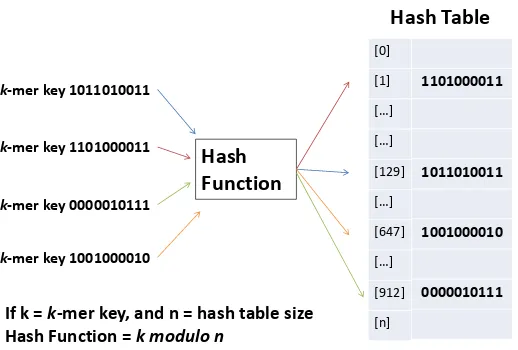
Large data sets require arrays that are large enough to store the initial data, and any data that may be added afterwards. The number of elements is usually not known in advance, so an estimate must be made for the initial array size. The initial array size should have more elements than the initial data size in order to add elements afterwards. There must also be a fast way to find elements in the array. A type of array that can accomplish this is called ahash table, and the function that is used to store and retrieve elements in a hash table quickly is called ahash function.
4.1. Implementation 21 1101000011 1011010011 1001000010 0000010111 Hash Table Hash Function
k-mer key 1011010011
k-mer key 1101000011
k-mer key 1001000010
k-mer key 0000010111
If k = k-mer key, and n = hash table size Hash Function = k modulo n
[0] [1] […] […] [129] […] [647] […] [912] [n]
Figure 4.3: Hash function example.
addressing solutions to collisions arelinear probing, quadratic probing, anddouble probing. Good probing techniques should try to distribute values evenly throughout the hash table to avoid collisions.
Linear probing is the simplest way to find an empty location to store a new element, and it is the type of probing used in RACER. If there is a collision at indexithen the next index ati+1 is searched, if that element is occupied then the next element ati+2 is searched. This continues sequentially until an empty location is found to insert the new element. This approach is fast because of cache effects, but tends to cluster elements.
Quadratic probing is similar to linear probing, except that instead of searching the next element in the hash table, a quadratic polynomial determines the next index searched. This method is slower than linear probing, since it does not take advantage of cache effects. Al-though, there is less clustering than the linear method which can improve performance for bad hash functions. Double probing requires a second hash function to handle collisions. If there is a collision using the main hash function, then the second hash function is used repeatedly until an empty location is found.
The 2-bit representation of each k-mer is used as a unique binary number that represents the input key for the hash function. The hash function in RACER takes the input key modulo the hash table size, and the result is the index in the hash table to store thek-mer. RACER uses a hash table size that is a prime number, and initial collisions are reduced since the greatest common factor is 1. The initial size of the hash table in RACER is set to the first prime number that is greater than nine times the genome size.
4.1.4
Storing
k
-mers and Counting Adjacent Bases
RACER uses a hash table with linear probing to storek-mers and the counters for the adjacent bases. The k-mers are stored in a 64-bit unsigned integer array, which limits the length of a
22 Chapter4. RACER
A C G T C A G T A T T A C
00 01 10 11 01 00 10 11 00 11 11 00 01
Current Read
k-mer window before after
G T A A T A C T G A C G T
10 11 00 00 11 00 01 11 10 00 01 10 11
Reverse Complement
k-mer window before after
(a)
A C G T C A G T A T T A C
00 01 10 11 01 00 10 11 00 11 11 00 01
Current Read
k-mer window before after
G T A A T A C T G A C G T
10 11 00 00 11 00 01 11 10 00 01 10 11
Reverse Complement
k-mer window before after
(b)
Figure 4.4: Findingk-mers and adjacent bases.
Each block of eight elements in the counters array stores the number of times each of the four DNA bases appears before and after each k-mer. The first four elements represent the four possible bases before thek-mer, and the next four elements represent the four possible bases after the k-mer. Since the counters array is 8-bits, the maximum k-mer occurrences that can be counted is 255. If there is a letter that appears more than 255 times it is assumed to be correct and the counter stays at 255. Once the hash table is half full it is increased to the size of the prime number closest to twice the previous hash table size. The smaller hash table is deleted before creating the larger hash table to save space, and the k-mers and counters are recalculated.
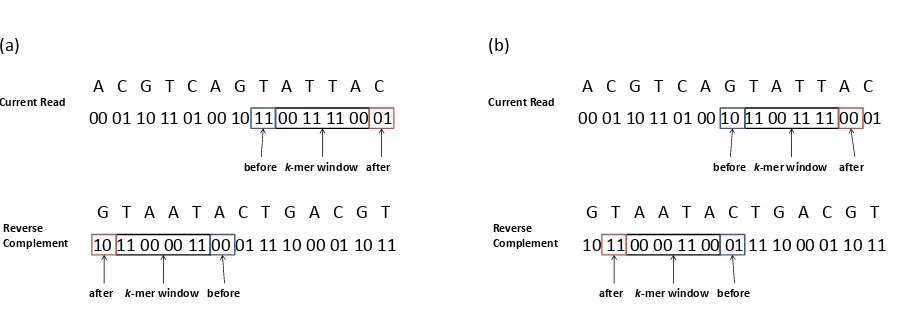
The process of findingk-mers and incrementing the counters starts by copying the current read into a temporary array. The size of the array is set to twice the size of the longest read, since two bits are needed for each letter in the read. The last 64 bits of the current read are loaded into the current 64-bit window. Another 64-bit window is used to store the reverse complement of the current 64-bit window. Once the end of the 64-bit window is reached, the next 64 bits of the read and its reverse complement are loaded into the temporary arrays.
A k-mer window is created which is twice the k-mer length, since each base is encoded using two bits. Thisk-mer window is then aligned with the rightmost end of the 64-bit window. Thek-mer is obtained with a logical AND operation between thek-mer mask and the 64-bit window. Thek-mer mask contains bit values of 1 inside thek-mer window and 0 elsewhere. A similar procedure is used for the reverse complement of the current 64-bit window. The bases that are before and after thek-mer are extracted using a similar masking procedure. Each mask is set to all 0’s, except for the two bit locations where the before or after base is located. An example of this procedure is shown in Figure 4.4. After storing ak-mer and incrementing its counters, Figure 4.4(a) , thek-mer windows shifts two bits to find the nextk-mer in the read, Figure 4.4(b).
Storing the information for both the forward and reverse complements is redundant, so space is halved by only storing the smaller of the two integer values. The hash function is then used to store or find thek-mer in the hash table. If thek-mer already exists then the appropriate counters are incremented, if it is not in the hash table it is added.
4.2. Testing 23
is not in the hash table and the counters are incremented, then the window is shifted two bits again. This continues until all thek-mers in the read are found. Iflis the read length andkis thek-mer length, then the number ofk-mers in a read isl−k+1.
4.1.5
Correcting Reads
After finding the k-mers and incrementing the counters, RACER begins correcting the reads. Correction starts by finding thek-mers in a read with the same technique described previously. The counters for eachk-mer are used to determine if a correction needs to be made in the base before or after the k-mer, and to decide what is the correct base. If the count for the before or after base is less than the threshold it is considered an error, and the counters are searched for a base that is above the threshold. If there is another base above the threshold then the erroneous base is replaced with the correct base. If there is more than one base that is above the threshold then no corrections are made. If the total count for the before or after base is above the threshold it is considered correct and no corrections are made.
The hash table and the corrected read are updated before the next k-mer in a read is con-sidered for correcting. An advantage of this implementation is that once an erroneous base is corrected, the next k-mer that is considered will contain the corrected base. This allows RACER to correct more than one error in a read in one iteration, and eventually exceed the accuracy of HiTEC.
4.1.6
Heuristics
RACER has a minimum amount of four iterations of corrections, and a maximum amount of eight iterations of corrections. After four iterations, if the number of corrections is below 0.01% of the total number of reads, then RACER stops correcting. This is because there are not likely any more significant changes that can be made. Extensive testing was performed to evaluate the performance of RACER compared to the current leading technologies.
4.2
Testing
4.2.1
Data Sets
To test the performance of RACER we obtained fifteen data sets from the Sequence Read Archive (http://trace.ncbi.nlm.nih.gov/Traces/sra/). The information for each data set is listed in Table 4.1. The goal was to find good data sets that vary in read length, coverage, and genome size. There was also a large variation in the error rates, most notably the high error rate of E.coli 3.
24 Chapter4. RACER
Table 4.1: Data sets used for testing.
Data Sets Read Error Genome Number of Coverage
Length Rate Length Reads
L.lactis 36 0.52% 2,598,144 4,370,050 60.55 T.pallidum 35 0.89% 1,139,417 7,133,663 19.13 E.coli 1 75 0.65% 4,639,675 3,454,048 55.83 B.subtilis 75 0.58% 4,215,606 3,519,504 62.62 E.coli 2 75 0.62% 4,639,675 4,341,061 70.17 P.aeruginosa 36 0.09% 6,264,404 9,306,557 53.48 E.coli 3 47 3.65% 4,771,872 14,408,630 141.92 L.interrogans 1 100 0.26% 4,338,762 7,066,162 162.86 L.interrogans 2 100 0.21% 4,277,185 7,127,250 166.63 E.coli 4 36 0.46% 4,771,872 20,816,448 157.04 H.influenzae 42 0.39% 1,830,138 23,935,272 549.29 S.aureus 76 1.75% 2,901,156 25,551,716 669.36 S.cerevisiae 76 0.72% 12,416,363 52,061,664 318.67 C.elegans 100 0.35% 102,291,899 67,617,092 66.10 D.melanogaster 45,75,95 1.12% 120,220,296 101,548,652 57.43
we corrected both the raw and mapped data sets. We used a program called Burrows-Wheeler Aligner [4] to map the reads to their reference genomes using the default parameters.
Figure 4.5 shows images of the organisms corresponding to some of the smaller genomes used in our testing. The top left image is of Escherichia coli, which is one of the most studied organisms to date, due to its extensive use in Biotechnology. The top right image is of Pseu-domonas aeruginosa, which is a commonly found bacteria that can cause death in humans if it infects major organs. The bottom left image is of Haemophilus influenzae, which is more commonly known as the flu. Finally, the bottom right image is of Saccharomyces cerevisiae, which is a type of yeast.
Figure 4.6 shows the images of the organisms corresponding to the two large genomes used in our testing. The left image is Drosophila melanogaster, more commonly known as the fruit fly. Due to its high reproductive rate and ease of maintenance, the fruit fly is one of the mostly widely used organisms in genetic research. The right image is of Caenorhabditis elegans, which is another highly studied organism for genetic research.
These organisms were chosen because they are all commonly studied organisms, which means the reference genome for each should be reliable. This assures that accuracy results are valid, and that there are plenty of read files available from the Sequence Read Archive.
4.2.2
Evaluation
4.2. Testing 25
Figure 4.5: From top left by rows; Escherichia coli, Pseudomonas aeruginosa, Haemophilus influenzae, Saccharomyces cerevisiae.
26 Chapter4. RACER
Academic Research Computing Network (SHARCNET), with a HP 24 core 2.1 GHz AMD Opteron with 98GB RAM running Linux Red Hat, CentOS 5.6.
The data sets are measured in time, space, and accuracy. The time is measured in seconds, and space is the peak space reported by SHARCNET. The accuracy is calculated using the number of reads corrected (TP - true positives), the number of correct reads made incorrect (FP - false positives), and the number of reads with errors that were not corrected (FN - false negatives). The formula used to calculate the accuracy is:
T P−FP
T P+FN (4.2)
4.2.3
Results of Raw Data Sets
The previous software with the highest accuracy was HiTEC. The results of our testing shows that RACER outperforms HiTEC in accuracy in most cases. Even for the data sets that HiTEC corrects more reads, it is by less than 1%. RACER had much better accuracy results for the data sets S.aureus and S.cerevisiae because HiTEC stopped after one iteration of corrections, whereas RACER used eight iterations of corrections. The main advantage of RACER over HiTEC is the faster running time and decreased peak space used.
RACER was the fastest program in both serial and parallel modes. Quake was the second fastest in serial mode, but RACER was twice as fast in serial mode. RACER was one order of magnitude faster than all programs in parallel mode. Coral had the largest improvement from serial to parallel mode at 15 times faster, but also required an increase in space of 12 times. RACER was not far behind in the increase in time at 11 times, but the increase in space was minimal. The overall space used was the lowest for RACER. Quake is the next best program at space reduction, but still uses more than 50% more space than RACER in parallel mode.
HiTEC was not able to correct D.melanogaster due to the varying read sizes. Quake was not able to correct H.influenzae and S.aureus due to a failed cut off value. SHREC was not able to correct L.lactis and E.coli 3 because of an error while reading the input. The rest of the missing results were due to the programs running out of space. All tests were allocated 98GB of RAM.
4.2.4
Results of Mapped Data Sets
4.2.
T
esting
27
Table 4.2: Accuracy in % using raw data.
Serial Parallel
Genome Coral HiTEC Quake Reptile SHREC RACER Coral Quake SHREC RACER L.lactis 65.54 80.61 71.65 60.27 - 80.49 65.52 71.31 - 80.49 T.pallidum 38.55 84.45 59.46 2.65 61.79 85.75 38.54 59.24 61.50 85.75 E.coli 1 26.04 82.72 1.50 21.82 72.61 83.58 26.04 2.11 71.67 83.58 B.subtilis 59.76 80.59 53.59 64.25 41.19 82.12 59.77 53.63 40.54 82.12 E.coli 2 9.80 76.38 2.51 54.55 38.58 76.32 9.80 2.18 37.78 76.32 P.aeruginosa 79.78 78.68 7.08 68.44 63.40 85.32 79.77 30.48 63.37 85.32
E.coli 3 0.00 19.35 8.53 0.00 - 56.50 0.00 8.46 - 56.50
L.interrogans 1 48.25 60.23 49.75 35.55 55.99 59.87 48.25 49.75 55.15 59.87 L.interrogans 2 44.16 54.26 44.97 38.46 48.09 53.91 44.16 44.95 47.39 53.91 E.coli 4 58.02 85.89 81.38 0.06 77.49 86.32 58.02 81.43 77.03 86.32 H.influenzae 28.39 73.33 60.52 10.64 53.45 78.35 28.39 - 53.19 78.35
S.aureus 0.02 0.03 - 0.03 - 25.96 0.02 - - 25.96
S.cerevisiae 2.85 0.23 6.81 11.38 9.17 12.25 2.85 6.90 8.96 12.25
C.elegans - - 38.88 0.21 - 56.54 - 38.87 - 56.54
28
C
hapter
4.
RA
CER
Table 4.3: Run time in seconds using raw data.
Serial Parallel
Genome Coral HiTEC Quake Reptile SHREC RACER Coral Quake SHREC RACER
L.lactis 1,741 852 1,694 623 - 174 208 559 - 23
T.pallidum 7,325 2,636 4,309 2,266 5,373 780 534 1,028 548 71
E.coli 1 6,330 3,074 842 2,248 6,672 1,366 512 658 787 99
B.subtilis 6,192 3,114 1,309 1,988 6,322 1,067 513 698 767 111
E.coli 2 8,427 4,001 1,109 3,306 8,504 1,322 682 727 1,348 118
P.aeruginosa 3,663 916 1,348 4,744 5,652 409 424 1,000 658 63
E.coli 3 3,960 7,862 22,874 4,509 - 2,790 738 3,596 - 483
L.interrogans 1 64,343 7,837 1,678 3,334 18,115 2,268 3,456 851 2,460 180 L.interrogans 2 69,289 8,831 1,840 3,288 18,724 2,029 3,648 1,174 2,070 163 E.coli 4 19,133 9,610 10,123 4,295 13,681 1,515 1,497 2,228 1,608 202 H.influenzae 84,724 13,562 6,108 10,309 18,736 2,127 4,282 - 2,125 266
S.aureus 142,233 3,753 - 29,496 - 8,518 8,714 - - 1,077
S.cerevisiae 359,097 8,081 8,915 29,174 100,425 13,732 18,894 4,812 20,212 1,294
C.elegans - - 19,975 104,010 - 34,165 - 6,906 - 2,618
4.2.
T
esting
29
Table 4.4: Peak space used in MB for raw data.
Serial Parallel
Genome Coral HiTEC Quake Reptile SHREC RACER Coral Quake SHREC RACER
L.lactis 1,996 2,979 493 579 - 515 52,544 1,619 - 722
T.pallidum 3,271 4,738 1,297 768 35,178 569 53,819 1,838 99,492 798 E.coli 1 3,810 4,895 1,230 1,765 35,987 1,437 54,355 1,944 99,394 1,773 B.subtilis 4,243 4,981 1,332 1,595 36,444 1,438 54,789 1,945 99,600 1,773 E.coli 2 4,910 6,064 1,732 3,598 36,454 1,477 55,427 2,180 99,606 1,803 P.aeruginosa 3,579 6,340 1,851 790 35,865 1,167 54,189 2,575 99,525 1,429 E.coli 3 11,934 12,755 3,364 1,914 - 6,433 62,453 4,045 - 6,944 L.interrogans 1 8,210 7,253 2,673 2,431 38,030 966 58,727 3,226 99,628 1,383 L.interrogans 2 7,982 7,343 2,800 2,322 37,961 964 58,499 3,139 99,591 1,252 E.coli 4 8,235 14,178 4,090 1,070 37,872 1,411 58,816 5,008 99,515 1,949 H.influenzae 10,231 19,132 4,253 1,060 38,142 1,278 60,811 - 99,637 1,669
S.aureus 43,981 36,117 - 8,837 - 4,561 94,499 - - 5,109
S.cerevisiae 41,278 77,893 15,056 4,421 69,125 5,628 91,858 15,581 100,002 6,267
C.elegans - - 32,001 10,406 - 17,803 - 32,688 - 18,263
30
C
hapter
4.
RA
CER
Table 4.5: Accuracy in % using mapped data.
Serial Parallel
Genome Coral HiTEC Quake Reptile SHREC RACER Coral Quake SHREC RACER L.lactis 75.22 92.16 81.67 0.11 84.87 92.02 75.21 81.82 84.74 92.02 T.pallidum 50.81 91.72 68.77 0.77 70.72 92.35 50.82 69.18 70.55 92.35 E.coli 1 26.49 83.08 1.51 0.07 73.05 83.91 26.49 1.65 72.14 83.91 B.subtilis 73.93 92.64 63.90 32.25 47.93 93.55 73.93 63.92 47.46 93.55 E.coli 2 11.65 78.22 1.42 0.07 40.35 77.80 11.65 1.16 39.56 77.80 P.aeruginosa 84.28 82.92 60.54 3.26 66.74 89.51 84.27 60.56 66.71 89.51 E.coli 3 3.78 77.00 45.79 0.02 56.44 82.67 3.78 45.97 55.53 82.67 L.interrogans 1 75.18 91.58 76.07 0.12 85.44 90.81 75.20 76.11 84.22 90.81 L.interrogans 2 75.35 90.05 75.33 1.61 80.31 89.27 75.34 75.47 79.44 89.27 E.coli 4 67.74 90.74 90.73 0.07 86.65 90.80 67.75 90.85 86.19 90.80 H.influenzae 48.65 80.04 69.60 8.32 60.66 84.33 48.57 - 60.45 84.33 S.aureus 0.25 0.43 32.75 0.07 40.49 47.00 0.25 32.83 39.35 47.00 S.cerevisiae 5.97 0.30 8.92 0.30 11.94 14.68 5.97 9.00 11.75 14.68
C.elegans 27.53 - 47.90 0.26 - 65.96 - 47.92 - 65.96
4.2.
T
esting
31
Table 4.6: Run time in seconds using mapped data.
Serial Parallel
Genome Coral HiTEC Quake Reptile SHREC RACER Coral Quake SHREC RACER
L.lactis 1,667 823 1,261 1,760 2,626 157 183 551 317 20
T.pallidum 7,366 1,669 2,170 2,565 3,964 462 518 906 448 49
E.coli 1 6,017 3,069 709 2,370 6,442 951 485 640 831 92
B.subtilis 6,239 2,926 1,101 1,829 5,272 881 480 657 624 80
E.coli 2 8,534 4,028 865 2,666 9,033 1,187 702 787 1,656 186
P.aeruginosa 3,573 867 1,136 4,189 5,726 498 386 835 642 43
E.coli 3 1,705 2,375 9,053 3,205 5,232 819 252 1,747 1,041 166
L.interrogans 1 61,714 7,084 1,538 4,381 16,883 1,665 3,210 932 1,983 155 L.interrogans 2 65,612 8,062 1,777 3,006 16,459 1,318 3,419 848 2,650 155 E.coli 4 18,691 5,108 4,693 6,008 12,872 942 1,392 1,588 1,443 101 H.influenzae 26,876 7,404 4,573 8,993 17,428 1,269 4,419 - 1,876 160 S.aureus 9,214 3,928 5,567 9,528 31,471 4,901 6,388 2,857 8,101 81 S.cerevisiae 357,529 7,074 7,799 34,476 84,381 11,899 19,434 3,924 14,040 840
C.elegans 262,581 - 15,831 104,010 - 33,072 - 5,773 - 1,932
32
C
hapter
4.
RA
CER
Table 4.7: Peak space used in MB for mapped data.
Serial Parallel
Genome Coral HiTEC Quake Reptile SHREC RACER Coral Quake SHREC RACER L.lactis 1,962 2,914 233 543 34,238 467 52,573 1,553 99,514 730 T.pallidum 3,067 4,557 449 689 34,829 478 53,616 1,616 99,538 768 E.coli 1 3,786 4,927 371 1,724 35,907 1,393 54,330 1,533 99,615 1,730 B.subtilis 3,511 4,694 424 1,680 34,837 1,389 54,056 1,713 99,648 1,727 E.coli 2 4,747 5,974 399 1,718 38,430 1,420 55,268 1,734 99,548 1,747 P.aeruginosa 3,571 6,330 311 781 35,418 1,079 54,118 1,507 99,528 1,277 E.coli 3 3,892 4,209 1,184 1,043 36,399 1,530 54,409 1,782 99,598 1,852 L.interrogans 1 7,375 6,683 611 2,268 36,964 859 57,891 2,413 99,578 1,217 L.interrogans 2 7,279 6,759 472 2,712 36,675 859 57,798 2,409 99,647 1,217 E.coli 4 7,772 13,937 819 878 36,996 1,141 58,354 2,882 99,718 1,683 H.influenzae 9,628 18,757 629 1,016 36,930 843 60,146 - 99,592 1,351 S.aureus 18,267 22,941 3,083 3,086 53,599 2,163 68,782 3,591 99,948 2,535 S.cerevisiae 34,491 65,590 3,041 3,411 50,815 3,233 85,069 10,828 99,789 3,937
C.elegans 75,096 - 6,685 10,406 - 16,765 - 24,747 - 17,271
Chapter 5
Conclusion
We have presented a new program, RACER, which is designed for correcting substitution errors in short reads from NGS technologies. The purpose of this thesis was to implement a program that was at least as accurate as HiTEC, but more time and space efficient. The current implementation of RACER has been shown to be the fastest, most accurate, and space efficient program to date. RACER scales very well with an increasing number of processors, which is important for the huge amounts of data produced by NGS technologies. Accuracy is improved with longer reads due to the statistical approach used to determinek-mer lengths based on the read length. Future improvements to RACER will include the ability to correct indels, read mixed data sets, and use MPI parallelization.
Bibliography
[1] M. Chaisson, P. Pevzner, and H. Tang. Fragment assembly with short reads. Bioinfor-matics, 20(13):2067–2074, 2004.
[2] L. Ilie, F. Fazayeli, and S. Ilie. HiTEC: accurate error correction in high-throughput sequencing data. Bioinformatics, 27:295–302, 2011.
[3] D.R. Kelley, M.C. Schatz, and S.L. Salzberg. Quake: quality-aware detection and correc-tion of sequencing error. Genome Biology, 11:R116, 2010.
[4] H. Li and Durbin R. Fast and accurate short read alignment with Burrows-Wheeler Trans-form. Bioinformatics, 25:1754–1760, 2009.
[5] L. Liu and et al. Comparison of next-generation sequencing systems. Journal of Biomedicine and Biotechnology, 2012:1–11, 2012.
[6] E.R. Mardis. Next-generation DNA sequencing methods. Annu. Rev. Genomics Hum. Genet., 9:387–402, 2008.
[7] M.L. Metzker. Sequencing technologies - the next generation. Nature Genetics, 11:31– 46, 2010.
[8] G. Narzisi and B. Mishra. Comparing de novo genome assembly: The long and short of it. PLoS ONE, 6(4):e19175, 2011.
[9] L. Salmela. Correction of sequencing errors in a mixed set of reads. Bioinformatics, 26(10):1284–1290, 2010.
[10] Salmela, L. and Schr¨oder, J. Correcting errors in short reads by multiple alignments.
Bioinformatics, 27(11):1455–1461, 2011.
[11] F. Sanger and et al. DNA sequencing with chain-terminating inhibitors. Proc. Natl. Acad. Sci., 74:5463–5467, 1977.
[12] Schr¨oder, J. and Schr¨oder, H. and Puglisi, S.J., et al. SHREC: a short-read error correction method. Bioinformatics, 25:2157–2163, 2009.
[13] Lankesh Shivanna. A fast implementation for correcting errors in high throughput se-quencing data. Master’s thesis, University of Western Ontario, 2011.
BIBLIOGRAPHY 35
[14] Sanders J.Z. Kaiser R.J. et al Smith, L.M. Fluorescence detection in automated DNA sequence analysis. Nature, 321(6071):674–679, 1986.
[15] X. Yang, S.P. Chockalingam, and Aluru. S. A survey of error-correction methods for next-generation sequencing. Briefings in Bioinformatics, 2012.
Curriculum Vitae
Name: Michael Molnar
Post-Secondary University of Western Ontario
Education and London, ON
Degrees: 2011-2012 M.Sc. (pending defense)
University of Western Ontario London, ON
2001-2011 Honors Specialization in Bioinformatics (Biochemistry Concentration)
Fanshawe College London, ON
1997-1999 Business Information Systems
Honours and Dean’s Honor List
Awards: 2001
Related Work Teaching Assistant
Experience: The University of Western Ontario 20011-2012
Publications:
L. Ilie, M. Molnar. (2012) RACER: Rapid and Accurate Correction of Errors in Reads. Bioin-formatics. Submitted.
![Table 2.1: Details of NGS technologies [5][15].Read Length (bp)](https://thumb-us.123doks.com/thumbv2/123dok_us/7784654.1287351/11.612.90.529.638.725/table-details-ngs-technologies-read-length-bp.webp)
![Figure 2.1: Pyrosequencing in the 454 Genome Sequencer [7].](https://thumb-us.123doks.com/thumbv2/123dok_us/7784654.1287351/12.612.187.408.64.323/figure-pyrosequencing-genome-sequencer.webp)
![Figure 2.2: Sequencing by ligation used by SOLiD [7].](https://thumb-us.123doks.com/thumbv2/123dok_us/7784654.1287351/13.612.209.423.218.526/figure-sequencing-ligation-used-solid.webp)
![Figure 2.3: Colour space encoding used by SOLiD [7].](https://thumb-us.123doks.com/thumbv2/123dok_us/7784654.1287351/14.612.160.438.588.678/figure-colour-space-encoding-used-solid.webp)
![Figure 3.1: Multiple sequence alignment in Coral [10].](https://thumb-us.123doks.com/thumbv2/123dok_us/7784654.1287351/17.612.93.538.68.249/figure-multiple-sequence-alignment-in-coral.webp)
![Figure 3.3: Correcting indels [9].](https://thumb-us.123doks.com/thumbv2/123dok_us/7784654.1287351/21.612.224.405.71.177/figure-correcting-indels.webp)
![Figure 3.4: Suffix array showing supp(u,T)=5 and supp(u,A)=1 [2].](https://thumb-us.123doks.com/thumbv2/123dok_us/7784654.1287351/22.612.88.500.544.680/figure-sux-array-showing-supp-u-t-supp.webp)