A New approach of Securities in cloud
computing applications
Mr. M.Narender
Assistant Professor, Dept. of CSE
Jayamukhi Institute of Technological Sciences, Warangal, Telangana.
Abstract:Cloud based services and service vendors are being evolved which has resulted in a brand new trade pattern founded on cloud technology. With the introduction of numerous cloud based services and geographically dispersed cloud provider vendors, sensitive understanding of different entities are on the whole saved in remote servers and places with the possibilities of being exposed to unwanted parties in instances the place the cloud servers storing these data are compromised. If security shouldn't be effective and regular, the flexibility and benefits that cloud computing has to present may have little credibility. This paper presents a review on the cloud computing principles as good as security issues inherent inside the context of cloud computing and cloud infrastructure.
Key Words: Cloud computing, cloud service, cloud security, computer network.
I. INTRODUCTION
As per the definition offered by using the national Institute for requirements and technological know-how (NIST) (Badger et al., 2011), “cloud computing is a mannequin for enabling easy, on-demand community access to a shared pool of configurable computing assets (e.g., networks, servers, storage, purposes, and services) that may also be swiftly provisioned and launched with minimal administration effort or provider service provider interaction”. It represents a paradigm shift in understanding technological know-how many people are prone to see in our lifetime. Whilst the
shoppers are excited by means of the possibilities to lessen the capital bills, and the risk to divest
themselves of infrastructure management and focal point on core skills, and chiefly the agility provided by the on-demand provisioning of computing, there
are disorders and challenges which have got to be addressed before a ubiquitous adoption may happen.
just exist offsite. A detailed case of group cloud is the government or G-Cloud. This sort of cloud computing is furnished with the aid of a number of corporations (carrier supplier function), to be used through all, or most, executive agencies (person function). (iv) Hybrid cloud which is a composition of exclusive cloud computing infrastructure (public, private or community). An illustration for hybrid cloud is the information stored in personal cloud of a travel agency that's manipulated through a program going for walks in the public cloud.
For now, many efforts have been made to search out most important security issues in cloud. It is described that privateness and the trust are the main security problems faced via the cloud computing [10]. Security and privacy challenges to cloud computing are discussed in important points in [11]. Where [12] also addresses the security challenge. It is claimed that cloud methods can’t prosper without resolving security and privateness problems [13]. A cloud computing framework and data asset classification model were proposed to aid cloud users making a choice on special delivery offerings and units [1].
II. RELATED WORKS
A. Problems of Security in the Cloud
Presently, security in information technology is viewed as a key feature. Hackers or the number of attackers are increased with the intention to deal with main data on the brand new technologies.
Problems of data security: Amongst them cloud computing, the technological difference that's being adopted by way of many businesses due to industrial and business earnings of cloud however the essential crisis about these companies is the safety of their data There are a couple of reviews that show the dangers which threatened the protection of the data stored within the cloud; we can exhibit some within the subsequent:
Kuyoro et al. [2] regarded that security plays a very important role in cloud computing. They referred to some issues comparable to safety of data storage on a rough disk of one other character, the lack of
knowledge and the problem of piracy; if hackers use the cloud services, they might present free or at a less expensive fee to fulfill their attacks. Maheshwari and Pathak [3] have listed the more than a few protection challenges in cloud computing. They discussed the security of data and that this data will have to mostly seek advice from the confidentiality, integrity and availability. In addition they recognized issues of access clients, the region and transmission of data which is secured with the aid of making use of IPSec (IP protection), SSL (secure Socket Layer), however there nonetheless are some disorders comparable to the pace and complexity of the enter encoding.
Padia and Parekh [4] in their work showed more than a few security problems, keeping apart element by using aspect. They started with issues concerning data protection from unauthorized access to data sources in an organization considering that the data is unfold throughout different methods and they can be accessed by using unauthorized humans.
Parakh and Kak [5] have proven that the normal approach of security (specific), whose data are saved on a single server and entry to these data by using a password, which is frequently easy and noteworthy for many clients, facilitated the attacks and intrusions on these data sources.
Karkouda et al. [6] treated of their work the protection of the data warehouses stored in the cloud. They showed that reliance on vendors is elaborate to construct with the usual structure of the cloud founded on a single provider. This structure threatens the confidentiality of client data on the grounds that they're hosted via a single provider of external hazard function [7].
also spoke about data access and they viewed that data access predicament is generally involving protection policies offered to the users whereas accessing the data.
III.PROPOSED METHOD
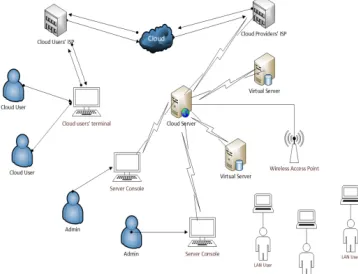
Fig.1 illustrates a normal cloud based situation that involves the cloud service provider and the cloud clients in a cloud computing structure. The illustration of cloud architecture in fig.1 is a simplest one the place few complicated qualities of
cloud computing (e.g. Redundancy, server
replication, and geographic dispersion of the cloud providers’ network) aren't proven – the motive of the illustration is to set up the association that makes the idea of cloud computing a tangible one. The network architecture is self explanatory with the identification of cloud clients when regarded in-line with the discussion of the cloud computing concept provided earlier. One great section from the architecture is that, while the cloud clients are clearly identified and named therefore as a result of their remote area and method of remote access to the cloud servers, the admin clients who're administering the cloud servers are not cloud clients in any kind with recognize to the cloud carrierservice provider’s ntework in the state of affairs.
Fig.1: A Typical Cloud Architecture
It is controversial whether the LAN users in fig.1 are cloud clients or now not. Such area for argument might exist as a result of the phrase ‘cloud computing’ being a notion as an alternative than a technical terminology. If the definition of cloud computing is taken to have main preparations of being the servers placed remotely which might be accessed through public infrastructure (or by way of cloud), then the LAN customers in fig.1 will not be considered because the cloud users within the context. With respect to expended and grid computing as the mother technological difference that outline the infrastructural technique to acquire cloud computing, the LAN clients in the situation are essentially the cloud users when they use the cloud services supplied by way of the servers; the LAN clients on this point of view are very nearly making use of assets that are ‘borrowed’ from the servers on an on-demand foundation.
Fig. 2 illustrates the hierarchical arrangement based on which a cloud is perceived in the form of IaaS, PaaS and SaaS from any cloud end-user’s standpoint.
Fig. 2: Cloud Service Hierarchy
rationale, deem to the cloud users both as service unavailability or nice deterioration – its have an impact on and approaches to counter this disruption is a central part for the cloud infrastructure.
Security complaints could play a stimulating
position as a driving element for any
aforementioned disruption. Security is essentially the most prioritized aspect for any form of computing, making it an apparent expectation that protection problems are significant for cloud environment as well. Because the cloud computing procedure would be related to having user’s sensitive data protected each at users’ end as well as in cloud servers, identification administration and authentication are very crucial in cloud
computing. Verification of eligible users’
credentials and protecting such credentials are a part of main security problems within the cloud - violation in these areas could lead to undetected protection breach (Kumar, 2012) at the least to a point for some interval. A feasible authentication state of affairs for a cloud infrastructure is illustrated in fig.3.
Fig.3: Authentication in the Cloud
The illustration provided in fig. 3 conveys that the authentication for the cloud clients may also be carried out both by means of the cloud service provider or the service provider can outsource the identification administration and authentication service to third party group professionals (Gonzalez, Miers, Redigolo, Simplicio, Carvalho, Naslund & Pourzandi, 2012; Sharma & Mittal, 2013). In the later case, the cloud service provider is required to have collaboration with the third
party group authentication expert – the
collaboration between the cloud service provider and the third party authentication expert throughout the authentication procedure of cloud users is completed pretty much by means of cloud. This selection provides efficiency overheads and security disorders to the cloud context because the
message passing between third party
authentication administration authority and the cloud provider supplier as part of collaboration would virtually be accomplished by way of cloud infrastructure.
As mentioned earlier, the complete authentication procedure and how they're implemented - whatever the involvement of third party authentication experts – is transparent to the cloud users. The illustration on the authentication state of affairs provided above is a quite simple one – if geographically dispersed servers are deployed by using the cloud service providers then the complete authentication system possibly some distance more complex in phrases of safety, underlying algorithm as good as efficiency stage. Something is the level of complexity, the introduction of third party authentication and identification administration professional into any cloud structure should have only one intention; and the goal is to enhance the robustness of safety within the involved area which the cloud service provider itself shouldn't be capable of to deploy or offer.
radically specific from these trendy on their own in-residence managed corporations. The same internal and external threats are reward and require chance mitigation or hazard acceptance. In the following, we compare the different security challenges that adopting corporations will need to remember, both by means of assurance interests on the seller or public cloud providers or immediately, by way of designing and enforcing protection manipulate in a privately owned cloud. In detailed, we evaluate the next issues:
• The treats towards data assets existing in cloud computing environments.
• The types of attackers and their capability of attacking the cloud.
• The security risks associated with the cloud, and where vital considerations of attacks and counter measures.
• Emerging cloud security risks.
• Some example cloud security incidents.
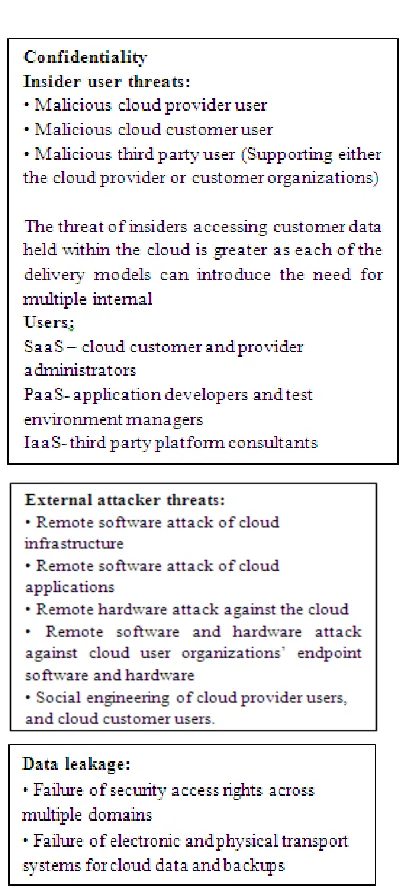
The threats to information assets residing in the cloud can vary according to the cloud delivery models
used by cloud user organizations. There are several types of security threats to which cloud computing is vulnerable. Table.1 provides an overview of the threats for cloud customers categorized according to the confidentiality, integrity and availability (CIA) security model and their relevance to each of the cloud service delivery model.
Table.1 overview of the threats for cloud customers
Cloud Security Risks: The security risks
associated with each cloud delivery model vary and are dependent on a wide range of factors including the sensitivity of information assets, cloud architectures and security control involved in a particular cloud environment. In the following we discuss these risks in a general context, except where a specific reference to the cloud delivery model is made. Table.2 summarizes the security risks relevant in the cloud computing paradigm.
Risk Description
Privileged user access Cloud providers
generally have
unlimited access to user data, controls are needed to address the risk of privileged user
access leading to
compromised customer data.
Data location and segregation
Customers may not know where their data is being stored and there may be a risk of
data being stored
alongside other
customer information.
Data disposal Cloud data deletion
and disposal is a risk,
particularly where
hardware is
dynamically issued to
customers based
on their needs. The risk
of data not being
deleted from data
stores, backups and physical media during
decommissioning is
enhanced within the cloud.
Assuring cloud security
Customers cannot
easily assure the
security of systems that they do not directly control without using SLAs and having the right to audit security controls within their agreements
IV. CONCLUSION
The protection issues would severely have an effect on powerful infrastructures. Security itself is conceptualized in cloud computing infrastructure as a special layer. Protection for cloud computing environment is a non-compromising requirement. Cloud computing is inevitable to turn out to be the ideal (and potentially the excellent) process to trade computing though the security obstacles together with other problems must be resolved for cloud computing to make it more manageable.The security problems in cloud computing are reasonably sensitive and based on the groundwork of sociological and technological viewpoints – the technological inconsistency that outcome in security issue in cloud computing might result in large sociological impacts. As a result, when coping with cloud computing and its security issues, technical as good as epistemological causes are equally primary to take into consideration. Based on the fact that they have an impact on of cloud computing can incorporate both the technical and social settings, the research on cloud computing and its associated issues aren't associated simplest with computing aspects.
REFERENCES
[2] S.O. Kuyoro, F. Ibikunle, and O. Awodele,“Cloud
Computing Security Issues and Challenges,”
International Journal of Computer Networks, vol. 3,issue 5, pp. 247-255,2011.
[3] R. Maheshwari and S. Pathak, “A Proposed Secure Framework for Safe Data Transmission, in Private Cloud,” International Journal of Recent Technology and Engineering,vol.1, issue 1, pp.78-82, April 2012.
[4] N. Padia and M. Parekh, “Cloud Computing Security Issues, in Enterprise Architecture and Its Solutions,” International Journal of Computer Application, vol.2, issue 1, pp. 149-155,December 2011.
[5] A.Parakh and S. Kak, “Online data storage using
implicit security,” Information Sciences,
vol.179,pp.3323-3331, 24 May2009.
[6] Buyya, R., Yeo, C.S., Venugopal, S., Broberg, J. and Brandic, I. (2009). Cloud computing and emerging IT platforms: Vision, hype, and reality for delivering computing as the 5th utility. Future Generation Computer Systems, 25, 599–616.
[7] A. Talib, “Security Framework of Cloud Data Storage Based on Multi Agent System Architecture: Semantic Literature,” Computer and Information Science, Published by Canadian Center of Science and Education, vol. 3, pp.175-186, November 2010.
[8] S. Subashini and V. Kavitha, “A survey on security issues in service delivery models of cloud computing,” Journal of Network and Computer Applications, vol. 34, pp. 1–11, 2011.
[9] Che, J. Duan, Y, Zhang, T. and Fan, J. ().Study on the security models and strategies of cloud computing.
Procedia Engineering, 23, 586 – 593.
doi:10.1016/j.proeng.2011.11.2551.
[10] Li, Wenjuan, and Lingdi Ping. "Trust model to enhance security and interoperability of cloud environment." In Cloud Computing, pp. 69-79. Springer Berlin Heidelberg, 2009.
[11] Ko, Ryan KL, et al. "Trust Cloud: A framework for accountability and trust in cloud computing." Services (SERVICES), 2011 IEEE World Congress on. IEEE, 2011.
[12] Pearson, Siani, and Azzedine Benameur. "Privacy, security and trust issues arising from cloud computing." Cloud Computing Technology and Science (Cloud
Com), 2010 IEEE Second International Conference on.IEEE, 2010.
[13] H. Takabi, J.B.D. Joshi, G. AhnSecurity and privacy challenges in cloud computing environments. IEEE Security & Privacy;, 8 (6) (2010), pp. 24–31.
Author Profile:
M.Narender working as Asst. Professor,CSE