Comparative Analysis of AODV & AOMDV
under Varying Number of Nodes &at
Different Pause Time
Kaveri G1, Dr. K.G Maradia2, Prof. Usha Neelakantan3
PG Student [CSE], Dept. of ECE, L.D College of Engineering, Ahmedabad, Gujarat, India1
H.O.D, Dept. of ECE, Govt. Engineering College, Modasa, Gujarat, India2
H.O.D, Dept. of ECE, L.D College of Engineering, Ahmedabad, Gujarat, India3
ABSTRACT:An ad hoc wireless networkcan be described as a collection of nodes which have to interact among themselves without any centralized authority. In an ad hoc network node movement results in dynamic topology and link failure and thus routing become a challenging task. Many routing protocols have been proposed to overcome various challenges of routing in ad hoc networks. This paper presents performance comparison of mobile ad hoc network routing protocols; Ad hoc On demand Distance Vector (AODV) and Ad hoc On demand Multipath Distance Vector (AOMDV). Here investigation has been done on the effect of change in number of nodes and varying pause time on MANET routing protocols. The performance of AODV & AOMDV based on TCP based traffic pattern has been analyzed and compared. The NS2 simulator is used for performing various simulations. The performance analysis is based on different network metrics such as end to end delay, Packet Delivery Ratio (PDR), Throughput, Normalized Routing Load, Packet loss and Routing Overhead
KEYWORDS: MANET, AODV, AOMDV, TCP, Routing Protocols, Performance metrics
I.INTRODUCTION
A MANET[1, 5] consists of a number of mobile devices that come together to form a network as needed, without any support from any existing internet infrastructure or any other kind of fixed stations. Formally a MANET can be defined as an autonomous system of nodes serving as routers connected by wireless links. As the network topology changes frequently because of node mobility [4] and power limitations, efficient routing protocols are necessary to organize and maintain communication between the nodes. MANET has several salient characteristics: i) dynamic topology ii) Bandwidth constrained iii) Energy constrained operation and limited physical security etc. Therefore the routing protocols used in ordinary wired network cannot be used in wireless network. Application of MANET includes military use in battlefields and disaster management scenario.
II.ROUTING PROTOCOLS
Routing protocols for Mobile Ad hoc Network can be broadly classified into three main categories [2]: 1. Proactive or Table driven routing protocol
2. Reactive or On demand routing protocol 3. Hybrid routing protocol
4.
A. Table driven Routing Protocol
However, for highly dynamic network topology, the proactive scheme requires a significant amount of resource to keep routing information up-to-date and reliable. Examples include Destination Sequence Distance Vector (DSDV), Global State Routing (GSR) etc.
B. On demand Routing Protocol
Reactive routing protocols try to utilize network band width by creating routes only when desired by the source node. Once a route has been established, it is maintained by some route maintenance mechanism as long as it is needed by the source node. When a source node needs to send data packets to some destination, it checks its route table to determine whether it has a valid route. If no route exists, it performs a route discovery procedure to find path to destination. Hence route discovery became on demand. Examples include Ad hoc On demand Distance Vector (AODV), Temporally Ordered Routing Algorithm (TORA) and Dynamic Source Routing (DSR).
C.Hybrid Routing Protocol
Hybrid protocols are the combination of reactive and proactive routing protocols and take advantages of these two protocols and as a result routes are found quickly in the routing zone. Examples are Zone Routing Protocol (ZRP), Core Extraction Distributed Ad hoc Routing Protocol (CEDAR).
III.OVERVIEW OF AODV & AOMDV ROUTING PROTOCOLS
Every routing protocol has its own merits and demerits, none of them can be claimed as absolutely better than others. In this paper AODV & AOMDV have been selected for evaluation.
A. Ad hoc On demand Distance Vector Routing Protocol
The Ad hoc On demand Distance Vector [8, 9, 10, 11] is a reactive routing protocol which allow dynamic, self-starting, multi hop routing among participating mobile nodes that desire to set up and preserve an ad hoc network. It allows the communication between two nodes through intermediate nodes
To establish a route AODV routing protocol uses two mechanisms: i) Route discovery ii) Route maintenance. Main objective of AODV are to establish loop free route and to find shortest route possible. In case there are two routes to a destination, a requesting node selects the one with greatest sequence number.
For route discovery and maintenance purpose control messages are defined in AODV. Different control messages are defined as follows.
RREQ: Whenever a node desire to communicate with another node it broadcast route request message (RREQ) to its neighbor nodes. Tis message is further forwarded by intermediate nodes until destination is reached. RREQ packet include information such as RREQ id, destination IP address, destination sequence number, originator IP address, originator sequence number.
RREP: When intermediate nodes receives RREQ message they unicast route reply (RREP) message to source only if it is legitimate destination or it has route to destination and reverse route is established between source and destination. RREP packet include information such as hop count, destination sequence number, destination IP address
RRER: Whenever link failure occur route error message (RRER) is used in AODV to invalidate the route. RRER include information such as Unreachable Destination IP addresses Unreachable destination sequence number.
Fig: 1: AODV Route Discovery
Fig(1) shows Route discovery process in AODV. When a node needs to determine a route to a destination node, it floods the network with a Route Request (RREQ) message. The originating node broadcasts a RREQ message to its neighboring node, which broadcasts the message to their neighbors, and so on. When a node receiving the request either knows of a “fresh enough” route to the destination, or is itself the destination, the node generate a route reply message, and sends this message along the reverse path back towards the originating node. As the RREP message passes through intermediate nodes, these nodes update their routing table, so that in the future messages can be routed through these nodes to the destination.
Fig: 2: AODV path maintenance
Fig: 2 shows path maintenance in AODV.Whenever a node determines one of its next-hops to be unreachable; it removes all affected route entries, and generates a RRER message. This RRER message contains a list of all destinations that have become unreachable as a result of the broken link. The nodes send the RRER to each of its precursors. These precursors update their routing table, and in turn forward the RRER message if at least one route has been removed
B. Ad hoc On demand Multipath Distance Vector Routing protocol (AOMDV)
AOMDV [3. 12] routing protocol is an extended version of AODV. AOMDV provides multiple paths to reach the destination while AODV only has a unipath to the destination. Despite of their difference, both protocols share the same behavior in several things such as reactive route discovery mechanism and route maintenance. AOMDV also has similar kind of routing packets such as RREQ. RREP, RERR and HELLO messages. HOW ever AOMDV in particular has extra RREP and RERR for multipath discovery and maintenance along with few extra fields in routing control packets. Thus it costs more routing overhead than AODV. AOMDV establishes the route to the destination through route discovery process as basically the same as AODV does. However instead of responding to one RREQ, the destination will respond to several numbers of RREQs by sending unicast transmission of multiple RREPs back to the source. Thus it creates the multipath between the source and the destination.
IV.PERFORMANCE METRICS
1. Throughput:The ratio of the total amount of data that reaches a receiver from a sender to the time it takes for the receiver to get the last packet.
2. Packet Delivery Ratio: The ratio of the data packets delivered to the destination to those generated by the sources.
3. Average end to end delay: It can be defined as average propagation time taken by data packet.
4. Normalized routing Load: Number of routing packet transmitted per data packet delivered at destination
5. Routing overhead: It is the total number of control or routing packets generated by routing protocol during the simulation
6. Packet loss: It can be defined as the difference between total number of packets send and total number of packet received.
V.SIMULATION SETUP
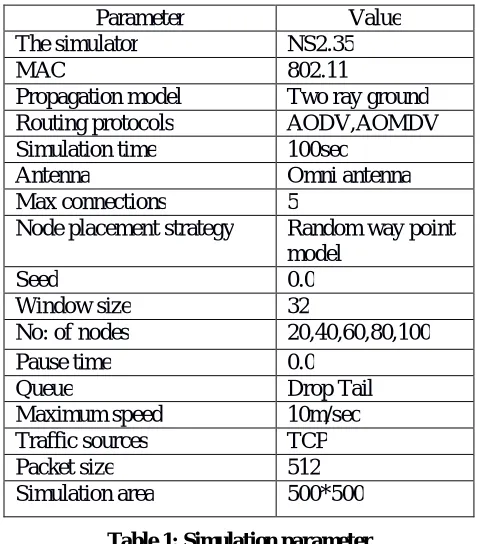
The simulation is done with the help pf NS-2 (V-2.35) network simulator. Here we used two different scenarios for our study. In the first case we changed the number of nodes and in second case we use different pause time.In the first case the pause time is fixed as 0.0s and in second case number of node is fixed as 100. The simulation parameters for both cases are shown in the table below
Table 1: Simulation parameter
VI. RESULTS AND DISCUSSION
Simulations were done by varying number of nodes and keeping pause time constant then varying the pause time keeping the number of the nodes is constant (100 nodes). In all scenarios the comparison were based on the performance metrics: Throughput, Packet Delivery Ratio, Average end to end delay, Normalized Routing Load, Routing overhead and Packet loss
Parameter Value
The simulator NS2.35
MAC 802.11
Propagation model Two ray ground Routing protocols AODV,AOMDV Simulation time 100sec
Antenna Omni antenna
Max connections 5
Node placement strategy Random way point model
Seed 0.0
Window size 32
No: of nodes 20,40,60,80,100
Pause time 0.0
Queue Drop Tail
Maximum speed 10m/sec Traffic sources TCP
Packet size 512
1. Throughput
Fig : 3: Throughput v/s No.of nodes
Figure (3) shows the performance of throughput for AODV & AOMDV under varying number of nodes .AOMDV gives highest throughput for small and medium networks.But when the network size increases the performance of AOMDV degrades as compred to AODV.
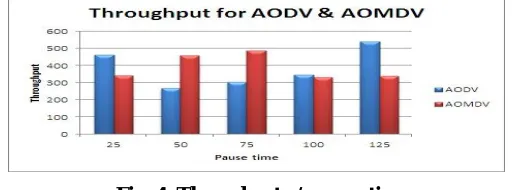
Fig: 4: Throughput v/s pause time
Figure (4) shows the performance of throughput for AODV & AOMDV at different pause time. AOMDV gives highest throughput at 50s & 75s pause time. But when pause time increases its performance degrades as compared to AODV.
2. Packet Delivery Ratio
Fig: 5: PDR v/s Number of nodes
Figure (5) shows the performance of packet delivery ratio for AODV & AOMDV under varying number of nodes AOMDV gives better PDR for small and large network.
Figure (6) shows the performance of packet delivery ratio for AODV & AOMDV at different pause time. AOMDV gives better performance at 50s, 75s & 100s pause time and performance degrades when pause time increases as compared to AODV.
3. End to end Delay
Fig: 7: End to end delay v/s Number of nodes
Figure (7) shows the performance of end to end delay for AODV & AOMDV under varying number of nodes. AODV has smallest end to end delay for small and medium networks.But when network size increses AOMDV performs better than AODV.
Fig:8: End to end delay v/s pause time
Figure (8) shows the performance of end to end delay for AODV & AOMDV at different pause time The performance of AODV is better compared to AOMDV at all pause times
4. Normalized Routing Load
Fig: 9: NRL v/s Number of nodes
Fig:10: NRL v/s Pause time
Figure (10) shows the performance of throughput for AODV & AOMDV at different pause time. At all pause time except at 100s the performance of AODV is better compared to AOMDV.
5. Packet Loss
Fig: 11: Packet loss v/s Number of nodes
Figure (11) shows the performance of throughput for AODV & AOMDV under varying number of nodes For small and medium networks packet loss is less for AOMDV compared to AODV.
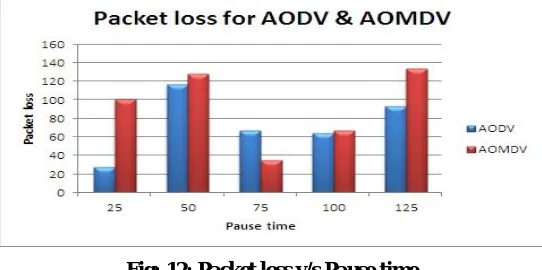
Fig: 12: Packet loss v/s Pause time
6. Routing Overhead
Fig:13: Routing overhead v/s Number of nodes
Figure (13) shows the performance of Routing overhead for AODV & AOMDV under varying number of nodes . For all types of network the performance of AODV is better compared to AOMDV.
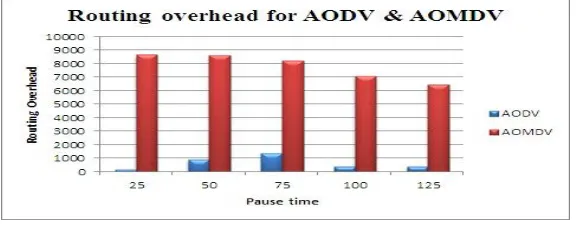
Fig: 14: Routing overhead v/s Pause time
Figure (14) shows the performance of Routing overhead for AODV & AOMDV at different pause time AODV has smallest routing overhead compared to AOMDV at all pause times.
VII.CONCLUSION& FUTURE WORK
In this paper, we examined the performance of AODV & AOMDV routing protocol for MANET under varying number of nodes and at different pause time. We measured the end to end delay, throughput, PDR, NRL, packet loss and Routing overhead. Simulation result shows that AOMDV is the best protocol in terms of throughput and PDR for varying number of nodes and at different pause time. Also AOMDV performs better in terms of packet loss under varying number of nodes. But the performance of AODV is better compared to AOMDV in terms of end to end delay, NRL & Routing overhead under varying number of nodes and at different pause time.
In future different traffic sources, different node placement strategy and hybrid protocols will have to be considered for comparison.
ACKNOWLEDGEMENT
REFERENCES
[1] C.Siva Ram Murthy and B.S Manoj, “ Ad hoc wireless networks: Architecture and protocol”, Pearson
[2] Rahul Patel, Shreya Patel “A Survey Paper on AODV Routing Protocol for MANET”, International Journal for Scientific Research & Development vol.2, Issue 10, 2014
[3] K.Vanaja, Dr. R. Umarani “An Analysis of Single Path AODV Vs Multipath AOMDV on Link Break Using ns-2”, International Journal of Electronics and Computer Science Engineering, Vol.1, Number3, 2012
[4] Vasanthi V , Romen Kumar M , Ajith Singh N, M.Hemalatha “A Detailed Study of Mobility Models in Wireless Sensor network”, Journal of Theoretical and Applied Information Technology 15th November 2011. Vol. 33 No.1
[5] Dr. SaadTalibHasson, Ahmed JawadKadhim, ZainabSaadTalib, “Enhancing the NS-2 Traffic Generator for the MANETs”, IOSR Journal of Computer Engineering (IOSRJCE) ISSN: 2278-0661 Volume 4, Issue 2 (Sep.-Oct. 2012)
[6] Suresh Kumar, Jogendra Kumar “Comparative performance analysis of routing protocol in MANET using varying pause time”, Int’l journal of computer application, volume-47-no 12 June 2012
[7] Jaiyasha Jain, Ms.Nidhi Gaur, VivekUpadhyay, “Comparison and Analysis of Ad hoc routing Protocol”, International Journal for Applied Engineering Research,Vol.9,2014
[8] “AODV routing Implementation for Scalable wireless Ad hoc network simulation” [email protected].
[9] Nilesh M. Kadivar, “Reliable routing in AODV protocol”. International Journal for scientific Research and Development”, Vol.2, Issue 3, 2014
[10] Jin Taek, Jeong-Ho Kho,” A Safe AODV”, International Conference on Convergence and Hybrid Information Technology, 2008
[11] Prashant Kumar Maurya, Gaurav Sharma , “ An overview of AODV routing protocol-International Journal of Modern Egg Research”, vol2, issue3, may-2012
[12] Ms. NamrataMaheshwari, Mr. Pankaj Singh, “An enhancement approach to avoid black hole attack in MANET using AOMDV Protocol”, International Journal for Scientific Research and Development”, vol 11, issue 7, 2013
BIOGRAPHY
Prof. UshaNeelakantan is currently Professor and Head of Electronics and Communication Department at LD College of Engineering Ahmedabad and she is also having additional charge as SPFU Coordinator TEQIP II (Technical Education Quality Improvement Programme) of Gujarat. She received her BE degree in 1979 from Madras University and ME degree in 1984 from Anna University . She has a total of about 35 years of teaching and professional experience. She has won a no. of awards for academic excellence during her study, notable among them being Srinivasan Memorial Award, Yoganandam Memorial Award, Govt. of Tamil Nadu Prize, Rudra Memorial awards etc. Before joining Academics, which is her passion, she was involved with the conceptual design of TOKAMAK with the Plasma Physics Programme of PRL, Ahmadabad; the group is now functioning as IPR at Bhatt..
Dr.Kishor G. MaradiaCurrently working as Head of EC Department at Government Engineering Collage, Modasa since 2007. He joined as a lecturer in EC at L. D. College of Engineering, Ahmedabad in1996. He received B.E. (EC) from Bhavnagar University in 1992 and received ME (EC) (Spl. in communication System Engineering) from Gujarat University in 2003. He is awarded his Ph. D. in wireless Communication from M.S University of Baroda. He has served as a Lecturer and sr. Lecturer in EC. At L. D. College of Engineering Ahmedabad for 14 years. He is having 18 years of teaching and 2 years Industrial experience. He was ex. Engineer with Gujarat Ambuja cements Ltd. He is Ex. Dean of Faculty of Engineering, Hem.North Gujarat University.. He has published 30 research papers in to his credit at various national, international conferences and Journals. Presently He is contributing as a chairman at IETE Ahmedabad centre.