2039 |
P a g e
FIREFLY ALGORITHM FOR OPTICAL PATH
DETECTION IN AD HOC ON-DEMAND DISTANCE
VECTOR (AODV)
M. B. Benjula Anbu Malar
1,M. Lawanya Shri
2, M. Deepa
3, K. Santhi
4,
Feslin Anish Mon
5, G Priya
61, 2, 3, 4,5,6
School of Information Technology, VIT University, Tamilnadu, (India)
5
College of Applied Sciences, Rustaq
ABSTRACT
Meta-heuristic algorithms have become prevalent in today‟s world. These algorithms are basically inspired by nature. Most wide spread are the algorithms based on swarm intelligence. Five years ago, an algorithm called as the Firefly algorithm came into existence and since then its application has been spreading slowly. In this paper, we showcase the basic details of firefly algorithm and its presentation in Ad Hoc networks. Here we point out the difference by comparing the results with the intermittent techniques and show how it performs better in most of the cases. The Firefly Algorithm is a meta-heuristic algorithm that is hugely built on the flashing of the fireflies. Fireflies attract other fireflies using the flash that they carry. And since the fireflies are unisex, therefore every firefly attracts every other firefly. The degree to which a firefly attracts the other firefly is directly proportional to the brightness for the two fireflies involved. To put it into simpler words, the brighter firefly will attract the less bright firefly. The brightness of the firefly however, decreases with the increase of distance. But, if a particular firefly doesn‟t find any other firefly which is brighter than it, then it moves in random fashion. The main purpose of Ad-hoc On Demand Distance Vector (AODV) routing protocol is its use in adhoc mobile networks. In the Route discovery mechanism of AODV, a query is put and its reply cycles are recorded. The information about this route is also stored in intermediate nodes in tabular form. Here, we take up the firefly algorithm to show the implementation for partial route selection.
Keywords: MANET, Meta-heuristic, AODV, firefly algorithm.
I.INTRODUCTION
2040 |
P a g e
wherever D characterises as the measure of variables that are to be optimized. Firefly algorithm is basically an abstract form of the real behaviour of fireflies. The fireflies represent a very interesting behaviour by flashing to appeal the other fireflies. Every species has its own characteristic order of flash. The flavour of a particular flaring light is used as a signalling function for the message passing. In AODV, communication between the nodes takes place in order to form a route for data transmission. Firefly algorithm, gives a finest result at the period of message passing instead of making use of the basic functionality of AODV. But, in actual scenario the fireflies are splaying to appeal to the copulating mate. Fireflies appeal the opposed gender. To achieve the chief aim of using firefly algorithm for message passing, a need for ideating the general behaviour of firefly algorithm arises. These can be explained as–
1 .All fireflies are unisex and hence, there is no restraint of transferring the message based on gender. I. Brightness and attractiveness are proportional to each other.
II. Brightness is proportional of the firefly to the distance from the aim.
RouteRequest and RouteReply packets are generally used in AODV protocol for route establishment. In these packets, the information about the neighbours that can be reached is being managed. The number of messages that are used to set up the route is more than the actual messages and hence the overhead of the run time can be increased of the protocol. And hence, firefly algorithm is considered better than RouteRequest and RouteReply, which is exactly the reason why we are using it here in this project. Basically, in a firefly algorithm brighter nodes can receive messages from less bright node. The advantage of this algorithm is that it also includes the distortion factor which makes it unique, different, and gives it much more realistic effect as it is neglected in the AODV protocol. The firefly algorithm is different from others as it requires less number of messages for route establishment and hence doesn‟t need more time and doesn‟t carry such overheads as other algorithms do. Brightness of a node is relative to the function as it is directly proportional to it. Every node has its own intensity. The brightness decreases as the distance increases and so does the reachability of the node and hence the node will transfer the messages only to interested neighbour node which brighter than others. And likewise the message is passed on and on until it reaches its destination efficiently.
II.LITERATURE SURVEY
2041 |
P a g e
and correct results. The structures like the nature of the fireflies, the transitions that they follow and the calculations are also involved here.
Xiaojun Bi‟s proposal of the firefly algorithm [18], is a development of swarm brilliance. It is other impending reconnoitering procedure that is recycled in optimization glitches after recreation of the algorithm, etc. Firefly algorithm has numerous shortcomings such as diminished frequency while looking for the solution and effortlessly searching into a native optimization and so forth. For this reason, a boosted firefly algorithm fabricated on the Inver-over operator is being shown here in this video. The algorithm is a little compact in its early stages and this is ignored while going in a local optimization. And hence a demand to increase and enhance the solutions available comes in along with the demand to increase the range of the optimal answer. The improved algorithm is then replicated on firefly algorithm using AODV and contrast is prepared. After repeating these steps of comparison for a number of times, the contrast on the ratio of optimization and optimization shows that the algorithm that we are showcasing here is better than other two algorithms.
Modern global optimization is attained from meta-heuristic algorithms as it is an integral part of artificial aptitude and soft computing. ASHOC networking has been used as well specially for optimising the traversal track. Swarm intelligence (SI)[1] is an algorithm that is based on one of the categories of this meta-heuristic techniques. It is majorly based on biological activities of natural entities. Firefly algorithm [2, 3] is such one algorithm that depends on the flashing pattern of these fireflies from the tropical regions. Other such algorithms contain bat algorithm [5], cuckoo algorithm [4] etc. From the last few years all these algorithms have made significant progress. Atom swarm optimisation, differential evolution, cuckoo search, bat algorithm and firefly algorithm have helped a lot in solving the optimisation algorithms competently [4,6,7,8]. Amid all these forthcoming algorithms, firefly algorithm is supposed to be the most effective in resolving multimodal and global optimisation difficulties. Mostly back propagation is combined in all these algorithms to search for better answers. These mixture algorithms catch answers for numerous mechanical matters. Ad hoc On-Demand Distance Vector (AODV) Routing is a routing protocol which is mainly used in mobile ad hoc networks (MANETs) and in few other wireless ad hoc networks. As it is a sensitive protocol AODV, it generates the routes only when it is necessary. Old-style routing tables are majorly used by AODV as they have a single entrance for each terminus and arrangement number governs the position of these slabs and avoids loop creation. A vital representation of AODV is that it orders the position of the steering table and therefore rejects the table when it is not efficient. Route discovery rest on the query and the reply and hence the practice is active in nature. All middle nodes will have report about the routes.
III.PROPOSED SYSYEM
2042 |
P a g e
destination mode and then communication takes place between different fireflies using brightness algorithm and finally data will reach to the destination node that is. The probability of data loss will almost be zero. The firefly „i‟ who is going in the direction of brighter firefly „j‟ is expected as the firefly „i‟ can reach and diffuse the data to the firefly „j‟. The reach of each firefly is updated periodically. This is much more better for the ad-hoc environment [13]. This method is better for the nodes having dynamic nature.
This approach centred on the tree idealization that is – where first says that first one is all fireflies are androgynous, where another is attraction and intensity are proportional to each other and third is intensity is dependent on the background of the goal. Attraction rate of one firefly is based on the brightness of the second firefly. The second supposition states that the distance is inversely proportional to the brightness rate . Brightness (B) at locaton (l) can be firm as B(l) ∝ f(l). Brightness and the light rate intensity will change with distance dij between i
th
firefly to jth firefly if distance increases then light intensity decreases.
We can use the Inverse square law to observe the change in the rate of intensity of light I(d) periodically. I(d) = Is / d2
where Is represents the light intensity of source firefly. In the environment, light absorption factor exists. „γ‟ is a
constant that is used for light absorption aspects. This method is effective for noisy channel [14-15]. Variation in light intensity I with respect to distance d is
I = I0e-γd
I0 is representing the original light intensity of the specified firefly. After integrating the inverse square law and
absorption factor , the intensity of light at distance d is I(d) = I0e
-γdᴧ2
The motion of a firefly „i‟ is dependent on the distance of the firefly „j‟.
now our next step is to calculate β0 [9]. α is used for calculating the random values and ri representing the vector
of random number ranging between 1 and 2. Approximate value for ri will be 0.5. For the execution purpose α
∊ [0, 1] and β0 = 1. If we take β0 = 0 then it will be a simple walk as it will totally neglect the brightness factor of
2043 |
P a g e
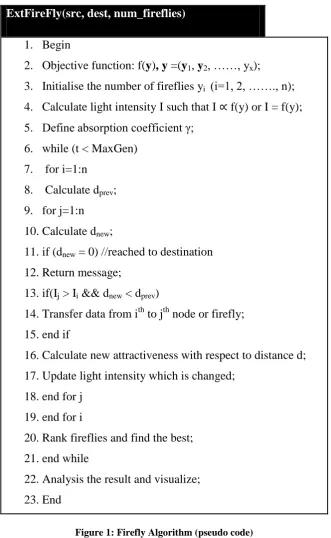
evaluated by matching it with other values. If „n‟ increases then it needs some more iterations as mentioned above to reach at either of the level i.e local or global optimum place. Fireflies are working independently at this level.
ExtFireFly(src, dest, num_fireflies)
1.
Begin
2.
Objective function: f(
y
)
, y
=(
y
1,
y
2, ……, y
x);
3.
Initialise the number of fireflies y
i(i=1, 2, ……., n);
4.
Calculate light intensity I such that I
∝
f(y) or I = f(y);
5.
Define absorption coefficient γ;
6.
while (t < MaxGen)
7.
for i=1:n
8.
Calculate d
prev;
9.
for j=1:n
10.
Calculate d
new;
11.
if (d
new= 0) //reached to destination
12.
Return message;
13.
if(I
j> I
i&& d
new< d
prev)
14.
Transfer data from i
thto j
thnode or firefly;
15.
end if
16.
Calculate new attractiveness with respect to distance d;
17.
Update light intensity which is changed;
18.
end for j
19.
end for i
20.
Rank fireflies and find the best;
21.
end while
22.
Analysis the result and visualize;
23.
End
2044 |
P a g e
In that dprev and dnew is used to calculate distance from ith node to destination and jth node to destination. If the
new node is having less distance and more brightness then only it will forward the packet otherwise it will not forward. In this technique only interesting nodes or fireflies are participating in the data transmission. If any node is busy or not interested to take part in the route establishment then it will reduce its brightness. So no node will send packet to less brighter node. After completion of each iteration the calculation of present attraction rate of each node takes place. As nodes are ad-hoc in nature so they can move to other places and in that situation the attraction rate can be increased or decreased. After formation of the final route, the result analysis and visualization should be done.
IV.RESULT AND ANALYSIS
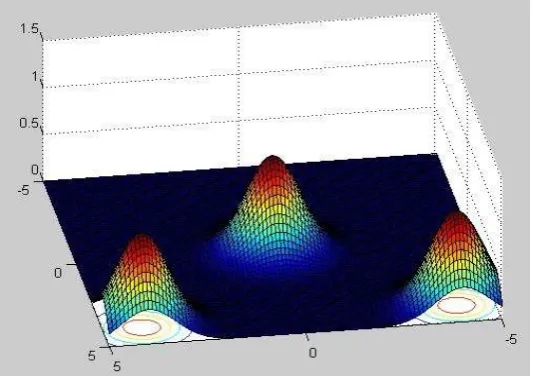
Whenever we consider any fireflies problem , number of fireflies which should be considered are 15-20 . in our proposed method we have used total of three local and global optima –
In the statement given above x and y are bounded in the two-dimensional area that is [-5, 5] × [-5, 5]. For the mentioned statement there are three crests, (-4, 4), (4, 4) and (0, 0).In our implementation process we have used in total of 25 fireflies. And the above mentioned crests are the destination points of the fireflies. Analysis indicates that the three optima points found by using twenty fireflies and also four optima observed when the number of fireflies is 25 [tble 1].
2045 |
P a g e
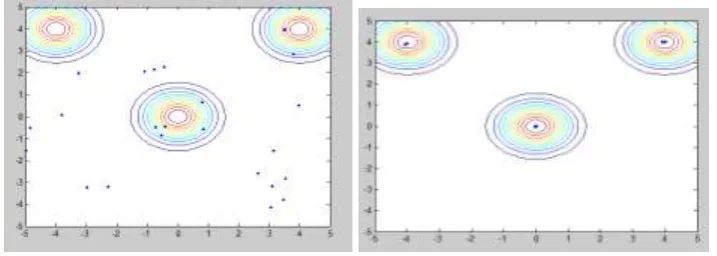
Table 1: Required number of iteration and optima for various number of fireflies.The above figure shows the results for n= 23 (number of fireflies). The first figure shows the first the initial state of fireflies, where second one shows the final position of fireflies. In our implementation the values we got areα = 0.2, β0 = 1 and γ = 1. These parameters will vary according to the value of n ( number of fireflies).
Figure 3: Prior position (up) and final position of the 23 fireflies (down).
V.CONCLUSION AND FUTURE SCOPE
2046 |
P a g e
REFERENCES
[1.] J. Kennedy and R. Eberhart, Particle swarm optimisation, in: Proc. of the IEEE Int.Conf. on Neural Networks, Piscataway, NJ, pp. 1942-1948 (1995).
[2.] X. S. Yang, Nature-Inspired Metaheuristic Algorithms, Luniver Press, UK, (2008).
[3.] X. S. Yang, Firefly algorithms for multimodal optimisation, Proc. 5th Symposium on Stochastic Algorithms, Foundations and Applications, (Eds. O. Watanabe and T. Zeugmann), Lecture Notes in Computer Science, 5792: 169-178 (2009).
[4.] X. S. Yang and S. Deb, Cuckoo search via L´evy flights, Proceeings of World Congress on Nature & Biologically Inspired Computing (NaBIC 2009, India), IEEE Publications, USA, pp. 210-214 (2009).
[5.] Iztok Fister Jr., Dusan Fister , Xin-She Yang, A Hybrid Bat Algorithm, elektrotehniski vestnik ˇ 80(1-2): 1–7, original scientific paper, 2013
[6.] J. C. Bansal and K. Deep, Optimisation of directional overcurrent relay times by particle swarm optimisation, in: Swarm Intelligence Symposium (SIS 2008), IEEE Publication, pp. 1-7, (2008)
[7.] C. A. Floudas and P. M. Pardolos, Encyclopedia of Optimisation, 2nd Edition, Springer(2009).
[8.] A. H. Gandomi, X. S. Yang, and A. H. Alavi, Cuckoo search algorithm: a metaheuristic approach to solve structural optimisation problems, Engineering with Computers, 27, article DOI 10.1007/s00366-011-0241-y, (2011).
[9.] Yang, X. S. Nature-Inspired Metaheuristic Algorithms. Frome: Luniver Press. ISBN 1-905986-10-6, 2008 .
[10.] Ausiello, Giorgio; et al., Complexity and Approximation (Corrected ed.), Springer, ISBN 978-3-540-65431-5, 2008.
[11.] Xin-She Yang and Amir H. Gandomi, Bat Algorithm: A Novel Approach for Global Engineering Optimization, Engineering Computations, Vol. 29, Issue 5, pp. 464-483, 2012.
[12.] MA Sasa, Xue Jia, Fang Xingqiao, Liu Dongqing, “Research on Continuous Function Optimization Algorithm Based on Swarm Intelligence”, 5th International Conference on Computation, 2009, pg no. 61-65. [13.] Yang, X. S. (2009). "Firefly algorithms for multimodal optimization". Stochastic Algorithms: Foundations and Applications, SAGA 2009. Lecture Notes in Computer Sciences 5792. pp. 169–178. arXiv:1003.1466. [14.] Chai-ead, N.; Aungkulanon, P.; Luangpaiboon, P. (2011). "Bees and firefly algorithms for noisy non-linear optimisation problems". Prof. Int. Multiconference of Engineers and Computer Scientists 20112: 1449– 1454.
[15.] Aungkulanon, P.; Chai-ead, N.; Luangpaiboon, P. (2011). "Simulated manufacturing process improvement via particle swarm optimisation and firefly algorithms".Prof. Int. Multiconference of Engineers and Computer Scientists 20112: 1123–1128.
2047 |
P a g e
[17.] Xin-She Yang and Xingshi He, “Firefly Algorithm: Recent Advances and Applications”, Int. J. Swarm Intelligence,Vol. 1, No. 1, pp. 36–50,2013