IDENTIFICATION OF MODIFIER COMPONENT IN
UPPER AND LOWER ZONE OF DEVANAGARI
CHARACTERS
Manoj Kumar Gupta
1, C. Vasantha Lakshmi
2, C. Patvardhan
31
Ph.D.(C. S.) Scholar, Dept. of Physics and C. S., Dayalbagh Educational Institute, Agra (India)
2Dept. of Physics and Computer Science, Dayalbagh Educational Institute, Dayalbagh, Agra (India)
3Dept. of Electrical Engineering, Dayalbagh Educational Institute, Dayalbagh, Agra (India)
ABSTRACT
Upper and lower zone of the Devanagari character contains the modifiers of the core character which are
present in middle zone. Though these modifiers are very less in number but their proper identification is very
important. As some modifier have their part in middle zone which required to be clubbed with the part of the
connected component of the modifier in upper zone to correctly identify the modifier. Shirorekha provides a very
good basis for separating modifier in upper zone. An attempt is made to identify all possible connected symbols
in upper and lower zone of Devanagari character. The frequency analysis done on two documents with different
contents and sizes shows that out of all upper zone modifier, the presence of (vowel ) is highest with
around 33%. And more than 90% of the symbols in the upper zone are coverd by 5 modifiers viz.
. The results also shows that out of all lower zone modifier, the presence of (vowel ) is
highest with around 55%. And more than 90% of the symbols in the lower zone are coverd by 3 modifiers viz.
It has been validated on an article of unknown font. The utility of the proper identification of
possible upper and lower zone modifiers along with associated character is in the correct assembly of word
after recognition.
Keywords: Optical Character Recognition, Modifiers, Upper Zone, Lowe Zone
I. INTRODUCTION
Devanagari characters can be divided into three zones and a header line as shown below in Figure 1.
Fig. 1.
Example of various zones in devanagari character
right, top, or bottom of the consonant [1]. Matras may be attached or detached from the base characters. Hence, the detection of the zone boundaries of character is an important task [2].
Middle zone characters are the core character which can either be single or conjunct characters, though theoretically there can be 46656 triconsonantal conjunct but there are only 345 frequently used symbols in the middle zone. Various structural features viz. bar type, touching count [3], number of water bodies [4], number of left surface cavities [5], place of the touching point to the shirorekha and bar can further classify the connected symbols in the middle zone into manageable chunks of classes [6]. recognition accuracies are further enhanced by identification of the possible character set for single letter words [7].
Motivation for the present work: How do we handle the attached symbols that are attached in the top and bottom
strip? How many are there and in how many ways are they attached? Is there a simple way to separate that out? These are the pertinent questions behind the motivation for undertaking this research work.
The paper is organized as follows: Section I describes the proposed approach. Section II describes the identification of the symbols in the upper and lower zone. Frequency Analysis is described in Section III. Validation of proposed scheme over unknown font is discussed in Section IV. Finally, Conclusions are given in Section V.
II. PROPOSED APPROACH
Though modifiers in upper and lower zone are very less in number but their proper identification along with associated character is very important for correct assembly of word after recognition. Moreover some modifiers have their part in middle zone. There are some modifiers or their portions which could be above the header line, below the character and some in the middle zone. The position and the way in which the marks are joined to the base character are required to be identified.
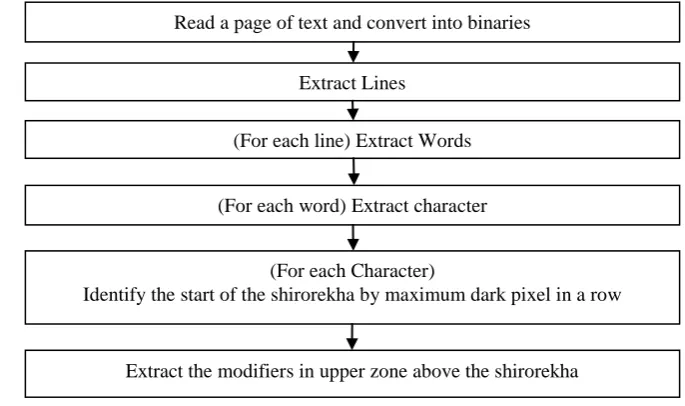
Shirorekha provides a very good basis for separating modifier in upper zone. Steps required to be performed to extract the upper zone symbols starting from reading a page of text are given below in Figure 2.
Fig. 2.
Steps for extraction of symbols in upper zone
Read a page of text and convert into binaries
Extract Lines
(For each line) Extract Words
(For each word) Extract character
(For each Character)
Identify the start of the shirorekha by maximum dark pixel in a row
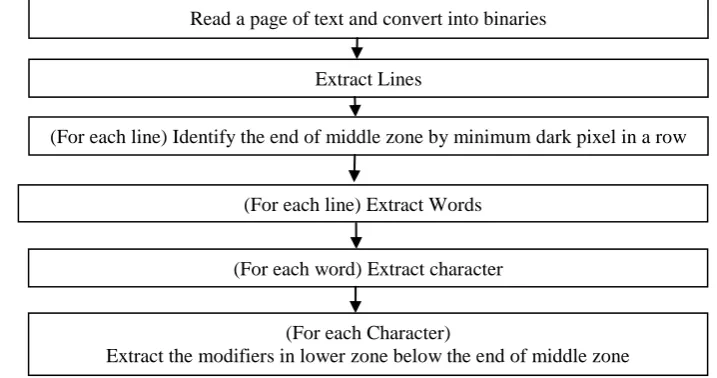
The position and the way in which the marks are joined to the base character may vary from font to font. In some fonts the vowel or consonant modifier may touch the character it modifies and in others it may not. Hence the identification of start of lower zone symbols depends upon the identification of end of middle zone. Steps required to be performed to extract the lower zone symbols starting from reading a page of text are given below in Figure 3.
Fig. 3.
Steps for extraction of symbols in lower zone
III. IDENTIFICATION OF THE SYMBOLS IN UPPER AND LOWER ZONE
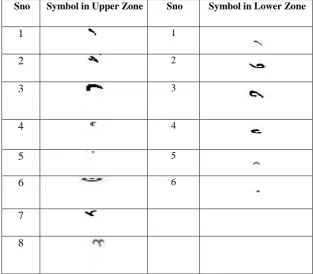
Devanagari script has 13 vowels. The part of the modifiers could be above the header line, below the character or even in the middle zone. Apart from these, there are various other possible symbols formed due to the presence of multiple modifiers on a particular character. In addition to these, there are symbols which are having unconnected component in the lower zone. All these are depicted below in Table I.
TABLE I.
List of Modifiers of the Devanagari Script
Sno Vowel/
Multiple Vowel/
Others
Modifier symbols
attached with
consonant क
Symbols in upper zone/
upper zone with portion in middle zone/
lower zone
1
अ
2
इ
कि
3
ई
िी
4
उ
िु
5
ऊ
िू
6
ऋ
िृ
Read a page of text and convert into binaries
Extract Lines
(For each line) Identify the end of middle zone by minimum dark pixel in a row
(For each line) Extract Words
(For each word) Extract character
(For each Character)
7
ऋ
8
ऋ
9
ए
िे
10
ऐ
िै
11
ओ
िो
12
औ
िौ
13
अं
14
अं
15
ए
ऋ
16
इ
ऋ
17
ई
ऋ
18
ओ
ऋ
19
ए
अं
20
ई
अं
21
ओ
अं
22
ऐ
अं
23
ओ
ऋ अं
24
TABLE II.
List of distinct Symbols in the Upper and Lower Zone
Sno Symbol in Upper Zone Sno Symbol in Lower Zone
1
12
23
34
45
56
67
8
IV. FREQUENCY ANALYSIS OF SYMBOLS IN UPPER ZONE AND LOWER
ZONE
Frequency analysis is done manually to find out the most frequently used symbols in upper and lower zone in two articles of different contexts and sizes [8][9]. The first article contains the 3236 character and the second article contains the 1912 character. The results of upper zone are summarized in Tables III. The results shows that out of all upper zone modifier, the presence of (vowel ए ) is highest with around 33%. And more than
TABLE III.
Results of Frequency Analysis of Symbols in Upper Zone
Sno Symbols in
upper zone
Article I Article II
Frequency %age Frequency %age
1 409 32.72 244 33.70
2 222 17.76 107 14.78
3 197 15.76 91 12.57
4 158 12.64 123 16.99
5 137 10.96 80 11.05
6 63 5.04 35 4.84
7 33 2.64 26 3.59
8 27 2.16 16 2.20
9 2 0.16 - -
10 1 0.08 - -
11 1 0.08 1 0.14
12 - - 1 0.14
Total 1250 - 724 -
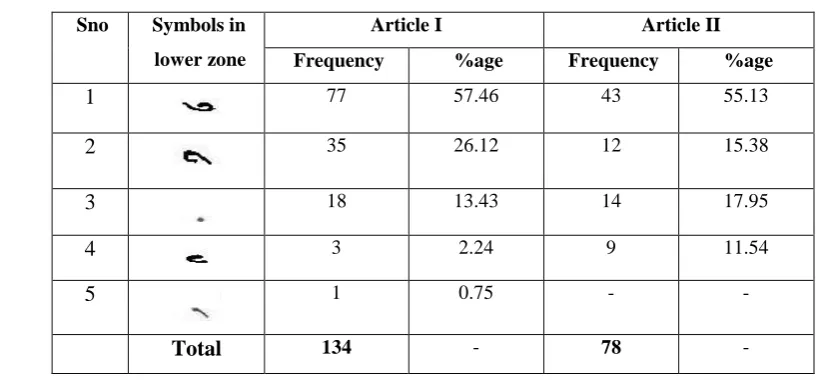
The results of the frequency analysis of most frequently used symbols in lower zone are shown below in Table IV. The results shows that out of all lower zone modifier, the presence of (vowel उ ) is highest with around 55%. And more than 90% of the symbols in the lower zone are coverd by 3 modifiers viz.
TABLE IV. RESULTS OF FREQUENCY ANALYSIS OF SYMBOLS IN LOWER ZONE
Sno Symbols in
lower zone
Article I Article II
Frequency %age Frequency %age
1
77 57.46 43 55.132
35 26.12 12 15.383
18 13.43 14 17.954
3 2.24 9 11.545
1 0.75 - -V. VALIDATION OVER UNKNOWN FONT
To validate the proposed scheme, a system is developed in JAVA. The Figure 4 shows the image of an article [10] of unknown font used for testing.
Fig. 4.
Image of an article of unknown font used for testing
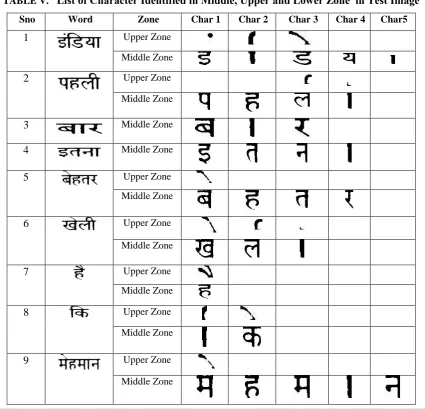
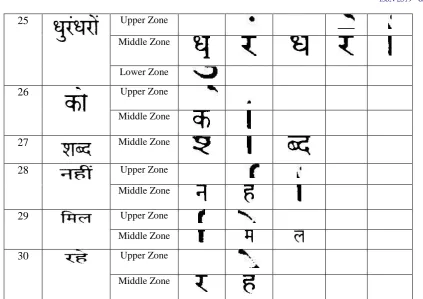
Program extracted the 30 words from the above test image. The details of the character identified in all three zones viz. middle, upper and lower zone of test image are summarized in Table V below. Some modifier has their part in middle zone which required to be clubbed with the part of the connected component of the modifier in upper zone to correctly identify the modifier.
TABLE V.
List of Character Identified in Middle, Upper and Lower Zone in Test Image
Sno Word Zone Char 1 Char 2 Char 3 Char 4 Char5
1
Upper ZoneMiddle Zone
2
Upper ZoneMiddle Zone
3
Middle Zone4
Middle Zone5
Upper ZoneMiddle Zone
6
Upper ZoneMiddle Zone
7
Upper ZoneMiddle Zone
8
Upper ZoneMiddle Zone
9
Upper Zone10
Upper Zone Middle Zone11
Upper ZoneMiddle Zone
12
Middle Zone13
Middle Zone14
Upper ZoneMiddle Zone
15
Upper ZoneMiddle Zone
16
Upper ZoneMiddle Zone
17
Middle Zone18
Upper ZoneMiddle Zone
19
Upper ZoneMiddle Zone
20
Middle Zone21
Upper ZoneMiddle Zone
22
Upper ZoneMiddle Zone
23
Upper ZoneMiddle Zone
24
Upper Zone25
Upper Zone Middle ZoneLower Zone
26
Upper ZoneMiddle Zone
27
Middle Zone28
Upper ZoneMiddle Zone
29
Upper ZoneMiddle Zone
30
Upper ZoneMiddle Zone
Middle zone connected component along with their various structural features of the middle zone component viz. Bar Type, Touching count [3], Number of water bodies [4], number of left surface cavities [5], place of the touching point to the shirorekha and bar which have been extracted by the program on the above image of unknown font are summarized in Table VI.
TABLE VI.
List of Character Identified in Middle Zone with Structural Properties
SNO Middle
Zone
Char
Bar Type Touching
Count Number of Water Bodies Number of Left Surface Cavities First Shirorekha
Touching Point from
Left in End Bar
Character
First Bar Touching
Point from Bottom
in End Bar
Character
1 No Bar 1 1 2
2 End Bar 1 1 0 After Mid Point Above Mid Point
3 No Bar 1 1 2
4 End Bar 2 1 1 Before Mid Point Below Mid Point
5 End Bar 1 1 0 After Mid Point Above Mid Point
End of Word
6 End Bar 2 1 0 Before Mid Point Below Mid Point
7 No Bar 1 1 1
8 End Bar 1 2 1 After Mid Point Above Mid Point
End of Word
10 End Bar 1 1 1 After Mid Point Below Mid Point
11 End Bar 1 1 0 After Mid Point Above Mid Point
12 No Bar 1 1 1
End of Word
13 No Bar 1 1 2
14 End Bar 1 1 1 After Mid Point Above Mid Point
15 End Bar 1 1 1 After Mid Point Above Mid Point
16 End Bar 1 1 0 After Mid Point Above Mid Point
End of Word
17 End Bar 1 1 1 After Mid Point Below Mid Point
18 No Bar 1 1 2
19 End Bar 1 1 1 After Mid Point Above Mid Point
20 No Bar 1 1 1
End of Word
21 End Bar 2 1 1 Before Mid Point Below Mid Point
22 End Bar 1 1 1 After Mid Point Above Mid Point
23 End Bar 1 1 0 After Mid Point Above Mid Point
End of Word
24 No Bar 1 1 1
End of Word
25 End Bar 1 1 0 Before Mid Point Above Mid Point
26 Mid Bar 1 1
End of Word
27 End Bar 2 1 1 Before Mid Point Above Mid Point
28 No Bar 1 1 1
29 End Bar 2 1 1 Before Mid Point Above Mid Point
30 End Bar 1 1 0 After Mid Point Above Mid Point
31 End Bar 1 1 1 After Mid Point Above Mid Point
End of Word
32 No Bar 1 1 1
34 End Bar 2 1 1 Before Mid Point Above Mid Point End of Word
35 Mid Bar 1 1
End of Word
36 End Bar 2 1 0 Before Mid Point Below Mid Point
37 End Bar 1 1 0 Before Mid Point Above Mid Point
38 End Bar 2 1 1 Before Mid Point Above Mid Point
End of Word
39 No Bar 2 1 1
40 End Bar 1 1 0 After Mid Point Above Mid Point
41 No Bar 1 1 1
End of Word
42 End Bar 1 1 1 After Mid Point Above Mid Point
43 No Bar 1 1 2
44 End Bar 1 1 0 After Mid Point Above Mid Point
End of Word
45 No Bar 1 1 1
End of Word
46 End Bar 2 1 2 Before Mid Point Above Mid Point
47 End Bar 2 1 0 Before Mid Point Below Mid Point
48 End Bar 1 1 1 After Mid Point Above Mid Point
End of Word
49 End Bar 1 1 1 After Mid Point Below Mid Point
50 End Bar 1 1 1 After Mid Point Below Mid Point
51 End Bar 1 1 0 After Mid Point Above Mid Point
52 End Bar 1 1 1 After Mid Point Below Mid Point
End of Word
53 Mid Bar 1 1
End of Word
54 End Bar 1 1 0 After Mid Point Above Mid Point
55 End Bar 1 1 1 After Mid Point Above Mid Point
End of Word
57 End Bar 1 1 0 After Mid Point Above Mid Point
End of Word
58 End Bar 1 1 1 After Mid Point Above Mid Point
59 No Bar 1 2 2
60 End Bar 1 1 0 After Mid Point Above Mid Point
End of Word
61 End Bar 1 1 0 After Mid Point Above Mid Point
62 End Bar 1 1 1 After Mid Point Above Mid Point
63 End Bar 3 2 1 Before Mid Point Below Mid Point
End of Word
64 End Bar 1 1 0 After Mid Point Above Mid Point
65 Mid Bar 1 2
66 Mid Bar 1 1
67 No Bar 1 1 1
End of Word
68 Mid Bar 1 1
End of Word
69 End Bar 3 1 1 Before Mid Point Below Mid Point
70 No Bar 1 1 1
71 End Bar 3 1 0 Before Mid Point Below Mid Point
72 No Bar 1 1 1
73 End Bar 1 1 0 Before Mid Point Above Mid Point
End of Word
74 Mid Bar 1 1
75 End Bar 1 1 0 After Mid Point Above Mid Point
End of Word
76 No Bar 2 1 1
77 End Bar 1 1 0 Before Mid Point Above Mid Point
78 No Bar 1 1 1
End of Word
79 End Bar 1 1 1 After Mid Point Above Mid Point
81 End Bar 1 1 0 After Mid Point Above Mid Point End of Word
82 End Bar 1 1 0 After Mid Point Above Mid Point
83 End Bar 2 1 1 Before Mid Point Below Mid Point
84 End Bar 1 2 1 After Mid Point Above Mid Point
End of Word
85 No Bar 1 1 1
86 No Bar 1 1 1
End of Word
VI. CONCLUSIONS
Though Upper and lower zone modifiers are very less in number but their proper identification is very important. Some modifier has their part in middle zone which required to be clubbed with the part of the connected component of the modifier in upper zone to correctly identify the modifier. Shirorekha provides a very good basis for separating modifier in upper zone. The frequency analysis done on two documents with different contents and sizes shows that out of all upper zone modifier, the presence of (vowel ) is highest with around 33%. And more than 90% of the symbols in the upper zone are covered by 5 modifiers viz.
. The results also show that The results shows that out of all lower zone modifier, the presence of (vowel ) is highest with around 55%. And more than 90% of the symbols in the lower zone are covered by 3 modifiers viz. It has been validated on an article of unknown font.
The utility of the proper identification of possible upper and lower zone modifiers along with associated character is in the correct assembly of word after recognition.
REFERENCES
[1] R. Jayadevan, S. R. Kolhe, P. M. Patil, U. Pal “Offline Recognition of Devanagari Script: A Survey” in IEEE Transaction on Systems, Man, and Cybernetics, Part C: Applications and Reviews, Year: 2011, Volume: 41, No. 6 pp 782-796
[2] J. Dholakia, Atul Negi, S. Rama Mohan “Zone Identification in the Printed Gujarati Text” in Proceedings of the 2005 Eight International Conference on Document Analysis and Recognition (ICDAR’05), Year 2005, Vol. 1, pp 272 – 276
[3] M. K. Gupta, C. Vasantha Lakshmi, M. Hanmandlu, C. Patvardhan “An Exhaustive Font and Size Invariant Classification Scheme for OCR of Devanagari Character” in International Journal on Natural Language Computing, Feb.2015, Vol. 4 No. 1 pp 1-21
[5] M. K. Gupta, C. Vasantha Lakshmi, C. Patvardhan “Classification of Devanagari Character based on Left Surface Cavity” in International Journal of Recent Scientific Research, Feb. 2016, Vol. 7 Issue. 2 pp 8741 - 8746
[6] M. K. Gupta, C. Vasantha Lakshmi, C. Patvardhan “Identification and Use of Touching Point Structural Property for Piece wise Classification of Devanagari Characters” in International Journal of Computer & Mathematical Sciences, Feb. 2016, Volume 5, Issue 2, pp. 83 - 93
[7] M. K. Gupta, C. Vasantha Lakshmi, C. Patvardhan “Identification of Character Pattern in Devanagari Words for Enhancement of Recognition Accuracy” in Advances in Computer Science and Information Technology, Jan. 2016, Vol. 3 Issue. 1 pp 5-8