Logical Cryptanalysis as a SAT Problem
?
Encoding and Analysis of the U.S. Data Encryption Standard
FABIO MASSACCI
Dipart. di Informatica e Sistemistica, Università di Roma I “La Sapienza”, Italy and Dipart. di Ingegneria dell’Informazione, Università di Siena, Italy. e-mail: [email protected]
LAURA MARRARO
Dipart. di Informatica e Sistemistica, Università di Roma I “La Sapienza”, Italy
Abstract. Cryptographic algorithms play a key role in computer security and the formal analysis of their robustness is of utmost importance. Yet, logic and automated reasoning tools are seldom used in the analysis of a cipher, and thus one cannot often get the desired formal assurance that the cipher is free from unwanted properties that may weaken its strength.
In this paper, we claim that one can feasibly encode the low-level properties of state-of-the-art cryptographic algorithms as SAT problems and then use efficient automated theorem-proving systems and SAT-solvers for reasoning about them. We call this approach logical cryptanalysis.
In this framework, for instance, finding a model for a formula encoding an algorithm is equivalent to finding a key with a cryptanalytic attack. Other important properties, such as cipher integrity or algebraic closure, can also be captured as SAT problems or as quantified boolean formulae. SAT benchmarks based on the encoding of cryptographic algorithms can be used to effectively combine features of “real-world” problems and randomly generated problems.
Here we present a case study on the U.S. Data Encryption Standard (DES) and show how to obtain a manageable encoding of its properties.
We have also tested three SAT provers,TABLEAUby Crawford and Auton,SATOby Zhang, and rel-SATby Bayardo and Schrag, on the encoding of DES, and we discuss the reasons behind their different performance.
A discussion of open problems and future research concludes the paper.
Key words: cipher verification, Data Encryption Standard, logical cryptanalysis, propositional satis-fiability, quantified boolean formulae, SAT benchmarks.
1. Introduction
Providing computer security in large open networks such as the Internet is one of the frontiers of computer science today [2, 38, 35]. Yet, providing security is not so simple, and many technical challenges need to be solved to provide the high assurance that such an enterprise requests. These challenges are sketched in the excellent introduction by Anderson and Needham [2] and require the use of partic-? This is a longer and revised version of [30]. It contains also some of the experimental data reported in [31] for rel-SAT. Further details, problem instances, and the encoder program can be found at the URL:http://www.dis.uniromal.it/∼massacci/cryptoSAT.
ular security protocols for communication [1, 19, 45] and advanced cryptographic techniques [45]. Notwithstanding the amount of research and development work, the literature is full of “how to break a secure...” examples [10, 28, 43]. A protocol can be proven formally secure [39] and still be broken because the cipher used for its implementation has unwanted algebraic properties [43].
So, the use of logical encodings and automated reasoning tools for the analysis of cryptographic algorithms seems to be the next step toward greater assurance of security. Yet, in contrast with the large literature on formal verification of cryp-tographic protocols (see, e.g., [10, 39, 28, 34]), we find little or no use of logics and automated reasoning tools in the proper cryptographic literature. Sophisti-cated and successful techniques such as linear cryptanalysis [33, 32] or differential cryptanalysis [7] use only statistical tools for solving cryptanalysis problems. The presence or absence of algebraic properties that may substantially weaken a ci-pher, such as algebraic closure, is often determined by ad hoc methods or huge experiments [12, 26, 45].
In the absence of formal verification, the properties of many cryptographic algo-rithms are subject to intense debates and speculations.? Cryptographic key search has become THE search problem for many governments and large corporations, and the (lack of) resistance to key search is often the main concern behind the licensing of a cipher [23].
Thus, a new field of potential applications comes to mind: – Can we encode low-level properties of ciphers into logic?
– Can we do it in such a way that finding a model of the encoded formula is equivalent to finding a key so that AI search techniques can be used to validate the strength of an algorithm?
– Can we do it in such a way that other problems, such as cipher integrity or existence of trapdoors, can also be formally verified by complete automatic reasoning tools?
– Last, but not least, can we do it by using a feasible encoding, which might give hard-to-analyze formulae but not overwhelming?
In this paper we claim that propositional logic and automated reasoning tools can be efficiently used to model and verify state-of-the-art cryptographic algo-rithms such as the (U.S.) Data Encryption Standard.
Among the various possibilities, we have chosen to encode cryptographic prop-erties as SAT problems for a number of factors that are well summarized by Sel-man, Kautz, and McAllester [47]:
First new algorithms were discovered, including ones based on stochastic local search as well as systematic search, that have better scaling properties than ? See, e.g., [45, Chapter 12] for a survey of the long-lived debate on whether the Data Encryption Standard has hidden trapdoors that would allow the U.S. National Security Agency to decrypt all traffic.
the basic Davis–Putnam algorithm. Second, improvement in machine speed, memory size and implementations extended the range of the algorithms. Third, researchers began to develop and solve prepositional encodings of interesting, real-world problems such as planning and diagnoses, with others on the horizon [. . .].
Between 1991 and 1996 the size of hard satisfiability problems grew from ones involving less than 100 variables to ones involving over 10,000 variables. As we shall see, a number of interesting and challenging cryptographic problems are now at the border of tractability for SAT-based approach.
1.1. CONTRIBUTIONS OF THIS PAPER
In a nutshell, we show how to encode the abstract, functional properties of a cryp-tographic algorithm? in a suitable logic so that, for instance, finding a model of the corresponding formulae is equivalent to recovering a key in a cryptanalytic attack. Once the properties of the algorithm are represented as (propositional) formulae, we can use efficient and effective automatic (SAT) reasoning tools for the analysis and the verification of the algorithm. We call this approach logical cryptanalysis.
To make our claims concrete, we show that by combining clever reverse engi-neering, advanced CAD minimization, and propositional simplification, it is pos-sible to encode in propositional logic the properties of the U.S. Data Encryption Standard, DES for short, [36, 45].
The Data Encryption Standard, designed by IBM and NSA in the 1970s, is the current U.S. government standard, has been adopted for many financial and banking institutions, and is the recommended standard of the international banking transaction services. Although DES is currently under review [37], its widespread use and the fact that its security has been the subject of an intense scrutiny since its inception [7, 12, 33, 32] make the case study significant. For many years DES has been (and still is) the algorithm on which cryptanalysts tested the final success of their techniques (see [45, pages 285–294] or Section 2 for a discussion and fur-ther references). Even partial successes with AI techniques might be of substantial industrial relevance.
The encoding of the properties of DES that we have been able to generate is at the border of tractability for current search techniques: it is hard but not impossible. For example, the encoding of a cryptographic attack with a known plaintext (where finding a model is equivalent to finding a key) for the commercial version of DES requires slightly more than 60,000 clauses and 10,000 variables (out of this only 56 are independent control variables, the key bits).
? We refer only to the analysis of the algorithm itself and not to the verification of the program, software code, or hardware circuit that implements it. Thus, we are not interested in software verifi-cation and in showing that an implementation matches a specifiverifi-cation. We are interested in showing that the specification itself does not imply hidden, unwanted properties.
To check the effectiveness of AI techniques on this problem, we have used state-of-the-art SAT provers for cryptographic key search with our encoding. Here we focus on complete algorithms? based on the Davis–Putnam (DPLL) procedure [18, 17] and in particular on
– TABLEAU, by Crawford and Auton [15], a reference implementation of the DPLLprocedure,
– SATO, by Zhang [51], which uses a sophisticated trie data structure for speed-ing up unit propagation,
– rel-SAT, by Bayardo and Schrag [5], a combination of the traditional DPLL procedure with back-jumping and learning.
In the experiments on the Data Encryption Standard, we didn’t expect to be immediately competitive with twenty years of advanced cryptanalysis techniques, especially because AI labs are not equally well funded to afford a specialized hardware machine of 250.000 USD, or the exclusive use of a network of 12 work-stations for 50 days, which have been used to break DES in the last few years [16, 32]. Still, we were pleasantly surprised by the result: a general-purpose search algorithm such as rel-SAT using off-the-shelf hardware (Sparcs and Pentium II) can solve limited versions of DES without being told any information on the struc-ture of the problem. Yet, there is a lot of research work that needs to be done, since the commercial version is still out of reach for SAT-based systems, and on intermediate versions we cannot fully compete??with the performance of advanced cryptographic techniques based on statistical analysis [3, 7, 32].
Still, we believe that this approach might be beneficial for both the automated reasoning and the computer security communities.
For the automated reasoning community, it provides a set of challenging prob-lems of industrial relevance ranging from satisfiability and validity in propositional logic to validity in quantified boolean logic. Thus we claim that this problem could be one of the reference benchmarks for propositional reasoning and search. We should not see such applications as tools for “electronic criminals”. Verification and cryptanalysis of ciphers are the common practice of institutions responsible for international standards and of cryptographic research.‡After all, before recom-mending an algorithm for encoding bank transactions, one may want to thoroughly test and verify it.
Moreover, the encoding of Feistel-type ciphers like DES has the same char-acteristics of challenging hard problems such as the hidden parity bit problem mentioned in [47]: defined and independent variables, a hierarchical and regular ? Local search algorithms such asGSATand Walk-SAT do not seem to perform well on this problem. See Massacci [31] for further details.
?? Note, however, that these cryptographic methods require large amount of data to be effective. See further in Section 2.
structure, and large affine subproblems (i.e., formulae with exclusive or). As we shall see, such encodings give the possibility of generating as many random in-stances as one wants, and still each instance is as “real-world” as any instance that can be met in commercial cryptographic applications.?
Thus, we believe that it can be a first step toward an answer to the last SAT challenge proposed by Selman, Kautz, and McAllester [47]. It is also an answer to the problem of generating hard solved instances discussed by Cook and Mitchell in their DIMACS survey [14]. As our experiments shows, our encoding can be used to generate solved instances which are hard to solve, in contrast with the standard generation methods for solved instances. We exploit the fact that cryptographic algorithms are designed to be hard to crack. Our proposal follows the spirit of Cook and Mitchell [14], where it was proposed to use RSA for generating hard solved instances.
For the security community, the formalization of the property of a cipher using logic might offer a simple solution to many issues regarding the strength of a cryptographic algorithm. Consider the hot debate about the existence of trapdoors or key escrow schemes. The formal proof that there is no universal key to escrow a cipher might be provided together with the algorithm. The proof might then be quickly machine checked for correctness by suspicious users. Even if finding the proof takes a long time, this can be done off-line once and for all. Also, to verify the strength of a cipher, one may test it for resistance against SAT solvers and thus possibly avoid the risk of becoming the subject of a “how to break a secure. . .” paper at the next crypto conference.
1.2. PLAN OF THE PAPER
In the rest of the paper we recall at first some basic things about cryptography, how the Data Encryption Standard works, and some of the main approaches used for the cryptanalysis of DES (Section 2).
Then we present the general idea behind logical cryptanalysis, and how different properties can be captured by this approach once we have encoded the functional description of a cipher into propositional logic (Section 3). The details of the en-coding of the Data Encryption Standard are presented in Section 4, where we also presents some experimental data on the size and structure of the corresponding SAT-problem.
Third, we present some preliminary experiments on the performance of the automated reasoning toolsTABLEAU,SATO, andrel-SATfor the simplest crypto-graphic problem that we can encode as a SAT problem (cryptocrypto-graphic key search ? This contrast, with the most common benchmarks for propositional reasoning and search, which either are totally random such as the Random 3-SAT CNF [48] or are fixed but have industrial relevance such as the IFIP benchmark for hardware verification [13]. Our proposal follows the line of the work by Gomes et al. on generating structured CSP problems using quasi-group problems [21, 22].
on a limited version of DES) and discuss the reason behind their different perfor-mances (Section 5).
We conclude the paper with some topics for future research (Section 6). 2. Basics of Cryptography
At high level (for a comprehensive introduction to the subject, see [45]), a cryp-tographic algorithm transforms a sequence of bits into another sequence of bits with certain (desirable) properties. So, if we denote three vectors of bits by P (the plaintext), C (the ciphertext), and K (the secret key) we have
C=EK(P).
The important property of this transformation, called encryption, is that it must be difficult to recover P from C if one does not know K.
In most cases we have another transformation (decryption) that maps back C into P using K or another sequence of bits K−1, which is related to K.
C=DK−1(P).
If K can also be used for decryption, we have a symmetric cipher.
The first thing a cryptanalyst may wish to do is to search for a key which produced a given ciphertext. This can be done by using only the ciphertext, or a number of known pairs of plaintext and ciphertext (known plaintext attack). This latter attack is not so impossible as one might expect: there are lot of standard parts in encrypted messages and files. In some cases it makes sense to assume that the cryptanalyst could choose such pairs (chosen plaintext attack). The cryptographic techniques we sketch in Section 2.2 can be classified along these lines.
There are other, more sophisticated properties that are more interesting though harder to analyze. The basic one regards the existence of trapdoors in a cipher. For instance, we may wonder if there is an universal key to decrypt any message encrypted with DES. As we already noted, this has been the subject of an intense debate till the recent past [45, Section 12.3].
Almost all algebraic properties of a cipher that distinguish it from a pseudo-random permutation affect (weaken) its strength. A fairly simple property is the existence of weak keys, i.e., of keys K such that P = EK(EK(P)). There is little
sense in encrypting things twice with a weak key. For instance, DES has an handful of weak keys [45, p. 280].
Even if no weak key exists, we may wish to know whether a cipher is closed [26, 45, 12]; that is, for any plaintext P and for any two key K1 and K2 we can always find a third key K3such that encrypting a plaintext with the first key and
then with the second key is perfectly equivalent to encrypting it is just once with the third key. In other words we want to know whether EK2(EK1(P)) =EK(P)for a suitable key K. In general we may wish to find a key K that is independent from the plaintext and just dependent on the other two keys.
Figure 1. A round of DES.
If a cipher is closed, this means that we cannot improve its security by en-crypting things twice with different keys. Even worse, the cipher is vulnerable to particular attacks that make it possible to reduce the search space of brute force attacks to half of the key bits [26]. Proving that a cipher is closed is equivalent to proving that the encryption transformations form a group. For instance, it has been proved with a huge number of cyclic experiments that DES is not a group [12].
Another interesting combination of encryption with different keys is Tuchman’s triple encryption scheme, which is an encryption of the plaintext with one key, its decryption with a different key, and its final re-encryption with a third key. Again, we wish to known whether we are better off than by using a simple encryption, i.e., whether
EK3(DK2(EK1(P)))6=EK(P)
for all plaintexts P and all keys K.
As a final example, we may wish to know whether a cipher is faithful [26], i.e., if different keys can be used to generate the same plaintext-ciphertext pair. In symbols we may ask whether EK(P) = EK0(P) implies that K = K0. This is
important if we want to use the data as court evidence.
2.1. THE DATA ENCRYPTION STANDARD
As the reader might now want to know how DES works, we start by saying that DES is a block cipher, which enciphers blocks of 64 bits (the plaintext) into blocks of 64 bits (the ciphertext) using a key of 56 bits.? We give here only a simple presentation to make the paper self-contained; the interested reader is referred to [36] or [45, Chap. 12] for more details.
? The key is usually expressed as a 64-bit number, in which every eighth bit is used for parity checks and is ignored by the algorithm.
DES and many other popular symmetric ciphers such as RC5 are built following a common architecture which is due to Feistel and his group [20]. After some initial preprocessing, the following operations are executed:
1. break the plaintext in two halves,
2. combine one half with the key using a clever functionf, 3. XOR the combination with the other half, and
4. swap the two parts.
The combination of these operations is called a round. Figure 1 exemplifies the construction.
In the case of DES there are 16 rounds (i.e., the above operations are “repeated” 16 times), which are almost identical except for the keys: for each round a different subset of the 56 key bits is selected and combined with the input of the previous round. The strength of the cipher depends on the way this combination function is designed and on the number of rounds. This design is, to quote Ron Rivest, “part art, part science”.
Following the notation introduced at the beginning of the section, we use super-scripts to distinguish two different vectors of bits and subsuper-scripts to represents the single element within a vector. So, in L1, L2, and as or, Liis theith vector and not theith component. Thejth component of theith vector Liis represented as Li
j. After an initial permutation, whose purpose is to mix the input bits, the plaintext is divided in two halves, a left one and a right one. The 16 rounds in which the right part of the data is combined with the key can be described as follows:
Li=Ri−1, (1)
Ri=Li−1⊕f (Ri−1,Ki), (2)
where we indicate by A⊕B the xor of thejth component of the vector A with the jth component of the vector B. After the 16th round, the right and left halves are joined, and a final permutation (the inverse of the initial permutation) finishes the algorithm.
For each of the 16 rounds of DES a 48 bits subkey is generated. These subkeys, Ki, are generated according a particular scheduling algorithm. Initially we divide the 56 bits key in two 28 bits blocks, C0and D0, and, during the generic iteration, Ci−1 and Di−1 are circularly shifted left of one or two bits based on the roundi.
This produces two blocks, Ciand Di, that are joined and permuted to produce the 48 bits subkey Ki.
The round function f, which DES uses to mix up the key bits with the output of the previous round, takes as arguments the right half Ri from the previous round and the subkey from the actual round. Then the 32 bits that compose Ri are permuted and expanded to 48 bits and then xored together with the key bits:
Xi=E(Ri−1)⊕Ki.
The 48-bit block Xiis then divided in eight subblocks of 6 bits each. Each subblock specifies an entry in a substitution matrix called S-box. Every matrix has six input
Figure 2. The round functionf of DES.
bits and four output bits; therefore it has four rows and sixteen columns. The six input bits specify in which row and column to see to find the four output bits. From the S-boxes we obtain eight 4-bit numbers that form a 32-bit block.
The pictorial representation in Figure 2 should make it clearer.
Substitution and permutation operations realize the properties that Shannon [49] named confusion?and diffusion??and that give a cipher its strength. So the S-boxes represent the most critical step that gives DES its strength [45, pp. 284 and 294].
2.2. EXISTING CRYPTANALYTIC APPROACHES
The simplest approach is exhaustive search: try different keys until the right one is found. Testing 255keys on average is not easy unless one has specialized hardware
or a large network of machines. This has proved to be finally successful in 1998: a specialized machine costing 250.000 US$ broke the DES challenge posted by RSA Security in 56 hours [16]. Although the search strategy exploited some of the algebraic properties of DES to cut the size of the search space, we can substantially classify it as exhaustive search.
Differential cryptanalysis was introduced in the early 1990s by Biham and Shamir [7]. It considers ciphertext and plaintext pairs presenting particular fixed differences. Then, it analyzes the evolution of these differences as the plaintexts pass through the rounds of DES. Using the differences appearing in the actual ciphertexts, different probabilities can be assigned to different keys. Considering ? Confusion is created using operations that make an output sequence non-linearly dependent on an input bits sequence.
an increasing number of ciphertext and plaintext pairs, a key will emerge as the most probable.
Using this approach Biham and Shamir found a chosen plaintext attack that is more efficient than exhaustive search. For a few rounds this approach is still feasi-ble, although it requires larger and larger amounts of data as the number of rounds increase. For instance, DES up to 8 rounds can be broken within few minutes on a PC if a sufficiently large pool of chosen plaintexts (50,000) is available [7, p. 6]. However, for the full DES with 16 rounds, this attack is only theoretical since it requires too many resources. To get the key, it uses 247 chosen plaintext. The
time complexity of the data analysis is about 237 DES equivalent operations. If this approach is converted in a known plaintext attack, its efficiency is worse than exhaustive search.
Matsui’s linear cryptanalysis [32, 33] works better. This method uses linear approximations (xor) to describe the behavior of a block cipher. By xoring together some plaintext bits with some ciphertext bits, one can get a bit that is the xor of some key bits. This is a linear approximation of a round that is correct with a certain probability. Using an increasing number of plaintext and related ciphertexts, it is possible to guess the value of some key bits. If more data is analyzed, the guess is more reliable.
To identify a good linear approximation for DES, it is necessary to find good linear approximations for each round, and then join them together. The base attack uses the best linear approximations for 16-rounds DES, and 227known plaintexts, returning two key bits. A refinement of this method uses the linear approximations of 14 rounds and then guesses the input and output values of the first and last rounds of DES. It can find 26 key bits and for the remaining bits uses exhaustive search. An experimental analysis by Matsui [32] showed that is possible to get the key of the full version of DES in 50 days using a network of workstations.
Davie (unpublished) proposed a potential attack on DES based on the non-uniformity of the distribution of the output of pairs of adjacent S-boxes. This attack is theoretical and requires 256.6known plaintexts to discover two key bits.
The improved Davie’s attack [6] finds 24 key bits by applying the analysis twice, one considering the odd rounds and the other considering the even rounds. The remaining 32 bits can be found by exhaustive search. The improved version is able to break DES faster than exhaustive search.
3. Logical Cryptanalysis
The main intuition behind logical cryptanalysis is that we should view each bit sequence P,C,K as a sequence of propositional variablesP , C, K, in which every variable is true when the corresponding bit is 1 and false when it is 0.
Then we simply need to encode the properties of the cryptographic algorithm with a logical formulaE(P , K, C), which is true if and only if for the correspond-ing sequences of bits we have that C = EK(P) holds. Propositional logic is the
straightforward choice, but other logics (such as temporal logic) might give a more compact encoding.
The intuition behind logical cryptanalysis is as simple as that. Once we have the formula describing the cipher, the cryptanalysis problems we have described can be easily formalized.
However, before going forward to the examples, we need to notice that if E(P , K, C) holds there is no guarantee that E(C, K, P ) holds too. E(C, K, P ) does not model the fact that we can obtain P by decrypting C using K. Even for symmetric ciphers, where the same key is used for encryption and decryption, the algorithm used for decryption is slightly different from the algorithm used for en-cryption (e.g., in DES we need to change the key scheduling). This slight difference is sufficient to make the formulaD(C, K, P )slightly different fromE(C, K, P ).
To model key search, let vC be the truth values (true/false) of the available ciphertext. To find a key with a ciphertext only-attack, it is enough to find a model of E(P , K, vC). In a known plaintext attack, we also know the values vP of the propositional variablesP. So, we only need to search for a model ofE(vP, K, vC). For reason of space efficiency we may need to introduce more variables in E(P , K, C) besides C, P and K to make use of abbreviations and definitions. Indeed, this is what we have done in the encoding of DES in Section 4. Still, if the encoding is well made, thenK, C, andP should be the only control variables of the problem; i.e., fixing their values should determine the values of all other variables. Thus, inE(vP, K, vC)the interesting variables are onlyK. For instance, in the case of the DES encoding we have only 56 control variables.
If we havenplaintext and ciphertext pairs, we can constrain the search further by conjoining the corresponding formulae
n
^
i=1
E(vPi, K, viC).
We can thus encode cryptographic key search as a satisfiability problem.
In this way we can generate easily solved instances that might be very hard to solve: we generate randomly a key K and a plaintext P. Then we use the crypto-graphic algorithm itself to generate C=EK(P). Finally we substitute inE(P , K, C)
the corresponding Boolean valuesvP andvC that we have so far generated. Then the pair hvK,E(vP, K, vC)i gives a solved instance of the satisfiability problem. If the encoding is well designed, one could also useE(vP, vK, C) and unit prop-agation to obtain vC. Our encoding satisfies this property, but using the original encryption algorithm is much faster.
Finding a model (vK or another assignment) is then equivalent to break the cipher with a known plaintext attack that uses only one or few plaintext/ciphertext pair. Since the ciphers are designed to be hard to break, this will provide us with the hard solved instances asked for by Cook and Mitchell [14].
For the analysis of the strength of a cipher, we are often interested in other important properties that can be encoded as SAT problems or at worst as quantified
Boolean formulae (QBF) [9, 11]. For instance, if we use QBF, finding a key would correspond to a constructive proof of
∃K. n ^ i=1 E(vCi, K, vPi) ! .
The simplest property (but for importance) that can be encoded as a SAT prob-lem is the property that a cipher is faithful [26]: for any pair of plaintext and ciphertext there is only one key that could have produced them. This property is captured by the following formula:
E(P , K, C)∧E(P , K0, C)⇒ ^ i
Ki⇔Ki0
.
In the case of DES, by analyzing the algorithm it is possible to detect some (six) key pairs K and K0 that do not satisfy this property. They are called semi-weak keys.?It is not known whether they are the only ones (see, e.g., [45, p. 281]).
In some cases (e.g., when discussing the value of encrypted evidence in a court case), we may be interested in knowing whether a semi-weak key exists for given plaintexts and ciphertexts. This problem is just a slightly harder variant of the key search problem: we want to know whetherE(vP, K, vC)has a unique solution.
Another problem that can be expressed as a SAT problem is the (non) existence of weak keys: we want to prove that EK(EK(P)) 6= P for all values of P. If we denote the result of the first encryption byC, this property can be captured by the propositional formula below:
E(P , K, C)⇒ ¬E(C, K, P ).
If the formula above is propositionally valid, then no weak key exists for all values of the plaintext. We can restrict it further by looking at particular instances ofvP or vK, if we suspectvKto be a weak key. Since DES has few weak keys, this problem has a known answer. It might be interesting to see whether SAT-based approaches can find other weak keys automatically.
If the strong property above is not valid, we can weaken it by using a 2-QBF formula. Now we just require that for every key there is at least a plaintext that is not mapped into itself.
¬∃K.∀P .(E(P , K, C)⇒E(C, K, P )).
Notice that we do not need to quantify overC: it should be uniquely determined by the values ofKandP if the encoding is well designed.
If we want to prove that a cipher is not closed, the formula we have to prove is slightly more complicated. Recall that we have to prove that for any pair of keys ? For instance, including the parity bits (every eighth bit), the keys01FE 01FE 01FE 01FEand
K1 and K2 we can never find a third key K such that EK2(EK1(P)) = EK(P). If we denote byC1 the result of the first encryption and byC the result of the final
encryption, we get the following formula:
E(P , K1, C1)∧E(C1, K2, C)⇒ ¬E(P , K, C).
If this formula is valid, then the cipher is not closed: encrypting twice (with differ-ent keys) is better than encrypting once.
Notice that this property has never been formally proven for DES. There is only an indirect proof based on cyclic experiments [12] of the weaker property that the encryption with DES does not form a group, which is equivalent to the following one:
∃K1∃K2.∀K∃P . E(P , K1, C1)∧E(C1, K2, C)∧ ¬E(P , K, C).
Proving that Tuchman’s triple encryption is stronger than single encryption can also be done by proving the following formula:
E(P , K1, C1)∧D(C1, K2, C2)∧E(C2, K3, C)→ ¬E(P , K, C). This property can also be weakened using QBF.
The existence of universal keys which can decrypt all traffic can be characterized by a QBF formula. If we denote byC the result of the encryption, we have
∃Ku.∀K.∀P . E(P , K, C)⇒D(C, Ku, P ).
Of course, we might be more interested in the negation of this formula, i.e., in proving that no universal key exists. It is easy to check that if a cipher is faithful, then no universal key exists.
Among these problems, we believe that the encoding of key search as a SAT problem deserves particular attention as a SAT benchmark. The main advantage behind our proposal is the combination of the seemingly contrasting needs of using “real-world” problems (possibly with a lot of structures) and of generating a huge number of instances which can only be (pseudo) randomly generated.
Real problems are important because solving them is what one expects from SAT solvers. Yet, dealing with them is not simple [5]:
Care must be taken when experimenting with real world instances because the number of instances available for experimentation is often limited.
Crawford and Auton [15] noted that working with random instances might be preferable because
[. . .] random problems are readily available in any given size and virtually inexhaustible numbers. For example, . . .[their experiments] required several million problems and it is hard to imagine collecting that many problems any other way.
Our main point is that by changing the plaintext and the key we can generate as many solved instances as we want. If we encode the full-fledged version of the cryptographic algorithm (such as the Data Encryption Standard), each instance would be identical to an actual plaintext and ciphertext used by a bank, financial institution, or government department. In the case of the Data Encryption Standard we can generate 256×264 instances that are fairly enough. Indeed, if we consider the encryption of binary or compressed data, we can substantially span the whole message space. If we restrict ourselves to ASCII plaintexts, the number of different plaintexts shifts from 264to 256, since every 8th bit of the 64 message bits will be
fixed.
To generate unsatisfiable instances, it is sufficient to generate a plaintext and ciphertext pair and then give it to the encoder together with a wrong ciphertext (by randomly flipping few bits). Our experimental analysis (Section 5) on the Data Encryption Standard shows that few rounds or few plaintext and ciphertext pairs are sufficient to constraint the search to only one model. Changing one bit of the ciphertext would make the problem unsatisfiable.
Of course, the hard part is getting a manageable translation. We have done this for the Data Encryption Standard.
4. Encoding the Data Encryption Standard
The generation of the formulaE(C, K, P )that describes the logical characteristics of DES has been a substantial operation of reverse “logical” engineering.
The straightforward approach would be describing the VLSI circuit implement-ing DES and transformimplement-ing the circuit into a logical formula. Unfortunately, the resulting formula is too big to be of any use.
Our basic idea is to walk through the DES algorithm, generating along the way the formulae corresponding to each operation that DES performs, with a clever trick. The trick to obtain manageable formulae is that not all stages of DES should be explicitly represented by a circuit and then encoded as formulae. Whenever possible, operations should be executed directly on the propositional variables representing the input bits. For instance, a permutation is not encoded; rather we execute the permutation of the input bits and provide as output the permuted propositional variables.
Intuitively, to generate the encoding our programs must
– transform into Boolean formulae the fixed matrix operations corresponding to the round functionf (Figure 2), and minimize them off-line using state-of-the-art CAD tools;
– encode each bit of the ciphertext, the plaintext and the key as a propositional variable;
– simulate the DES algorithm, and generate formulae corresponding to each DES operation on the way by
• encoding complex transformations (previously minimized off-line); • encoding exclusive or and equivalences;
• calculating simple operations and permutations;
– if requested, read from files the known values of the plaintext and ciphertext and substitute the corresponding Boolean values in the formula;
– finally, simplify the formula, propagate and eliminate Boolean values, equiva-lences, duplicate variables, tautological or inessential clauses, and so furth.
This process can be logically divided in three parts, one dealing with the general structure of Feistel-like ciphers, one dealing with the permutations and the key scheduling, one treating the S-boxes.
4.1. ENCODING THE GENERAL FEISTEL ARCHITECTURE
The encoding of the general Feistel-like structure of DES is straightforward. For every roundiof the algorithm we generate the formulae
Li j ⇔R i−1 j , j =1, . . . ,32, Ri j ⇔L i−1 j ⊕Fji, j =1, . . . ,32, Xi j ⇔E(R i−1) j ⊕Kji, j −1, . . . ,48, Fji⇔P (Si)j, j =1, . . . ,32.
In the previous formulae, the expressionE(Ri−1)represents a permutation and an extension from 32 to 48 bits of the initial vector of 32 propositional variables repre-sented byRi−1. In practice this means that some variables inRiare duplicated. The expressionP (Si)represents the permutation of the S-boxes outputs. The vector of variablesFi is the output of thef function. The vector of propositional variables Ki represents theith subset of the initial key that is chosen by the algorithm for each round.
In the future we plan to study some possibility of off-line minimization for these formulae, using the CAD minimization tool we have used for the generation of the S-boxes in Section 4.3, since they are common to many other ciphers and are repeated for many rounds.
4.2. ENCODING PERMUTATIONS AND THE KEY SCHEDULING
The “encoding” of the permutations and the generation of the subkeys Ki have been the subject of the trick we mentioned at the beginning of the section.
So, letM be a permutation matrix andAthe vector of propositional variables to be permuted. If mj is the element j in the matrix M, then the variable Mj representing the element j of the matrix M will be equal to the variable Amj
representing the element mj of the vector A. Then we can simply consider the permuted variables as the input of the next stage of the algorithm.
To generate the subkey Ki we consider a 64-element vector in which every element is an integer representing the index of the variable that locates a particular key bit. The DES algorithm applies a permutation (the one that eliminates eight parity bits) and reduces these elements to 56. These 56 elements are divided in two halves, and the shift operation is performed for each round. The two shifted parts are then joined and permuted again to give the subkey. To encode the shift operation, suppose that the number of shifts that have to take place at round i is denoted bysi. Then, for each element in the vector to be shifted we calculate the positionpj with(j =1, . . . ,28)that each element occupies in the shifted vector.
The new positions can be obtained using the following algorithm: 1. pj0 =(j −si).
2. Ifpj0 60
thenpj =28− |pj0| elsepj =p0j.
With the new positions, the shift can be encoded as a permutation.
For instance, suppose that the processed round is the first round. Then si is equal to 1, and one of the two vectors containing half of the key bits to be shifted isC0: [57 49 41 33 . . . 52 44 36].
Using the previous criteria it is possible to see that j =1⇒p10 =1−1=0⇒p1=28
j =2⇒p20 =2−1=1⇒p2=1
.. .
j =28⇒p280 =28−1=27→p28 =27
In this way we have obtained a permutation vector that has to be applied toC0.
Performing this permutation we obtain the shifted vectorC1: [49 41 33 . . . 52 44
36 57]. In the final formula, rather than adding a formula corresponding to the permutation relating the input variablesK1, K2, . . . , K64 and the output variables
of the permutation circuit K2
1, K22, . . . , K642 and then using the output variables
K12, K2i, . . .in the rest of the circuit, we use the corresponding permuted variables K49, K41, etc. This is the twist that makes the encoding feasible.
4.3. ENCODING THE S-BOXES
The fundamental problem in processing the S-boxes is to determine a represen-tation that is adequate to translate these matrices into formulae. The simplest ap-proach is to use programmable logic arrays (PLAs) since these matrices are ad-dressed by bits and their entries are bits too. Once every S-box is represented as a PLA, we get formulae of this kind:
Mkhi ⇔
48 ^
j=1
Shi ⇔
max_Mih
j=k1 Mki
jh, h=1, . . . ,32,
where Mi are the minterms generated in the round i, the vector of propositional variables Si represents the 32 output bits of the S-boxes for the round i, and max Mih is the number of minterms generated in the round i for thehth output bit of the S-boxes.
If we do this translation without using minimization techniques, we introduce a lot of redundant minterms, which make the search harder.
To minimize the PLAs representing the S-boxes, we used a CAD program for PLA minimization [42, 41] named Espresso, a minimization tool for two-level binary functions and multiple-valued logic functions. Espresso accepts as input a two-level description of a Boolean function. This function is represented as a character matrix with keywords embedded in the input to specify the size of the matrix and the logical format of the input function. In our case we automatically generate the inputs forEspressofrom the standard S-box descriptions.
We tried two different approaches to minimization. In the first one every S-box was considered as a single PLA with multiple valued outputs. In the second one we modeled each output bit of each S-box as a separate PLA and minimized each PLA independently. The rationale behind the first choice is that we expected to have minterms common to different outputs.
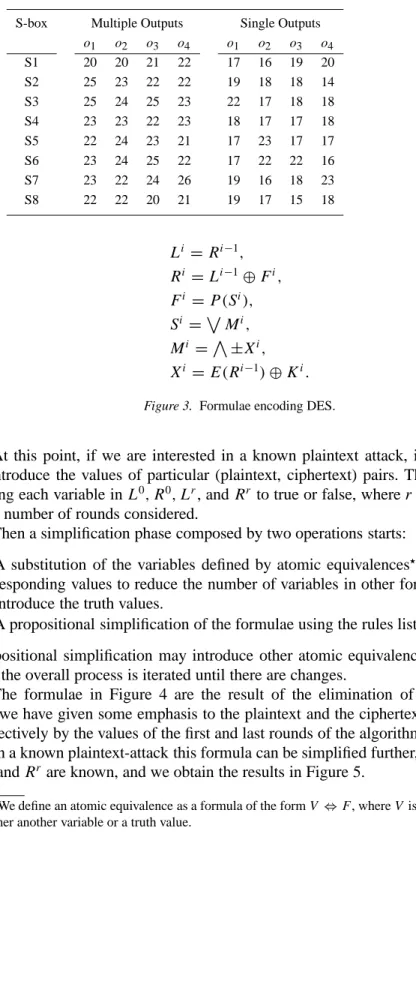
In the first case we have 8 PLAs with six input variables and four output vari-ables. After the minimization, the entries of the matrixes are reduced from 64 to 52 (51 for the eighth S-box). The distribution is presented in the first four columns of Table I. The column represents each S-box outputs.
Considering each output bit of an S-box as a single output we got 32 PLAs with six input variables and one output variable. With this kind of minimization we obtain a further improvement in terms of the number of minterms associated with each output and the average number of variables associated with each minterm. The distribution of the number of minterms is presented in the last four columns of Table I.
As for the number of variables, we note that in the first case we have on av-erage 5.4–5.6 variables per minterm and in the second case 4.8–5.0 variables per minterm.
Clearly, we have chosen the second approach for the final generation.
4.4. BUILDING THE FINAL FORMULA
After every step of DES has been encoded, we obtain a set of formulae whose conjunction is exactly the formula E(C, K, P ) that characterizes DES. To give an intuitive feeling of how it looks we present a sketch in Figure 3. For sake of readability, we have dropped the subscript corresponding to single bits and use only the superscripti to indicate theith round of DES.
Table I. Number of minterms per output.
S-box Multiple Outputs Single Outputs
o1 o2 o3 o4 o1 o2 o3 o4 S1 20 20 21 22 17 16 19 20 S2 25 23 22 22 19 18 18 14 S3 25 24 25 23 22 17 18 18 S4 23 23 22 23 18 17 17 18 S5 22 24 23 21 17 23 17 17 S6 23 24 25 22 17 22 22 16 S7 23 22 24 26 19 16 18 23 S8 22 22 20 21 19 17 15 18 Li=Ri−1, Ri =Li−1⊕Fi, Fi=P (Si), Si=WMi, Mi =V±Xi, Xi =E(Ri−1)⊕Ki.
Figure 3. Formulae encoding DES.
At this point, if we are interested in a known plaintext attack, it is necessary to introduce the values of particular (plaintext, ciphertext) pairs. This is done by setting each variable inL0, R0, Lr, andRr to true or false, wherer represents the total number of rounds considered.
Then a simplification phase composed by two operations starts:
1. A substitution of the variables defined by atomic equivalences? with the cor-responding values to reduce the number of variables in other formulae, and to introduce the truth values.
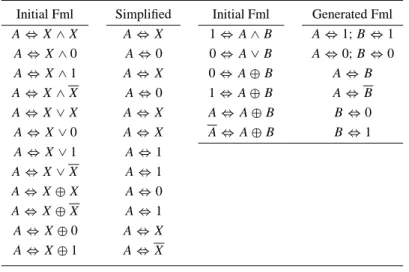
2. A propositional simplification of the formulae using the rules listed in Table II. Propositional simplification may introduce other atomic equivalences, and there-fore the overall process is iterated until there are changes.
The formulae in Figure 4 are the result of the elimination of equivalences, and we have given some emphasis to the plaintext and the ciphertext, represented respectively by the values of the first and last rounds of the algorithm.
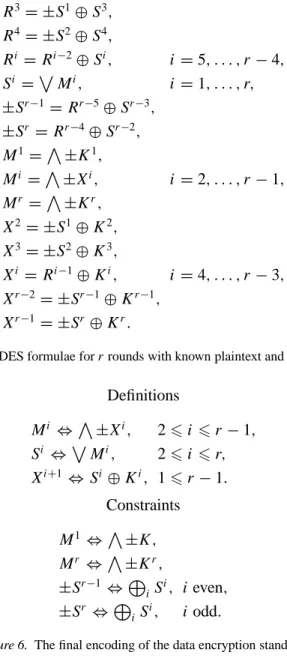
In a known plaintext-attack this formula can be simplified further, sinceL0, R0,
Lr, andRr are known, and we obtain the results in Figure 5.
? We define an atomic equivalence as a formula of the formV ⇔F, whereV is a variable andF is either another variable or a truth value.
Table II. Propositional simplification rules.
Initial Fml Simplified Initial Fml Generated Fml
A⇔X∧X A⇔X 1⇔A∧B A⇔1;B⇔1 A⇔X∧0 A⇔0 0⇔A∨B A⇔0;B⇔0 A⇔X∧1 A⇔X 0⇔A⊕B A⇔B A⇔X∧X A⇔0 1⇔A⊕B A⇔B A⇔X∨X A⇔X A⇔A⊕B B⇔0 A⇔X∨0 A⇔X A⇔A⊕B B⇔1 A⇔X∨1 A⇔1 A⇔X∨X A⇔1 A⇔X⊕X A⇔0 A⇔X⊕X A⇔1 A⇔X⊕0 A⇔X A⇔X⊕1 A⇔X R1=L0⊕S1, R2=R0⊕S2, Ri=Ri−2⊕Si, j =3, . . . , r−2, Rr−1=Rr−3⊕Sr−1, Rr =Rr−2⊕Sr, Si=WMi, i =1, . . . , r, Mi =V±Xi, i =1, . . . , r, X1=R0⊕K1, Xi=Ri−1⊕Ki, i =2, . . . , r −1, Xr =Rr−1⊕Kr.
Figure 4. DES formulae forrrounds.
The final outcome of the encoder is a formula that represents the logical re-lations between the key bits, the known plaintext, and the known ciphertext. Its structure is shown in Figure 6.
4.5. EXPERIMENTAL DATA
Since it makes no sense to do this encoding by hand, a program?has been designed and implemented to generate formulae encoding DES in an entirely modular and automatic way.
R3= ±S1⊕S3, R4= ±S2⊕S4, Ri=Ri−2⊕Si, i =5, . . . , r −4, Si =WMi, i =1, . . . , r, ±Sr−1=Rr−5⊕Sr−3, ±Sr =Rr−4⊕Sr−2, M1=V±K1, Mi=V±Xi, i =2, . . . , r −1, Mr =V±Kr, X2= ±S1⊕K2, X3= ±S2⊕K3, Xi=Ri−1⊕Ki, i =4, . . . , r −3, Xr−2= ±Sr−1⊕Kr−1, Xr−1= ±Sr ⊕Kr.
Figure 5. DES formulae forrrounds with known plaintext and ciphertext. Definitions Mi ⇔V±Xi, 26i 6r−1, Si⇔WMi, 26i 6r, Xi+1⇔Si⊕Ki, 16r−1. Constraints M1⇔V±K, Mr ⇔V±Kr, ±Sr−1⇔L iSi, i even, ±Sr ⇔L iSi, i odd.
Figure 6. The final encoding of the data encryption standard.
We can easily generate the formulae describing DES-like cryptosystems for any number of rounds up to 16, for any key and any pair of plaintext and ciphertext. All the permutation and substitution matrices (S-boxes) are read from external files so that one can change them according to one’s wishes. In this manner one can evaluate the strength of DES when the number of rounds and the values of the matrices vary.
The use of Espresso [42] to generate minimal covers for the S-boxes is the only part in our approach where human intervention is necessary: due to interface
problems, Espresso must be run on the input files using shell commands. Once Espresso files are generated (and this happens only once for each S-box), our encoder program reads directly fromEspressooutput files.
As output we can produce a textual representation using AND, OR, etc., to be used by BDD-like algorithms, a set of clauses to be used by CNF-based provers [25], and the TPTP non-clausal format [50].
We have made some tests to get information about execution times and use of memory. These tests were made on a Workstation UltraSparc using Solaris, and on a Pentium II 300 MHz using Windows 98 and Linux. Here we report only the data on Solaris and Windows 98, the data using Linux being somehow intermediate between the other two.
Execution times were better on the Pentium. In particular for the full 16-rounds version of DES,
1. to generate the generic circuit are needed almost 25.96 seconds; 2. to generate the simplified circuit are needed almost 71 seconds.
It is also possible to use the algorithm to verify that we are indeed encoding a solved instance; i.e., we generate the simplified circuit, read plaintext, key and ciphertext and verify that everything simplifies to true. This took approximately 197 seconds. Proportionately smaller timings and memory requirements were found for reduced variant of DES. For instance one or two rounds can be done within one second.
Memory usage for the three previous cases is fairly substantial and is substan-tially smaller for the Unix machines:
1. to generate the generic formulae are needed 130 MB (167 MB for Windows 98); 2. to generate the simplified formulae are needed 136 MB (175 MB for Windows
98);
3. to verify the formulae are needed 137 MB (175 MB for Win 98).
These memory requirements are likely due to a poor (say nonexistent) memory management of our algorithm. With better memory management it could also probably take much less time because it would not have to use the swap space.
Beside memory and time we have collected a substantial amount of quanti-tative data regarding the size and nature of the final encoded formula. To this extent we have concentrated on the generation of solved instances of the SAT problem, according to the methodology that we have presented in Section 3. Thus our algorithm for the generation of the benchmark suite worked as follows:
1. fix the number of rounds of DES we are interested in;
2. generate randomly a key K (the solutionvK of the SAT problem); 3. generate randomly 400 blocks of plaintext P (a block is 64 bits);
4. encrypt the plaintext with the key using DES limited to the requested number of rounds and generate the ciphertext C=EK(P);
5. encode the limited version of DES as a formulaE(P , K, C)and substitute the values of the plaintextvP and ciphertextvC.
Table III. Occurrences of formulae per single plaintext/ciphertext pair.
Round Equiv Xor And Or Clauses Vars
1 520 0 504 16 1,645 243 2 1,042 0 1,010 32 3,304 489 3 1,738 48 1,609 80 9,064 1,430 4 2,432 96 2,208 128 14,811 2,368 5 3,096 176 2,760 160 18,738 3,032 6 3,760 256 3,312 192 22,665 3,696 7 4,424 336 3,864 224 26,592 4,360 8 5,088 416 4,416 256 30,519 5,024 9 5,752 496 4,968 288 34,446 5,688 10 6,416 576 5,520 320 38,373 6,352 11 7,080 656 6,072 352 42,300 7,016 12 7,744 736 6,624 384 46,227 7,680 13 8,408 816 7,176 416 50,154 8,344 14 9,072 896 7,728 448 54,081 9,008 15 9,736 976 8,280 480 58,008 9,672 16 10,400 1,056 8,832 512 61,935 10,336
Each block of plaintext and ciphertext gives a (satisfiable) formulaE(vP, K, vC). We repeated the process for five randomly generated keys.
Table III reports the arithmetic mean of the number of equivalences, exclusive or, conjunctions, and disjunctions present in a formulaE(vP, K, vC)for the various rounds of DES. For instance the fourth row shows that if we limit DES to four rounds (1st column) thenE(vP, K, vC)is made (on average) by the conjunction of 2,432 equivalences out of which 96 contain exclusive or, 2,208 contain (multiple) conjunctions and 128 contain disjunctions. See again Figure 5 or Figure 6 for an intuitive idea of their shape.
The last two columns of Table III show the number of variables occurring in the formula that are different from the variables representing the key bits and the number of clauses that is generated whenE(vP, K, vC)is translated into clausal normal form.
Note that the data in Table III are given per single pair of plaintext and ci-phertext, and therefore the total number of the formulae, clauses, and so forth is obtained by multiplying those numbers by the number of plaintext and ciphertext pairs. For instance, the clauses corresponding to 4 blocks of plain/ciphertext for DES limited to 2 rounds are over 13,000 (3,304×4) and the variables over 1,900 (489×4).
The variance of these numbers is not shown here because it is fairly small as we move beyond the fourth round. A simple explanation is that the known values
Table IV. Occurrences of key bits per single
plain-text/ciphertext pair.
Round Avg Max Round Avg Max
1 40.99 57 9 89.03 115 2 82.01 113 10 90.79 115 3 84.79 112 11 91.64 119 4 85.64 111 12 92.5 118 5 86.50 115 13 93.36 119 6 87.36 112 14 94.21 118 7 88.21 113 15 95.07 118 8 89.07 116 16 95.93 126
of the plaintext and the ciphertext do not propagate through the rounds as soon as exclusive or starts to appear.
The clause length varies quite widely, and therefore the mean clause length is not a good indicator. However, if one looks at the way in which clauses are generated, more information can be obtained:
– for every equivalence containing an exclusive or we obtain 8 clauses of length 3; – for every equivalence containing a conjunction we obtain a number of binary
clauses (usually less than 5–6) and a large clause with 5–6 literals;
– for every equivalence containing a disjunction we obtain a number of binary clauses (as for conjunctions) and one large clause.
So, there is an overwhelming component of binary clauses with ternary clauses starting to appear as soon as exclusive or starts to appear.
For these formulae, the clause over variable ratio (the standard indicator of the hardness of random 3-SAT formulae [48]) does not explain well the hardness of the problem. Indeed, consider the case of the commercial version of DES, whose ratio clauses over variables can be identified by the following formula (wherebis the number of blocks, i.e., plaintext/ciphertext pairs, andkthe number of key bits):
c/v = 61,935×b k+10,336×b.
The number of key bits is less and less relevant as the number of blocks increases. With an infinite number of blocks, it converges to a fixed value. However, even if we add an infinite number of blocks, after 3 rounds the shift in the clause/variable ratio would be less than 1–2%. This seems to imply that adding more blocks should make the problem neither much easier nor much harder. As we shall see in Section 5, the experimental data contradict this hypothesis.
Table IV contains the average number of variables representing the key bits occurring in the formulae generated for each round.
Let6be a set of clauses using variables inV. – if6is empty return SAT;
– if6contains an empty clause return UNSAT; – (Unit Propagation) if6contains a unit clause{l}
then assignlthe value true and call recursivelyDPLL on the simplified set of clauses;
– (Splitting Rule) Select a variablevinV, assign va truth value and call recursively DPLLon the simplified set of clauses. IfDPLLreturns SAT then return SAT; otherwise assignvthe opposite truth value and return the result ofDPLLon the simplified set of clauses.
Figure 7. Davis–Putnam–Longemann–Loveland algorithm.
Not shown here is the fact that there are between 40 (1 round) and 90 (16 rounds) occurrences of each key bit. Moreover, key bits occur in approximately 17% of the total number of clauses and are the most frequently occurring variables, since other variables occur always in less than 100 formulae.
This means that almost all SAT heuristics, which are usually variants of “choose the literal with most occurrences such that X”, will select almost only key bits in the search process.
5. Experimental Cryptanalysis with Theorem Provers
To test the ability of a generic ATP to cope with cryptographic problems, we have chosen three state-of-the-art provers for propositional logic:
– TABLEAUby Crawford and Auton [15], because it is a reference implementation of the Davis-Putnam procedure and because it has been extensively tested on the random 3-SAT benchmark;
– SATOby Zhang [51, 53], because it uses the trie data structure to boost the speed of the unit propagation phase and because it has been successfully used on the encoding of semi-groups problems;
– rel-SAT by Bayardo and Schrag [5], because it combines the Davis–Putnam algorithm with back-jumping and learning of CSP algorithms and because it has been successfully used on “real-world” problems in scheduling.
The backbone algorithm used by all three provers is the Davis–Putnam–Longe-mann–Loveland (DPLL) algorithm [18, 17] which we only sketch for reference in Figure 7. For the particular implementation details of each prover we refer to
corresponding paper. We recall that a literal is either a propositional variable or a negated propositional variable and that a clause is a set of literals. A unit clause is a clause with only one literal.
Among the various possibilities described in Section 3 we have focused on key search assuming a known plaintext attack because it is the simplest problem avail-able among the SAT-problems we can generate, and because it generates solved instances. To generate the benchmark suite, we have followed the same methodol-ogy that we have presented in Section 4. The only difference here is that we have also grouped together the formulae corresponding to different plaintext using the same key. In other words we have tested the provers on the formulae
E(vC, K, vP) 2 ^ i=1 E(vCi, K, viP) . . . n ^ i=1 E(vci, K, vPi)
forn =1,2,4,8 to test whether increasing the number of constraints can lead to an increase of performance (i.e., decrease of running time) in the same fashion of what happens in random 3-CNF problems [15]. Indeed, having large quantities of plaintext is necessary for all standard cryptanalytic approaches that do not rely on exhaustive search.
All tested ATP systems admit different settings, and we have tried to stick to the recommended standards, eventually experimenting with heuristics. This was one of the main aims of the experiment: we wanted to see how a generic ATP system performed without being told any information on the problem, i.e., whether SAT-solvers were able to automatically detect and exploit the underlying hidden properties of DES which have been the subject of intense cryptographic research. Indeed the SAT-based approach make sense only if we just need to specialize our SAT-algorithm at the level of heuristics or just add features (such as reasoning with affine subproblems) that are of general interest.
In this framework, the only reasonable re-engineering of the heuristics is the limitation of the branching search variables to the known independent control vari-ables, i.e., to the 56 bits of the key. We have explored this possibility with the various provers but without great successes. This contrasts with other applications of SAT-based encodings, such as planning, where branching on a restricted set of variables, the others being implied, considerably improves the performance [47]. We discuss this issue later in this section.
The tests have been run on SUN UltraSparcs running Solaris with 64 M RAM and on a Pentium II with the same memory and we obtained qualitatively the same results (to avoid normalization problems we only report here the CPU running time on the SUN machines).
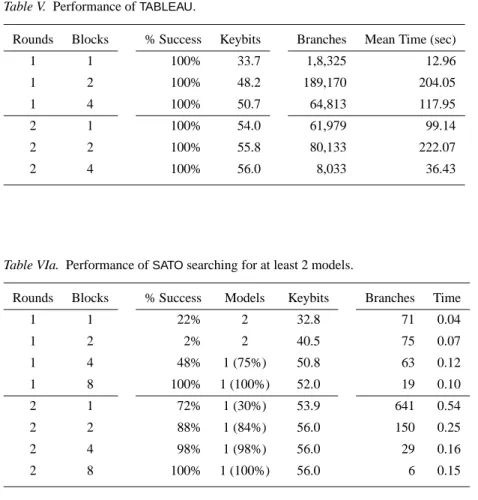
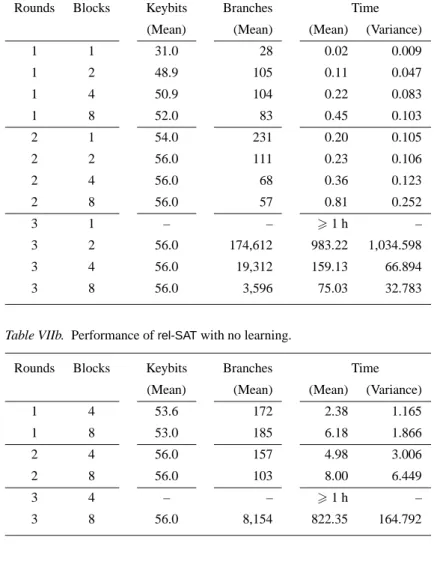
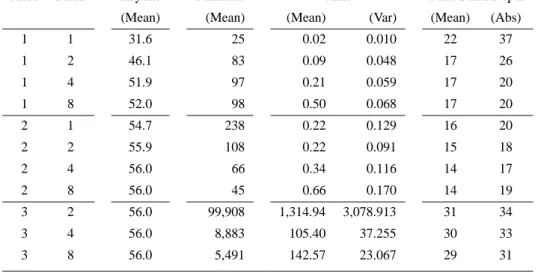
For each prover, we report the results as follows: for each class of instances, characterized by the number of rounds of DES and by the number of blocks (i.e., number of E(vCi, K, viP)formulae that are conjoined together) we report the per-centage of success in finding a solution and the mean time in seconds necessary
to find a solution. For mean time we intend the arithmetic mean? over the total number of instances of the class (see Section 4). We also report the mean number of branches explored during the search, with the caveat that each algorithm has a slightly different notion of what constitute a branch. Hence, comparison of number of branches across different provers should only be made w.r.t. scaling rather than w.r.t. absolute values.
Since we didn’t know whether the encoding of a plaintext and ciphertext pair would have admitted different models, i.e., keys,†whenever a model was found it was compared with the “original key” used to generate the instance. The average number of matching key bits (arithmetic mean over all instances) is then reported in the tables for each benchmark class.
To be fully complete, our experiments should have also explored another source of randomness: varying the keys, i.e., the solutions of the SAT instances, while keeping the plaintexts fixed (recall that in the bulk of the experiments the key is randomly generated but stay fixed for all the 400 plaintexts we have generated). We have investigated this possibility only for one of the algorithm (i.e.,rel-SAT), and we have not found any significant pattern (although our experiments were limited to 50 different keys). Since cryptography research has also investigated key patterns without much results, whereas plaintexts and ciphertexts analysis has led to sub-stantial attacks, we have postponed the analysis of key randomness to future works. A further general observation concerning the organization of the experiments is the use of normalization: since all chosen ATP systems require clausal normal form we have used the CNF generation facilities provided by the encoder. Before using the clause file as input for the search algorithms, a preprocessing step was necessary to “compact” the integer values used for representing variables??since the encoding was so sparse that we exceeded the maximum number of atoms readable by the ATP systems. The running time of this auxiliary algorithm is not included in the running time of the provers.
The results are reported in separate subsections for each prover, and a final part with general observations concludes this section.
5.1. TABLEAUON DES
Table V contains the running time of TABLEAU for the limited version of DES for which it could solve some problems.TABLEAUhas been run with the standard setting, and eventually with purity disabled.
? We have used the mean time rather than the median time because the running times do not show the big outliers exhibited by random 3-SAT [15, 48].
†Recall that if we have more than one key for the same pair, the cipher is not faithful, and we have
semi-weak keys. See again Section 2 for details.
??Our encoder used a redundant and sparse encoding so that one could detect from which round and which pair of ciphertext and plaintext a variable came.
Table V. Performance ofTABLEAU.
Rounds Blocks % Success Keybits Branches Mean Time (sec)
1 1 100% 33.7 1,8,325 12.96 1 2 100% 48.2 189,170 204.05 1 4 100% 50.7 64,813 117.95 2 1 100% 54.0 61,979 99.14 2 2 100% 55.8 80,133 222.07 2 4 100% 56.0 8,033 36.43
Table VIa. Performance ofSATOsearching for at least 2 models.
Rounds Blocks % Success Models Keybits Branches Time
1 1 22% 2 32.8 71 0.04 1 2 2% 2 40.5 75 0.07 1 4 48% 1 (75%) 50.8 63 0.12 1 8 100% 1 (100%) 52.0 19 0.10 2 1 72% 1 (30%) 53.9 641 0.54 2 2 88% 1 (84%) 56.0 150 0.25 2 4 98% 1 (98%) 56.0 29 0.16 2 8 100% 1 (100%) 56.0 6 0.15
Note that the problem becomes easier as we add more ciphertext and plaintext pairs. We stopped at 8 blocks because the formulae could not be read byTABLEAU: there were too many variables (see again Section 4 for the size of the problem). The running times had very limited variance, which is not shown for readability.
Yet, it is not all so easy: TABLEAU could not solve 3 rounds of DES in two hours, no matter the number of blocks. Increasing the time limit before timeout has been also tried (up to one day) but to no avail. Increasing the number of rounds did not lead to any solution either.
Re-engineering TABLEAUto branch only on key bits was too hard a task (be-cause of the poor documentation of the program), so we have relied on an alter-native implementation using the same heuristics which have been used for finding minimal models [27]. This further experimental analysis was again not conclusive: by restricting to independent variables we do not seem to gain much. In particular we are still not able to crack DES with three rounds.
Table VIb. Performance ofSATOsearching for 1 model.
Rounds Blocks % Success Keybits Branches Time
2 1 76% 53.3 458 0.36 2 2 96% 55.6 118 0.19 2 4 100% 56 18 0.10 2 8 100% 56 9 0.14 3 8 50% 56 269,804 2,192.73 5.2. SATOON DES
The timings ofSATOare shown in Table VIb and Table VIa. At the beginning we have triedSATOwith the standard setting and then with different options (such as searching for more than one model) and search heuristics. Table VIa refers to the standard settings, but we stopped the search after the second model has been found (or the search space exhausted). Table VIb is generated by stopping the search after the first model has been found.
Since we have not limited the search to the first model, this explains the greater running time and number of branches in comparison withTABLEAU. In the column “Models” we show between brackets the number of instances on which only one model was found. Also in this case the variance of the running time was limited, and it suggests that the running time distribution of the problem does not exhibit a heavy tail behavior.
Most ofSATO’s failures are due to virtual memory failure rather than the two hours timeout. Thus, we have decided to run SATOon a Pentium II with 64 M but with a swap space of over 628 M. It turned out that if we let SATO run on three rounds of DES without time limit we could solve all instances within few minutes of actual CPU time. Yet, if we looked at “real” time, it took over 12 hours for a single instance to be solved. In practice, the time is spent by swapping the trie data structure in and out main memory and then performing very few quick operations on each part of the trie. Therefore, we have decided not to include these latest running times into the table: they may give a wrong idea of the computational resources needed bySATO.
For the case of one round and eight blocks, the strange results that we get are for only one model, and yet only 52 out of 56 bits can be explained by the fact that not all key bits occur in the corresponding formulae and SATO has been used with purity on (that is setting to false any bit that does not occur).
WithSATOwe have also experimented with different heuristics and a new fea-ture of the algorithm that makes it possible to generate lemmata corresponding to closed branches. We have also experimented with a simple list structure rather than the trie data structure. The worst heuristics for this problem seemed to be that