Towards the development of a holistic planning
framework for a Logistics City-Cluster: A
multinational modified Delphi Study
A thesis submitted in fulfilment of the requirements for
the award of the degree of
Doctor of Philosophy
Carsten Sengpiehl
Dipl.-Wirtsch.-Ing. (FH)
Victoria University
Faculty of Health, Engineering and Science
Institute for Logistics and Supply Chain Management
ABSTRACT
Macroeconomic competition between regions and countries has intensified dramatically in recent years, and as a result, selection of a favourable location and organisation of a logistics node plays an important role in determining a region’s ability to participate in emergent globalisation opportunities. Global connectivity of an area and its related industries, together with their ability to retain and further develop a ‘competitive advantage’, requires a significant review of the way in which a region interfaces with the rest of the world.
The Logistics City-Cluster concept, which is one of the latest manifestations of a logistics node, is believed to be a suitable strategy to address these changes. However, whilst the Logistics City-Cluster is accepted by industry as a viable and unique concept, the nature of composition, characteristics and impact is still fragmented and very limited. The continued growth of this new strategy has made it imperative to develop a coherent knowledge base, ensuring future orderly development. Hence, this research was twofold: first, it sought to contribute to the theoretical knowledge of the common enabling elements of a Logistics City-Cluster and of their core influential factors; and secondly to explore the underlying assumptions that sustainable regional growth can be provided by such a concept.
Because of the limited literature and inherently subjective nature of the conceptual environment, a modified Delphi approach, applying three iterations, appeared to be the most suitable methodology for the development of a Logistics City-Cluster framework. Round I used relevant literature and two un-structured interviews with key informants to generate a preliminary framework. Round II enriched and restructured this preliminary work using semi-structured face-to-face interviews with respondents who held significant executive positions in four European Logistics City-Clusters. In Round III, the elaborated framework was substantiated via a questionnaire to experts associated with world class clusters in Europe and the Asia-Pacific region.
elements. Both influential aspects are imperative for the development and growth of the Logistics City-Cluster. Finally, the ‘Impact’ category describes the positive and negative effects on the economy, environment and society that occur within a region due to the existence of a logistics-driven system.
This research provides a systematic contribution to knowledge by: (i) clearly defining a Logistics City-Cluster and distinguishing it from other existing logistics type configurations; (ii) structuring its enabling elements and representing their mutual interactions; (iii) identifying external influences on the setup of a Logistics City-Cluster; and (iv) understanding the impact on a host region caused by introduction of a Logistics City-Cluster. Most importantly, it presents a validated description which brings the three categories together in one holistic framework, since changing one parameter of the model results in the alteration of other due to the dynamic interdependencies of the categories and their sub-concepts.
The developed framework and its derived implications hold the potential for the efficient planning of Logistics City-Clusters, in order to achieve competitive advantage as a supply chain location. In particular, the fact that the framework is derived from, and validated by, executive experts underpins its potential as an integrated tool-kit that offers detailed knowledge to facilitate systematic development or expansion of Logistics City-Clusters. It provides a roadmap to guide the efficient allocation of resources to facilitate a sustainable development. Indeed, the major contribution for the practitioner is the assertion that the framework is a holistic system in which all categories have dynamic interdependencies. Hence, the categories cannot be dealt with separately when attempting to achieve long term success.
DECLARATION
I, Carsten Sengpiehl, declare that the PhD thesis entitled “Towards the development of a holistic planning framework for a Logistics City-Cluster: A multinational modified Delphi-Study” is no more than 120,000 words in length including quotes and exclusive of tables, figures, appendices, bibliography, references and footnotes. This thesis contains no material that has been submitted previously, in whole or in part, for the award of any other academic degree or diploma. Except where otherwise indicated, this thesis is my own work.
ACKNOWLEDGEMENTS
The PhD process is a voyage which takes many years to complete. During this exciting and stimulating, but at times exhausting and difficult journey, I was accompanied by wonderful people who supported me in innumerable ways. I am grateful to all of them.
I would like to thank my supervisors Prof. Dr. Pieter Nagel and Prof. Dr. Peng Shi for their guidance, financial support and particular knowledge which contributed to the study. Importantly, I thank Prof. Dr. Jim Sillitoe for the time, energy and expertise offered over the years, in order to provide me with the skills and knowledge required for the production of this work. Foremost your encouragement, intensive supervision and support for my intellectual and personal development are immensely appreciated. It has bound us as friends and I hope I can return a favour to you.
I also thank past members of the Institute for Logistics and Supply Chain Management for their support. Especially Dr Yong Wu for his support and time regarding my computer-related challenges and recovering my work when my hard disk said
‘Goodbye my German mate’. I would also like to thank Ms. Lyn Russel for her
professional administrative support and Mr. Thibault Neville for his help in preparing the software to visualise the boxplots.
Special thanks to the dynamic and smart PhD research fellows from 14 Geelong Road for their collegiality and friendship. Heli, YoYo, Louise, Nickson, Rimsky and Johanudin - You made my time in the PhD house an enjoyable experience. Special thanks to ‘Stimpy’ for smiling everyday, it surely cheered me up. You all can do it.
I would like to thank the more than 40 ‘executive experts’ that generously participated in this research. Their contribution was essential for the type of research carried out. I hope the conclusions and implications for policy and management in Logistics City-Clusters can serve as recompense for the time offered.
My deep love and appreciation goes to my family in Germany with whom I shared my childhood and whose love and support still sustain me today. A special thanks to my brothers, Torsten and Christoph, who are so much part of me and my memories. Ich
vermisse Euch sehr. Sincere gratitude to my parents, Wolfgang and Heike, who gave
me a curiosity about life with their love for books and learning. You have been always there and supported me in all my pursuits in life. In turbulent times at sea you always have been a safe harbour, in which you provided me strength, motivation and happiness. Thank you for believing in me. This thesis is dedicated to you.
Last but not least, I would like to thank my wonderful ‘African Queen’. You have been
my pillar, my joy and my guiding light in the last year. Your love through understanding, constant support and sincere patience has always given me strength, especially helped me in my difficult times and has enriched my life. Ondi kuhole.
List of Recent Publications
Journal Publications
Sengpiehl, C., Oakden, R., Nagel, P., Toh, K.T.K. and Shi, P. (2008) The Emergence of Logistics Cities: Conceptual Model. Journal of Transport and Supply Chain Management. 2 (1), 58-77.
Toh, K.T.K., Oakden, R., Nagel, P., Sengpiehl, C. and Shi, P. (2008) A Model for an Inland Port in Australia. Journal of Transport and Supply Chain Management. 2 (1),
78-92.
Refereed Conference Publications
Sengpiehl, C., Wu, Y. and Nagel, P. (2009) Logistics Cities: A Spatial Requirement Framework. In: 14th International Symposium on Logistics – Global Supply Chain and
Inter-Firm Networks. Proceedings of 14th ISL, 2009. Istanbul: Centre for Concurrent
Enterprises Nottingham University.
Manzoni, A. and Sengpiehl, C. (2009) Inter-Firm Performance for Global Networks: An Optimisation Model Using Data Envelopment Analysis. In: 14th International Symposium on Logistics – Global Supply Chain and Inter-Firm Networks. Proceedings
of 14th ISL, 2009. Istanbul: Centre for Concurrent Enterprises Nottingham University.
Wu, Y., Sengpiehl, C., Toh, K. and Nagel, P. (2009) The Progression to Logistics City and its Implication on Economies of Agglomeration. In: 14th International Symposium
on Logistics – Global Supply Chain and Inter-Firm Networks. Proceedings of 14th ISL,
2009. Istanbul: Centre for Concurrent Enterprises Nottingham University.
Sengpiehl, C., Toh, K.T.K., Nagel, P. and R. Oakden, R. (2008) Conceptual Map of a Logistics City. In: 13th International Symposium on Logistics - Integrating the Global
Supply Chain. Proceedings of 13th ISL, 2008. Bangkok: Centre for Concurrent
Enterprises Nottingham University.
Toh, K.T.K., Sengpiehl, C., Oakden, R., Nagel, P. and Shi, P. (2008) The National Logistics City Business and Information Systems Architecture. In: Third International Conference on Innovative Computing, Information and Control. Proceedings of ICICIC
2008 – 2214. Dalian:Conference Publishing Services.
Technical Paper:
Wu, Y. and Sengpiehl, C. (2010) Comparison of Road and Rail Transport for
Container Distribution in Melbourne. Melbourne: Technical Report by the Institute for
Logistics and Supply Chain Management.
Nagel, P., Toh, K. and Sengpiehl, C. (2009) A Scoping Framework for Logistics Cities
in Victoria. Melbourne: Technical Report by the Institute for Logistics and Supply
Chain Management.
Nagel, P., Wu, Y. and Sengpiehl, C. (2009) Western Metropolitan Region of
Melbourne – Logistics City. Melbourne: Technical Report by the Institute for Logistics
TABLE OF CONTENTS
ABSTRACT... i
DECLARATION ... iii
ACKNOWLEDGEMENTS... iv
LIST OF RECENT PUBLICATIONS... vi
TABLE OF CONTENTS... vii
LIST OF FIGURES... xiii
LIST OF TABLES ... xvii
LIST OF ABBREVIATIONS... xviii
CHAPTER 1 INTRODUCTION ... 1
1.1. BACKGROUND AND CONTEXT...1
1.2. RESEARCH OBJECTIVES...4
1.3. RESEARCH PARADIGM, METHODOLOGY AND METHODS...5
1.4. SIGNIFICANCE OF THE STUDY...8
1.5. STRUCTURE OF THE THESIS...9
CHAPTER 2 LITERATURE REVIEW: LOGISTICS CITY-CLUSTERS ...12
2.1 INTRODUCTION...12
2.2 REVIEW OF LOGISTICS NODE PROGRESSIONS...13
2.2.1 ‘Freight Villages’... 13
2.2.2 ‘Inland Ports’... 15
2.2.3 ‘Freight Hubs’... 17
2.2.4 ‘Intermodal Terminals’... 18
2.2.5 ‘Logistics Cities’... 19
2.2.6 ‘Logistics Clusters’... 23
2.2.7 Evolution of logistics nodes... 26
2.2.8 Concluding logistics node progressions... 29
2.3 REVIEW OF CLUSTER THEORIES...31
2.3.1 Relevant cluster theories... 32
2.3.1.1 The ‘Neo-Classic Economic School of Thought’...35
2.3.1.2 The ‘Social and Institutional School of Thought’...38
2.3.1.3 The ‘Strategic Diamond School of Thought’...39
2.3.1.4 Various ‘Smaller Schools of Thought’...42
2.3.2 Concluding cluster theories... 44
2.4 REVIEW OF SUSTAINABLE DEVELOPMENT...45
2.4.1 The concept of sustainable development... 46
2.4.2 The ‘Triple Bottom Line’ approach... 48
2.4.2.1 The economic dimension...50
2.4.2.2 The environmental dimension...51
2.4.2.3 The social dimension...53
2.4.3 Concluding sustainable development... 55
CHAPTER 3
THE RESEARCH DESIGN ...59
3.1 INTRODUCTION...59
3.2 DISCUSSION OF ALTERNATIVE RESEARCH DESIGNS...60
3.3 DESCRIPTION OF THE RESEARCH PARADIGM...62
3.3.1 Constructivism: The underpinning epistemology... 63
3.3.2 Interpretivism: The underpinning theoretical perspective... 64
3.4 METHODOLOGY:THE MODIFIED ‘DELPHI STUDY’...64
3.4.1 Investigation of possible methodologies... 65
3.4.2 Justification for using a modified ‘Delphi Study’... 67
3.4.3 Key principles of the applied modified ‘Delphi Study’... 69
3.4.3.1 The role of the expert panel...69
3.4.3.2 The use of iterative rounds...71
3.4.3.3 The process of controlled feedback...72
3.4.3.4 The anonymity of response...73
3.5 DATA COLLECTION AND ANALYSIS METHODS...73
3.5.1 Methods applied in ‘Round I’... 73
3.5.1.1 Data Collection: Literature reinterrogation and un-structured interviews.74 3.5.1.2 Data Analysis: Content analysis...76
3.5.2 Methods applied in ‘Round II’... 78
3.5.2.1 Data Collection: Semi-structured face-to-face interviews...78
3.5.2.2 Data Analysing: Substantial and theoretical coding...80
3.5.3 Methods applied in Round III... 82
3.5.3.1 Data Collection: Survey questionnaire...82
3.5.3.2 Data Analysis: Descriptive statistics...84
3.6 CONCLUDING THE STRENGTHS AND WEAKNESSES OF THE RESEARCH DESIGN...85
CHAPTER 4 DELPHI ROUND I: ESTABLISHING THE PRELIMINARY LOGISTICS CITY-CLUSTER FRAMEWORK ...88
4.1 THE PRELIMINARY LOGISTICS CITY-CLUSTER FRAMEWORK...88
4.2 THE PRELIMINARY ‘ENABLER’ CATEGORY...89
4.2.1 Infrastructure... 89
4.2.2 Services... 91
4.2.3 Skilled workforce... 93
4.2.4 Proximate demand... 94
4.2.5 Stakeholders... 94
4.2.6 Governance and policy... 95
4.2.7 An overview of the ‘Enabler’ category... 96
4.3 THE PRELIMINARY ‘SCOPE’ CATEGORY...98
4.3.1 Economic dimension... 98
4.3.2 Environmental dimension... 99
4.3.3 Social dimension... 101
4.3.4 An overview of the ‘Scope’ category... 102
CHAPTER 5
DELPHI ROUND II: THE CONCEPT OF LOGISTICS CITY-CLUSTERS AND AN
ELABORATED FRAMEWORK ...106
5.1 INTRODUCTION AND STRUCTURE OF THE CHAPTER...106
5.2 A DEFINITIONAL CONCEPTION:LOGISTICS CITY-CLUSTERS...106
5.2.1 Interpretations of the current term ‘Clusters’... 107
5.2.2 Interpretations of the current term ‘Logistics’... 108
5.2.3 The relevance of geographical borders... 112
5.2.4 Interim conclusions... 115
5.3 AN ELABORATED LOGISTICS CITY-CLUSTER FRAMEWORK...115
5.3.1 Reflection on the amendments of the preliminary framework... 116
5.3.2 The elaborated Logistics City-Cluster framework... 117
CHAPTER 6 DELPHI ROUND II: EXPLICATION OF THE ENABLING CATEGORIES...118
6.1 THE ENABLER CATEGORY OF LOGISTICS CITY-CLUSTERS...118
6.1.1 Market Enabler... 119
6.1.1.1 Segmentation of markets...119
6.1.1.2 Local, regional and international markets...120
6.1.1.3 The role of market size...123
6.1.1.4 The relevance of the quality of markets...124
6.1.1.5 Concluding the ‘Market’ enabler...126
6.1.2 Infrastructure Enabler... 127
6.1.2.1 The critical function of logistics infrastructure...127
6.1.2.2 The necessity of IT infrastructure...132
6.1.2.3 The role of social infrastructure...133
6.1.2.4 Concluding the ‘Infrastructure’ enabler...135
6.1.3 Service Enabler... 137
6.1.3.1 The lower and higher value-add logistics activities...137
6.1.3.2 The role of services supporting logistics activities...140
6.1.3.3 The importance of logistics activities in a region...142
6.1.3.4 Concluding the ‘Service’ enabler...144
6.1.4 Workforce Enabler... 145
6.1.4.1 Segmentation of workforce...145
6.1.4.2 Challenges of recruiting appropriate workforce...148
6.1.4.3 Demand coverage of required workforce...149
6.1.4.4 Proximity of workforce...150
6.1.4.5 Concluding the ‘Workforce’ enabler...151
6.1.5 Knowledge Enabler... 152
6.1.5.1 The role of knowledge creation...153
6.1.5.2 Private and public involvement in knowledge creation...155
6.1.5.3 Collaboration in the area of innovation...156
6.1.5.4 Concluding the ‘Knowledge’ enabler...158
6.1.6 Capital Enabler... 159
6.1.6.1 The private and public role related to capital accessibility...159
6.1.6.2 Accessibility of capital for operational functionalities...160
6.1.6.3 Accessibility of capital for infrastructure investment...162
6.1.7 Competition Enabler... 166
6.1.7.1 The role of intra-competition...166
6.1.7.1.1 Intra-competition of trade gateways...167
6.1.7.1.2 Intra-competition of logistics service provider...168
6.1.7.2 The role of inter-competition...169
6.1.7.2.1 Inter-competition of trade gateways ... 170
6.1.7.2.2 Inter-competition of logistics service providers... 171
6.1.7.2.3 Inter-competition and the notion of proximity ... 172
6.1.7.3 Concluding the ‘Competition’ enabler...173
6.1.8 Governance Enabler... 174
6.1.8.1 The necessity of governance...175
6.1.8.2 Historical grown governance...176
6.1.8.3 Pure Logistics City-Cluster governance...177
6.1.8.4 Concluding the ‘Governance’ category...181
6.2 CONCLUSION...182
CHAPTER 7 DELPHI ROUND II: EXPLICATION OF INFLUENCE CATEGORIES ...184
7.1 THE ROLE OF INFLUENCES ON THE ‘ENABLER CATEGORIES’...184
7.2 POLITICAL INFLUENCE ON THE ENABLERS...185
7.2.1 The role of politics for the market enabler... 185
7.2.2 The role of politics for the infrastructure enabler... 187
7.2.3 The role of politics for the service enabler... 188
7.2.4 The role of politics for the workforce enabler... 190
7.2.5 The role of politics for the knowledge enabler... 192
7.2.6 The role of politics for the capital enabler... 194
7.2.7 The role of politics for the competition enabler... 195
7.2.8 The role of politics for the governance enabler... 198
7.2.9 Concluding the influence of ‘Politics’... 199
7.3 THE INFLUENCE OF GEOGRAPHY ON THE BASE AND FUNCTIONAL ENABLERS...200
7.3.1 Geography as an accessibility factor to the markets... 201
7.3.1.1 Proximity to the markets as an accessibility factor...201
7.3.1.2 Topographical conditions as an accessibility factor...203
7.3.2 Geography and its influence on the functional enablers... 204
7.3.3 Geography a past-dependent factor... 205
7.3.4 Concluding the influence of ‘Geography’... 207
7.4 CONCLUDING THE ‘INFLUENCE’ CATEGORY...208
CHAPTER 8 DELPHI ROUND II: EXPLICATION OF THE IMPACTS ON THE REGION ...210
8.1 THE IMPACT OF A LOGISTICS CITY-CLUSTER ON THE REGION...210
8.2 THE ECONOMIC IMPACT...211
8.2.1 The significance of employment opportunities... 212
8.2.2 The importance of value-add for the region... 214
8.2.3 Tax and duties as revenue originators for authorities... 215
8.2.4 Income for the workforce... 217
8.3 THE ENVIRONMENTAL IMPACT...219
8.3.1 The challenge of pollution... 219
8.3.2 Land use and destruction... 221
8.3.3 The effects of noise, odour and visual appearance... 222
8.3.4 Rising awareness of negative environmental impact... 223
8.3.5 Current activities to reduce environmental degradation... 225
8.3.6 Concluding the ‘Environment’ impact category... 229
8.4 THE SOCIAL IMPACT...230
8.4.1 The effects on liveability... 231
8.4.2 Material well-being and work related impact... 233
8.4.3 Interconnectedness of the community... 235
8.4.4 Concluding the ‘Social’ impact category... 238
8.5 CONCLUDING THE IMPACT CATEGORY...239
CHAPTER 9 VALIDATION OF THE LOGISTICS CITY-CLUSTER FRAMEWORK ...241
9.1 INTRODUCTION:THE ANALYSING LOGIC OF ROUND III...241
9.2 VALIDATION OF THE CONCEPTUAL LOGISTICS CITY-CLUSTER DESCRIPTION ...242
9.3 VALIDATION OF THE FRAMEWORK...243
9.3.1 Validation of the enabler categories... 244
9.3.1.1 The market base enabler...244
9.3.1.2 The infrastructure enabler...247
9.3.1.3 The service enabler...251
9.3.1.4 The workforce enabler...254
9.3.1.5 The knowledge enabler...258
9.3.1.6 The capital enabler...262
9.3.1.7 The competition enabler...266
9.3.1.8 The governance enabler...271
9.3.2 Validation of the influence categories... 275
9.3.2.1 Analysis of the political influence...275
9.3.2.1.1 Influence on market size and quality ... 276
9.3.2.1.2 Influence on the infrastructure ... 277
9.3.2.1.3 Influence on the service enabler... 278
9.3.2.1.4 Influence on the workforce enabler ... 279
9.3.2.1.5 Influence on the knowledge enabler... 281
9.3.2.1.6 Influence on the capital enabler... 282
9.3.2.1.7 Influence on the competition enabler ... 283
9.3.2.1.8 Influence on the governance enabler ... 284
9.3.2.1.9 General notions on the political influence... 285
9.3.2.2 Analysis of the geographical influence...286
9.3.3 Validation of the impact categories... 290
9.3.3.1 Analysis of the economic impact category...290
9.3.3.1.1 Employment opportunities ... 290
9.3.3.1.2 Importance of value-add... 291
9.3.3.1.3 Income for governments and the workforce ... 292
9.3.3.1.4 General notion of the economic impact category... 294
9.3.3.2 Analysis of the environmental impact category...294
9.3.3.2.1 The effects of logistics activities on the environment ... 294
9.3.3.2.2 Rising awareness of negative environmental impact ... 297
9.3.3.2.3 Activities to reduce negative environmental impact ... 298
9.3.3.3 Analysis of the social impact...302
9.3.3.3.1 Effects on the liveability factors ... 302
9.3.3.3.2 Material well-being and work related impact ... 305
9.3.3.3.3 Interconnectedness of the community... 306
9.3.3.3.4 General notion of the social impact category ... 309
9.4 CONCLUDING DELPHI ROUND III...310
CHAPTER 10 IMPLICATIONS AND FURTHER RESEARCH OPPORTUNITIES...316
10.1 INTRODUCTION...316
10.2 A PRECISE UNDERSTANDING OF LOGISTICS CITY-CLUSTERS...317
10.3 THE LOGISTICS CITY-CLUSTER FRAMEWORK...318
10.3.1 The enabler categories and influential factors - Implications... 320
10.3.1.1 The market base enabler...322
10.3.1.2 The infrastructure enabler...323
10.3.1.3 The service enabler...325
10.3.1.4 The workforce enabler...326
10.3.1.5 The knowledge enabler...327
10.3.1.6 The capital enabler...329
10.3.1.7 The competition enabler...330
10.3.1.8 The integrating governance enabler...331
10.3.2 The impact categories - Implications... 333
10.3.2.1 Economic impact...334
10.3.2.2 Environment impact...336
10.3.2.3 Social impact...338
10.4 SIGNIFICANCE AND KNOWLEDGE CLAIMS OF THIS RESEARCH...339
10.5 LIMITATIONS OF THE STUDY AND SUGGESTION FOR FURTHER RESEARCH...341
LIST OF REFERENCES ... 343
APPENDIX 1: ROUND II - INTERVIEW INFORMATION PACKAGE ... 371
APPENDIX 2: ROUND II - CERTIFICATION OF ACCREDITED TRANSLATION.... 372
LIST OF FIGURES
Figure 1.3-1: The research design... 7
Figure 1.5-1: Thesis structure... 9
Figure 2.2-1: Progressions of logistics nodes... 29
Figure 2.2-2: First insight of Logistics City-Clusters ... 30
Figure 2.3-1: Notions of the ‘Neo-Classic Economic Theory’ ... 38
Figure 2.3-2: The strategic ‘Diamond Framework’... 40
Figure 2.4-1: Sustainable development – The ‘Triple Bottom Line’ approach ... 49
Figure 3.2-1: Aggregation of research design approaches... 61
Figure 4.1-1: The preliminary Logistics City-Cluster framework ... 88
Figure 4.2-1: The core elements of the initial ‘Enabler’ category... 89
Figure 4.2-2: The preliminary ‘Infrastructure’ enabler... 91
Figure 4.2-3: The preliminary ‘Service’ enabler ... 93
Figure 4.2-4: The preliminary ‘Skilled Workforce’ enabler ... 93
Figure 4.2-5: The preliminary ‘Proximate Demand’ enabler ... 94
Figure 4.2-6: The preliminary ‘Stakeholders’ enabler ... 95
Figure 4.2-7: The preliminary ‘Governance and Policy’ enabler... 96
Figure 4.2-8: The integrated ‘Enabler’ category of the preliminary framework ... 97
Figure 4.3-1: The core elements of the ‘Scope’ category ... 98
Figure 4.3-2: The preliminary ‘Economic’ scope category... 99
Figure 4.3-3: The preliminary ‘Environmental’ scope category... 100
Figure 4.3-4: The preliminary ‘Social’ scope category... 102
Figure 4.3-5: The integrated ‘Scope’ category of the preliminary framework ... 102
Figure 5.3-1: The elaborated Logistics City-Cluster framework... 117
Figure 6.1-1: The elaborated ‘Enabler’ category ... 118
Figure 6.1-2: The ‘Market’ category and its properties ... 127
Figure 6.1-3: The ‘Infrastructure’ category and its properties ... 136
Figure 6.1-4: The ‘Service’ category and its properties ... 145
Figure 6.1-5: The ‘Workforce’ category and its properties... 152
Figure 6.1-6: The ‘Knowledge’ category and its properties ... 159
Figure 6.1-7: The ‘Capital’ category and its properties ... 166
Figure 6.1-8: The ‘Competition’ category and its properties ... 174
Figure 6.1-9: The ‘Governance’ category and its properties... 182
Figure 7.1-1: The influential factors of politics and geography ... 184
Figure 7.2-1: Politics as an influential factor ... 200
Figure 8.1-1: The impact categories and its sub-segments... 210
Figure 8.1-2: The application of the impact analysis ... 211
Figure 8.2-1: The ‘Economic’ impact category ... 219
Figure 8.3-1: The ‘Environmental’ impact category ... 230
Figure 8.4-1: The ‘Social’ impact category ... 239
Figure 9.1-1: Analysing logic ... 242
Figure 9.2-1: Results – Conceptual description... 243
Figure 9.3-1: Results – Structure of the Logistics City-Cluster framework ... 244
Figure 9.3-2: Results – Structure of the enabling category ... 244
Figure 9.3-3: Results – Market segmentation and location ... 245
Figure 9.3-4: Results – Market size and quality... 246
Figure 9.3-5: Results – Market ‘Enabler’ ... 246
Figure 9.3-6: Results – Transport and gateway infrastructure... 247
Figure 9.3-7: Results – Land allocation, innovation and quality ... 248
Figure 9.3-8: Results – ICT infrastructure... 249
Figure 9.3-9: Results – Social infrastructure... 250
Figure 9.3-10: Results – Infrastructure ‘Enabler’ ... 251
Figure 9.3-11: Results – Logistics higher and lower value-add activities ... 251
Figure 9.3-12: Results – Outsourcing and supporting activities ... 252
Figure 9.3-13: Results – Importance of core activities... 253
Figure 9.3-14: Results – Service ‘Enabler’ ... 254
Figure 9.3-15: Results – Segmentation of the workforce ‘Enabler’... 254
Figure 9.3-16: Results – Scarcity of the workforce ... 255
Figure 9.3-17: Results – Addressing scarcity of the workforce... 256
Figure 9.3-18: Results – Proximity of the workforce ... 257
Figure 9.3-19: Results – Workforce ‘Enabler’ ... 258
Figure 9.3-20: Results – Role of knowledge creation ... 258
Figure 9.3-21: Results – Private role in knowledge creation ... 259
Figure 9.3-22: Results – Public role in knowledge creation... 260
Figure 9.3-23: Results – Collaboration to innovate... 261
Figure 9.3-24: Results – Knowledge ‘Enabler’... 262
Figure 9.3-25: Results – Private and public role in accessibility of capital ... 263
Figure 9.3-26: Results – Accessibility of capital for logistics operations... 263
Figure 9.3-27: Results – Accessibility of capital for infrastructure investments ... 264
Figure 9.3-28: Results – Capital ‘Enabler’ ... 265
Figure 9.3-29: Results – Classification of the competition ‘Enabler’... 266
Figure 9.3-31: Results – Intra-competition of logistics service provider ... 268
Figure 9.3-32: Results – Inter-competition of trade gateways ... 269
Figure 9.3-33: Results – Inter-competition of logistics service provider ... 270
Figure 9.3-34: Results – Interdependency of proximity and inter-competition... 270
Figure 9.3-35: Results – Competition ‘Enabler’ ... 271
Figure 9.3-36: Results – Necessity of governance ... 271
Figure 9.3-37: Results – Current strategic logistics planning ... 272
Figure 9.3-38: Results – LC-C governance and its requirements... 273
Figure 9.3-39: Results – Focus of a governance model ... 274
Figure 9.3-40: Results – Governance ‘Enabler’... 275
Figure 9.3-41: Results – Setup of influence categories ... 275
Figure 9.3-42: Results – Political influence on market size and quality... 276
Figure 9.3-43: Results – Political influence on infrastructure... 277
Figure 9.3-44: Results – Political influence on the service enabler ... 278
Figure 9.3-45: Results – Political influence on the workforce enabler ... 279
Figure 9.3-46: Results – Political influence on the knowledge enabler ... 281
Figure 9.3-47: Results – Political influence on the capital enabler ... 282
Figure 9.3-48: Results – Political influence on the competition enabler ... 283
Figure 9.3-49: Results – Political influence on the governance enabler... 285
Figure 9.3-50: Results – General notions on political influence... 285
Figure 9.3-51: Results – Political Influence on the enabler categories... 286
Figure 9.3-52: Results – Geography as a market accessibility factor... 286
Figure 9.3-53: Results – Proximity to market as an accessibility factor... 287
Figure 9.3-54: Results – Topographical conditions as an accessibility factor ... 288
Figure 9.3-55: Results – Geography’s influence on the functional enablers ... 288
Figure 9.3-56: Results – Geography a past dependent factor... 289
Figure 9.3-57: Results – The influence of geography on the enablers ... 289
Figure 9.3-58: Results – Structure of the impact category ... 290
Figure 9.3-59: Results – The pre-eminence of employment opportunities ... 291
Figure 9.3-60: Results – The importance of value-add... 291
Figure 9.3-61: Results – Tax and duties as government revenue ... 292
Figure 9.3-62: Results – Generating income for the workforce ... 293
Figure 9.3-63: Results – The economic impact category ... 294
Figure 9.3-64: Results – The impact of pollution ... 294
Figure 9.3-65: Results – Environmental degradation due to land use... 295
Figure 9.3-66: Results – Effects of noise, odour and visual appearance ... 296
Figure 9.3-68: Results – Approaches reducing environmental degradation... 298
Figure 9.3-69: Results – Activities to reduce pollution... 299
Figure 9.3-70: Results – Activities to reduce land degradation ... 300
Figure 9.3-71: Results – Activities to reduce noise, odour and visual effects... 301
Figure 9.3-72: Results – The environmental impact category ... 302
Figure 9.3-73: Results – Environmental hazards and its effect on liveability... 302
Figure 9.3-74: Results – Social infrastructure and its effect on liveability... 303
Figure 9.3-75: Results – Transport infrastructure and its effect on liveability ... 304
Figure 9.3-76: Results – Income and its effect on material well-being ... 305
Figure 9.3-77: Results – Working conditions and its effect on well-being ... 306
Figure 9.3-78: Results – Local community belonging and identification... 306
Figure 9.3-79: Results – Trust and influence of the community ... 307
Figure 9.3-80: Results – Increased international character ... 308
Figure 9.3-81: Results – The social impact category... 309
Figure 10.2-1: Conceptual understanding of the Logistics City-Cluster... 318
Figure 10.3-1: The Logistics City-Cluster framework... 319
Figure 10.3-2: The dynamic character of the enablers and influential factors ... 321
LIST OF TABLES
Table 2.2-1: Infrastructure and service elements of ‘Freight Villages’ ... 14
Table 2.2-2: Elements of ‘Inland Ports’... 17
Table 2.2-3: Logistics Cities Zones – Lingang, Dubai and Manila... 21
Table 2.3-1: Analysis of theoretical approaches I... 32
Table 2.3-2: Analysis of theoretical approaches II... 33
Table 2.3-3: Analysis of theoretical approaches III... 33
Table 2.3-4: Analysis of theoretical approaches IV ... 34
Table 2.3-5: Derived classification of cluster theories ... 34
Table 2.3-6: The underlying determinants of clustering... 44
Table 2.4-1: The core notions of the three dimensions ... 56
Table 3.2-1: Synonyms for the main research paradigms ... 61
Table 3.3-1: The five core principles of ‘Symbolic Interaction’... 64
Table 3.4-1: Possible research methodologies... 65
Table 3.4-2: Pragmatic aims of ‘Delphi-Studies’... 67
Table 3.4-3: Sampling framework... 70
Table 3.4-4: Participants’ selection criteria ... 71
Table 3.5-1: Five applied interview rules ... 74
Table 3.5-2: Round I sampling: Coastal Logistics City-Clusters... 75
Table 3.5-3: The five steps of ‘Content Analysis’... 76
Table 3.5-4: Round II sampling: Inland Logistics City-Clusters ... 79
Table 3.5-5: Round II sampling: Coastal Logistics City-Clusters... 79
Table 3.5-6: Content of the interview information package ... 80
Table 3.5-7: Coding process... 81
Table 3.5-8: Likert-Scale voting dimension... 83
Table 3.5-9: Round III sampling... 84
Table 9.4-1 Confirmation and contestation of the enabler properties... 310
Table 9.4-2 Confirmation and contestation of the influence properties ... 312
LIST OF ABBREVIATIONS
AGV Automated Guided Vehicles
DC Distribution Centre
DLC Dubai Logistics City
DTC Dense Trade Cluster
DWC Dubai World Central
EDC European Distribution Centre
EU European Union
FDI Foreign Direct Investment
FTA Free Trade Agreement
FTZ Free Trade Zone
GDP Goss Domestic Product
GGLC Global Gateway Logistics City
HQ Headquarter
ICT Information and Communication Technology
ILSCM Institute for Logistics and Supply Chain Management
IQR Inter Quartile Range
JIS Just-in-Sequence
JIT Just-in-Time
LC-C Logistics City-Cluster
LSP Logistics Service Provider
MIT Massachusetts Institute of Technology
PPP Public Private Partnership
PR Public Relations
R&D Research and Development
RFID Radio Frequency Identification
SECA Sulphur Emission Controlled Area
SME Small and Medium Enterprises
SOA Service Oriented Architecture
UAE United Arab Emirates
UNCSD The United Nations Commission on Sustainable Development
Chapter 1
Introduction
1.1. Background and context
With increasing levels of globalisation, the rapid development of transport technology and the worldwide enlargement of markets, economic competition between regions and countries has expanded dramatically in recent years (Capineri & Leinbach, 2006; Leinbach & Bowen, 2005). As a result, the favourable location of a region in terms of the connectivity of one economy to another, in regards to sourcing and distribution, has been seen to play an important role in determining its ability to participate in emergent globalisation opportunities. Thus, the logistical setup and the associated global connectivity of a metropolitan area and of its related industries, together with its ability to retain and further develop its ‘competitive advantage’, requires a significant review of the way in which many regions interface with world markets.
The connectivity provided by one economy to another through physical trade gateways, is often historically embedded in the regional demand for importing and exporting goods (Notteboom & Rodrigue, 2009). However, simple import / export transhipment connections have evolved over the last decades through more complex ‘Hub-and-Spoke’ systems to logistics centre gateways (ESCAP, 2005; Abrahamsson et al., 2003). This move towards logistics centre gateways includes the development of logistics supporting value-add business services and related social aspects (Sengpiehl et al., 2008a), and in this context, it is important to briefly address the core factors that have influenced these evolutionary changes.
It is argued that progress in ‘trade liberalisation’ through the reduction of trade tariffs
and trade barriers as an outcome of ‘Free Trade Agreements’ (FTA) and ‘Free Trade Zones’ (FTZ), has been the impetus for companies to focus on distinctive logistics management and related systems (Rimiene & Grundey, 2007). As a result, a new global-oriented production structure and significant developments in ‘transport
technology’ have surfaced (ESCAP, 2009; Coe et al., 2004). For instance, the
concentration of trade and the development of large logistics locations as part of the emergent ‘Hub-and-Spoke’ network (Capineri & Leinbach, 2006). Further, ‘Information
and Communication Technology’ (ICT) has rapidly advanced and become firmly
integrated in transport and logistics services, whilst its importance and influence is continually increasing (Lemoine & Dagnaes, 2003). E-commerce based administration and e-commercial services have multiplied efficiency by reducing redundant information and enhancing visibility within the whole supply chain, leading to better operations and reduced cost (Groznik, 2008). This integration of ICT has also taken place in trade nodes and increased their competitiveness (Srour et al., 2008). Development in trade liberalisation, transport and information technology are advancing steadily, and as a consequence, ‘new business practices’ have emerged
(ESCAP, 2005; Schmitz & Gentry, 2000). For example, global companies now tend to concentrate production facilities in particular regions, leaving business opportunities, such as customizing and light manufacturing, in other regions due to heterogeneous markets (Van der Lugt & de Langen, 2005). Consequently, business strategies such as centralized inventory, delayed configuration or light assembly, customising and quality control have emerged (Abrahamsson et al., 2003).
These forces and associated evolution led to a high concentration of logistics activities in relatively few gateways that have access to major markets (Notteboom & Rodrigue, 2009). However, it appears that this engagement in the global trading arena and the resulting trade hub’s concentration of logistics activities, commonly in metropolitan areas, can cause congestions and bottlenecks, which decrease the seamlessness of connectivity and put regions under enormous pressure (Capineri & Leinbach, 2006). Therefore, new strategies are required to develop well-structured and sustainable solutions to support industrial and commercial activities within a region that has efficient connectivity to other economic localities. In this context, one essential issue is the alignment of activities and regulations across traditional boundaries to enable logistics centre gateways to connect a region via physical, virtual and legal interfaces to the rest of the world (Sengpiehl et al., 2008b). Indeed, one strategy which can address these changes is seen as the Logistics City-Cluster concept, which is one of the latest manifestations of logistics centre gateways (e.g. Nagel et al., 2009a; ILSCM, 2007a; Lingang Group, 2006).
critical amount of multimodal transport and gateway infrastructure. A Logistics City-Cluster has embedded urban constructs such as specific logistics-oriented education or research facilities and social amenities. Hence, the main function of the Logistics City-Cluster is to provide a logistical platform to accompany appropriate logistics infrastructure and physical facilities (e.g. roads, rail tracks, terminals and ICT) and substantial existing logistics services (e.g. warehousing, distribution and freight forwarding). However, related business value-add services (e.g. legal or finance) and social infrastructure (e.g. education and recreation) are necessary elements for the Logistics City-Cluster in terms of it being an independent and sustainable entity. This formulation is alternatively referred to as a ‘Logistics Cluster’, ‘Harbour City’, Port City’ or, more recently, as a ‘Logistics City’ (Sengpiehl et al., 2008b).
Whilst the naming itself appears to be contested, Logistics City-Clusters have gained acceptance as representing a viable and unique concept, as is shown by recent developments in Dubai, Lingang, Singapore, Hamburg, Rotterdam, Zaragoza and Duisburg. There is, however, an absence of an academically-founded conceptual description which adequately identifies its distinct characteristics and necessary contributing elements. Additionally, current literature lacks the ability to explicitly describe how the elements of a Logistics City-Cluster both strengthen and impact on the region. The emergence of this concept makes it imperative that a scientific knowledge base is elaborated to ensure orderly and efficient development of Logistics City-Clusters, and to understand the nature of the constituting elements in order to assess its potential as a sustainable regional strategy.
The outcome is likely to have significance for practical developments of Logistics City-Clusters. Stakeholders, such as governmental development departments, logistics cluster initiatives and logistics operators, will have a better understanding of Logistics City-Clusters enablers, influential factors and the nature of their dynamic relationships. It is anticipated that the resulting holistic framework and its elements will provide a generic tool-kit that can be transformed or adapted for regional needs to support decision-making for investments in specific enabling elements, such as infrastructure and operational services, when developing or modifying existing clusters. Further, the assessment of the effects of the Logistics City-Cluster on the region as a holistic system will provide practitioners with an appreciation of the likely outcomes of introducing this strategy to their particular metropolitan area. The framework is also significant from an academic perspective. Because there is a paucity of available literature regarding the notion of Logistics City-Clusters, this study will contribute significantly to the knowledge base of this emerging concept and will provide a sophisticated base for future qualitative and quantitative research in this area.
1.2. Research objectives
Whilst the concept of a Logistics City-Cluster is accepted as a unique concept and is currently being planned and developed, the body of knowledge of this regional development strategy, thus its composition, characteristics and actual effects on the region, is still fragmented and very limited. Consequently, the objective of this study is to enrich this knowledge by developing a framework that draws from both cluster theories and the practical experience of senior practitioners associated with leading Logistics City-Clusters. This framework will provide a knowledge base for a better understanding of the phenomenon and represents a first step in filling the gap in our understanding of the unique elements and value propositions of Logistics City-Clusters and their behaviour towards regional development. Accordingly, the general aims of the research objective are:
to explore Logistics City-Clusters in the context of their characteristics and elements as well as their distinguishing attributes;
to identify the scope and therefore effects of Logistics City-Clusters in the context of regional development;
to correlate informed judgements on both these topics spanning a wide range of disciplines and locations to achieve a holistic understanding; and
These research aims led to three main research questions. To provide a comprehensive and elaborated answer to these questions, a number of subsequent questions are necessary. The research questions and their sub-questions are:
3. Does the Logistics City-Cluster, as a regional development strategy, provide a sustainable system?
How might the concept impact on the economic aspect of the region? How might the concept impact on the regional environment?
How might the concept impact on the social aspects of the region it serves?
Because of the limited literature and inherently subjective nature of the conceptual environment, the research will be of exploratory nature and will have an inductive, interpretive and iterative character. Consequently, it will not commence with a formal hypothesis to be tested, as it is common for classical deductive research (Glaser, 2007; O'Leary, 2004, Sarantakos, 1998). The chosen research paradigm, methodology and methods that will underpin the exploratory nature of the investigation will be introduced in the next section.
1.3. Research paradigm, methodology and methods
The notion of a Logistics City-Cluster is currently being developed in a number of areas in response to specific contexts, experiences and economic needs of diverse stakeholders. Whilst there is clearly a subjective dimension to meanings and understandings about this concept that may vary according to an individual’s unique perception, key players in the Logistics City-Cluster field are conjointly aware of other positions and opinions which can provide a base level of agreement. It is this potential for a shared level of opinion which suggests that a constructivist theory of knowledge is appropriate as the underpinning epistemological position for this investigation. Whilst ‘Constructivism’ rejects the view that there is a single objective truth waiting to be discovered, it holds that truth and meaning are developed in concert by the various
particularly that of ‘Symbolic Interaction’, is an appropriate choice. The principles of this theoretical perspective are underpinned by constructivist epistemology, which demands that methodologies and methods need to be chosen that allow individuals to freely express their perceptions (Robson, 2002).
There are several methodologies that are consistent both with the general tenets of constructivism and the more detailed principles of symbolic interaction. The modified Delphi approach (e.g. Hsu & Sandford, 2007; Landeta, 2006; van Zolingen & Klaassen, 2003) appeared to be the most appropriate methodology for exploration of the concept and its underlying assumptions to allow valid and rigorous contributions to the research questions. One of the main reasons is that this methodology is suitable for exploratory research in which variables are already partially developed and that it draws on the current understanding of experts to update and enhance scientific knowledge (Engels & Kennedy, 2007; Cottam et al., 2004; Hwang, 2004). Additionally, the modified Delphi methodology has the ability to apply multiple methods, both qualitative and quantitative, which strengthens the research outcomes (Powell, 2003). This approach further provides anonymity for the participants, which reduces the risks of bias and peer pressure, and has the ability to be flexible in terms of the sampling, which supports the multi-method approach of this investigation (Islam, 2005; Meyrick, 2003). The modified Delphi approach has been applied in various aspects in logistics research, and is nowadays widely accepted in this field (e.g. Keebler & Plank, 2009; Boone et al., 2008; Wu & Cheng, 2007; Islam et al., 2006).
The modified Delphi methodology always employs multiple iterations (Hasson et al., 2000). For this investigation, three successive rounds have been decided as suitable to both collect the major notions and to reach a rich description and to enable unforced consensus on most issues, whilst still leaving space for exploration of divergent ideas. The three iterations apply specific data collection and data analysis methods, which are chosen appropriately for the stages and circumstances of the research (Hsu & Sandford, 2007; Ludwig, 1994).
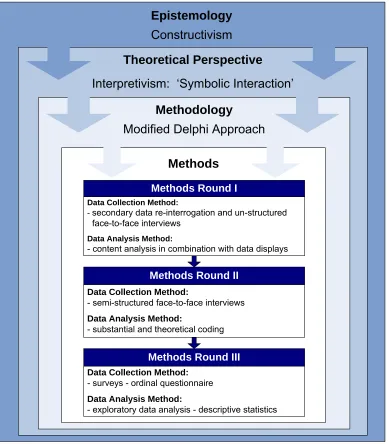
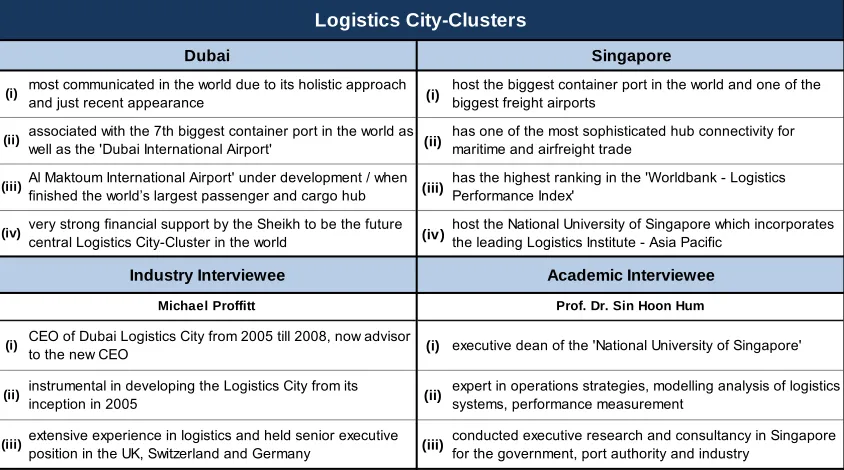
In Round I, a re-interrogation of the relevant literature as a secondary data-collection
was conducted in conjunction with two unstructured interviews with eminent practitioners of the world class Logistics City-Clusters of Dubai and Singapore. Content analysis was applied at this stage, allowing the development of a preliminary framework upon which the second iteration was based. Round II applied intensive
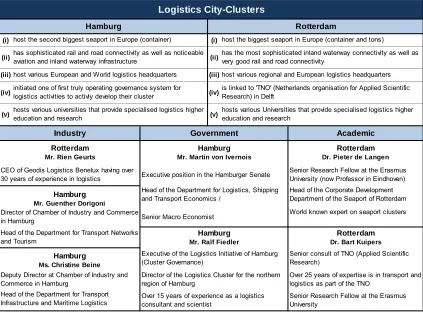
purposefully selected informants held significant positions of responsibility in leading Logistics City-Clusters in Europe, and the interviews were analysed by applying substantial and theoretical coding methods. As a result, an amended elaborated Logistics City-Cluster model was prepared. The major findings have been transformed and summarised into statements, which provided the foundation for the third iteration.
Round III applied a more traditional Delphi data collection and analysis method. The
derived statements of the elaborated framework were presented to the experts that participated in the earlier iterations plus additional eminent practitioners of world class Logistics City-Clusters, via an ordinal questionnaire. These experts were asked to validate the emergent notions and were given the opportunity to clarify their ratings. The resulting data were evaluated by using descriptive statistics with emphasis on central tendency and level of dispersion. Figure 1.3-1 summarises the research design.
Epistemology
Constructivism
Theoretical Perspective
Interpretivism: ‘Symbolic Interaction’
Methodology
Modified Delphi Approach
Methods
Data Collection Method:
-secondary data re-interrogation and un-structured face-to-face interviews
Data Analysis Method:
- content analysis in combination with data displays
Methods Round I
Data Collection Method:
- semi-structured face-to-face interviews
Data Analysis Method:
- substantial and theoretical coding
Methods Round II
Data Collection Method: - surveys - ordinal questionnaire
Data Analysis Method:
- exploratory data analysis - descriptive statistics
Methods Round III
1.4. Significance of the study
Since the phenomenon of a Logistics City-Cluster is an emerging concept, relatively little commentary is available in the literature to guide practitioners in the area. Therefore, this research will provide a significant contribution to knowledge by enhancing the current understanding of the phenomenon of a Logistics City-Cluster through the identification of common enabling elements which are structured to represent their relationships and interaction. Additionally, this research will enable insight in the core external influential factors impinging on the enabling systems and develop a comprehensive understanding of the impact of a Logistics City-Cluster on its region. It is anticipated that this knowledge base, grounded in the thinking, actions and experiences of executive experts in this area, will provide a set of relationships between the core categories and their inherent properties that offers a holistic and widely applicable explanation of the Logistics City-Cluster concept.
This research is designed to be significant in a macro perspective for stakeholders that govern, participate in the development of, or invest in, a Logistics City-Cluster. It will provide practitioners or academics with the potential to appreciate the possible setup and important elements of a Logistics City-Cluster and can increase the awareness of likely outcomes affecting the region, when adapted to alternative contexts. Consequently, because of this comprehensive understanding of the general concept, the potential to improve the quality and effectiveness of Logistics City-Clusters and its possible regional strengths can be exploited more efficiently. The core significance is that it demonstrates that the Logistics City-Cluster concept is a holistic system, based on categories which have a dynamic relationship. Indeed, possible elements cannot be dealt with separately when attempting to achieve sustainable growth within a region; therefore an examination of all elements are required in order to estimate the overall effects of a Logistics City-Cluster. In this way, the framework can be used as a generic planning tool, which can be adapted to regional needs when developing or modifying a Logistics City-Cluster.
while the ‘left outs’ are defined as omitted aspects of the study that readers can identify due to their own experience and knowledge. The importance of the current research, therefore, is that it provides systematic and complex details of the phenomenon of Logistics City-Clusters, which can be used to underpin further qualitative or quantitative research into specific sites.
1.5. Structure of the Thesis
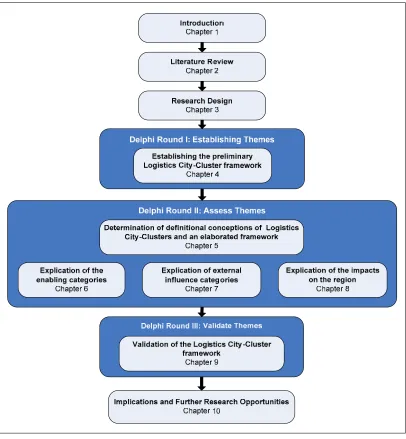
In this first chapter, the background and context upon which the research on the concept of a Logistics City-Cluster was initiated has been described, and an outline of the research objectives, the overall research design and the significance of the results presented. The thesis, structured according to the research design in Figure 1.5-1, is briefly described below.
Chapter 2 contains the literature review, which has helped to shape the research objectives and has guided the preliminary development of the Logistics City-Cluster framework. It presents a comprehensive review of literature associated with logistics agglomerations, including a review on the evolution of logistics nodes describing the emergence of Logistic City-Clusters. This initial work led to two further topics that needed to be considered for review: first, a comprehensive literature investigation on different cluster theories that have informed this study with possible variables needed to form agglomerations; and second, a review and discussion on sustainability.
The research design and its associated paradigm, methodology, data collection and analysis methods are detailed in Chapter 3. The positioning of the investigation within the epistemological and theoretical perspective is discussed and justified. This reflection leads to the selection of the modified Delphi methodology, where its key principles are considered within the context of the research objectives. The application of three iterative rounds of investigations using a multi-method strategy for data-collection and analysis is explained and its applicability comprehensively argued.
Round I, in which the themes of this investigation have been established, is dealt with in Chapter 4. The open approach of the re-interrogation of relevant literature and the two unstructured interviews with executive experts in the field has resulted in a tentative definitional conception of a Logistics City-Cluster, which allowed the creation of a preliminary framework, consisting of two categories. This was used to develop the subsequent collection phase of Round II.
The validations of emergent themes, which were carried out in Round III, are presented in Chapter 9. This final round tested the elaborated Logistics City-Cluster by applying a structured questionnaire. The validated outcomes of the model are presented within this chapter in the form of text description, figures and tables related to an ‘approve or disapprove’ voting dimension. Further, it explicitly discusses the consensuses and differences for all categories and sub-categories that are explored during the validation process.
Chapter 2
Literature Review: Logistics City-Clusters
2.1 Introduction
The first section of this chapter presents an in-depth review of logistics nodes by focusing on six designations: (i) ‘Freight Villages’ (ii) ‘Inland Ports’ (iii) ‘Freight Hubs’, (iv) ‘Intermodal Terminals’ (v) ‘Logistics Cities’ and (vi) ‘Logistics Clusters’. This review has guided a literature investigation into the evolution of logistics node progressions, describing the dominant determinants leading to sophisticated logistics poles. It concludes with a developed logistics node hierarchy that is based on distinguishing levels of value-add activities, differences in their geographical size, number of bounded logistics nuclei and urban constructs, leading to a first definitional understanding of the Logistics City-Cluster.
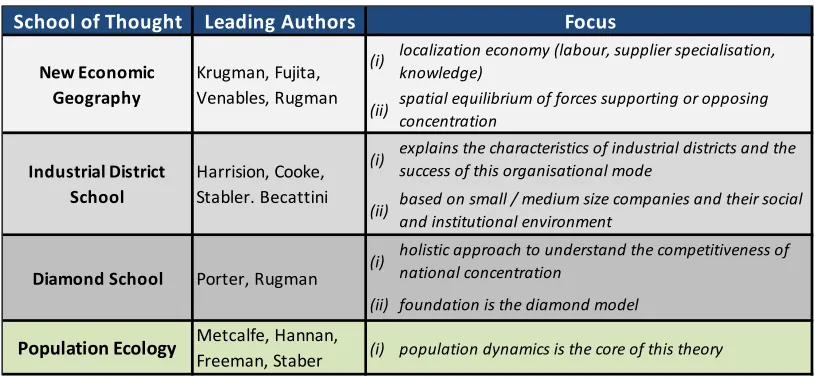
The second part of this review critically discusses and explains the focal points of relevant theoretical cluster frameworks related to the concept of Logistics City-Clusters. Identified competing and overlapping theories are summarized in a collective listing of twelve determinants representing the underlying processes of clusters. These are seen as a platform that, combined with the first part of the literature review, provides a sophisticated foundation upon which to theorise and create a preliminary model of Logistics City-Clusters.
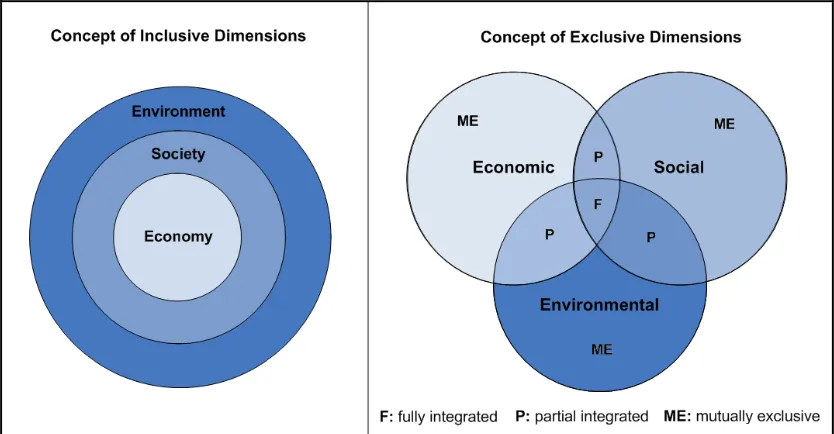
In the third section, there is a review of the sustainability notion, because it is argued that logistics agglomeration in a metropolitan area facilitates sustainable growth for a region. The focus here is on the ‘Triple Bottom Line Approach’ with its (i) economic, (ii) environmental and (iii) social dimensions. A critical discussion on the current challenges of this theoretical framework and the identification of the ‘core capitals’, which are the foundation for the further development of the preliminary Logistics City-Cluster framework, concludes this section.
2.2 Review of logistics node progressions
ILSCM focuses its research on the concept of ‘Logistics Cities’ particularly with regard to the metropolitan area of Melbourne. ILSCM (2007a) defines a ‘Logistics City’ as the final progression of a ‘Dense Trade Cluster’ (DTC), embracing multi-modal infrastructure, an international gateway (e.g. a large seaport or freight airport) and embedded in a metropolis of at least 3 million inhabitants. Additionally, ILSCM (2007b) provides a definition for DTCs, describing it as a nodal point that facilitates and processes international trade by strategic investment in multimodal transportation assets and by promoting value added services. Moffatt-Nicholson Engineers (2002) further describe DTCs as areas which process trade and have convenient rail access. It is argued that such areas are concentrated within an 80 mile radius that incorporates concentrated logistics demand. Cambridge Systematics (2004), instead, argue that DTCs have a radius of 45 – 75 km and links mainly to efficient non-truck port-related traffic. Generally, all three different definitional understandings coincide, with the latter two broadening the definition by including a geographical range.
More importantly, the work of ILSCM (2007a) proposes four levels of a DTC, namely: ‘Freight Villages’, ‘Inland Ports’, ‘Freight Hubs’ and ‘Logistics Cities’. It is argued that these progress in order of size and range of services provided. The concept of a ‘Logistics City’ is seen as the largest manifestation of a DTC, implying that the other three designations are contributing integral parts. These designations and their variants are reviewed and discussed in the next paragraphs in terms of their definitions and characteristics.
2.2.1 ‘Freight Villages’
Breitzmann and Wenske (2003) and Konings (1994) assert that a ‘Freight Village’1 is an element of intermodal transport chains which provides efficient transhipment infrastructure supported by specialized logistics services. UNECE (2001) further specified that it is a geographical grouping that comprises at least one terminal and offers accompanying services such as storage, maintenance and repair. Capineri and Leinbach (2006) and Tsamboulas (2005) suggest that this bounded grouping of infrastructure and superstructure is linked to different transport modes, logistics
1
services and is equipped with sophisticated information technology. The ‘European Association of Freight Villages’ broadly describes the concept as a site concentrating logistics activities such as transport, goods distribution and warehousing (EEIG, 2004). Interestingly, Capineri and Leinbach (2006) argue that ‘Freight Villages’ are located inland to unload and repack containers from major seaports, but this specification is not supported by other publications.
Activities within a ‘Freight Village’ are carried out by more than one company for national and international trade purposes and it consists of essential facilities and services to support the logistics sector (Meidute, 2005; EEIG, 2004). This notion of a shared system is also strengthened by Tsamboulas and Kapros (2003) by stating that the concept as a logistics platform has various internal stakeholders such as multiple logistics service providers, logistics users or business services. In summary, ‘Freight Villages’ can be described from the perspectives of (i) infrastructure and facilities and (ii) related logistics and business services, as shown in Table 2.2-1.
Table 2.2-1: Infrastructure and service elements of ‘Freight Villages’
Tsamboulas and Kapros (2003) and Meidute (2007) also assert that the development of ‘Freight Villages’ not only benefits private stakeholders, but also the region and its associated governments and population. It is generally argued that the public domain’s interest is in the resulting socio-economic benefits for the region such as employment possibilities and economic growth (e.g. Capineri & Leinbach, 2006; Tsamboulas, 2005; Meidute, 2005). In this context it is claimed that ‘Freight Villages’, due to enhanced transport infrastructure, logistics services and integrated information technologies, enable a stronger integration in global supply chains and therefore enhance the regional economy (Meidute, 2005; Tsamboulas & Kapros, 2003).
It is commonly claimed that ‘Freight Villages’ are a progression of a simple terminal due to the integration of additional logistics activities and supporting activities (e.g. Labanauskas & Palsaitis, 2007; Capineri & Leinbach, 2006; Meidute, 2005). However an interesting and somewhat surprising point has been made by Ballis (2006), who claims that ‘Freight Villages’ also operate in the United States as ‘Inland Ports’. ILSCM (2007a), on the other hand, distinguish between these two and it is this contestation that necessitates the further in-depth investigation of the ‘Inland Port’ concept.
2.2.2 ‘Inland Ports’
Generally, ‘Inland Ports’ are defined as logistics sites that include appropriate multimodal transportation assets, logistics services and business value-add activities having the ability to enable international trade (e.g. Notteboom & Rodrigue, 2009; Cumming & Elzer, 2007; Walter & Poist, 2004). Chang and Canode (2003) extended this definition by stating that ‘Inland Ports’ include FTZ, have access to sufficient labour, and tend to involve high value commodities.
Notteboom and Rodrigue (2009) and the IBI Group (2006) argue that an ‘Inland Port’ performs several functions of a seaport whilst located inland, in contradiction to Leitner and Harrison’s (2001) definition.
Interestingly, some scholars oppose the argument that an ‘Inland Port’ is located on navigable water and refer to it as an inland dry-port (Cumming & Elzer, 2007; Walter & Poist, 2003). Whilst Roso et al. (2009) and Jaržemskis and Vasiliauskas (2007) support the notion of a dry-port, they apply the classification measure of distance from a maritime gateway and argue that the ‘Inland Port’ function is a supporting node for seaports, reducing their congestion and securing hinterland market opportunities. In this regard ‘Inland Ports’ have been also referred as ‘Agile Ports’, which guarantee efficient distribution and environmental benefits by setting up a direct mass transportation seaport link (Bryan et al. 2007; Roso, 2007).
Based on their world-wide review, Harrison et al. (2004) state that it is difficult to classify the wide variety of ‘Inland Ports’. Therefore, the appraisal of Bichou and Gray (2005) that, depending on geographical circumstances, an ‘Inland Port’ does not necessarily require navigable water or a link to maritime transport node is the most neutral description of the location factor.
Notwithstanding, these different interpretations, there are generic characteristics and services of an ‘Inland Port’ identified in the literature. Activities commonly include transhipment and distribution services, customs brokerages and clearance, integrated information systems, stuffing and stripping of containers as well as their consolidation and buffering (e.g. Roso et al., 2009; Notteboom & Rodrigue, 2009; Walter & Poist, 2003; Leitner & Harrison, 2001). The most sophisticated understanding of services provided by ‘Inland Ports’ is proposed by Walter and Poist (2004), based on field interviews and focus group discussions. The generic and widely agreed services and characteristics are shown in Table 2.2-2.
Rodrigue, 2009; Roso et al., 2009; Walter & Poist, 2003). Hence, ‘Inland Ports’ must take the geo-strategic notion into consideration.
Table 2.2-2: Elements of ‘Inland Ports’
An important claim of Cumming and Elzer (2007) is that an ‘Inland Port’ is different to a ‘Freight Village’, which agrees with the understanding of ILSCM (2007a). However, their argument that ‘Inland Ports’ provide additional services such as customs inspections, bonded warehouses and banking can be criticized, since these are also an integral part of ‘Freight Villages’. Hence, based on the literature review, the differentiation of both concepts continues to be contested and their difference appears to be in the area of nomenclature since their characteristics and purposes are comparable.
2.2.3 ‘Freight Hubs’
attempt to integrate additional logistics and business service in ‘Freight Hubs’ (Hesse & Rodrigue, 2004; Lemoine & Dagnaes, 2003).
Numerous studies conclude that the existence of ‘Freight Hubs’ is only possible if sufficient demand is available (van Dam et al., 2007; Hong & Chin, 2007; Racunica & Wynter, 2005). This is embedded in the fact that economy of scale is needed to justify the massive infrastructure development and the efficient operation of associated mass transport modes. It also appeared that its development depends on factors such as the financial stability to provide the necessary infrastructure and the government sector (Van Dam et al., 2007). Hence, the earlier arguments for ‘Freight Villages’ and ‘Inland Ports’ regarding geo-strategic concerns and government reinforcement also apply here.
Like ‘Inland Ports’ and ‘Freight Villages’, hubs involve various stakeholders such as transport agencies, infrastructure providers, hub operators and users, governments and communities (e.g. van Dam et al., 2007; Nathanail, 2007; Hesse & Rodrigue, 2004). Most stakeholder-related studies focus on the benefits for hub operators and users by pinpointing increases in efficiencies, cost reductions and higher frequency of transport schedules due to critical cargo mass (Racunica & Wynter, 2005; Hesse & Rodrigue, 2004). However, there are also recognized benefits for the community such as the minimizing of environmental externalities and the creating employment opportunities (van Dam et al., 2007).
There is one significant difference between ‘Freight Hubs’ and ‘Freight Villages’ / ‘Inland Ports’. Hubs only considers consolidation, transhipment and distribution as the core objective, although it can eventually evolve to an integrated logistics centre having the value-add services of ‘Freight Villages’ and ‘Inland Ports’. In this context it was argued that complex supply chains integrated in ‘Hub-and-Spoke’ systems can further attract pure logistics providers and various other business value-add activities (Lau & Tsang, 2008; Lemoine & Dagnaes, 2003).