Data Set Generation for Non-Slicing Rectangular
Placement Problems
Pearl Y. Wang
1•
Christine L. Valenzuela
Department of Computer Science MS 4A5, George Mason University, Fairfax,
VA 22030-4444, USA
Department of Computer Science, Cardiff University, PO Box 916, Cardiff CF24
3XF, United Kingdom
•
This work extends our previously reported algorithms that generate data sets containing rectangles which can be optimally packed into rectangular regions using slicing layouts. The sizes and rela-tive areas of the rectangles in the data sets can be controlled by the use of two input parameters. The new procedures described in this paper enable researchers to control the generation of data sets of rectangles which can be packed into rectangular regions using simple non-slicing layouts. By incorporating both slicing and non-slicing layouts, a broader range of data sets may now be generated. The characteristics of these data sets are specified by the user so that the data can be used to benchmark any packing or layout heuristic designed to solve rectangular cutting stock, bin-packing, or VLSI layout problems.
(Cutting stock, Packing, Analysis of Algorithms)
1.
Introduction
In our previous work (Wang and Valenzuela 2001) we introduced and analyzed a technique that can be used to generate a data set of rectangles which can be optimally packed into a single larger rectangle. The user can specify values for two input parameters which control the shapes and relative areas of the rectangles produced by the data generation process. More precisely, the two input parameters specify:
• the maximum and minimum height/width ratios (i.e. the aspect ratios) of the pieces, and • the ratio of the largest to the smallest piece (i.e. the area ratio) of the data set.
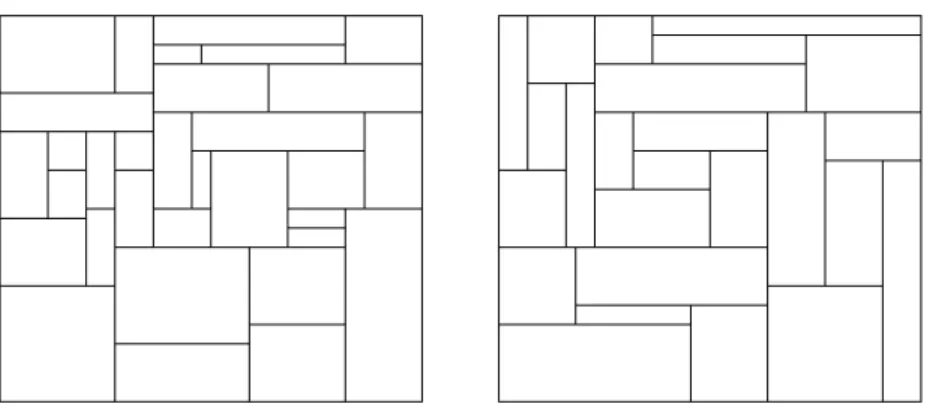
Figure 1: Two slicing layouts
These data sets can then be used by researchers to evaluate new algorithms for solving cutting, packing, or layout problems.
The data generation procedure is a recursive process which cuts the required number of rect-angles from a larger rectangle by making a succession of horizontal and vertical edge–to–edge (or
guillotine) cuts. The resulting set of rectangles will satisfy the following: (1) if aspect ratioρ≥2
is specified, then every rectangleRi =hi ×wi will have the property that1/ρ ≤ hi/wi ≤ ρand
(2) if area ratioγ ≥ 5is specified, then the ratio of the areas of any two rectangles Ri andRj in
the data set will fall in the interval[1/γ, γ]
Using the procedure, data sets that have specific characteristics (e.g. all rectangles might be tall and thin, or all rectangles must be “nearly” square) can be generated inO(n2)time where n
is the size of the data set. These rectangles can be packed into a larger rectangle with zero waste using a slicing layout pattern– the individual rectangles of the data set can be obtained from the larger rectangle by making edge-to-edge or guillotine cuts. Figure 1 illustrates slicing layouts for two sets of 500 rectangles generated in (Wang and Valenzuela 2001). The aspect and area ratios of the rectangles in the left layout were not controlled. In contrast, the aspect ratios of all rectangles in the right hand layout are in the range1/4.18≤ ρ≤4.18and the area ratio is less than 7.32 for all this data.
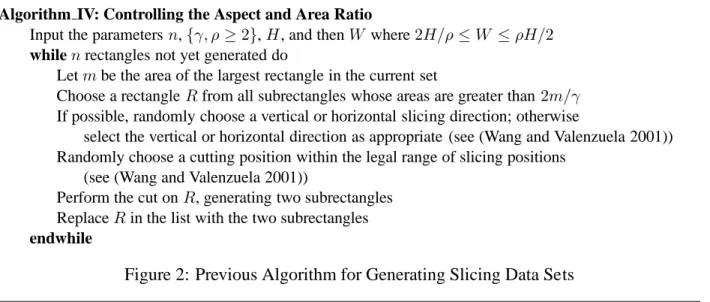
The layout on the right in Figure 1 contains rectangles that were generated by Algorithm IV which is reproduced from (Wang and Valenzuela 2001) in Figure 2. A similar recursive process was developed independently and used by (Hopper and Turton 2001). Algorithm IV, however, obtains the desired number ofnrectangles by repeatedly slicing an input rectangle of heightH and width
Algorithm IV: Controlling the Aspect and Area Ratio
Input the parametersn,{γ, ρ≥2},H, and thenW where2H/ρ≤W ≤ρH/2
whilenrectangles not yet generated do
Letmbe the area of the largest rectangle in the current set
Choose a rectangleRfrom all subrectangles whose areas are greater than2m/γ If possible, randomly choose a vertical or horizontal slicing direction; otherwise
select the vertical or horizontal direction as appropriate (see (Wang and Valenzuela 2001)) Randomly choose a cutting position within the legal range of slicing positions
(see (Wang and Valenzuela 2001))
Perform the cut onR, generating two subrectangles ReplaceRin the list with the two subrectangles
endwhile
Figure 2: Previous Algorithm for Generating Slicing Data Sets
The reader is referred to it for a detailed description of the theory and application of the data set generation technique. The method was applied extensively to supply test problems for our work in (Valenzuela and Wang 2001).
Much of the work on cutting, packing and placement which has been reported in the liter-ature may utilize non-slicing or non-guillotine patterns (e.g. (Chazella 1983), (Coffman et al. 1984), (Hopper and Turton 2001), (Jakobs 1996), (Liu and Teng 1999), (Murata and Kuh 1998), (Nakatake et al. 1995). The purpose of our present paper is to generalize our techniques to produce a wider range of data sets and thus extend their usefulness. Data sets which are generated by the production of non-slicing patterns that are cut out of a large enclosing rectangle with zero waste would provide ideal benchmarks.
In non-slicing layouts, at least one rectangle in the layout cannot be obtained by making a series of guillotine cuts. Two non-slicing layouts shown in Figure 3 are reproduced from (Wu 2002) and (Wang and Wong 1992). None of the interior rectangles can be obtained if only edge-to-edge cuts are permitted. As we shall see, it will be possible to generate similar data sets of rectangles whose aspect and area ratios are controlled and which can optimally be packed into a single rectangle using a non-slicing layout. For the most part we shall restrict our study of non-slicing floorplans to hierarchical floorplans of order 5 which can be obtained by recursively partitioning a rectangle into either two smaller rectangles or into a 5-wheel. 5-wheels are the simplest non-slicing floorplans containing 5 smaller rectangles with a layout similar to Figure 4. A computer program which produces non-slicing data sets based on wheels has been written by Hopper and Turton, and some data sets produced using their program can be found at the SICUP web-site (SICUP).
Figure 3: Two Non-slicing Layouts
In section 2, we examine constraints which need to be satisfied for generating data sets that incorporate 5-wheels so that the aspect ratio of the rectangles in the set is bounded. In section 3, we examine conditions needed for data set generation when area ratio is to be controlled. Section 4 describes a data generation algorithm that can generate hierarchical layouts where the aspect and area ratios of the rectangles are controlled by the user. Section 5 discusses general conditions which permit non-slicing data sets to be created, and section 6 summarizes the results and describes ongoing research on this problem. The proofs of most of the lemmas, theorems, and corollaries can be found in the Appendices of this paper.
2.
Satisfying the Aspect Ratio Requirements
In this section, we determine conditions under which it will be possible to generate a set of rectan-gles having legal aspect ratioshi/withat lie between 1/ρandρwhereρ≥ 2and which together,
can be optimally packed into a single rectangle using a non-slicing layout. We begin with a con-struction process based on a single symmetric shape and show how it can be generalized. In the following discussion, a rectanglehi×wiis said to have a legal aspect ratio if1/ρ≤hi/wi≤ ρ.
2.1
Generating Symmetric Non-Slicing Layouts
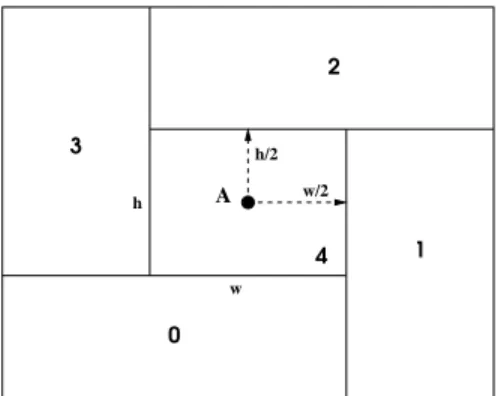
The simplest way in which to generate a non-slicing layout is to divide anH×W rectangle into five subrectangles using a 5-wheel layout. For the purposes of discussion, we will analyze only one orientation of the 5-wheel shown in Figure 4 in the subsequent discussion. Analogous results can be derived for wheels obtained by reflecting this layout.
H W h w 0 2 3 h/2 w/2 1 4 A
Figure 4: A Simple Symmetric 5-wheel Layout
list of rectangles with legal aspect ratios is maintained as in (Wang and Valenzuela 2001); initially the list consists of a user specified rectangle. A member of the list is then selected randomly for cutting. The resulting subrectangles are added to the current list, and the process is repeated until nrectangles are obtained.
In this case, however, the selected rectangle may be divided into five subrectangles as shown in Figure 4 instead of just two subrectangles as in the case of slicing layouts. We denote the height and width of the selected rectangle asHandW, respectively. If rectangle4is centered within the larger rectangle at pointA= (H/2, W/2)and if its size is given byh×w, then the dimensions of the remaining rectangles can be obtained symmetrically as:
Table 1: Sizes of the symmetric 5-wheel subrectangles
Subrectangle Height Width
0 H−h 2 W+w 2 1 H+2h W−w 2 2 H−h 2 W+w 2 3 H+2h W−w 2 4 h w
In order to ensure that the five subrectangles resulting from this division of the originalH×W rectangle all have legal aspect ratios, the choices forhandware given by the following theorem.
Theorem 1 LetH×W have a legal aspect ratio and denote the aspect ratio of subrectangle4by
f. Selectf between1/ρandρ. In order to guarantee that all five subrectangles of the symmetric 5-wheel will have legal aspect ratios,wmust satisfy the following inequality
0≤w≤min{ρW −H
ρ+f ,
ρH−W ρf+ 1 }.
0.66 18 25 75 150 50 25 75 92 108 92 108 18 82 82 50 150 50 100 6.0 2.0 6.0 .125 6.0 8 6.0 0.66 64 1.122 1.122
Figure 5: Sample Symmetric 5-wheel Layout hcan then be computed ash=f w.
Corollary 1 IfH/W =ρorH/W = 1/ρ, then the selectedH×W rectangle cannot be cut into
a 5-wheel whose subrectangles have legal aspect ratios.
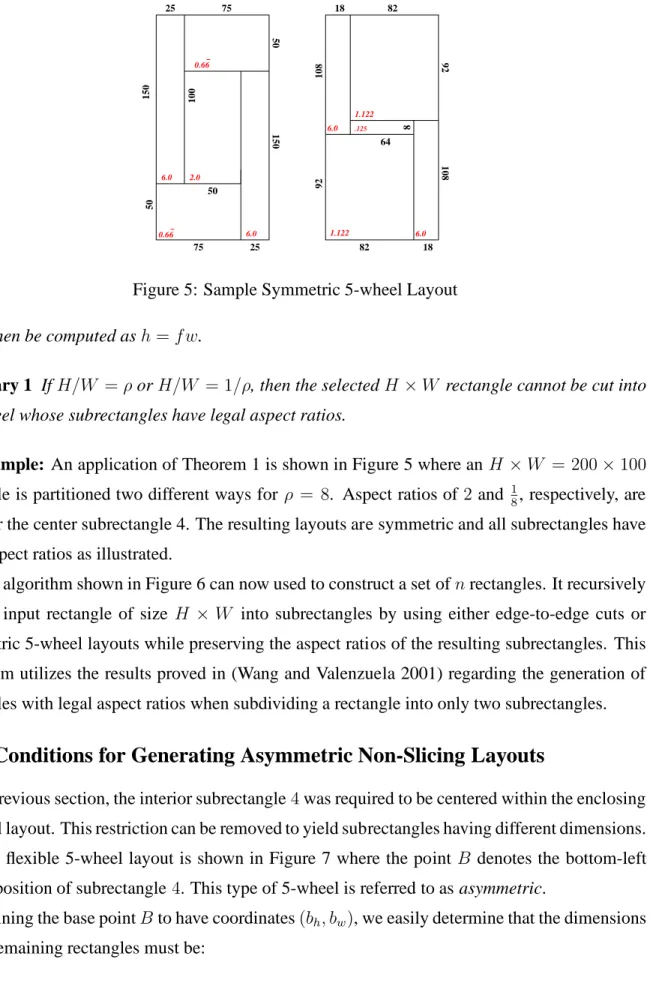
Example: An application of Theorem 1 is shown in Figure 5 where an H×W = 200×100
rectangle is partitioned two different ways for ρ = 8. Aspect ratios of2 and 18, respectively, are used for the center subrectangle 4. The resulting layouts are symmetric and all subrectangles have legal aspect ratios as illustrated.
The algorithm shown in Figure 6 can now used to construct a set ofnrectangles. It recursively cuts an input rectangle of size H × W into subrectangles by using either edge-to-edge cuts or symmetric 5-wheel layouts while preserving the aspect ratios of the resulting subrectangles. This algorithm utilizes the results proved in (Wang and Valenzuela 2001) regarding the generation of rectangles with legal aspect ratios when subdividing a rectangle into only two subrectangles.
2.2
Conditions for Generating Asymmetric Non-Slicing Layouts
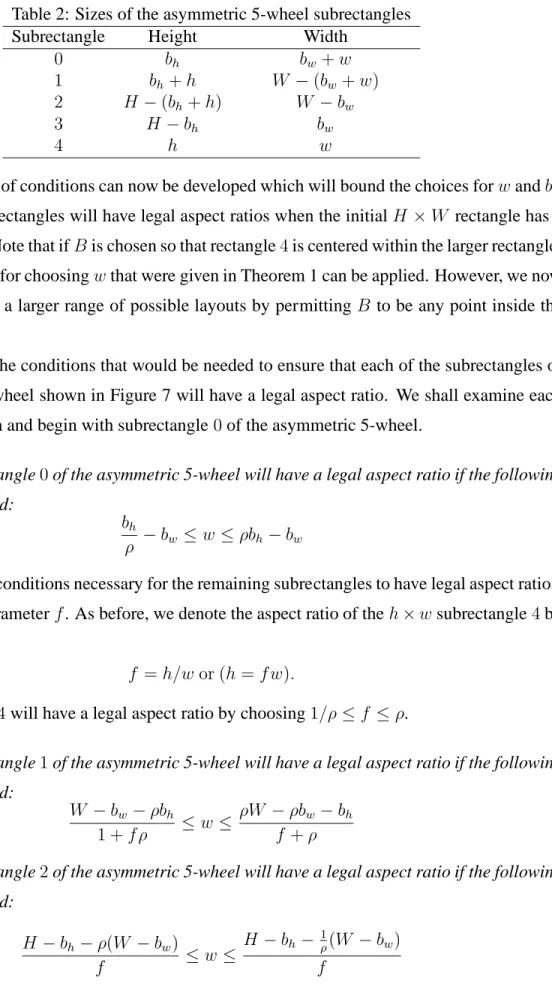
In the previous section, the interior subrectangle4was required to be centered within the enclosing 5-wheel layout. This restriction can be removed to yield subrectangles having different dimensions. A more flexible 5-wheel layout is shown in Figure 7 where the point B denotes the bottom-left corner position of subrectangle4. This type of 5-wheel is referred to as asymmetric.
Algorithm I: Controlling the Aspect Ratio With Symmetric 5-wheels
Input the parametersn,{ρ≥2},H, and thenW where2H/ρ≤W ≤ρH/2
whilenrectangles not yet generated do Choose a rectangleRat random
Randomly choose a type of cut: slicing or the 5-wheel (unless more thatn−5rectangles have been generated orH/W =ρor1/ρ)
if the type of cut is a slicing cut then
Randomly choose a vertical or horizontal slicing direction, if possible; otherwise
select the vertical or horizontal direction as appropriate (see (Wang and Valenzuela 2001)) Randomly choose a cutting position within the legal range of slicing positions
(see (Wang and Valenzuela 2001))
Perform the cut onR, generating two subrectangles ReplaceRin the list with the two subrectangles
else
Choose a value off between1/ρandρ Choose a value ofwas dictated by Theorem 1
Calculate the dimensions of the 5-wheel subrectangles ReplaceRin the list with the five subrectangles
endif endwhile
Figure 6: Generating Data Sets Containing Symmetric 5-wheels with Legal Aspect Ratios
b h b w H W 3 2 1 4 h w B 0
Table 2: Sizes of the asymmetric 5-wheel subrectangles
Subrectangle Height Width
0 bh bw +w
1 bh+h W −(bw+w)
2 H−(bh+h) W −bw
3 H−bh bw
4 h w
As before, a set of conditions can now be developed which will bound the choices forwandbw
so that all five subrectangles will have legal aspect ratios when the initialH×W rectangle has a legal aspect ratio. Note that ifBis chosen so that rectangle4is centered within the larger rectangle, then the conditions for choosingwthat were given in Theorem 1 can be applied. However, we now seek to incorporate a larger range of possible layouts by permittingB to be any point inside the larger rectangle.
First, consider the conditions that would be needed to ensure that each of the subrectangles of the asymmetric 5-wheel shown in Figure 7 will have a legal aspect ratio. We shall examine each subrectangle in turn and begin with subrectangle0of the asymmetric 5-wheel.
Lemma 1 Subrectangle0of the asymmetric 5-wheel will have a legal aspect ratio if the following
condition is satisfied:
bh
ρ −bw ≤w≤ρbh−bw
To develop the conditions necessary for the remaining subrectangles to have legal aspect ratios, we first define a parameterf. As before, we denote the aspect ratio of theh×wsubrectangle4by the variable
f =h/wor (h=f w).
Then subrectangle4will have a legal aspect ratio by choosing1/ρ≤f ≤ρ.
Lemma 2 Subrectangle1of the asymmetric 5-wheel will have a legal aspect ratio if the following
condition is satisfied:
W −bw −ρbh
1 +f ρ ≤w≤
ρW −ρbw−bh
f +ρ
Lemma 3 Subrectangle2of the asymmetric 5-wheel will have a legal aspect ratio if the following
condition is satisfied:
These first three lemmas provide necessary and sufficient conditions for subrectangles0,1, 2, and4to have legal aspect ratios when1/ρ ≤ f ≤ ρ. Subrectangle 3of the asymmetric 5-wheel will have a legal aspect ratio if the condition1/ρ≤(H−bh)/bw ≤ρis satisfied. We define
g = (H−bh)/bw
to represent the aspect ratio of subrectangle3.
By choosing f andg (the aspect ratios of subrectangles 3and4) so that 1/ρ ≤ f, g ≤ ρand a pair of valuesbw andwwhich satisfy Lemmas 1, 2, and 3, an asymmetric division of the larger
H×W rectangle into five subrectangles having legal aspect ratios will be obtained.
As we intend to develop an algorithm based on these conditions, we must show that they are not mutually exclusive. Before we proceed, we substitute g = (H −bh)/bw into the bounds in
Lemmas 1, 2, and 3 to eliminate thebh variable.
Theorem 2 If a rectangleH×W having a legal aspect ratio is to be divided into an asymmetric
5-wheel whose subrectangles also have legal aspect ratios, then the following conditions must first be satisfied forbw, w, g, andf:
Subrectangle 0 condition : H−bw(g+ρ) ρ ≤w≤ρH−bw(ρg+ 1) Subrectangle 1 condition : (W−ρH)+bw(ρg−1) 1+f ρ ≤w≤ (ρW−H)−bw(ρ−g) f+ρ Subrectangle 2 condition : bw(g+ρ)−ρW f ≤w≤ bw(gρ+1)−W f ρ Subrectangle 3 condition : 1/ρ≤g ≤ρ Subrectangle 4 condition : 1/ρ≤f ≤ρ
Corollary 2 If H/W = ρ, it cannot be subdivided into five subrectangles that will have legal
aspect ratios.
2.3
Satisfying the Conditions for Asymmetric Layout
The next task is to prove that it is always possible to select values forbw, w, g, andf so that the
conditions of Theorem 2 are valid. We begin by defining a shorthand notation for these bounds.
denoted as follows: min0= H−bw(g+ρ) ρ max0=ρH−bw(ρg+ 1) min1= (W−ρH)+bw(ρg−1) 1+f ρ max1= (ρW−H)−bw(ρ−g) f+ρ min2= bw(g+ρ)−ρW f max2= bw(gρ+1)−W f ρ
It must now be shown that it is possible to select a pair of values forbwandwsuch that
min0 ≤ w ≤ max0,
min1 ≤ w ≤ max1, and
min2 ≤ w ≤ max2
for any choice of f andg between1/ρ andρ. To do this, we examine the intersection of the six regions of the plane defined by w ≥ min0, w ≤ max0, w ≥ min1, w ≤ max1, w ≥ min2, and w ≤ max2. Some results that will be useful for showing that this intersection is nonempty are presented in the following lemmas: e.g. determining the bw andwintercepts of the lines, the
points where each pair of lines intersect, the relative slopes of the lines, and the relative positions of thebw intercepts.
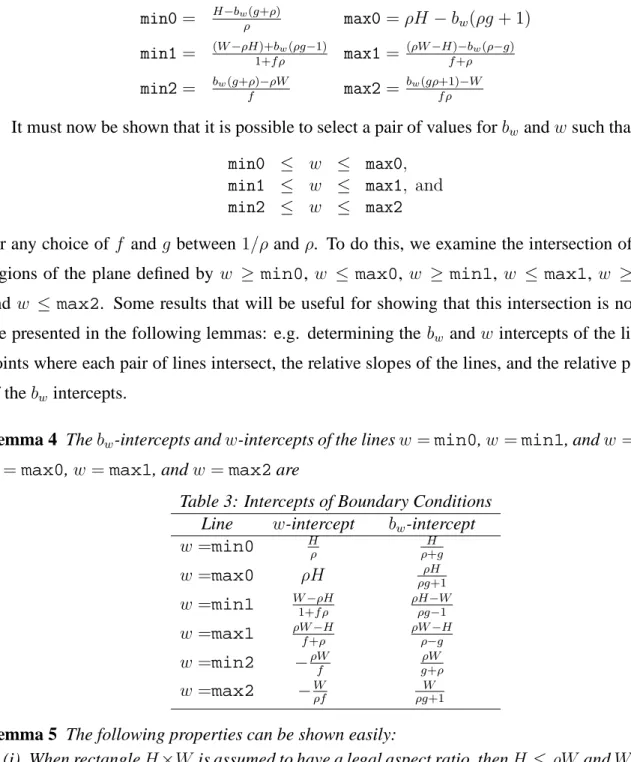
Lemma 4 Thebw-intercepts andw-intercepts of the linesw=min0,w=min1, andw=min2,
w=max0,w=max1, andw=max2are
Table 3: Intercepts of Boundary Conditions Line w-intercept bw-intercept
w=min0 H ρ H ρ+g w=max0 ρH ρgρH+1 w=min1 W−ρH 1+f ρ ρH−W ρg−1 w=max1 ρW−H f+ρ ρW−H ρ−g w=min2 −ρW f ρW g+ρ w=max2 −Wρf ρgW+1
Lemma 5 The following properties can be shown easily:
(i) When rectangleH×Wis assumed to have a legal aspect ratio, thenH≤ρW andW ≤Hρ. (ii) When1/ρ≤g ≤ρwhereρ≥2, it is also true thatgρ≥1.
(iii) Thew-intercepts ofw=min0,w=max0,w=max1are positive (iv) Thew-intercepts ofw=min1,w=min2,w=max2are negative.
b w b w b w b w (a) (b) (c) (d) max0
max2 min0 min2
max0 max2
min0 min2
max2
min0 max0 min2
max2 min0 max0 min2
Figure 8: Relative positions of the bw-intercepts of w =min0, w =max0, w =min2, and
w=max2
Lemma 6 The relative positions of thebw-intercepts formin0,max0,min2, andmax2satisfy:
(i) bw-intercept ofmin0≤bw-intercept ofmax0
(ii) bw-intercept ofmax2≤bw-intercept ofmin2
(iii) bw-intercept ofmin0≤bw-intercept ofmin2
(iv) bw-intercept ofmax2≤bw-intercept ofmax0.
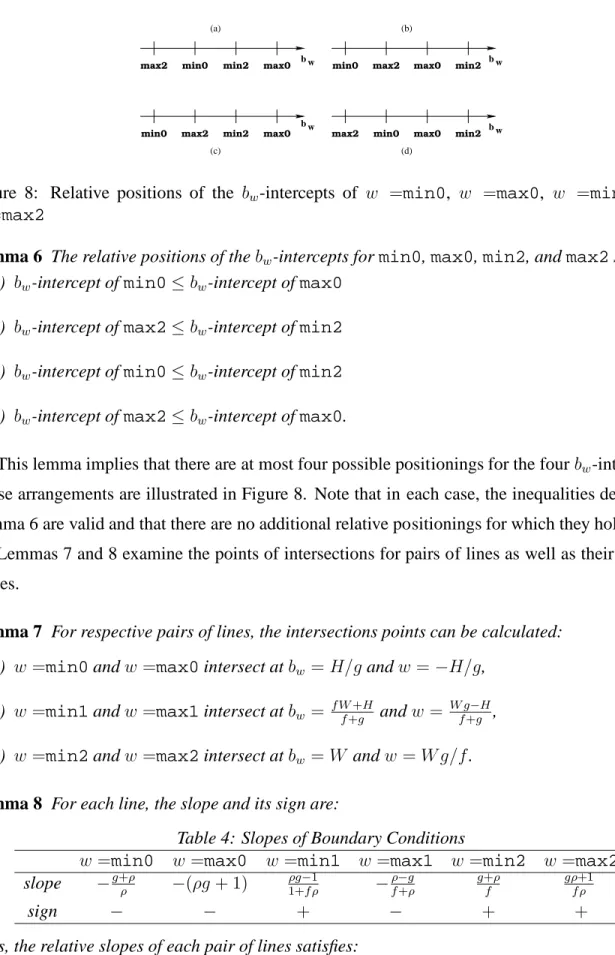
This lemma implies that there are at most four possible positionings for the fourbw-intercepts.
These arrangements are illustrated in Figure 8. Note that in each case, the inequalities derived in Lemma 6 are valid and that there are no additional relative positionings for which they hold.
Lemmas 7 and 8 examine the points of intersections for pairs of lines as well as their relative slopes.
Lemma 7 For respective pairs of lines, the intersections points can be calculated: (i) w=min0andw=max0intersect atbw =H/g andw=−H/g,
(ii) w=min1andw=max1intersect atbw = f Wf++gH andw= W gf+−gH,
(iii) w=min2andw=max2intersect atbw =W andw=W g/f.
Lemma 8 For each line, the slope and its sign are:
Table 4: Slopes of Boundary Conditions
w=min0 w=max0 w=min1 w=max1 w=min2 w=max2 slope −g+ρρ −(ρg + 1) ρg−1 1+f ρ − ρ−g f+ρ g+ρ f gρ+1 f ρ sign − − + − + +
Thus, the relative slopes of each pair of lines satisfies: (i) w=max0is steeper thanw=min0
pH w = max 0 H/p w = min 0 bw −H/g H/(p+g) pH/(pg+1) H/g w
Figure 9: Feasible Region of Choices forwandbw:min0≤w≤max0
(ii) w=min2is steeper thanw=max2
(iii) w=min0andw=max0are steeper thanw=max1 (iv) w=min2andw=max2are steeper thanw=min1
These lemmas enable us to plot the lines associated withw=min0,w =max0,w =min1, w=max1,w=min2, andw=max2as a function ofbw. Recall that the goal is to selectbwand
wvalues which ensure that all subrectangles have legal aspect ratios. In particular, if subrectangle
0is to have a legal aspect ratio, we need to ensure thatmin0 ≤ w ≤max0(as well as w > 0.) Consider the plots of the linesw=min0andw=max0as shown in Figure 9. For a fixedbwin the
shaded region of the graph, any value ofwchosen betweenw=min0andw=max0will permit subrectangle0to have a legal aspect ratio.
Similarly, Figure 10 plots the w =min2 and w =max2 lines and illustrates the choices for bw andw which will produce a subrectangle 2having a legal aspect ratio. It is also necessary to
examine the region defined bymin1≤w≤max1, but first we note that Lemmas 6, 7, and 8 can be used to prove that the regions shown in Figure 9 and 10 must intersect.
Theorem 3 The intersection of the regions defined by min0 ≤ w ≤ max0 and max2 ≤ w ≤
−W/(pf) −pW/f pW/(g+p) W/(pg+1) W bw w Wg/f w = max 2 w = min 2
Figure 10: Feasible Region of Choices forwandbw: min2≤w≤max2
defined bymin1≤ w ≤max1. The geometry of the region of intersection can be characterized by the values ofH/W andg. In Figure 11, three configurations of the regionmin1≤w≤max1
are shown depending on whetherH/g < W,H/g =W, orH/g > W.
In order to develop an algorithm that relies on dividing a rectangleH×W into five asymmetric subrectangles with legal aspect ratios, it is necessary to determine some conditions under which
min1 ≤ w ≤ max1 intersects with min0 ≤ w ≤ max0 and min2 ≤ w ≤ max2. If this is possible, then a pair of values forbw andwcan be selected from the common region and then used
to determine the dimensions of all five subrectangles.
2.4
An Algorithm for Generating Asymmetric Layouts with Legal Aspect
Ratios
Consider the aspect ratio conditions for subrectangle 1, i.e. the region min1 ≤ w ≤ max1 in Figure 11. Since we are interested in the intersection of this region with those in Figures 9 and 10, we examine the simplest case whereH/g =W. This choice implies that the user has selected an aspect ratio for subrectangle 3 in Figure 7 identical to the aspect ratio of the rectangle being subdivided. If H/g = W, then the exact relationship between the bw-intercepts of w =min0,
w=max0,w=min2, andw=max2can be determined.
Lemma 9 IfH/g =W, then Lemma 6 can be revised.
(i) Ifg ≥ 1, thebw-intercept ofw=min0is greater than or equal to thebw-intercept ofw =
(a)H/g < W (b)H/g =W (pH−W)/(pg−1) (fW + H)/(f+g) bw (pW−H)/(p−g) (gW−H)/(f+g) w = max 1 (pW−H)/(f+p) w = min 1 (W−pH)/(1+fp) W w W w (pH−W)/(pg−1) (pW−H)/(p−g) bw (W−pH)/(1+fp) (pW−H)/(f+p) w = max 1 w = min 1 (fW + H)/(f+g) w bw (fW + H)/(f+g) W (pW−H)/(p−g) (pH−W)/(pg−1) w = min 1 w = max 1 (pW−H)/(f+p) (W−pH)/(1+fp) (gW−H)/(f+g) (c)H/g > W
H/p pH -W/(pf) -pW/f H/g W (pW-H)/(p-g) (pH-W)/(pg-1) min 0 max 0 min 2 max 2 W/(pg+1) H/(p+g) pH/(pg+1) pW/(g+p) w bw
Figure 12: Overlap ofmin0≤w≤max0andmin2≤w≤max2whenH/g =W andg ≥1
min2. Thus, Figure 8(a) applies.
(ii) If g < 1, the bw-intercept of w = min0 is less than or equal to the bw-intercept of w =
max2, and the bw-intercept ofw = max0is less than or equal to the bw-intercept ofw =
min2. Thus, Figure 8(b) applies.
Lemma 6 and Lemma 7 established that both pairs of lines (i.e. w=min0andw=max0, and w =min2andw =max2) will intersect at bw = W. The case when g ≥ 1is given in Figure 12
while Figure 13 illustrates the situation wheng <1. The shaded regions in these figures need now be intersected with the region defined bymin1≤ w ≤max1for the case where H/g = W. As we shall see, this intersection can occur in two ways. To simplify the process for specifying this common region, we first determine the intersections points of some lines shown in Figures 12 and 13.
Lemma 10 The lines w =min0 and w =max2 intersect at a point A = (bw, w) where bw =
f H+W
f g+f ρ+gρ+1 andw=
g(ρH−W)+(H−ρW)
H/p pH min 0 max 0 -W/(pf) -pW/f min 2 max 2 H/g pH/(pg+1) H/(p+g) W/(pg+1) pW/(g+p) W w bw
Lemma 11 The lines w =max0 and w =min2 intersect at a point B = (bw, w) where bw = ρ(f H+W)
f ρg+f+g+ρandw=
(ρH−W)+g(H−ρW)
ρgf+f+g+ρ .
Lemma 12 The lines w =max0 and w =max2 intersect at a point E = (bw, w) where bw =
f ρ2H+W
(f ρ+1)(ρg+1) andw=
ρH−W
ρf+1 .
To create an asymmetric subdivision of a H×W rectangle that has a legal aspect ratio, select f, the aspect ratio for subrectangle4andg, the aspect ratio of subrectangle3so that1/ρ≤f ≤ρ andg = H/W. We must now determine conditions forbw andwso that subrectangles 0, 1, and
2will have legal aspect ratios. As we have seen, these conditions are defined by the intersection of the shaded regions in Figure 12 and Figure 13 with the shaded region defined bymin1≤w≤
max1in Figure 10(b). Thus, it is of interest to determine where the linew =max1intersects the shaded regions in Figure 12 and Figure 13. There are two cases to consider, depending on whether g ≥1org <1.
2.4.1 Case 1: g ≥1
Some possible positions for the line w =max1 are shown as dotted lines in Figure 14 which magnifies the shaded region shown in Figure 12. From Lemma 8, the slopes of linesw=min0and w=max0are both steeper than the slope of the linew =max1so these are the only intersection combinations that can occur. That is,w=max1cannot intersect bothw=min2andw =max 0; similarly, it cannot intersect both w =min0 andw =max2. It may also not intersect any of the lines.
Lemma 13 The linew=max1may intersect the common region in one of the following scenarios:
S1: w=max1intersects the line segmentsAC andBDat pointsA1 andB1
S2: w=max1intersects the line segmentsAC andBE at pointsA1 andB2
S3: w=max1intersects the line segmentsAE andBDat pointsA2 andB1
S4: w=max1intersects the line segmentsAE andBE at pointsA2 andB2
S5: w=max1lies above the region outlined by the points CAEBDC
where the bw values of the points A1, A2, B1, and B2 are, respectively, bw = ((ρρW−H)ρ−H(f+ρ)
−g)ρ−(g+ρ)(f+ρ), bw = (f ρgρ(+1)(ρW−f+Hρ)+)+(Wρ(f+ρ) −g)f ρ,bw = f(ρW−H)+ρW(f+ρ) (g+ρ)(f+ρ)+f(ρ−g) , andbw = (ρW−H)−(f+ρ)ρH (ρ−g)−(f+ρ)(ρg+1).
bw D w W max2 E max1 A C B max0 min2 min0
Figure 14: Feasible Region forH/g =W andg ≥1
bw w W F G E max1 max2 max0
2.4.2 Case 2: g <1
The region of intersection for all three pairs of lines can be found for the case of g < 1by using similar arguments. Figure 15 shows the intersection of the regionsmin0≤w≤max0andmin2
≤w≤max2from Figure 13 with the linew=max0. In this case, there are two possible scenarios described in the lemma below.
Lemma 14 The linew=max1may intersect the common region in one of the following scenarios:
S6: w=max1intersects the line segmentsF E andGE at pointsA2 andB2
S7: w=max1lies above the region outlined by the points FEGF
where, as before, the bw values of the points A2 and B2 are bw = (f ρgρ(+1)(ρW−f+Hρ)+)+(Wρ(f+ρ)
−g)f ρ andbw =
(ρW−H)−(f+ρ)ρH
(ρ−g)−(f+ρ)(ρg+1).
The seven scenarios of these lemma identify the coordinate points of the vertices of the region defined by the intersection of the inequalities min0 ≤ w ≤ max0, min1 ≤ w ≤ max1, and
min2≤ w ≤max2. By selecting a point(bw, w)in the region, the initialH ×W rectangle can
be subdivided into five smaller rectangles having legal aspect ratios. Each of these, in turn, can be subdivided by the same process (or just sliced into two parts at appropriate positions as analyzed in (Wang and Valenzuela 2001). Thus, we have established the following result.
Theorem 4 LetH×W be a rectangle with a legal aspect ratiog 6=ρ,1/ρ. Iff is chosen so that
1/ρ≤f ≤ρ, then it is possible to choose values forbw andwso that all five subrectangles of an
asymmetric 5-wheel division ofH×W will have legal aspect ratios.
Corollary 3 If H/g = W andg ≥ 1, the feasible values of(bw, w)reside in one of the regions
defined by the vertices:
Scenario Vertices S1 CA1B1DC S2 CA1B2BDC S3 CAA2B1DC S4 CAA2B2BDC S5 CAEBC
Corollary 4 If H/g = W andg < 1, the feasible values of(bw, w)reside in one of the regions
defined by the vertices:
Scenario Vertices
S6 F A2B2GF
0 20 40 60 80 100 120 −100 −50 0 50 100 150 200 250 bw w min0 max0 min2 max2 min1 max1 C D A A B 2 1 B 80 40 20 32 168 32 160 48 52 3.077 3.5 2.5 0.25 8 2.0 (a) (b)
Figure 16: Sample Asymmetric Wheel Layout
Example: An application of Theorem 4 and Corollary 3 is illustrated by Figure 16. The aspect
ratioρ= 8and anH×W = 200×100rectangle is to be partitioned by selectingh/w =f = 1/4
and settingg = H/W = 2 for the aspect ratios of rectangles 4 and 3, respectively. The resulting region from which a suitable(bw, w)value can be chosen is shown in Figure 16(a) where the corner
points areC = (20.0,0), A = (7.69,15.38), A2 = (13.30,),B1 = (80.34,), and D = (80.0,0).
Figure 16(b) shows a partition of the rectangle when the values (bw, w) = (20,32) are selected.
All resulting subrectangles have legal aspect ratios between 18 and 8.
This approach can be used to develop an algorithm that generates data sets containing rect-angles that form asymmetric 5-wheels. The pseudo-code is given in Figure 17. We note that the computation involves the determination of the feasible region of (bw, w)choices and that the
division will always set the aspect ratio of subrectangle 3 to be the same as the rectangle being partitioned.
2.5
Determining the Feasible Region of
b
wand
w
Choices for an Asymmetric
Layout when
g
6
=
H/W
It would be desirable to have a similar generalized result so thatg, the aspect ratio of subrectangle 3 could be selected irrespective of the aspect ratio of theH×W rectangle being subdivided in Algo-rithm II. Unfortunately, this necessitates a more complicated analysis to determine the intersection of the three regions of interest.
Algorithm II: Controlling the Aspect Ratio With Asymmetric 5-wheels
Input the parametersn,{ρ≥2},H, and thenW where2H/ρ≤W ≤ρH/2
whilen−5rectangles not yet generated do Choose a rectangleRat random
Randomly choose a type of cut: slicing or the 5-wheel (unless more thatn−5rectangles have been generated orheight(H)/height(W) =ρor1/ρ)
if the type of cut is a slicing cut then
Randomly choose a vertical or horizontal slicing direction, if possible; otherwise,
select the vertical or horizontal direction as appropriate (see (Wang and Valenzuela 2001)) Randomly choose a cutting position within the legal range of slicing positions
(see (Wang and Valenzuela 2001))
Perform the cut onR, generating two subrectangles ReplaceRin the list with the two subrectangles
else
Letg←height(R)/width(R)
Choose a value off between1/ρandρ
ifg≥1then
Determine which scenario of Corollary 3 applies and choose appropriate values forbwandwrandomly
else{g <1}
Determine which scenario of Corollary 4 applies and choose appropriate values forbwandwrandomly
endif
Calculate the dimensions of the asymmetric 5-wheel subrectangles ReplaceRin the list with the five subrectangles
endif endwhile
H/g > W would need to be determined. A detailed analysis based on our approach in section 2.4 might be performed. By inspection, however, we note that it may be possible for the intersection of all three regions to be empty. We believe that quantifying the conditions which would ensure that the overlap is non-empty will be a non-trivial task.
An alternative approach for solving the problem would be to utilize a numerical procedure to calculate the intersections of the regions: the six inequalities of interest
H−bw(g+ρ) ρ ≤ w ≤ ρH−bw(ρg+ 1) (W−ρH)+bw(ρg−1) 1+f ρ ≤ w ≤ (ρW−H)−bw(ρ−g) f+ρ bw(g+ρ)−ρW f ≤ w ≤ bw(gρ+1)−W f ρ
could be reformulated as equalities using slack variables, and the application of a procedure similar to that used in linear programming to determine a basis for the system of equations would provide the coordinates of the vertices for the region of intersection (if it exists). Thebwandwvalues of the
basis vectors would provide the corner vertices. Once these are determined, the feasible region of choices would be defined by these vertices so any point inside them could be chosen, thus defining a division of the asymmetric 5-wheel into five subrectangles with legal aspect ratios.
3.
Satisfying the Area Ratio Requirements
When generating data sets of slicing rectangles in (Wang and Valenzuela 2001), the user was able to specify values for a parameter γ which defined the bounds for the maximum and minimum allowable ratios of the areas of any two rectangles in the data set. In this section, we explore the possibility of using a similar technique to generate data sets of rectangles that can be placed into a larger rectangle with zero waste.
As before, the procedure for generating the data is built upon the recursive process of dividing a selectedH×W rectangle into smaller rectangles so that all pairs of resulting rectangles have legal area ratios between 1γ andγ. The simplest way to guarantee the legality of the final data set is to require that a subdivision of a rectangle into a 5-wheel arrangement be such that the five resulting subrectangles along with the current set of other generated rectangles all have legal area ratios.
We first examine the simpler case where the symmetric 5-wheel is to be subdivided and show that it is possible to preserve area ratios when partitioning a rectangle. This analysis provides some insight for dealing with the asymmetric case.
3.1
Using the Symmetric Wheel Layout
Consider a selected rectangle of size H ×W and assume that all rectangles which have been generated so far have legal area ratios. In particular,
1 γ ≤ HW area(Rj) ≤γ 1 γ ≤ area(Rj) HW ≤γ, and 1 γ ≤ area(Rk) area(Rl) ≤γ
for all rectanglesRj, Rk,andRlin the currently generated data set.
The goal is to divide theRi =H×W rectangle into the five subrectangles{0,1,2,3,4}of the
symmetric 5-wheel layout (Figure 4) so that the area ratio property is preserved for the augmented data set, i.e. so that
1 γ ≤ area(i) area(Rj) ≤ γ (1) 1 γ ≤ area(k) area(i) ≤γ (2)
for all rectanglesRj in the generated data set and the subrectangles0≤ {i,k} ≤4.
A rectangle Ri = H × W can always be selected so that HW ≥ 5area(R0)/γ when R0
is the rectangle of the currently generated list with the maximum area and γ ≥ 5. There are two basic ways to partition H × W so that the inequalities (1) and (2) are satisfied. The first partitioning method divides theH×W so that the area of each subrectangle equalsHW/5. It will follow that the resulting subrectangles satisfy inequalities (1) and (2). An alternative approach is to divideH×W into subrectangles with areas that are greater than or equal toarea(R0)/γ. This
second method attempts to provide more flexibility to create five symmetric subrectangles with non-identical areas. These two approaches are discussed below.
3.1.1 Identical Area Subdivision
Lemma 15 LetRi = H ×W be a rectangle whose area exceeds 5area(R0)/γ whereR0 is the
rectangle of the currently generated list which has the maximum area andγ ≥5. IfRi is divided
into symmetric 5-wheel subrectangles each with area equal toHW/5, then the subrectangles have legal area ratios.
Suppose a rectangle has been selected as part of the data generation process and that this rect-angle is to be divided into a symmetric 5-wheel so that area ratios are preserved. A division of this rectangle can be performed which will create five subrectangles with identical areas; the list of all rectangles generated thus far will have legal area ratios.
40 5 20 5 50+10 5 50−10 5 50−10 5 50+10 5 100+20 5 100−20 5 100+20 5 100−20 5 4000 4000 4000 4000 4000
Figure 18: Sample Symmetric Layout with Identical Subrectangle Areas
Theorem 5 Let R0 be the rectangle having largest area in a list of rectangles with legal area
ratios and γ ≥ 5. Remove a rectangle H ×W where HW ≥ 5area(R0)/γ for cutting. Then,
a symmetric 5-wheel division of this rectangle using h = H/√5and w = W/√5will produce five subrectangles, each having area HW/5. If these rectangles are added to the original list of rectangles, then they will all have legal area ratios.
Example: An application of this theorem is shown in Figure 18. Assuming that area(R0) =
30,000andγ = 10, theH×W = 200×100 rectangle is easily partitioned into five symmetric subrectangles having identical areas.
3.1.2 Non-Identical Area Subdivision
Lemma 16 If we pick Ri = H ×W to be a rectangle whose area exceeds 5area(R0)/γ,γ ≥ 5,
and divide Ri into five subrectangles i for which area(i) ≥ area(R0)/γ, then the subrectangles
will have legal area ratios.
Lemma 17 Suppose we pick Ri = H×W to be a rectangle whose area exceeds 5area(R0)/γ,
γ ≥5, and we sethw= area(R0)/qwhere
γarea(R0)
γHW −4area(R0) ≤
q ≤γ.
60 20 80 37.5 162.5 162.5 37.5 20 80 3000 3000 135 3250 3250 7500
Figure 19: Sample Symmetric Layout with Non-Identical Subrectangle Areas
setting the area of subrectangle 4 of a symmetric 5-wheel to be area(R0)/q, where γ ≥ q ≥
(area(R0)γ)/(γHW −4area(R0)), the dimensions of the remaining subrectangles can be
deter-mined so that their areas are greater than or equal toarea(R0)/γ.
Corollary 5 If we sethw= area(R0)/q, thenhmust be chosen so that
h ≥ (area(R0)(γ+4q)−γqHW)+ √ (area(R0)(γ+4q)−γqHW)2+4γ2qHWarea(R0) 2γqW h ≤ −(area(R0)(γ+4q)−γqHW)+ √ (area(R0)(γ+4q)−γqHW)2+4γ2qHWarea(R0) 2γqW
Example: The rectangle H ×W = 200×100 is partitioned into symmetric subrectangles
with non-identical areas in Figure 19. Here, R0 = 30,000, γ = 10 andq = 4 is chosen so that
hw= area(R0)
q = 7500for subrectangle 4. Note γarea(R0)
γHW−4area(R0) ≤q≤ γ
⇒ 3.75 ≤q≤ 10
In this case, Corollary5 indicates that the range of appropriate hvalues which can used to yield subrectangles with areas greater than or equal to R0
γ is120≤h≤125.
We can now specify an algorithm that will generate data sets containing symmetric 5-wheels that satisfy the area ratio property based on Theorems 5, 6, and Corollary 5. The pseudo-code is given in Figure 20.
3.2
The Asymmetric Wheel Layout
The previous section determined conditions under which it is possible to preserve the area ratio requirements when a rectangle is subdivided into a symmetric 5-wheel. In this section, we inves-tigate if similar conditions can be found for generating asymmetric subrectangles which preserve
Algorithm III: Controlling the Area Ratio With Symmetric 5-wheels
Input the parametersn,{ρ≥2, γ ≥5},H, and thenW where2H/ρ≤W ≤ρH/2
whilenrectangles not yet generated do
R0←rectangle with maximum area in the current list
Randomly choose a type of cut: slicing or the 5-wheel (unless more thatn−5rectangles have been generated)
if the type of cut is a slicing cut then
Choose a rectangleRat random such thatarea(R)≥2area(R0)/γ
Perform an appropriate slicing cut onR(see (Wang and Valenzuela 2001)) ReplaceRin the list with the two subrectangles
else{5-wheel}
Choose a rectangleRat random such thatarea(R)≥5area(R0)/γ
if identical areas are desired then
Use Theorem 5 to divideRinto five subrectangles
else
Use Theorem 6 and Corollary 5 to divideRinto five subrectangles
endif
ReplaceRin the list with the five subrectangles
endif endwhile
Figure 20: Generating Data Sets Containing Symmetric 5-wheels with Legal Area Ratios
the area ratio property. As before, we consider two possible partitioning methods: dividing the rectangle into identical area subrectangles as opposed to non-identical area subrectangles.
3.2.1 Identical Area Subdivision
Recall that the dimensions of the five subrectangles of an asymmetric 5-wheel were given in Table 2 and assume that the area of every such subrectangle is HW/5. By solving the equations for the areas of the subrectangles, it can be shown that there is only one practical way in which to divide the rectangles to meet the equal area requirement.
Theorem 7 LetR0be the rectangle having largest area in a list of rectangles with legal area ratios
whereγ ≥5. Remove a rectangleH×W whereHW ≥5area(R0)/γfor cutting. Then, the only
way to divide the asymmetric 5-wheel into five subrectangles, each having areaHW/5, is to set
h=H/√5,w=W/√5, (as in Theorem 5) andbh =H
√ 5−1 2√5 andbw =W 2 √ 5(√5+1).
natesbh andbw for subrectangle 4 must be determined along with its height and width. A set of
conditions can be written which need to be satisfied to obtain a non-identical area subdivision of anH×W rectangle into an asymmetric 5-wheel. The six area conditions are:
Basics : 0< h, bh, < H and 0< w, bw, < W 0< h+bh < H and 0< w+bw < W Subrectangle 0 : bh(bw+w) ≥ area(γR0) Subrectangle 1 : (bh+h)(W −(bw+w)) ≥ area(γR0) Subrectangle 2 : (H−(bh+h))(W −bw) ≥ area(γR0) Subrectangle 3 : (H−bh)bw ≥ area(γR0)
which must be satisfied bybh, bw, h,andw.
For fixedhandwvalues, the basic constraints clearly dictate that
BAS:0< bh < H−handB1 : 0< bw < W −w.
The remaining area conditions can be characterized by viewing each constraint as a graph plotted using the(bw, bh)coordinate system. The challenge is then to determine if a region of intersection
for all four conditions exists and what this region looks like if it does exist. We begin with four lemmas characterizing the graph of each condition.
Lemma 18 The constraint for subrectangle 0 describes the region above the hyperbola
C0:bh(bw+w) =
area(R0)
γ
as plotted in the(bw, bh)plane. The hyperbola has axes of symmetrybw =−wandbh = 0.
Lemma 19 The constraint for subrectangle 2 describes the region below the hyperbola
C2:(H−(bh+h))(W −bw) =
area(R0)
γ
as plotted in the(bw, bh)plane. The hyperbola has axes of symmetrybw =W andbh =H−h.
Lemma 20 The constraint for subrectangle 1 describes the region to the left of the hyperbola
C1:(bh+h)(W −(bw+w)) =
area(R0)
γ
Lemma 21 The constraint for subrectangle 3 describes the region to the right of the hyperbola
C3:(H−bh)bw =
area(R0)
γ
as plotted in the(bw, bh)plane. The hyperbola has axes of symmetrybw = 0andbh =H.
To proceed, we employ the approach taken in the previous section for symmetric 5-wheels and first pickq so that area(R0)γ
γHW−4area(R0) ≤ q ≤ γ. This determines a range for h (andw) in Theorem 6
so that hw = area(R0)/q and all five symmetric subrectangles have area ratios greater than or
equal toR0/γ. The choices forh and w are, of course, additionally restricted by the H and W
dimensions of the rectangle being subdivided.
We believe that by using this range of choices for h from Theorem 6, it will be possible to selectbw andbh values so that all area constraints are satisfied when we partition into asymmetric
subrectangles with non-identical areas.
Conjecture 1 If the value ofh(andw) is selected within the range ofhvalues given in Theorem 6,
then the regions defined by the constraints B0, B1, and C0 – C3 will intersect. Any point(bw, bh)
in the intersection region will then yield an asymmetric division of anH×W rectangle so that all subrectangle areas are greater than or equal toarea(R0)/γ.
Consider the situation from the previous example where H ×W = 200×100, area(R0) =
30,000, γ = 10, and q = 4 was selected. From before, the range of (h, w)values defined by Theorem 6 which will partition the rectangle symmetrically into subrectangles with non-identical areas was120 ≤h≤125, and correspondingly 60≤w≤62.5.
For the asymmetric case, we examine the graphs of the lines C0 – C3 with bh plotted as a
function ofbw for increasing fixed values ofw fromw = 55tow = 65. Figure 21 plots the four
constraints (i.e. hyperbolas) for the values ofw= 55, 60, 62, 62.5, 63, and 65.
For thewvalues between 60 and 62.5 (i.e. thosewcorrespondingly given by Theorem 6 there exists a region of intersection for the four subregions defined in the above lemmas. For the other values ofw, there is no common intersection. In particular, for Figures 21(a,b,c,d), the subregion to the left of C1 intersects with the subregion to the right of C3. However, the subregion below C2 does not intersect with the subregion above C0 in Figure 21(a). These subregions do intersect in Figure 21(e,f), but the subregion to the left of C1 does not intersect with the subregion to the right of C3. The intersection of all four subregions exists in Figures 21(b,c,d).
0 10 20 30 40 50 60 70 80 90 100 0 10 20 30 40 50 60 70 80 90 100 b w bh C0 C1 C2 C3 0 10 20 30 40 50 60 70 80 90 100 0 10 20 30 40 50 60 70 80 90 100 b w bh C0 C1 C2 C3 (a)w= 55, h= 136.364 (b)w= 60, h= 125 BAS:0< bw <45,0< bh <63.636 BAS:0< bw <40,0< bh <75 0 10 20 30 40 50 60 70 80 90 100 0 10 20 30 40 50 60 70 80 90 100 bw bh C0 C1 C2 C3 0 10 20 30 40 50 60 70 80 90 100 0 10 20 30 40 50 60 70 80 90 100 bw bh C0 C1 C2 C3 (c)w= 62, h= 120.968 (d)w= 62.5, h= 120 BAS:0< bw <38,0< bh <79.032 BAS:0< bw <38.5,0< bh <80 0 10 20 30 40 50 60 70 80 90 100 0 10 20 30 40 50 60 70 80 90 100 bw bh C0 C1 C2 C3 0 10 20 30 40 50 60 70 80 90 100 0 10 20 30 40 50 60 70 80 90 100 bw bh C0 C1 C2 C3 (e)w= 63, h= 119.048 (f)w= 65, h= 115.385 BAS:0< bw <37,0< bh <80.952 BAS:0< bw <35,0< bh <84.615
7500/62 120.968 ≅ 19 81 40 160 160.968 39.032 19 81 3058.392 3040 3240 3161.592 62 7500
Figure 22: Sample Asymmetric Layout with Non-Identical Subrectangle Areas
4.
Controlling Aspect and Area Ratios
Our goal is to develop an algorithm that generates data sets of rectangles which form a non-slicing layout when reassembled. Data sets are more effective as benchmarks when both the aspect ratio and area ratio of the rectangles can be controlled by the user. In the case of slicing layouts (Wang and Valenzuela 2001), the conditions under which aspect ratios were controllable could be directly combined with conditions under which area ratios were controllable so that the data generation algorithm shown in Figure 2 could be designed.
The same approach could be employed here, although it would require a substantial computa-tional effort to determine some exact conditions that force the regions of intersection described in section 2 to be consistent with those controlling area ratios in section 3. Consider, for example, the situation described in section 2.5 where an asymmetric layout of subrectangles is desired– it is necessary to determine if a region of intersection exists and what the corner points of that re-gion, if it exists, would be. It is not obvious that the intersection region would be consistent with w, h, bw, bhvalues solving the inequalities in section 3.2.2.
In spite of these difficulties, it is still possible to propose some simpler algorithms for gener-ating non-slicing layouts where both aspect ratio and area ratios are controlled. We discuss two possible methods below, both of which partition rectangles into symmetric 5-wheels.
4.1
Identical Area Subdivision
Theorem 8 LetR0 be the rectangle having the largest area in a list of rectangles with legal area
and aspect ratios. Withγ ≥5, remove a rectangleH×W whereHW ≥5area(R0)/γand
√ 5 + 1 ρ(√5−1) ≤H/W ≤ ρ(√5−1) √ 5 + 1 (3)
for cutting. Then a symmetric 5-wheel division of this rectangle usingh =H/√5andw=W/√5
will produce a layout where all subrectangles have legal aspect and area ratios.
This approach is an extension of the process where a rectangle was divided into subrectangles having identical areas, i.e. HW/5 in Theorem 5 so that the resulting area ratios are legal. If it is also true that a rectangle H×W can be found in the list which satisfies the additional constraint of (3), then its partition will also preserve aspect ratios.
4.2
Non-Identical Area Subdivision
Using a similar approach, we investigate the possibility of extending Theorem 6 and Corollary 5 which specified how symmetric layouts of subrectangles with non-identical (legal) areas could be obtained. Since it is of interest to preserve the aspect ratio property as well, we see that if certain additional conditions can be satisfied, then it will be possible to obtain a 5-wheel partition where all the subrectangles have legal aspect and area ratios.
Theorem 9 Let R0 be the rectangle having largest area in a list of rectangles with a legal area
ratio whereγ ≥5. Remove a rectangleH ×W whereHW ≥ 5 area(R0)/γ for cutting. Set the
area of subrectangle4of a symmetric 5-wheel to bearea(R0)/q, wherewsatisfies:
γ ≥q ≥ γHWarea(R0)γ −4area(R0) γ ≥q ≥ 4ρarea(R0) (ρH−W)2 γ ≥q ≥ 4ρarea(R0) (ρW−H)2 Find the intersection of the following conditions forh:
h ≥ (area(R0)(γ+4q)−γqHW)+ √ (area(R0)(γ+4q)−γqHW)2+4γ2qHWarea(R0) 2γqW h ≤ −(area(R0)(γ+4q)−γqHW)+ √ (area(R0)(γ+4q)−γqHW)2+4γ2qHWarea(R0) 2γqW and q area(R0) ρq ≤h ≤ q area(R0)ρ q (ρH−W)− √ (ρH−W)2−2ρarea(R0)/q 2ρ ≤h ≤ (ρH−W)+ √ (ρH−W)2−4ρarea(R0)/q) 2ρ (ρW−H)− √ (ρW−H)2−2ρarea(R0)/q 2 ≤h ≤ (ρW−H)+ √ (ρW−H)2−4ρarea(R0)/q) 2
4666.6 4333.3 4666.6 4333.3 60 2000 140 5250 60 3750 5250 3750 62.5 37.5 37.5 70 1.8 1.05 3.9 1.05 3.9 3.2 25 80 2000 140 60 62.5 1.0416 3.73 3.73 1.0416 130 33.3 66.6 33.3 66.6 130 70 33.3
Figure 23: Sample Symmetric Layouts Legal Aspect and Area Ratios (ρ= 4, γ= 20
If this intersection exists, then select anhfrom within the overlap. The resulting symmetric parti-tioning ofH×W will yield five subrectangles with legal area and aspect ratios.
Example: Suppose that an H ×W = 200 ×100 rectangle is to be partitioned so that the
resulting subrectangles have legal aspect and area ratios ofρ= 4andγ = 20respectively, and that this rectangle was chosen for partitioning because its area exceeds5 area(R0)/γ witharea(R0) =
30,000. We note that a value ofq = 15will satisfy the specified constraints (20 ≥ q ≥ 2.143,
20≥q ≥0.98, and20≥q≥12).
The area of subrectangle 4 will then be hw = R0
q = 30000/15 = 2000. The possible values
for h are 55.279 ≤ h ≤ 89.443. We can select h = 80 or h = 60 and obtain the layouts shown in Figure 23. The aspect ratio of the subrectangles (shown in the lower left corners) are legal, i.e. between .25 and 4. The area of each rectangle exceeds R0/γ = 1500. Thus, either
set of subrectangles can be added to the currently generated list of rectangles and can be further partitioned into subrectangles with legal aspect and area partitions.
We can now formulate a fourth algorithm shown in Figure 24 that combines both area and aspect ratio using Theorems 8 and 9. Note that if it is not possible to partition a chosen rectangle into legal subrectangles using the symmetric 5-wheel, then a slicing cut can be used. The latter can always be applied (see (Wang and Valenzuela 2001)).
Algorithm IV: Controlling the Aspect and Area Ratio With Symmetric 5-wheels
Input the parametersn,{ρ≥2, γ ≥5},H, and thenW where2H/ρ≤W ≤ρH/2
whilenrectangles not yet generated do
R0←rectangle with maximum area in the current list
Randomly choose a type of cut: slicing or the 5-wheel (unless more thatn−5rectangles have been generated)
if the type of cut is a slicing cut then
Choose a rectangleRat random such thatarea(R)≥2area(R0)/γ
Perform an appropriate slicing cut onR(see (Wang and Valenzuela 2001)) ReplaceRin the list with the two subrectangles
else{5-wheel}
if identical areas are desired then
try using Theorem 8 to divideRinto five subrectangles
else
try using Theorem 9 to divideRinto five subrectangles
endif
ReplaceRin the list with the five subrectangles if they could be generated;
if not, perform a slicing cut on a randomly selected R(see (Wang and Valenzuela 2001))
endif endwhile
Figure 24: Generating Data Sets Containing Symmetric 5-wheels with Legal Aspect and Area Ratios
5.
Generalizing the Wheel
The results we have obtained make it possible to design algorithms that generate sets of rectangles whose aspect and area ratios are controlled, and which collectively combine into a single larger rectangle with zero waste using a hierarchical layout. The 5-wheel is a basic non-slicing layout which can be used for partitioning rectangles into smaller ones during the data set generation process. However, the 5-wheel is somewhat restrictive in terms of the types of patterns that will be generated. On the other hand, as we have seen, it has been a non-trivial task to determine the conditions under which the partitioning will yield subrectangles with legal aspect and area ratios when the 5-wheel layout is utilized.
Other methods can be proposed for generating non-slicing layouts. By definition, a non-slicing layout contains rectangles that cannot be obtained by making a series of edge-to-edge cuts. The reason that the wheel layout is non-slicing is because the horizontal lines defining the top edge of rectangle1and the bottom edge of rectangle 3cannot be extended to the edges of the enclosing rectangle because of the placement of rectangles0and2.
Figure 25(a) summarizes this property. The three rectangles A, B, and C form the core of a non-slicing layout if the lines of the rectangles are not continued to the outer edges of the enclosing layout. Thus, if the rectangles in the final layout do not contain the line segments shown in Fig-ures 25(b,c), then the layout will be non-slicing. The region surrounding the core rectangles can be divided into many different types of subrectangles none of which border the complete dashed line segments of Figures 25(b) or (c).
5.1
Extending the 5-wheel
In light of these observations, the subrectangles in the basic 5-wheel can be extended so that these dashed segments do not appear in a final partition of the larger rectangle. One popular layout is ob-tained by stretching two opposing rectangles either horizontally or vertically. An illustration of this distorted wheel is shown in Figure 26(a). A larger non-slicing layout is obtained by successively adding pairs of rectangles to create a pin-wheel or log-cabin quilt arrangement shown in Figure 26. This extended-wheel arrangement has been used for VLSI layout studies of hierarchical floorplans in (Wang and Wong 1992).
(c) (b) OR (a) A A A B B B C C C
Figure 25: A Recursive-wheel Layout Figure 26: A Pin-wheel Layout
5.2
L-shapes
By additionally distorting the widths of rectangles 0 and 2 of the basic 5-wheel, the shaded L-shaped regions shown in Figure 27(a) are created. These can be filled in using either slicing or non-slicing layouts as shown in Figures 27(b) and (c), respectively. These completions illustrate layouts that could be obtained using the techniques we have described in this paper (incorporating symmetric reflections of the 5-wheel).
The shaded L-shaped regions, however, could have been completed in a different manner. In effect, we can obtain non-slicing layouts by combining a series of L-shaped regions. The first non-slicing layout introduced in Figure 3 can be obtained this way: by combining L-shapes 1, 2, 3, and then 4 as shown in Figure 28, we would obtain the layout. The use of L-shapes for non-slicing VLSI layout design has been proposed and studied by (Wang and Wong 1992).
6.
Summary
In this paper we have extended our earlier work which was confined to slicing floorplans, and in-vestigated the use of the basic 5-wheel shape as a means for generating non-slicing data sets of
000000000 000000000 000000000 000000000 000000000 000000000 000000000 000000000 000000000 000000000 000000000 000000000 000000000 000000000 111111111 111111111 111111111 111111111 111111111 111111111 111111111 111111111 111111111 111111111 111111111 111111111 111111111 111111111 000000000000 000000000000 000000000000 000000000000 000000000000 000000000000 000000000000 000000000000 000000000000 000000000000 000000000000 000000000000 000000000000 000000000000 111111111111 111111111111 111111111111 111111111111 111111111111 111111111111 111111111111 111111111111 111111111111 111111111111 111111111111 111111111111 111111111111 111111111111 0 1 2 3 4 0 1 2 4 0 1 2 3 4 3 (a) (b) (c)
Figure 27: Completing the 5-wheel
1
2 3
4
rectangles that can be packed into a single larger rectangle. Our aim is to extend the usefulness of our data generation techniques to benchmark a wider range of cutting, packing and placement problems. As part of our new data generation process, we have shown that it is possible to succes-sively partition a rectangle into symmetric and asymmetric 5-wheel layouts while preserving the aspect ratio property needed to ensure that all final rectangles will have legal aspect ratios. Simi-larly, conditions under which the area ratio property can be preserved when subdividing a rectangle have been studied. Using these results, we were able to formulate algorithms which create data sets by subdividing a rectangle so that the subrectangles will have either legal aspect ratios or legal area ratios.
Finding a partitioning of a rectangle so that both the aspect ratio and area ratio properties are preserved is more difficult. As we showed, it is possible to do this and we investigated one method where aspect ratios and area ratios within a symmetric 5-wheel might be preserved. In many cases, however, it would be a non-trivial task to write a computer program which utilizes the most general results we have obtained for partitioning a rectangle. Nevertheless, we have demonstrated that it is feasible and in some cases, straightforward, to extend the algorithms developed in (Wang and Valenzuela 2001) for generating data sets when symmetric 5-wheels are utilized.
Further extensions of the 5-wheel lead to other possible partitionings for generating non-slicing layouts of rectangles. There are several directions for future research which might be taken from this starting point; the use of L-shapes is currently under investigation.
A.
Proofs for Section 2.1
Theorem 1 LetH×W have a legal aspect ratio and denote the aspect ratio of subrectangle4by
f. Selectf between1/ρandρ. In order to guarantee that all five subrectangles of the symmetric 5-wheel will have legal aspect ratios,wmust satisfy the following inequality
0≤w≤min{ρW −H
ρ+f ,
ρH−W ρf+ 1 }.
hcan then be computed ash=f w.
Proof. Assume that f has been selected as the aspect ratio for subrectangle 4 and that this
value was chosen to be between1/ρandρ. Since subrectangles 0and 2are identically sized (as are subrectangles 1 and 3), we need only examine the conditions that must be met in order for subrectangles0and1to have legal aspect ratios.
For subrectangle0, it is necessary to have
1 ρ ≤ H−h W +w ≤ρ or equivalently, 1 ρ(W +w)≤H−handH−h≤ρ(W +w) By substitutingh=f w, we obtain 1 ρW + 1 ρw≤H−f w and H−f w ≤ρW +ρw) ⇔ w(f+ 1ρ)≤H−Wρ and H−ρW ≤w(f+ρ) ⇔ w(ρfρ+1)≤H− Wρ and H−ρW f+ρ ≤w ⇔ w≤ ρH−W ρf+1 Note that H−ρW
f+ρ ≤0becauseH/W ≤ρso we need only choose
0≤w≤ ρH−W
ρf+ 1 (4)
in order for both inequalities above to be valid.
For subrectangle1to have a legal aspect ratio, it is necessary for
1
ρ ≤
H+h W −w ≤ρ which happens if and only if
1
ρ(W −w)≤H+f w and H+f w ≤ρ(W −w)
⇔ Wρ −H ≤w( 1
SinceH/W ≥ 1ρ, W−ρH
1+f ρ ≤0and we need only choose
0≤w≤ ρW −H
ρ+f (5)
in order for both inequalities above to be valid.
Note also thatwmust not exceedW for practical reasons. However, since ρW −H
ρ+f ≤ ρW
ρ+f ≤W becauseρandf are both positive, we need only choosewso that
0≤w≤min{ρW −H
ρ+f ,
ρH−W ρf+ 1 }.
Oncewhas been chosen, thenh=f wcan be calculated.
Corollary 1 IfH/W = ρorH/W = 1/ρ, then the selectedH ×W rectangle cannot be cut
into a 5-wheel whose subrectangles have legal aspect ratios.
Proof. Note that ifH/W = ρorH/W = 1/ρ, thenH = ρW orW = ρH, respectively, so
that the upper bound for the choice ofwis zero.
B.
Proofs for Section 2.2
Lemma 1 Subrectangle0of the asymmetric 5-wheel will have a legal aspect ratio if the following
condition is satisfied:
bh
ρ −bw ≤w≤ρbh−bw
Proof. If subrectangle0has a legal aspect ratio, then
1
ρ ≤ bh
bw+w ≤
ρ. This occurs if and only if
1
ρ(bw+w)≤bh and bh ≤ρ(bw+w)
⇔ bw+w≤ρbh and bρh ≤bw+w
⇔ w≤ρbh −bw and bρh −bw ≤w
Thus, if both inequalities are satisfied, then subrectangle will have a legal aspect ratio.
Lemma 2 Subrectangle 1of the asymmetric 5-wheel will have a legal aspect ratio if the
fol-lowing condition is satisfied:
W −bw −ρbh
1 +f ρ ≤w≤
ρW −ρbw−bh
Proof. If subrectangle1has a legal aspect ratio, then 1 ρ ≤ bh+h W −(bw+w) ≤ ρ. This happens if and only if
1 ρ(W −(bw +w))≤bh+f w and bh+f w ≤ρ(W −bw−w) ⇔ Wρ − bw ρ − w ρ ≤bh+f w and bh +f w ≤ρW −ρbw−ρw ⇔ Wρ − bw ρ −bh ≤ w ρ +f w and ρw+f w≤ρW −ρbw−bh ⇔ W ρ − bw ρ −bh ≤w( 1 ρ+f) and (ρ+f)w≤ρW −ρbw−bh ⇔ W ρ − bw ρ −bh ≤w( 1+f ρ ρ ) and w≤ ρW−ρbw−bh ρ+f ⇔ W−bw−ρbh 1+f ρ ≤w
Lemma 3 Subrectangle 2of the asymmetric 5-wheel will have a legal aspect ratio if the
fol-lowing condition is satisfied:
H−bh−ρ(W −bw)
f ≤w≤
H−bh− 1ρ(W −bw)
f
Proof. If subrectangle2has a legal aspect ratio, then
1
ρ ≤
H−(bh+h)
W −bw ≤
ρ. Substitutingh=f w, the double inequality can be expressed as:
1 ρ(W −bw)≤H−(bh+h) and H−(bh +h)≤ρ(W −bw) ⇔ 1 ρ(W −bw)≤H−(bh+f w) and H−(bh+f w)≤ρ(W −bw) ⇔ 1ρ(W −bw)≤H−bh−f w and H−bh −f w ≤ρ(W −bw) ⇔ f w≤H−bh −1ρ(W −bw) and H−bh −ρ(W −bw)≤f w ⇔ w≤ H−bh−1ρ(W−bw) f and H−bh−ρ(W−bw) f ≤w
Theorem 2 If a rectangleH×W having a legal aspect ratio is to be divided into an asymmetric
5-wheel whose subrectangles also have legal aspect ratio, then the following conditions must first be satisfied forbw, w, g, andf:
Subrectangle 0 condition : H−bw(g+ρ) ρ ≤w≤ρH−bw(ρg+ 1) Subrectangle 1 condition : (W−ρH)+bw(ρg−1) 1+f ρ ≤w≤ (ρW−H)−bw(ρ−g) f+ρ Subrectangle 2 condition : bw(g+ρ)−ρW f ≤w≤ bw(gρ+1)−W f ρ Subrectangle 3 condition : 1/ρ≤g ≤ρ Subrectangle 4 condition : 1/ρ≤f ≤ρ
Proof. If g = (H −bh)/bw, thenbh = H −gbw can be substituted into the inequalities of Lemma 1: bh ρ −bw ≤w≤ ρbh −bw ⇔ H−gbw ρ −bw ≤w≤ ρ(H−gbw)−bw ⇔ Hρ − gbw ρ −bw ≤w≤ ρH−bw(ρg+ 1) ⇔ Hρ −bw( g ρ+ 1) ≤w≤ ρH−bw(ρg+ 1) ⇔ H−bw(g+ρ) ρ ≤w≤ ρH−bw(ρg+ 1)
For the inequalities of Lemma 2, the substitution yields
W−bw−ρbh 1+f ρ ≤w≤ ρW−ρbw−bh f+ρ ⇔ W−bw−ρ(H−gbw) 1+f ρ ≤w≤ ρW−ρbw−(H−gbw) f+ρ ⇔ W−bw−ρH+ρgbw) 1+f ρ ≤w≤ ρW−ρbw−H+gbw) f+ρ ⇔ (W−ρH)+bw(ρg−1) 1+f ρ ≤w≤ ρW−H−bw(ρ−g) f+ρ
Finally, usingbh =H−gbw in the inequalities of Lemma 3, we obtain H−bh−ρ(W−bw) f ≤w≤ H−bh−1ρ(W−bw) f ⇔ H−(H−gbw)−ρW+ρbw f ≤w≤ H−(H−gbw)−Wρ+bwρ f ⇔ gbw−ρW+ρbw f ≤w≤ gbw−Wρ+bwρ f ⇔ bw(g+ρ)−ρW f ≤w≤ bw(g+1ρ)−Wρ f
Corollary 2 IfH/W =ρ, it cannot be subdivided into five subrectangles that will have legal
aspect ratios.
Proof. IfH/W = ρ, then the upper bound for subrectangle 1 is non-positive: ρW −H = 0
andρ−g ≥0because1/ρ≤g ≤ρin order for subrectangle 3 to have a legal aspect ratio.
Lemma 4 The bw-intercepts and w-intercepts of the lines w =min0, w =min1, andw =
min2,w=max0,w=max1, andw=max2are
Table 3: Intercepts of Boundary Conditions Line w-intercept bw-intercept
w=min0 H ρ H ρ+g w=max0 ρH ρgρH+1 w=min1 W−ρH 1+f ρ ρH−W ρg−1 w=max1 ρW−H f+ρ ρW−H ρ−g w=min2 −ρWf gρW+ρ w=max2 −Wρf ρgW+1