CREATING A BENCHMARKING SERVICE TO MEASURE ICT UPTAKE
FOR THE AUSTRALIAN CONSTRUCTION INDUSTRY*
Graham Brewer
School of Architecture and Built Environment, University of Newcastle, Australia
Thayaparan Gajendran
School of Architecture and Built Environment, University of Newcastle, Australia
Judith McCann
School of Architecture and Built Environment, University of Newcastle, Australia
Professor Swee Eng Chen
School of Architecture and Built Environment, University of Newcastle, Australia
ABSTRACT
As national and international competition in the Construction Industry (CI) intensifies, construction organisations are investing large amounts of money in Information and Communication Technology (ICT) in an attempt to gain a competitive advantage. However, the beneficial outcomes of ICT are sometimes unclear and some organisations are dissatisfied with their ICT investments. This suggests that organisations are experiencing problems in their adoption and integration of new technology into their business practices. Benchmarking ICT uptake can aid an organisation in identifying and achieving its ICT goals, highlighting areas of deficiency. The Co-operative Research Centre for Construction Innovation (CRC CI) in Australia has commissioned a scoping study into the development of a benchmarking tool to measure ICT uptake in the CI. Initial research indicates the development of a web-based survey tool that can be expanded enabling other, unrelated issues to be investigated using the same infrastructure. This paper presents the rationale behind the tool and outlines its features.
Keywords: Benchmarking, ICT, Uptake, On-line
INTRODUCTION
Construction projects demand the intensive generation and communication of information. The effective integration of information is a key factor in improving the quality, cost efficiency and shortened delivery times in any construction project (Sarshar, Betts & Ridgeway, 1999). In such an information-rich environment the implementation of a coherent ICT strategy is vital to an organisation aiming to improve time, cost and quality outputs.
Widening of the operational environment further complicates the situation. With the advent of sophisticated ICT technologies, organisations are able to undertake projects on the other side of the world with partners they may never meet. Within Australia, construction organisations are operating in remote locations from central offices. Kajewski (2000) has recognised the need for web-based project platforms and information transfers, and for the CI to embrace these methods as other sectors have.
With the globalisation of the CI Australian companies have to vie with major international competitors for local contracts. If the industry is to engage competitively in these situations then some measure of performance is required. The process of benchmarking provides such a measure and has been defined as “ the continuous process of measuring products, services and practices, against the toughest competitors or those companies recognised as industry leaders” (Keans, 1989, cited in Bendal, Boulter & Goodstadt, 1998).
∗
This project is funded by the Co-operative Research Centre for Construction, Australia.
Benchmarking methodologies are primarily tools that encourage a culture of continuous improvement, triggered by observation of best practice. As competitors pr∗ovide challenges within marketplaces, they can also give insights into how business performance might be improved. Benchmarking through objective competitor analysis allows companies to measure products or services against competitors and best-in-class companies. Such is the potential benefit of a benchmarking database- a system that has the ability to act as an industry sentinel, monitoring sector-wide improvements whilst concurrently identifying best practice against which organisations can compare and learn.
Organisations are enabling themselves through ICT implementation in order to compete in a market that is rapidly becoming global. Logically, the next phase in this evolution is to assess the performance benefits gained by implementing these innovations using organisational benchmarking as a trigger. If this is accomplished, both individual organisations and the industry at large will be able to monitor performance improvements over time, compare themselves with competitors and supply chain partners, and access useful information regarding their organisational status.
Perceptive and considered use of such information has the potential to revolutionise the business practices of construction industry participants and promote a culture of knowledge sharing and co-operation without the risk of compromising competitive advantage. By benchmarking ICT uptake and integration it will be possible to gauge where industry participants stand in relation to each other and also, more importantly, with the rest of the world.
The CRC CI is a unique initiative that allows co-operative groups of organisations from industry, government and research to access substantial amounts of Australian Federal Government grant aid for applied research projects that are likely to deliver tangible benefits to the industry. Its vision is to lead the Australian property and construction industry in collaboration and innovation, with the three objectives of: • enhancing the contribution of long-term scientific and technological research and innovation to
Australia's sustainable economic and social development.
• enhancing the collaboration between researchers, industry and government, and improving efficiency in the use of intellectual and research resources.
• creating and commercially exploiting tools, technologies and management systems to deliver innovative and sustainable constructed assets to further the financial, environmental and social benefit to the construction industry and the community.
It is logical that the CRC CI with its nationwide focus should champion a benchmarking initiative.
BENCHMARKING ICT UPTAKE
Rationale for the study
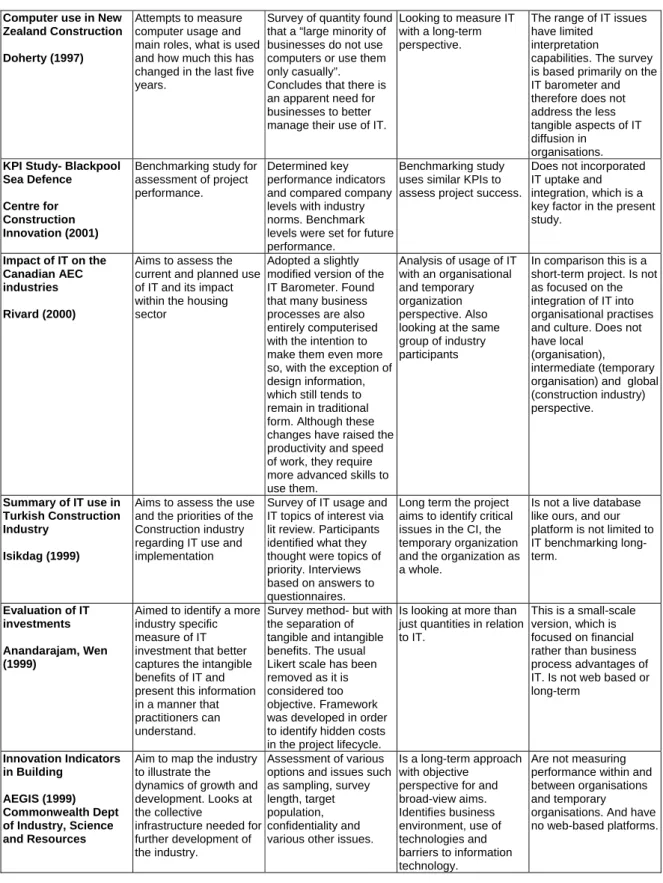
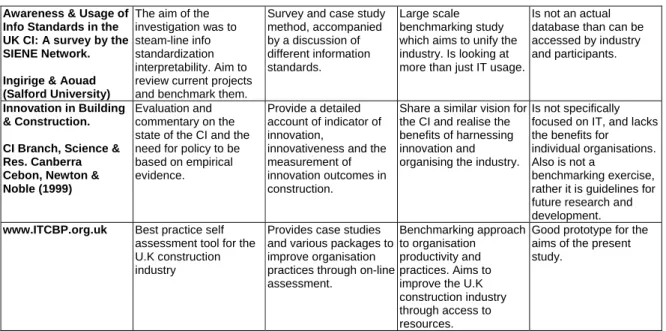
There is abundant literature that attests to the desirability of integrating ICT into the business processes of CI participant organisations. Likewise, many studies have been carried out worldwide to establish the level of ICT uptake across the CI; a meta-analysis of the prominent amongst these is provided in Table 1. The authors acknowledge that ICT uptake alone will not produce the desired business performance
improvements. It is held that project performance is a function of the uptake and integration of ICT into the business processes of the project supply chain. Longitudinal studies have charted the spread (or lack of it) of ICT throughout the sector, though none nationally in Australia, thus providing the rationale for this study (ICT integration is the subject of a sister project being funded by the CRC CI and carried out at the University of Newcastle). The IT Barometer, originally developed in Scandinavia, forms the point of departure for the proposed survey, though it is intended to form partnerships with other international benchmarking organisations.
TITLE/AUTHOR GOALS/AIMS METHOD SIMILARITIES DIFFERENCES Building & Construction Industries Supply Chain Project Tucker, Mohamed, Johnston, McFallen & Hampson (2001) CSIRO
Uses best practice to identify concepts, innovations and initiative that are working in supply chain management.
Survey via email with small numbers.
Are looking to identify key performance indicators and are benchmarking supply chain management practices. Supply chain management is facilitated by the integration of business process which is in turn facilitated by IT
Although there is an overlap, fundamentally the projects at this stage are looking at different levels of complexity. This study is looking at processes rather than IT specifically. We are looking at much larger numbers of
organisations and individuals.
International
Benchmarking Studies Department of Trade & Industry
Enhance knowledge or ICT usage and benchmark UK against other countries, identify strengths & weaknesses in organisations of all sizes.
Completed telephone interviews with approximately 7600 businesses of all sizes.
Aims are basically the same.
Study assesses both the usage of ICT and its integration into business practises.
The study is not limited to the construction sector.
On-line and Remote Construction Management (ORCM) Kajewski & Pahos QUT & CSIRO
Development and evaluation of an on-line project platform to reduce time wastage and cost associated with information transfers. On-line databases accessible to project participant to allow communication between geographically isolated project participants. Use of case studies to assess the success of the on-line techniques.
Encouraging web-based project management and the use of IT. Also attempts to benchmark the project to determine cost effectiveness to technologies.
Primarily focused on remote project management, not IT uptake and integration.
Case Study of the National Museum (Acton Peninsula) Project
Keniger, Hampson & Peters (2000)
The application of the alliancing method of project delivery; and The use of IT in the design, construction and project management
Case study approach using surveys with project participants assessing project alliancing and IT. Case was benchmarked against the Australian industry standards.
Case study approach to benchmarking with an emphasis on IT.
Is small scale compared to the scope of the present study which aims to collect similar information on a much larger scale
Gallicon/ Salford University
Aouad, Sun, Bakis & Swan (2001)
Evaluate the impact of an integrated project database on a project lifecycle in construction
Benchmarking- see figure 1 for a breakdown of the benchmarking lifecycle adopted for this study. Is a hybrid of Andersen & Pettersen (1996) and Construct IT (1998) methods of benchmarking
IT Construction & Real Estate
www.itbof.com
Provide a common IT platform for construction and real estate companies for improved market communication, greater efficiency, lower costs, and higher quality.
Use IT as support to change management processes. Requires active cooperation between all parties. Is not about the immediate needs of the
construction industry.
Long-term perspective for management change regarding IT.
Requires industry participation.
Is not a live data site Does not look at the industry as a whole, is more a tool than a data reservoir.
Construction Industry Trading Exchange (CITE)
Create an “open, neutral exchange” via a web based “one stop shop” for the procurement of goods and services.
Project process: feasibility> design> construction> operation with participants involved for different periods at different times. Has various capabilities: design and document management, tendering, purchasing and progress to date.
Is a web-based approach with a heavy emphasis on being a neutral exchange. Aim to introduce web based trading into construction management practices
Does not seem to involve the long term storage of company information for use in comparison. It is more a virtual shopping centre and lacks best practice capabilities.
Computer use in New Zealand Construction Doherty (1997)
Attempts to measure computer usage and main roles, what is used and how much this has changed in the last five years.
Survey of quantity found that a “large minority of businesses do not use computers or use them only casually”. Concludes that there is an apparent need for businesses to better manage their use of IT.
Looking to measure IT with a long-term perspective.
The range of IT issues have limited
interpretation
capabilities. The survey is based primarily on the IT barometer and therefore does not address the less tangible aspects of IT diffusion in
organisations.
KPI Study- Blackpool Sea Defence Centre for Construction Innovation (2001)
Benchmarking study for assessment of project performance.
Determined key performance indicators and compared company levels with industry norms. Benchmark levels were set for future performance.
Benchmarking study uses similar KPIs to assess project success.
Does not incorporated IT uptake and integration, which is a key factor in the present study.
Impact of IT on the Canadian AEC industries Rivard (2000)
Aims to assess the current and planned use of IT and its impact within the housing sector
Adopted a slightly modified version of the IT Barometer. Found that many business processes are also entirely computerised with the intention to make them even more so, with the exception of design information, which still tends to remain in traditional form. Although these changes have raised the productivity and speed of work, they require more advanced skills to use them. Analysis of usage of IT with an organisational and temporary organization perspective. Also looking at the same group of industry participants
In comparison this is a short-term project. Is not as focused on the integration of IT into organisational practises and culture. Does not have local
(organisation), intermediate (temporary organisation) and global (construction industry) perspective. Summary of IT use in Turkish Construction Industry Isikdag (1999)
Aims to assess the use and the priorities of the Construction industry regarding IT use and implementation
Survey of IT usage and IT topics of interest via lit review. Participants identified what they thought were topics of priority. Interviews based on answers to questionnaires.
Long term the project aims to identify critical issues in the CI, the temporary organization and the organization as a whole.
Is not a live database like ours, and our platform is not limited to IT benchmarking long-term. Evaluation of IT investments Anandarajam, Wen (1999)
Aimed to identify a more industry specific measure of IT investment that better captures the intangible benefits of IT and present this information in a manner that practitioners can understand.
Survey method- but with the separation of tangible and intangible benefits. The usual Likert scale has been removed as it is considered too objective. Framework was developed in order to identify hidden costs in the project lifecycle.
Is looking at more than just quantities in relation to IT.
This is a small-scale version, which is focused on financial rather than business process advantages of IT. Is not web based or long-term Innovation Indicators in Building AEGIS (1999) Commonwealth Dept of Industry, Science and Resources
Aim to map the industry to illustrate the dynamics of growth and development. Looks at the collective
infrastructure needed for further development of the industry.
Assessment of various options and issues such as sampling, survey length, target population, confidentiality and various other issues.
Is a long-term approach with objective
perspective for and broad-view aims. Identifies business environment, use of technologies and barriers to information technology.
Are not measuring performance within and between organisations and temporary organisations. And have no web-based platforms.
Awareness & Usage of Info Standards in the UK CI: A survey by the SIENE Network. Ingirige & Aouad (Salford University)
The aim of the investigation was to steam-line info standardization interpretability. Aim to review current projects and benchmark them.
Survey and case study method, accompanied by a discussion of different information standards. Large scale benchmarking study which aims to unify the industry. Is looking at more than just IT usage.
Is not an actual database than can be accessed by industry and participants.
Innovation in Building & Construction. CI Branch, Science & Res. Canberra Cebon, Newton & Noble (1999)
Evaluation and commentary on the state of the CI and the need for policy to be based on empirical evidence.
Provide a detailed account of indicator of innovation,
innovativeness and the measurement of innovation outcomes in construction.
Share a similar vision for the CI and realise the benefits of harnessing innovation and organising the industry.
Is not specifically focused on IT, and lacks the benefits for individual organisations. Also is not a
benchmarking exercise, rather it is guidelines for future research and development.
www.ITCBP.org.uk Best practice self assessment tool for the U.K construction industry
Provides case studies and various packages to improve organisation practices through on-line assessment.
Benchmarking approach to organisation productivity and practices. Aims to improve the U.K construction industry through access to resources.
Good prototype for the aims of the present study.
Table 1 Meta-analysis of benchmarking methodologies cont.
Rationale for web-based data collection
After reviewing the literature and identifying diverse examples of “world’s best practice” in survey methodology a number of survey mechanisms were considered for use in this study including Postal survey, Computer Assisted Telephone Interview (CATI) survey and Web-based survey. These were then assessed for ease of use, cost, reliability and potential for introducing bias, with a final choice being made in favour of web-based technology. Some of the advantages of web-based surveys include:
• Email follow-up reminders are easy and low cost.
• Provision of feedback has been found to motivate respondent participation.
• Running costs are minimal compared to postal surveys. With the exception of the development costs for the site, there are few ongoing costs.
• Data analysis costs are minimal compared to other survey types. Not only do they contain the advantages of traditional survey methods, but also save cost and time in data entry, as survey data is immediately available for analysis.
• Altering and updating can be done automatically.
The decision to pursue a web-based solution was in part guided by the recognition that, with careful design, a robust and adaptable survey mechanism could be created that could be used by the CRC CI to benchmark other, unrelated, subjects.
The conceptual CRC CI benchmarking tool
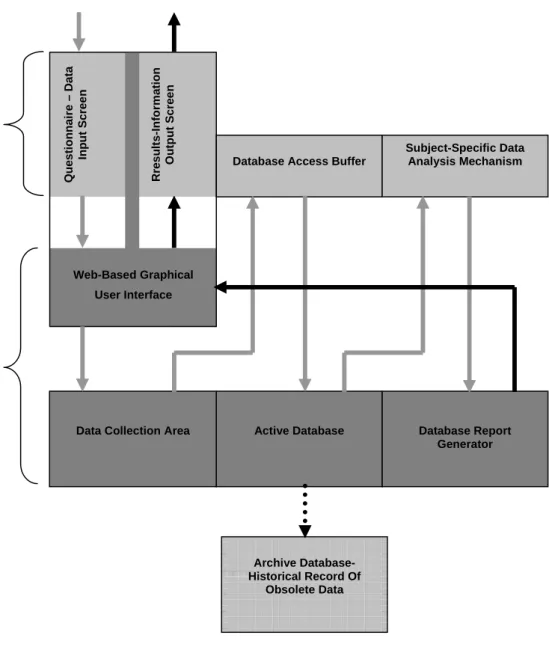
Literature has indicated that maximum benefit can be derived from using a web-based data collection mechanism. Ongoing costs associated with data collection, storage and analysis will be lower than with either of the alternatives discussed in this document. The proposed benchmarking tool will have a core survey mechanism that uses a modular graphical user interface (the questionnaire and report generator) dedicated to investigating a particular study topic and will be able to be adapted to other areas of investigation. Figure 1 demonstrates the conceptual structure of the benchmarking tool. A number of features are apparent in this mechanism:
• The data will be collected via an on-line questionnaire. This will be the public face of a subject-specific module.
• User enquiries, data input and reporting of results will all be executed through the same interface, and hosted on a web site.
• The tool will generate a set of key performance indicators relevant to the user enquiry.
• After analysis, results access will be facilitated through the web site. It is intended that the results will be available in many different formats, diagrams, charts and written reports.
• The results type and availability will be controlled by the nature of the module being accessed. • A buffer mechanism will be included to screen the data being inputted into the system. It is
considered that this would be an essential feature, protecting the integrity of the database because: - It would prevent the same organisational unit from inputting multiple entries.
- It would also prevent the entry of “trial runs” that would corrupt the integrity of the database. - It would allow a user to save (via an I.D. number) a partially complete response to the
questionnaire, allowing them to complete it at a later date.
• The database will be divided into two parts, the active database (data not more than two years old) and the archive database (data older than two years). These would serve two distinct purposes: - Active database- this would allow users to compare their organisational practice with industry
and sector norms, and best-practice examples. Access to a contemporary snapshot of industry performance could allow meaningful benchmarking baselines to be set, and progress towards individual goals to be recorded.
- Archive database- this would allow other groups of users to take a longer-term view of the issue under consideration. Trends could be identified, the diffusion of innovation could be mapped and evidence for the effectiveness of specific research initiatives could be sought. By moving ageing data out of the active database, benchmarking against obsolete practice would be avoided.
• Notwithstanding the need for commercial confidentiality, the mechanism would allow for the easy identification of organisations that demonstrated best practice in aspects of their performance. If they indicated their willingness to participate, they could then be the subject of a case study. This would then be published in a dedicated area of the web site.
• The underlying mechanism could be applied to any number of data collection, analysis, or reporting situations.
It is intended that the initial population of the database will be achieved by using a number of survey methods (post, telephone and electronic) and will be recruited from diverse sources, for example CRC CI project participants, Master Builders Association membership databases, and other commercial databases.
The ‘living’ nature of the mechanism will ensure that changes can be made to the detail of the questions without rendering the database obsolete. New lines of questions may be introduced as a result of the findings of the latest research, for instance, arising from other CRC CI projects. These questions will run in parallel with the existing set. This will allow comparison with previous datasets, whilst preparing for the next iteration of the instrument when the old question sets will have been replaced.
Analysis of the active database and the process of archiving historical databases could allow the mapping of industry-wide change over time. From this, changing patterns of use and integration would be plotted, indicating the diffusion of innovation in the areas that had been surveyed.
At present, the status of the project is that in-principle agreement has been given for its development, funding the implementation phase. A computer software engineering research student is beginning concurrent development of a beta version of both the database and the web-based front end. This is to be based upon a needs analysis. Inherent in this process is the recognition that a template approach will be required for questionnaire design that is flexible enough to enable various diverse research topics to use the underlying mechanism. Clearly this will require input from other potential researchers. A number of different software engineering structures have been suggested and will be evaluated for fit with the outcome of the needs analysis.
R re s u lts -I nf orma ti o n Ou tp ut S c re en Questio n n ai re – Data Inp u t Scree n Web-Based Graphical User Interface
Database Access Buffer
Subject-Specific Data Analysis Mechanism
Data Collection Area Active Database Database Report Generator Subject-specific module Core survey mechanism Archive Database-Historical Record Of Obsolete Data
User Inquiry
CONCLUSION
Until now, Australia has lacked a national survey of ICT uptake. The CRC CI has recognised the need for this, both in terms of a national “stock take” and as a vital step for any organisation wishing to benchmark its ICT performance. Concurrently, it has been acknowledged that the mechanism being developed to fulfill these requirements could be utilised to investigate a number of other issues. The proposed benchmarking tool generates a database of information that grows with every new participant’s input via the web questionnaire. The information can be kept up-to-date with periodic input from participants ensuring the data contained is a true depiction of the current environment. The tool’s ability to be expanded is easily achieved since its mechanism is indifferent to the content type. The possibilities for expansion include adaptation by other CRC CI projects and industry sectors.
This line of research has the potential to be highly successful, due to the many derived organisational and industry-wide benefits. It is an innovative concept that is feasible for the following reasons:
• International experience has shown that centralised benchmarking initiatives have acted as a spur to industry-wide performance improvement, since
• Exposure to best practice case studies has been shown to trigger organisational re-engineering, and • Access to mean industry performance values in the form of key performance indicators has provided
a direct measure of organisational performance improvement.
The tool has several advantages over other benchmarking schemes used elsewhere: • The survey will be web-based.
• It will add new data to the existing database.
• The mechanism will compare this dataset to the industry mean contained in the database and report back to the user.
• Database reports will be tailored to the user’s requirements. This could be achieved manually (by subscriber selection of comparator groupings) or automatically (the database will select a range of comparator groups of interest, based on the subscriber’s own data).
• The master database will be a ‘living’ resource, constantly being updated as each new dataset is added.
• Periodic culls of old datasets will ensure that the active database only contains data that is less than two years old, ensuring that comparisons will only be made with latest industry practice.
• The user subscription structure will be arranged to encourage periodic updating of the database. • Concurrently, the mechanism will identify sector leaders in terms of their performance, targeting
them for potential inclusion as best-practice case studies.
The tool has the potential to become the accepted benchmarking mechanism in the Australian construction industry, and can be heralded as promoting industry and cross-industry benchmarking standards. The CRC CI believe the tool will help foster an online community in the construction industry, over time encourage industry participants to create more online communities. They believe the tool will help organisations develop more effective and efficient business practices and encourage integration and standardisation in the construction industry.
REFERENCES
Betts, M. (1999). "Strategic Management of IT in Construction." Blackwell Science, Oxford, U.K.
Fischer, M. A., Waugh, L.M, Axworthy, A. (1998). "IT support of single project, multi project and industry wide integration." Computers in Industry 35: 31-45.
Ingirige, B. and G. Aouad (2001). Awareness and Usage of Information Standards in the UK Construction Industry: A Survey by The SIENE Network. School of Construction and Property Management, University of Salford.
Kajewski, S. P., S (2000). "IT fast-tracking remote construction projects." Built Environment Innovation and Construction Technology.
Lenard, D. and C. Abbott (2002). Innovative Procurement in Construction: An Australian Case Study. Centre for Construction Innovation.
Love, P. E. D. and M. Skitmore (1996). Construction project delivery systems: An analysis of selection criteria weighting. Proceedings of CIB W92 - "North meets South: Developing Ideas", Durban, South Africa, The Department of Property Development and Construction Economics, University of Natal. Sarshar, M., Betts, M. and Ridgeway, M. (1999) “Does construction need an Information Strategy Planning methodology?” in Bowen, P. and Hindle, R. (eds) “Customer satisfaction: a focus for research and practice”. Proceedings of Joint Triennial Symposium. Capetown. CIB W55 & W65.
Sturges, J. L., C. Egbu, Bates, A. (1999). Innovation in Construction. Construction Industry Development in the New Millenium, Singapore, School of Building and Real Estate, National University of Singapore.