The role of emotion in moral
psychology
Bryce Huebner
1,3, Susan Dwyer
2and Marc Hauser
3,4,51
Center for Cognitive Studies, Tufts University, Medford, MA 02155, USA 2Department of Philosophy, UMBC, Baltimore, MD 21250, USA
3
Department of Psychology, Harvard University, Cambridge, MA 02138, USA 4
Department of Biological Anthropology, Harvard University, Cambridge, MA 02138, USA 5Department of Evolutionary Biology, Harvard University, Cambridge, MA 02138, USA
Recent work in the cognitive and neurobiological sciences indicates an important relationship between emotion and moral judgment. Based on this evidence, several researchers have argued that emotions are the source of our intuitive moral judgments. However, despite the richness of the correlational data between emotion and morality, we argue that the current neuro-logical, behavioral, developmental and evolutionary evi-dence is insufficient to demonstrate that emotion is necessary for making moral judgments. We suggest instead, that the source of moral judgments lies in our causal-intentional psychology; emotion often follows from these judgments, serving a primary role in motiv-ating morally relevant action.
Introduction
The role of emotion in our moral psychology has long been the focus of philosophical dispute [1,2]. Critically, it has often been asked: does emotion influence moral judgment or merely motivate morally relevant action? Recently neurological and behavioral data have been marshaled in favor of the claim that emotion is necessary for moral judgment[3–7], if not both necessary and sufficient[7,8]. We are not convinced that the evidence warrants such conclusions. Although there is ample support for the claim that emotion has some role in moral thought and moral motivation, current evidence is insufficient to explain when or how emotion has a role in our moral judgments. We argue that the existing data cannot establish ‘the synchronic claim’ that emotion partially or wholly consti-tutes our moral capacities, nor can it establish ‘the dia-chronic claim’ that emotion is necessary for the development of our moral capacities [9,10]. Our goal is to clarify the relationship between current empirical evi-dence and existing theories concerning the source of our moral judgments, concluding with some brief suggestions for future research.
Before we begin, we pause to note that ‘emotion’ and ‘moral’ are contentious terms. We do not intend to enter into disputes over the meaning of these terms, and this is not an oversight on our part. The targets of our criticism have not typically explicated these terms or felt that it was necessary to define them to make the claim that, for example, emotion mediates our moral judgments
[3,4,7,8,11–14]. In line with this research, we adopt the vernacular understanding of ‘emotion’ and merely appeal to the paradigm examples of emotional states that have been studied by such researchers: happiness, disgust, fear, contempt and guilt. The term ‘moral’ is more contentious. Yet, although there is debate over the scope of the term, there is a broad consensus that physically harming others and violating considerations of fairness are central to the moral domain [15–18], although there are clearly other aspects of morality as well[19].
Emotion has a role in our moral psychology
It has long been recognized that violating moral norms is emotionally taxing[20]. Moreover, although our emotions do not always prevent us from contemplating morally reprehensible actions, feelings of guilt and shame typically compel us to stop short of immoral action. Indeed, psycho-paths, who lack the capacity for empathy and guilt, often fail to inhibit their violent tendencies [9,21,22]. Such observations provide the background against which the role of emotion in moral psychology must be understood. However, they are also consistent with a variety of con-ceptually and empirically distinct claims about the relationship between emotion and moral psychology (Box 1), with at least four specifically implicated thus far:
(i) Perceived moral violations often evoke contempt, shame, anger or disgust[23,24].
(ii) Emotion often leads to moralization [7,13,25], for example, when disgust is cultivated in the service of the politically insidious goal of removing people from the realm of moral concern.
(iii) Neuroscientific studies [3,4,12,21]demonstrate that emotional structures are recruited in making moral judgments.
(iv) Morally relevant action is often emotionally motiv-ated, appearing early in ontogeny [12,26–30] and phylogeny[31].
First, although emotion ‘accompanies’ some of our moral judgments, this does not mean that emotional responses ‘constitute’ such moral judgments. Second, although emotion sometimes leads to moralization, this is consistent with the hypothesis that emotion merely draws our atten-tion to the morally salient features of our environment, Corresponding author:Huebner, B. ([email protected]).
capturing attention and triggering distinctively moral cog-nition[32–34]. Third, existent neurological data are insuf-ficiently precise to demonstrate the causal or temporal role of emotion in moral psychology. Finally, we take no issue with the fourth claim. In fact, we not only applaud attempts to understand the role of emotion in motivating moral action but also suggest that this is probably its most important role[15]. It is, however, more frequently hypoth-esized that emotion is both necessary and sufficient for the possession of moral concepts [8], that making a moral judgment is nothing more, nor less, than being in a particu-lar emotional state and that emotional structures are recruited in making some [3,4,6,7,12,13] or even all[10]
moral judgments. Furthermore, building on a long philo-sophical tradition [1,2], some cognitive scientists have recently suggested that sympathetic concern is both onto-genetically and phyloonto-genetically necessary for the devel-opment of kin-altruism, reciprocal altruism and even genuine altruism [9,21,31,35–39]. Unfortunately, we do not believe the existent experimental paradigms are suffi-cient to test these hypotheses.
To clarify what is theoretically at stake in this debate, consider a parallel set of concerns about ‘embodied cogni-tion’. The strong embodied cognition thesis holds that explicit motor representations partially constitute many concepts [40–42]. The concept HAMMER is thought to consist of (i) features that typify hammers (e.g. a grasping shaft, a hard end) and (ii) the motor routines involved in goal-directed grasping and swinging. Supporters of this hypothesis often appeal to neuroimaging data demonstrat-ing that the word ‘hammer’ activates circuits classically associated with object categorization and circuits in the primary motor cortex [43]. However, activation in the motor cortex does not license the conclusion that the con-cept HAMMER includes motor routines. Given the poor temporal resolution of neuroimaging, it is just as likely that the concept HAMMER activates circuits dedicated to object categorization, which, in turn, activate circuits in the motor cortex. Distinguishing these hypotheses enables cognitive scientists to target motor routines to see whether they are ‘part of our concepts’ or instead ‘stand in import-ant causal relationships to them’. Analogously, we argue that cognitive scientists must target emotional mechan-isms to see whether they ‘constitute’ moral concepts or merely ‘stand in an important causal relationship’ to them. Behavioral data
The central behavioral data in favor of the claim that emotion is the source of moral judgment is the apparent modulation of moral judgment by disgust [7,44]. Partici-pants responding to moral dilemmas at a dirty desk or when smelling a noxious odor, make more severe moral judgments than controls [6]. Highly susceptible partici-pants, hypnotically induced to experience ‘a brief pang of disgust’ when confronted with a neutral word, see moral transgressions as more morally wrong in vignettes contain-ing the hypnotically targeted word[44]. And, participants who watch a humorous clip from ‘Saturday Night Live’, as opposed to a neutral control clip, report feeling more positive mood and offer more utilitarian responses to the footbridge dilemma but not to the bystander dilemma[45]. Yet, although these are fascinating effects, they are insuf-ficient to demonstrate that emotion is necessary for moral judgment. As we see it, there are four difficulties with appealing to such behavioral data in establishing that emotions partially constitute moral judgments.
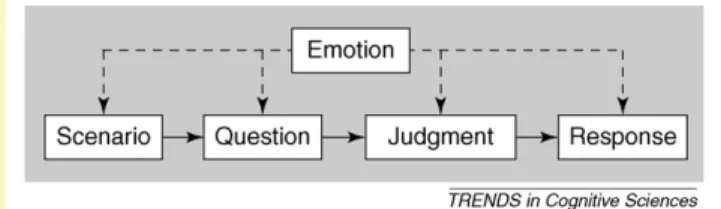
First, these data fail to isolate the precise point at which emotion has a role in our moral psychology (see Box 2). Studies [6,45] in which emotional stimuli are presented before the scenario is read, could modulate the inputs to the emotional system, enabling emotion to influence the interpretation of the scenario or the question. Or, emotion could act as a gain on what has already been conceived as a moral infraction (thereby, increasing the severity of the Box 1. Five models of our moral psychology
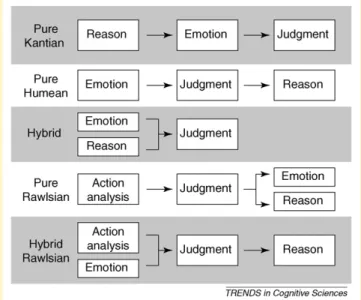
It is commonly agreed that moral psychology relies on a variety of computational mechanisms. However, there is little agreement concerning the causal structure or temporal organization of these mechanisms. We suggest that the following five models delimit the most promising avenues for empirical enquiry (NB these are merely initial models; a complete story of our moral cognition is likely to be far more complicated) (Figure I). The ‘Pure Kantian’ [61] model indicates that moral judgment is a rational, deliberative endeavor. According to the Pure Kantian, emotion generates reactive attitudes [62] on the basis of rational appraisals, but moral judgment is primarily a conscious process of deliberate reflection. The ‘Pure Humean’[7,8], by contrast, maintains that reason is the ‘slave of the passions’, that moral psychology is essentially emotive and that deliberative mechanisms are recruited only to provide post-hoc rationalizations of moral judgments. ‘Hybrid’[3,4,10]models have also been developed on the basis of recent neurophysiological data, indicating that both emotional and deliberative mechanisms are recruited in making moral judgments. Some advocates of this view [10]maintain that moral judgment always requires both emotion and reason; others[3,4,12]maintain that emotion has a important role only in evaluating personal-moral dilemmas that require physical intervention. ‘Pure Rawlsians’ [15,16,63] indicate the existence of a distinctively moral faculty, operating independently of deliberative and emotional mechanisms. For the Pure Rawlsian, emotional mechanisms are recruited antecedent to moral judgment to translate moral judgments into morally relevant actions. Finally, the ‘Hybrid Rawlsian’ could indicate that emotion is recruited in evaluating high-conflict personal dilemmas and in resolving ambiguous outputs from the moral faculty. However, the plausibility of this model has yet to be defended or subjected to empirical scrutiny.
perceived wrong) antecedent to the operation of distinc-tively moral circuits. Moreover, appeals to hypnotically induced disgust[44]cannot alleviate this worry. Because, here too, emotion could modify the inputs into distinctively moral circuits rather than modulating the operation of these moral circuits themselves. Thus, although asking subjects to evaluate a moral question triggers the process of moral evaluation, the negative emotional state yields a more severe moral judgment because of an increased focus on the ‘antecedently’ morally salient features of the scenario.
Second, and on a related note, these data fail to demon-strate that emotion transforms conventional judgments into moral judgments. To demonstrate that judgments can be shifted from the non-moral into the moral realm by inducing or amplifying an emotional response (a thesis suggested by Nichols[46]) experiments analyzing the per-ceived moral relevance of a transgression would have to be used. Thus, all existent data fail to distinguish between three plausible hypotheses: (i) emotion acts as a gain antecedent to moral judgment, (ii) negative emotion alerts us to the moral salience of a situation and (iii) emotion triggers a genuine conceptual shift from merely conven-tional to moral.
Third, there is little consistency in the scales used to measure the role of emotion in moral psychology. Some use a 7-point scale ranging from ‘perfectly OK’ to ‘extremely immoral’[6], others use a scale asking ‘how morally wrong’ an action is[44]. Yet others pose a dichotomous question about ‘acceptability’ or ‘permissibility’ and some use a combination of these and other scales within the same study. This makes comparison across, and even within, studies[6]impossible.
Fourth, although emotion yields ‘practical’ judgments, it is unclear that this warrants treating emotion as consti-tutive of ‘moral’ judgments. Perhaps moral cognition can be interfered with by introducing distracting emotional stimuli[6]. However, because disgust functions practically to help us avoid toxic, infectious or contaminating sub-stances, it could generate interruptive judgments that could compete with moral cognition for attentional
resources. Existent data fail to address the plausible hy-pothesis that the apparent modulation of moral judgments by emotion is an artifact of the redeployment of attentional resources. With this in mind, we also note that although high socio-economic status (SES) participants treat harm-less wrongdoings (e.g. cleaning a toilet with one’s national flag) as disgusting, whereas low-SES participants treat such actions as universally wrong and deserving of punish-ment [13], such data merely show that the class of uni-versally wrong actions that are deserving of punishment has a permeable boundary. This is unsurprising. After all, differences in socialization, mediated by strong emotional cues, can ground conventional judgments about taboos that exhibit precisely these features.
In summary, current behavioral data fail to license the claim that emotional processes are the source of moral computation leading to judgment.
Neuroimaging data
Neurobiological data have also been offered in support of the claim that emotional circuits are integral to evaluating morally salient stimuli. For example, judgments about morally salient claims (e.g. ‘The elderly are useless’) show increased activity in the frontal polar cortex (FPC) and medial frontal gyrus, when compared to judgments about non-moral claims (e.g. ‘Telephones never ring’)[47]. More-over, morally salient stimuli evoke increased functional connectivity between the left FPC, orbital frontal (OFC), anterior temporal, and anterior cingulate cortices (ACC) and limbic structures such as the thalamus, midbrain and basal forebrain [48]. Finally, personal-moral dilemmas (e.g. footbridge dilemma) selectively recruit emotional cir-cuits when compared to impersonal-moral dilemmas (e.g. bystander dilemma).
On the basis of these and similar imaging results [3,4,12], Greene [11] has proposed that moral judgment requires a prepotent emotional response (subserved by circuits in the medial frontal gyrus, the posterior cingulate gyrus and the angular gyrus) that drives moral disapproval and reflective utilitarian reasoning (implemented in the dorsolateral prefrontal cortex [DLPFC]). Although these systems typically produce convergent outputs, outputs diverge in personal-moral dilemmas, generating conflict (evidenced by increased activity in the ACC) that must be resolved by higher-cognitive control circuits in the anterior DLPFC. Converging data from neuroeconomics indicate that unfair offers in an ‘ultimatum game’ elicit increased cortical activity in the anterior insula in addition to the DLPFC [49,50]. More broadly, emotional circuits in the insular cortex are differentially activated in the perception of inequity[50], and it is hypothesized that activity in the insular cortex is indicative of the sensitivity to norm-violations implicated in deontological judgment.
As interesting as these neurobiological data are, they only show ‘that some perceived deontological violations are associated with strong emotional responses’, a perspective that ‘few would doubt or deny’ [51]. More generally, the activity of emotional circuits provides only correlational data, showing that emotions are associated with moral judgments. Such data (on their own) can never be used to infer causality, and because of the poor temporal resolution Box 2. Where is the effect of emotion?
Although various experiments demonstrate that strong emotional stimuli affect the response to moral scenarios, the exact point at which the effect occurs has not been critically examined. On the basis of currently available data, the effect of emotion could occur (i) in the interpretation of the scenario, (ii) in the interpretation of the question, (iii) in the production of the moral judgment or (iv) in reporting the judgment as a measurable response. The precise point at which emotion has a role is the most important issue for establishing the truth or falsity of the emotional constituency hypothesis (Figure I).
of neuroimaging, cannot be used to assess when emotions have a role or whether they are constitutive of moral concepts. In summary, the mere activity of neural circuits classically associated with emotion in processing moral scenarios fails to distinguish between the claim that (i) emotions are integral to moral computation and (ii) emotions result from these computations. We, therefore, conclude that imaging data on their own are insufficient to determine whether emotions are activated before moral computations, during moral computations or antecedent to moral computations. Future research combining func-tional magnetic resonance imaging (fMRI) with event related potentials (ERPs) could help resolve this timing issue.
Neuropsychological data
A much stronger test of the hypothesis that emotion is the source of moral judgment is indicated by studies of patients with adult-onset, bilateral damage to ventromedial pre-frontal cortex (VMPC). VMPC patients exhibit: (i) a flat-tening of their social emotions, indicated by behavioral and physiological measures; (ii) an inability to redeploy emotional representations previously associated with pun-ishment and reward; (iii) an inability to anticipate future outcomes, punishments and rewards and (iv) a lack of inhibitory control [10,52–54]. Damasio [10] argues that emotion is usually integral to cognition, and on this basis, hypothesizes that moral judgment is likely to rely on the emotional processes implemented in VMPC.
Consistent with this hypothesis, frontotemporal demen-tia (FTD), resulting from the deterioration of prefrontal and anterior temporal cortex, generates blunted emotion, disregard for others and a willingness to engage in moral transgressions. Moreover, FTD patients show a pro-nounced tendency to adopt the utilitarian alternative in personal moral dilemmas such as the footbridge case[55]. With these results in mind, Koenigs, Young and colleagues [53]examined the judgments of the previously mentioned VMPC patients for moral and non-moral dilemmas. Each dilemma was classified as involving a personal or an impersonal violation[4]; personal violations were further subdivided into low-conflict (characterized by short reac-tion times and low variance in subject judgments) and high-conflict cases. VMPC patients were indistinguishable from controls, except in high-conflict dilemmas in which they were more likely to endorse the utilitarian outcome. Overall, these data show that even though VMPC patients experience a flattened socio-emotional profile, they nonetheless judge most moral dilemmas (i.e. imper-sonal moral dilemmas, low-conflict perimper-sonal moral dilem-mas and personal dilemdilem-mas in which ‘harm to another’ is pitted against a ‘benefit to self’) as do healthy controls. Moreover, given the limited range of cases on which VMPC patients deviate, it is plausible that they fail to treat the morally salient features of high-conflict dilemmas as morally salient. If our interpretation is correct, then moral cognition would yield deviant outputs as a result of deviant inputs, rather than as a result of a deficit in moral proces-sing per se; this parallels the interpretation we offered earlier for the hypnotism study [44]. In this case, the process of moral evaluation would remain intact. However,
the flattening of negative emotion would yield more per-missible moral judgments because of a failure to focus on the ‘antecedently’ morally salient features of the scenarios.
The diachronic necessity of emotion?
Correlational data from the mind sciences could be further reinforced by data demonstrating that emotion is necess-ary for the acquisition of moral concepts and the devel-opment of moral judgment. Hoffman [56], for example, appeals to the affectively laden tools used by parents to convey social rules and correct behavior in arguing that emotions are developmentally necessary for moral judg-ment. We disagree. Children are not given sufficient moral correction to account for the intricate structure of their moral psychology[57], and although there is virtually no work on the morally relevant input the child receives, our sense is that most rule-based correction is directed towards conventional transgressions (‘Take your finger out of your nose!’) as opposed to moral ones (‘Don’t kill your brother.’). As in studies of child language acquisition, it is clear that we need serious studies of the actual input the child receives in the moral domain.
An alternative ontogenetic hypothesis relies on the moral deficiencies of psychopaths. Psychopaths engage in immoral acts, show a callous lack of concern for others and lack the capacities for guilt, remorse and empathy [9,21,32,58]. Blair has claimed that in normally developing children, emotional circuits facilitate negative reinforce-ment for actions that generate distress cues. Psychopaths lack these emotional circuits, and Blair[9,21]argues from this fact to the claim that emotion is the developmental source of our moral concepts and that psychopathy is a developmental consequence of an early emotional deficit.
Although psychopaths fail to distinguish moral from conventional transgressions, treating conventional viola-tions as less permissible, more serious and as authority-independent (i.e. as moral transgressions)[21], such data do not speak to either the source or the content of a psychopath’s moral cognition. This pattern of response is equally well accounted for by a cold, calculated rationality, designed to get ‘off the hook’ and to say what others want to hear. Moreover, as Blair[9] himself has shown by using age-matched psychopathic and non-psychopathic juvenile delinquents, even psychopathic juveniles draw the moral-conventional distinction (although it is less pronounced in psychopathic than non- psychopathic juveniles), and make just as many references to welfare considerations as do non-psychopathic controls (although psychopathic juven-iles were less likely to ascribe moral emotions to others). These data indicate a developmental trajectory for psycho-pathy, but contrary to what one would predict if emotion is developmentally necessary for acquiring moral concepts. Psychopathic juveniles apparently lose the capacity to distinguish moral from conventional violations over the course of development. Therefore, perhaps the deficiencies in the moral psychology of the psychopath are a develop-mental consequence of antisocial behavior, instead of the other way around. As Raine[58]argues, a life filled with antisocial behaviors could modify the moral psychology of an individual, allowing for the justification of immoral behaviors and reducing cognitive dissonance. However, if
this is true, the moral cognition of psychopaths is deviant as a result of deviant inputs rather than as a result of a deficiency in moral processing.
A final piece of evidence for the developmental necessity of emotion is indicated by the moral psychology of early-onset VMPC patients. Early-early-onset lesions to VMPC [54,59]lead to a phenotype that is unresponsive to punish-ment, lacks inhibitory control, generates behavioral deficiencies in moral and prudential domains and shows emotional deficits in guilt, remorse and empathy. Such patients also fail to acquire moral concepts, justifying their behavior by appeal to the egocentric desire to avoid punishment[54,59]. However, such data only tell us that the acquisition of moral concepts is downstream from some social-emotional mechanisms. To establish that emotional processes are constitutive of moral cognition, we would need a much clearer picture of the precise deficits present in early-onset VMPC patients, testing them on the same battery of dilemmas used in the adult study. Given the rarity of this disorder, it is unclear whether the absence of moral cognition is a deficit in the acquisition of social rules produced by a lack of positive feedback, or even a result of deviant behavior that inhibits the matu-ration of moral cognition.
Conclusion
We conclude that current evidence is insufficient to sup-port the hypothesis that emotional processes mediate our intuitive moral judgments, or that our moral concepts are emotionally constituted. We suggest instead (for more complete development, see Refs [15,16,51,60]) that our moral judgments are mediated by a fast, unconscious process that operates over causal-intentional representa-tions. The most important role that emotions might have is in motivating action. We offer these criticisms to sharpen future discussion and empirical enquiry. In addition, we hope that future studies will be careful to disambiguate the various ways in which emotional mechanisms might have a role in our moral cognition (Box 3). Do the social emotions push us into the moral domain, alerting us to the presence of morally salient properties? Do they modify the severity of our moral judgments? Do emotional structures inhibit our tendency to entertain thoughts that are contrary to moral reasoning? Do they merely inhibit practically irrational action? We are optimistic that more careful research in the cognitive sciences will lead to more satisfy-ing answers to these empirical and conceptual questions, and that the tools of cognitive neuroscience and neurop-sychology will be at the forefront of future discussion. References
1 Hume, D. (1978)A Treatise of Human Nature,Oxford University Press 2 Smith, A. (1759) The Theory of Moral Sentiments, Cambridge
University Press
3 Greene, J.D. et al. (2001) An fMRI investigation of emotional engagement in moral judgment.Science293, 2105–2108
4 Greene, J.D.et al.(2004) The neural bases of cognitive conflict and control in moral judgment.Neuron44, 389–400
5 Haidt, J.et al. (1997) Body, psyche, and culture: the relationship between disgust and morality.Psychol. Dev. Soc. J.9, 107–131 6 Schnall, S.et al.(2008) Disgust as embodied moral judgment.Pers. Soc.
Psychol. Bull.34, 1096–1109
7 Haidt, J. (2001) The emotional dog and its rational tail.Psychol. Rev. 108, 814–834
8 Prinz, J. (2006) The emotional basis of moral judgment.Philos. Exp.9, 29–43
9 Blair, R. (1997) Moral reasoning and the child with psychopathic tendencies.Pers. Individ. Dif.22, 731–739
10 Damasio, A. (1994)Descartes Error,Harper Perennial
11 Greene, J.D. (2007) Why are VMPFC patients more utilitarian?: a dual-process theory of moral judgment explains.Trends Cogn. Sci.11, 322–323
12 Greene, J.D. and Haidt, J. (2002) How (and where) does moral judgment work?Trends Cogn. Sci.6, 517–523
13 Haidt, J. (1993) Affect, culture, and morality, or is it wrong to eat your dog?J. Pers. Soc. Psychol.65, 613–628
14 Shweder, R. and Haidt, J. (2000) The cultural psychology of the emotions: ancient and new. In Handbook of emotions(Lewis, M. and Haviland, J., eds), pp. 397–414, Guilford Press
15 Hauser, M. (2006)Moral Minds,Harper Collins
16 Mikhail, J. (2007) Universal moral grammar.Trends Cogn. Sci.11, 143–152
17 Joyce, R. (2006)The Evolution of Morality,MIT Press 18 de Waal, F. (1997)Good Natured,Harvard University Press 19 Haidt, J. (2007) The new synthesis in moral psychology.Science316,
998–1002
20 Milgram, S. and Sabini, J. (1978) On maintaining urban norms: a field experiment in the subway. InAdvances in Environmental Psychology (Baum, A.et al., eds), pp. 31–40, Erlbaum
21 Blair, R.J. (1995) A cognitive developmental approach to morality: investigating the psychopath.Cognition57, 1–29
22 Nichols, S. (2002) How psychopaths threaten moral raitonalism, or is it irrational to be amoral.Monist85, 285–303
Box 3. Directions for future research
Future experiments should adopt a single scale for analyzing the effect of emotion on moral judgment, or at least use different scales with one set of dilemmas to assess whether they generate different patterns of judgment. For example, to explore the potential ‘gain’ function of emotion in shifting the severity of the moral judgment, we propose a 7-point scale ranging from obligatory (1)–permissible (4)–forbidden (7)[64]. To explore the potential driving force of emotion in labeling a situation as moral, we propose using a moralness scale that runs from conventional (1) to moral (7), each end point anchored by a concrete example. Experimental paradigms should be established to time-lock fMRI data with ERP data, and experimental paradigms should be developed to distinguish the effect of emotion on moral judgment from the effect of attentional redeployment and cognitive load on moral judgment.
Further experiments on patient populations (especially adult- and early-onset VMPC patients) should be carried out to examine the precise deficits that they exhibit on moral tasks, including the interaction between social emotions. Similarly, we should pursue experiments targeting the performance of psychopaths on moral dilemmas, instead of moral-conventional cases, to eliminate the use of previously rehearsed answers and a rational desire to cohere.
A more complete account of the component processes that underlie moral judgment must be established, distinguishing domain-specific from domain-general processes, and document-ing how non-morally specific components interface to create new and potentially morality-specific representational resources [15,16]. With this descriptive account in place, it will then be possible to map out the ontogenetic and phylogenetic patterns of change, and use neurobiological techniques such as transcranial magnetic stimulation to disrupt these components.
Finally, we propose that emerging work on the performance of participants in virtual reality environments provides an important and intriguing test ground for examining the role of emotion in moral motivation as opposed to moral judgment[65,66]. Such studies are only in their early days, however, they do indicate a promising and untapped research environment, especially one aimed at distinguishing judgment from action.
23 Rozin, P.et al.(1999) The moral-emotion triad hypothesis: a mapping between three moral emotions (contempt, anger, disgust) and three moral ethics (community, autonomy, divinity).J. Pers. Soc. Psychol.76, 574–586
24 Rozin, P. (1997) Moralization and becoming a vegetarian.Psychol. Sci. 8, 67–73
25 Rozin, P.et al.(1993) Disgust, InHandbook of Emotions, pp. 575–594, Guilford Press
26 Gallese, V. (2003) The roots of empathy: the shared manifold hypothesis and the neural basis of intersubjectivity.Psychopathology36, 171–180 27 Hoffman, M. (1982) Development of prosocial motivation: empathy and guilt. InDevelopment of Prosocial Behavior(Eisenberg, N., ed.), pp. 281–313, Academic Press
28 Hoffman, M. (2000)Empathy and Moral Development: Implications for Caring and Justice,Cambridge University Press
29 Meltzoff, A.N. and Moore, M.K. (1977) Imitation of facial and manual gestures by human neonates.Science198, 75–78
30 Zahn-Waxler, C.et al.(1979) Child rearing and children’s prosocial initiations toward victims of distress.Child Dev.50, 319–330 31 Preston, S. and DeWaal, F. (2001) Empathy: its ultimate and
proximate bases.Behav. Brain Sci.25, 1–20
32 Batson, C.et al.(1995) Immorality from empathy-induced altruism: when compassion and justice conflict.J. Pers. Soc. Psychol.68, 1042–1054 33 Pizarro, D. (2000) Nothing more than feelings?: the role of emotions in
moral judgment.J. Theory Soc. Behav.30, 355–375
34 Pizarro, D.et al.(2006) The creativity of everyday moral reasoning: empathy, disgust and moral persuasion. InCreativity and Reason in Cognitive Development (Kaufman, J. and Baer, J., eds), pp. 81–98, Cambridge University Press
35 Blair, R.J. and Cipolotti, L. (2000) Impaired social response reversal: a case of ‘acquired sociopathy’.Brain123, 1122–1141
36 Decety, J.et al.(2002) A PET exploration of the neural mechanisms involved in reciprocal imitation.Neuroimage15, 265–272
37 Jackson, P.L.et al.(2006) Neural circuits involved in imitation and perspective-taking.Neuroimage31, 429–439
38 Flack, J. and deWaal, F. (2000) ‘Any animal whatever’. Darwinian building blocks of morality in monkeys and apes.J. Conscious. Stud.7, 1–29
39 Sober, E. and Wilson, D. (1998)Unto Others,Harvard University Press 40 Barsalou, L.W. et al. (2003) Grounding conceptual knowledge in
modality-specific systems.Trends Cogn. Sci.7, 84–91
41 Mahon, B.Z. and Caramazza, A. (2008) A critical look at the embodied cognition hypothesis and a new proposal for grounding conceptual content.J. Physiol. (Paris)102, 59–70
42 Lakoff, G. and Johnson, M. (1999) Philosophy in the Flesh: The embodied Mind and its Challenge to Western Thought,Basic Books 43 Pulvermu¨ller, F. (2005) Brain mechanisms linking language and
action.Nat. Rev. Neurosci.6, 576–582
44 Wheatley, T. and Haidt, J. (2005) Hypnotic disgust makes moral judgments more severe.Psychol. Sci.16, 780–784
45 Valdesolo, P. and DeSteno, D. (2006) Manipulations of emotional context shape moral judgment.Psychol. Sci.17, 476–477
46 Nichols, S. (2004)Sentimental Rules: On the Natural Foundation of Moral Judgment,Oxford University Press
47 Moll, J. et al.(2002) The neural correlates of moral sensitivity: a functional magnetic resonance imaging investigation of basic and moral emotions.J. Neurosci.22, 2730–2736
48 Moll, J.et al.(2003) Morals and the human brain: a working model. Neuroreport14, 299–305
49 Sanfey, A.G.et al.(2003) The neural basis of economic decision-making in the ultimatum game.Science300, 1755–1758
50 Hsu, M.et al.(2008) The right and the good: distributive justice and neural encoding of equity and efficiency.Science320, 1092–1095 51 Mikhail, J. (2008) Moral cognition and Computational theory. InMoral
Psychology: The Neuroscience of Morality: Emotion, Disease, and Development(Sinnott-Armstrong, W., ed.), pp. 81–92, MIT PRESS 52 Damasio, A.R.et al.(1990) Face agnosia and the neural substrates of
memory.Annu. Rev. Neurosci.13, 89–109
53 Koenigs, M.et al.(2007) Damage to the prefrontal cortex increases utilitarian moral judgments.Nature446, 908–911
54 Anderson, S.W.et al.(2006) Impairments of emotion and real-world complex behavior following childhood- or adult-onset damage to ventromedial prefrontal cortex.J. Int. Neuropsychol. Soc.12, 224–235 55 Mendez, M.F. et al.(2005) An investigation of moral judgment in
frontotemporal dementia.Cogn. Behav. Neurol.18, 193–197 56 Hoffman, M. (1983) Affective and cognitive processes in moral
internalization: an information processing approach. In Social Cognition and Social Development(Higgins, E.et al., eds), pp. 236–
274, Cambridge University Press
57 Mikhail, J. (2008) The poverty of the moral stimulus. In Moral Psychology: The Evolution of Morality(Sinnott-Armstrong, W., ed.), pp. 353–360, MIT Press
58 Raine, A. and Yang, Y. (2006) Neural foundations to moral reasoning and antisocial behavior.Soc. Cogn. Affect. Neurosci.1, 203–213 59 Anderson, S.W.et al.(1999) Impairment of social and moral behavior
related to early damage in human prefrontal cortex.Nat. Neurosci.2, 1032–1037
60 Dwyer, S. Moral dumbfounding and the linguistic analogy.Mind Lang. (in press)
61 Kohlberg, L. (1969) Stage and sequence: the cognitive-developmental approach to socialization. InMoral Development and Behavior(Goslin, D., ed.), pp. 31–53, Holt, Reinhart, and Winston
62 Strawson, P. (1960) Freedom and resentment. Proceedings of the British Academy47, 1–25
63 Dwyer, S. (1999) Moral competence. InPhilosophy and Linguistics (Murasugi, K. and Stainton, R., eds), pp. 169–190, Westvew Press 64 Cushman, F.et al.(2006) The role of reasoning and intuition in moral
judgments: testing three principles of harm.Psychol. Sci.17, 1082–
1089
65 Slater, M. et al. (2006) A virtual reprise of the stanley milgram obedience experiments.PLoS One1, e39
66 Kinga, J.et al.(2005) Doing the right thing: a common neural circuit for appropriate violent or compassionate behavior.Neuroimage30, 1069–