eCommerce for
Small Enterprise
Development
A Handbook for
Enterprise Support
Agencies
in India
2005
Richard Duncombe & Richard Heeks
IDPM, University of Manchester, UKSunil Abraham
Mahiti, Bangalore, IndiaWith Support From:
The Commonwealth Telecommunications Organisation (CTO) The UK Department for International Development
Building Digital Opportunities (BDO) Programmme Institute for
Development Policy and Management The University of Manchester
Commonwealth Telecommunications Organisation
United Kingdom Department for International
Written by: Richard Duncombe and Richard Heeks
Institute for Development Policy and Management (IDPM) University of Manchester, Precinct Centre, Manchester,
M13 9QH, UK Tel: +44-161-275-2800 Fax: +44-161-273-8829 Email: [email protected] Email: [email protected] Sunil Abraham Mahiti
314/1, 7th Cross, Domlur, Bangalore 560 071, Karnataka, India Tel: +91-80-5115-0580
Fax: +91-80-5115-0583 Email: [email protected] Web: http://www.mahiti.org
Published by: Institute for Development Policy and Management (IDPM) Email: [email protected]
Web: http://www.sed.manchester.ac.uk/idpm With support from: Building Digital Opportunities (BDO) Programme
Department for International Development 1 Palace Street, London, SW1E 5HE, UK Email: [email protected]
Web: http://www.dfid.gov.uk/
Commonwealth Telecommunications Organisation (CTO) Clareville House, 26-27 Oxendon Street, London, SW1Y 4EL, UK
Email: [email protected] Web: http://www.cto.int
This handbook can be used together with 'eCommerce for Small Enterprise
Development – A Handbook for Entrepreneurs in India', which has been designed specifically for use by small business owners and employees.
View/download both handbooks from: http://www.ecomm4dev.org/
View/download additional handbooks concerning ICTs and enterprise development at:
http://www.sed.manchester.ac.uk/idpm/research/is/ictsme/index.htm Exchange rate used in handbook: 1 US Dollar = 50 Indian Rupees.
List of Contents
How To Use This Handbook ...1
A. Introduction...2
A1. What Is eCommerce? ...2
A2. What Is Driving eCommerce For Small Enterprises?...3
A3. What Are The Benefits Of eCommerce? ...4
A4. What Are The Risks Of Going Into eCommerce? ...6
A5. What Are The Agency Benefits And Risks? ...7
B. eCommerce in India ...8
B1. How Big Is eCommerce In India?...8
B2. Assessing eReadiness For Small Enterprise In India ...11
B3. How Is The Government Assisting eCommerce For Small Enterprise?...12
C. Indian Enterprise On The Road To eCommerce...13
C1. Moving Up The eCommerce Ladder ...13
D. eCommerce Support ...17
D1. Different Types of eCommerce-Related Support ...17
D2. Examples Of eCommerce Support For Small Enterprise ...19
D3. Analysing Enterprise Support Needs ...24
E. Agency Strategy on eCommerce ...26
E1. Agency Strategy For eCommerce And Small Enterprise...27
E2. Understanding eCommerce Users ...28
E3. Determining eCommerce Entry Points...29
E4. Other Issues For Agencies...31
E5. Strategies For eCommerce Promotion...34
F. eCommerce Best Practice Guides ...36
Advice Sheet 1: Getting Connected And Making A Start ...36
Advice Sheet 2: Using Electronic Mail (email)...37
Advice Sheet 3: eCommerce Skills...38
Advice Sheet 4: Web Development ...39
Advice Sheet 5: Online Promotion ...40
Advice Sheet 6: Networking And Communities On The Internet...41
Advice Sheet 7: Contracting Out Web Services ...42
Advice Sheet 8: Order Fulfilment And Logistics ...43
Advice Sheet 9: Costs Of Web-Based eCommerce...44
Advice Sheet 10: Some Legal/Regulatory Issues ...45
Advice Sheet 11: Web Security ...46
Advice Sheet 12: Open Source Software...47
G. Finding eCommerce Support In India...48
G1. India-Based Small Enterprise Support Agencies ...48
G2. Internet Service Providers (ISPs)...51
H. Understanding More About eCommerce ...53
H1. Glossary/Jargonbuster...53
How To Use This Handbook
This handbook is designed for agencies that are supporting entrepreneurs running micro and small-scale enterprises (MSEs) in India, including small-scale industries (SSIs). It is designed for agencies that have little current involvement in eCommerce support and have little knowledge of what is involved, as well as for more
experienced agencies that are already using information and communication
technologies (ICTs). Your agency may be considering raising its level of support and involvement in eCommerce – through increased use of computer-based information systems, use of the Internet or through expanding communications via email, mobile phones and the World Wide Web (WWW). If so, then this handbook will be of use to you.
The objectives of the handbook are as follows:
• To outline some basic information about eCommerce including the benefits and risks for agencies and clients (Section A).
• To present an overview of eCommerce in India (Section B).
• To explain the different ways in which small enterprises use eCommerce (Section C).
• To review current practice in India for eCommerce support for small enterprises, and outline an approach to enterprise needs analysis for eCommerce (Section D).
• To encourage a strategic approach to eCommerce support by agencies (Section E).
• To provide information about different aspects of eCommerce (Section F).
• To point toward further information and support for eCommerce in India and from overseas (Sections G&H).
The first thing you should do is read through Sections A & B to learn more about eCommerce, then look at Section C to gauge how far your clients have climbed the 'eCommerce ladder'. Next look at Section D that focuses on client support. Section D1 outlines different approaches to eCommerce support for small enterprises and Section D2 presents agency case study examples from India. Section D3 outlines a client-centred approach for improving your agency's analysis of eCommerce needs for small enterprises, concentrating on three areas – information needs, value chain analysis, and resources.
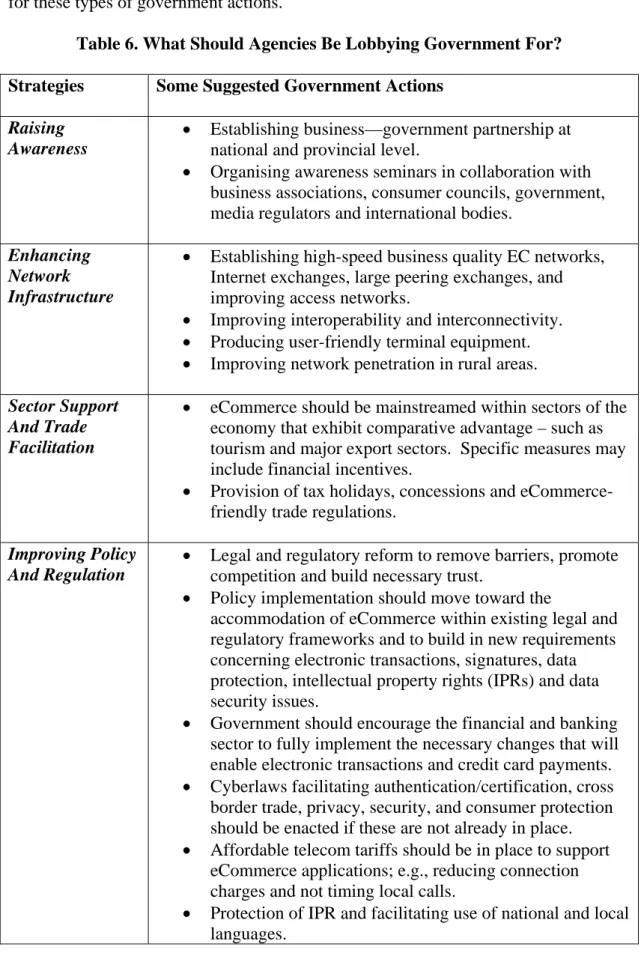
Then move on to Section E. E1-E4 provide guidelines for developing an agency strategy towards eCommerce support for small enterprises – focusing on business integration, sustainability, user involvement, a step-by-step approach to scaling up activities, and how best to choose eCommerce facilitators. Additionally, Section E5 suggests areas where agencies can actively lobby government to further assist with the development of eCommerce for small enterprises in India.
Finally, look at Section F that provides information on various aspects of 'best
practice' for small enterprises implementing eCommerce, and Sections G & H, which provide sources of further information and support for eCommerce in India and from overseas.
A. Introduction
eCommerce is emerging as a new way of helping business enterprises to compete in the market and thus contribute to India's economic success. eCommerce is important for economic growth, increased business opportunities, enhanced competitiveness and better access to markets. At present in India most small enterprises lack the
knowledge of how investment in eCommerce could benefit their businesses and help them develop that competitive edge. This is at a time when eCommerce opportunities for SSIs and rural businesses are growing due to steadily improved access to the technical and communication infrastructure.
Since the time of Indian independence in 1947, a significant feature of the Indian economy has been the rapid growth of the small-scale industry (SSI) sector. The SSI sector is considered to have a major role in the Indian economy due to its 40% share of national industrial output along with an 80% share in industrial employment and nearly 35% share in exports. The SSI sector has been assigned an important role in the industrialisation of the country by the government of India.
SSIs are distinguished from the large-scale and the medium-scale industries on the basis of capital resources and labour force in the units. In 2002-2003 there were more than 3.5 million SSI units trading throughout India, with a fixed investment of Rs.90.5 billion (US$1.8 billion). The SSI sector employed about 20 million people and
produced Rs.7420 billion (US$148 billion) of output – Rs.860 billion (US$17 billion) of which went for export. These figures highlight the importance of the SSI sector. In an increasingly competitive and globalised world, SSIs need to compete more effectively in order to further boost domestic economic activity and contribute toward increasing export earnings. SSIs will also continue to play an important role in increasing employment and incomes and thus contribute to poverty reduction on a sustainable basis. In fact, rural businesses may be among the biggest beneficiaries of eCommerce. Lower costs afforded through eCommerce can provide opportunities for many rural and regional communities to revitalise their economic base. The Internet can give small enterprises and communities the ability to present a regional image to the world and create focal points (or portals) for inquiries about local businesses and their offerings (see, for example, the case of Toehold in Section C of this handbook). Business support agencies can play a key role in helping small enterprises attain the benefits that eCommerce has to offer. Agencies can also look beyond the technology, and understand how real commercial benefits can flow to individual enterprises and sectors from adopting the new business methods that are required to use eCommerce effectively.
A1. What Is eCommerce?
eCommerce involves the sale or purchase of goods and services by businesses, individuals, governments or other organisations and is conducted over computer networks. eCommerce builds on traditional commerce by adding the flexibility and speed offered by electronic communications. This can facilitate improvement in
operations leading to substantial cost savings as well as increased competitiveness and efficiency through the redesign of traditional business methods.
eCommerce is the application of current and emerging information and
communication technologies (ICTs) to conduct business. These include telephone, fax, TV, electronic payment and money transfer systems, electronic data interchange (EDI) and the Internet.
• Mobile phones, email and the Internet provide most scope for small businesses. Applications include Internet retailing, Internet banking and electronic settlements, browsing and customer selection of products and services. The Internet provides access 24 hours a day, seven days a week – any time – anywhere. Thus, time and place are no longer binding factors.
• Participation in eCommerce is important not only for conducting commercial transactions, but rather in the way it encourages transformation of internal systems and increases efficiencies in terms of cost, responsiveness to
customers, customisation of offerings, and through the potential emergence of new products and services.
• eCommerce also offers a landscape of opportunities for improving people management, strengthening communication-intensive business processes, and for deepening affiliation among employees, and workforce capabilities. eCommerce may involve selling directly from businesses to consumers (B2C eCommerce). eCommerce can also be conducted directly between businesses (B2B eCommerce). This is where eCommerce is growing most rapidly. These include portals that operate as electronic marketplaces (e.g., www.exportindia.com) or as auction sites (e.g., www.matexnet.com). Benefits of eMarketplaces can include
reduced costs, better research and quicker transactions for buyers. Rewards for sellers include improved customer service levels and cheaper exposure to customers.
There is also business-to-government (B2G) eCommerce that refers to the growth in supply of goods and services for online government procurement – potentially a large growth area in India.
A2. What Is Driving eCommerce For Small Enterprises?
The need for small enterprises in India to consider adopting eCommerce is driven by global, national and regional business trends. These relate to markets, costs, new technologies and political factors as follows:
• Adaptation to rapid market changes that are impacting on export-led and domestic markets.
• Cost competition and the need to compete in export-led sectors.
• Globalisation of the production and supply of goods and services – and the need to integrate small enterprises more effectively into the supply chains of larger businesses.
• Increased customer expectations and consumer power – buyers expecting to be able to access web-based information about products and services, for
example.
• Adaptation to new technologies – an overall need for technological upgrading.
• Greater role for information in business and the need to access, process and communicate it efficiently and effectively.
• Government deregulation and liberalisation – lowering costs of access.
• Bilateral and multilateral trade agreements – opening up markets to developing country producers.
• Adaptation to higher quality standards such as ISO9000 – ICTs are acting as an enabler in this area.
It is important that enterprises – and the agencies that endeavour to support them – understand the driving forces for eCommerce. For example, many sector-based B2B marketplaces do not necessarily use the Internet as a medium – but commonly use private networks or auction sites where access is restricted – such as in the automotive sector or for agricultural and horticultural products. In order for enterprises in India to participate in these marketplaces it is necessary to gain market entry to these supply chains, and to understand how they operate.
Individual sectors (e.g., financial and business services or travel and tourism) require individual analysis to assess market entry requirements. It is also important,
therefore, to understand what is driving eCommerce on a sector-by-sector basis.
A3. What Are The Benefits Of eCommerce?
eCommerce can provide substantial benefits to small enterprises via improved efficiencies and raised revenues. It enables a new way of working to emerge as businesses face the future and embrace the new economy. eCommerce enables small business entrepreneurs to gain access to better quality information, and thus
empowers them to take informed decisions in their businesses.
Most importantly, eCommerce can give a competitive advantage. It can help
strengthen market position and open up new business opportunities with the potential to improve profits. Benefits of eCommerce can arise in the following ways:
Cost Reduction Benefits
• Reduced travel costs: by using a mobile phone, email and other ICTs to substitute for journeys.
• Reduced cost of materials: more information means better choice of suppliers and more competitive prices.
• Reduced marketing and distribution costs: for example, publishing a brochure online can reach an unlimited number of potential export customers and allow regular update.
• Reduced sales costs: the Internet provides unprecedented opportunities for businesses to reduce the costs of trade locally and, even more, across borders.
• More efficient supply chain management: can eliminate the need for middlemen leading to lower transaction costs (including marketing, sales,
transaction processing), reduced overhead, and reduced inventory and labour costs.
• Improved internal functions: cutting down on meetings, improving the exchange of critical knowledge, eliminating red tape, and streamlining communications.
Market Benefits
• Greater reach: a web presence can allow entrepreneurs to reach out to customers far beyond their immediate location.
• More brand awareness: offering new avenues of promotion for products and services.
• Improved customer service: providing more responsive order taking and after-sales service to customers; this, in turn, can lead to increased customer loyalty.
• Increased market awareness: entrepreneurs can become more aware of
competition within their market and more aware of market changes, which can lead to product/service innovation or quality improvement.
Other Competitiveness Benefits
• Increased efficiency: eCommerce not only reduces costs but it can also increase the speed of transactions; both buying and selling.
• Continuous trading: suppliers and customers, if they wish, can access a 24-hour/7-day sales service – particularly important when trading through time zones.
• Specialisation: eCommerce can help entrepreneurs focus their activities – making it easier to build relationships with other enterprises and communicate their needs to support agencies.
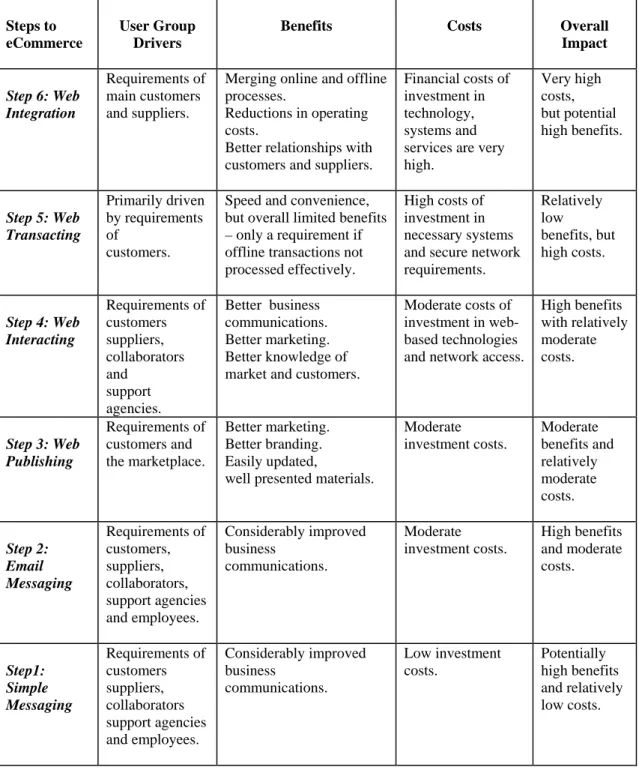
Many of these benefits can be gained through relatively modest investments in new technology and systems. Greater benefits accrue as the enterprise moves up the eCommerce adoption ladder (see Section C1). It is important to realise, however, that the benefits outlined are not exclusively tied to eCommerce. For example, market benefits may be achieved more effectively through better business networking and the building of personal business relationships, rather than through use of the Internet. This emphasises the importance of adopting an approach towards eCommerce that puts business objectives first, rather than believing that technology alone can deliver the benefits described above.
A4. What Are The Risks Of Going Into eCommerce?
There are great potential benefits but there are also pitfalls of going into eCommerce. They are the financial costs, the business 'opportunity costs' and the dangers of failure. These are detailed below. It will be important for your agency to identify the pitfalls and help minimise the risks for clients.
eCommerce will bring extra costs as well as cost savings! Developing eCommerce for a business will almost certainly bring an increase in costs before such time that either savings due to greater efficiency or increased revenue become evident. It is likely that eCommerce activity will need to run in parallel with more traditional business methods. For example, an enterprise will need to continue to produce paper-based marketing material (brochures, stationery, leaflets, etc) as well as building up a web presence. Taken overall, the costs associated with eCommerce (see Advice Sheet 9) are unlikely to be justified without significant increases in revenue.
Hence, many small businesses are still sceptical about generating revenues directly through the Internet. The use of the Internet in India for commercial purposes (online trading) is still very low – primarily due to the lower than anticipated amount of Internet traffic and the lack of (credit card) payment facilities.
eCommerce may divert attention away from 'more important' offline activities! It is important that online and offline efforts are not in competition with each other within a business. In fact, for most small enterprises, offline activities (such as face-to-face meetings) will remain far more important than online communication. In the long term, risks can be minimised through effective integration of online and offline activities – using eCommerce to complement existing business processes and building new skills. In the short and medium term, there is a risk that a business owner could lose sight of his/her true business needs if eCommerce is oversold such as happened during the Dotcom boom during the late 1990s.
An eCommerce venture may well fail completely! Any new business venture is likely to fail. As the Dotcom boom and subsequent bust demonstrated, eCommerce ventures are probably more likely to fail than conventional businesses. This
emphasises the importance for small businesses of not throwing all their eggs in the eCommerce basket. Failure can be avoided in one of two ways. First, by deciding not to adopt eCommerce at all. Second, by taking a step-by-step approach that minimises risk – such as suggested in this handbook.
However, there are also risks of ignoring eCommerce! Technology and innovation are often described as the catalyst for change. Ignoring new technology may have significant implications for the ways business is done in the future. For example, having no website, or a badly designed or marketed website, may put a business at a disadvantage as compared with competitors. Over the medium and long term, unsuitable or inadequate technology can mean that your client enterprises remain without the communications systems that they will need to compete effectively.
A5. What Are The Agency Benefits And Risks?
You should also consider the benefits and risks for your agency in supporting eCommerce activities and in developing your own capacities for eCommerce. The message for agencies is essentially the same as for the enterprises you support. Technology should be an enabler and not a driver for the realisation of benefits, and risks need to be assessed in terms of actual costs, opportunity costs, and the dangers of failure. The benefits for your agency of actively supporting eCommerce will involve building capacity in four areas:
• Improving your own knowledge concerning eCommerce.
• Using eCommerce to improve your own processes – new and better ways of doing things.
• Involving people – encouraging and providing new skills and capacities for your staff.
• Using technology efficiently and effectively.
eCommerce can also improve the agency's ability to advocate on behalf of clients. This may involve using eCommerce technologies to solicit funds and to interact more effectively with donors or other governmental and non-governmental organisations. But you need a balance – as shown below if the agency itself uses eCommerce there can be both pros and cons.
Benefits of eCommerce for Agencies:
• Improving information/knowledge capacity – eCommerce will support marketing, communication and branding of your agency's activities. It will help you access, process and disseminate increased amounts of information and build your knowledge base.
• Improving technical capacity – building your internal technical capacity will make you less reliant on external infrastructure access and technical support.
• Improving human capacity – eCommerce will improve business and
organisational skills as well as technical skills. Additionally, the motivation and confidence of your staff can be enhanced.
• Improving processes of activity – both efficiency and effectiveness can be improved across a wide range of activities – particularly internal and external communications.
Risks of eCommerce for Agencies:
• Costs factors – there is likely to be a high cost of initial investment in time, money and skills.
• Information and communication factors – are you able to handle increased amounts and complexity of information (information overload)? Are you able to use information effectively and ensure data reliability? Is there a danger you may neglect personal face-to-face communication channels – which may be the most relevant to your clients?
• Sustainability factors – initial investment may be forthcoming from donors, but is it sustainable in terms of recurrent costs, required staffing and skills, maintenance and upkeep? Additionally, what opportunity costs may arise due to time and efforts spent on eCommerce activities?
B. eCommerce in India
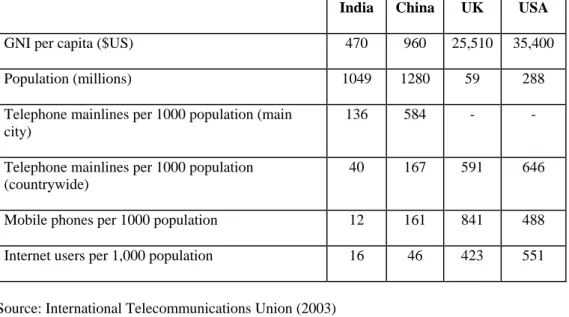
B1. How Big Is eCommerce In India?India is on the threshold of emerging as a key player in global eCommerce. This is reflected in the rapid growth of Internet users. By 2002 there were an estimated 16.6 million Internet users throughout India with India having exhibited the highest growth rate of any region in the world – 137% increase between 2001 and 2002 (UNCTAD, 2003). Total online users are around 35 million in 2005. The IT sector is growing at an annual rate of 30% across the board. Between 1985 and 2005, the growth rate of the IT sector was almost 5 times faster than world GDP growth.
Table 1. eCommerce Network Access – Country Comparisons (2002)
India China UK USA
GNI per capita ($US) 470 960 25,510 35,400
Population (millions) 1049 1280 59 288
Telephone mainlines per 1000 population (main city)
136 584 - -
Telephone mainlines per 1000 population (countrywide)
40 167 591 646
Mobile phones per 1000 population 12 161 841 488
Internet users per 1,000 population 16 46 423 551
Source: International Telecommunications Union (2003)
Table 2. Comparison of Internet Growth (2000 to 2002)
Internet Users by Country
(thousands) % Change Country 2000 (000) 2001 (000) 2002 (000) 2000-2001 2001-2002 United States 124,000 142,823 155,000 8.5% 15.2% China 22,500 33,700 59,100 75.4% 49.8% United Kingdom 15,800 19,800 24,000 21.2% 25.3% India 5,500 7,000 16,580 136.9% 27.3%
Source: International Telecommunications Union (2003)
The total volume of eCommerce transactions in India grew very rapidly at first: from Rs.130 crore (US$26m) in 1998/9 to Rs.1200 crore (US$240m) in 2000/1, of which around 90% was business-to-business transactions. The bursting of the Dotcom bubble then slowed down growth but there is now evidence of a significant revival in
eCommerce worldwide. This time many of the lessons of the past have been absorbed and eCommerce transactions are tempered by realistic expectations. By 2004/5, total eCommerce transactions in India were estimated at around Rs.2250 crore (US$450m). B2C eCommerce had grown particularly quickly, now making up Rs.650 crore (US$130m) – more than one quarter of the total. Areas of growth include travel and ticketing sales, electronic gadgets, household appliances and gifts. As noted, now and in the future, the bulk of eCommerce is B2B transactions. The principal benefits of eCommerce are likely to accrue from collaborative initiatives across an industry supply chain (sharing of inventory information, collaborative product design, etc). To capture these benefits, businesses will need well-connected supply chains and well-connected internal systems. Automotive and consumer goods are expected to lead B2B eCommerce adoption in India. The potential marginal impact in automotive and consumer goods could be as high as 4% of sales. Both these industries are dominated by large companies with the willingness to drive eCommerce adoption across their supply chains, which can have a beneficial knock-on effect for small businesses operating in the sector.
Currently, there is a huge variance in readiness for supply chain connectivity across industries. For example, the Boston Consulting Group (India) estimates that by the end of 2001, some sectors in the consumer durables industry had almost 90% of their procurement and 80% of their sales to distributors/dealers web-enabled, whilst other sectors had less than 10% of their suppliers and dealers online.
B2C eCommerce offers fewer opportunities for small business. Although transaction volumes for B2C are growing fast, the Internet is unlikely to become a key sales channel in any industry in India and the overall penetration is expected to remain below 1% of retail sales. Cultural factors and the current convenience of offline retailing are the key factors that will limit online sales. Telecom services, consumer electronics, travel, automotive products and financial services will be the most important sectors of B2C eCommerce activity.
However, as evidenced in other countries, early movers can accrue a large share of the benefits that are realised through eCommerce. Early movers in eCommerce adoption are better positioned to keep the major share of cost savings and to build market share. Latecomers, on the other hand, can suffer significant erosion in their competitive positions.
For the vast majority of small enterprises and their customers (particularly those in rural areas) multiple external factors are still impeding eCommerce adoption. These include limited Internet access, poor telecommunications infrastructure, multiple gaps in the current legal and regulatory framework, multiple issues of trust and lack of payment gateways, uncertainty of benefits, and fear of transparency. Hence, vast differences exist between enterprises and sectors in terms of value that can be realised from eCommerce.
Box 1. SWOT Analysis for eCommerce in India Strengths:
• Active participation and promotion in using eCommerce.
• STPI units, agencies and NGOs are promoting eCommerce.
• Government support to upgrade technology.
• Good English language proficiency.
• Entrepreneurs are enthusiastic in adapting to technological change.
• IT service sector is growing rapidly.
Weaknesses:
• Lack of IT infrastructure, knowledge and skills especially in the rural areas.
• Urban-rural gaps in use of computers and the Internet.
• Inefficiency of financial and banking system to support SSI.
• Security system is not reliable.
• Poor telecom and
communications infrastructure for reliable connectivity.
• Multiple gaps in the current legal and regulatory framework.
• Fear of transparency in operations.
• Cost of electricity is high.
• Approach to government support and subsidy is very difficult. Opportunities:
• Increased customer orientation for all businesses through rapid feedback.
• Indian small and medium enterprises can project their capability globally.
• Growth in traditional sectors such as handicrafts, textiles, art, natural medicines through tapping into global markets.
• Indian cultural heritage – monuments, temples, classical music etc. can be marketed to assist tourism.
• Forecasts indicate that India has the potential to create a very large eCommerce market.
• Outsourcing software and IT services from USA and other advanced countries.
• Domestic use of eCommerce utilising mobile networks for better communication.
Threats:
• Competition and penetration from outside firms.
• The corporate giants can continue to grow stronger and stronger. This poses a threat to SMEs but is also a challenge.
• There is a danger of creating two classes of operators – fast track and laggards.
• The combined strength of eCommerce and
telecommunications may monopolise political and financial power.
• Lack of national, sub-regional and regional web data centres and communication facilities will shift business to places where those facilities exist.
• High cost of bandwidth in India as compared to other countries.
• Competition has increased and there is a threat of losing market to large overseas companies.
B2. Assessing eReadiness For Small Enterprise In India
Assessing eReadiness means finding out how ready SSIs are to engage in
eCommerce. At a national level, the Global Information Technology Report ranks 82 countries on their level of eReadiness which is defined according to the degree of preparation of a country to benefit from developments in ICT, taking into account a wide range of indicators including policy, legal, security, infrastructure and market factors. India ranks 37 in the world with a networked readiness index (NRI) of 3.89 ahead of countries such as Poland (3.85), Greece (3.77) and China (3.7). This high scoring reflects the considerable comparative advantage India has developed in the IT sector.
The potential for small enterprises to take advantage of India's rapidly improving networked readiness will vary considerably, depending upon geographical location and access to physical and human resources. Therefore, for the majority of SSIs and rural enterprises in India, eReadiness needs to be assessed from a broader perspective – gauging their ability to respond to the challenges of eCommerce – given the
infrastructure, institutional and regulatory environment within which they are currently operating in their locality.
For the majority of enterprises that are currently excluded from eCommerce, an appreciation of eReadiness should emphasise the following:
• Access – to affordable access technologies, local access network infrastructure and responsive ISPs (Internet Service Providers).
• Awareness – of eCommerce technology and market opportunities.
• Knowledge – of the online environment, the benefits of eCommerce and viable business models.
• Skills – access to new ICT skills and business skills.
• Language – eCommerce applications and content in local languages.
• Trust and confidence – government and agencies can play a key role by making eCommerce a national priority.
• Business cost factors – relating to transport, delivery, and other overheads.
• Socio-cultural factors – that influence technology's diffusion and use.
• Market analysis – including value chains and market conditions.
A number of tools have been developed that adopt varying approaches to assessing eReadiness for small and community-based enterprises – see, for example:
http://www.bridges.org/ereadiness
Because the impact of eCommerce is so diverse, analysis should be carried out on a sector-by-sector basis. Sectors featured in this handbook that demonstrate the greatest potential for eCommerce in India include the automotive sector (see Enterprise Case Studies 2&3); tourism and related markets such as arts and crafts (see Enterprise Case Study 6); agricultural and food industries (see Enterprise Case Studies 4&5). There is also considerable potential to benefit from eCommerce technologies in the domestic market (see Enterprise Case Studies 1,2&3).
B3. How Is The Government Assisting eCommerce For Small Enterprise? Business groups have welcomed India's new legal framework for eCommerce, which enables electronic signatures and eTransactions. An improved legal and regulatory environment will help to change the way Indian entrepreneurs do business and advance the country's position as an emerging superpower in the global information economy.
In an effort to boost the IT sector and develop eCommerce in India, the government has:
Passed the Information Technology Bill. The bill gives legal recognition to digital signatures and outlines the penalties and procedures for dealing with cyber crimes.
Eased foreign direct investment (FDI) restrictions in the eCommerce sector. Foreign equity of up to 100% will be permitted in business-to-business (B2B) ventures, provided overseas concerns agree to divest 26% of their holdings to the Indian public within a five-year period. For business-to-consumer (B2C) ventures, foreign equity will be capped at 49%.
Relaxed initial public offering (IPO) requirements for IT-related businesses. The minimum IPO requirement for IT companies seeking to list in India was reduced to 10% from 25%, subject to a minimum of Rs.2 million securities to be offered to the public and minimum public offer net size of Rs.500 million (US$10 million)
Through enacting laws to protect intellectual property rights (IPR). The following important initiatives have been taken by the Indian Government to promote the Internet and eCommerce infrastructure:
Permission given to private Internet Service Providers to set up international gateways.
Permission for Internet access through the cable TV infrastructure. Initiation of the setting up of the National Internet Backbone.
The opening up of national long-distance telecommunication services to private operators.
Complete non-monopolisation of undersea fibre connectivity for ISPs. Free right of way facility, with no charge in cash or kind, for private access providers to lay optical fibre networks along national highways, state highways and other roads.
The Department of Telecommunications has allowed interconnectivity of government and closed user group networks.
The establishment of Public Tele Info Centres (PTIC) having multimedia capabilities has been permitted.
C. Indian Enterprise On The Road To eCommerce
This section outlines the steps to eCommerce describing the differing stages of eCommerce development – presenting six local enterprise case studies (thumbnail sketches) that highlight an eCommerce application for each stage. The case studies show how enterprises are benefiting from eCommerce by illustrating practical examples. More detailed versions of these case studies can be found in the sister handbook to this one, for entrepreneurs: http://www.ecomm4dev.org/C1. Moving Up The eCommerce Ladder
The 'steps' model can help you understand the different types of eCommerce business applications you may encounter. It may also help you to identify the types of
assistance you may provide to small enterprises.
Step 1. Starting Out: Simple messaging using mobile communications
Currently 'wireless' communications – including short messaging services (SMS) – provide a cheap and widely available option for enterprises. Mobile phones offer a number of key advantages over fixed line communications for small businesses – such as instant communications with customers and suppliers – even when on the move. They also provide greater connectivity and network coverage than landlines – users can be instantly connected by text messages and mobile chat – a powerful marketing and advertising tool.
Thumbnail Sketch: Gayatri Granites
Located in the Industrial Area of Ilkal, Bagalkot. The enterprise produces granite slab and tiles, and carries out polishing and styling. There are eight employees and the business was established in 1992-93 under sole proprietorship. The main customers are located in India, and recent annual turnover was Rs.35 lakhs. The entrepreneur uses mobile phones primarily to interact with clients and dealers of raw materials. Use of phones gets an immediate response and it is a more direct means of
communication. As the entrepreneur states: "before when clients used to call and we were not present in the office, we used to miss them. But now when they call and if we are not in the office, the person in the office gives our mobile number to them, and we are contacted. Thus we do not have to stick around in the office but can also do other work alongside."
Contact: Mr Ramanujan Darak. Tel: (08351) 770939
Step 2. Getting Online: Email messaging – a powerful business communication tool
This involves sending or receiving emails from a computer terminal either located on the business premises or via a facilitator (such as an Internet Café or Telecentre). Email is a cheap, quick and reliable way to exchange business information with customers, suppliers, and business contacts who are also connected to email. A variety of information can be sent – not just messages, but documents, photographs, drawings, or any other computer data file (see Advice Sheet 2 for more information on email).
Thumbnail Sketch: Shan Marc
Located on the Peenya Industrial Estate, Bangalore. The business manufactures metal gaskets for spark plugs used in automobiles, focusing 100% on the home market. The factory achieved the ISO 9001 certification in the year 2000. The business was established in 1987, there are 8 employees, and recent annual turnover was approx Rs.26 lakhs. Recently, they started creating designs of gas turbines using CAD and sending them via email to international business clients. Designs of gas turbine parts are rendered in 3-D using the Pro E software package. These designs are sent via email to clients outside India. This enterprise has made maximum use of email and the web to make contact with specialist organisations in the engineering sector. Contact: Mr. Maria Dass.
Step 3. Web Publishing – to reach a wider customer base
Web publishing can be used to make enterprise information available – by using an online brochure, for example. Its simplest form may consist of a 3-4 page website giving a basic business profile, some information about products and services, and contact information – physical and postal address, telephone and fax, and email contact. In a more advanced form it may include an online catalogue – an online version of a conventional catalogue that can be easily updated. Even a simple web presence offers the ability to access a wide – potentially global – market with 24/7 accessibility. (See Advice Sheet 4 for more information on creating websites).
Thumbnail Sketch: Adam Sons
Located at the Industrial Estate in Mercara. The business makes machinery such as that used for processing coffee. They have 9 employees. 5% of the unit's work is for the export market. They have been exporting machinery for 5 years now. The home market is based all over their own District. Recent annual turnover was Rs.63 lakhs. They have attracted prospective clientele and enthusiastic persons who have browsed through the net to get information regarding their coffee units. They have received good leads through www.googlesearch.com where they are listed. The entrepreneur states: "Advertising in newspapers turns out to be expensive but if we have a website, we can just put the URL of the website in the newspaper – which saves a lot of space/money. Interested parties can log on to the net and find information about our business. Thus it should be on the agenda of every entrepreneur to have a website".
He also stated that customers are more enthusiastic about reputable businesses and having a website gives substantial evidence to the authenticity of the unit.
Contact: Mr Thahir.
Step 4. Web Interacting – to improve relationships with users
Web interaction will allow customers (for example) more scope to browse through images, descriptions and specifications relating to your products and services. It may allow them to submit email enquiry forms, to order online, to use online services or to use a shopping cart facility and order confirmation – that could be paid for and
fulfilled (delivered) offline. Interaction over the web can improve customer service and response to customer queries.
Thumbnail Sketch: Ace Foods Limited
Located at the Industrial Estate in Yeyyadi. The business produces packaged food products. It employees 25 men and women, and was established in 1984. 40 % of products are exported to the Middle East, Australia and the USA. The business has a static web model with a product catalogue. The web model serves to describe their products - a medium to convey broad details to their clients. With the Internet, export-related tasks have become simpler and more convenient. Dr Kasturi cited an example – the business was in constant touch with a client in the USA on a casual basis through email and through phone calls. One day, this client placed a huge order. Communication via the Internet made the relationship grow. He states: "without the new technology we would not have been able to do what we are doing - as simple as that". And he added: "a keen business acumen is also essential".
Contact: Dr Kasturi Umesh Pai or Mr. Annappa Pai. www.acefoodspl.com [email protected]
Step 5. Web Transacting – moving to true eBusiness
This can be termed as having a full eCommerce capability that covers the whole transaction process from the placing of an order to online payment for goods and services via secure networks. For B2C eCommerce this will involve making use of secure credit card payments systems, and for B2B eCommerce will involve payment through secure banking systems.
Thumbnail Sketch: Kamal Bells
Located at the Industrial Estate in Rajajinagar. The business has 40 employees and was established in 1983. They manufacture machine and pressed metal components. Their customers are 100% home market, but some export products that contain their components are used in the motor industry. Recent annual turnover was almost Rs.2 crores. Kamal Bells are well informed about the various benefits of eCommerce due to location in Bangalore. They have registered with a site called
www.exportindia.com through which they have received a lot of information from similar units and clients from all over the world. They cite an example where an entire transaction was done via the web: "We received an order by email from HAL [Hindustan Aeronautics Ltd] in Bangalore. There was an application form on the net, which we filled in; and all further correspondence was followed up through email; thus the entire transaction was completed through the net". The entrepreneur reminds us, however, along with technology it is important the human element is retained in the unit; like the business owner says: "each employee in my unit is treated like a family member, and we discuss various problems together".
Contact: Mrs Nirmala S. Murthy [email protected]
Step 6. Web Integration – a fully e-enabled enterprise
eCommerce may also take on a wider role within a business through Web integration. Web integration provides an electronic platform that links customer-facing processes such as sales and marketing (the "front office") with internal processes such as accounts, inventory control and purchasing (the "back office"). This is often called eBusiness or the business may be described as becoming fully "e-enabled". eBusiness links internal systems with external networks (customers, suppliers and collaborators) via the Internet. Integrating systems can make it easier and cheaper to do business, and it can encourage customer loyalty and repeat business.
Thumbnail Sketch: Project ToeHold
Located in Malleswaram, Bangalore. ToeHold manufactures and markets traditional leather slippers and sandals. These are manufactured by artisans of a marginalised community in the Belgaum Region of Karnataka. There are 8 full time employees. Established in 1999, it is run on a cooperative basis. ToeHold's customers are mainly shoe stores and boutiques in Australia, Japan, Italy and other countries. ToeHold communicates with its customers and its own manufacturing unit via email. Its website contains a catalogue of its products and customers are able to browse and purchase its products via the integrated shopping cart application. Orders are received via email and company representatives follow up with a quotation. Clients also use email to send in suggestions, alterations and photographic evidence of damage/faults in products that might need replacement. This helps ToeHold improve the quality of their product design. A management information system keeps track of customers and predicts their buying patterns. This helps them to optimise their leather and accessories purchases and keep inventory levels low. Workers in the villages are able to speak to their head offices via mobile telephone. Decisions get taken faster and get communicated down the line cheaper.
Contact: Madhura Chatrapathy [email protected]
D. eCommerce Support
For enterprises seeking to climb the steps to eCommerce it will be as important to understand their own business strengths and weaknesses, as it will be to understand the opportunities presented by new technologies. Your agency will need to have a clear understanding of the business environment in order to assess the type of eCommerce support that will be most appropriate for your client enterprises.
This section provides a model of the different types of support that are being provided to small enterprises, and presents five case study examples of support currently on offer in India. It then suggests how your agency might go about improving the analysis of enterprise support needs for eCommerce.
D1. Different Types of eCommerce-Related Support
This model describes five different types of eCommerce-related support that agencies can provide to enterprises:
1. No Support
There may be a case for offering no eCommerce support to clients or members. It may be for any of the following reasons: a) The enterprise may not fulfil your particular criteria for offering support. b) The enterprise may already be operating eCommerce successfully. c) You may want to refer the enterprise to a different agency or facilitator. d) The enterprise may not yet be ready for eCommerce. 2. Awareness Raising
Most small enterprises in India are at the stage of eCommerce development where awareness raising is likely to be of greatest benefit. Awareness raising should seek to develop a business-led approach that examines the potential costs and benefits of eCommerce in relation to overall business goals and strategies, and in the full knowledge of the commercial realities of the market.
Awareness raising for eCommerce should not, in the first instance, seek to stimulate the use of ICTs, but should examine the actual information and communication needs of the enterprise. Awareness can be created through the use of case studies and with reference to current best practice for enterprise development more generally.
Awareness raising methods may include manuals such as this one, workshops, award schemes or possibly web-based material – although the ability of your target audience to access web-based material must be gauged.
3. Training
It is unlikely that your agency will provide dedicated training courses for eCommerce. It is preferable that training for eCommerce is integrated with existing training
courses and programmes in order that eCommerce strategies can be seen in the context of the wider solutions to business problems. For specific eCommerce skills (such as use of email or free software, for example) it would be preferable to work through private sector training agencies. Awareness raising strategies should also be
fully integrated into 'training of trainers' for small enterprise development programmes. This handbook could provide a useful conduit for that purpose. 4. Business Support Package
Agencies that already run business support packages – dealing with training, finance and advice – will need to integrate eCommerce support into these wider programmes. In fact, this integrated approach is a preferable option. Customised support for
eCommerce, however, may be preferable when focused on individual enterprises or sectors where specific eCommerce needs have been carefully identified.
5. Trading Portal
The most direct form of eCommerce intervention for an agency would be through the provision of a trading portal or some other form of web-based marketing or
information assistance for client enterprises. Some agencies, of course, already act as market facilitators providing marketing assistance and may purchase and resell goods and services on behalf of client enterprises. The use of a trading portal can be seen as an extension of this, and there may be benefits for agencies in developing their own eCommerce capacities. However, web-based approaches need to be considered on a strict cost/benefit basis in comparison with other more traditional avenues of
marketing and trading. In addition, such investments should take full account of the requirements for a needs-based approach set out in Section D3.
Rather than setting up their own web-based marketing, agencies should first consider the following approaches.
• Facilitating access to existing portals.
• Working through and coordinating with other web-based facilitators.
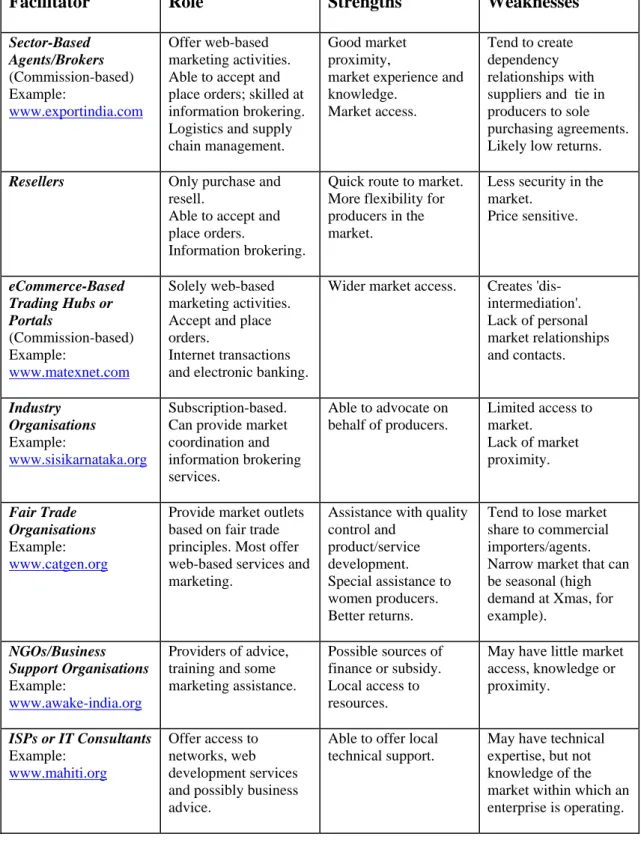
• Helping clients work through trusted third parties and other private sector trade facilitators (Table 5 provides a list of possible eCommerce facilitators). The following case studies provide examples of current practice in India for
eCommerce support to small enterprise, including 'for profit' and 'not for profit' agencies. Each of the case studies provides examples of one or more of the eCommerce support categories outlined above.
D2. Examples Of eCommerce Support For Small Enterprise
Case Study A: AWAKE (Association of Women Entrepreneurs of Karnataka)
E-mail: [email protected] URL: www.awake-india.org Contact: Ms Dhanavanti Jain. AWAKE has 5 full time employees. AWAKE has a trained professional staff that co-ordinate all programmes. All the employees have portfolios and are allotted activities according to on-going projects. AWAKE is a non-commercial registered society. The agency's focus is on woman entrepreneurs. Out of these 80% of the target audience is below the poverty line. AWAKE supports new and established enterprises with programmes that help them enhance the quality of their operations through management counselling and development courses.
ICT Resources: AWAKE has a high-speed cable connection to the Internet. They also have an EPABX facility connecting all departments via 7 computers. AWAKE have their own website. Ms Jain says "Having a website is very convenient. We get emails from
Washington, New York, etc. inquiring about our work. So we tell them to log on to our website as all the information is listed there. Also it is very useful as the site has a membership form, which people can download, fill and mail to us. The forms are in the HTML format."
AWAKE is developing a mobile kiosk that will list all the latest government policies, schemes, profiles of member entrepreneurs, some case studies and also profiles of sponsors. They intend to have all this data in the local language (Kannada).
Support for eCommerce: For members who are based in rural areas, communication is much easier using email. Entrepreneurs based in outlying towns also operate using email. She says that many clients go to the website and learn about the various benefits that
AWAKE can offer. The important thing is to disseminate information. She cites the example of vanilla beans from which you get the essence. Shimoga is the growing area for these beans and there is quite a demand for it. Ms. Jain says: "We started disseminating information that when you process the beans you create added value. We passed on information to
entrepreneurs in Shimoga that was downloaded from the Internet. Thus, before, these rural businesses just sold vanilla beans, they are now selling vanilla essence."
AWAKE has conducted training for eCommerce. It is in the process of making a list of entrepreneurs and is also developing hyperlinks to reach them individually. In one area, people log on to the net to contact their clients. The entrepreneurs have also created their own website and are directly dealing with their customers. They also feel that transactions by email are very fast and beneficial. Ms Jain says: "we are creating a database. We are looking for a major fund to make an expansive website in which we can make a detailed listing of our member entrepreneurs. Right now we have made a CD"
Reflections on Best Practice: eCommerce-related support in the future will definitely be enhanced as now all entrepreneurs are becoming driven by the technology. Ms Jain says:
"what AWAKE does is to facilitate opportunities and thereafter monitor progress to sustain stability of the deal". Ms Jain also emphasises that the website and email can be used for sundry communication and casual contact, but most interaction with clients (like counselling) has to be face-to-face. She says that to make use of individual websites, initial awareness is needed. AWAKE can just trigger an interest, and cannot force anyone to have a website. Thus, she says that it works through word of mouth. "Entrepreneurship is not just business counselling but also emotional counselling... and in the process, make them more aware".
Case Study B: Explocity Limited
URL: www.explocity.com Contact: Mr Atul.
Explocity is a private company with 100 employees, providing information services to the small business sector from centres in Bangalore, Delhi, Mumbai, Chennai, Kolkata and Hyderabad. Clients include any brand establishment, franchisee or outlet that requires fee-paying information services (e.g., advertising).
ICT Resources: Explocity uses an open source platform from Mahiti Infotech, where entrepreneurs can update their own website space regularly. Explocity develops the initial website for the client. The entrepreneurs can then update information on their own. Explocity also has relations with Indya.com & MSN and the website provides links to these sites. Explocity have also tied up with 'Hutch and Spice mobile phone services' that can give instant news updates, emergency service contacts and local information via mobile networks.
Support for eCommerce: Explocity provide an information distribution channel with additional features enabled by the Internet – such as the ability to download from web sites, provide web links, search facilities and interactivity. Regional centres send information to Explocity HQ through email or via an FTP server for finalising the layout. Clients can also include brand names. All information is listed on the website and the same content is also available in printed format. A new edition of Explocity is printed every 15 days and uploaded simultaneously on the Internet. Chat and instant messaging have also proven beneficial to small business clients.
Reflections on Best Practice: Mr Atul states that in the late 1990s they considered expanding their website. However, according to him, the Internet usage in India that initially seemed promising had not been realised.
At present most revenue for Explocity is still obtained through printed material. This demonstrates the importance of continuing to focus on a printed edition – through which the company has generated highest revenue – alongside developing the web-based facility. The company has not really incurred any losses though the Internet but did not reach the heights they had anticipated.
Regarding the issues faced in setting up web-based support activities, Mr Atul states that now they are more sceptical about collecting revenues through Internet usage due to insufficient traffic, low uptake and lack of credit card payment services. For example, a flower delivery service client in Bangalore received less than 10% of orders online. Anything that cannot be delivered in a digital format is problematic as 'it would not be scalable' through web-based marketing; that is, from the initial stocking stage till to the final delivery of the service to the customer.
Wireless technology and the use of mobile telephone services is now more popular, and likely to drastically increase. Moreover, if Internet access can be made more widely available via mobile networks there might be more people using it. However, for such a facility one would need high-end sets with General Packet Radio Service (GPRS) technology which will remain unaffordable for the majority.
Case Study C: MatexNet Pvt. Ltd.
E-mail: [email protected] URL: www.matexnet.com Contact: Mr Jaganni Vasan. Matex employs around 45 people and provides business support and brokering services to clients – 88% of which are small enterprises from Mumbai, Pune, Kolkata, Bangalore, Chennai, Coimbatore etc. Matex provides assistance to businesses in the formulation and deployment of solutions for effective execution of internal and external business processes such as inventory management, purchasing and logistics.
ICT Resources: Matex started online trading in 1999. They rely on networking between the various branches of MatexNet throughout India. The central server is in Bangalore with a back up in Chennai. All orders are taken online. MatexNet also has an online auction service.
Support for eCommerce: Matex offers an online exchange to connect large-scale industries and small enterprises (SEs) together. Large industries sell new surplus and scrap to SEs. SEs can sell their finished products to the large industries. Therefore, middlemen are avoided, due to online direct one-on-one trading. Matex helps companies liquidate their inventory. In a review in the year 1999, they claimed that they already have a client base of 2,000 SEs, along with about 200,000 traded items listed.
MatexNet asks companies to register with them online. These clients can sell both excess raw material as well as finished inventory. MatexNet scouts for buyers and sellers in two ways. The information is posted on the net, plus they also invite people to come to the site by sending emails, faxes and making phone calls. The buyers also get all the information from the Net and also get in touch via email. The rest of the transaction is physical. MatexNet also uses consultants who can suggest ways to add value to purchases. MatexNet charges 2.5% of the traded value from both the buyer and the seller for the transaction.
Mr Vasan states: "Companies have a surplus of inventory build-ups of machinery and goods which are in excellent condition but unusable due to design changes, plant upgradation or excess production – these are inevitable in any manufacturing system. These companies are usually the large ones, and the surplus blocks space and money. And as other people require this inventory, but don't know where to get them, this is where MatexNet steps in, providing a matchmaking service".
Reflections on Best Practice: Benefits of online trading on the net for SEs are direct cost saving, provision of both a sell and buy facility, reduced overhead and labour costs,
transparency, accessibility and speed. The main barriers are building trust and verification of SEs. Skills are also important: there is a need for both suppliers and vendors to receive sufficient training in the use of web-based trading systems, online auctions and the working of eCommerce. Regarding online trading, Mr Vasan states that as transactions on the net are cost efficient, online trading is most appropriate for SEs. However, traders (middlemen) do still play a role as SEs can often negotiate better rates with traders individually.
Although what agencies like MatexNet provide is essentially a virtual domain, a large part of the interaction is done personally. It is thus very necessary to mix the personal with the virtual for the success of any business.
Case Study D: Small Industries Service Institute (SISI)
E-mail: [email protected] URL:www.sisikarnataka.org Contact: Mr Badrinath.
With 60 employees this agency is a Government of India undertaking and is around 50 years old – established for the provision of support services to small enterprises. With effect from 1st October 2001, it has been converted into a Technology Resource Centre (TRC) for SSIs. SISI is part of a national network under the Small Industries Development Organisation (SIDO); which is an apex body and a nodal agency for formulating, coordinating and monitoring the policies and development of small-scale industries in the country. The functions of SISI are primarily to provide industrial extension services to small-scale industries mainly centred around the technical aspects of operations.
ICT Resources: SISI operate a Small Enterprise Information and Resources Network (SENET): a computerised database for the small and medium enterprises and other promotional agencies at state and national level. Information is provided through SISI's website. They also run a Technology Resources Centre (TRC) providing technology data banks, technology-related information, and services to facilitate technology transfer.
Support for eCommerce: SISI mainly deals with information distribution to provide help for all sectors/clients of the small-scale sector. It downloads information from various websites for their internal workings and research. Owing to the provision of online services by SISI, clients can also obtain services online, including requests for information through email. Mr Badrinath stated: "eCommerce and such other activities are not our focal point. However, we do educate our clients about the importance of eCommerce in their business. Yet,
sensitisation is one aspect, and actual implementation is another. We attempt to sensitise. We do not monitor the efficiency and effectiveness of our attempts at creating awareness and neither do we monitor the enterprise usage of eCommerce or maintain any statistics in relation thereto. Yet, by & large we can say that there has been a considerable rise in usage of computers and information technology by small-scale units".
Reflections on Best Practice: Educational programmes highlighting specific and unique benefits of eCommerce to the specific units need to be developed rather than obvious or general benefits which are commonly known. Mr Badrinath believes that agencies should not necessarily take direct responsibility for educating entrepreneurs in the advantages of
eCommerce. In SISI's case, for example, it has therefore been important to work effectively with other agencies who can offer eCommerce expertise.
Mr Badrinath cautioned against complacency on eCommerce. Even though various small enterprises are presently surviving comfortably without eCommerce, entrepreneurial units would become irrelevant if they do not commence the use of eCommerce in the next 5-6 years. "We still have money transactions conducted in banks and we also have ATM booths enabling these. Therefore convenience is drawing people to use eCommerce. When the environment is such that they cannot do without it, then they will use it more effectively".
He concludes that it is advisable for all units to commence the use of eCommerce if they want to stay competitive in their business. The first step would involve evaluating and gaining information about the available technology, and then subsequently trying to inculcate the same into practice in their business processes.
Case Study E: Visveshvaraya Industrial Trade Centre (VITC)
Email: [email protected] URL: www.vitcblr.org Contact: Mr. B R. Umakanth. VITC employs 7 full-time staff including an export manager and 4 industrial promotion officers specialising in trade development. VITC's clients are predominantly rural artisans and industries. VITC is the designated nodal agency in its state for promotion of international trade. VITC provides proactive and supportive institutional mechanisms for the growth of exports, focusing on sustainability, export promotion, sector strategies, and building an effective and competitive export infrastructure. VITC concentrates on marketing, but also gives financial assistance or any other help if required. Clients include the Ambedkar Hastashilpa Yojna, a Government of India enterprise scheme supporting rural artisans.
ICT Resources:
VITC has the provision for video conferencing/networking between offices. Its HQ communicates with sub-offices through video conferencing. In this way 4 to 12 people can converse together, not wasting time travelling from office to office. All computers in the office are used for communication. The plan for the current year is to obtain software and trade information from the National Centre of Trade Information (NCTI). In NCTI, global inquiries are made which can be fed through the VITC portal and distributed to the registered users/members of VITC.
Support for eCommerce: VITC operates a portal www.vitcblr.org which provides a platform for the exporters and importers of India in general and of the state in particular to have a direct interface with their trade counterparts world-wide. The portal is interactive and provides hyperlinks to other websites (such as the NCTI portal) that give information about export policies and regulations. The VITC portal also has a facility for fee-paying
advertisers. VITC also holds training sessions at regular intervals to educate medium, small and tiny units about eCommerce. VITC are in the process of setting up a B2B exchange. Once the portal has uploaded all the relevant information, there will be provision for online secure transactions.
Reflections on Best Practice: Mr Umakanth states that entrepreneurs should attend
orientation courses conducted on eCommerce, particularly where experts in the private sector are put forward as role models. These experts share their experiences and discuss ways to conduct business. He also advocates VITC's approach of collaborating with various agencies in the service sector, which provide export incentives where 100% eCommerce facilities and programmes are launched with a nominal fee, informing various units on the benefits of eCommerce usage and trade opportunities.
VITC has outsourced an eCommerce contract to a private agency. This has worked well but in-house support is also important, as the in-house person will be more aware of the internal workings of the agency.
VITC feels it is important to include eCommerce in an agency's support concept. As he states: "We are presently trying to do something unique and we also expect other trade
organisations like the Chamber of Commerce to replicate the model by which VITC performs. In the process VITC is forming export clubs for interactions between organisations and units".
D3. Analysing Enterprise Support Needs
Section D1 has suggested five forms of intervention that may be adopted by agencies to assist enterprises with eCommerce. These include the option to decide that
eCommerce may not relevant for many enterprises. Before considering intervention, agencies need to answer two fundamental questions:
• First, how do you go about analysing the specific eCommerce-related needs of enterprises (i.e. what questions do you ask your clients)?
• Second, based on the kind of answers do you get, what type of support interventions do you then provide?
1. Identifying Information and Communication Needs
The best approach to identifying the information and communication needs of your clients is to start from the customer (or market) and work backwards. This requires a market-focus – on factors external to the enterprise.
Customers and Markets: you should ask your clients the following types of questions:
• How do you currently conduct business with your customers?
• In which areas do you interact directly with customers (e.g., sales, billing, delivery, after-sales, etc)?
• What type of information do you collect about your customers – how effectively is that information used at present?
• How do you receive information about follow-up orders, new customers or new business opportunities?
Suppliers and Collaborators: you should ask your clients the following types of questions:
• What particular constraints to you face in accessing enterprise inputs (finance, materials, skills)?
• How do you access/receive information about these inputs?
• How do you communicate with your suppliers?
• How do you cooperate with other enterprises/agencies to access or receive information about inputs?
You should encourage the entrepreneur to identify their own requirements according to the quality of information they are currently receiving, and identify the particular strengths and weaknesses associated with their current information sources and communication channels. An assessment of information needs should involve
listening to the entrepreneur and encouraging them to participate, whilst also bringing an independent understanding of challenges facing the enterprise.
A second complementary approach – again concentrating on external factors – is to examine the needs of the enterprise in relation to the value/supply chain within which it operates.