1
Energy Efficient Routing Protocol for Heterogeneous Wireless Sensor
Networks
Ibrahim Yahia Mohammed1, Adel Gaafar A.Elrahim2 Electrical & Electronics Engineering Dept. Red Sea University, Sudan
[email protected] Received: 19/03/2019 Accepted: 26/05/2019
ABSTRACT- Due to the sensibility of power issue in wireless sensor networks and the limitations of power sources, preserving energy issue prepossesses most recent advances researches in this field. Routing protocols have considerable space in those researches, and the hierarchal algorithms like LEACH are a common kind of important techniques used to decrease energy consumption in sensor networks. It increases the network scalability and prolonging network lifetime. Hierarchal based energy efficient routing protocols should be designed to adapt with characteristics of heterogeneous wireless sensor networks. In this paper a new LEACH based clustering scheme for heterogeneous wireless sensor networks proposed, which is called master, advance, and normal nodes LEACH (MAN-LEACH) deal with heterogeneity and attempt to remedy some original LEACH drawbacks. In MAN-LEACH, the cluster heads are selected by take in consideration the ratio between residual energy of each node in network after certain round and the average energy of the network. So the chances to become a cluster head for nodes are differ according to the residual energy they have. Also MAN-LEACH introduced multi levels of amplifying energy to transmit packets through network, the lowest level used to transmission between cluster members and cluster head, the middle to transmit between cluster heads and highest level used to transmit between cluster heads and base station. The performance of MAN-LEACH evaluated against three other protocol approaches LEACH, MOD-LEACH, DEEC, and simulation results show that MAN-LEACH gives longer lifetime, highest average residual energy rate, and highest rate in transferring packets to base station.
Keywords: WSN, Heterogeneous, Energy efficient routing protocols, LEACH, MAN-LEACH, Residual energy.
صمختدسلا - طلا ردارم ةيدودحسل كلذو ، ةيسادح اىرثكأو ، ةيكمس لالا تاسادحلا تاكبش يف لماهعلا مىأ نم ةقاطلا لماع ربتعي يتلا ةقا ذإ ، اييمع دستعت لا ظفح لماع لغذي هتوربب ةقمعتسلا ثاحبلأا لتحت .لاجسلا اذى يف ةثيدحلا ةيسمعلا ثاحبلأا مظعم ايكلايتسإ نيدحتو ةقاط تلاهك نسض ةصاخ ةيسىأ ويجهتلا يمريلا ماظشمل اقفو ويجهتلا تايمزراهخ ربتعتو ، ةثيدحلا ثاحبلأا ةمدمدتسلا ديقاشعلا ةيمزراهخ لثم ةقاطلا تاذ ايمرى شقتلا ريشأ نم ةزفخشسلا تاسادحلا ةكبش يف ةمدختدسلا تاي ةيكمس لالا ل ةقاطلا كلايتسإ نيدحت دوزت ذإ ، ب اكمإ ، ةكبذلا مجح يف عسهتلا ةين و هخلا هذى ميسرت يف .يضارتفلإا ةكبذلا رسع نم ديزت لماع ةاعارم يغبشي ةيمريلا تايمزرا قاطلا يهتدم يمع تاسادحلا نيب سناجتلا مدع يف .ة هذى ةقرهلا ريهطت مت هخ ةمدمدتسلا ديقاشعلا ةيمزرا ، ةدناجتسلا ريغ ةيكمسلالا تاسادحلا تاكبش عم بساشتتل ةزفخشسلا ةقاطلا تاذ ايمرى ةحرتقسلا ةيمزراهخلا ةقاطلا ثيح نم تاسادحلا نيب سناجتلا مدع نابدحلا يف عزت يف ببدتت يتلا بهيعلا ضعب ةجلاعسب متيت اينأ اسك ، مزراهخلا ءادأ ضفخ يف .لصلأا ةي ةحرتقسلا ةيمزراهخلا لكل ةيقبتسلا ةقاطلا ةسيق نيب ةبدشلا يمع ءاشب ةيمخ لكل ةدئاقلا ةسادحلا رايتخإ مت هتم يلإ اييمت يتلا ةلهجلا ةيادب لبقو ةشيعم ةلهج دعب ةكبذلا يف ةسادح ةكبذلا لك يف ةيقبتسلا ةقاطلا طس . دوزت ةحرتقسلا ةيمزراهخلا ازيأ دسلا ةقاطلا ميدقت ةيناكمإ ايبلا لاسرلإ مدختدي ضفخشسلا يهتدسلا ، ةدع تايهتدم يمع ءاشب تانايبلا لاسرإ يف ةكميت ةدحاهلا ةيمخلا لخاد تان ، ، ةدئاقلا تاسادحلا نيب لاسرلإل طسولأاو اسرلإل مدختدي يمعلأا يهتدسلاو ةدئاقلا تاسادحلا نيب ل او ةيديئرلا ةطحسل ةيمزراهخلا ءادأ مييقت مت . نراقم ةحرتقسلا رسعلا ةدايز يف يرخلأا تلاهكهتوربلا قهفي ةحرتقسلا ةيمزراهخلا ءادأ نأ دجو ةاكاحسلا جئاتن نمو ، يرخأ تلاهكهتورب ةثلاثب ة طحسمل تانايبلا لقن لدعم يف يرخلأا تلاهكهتوربلا قهفي ونأ اسك ، تاسادحلا يف ةيقبتسلا ةقاطلا نم ربكأ تايسك ظفحو ةكبذمل يضارتفلإا ة ديئرلا ي مل ة .ةكبذ
INTRODUCTION
Wireless sensor networks (WSNs) are composed with large amount of tiny nodes with different characteristics such as self-organizing, broadcast communication in short-ranges and routing in multi-hop. These tiny nodes equipped with many capabilities, support for radio implementations, processing, and high sensitivity, and deployed in remote areas to monitor, gathering data, and transmit the useful information about certain phenomena desired to monitor in that area, from any node to the desired destination. The deployment of sensor nodes usually be done in different modes, uniformly, randomly, or linear depending on applications and objectives that utilized in [1].
The general source of power in sensor networks is batteries; and this limitation in WSNs makes energy consuming as a most challenging matter. So, the most important challenge in WSNs is power consuming. Usually sensors distributed in unreachable area; if one of the sensors depletes its energy, replacing the batteries becomes complicated or impossible in some cases, and energy holes emerge. Moreover, the sensor node energy reduced during radio implementations. Therefore, in WSNs routing role an important issue and suitable election of effective routing protocols can preserve energy and extend network lifetime [2].
Many protocols have been introduced to reduce the power consumption in WSNs. These protocols follow several techniques in routing data, such as low duty cycle, contention based, schedule based or cluster algorithms. Cluster algorithms is one of most common routing techniques used in WSNs, it surpassed with several benefits like increasing scalability and prolong network lifetime. There are two kinds of clustering mechanisms.
Homogeneous mechanism that implemented in homogeneous networks in which all nodes equipped with same initial energy and hardware capabilities, and heterogeneous mechanism that implemented in heterogeneous networks in which all nodes equipped with different levels of energy and hardware capabilities [3].
Due to the radio communication characteristics, random events and failures such as short-term link failures or morphological characteristics of the
field, the network cannot expend energy equably for each node, so, WSNs are more possibly heterogeneous networks than homogeneous ones. It is good to notice that, homogeneous based routing protocols may work well on homogeneous networks only, but in heterogeneous networks it faces difficulties in distributing energy fairly between nodes, and this led to deteriorating their performance, contrariwise with heterogeneous based protocols that work well under two cases. The rest of the paper is organized as follows. In Section II, related works briefly reviewed. Section III, introduces the details of MAN-LEACH protocol. Section IV, describes radio energy dissipation model used in simulation and analysis. Section V shows the simulation parameters. Section VI shows results and discussions. Finally, Section VII shows conclusions.
Related works
LEACH protocol [4] is the most common cluster-based routing protocol in WSNs. in LEACH cluster heads are selected randomly, it is self-adaptive and self-organized, and to reduce collisions for intra-cluster and inter-cluster communications it uses a TDMA/CDMA MAC respectively. However, gathering data is periodic. In LEACH nodes are deployed randomly in certain area with ability of gathering and processing data.
LEACH income into several rounds which are divided into two stages as setup stage and steady stage. LEACH is completely distributed approach and it is a powerful and modest routing protocol, but it go through many drawbacks, Selection of cluster head in any round is go randomly and does not take in consideration energy level of node, which can lead to exhaustion specific nodes [5] also it designed to adapt with homogeneous networks and These led to perform poorly in heterogeneous networks.
K-LEACH protocol [6] proposed to enhance LEACH, in which the election of cluster heads procedure at first round uses K-medoids algorithm for cluster creation to guarantee uniform clustering. For following rounds cluster heads election done by choose next nearest node to cluster head in previous round as a current cluster head. Though it enhances the lifetime but it
3 perform on presumption that all nodes are homogeneous and no mobility of sensor node. En-LEACH protocol [7] proposed to enhance LEACH, in which the election of cluster head procedure at first round done randomly, that all nodes have same amount of energy, from next rounds a node has highest energy than current cluster head elected as a cluster head. En-LEACH also uses dual modes of energy to amplify transmitted signals in network, these two criteria’s implemented in En-LEACH improves the lifetime of sensor nodes and preserves more energy, but it designed for homogeneous networks and the performance become poor in heterogeneous networks.
All previous protocols mentioned is designed with assumption, that sensor networks is homogeneous networks, so, their performance through heterogeneous networks become poorly. MS-LEACH protocol [8] is proposed to adapt with heterogeneous networks in which every node in a hierarchical network with two level of heterogeneity with multi-hop routing selects the best route between cluster head and base station with minimum hop counts, noticed that MS-LEACH performance become poorly in heterogeneous networks with multi-levels.
BEENISH protocol [9] introduced to adapt cluster based algorithms with heterogeneous networks, in BEENISH network is equipped with four classes of nodes based on their initial energy level in which high energy nodes has more chances to elected as cluster heads, in this procedure energy consumption between nodes go equally and fairly distributed. A new mechanism introduced in [10] to enhance BEENISH performance called m- BEENISH, in which election of cluster heads done by taking in consideration the location centrality of nodes. This not only improves energy efficiency, but also gives drastic improvement in the network lifetime.
EECCCP protocol [11] introduced to adapt cluster based algorithms with heterogeneous networks, in which network equipped with three levels of energy nodes, the normal and super nodes forming flat topology, and advanced nodes forming cluster topology deployed in concentric circular network field, This protocol considers the average energy of the network and residual energy and extend network life time.
Het-DEEC protocol [12] is proposed to adapt with multi-level heterogeneous networks, it is cluster based protocol in which the mechanism of electing cluster heads and its members by using weighted election probability and threshold function. In Het-DEEC, nodes that own highest energy have more chances to become a cluster heads. This algorithm prolongs the network lifetime and increasing total energy of network.
MAN-LEACH protocol
According to original LEACH drawbacks mentioned in previous section, proposed protocol deal with three problems and attempt to make considered solvent to following drawbacks, cluster head selection, heterogeneity, and energy amplification used to transmitting data regard of distance between transmitter and receiver. Which is our current subject, proposed protocol be assisted with some advantages of two other routing protocols and introduce new algorithm to select cluster head by developing threshold equation.
Distributed energy-efficient clustering (DEEC) algorithm [13] propose clustered technique deal with heterogeneity problem and distribute energy based on residual energy of nodes in sensor network. DEEC suggest network with nodes has two levels of energy, advanced and normal nodes, the source of heterogeneity in DEEC comes from its assumption that all nodes in network are prepared with different initial energies, and at the certain round each one of these nodes has different probability to become a cluster head.
Proposed protocol introduce network with three levels of nodes, master, advanced and normal node (MAN-LEACH), which give network more reality and evaluate threshold equation to include residual energy in cluster head selection calculations. In three-level heterogeneous networks, Let (m) be the fragment of the overall number of nodes in network
(
N
)
, and (mo) is the proportion of the overall number of nodes which are prepared with initial energy higher than normal nodes (a
) times, which called master nodes with (N.m.mo)number of nodes. The remainder
) 1 .( .m mo
N nodes are prepared with initial energy higher than normal nodes
(
a
)
times, which called advanced nodes and remaining N.(1m)represent normal nodes. The initial energy of each level of nodes described in Table I.
TABLE 1:INITIAL ENERGY OF NODES IN
HETEROGENEOUS NETWORK
Node type Initial energy Master node Eo(1a) Advanced node Eo(1a)
Normal node Eo
Total energy of network is given by equation:
) 1 ( ) 1 ( ) 1 ( ) 1 ( a E Nmm a E m Nm E m N E o o o o o tot (1) Total energy of network of original LEACH is given by equation:
N i i totE
r
E
1)
(
(2) From (1) and (2) founded that, MAN-LEACH geta head of original LEACH with
(
1
m
.(
a
m
o.
a
))
more energy.To understand electing cluster head mechanism in MAN-LEACH, it better to understand this operation in original LEACH. Original LEACH assume number of rounds (ni) to be cluster head for nodes (si) and it let the probability of each node (si) to become cluster head calculated by equation:
i
opt
n
p
1
(3)Where (popt) is optimum probability of (N) nodes to become a cluster head. Then nodes in LEACH become cluster head once every (ni) rounds regardless of the variance in residual energy of each node, all nodes cannot have similar residual energy after network begin to evolves, and according to LEACH nodes have lowest energy will die earlier than highest one because of energy will not be fairly distributed. LEACH uses Eq. (3) to calculate probability with threshold equation to elects a cluster head.
DEEC protocol choose different algorithm to calculate the probability of nodes to become a cluster head through (ni)rounds based on residual
energy Ei(r)of node (si) at round (r)and use original LEACH threshold equation to elect cluster head. MAN-LEACH uses DEEC calculations for average probability but propose new threshold to select cluster head as shown later, then, let average probability is given by:
i
i n
p 1 (4)
By take in consideration the residual energy of network: ) ( ) ( r E r E p p i opt i (5)
According to total energy in heterogeneous network described in Eq. (1), the average probability in Eq. (5) is coping with heterogeneous nodes with: ) ( )) .( 1 ( ) ( * r E a m a m r E p p o i opt i Normal nodes ) ( )) .( 1 ( ) 1 )( ( * r E a m a m a r E p p o i opt i Advanced nodes (6)
)
(
))
.(
1
(
)
1
)(
(
*
r
E
a
m
a
m
a
r
E
p
p
o i opt i
Master nodesWhereEi(r): define initial energy of node (si) at round(r).E(r): define average energy of network at round(r).
N i ir
E
N
r
E
1)
(
1
)
(
(7) To compute average energy by Eq. (7) each node in network should have the knowledge of the total energy of all nodes in the network, and this led to many complications, then, a mechanism to estimate average energy in network is required; the average energy E(r) is just required to be as reference energy for each node. It is the idealistic energy that keep network alive when each node own it in certain round. In such idealistic situation, the energy is rightly distributed, and most nodes die at the same time as shown in simulation later and as desired target. Thus the average energy) (r
E of (rth) round can be estimated as follow: ) 1 ( 1 ) ( R r E N r E tot (8) Where (R) denotes the overall rounds of the network lifetime. It means that every node in network expend in every round the same amount
5 of energy in transmission, and this is the desired object that our algorithms try to achieve.
To compute E(r) by Eq. (8), we need to know the network lifetime with the value in an idealistic situation. By take assumption that all nodes will go to die at the same time, (R) is the overall rounds from the network begins evolve to the death of all nodes. Let Eround denote the energy wasted in each round by the network. (R) can be roughly calculated as follows:
round tot E E R (9) ) 2 ( 2 4 6 MtoC amp CtoC amp CtoB amp DA elec round d NE d NE d pE NE NE k E (10) Where, Eelec: Electronic energy.
E
DA: Energy required for data aggregation. Eamp: Amplified energy to transmit message. dMtoC: Distance to cluster head. dCtoB: Distance to base station.CtoC
d : Distance between cluster heads. p: Desired number of cluster heads. N : Number of nodes. Then we get the probabilistic threshold value that each node (si) in network use to determine whether itself to be a cluster head in certain round by developed threshold equation as follow: ) (si T , ) ( ) ( * ) 1 mod ( 1 E r r E p r p p i if siG (11)
Zero , other wise
Where p is the desired proportion of cluster heads, r is the current round number, and G is group of nodes that have not been cluster heads in the last
p
1 rounds.
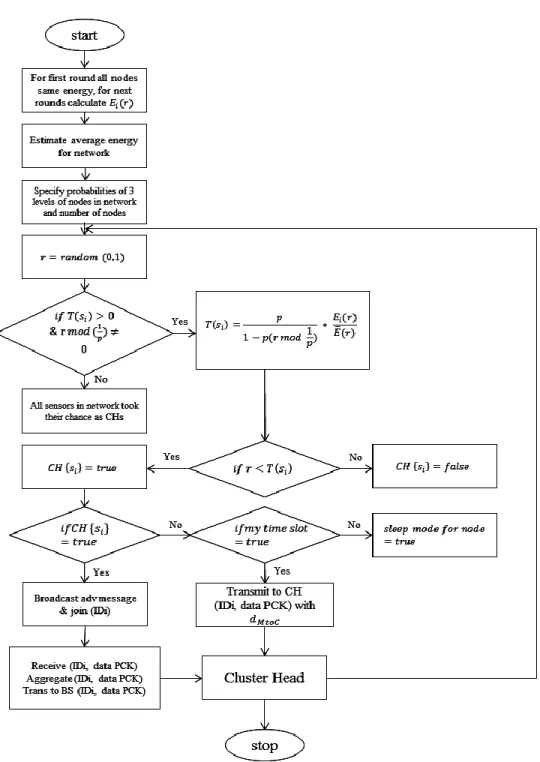
Then, in MAN-LEACH, the selection of cluster heads depend on the probability based on the proportion between the residual energy of each node after certain round and the average energy estimated of whole network. The round number of the revolving period for each node is differ according to its initial or residual energy, i.e., MAN-LEACH adapt the revolving period of each node to its own energy.
So, the highest initial or residual energy nodes will have highest chances to be the cluster heads than lowest one as shown in Figure 1 that describe the flow chart of MAN-LEACH. Thus MAN-LEACH can prolong the network lifetime, and distribute the energy at which all nodes will die in same time as desired, and as shown in simulation results. Another problem faces LEACH, that nodes are transmit data by use of same amplified energy with neglect the distance between transmitter and receiver. So, transmission mechanisms that specify the required amount of amplification energy to communicate nodes with cluster heads or base station are required to preserve energy.
For example, transmitting a packets to cluster head does not need same amount of amplified energy to transmit packets to farthest end of network or base station, so, using same amplification power level is results in wastage of energy. One of the proposed solutions is to have global knowledge of network situation and then nodes decide energy amplification required to transmit signal. Locating and calculating a distance with in full network topology needs lot of routing and so, this approach causes overwhelming in control data.
To solve above described problems, MOD-LEACH propose two mechanisms, one of them is dual transmitting power levels [14]. MOD-LEACH describes three modes of transmission in cluster based networks:
1. Intra cluster transmission: deals with all communication within cluster.
2. Inter cluster transmission: deals with the transmission/reception between cluster heads. 3. Cluster head to base station transmission. For intra cluster communications using lowest level of energy with respect to cluster head to base station communications is leads to preserve more energy. Furthermore, dual mode of amplify also reduce the packet drop ratio, collisions and/or interference for other signals. MAN-LEACH assisted with advantage of MOD-LEACH in dividing transmitting power to transmit the amplified signal based on single hop data transmission by proposing multi transmitting power mode, let (dMtoC) refer to threshold distance between cluster members and cluster head, it calculated by:
4
f MtoC
d
Where df refer to distance from farthest node in network from base station. If distance is lower
than threshold (dMtoC) the lowest level is used, otherwise it uses other two levels.
7
Figure 2: First order radio model.
MAN-LEACH also proposes another threshold distance, it refers to distance between cluster heads in network denoted as (dCtoC)and calculated by:
3
f CtoC
d
d (13)
If distance is lower than threshold (dCtoB) and higher than threshold (dMtoC) the middle level is used, otherwise it uses extra level. Extra level used to transmit between cluster heads and base station with threshold calculated by:
2 f CtoB
d
d (14)
Where (dCtoB) refers to distance between cluster heads and base station that represent the longest distance in network, if threshold is higher than
)
(dCtoB the radio model uses extra model to transmit data.
Radio energy dissipation model
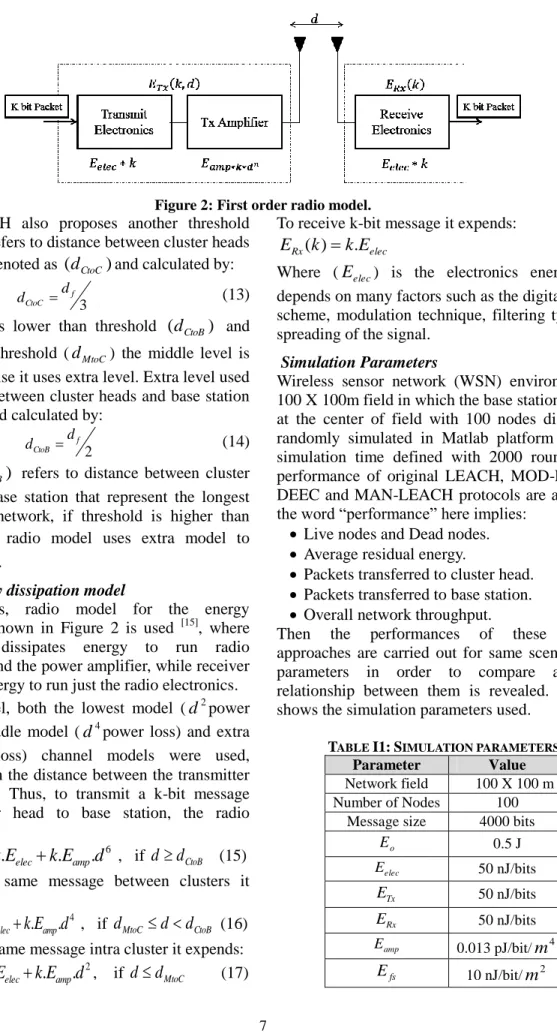
For analysis, radio model for the energy dissipation shown in Figure 2 is used [15], where transmitter dissipates energy to run radio electronics and the power amplifier, while receiver dissipates energy to run just the radio electronics. In this model, both the lowest model (d2power loss) the middle model (d4power loss) and extra (d6power loss) channel models were used, depending on the distance between the transmitter and receiver. Thus, to transmit a k-bit message from cluster head to base station, the radio expands: 6
.
.
.
)
,
(
k
d
k
E
k
E
d
E
Tx
elec
amp , if ddCtoB (15) To transmit same message between clusters it expends: 4.
.
.
)
,
(
k
d
k
E
k
E
d
E
Tx
elec
amp , if dMtoC ddCtoB (16) To transmit same message intra cluster it expends:2
.
.
.
)
,
(
k
d
k
E
k
E
d
E
Tx
elec
amp , if ddMtoC (17)To receive k-bit message it expends: elec
Rx k kE
E ( ) . (18)[15] Where (Eelec) is the electronics energy, and depends on many factors such as the digital coding scheme, modulation technique, filtering type, and spreading of the signal.
Simulation Parameters
Wireless sensor network (WSN) environment in 100 X 100m field in which the base station is fixed at the center of field with 100 nodes distributed randomly simulated in Matlab platform and the simulation time defined with 2000 rounds. The performance of original LEACH, MOD-LEACH, DEEC and MAN-LEACH protocols are analyzed, the word “performance” here implies:
Live nodes and Dead nodes.
Average residual energy.
Packets transferred to cluster head.
Packets transferred to base station.
Overall network throughput.
Then the performances of these routing approaches are carried out for same scenario and parameters in order to compare and the relationship between them is revealed. Table II shows the simulation parameters used.
TABLE I1:SIMULATION PARAMETERS.
Parameter Value
Network field 100 X 100 m Number of Nodes 100
Message size 4000 bits
o E 0.5 J elec E 50 nJ/bits Tx E 50 nJ/bits Rx E 50 nJ/bits amp E 0.013 pJ/bit/ 4 m fs E 10 nJ/bit/ 2 m
DA
E 5 nJ/bit/signal
opt
p 0.1
The following scenario we have taken for three level of heterogeneity:m0.5,mo 0.3, a1.5,
3
a .
RESULTS AND DISCUSSIONS
With references to parameter set given in Table I, the result of our simulated work and its validation compared with well-known published protocols and results discussed as follow:
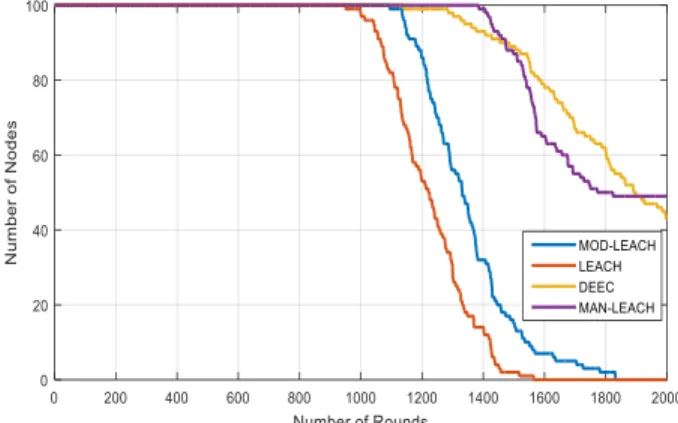
Live nodes and Dead nodes: From the Figure 3, it is quite clear that MAN-LEACH outperform than LEACH, MOD-LEACH and DEEC as in prolonging network life time. X-axis in figure defines number of rounds and Y-axis defines number of nodes. It is quite clear that while nodes beginning to die in other protocols at early rounds, the first node die in MAN-LEACH approximately at round 1400, additionally while all nodes die in LEACH and MOD-LEACH before ending all rounds simulated.
DEEC and MAN-LEACH keeps many nodes in a live at the end of rounds, but MAN-LEACH preserve more nodes as shown, approximately 50 nodes at a live and nodes go to die at same because of the distribution of tasks between nodes with respect to their residual energy, so MAN-LEACH has better performance in prolonging network lifetime and it appropriate for long time applications.
Figure 3: Live and dead nodes through rounds.
Average residual energy: Figure 4 shows the average residual energy of nodes in whole network after each round, where X-axis defines number of rounds simulated Y-axis define the average
residual energy value in joule. The residual energy of all protocols is begin with considered value and go to decrease through advanced in rounds, while the residual energy of LEACH and MOD-LEACH go to depletion before ending rounds and this indicate to depletion of nodes energy, DEEC and MAN-LEACH preserve amount of energy but MAN-LEACH outperform with a world of difference compared to DEEC because of important reason, MAN-LEACH mechanism in forming clusters in which nodes has highest energy elected as cluster head made proportion in the distribution of tasks between nodes, in radio implementation cluster heads require more energy to process received signals and re-route them to base station, while member nodes require less energy for sensing data and transfer it to cluster heads at short distance, so, MAN-LEACH procedure in forming cluster heads preserve more energy, also transferring data through multi modes of energy is contributes in preserving energy. So MAN-LEACH outperform in preserving energy.
Figure 4: Average residual energy.
Packets transferred to cluster head: Figure 5 shows packets transferred to cluster heads, where X-axis define number of rounds simulated, Y-axis define packets transferred per rounds in bit. It is quite clear that DEEC has highest rate in transferring data to cluster head, and MAN-LEACH has the lowest rate. MAN-MAN-LEACH rate is decreased for important reason, MAN-LEACH distribute tasks between nodes with respect to their residual energy as mentioned in previous, so, in MAN-LEACH the number of cluster formed through rounds is increased compared to other protocols, and thus the amount of data received in each cluster head is decreased compared to other protocols in which cluster members in MAN-LEACH is too less compared to other protocols.
9 This procedure gives MAN-LEACH continuity in forming clusters and keeping nodes at a live, but it increases control packets overhead required in forming cluster stage, and this be considered as interested drawback.
Figure 5: Packets transferred to cluster heads.
Packets transferred to base station: Figure 6 shows messages transferred to base station. Where X-axis defines number of rounds simulated Y-axis defines messages transferred per rounds in bit. It is quite clear that MAN-LEACH outperform in transferring data to base station compared with other competitor’s protocols.
This preference is coming because of important reasons, MAN-LEACH algorithm in forming clusters and transferring data preserve more nodes at a live as shown in previous results, of course preserving nodes at a live guarantee the continuity of sensing data and route operation, contrary in other protocols that nodes go to die before in MAN-LEACH, this contribute in increasing packets transferred to base station. So MAN-LEACH has better performance in increasing network throughput.
Figure 6: Packets transferred to base station.
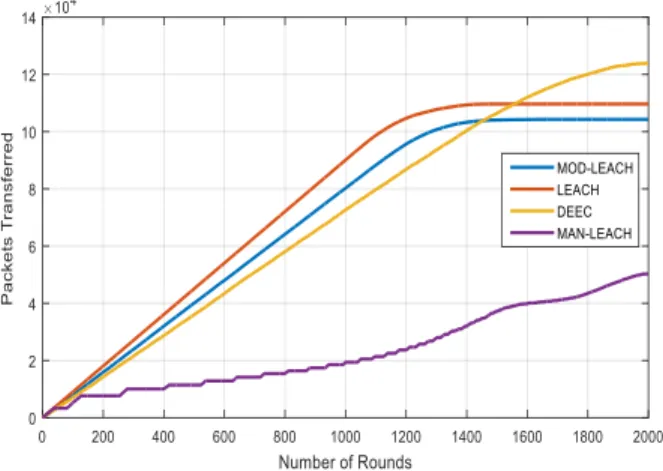
Overall network throughput: Figure 7 shows the overall traffic in network, in other expression it describe the overall throughput of network, where X-axis define number of rounds simulated Y-axis define packets transferred per rounds to base station in bit.
The overall traffic here include sensed data by member nodes in each cluster in which transferred to cluster heads, the advertisement and request to join packets for each cluster (control packets), and the packets collected from cluster heads and transferred to base station.
It is quite clear that LEACH has a lowest throughput followed by MOD-LEACH and DEEC exceed MAN-LEACH by a narrow margin for important reason, as shown in previous results, DEEC performance exceed MAN-LEACH performance in transferring data to cluster heads, because of MAN-LEACH procedure in forming cluster and distributing of sensing data and route task, and this affect negatively in the overall throughput for network in MAN-LEACH.
Figure 7. Overall throughput of network.
CONCLUSIONS
In this paper we proposed MAN-LEACH protocol,
an energy adaptive clustering routing protocol which enhances stability and energy efficient attribute of the heterogeneous wireless sensor networks and hence prolong network lifetime. In MAN-LEACH nodes elects itself as cluster head with take into care the residual energy of nodes in network with respect to average energy of network, and amplifying energy to transmit packets in multi-level of energy.
Simulation results were beyond our expectations and show that MAN-LEACH performance is better as compared to original LEACH, MOD-LEACH, and DEEC in term of extending network
life time, increase average energy and packets transferred to base station.
From results it’s quite clear that MAN-LEACH is appropriate option for long time applications in which it keeps nodes in a live at long times, also it appropriate for applications require periodically reports. MAN-LEACH pave the way for multi-level of heterogeneity networks and the utilization of energy dissipation models with multi-level of amplifying energy in message transmission through network. The future direction can be focus in these points, also it can focus on security process; most cluster protocols did not consider security in their process.
REFERENCES
1. V. santosh, R.S. deshpande, “Energy Efficient Clustering Protocol to Enhance Performance of Heterogeneous Wireless Sensor Network: EECPEP-HWSN,” Journal of Computer Networks and Communications, Vol 2018, pp.1-12.
2. A. Mohammed, W. Tat Chee, K. Ahmad, “Variants of the Low-Energy Adaptive Clustering Hierarchy Protocol: Survey, Issues and Challenges,” Electronics, Vol 7, Issue 8, Aug 2018.pp.136-164.
3. C. anurag, S. dumedha, “Review on various routing protocol for heterogeneous wireless sensor network,” IEEE 2017 International Conference on I-SMAC (IoT in Social, Mobile, Analytics and Cloud) (I-SMAC), Palladam, India.
4. W Heinzelman, Anantha C, Hari B, “Energy-Efficient Communication Protocol for Wireless Microsensor Networks,” Hawaii International Conference on System Sciences, volume 1, January 4-7, 2000, Maui, Hawaii. 5. Prashant, M.; Amanpreet, K, “A Survey on
Descendants of LEACH Protocol”. I.J. Information Engineering and Electronic Business, Mar 2016, pp.46-58.
6. P. parul, M. sheetal, “K-LEACH an improved LEACH protocol for lifetime improvement in WSN,” International Journal of Engineering Trends and Technology (IJETT), Vol 4, Issue 5, May 2013.
7. N. Muhammad, J. mohsin, “performance improvement in lifetime and throughput of LEACH protocol,” Indian Journal of Science and Technology, Vol 9, June 2016.
8. T. sonamani, R. soram, A. kumar, “distance based multi single hop low energy adaptive clustering hierarchy (MS LEACH) routing protocol in wireless sensor network,” IEEE 2016 6th International Conference on Advanced Computing (IACC) - Bhimavaram, India, pp.613-617.
9. T. N. Qureshi, N. Javaid, A.H. Khan, A. Iqbal, E. Akhtar, M. Ishfaq,“BEENISH: Balanced Energy Efficient Network Integrated Super Heterogeneous Protocol for Wireless Sensor Networks,” The 4th International Conference on Ambient Systems, Networks andTechnologies (ANT 2013), Vol 19, 24 June 2013, pp.920-925.
10. A. Preethi, E. Pravin, D. Sangeetha, “Modified Balanced Energy Efficient Network Integrated Super Heterogeneous Protocol,” IEEE 2016 Fifth International Conference On Recent Trends In Information Technology, Chennai, India, pp.1-6.
11. A. Chithra, R. Shantha, “A novel 3- level energy heterogeneity clustering protocol with hybrid routing for a concentric circular wireless sensor network,” springer – cluster computing, Vol 20, Issue 2, Nov 2017.
12. S. Singh, A. Malik, and R. Kumar, “Energy efficient heterogeneous DEEC protocol for enhancing lifetime in WSNs,”Engineering Science and Technology an International Journal, Vol 20, no. 1, 2017, pp. 345–353. 13. Q. Li, Z. Qingxin, W. Mingwen, “Design of a
distributed energy efficient clustering algorithm for heterogeneous wireless sensor networks,” Comput. Commun, Vol 29, Issue 12, 2006, pp.2230–2237.
14. D. Mahmood, N. Javaid, S. Mahmood, S. Qureshi, A. M. Memon, T. Zaman, “MODLEACH: A Variant of LEACH for WSNs,” IEEE 2013 Eighth International Conference on Broadband, Wireless Computing, Communication and Applications, Compiegne, France, Jul 2013, pp.158-163. 15. W. Heinzelman, “Application-Specific
Protocol Architectures for Wireless Networks,” PhD thesis, Massachusetts Institute of Technology, June 2000.