C O M P U T I N G P R A C T I C E S
Hanna Oktaba
National Autonomous University of MexicoFélix García,
Mario Piattini,
and Francisco
Ruiz
Alarcos Research Group
Francisco J.
Pino
University of Cauca, ColombiaClaudia Alquicira
UltrasistS
oftware constitutes an important industry for developing Latin Amer-ican countries. The small- and medium-sized companies that account for up to half the industry’s employment face serious problems, however, when they start to grow. In many cases, the absence of a visible soft-ware-development process creates chaos for the entire organization, including its products.1The companies’ lack of competitiveness seriously limits their growth.2USING EXISTING REFERENCE MODELS
Recently, small Latin American software companies have tried to improve their software processes’ capability as a fundamental step toward increasing product quality. They’ve addressed two main concerns:
• their image, a key factor for establishing and maintaining a position in the global marketplace; and
• the efficiency and effectiveness of software process management.
Many of these businesses deploy reference models proposed by the Software Engineering Institute (SEI), the Capability Maturity Model Institute (CMMI), or the International Organization for Standardization (ISO). However, these ref-erence models’ complex recommendations and significant time and resource com-mitment make their application difficult for small organizations.3-5
The situation is especially troublesome for small Latin American organizations due to the absence of tailor-made process reference models and the adoption of models defined in other countries without suitable adaptation. Indeed, software-process-improvement advocate Sami Zahran6observed that an organization will reject a process if it doesn’t match its culture, just as the human body will reject a mismatched transplanted organ. Software-engineering researcher Tore Dyba, meanwhile, noted that cultural differences play a role in the success of software process improvement.7
Software Process
Improvement:
The Competisoft Project
Competisoft provides the Latin American software industry with
a reference framework for improvement and certification of its
software processes.The project is based on proven solutions,
including the MoProSoft model that four Mexican software
companies applied to increase their processes’ capacity level.
The SEI emphasizes that it’s expensive and difficult to implement CMMI and the Standard CMMI Appraisal Method for Process Improvement (SCAMPI) in the US.2,8 Applying these models would be even more expensive and difficult for Latin American companies, which must make copyright and certification payments to the US.
With limited resources, small companies generally need external assistance in planning and implementing process improvement to keep abreast of state-of-the-art software-engineering research and practice. Further-more, the current international life-cycle processes (ISO/IEC 12207 and ISO/IEC 15288) don’t explicitly address the needs of small organizations. The new ISO/IEC JTC1 SC7 Working Group 24, which was created to develop software life-cycle profiles and guide-lines for very small enterprises (those with fewer than 25 employees), recognizes the need to adapt ISO/IEC 12207 increasingly to small organizations. The “Stan-dards Application in Very Small Enterprises” sidebar provides additional information about these efforts.
Several researchers seek to adapt models for process assessment and improvement (mainly from ISO and SEI)
to the special characteristics of small organizations. The SEI’s Proceedings of the First International Research Workshop for Process Improvement in Small Settings,9 for example, includes many articles on the challenges of process improvement in small organizations.
THE MOPROSOFT EXPERIENCE
Mexico’s attempts to improve its software industry led to development of the Process Model for the Software Industry (Modelo de Procesos para la Industria de Software) reference model in 2002.10MoProSoft built on the well-known practices of the SEI’s now-retired Capability Maturity Model for Software, ISO 9000: 2000, the Project Management Institute’s project man-agement body of knowledge (PMBOK), and others. It offered a new process structure, some new process-doc-umentation elements, a more precise process relation-ship, and an explicit process-improvement mechanism. In addition to conforming with ISO/IEC 15504, the government needed a model suitable for small- and medium-sized enterprises, inexpensive to adopt and assess, feasible as a national standard, specific for
soft-Standards Application in Very Small Enterprises
Claude Y. Laporte, École de Technologie Supérieure
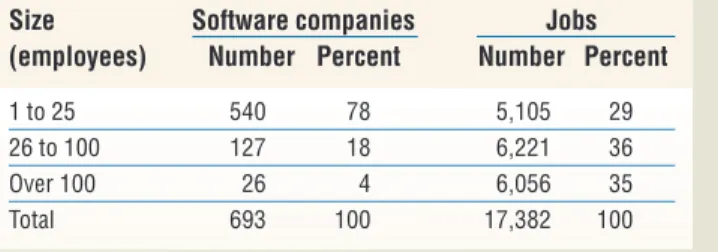
International software-engineering standards weren’t written with very small enterprises (fewer than 25 employees) in mind, even though a majority of organi-zations fall into this category. Microenterprises (nine or fewer employees) represent 93 percent of companies in Europe, 56 percent in the US, and 66 percent of total employment globally.1As Table A shows, a 2004 survey of the Montreal area’s IT sector found that 78 percent of software-development companies had 25 or fewer employees, and 50 percent had fewer than 10 employ-ees (http://profs.logti.etsmtl.ca/claporte/English/ Publications/index.html).
Since ISO/IEC software standards are difficult to apply in such settings, WG24, an ISO/IEC JTC1 SC7 working group, has been established to develop international standard profiles and technical reports to help VSEs
com-ply with ISO software-engineering standards (www. tudor.lu/spice2006). The group will use parts of ISO standards and parts of national standards to create a profile, defined as a set of one or more base standards necessary to fulfill a particular function.
Australia, Belgium, Canada, the Czech Republic, Finland, India, Ireland, Italy, Japan, Korea, Luxembourg, Mexico, South Africa, Thailand, and the United
Kingdom are participating in WG24, along with the IEEE Computer Society and the International Council on Systems Engineering.
WG24 surveyed VSEs to identify problems and poten-tial solutions to help them apply standards and become more competitive. Available in English, French, German, Korean, Portuguese, Russian, Spanish, Thai, and Turkish, the survey yielded more than 444 responses from 32 countries. About half the responses were from Latin American countries, mainly Brazil, Colombia, and Mexico.
When respondents were asked why they didn’t use standards,
• 28 percent indicated a lack of resources (expertise, budget, time),
• 24 percent indicated that customers or management didn’t require them, and
• 15 percent indicated they were bureaucratic and dif-ficult to apply.
Table A. Employment by different-sized software-development companies in the Montreal area (2004).
Size Software companies Jobs
(employees) Number Percent Number Percent
1 to 25 540 78 5,105 29
26 to 100 127 18 6,221 36
Over 100 26 4 6,056 35
business’s direction, middle management is responsible for project and resource procurement and control, and an operations group develops projects using allotted resources. The members of those groups acknowledge responsibilities through their assigned roles, which have vertical authority alignment and horizontal collabora-tion relacollabora-tionships.
We considered three process categories:
• Top management.Members of this category are con-cerned with business-management practices and direct and receive reports from middle management. • Middle management.Members of this category deal with process-, project-, and resource-management practices in line with top management’s business goals. They provide elements for the performance of operations processes, receive and evaluate the infor-mation those processes generate, and inform top man-agement of the results. The resource-manman-agement process includes three subprocesses: human resources and work environment; goods, services, and infra-structure; and knowledge of the organization. ware-development and maintenance organizations, and
defined as a set of processes based on internationally recognized practices.
MoProSoft was complemented by the EvalProSoft process-assessment method,9based on the recommen-dations of ISO/IEC 15504 (Part 2). Trials of MoProSoft and EvalProSoft in four Mexican companies confirmed the model’s suitability for small organizations with low maturity levels, borne out by the improvements achieved and the low cost of process adoption.9
In August 2005, Mexico approved MoProSoft and EvalProSoft as standard NMX-059-NYCE-2005. To-gether, they were intended to provide Mexico’s software industry with an easy-to-understand model based on best international practices that would help organiza-tions standardize their practices.
Process model structure
Defining the process model’s structure requires ana-lyzing the structure of software-development enterprises. In most firms—even microenterprises with fewer than 10 people—top management makes decisions on the
More than 74 percent of respondents indicated it was important to be either recognized or certified. Among the respondents, 40 percent requested ISO certification, and 28 percent requested market recogni-tion. A national certification interested only 4 percent of the respondents. Regarding the need for assistance, 62 percent ask for more guidance and examples, and 55 percent require lightweight and easy-to-understand standards provided with examples, templates, and checklists.
In 1997, the council responsible for IEEE Software Engineering Standards surveyed software-engineer-ing-standards users to improve those standards.2 The 148 responses, mainly from the US and compa-nies with more than 100 employees, indicated that IEEE standards needed examples, templates, a life-cycle process definition, and support for metrics and measurement.
At its 2005 meeting, WG24 considered that Mexico’s MoProSoft could serve as the basis for a first working draft, even though the standard is aimed at larger enterprises. The following year, WG24 tailored the Mexican standard for VSEs, and earlier this year decided to develop Profile 1 using the tailored Mexican standard.
To help VSEs implement forthcoming ISO profiles, the group also decided to develop deployment kits
that would enable VSEs to rapidly deploy a subset of the total profile. For example, a VSE could attend a half-day workshop about version control. The deploy-ment kit would contain the information required to deploy version control, such as a description of the process, guides, templates, checklists, an evaluation form, and an installation and user guide for an open software version-control tool.
WG24 also plans pilot projects to validate the approach and obtain feedback to improve the docu-ments before seeking ISO/IEC publication. Production of a working draft is set for 2007, a final draft in 2009, and ISO/IEC publication in 2010.
References
1. Organisation for Economic Co-Operation and Development,
Small and Medium Enterprise Outlook, OECD, 2002.
2. S.K. Land, “Results of the IEEE Survey of Software Engineer-ing Standards Users,” Proc. Int’l Software Eng. Standards
Symp. and Forum, Emerging Int’l Standards(ISESS 97), IEEE
Press, 1997, pp. 242–270.
Claude Y. Laporteis a professor in the Department of Software and IT Engineering at École de Technologie Supérieure in Montreal. Contact him at [email protected].
•Operations.Members of this category address the practices of software-development and -maintenance projects. They perform activities using elements management provides and deliver reports and the software products generated.
We based these categories on management and gov-ernance structure, as Figure 1 shows.
Process pattern
The model’s innovative process pattern, the set of elements needed to document a process, consists of a general process definition,tailoring guidelines, and a practices section.
The general process definition includes the process name, category, and purpose; an abstract of process activities; goals, goal indicators, responsibility, and authority roles; subprocesses (if any) and related processes; inputs, outputs, and internal products; and bibliographical references.
Tailoring guidelines suggest the possible process mod-ifications, which shouldn’t affect achieving process goals. The practices section includes recommended training practices, exceptional situation management, use of lessons learned, and a UML activity diagram. It identi-fies the roles involved in the process, the training required, and the infrastructure resources needed to sup-port activities. The practices session describes product verifications and any required validations as well as activ-ities associating them with the process goals and the roles involved. It lists products that should be incorporated into the organization’s knowledge base and exemplifies process measurements for each goal indicator.
Organizations use this pattern to document all MoProSoft processes. An organization that decides to introduce standardized processes without knowing how to do so can start with this model as the initial process documentation and adjust it with local techniques,
prod-ucts form, and terminology. The process pattern also facilitates the inclusion of new processes in the model. For example, if the organization needs a client-service process, it can use the pattern to define and incorporate the model.
Interrelated processes
MoProSoft processes are interrelated. The process pat-tern defines its relationship based on product inter-change and role participation. Each output product that the process generates is explicitly identified as the input product in one or more other processes. The same process that generates internal products also “con-sumes” them.
The process relationship based on role participation means that some roles of one process participate in activ-ities of others. This interrelation makes it possible to fol-low the product and workflow between processes and facilitates the assignment of personal responsibilities through roles. It’s particularly important for small orga-nizations where a few people must play several roles.
Assessing other standards
Organizations can use MoProSoft as a vehicle to assess or audit other standards. Several studies show coverage of 92 percent of the requirements of ISO 9000:2000;1195 percent of the process purposes in Annex F of ISO 12207 within the scope of the MoProSoft processes; and 77 percent of the specific and general goals and practices of CMMI 1.1 Level 2.12
According to the MoProSoft model, an organization should establish its own strategies for setting up the processes it defines, and the processes should evolve in line with suggestions for improvement. That will allow coverage of the organization’s strategic plan objectives and setting of increasingly ambitious goals. In this way, the company can reach maturity progressively through ongoing process improvement.
Testing MoProSoft
In 2004, four trials were run in typical small Mexican software companies to evaluate the ease of application and usefulness of MoProSoft as a software process model for small companies and to determine the cost of the EvalProSoft assessment method.
Initial assessments to establish the baseline capabili-ties of the enterprise processes showed them all to be between 0 and 1. Over the next six months, consultants coached the companies on MoProSoft tailoring and adoption. When the companies were assessed a second time, all enterprises achieved an average increase of 1.08 in the capacity level of all their processes.
Table 1 shows the number of employees, the total improvement effort in hours, and the effort per person for each company. The last column indicates the average capacity improvement per process. It’s interesting to
Specific project administration Software development and maintenance
Opera tions Process management Project management Resource management Middle man agem ent Business management Top managem ent
Figure 1. MoProSoft’s process categories. An analysis of the structure of software-development enterprises provided the basis for the process categories.
observe the relationship between the effort per person and the average process improvement. For example, Company C invested the largest number of hours per person and achieved the greatest process improvement. The average num-ber of employees was 18, and the average effort per person was 21.28 hours over six months.
THE COMPETISOFT APPROACH
In 2005, several researchers and practitioners recognized the importance of an improvement and certification framework for small
organi-zations. They proposed Competisoft to the Ibero-American Science and Technology Development Program (Programa Iberoamericano de Ciencia y Tecnología para el Desarrollo), a group created in 1984 for multilateral scientific and technological cooperation and supported by 21 Latin American countries plus Spain and Portugal. CYTED aims to establish coopera-tion between university research groups, R&D insti-tutes, and innovative companies in the countries involved to transfer scientific and technological results to productive systems and social politics.
Participants applied action research, a collaborative approach featuring continual feedback between the researchers and companies in the definition, refinement, and application of the Competisoft model. Participants in Competisoft fell into two main categories:
• researchers from universities in Argentina, Brazil, Chile, Colombia, Costa Rica, Cuba, Ecuador, Mexico, Peru, Portugal, Spain, Uruguay, and Venezuela; and • the critical reference group, consisting of the
Argentinian IRAM (Institute for Standardization and Certification), the government of Argentina’s Neuquén region, and small companies,
including five from Colombia, four from Peru, three from Spain, and one each from Argentina, Chile, Ecuador, Mexico, and Uruguay.
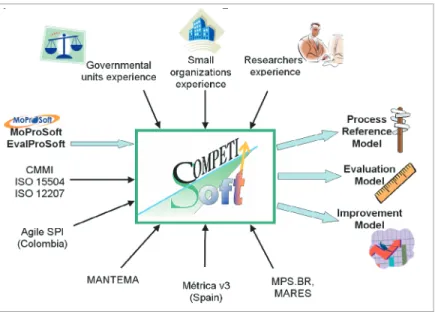
To develop the Competisoft project, we studied different Latin American initiatives, such as MoProSoft, the Brazilian Process Improvement Model (Melhoria de Proces-sos do Software Brasileiro), and also agile software process improvement (SPI). The Spanish Ministry of Public Administration’s Métrica v3 was also considered, since it’s aimed at improving software processes and products.
As Figure 2 shows, we developed Com-petisoft by borrowing heavily from well-known assessment methods intended for small companies, especially MoProSoft, as a process reference model. In fact, we can
Table 1. Improvement experience using MoProSoft.
Company Employees Total effort Effort per Average (hours) person (hours) improvement
A 17 479 28.18 1.00
B 8 199 24.88 1.00
C 17 628 36.94 1.56
D 29 221 7.62 0.78
Average 18 383 21.28 1.08
view Competisoft as an evolution of MoProSoft, with researchers’ and practitioners’ experience in software process deployment and improvement leading to a new process reference and evaluation model that enhances MoProSoft and EvalProSoft, and a new process-improve-ment model based on agile SPI.
Process reference model
The Competisoft process reference model incorpo-rates several improvements and refinements.
Process management.We developed a
self-assess-ment questionnaire that can help small organizations with the first contact with the assessment and improve-ment of their process maturity.
Project management.We selected basic software
pro-ject measurements and indicators aligned to the propro-ject and process objectives. We integrated them with the administration of specific projects and with the soft-ware-development processes to facilitate use by small organizations. We’re also tackling the improvement of estimation techniques, a fundamental need in small organizations but one that’s difficult to understand and apply in these settings.
Figure 2. Competisoft project overview. Several different Latin American initia-tives were studied for Competisoft.
Development.We built in examples of deployment guidelines for requirements, analysis and design, con-struction, testing, and measurement activities to facilitate application in small organizations. The deployment guides describe techniques and specific work products, suggest support tools, recommend a bibliography, and provide an application example. This strategy gives small organiza-tions more flexibility in running the development process, as companies of this kind tend to integrate techniques from different approaches depending on the context.
Maintenance.It’s important to tackle maintenance
separately from development, as their nature and char-acteristics are different and many development tech-niques, tools, model processes, and so on aren’t directly applicable to maintenance. Indeed, many small organi-zations must develop pure software-maintenance pro-jects, which makes it important for them to apply specific maintenance methodologies.
In this regard, the Competisoft approach has devel-oped a maintenance process adapting the Mantema12 and Scrum methodologies to small organizations. This process defines two levels of maintenance services: basic, which includes urgent, nonurgent, and perfective kinds of maintenance; and advanced, which is concerned with adaptive and preventive maintenance.
We’re currently tackling several other issues associated
with the reference model. In addition to improvements proposed for specific processes, two aspects common to all processes are the incorporation of free and open source software—a key element for small organizations to reduce costs—and development of specific techniques for the improvement of systems usability.
Business management.As small organizations work
to better align their business objectives and informa-tion technologies, we need to include virtual enterprises and intercompany connectivity, a key requirement to guarantee the survival of small organization clusters in today’s marketplace.
Resource management.We’ll emphasize the
impor-tance of reusability by developing an experience base structured according to the processes in the reference model. To this end, we’ll consider other similar experi-ences.13Indeed, Competisoft places great importance on the experience base from the outset at all organizational levels, regardless of the quality of the components stored in the base, as they may all be useful. We also recognize the value of a more formal, yet still lightweight, method of eliciting experience that’s easy for a small organiza-tion to use, providing guidance and structure to assist users in creating more experiences for the base. Other important issues to address are documentation and con-figuration management.
COMPETISOFT
Evaluation Method
CAPABILITY Dimension PROCESS DimensionCOMPETISOFT
Reference
Model
ISO/IEC 15504-5:2006(E) Process Management Project Management Human Resources Management Goods, Services, and Infrastructure ManagementKnowledge Management Business Management HIGH DIRECTION (DIR) MANAGEMENT (MAN) Category Category
Specific Project Administration Software Development Software Maintenance
OPERATION (OPE)
Category
Level 5: Optimizing (2 attributes) Level 4: Predictable (2 attributes) Level 3: Established (2 attributes) Level 2: Managed (2 attributes) Level 1: Performed (1 attribute) Level 0: Incomplete
Process capability assessment (Level 1 to 5) based on Process Attribute Indicators (PAI) - GP: Generic Practice
- GR: Generic Resource - GWP: Generic Work Product
For each attribute PA 1.1 to PA 5.2
Level 1
Elements (from COMPETISOFT) for process performance assessment based on: ·Purpose
·Description
·Objectives
·Indicator
·...
Figure 3. Competisoft evaluation model. Based on EvalProSoft, the model defines a set of measures for estimating the capability and performance of software processes.
T
o date, Competisoft has resulted in the develop-ment of a common methodological framework suitable for small Latin American organizations and oriented toward continual software process improvement. The project has introduced the Latin American software industry to a process-improvement culture, and it has introduced standardization and cer-tification organizations to methodological principles. Currently, six small companies are applying the Competisoft model over a four-month period. The goal is to increase by one the process capability and measure the effort required to conduct the improvement. We will generate new versions of the process reference, evalua-tion, and improvement models on the basis of feedback and lessons learned. ■References
1. J. Batista and A. Dias de Figueiredo, “SPI in a Very Small Team: A Case with CMM,” Software Process: Improvement and Practice, vol. 5, no. 4, 2000, pp. 243-250.
2. Mayer & Bunge Informática, Panorama de la Industria del Software en Latinoamérica, 2004, p. 97.
3. H.K.N. Leung and T.C.F. Yuen, “A Process Framework for Small Projects,” Software Process: Improvement and Prac-tice, vol. 6, no. 2, 2001, pp. 67-83.
4. H. Saiedian and N. Carr, “Characterizing a Software Process Maturity Model for Small Organizations,” ACM SIGICE Bull., vol. 23, no. 1, 1997, pp. 2-11.
5. P. Maller, C. Ochoa, and J. Silva, “Lightening the Software Production Process in a CMM Level 5 Framework,” IEEE Latin America Trans., vol. 3, no. 1, 2005, pp. 14-21. 6. S. Zahran, Software Process Improvement: Practical
Guide-lines for Business Success, Addison-Wesley, 1998.
7. T. Dyba, “An Empirical Investigation of the Key Factors for Success in Software Process Improvement,” IEEE Trans. Soft-ware Eng., vol. 31, no. 5, 2005, pp. 410-424.
8. M.B. Chrissis et al., CMMI Interpretive Guidance Project: What We Learned, special report CMU/SEI-2004-SR-008, Software Eng. Institute, 2004; www.sei.cmu.edu/pub/ documents/04.reports/pdf/04sr008.pdf.
9. S. García, C. Graettinger, and K. Kost, eds., Proc. 1st Int’l Research Workshop for Process Improvement in Small Set-tings, special report CMU/SEI-2006-SR-001, Software Eng. Institute, 2006; www.sei.cmu.edu/pub/documents/06.reports/ pdf/06sr001.pdf.
10. H. Oktaba, “MoProSoft: A Software Process Model for Small Enterprises,”Proc. 1st Int’l Research Workshop for Process Improvement in Small Settings, special report CMU/SEI-2006-SR-001; Software Eng. Institute, 2006, pp. 93-101; www.sei. cmu.edu/pub/documents/06.reports/pdf/06sr001.pdf. 11. M. Oyvind, “Comparación del Modelo de Procesos para la
Industria de Software (MoProSoft) con las Normas y Mode-los de Referencia,” master’s thesis, National Autonomous Uni-versity of Mexico, 2005.
Evaluation model
The Competisoft evaluation model is based on the EvalProSoft model. The first task was to define a set of measures for estimating the capability and perfor-mance of software processes. The aim was to help small organizations carry out their assessments by reducing subjectivity and making the process more formal.
As Figure 3 shows, the measures are grouped into two main types:
• The capability measures, which use process attribute indicators to evaluate process capability (from Level 1 to 5) on the basis of generic practices, resources, and work products; and
• The performance measures, which are based on pur-pose, description, work products, and activities from the Competisoft reference model.
The organization is also developing a software tool with a Web interface to support the evaluation model.
Improvement model
The Competisoft improvement model is based on agile SPI, which establishes the elements necessary for eco-nomically running improvement programs in small orga-nizations. The model defines PmCompetisoft, an improve-ment process that follows the process pattern defined in Competisoft. Designed to be easier and more intuitive for small software organizations, PmCompetisoft offers
• early and continuous achievements of improvement, • continuous and fast process diagnosis,
• elemental process measurement, • effective group communication, and • continuous learning.
PmCompetisoft is a lightweight process that follows an iterative and incremental approach to guide the imple-mentation of an improvement cycle. To achieve this, PmCompetisoft is highly influenced by the Ideal model as well as by agile methodologies such as eXtreme Program-ming and Scrum. It’s composed of one or more improve-ment cycles, each one involving five activities: initiating the cycle, diagnosing the process, formulating improve-ments, executing improveimprove-ments, and revising the cycle. The model clearly defines these activities by describing the roles involved, the expected work products, and, for each work product, a fully detailed self-content template.
Furthermore, the Competisoft improvement model defines a set of high-priority processes for small organi-zations implementing a process-improvement project. The strategy’s fundamental principle is that companies must connect process improvement with the other soft-ware process-management responsibilities. A consultant guide must advise the program leader on using PmCom-petisoft to start a process-improvement cycle.
Mario Piattini, general director of Competisoft,is a pro-fessor in the Department of Information Technologies and Systems at UCLM, where he leads the Alarcos Research Group. His research interests include software quality, met-rics, and maintenance. Piattini received a PhD in computer science from the Polytechnic University of Madrid. He is a member of the IEEE Computer Society and the ACM. Con-tact him at [email protected].
Francisco Ruizis an associate professor in the Department of Information Technologies and Systems at UCLM, where he is a member of the Alarcos Research Group. His research interests include business process modeling and measure-ment, software measuremeasure-ment, software process technology, and methodologies for planning and managing software projects. Ruiz received a PhD in computer science from UCLM. He is a member of the IEEE Computer Society and the ACM. Contact him at [email protected].
Francisco J. Pinois a lecturer on the electronic and telecom-munications engineering faculty at the University of Cauca, Popayán, Colombia, and is currently a PhD student in com-puter science at UCLM. His research interests focus on soft-ware process improvement in small companies. Contact him at [email protected].
Claudia Alquicira is a consultant in software process improvement at Ultrasist and a Competisoft team member. She received an MS in computer science from the National Autonomous University of Mexico. Contact her at alqcae@ gmail.com.
12. G. Rivera and E. Montero, “Mapeo de CMMI Nivel 2 con MoProSoft,” internal report, Mexican Ministry of Economy, 2004.
13. M. Polo, M. Piattini, and F. Ruiz, “Using a Qualitative Research Method for Building a Software Maintenance Methodology,” Software Practice and Experience, vol. 32, no. 13, 2002, pp. 1239-1260.
14. F. Kurniawati and R. Jeffery, “The Use and Effects of an Elec-tronic Process Guide and Experience Repository: A Longitu-dinal Study,” J. Information and Software Technology, 2005, pp. 1-12.
Hanna Oktaba, a professor of computer science at the National Autonomous University of Mexico, is the techni-cal director of Competisoft. Her research interests include software engineering, object-oriented technology, and soft-ware process models and improvement. Oktaba received a PhD in computer science from the University of Warsaw, Poland. She is a Mexican delegate to WG24. Contact her at [email protected].
Félix Garcíais a lecturer in the Department of Information Technologies and Systems at the University of Castilla-La Mancha (UCLM), where he is a member of the Alarcos Research Group, specializing in information systems, data-bases, and software engineering. His research interests include business process management, software processes, software measurement, and agile methods. He received a PhD in computer science from UCLM. Contact him at [email protected].
E d i t o r i n C h i e f
f o r
2 0 0 9 – 2 0 1 1
Wa n t e d
Computing in Science & Engineering (www.computer.org/cise) is a copublication of the IEEE Computer Society (www.computer.org) and the American Institute of Physics (http://cise.aip.org) that supports the development of computing tools and methods as well as their effective use in theoretical, computational, and experimental science, engineering, and education. The magazine seeks an editor in chief with exceptional vision and a broad background and familiarity with the users and uses of computation in the whole spectrum of science and engineering fields.
Each applicant should submit
A resume, including publications and editorial experience.
A cover letter outlining how the applicant would provide leadership for CiSE.
The two-year term for the new EIC begins January 2009. Applications and nominations received by 1 November 2007 will receive full consideration, but applications will be accepted until the post is filled. Visit http://cise.aip.org/ or www.computer.org/cise for additional information, and send nominations, inquiries, and applications materials to Dianne O’Leary ([email protected]).