Secure Contactless Payment
Handan Kılın¸c and Serge VaudenayEPFL, Lausanne, Switzerland
Abstract. A contactless payment lets a card holder execute payment without any interaction (e.g., entering PIN or signing) between the ter-minal and the card holder. Even though the security is the first priority in a payment system, the formal security model of contactless payment does not exist. Therefore, in this paper, we design an adversarial model and define formally the contactless-payment security against malicious cards and malicious terminals including relay attacks. Accordingly, we design a contactless-payment protocol and show its security in our secu-rity model. At the end, we analyze EMV-contactless which is a commonly used specification by most of the mobile contactless-payment systems and credit cards in Europe. We find that it is not secure against mali-cious cards. We also prove its security against malimali-cious terminals in our model. This type of cryptographic proof has not been done before for the EMV specification.
1
Introduction
A contactless payment (CP) system is a payment method using a card or a device, that allows a user to pay at a point of sale by holding the card/device near a contactless terminal. There are two main ways of performing a contactless transaction: with a card or with a smartphone.
CP technologies advanced quickly in recent years. Therefore, the CP market size is expected to grow from USD 6.70 Billion in 2016 to USD 17.56 Billion by 2021 [1]. One of the reasons of this development is based on the convenience of the payment process (e.g., users do not need to type a PIN code (or sign a bill) and wait for the verification process of the PIN). The first CP was implemented in 1995 by Seoul Bus Transport and since then many leading companies (Apple, Google, Samsung) started to integrate a CP process into smartphones. The first (contactless) payment system launched by a leading company is Google Wallet in 2011. Then, Apple Pay and Samsung Pay followed suit in 2014 and 2015, respectively. Also in 2015, Google announced a new contactless system, Android Pay. Classic CP systems use cards. A majority of them now follow EMV con-tactless specifications, written by EMVCo [3], a consortium created by payment companies, like Visa and Mastercard. The USA has migrated from old magnetic reader terminals to new EMV compliant ones, already used in Europe.
Despite the big developments in this technology, we realize that some impor-tant functionalities such as secure processing of payments have not been consid-ered formally. No standard security model was provided for CP. Some pre-play attacks were detected for EMV because of poor random generation [8, 7]. Roland
and Langer [23] discovered a cloning attack for EMV contactless payment cards since the contactless payment permits an attacker to learn the necessary data for cloning. The cloned cards can then be used to perform EMV Mag-Stripe transactions at any EMV contactless payment terminal. Another type of pre-play attack [8] was discovered which relies on the fact that EMV do not impose any encryption between merchant and acquirer, or between acquirer and issuer. The most important attack specific for EMV-contactless (and also most of the contactless applications) is relay attack which has shown up for a while ago [22, 28, 19, 17, 18]. A relay attack in an EMV-contactless payment can be run as follows: the man-in-the-middle (MiM) adversary makes payment by relaying messages from a card to a terminal and vice versa, while terminal and the card think that they communicate with each other. Chothia et al. [14] remark that the first version of EMVco is vulnerable to relay attacks and provide a solution for this. The current EMVco [3], therefore, take precaution partly against relay attacks using the solution proposed by Chothia et al. [14]. It is “partly” because the solution they use is software based where the terminal does not require a specific hardware. So, it protects against relatively trivial adversaries but does not protect against the adversaries using a sophisticated hardware [18, 15]. To defend this level of security that they provide against relay attacks, Chothia et al. [14] say that “Considering that contactless payments are limited to small amounts, the cost of the hardware would be a disincentive for criminals”. How-ever, limiting to small amounts does not necessarily mean that the relay attack outcome will be also a small amount. An attacker in a crowded area (e.g., metro, concert, museum) can execute many numbers of relay attacks and increase its outcome. In addition, some cards are limited to some small amounts in their issued country currency, but when they are abroad this limit is removed because the conversion from the issued country currency to currency in the current coun-try cannot be computed. Besides this, the solution provided by Chothia et al. [14] for EMV-contactless does not protect against malicious cards who can exe-cute relay attacks in a different way than MiM-adversaries such as:
Distance Fraud (DF): A malicious far-away card tries to prove that he is close enough to the terminal to make the verifier accept the payment.
Distance Hijacking (DH) [16]: A far-away malicious prover takes advantage of some honest and active provers who are close to the verifier to make the verifier grant privileges to the far-away prover.
Preventing against DF and DH in payment protocols is important as well. For example, a DF or DH attack can be harmful to a bank in the following case: A credit card holder makes a payment while he is far-away from a POS machine. Then, he asks for a reimbursement of the payment from his bank by claiming that he did not make the payment and he was probably exposed to relay attack or cloning attack. While doing this, he can prove that he was not at the place where the payment has been executed (e.g., showing that he was in another city).
The most promising solution against MiM, DH or DF is distance bounding (DB) [11]. In DB, a verifier determines the distance of a prover who wants to
authenticate. If the distance of a prover is close enough, the verifier will be sure of the nonexistence of relay attack during the protocol execution. Apparently, it is necessary to utilize a secure distance bounding [20, 26, 25, 27, 12, 6, 24, 9, 10] in contactless payment.
Our Contributions: Considering all these attacks and the missing formalism, we design a new security model for CP protocols and design a secure contactless-payment protocol. In more detail, our contributions are as follows:
– We formally define CP between parties: an issuer, a terminal, a card. Then, we give two security definitions for malicious cards and for malicious termi-nals in the adversarial and communication model that we define.
– We construct a secure CP protocol (ClessPay) against malicious cards and malicious terminals. ClessPay uses a distance bounding protocol to protect against relay attacks by malicious cards and MiM-adversaries. We proved formally the security of ClessPay in our security model.
– We analyze EMV-contactless protocol in our model. We give some vulner-abilities on this against malicious cards. We prove the security of EMV-contactless protocol against malicious terminal formally. This type of formal cryptographic analysis is the first for EMV-contactless protocol.
2
Definitions
2.1 Contactless Payment
According to the EMV specifications [2], a (contactless) payment system consists of a card holder, a merchant, an acquirer, an issuer, a payment system, a card and a terminal. Our definitions do not include certification by the payment system, communication between merchant-acquirer and terminal-acquirer. We assume that the setup between payment components has been established. For the sake of simplicity, we assume the terminal represents both the terminal and the acquirer in the payment system and all cards are issued by one issuer. The Issuer: It issues a personalized card to the card holder. The cards may contact with the issuer during the payment process (in online transactions) for the verification of the payment data. It also gives reimbursements of completed transactions to the acquirer. Each issuer has its policy functionPolicyto approve or disapprove a transaction. We assume that the issuer has a database DataB
which stores the card information.DataB consists of tuples (Public Key, Card Information) of each card. Card information (CI) may consist of transaction list, the balance or the card limit.
Cards: They have a technology (e.g. NFC, Bluetooth) to communicate with a payment terminal without any contact. In CP, cards are the components which interact with a payment terminal to execute a payment with a certain amount. They include a unique card number. They also store a secret/public key pair in their tamper-resistant module and the issuer’s public key. In this paper, we exclude card numbers in our definitions for simplicity. In our definitions, cards are identified with their public keys.
They receive an order of payment from a card and validate the payment together with the issuer of the card.
Definition 1 (Contactless Payment (CP)). A CP consists of rithms for cards, terminals and issuers. They respectively run the algo-rithms C(skC,pkC,pkI), T(pkI, τT) and I(skI,pkI, DataB). Here, (skC,pkC)
and (skI,pkI) are the secret/public key pair of C and I, respectively. They
are generated by the algorithms GC(1n) and GI(1n) where n is a security
pa-rameter. DataB is the database for cards’ information. I includes a subroutine Policy(pkC, CI, τI)whereCI represents the card information of a card withpkC.
In the end,I outputsOutI ∈ {0,1}and privately outputsPOutI = (pkC, idI, τI).
Similarly, T outputs OutT ∈ {0,1}1 and private output POutT = (pkC, idT, τT)
andCprivately outputsPOutC= (idC, τC). Here,τis the transaction (τT, τIand τC are the values seen by the terminal , the issuer and the card),idis the
iden-tifier of the transaction (idT, idI and idC are similarly defined) and φ∈ {0,1}
shows the approval or disapproval of the transaction.
The algorithmPolicy depends on the policy of the transaction approval by the issuer. So, we can consider it as an algorithm which decides if a transaction
τI is possible for the card withpkC andCI.
We note thatOutI and Policy(pkC, CI, τI) can be different. OutI (similarly
OutT) shows the result of the CP which can be either accepting or canceling the
payment. However,Policy(pkC, CI, τI) shows only if the card withpkCis able to
do the payment. For example, even though the payment is canceled (OutI = 0)
by the issuer, the issuer can approve the payment (Policy(pkC, CI, τI) = 1).
It means that the card is able to to this payment but the payment process is canceled (e.g., because of malicious behaviors).
Definition 2 (Correctness of CP). A contactless payment is correct for all
B, transactionsτ, databaseDataB,CI, and generated key pairs(skC,pkC)and
(skI,pkI) if
– the algorithmsC, T andI are run, – T starts a transactionτ,
– there exists aC whose distance fromT is at most B, – (pkC, CI)is inDataB of an issuerI,
then there existsidsuch that probability of(OutT =OutI =Policy(pkC, CI, τ))∧
(POutT =POutI = (pkC, id, τ))∧(POutC = (id, τ))is 1.
The output ofT has to depend on the output ofIbecause actuallyIis in the position to decide if the transaction is possible with the card (in fact an honest card cannot know if the transaction is possible).
Adversarial and Communication Model: In contactless payment, we consider the similar adversarial and communication model with the access control (AC) security model by Kılın¸c and Vaudenay [21]. The parties in AC: a controller, a
1
reader, a tag correspond to the parties contactless payment: an issuer, a terminal, a card, respectively. Differently than AC, in the contactless-payment adversarial model, terminals can be malicious. In a nutshell, the model is as follows:
– The communication betweenT andI is secure and authenticated. The ad-versary cannot attack this part of the communication.
– The communication between the parties is limited by the speed of light. – All parties have polynomially many instances. An instance of a party is an
execution of its corresponding algorithm at a given location. Instances of honest parties cannot be run in parallel.
– The adversaries can change the location of honest instances (but they move at a limited speed) or can activate them (See [21] for details).
– Adversaries can create the database.
– Adversaries can change the destination of messages.
Definition 3 (Security in Contactless Payment with Malicious Cards). The security game is as follows:
– RunGI(1n)→(sk
I,pkI)andGC(1n)→(skCi,pkCi)for the issuer and each
cardCi and give the public keys to the adversary.
– The adversary creates instances of cards (Ci’s) and the terminals at some
locations of his choice. There is a distinguished terminalT (T is honest). – The adversary sets a database DataB of the issuer. The issuer instance I
which communicates withT is the distinguished issuer.
– The adversary creates the instances of himself (malicious cards or terminals) which can run independently and communicate together.
We denote POutI = (pk0C, idI, τI) andPOutT = (pk00C, idT, τT) the private
out-puts of I and T. Following our communication model, the game ends when T
outputs OutT. A contactless payment is secure, if the adversary wins this game
with negligible probability. The adversary wins the game ifOutT = 1and at least
one of the following conditions are satisfied: 1. (pk0C, .)∈/DataB,
2. pk0C∈ {pkC
i}and the distance between anyCholdingpkandT is more than
B during the execution of the protocol withidT,
3. pk0C ∈ {/ pkC
i} and no instance of the adversary is close to T during the
execution of the contactless payment protocol withT andI. 4. (pk0C, idI, τI)6= (pk0C, idT, τT),
5. pk0C∈ {pkCi} and there exists no card with pk0C andPOutC= (idI, τI).
Remarks: The first winning condition shows that a card which does not belong
DataB should not authenticate. The second and the third conditions are to protect against MiM and DH (DF as well), respectively. Finally, the last two conditions are to be sure that the transaction thatIandT approve and complete, and the transaction thatIand an honestCapprove and complete are the same. Definition 4 (Security in Contactless Payment with Malicious Termi-nals). The security game is as follows:
– Run the key generation algorithms GI(1n) → (skI,pkI) and GC(1n) →
– The adversary creates instances of Ci and the terminals at some locations of his choice. There is a distinguished instanceI.
– The adversary sets a databaseDataB.
– The adversary creates the instances of himself which can run independently and communicate together (as malicious cards or malicious terminals). At the end of the gameIoutputsOutI andPOutI = (pk0C, idI, τI). A
contact-less payment is secure, if the adversary wins this game with negligible probability. The adversary wins the game:
1. ifOutI = 1 and if at least one of the following conditions are satisfied:
(a) (pk0C, .)∈/ DataB,
(b) pk0C∈ {pkC
i} and there exists no card withpk
0
C which outputs (idI, τI),
(c) pk0C∈ {pkC
i}and the instance of this card withpk
0
C having(idI, τI)has
distance from the adversary and any honest terminal more thanB. 2. or if there exists an honest card instance withpkC ∈ {pkCi} which privately
outputs POutC = (idC, τC) and there exists an issuer instance which has
Policy(pkC, CI, τC) = 0 andidC.
The proximity condition (1c) has not been considered by any of the payment systems before. Actually, even though we make sure that the payment can be approved only when the terminal is close to the card, we still cannot prevent a malicious terminal to execute a payment unbeknown to a card holder. For example, a malicious terminal can be moved close to a card while the card is not at the shop. This means 1c does not prevent the malicious intention of the terminals. If we can be sure that the terminals can be run in a certain loca-tion, then we can guarantee the security against malicious terminals with the proximity condition. This can be possible by using position-based cryptography [13], but current terminals do not support this. Therefore, in our protocol, we eliminate 1c. We callalmost-secure against malicious terminals if a pro-tocol is secure without the condition 1c in Definition 4. The condition 2 is to prevent honest cards to make payment even though the issuer does not approve it. For example, this condition prevents attacks where malicious terminals make a card pay (maybe without the knowledge of the honest card) for a big amount of money where normally the issuer would not let this amount of payment.
2.2 Preliminaries about Public Key Distance Bounding
We give security definitions (MiM, DF, DH) of public-key distance bounding. In CP, the terminal represents the verifier in DB because the issuer is not at the position to determine the distance of cards and the card represents the prover. Definition 5 (Public key DB Protocol [26, 20]).A public key DB protocol is a two-party probabilistic polynomial-time (PPT) protocol and it consists of a tuple (KP,KV, V, P, B). Here,KP is the key generation algorithm of the prover algorithm P and outputs secret/public key pair (skP,pkP). KV is the key
gen-eration algorithm of the verifier algorithm V and outputs secret/public key pair (skV,pkV). B is the distance bound.P(skP,pkP,pkV) and V(skV,pkV) are
privately outputs POutV = pkP. If OutV = 1, then V accepts. If OutV = 0,
then V rejects. A public-key DB protocol is correct if and only if under honest execution, whenever a verifier V and a close (to V) proverP run the distance bounding protocol, then V outputs OutV = 1andPOutV =pkP.
We use the same adversarial and communication model as in contactless-payment where the provers are cards and the verifiers are terminals.
Definition 6 (MiM security [26]). The game begins by running the key gen-erations algorithmsKV andKP. They output(skV,pkV)and(skP,pkP),
respec-tively. The public keyspkV andpkP are given to the adversary. In the game, we have polynomially many verifier instances where one of them is the distinguished oneV and polynomially many honest prover instances which are far away from
V. The adversary with its instances can be at any location. The adversary wins if V outputs OutV = 1 andPOutV =pkP. A DB protocol is MiM-secure if for
any such game, the probability of an adversary to win is negligible.
Definition 7 (Distance fraud [26]). The game begins by running the key generation algorithm KV. It outputs (skV,pkV). The public key pkV is given
to the adversary. The adversary generates its secret/public key pair (skP,pkP)
with using an arbitrary algorithmK∗
P. In the game, we have polynomially many
verifier instances including the distinguished oneVand instances of an adversary (prover instances). The adversary wins ifV outputsOutV = 1andPOutV =pkP
when there is no close party to V. A DB protocol is DF-secure, if for any such game, the adversary wins with negligible probability.
Definition 8 (Distance hijacking [26]). The game includes polynomially many verifier instances V, V1, V2, ..., a far away adversaryP, and honest prover
instancesP0,P01,P02.... In this game, we consider a DB protocol(KP,KV, V, P, B) with phases: initialization, a challenge and a verification phases. A DB protocol is DH-secure if for all PPT algorithms K∗
P and A, the probability ofP to win
the following game is negligible.
– The game runsKV →(skV,pkV)for the verifier andKP0 →(skP0,pkP0)for
the honest prover. – The adversary runsK∗
P(pkP0,pkV)→(skP,pkP).
– The game aborts, ifpkP =pkP0. Otherwise, instances ofPrun the
adversar-ial algorithmA, the honest prover instances P0,P01,P02, ... run P(skp0,pkV),
the verifier instancesV, V1, V2, ...runV(skV,pkV).
– Pinteracts withP0,P01,P02, ...andV, V1, V2, ...during the initialization phase
ofV andP0 concurrently.
– P0 and V continue interacting with each other in their challenge phase and Premains passive but it sees the exchanged messages.
– Pinteracts with P0,P01,P02, ...andV, V1, V2, ...in the verification phase.
The adversary wins if V outputs OutV = 1andPOutV =pkP.
The initialization and verification phase do not have any specific definition but the challenge phase corresponds to the phase where the challenge/response
exchanges occur. It is the time critical phase meaning that the verifier determines the proximity of the responses by checking the response time (i.e., If the responses arrived on time, the prover is accepted. Otherwise, it is rejected.).
3
Contactless Payment Protocol
In this section, we construct a secure CP protocol from a public-key distance bounding DB= (KP,KV, V, P, B), an encryption scheme (Enc,Dec) and a sig-nature scheme (Sign,Verify).
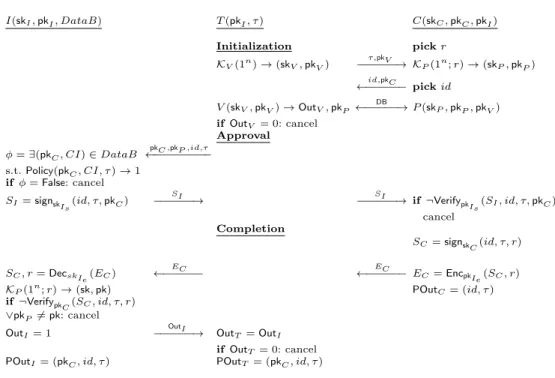
3.1 ClessPay I(skI,pkI, DataB) T(pkI, τ) C(skC,pkC,pkI) Initialization pickr KV(1n)→(skV,pkV) τ,pkV −−−−−−→ KP(1n;r)→(skP,pkP) id,pkC ←−−−−−− pickid V(skV,pkV)→OutV,pkP DB ←−−−−−→P(skP,pkP,pkV) if OutV = 0: cancel Approval φ=∃(pkC, CI)∈DataB ←−−−−−−−−−pkC ,pkP ,id,τ s.t.Policy(pkC, CI, τ)→1 if φ=False: cancel SI=signskIs(id, τ,pkC) SI −−−−−−→ −−−−−−→SI if¬Verifypk Is(SI, id, τ,pkC) : cancel Completion SC=signskC(id, τ, r) SC, r=DecskIe(EC) EC ←−−−−−− ←−−−−−−EC EC=EncpkIe(SC, r) KP(1n;r)→(sk,pk) POutC= (id, τ) if ¬Verifypk C(SC, id, τ, r) ∨pkP6=pk: cancel OutI= 1 OutI −−−−−−→ OutT =OutI if OutT= 0: cancel
POutI= (pkC, id, τ) POutT = (pkC, id, τ)
Fig. 1.The ClessPay Protocol.
The protocol ClessPay (See Figure 1) starts after the terminalT creates a transactionτ and connects with a cardC. We do not give the details ofτ since it depends on the payment system.
In our protocol, we use signature schemes and an encryption scheme. There-fore, some secret/public key pairs are generated by using their key generation algorithms. More specifically, the key generation algorithm GI generates a se-cret/public key pair (skI,pkI) = ((skIs,skIe),(pkIs,pkIe)) where (skIs,pkIs) is
generated by the key generation algorithm of the signature scheme used by issuers and (skIe,pkIe) is generated by the key generation algorithm of the
pair (skC,pkC) using the key generation algorithm of the signature scheme used by cards. ClessPay consists of the following phases:
Initialization Phase:This phase is executed byT andC. If this phase cannot be completed successfully, thenT cancels the transaction.
TandCgenerate ephemeral secret/public key pairs for the distance bounding protocolDB= (KP,KV, V, P, B). So,C first picks the random coinsrand runs the deterministic algorithmKP(1n;r) to generate (sk
P,pkP). Here, whatCdoes
is equivalent to runningKP(1n).C needs to generate the random coins used in KP(1n) because they will be needed in the last phase as a one-time proof for
having generatedpkP. Then,TrunsKV(1n) to obtain (skV,pkV) used for DB.T
sendsτ andpkV toC. After receiving them,C picks an identifieridand replies withidandpkC to introduce itself.
T and C start the distance bounding protocol so that T determines the distance of C. Therefore,T runs the verifier algorithmV(skV,pkV) of DB and C runs the prover algorithm P(skP,pkP,pkV) of DB. At the end, V outputs
OutV which shows if C is close or not and private output POutP = pkP. If
OutV = 0, then T cancels the transaction. Otherwise, they continue with the
next phase. Remark that, T still does not know if the card whose distance is determined is an authorized card becauseChas not authenticated itself with its (static) public keypkC yet.
Approval Phase: This phase aims to check with the issuer whether the card can execute the transaction. T first sends pkC,pkP, id, τ to I. I checks if the card withpkC is inDataB. If it is inDataB, it retrieves the card information of
the card (CI) and runs the algorithmPolicy(pkC, CI, τ) which outputs 1 if the card has the privilege to executeτ2. If this algorithm returns 0, the transaction
is canceled. Otherwise,I approves the transaction.
If it is approved,I signs withskIs the message (id, τ,pkC). This signature is
necessary for cards to be sure that they are approved for the payment. Then, it sends this signature SI to T and T relays it to C. C runs the verification
algorithm of the signature scheme Verifypk
Is(SI, id, τ,pkC) to be sure that C
and I have the same id, τ,pkC. If C verifies SI, then the next phase begins.
Otherwise,C cancels.
Completion Phase: In this phase, the execution of the transactionτ withid
is completed by I, T and C. First, C signs the message id, τ, r with skC as a
proof of execution of the payment. The reason of signing r is showing that C
took part in the DB protocol. Then, it encrypts the signatureSC andrby using
the key pkI
e. The reason of the encryption is to hide r. At the end, C sends
the encryption (EC) to T. T relays it to I. At this point, the transaction is
completed forC and it privately outputs (id, τ).
In order to obtainSC and r, I first decrypts EC with skIe. I verifies that
r generates pkP by running KP(1n;r). If it is verified, it also verifies SC with
Verifypk
C(SC, id, τ, r). If the signature is valid, then it sendsOutI = 1 toT and
privately outputs (pkC, id, τ). Otherwise,I cancels the transaction.
2 ThePolicy checks the execution right of a card depending on the bank policy. So, we do not discuss about how this verification happens.
Cancel the transaction: As it can be seen in the protocol, the cancellation can be done by I, T or C. In the case of timeout, parties cancel as well. When I
cancels, it sets OutI = 0 and sendsOutI to T. Then,T cancels as well. When T cancels, it sets OutT = 0 and terminates. WhenC cancels, it sends a cancel
message toT and terminates withPOutC =⊥.
3.2 Security
Theorem 1. Assuming that DB = (KP,KV, V, P, B)is DF secure (Definition 7), DH-secure (Definition 8) and MiM-secure (Definition 6), the encryption scheme is IND-CCA secure and the signature scheme used by cards is secure against the existential forgery under no message attacks (EF-0MA), ClessPay is secure against malicious cards (Definition 3).
Proof. We define a sequence of gamesΓi where we denotepias a success
proba-bility of winningΓi. We assume that we have honest cards {C1, C2, ..., Ck} and
their public keys are in a set{pkCi}.
Γ0: The instances of the issuer, terminals and cards play the game in
Def-inition 3. There is a distinguished terminal instanceT which privately outputs POutT = (pk00C, idT, τT) and in which the V protocol outputs POutV = pk0P,
and a distinguished issuerI which communicates withT and privately outputs POutI = (pk0C, idI, τI). In Γ0, the adversary cannot win withthe first
condi-tionin Definition 3 becauseIalways cancels the transaction if (pk0C, .)∈/ DataB.
Γ1 : It is the same game as Γ0 except that (pk0C, idI, τI) is always equal
(pk00C, idT, τT). Because of our secure and authenticated channel assumption
be-tweenT andI and because of the honesty ofT, they have the same public-key, identifier and the transaction. Besides,T outputs 1, ifIoutputs 1. So,p1=p0.
InΓ1, the adversary cannot win withthe fourth conditionin Definition 3.
Γ2: It is the same game as inΓ1except that instances of honest cards do not
sign and they encrypt a random message. Basically, each stores the ciphertext together with the identifier, transaction and static/ephemeral public keys to a table.I does not decrypt such random ciphertexts and retrieves their data from the table. More specifically, we simulate them as follows:
C(skC,pkC,pkI)
... (unchanged untilsign)
pickR
EC=EncpkIe(R)
store(EC, id, τ,pkC,pkP)inTableE
sendEC
POutC= (id, τ)
I(skI,pkI, DataB)
... (unchanged until the reception ofEC)
if(EC, id, τ,pkC, .)∈TableE:
retrievepks.t.(EC, id, τ,pkC,pk)∈TableE
ifpk6=pkP: cancel
OutI= 1,POutI= (pkC, id, τ)
else:the same as after receivingEC
We can easily showΓ1 andΓ2 are indistinguishable by using the IND-CCA
security of the encryption scheme. So, |p2−p1| is negligible. Remark that the
random coins of the honest cards are not used inΓ2.
Γ3: It is the same game asΓ2 except thatOutV = 0 after the execution of V(skV,pkV) if one of the situations happens:
1. no party is close toT,
2. pk0P is generated by no honest card and there is no adversary close toT,
Γ3 and Γ2 are indistinguishable because the probability that OutV = 1 if
one of the situations above happens is negligible. OutV = 1 when the 1st
sit-uation happens with negligible probability due to the the DF-security of DB. OutV = 1 when the 2ndsituation happens with negligible probability due to the
DH-security of DB. OutV = 1 when the 3rd situation happens with negligible
probability due to the MiM-security ofDB. Note that we can simulate an honest card instance inΓ3by using a prover instance in the MiM-game becauseris not
used by honest card instances. Therefore,|p3−p2|is negligible.
Γ4: It is the same game as inΓ3except thatI cancels after decrypting and
obtaining the random coins r where KP(1n;r) →(sk
P,pkP) and (skP,pkP) is
generated by an honest card instance.
I(skI,pkI, DataB)
... (unchanged until the reception ofEC)
if(EC, id, τ,pkC, .)∈TableE:retrievepks.t.(EC, id, τ,pkC,pk)∈TableE
ifpk6=pkP: cancel
OutI= 1,POutI= (pkC, idT, τT)
else:SC, r=DecskI(EC),KP(1n;r)→(sk,pk)
if(sk,pk) is generated by an honest instance: cancel else if¬Verify(SC, id, τ, r)∨pkP6=pk: cancel
OutI= 1,POutI= (pkC, id, τ)
We can easily prove that if there exists an adversary withpkCinΓ3which
ob-tains a randomnessrgenerating the secret/public key pair used by an honest in-stance, then we can construct another adversary which breaks the MiM-security ofDB. Clearly, during the simulation ofΓ3, ifIgetsr, then it generates the
cor-responding secret key of the prover in MiM-game and breaks the MiM-security. Since receiving such rinΓ4 is negligible,|p4−p3|is negligible.
Now, we show that the adversary cannot win withthe third conditionin
Γ4. If the adversary wins with this inΓ4, it means that pk0C ∈ {/ pkCi} and no
instance of the adversary is close toT during the execution of the CP protocol with T and I. Due to the condition 2 in the reduction of Γ3, pkP must be
generated by an honest card (otherwise, T cancels) . However, in Γ4, it is not
possible to haveOutI = 1 whilepkC∈ {/ pkCi}andpkP is generated by an honest
card instance (check the dashed underlined parts in the simulation of I). So, it is not possible thatOutI = 1, if the game is in the third condition.
Since only condition 2 and 5 of Definition 3 remain to win in Γ3, we can
assume thatpkC∈ {pkCi}.
Γ5 : It is the same game as Γ4 except we simulate Verify algorithm with
Verify0 such that it only accepts the signature of malicious cards. It does not accept the signatures of honest cards’ instances.
The only difference inVerifyandVerify0is in the case ofpkC∈ {pkCi}. In this case, while Verifyreturns the output of the verification of the signature,Verify0 returns 0. InΓ5andΓ4, no honest cards’ instances generate a signature. So, the
only difference between Γ4 and Γ5 happens when I obtains a forged signature
of an honest card instance.
Thanks to EF-0MA security of the signature, we can easily show that forging a signature of any honest cards happens with a negligible probability to prove that Γ5andΓ4are indistinguishable.
Remark that inΓ5,I haveOutI = 1, if and only if (EC, idT, τT,pk0C,pk 0 P) is
in TableE. So, we can assume that (EC, idT, τT,pk0C,pk0P)∈TableE.
If the adversary wins with the condition 2 inΓ5, thenpk0C∈ {pkCi}and the
distance between anyCholdingpk0C andT is more thanBduring the execution
of the protocol withidT. Due to condition 3 inΓ3,pk0P must not been generated
byC. So, (EC, idT, τT,pk0C,pk 0
P, .) cannot be in TableEwhich contradicts with
our assumption. Hence, the adversary cannot win withthe secondcondition. If the adversary wins with the fifth condition, then it means that pk0C ∈ {pkC
i}and there exists no card withpk
0
C which privately outputsidI, τI. Then,
it means that (EC, idT, τT,pk0C,pk 0
P, .) ∈/ TableE since no honest card instance
has (idT, τT). This contradicts with our assumption. Therefore, the adversary
cannot win withthe fifth condition. Remark that inΓ5, the adversary cannot
win the game So,p5is negligible meaning thatp0 is negligible. ut
Theorem 2. Assuming that the signature schemes used are existential forgery chosen message attack (EF-CMA) secure then ClessPay is almost-secure
against malicious terminal (Definition 4).
Proof. We recall that in almost-security, we do not need to consider condition 1cof Definition 4 .
Γ0: The instances of the issuer, terminals and cards play the game in
Defi-nition 4. We have a distinguished issuer instanceI which outputs (pk0C, idI, τI). Remark that in Γ0, the adversary cannot winwith condition 1a ((pk0C, .) ∈/ DataB) becauseI rejects the cards which are not inDataB.
Γ1: It is the same game asΓ2 except that no idselected by an honest card
instance repeats. Clearly,|p1−p0|is negligible.
Γ2 : It is the same game asΓ1 except that we simulateI and its instances
while generating the signature and honest cards’ instances in the verification of this signature as follows:
I(skI,pkI, DataB)
SI=signskIs(id, τ,pkC)
store(SI, id, τ,pkC)inTable1
sendSI Verify0pkIs(S, id, τ,pkC) if(S, id, τ,pkC)inTable1 return1 else: return0 |p2−p1| is negligible.
The output of issuer instance is the same as issuer instances inΓ1. Therefore,
we have a perfect simulation for it. The only difference happens when honest cards’ instances inΓ1receive a valid signature verified bypkIs and not inTable1.
In this case, honest cards in Γ1 verify the signature but they do not in Γ2.
Otherwise, the simulations of them are perfect. We can easily show that the probability of generating a valid signature which is not in theTable1is negligible inΓ2thanks to EF-CMA security of the signature scheme. We can use the public
key received from the signing game as a public key of the issuer and simulate signatures of issuer instances by using the signing game. Note that skIs is not
used in the simulation but the signature generation, so we can simulate the rest of the protocol perfectly. Therefore,|p2−p1|is negligible.
The adversary cannot win the gamewith condition 2in Definition 4. As-sume that the adversary wins with this. It implies that (., idC, τC,pkC)∈/Table1
Γ3 : It is the same game as Γ2 except we simulate honest cards’ instances
while generating the signature andI in the verification of it as follows:
C(skC,pkC, DataB)
SC=signskC(id, τ, r)
store(SC,pkC, id, τ, r)inTable2
EC=EncpkIe(SC, r) sendEC Verify00pk C(S, idI, τI,pkC, r) if(S,pkC, id, τ, r)inTable2 return1 else: return0
The only difference is the output ofVerify00andVerifywhen a forged signature received. To show the indistinguishability ofΓ2andΓ3, we can EF-CMA security
of the signature scheme. So,|p3−p2|is negligible.
Remark that in this game, the adversary cannot win withthe condition 1b. IfIoutputs (pk0C, idI, τI), it means that an honest card instance withpk0Cadded (S,pk0C, idI, τI, .) in Table2 and outputted (idI, τI). Hence, inΓ3, the adversary
cannot win. So,p0 is negligible. ut
We recommend using Eff-pkDB [20] as a public-key DB in ClessPay since it is shown that it is the most efficient public-key DB protocol having the necessary security requirements for ClessPay. It requires one exponentiation and hashing. The assumption on the signature scheme used by cards differ in Theorem 1 (EF-0MA) and Theorem 2 (EF-CMA). Hence, it looks like to have security against both terminals and cards we need DF, DH, MiM-secure DB protocol, IND-CCA secure encryption scheme, and EF-CMA secure signature schemes. However, we could have the almost security against malicious terminal if we have the following assumptions in Theorem 2: the encryption scheme is IND-CCA secure and the signature scheme used by cards is EF-0MA secure. In this case, the proof of Theorem 2 would need the same gamesΓ2andΓ5in the proof
of Theorem 1 instead of Γ3 in the proof of Theorem 2. So, actually, to have
full security in ClessPay, we need DF, DH, MiM-secure DB protocol, IND-CCA secure encryption scheme, EF-CMA secure signature for issuers, and EF-0MA secure signature for cards.
4
EMV Analysis
EMV key setting is different than our contactless payment key setting because it has a symmetric key shared between the card and its issuer as well as asymmetric keys. An issuerIhas secret/public key pairSI/PI. It also has a master symmetric keyM KAC. A cardC sharesM KAC with its issuer I. It has public/secret key pair PIC and SIC. PIC is signed by I’s private key SI. C stores certified PI. We assume that the terminalT knows the public key of the certificate authority (CA) to verifyPI and soPIC. We also assume that the channel betweenI and
T is authenticated.
For the sake of simplicity, in our description, we assume that C knows all terminal related information and the authentication method.T also knows the card related information.
EMV contactless session consists of four phases without card holder (user) verification method:
Transaction Initialization: T sends the transaction τ to C. Then, C responds with its public keyPIC and card information such asP AN and expiration date (ED). IfT verifiesPIC, it continues.
Relay Resistance Protocol [3]: This protocol is executed if C and T support it. Here, we assume that they support this feature. T picks a random number
R1 and sends this to C.C responses with another random numberR2. It also
sends timing estimates (timings): Min and Max Time For Processing, Device Estimated Transmission Time. Then, T checks if the total time passed after sending R1 exceeds the limit (let’s call itB). If the total time does not exceed
B, then the next phase begins. Otherwise, the transaction is canceled.
Data Authentication: There are three type of authentication methods in EMV: Static Data Authentication (SDA), Dynamic Data Authentication (DDA) and Combined Data Authentication (CDA). Because of some weaknesses in SDA and DDA (replay attacks and wedge attacks), we consider CDA which is combined with the next phase.
Transaction: T sends a random numberU NT to request a cryptogram genera-tion from C. In EMV, three type of cryptograms exist: Transaction Certificate (TC), Authorization Request Cryptogram (ARQC), Application Authentication Cryptogram (AAC). Here, we consider the online verification whereT requests ARQC. TC is used for the offline verification by the issuer and AAC is used to cancel the transaction.
Online Verification:C increases its counter ATC and generates a secret key
SKAC by using ATC and M KAC. Then, it generates the cryptogram ARQC:
a MAC of U NT, AT C, τ with using SKAC. C sends the cryptogram AC to T
and T relays it to I with the card information.I verifiesARQC and possibly validate the information ofC. IfARQC passes verification and card is validated for the transaction, thenARC= 1 andIgenerates a MAC ofARQC andARC
with the secret keySKAC. This MAC is called as ARP C.I sendsARP C with the message to T and T relays it to C if ARC = 1. Otherwise, it cancels. C
verifies ARP C. If the verification and ARC is 1 then C generates the second cryptogram T C. T C is a MAC of CDOL2’s objects with SKAC (See [4], Table 26) to show transaction is complete. Also, it picks a random number U NC and signsU NC, U NT,AT C,T C, timings, R1, R2 withSIC.C At the end,C sends
the signature andT C to T.
Terminal checks if the signature and the data signed are valid. Later, the terminal contacts with the issuer to receive the reimbursement and givesT C as a proof of transaction completion by the card. In this case, the issuer verifies
T C to execute the reimbursement.
EMV in Our Model: The EMV protocol can have the following maps to have the same structure as in Definition 1: (skC,pkC) = ((M KAC, SIC), PIC),
(skI,pkI) = ((M KAC, SI), PI), id = AT C, Policy(pkC, CI, id, τ) = ARC,
OutT = approval/ decline, OutI = Verify(T C, U NT, AT C, τ), POutI =
(PIC, AT C, τ),POutT = (PIC, AT C, τ) andPOutC= (AT C, τ).
Security Against Malicious Terminal in EMV: Clearly, the EMV protocol is not secure according to Definition 4 since the malicious terminal can approve
relay resistance protocol without considering the distance of C. However, it is almost-secure against malicious terminals. We prove this as follows:
Theorem 3. Assuming that MAC is EF-CMA secure and Gen is a pseudo-random permutation, then EMV protocol is almost-secure against malicious ter-minals (Definition 4).
Proof. Γ0: The instances of the issuer, terminals and cards play the game in
Defi-nition 4. We have a distinguished issuer instanceIwhich outputs (PIC, AT C, τI). InΓ0, there exists at most one card instance withPIC seeingAT CasAT C is a
counter and incremented by each new instance. Let’s call this instance asC.
Γ1 : It is the same game asΓ0 except that the honest card instances picks
a random SKAC0 instead of generating it withGen(M K0, AT C) and stores the randomSKAC0 in Table1as (M K0, AT C0, SKAC0 ). If an issuer instance receives card information belongs to an honest card then it retrievesSKAC0 fromTable1. SinceGenis pseudo-random permutation, |p1−p0|is negligible.
Γ2 : It is the same game asΓ1 except that we simulate MAC generation of
honest cards and verification of MACs of honest cards’ instances by the issuer as follows: I(PIC0 , S0IC, PI0, M KAC0 ) AT C0=AT C0+ 1 pickSK0AC store(M K0 AC, AT C 0, SK0 AC) ARQC=MACSK0 AC (U NT, AT C0, τ)
store(SKAC0 , U NT0, AT C0, τ0, ARQC) inTableARQC
rest is the same untilT C/AACgeneration ifARC = 1andVerify(ARP C0, SKAC0 ):
T C=MACSK0 AC(U NT, AT C 0, τ) store(SK0AC, U NT0, AT C0, τ0, T C) inTableT C else: AAC=MACSK0 AC(U NT, AT C 0, τ)
store(SK0AC, U NT0, AT C0, τ0, AAC) inTableAAC
Verify0(AC, SKAC)
if (SKAC, U NT, AT C, τ, AC) ∈
TableAC
return 1
else:return 0
Γ2 is indistinguishable fromΓ1because of the security ofMAC. The similar
reduction in the proof of Theorem 1 from Γ4 to Γ5 can be used to prove the
indistinguishably. So,|p2−p1|is negligible.
Γ3 : It is the same game withΓ2 except that I generatesARP C and then
stores it to TableARP C (similar storing as in Γ2). Then, the honest cards verify
ARP C by checking if it is in the TableARP C. Γ3 is indistinguishable from Γ2
because of the security ofMAC. So,|p3−p2|is negligible.
Clearly, in Γ3, the adversary cannot win with the condition 1b because I
privately outputs (PIC, AT C, τ) if and only if the card withPICoutputsAT C, τ.
In addition, it cannot win with the condition 2 because ifARC6= 1, then no honest card outputsAT C, τ and if an honest card receives a validARP Chaving
ARC = 1, then it means thatARP C is inTableARP C. So,I has (PIC, AT C, τ).
Since the adversary cannot win inΓ3,p0 is negligible. ut
However, there exists another problem in EMV related to ATC which is not considered in our model. It can be explained as follows: ATC is 16-bit number and incremented at the beginning of each session. If ATC reaches the limit which
65535, then the card is not valid anymore because EMV specification does not let rotating the counter due to the security reasons. According to EMV specification [4] if cards are used normally, it will approach the limit (65,535) transaction limit not so fast (60 per day every day for a 3-year card). However, an attacker who does not aim to make a payment but aims to invalidate the card can trigger the card at most 65,535 times. Then, the card cannot be used anymore.
Security Against Malicious Card in EMV: Unfortunately, EMV is not secure against malicious cards. In the followings, we show that an adversary can win with the second, third and fourth condition in Definition 3.
Fake Transaction Attack: This attack comes from the fact that T cannot vali-date T C in the signatureSDAD because it does not haveSKAC. Therefore, a malicious card can generate an invalid T C0 in the last cryptogram generation process and use this cryptogram while generating this signature. Then, the ter-minal will approve the payment because the signature is correct. However,T C0
is not valid. So, whenT contacts withI,I cannot validateT C0. In this case, the
malicious card succeeds to break the security of EMV with breakingthe fourth conditionof Definition 3 becauseI cancels whileT does not.
Distance Fraud Attack: A malicious card can initiate a payment process with
T, while it is not closeT. In this case, it can sendR2 before seeingR1in order
to reply early enough. In this case, T thinks that the card is close. Here, the malicious card succeeds to break the security of EMV with breaking the third conditionof Definition 3. This type of attack is dangerous for an EMV payment because the malicious card can claim later that it does not do the payment by showing that it was in somewhere else.
MiM Attack:The relay resistance protocol in EMV constructed to prevent relay attacks by a MiM-adversary. In this attack scenario, a MiM-adversary relays the messages between the card and the terminal to do the payment without the card’s consent. The relay resistance protocol aims to prevent it by checking the distance of the card. The assumption on its security based on the fact that the adversary cannot relay the messages faster than the speed of light. Therefore, the adversary cannot succeed to pass the relay resistance protocol because it cannot guess R2 before R2 is picked by the card. However, it has been shown
that with guessing attacks [15] the security against relay attacks is breakable for the protocols with single challenge/response bit strings exchanges. In addition, Chothia et al. [14] have already explained this vulnerability.
5
Conclusion
In this paper, we concentrated on formalism of CP system. In this direction, we formally define contactless payment by defining the inputs and outputs of the algorithms of issuers, terminals and cards. Based on this definition, we gave two security definitions against malicious cards and malicious terminals. We also considered relay attacks which are very common attacks in CP.
We also designed a contactless-payment protocol ClessPay in our model. In this protocol, the terminal determines the distance of the card by using a
secure public-key distance bounding protocol to prevent the relay attack and then the rest of the protocol continues with the authentication of the card and the issuer. We proved the security of ClessPay against malicious cards and malicious terminals formally.
Finally, we analyzed current EMV-contactless protocol [5] in our model. We realized that it is not secure against malicious cards because MiM-attack and DF-attack which are based on relay attacks. In addition to this, we formally proved that EMV-contactless protocol is secure against malicious terminals. Our analysis is the first formal cryptographic analysis of EMV-contactless protocol.
If we compare ClessPay and EMVCo in regard to cryptographic computa-tions executed by the cards, we see that EMVCo is slightly more efficient since public-key operations are less in EMVCo. A card in EMVCo has to compute two MAC, verify one MAC and generate one signature. While a card in ClessPay has to compute one public-key encryption, generate one signature and verify one sig-nature. However, to have the highest level of the security, it is the price to pay and with a dedicated hardware on smart cards, this price is not so high. As a future work, assuming that changing completely EMV specification is very hard, we can recommend some adaptations on EMVCo to have full security without not so much change in the basic structure of the protocol.
References
1. Contactless payment market by solution (payment terminal, mobile pay-ment, transaction and data management, security and fraud manage-ment), service (professional, managed), payment mode (mobile hand-sets, smart cards), vertical - global forecast to 2021. Available at https://www.marketsandmarkets.com/Market-Reports/contactless-payments-market-1313.html.
2. EMV acquirer and terminal security guidelines.
3. EMV contactless specifications for payment systems, Book C-2: Kernel 2 specifi-cation.
4. EMV integrated circuit card specifications for payment systems, Book 2: Security and key management.
5. EMVCo: EMV contactless specifications for payment systems, version 2.4 (2014). 6. G. Avoine, X. Bultel, S. Gambs, D. G´erault, P. Lafourcade, C. Onete, and J.-M. Robert. A terrorist-fraud resistant and extractor-free anonymous distance-bounding protocol. InProceedings of the 2017 ACM on Asia Conference on Com-puter and Communications Security, pages 800–814. ACM, 2017.
7. M. Bond, M. O. Choudary, S. J. Murdoch, S. Skorobogatov, and R. Anderson. Be prepared: The emv preplay attack. IEEE Security & Privacy, 13(2):56–64, 2015. 8. M. Bond, O. Choudary, S. J. Murdoch, S. Skorobogatov, and R. Anderson. Chip
and skim: cloning emv cards with the pre-play attack. In Security and Privacy (SP), 2014 IEEE Symposium on, pages 49–64. IEEE, 2014.
9. I. Boureanu, A. Mitrokotsa, and S. Vaudenay. Secure and lightweight distance-bounding. In Lightweight Cryptography for Security and Privacy, LNCS 8162, pages 97–113. Springer, 2013.
10. I. Boureanu and S. Vaudenay. Optimal proximity proofs. InInscrypt, LNCS 8957, pages 170–190. Springer, 2014.
11. S. Brands and D. Chaum. Distance-bounding protocols (extended abstract). In
EUROCRYPT, LNCS 765, pages 344–359. Springer-Verlag, 1993.
12. X. Bultel, S. Gambs, D. G´erault, P. Lafourcade, C. Onete, and J.-M. Robert. A prover-anonymous and terrorist-fraud resistant distance-bounding protocol. In
Proceedings of the 9th ACM Conference on Security & Privacy in Wireless and Mobile Networks, pages 121–133. ACM, 2016.
13. N. Chandran, V. Goyal, R. Moriarty, and R. Ostrovsky. Position based cryptog-raphy. InCRYPTO, volume 9, pages 391–407. Springer, 2009.
14. T. Chothia, F. D. Garcia, J. De Ruiter, J. Van Den Breekel, and M. Thompson. Relay cost bounding for contactless EMV payments. InInternational Conference on Financial Cryptography and Data Security, pages 189–206. Springer, 2015. 15. J. Clulow, G. Hancke, M. Kuhn, and T. Moore. So near and yet so far:
Distance-bounding attacks in wireless networks.Security and Privacy in Ad-hoc and Sensor Networks, pages 83–97, 2006.
16. C. Cremers, K. B. Rasmussen, B. Schmidt, and S. Capkun. Distance hijacking attacks on distance bounding protocols. InSecurity and Privacy (SP), 2012 IEEE Symposium on, pages 113–127. IEEE, 2012.
17. S. Drimer, S. J. Murdoch, et al. Keep your enemies close: Distance bounding against smartcard relay attacks. In USENIX security symposium, volume 312, 2007.
18. A. Francillon, B. Danev, and S. Capkun. Relay attacks on passive keyless entry and start systems in modern cars. InNDSS, 2011.
19. L. Francis, G. Hancke, K. Mayes, and K. Markantonakis. Practical NFC peer-to-peer relay attack using mobile phones. In International Workshop on Radio Frequency Identification: Security and Privacy Issues, LNCS 6370, pages 35–49. Springer, 2010.
20. H. Kılın¸c and S. Vaudenay. Efficient public-key distance bounding protocol. In
ASIACRYPT, 2016.
21. H. Kılın¸c and S. Vaudenay. Contactless access control based on distance bounding. 10599:195–213, 2017.
22. K. Markantonakis, L. Francis, G. Hancke, and K. Mayes. Practical relay attack on contactless transactions by using nfc mobile phones.Radio Frequency Identification System Security: RFIDsec, 12:21, 2012.
23. M. Roland and J. Langer. Cloning credit cards: A combined pre-play and down-grade attack on emv contactless. InWOOT, 2013.
24. S. Vaudenay. On modeling terrorist frauds. In Provable Security, LNCS 8209, pages 1–20. Springer, 2013.
25. S. Vaudenay. On privacy for RFID. In Provable Security, pages 3–20. Springer, 2015.
26. S. Vaudenay. Private and secure public-key distance bounding application to NFC payment. InFinancial Cryptography, LNCS 8975, pages 207–216, 2015.
27. S. Vaudenay. Sound proof of proximity of knowledge. InProvable Security, LNCS 9451, pages 105–126. Springer, 2015.
28. M. Weiß. Performing relay attacks on ISO 14443 contactless smart cards using nfc mobile equipment. Master’s Thesis in Computer Science, University of Munich, 2010.