Texting satisfaction: does age and gender make a difference?
Vimala Balakrishnan
[email protected]
Faculty of Information, Science and Technology Multimedia University
Melaka, 75450, Malaysia.
Paul H. P. Yeow
[email protected]
Faculty of Business and Law Multimedia University Melaka, 75450, Malaysia.
Abstract
This study investigated the effect of age and gender on mobile phone users’
texting satisfaction, focusing on text entry factors. Structured questionnaire
interviews were used to interview 18 subjects of both genders, aged between
17–37 years. Analysis of variance was computed. Gender effect was found on
the speed of text entry method (p = 0.027), with the females being more satisfied
than males. Age has a significant effect on navigation (p = 0.026) and learnability
(p < 0.001), with the younger groups being more satisfied than the older groups.
A significant interaction was found between age and gender for learnability (p =
0.039), with a clear difference between genders in the twenties and thirties.
Results suggest that age and gender affect users’ texting satisfaction, with
varying text entry factors. Results obtained can be used to improve text entry
methods by (i) catering to local dialects (ii) reducing key overloading or
introducing a better method for text entry. It is concluded that texting satisfaction
awaits improvements to the text entry methods.
Keywords: Age; Gender; Texting satisfaction; Text entry factors; Structured questionnaire interview
1 INTRODUCTION
Texting on mobile phones refers to the activity of composing short character based messages and exchanging it between mobile phone subscribers. Text messages or popularly known as SMS (Short Message Service) is an offshoot of the mobile phone which has evolved to service a number of unanticipated different uses (Lewis 2005). Teenagers originally started the textual use of the mobile as a form of cheap and accessible social communication. Today texting is a world wide phenomenon that has now well and truly spread beyond teenagers. Mobile Data Association (MDA) reported that over 3 billion text messages were sent in the UK during January 2006. This represents a 25% increase over the same period in 2005, where over 100 million SMS are now being sent per day (Upside Wireless Text Messaging 2006).
One of the major benefits of texting on a mobile phone is that it is cheaper than a mobile call, which appeals to people with limited incomes and to those who do not have access to the Internet for electronic communication. Text messages are being sent for various reasons all over the world. Some interesting ones are: a Malaysian man who divorced his wife by text (Kent 2003), a
Singaporean man being fired by text (Soh 2001) and an African shepherd alerting another shepherd regarding other high quality grazing areas (Gwin 2005).
Due to its overwhelming popularity, SMS and mobile phones have always been a subject of study among many researchers. One area that has been focus of many studies is the text entry method. Mobile phones were initially designed for the sole purpose of making and receiving calls. Today, it is overloaded with many utilities such as, games, browsing and chatting. Text input and the mobile phones are not a very good pairing. The standard keypad on mobile phones consists
between 12–15 keys that can be used for text entry (capitalization, symbols, numbers and
punctuations) with two to four keys for navigation purpose (arrow keys). This design obviously
creates problem when a text needs to be entered in English, a language that involves 26 letters, punctuations and an intricate grammatical structure.
Typically text is entered on a mobile phone in one of two ways: multitap or predictive text entry.
As the name implies, in a multitap system the user needs to make multiple key presses to make a
letter selection. For example, the key ‘2’ is loaded with the letters ‘A’, ‘B’ and ‘C’, thus if a user
wants to enter a ‘C’, then he or she has to press the key three times (2–2–2) as ‘C’ is the third
letter placed on the key. Things become more complicated when the intended letters are placed
on the same key. For example, to text ‘cab’ the key presses will be 222–2–22. Segmentation
takes place to determine the correct letter. Most of the mobile phones employ a time-out process,
in which the user is required to wait for a specified time (typically one – two seconds) before
attempting to enter the next letter; hence multitap is often criticized for being slow.
On the other hand, the predictive text entry method uses linguistic knowledge to predict the intended words of the user. Most mobile phones have licensed the T9 input method which uses a dictionary as the basis for disambiguation. Each key is pressed only once. For example, the user
enters 8–4–3–0 to key in ‘the’ whereby the 0-key delimits words and terminates disambiguation of
the preceding keys (Silfverberg et al. 2000). However, this process of disambiguation must
sometimes automatically choose between more than one words produced by the same set of key
presses, or present the user with a series of word choices. For example, the combination of 3–6–
4 (‘def’–‘mno’–‘ghi’) might mean dog or fog. If the algorithm suggests a wrong word, the user has
to manually cycle through the possible options by pressing a next key. Predictive text entry was
found to expedite messaging, only when one really knows how to use it. An experiment using a mobile phone (James and Reischel 2001) found that experts and novices reached about 8 words
per minute (wpm) with multitap. In comparison, predictive text entry was used by novices at 9.1
wpm and experts at 20.4 wpm. However, all these results were based on English-based text only.
User input is a crucial issue concerning mobile devices, thus a lot of studies have been conducted on the efficiency of text entry methods and ways to improve them. Some researchers
have done comparison studies based on the text entry methods (Silfverberg et al. 2000,
Buchanan et al. 2001, James and Reischel 2001, Cockburn and Siresena 2003, Wigdor and
Balakrishnan 2004) whereas others have tried to introduce new techniques to enter text via mobile phone’s limited interface (Mackenzie 2002, Wigdor and Balakrishnan 2003, Gong and
Tarasewich 2005). Mackenzie et al. (1999) explored the text entry rates for several variations of
soft keyboards. Studies have also been conducted to enhance the existing predictive text entry
methods (Maragoudakis et al. 2002). Though numerous studies have been conducted related to
text entry methods, but to the best of our knowledge, none focused on users’ texting satisfaction based on age and gender.
People of different age communicate differently as they grew up with different genres of technologies. A number of studies of technology usage and age have found that usage diminishes with age, and sometimes this is linked with attitudes towards specific technologies like the Internet (Pew-Internet 2001, US Department of Commerce 2002). The Department of Commerce study found that computer and Internet use is highest among children and teenagers,
while people over 50 years old are less likely to use computers. The e-Living project (Ling et al.
2002) investigated technology uptake across age and found that Internet usage, mobile ownership and household Internet connections rapidly decreased for users over 50 years old,
whilst being high for younger adults. A study examining the text entry on handheld computers by older workers found that younger people were faster but less accurate than older people at using
a touch-screen keyboard (Wright et al. 2000). Age factor was studied in many other studies as
well, e.g. Bunce and Sisa (2002) investigated age differences in the perceived workload associated with the performance of a demanding, high event rate, vigilance task. Lightner (2003)
studied the impact of age, income and education in e-commerce designs and found that sensory
impact of e-commerce sites became less important as respondents increase in age.
Gender has also been used as an important moderating variable in many studies. These include the influence of gender on grip strength and endurance (Nicolay and Walker 2005), the effects of
chronic low back pain, age and gender on vertical spinal creep (Kanlayanaphotporn et al. 2003),
psychology of SMS messaging between male and female users (Reid and Reid 2004), maturation and gender identity of the adoption of mobile phones by teenagers in Norway (Ling 2001) and the
moderating effect of gender in explaining the intention to use mobile chat services (Nysveen et al.
2005). From a marketing perspective, findings suggest that females and males process advertisements differently and respond differently to marketing communication efforts (Wolin 2003). Gender differences were also noted in studies of technology use. For example, Gefen and
Straub (1997) reveal that women and men differ in their perception of e-mail, while Venkatesh
and Morris (2000) find gender differences in the motives for using a new software system at a workplace.
Identifying age and gender effect is important to improve technology product designs, so as to increase users’ subjective satisfaction. Thus, the aim of this study is to investigate if gender and age influence mobile phone users’ texting satisfaction with respect to the text entry factors.
2 RESEARCH FRAMEWORK
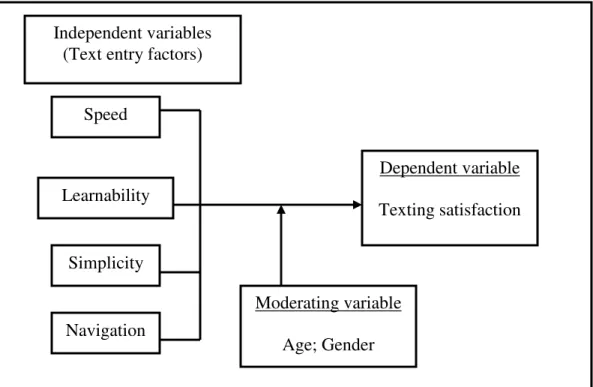
In this study, texting satisfaction was identified as the dependent variable and text entry factors such as speed, learnability, simplicity and navigation are the independent variables. All these
factors were identified from literature reviews (Silfverberg et al. 2000, Buchanan et al. 2001,
James and Reischel 2001, Wigdor and Balakrishnan, 2004,Soriano et al. 2005). Age and gender
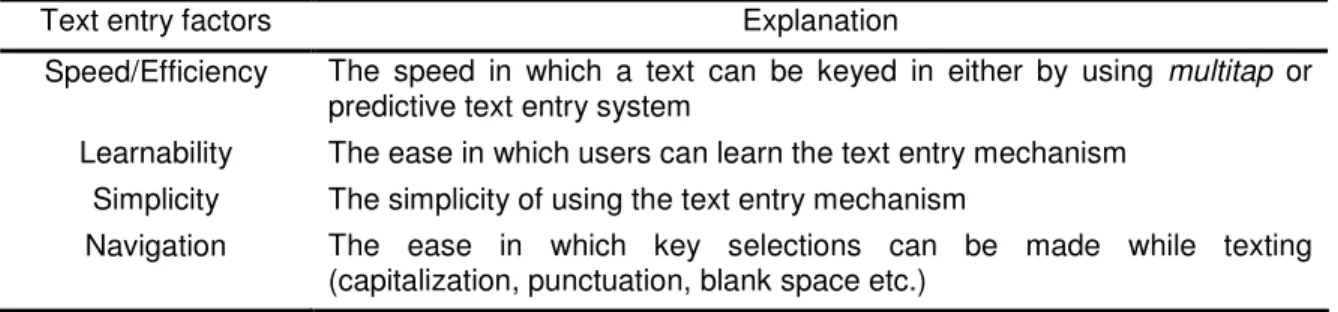
are the moderating variables. Table 1 shows the description for each of the text entry factors and Figure 1 shows the research framework used in this study.
Table 1- Text entry factors
Text entry factors Explanation
Speed/Efficiency The speed in which a text can be keyed in either by using multitap or
predictive text entry system
Learnability The ease in which users can learn the text entry mechanism
Simplicity The simplicity of using the text entry mechanism
Navigation The ease in which key selections can be made while texting
Figure 1-Research framework.
3 METHODS
3.1 Subjects
A total of 18 subjects were interviewed, consisting of nine males and nine females, aged between 17 – 37 years old (mean = 24.3 years, SD = 5.8). All subjects were recruited from Multimedia University (Malaysia), comprising of students and staff. Only a small number of interviews were
conducted to obtain in-depth qualitative data. By way of comparison, in a study of teens’ text
messaging behaviour by Grinter and Eldridge (2001), five males and five females were interviewed. Similarly, in another study of people’s monitor usage, only 18 participants were interviewed (Grudin 2001). The subjects were then grouped into three age categories, i.e. teens, twenties and thirties. This resulted in six subjects in each group with three males and three females. All the subjects have used SMS before, with an average of 3.7 years of experience and
SD = 1.18. Almost 61.1% (11) of the subjects use multitap technique for text entry, 22.2% (4) use
predictive text entry and only three teens use predictive text entry and multitap technique
interchangeably. All 18 subjects use Nokia mobile phones of different models but with a similar keypad layout (Nokia 8250, 3120 and 6610), except for Nokia Communicator 9210™ that was used by one male subject. This particular model displays a smaller version of the QWERTY style keypads that allow for text entry with techniques similar to typing on a regular keyboard.
Speed
Learnability
Simplicity
Navigation
Dependent variable
Texting satisfaction
Independent variables
(Text entry factors)
Moderating variable
Age; Gender
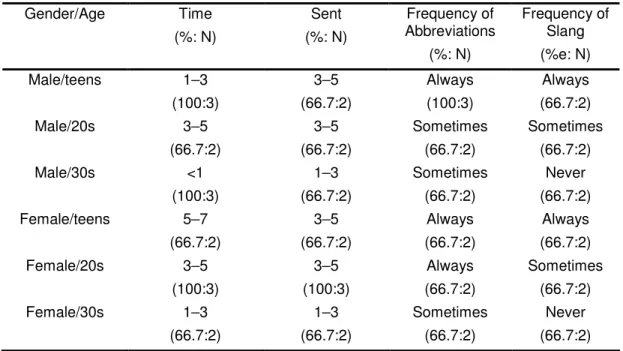
Table 2-Summary statistics for the majority number of users for each gender/age categories
Time: time spent to SMS in a day (minutes); Sent: number of SMS sent in a day; N: number of subjects; Total number of subjects for each category is 3
Table 2 shows some of the summary statistics for the average time spent in messaging in a day, average number of SMS sent in a day, frequency of using abbreviations and slang (local dialect
such as ‘eh’ and ‘lah’) based on gender and age.
Females spend more time texting in a day than males, hence sending more messages in a day. Moreover, texting activities also decline as the participants’ age increases. Females use more abbreviations than males. It can also be noted that the younger the subject, the higher the frequency of using abbreviations and slang in messages.
3.2 Materials
An interview questionnaire was designed based on Sinclair’s (1995) guidelines. The questionnaire was developed in English and had two major sections: Section A to obtain the demographic profile of the subjects (gender, age and experience in using SMS) whereas Section B is for the subjects to rate their satisfaction/dissatisfaction levels to statements using Likert’s
five-point scale, whereby 1 means ‘Strongly dissatisfied’, 2 means ‘Dissatisfied’, 3 means
‘Neutral’, 4 means ‘Satisfied’ and 5 means ‘Strongly Satisfied’.
3.3 Interviews
Face-to-face interviews were conducted with each of the subject. Each interview session lasted
for about 15–20 minutes. Subjects were encouraged to discuss problems, voice out opinions,
suggestions and recommendations. All verbal comments were recorded. All interviews took place in Multimedia University involving undergraduate students and working professionals. Only one interviewer was involved in this exercise and all 18 interviews were completed within two days.
4 RESULTS AND DISCUSSION
The data collected were analysed using Statistical Package for the Social Sciences (SPSS)
software. Analysis of variance (ANOVA) and Tukey Post-Hoc analysis were used to analyse the
significant differences (if any) between gender and age groups, with respect to text entry factors
effect on texting satisfaction. All results are considered significant at p < 0.05 level.
Gender/Age Time (%: N) Sent (%: N) Frequency of Abbreviations (%: N) Frequency of Slang (%e: N) Male/teens 1–3 (100:3) 3–5 (66.7:2) Always (100:3) Always (66.7:2) Male/20s 3–5 (66.7:2) 3–5 (66.7:2) Sometimes (66.7:2) Sometimes (66.7:2) Male/30s <1 (100:3) 1–3 (66.7:2) Sometimes (66.7:2) Never (66.7:2) Female/teens 5–7 (66.7:2) 3–5 (66.7:2) Always (66.7:2) Always (66.7:2) Female/20s 3–5 (100:3) 3–5 (100:3) Always (66.7:2) Sometimes (66.7:2) Female/30s 1–3 (66.7:2) 1–3 (66.7:2) Sometimes (66.7:2) Never (66.7:2)
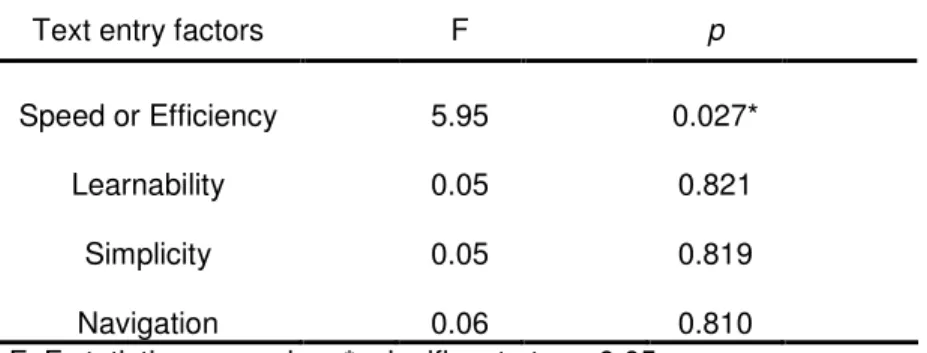
Table 3-ANOVA test for text entry factors satisfaction, based on gender
Text entry factors F p
Speed or Efficiency 5.95 0.027*
Learnability 0.05 0.821
Simplicity 0.05 0.819
Navigation 0.06 0.810
F: F statistic; p: p-value; *: significant at p < 0.05
Table 3 shows that there is a significant effect of gender with respect to users’ satisfaction towards speed or efficiency of text entry mechanism. The females were found to be more satisfied (mean = 4.2) than males (mean = 3.3). About 44.4% (4/9) of the males reported that texting using the current text entry methods can be tedious and time consuming, especially when they are on the move or when they couldn’t pay full attention to the screen and keypads while texting (crowded place, looking elsewhere etc.). Both the text entry mechanisms require a significant amount of visual searching to find a needed letter or word. This results in them not to adopt using SMS at times as making a call would be much faster and less cumbersome. Slow text entry mechanism which includes the multiple key presses involved in accessing characters
has also been cited as one of the usability issues of mobile phones by Axup et al. (2005).
Moreover, two males who use multitap and predictive text entry system interchangeably agreed
that texting using the latter system is faster. However, having to cycle through to select the correct word can be frustrating, especially when texting needs to be done in a hurry. When this
situation arises, multitap would be the preferred method. Interestingly, females being more
satisfied than males could also be contributed to the fact that females generally have smaller fingers, thus they are able to make multiple key presses on the keypads with lesser error and faster. Another possible reason could be that females spend more time in texting and send more messages in a day than males (see table 2). This statistic is also consistent with some other studies (Ling 2003, Reid and Reid 2003, Faulkner and Culwin 2005). Heavy texting among the females might have made them an expert in keying in the text.
Table 4-ANOVA test for text entry factors satisfaction, based on age
Text entry factors F p
Speed or Efficiency 2.50 0.116
Learnability 28.81 0.000*
Simplicity 2.67 0.102
Navigation 4.67 0.026*
F: F statistic; p: p-value; *: significant at p < 0.05
In table 4, age was found to have significant effect with users’ satisfaction towards learnability and navigation. Tukey Post-Hoc analysis revealed that teenagers are more satisfied with
learnability (p < 0.001) and navigation (p = 0.003) compared to users in their thirties. Moreover,
users in their twenties are also more satisfied with the navigation than those in their thirties (p =
0.023). Younger users have the capability and the interest in learning new techniques fast compared to their older counterparts. Moreover, they are keener in adapting to new environment or changes as well. This could be the reason for their satisfaction towards learnability compared
using SMS only seven months after purchasing my mobile phone, I found it to be complicated and cumbersome…and my SMS coach was my 12-year old nephew!!”. This comment hints at a fact that it is the younger generation that has taken the lead in SMS messaging. This notion is also supported by findings from other studies (Ling 2003, Reid and Reid 2003, Faulkner and
Culwin 2005). The male participant who uses Nokia Communicator™ commented “I love
messaging using my Communicator as it is the fastest way to send romantic text to my girl-friend”. However, upon further discussion, he also mentioned that he only uses the QWERTY keyboard instead of the standard 12-key keypad to text as it is much faster and easier. Learnability is not an issue here but unfortunately the majority of mobile phone users carry standard 12-key mobiles.
Apart from facing the difficulty in learning text entry methods, mobile phone users need to know the language and syntax of SMS communication. Using text relies on the creative use of language in order to maximize the 160 characters that are allowed per message. Once the maximum characters are reached, then the sender is charged for a second message. This is the main reason why text message users truncate and alter conventionally written language. For
example, it is very common to type ‘hru?’ instead of ‘How are you?’ or ‘c u l8r’ instead of ‘See you
later’. One must be able to decipher the meaning of all the abbreviations used to understand the content of a message. Younger users who text frequently feels very comfortable in using these SMS language, however, this might not be the case for the older users. One male in his early twenties responded that he once felt very embarrassed with himself as he couldn’t understand
what ‘tc’ means; only to find out from a friend later that it simply means ‘take care’. Thus, having
to master the technique of text entry and also being able to communicate successfully using SMS language affects learnability of mobile phone users, especially among the older ones.
The younger users were also found to be more satisfied with the navigation while texting than users in their thirties. Navigation problem occurs due to the nature of the keypads that are overloaded to accommodate all the available letters, numbers and punctuations. It is obvious to know that the letters ‘A’, ‘B’ and ‘C’ are placed on the 2-key, however, symbols and punctuations are not presented clearly. Users have to ‘look’ for these characters by making multiple key presses and not knowing which key to press complicates the procedure. Knowing which key to press might not be a problem among the younger users due to their active messaging, but it will slow down texting process among the older mobile phone users. Moreover, the pattern of messages written further complicates navigation problems among the older generations. Older subjects tend to pay more attention to capitalization, spacing and punctuations than teenagers. This results in them having to access the key that is mapped to these characters frequently. Mapping of the appropriate navigational keys to the desired object was also found to be
cumbersome by a study conducted among middle-aged users (Soriano et al. 2005), e.g. locating
the key to access the ‘ABC’ (non-predictive) menu that allows a user to change from different character input types, i.e. from alphabetical to numerical is not a straight-forward and clear process. However, this finding is solely based on Samsung T400 model.
Table 5-ANOVA test for text entry factors satisfaction, based on age x gender
Text entry factors F p
Speed or Efficiency 0.08 0.921
Learnability 4.30 0.039*
Simplicity 0.41 0.671
Navigation 1.59 0.11
F: F statistic; p: p-value; *: significant at p < 0.05
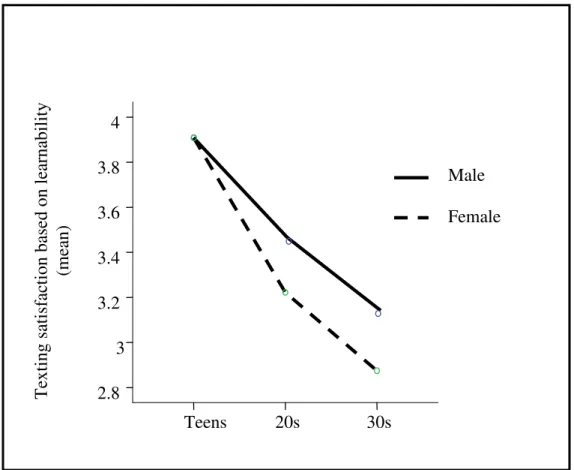
Table 5 shows that the interaction effect of age x gender was found to be significant for
learnability.
Figure 2- Interaction effect of age x gender on learnability
Figure 2 shows a clear difference between the genders in the twenties and thirties categories, with the males being more satisfied than females with respect to learnability. The males have the capability of learning and understanding technical things faster than the females, thus making them to be more satisfied than females. All six females in their twenties and thirties agreed that learning the art of texting was difficult as it seems to be a complex feature. Learning the method to make key presses and knowing the mapping of other characters to the keys were cited as the major obstacles. Females also have the tendency to include more literary flourishes like proper salutations, capitalization and punctuations in their messages. They are also more likely to write longer and complex messages that include emotional elements in their communications
30s
20s
Teens
4
3.8
3.6
3.4
3.2
3
2.8
T
ex
tin
g
sa
tis
fa
ct
io
n
ba
se
d
on
le
ar
na
bi
lit
y
(m
ea
n)
Male
Female
(emoticons to reflect happiness and sadness). In addition, their messages tend to retain more of the traditional conventions associated with other written forms than men (Sattle 1975, Rosenthal 1985). This requires them to make more key presses, and most importantly, they also agree that they tend to forget the correct key to press especially when they are stressed. Men on the contrary writes short text that is simple and straight to the point, often only using a single sentence or a single word (Ling 2003).
It can also be noted that the users’ satisfaction declines as the age increases. The older a person gets, the more difficult it is to learn and adapt to new technological products. A similar finding was reported by Ling (2003) and Faulkner and Culwin (2005). The majority of the subjects in their thirties (4/6) stated that they rather make phone calls instead of texting as texting can be tedious and time consuming at times. Two males in this category responded that they only text when it is really necessary or unavoidable (when in meetings or conference, cinema or when pre-paid credit is low), otherwise they prefer phone calls. Moreover, subjects in their twenties and thirties are working professionals who have a steady income, thus they can afford to make phone calls unlike the teens. Subjects in twenties and thirties also rarely or never use predictive text entry as they
feel that multitap technique is straight-forward, thus faster. Subjects also commented that no
unnecessary interruptions take place while messaging using multitap, unlike having to press the
next key to make word selections in predictive text entry. Learning to use predictive text entry was
found to be more difficult than multitap system. Moreover, one has to practice using it to
understand the mechanism behind it. The older users neither have the time nor the interest to learn this mechanism. The younger generations, teens in this case, have the capability of learning new things faster compared to the older generations, regardless of their gender. This explains as to why the difference is not pronounced between the males and females in their teens. Though they are more satisfied than subjects in their twenties and thirties, they also feel that predictive text entry software should be further enhanced to cater to their needs, such as, to support more SMS languages or interestingly, to support local dialects (Chinese, Malay or Tamil) and even
slang frequently used among the teens like ‘kewl’ (cool), ‘omigod’ (Oh my God), ‘eh’, ‘lah’ (local
slang) and many more. Data in this study (see table 2) also indicate that teens use abbreviations and slang more frequently compared to users in their twenties and thirties. Data obtained by Ling (2003) for Norwegian mobile users also indicate that teens are more inclined to use dialects than older users.
5 CONCLUSION
Structured questionnaire interviews’ results involving 18 subjects comprising of mobile phone users from three age categories (teens, twenties and thirties) were presented. All subjects use Nokia mobile phones, thus the text entry methods and keypad layouts are similar (except for one male participant who uses a Nokia Communicator™). Focus of this study was mainly on text entry factors that could affect mobile phone users’ satisfaction in texting, seen from the perspectives of gender and age variations. Females were found to be more satisfied with the
speed or efficiency of text entry mechanism (multitap or predictive text entry) than males. Older
subjects (twenties and thirties) are less satisfied with the navigation and learnability of the text
entry method than teenagers. Moreover, the interaction between age x gender was found to be
significant for learnability as well, with the differences between genders being clear for those who are in their twenties and thirties. Males were found to be more satisfied with learnability than females in the same categories. This study revealed that gender and age do influence texting satisfaction among mobile phone users. Two factors that were found to significantly affect their satisfaction are learnability and navigation. These factors were prominent among older users and they took a longer period to learn the text entry mechanism as it was found to be complicated, hence resulting in them using SMS on a rare basis only. Subjects who use predictive text entry system indicated that support for abbreviations, slang, emoticons and dialects would increase their texting satisfaction. Mobile phone designers should look into incorporating other possibilities
of text entry mechanism (Mackenzie 2002, Wigdor and Balakrishnan 2004, Gong et al. 2005).
Perhaps customized mobile phones can be designed to cater for specific needs for different targets.
6 REFERENCES
Axup, J., Viller, S. and Bidwell, N., 2005, Usability of a Mobile, Group Communication Prototype
While Rendezvousing. In CTS’05 International Symposium on Collaborative Technologies and
Systems-Special Session on Mobile Collaborative Work (St. Louis).
Buchanan, G., Jones, M., Thimbleby, H., Farrant, S. and Pazzani, M., 2001, Improving Mobile
Internet Usability. In Web 2001 Conference (Hong Kong, ACM Press).
Bunce, D., and Sisa, L, 2002, Age differences in perceived workload across a short vigil.
Ergonomics, 45, pp. 949–960.
Cockburn, A. and Siresena, A., 2003, Evaluating Mobile Text Entry with the Fastap Keypad. In
British Computer Society Conference on Human Computer Interaction, England.
Faulkner, X. and Culwin, F., 2005, When Fingers Do The Talking: A Study of Text Messaging.
Interacting with Computers, 17, pp. 167–185.
Gefen, D. and Straub, D.W., 1997, Gender differences in the perception of e-mail: An extension
to the technology acceptance model. MIS Quarterly, December 1997, pp.389–400.
Gong, J. and Tarasewich, P., 2005, Alphabetically Constrained Keypad Designs for Text Entry on
Mobile Devices. In CHI 2005, PAPERS: Small Devices 1, pp. 211–220.
Gong, J., Haggerty, B. and Tarasewich, P., 2005, An Enhanced Multitap with Predictive
Next-Letter Highlighting. In CHI 2005, Oregon, USA.
Grinter, R. and Eldridge, M., 2001, y do tngrs luv 2 txt msg?. In Seventh European Conference on
Computer Supported Cooperative Work, ECSCW, Bonn, Germany.
Grudin, J., 2001, Partitioning Digital World: focal and peripheral awareness in multiple monitor
use. In Human Factors and Computing Systems, CHI’01, Seattle, USA.
Gwin, P., 2005, Making the Connection: The Jump From Wired to Wireless is Changing Africa, National Geographic (September 2005).
James, C.L. and Reischel, K.M., 2001, Text Input for Mobile Devices: Comparing Model
Prediction to Actual Performance. CHI 2001, 3, pp. 365–371.
Kanlayanaphotporn, K., Trott, P., Williams, M. and Fulton, I., 2003, Effects of chronic low back
pain, age and gender ion vertical spinal creep. Ergonomics, 46, pp. 561–573.
Kent,J., 2003, Malaysia Reviews Texting Divorce. Available online
at:www.news.bbc.co.uk/2/hi/asia-pacific/3112151.htm (accessed August 2006).
Lewis, A., 2005, Hve I told U l8tly that I luv u?:Mobile phones: The New Domesticated Artefact.
Australian Counseling Association Journal “Counseling Australia”, 5.
Lightner, N.J., 2003, What users want in e-commerce design: effects of age, education and
Ling, R., 2001, “We Release Them Little by Little”: Maturation and Gender Identity as Seen in the
Use of Mobile Telephony. Personal and Ubiquitous Computing, 5, pp. 123–136.
Ling, R., 2003, The Socio-linguistic of SMS: An Analysis of SMS Use by a Random Sample of
Norwegians. In Mobile Communications: Renegotiation of the Social Sphere , Ling, R. and
Pedersen, P. (Eds.), pp. 335 –349 (London: Springer, 2003).
Ling, R., Yttri, B., Anderson, B. and Diduca, D., 2002, Age, gender and social capital- a cross
sectional analysis. Available at: www.eurescom.de/e-living/ (accessed August 2006).
Mackenzie, S., Zhang, S.X. and Soukoreff, R.W., 1999, Text entry using soft keyboards.
Behaviour & Information Technology, 18, pp. 235–244.
Mackenzie, S.I., 2002, Mobile Text Entry Using Three Keys. In Proceedings of the Second Nordic
Conference on Human-Computer Interaction- NordiCHI 2002, pp. 27–34.
Maragoudakis, M., Tselios, N.K., Fakotakis, N. and Avouris, N.M., 2002, Improving SMS Usability Using Bayesian Networks. In Methods and Applications of Artificial Intelligence, Vlahavas, I.P.
and Spyropoulos, C.D. (Eds), pp. 179–190 (Berlin: Springer-Verlag, 2002).
Nicolay, C.W. and Walker, A,L., 2005, Grip Strength and Endurance: Influence of Anthropometric
Variation, Hand Dominance and Gender. International Journal of Industrial Ergonomics, 35, pp.
605–618.
Nysveen, H., Pedersen, P.E. and Thorbjornsen, H., 2005, Explaining Intention to use Mobile Chat
Services: Moderating Effects of Gender. Journal of Consumer Marketing, 22, pp. 247–256.
Pew-Internet, 2001, Wired Seniors: A Fervent Few, Inspired by Family Ties. Available at:
www.perinternet.org/reports/pdfs/PIP_Wired_Seniors_Report.pdf (accessed July 2006)
Reid, D.J. and Reid F.J.M., 2003, Text mates and text circles: insights into the social ecology of
SMS text messaging. In The Mobile Revolution: A Retrospective-Lesson on Social Shaping,
Lasen, A. (Ed.), Proceedings of the 4th Wireless World Conference.
Reid, F.J.M. and Reid, D.J., 2004, Text Appeal: The Psychology of SMS Texting and Its
Implications for the Design of Mobile Phone Interfaces. Campus Wide Information Systems, 21,
pp. 196–200.
Rosenthal, C., 1985, Kinkeeping in the Familial Division of Labor. Journal of Marriage and the
Family,47, pp. 965–974.
Sattle, J.W., 1985, The Inexpressive Male: Tragedy or Sexual Politics. Social Problems, 23, pp.
469–477.
Silfverberg, M., Mackenzie, S.I. and Korhonen, P., 2000, Predicting Text Entry Speed on Mobile
Phones. CHI 2000, 2, pp. 9–16.
Sinclair, A.M., 1995, Subjective Assessment. In Evaluation of Human Work-A Practical
Ergonomics Methodology, Wilson, J.R. and Corlett, E.N. (Eds.), pp. 69–100 (London:Taylor & Francis, 1995).
Soh, N., 2001, First Case of Sacking Via SMS. Available at:
www.it.asia1.com.sg/newsarchive/07/news004_20010724.html (accessed August 2006).
Soriano, C., Raikundalia, G.K. and Szajman, J., 2005, A Usability Study of Short Message
Upside Wireless Text Messaging, 2006, 2006: Year of the Text Message?. Available at:
www.upsidewireless.com/blog/2006/2006-year-of-the-text-message/ (accessed December 2006). US Department of Commerce, 2002, A Nation Online: How Americans Are Expanding Their Use of the Internet. National Telecommunications and Information Administration. Availbale at:
www.ntia.doc.gov/ntiahome/dn/html/Chapter2.htm (accessed June 2006).
Venkatesh, V. and Morris, M.G., 2000, “Why don’t men ever stop to ask for directions: gender,
social influence, and their role in technology acceptance and usage behavior”. MIS Quarterly, 24,
pp. 115–39.
Wigdor, D. and Balakrishnan, R., 2003, TiltText: Using Tilt for Text Input to Mobile Phones. CHI
Letters,5, pp. 81–89.
Wigdor, D. and Balakrishnan, R., 2004, A Comparison of Consecutive and Concurrent Input Text
Entry Techniques for Mobile Phones. CHI 2004, 6, pp. 81–88.
Wolin, L.D., 2003, Gender Issues in Advertising – An Oversight Synthesis of Research: 1970 –
2002. Journal of Advertising Research, pp. 111–129.
Wright, P., Bartram, C., Rogers, N., Emslie, H., Evans, J., Wilson, B. and Belt, S., 2000, Text