Fuzzy Structured Element Method for
Automatic Evaluation of Ship
Maneuvering on Marine simulator
CHEN Jinbiao1 CHEN Tingting2
1
Merchant Marine College, Shanghai Maritime University, Shanghai, China
2
Navigation Department,Nantong Shipping College, Nantong, China
Abstract- Marine simulator has been widely used in seafarer training and examination. Besides, in order to
reduce the human subjective influence during the
examination, the automatic evaluation system for ship
maneuvering based on the marine simulator has
become more and more necessary. So, the general
design idea of the automatic evaluation system of ship
maneuvering is proposed. And, considering different
conditions when ship navigating in one channel, for
example, poor visibility, narrow channel, and several
modules for different conditions was designed to
construct the whole system. Then, value sets of the
trainees can be extracted from the simulator to
compare with the expert sequence in the database. For illustrating the trainee’s performance
comprehensively, the fuzzy structured element
method was introduced into the evaluation. This
method can not only describe the distance from the trainee’s operation to the experts’, also can
comprehensively reflect the uncertain degree of each step during the trainee’s operation, which can provide more guidance for the trainee’s further development.
Finally, actual example was taken to verify the model
proposed.
Keywords- Automatic Evaluation, Fuzzy Structured Element Method, Marine Simulator, Ship
Maneuvering
I.INTRODUCTION
Marine simulator has been widely used in the seafarer training, shown in [1-2]. But traditionally, the assessment of the operation was based on the subjective judgment of the trainers, mixed with the influence of the human factor. Therefore, more and more researches have
turned to the automatic assessment of ship maneuvering on marine simulator, see reference [3]. That is, based on the extracted real-time maneuvering data from the simulator and comprehensive assessment model built, the score can be given automatically.
Certainly, many modern computer technology played important role in the whole project, including database technology, programming technology, etc. And also various comprehensive evaluation method have been introduced, especially the fuzzy evaluation model, grey correlation model, AHP method, and so on. In which, because of its systematic, structured, both qualitative and quantitative, and some other advantages, the fuzzy comprehensive evaluation method was most commonly used. It can better solve the problem that is fuzzy, uncertain or hard to quantify. However, the fuzzy method can only give out the quantitative score or rank of the trainee but comprehensively illustrate the trainee’s performance during the whole maneuvering. Thus, the fuzzy structured element method was introduced into the evaluation to optimize the traditional fuzzy method. This method can not only describe the distance from the trainee’s operation to the experts’ or the standard data, also can comprehensively reflect the uncertain degree of each step during the trainee’s operation, which can provide more guidance for the trainee’s further development.
II.GENERAL PROCEDURE OF THE
AUTOMATIC EVALUATION ON MARINE
SIMULATOR
Designed environment
Marine simulator
Index set module Data extraction module
Evaluation module Database…… Trainer’s operation
Experts’ operation database
Score or Rank
Uncertainty of each index
Suggestions
Fig.1 General Procedure of the Automatic Evaluation on Marine Simulator
Before the evaluation, it is important to build the index system for each object. The index should be suitable, scientific, complete, specific and operational as possible. Regarding to the training code in China, the ship maneuvering contains three basic aspects, which are ship navigation, ship berthing and unberthing, collision avoidance, and some other ship operations under difference environments or special conditions. Each step or aspect was designed to test difference competence of the trainer. Using ship berthing as an example, as shown in below Fig.2, the whole process of ship berthing can be decomposed into three steps: A, A1 and A2.
Fig.2 Process of Ship Berthing
The whole process can be described as follows:
Part A: the ship entering into the anchorage. The performance of this part can be reflected by the speed when ships arrived at the position①, that is, the inertial velocity of the ship, and the included angle θ between ship heading and the quay shoreline. During this voyage, the operator should pay more attention to ship handling’s safety and proficiency in the use of rudder to prevent the ship track deviation and control the
inertial velocity.
Part A1: the ship berthing procedure after entering the anchorage. The main aspects should be considered include leaving velocity at position ②, horizontal distance d, the entering angleψ, closing angleαat position ③, closing
velocity and accuracy and continuity in the use of rudder, and so on.
Finally, the ship berthing already finished at position ④. Some aspects should also be considered to evaluate the final performance, including the safe distance from the final ship position to the neighbor ship or berth, the position accuracy, the total time consuming, the ship track’s smoothness during the whole process, the safety degree of the process (that is, whether cause some damage to the berth or ship hull or some other things, or not), and so on.
Then, after operating on the simulator, the value set of each index for every trainer can be achieved automatically through the data extraction module and data interface, also the experts’ operation data.
Both the data of the trainer’s and the expert’s were input into evaluation module (fuzzy structured element method). Finally, the results can be displayed on the simulator, including two parts: the score or rank of the trainer; the uncertainty of each index during the operation. Based on the results, the trainer can easily find out which part or step he still has some problems or is unskilled. Also, the trainee can give some corresponding suggestions and guidance. In a word, this method can help further improving the training effectiveness and reduce some workloads of the trainers and the subjective influences.
III.INTRODUCTION OF FUZZY STRUCTURED
ELEMENT
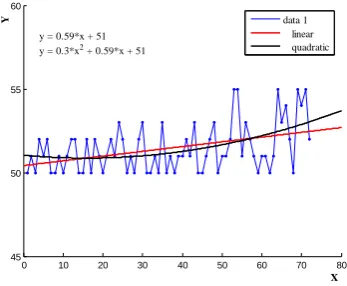
0 10 20 30 40 50 60 70 80 45 50 55 60 X Y
y = 0.59*x + 51 y = 0.3*x2 + 0.59*x + 51
data 1 linear quadratic
Fig.3 Scatter Points Diagram and Fitting Curve
Therefore, it is necessary to introduce one function which can not only show the change trend reflected by the scatter points, also the degree of uncertainty for the data change. Then, fuzzy function is one better way to illustrate the change rules of the scatter points than one traditional function.
Let
E
as the fuzzy setin field of real number
R
, and E(x),(xR)is the membership function. If E(x) meet following properties, see reference [6-9].
(1) E(0)1, E(10)E(-1-0)0;
(2) In interval [-1,0 ) , E(x) is a monotonically increasing and right-continuous function, while in interval ( 0,1] is monotonically decreasing and left-continuous;
(3) When -∞x-1 or 1x∞ ,
0 ) (x
E .
Then, the fuzzy set E is called to be one fuzzy structured element inR.
Assume that fuzzy set E has a membership function as follows, and shown in Fig.4. Then,Eis called a triangle structured element.
other , 0 ] 1 , 0 ( , -1 ) 0 , 1 -[ , 1 ) ( ∈ ∈ x x x x x
E (1)
x E(x)
-1 0 1
1
Fig.4 Triangle Structured Element
So, for every fuzzy-valued function~y , there
always has a fuzzy structured function
E
x
and one common function f(x) and one non-negative function (x), then:x
E
x
x
f
y
(
)
(
)
~
(2) In which, f(x)is the kernel function, while the values of (x)reflect the uncertainty of
y
~at the point of X, a kind of membership
degree that the discrete points belong to~y , also means a kind of distance between the discrete points and the kernel function. And, the membership function of y~ can be expressed
as: Y y x x f y E y
y ),∀ ∈
) ( ) ( -( ) ( ~
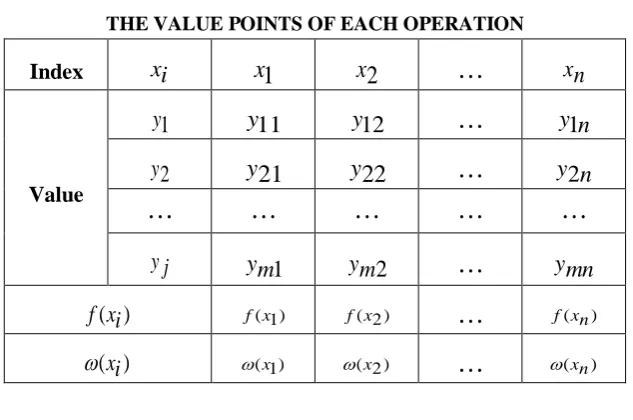
(3)During the automatic evaluation of ship maneuvering on marine simulator, based on the index system built and data extraction module, the value points of each index from the trainers’ operations and also the experts (or the standard database) can be achieved. These value points can be expressed in the following Table 1.
In the table,
x
i
(
i
1
,
2
,
,
n
)
means the index set. Andy
j
(
j
1
,
2
,
,
m
)
means m series of operation results on each index,)
,
,
2
,
1
,
,
,
2
,
1
(
i
n
j
m
ij
y
means the jthtrainer’s operation data of the
i
th
index. Then,)
,
,
2
,
1
)(
(
x
i
i
n
f
is the expert’s operation value or the standard value, here, we call it the kernel function. So the fuzzy degree function) (x
can be calculated by:
|
)
(
-)
(
|
)
(
x
i
y
j
x
i
f
x
i
based on the above briefTABLE 1
THE VALUE POINTS OF EACH OPERATION
Index
x
i
x
1
x
2
x
n
Value
1
y
y
11
y
12
y
1
n
2
y
y
21
y
22
y
2
n
j
y
y
m
1
y
m
2
y
mn
)
(
x
i
f
f(x1) f(x2)
f(xn))
(
x
i
(x1) (x2)
(xn)According to the properties of fuzzy structured element, the membership degree of
the discrete points
y
j
belonging to y~ is:))
(
/
))
(
)
(
((
))
(
j
](
~
[
y
y
x
i
E
y
j
x
i
f
x
i
x
i
(4)
And, the membership degree for every points
j
y
should be larger than the value ofparameterh, a designed membership degree, andh[0,1]. Usually for the triangle fuzzy
structured element, h0.5 , and
5 . 0 ) 2 1 (
E . So, in order to determine the
function(xi) , often using the fuzzy regression
analysis method, let:
h i x i x f i x j y E i
( ))/ ( )) )
( ((
max (5)
Then, the fuzzy degree function (xi ) for each trainer’s operation data set can be gained. The value of it can show that in which index the trainer has larger uncertainty or vibration, which means he is not skilled or qualified at this point. By that analogy, the performance of every point during each trainer’s operation can be illustrated clearly.
IV.IMPROVEMENT OF TRADITIONAL FUZZY
COMPREHENSIVE EVALUATION METHOD
Based on the above introduced method, the traditional fuzzy comprehensive evaluation method can be improved. The steps are as follows.
1) According to Table 1,the index set isX(x1,x2,,xn), corresponding evaluation
decision matrix isY(y1,y2,,ym)T , after
normalization processing, that
isY(y1,y2,,ym)T;
2) Based on the expert-consulting method and AHP, the weight set is calculated as:
)
,
,
,
(
a
1a
2a
nA
;3) Then, the comprehensive evaluation result can be calculated by traditional fuzzy evaluation method, which is the score or rank for each operation. But, this is just one part of the comprehensive evaluation.
4) According to the fuzzy structured element method, after building and normalization processing the decision matrix Y , calculating the fuzzy degree (xi) of each factor xi(i1,2,,n) for every trainer’s operation, then rank the fuzzy degree, so, the trainer and trainee both can directly find out which part of the operation is still not qualified or skilled. This is another part of the evaluation results.
5) Combing the two parts s of results makes the comprehensive evaluation more scientific and complete, and can provide further suggestions for the development of the trainers.
Besides, the method proposed is much more useful and complete than traditional fuzzy comprehensive evaluation method. Also, it also has clear and simple logic structure, easy to be realized on a computer. That is, suitable to the automatic evaluation of ship maneuvering on marine simulator. Based on the related research project, some actual experiments and working are under doing.
V.CONCLUSION
evaluation on marine simulator, the fuzzy structured element method was introduced into improve the traditional fuzzy comprehensive evaluation method. Then, the results given out can not only describe the distance from the trainee’s operation to the experts’, also can comprehensively reflect the uncertain degree of each step during the trainee’s operation, which can provide more guidance for the trainee’s further development. Although still under research, it is with a good application perspective.
VI.ACKNOWLEDGMENT
The research was sponsored by grants from the Key Project in the National Science & Technology Pillar Program (Grant No.2015BAG20B05).
REFERENCES
[1] Wang Chaoqun. “Research and Assess of Some
Training Courses’ Effectiveness Based on Chinese
Seafarer Training’s Status”, Dalian Maritime
University. (2015).
[2] PENG Yu, GAO Deyi, HUANG CHANGhai, XIAO
Yingjie, YANG Weihua,“Research on the Design
and Implementation of Crew Development Strategic
Plan of China”. China Soft Science, no. 9, (2015), pp.
15-26.
[3] WANG Delong, REN Hongxiang, XIAO Fangbing.
“Automatic Assessment System for Single-Target
Collision Avoidance on Ship Handling Simulator”,
Navigation of China, no.1, (2015), pp. 44-48.
[4] XUE Manfu, FANG Xiwang, REN Hongxiang. “An
Assessment Model of Ship Berthing”, Navigation of
China, vol. 36, no. 3, (2013), pp. 46-49.
[5] WANG Delong, REN Hongxiang. “Automatic
Assessment Model for Sailing in Narrow Channel”,
Springer International Publishing, Algorithms and
Architectures for Parallel Processing, (2014),
pp.394-403.
[6] WANG Shengyu, ZHANG Wanjian, CAO Kun.
“Safety Culture Assessment of Tonghua Coal Group
Based on Structure Element Method”, Journal of
Liaoning Technical University(Social Science
Edition), vol. 12, no. 3, (2010), pp. 259-262.
[7] Yang Y, Guo S, Zhang Q, Cao X. Fuzzy Structured
Element Algorithm of System Reliability with Fuzzy
Parameter. Fuzzy Information and Engineering 2010.
Advances in Intelligent and Soft Computing, vol 78.
Springer, Berlin, Heidelberg
[8] Xiaohua Peng, Xinghan Tu. Solving Fully Fuzzy
Systems by Fuzzy Structured Element Method.
Fuzzy Information and Engineering 2010 - Volume I,
Proceedings of the 5th Annual Conference on Fuzzy
Information and Engineering, ACFIE 2010,
Sepember 23-27, 2010, Huludao, China
[9] CHEN Tingting. “Ship Track Fitting Based on Fuzzy
Structured Element Method”, Transportation