Can Homomorphic Encryption be Practical?
Kristin Lauter
Microsoft Research [email protected]Michael Naehrig
Microsoft Research [email protected]Vinod Vaikuntanathan
Microsoft Research [email protected]ABSTRACT
The prospect of outsourcing an increasing amount of data storage and management to cloud services raises many new privacy concerns for individuals and businesses alike. The privacy concerns can be satisfactorily addressed if users en-crypt the data they send to the cloud. If the enen-cryption scheme is homomorphic, the cloud can still perform mean-ingful computations on the data, even though it is encrypted. In fact, we now know a number of constructions offully ho-momorphic encryption schemes that allow arbitrary compu-tation on encrypted data. In the last two years, solutions for fully homomorphic encryption schemes have been proposed and improved upon, but it is hard to ignore the elephant in the room, namely efficiency –can homomorphic encryption ever be efficient enough to be practical? Certainly, it seems that all knownfullyhomomorphic encryption schemes have a long way to go before they can be used in practice. Given this state of affairs, our contribution is two-fold.
First, we exhibit a number of real-world applications, in the medical, financial, and the advertising domains, which require only that the encryption scheme is “somewhat” ho-momorphic. Somewhat homomorphic encryption schemes, which support a limited number of homomorphic operations, can be much faster, and more compact than fully homomor-phic encryption schemes.
Secondly, we show a proof-of-concept implementation of the recent somewhat homomorphic encryption scheme of Brakerski and Vaikuntanathan, whose security relies on the “ring learning with errors” (Ring LWE) problem. The scheme is very efficient, and has reasonably short ciphertexts. Our
unoptimized implementation in magma enjoys comparable efficiency to evenoptimizedpairing-based schemes with the same level of security and homomorphic capacity. We also show a number ofapplication-specific optimizations to the encryption scheme, most notably the ability to efficiently convert between different message encodings in a cipher-text.
Permission to make digital or hard copies of all or part of this work for personal or classroom use is granted without fee provided that copies are not made or distributed for profit or commercial advantage and that copies bear this notice and the full citation on the first page. To copy otherwise, to republish, to post on servers or to redistribute to lists, requires prior specific permission and/or a fee.
Copyright 20XX ACM X-XXXXX-XX-X/XX/XX ...$10.00.
1.
INTRODUCTION
The development of cloud storage and computing plat-forms allows users to outsource storage and computations on their data, and allows businesses to offload the task of maintaining data-centers. However, concerns over loss of privacy and business value of private data is an overwhelm-ing barrier to the adoption of cloud services by consumers and businesses alike. An excellent way to assuage these pri-vacy concerns is to store all data in the cloud encrypted, and perform computations on encrypted data. To this end, we need an encryption scheme that allows meaningful computa-tion on encrypted data, namely ahomomorphic encryption scheme.
Homomorphic encryption schemes that allow simple com-putations on encrypted data have been known for a long time. For example, the encryption systems of Goldwasser and Micali [GM82], El Gamal [El-84] and Paillier [Pai99] support either adding or multiplying encrypted ciphertexts,
but not both operations at the same time. Boneh, Goh and Nissim [BGN05] were the first to construct a scheme capa-ble of performing both operations at the same time – their scheme handles an arbitrary number of additions and just
onemultiplication. More recently, in a breakthrough work, Gentry [Gen09, Gen10] constructed afully homomorphic en-cryption scheme (FHE) capable of evaluating an arbitrary number of additions and multiplications (and thus, compute any function) on encrypted data.
The main point of this paper is to show to what extent current schemes can actually be used to compute functions of practical interest on encrypted data. Since the appear-ance of Gentry’s scheme, there has been much informal dis-cussion in the industry as to whether fully homomorphic encryption is implementable and practical. While the initial solution may not have been practical, subsequent develop-ments produced other schemes [DGHV10, SV10, SS10] lead-ing up to the most recent solutions of Brakerski and Vaikun-tanathan [BV11b, BV11a], an implementation of which we consider in this paper. The scheme is efficient and simple, produces short ciphertexts, and its security is based on the “ring learning with errors” (Ring LWE) problem [LPR10].
While the performance of the state-of-the art FHE imple-mentations is itself a question of interest (and has indeed been considered recently in, e.g., [GH11, SV11]), our fo-cus here is on describing concrete practical applications and concrete useful functions to be computed, most of which re-quire only a limited number of multiplications of ciphertexts (as well as a possibly very large number of additions of ci-phertexts). For these applications, it is enough to consider
an implementation of a “somewhat homomorphic encryp-tion” (SHE) scheme, namely, one which allows a fixed num-ber of multiplications of ciphertexts. These SHE schemes are building blocks for the FHE schemes of, e.g., [Gen09, DGHV10, BV11b, BV11a], and provide much better effi-ciency guarantees than their fully homomorphic counter-parts.
1.1
Practical Applications of Homomorphic
En-cryption
We describe a number of concrete applications and func-tions to be implemented to provide cloud services in the medical, financial, and advertising sectors. (We provide a sketch of the applications here, and refer the reader to Sec-tion 2 for detailed descripSec-tions).
For a cloud service managing electronic medical records (EMR), consider a futuristic scenario where devices contin-uously collect vital health information, and stream them to a server who then computes some statistics (over these mea-surements, and over the course of time) and presumably decides on the course of treatment (e.g., whether the dosage of medicine should be changed). The volume of the data involved is large, and thus, the patient presumably does not want to store and manage all this data locally; she may pre-fer to use cloud storage and computation. To protect patient privacy, all the data is uploaded in encrypted form, and thus the cloud must perform operations on the encrypted data in order to return (encrypted) alerts, predictions, or summaries of the results to the patient.
We describe scenarios such as the above, which require computing simple statistical functions such as the mean, standard deviation, as well as logistical regressions that are typically used for prediction of likelihoods of certain desir-able or undesirdesir-able outcomes. For these functions, it suffices to have a somewhat homomorphic encryption system which computes many additions and asmall number of multiplica-tionson ciphertexts: for example, averages require no mul-tiplications, standard deviation requires one multiplication, and predictive analysis such as logistical regression requires a few multiplications (depending on the precision required). Other applications we describe in the financial and advertis-ing sector use similar functions, except that in those sectors, the function itself may also be private or proprietary.
1.2
Our Implementation
We have implemented the somewhat homomorphic en-cryption scheme of [BV11b] using the computer algebra sys-tem Magma [BCP97]. We ran experiments on an ordi-nary laptopwith an Intel Core 2 Duo processor running at 2.1 GHz, with 3MB L2 cache and 1GB of memory, using Magma’s polynomial arithmetic for all computations inRq. Choosing secure parameters for lattice-based cryptogra-phy is a complex problem. Unlike traditional number-theory based systems, cryptosystems based on lattices and the learn-ing with errors (LWE) problem tend to be governed by a number of inter-related parameters. We follow the method-ology of Lindner and Peikert [LP11] (following earlier work of [GN08, MR09, RS10]) to choose these parameters cor-rectly and securely.1 More precisely, fixing a parameterD
1
Lindner and Peikert, and indeed all previous work, analyze security for the LWE problem, whereas here, we rely on the security of the more restricted Ring LWE problem. We
– an upper bound on the number of multiplication opera-tions that the scheme supports – we compute the parame-ters of the scheme secure against an attacker with a time-to-advantage ratio of about 2120 (or larger) which, by the heuristics of Lenstra and Verheul [LV01], roughly translates to a security level matching that of AES-128.
For parameter settings which support one multiplication (i.e., D= 2) followed by a large number of (integer) addi-tions, the underlying ring in our scheme isRq=Zq[x]/hxn+ 1i wheren≈2048 andq≈258. We always set the LWE error to be a discrete Gaussian with standard deviation σ = 8. In fact, for these choices of parameters, we get more secu-rity than we asked for, namely a time-to-advantage ratio of about 2196.2 For this setting, the key and ciphertext sizes, and the running times are as follows:
• The public key is 2nlgq ≈ 29 KB, the secret key is
nlgq ≈ 14 KB, and a ciphertext generated by the encryption algorithm is 2nlgq ≈29 KB. The cipher-text has two ring elements inRq=Zq[x]/hf(x)i, how-ever homomorphic multiplication adds another ring el-ement to the ciphertext making it 3nlogq≈43.5 KB. • Key-generation runs in 250 milliseconds (ms), encryp-tion takes 24 ms, whereas decrypencryp-tion takes 15–26 ms (depending on whether we are decrypting a 2- or 3-element ciphertext). Homomorphic addition is essen-tially instantaneous (i.e., takes less than 1 ms), whereas homomorphic multiplication takes about 41 ms. We also implement an optimization proposed in [BV11a] – termedre-linearization– that reduces the size of the cipher-text to two ring elements. This comes at a cost of increasing the keys and the time for homomorphic multiplication, al-though we observe that the advantage of this optimization outweighs the cost in the larger parameter settings.
Let us contrast these numbers with the performance of the BGN encryption scheme [BGN05] based on bilinear pairings on elliptic curves, which also supports one multiplication. While the key sizes in our scheme are larger, our homomor-phic multiplication is much faster than that for the BGN scheme, which requires a pairing computation. A magma implementation of the optimal ate pairing on a 254-bit BN (Barreto-Naehrig) curve takes around 240 ms on the same machine that we used to time the somewhat homomorphic scheme. The BGN scheme requires composite order pair-ing groups and thus, it is likely that the parameters are less favorable parameters leading to an even slower pairing com-putation. Even if we assume highly optimized pairings at the 128-bit security level (about 1ms per pairing) and the use of Freeman’s prime-order version of the BGN scheme [Fre10] which requires 12 such pairings, the performance of the homomorphic multiplication of our magma implemen-tation is comparable to the BGN scheme. We remark that a C implementation (possibly using special purpose polyno-mial arithmetic along the lines of the SWIFFT hash func-still choose to use the analysis of [LP11] since (as pointed out therein), we do not know any attacks against ring LWE that perform better than the attacks on LWE.
2
Since we constrain the dimensionnto be a power of 2, we sometimes get “jumps” in security levels. In such a case, we choose to use the smallest setting whose security level exceeds our minimum, namely a time-to-advantage ratio of 2120.
tion [LMPR08]) would likely be several orders of magnitude faster than themagmaimplementation that we report here. We build on the somewhat homomorphic encryption, and implement simple statistics such as mean, standard devia-tion and logistical regression, and report on the performance numbers (See Section 5 for more details). To support com-puting these functions, we come up with two tricks to encode messages appropriately. As such, the encryption scheme supports addition and multplication modulo a fixed inte-gert, wheret is a parameter of the system. The first trick shows how to encode integers in a ciphertext so as to enable efficient computation of their sums and products over the integers. This is useful in computing the mean, the stan-dard deviation and other private statistics efficiently. The second trick shows how to “pack”nencryptions of bits into a single encryption of then-bit string. Some homomorphic operations, e.g., comparison of integers or private informa-tion retrieval, seem to require bit-wise encrypinforma-tions of the input. Once the answers are computed, though, they can be packed into a single encryption using this trick.
Finally, the work of [BV11a] shows how to make this schemefully homomorphicunder the same assumption (namely, ring LWE) in an efficient way. Implementing the “boot-strapping” operation for this system (thus, making it fully homomorphic) is a very interesting avenue for future imple-mentation efforts.
2.
CLOUD SERVICES
Adoption of cloud services by consumers and businesses is limited by concerns over the loss of privacy or business value of their private data. In this section we will describe concrete and valuable applications of Fully Homomorphic Encryption which can help preserve customer privacy while outsourcing various kinds of computation to the cloud. In all of these scenarios, we imagine a future of streaming data from multiple sources, uploaded in encrypted form to the cloud, and processed by the cloud to provide valuable ser-vices to the content owner. There are two aspects of the computation to consider: the data itself, and the function to be computed on this data. We consider cases where one or both of these are private or proprietary and should not be shared with the cloud.
In all of these applications, we consider a single content-owner, who is the consumer for the cloud service. All data that is encrypted and sent to the cloud is public-key en-crypted to the content-owner’s public key, using the seman-tically secure somewhat homomorphic encryption scheme from [BV11b] described later in this paper.
2.1
Medical Applications: Private data and
Public functions
In [CLBH09], a private cloud medical records storage sys-tem (Patient Controlled Encryption) was proposed, in which all data for a patient’s medical record is encrypted by the healthcare providers before being uploaded to the patient’s record in the cloud storage system. The patient controls sharing and access to the record by sharing secret keys with specific providers (features include a hierarchical structure of the record, ability to search the encrypted data, and var-ious choices for how to handle key distribution). However this system does not provide for the cloud to do any compu-tation other than search (exact keyword match, or possibly
conjunctive searches). With our FHE implementation, we add the ability for the cloud to do computation on the en-crypted data on behalf of the patient. Imagine a future where monitors or other devices may be constantly stream-ing data on behalf of the patient to the cloud. With FHE, the cloud can compute functions on the encrypted data and send the patient updates, alerts, or recommendations based on the received data.
The functions to be computed in this scenario may include averages, standard deviations or other statistical functions such as logistical regression which can help predict the likeli-hood of certain dangerous health episodes. Encrypted input to the functions could include blood pressure or heart mon-itor or blood sugar readings, for example, along with infor-mation about the patient such as age, weight, gender, and other risk factors. The functions computed may not need to be private in this case since they may be a matter of public health and thus public.
2.2
Financial Applications: Private data and
Private functions
In the financial industry there is a potential application scenario in which both the data and the function to be com-puted on the data is private and proprietary.
As an example, data about corporations, their stock price or their performance or inventory is often relevant to mak-ing investment decisions. Data may even be streamed on a continuous basis reflecting the most up-to-date information necessary for making decisions for trading purposes. Func-tions which do computaFunc-tions on this data may be propri-etary, based on new predictive models for stock price per-formance and these models may be the product of costly research done by financial analysts, so a company may want to keep these models private to preserve their advantage and their investment.
With FHE, some functions can be evaluated privately as follows. The customer uploads an encrypted version of the function to the cloud, for example a program where some of the evaluations involve encrypted inputs which are specified. The streaming data is encrypted to the customer’s public key and uploaded to the cloud. The cloud service evaluates the private function by applying the encrypted description of the program to the encrypted inputs it receives. After processing, the cloud returns the encrypted output to the customer.
2.3
Advertising and Pricing
Imagine an advertiser, for example a cosmetics company, who wants to use contextual information to target adver-tising to potential customers. The consumer uses a mobile phone as a computing device, and the device constantly up-loads contextual information about the consumer, including location, the time of day, information from email or brows-ing activity such as keywords from email or browser searches. In the future, imagine that information is uploaded poten-tially constantly from video devices: either pictures of ob-jects of interest such as brands or faces which are automat-ically identified, or from a video stream from a camera on the body which is identifying context in the room (objects, people, workplace vs. home vs. store). When contextual in-formation is uploaded to the cloud server and made accessi-ble to the cosmetics company, the company computes some function of the contextual data and determine which
tar-geted advertisement to send back to the consumer’s phone. Some examples of where context is important for advertis-ing or providadvertis-ing targeted coupons: beer commercials duradvertis-ing sports events, or, you are near a Starbucks in the morn-ing and a coffee discount coupon for the Starbucks nearby is sent to your phone, or, cosmetics companies market different products for different times of day (e.g. Friday night going out vs. Sunday morning hanging out with the family), ads or coupons for shows if you are in New York near Broadway in the evening. Other (private) contextual data might be: your income, your profession, your purchasing history, your travel history, your address, etc.
Encrypted version: The problem with these scenarios is the invasion of privacy resulting from giving that much detailed information about the consumer to the server or to the ad-vertising company. Now, imagine an encrypted version of this entire picture. All the contextual data is encrypted and then uploaded to the server; the advertiser uploads en-crypted ads to the server; the server computes a function on the encrypted inputs which determines which encrypted ad to send to the consumer; this function could be either private/proprietary or not. All contextual data and all ads are encrypted to the consumer’s public key. Then the cloud can operate and compute on this data, and the consumer can decrypt the received ad. As long as the cloud service provider does not collude with the advertisers, and seman-tically secure FHE encryption is employed, the cloud and the advertisers don’t learn anything about the consumer’s data.3
2.4
Functions to be computed with FHE
We can compute the following functions with a somewhat homomorphic encryption scheme:• Average of n terms {ci}: as a pair (P
i=1,...nci, n), wherem= P i=1,...nci n is the average. • Standard deviation: q (P i=1,...nci−m)2 n , returned as a pair which is the numerator and denominator of the expression, before taking the square root.
• Logistical regression: x=P
i=1,...nαixi , whereαi is the weighting constant or regression coeffficient for the variablexi, and the prediction isf(x) = e
x 1+ex
A couple of remarks are in order. First, we set the parame-ter choices for the encryption system based on the expected number of multiplication operations to be done to compute the given functions. These parameter choices determine the efficiency and security of the system. Thus parameters for the system need to be changed as the functions to be com-puted change.
Secondly, so far we do not have a way to efficiently do divisions of real numbers or square roots. Thus in the above computations, numerators and denominators need to be re-turned as separate encryptions.
3
If the cloud and the advertiser collude, then the cloud may be able to learn some information about whether the user likes the ad or not, which reveals information about his pref-erences. This constitutes a form of CCA attack, which might endanger the securty of the FHE.
3.
THE ENCRYPTION SCHEME
We describe the “ring learning with errors” (Ring LWE) assumption of [LPR10] in Section 3.1, and present the “some-what” homomorphic encryption scheme of Brakerski and Vaikuntanathan [BV11b] based on Ring LWE in Section 3.2. We then report on an instantiation of the parameters, as well as the running-times and sizes of the keys and ciphertexts in Section 5.
3.1
The Ring LWE Assumption
In this section, we describe a variant of the “ring learn-ing with errors” (RLWE) assumption of Lyubaskevsky, Peik-ert and Regev [LPR10]. In theRLWEassumption, we con-sider rings R , Z[x]/hf(x)i and Rq , R/qRfor some de-green integer polynomialf(x)∈Z[x] and a prime integer q∈Z. Note that Rq≡Zq[x]/hf(x)i, i.e. the ring of degree
n polynomials modulo f(x) with coefficients in Zq. Addi-tion in these rings is done component-wise in their coeffi-cients (thus, their additive group is isomorphic to Zn and
Znq respectively). Multiplication is simply polynomial mul-tiplication modulof(x) (and alsoq, in the case of the ring
Rq).
Thus an element inR (orRq) can be viewed as a degree
n polynomial over Z (or Zq). One can represent such an element using the vector of its coefficients. For an element
a(x) =a0+a1x+. . .+an−1xn−1∈R, we letkak= max|ai| denote its`∞norm.
TheRLWEf,q,χ assumption is parameterized by an inte-ger polynomialf(x) ∈Z[x] of degree n (which defines the
ringR=Z[x]/hf(x)i), a prime integerq ∈Zand an error
distributionχoverR, and is defined as follows. Lets←$ Rq be a uniformly random ring element. The assumption is that given any polynomial number of samples of the form (ai, bi=ai·s+ei)∈(Rq)2, whereaiis uniformly random in
Rqandeiis drawn from the error distributionχ, thebi’s are computationally indistinguishable from uniform in Rq. As shown in [ACPS09, LPR10], this is equivalent to a variant where the secret is sampled from the noise distribution χ
rather than being uniform inRq. It is also easy to see that the assumption is equivalent to a variant where the noiseei are multiples of some integertthat is relatively prime toq. We consider theRLWEproblem for specific choices of the polynomialf(x) and the error distributionχ. Namely,
• We setf(x) to be the cyclotomic polynomialxn+ 1 forna power of two. In addition to many other useful properties, the fact that f(x) = xn+ 1 means that multiplication of ring elements does not increase their norm by too much (see Lemma 3.2 below).
• The error distributionχis the discrete Gaussian dis-tributionDZn,σ for someσ > 0. A sample from this distribution defines a polynomiale(x)∈R.
We present some elementary facts about the Gaussian er-ror distribution, and multiplication over the ringZ[x]/hxn+ 1i.
The first fact bounds the (Euclidean and therefore, the`∞)
length of a vector drawn from a discrete Gaussian of stan-dard deviationσ byσ√n. The second fact says that mul-tiplication in the ring Z[x]/hxn+ 1i increases the norm of
Lemma 3.1 (see [MR07], Theorem 4.4). Letn ∈N.
For any real numberσ > ω(√logn), we have
Pr
x←DZn ,σ
[||x||> σ√n]≤2−n+1
Lemma 3.2 (see [LM06, Gen09]). Letn∈N, letf(x) = xn+ 1and letR=
Z[x]/hxn+ 1i. For anys, t∈R,
||s·t (modxn+ 1)||∞≤n· ||s||∞· ||t||∞
Solving theRLWEproblem (for the stated parameters) is also known to give us a quantum algorithm that solves “short vector problems” on ideal lattices with related parameters. The latter problem is believed to be exponentially hard.
3.2
Somewhat Homomorphic Encryption
The somewhat homomorphic encryption scheme SHE = (SH.Keygen,SH.Enc,SH.Add,SH.Mult,SH.Dec) is associated with a number of parameters:
• the dimensionn, which is a power of 2, • the cyclotomic polynomialf(x) =xn+ 1,
• the modulus q, which is a prime such that q ≡ 1 (mod 2n),
Together,n, qandf(x) define the ringsR,Z[x]/hf(x)i
andRq,R/qR=Zq[x]/hf(x)i.
• the error parameterσ, which defines a discrete Gaus-sian error distributionχ=DZn,σwith standard devi-ationσ,
• a prime t < q, which defines the message space of the scheme as Rt =Zt[x]/hf(x)i, the ring of integer polynomials modulof(x) andt, and
• a numberD >0, which defines a bound on the maxi-mum number of multiplications that can be performed correctly using the scheme.
These parameters will be chosen (depending on the security parameterκ) in such a way as to guarantee correctness and security of the scheme. See Section 3.2.2 for the asymptotic setting of parameters, and 5 for concrete choices.
3.2.1
The Scheme
SH.Keygen(1κ): Sample a ring elements $
←χand define the secret key sk , s. Sample a uniformly random ring element a1 ← Rq and an error e ← χ and compute the
public key pk,(a0=−(a1s+te), a1). Publishpkand keepsksecret.
SH.Enc(pk, m): Recall that our message space isRt. Namely, we encode our message as a degreenpolynomial with coef-ficients inZt.
Given the public keypk= (a0, a1) and a messagem∈Rq, the encryption algorithm samplesu←χ, andf, g←χ, and computes the ciphertext
ct= (c0, c1),(a0u+tg+m, a1u+tf)
SH.Dec(sk,ct= (c0, c1, . . . , cδ)): To decrypt, we first com-pute e m= δ X i=0 cisi∈Rq
and output the message asme (modt).
Homomorphic Operations. We now show how to compute the addition and multiplication operations homomorphically. To compute an arbitrary function f homomorphically, we construct an arithmetic circuit forf (made of addition and multiplication operations overZt), and then useSH.Addand SH.Multto iteratively computef on encrypted inputs.
Although the ciphertexts produced by SH.Enc contains two ring elements, the homomorphic operations (in partic-ular, multiplication) increases the number of ring elements in the ciphertext. In general, theSH.Addand SH.Mult op-erations get as input two ciphertexts ct = (c0, c1, . . . , cδ) and ct0 = (c00, c
0
1, . . . , cγ). The output of SH.Addcontains max(δ+1, γ+1) ring elements, whereas the output ofSH.Mult containsδ+γ+ 1 ring elements.
SH.Add(pk,ct0,ct1): Let ct = (c0, c1, . . . , cδ) and ct0 = (c00, c
0
1, . . . , c
0
γ) be the two ciphertexts. Assume thatδ =γ, otherwise pad the shorter ciphertext with zeroes.
Homomorphic addition is done by simple component-wise addition of the ciphertexts. Namely, compute and output ctadd= (c0+c 0 0, c1+c 0 1, . . . , cmax(δ,γ)+c 0 max(δ,γ))∈R max(δ,γ) q
SH.Mult(pk,ct0,ct1): Let ct = (c0, c1, . . . , cδ) and ct0 = (c00, c
0
1, . . . , c
0
γ) be the two ciphertexts. Here, we do not pad either of the ciphertexts with zero.
Letvbe asymbolic variable and consider the expression
( δ X i=0 civi)·( γ X i=0 c0ivi)
(overRq). We can (symbolically, treatingvas an unknown variable) open the parenthesis to compute ˆc0, . . . ,cˆδ+γ∈Rq such that for allv∈Rq
δ X i=0 civi ! · γ X i=0 c0iv i ! ≡ δ+γ X i=0 ˆ civi. (1)
The output ciphertext isctmlt= (ˆc0, . . . ,cˆδ+γ).
3.2.2
Correctness and Security
We show the correctness of decryption and homomorphic evaluation in the following lemmas. The statement of the lemma also serves as the setting of the modulusq(in terms ofσ, t, n andD) that ensures that the scheme can perform
D multiplications andAadditions.
Lemma 3.3. The encryption schemeSHE is correct, and can computeD multiplications followed by Aadditions, as-suming that
q≥4·(2tσ2√n)D+1·(2n)D/2·√A (2) Proof. First, note that the ciphertext ct= (c0, c1) can be written in the following way:
c0 = a0u+tg+m
= −(a1s+te)u+tg+m
= −(a1u+tf)s+t(−eu+f s+g) +m = −c1s+tee+m
where tee = −t(eu+f s+g) is a polynomial where each co-efficient has magnitude at most √3·σ2t√n with over-whelming probability. This is because e, u, f, s and g are
all polynomials whose co-efficients are drawn from a dis-crete Gaussian with standard deviationσ, and multiplying two such polynomials (modxn+ 1) produces a polynomial whose co-efficients are of size at most
q
(σ2·√2n)2+σ2·t·ω(plogn)≤√3·σ2√n·t·ω(plogn) with overwhelming probability (by the Central Limit the-orem). Our experiments show that this number is in fact smaller, and is of the order of 2·σ2t√n.
Before we prove correctness of the homomorphic opera-tions, we state an invariant that holds for all ciphertexts produced either by the encryption algorithm, or as a result of a homomorphic evaluation. The invariant is that for a ciphertextct= (c0, c1, . . . , cδ), fct(s), δ X i=0 cisi=te+m (3)
wheresis the secret key,eis a “small error” (namely,|te|< q/2) andmis the message.
Clearly, the invariant holds for a fresh ciphertext pro-duced bySH.Enc(by the calculation above), assuming that
q≥2·(2tσ2√n). Furthermore, if the invariant holds, then the decryption algorithm succeeds. This is because the de-cryption algorithm outputs fct(s) (modt) which is indeed
the message, assuming the bound on the error. The bound on the error essentially ensures that the quantity te+m
(modq) that the decryption algorithm recovers does not “wrap around modq”.
Correctness of homomorphic addition is easy to see. We have two ciphertextsct= (c0, . . . , cδ) andct0= (c00, . . . , c0δ) that satisfy the invariants thatfct(s) =te+mandfct0(s) = te0+m0 respectively. Then, the sum of the two ciphertexts isctadd=ct+ct0, where the addition is done componentwise.
Now, fctadd(s) = fct+ct0(s) = δ X i=0 (ci+c 0 i)s i = δ X i=0 cisi+ δ X i=0 c0is i = fct(s) +fct0(s) =t(e+e0) +m+m0
This satisfies the invariant as well, assuming that the larger error t(e+e0) is smaller thanq. In general, adding A ci-phertexts with error at mostηeach results in error at most
A·η. In practice, as our experiments show, this is likely to be smaller, namely of the order of 2√A·η.
With this perspective, correctness of homomorphic mul-tiplication is easy to see. The way the ciphertext ctmlt is
defined, we have
fctmlt(s) = fct(s)·fct0(s) (by Equation 1)
= (te+m)·(te0+m0) = temult+mm
0
whereemult=tee0+em0+e0m. This satisfies the invariant as
well, however the error grows roughly as the product of the constituent errors. In particular, assuming that the errors
in the ciphertextte+mandte0+m0 each have magnitude at mostη, each co-efficient of the resulting error polynomial (te+m)·(te0+m0) can be as large asη2·n. However, in practice, the error is only aboutη2·√2n, as our experiments show.
Putting these estimates together, doingDmultiplications increases the error from η to about ηD+1(√2n)D. Then, performingAadditions increases this to 2·ηD+1(√2n)D·√A. Since the initial error (in a ciphertext produced bySH.Enc) is at mostη≤2tσ2√n, the final error (afterDmultiplications followed byAadditions) is at most
ηfinal≤2·(2tσ2
√
n)D+1(2n)D/2·√A
Decryption succeeds if this quantity is smaller than q/2, which gives us equation 2 in the Lemma.
Security follows directly from Ring LWE. For a proof, we refer the reader to [LPR10].
Lemma 3.4. The encryption schemeSHE is secure under
the Ring LWE assumption with parameters n, qandχ.
3.2.3
An Optimization to Reduce Ciphertext Size
The homomorphic multiplication operation described above increases the number of ring elements in a ciphertext. Brak-erski and Vaikuntanathan [BV11a] describe a transforma-tion – called “relinearizatransforma-tion” – that reduces the ciphertext back to two ring elements. We describe this optimization be-low, implement it and report on the performance numbers in Section 5.
Essentially, the idea is the following: assume that we run SH.Multon two ciphertexts (each containing two ring ele-ments) produced by the encryption algorithm. The result-ing ciphertextctmlt contains three ring elements that satisfy
the ”invariant”
fctmlt(s) =c2s
2
+c1s+c0=temult+mm
0
This is a quadratic equation ins, and thus,SH.Multturned two “linear ciphertexts” into a “quadratic ciphertexts”. The goal ofre-linearizationis to bring this back down to a linear ciphertext.
To this end, we publish some “homomorphism keys” to aid re-linearization. This could be thought of as part of the public key, but the homomorphism key is only used for re-linearization (following an SH.Multoperation). The ho-momorphism keyhk= (h1, . . . , hdlogtqe−1) is computed as:
hi= (ai, bi=−(ais+tei)+tis2) fori= 0, . . . ,dlogtqe −1 where ai ←Rq and ei ← χ are chosen independently for everyi. In a sense, these are “quasi-encryptions” of ti·s2. They are not real encryptions sinceti·s2 may not lie in the message space of the encryption scheme, namelyRt.
The homomorphic multiplication generates a ciphertext ctmlt = (c0, c1, c2), starting from two 2-element ciphertexts. Re-linearization is performed after every homomorphic mul-tiplication, and proceeds as follows.
1. Write the polynomial c2 in its base-t representation as follows. c2 =Pc2,iti (fori= 0, . . . ,dlogtqe −1), where all the co-efficients ofc2,i are smaller thant.
2. Now, set crelin1 := c1+ dlogtqe−1 X i=0 c2,iai and (4) crelin0 := c0+ dlogtqe−1 X i=0 c2,ibi (5)
where hi = (ai, bi) come from the “homomorphism key”.
3. Output the 2-element ciphertextctmlt:= (crelin0 , c
relin
1 ). To see why this works, note that4
crelin0 = c0+ X i c2,ibi = c0+ X i c2,i(−ais−tei+tis2) = c0− X i c2,iai ! s−terelin+ X i c2,iti ! s2 = c0−(crelin1 −c1)s−terelin+c2s2
from Equation 4 and by the definition ofc2,Pic2,iti. This means that
crelin0 +c
relin
1 s=c0+c1s+c2s2−terelin
But, sincec0+c1s+c2s2=temult+mm0, we have crelin0 +c
relin
1 s=t(erelin+emult) +mm
0
thus maintaining the invariant and achieving correctness of decryption if the final error erelin+emult is small enough.
Note that the re-linearization process adds a fixed amount of error to the ciphertext, and does not accumulate error multiplicatively.
On the one hand, re-linearization reduces the length of the ciphertext considerably. On the flip side, the public parame-ters become much larger. They now consist of an additional logtqring elements, totaling to logtq·nlgt=n(lgq)
2
/lgt
bits. Re-linearization also affects the running time of the ho-momorphic multiplication. In particular, one needs to addi-tionally perform roughly logtq polynomial multiplications and additions. These (side-)effects are most pronounced for small t, where our experiments indicate considerable overhead. Quite encouragingly, though, the benefits of re-linearization seem to dominate the side-effects for large t
(see Section 5 for more details).
The security of the encryption scheme given the homomor-phism keys relies on the circular security of the encryption scheme when encrypting quadratic functions of the secret key.
4.
MESSAGE ENCODING TECHNIQUES
The ease of performing homomorphic operations depends crucially on the specific message-encoding used in the ci-phertexts. Consider the following two examples.
• If we wish tocompare two encrypted integersx, y∈Zt homomorphically, then it seems best to encrypt them 4The summation runs fromi= 0 to i=dlog
tqe −1. We omit the indices for brevity.
bit-wise rather than as an elements of Zt. The for-mer approach translates to computing a polynomial of degree lgtover the encrypted bits, whereas the latter seems to require a polynomial of degreeO(t).
• If we wish to compute the mean of k integers, then it seems most natural to encode them as elements of
Zt (for a large enough t). Computing the mean ho-momorphically then involves only cheap homomorphic additions overZt. On the other hand, if the numbers are encrypted bit-wise, then addition requires compu-tation of expensive “carry” operations that involve ho-momorphic multiplication overZ2.
We describe two tricks for encoding messages. The first trick shows how to efficiently encode integers in a ciphertext so as to enable efficient computation of their sums and products
over the integers. This is useful in computing the mean, the standard deviation and other private statistics efficiently. The second trick shows how to “pack”nencryptions of bits into a single encryption of the n-bit string. Some homo-morphic operations, e.g., comparison of integers or private information retrieval, seem to require bit-wise encryptions of the input. Once the answers are computed, though, they can be packed into a single encryption using this trick.
4.1
Efficient Encoding of Integers for
Arith-metic Operations
Given a list of integers (m1, . . . , m`)∈Z`, if our goal is to
compute their sum or product over the integers homomor-phically, the obvious (and sub-optimal) choice is to encrypt them directly. Namely, for everymin the list, compute
Enc(pk, m) = (c0, c1) = (a0u+tg+m, a1u+tf) To ensure that we obtainP
imiover the integers (and not modt), we are forced to choosetto be rather large, namely
t >P
imi, which could be rather prohibitive.
We show a method of encrypting integers more efficiently by encoding them in the polynomial ring, in essence enabling a smaller choice oftand better efficiency. In particular, for small enough mi < 2n, we show that it suffices to choose
t > `in order to add`integers. Being able to work with a smalltin turn enables us to choose other parameters, e.g.,
qandnto be correspondingly smaller.
The idea is very simple: break each m into (at most
n) bits (m(0), . . . , m(n−1)), create a degree-(n-1) polynomial pm(x) =P jm (j) i x jand encryptmas Enc(pk, m) = (c0, c1) = (a0u+tg+pm, a1u+tf) Adding these encryptions now adds up the polynomialspmi(x)
co-efficient-wise. Note that each co-efficient was a single bit to start with, and a sum ` of them grows to at most `. As long as q > t > `, this does not wrap around mod-ulo t and upon decryption, we in fact get the polynomial pmadd(x) =P
ipmi(x) overZ[x]. Now, the result is simply pmadd(2).
Extending this idea to support multiplication is a bit trick-ier. The problem stems from the fact that multiplying the polynomials pm(x) and pm0(x) increases their degree. If their original degree was close tonto start with, we will only be able to obtainpm(x)pm0(x) (modxn+ 1) upon decryp-tion, which loses information about the product. The solu-tion is to encode the messagesm as polynomials of degree at mostn/d, if we anticipate performingd multiplications.
For our applications (e.g., computing standard deviations), this is an acceptable trade-off since we only anticipate doing a single multiplication (or, at most a small number of them in the case of computing higher-order regression functions).
4.2
Packing Many Bits in a Ciphertext
We show how to transform ciphertexts that encodenbits
b0, b1, . . . , bn−1 separately, into a single ciphertext that en-codes the polynomialb(x) =b0+b1x+. . .+bn−1xn−1.
Givennciphertextscti= (c0,i, c1,i) that encrypt the bits
bi, it is easy to see that the ciphertext ctpack,( X i c0,ixi, X i c1,ixi)
encrypts the polynomialb(x) =b0+. . .+bn−1xn−1. (It is equally easy to do this with homomorphically evaluated – and thus, potentially longer – ciphertexts as well).
In contrast, it seems much harder tounpacka ciphertext. Namely, transform a ciphertext that encodes the polynomial
b(x) =b0+. . .+bn−1xn−1 intonseparate ciphertexts that encode the bits bi. This is a useful thing to do when the homomorphic computation demands that the messages be encrypted bit-wise, forcing the client to send many cipher-texts, one for each bit. If we had a technique for unpack-ing bits, we could have the client send a sunpack-ingle ciphertext, unpack it at the server’s end, have the server perform com-putations, and finally, pack the result into one ciphertext to send it back.
5.
IMPLEMENTATION DETAILS
We have implemented the somewhat homomorphic pub-lic key encryption scheme in the computer algebra system magma [BCP97] and ran experiments on an Intel Core 2 Duo processor at 2.1 GHz. We use magma’s polynomial arithmetic for all computations inRq, in particular we use magma’s addition and multiplication of polynomials overZq moduloxn+ 1.
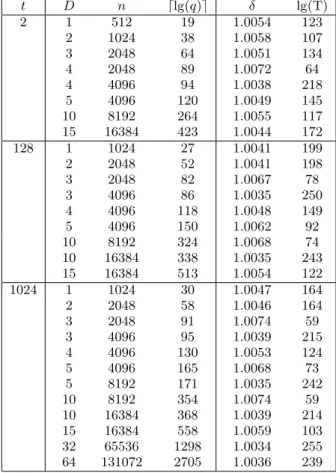
Choice of Parameters.To assess the security of our encryp-tion scheme, we assume that an adversary carries out the attacks described in [MR09, LP11]. We follow the analy-sis described in [LP11] and adjust it to our setting. This leads to specific parameter choices for different required ci-phertext degreesD. The results are summarized in Table 1. According to the analysis in [LP11], the chosen parameters mostly provide a security level of around 128 bits or more against the distinguishing attack with advantage= 2−32.
We explain the choice of the parameters in detail in Ap-pendix A. We end this discussion with the remark that both
n and logq seem to grow almost linearly in D (more pre-cisely, they grow asDlogD). This observation is confirmed by our concrete parameter calculations.
Mean and variance computation. To compute the mean, we do not need any multiplications, just additions of ci-phertexts, i.e. the maximal degree of ciphertext we need is
D= 1. We used the parameters from Table 1 witht= 1024,
D = 1 and n = 1024. The corresponding 30-bit prime is
q = 1061093377 and has been chosen so as to support up to 1000 additions. We do not compute the ciphertext of the mean, but of the sum of all numbers instead together with a ciphertext encrypting the number of numbers that have been added. The mean can then easily be computed
t D n dlg(q)e δ lg(T) 2 1 512 19 1.0054 123 2 1024 38 1.0058 107 3 2048 64 1.0051 134 4 2048 89 1.0072 64 4 4096 94 1.0038 218 5 4096 120 1.0049 145 10 8192 264 1.0055 117 15 16384 423 1.0044 172 128 1 1024 27 1.0041 199 2 2048 52 1.0041 198 3 2048 82 1.0067 78 3 4096 86 1.0035 250 4 4096 118 1.0048 149 5 4096 150 1.0062 92 10 8192 324 1.0068 74 10 16384 338 1.0035 243 15 16384 513 1.0054 122 1024 1 1024 30 1.0047 164 2 2048 58 1.0046 164 3 2048 91 1.0074 59 3 4096 95 1.0039 215 4 4096 130 1.0053 124 5 4096 165 1.0068 73 5 8192 171 1.0035 242 10 8192 354 1.0074 59 10 16384 368 1.0039 214 15 16384 558 1.0059 103 32 65536 1298 1.0034 255 64 131072 2705 1.0036 239
Table 1: Example parameters and cost of the distin-guishing attack from [LP11] for distindistin-guishing
ad-vantage = 2−32, i.e. c ≈ 2.657, modulus t for the
message spaceRt, maximal ciphertext degreeD, size
of prime q, Hermite root factor δ, and logarithm of
the runtimelg(T).
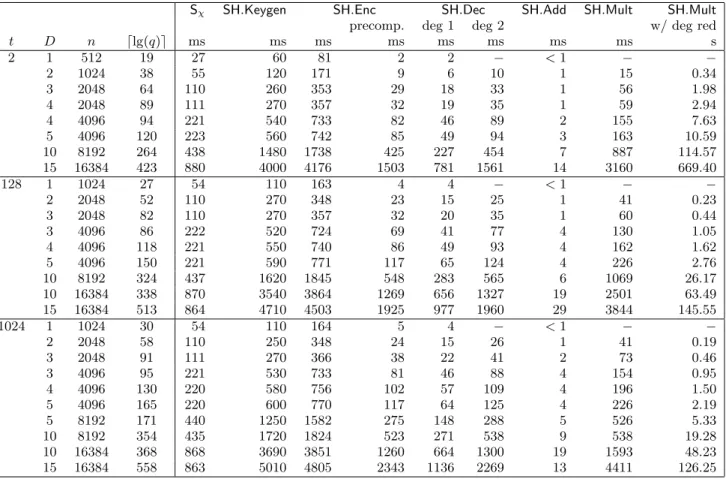
by one division after decryption. Computing the ciphertext for the sum of 100 numbers of size 128-bits from the single ciphertexts takes about 20ms.
Computation of the variance requires one multiplication. Suitable parameters are given in Table 1 ast= 1024,D= 2, andn= 2048 with the 58-bit primeq= 144115188076060673. To obtain the ciphertexts for the sum and sum of squares that can be used to determine mean and variance takes about 6s.
Potential Improvements. We remark that our implementa-tion uses the generic polynomial arithmetic in magma. A number of performance optimizations are possible; we men-tion one such possibility, suggested to us by Daniele Mic-ciancio. The encryption scheme uses addition and multipli-cation of polynomials overZq moduloxn+ 1, wheren is a power of two andq= 1 (mod 2n). However, the particular choice ofn and q could allow for much faster implementa-tions than the genericmagmacode. Such optimizations have already been considered in the context of hash functions (e.g., SWIFFT [LMPR08]) that use fast Fourier-transform techniques to speed up computations.
Sχ SH.Keygen SH.Enc SH.Dec SH.Add SH.Mult SH.Mult
precomp. deg 1 deg 2 w/ deg red
t D n dlg(q)e ms ms ms ms ms ms ms ms s 2 1 512 19 27 60 81 2 2 − <1 − − 2 1024 38 55 120 171 9 6 10 1 15 0.34 3 2048 64 110 260 353 29 18 33 1 56 1.98 4 2048 89 111 270 357 32 19 35 1 59 2.94 4 4096 94 221 540 733 82 46 89 2 155 7.63 5 4096 120 223 560 742 85 49 94 3 163 10.59 10 8192 264 438 1480 1738 425 227 454 7 887 114.57 15 16384 423 880 4000 4176 1503 781 1561 14 3160 669.40 128 1 1024 27 54 110 163 4 4 − <1 − − 2 2048 52 110 270 348 23 15 25 1 41 0.23 3 2048 82 110 270 357 32 20 35 1 60 0.44 3 4096 86 222 520 724 69 41 77 4 130 1.05 4 4096 118 221 550 740 86 49 93 4 162 1.62 5 4096 150 221 590 771 117 65 124 4 226 2.76 10 8192 324 437 1620 1845 548 283 565 6 1069 26.17 10 16384 338 870 3540 3864 1269 656 1327 19 2501 63.49 15 16384 513 864 4710 4503 1925 977 1960 29 3844 145.55 1024 1 1024 30 54 110 164 5 4 − <1 − − 2 2048 58 110 250 348 24 15 26 1 41 0.19 3 2048 91 111 270 366 38 22 41 2 73 0.46 3 4096 95 221 530 733 81 46 88 4 154 0.95 4 4096 130 220 580 756 102 57 109 4 196 1.50 5 4096 165 220 600 770 117 64 125 4 226 2.19 5 8192 171 440 1250 1582 275 148 288 5 526 5.33 10 8192 354 435 1720 1824 523 271 538 9 538 19.28 10 16384 368 868 3690 3851 1260 664 1300 19 1593 48.23 15 16384 558 863 5010 4805 2343 1136 2269 13 4411 126.25
Table 2: Timings for the somewhat homomorphic encryption scheme using the example parameters given in
Table 1. The column labeledSχgives timing for sampling an element from the discrete Gaussian distribution
χ. In the second column for SH.Enc, labeled prec., encryption is measured without sampling fromχ, which
is instead done as a precomputation. The two columns for SH.Dec correspond to decryption of a degree-1
and a degree-2ciphertext, respectively. The last column gives the time taken for a ciphertext multiplication
of two linear ciphertexts including the degree reduction resulting in a degree-1 ciphertext for the product.
6.
EXTENSIONS AND FUTURE WORK
Implementing Fully Homomorphic Encryption. The some-what homomorphic encryption scheme of [BV11b] can be turned into a fully homomorphic encryption scheme using the re-linearization and the dimension reduction techniques of [BV11a]. We leave the problem of implementing the re-sulting fully homomorphic encryption scheme as an impor-tant future work. Implementing bootstrapping could also lead to a number of nice applications of homomorphic en-cryption, for example, to the problem of optimizing commu-nication with the cloud described below.
Optimizing communication with the cloud. We present a solution to help mitigate the problem of the large ciphertext size for the Ring-LWE based FHE solution. In any of the above applications, a client communicates with the cloud service and uploads its data encrypted under a FHE scheme, and the cloud operates on this data and returns encrypted outputs to the client. Each ciphertext has sizenlog(q), and for functions requiring a large number of multiplications,q
andn could be very large (see the implementation section for sample choices ofqandn).
The solution to this is two fold. First, all encryptions that the client sends to the server can be encrypted using AES (which, by itself, is not homomorphic at all). The main observation is that the steps of AES encryption and decryption can all be carried out on FHE-encrypted entries. A one time set-up cost is that the client uploads the FHE-encryption of its AES secret keyK:
”Client sendsF HE(K) to Cloud”
Then for each piece of content m to be uploaded to the cloud, the client uploads only the AES-encryption ofmto the cloud, encrypted under its own secret keyK.
”Client sendsAESK(m) to Cloud”
Now the cloud is expected to operate on the inputs it receives for the client and compute and return FHE-encryptions of functions of those inputs. In order to do that, the cloud must first compute the FHE-encryption ofm: in other words the cloud computes the public key FHE-encryption of the AES encryption of the content,F HE(AESK(m)), and must now unravel the AES encryption inside the FHE encryption to obtainF HE(m). Once this is done, the cloud computes the FHE encryption off(m), for the appropriate functionf.
There is still a snag in this solution, namely that the re-sulting ciphertext that the server returns to the client is still a large FHE ciphertext. The solution to this is the dimen-sion reduction technique introduced by [BV11a]. In particu-lar, the dimension reduction technique converts a ciphertext inZq[x]/hxn+ 1i (where both n and q are large in order to support expressive homomorphisms) to a ciphertext in
Zp[x]/xk+ 1, where both kandpare small. The result-ing ciphertext encrypts the same message, although it does not support any further homomorphisms. The server then applies this transformation and sends the resulting short ci-phertext to the client.
In short, all the communication over the network consists of short, non-homomorphic ciphertexts. At the server’s end, the ciphertexts are first “upgraded” to homomorphic cipher-texts which are then computed on, and finally “downgraded” to short non-homomorphic ciphertexts which are then sent to the client.
7.
REFERENCES
[ACPS09] Benny Applebaum, David Cash, Chris Peikert, and Amit Sahai. Fast cryptographic primitives and circular-secure encryption based on hard learning problems. In Shai Halevi, editor,CRYPTO, volume 5677 ofLecture Notes in Computer Science, pages 595–618. Springer, 2009.
[BCP97] Wieb Bosma, John Cannon, and Catherine Playoust. The Magma algebra system I: The user language.J. Symbolic Comput., 24(3-4):235–265, 1997. Computational algebra and number theory (London, 1993).
[BGN05] Dan Boneh, Eu-Jin Goh, and Kobbi Nissim. Evaluating 2-DNF formulas on ciphertexts. In Theory of Cryptography - TCC’05, volume 3378 of Lecture Notes in Computer Science, pages 325–341. Springer, 2005.
[BV11a] Zvika Brakerski and Vinod Vaikuntanathan. Efficient fully homomorphic encryption from (standard) LWE. In Submission, 2011.
[BV11b] Zvika Brakerski and Vinod Vaikuntanathan. Fully homomorphic encryption from ring-LWE and security for key dependent messages. To Appear in CRYPTO 2011, 2011.
[CLBH09] Melissa Chase, Kristin Lauter, Josh Benaloh, and Eric Horvitz. Patient-controlled encryption: patient privacy in electronic medical records. InACM Cloud Computing Security Workshop, 2009.
[DGHV10] Marten van Dijk, Craig Gentry, Shai Halevi, and Vinod Vaikuntanathan. Fully homomorphic encryption over the integers. In Gilbert [Gil10], pages 24–43.
[El-84] Taher El-Gamal. A public key cryptosystem and a signature scheme based on discrete logarithms. In CRYPTO, pages 10–18, 1984.
[Fre10] David Mandell Freeman. Converting pairing-based cryptosystems from composite-order groups to prime-order groups. In Gilbert [Gil10], pages 44–61. [Gen09] Craig Gentry. Fully homomorphic encryption using
ideal lattices. In Michael Mitzenmacher, editor, STOC, pages 169–178. ACM, 2009.
[Gen10] Craig Gentry. Toward basing fully homomorphic encryption on worst-case hardness. In Tal Rabin, editor,CRYPTO, volume 6223 ofLecture Notes in Computer Science, pages 116–137. Springer, 2010. [GH11] Craig Gentry and Shai Halevi. Implementing
gentry’s fully-homomorphic encryption scheme. In EUROCRYPT, 2011. (To appear).
[Gil10] Henri Gilbert, editor.Advances in Cryptology -EUROCRYPT 2010, 29th Annual International Conference on the Theory and Applications of Cryptographic Techniques, French Riviera, May 30 -June 3, 2010. Proceedings, volume 6110 ofLecture Notes in Computer Science. Springer, 2010. [GM82] Shafi Goldwasser and Silvio Micali. Probabilistic
encryption and how to play mental poker keeping secret all partial information. InSTOC, pages 365–377. ACM, 1982.
[GN08] Nicolas Gama and Phong Q. Nguyen. Predicting lattice reduction. In Nigel P. Smart, editor, EUROCRYPT, volume 4965 ofLecture Notes in Computer Science, pages 31–51. Springer, 2008. [LM06] Vadim Lyubashevsky and Daniele Micciancio.
Generalized compact knapsacks are collision resistant. In Michele Bugliesi, Bart Preneel, Vladimiro Sassone, and Ingo Wegener, editors, ICALP (2), volume 4052 ofLecture Notes in Computer Science, pages 144–155. Springer, 2006. [LMPR08] Vadim Lyubashevsky, Daniele Micciancio, Chris
Peikert, and Alon Rosen. Swifft: A modest proposal for fft hashing. In Kaisa Nyberg, editor,FSE, volume 5086 ofLecture Notes in Computer Science,
pages 54–72. Springer, 2008.
[LP11] Richard Lindner and Chris Peikert. Better key sizes (and attacks) for lwe-based encryption. In Aggelos Kiayias, editor,CT-RSA, volume 6558 ofLecture Notes in Computer Science, pages 319–339. Springer, 2011.
[LPR10] Vadim Lyubashevsky, Chris Peikert, and Oded Regev. On ideal lattices and learning with errors over rings. In Gilbert [Gil10], pages 1–23. Draft of full version was provided by the authors.
[LV01] Arjen K. Lenstra and Eric R. Verheul. Selecting cryptographic key sizes.J. Cryptology,
14(4):255–293, 2001.
[MR07] Daniele Micciancio and Oded Regev. Worst-case to average-case reductions based on gaussian measures. SIAM J. Comput., 37(1):267–302, 2007.
[MR09] Daniele Micciancio and Oded Regev. Lattice-based cryptography. InPost-Quantum Cryptography. Springer, 2009.
[Pai99] Pascal Paillier. Public-key cryptosystems based on composite degree residuosity classes. In
EUROCRYPT, pages 223–238, 1999.
[RS10] Markus R¨uckert and Michael Schneider. Estimating the security of lattice-based cryptosystems. Cryptology ePrint Archive, Report 2010/137, 2010. http://eprint.iacr.org/2010/137.
[SS10] Damien Stehl´e and Ron Steinfeld. Faster fully homomorphic encryption. In Masayuki Abe, editor, ASIACRYPT, volume 6477 ofLecture Notes in Computer Science, pages 377–394. Springer, 2010. [SV10] Nigel P. Smart and Frederik Vercauteren. Fully
homomorphic encryption with relatively small key and ciphertext sizes. In Phong Q. Nguyen and David Pointcheval, editors,Public Key Cryptography, volume 6056 ofLecture Notes in Computer Science, pages 420–443. Springer, 2010.
[SV11] N.P. Smart and F. Vercauteren. Fully homomorphic simd operations. Cryptology ePrint Archive, Report 2011/133, 2011. http://eprint.iacr.org/2011/133.
APPENDIX
A.
CHOICE OF PARAMETERS
We now explain the choice of parameters in our scheme. For simplicity, we analyze the distinguishing attack of [MR09]. We remark that the parameters in the tables also offer a large degree of protection against the more powerful decod-ing attack of [LP11].
The distinguishing attack, in order to succeed with advan-tage, needs vectors of lengthc·q/sin the dual Λ⊥(A). We havec≈p
lg(1/)/(lg 2·π) which for example translates to
c≈2.657 for= 2−32orc≈3.758 for= 2−64.
Since the runtime of the BKZ algorithm is mainly deter-mined by the root Hermite factorδ [LP11], we express the length of the shortest vector in the reduced basis in terms ofδ and get
c·q/s=δm·det(Λ⊥(A))1/m=δm·qn/m.
The optimal runtime of the attack is achieved for m =
p
nlogq/logδwhich gives us the following relation between
q,nandδ:
c·q/s= 22
√
nlogqlogδ
. (6)
To determine specific parameters, we fixed a value forn
which we require to be a power of 2. The correctness condi-tion (2) (or an experimentally confirmed smaller value) gives us a lower bound on the primeq. Also fixing the prime q
now allows us to solve equation (6) forδ and determine a runtimetAdvvia
lgtAdv= 1.8/lgδ−110