A Report on Curriculum Content for a Graduate Program
in Systems Engineering: A Proposed Framework
Rashmi Jain1, Ph.D. Associate Professor
School of Systems and Enterprises Stevens Institute of Technology
Hoboken, NJ 07030 201-216-8047
Dinesh Verma, Ph.D.
Professor
School of Systems and Enterprises Stevens Institute of Technology
Hoboken, NJ 07030 201-216-8645
COPYRIGHT © 2007 BY INCOSE, SUBJECT TO THE FOLLOWING RESTRICTIONS:
AUTHOR USE. AUTHORS AND COLLABORATIVE ORGANIZATIONS HAVE FULL RIGHTS TO USE THEIR CONTRIBUTIONS IN A TOTALLY UNFETTERED WAY WITH CREDIT TO THE INCOSE TECHNICAL SOURCE. ABSTRACTION IS PERMITTED WITH CREDIT TO THE SOURCE.
INCOSE USE. PERMISSION TO REPRODUCE AND USE THIS DOCUMENT OR PARTS THEREOF BY MEMBERS OF INCOSE AND TO PREPARE DERIVATIVE WORKS FROM THIS DOCUMENT FOR INCOSE USE IS GRANTED, WITH ATTRIBUTION TO INCOSE AND THE ORIGINAL AUTHOR(S) WHERE PRACTICAL, PROVIDED THIS COPYRIGHT NOTICE IS INCLUDED WITH ALL REPRODUCTIONS AND DERIVATIVE WORKS.
EXTERNAL USE. THIS DOCUMENT MAY BE SHARED OR DISTRIBUTED TO (COLLABORATIVE TEAM MEMBERS OR NON-INCOSE THIRD PARTIES). REQUESTS FOR PERMISSION TO REPRODUCE THIS DOCUMENT IN WHOLE ARE GRANTED, PROVIDED IT IS NOT ALTERED IN ANY WAY. REQUESTS FOR PERMISSION TO PREPARE DERIVATIVE WORKS OF THIS DOCUMENT FOR EXTERNAL AND/OR COMMERCIAL USE WILL BE DENIED UNLESS COVERED BY OTHER FORMAL AGREEMENTS WITH INCOSE. COPYING, SCANNING, RETYPING, OR ANY OTHER FORM OF REPRODUCTION OF THE CONTENT OF WHOLE PAGES OR SOURCE DOCUMENTS IS PROHIBITED EXCEPT AS APPROVED BY THE INCOSE CENTRAL OFFICE, 2150 N.107TH ST., SUITE 205, SEATTLE, WA 98133-9009.
ELECTRONIC VERSION USE. ANY ELECTRONIC VERSION OF THIS DOCUMENT IS TO BE USED FOR PERSONAL, PROFESSIONAL USE ONLY AND IS NOT TO BE PLACED ON A NON-INCOSE SPONSORED SERVER FOR GENERAL USE. ANY ADDITIONAL USE OF THESE MATERIALS MUST HAVE WRITTEN APPROVAL FROM INCOSE CENTRAL.
PERMISSIONS. INCOSE HAS GRANTED PERMISSION TO MEMBER COMPANIES OF THE INCOSE CORPORATE ADVISORY BOARD AND THE COLLABORATIVE AUTHOR ORGANIZATIONS TO POST AND USE THIS DOCUMENT INTERNALLY, SUBJECT TO THE EXTERNAL USE RESTRICTION.
ACKNOWLEDGEMENTS
Identifying what should be taught in a graduate-level Systems Engineering (SE) program has been the subject of many discussions in the academic community and within industry and government organizations looking for SE and related skills and competencies. The International Council on Systems Engineering (INCOSE) has taken the initiative in the last few years to provide a forum for such discussions. This research report is an outcome of this initiative, and a response to a specific request in this regard from the INCOSE Academic Council, currently chaired by Dr. Dan Hastings, MIT. We would like to acknowledge the foundational thinking and work on the subject of systems engineering education done by Dr. Andrew Sage, George Mason University, and Dr. Wolter Fabrycky, Virginia Tech. In our survey of SE centric graduate programs we build upon Dr. Wolter Fabrycky’s research. Various SE competency models developed within industry and government provided us an understanding of the demand-side of systems engineering education. Specifically, the work done by the UK INCOSE chapter was very helpful in this regard.
We also appreciate the valuable inputs and advise received from the INCOSE Academic Council, the Board of Directors, the Corporate Advisory Board, the University Leadership Roundtable, and finally the Education and Research Technical Committee. Specifically, the work done by the SE Curriculum Committee was invaluable to the development of this report. Finally, and most importantly, we would also like to thank Alice Squires and Anithashree Chandrasekaran, both doctoral students at Stevens Institute of Technology, for their support in collecting, and analyzing volumes of data collected. Without their support such extensive an effort would not have been possible.
Rashmi Jain, Ph.D. Dinesh Verma, Ph.D. September 15, 2007
TABLE OF CONTENTS
1. ABSTRACT 5
2. INTRODUCTION 5
2.1. RESEARCH METHODOLOGY...6
i. Survey of Systems Engineering Centric Programs...7
ii. Survey of systems engineering skills and competencies...10
3. REVIEW OF SE PROGRAMS AND CURRICULUMS 11 3.1. COMMONALITIES AND PATTERNS...11
3.2. SECOMPETENCIES –INDUSTRY NEEDS...12
3.3. GAPS ANALYSIS IN THE SEPROGRAMS...14
i. Correlation of the topical areas offered by Academia with SE competencies desired by Government and Industry...14
ii. Correlation within the identified topical areas...14
4. PROPOSED FRAMEWORK 16 5. FUTURE RESEARCH 19 6. CONCLUSIONS 19 7. REFERENCES 19 8. APPENDIX I 21 9. APPENDIX II 22 10. APPENDIX III 28 List of Figures Figure 1 The research methodology followed to develop this reference curriculum... 7
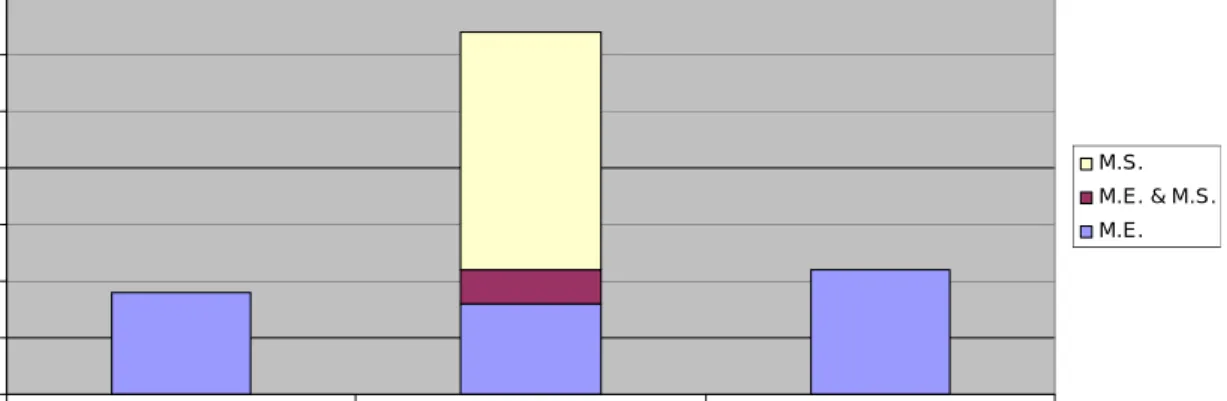
Figure 2 A distribution of degrees offered by US based SE centric programs... 8
Figure 3 The regional dispersion of Graduate SE Programs in the United States... 8
Figure 4 The QFD correlations key... 12
Figure 5 Gap Analysis represented in a QFD Matrix... 13
Figure 6 A proposed reference SE curriculum framework... 17
List of Tables Table 1 Systems engineering degrees awarded by University... 9
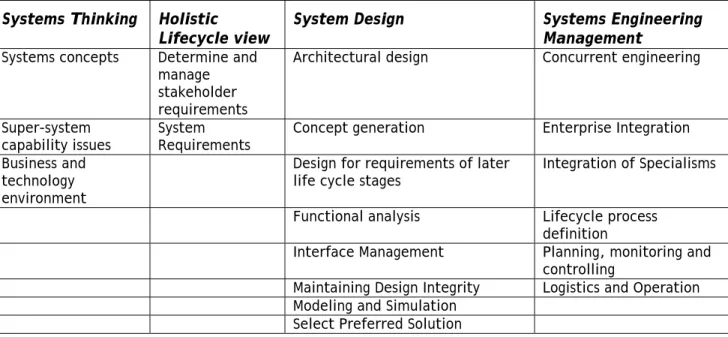
Table 2 SE Competencies... 10
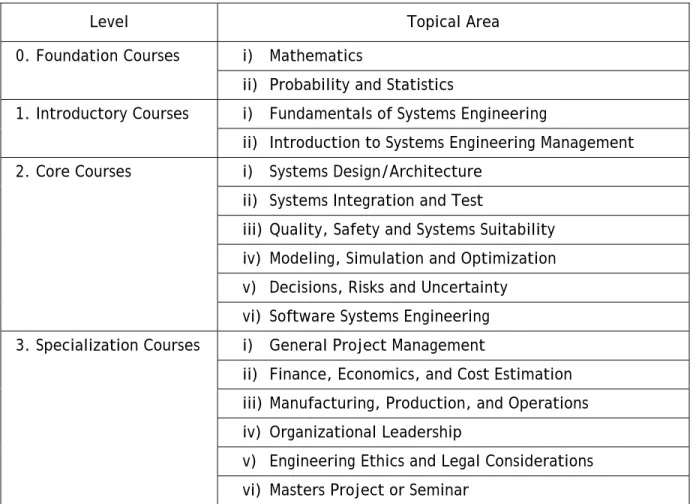
Table 3 Levels of Graduate Systems Engineering Topical Areas... 11
Table 4 Topical area groupings into curriculum levels... 12
Table 5 Example of Proposed SE Curriculum Framework... 18
Table 6 University Websites Analyzed for Course Descriptions... 21
Other Attachments:
INCOSE UK Advisory Board, “Systems Engineering Core Competencies Framework”, INCOSE UK, 2005
Fabrycky, W., McCrae, E., “Systems Engineering Degree Programs in the United States”, INCOSE International Symposium, 2005
1. Abstract
Numerous academic institutions worldwide have developed courses and programs of study within the field of systems engineering, architecting, and integration. These programs are often a function of their academic legacies and strengths, along with their perception about the educational needs of their primary audiences – students and sponsors, both within industry and government. Some of the legacy factors may be determined by the history of academia-industry partnerships, concentration of a specific industry or resources in a region etc. This perception, or sense for the needs of an audience, is often based on interviews, exchange forums, and surveys, and sometimes on informal assessments through a variety of interchanges. Academia and industry often differ in the definition of the scope of a systems engineering (SE) curriculum. The assessment of industry and government requirements for SE competencies represents the “demand side” of education and competency development enterprise. One important aspect of the “supply side” is represented and provided by academia.
This paper proposes a reference systems engineering curriculum at the graduate level. This is based on a study of systems engineering programs at 35 Universities in the US and the correlation of these programs with some published reports from industry and government on systems engineering competency requirements. The study was initiated based on a request from the Academic Council of INCOSE, and
supported by the Systems Engineering Curriculum Working Group2 within INCOSE. The
proposed framework does not include the application domain offerings required within a SE curriculum which is very critical to the application of SE. This is intended to be included into the SE centric programs in the form of capstones, use of case-studies, team-projects, popularizing thesis requirement for a graduate degree.
2. Introduction
An increasing number of universities are offering graduate programs in systems engineering, while simultaneously a number of corporations in the commercial and defense sectors have articulated needs for systems engineering skills and competencies. Within this environment, the need for a reference curriculum has often been articulated in a variety of meetings within the systems engineering community. This need resulted in a specific request by the Academic Council of
2 The SE Curriculum Working Group of INCOSE provided critical input to make this study and paper possible.
Members of this working group are: R. D. Adcock (Cranfield University, UK), Tim Eveleigh (ImageMatters LLC, UK), Jose Fernandez (Industrial Engineering School, Madrid Technical University (UPM), Spain), John Hooper (Loughborough University, UK), Ady James (University College, London, UK), Philip John (Cranfield University), Rashmi Jain – Chair of the WG (Stevens Institute of Technology, USA), Joseph Kasser (University of South Australia, Australia), Herbert Longenecker (University of South Alabama, USA), Mark Powell (SAIC, USA), David Yarborough (Northrop Grumman, USA), Ricardo Valerdi (MIT, USA), Annalisa Weigel (MIT, USA), Stanley Weiss (Stanford University, USA).
INCOSE to conduct the necessary research to develop such a reference curriculum.
This paper presents this research and a proposed reference curriculum3. This
curriculum has also been reviewed by members of the SE University Leadership
Roundtable of INCOSE4.
The research methodology for developing the reference curriculum was developed by the SE Curriculum Working Group within INCOSE. The group met through teleconferences during April – July 2006.
2.1. Research Methodology
The methodology for undertaking this research on SE curriculum was conducted in the following phases as also illustrated in Figure 1:
• Identify all US based Graduate SE Programs and their point-of-contact
• Collect data on them and their curriculum through published secondary sources
as well as more specific information directly provided by the programs.
• Assimilate this information into an exhaustive database. Synthesize the
curriculum information to resolve overlapping topics and redundancies into a list of Topical Areas.
• Research on sources of information for SE competency needs of the industry.
• Consolidate and synthesize information from these sources into a list of
industry required SE competencies.
• Map the Topical Areas to the SE competencies in terms of the extent to which
TAs cover the required competencies and identify the gaps.
• Propose a reference SE curriculum framework based on the mapping.
For the purpose of this research, attention was focused on systems engineering centric programs as proposed by Fabrycky [2005]. According to Fabrycky [2005] Systems Engineering Centric (SEC) Program includes “basic and advanced level programs leading to a bachelors or higher degree in Systems Engineering comprise a distinct category with a discipline-like focus. Included herein are only those degree programs where the concentration is designated as Systems Engineering; where SE is the intended major area of study”. Whereas Domain Centric Systems Engineering (DCSE) Programs includes “basic and advanced level programs leading to a bachelors or higher degrees with the major designated as X Systems Engineering, Systems and X Engineering, etc”.
3 The Academic Council within INCOSE constitutes academic leaders from around the world. It was formed in 2002
and provides advice and counsel to the INCOSE Board of Directors.
4 The SE University Leadership Roundtable constitutes a forum of Systems Engineering Department and Program
Figure 1 The research methodology followed to develop this reference curriculum.
Domain Centric SE programs were purposely omitted from this study. Although of great importance, these programs are largely the purview of the domain societies. This research was conducted under the inspiration and guidance of INCOSE, a professional society seeking participating body status within the Accreditation Board for Engineering and Technology (ABET). A concentration on the SE Centric programs was found to be a reasonable way to limit and focus the findings on the academic sector of primary concern to INCOSE. In due time, this study could be extended into the domain centric SE areas through cooperation with the cognizant professional societies.
i. Survey of Systems Engineering Centric Programs
This initial survey of existing SE programs was based on previous work done by Fabrycky [2005], Infozee [2006], Thomson Peterson [2006], U.S.News & World Report [2006], and the ABET SE initiative (http://www.abet.org/systems.shtml). This initial survey was complemented with the efforts of the SE Curriculum Working Group. According to the estimates of Brown and Scherer [2000] on graduate systems engineering majors, there are less than 500 B.S. degrees, 250 M.S. (including M.E. and other designations) degrees, and 50 Ph.D. degrees granted each year. This was based on data that is now 10 years old, so the numbers would be considerably larger today. Brown and Scherer found some notable commonalities in the programs by the use of cluster analysis. It was found that SE education in the US has four major directions: systems analysis and design, industrial engineering, traditional control systems, and
control systems plus other topics. Of the major issues identified by the Brown and Scherer study [2000], the first was how schools should provide education in SE. Thus, defining an educational core (body of knowledge) in SE that differentiates it from other fields is of utmost importance. The role of professional societies such as IIE, IEEE, INFORMS, and INCOSE was also noted as being disappointing. None of these societies have been successful in defining a core body of SE knowledge that could be considered by academic institutions. INCOSE has attempted to provide guidance on major topics such as requirements analysis, standards, software tools, and SE metrics but few programs offer one course let alone multiple courses in these areas.
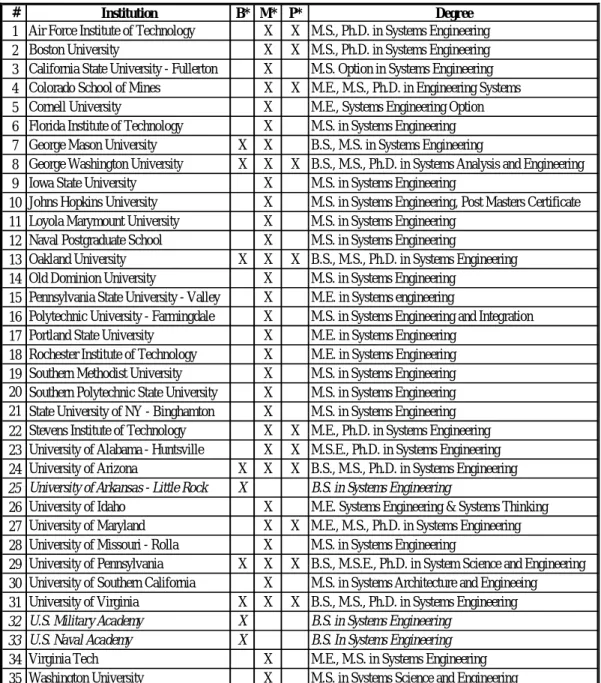
The graduate systems engineering programs included in this study are listed in the Table 1. In terms of their regional dispersion, more than half of these are in the
Eastern Region5, another third in the Central Region, and remaining in the Western
(Figure 3). 32 out of the total 35 universities offer graduate degrees (M.S. and M.E.), a fourth of them have undergraduate degrees, and a third of them have doctoral programs (Figure 2). 0 5 10 15 20 25 30 35 Bachelors Masters Ph.D. Degrees SE C e n tr ic Pr o g ra ms M.S. M.E. & M.S. M.E.
Figure 2 A distribution of degrees offered by US based SE centric programs.
Eastern Region 52% Central Region 34% Western Region 14%
Figure 3 The regional dispersion of Graduate SE Programs in the United States.
All universities with graduate systems engineering programs had some level of information on a publicly accessible website and initial course descriptions were collected from these sites listed in the Appendix I, Table 6. Additional information on the courses (and course outlines) offered by these programs was obtained from a variety of ways, to include: letters to the universities, graduate catalogs obtained from universities, information provided by program contacts, course descriptions obtained from the program catalogs, published papers on SE curriculum, and professional societies. Over one third of the universities responded (37.5% return rate) to our request for detailed course descriptions and outlines.
Table 1 Systems engineering degrees awarded by University.
# Institution B* M* P* Degree
1 Air Force Institute of Technology X X M.S., Ph.D. in Systems Engineering 2 Boston University X X M.S., Ph.D. in Systems Engineering 3 California State University - Fullerton X M.S. Option in Systems Engineering 4 Colorado School of Mines X X M.E., M.S., Ph.D. in Engineering Systems 5 Cornell University X M.E., Systems Engineering Option 6 Florida Institute of Technology X M.S. in Systems Engineering 7 George Mason University X X B.S., M.S. in Systems Engineering
8 George Washington University X X X B.S., M.S., Ph.D. in Systems Analysis and Engineering 9 Iowa State University X M.S. in Systems Engineering
10 Johns Hopkins University X M.S. in Systems Engineering, Post Masters Certificate 11 Loyola Marymount University X M.S. in Systems Engineering
12 Naval Postgraduate School X M.S. in Systems Engineering
13 Oakland University X X X B.S., M.S., Ph.D. in Systems Engineering 14 Old Dominion University X M.S. in Systems Engineering
15 Pennsylvania State University - Valley X M.E. in Systems engineering
16 Polytechnic University - Farmingdale X M.S. in Systems Engineering and Integration 17 Portland State University X M.E. in Systems Engineering
18 Rochester Institute of Technology X M.E. in Systems Engineering 19 Southern Methodist University X M.S. in Systems Engineering 20 Southern Polytechnic State University X M.S. in Systems Engineering 21 State University of NY - Binghamton X M.S. in Systems Engineering 22 Stevens Institute of Technology X X M.E., Ph.D. in Systems Engineering 23 University of Alabama - Huntsville X X M.S.E., Ph.D. in Systems Engineering 24 University of Arizona X X X B.S., M.S., Ph.D. in Systems Engineering 25 University of Arkansas - Little Rock X B.S. in Systems Engineering
26 University of Idaho X M.E. Systems Engineering & Systems Thinking 27 University of Maryland X X M.E., M.S., Ph.D. in Systems Engineering 28 University of Missouri - Rolla X M.S. in Systems Engineering
29 University of Pennsylvania X X X B.S., M.S.E., Ph.D. in System Science and Engineering 30 University of Southern California X M.S. in Systems Architecture and Engineeing 31 University of Virginia X X X B.S., M.S., Ph.D. in Systems Engineering 32 U.S. Military Academy X B.S. in Systems Engineering
33 U.S. Naval Academy X B.S. In Systems Engineering 34 Virginia Tech X M.E., M.S. in Systems Engineering 35 Washington University X M.S. in Systems Science and Engineering
ii. Survey of systems engineering skills and competencies
A number of industry and government surveys and studies [Kasser, 2004], [Kasser et al, 2006], [MIT, 2003], [Lockheed Martin, 2006], [INCOSE UK, 2005], [Stevens Institute of Technology, 2003] helped with the understanding of required systems engineering competencies and skills. References to a selection of these studies are included here:
• Engineering Process Improvement, “SE Curriculum”, EPI 270-15 Rev. 1.1, April
5, 2006, Lockheed Martin, 2006.
• INCOSE UK Advisory Board, “Systems Engineering Core Competencies
Framework”, INCOSE UK, 2005. This report referenced the following:
o International Standards Organization ISO15288,
o Capability Maturity Model Integration,
o EIA731,
o INCOSE Systems Engineering Body of Knowledge & Handbook,
o NASA Handbook,
o IEE/BCS Safety Competency Guidelines,
o A review of systems engineering competency requirements from companies
such as BAE Systems, EADS Astrium, General Dynamics, Loughborough University, Ministry of Defense (Director General Smart Acquisition), Thales, University College London, and feedback from the Systems Engineering Community.
• Stevens Internal Survey, Feb, 2003
The list of SE Competencies obtained from the above sources and considered for this study is shown in Table 2. The descriptions of the competencies are included in Appendix II, Table 7.
Table 2 SE Competencies Systems Thinking Holistic
Lifecycle view System Design Systems Engineering Management Systems concepts Determine and
manage stakeholder requirements
Architectural design Concurrent engineering
Super-system
capability issues System Requirements Concept generation Enterprise Integration Business and
technology environment
Design for requirements of later life cycle stages
Integration of Specialisms
Functional analysis Lifecycle process definition
Interface Management Planning, monitoring and controlling
Maintaining Design Integrity Logistics and Operation Modeling and Simulation
Systems Thinking Holistic
Lifecycle view System Design Systems Engineering Management
System Robustness
Integration & Verification
Validation
Transition to Operation
3. Review of SE programs and curriculums
For the initial analysis, the study focused on the core courses for a systems engineering degree. In some cases, elective courses were included when applicable. 203 graduate courses were analyzed from the 35 universities listed.
3.1.Commonalities and Patterns
Course descriptions and outlines were reviewed and an initial set of Topical Areas (TAs) defined. There were continuously refined as additional information on course offerings was received. This analysis for looking for overlaps, gaps, redundancies continued until each course was defined and reviewed through several iterations [Jain, 2006]. This was done to reduce the confusion caused by multiple course titles for similar topics, and similar course titles for a diversity of topics.
As the final outcome of this synthesis a comprehensive list of course descriptions was accomplished that can be used for a proposed SE curriculum framework. Once the baseline course descriptions [Jain, 2006] were finalized, each course was placed into one of the four levels listed in Table 3. The final grouping of the sixteen topical areas into four levels is shown in Table 4. The descriptions of each of the sixteen topical areas in Table 4 are included in Appendix II.
Table 3 Levels of Graduate Systems Engineering Topical Areas. Level 0:
Foundation Courses
Pre-systems engineering courses. Students must be competent in these areas to enter the systems engineering graduate program.
Level 1: Introductory Courses
Fundamental systems engineering courses for the beginning graduate student. These are the initial courses taken in the systems engineering graduate program.
Level 2: Core Courses
Required core courses towards the completion of a graduate degree in Systems Engineering. These are recommended as core courses in any systems engineering program.
Level 3: Specialization Courses
Either advanced courses which focus on systems engineering niches or special areas related to systems engineering. Students focus on specialization courses once the initial and core courses are complete.
Table 4 Topical area groupings into curriculum levels.
Level Topical Area
i) Mathematics 0.Foundation Courses
ii) Probability and Statistics
i) Fundamentals of Systems Engineering 1.Introductory Courses
ii) Introduction to Systems Engineering Management i) Systems Design/Architecture
ii) Systems Integration and Test
iii) Quality, Safety and Systems Suitability iv) Modeling, Simulation and Optimization v) Decisions, Risks and Uncertainty 2.Core Courses
vi) Software Systems Engineering i) General Project Management
ii) Finance, Economics, and Cost Estimation iii) Manufacturing, Production, and Operations iv) Organizational Leadership
v) Engineering Ethics and Legal Considerations 3.Specialization Courses
vi) Masters Project or Seminar
3.2.SE Competencies – Industry Needs
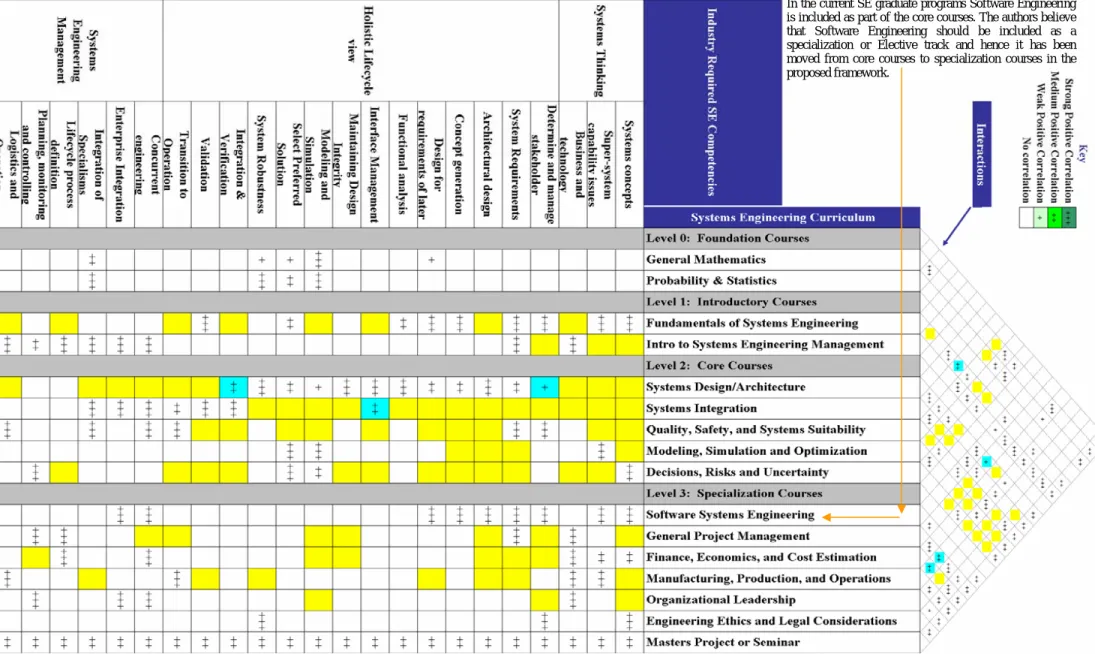
The topical areas and their curriculum level groupings were next cross referenced to industry needs through a Quality Function Deployment (QFD) exercise to identify gaps in the process or gaps in the ability to meet industry needs, as shown in
Figure 5. This process was repeated until industry needs were sufficiently addressed
and the topical areas were refined into a suggested SE curriculum. The correlation is analyzed in terms of “Strong Positive”, “Medium Positive”, “Weak Positive”, “No correlation” categories as shown in Figure 4.
Figure 5 Gap Analysis represented in a QFD Matrix.
is included as part of the core courses. The authors believe that Software Engineering should be included as a specialization or Elective track and hence it has been moved from core courses to specialization courses in the proposed framework.
3.3.Gaps Analysis in the SE Programs
In reviewing existing SE programs and mapping their offerings to industry needs, this research has identified missing topics and topics that could be strengthened.
i. Correlation of the topical areas offered by Academia with SE
competencies desired by Government and Industry
The gap analysis identified the following industry required SE competencies as not being addressed adequately by the courses offered in the current SE centric programs:
• System concepts
• Architectural design
• Modeling and simulation
The next level of SE competencies identified as not being adequately covered by the existing course offerings are:
• System requirements
• Determine and manage stakeholder requirements
• Super-system capability issues
In order to fill-up the gaps as identified above the topical areas in the existing SE course offerings that have to be revised and modified are:
• Level 1: Introductory Courses
o Fundamentals of SE
• Level 2: Core course
o System design/architecture
o Systems integration
o Quality, safety, and systems suitability
o Decisions, risks and uncertainty
ii. Correlation within the identified topical areas
The second category of gaps in the analysis is amongst and within the sixteen topical areas identified. This category of correlation indicates how one topical area is related to the others. The assumption is that a complete SE course offering should be such that they are interrelated and as a result reinforce the concepts that are covered in each of these course offerings. For example, if the topic of interfaces is introduced in an introductory course of fundamentals of SE then whether this topic is further developed in the system design and architecture, and covered in system integration and testing. The research revealed that the following three core courses had weak relationship or absence of any relationship with the other topical areas:
• Quality, safety, and systems suitability
• Modeling, simulation and optimization
• Decisions, risks and uncertainty
The most serious gaps were noticed between the above three core courses and the three specialized/elective courses below:
• General project management
• Finance, economics, and cost estimation
• Organizational leadership
While the intent of this correlation is not to suggest a tight coupling between all topical areas and resulting courses, rather the desire is to embed enough correlating themes in these courses to allow the emergence of an appreciation for the cross-cutting implications of the topics when applying a systems approach. The authors believe that a mature and evolving curriculum will allow sufficient links across courses to exemplify this systems perspective. Another approach to address this is by including more capstone projects and group work in the curriculum.
The requirement for a Master’s Thesis will be the most effective way of integrating the concepts from the individual courses and applying them to a research problem. Academic programs which do not have thesis requirement can address this by incorporating capstone courses that pull together concepts from multiple courses. Some programs have successfully introduced case-study method of teaching to create linkages between the different courses being taught within a graduate SE curriculum. While discussing improvements and enhancements in SE course offerings to better address industry needs, it is worth referencing the major ingredients associated with reshaping the curriculum cited by Andy Sage [2000] on the basis of an ASEE study in 1994. [Sage,1994]. These are: team skills, and collaborative, active learning; communication skills; a system perspective; a understanding and appreciation of diversity; appreciation of different cultures and business practices, and understanding that engineering practice is now global; integration of knowledge throughout the curriculum a multidisciplinary perspective; commitment to quality, timeliness, continuous process improvement; undergraduate research and engineering work experience; understanding of social, economic, and environmental impact of engineering decisions; and ethics. The SE graduate program must demonstrate that the graduates have the ability to participate in the design and integration of effective, life-cycle balanced systems by addressing the form, fit and function of both the product and the development process. An emphasis on system design for successful life-cycle outcomes must be present, with evidence that the curriculum provides preparation for engineering practice as part of a development team (INCOSE
Internal Document, 2005). Our intent has not been to propose a prescriptive curriculum. It is intended that the proposed curriculum would help address the above discussed goals. Some of these may be more suitably addressed through pedagogy, and teaching tools and techniques.
4. Proposed framework
A framework for a reference curriculum in systems engineering at the graduate level that was proposed to the INCOSE Academic Council in our report [2007] is proposed herein. The proposed framework takes into consideration the commonalities and patterns in SE education content as it is taught today. The focus is only on the knowledge content of the curriculum and not on behavioral skills and domain application related content. One of the main objectives of proposing a reference curriculum of SE is to try to bridge the gap between the expected systems engineering competencies by the potential employers and the graduate SE program curriculums. The framework is proposed to support the development of new graduate programs in systems engineering and the enhancements to the existing SE graduate programs. The framework assumes an entry criterion into the program similar to those required by other graduate engineering majors, which includes some combination of four years’ of science and engineering college education. Such combination of science and engineering varies between the different SE graduate programs.
The two other aspects that we have not addressed within the scope of our reference curriculum are the application domains and the basic skills and behaviors (soft skills) [INCOSE UK, 2005]. Both these aspects are necessary to be addressed in a SE curriculum. However, the emphasis, pedagogy, and concepts to be used will vary depending upon the socio-cultural aspects of the region, organizational practices, and relevance to an application domain. As a result there may be many different approaches to addressing these topics in a curriculum.
The INCOSE UK chapter report includes the following ‘usual common attributes required by any professional engineer’ that System Engineers need to be strong in: coaching, communication (verbal, non-verbal, and technical report writing), knowing when and how to listen, knowing when to ask, lateral thinking, negotiation and influencing, and team working.
Similarly, domain knowledge will vary from industry to industry and it will be a challenge to come up with a SE curriculum offering to provide domain-specific competencies for every possible application domain. Some of the application domains addressed in popular SE programs are aerospace, defense etc.
Level 0: Foundation Courses
Level 0: Foundation Courses
Level 0: Foundation Courses Level 1: Introductory Courses
(9 Credits)
Level 1: Introductory Courses
Level 1: Introductory Courses (9 Credits)
Level 2: Core Courses (12 Credits)
Level 2: Core Courses
Level 2: Core Courses
(12 Credits) Level 3: (9 Credits)Level 3: Level 3: (9 Credits)
•
• General MathematicsGeneral Mathematics
•
• Probability & StatisticsProbability & Statistics
•
• Fundamentals of Systems EngineeringFundamentals of Systems Engineering
•
• Intro to Systems Engineering Intro to Systems Engineering Management
Management •
• Systems Design/ArchitectureSystems Design/Architecture
•
• Systems Integration and TestSystems Integration and Test
•
• Quality, Safety, and Systems SuitabilityQuality, Safety, and Systems Suitability
•
• Modeling, Simulation and OptimizationModeling, Simulation and Optimization
•
• Decisions, Risks and UncertaintyDecisions, Risks and Uncertainty
Specialization Courses
Specialization Courses •
•Software Systems EngineeringSoftware Systems Engineering
•
•General Project ManagementGeneral Project Management
•
•Finance, Economics, and Cost EstimationFinance, Economics, and Cost Estimation
•
•Manufacturing, Production, and OperationsManufacturing, Production, and Operations
•
•Organizational LeadershipOrganizational Leadership
•
•Engineering Ethics and Legal ConsiderationsEngineering Ethics and Legal Considerations
•
•Masters Project or SeminarMasters Project or Seminar
Figure 6 A proposed reference SE curriculum framework.
The proposed framework has the following three dimensions:
• Topical Area: A list of graduate SE courses that are being offered at the
graduate level was compiled. This list was expanded with identified required courses in systems engineering based on the results of the curriculum analysis. The graduate courses were then categorized based on the topical areas covered, and commonalities in learning concepts in each course. The proposed framework has 16 topical areas of systems engineering courses.
• Level: The graduate courses analyzed by us include both sciences and applied
sciences for systems engineering. Level defines the state of our knowledge and understanding of a given topical area. Level is required to increase the understanding by sequencing these courses in the order of fundamentals and advanced courses. Identification of levels helps laying down the foundation for courses and promotes cognitive systems thinking. The proposed framework identifies 4 levels of graduate courses.
• SE Competencies: The identified areas of graduate level systems engineering
courses are correlated with systems engineering competencies that the industry needs from their SE majors. This correlation was explained in detail in the previous section of the paper.
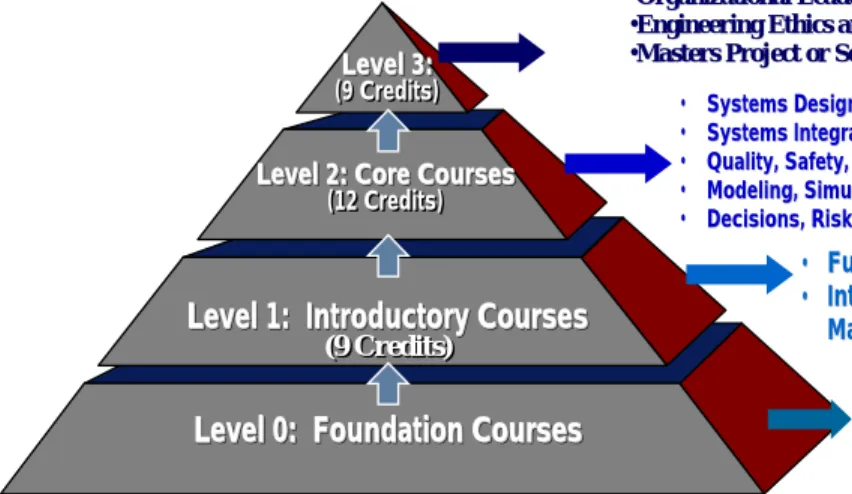
The Figure 6 shows the proposed framework in two dimensions, namely level and topical area. The descriptions of the topical areas are provided in Appendix II. The proposed framework does not provide guidance on the number and names/title of courses that a graduate program can have under each topical area. Individual graduate programs may want to reference the proposed framework and not be
constrained by it in any way. It assumes that the pedagogy of teaching the graduate courses is specific to each graduate program. Therefore, the teaching pedagogy and graduate level courses will evolve with the growth and maturity of the SE field.
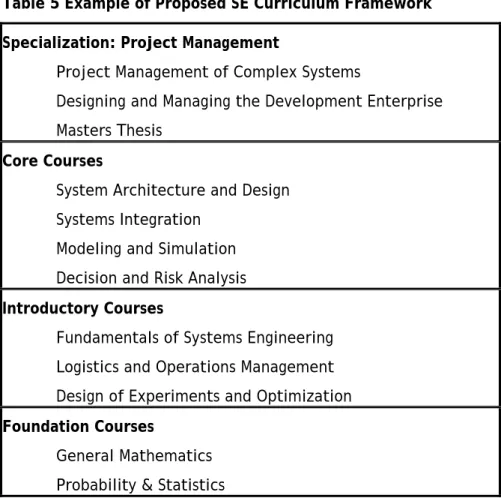
The proposed credit-hours will also vary based on specific requirements and domain-focus of a program, and its targeted audience. Credit hours have only been included as an indication of level of effort on a specific topical area. Therefore, a program may decide to not have 9 credit hours worth of introductory courses (Level 1) in its curriculum and rather have more than 12 credit hours worth of Level 2 (core courses). The elective or specialization topical areas will also vary depending upon the domain-focus and target audience for a specific program. The list provided of the elective topical areas is only a sample list. The total number of elective courses that a student may take for a graduate SE degree will vary based on specific program requirements and domain-specificity of the degree. A sample graduate curriculum with specialization in Project Management is described in Table 5.
Table 5 Example of Proposed SE Curriculum Framework Specialization: Project Management
• Project Management of Complex Systems
• Designing and Managing the Development Enterprise • Masters Thesis
Core Courses
• System Architecture and Design • Systems Integration
• Modeling and Simulation • Decision and Risk Analysis
Introductory Courses
• Fundamentals of Systems Engineering • Logistics and Operations Management • Design of Experiments and Optimization
Foundation Courses
• General Mathematics • Probability & Statistics
5. Future Research
The analysis included this research includes an international perspective on SE competencies desired by government and industry; however the analysis of SE courses and topical areas is US centric. Additional research will be required to address the necessary international perspective in the curriculum analysis. Future initiatives in curriculum analysis will also need to identify and study the project work and group work component. This is key in conveying the application of the theoretical concepts while also understanding the interdependent concepts that are likely covered in separate standalone courses. The integration of multiple SE topical areas into capstones, use of case-studies, popularizing thesis requirement for a graduate degree are some of the application components of SE curriculum that will have to be studied. As the field of systems engineering matures, similar analysis will become necessary at the undergraduate and doctoral levels.
6. Conclusions
This research established a strong need for a reference SE curriculum framework. The SE community realizes that there are many perspectives on the scope and content of a systems engineering curriculum, and there is a need for relative convergence in this regard. This is necessary and more urgent in an environment where the industry and government needs for SE competencies are growing.
The reference SE curriculum proposed in this paper is based on a correlation of industry needs and existing graduate level curriculum focused on systems engineering. The intent is to cause a convergence between the two while realizing the role of a university and the emphasis on education, rather than training.
The proposed curriculum uses a four level approach beginning with a foundation in mathematics and introductory systems engineering courses. It then transitions to core systems engineering courses supplemented with advanced and special courses related to systems engineering. The recommended framework is comprised of a baseline of sixteen systems engineering and related topical areas for universities to consider when developing a graduate level program of study in systems engineering.
7. References
1. Brown, D., Scherer, W., "A Comparison of Systems Engineering Programs in the
United States", IEEE Transactions on System, Man, and Cybernetics, Vol. 30, No. 2, May 2000.
2. Engineering Process Improvement, “SE Curriculum”, EPI 270-15 Rev. 1.1, April 5,
2006, Lockheed Martin, 2006.
3. Fabrycky, W., McCrae, E., “Systems Engineering Degree Programs in the United
States”, INCOSE International Symposium, 2005.
5. INCOSE UK Advisory Board, “Systems Engineering Core Competencies Framework”, INCOSE UK, 2005.
6. Jain, R., “A Reference Framework for Systems Engineering Curriculum”, Academic
Council Presentation, INCOSE Symposium, July, 11, 2006.
7. Jain, R, Verma, D., “Proposed Proposing a Framework for a Reference Curriculum
for a Graduate Program in Systems Engineering”, INCOSE Academic Council Report, January, 29, 2007.
8. Kasser, J., “Reorganizing SE”, SEEC RG, INCOSE-Australia and SESA-SA Chapter
meeting, 2006.
9. Kasser, J., Cook, S., Larden, D., Daley, M., Sullivan, P., “Crafting a postgraduate
degree for industry and government”, International Engineering Management Conference, 2004.
10. MIT Curriculum Design, “Committee on curriculum approved CDIO design,
Aero/Astro MIT, Fall ’05 – Spring ’06”, 2003.
11. Sage, A., “Systems Engineering Education”, IEEE Transactions on System, Man,
and Cybernetics, Vol. 30, No. 2, May 2000.
12. Stevens Internal Survey, Feb, 2003
13. Thomson Peterson’s guide at:
http://www.petersons.com/ugchannel/code/searches/
srchRslt.asp?sponsor=1&searchtype=multicrit&multicrit=y&sortcolumn=CLIENT_CH ECK,ISORT&sortorder=; 5/29/2006
14. U.S.News & World Report:
http://www.usnews.com/usnews/edu/college/majors/brief/major_14-27_brief.php; 5/26/2006
15. Sage, A., “Engineering Education for a Changing World” American Society for
8. Appendix I
Table 6 University Websites Analyzed for Course Descriptions.
# Institution WEBSITE
1 Air Force Institute of Technology http://www.afit.edu/cse/index.cfm
2 Boston University http://www.bu.edu/dbin/ece/web/grad/index.html 3 California State University - Fullerton http://www.fullerton.edu/ECS/ee/eemasters_02.htm 4 Colorado School of Mines http://egweb.mines.edu/
5 Cornell University http://www.systemseng.cornell.edu/CourseList.html 6 Florida Institute of Technology http://www.fit.edu/AcadRes/se/
7 George Mason University http://www.seor.gmu.edu/seor.html
8 George Washington University http://www.seasva.gwu.edu/gwu/dept/emse/index.htm 9 Iowa State University http://www.ede.iastate.edu/gradprograms.asp?gp=se 10 Johns Hopkins University http://www.epp.jhu.edu/05_06_catalog/se.html 11 Loyola Marymount University http://www.lmu.edu/Page24244.aspx
12 Naval Postgraduate School http://www.nps.navy.mil/se/pd21/curriculumnew.htm 13 Oakland University http://www2.oakland.edu/secs/ISEdept/
14 Old Dominion University http://www.eng.odu.edu/enma/
15 Pennsylvania State University - Valley http://gv.psu.edu/Prospective_Students/Degrees___Certificates/ Systems_Engineering/
16 Polytechnic University - Farmingdale http://www.poly.edu/li/academics/programs/ systems_engineering.php
17 Portland State University http://www.eas.pdx.edu/Systems/program/index.html 18 Rochester Institute of Technology http://www.rit.edu/~633www/grad/msie.html#committee 19 Southern Methodist University http://engr.smu.edu/emis/Programs/MS_SE/ms_se.html 20 Southern Polytechnic State University http://www.spsu.edu/mssye/
21 State University of NY - Binghamton http://www.ssie.binghamton.edu/ 22 Stevens Institute of Technology http://www.stevens.edu/sdoe
23 University of Alabama - Huntsville http://www.engdl.uah.edu/iseem/graduate/default.htm 24 University of Arizona http://www.sie.arizona.edu/
25 University of Arkansas - Little Rock
26 University of Idaho http://www.engboi.uidaho.edu/default.aspx?pid=85613 27 University of Maryland http://www.isr.umd.edu/ISR/about.html
28 University of Missouri - Rolla http://emgt.umr.edu/
29 University of Pennsylvania http://www.ese.upenn.edu/grad/mse.html 30 University of Southern California http://www.usc.edu/dept/ise/
31 University of Virginia http://www.sys.virginia.edu/grad/
32 U.S. Military Academy http://www.se.usma.edu/newsite/home/startup.asp?f=home
33 U.S. Naval Academy
34 Virginia Tech http://www.ise.vt.edu/ise.htm
9. Appendix II
Level 0: Foundation Courses
Foundation courses may be offered as prerequisites to a systems engineering program, where the students are given the option to show competency in each area through testing. However, if the testing indicates, the courses should be successfully completed before continuing in the program. The course descriptions for the two topical areas of foundation courses are shown below.
General Mathematics
Foundational Mathematics courses cover Numerical methods of continuous and discrete-time linear systems; Continuous-time and discrete-time stochastic processes; Linear or Matrix Algebra; Linear programming; Ordinary and partial differential equations; Bessel and Legendre functions; Fourier, Laplace, Z-transforms, etc... as required to support the level of mathematics used in the introductory, core and advanced graduate level courses.
Probability and Statistics
Foundational Probability and Statistics courses cover probability theory including the Central Limit Theorem and probability distribution, density and mass functions; Classical and Bayesian statistics; Normal (Gaussian), Poisson, Gamma, Exponential, Laplace, Cauchy, and Rayleigh distributions; Markov processes; Design of Experiments and Hypothesis Testing; Least squares optimization; etc. as required to support the level of statistics used in the introductory, core and advanced graduate level courses. Level 1: Introductory Courses
Introductory courses are the initial courses the student should complete when starting a graduate level systems engineering program. The course descriptions for the two topical areas for introductory courses are shown below.
Fundamentals of Systems Engineering
This course provides the student with a broad introduction to the fundamental principles, processes, and practices associated with the application of Systems Engineering across the system life cycle. The student will develop an understanding of the skills necessary to translate needs and priorities into system requirements, and develop derived requirements, forming the starting point for engineering of complex systems. Key topics include methods and standards; concept definition; interface definition; requirements development and management; system baseline definition and management; system architecture development; integrated schedule management and analysis; risk assessment; systems integration, verification and validation; mathematical and graphical tools for system analysis and control, testing
and evaluation of system and technology alternatives; reliability and maintainability; design trade-offs and trade off models. The course will cover the integrative nature of systems engineering and the breadth and depth of the knowledge that the systems engineer must acquire concerning the characteristics of the diverse components that constitute the total system.
Introduction to Systems Engineering Management
This course addresses the fundamental principles of engineering management in the context of systems engineering and explores issues related to effective technical planning, scheduling and assessment of technical progress, and identifying the unique challenges of the technical aspects of complex systems and systems of systems and ability to control them. Topics will include techniques for life cycle costing, performance measurement, modern methods of effective engineering management, quality tools, quality management, configuration management, concurrent engineering, risk management, functional analysis, conceptual and detail design assessment, test evaluation, and systems engineering planning and organization, communication and SE management tools and techniques. The course covers an examination of processes and methods to identify, control, audit, and track the evolution of system characteristics throughout the system life cycle. The course includes the development of a Systems Engineering Management Plan, Integrated Master Schedule and/or Integrated Master Plan.
Level 2: Core Courses
Core courses are required courses for completion of a graduate degree in Systems Engineering. The course descriptions for the six topical areas for core courses are shown below.
Systems Design/Architecture
This course is focused on concepts and techniques for architecting systems and the process of developing and evaluating architectures. The course includes generating a functional, physical and operational architecture from a top level operations concept for the allocation and derivation of component-level requirements. Both structured analysis and object oriented approaches will be discussed as well as the generation of executable architecture models for evaluating the behavior of candidate system concepts. Additional topics include interface design; architecture frameworks; enterprise engineering; design for reliability, maintainability, usability, supportability, producibility, disposability, and life cycle costs; validation and verification of systems architecture; the analysis of complexity; methods of decomposition and re-integration; trade-offs between optimality and reusability; the effective application of COTS; and practical heuristics for developing good architectures. Specialized areas of design and architecture may be addressed, such
as spacecraft design, design of net centric systems, or smart engineering systems architecture.
Systems Integration and Test
This course covers technologies and methodologies related to integrating large systems. The course focuses on the importance of structuring and controlling integration and test activities. Interactions with other system engineering topics such as system modeling techniques and risk management techniques are discussed. Topics include establishing a baseline control during the integration and test phases; cognitive systems engineering and the human-systems integration in complex systems environments; establishment of criteria for planning tests; the determination of test methods; subsystem and system test requirements; formal methodologies for measuring test coverage; sufficiency for test completeness; and development of formal test plans to demonstrate compliance. Also covered are methods of developing acceptance test procedures for evaluating supplier products.
Quality, Safety, and Systems Suitability
This course presents the managerial and mathematical principles and techniques of planning, organizing, controlling and improving the quality, safety, reliability and supportability of a system throughout the system life cycle. This course covers quality related topics including fitness for use, quality costs, quality planning, statistical quality control, experimental design for quality improvement, concurrent engineering, continuous improvement and quality programs such as ISO 9001:2000, ISO 14001, CMMI, Malcolm Balridge and TQM. Reliability related topics covered include reliability prediction using discrete and continuous distribution models. Supportability related topics include system supportability engineering methods, tools, and metrics and the development and optimization of specific elements of logistic support. Safety is a key theme throughout the course.
Modeling, Simulation and Optimization
This course covers advanced topics in modeling, simulation and optimization of system performance. In general, simulation, modeling and optimization approaches are applied to solve multidisciplinary engineering problems. A high-level simulation language is used to model the system and examine system performance. Other forms of modeling are also investigated and discussed. Systems considered include, but are not limited to, manufacturing systems, computer-communication networks, and computer systems. Probabilistic and statistical methods are applied as needed. Sensitivity analysis associated with the optimal solution is also discussed in detail using both geometric and algebraic methods. Includes constrained and unconstrained optimization problems.
Decisions, Risks and Uncertainty
This course uses advanced probability and statistics to provide the student with a methodology for making complex decisions under a high degree of risk and uncertainty. Areas of risk and uncertainty addressed include, but are not limited to, human safety, product reliability versus liability, quality control, environmental impact, and financial uncertainty. Classical statistics and Bayesian analysis based approaches are compared and contrasted. Design of experiments and research methods are reviewed in the context of collecting and organizing data in a manner that supports both hypothesis testing and rational and coherent decision making. The course includes a review and application of utility theory, game theory, Markov chains, Monte Carlo methods, decision trees, event trees, probability models, multi-objective models, cost-benefit analyses, reliability and hazard analyses, multiple regression analysis, opportunity loss and value of additional information. A basic foundation in probability and statistics is required.
Software Systems Engineering6
This course covers software engineering principles, software tools and techniques, and the software development process as applied to the development of software systems. Software focused methodologies are discussed, including structured analysis (SA), object-oriented (OO) development, the Unified Modeling Language (UML), and the use of formal methods. Topics include software requirements elicitation, contemporary issues in information systems architectures and architecture synthesis, software engineering and the basic concepts of software development, software-unique aspects of project management, software development facilities, technologies and management trends in software engineering today and software life cycle processes including planning considerations for product definition, development, test, implementation, and maintenance.
Level 3: Specialization Courses
Specialization courses are either advanced courses which focus on systems engineering niches or courses in special areas related to systems engineering. The course descriptions for the six specialization courses are shown below.
General Project Management
This course is an introduction and overview of project management that addresses all the phases of project management across the system life cycle. Management of each engineering discipline and the applicable support areas of the organization are
6 In the current SE graduate programs Software Engineering is included as part of the core courses. The authors
believe that Software Engineering should be included as a specialization or Elective track and hence it has been moved from core courses to specialization courses in the proposed framework.
included. The course will focus on both the technical tools and human side of project management. Focus areas include: the project plan, risk management, conflict management, effective communications, project assessment techniques, project and organizational learning, lean thinking, cost, schedule planning and control, structuring of performance measures and metrics and process control. A discussion and review of project management deliverables will include: Request for Proposal (RFP), Statement of Work (SOW), Work Breakdown Structure (WBS), and Critical Path Network (CPN).
Finance, Economics, and Cost Estimation
This course reviews the basics of financial management, engineering economics and system life cycle (SLC) cost estimation. Concepts addressed include financial accounting, engineering economic analysis, microeconomic theory, cost-benefit and cost-effectiveness calculations, activity-based costing, design-to-cost, cost as an independent variable and total system cost. Tools and advanced techniques in support of these concepts and the decision making process will be used throughout the course.
Manufacturing, Production, and Operations
This course is focused on manufacturing engineering and its role in the system engineering life cycle. Topics covered include lean manufacturing with detailed coverage of Just In Time (JIT) tools, computer-aided manufacturing, production planning and scheduling, manufacturing models and operating constraints, materials management, facilities design, capacities planning, the theory of constraints, inventory management, resource balancing and quality control.
Organizational Leadership
This course reviews organizational management and leadership from a complex systems perspective. External and internal factors and the conceptual framework and skills needed to manage and lead the organization of the future are covered. Focus areas include current effective practices, negotiating, cross-cultural communication, teamwork, alliances, learning, global performance, strategic management and organizational transformation. Models will be developed for a variety of areas including marketing, finance, organizational behavior, operational management, etc. Each student will complete a project that emphasizes the application of these concepts to an organizational setting.
Engineering Ethics and Legal Considerations
This course covers legal considerations and ethical reasoning related to systems engineering and engineering management -- applied at domestic, national and international levels. Topics include current global issues, documented case studies,
the role of legal counsel, potential liabilities and various areas of law including employment law and contract law.
Masters Project or Seminar
This is an individual or group project or thesis, optionally delivered in a seminar format that focuses on one or more aspects of systems engineering and, depending on the level of effort and work products, can count towards one or two course credits.
10.Appendix III
Table 7 SE Competencies.
SE Competency Definition
Systems Thinking Systems Thinking contains the under pinning systems concepts and the system/supersystem skills including the business and
technological environment.
Systems concepts The application of the fundamental concepts of systems thinking to systems engineering. These include understanding what a system is, its context within its environment, its boundaries and interfaces and that it has a lifecycle.
Super-system capability
issues An appreciation of the role the system plays in the super system of which it is a part. Business and technology
environment The definition, development and production of systems within an enterprise and technological environment.
Holistic Lifecycle view Holistic Lifecycle View contains all the skills associated the systems lifecycle from need identification, requirements through to operation and ultimately disposal.
Determine and manage
stakeholder requirements To analyze the stakeholder needs and expectations to establish and manage the requirements for a system. System Requirements To translate the stakeholder needs and expectations for the
system into system requirements such that it reflects the true needs of the stakeholders.
System Design
Architectural design The definition of the system architecture and derived
requirements to produce a solution that can be implemented to enable a balanced and optimum result that considers all
stakeholder requirements (business, technical….).
Concept generation The generation of potential system solutions that meet a set of needs and demonstration that one or more credible, feasible solutions exists.
Design for requirements of
later life cycle stages Ensuring that requirements of later lifecycle stages are addressed at the correct point in the system design. During the design process consideration should be given to manufacturability, testability, reliability, maintainability, safety, security, flexibility, interoperability, capability growth, disposal, etc. Functional analysis Analysis is used to determine which functions are required by the
system to meet requirements. It transforms requirements into a coherent description of system functions and their interfaces that can be used to guide the design activity that follows. It consists of the decomposition of higher-level functions to lower levels and the traceable allocation of requirements to those functions.
SE Competency Definition
Interface Management Interfaces occur where system elements interact, for example human, mechanical, electrical, thermal, data, etc. Interface Management comprises the identification, definition and control of interactions across system or system element boundaries. Maintaining Design Integrity Ensuring that the overall coherence and cohesion of the
“evolving” design of a system is maintained, in a verifiable manner, throughout the lifecycle, and retains the original intent. Modeling and Simulation Modeling is a physical, mathematical, or logical representation of
a system entity, phenomenon, or process. Simulation is the
implementation of a model over time. A simulation brings a model to life and shows how a particular object or phenomenon will behave.
Select Preferred Solution A preferred solution will exist at every level within the system and is selected by a formal decision making process.
System Robustness A robust system is tolerant of misuse, out of spec scenarios, component failure, environmental stress and evolving needs. Integration & Verification Systems Integration is a logical process for assembling the system.
Systems Verification is the checking of a system against its design – “did we build the system right?” Systems integration and
verification includes testing of all interfaces, data flows, control mechanisms, performance and behavior of the system against the system requirements; and qualification against the super-system environment (e.g. Electro Magnetic Compatibility, thermal, vibration, humidity, fungus growth, etc).
Validation Validation checks that the operational capability of the system meets the needs of the customer/user – “did we build the right system?”
Transition to Operation Transition to Operation is the integration of the system into its super-system. This includes provision of support activities for example, site preparation, training, logistics, etc.
Systems Engineering
Management Systems Engineering Management deals with the skills of choosing the appropriate lifecycle and the planning, monitoring and control of the systems engineering process.
Concurrent engineering Managing concurrent lifecycle activities and the parallel development of system elements.
Enterprise Integration Enterprises can be viewed as systems in their own right in which systems engineering is only one element. System Engineering is only one of many activities that must occur in order to bring about a successful system development that meets the needs of its stakeholders. Systems engineering management must support other functions such as Quality Assurance, Marketing, Sales, and Configuration Management, and manage the interfaces with them.
SE Competency Definition
Integration of Specialisms Coherent integration of Specialisms into the project at the right time. Specialisms include Reliability, Maintainability, Testability, Integrated Logistics Support, Producability, Electro Magnetic Compatibility, Human Factors and Safety.
Lifecycle process definition Lifecycle Process Definition establishes lifecycle phases and their relationships depending on the scope of the project, super system characteristics, stakeholder requirements and the level of risk. Different system elements may have different lifecycles. Planning, monitoring and
controlling Establishes and maintains a systems engineering plan (e.g. Systems Engineering Management Plan) which incorporates tailoring of generic processes .The identification, assessment, analysis and control of systems engineering risks. Monitoring and control of progress.
Logistics and Operation Identifies and manages the supporting logistics and operation of the system related issues.