MapReduce Network Enabled Algorithms for
Classification Based on Association Rules
A Thesis submitted for the Degree of Doctor of Philosophy
By
Suhel Hammoud
Electronic and Computer Engineering School of Engineering and Design
Brunel University May 2011
ii There is growing evidence that integrating classification and association rule mining can produce more efficient and accurate classifiers than traditional techniques. This thesis introduces a new MapReduce based association rule miner for extracting strong rules from large datasets. This miner is used later to develop a new large scale classifier. Also new MapReduce simulator was developed to evaluate the scalability of proposed algorithms on MapReduce clusters.
The developed associative rule miner inherits the MapReduce scalability to huge datasets and to thousands of processing nodes. For finding frequent itemsets, it uses hybrid approach between miners that uses counting methods on horizontal datasets, and miners that use set intersections on datasets of vertical formats. The new miner generates same rules that usually generated using apriori-like algorithms because it uses the same confidence and support thresholds definitions.
In the last few years, a number of associative classification algorithms have been proposed, i.e. CPAR, CMAR, MCAR, MMAC and others. This thesis also introduces a new MapReduce classifier that based MapReduce associative rule mining. This algorithm employs different approaches in rule discovery, rule ranking, rule pruning, rule prediction and rule evaluation methods. The new classifier works on multi-class datasets and is able to produce multi-label predications with probabilities for each predicted label. To evaluate the classifier 20 different datasets from the UCI data collection were used. Results show that the proposed approach is an accurate and effective classification technique, highly competitive and scalable if compared with other traditional and associative classification approaches. Also a MapReduce simulator was developed to measure the scalability of MapReduce based applications easily and quickly, and to captures the behaviour of algorithms on cluster environments. This also allows optimizing the configurations of MapReduce clusters to get better execution times and hardware utilization.
iii I would like to thank all those who have given me academic and moral support for my research work over the last years. I would like to thank the department of Electronic and Computing Engineering, in particular to my supervisor, Dr. Maozhen Li for his guidance and valuable advice.
I would like to thank my wife Zena Ibrahim for her support. I dedicate this work for her and for all my family members.
I would like to thank my friends Dr. Fadi Thabtah, Dr. Ivan Rankin, Yang Liu and Nasullah Khalid Alham for their help and advice in my research.
I would like to thank my friends Adam Daowd, Ahmad Daowd, and Ruaa Hasan for their support.
iv The work described in this thesis has not been previously submitted for a degree in this or any other university and unless otherwise referenced it is the author’s own work.
v The copyright of this thesis rests with the author. No quotation from it should be published without his prior written consent and information derived from it should be acknowledged.
vi The following papers have been published for publication or under review as a direct or indirect result of the research discussed in this thesis.
Journal Papers
F. Thabtah, P. Cowling, and S. Hammoud, ―Improving rule sorting, predictive accuracy and
training time in associative classification,‖ Expert Systems with Applications, vol. 31, Aug. 2006, pp. 414-426.
N.K. Alham, M. Li, S. Hammoud, L. Yang, and M. Ponraj, ―A distributed SVM for image annotation,‖ 2010 Seventh International Conference on Fuzzy Systems and Knowledge Discovery, Aug. 2010, pp. 2983-2987.
Y. Liu, M. Li, N.K. Alham, and S. Hammoud, ―HSim: A MapReduce simulator in enabling Cloud Computing,‖ Future Generation Computer Systems, May. 2011.
N. K. Alham, M. Li, Y. Liu and S. Hammoud, Parallelizing Multiclass Support Vector Machines for Scalable Image Annotation, Neurocomputing, Elsevier Science 2010. (under review).
N. K. Alham, M. Li, Y. Liu and S. Hammoud, A Resource Aware Parallel SVM for Scalable Image Annotation, Parallel Computing, Elsevier Science. 2010. (under review).
Y. Liu, M. Li, N. K. Alham, S. Hammoud, A Resource Aware Distributed LSI for Scalable Information Retrieval, Information Processing and Management, Elsevier Science. 2010 (under review).
Conference Papers
Y. Liu, M. Li, S. Hammoud, N.K. Alham, M. Ponraj, Distributed LSI for Information Retrieval, Proc. of IEEE FSKD’10, pp. 2978-2982.
N. K. Alham, M. Li, S. Hammoud, Y. Liu, M. Ponraj, MapReduce-based Distributed SMO for Support Vector Machines, Proc. of IEEE FSKD’10, pp. 2983-2987.
S. Hammoud, M. Li, Y. Liu, N. K. Alham, Z. Liu, MRSim: A Discrete Event based MapReduce Simulator, Proc. of IEEE FSKD’10, pp. 2993-2997.
vii paper).
viii Table of Contents Chapter 1 ... 1 1.1 Background ... 1 1.1.1 MapReduce Framework ... 2 1.1.2 MapReduce Simulation ... 3
1.1.3 Mining Frequent Items and Associations ... 3
1.1.4 Classification and Prediction using Association Rules ... 5
1.1.5 High Performance Computation in Mining Association Rules ... 6
1.2 Motivations of the Work... 7
1.3 Major Contributions ... 9
1.4 Structure of the Thesis ... 10
Chapter 2 ... 12
2.1 Introduction ... 12
2.2 Map Reduce Framework for Scalable Intensive Data Applications ... 12
2.2.1 MapReduce Programming Model ... 13
2.2.2 MapReduce Implementations ... 14
2.2.3 Map Reduce Framework Simulator... 14
2.2.4 Grid System Simulators ... 14
2.2.5 Limitations of Grid Simulators ... 15
2.2.6 Mumak MapReduce Simulator ... 15
2.2.7 MRPerf MapReduce Simulator ... 16
2.3 Mining Association Rule ... 18
2.3.1 Association Rule Discovery Problem ... 19
ix
2.4.1 Apriori... 21
2.4.2 Dynamic Itemset Counting ... 22
2.4.3 Frequent Pattern Growth ... 23
2.4.4 Partitioning ... 23
2.4.5 Direct Hashing and Pruning ... 24
2.4.6 Multiple Supports Apriori ... 25
2.4.7 Confidence-Based Approach ... 25
2.4.8 Tid-List Intersection ... 26
2.4.9 Constraint-Based Association Mining ... 27
2.5 Classification in Data Mining ... 27
2.5.1 Simple One Rule ... 27
2.5.2 Decision Trees ... 28
2.5.3 ID3 Algorithm ... 28
2.5.4 C4.5 Algorithm... 29
2.5.5 Statistical Approach (Naïve Bayes)... 29
2.5.6 Rule Induction and Covering Approaches ... 30
2.5.7 Prism ... 31
2.5.8 Hybrid Approach (PART)... 31
2.6 Associative Classification Mining... 32
2.6.1 Associative Classification Problem and Common Solutions ... 32
2.6.2 CBA ... 33 2.6.3 CPAR ... 34 2.6.4 CACA ... 34 2.6.5 BCAR ... 35 2.6.6 MCAR... 35 2.7 Issues in Classification ... 36
x
2.7.2 Inductive Bias... 36
2.8 Summary ... 36
Chapter 3 ... 38
3.1 Introduction ... 38
3.2 MRSim: MapReduce Simulator for Apache Hadoop ... 38
3.2.1 MRSim Features ... 39
3.2.2 System Architecture ... 40
3.3 Differences between MRSim and MRPerf Simulators ... 62
3.4 Validating MRSim ... 63
3.4.1 Design Validation ... 63
3.4.2 Local Cluster Experiment Validation ... 69
3.4.3 Sort Benchmark Validation ... 77
3.5 Summary ... 80
Chapter 4 ... 81
4.1 Introduction ... 81
4.2 Paralleling Apriori -like Algorithms that Uses Horizontal Data Representation ... 81
4.3 Paralleling Algorithms with Vertical Data Representation ... 82
4.4 MRApriori ... 83
4.4.1 Data Initialization ... 84
4.4.2 Frequent Items Discovery and Rule Pruning ... 87
4.4.3 Generate Strong Association Rules Form Frequent Itemsets ... 91
4.4.4 Algorithm Features ... 92
4.5 Scalable Distributed Set Intersection ... 93
4.6 Implementation ... 95
4.6.1 WEKA Software... 95
xi
4.7 Experiments ... 99
4.7.1 Number of frequent Item Sets ... 99
4.7.2 Times for find frequent Item Sets in Standalone Implementation ... 100
4.8 MRApriori Performance in Hadoop Cluster ... 101
4.8.1 Cluster Configuration ... 101
4.8.2 Scalability & Simulation Results ... 103
4.9 Summary ... 105
Chapter 5 ... 106
5.1 Introduction: ... 106
5.2 The Proposed MapReduce-MCAR (MRMCAR) Algorithm... 106
5.2.1 Initialization ... 107
5.2.2 Frequent Ruleitem Discovery ... 109
5.2.3 Rule Pruning and Classifier Building ... 115
5.3 MRMCAR for Multi-Label Classification ... 117
5.4 Confidence Batch Classifier ... 118
5.5 Rule Ranking and Sorting Criteria ... 120
5.6 Prediction and Test ... 122
5.6.1 Single Rule Prediction ... 122
5.6.2 Prediction Based on Groups of Rules ... 122
5.7 Incremental Learning ... 122
5.7.1 Incremental Learning in the Frequent Item Discovery Step ... 123
5.7.2 Incremental Learning in Rule Pruning and Classifier Building Step: ... 124
5.7.3 Incremental Learning Constraints and Solutions ... 124
5.7.4 HBASE Data Structure and Implementation for Incremental Learning: ... 126
5.8 Summary ... 127
xii
6.2 Sequential Implementation ... 128
6.3 Parallel Implementation Using MapReduce ... 131
6.3.1 Distribution Details ... 131
6.4 Evaluation of the MRMCAR Algorithm ... 132
6.4.1 Cross-Validation ... 132
6.4.2 Predicting Probabilities ... 133
6.4.3 Counting the Cost ... 134
6.4.4 Confusion Matrix ... 135
6.4.5 Kappa Statistic ... 135
6.4.6 Numeric Prediction in Evaluation ... 136
6.5 Experimental Results ... 138
6.5.1 Accuracy ... 139
6.5.2 Number of Rules ... 140
6.5.3 Confidence vs. Support Effects ... 143
6.5.4 Rule Sorting Effect on Accuracy ... 144
6.5.5 Effect of Rule Ranking on Number of Rules in Classifier ... 145
6.5.6 Support and Confidences for Best Accuracies: ... 147
6.6 Performance Evaluation, Scalability, and MRSim Results: ... 148
6.7 Summary ... 149
Chapter 7 ... 150
7.1 Conclusions ... 150
7.2 Future work ... 152
xiii
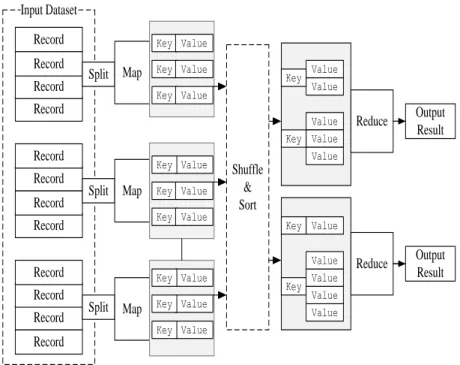
Figure 2-1: MapReduce model abstraction ... 13
Figure 2-2: Detailed characteristics of a TeraSort job using MRPerf simulator.[10] ... 17
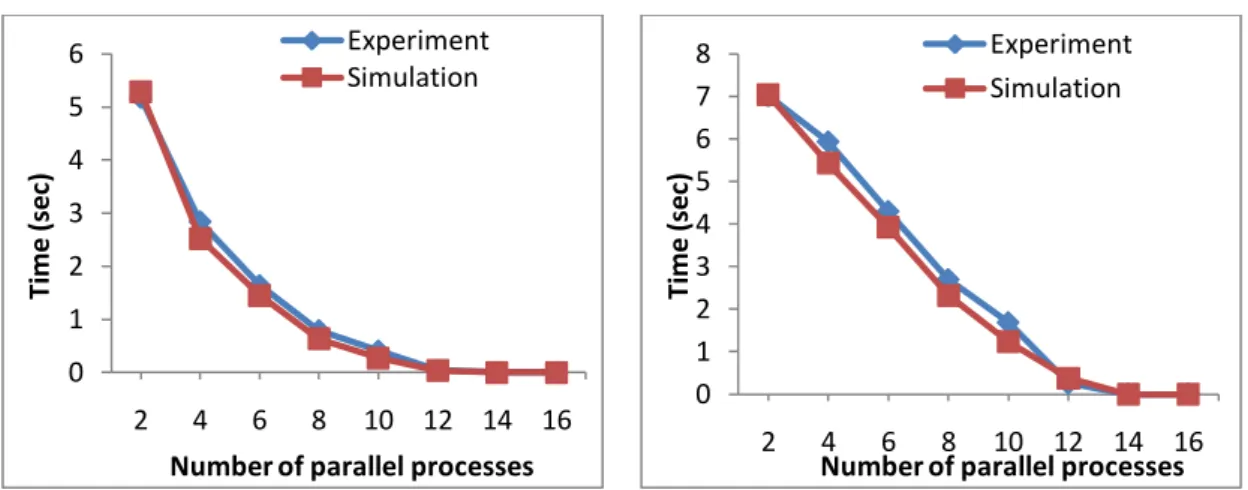
Figure 2-3: MR-LSI algorithm on HSim and MRPerf simulators vs. Actual Hadoop experiment. [69] ... 18
Figure 2-4: Pseudo code for Apriori algorithm ... 21
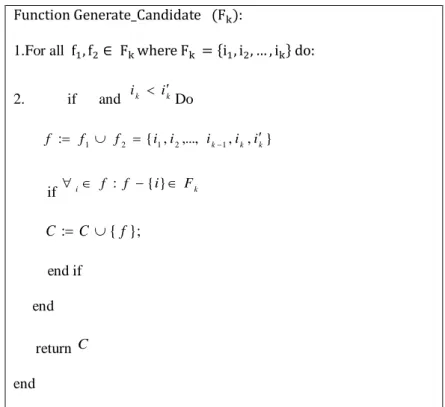
Figure 2-5: Pseudo code for generating candidate frequent items... 22
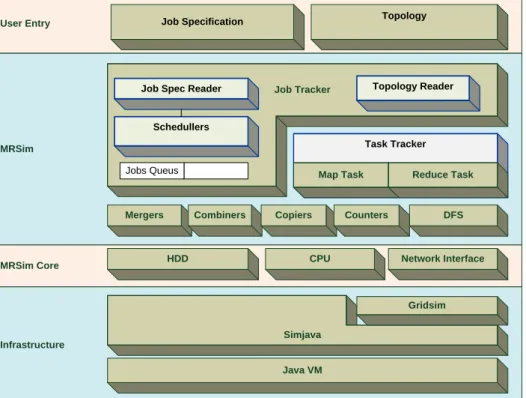
Figure 3-1: System architecture ... 40
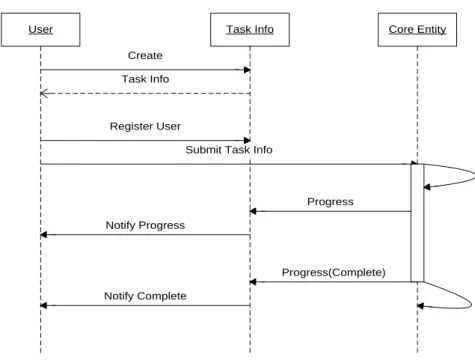
Figure 3-2: UML diagram of core entity that uses Observer Pattern... 42
Figure 3-3: UML sequence diagram of observer pattern used in core entities ... 42
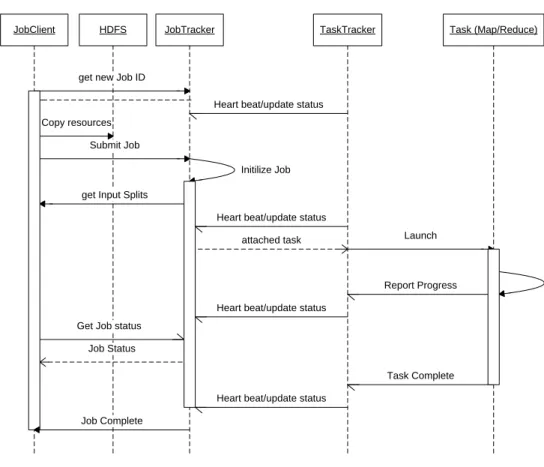
Figure 3-4: JobTracker in MRSim and Hadoop systems [36] ... 46
Figure 3-5: Workflow of JobTracker in Hadoop (and MRSim) ... 47
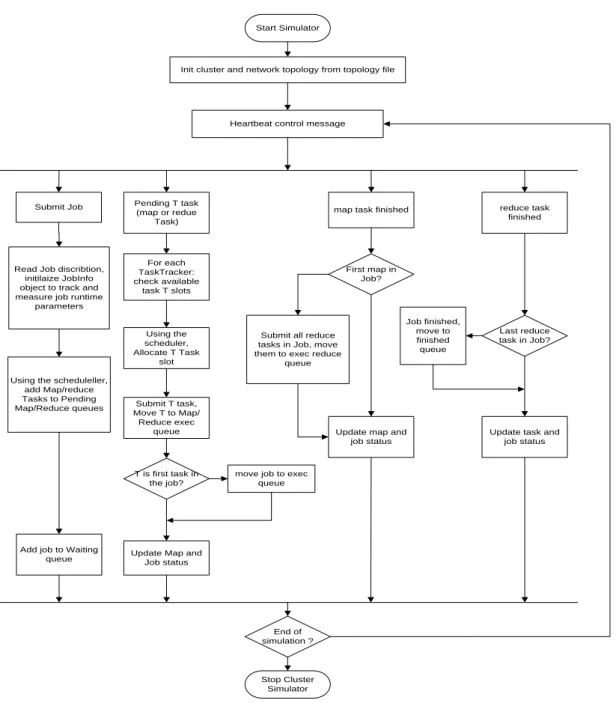
Figure 3-6: Flow control of JobTracker ... 48
Figure 3-7: Flow control of Map task ... 50
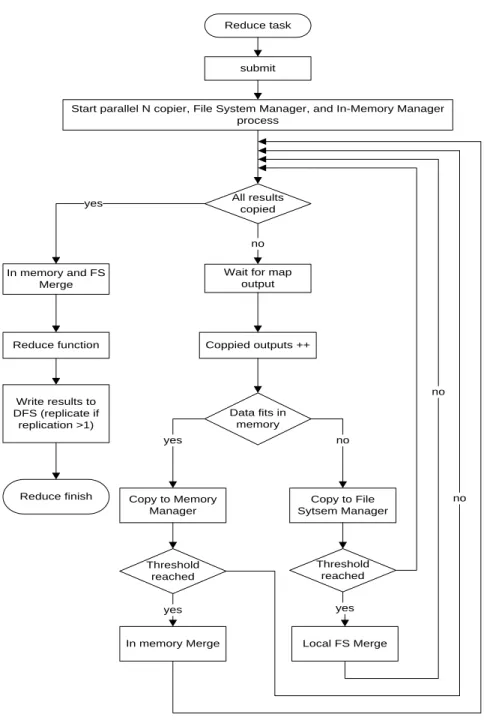
Figure 3-8: Flow control of Reduce Task ... 52
Figure 3-9: Hadoop data flow [36] ... 53
Figure 3-10: Spill writing and merging (M& W: Merge & write to file system) ... 53
Figure 3-11: Dataflow using combiner on map outputs (C: combine, M: Merge, W write to file system) ... 54
Figure 3-12: Hardware/Topology Input file ... 58
Figure 3-13: JSON object in Topology file ... 59
Figure 3-14 Job description File ... 61
Figure 3-15: Average Job throughput vs number of maximum of parallel processes ... 65
Figure 3-16: Standard deviation for job throughput vs. number of maximum parallel processes on CPU ... 65
Figure 3-17: Average Job turnaround time vs. number of maximum parallel processes running on CPU ... 65
Figure 3-18 : Standard deviation for job turnaround time vs. number of maximum parallel processes ... 65
xiv Figure 3-20: Standard deviation of job waiting time vs. number of maximum parallel
processes ... 66
Figure 3-21: Average Job execution times vs. number of maximum parallel processes allowed on CPU ... 66
Figure 3-22: Standard deviation of job execution time vs. number of maximum parrallel processes allowed on CPU ... 66
Figure 3-23: Read benchmark ... 68
Figure 3-24: Number of unique keys in sample subset vs. size of sample subset ... 69
Figure 3-25: Intermediate spilled records to local file system vs. input records ... 70
Figure 3-26: Intermediate spilled records to local file system vs. input records, using combiner function... 70
Figure 3-27: Intermediate spilled records to local file system vs. input records, using double virtual memory per task... 71
Figure 3-28: Local file system read bytes vs. input records ... 71
Figure 3-29: Local file system written bytes vs. input records ... 72
Figure 3-30: Local file system read bytes vs. input records, using combiner function ... 72
Figure 3-31: Local file system written bytes vs. input records, using combiner function ... 73
Figure 3-32: Local file system read bytes vs. input records, using double virtual memory per task ... 73
Figure 3-33: Local file system written bytes vs. input records, using double virtual memory per task ... 74
Figure 3-34: Execution times vs. input records ... 75
Figure 3-35: Execution times vs. input records, using combiner functions ... 75
Figure 3-36: Execution times vs. input records, using double virtual memory per task... 76
Figure 3-37: Data shuffled bytes vs. input records, using different job configurations ... 76
Figure 3-38: TeraSort experiments, time to complete the sort job vs. data input size ... 80
Figure 4-1: Distributed counting in Apriori using MapReduce framework ... 82
Figure 4-2: Initialize data using map and reduce methods ... 85
xv
Figure 4-5: Pseudo code for extracting associative rules in MRApriori ... 92
Figure 4-6 Workflow of MRApriori algorithm ... 92
Figure 4-7: Set intersection times using Java.retainAll vs. MR.Intersection methods ... 95
Figure 4-8: Associate panel in WEKA software ... 97
Figure 4-9: Example of MRApriori results ... 98
Figure 4-10: Object editor of MRApriori ... 98
Figure 4-11: Times between Apriori and MRApriori ... 100
Figure 4-12: To Item space support = 3% ... 102
Figure 4-13 To Line space support = 3% ... 102
Figure 4-14: To Item space support = 20% ... 102
Figure 4-15: Line space support = 20% ... 102
Figure 4-16: Total Time for MRApriori using several support thresholds ... 103
Figure 4-17: Number of nodes vs. execution times ... 104
Figure 5-1: Data workflow in MRMCAR ... 109
Figure 5-2: MRMCAR pseudo code for rules discovery step ... 113
Figure 5-3: Generating next Candidate ruleitems IDs ... 115
Figure 5-4: Steps of rule pruning ... 115
Figure 5-5: Rule pruning and building classifier ... 116
Figure 5-6: Average processing time vs. number of confidences calculated at once ... 119
Figure 5-7: Total processing times in ms vs. number of confidences calculated at one go .. 120
Figure 5-8: Incremental learning in MRMCAR ... 123
Figure 5-9: Number of Lines in Line Space vs. Iteration in Mushroom dataset for different support levels ... 125
Figure 5-10: Number of Items in Frequent Items space vs. Iteration number for different support levels ... 125
Figure 6-1: MRMCAR in Weka explorer ... 129
xvi
Figure 6-4: Error rate of the classification algorithms against 20 UCI data sets ... 139
Figure 6-5: the difference of the number of rules derived by MRMCAR1 and MRMCAR2 algorithms ... 142
Figure 6-6: Number of rules derived by MRMCAR1 and MRMCAR2 algorithms against 20 UCI data sets with MinSupp 5% and MinConf 50%... 142
Figure 6-7: Number of rules derived by MCAR and MRMCAR algorithms against 20 UCI data sets with MinSupp 1% and MinConf 10% ... 142
Figure 6-8: Classification accuracy of MRMCAR1 MCAR and MRMCAR2 ... 143
Figure 6-9: Effect of confidence vs. support levels on MRMCAR accuracy, (Breast dataset UCI) ... 143
Figure 6-10: Impact of rule sorting on accuracy... 145
Figure 6-11: Impact of rule sorting on number of rules ... 146
Figure 6-12: Average number of rules for different rule ranking criteria ... 146
Figure 6-13: Distribution of confidence and support levels for best accuracy using all datasets and all rule ranking criteria ... 147
xvii
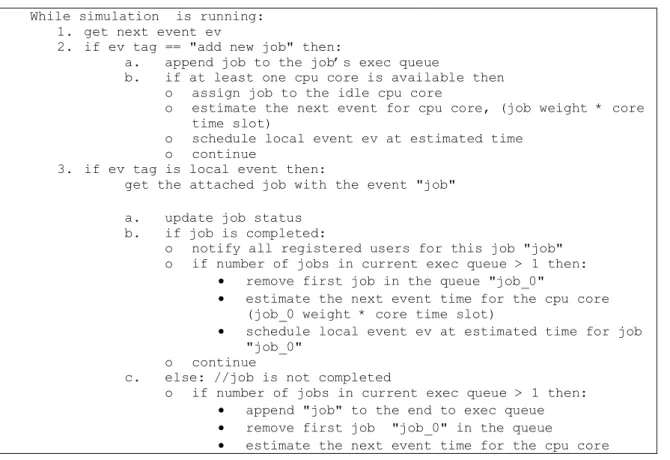
Table 3-1: Pseudo code for internal CPU scheduler ... 43
Table 3-2: Pseudo code for internal HDD scheduler ... 45
Table 3-3: Cluster configuration for TeraSort benchmark [114] ... 79
Table 4-1: Initial dataset ... 84
Table 4-2: add unique ID for each transaction ... 84
Table 4-3: Spars dataset ... 84
Table 4-4: Map each item to its lowest tid occurrence in the dataset ... 84
Table 4-5: Initial data representation in item space ... 86
Table 4-6: Map each item to its lowest tid occurrence in the dataset ... 89
Table 4-7: Batch set intersections ... 94
Table 4-8: Number of associated rules generated for minSupp = 50 % and min Confidence = 80% ... 100
Table 4-9 Hdoop cluster configuration ... 101
Table 4-10: Configuration of MRSim for scalability evaluation... 104
Table 5-1 Example dataset ... 108
Table 5-2 Initial data in line space ... 108
Table 5-3 Initial data in Item Space ... 108
Table 6-1: Predication results for two class classifier ... 135
Table 6-2: Different outcomes of four-class prediction ... 136
Table 6-3: Error rate in MRMCAR vs. other classification algorithms, MRMCAR1= CONF_ATT_SUPP, MRMCAR2= CONF_SUPP_ATT ... 140
Table 6-4: Impact of label matching and rule ranking on maximum accuracy achieved by MRMCAR... 144
Chapter 1: Introduction 1
Chapter 1
Introduction
This chapter briefly describes the background to the problems investigated in this thesis, the motivations of the work, major contributions and the structure of the thesis.
1.1Background
Data mining, a technique to understand and convert raw data into useful information, is increasingly being used in a variety of fields like marketing, business intelligence, scientific discoveries, biotechnology, Internet searches, and multimedia. Data mining is an interdisciplinary field combining ideas from statistics, machine learning, and natural language processing.
Advances in computing and networking technologies have resulted in many distributed computing environments. The Internet, intranets, LANs, WANs, and peer-to-peer (P2P) networks are all rich sources of vast distributed databases. These distributed data sets allow large-scale data-driven knowledge discovery to be used in science, business, and medicine. Data mining in such environments requires a utilization of the available resources. Conventional data mining algorithms are developed with the assumption that data is memory resident, making them unable to cope with the exponentially increasing size of data sets. Therefore, the use of parallel and distributed systems has gained significance.
Generally, parallel data mining algorithms work on tightly coupled custom-made shared memory systems or distributed-memory systems with fast interconnects. Other algorithms designed for clusters like loosely coupled systems are connected over a fast Ethernet LAN or
Chapter 1: Introduction 2 WAN. The main differences between such algorithms are scale, communication costs; interconnect speed, and data distribution. MapReduce is an emerging programming model to write applications that run on distributed environments. Several implementations such Apache Hadoop are currently used on clusters of tens of thousands of nodes [1]. This thesis focuses on MapReduce design and the implementation of two new data mining techniques relating to associative rules and associative classification. This trend to use distributed, complex, heterogeneous computing environments has given rise to a range of new data mining research challenges. This work explores the different methods and trade-offs when designing and implementing distributed data mining algorithms. Particularly, it discusses data partition/replication and workload distribution, and data formats. Also, this work aims to investigate the hardware utilization when running MapReduce algorithms on the infrastructure. This helps to study the behaviour of algorithms on simulated large clusters. This helps rapid optimizing and rapid developing efficient algorithms that use the MapReduce framework.
1.1.1MapReduce Framework
MapReduce [2] is a linearly scalable programming model. The programmer writes two functions—a map function and a reduce function—each of which defines a mapping from one set of key-value pairs to another. These functions are oblivious to the size of the data or the cluster that they are operating on, so they can be used unchanged for a small dataset and for a massive one. More importantly, if you double the size of the input data, a job will run twice as slowly. But if the size of cluster is doubled, a job will run as fast as the original one. This is not generally true of SQL queries.
One widely used implementation of MapReduce is Apache Hadoop [3] which is a collection of related subprojects that compose an infrastructure for distributed computing. These projects are open-source ones hosted by the Apache Software Foundation. Hadoop is known for MapReduce and its Hadoop Distributed File System HDFS [4], Hadoop provides complementary services, such as Core, MapReduce, HDFS, and HBase. Hadoop Core is a set of components and interfaces for distributed file systems and general I/O (serialization, Java RPC, persistent data structures). Hadoop MapReduce is distributed data processing model and execution environment that runs on large clusters of commodity machines. Hadoop HDFS is distributed file system that runs on large clusters of commodity machines.
Chapter 1: Introduction 3 Finally Hadoop HBase is distributed, column-oriented database. HBase is designed after Google Bigtable [5] and uses HDFS for its underlying storage, and supports both batch-style computations using MapReduce and point queries (random reads).
Using the MapReduce framework to build machine learning algorithms is investigated in [6] and Mahout [6] [7] to provide libraries for classification clustering and other machine learning algorithms.
1.1.2MapReduce Simulation
Several simulation environments are available to simulate batch systems running on clusters of machines [8] [9] and others. MapReduce is a paradigm which is only few years old. MRPerf [10] is an available tool simulator. It uses network simulator NS2 [11] to simulate the network traffic and uses a call back feature to simulate CPUs and hard drives using average processing speed and average IO speed respectively.
Mumak [12] is an open source project aim to provide a tool for researchers and developers to prototype features (e.g. pluggable block-placement for HDFS, Map-Reduce schedulers etc.) and predict their behaviour and performance with a reasonable amount of confidence. Mumak takes as an input a job trace from jobs executed on real clusters.
MRPerf is a MapReduce simulator based on C++, TCL and Python. As they described that they presented the design of an accurate MapReduce simulator, MRPerf, for facilitating exploration of MapReduce design space. MRPerf captures various aspects of a MapReduce setup, and uses this information to predict expected application performance.
1.1.3Mining Frequent Items and Associations
Frequent items are patterns of itemsets or sequences that frequently appear in a data set. For example, a set of items in shopping basket, such as milk and bread that appear frequently together in a transaction data set is a frequent itemset. Finding such frequent item plays an essential role in mining associations, correlations, and many other interesting relationships among data. Moreover, it helps in data classification as well. Several classifiers [13] [14] [15] [16] are built based on association rules. Thus, frequent pattern mining has become an
Chapter 1: Introduction 4 important data mining task and a focused theme in data mining research. Patterns represented in the form of association rules are human readable. For example, the association rule below:
milk bread [support = 2%; confidence = 60%]
Rule support and confidence are two measures of rule interestingness. They respectively reflect the usefulness and certainty of discovered rules. A support of 2% for an Association Rule means that 2% of all the transactions under analysis show that milk and bread are purchased together. A confidence of 60% means that 60% of the customers who purchased milk also bought bread. Association rules are considered interesting if they pass both a minimum support threshold and a minimum confidence threshold. Such thresholds can be set by users or domain experts.
Many algorithms have been developed for frequent itemset mining, from which association rules can be derived. Some of these algorithms are Apriori-like algorithms. Others are using growth-based algorithms [17] in addition to algorithms that use the vertical data format [18] [19].
The Apriori algorithm is one of the first algorithms used for mining frequent itemsets to get association rules. It employs the mining Apriori property that subsets of a frequent itemset are also frequent items. It iterates over the data to generate frequent k-itemset candidates based on the frequent (k-1)-itemsets. Variations involving hashing [20] and transaction reduction can be used to make the procedure more efficient. Other variations include partitioning the data [21] (mining on each partition and then combining the results) and sampling the data [22] [23] (mining on a subset of the data). These variations can reduce the number of data scans required.
Frequent pattern growth (FP-growth) [17] is a method of mining frequent itemsets without candidate generation. It constructs an FP-tree data structure to compress the original transaction database. It tries to achieve greater efficiency by focusing on frequent pattern growth, thus there are no candidate items generation steps.
Mining frequent itemsets using a vertical data format [19] (ECLAT) is a method that transforms a given data set of transactions in the horizontal data format of TID-itemset into the vertical data format of an item-TID set. It employs Apriori properties and mines the
Chapter 1: Introduction 5 transformed data set by TID set intersections for generating lower degree frequent items and vrepeating set intersections till it gets higher degree candidate rules. Additional optimization techniques are used in this method such as diffset [18]. Other extensions include using multiple supports thresholds [24] defined for each level of abstraction.
1.1.4Classification and Prediction using Association Rules
Association rules are not used directly for prediction without further analysis or domain knowledge. If one of the attributes is used as class label and the other attributes are used as conditions then associated rules can indicate causality used in classification. A classifier is usually built in two steps consisting of discovery of frequent itemset mining, as before, but narrows the search to items of targeted class attribute. The second step is to generate strong associations between frequent patterns and class labels. Several studies indicated that associative classification has been found to be more accurate than some traditional classification methods, such as C4.5 [25]. Classification Based on Associations (CBA) [13], Classification Based on Multiple Class-Association Rules (CMAR) [26], Multi-class Classification based on Association Rule (MCAR) [15] and Classification based on Predictive Association Rules (CPAR) [27] that adopt methods of frequent itemset mining to generate candidate association rules.
CBA (Classification-Based Association) [13] is one of the earliest and simplest algorithms for associative classification. CBA uses an iterative approach to frequent itemset mining, similar to that described for Apriori. Multiple passes are made over the data and the derived frequent itemsets are used to generate and test longer itemsets
CMAR [26] (Classification based on Multiple Association Rules) differs from CBA in its strategy for frequent itemset mining and its construction of the classifier. It also employs several rule pruning strategies with the help of a tree structure for efficient storage and retrieval of rules. CMAR adopts a variant of the FP-growth algorithm to find the complete set of rules satisfying the minimum confidence and minimum support thresholds.
CMAR employs another tree structure to store and retrieve rules efficiently and to prune rules based on confidence, correlation, and database coverage. Rule pruning strategies are triggered whenever a rule is inserted into the tree.
Chapter 1: Introduction 6 MCAR [15] improves the efficiency of the rule discovery phase by employing a method that extends the tid-list intersection methods.
1.1.5High Performance Computation in Mining Association Rules
The count distribution [28] algorithm is a distributed formulation of the Apriori algorithm, in which each processor generates its own version of the candidate hash tree. The counts of the candidates are estimated by performing a single pass over the local database, and a global reduction operation is then performed to estimate the global support of the candidate itemsets. When the globally frequent itemsets at level-k have been discovered, each processor generates the k+1-candidate itemsets in parallel, and repeats the process till all frequent itemsets have been found.
The Parallel Data Mining for association rules (PDM) algorithm [29] is a parallel implementation of the serial Direct Hashing and Pruning (DHP) algorithm [20]. While it is similar in nature to count distribution, the major difference is the use of a parallel hash table. The database is distributed among the processors, and each processor generates disjoint candidate itemsets. As in DHP, the hash table is built during the candidate counting phase and used to prune candidates in the subsequent generation phase. For this to happen, each processor needs to have a copy of the global hash table. Since PDM maintains parallel hash tables, this requires communicating the counts of each location in the hash table by a global exchange. Communicating the entire hash table is inefficient [30].
Task distribution: Another parallelization paradigm is to replicate the candidate generation process on each processor, and parallelize the support counting process. The processors will then perform different computations independently, but will need access to the entire database.
The Data Dist [28] algorithm addresses the memory problem of the count distribution algorithm by splitting the candidate generation process among the processors. The candidate itemsets are distributed among the processors in a round robin manner, and each processor computes the global counts of the candidates assigned to it. In order to do this, each processor needs to scan the transactions belonging to all the other processors. This is done by an asynchronous send–receive policy, wherein each processor allocates P buffers to read and write transactions from other processors. While this scheme allows each processor to handle a
Chapter 1: Introduction 7 greater number of candidates, the communication overheads make it an order of magnitude slower than the count distribution algorithm. There are a number of other algorithms such as Intelligent Data Distribution (IDD) [31], Hybrid Distribution (HD) [31], and Parallel Eclat [32] are based on the task distribution paradigm. These algorithms allow each processor to handle a subset of the candidate itemset and attempt to minimize communication and achieve load balance. The manner in which the database is replicated also impacts performance. A detailed summary of these techniques is available in [33] [32].
1.2Motivations of the Work
The MapReduce framework [2] is proved to be reliable low cost, data intensive framework used by giant enterprises such as Yahoo and Google [34] on clusters of tens of thousands of machines. Although a number of machine learning techniques are available for association and classification, very few are designed to be MapReduce aware algorithms. This work aims to introduce two new algorithms designed to naturally fit with the MapReduce programming model to benefit from the high scalability of MapReduce applications. Also, it aims to simulate the performance of MapReduce jobs using new general purpose MapReduce simulator MRSim [35]. The proposed algorithms are MRApriori for association rules and MRMCAR for associative classification.
The basic function of the MapReduce model is to iterate over the input, compute key/value pairs from each part of input, group all intermediate values by key, then iterate over the resulting groups and finally reduce each group. The programmer can abstract from the issues of distributed and parallel programming. The MapReduce implementation deals with issues such as load balancing, network performance, fault tolerance etc [36]. The Apache Hadoop [3] project is an open-source implementation of Google’s MapReduce written in java for reliable, scalable, distributed computing. Recently there have been many applications adapted to the MapReduce model; however these applications are tested with small and medium size clusters of participating nodes. Having such clusters of nodes it is difficult to measure the scalability of the algorithms. Scalability is a measure of efficiency of an algorithm with a much larger cluster i.e. hundreds of nodes as well using a much larger training dataset. It is almost impractical to set up a very large cluster consisting hundreds or thousands of nodes to measure the scalability of an algorithm. The Hadoop environment set-up involves alterations of a great number of parameters which are crucial to achieve best performances. An obvious
Chapter 1: Introduction 8 solution to the above problems is to use a simulator which can simulate the Hadoop environment; a simulator on one hand allows us to measure scalability of MapReduce based applications easily and quickly, on the other hand to determine the effects of different configurations of the Hadoop set-up on MapReduce based applications behaviour in terms of speed. Hadoop is offered as a service on Amazon Elastic Compute Cloud EC2 [37] where users can launch and terminate instances on demand and pay by the hour for active instances. Also a Hadoop cluster can be integrated in Sun Grid Engine. Thus, MapReduce simulators will be very useful utilities to allow users to estimate times and the costs for the jobs before submitting it to EC2 or Sun Microsystems Grid Compute Utility.
For finding association rules, it has been widely recognized that finding frequent items is computationally intensive when the size of a training dataset is large. An Apriori-like algorithm usually involves repeat scanning of datasets. To speed up training for associative classification, distributed computing paradigms have been investigated to partition a large training dataset into small data chunks and process each chunk in parallel utilizing the resources of a cluster of computers [21] [33] [29]. The approaches include those that are based on the Message Passing Interface (MPI). However, MPI is primarily targeted at homogeneous computing environments and has limited support for fault tolerance. Furthermore, inter-node communication in MPI environments can create large overheads when shipping data across nodes. Although some progress has been made by these approaches, existing distributed apriori algorithms usually partition large datasets into smaller parts with the same size which can be used efficiently only in homogeneous computing environments in which the computers have similar computing capabilities. Currently heterogeneous computing environments are increasingly being used as platforms for resource intensive distributed applications. One major challenge in using a heterogeneous environment is to balance the computation loads across a cluster of participating computer nodes. Using the MapReduce framework, the two algorithms developed are naturally load balanced to heterogeneous environments.
Multi-Class Association Rule (MCAR) [15] and Multi-Class Multi-Label (MMAC) [38] are two algorithms developed for associative classification. Both use the vertical dataset representation introduced by Eclat [19]. Finding frequent itemset is done by doing set intersections between sets that hold the occurrences of lower degree frequent itemsets. This
Chapter 1: Introduction 9 work tries to consider the steps of MCAR [15] and MMAC [38] to develop a generalized associative classifier MRMCAR that produces multi-label rules with probabilities attached to each predicted class.
1.3Major Contributions
This work has produces a design and an implementation for MapReduce simulator (MRSim) to simulate the behaviour of newly developed data mining MapReduce based algorithms in a Hadoop environment. With the real implementation of the algorithms, this helps to find the best values of parameters to tune the cluster for the best performance. MRSim is to be used later to evaluate the behaviours and the scalability of newly developed algorithms for MapReduce environments.
MRSim extends a discrete event engine used SimJava [39] to accurately simulate the Hadoop environment. Using SimJava MRSim simulates interactions between different entities within clusters. The GridSim [8] [40] package is also used for network simulation. It is written in the Java programming language on top of SimJava. Evaluation of MRSim is performed using a number of MapReduce based applications which have been implemented recently. Evaluation results show a high level of accuracy from different aspects. MRSim is modelled with several layers. This makes it easier to plug-in more components to it, such as new types of job schedulers. Network topology and hardware specifications are introduced to the simulator in text files of JSON format. Also, the definitions of algorithms are done in JavaScript Object Notation (JSON) format. Source code for MRSim is available for the community on [41].
MRApriori, a MapReduce aware distributed associative algorithm for finding frequent items has been implemented. MRApriori builds on the apriori algorithm for high efficiency in training and employs MapReduce. Two implementations of MRApriori are introduced; one is in-memory sequential application which is pluggable to WEKA [42] machine learning software and the second implementation was done using the Apache Hadoop distributed system platform. The Hadoop implementation [3] of MapReduce was used. MRApriori uses both vertical and horizontal dataset representations to find all frequent item sets. Including the implementation in WEKA machine learning software makes it available to the community.
Chapter 1: Introduction 10 This work also introduces MRMCAR (MapReduce Multi-Label Classifier based on Associative Rules). MRMCAR is a MapReduce based generalization of MCAR [15] classifier. Several ranking methods are plugged into the system allowing different classifiers for different datasets. Two implementations of MRMCAR are introduced; one is an in-memory application which is pluggable to WEKA machine learning software and the second implementation is done using Apache Hadoop [3]. MRMCAR uses both vertical and horizontal dataset representations to find all frequent item sets. Including the implementation in WEKA machine learning software makes it available to the community. Also, the incremental learning capability of MRMCAR is discussed and prototype was implemented using Google Bigtable distributed data structure. The performance of MRMCAR is evaluated and compared with several classification algorithms such as C4.5 [25], J48 [43] , RIPPER, CBA [13], and MCAR [15]. Results are discussed to appreciate the cost of MRMCAR classification to make it ready to be used in later machine learning analysis and specific classification applications.
The MapReduce framework facilitates a number of important functions such as partitioning the input data, scheduling MapReduce jobs across a cluster of participating nodes, handling node failures, and managing the required network communications. A notable feature of the Hadoop implementation of MRApriori and MRMCAR is the ability to support heterogeneous environments. This was utilized to design MRApriori and MRMCAR for effective load balancing scheme for resources with varied computing capabilities. Source code for MRApriori and MRMCAR with both Weka and Hadoop implementations is available for the community [44].
1.4Structure of the Thesis
The rest of this thesis is organized as follows:
Chapter 2 reviews two separate subjects; MapReduce framework, and associative classification in machine learning algorithms. The first part of the chapter introduces MapReduce and using it in large scale intensive data applications. It explains the MapReduce programming model and introduces several of its implementations. Then it reviews available MapReduce simulator and some of Grid System simulators. The second part of the chapter introduces the problem of mining frequent itemsets. It addresses common association rules
Chapter 1: Introduction 11 techniques and data formats used. This part reviews several commonly used classification algorithms and it concentrates on classification algorithms that are based on association rules. Chapter 3 introduces the design of MRSim MapReduce Simulator used to evaluate the behaviour of Map Reduce jobs on Hadoop software, System Architecture, Core entities, Map-Reduce entities, MRSim user level and input specifications, validating MRSim, design of core entities, validation on real cluster environments. Validation, Job Execution Times, IO data sized used locally and shuffled among cluster nodes comparing MRSim with results obtained from terasort benchmark are discussed.
Chapter 4 describes the design and the implementation of MRApriori, an association rules distributed algorithm based on MapReduce framework. Features and constraints of the algorithms are discussed. Sample run results are presented in this chapter in addition to MRSim configuration and results to simulate MRApriori for a higher number of machines. Chapter 5 is dedicated to the designing of the MRMCAR a multi-label associative rule classifier based on the MapReduce framework. Features of the algorithm are discussed. Challenges of distributions and constraints of incremental learning. and also scalability features are discussed.
Chapter 6 presents two implementations of the MRMCAR for training multiclass datasets; Weka plug-in sequential implementation and Hadoop parallel implementation. Several types of evaluations of the algorithm are presented. Firstly, the prediction accuracy of the algorithm is presented in experiments and compared with several existing classifiers. Also, other label-based measurements were calculated evaluating the cost of predication per predicted class. Performance results, scalability results, using MRSim are also discussed in the chapter. Finally, Chapter 7 summarizes the contributions of the thesis and proposes directions for future work.
Chapter 2: Literature Review 12
Chapter 2
Literature Review
2.1Introduction
The first part of this section summarizes the basic principles of the MapReduce model and discusses available implementations of the MapReduce framework. Also, it concentrates on available simulators for MapReduce and likewise environments.
In the second part of this chapter, the association rule mining problem is presented with a review of published research works conducted on it. Specifically, it discusses popular association rule mining approaches like Apriori [45], FP-growth [46], partitioning [47] and others. In the third part of this chapter, the classification problem in data mining is briefly defined with a review of well-known traditional classification approaches like decision trees, rule induction, and Naïve Bayes. Last part specially focuses on reviewing classification algorithms that uses associative classification such as CBA [13], CPAR [27], CMAR [26], CACA was proposed in [14], BCAR [48], and MCAR [15] [49].
2.2Map Reduce Framework for Scalable Intensive Data Applications
There is increasing interests to use MapReduce [2] in distributed machine learning algorithms such as Apache Mahout [6] [7]. Several algorithms were paralleled using MapReduce framework such as DisCo clustering [50], Locally Weighted Linear Regression (LWLR),
K-Chapter 2: Literature Review 13 Means, Logistic Regression (LR), Naive Bayes (NB), SVM, ICA, PCA, Gaussian Discriminant Analysis (GDA), Back Propagation, and several more in [51].
2.2.1MapReduce Programming Model
Jeffrey and Sanjay [2] introduced the easy and abstracted programming model, MapReduce. Many computation problems can be expressed using this model. It is inspired by functional programming languages. The input and output data have a specific format of key/value pairs. The users express an algorithm using two functions: the Map functions and the Reduce function. The Map function is written by the application developer. It iterates over a set of the input key/value pairs, and generates intermediate output key/value pairs. The MapReduce library groups all intermediate values by key and introduces them to the reduce function. The Reduce function is also written by the application developer, it iterates over the intermediate values associated by one key. Then it generates zero or more output key/value pairs. The output pairs are sorted by their key value.
(input) <k1, v1> -> map -> <k2, v2> -> reduce -> <k3, v3> (output)
Record Record Record Record Record Record Record Record Record Record Record Record Input Dataset Split Split Split Map Output Result Map Map Shuffle & Sort Reduce Reduce Output Result Value Key Key Key Key Value Value Value Key Key Value Value Value Value Value Key Key Key Value Value Value Value Value Value Key Key Key Key Value Value Value Value
Figure 2-1: MapReduce model abstraction
Figure 2-1 shows the split of the input into logical chunks and each chunk is processed independently by a map task. The results of these processing chunks can be physically
Chapter 2: Literature Review 14 partitioned into separate sets, which are then sorted. Each sorted chunk is passed to a reduce task.
2.2.2MapReduce Implementations
While the programming model is abstracted, it is the job of the implementation to deal with the details of parallelization, fault tolerance, data distribution, load balancing, etc. Several implementations of MapReduce have been proposed some of them provided by academic research as MR-J [52] which used Java multithreading and Phoenix [53] [54] which uses c threads on shared memory systems to implement MapReduce. Other implementations used by enterprises include e.g. Microsoft Dryad [55] [56] , Greenplum MapReduce [57] Aster data SQL-MapReduce [58] , Hadoop [3] and Google MapReduce [59].
The Apache Hadoop project [3] is the most popular and widely used open-source implementation of Google’s MapReduce. It is written in Java for reliable, scalable, distributed computing. The code is available as the Apache License Version 2.0 [60]. Hadoop is being used by known enterprises e.g. Facebook, Yahoo, Amazon and many others [34] .
2.2.3Map Reduce Framework Simulator
MapReduce is an emerging model. Yet, not much research on simulating the performance of MapReduce cluster has been done. To the best of our knowledge MRPerf [61] [10] and Mumak [12] are the only simulators targeting the MapReduce framework. However, there is a closely related large-scale distributed computing paradigm, Grid computing [62]. Grid computing is a well known paradigm used to solve large-scale problems on distributed systems. Several simulators have been developed to simulate the performance of Grid systems including Bricks [63], MicroGrid [64], SimGrid [9]. Another approach to understanding how MapReduce behaves is to develop tracing tools to build a comprehensive view of the system. The Chukwa project [65] and X-trace [66] are examples of tools used to collect different measurements in real clusters.
2.2.4Grid System Simulators
Bricks [63] simulation system simulates client-server applications. It follows a centralized global scheduling methodology.
Chapter 2: Literature Review 15 The MicroGrid simulator [64] is modelled after Globus. It allows the execution of applications constructed using the Globus toolkit in a controlled virtual Grid-emulated environment. The results produced by emulation can be precise but it is very time-consuming because it runs on emulated virtual resources. Applications modelled in MicroGrid should be fully implemented as applications ready to run in a real environment. So developing a model to be emulated by MicroGrid takes more effort than models designed to run on other simulators.
The SimGrid toolkit [9] is a C language based toolkit for the simulation of application scheduling. It supports modelling of resources that are time-shared and the jobs can be submitted dynamically. SimGrid is restricted to a single scheduling entity and time-shared systems; it is difficult to simulate multiple users, applications and schedulers, with different policies. This needs a substantial extending of the toolkit.
The GridSim [8] simulator is close to SimGrid [9] but GridSim is implemented in the Java programming language and extensively uses a SimJava [67] discrete event simulation infrastructure. GridSim allows users to extend scheduling policies easier than SimGrid.
2.2.5Limitations of Grid Simulators
Bricks, MicroGrid, SimGrid, GridSim and similar grid computing simulators cannot truly simulate the MapReduce framework. They model jobs submitted to the system as batch jobs where each job has fixed computational cost or CPU hours and has predefined input and output specifications. In the MapReduce framework, the interaction between hardware resources such as CPUs, memory buffers, local hard drives, and network adapters is more complicated and cannot be simplified as batch processes without losing a large amount of accuracy. For example, the reduce phase in any job is highly coupled and affected by the behaviour of all tasks executing at the map phase and no patch system can simulate this interaction accurately. The following simulators are dedicated for MapReduce frameworks.
2.2.6Mumak MapReduce Simulator
Mumak [12], MRSim and MRPerf [10][61] focused on modelling the specifics of MapReduce framework and not grid systems, so it does not worry about reservations, resource brokering and wide-area scheduling used in the Grids.
Chapter 2: Literature Review 16 Mumak [12] is an open source project aimed to provide a tool for researchers and developers to prototype features (e.g. pluggable block-placement for HDFS, Map-Reduce schedulers, etc.) and predict their behaviour and performance with a reasonable amount of confidence. Mumak takes as input a job trace from jobs executed on a real cluster. Then it simulates resubmitting the job on a Mumak virtual cluster. The output would be a detailed job execution trace recorded in virtual simulated time. Analyzing an output will provide more understanding of the effect of using different schedulers such as the effect of jobs’ turnaround time, throughput, fairness, capacity guarantee, etc. Mumak accurately simulates the conditions of the actual system which would affect the scheduler’s decision. This is because Mumak is unique in plugging in the real JobTracker and scheduler used in Hadoop middleware [12]. However, Mumak does not simulate tasks-sharing resources at a lower level. It does not simulate actual map/reduce tasks themselves. It merely takes the job history for jobs run on real clusters and keeps the run-time for each task as it is. It only re-allocates the tasks based on new schedulers and a new cluster environment. But tasks – definitely – will have a different execution time when using a new scheduling policy. This will generate unrealistic predictions if the same jobs were simulated on different clusters or when jobs were simulated on same cluster with different configurations. This is a major and the main limitation of Mumak. An example of wrong prediction is by doubling the number of tasks that each node can handle concurrently. Mumak will keep predicting the same time for each task as before, and this will reduce the total job time to half. In a real cluster, this scenario will roughly double the execution time for each task because now more processes are sharing the same hardware (CPUs, hard disks, and network adapters), but the total job time will not change very much from the previous run.
2.2.7MRPerf MapReduce Simulator
Guanying Wang and et al. [10] proposed their MapReduce simulator MRPerf which is based on C++, TCL and Python. They presented the design of an accurate MapReduce simulator, MRPerf, for facilitating exploration of the MapReduce design space. MRPerf captures various aspects of a MapReduce setup, and uses this information to predict expected application performance. They designed MRPerf which can serve as a design tool for the MapReduce infrastructure, and as a planning tool for making MapReduce deployment far easier via reduction in the number of parameters that currently have to be hand-tuned using
Chapter 2: Literature Review 17 rules of thumb. They validated their simulator using the data collected from medium-scale production clusters. The results showed that the simulator is able to predict application performance accurately, and thus can be a useful tool in enabling cloud computing.
Figure 2-2: Detailed characteristics of a TeraSort job using MRPerf simulator.[10]
From the published testing results [10][61] as partly showed in Figure 2-2 MRPerf shows its high accuracy in simulating the impacts of changing the network topologies. This kind of accuracy is based on two points. The first point is that MRPerf introduced a network simulator ns-2 [11] to form its network component. The network simulator ns-2 has been developed for several years and has proved that it can provides support for simulation of TCP, routing, and multicast protocols over wired and wireless (local and satellite) networks so that the ns-2 simulator involved can produce high accuracy when MRPerf simulates the behaviours of networks [68]. The second point is that they involved several benchmarks including TeraSort, Search and Index, which are presented as being able to represent the standard MapReduce applications and the results of the tests are quite convincing.
Chapter 2: Literature Review 18
Figure 2-3: MR-LSI algorithm on HSim and MRPerf simulators vs. Actual Hadoop experiment. [69]
However, MRPerf shows less accuracy when used to simulate other algorithm of MR-LSI [69] as in Figure 2-3. This limitation maybe caused showed that realistic behaviours of the framework are based on a number of interactions of hardware and system components. For in Map phase, the performances of Map instances are very tightly coupled to the current states of processor, buffer, hard drive and networks. When certain thresholds are reached, according to the working mechanisms certain components may be interrupted to guarantee the performance and synchronizations. In Reduce phase, the performance of Reduce instances is highly dependent on the current IO states. The copying, shuffling and sorting procedures are quite dynamic according to the current system states. MRPerf does not simulate these real time interactions accurately. Instead, it employs a number of rough estimations to estimate the overhead of the Hadoop system. These approximations in terms of parameterization can not reflect real world Hadoop implementations. In TeraSort, Search and Index validations, none of these three algorithms involved complex behaviours of a Hadoop framework when the tests were carried out. So these rough estimations may generate small errors when MRPerf simulates these simple-behaviours-involved algorithms. However, whether the simulator can adapt to complex Hadoop behaviours is quite critical.
2.3Mining Association Rule
Association rule mining was introduced by Agrawal, Imieliński, & Swami in 1993 [70]. It still has an active research area in the data mining and machine learning. Association rule mining finds correlations between items in a database. The classic application for association
Chapter 2: Literature Review 19 rule mining is market basket analysis [45][70], in which business experts aim to investigate the shopping behaviour of customers in an attempt to discover regularities. The aim is to find groups of items that are frequently sold together in order that marketing experts can develop strategic decisions concerning shelving, sales promotions and planning. Association rule mining has been widely used in various industries beside supermarkets such as mail order [45], telemarketing [70][71], and e-commerce [72].
2.3.1Association Rule Discovery Problem
Definition 2.1: The task of association rule discovery can be defined [70] as follows: Let D be a database of sales transactions, and be a set of binary literals called items. A transaction T in D contains a set of non empty items called an itemset, such that T I.
Definition 2.2: The support of an itemset is defined as the proportion of transactions in D that contain that itemset.
Definition 2.3: An association rule is an expression , where and Definition 2.4: The confidence of an association rule is defined as the probability that a transaction contains Y given that it contains X, and given as
Given a transactional dataset D, the association rule problem is to find all rules that have supports and confidences greater than certain user-specified thresholds, denoted by minimum support and minimum confidence, respectively.
Finding rules from in dataset D consistes of two steps [45]: step one is to generate all frequent itemsets. Frequent itemsets are itemsets that have support greater than minimum support threshold. Step two is for each frequent itemset generated in Step one, produce all rules that pass the minimum confidence threshold those rule are considered interesting or strong rules. For example if itemset XYZ is frequent, then the confidence of rules
Chapter 2: Literature Review 20 association rules is determined by the first step because it is relatively harder problem that requires extensive computation and storage [33][73].
Resulting rule pattern for shopping basket is of type:
milk bread [support = 2%; confidence = 60%]
A support of 2% for previous association rule means that 2% of all the transactions under analysis show that milk and bread are purchased together. A confidence of 60% means that 60% of the customers who purchased milk also bought the bread.
A major challenge in mining frequent itemsets from a large data set is the fact that such mining often generates a huge number of itemsets satisfying the minimum support threshold. This is because if an itemset is frequent then each of its subsets is frequent as well. A one candidate long frequent itemset of size 100 should contains frequent itemsets of size 1 and frequent itemsets of size 2 and so on total possible sub frequent itemsets is:
This is too huge a number of itemsets for any computer to compute or store. Many researchers have extensively investigated the problem of efficiently finding frequent itemsets in association rule discovery in the last decade for the purpose of improving its efficiency [20][24][74][75].
2.3.2Association Rule Data Layouts
There are several representations of a target database in association rule mining, these are the horizontal [45] , vertical layouts [33][76][77], and tree format for growth [46][78]. In the horizontal layout, the database consists of a group of transactions, where each transaction has transaction identifier (TID) followed by a list of items contained in that transaction. In the vertical layout on the other hand, the database consists of a group of items where each item is followed by its tid-list [47] transaction identifiers list that contains the item.
Chapter 2: Literature Review 21 2.4Common Association Rules Techniques
2.4.1Apriori
Apriori is an algorithm that has been proposed in [45]. The discovery of frequent itemsets is accomplished in several iterations. In each scan, a full scan of training data is required to count new candidate itemsets from frequent itemsets already found in the previous step. Apriori uses the ―apriori‖ property to improve the efficiency of the search process by reducing the size of the candidate itemsets list for each iteration.
DB : Transactional database Output O set of all frequent items
: Set of n-items that pass the minsupp threshold (frequent itemsets) : Set of n-candidate itemsets that are possibly frequent
1. ={frequent 1-itemsets}; 2. for (n=2; ≠Ø; n++) Do
3. =generate_candidates( );
4. for each transaction DB Do 5.
6. for each candidate
7. ; 8. end //for
9. 10.
11. end// for
Chapter 2: Literature Review 22 1.For all 2. if and ik ikDo f : f1 f2 {i1,i2,..., ik1,ik,ik} if i f : f {i} Fk C:C {f}; end if end return C end
Figure 2-5: Pseudo code for generating candidate frequent items
The Apriori algorithm for finding frequent itemsets is shown in Figure 2-4, where the generate candidate function shown in Figure 2-5 , is used to produce from by merging with , and discarding all itemsets in that do not pass the support threshold. Once these candidate itemsets are identified from , then their supports are incremented (line 6-7). The algorithm terminates whenever there are no frequent itemsets in the nth iteration.
2.4.2Dynamic Itemset Counting
Dynamic Itemset Counting (DIC) [21] was developed to speed up the discovery of frequent itemsets in a database.DIC splits the database into several partitions marked by start points. Then, it calculates the supports of all itemsets counted so far, dynamically adding new candidate itemsets whenever their subsets are determined to be frequent, even if their subsets have not yet been seen at all transactions. The main difference between DIC and Apriori is that whenever a candidate itemset reaches the support during a particular scan, DIC starts producing additional candidate itemsets based on it, without waiting to complete the scan as Apriori does.
To accomplish the dynamic candidate itemsets generation, DIC employs a prefix-tree where each item counted so far is associated with a node. One of the drawbacks of DIC algorithm is
Chapter 2: Literature Review 23 its sensitivity to how homogeneous the data is. Particularly, if the database to be mined is correlated,
2.4.3Frequent Pattern Growth
Han, et al. [45] [46,78] presented a new association rule mining approach that does not use candidate rule generation called FP-growth that generates a highly condensed frequent pattern tree (FP-tree) representation of the transactional database. Each database transaction is represented in the tree by at most one path. FP-tree is smaller in size than the original database the construction of it requires two database scans, where in the first scan, frequent itemsets along with their support in each transaction are produced; and in the second scan, FP-tree is constructed.
Once the FP-tree is built, a pattern growth method is used to mine association rules by using patterns of length one in the FP-tree. For each frequent pattern, all possible other frequent patterns co-occurring with it in the FP-tree (using the pattern links) are generated and stored in a conditional FP-tree. The mining process is performed by concatenating the pattern with the ones produced from the conditional FP-tree. One constraint of FP-growth method is that memory may not fit FP-tree especially in dimensionally large database.
2.4.4Partitioning
To reduce the number of database scans in association rule mining Savasere et al. [47] proposed an algorithm that divides the database into small partitions such that each partition can fit in the main memory and discovers frequent itemsets locally using a step-wise approach, e.g. Apriori, in the first pass. A tid-list structure for each itemset in a partition is then constructed. The tid-list of an itemset identifies rows in a partition that contain that itemset. The cardinality of an itemset tid-list divided by the total number of the transactions in a partition gives the support of that itemset.
In the second pass, the algorithm performs union operations on local frequent itemsets found in each partition to discover frequent itemsets in the database as whole. One of the drawbacks of the partitioning algorithm is that it prefers a uniform data distribution. For an unevenly distributed database, the majority of the itemsets in the second pass may be infrequent, causing extra I/O overhead. Furthermore, when the number of partitions increases, the
![Figure 3-9: Hadoop data flow [36]](https://thumb-us.123doks.com/thumbv2/123dok_us/781377.2598813/71.892.111.749.139.357/figure-hadoop-data-flow.webp)