pharmaceutical supply chain—VAN enabled
December 2019 by
Newton Mapowo
Thesis presented for the degree of Master of Engineering Management in the Faculty of Engineering at Stellenbosch University
Supervisor: Ms Louzanne Bam
Co-supervisors: Ms Imke Hanlu de Kock Dr Joubert van Eeden
Page | i
Declaration
By submitting this thesis electronically, I declare that the entirety of the work contained therein is my own, original work; that I am the sole author thereof (save to the extent explicitly otherwise stated); that reproduction and publication thereof by Stellenbosch University will not infringe any third-party rights, and that I have not previously in its entirety or in part submitted it for obtaining any qualification.
Date: December 2019
Copyright © 2019 Stellenbosch University All rights reserved
Page | ii
Abstract
Many of the challenges in supply chains have been traced to emanate from a misalignment between the type of product, together with its attributes, and the strategy according to which the supply chain of the product is managed. Several frameworks, incorporating a diverse set of product attributes, have been recommended to enable this alignment between product attributes and supply chain strategies in various sectors. The priorities that are typically pursued in public healthcare pharmaceutical supply chains, differ from those that are typically pursued in the commercial sector in a number of ways. Despite this, a structured search of literature did not uncover any framework that incorporates the distinct critical attributes to be used in describing product categorization in public healthcare pharmaceutical supply chains specifically.
A review of literature on product categorization as it has been applied in various industries, indicates that it is reasonable to conclude that tailoring supply chain management practices and policies to the attributes of the products being supplied in the public healthcare pharmaceutical supply chain sector is likely to be beneficial. The South African National Department of Health is in the process of rolling out the Visibility and Analytics Network reference framework, with the aim of ensuring the sustained availability of and access to medicine. At present, the Visibility and Analytics Network strategy does not incorporate the product categorization concept. In this study, a product categorization framework is developed specifically for use in the contemporary South African public healthcare pharmaceutical supply chain. The framework is intended to provide guidance to supply chain managers on aligning pharmaceutical products with appropriate supply chain strategies, thereby formulating different supply pipelines in line with the relevant attributes of the products.
It is envisioned that the framework will be used by the provincial supply chain managers in the Visibility and Analytics Network strategy informed push model as they: analyze and optimize complex links in the public healthcare pharmaceutical supply chain; and make inventory planning and management recommendations to primary healthcare facilities. The product categorization framework that is developed in this research is expected to aid in enhancing sustainable availability and access to medicines in the South African public healthcare supply chain.
Page | iii
Opsomming
‘n Groot aantal van die uitdagings in voorsieningskettings ontstaan vanweë ‘n wanbelyning tussen die tipe produk, tesame met die eienskappe daarvan, en die strategie waarvolgens die voorsieningsketting van die produk bestuur word. Verskeie raamwerke, wat 'n uiteenlopende reeks produkeienskappe insluit, word aanbeveel om hierdie belyning tussen produkeienskappe en voorsieningskettingstrategieë in verskillende sektore te bewerkstellig. Die prioriteite wat tipies in farmaseutiese voorsieningskettings vir openbare gesondheidsorg nagestreef word, verskil van dié wat tipies in die kommersiële sektor nagestreef word. Ten spyte hiervan het 'n gestruktureerde literatuursoektog geen raamwerk ontbloot wat die onderskeie kritieke eienskappe bevat wat gebruik moet word om, spesifiek in openbare gesondheidsorgvoorsieningskettings vir farmaseutiese produkte, die kategorisering van produkte te bewerkstellig nie.
'n Oorsig van die literatuur wat handel oor die toepassing van produk-kategorisering in verskillende industrieë, dui aan dat dit redelik is om tot die gevolgtrekking te kom dat hierdie praktyk ook in openbare gesondheidsorgvoorsieningskettings vir farmaseutiese produkte voordeel sal inhou. Die Suid-Afrikaanse Nasionale Departement van Gesondheid implementeer tans ‘n verwysingsraamwerk, naamlik die Sigbaarheid- en Analitiese Netwerk, wat ten doel het om volgehoue beskikbaarheid van- en toegang tot medisyne te verseker. Die produkkategorisering konsep word nie tans in hierdie verwysingsraamwerk ingesluit nie. In hierdie navorsing word 'n raamwerk vir produkkategorisering spesifiek ontwikkel vir gebruik in die kontemporêre Suid-Afrikaanse openbare gesondheidsorgvoorsieningsketting vir farmaseutiese produkte. Die raamwerk is ontwerp om aan bestuurders in die voorsieningsketting leiding te gee oor hoe om toepaslike voorsieningskettingstrategieë, vir verskillende farmaseutiese produkte te identifiseer om sodoende verskillende aanbodpyplyne daar te stel, in ooreenstemming met die toepaslike eienskappe van die produkte.
Daar word voorsien dat, binne die konteks van die Sigbaarheid- en Analitiese Netwerk, provinsiale voorsieningskettingbestuurders die raamwerk sal gebruik soos wat hul: komplekse skakels in die farmaseutiese voorsieningsketting vir openbare gesondheidsorg analiseer en optimeer; en aanbevelings rakende voorraadbeplanning en -bestuur by primêre gesondheidsorgfasiliteite maak. Die raamwerk vir produkkategorisering wat in hierdie navorsing ontwikkel is, sal na verwagting bydra tot volhoubare beskikbaarheid van- en toegang tot medisyne in die Suid-Afrikaanse openbare gesondheidsorgvoorsieningsketting.
Page | iv
Acknowledgements
I wish to express my sincere gratitude and appreciation to the following individuals who played an important role during this study:
✓ Firstly, the Lord Almighty for providence, strength, braveness, and wisdom to sail through. ✓ My fiancée Paidamoyo Dewa for fueling me to execute this study with excellence.
✓ Mr. Lloyd and Mrs. Tendai Chikope for your support.
✓ My supervisors: Louzanne Bam (in special mention); Imke H. de Kock; Joubert van Eeden; and Edward Llewellyn for the supervision and guidance throughout this study.
✓ Louzanne Bam and Sara Grobbelaar for believing in me. That has a special place in my heart! ✓ Last but not least, the individuals and organizations that agreed to partake in the validation of
Page | v
Table of contents
LIST OF FIGURES... VIII
LIST OF TABLES ... X
NOMENCLATURE ... XII
... 1
INTRODUCTION ... 1
Background ... 2
Research aim and objectives ... 3
Scope of study ... 5
Assumptions, limitations, and delimitations ... 6
Research design and methodology ... 6
Validation strategy ... 8
Thesis outline ... 12
... 13
RATIONALE:PRODUCT CATEGORIZATION AND THE SOUTH AFRICAN PUBLIC HEALTHCARE PHARMACEUTICAL SUPPLY CHAIN ... 13
Introduction to literature ... 13
The concept of product categorization ... 14
Applications of product categorization ... 15
The South African public healthcare pharmaceutical supply chain ... 22
The VAN strategy in the South African public healthcare pharmaceutical supply chain .. 28
The potential impact of product categorization in the South African public healthcare pharmaceutical supply chain ... 31
Framework design requirements identified in Chapter 2 ... 34
Page | vi
... 36
SOLUTION DEVELOPMENT:PRODUCT ATTRIBUTES AND SUPPLY CHAIN STRATEGIES TAXONOMY ... 36
Introduction ... 36
Product categorization methods ... 37
Salient supply chain-driving product attributes ... 39
Classification and nomenclature systems in healthcare ... 52
Which goals should product categorization target? ... 55
Generic supply chain strategies classifications ... 56
Levers to control in supply chain strategy implementation ... 63
Framework design requirements identified in Chapter 3 ... 81
Conclusion ... 81
... 82
THE VAN-PHARMACEUTICAL PRODUCT CATEGORIZATION FRAMEWORK DEVELOPMENT... 82
Introduction ... 82
Consolidated design requirements ... 83
The schematic tree that underpins the product categorization framework ... 86
The VAN-Pharmaceutical Product Categorization Framework ... 89
Demonstration of the decision-making philosophy ... 96
The VAN-Pharmaceutical Product Categorization Framework in the South African public healthcare pharmaceutical supply chain ... 98
Conclusion ... 101
... 103
VALIDATION OF THE VAN-PHARMACEUTICAL PRODUCT CATEGORIZATION FRAMEWORK ... 103
Introduction ... 103
Validation through SME input analysis ... 104
Page | vii
Conclusion ... 119
... 120
CONCLUSIONS AND RECOMMENDATIONS ... 120
Research summary ... 120
Contributions to literature and practice ... 122
Limitations to the study ... 123
Recommendations and future work ... 123
REFERENCES... 126
APPENDIX A:PRODUCTS ATTRIBUTES SEMI-STRUCTURED INTERVIEW ... 133
APPENDIX B:BACKGROUND OF SMES USED IN DEVELOPING THE PRODUCT ATTRIBUTES TAXONOMY ... 136
APPENDIX C:CLASSIFICATION AND NOMENCLATURE IN HEALTHCARE ... 138
APPENDIX D:FRAMEWORK VALIDATION DOCUMENT ... 140
APPENDIX E:SME INPUT ANALYSIS QUESTIONNAIRE ... 158
Page | viii
List of figures
FIGURE 1.1:A BASIC SYSTEMS ENGINEERING APPROACH FOR FRAMEWORK DEVELOPMENT (ADAPTED
FROM MOUTON (2013) AND VAN AKEN,BERENDS, AND VAN DER BIJ (2007)) ... 7
FIGURE 1.2:INPUT-OUTPUT TRANSFORMATION PROCESS (ADAPTED FROM THE USDEPARTMENT OF DEFENSE SYSTEMS MANAGEMENT COLLEGE (2001)) ... 8
FIGURE 1.3:VALIDATION PROCESS OVERVIEW ... 11
FIGURE 1.4:THESIS OVERVIEW ... 12
FIGURE 2.1:FISHER'S FRAMEWORK, MATCHING SUPPLY CHAINS WITH PRODUCTS.(ADAPTED FROM FISHER (1997)) ... 14
FIGURE 2.2:SYSTEMATIC LITERATURE REVIEW PROCEDURE (ADAPTED FROM TRANFIELD ET AL. (2003)) ... 16
FIGURE 2.3:SCOPUS DATABASE SEARCH METHODOLOGY (REPRODUCED FROM MAPOWO ET AL. (2018)) ... 18
FIGURE 2.4:PERCENTAGE DISTRIBUTION OF INDUSTRY-SPECIFIC DOCUMENTS POOL ... 19
FIGURE 2.5:PHARMACEUTICAL LOGISTICS FRAMEWORK (ADAPTED FROM RAJA AND MOHAMMAD (2004)) ... 23
FIGURE 2.6:PRODUCT FLOWS IN THE SOUTH AFRICAN PUBLIC HEALTHCARE PHARMACEUTICAL DISTRIBUTION NETWORK (ADAPTED FROM ZUMA (2016)) ... 26
FIGURE 2.7:SERVICE SUPPLY CHAIN PLANNING IN VAN(ADAPTED FROM LLEWELLYN (2017)) ... 29
FIGURE 2.8:THE SCOPE OF VAN(ADAPTED FROM LLEWELLYN (2017))... 30
FIGURE 3.1:LEANNESS AND AGILITY APPLICATIONS (ADAPTED FROM NAYLOR ET AL.(1999)) ... 58
FIGURE 3.2:HOW DEMAND/SUPPLY CHARACTERISTICS DETERMINE THE PIPELINE SELECTION STRATEGY (ADAPTED FROM CHRISTOPHER ET AL.(2006))... 59
FIGURE 3.3:ENABLING ELEMENTS TO BE ADDRESSED OVER THE LONG TERM (ADAPTED FROM LLEWELLYN (2016)) ... 70 FIGURE 3.4:SUPPLY PLANNING OVERVIEW WITH THE PDCL2 PRODUCT ATTRIBUTES TAXONOMY AND
Page | ix FIGURE 4.1:INPUT-OUTPUT PRODUCT CATEGORIZATION PROCESS (ADAPTED FROM THE US
DEPARTMENT OF DEFENCE SYSTEMS MANAGEMENT COLLEGE,2001)) ... 85 FIGURE 4.2:THE SCHEMATIC TREE THAT UNDERPINS THE PRODUCT CATEGORIZATION FRAMEWORK . 86 FIGURE 4.3:OVERARCHING PROCESS FLOW OF THE VAN-PHARMACEUTICAL PRODUCT
CATEGORIZATION FRAMEWORK ... 90 FIGURE 5.1:ASPECTS CONSIDERED IN SEMI-STRUCTURED INTERVIEW QUESTIONNAIRE FORMULATION
(ADAPTED FROM CRESWELL (2014);MOUTON (2001)) ... 106
FIGURE 5.2:SME FEEDBACK TO THE LIKERT SCALE SEMI-STRUCTURED INTERVIEW QUESTIONNAIRE
... 108 FIGURE 5.3:PARTICIPANT FEEDBACK TO THE FRAMEWORK SCORE QUESTIONS ... 118
Page | x
List of tables
TABLE 1.1: FRAMEWORK DESIGN REQUIREMENT CATEGORIES EMPLOYED IN THIS RESEARCH
(ADAPTED FROM VAN AKEN ET AL.(2007)) ... 8
TABLE 2.1:PRODUCT DEMAND ASPECTS VERSUS FUNCTIONAL OR INNOVATIVE (ADAPTED FROM
FISHER (1997)) ... 15
TABLE 2.2:IMPACTS OF APPLICATION OF PRODUCT CATEGORIZATION IN INDUSTRIES (REPRODUCED FROM MAPOWO ET AL.(2018)) ... 20 TABLE 2.3:IMPACTS OF APPLICATION OF PRODUCT CATEGORIZATION IN HEALTHCARE (REPRODUCED
FROM MAPOWO ET AL.(2018)) ... 22 TABLE 2.4:FRAMEWORK DESIGN REQUIREMENTS IDENTIFIED IN CHAPTER 2 ... 34 TABLE 3.1:PRODUCT ATTRIBUTES AND THEIR MEASURABLE CHARACTERISTICS (REPRODUCED FROM
MAPOWO,BAM, DE KOCK, AND VAN EEDEN (2019)©2019IEEE) ... 39 TABLE 3.2:SME’S RESPONSES TO LITERATURE COMPILATION OF PRODUCT ATTRIBUTES, AND OTHER
SUGGESTED PRODUCT ATTRIBUTES (REPRODUCED FROM MAPOWO ET AL.(2019)©2019IEEE) ... 44 TABLE 3.3:CONSOLIDATED PRODUCT ATTRIBUTES FOR PRODUCT CATEGORIZATION IN THE PUBLIC
HEALTHCARE PHARMACEUTICAL SUPPLY CHAIN (REPRODUCED FROM MAPOWO ET AL.(2019)©
2019IEEE) ... 49 TABLE 3.4:PROMINENT HORIZONTAL AND VERTICAL CLASSIFICATION AND NOMENCLATURE
STANDARDS (ADAPTED FROM GLOBAL STANDARDS 1(2015)) ... 52
TABLE 3.5:MEDICINE SCHEDULES (ADAPTED FROM INNOVATIVE PHARMACEUTICAL ASSOCIATION
SOUTH AFRICA (2016)) ... 54
TABLE 3.6:PHYSICALLY EFFICIENT AND MARKET RESPONSIVE SUPPLY CHAINS (ADAPTED FROM
FISHER (1997)) ... 57 TABLE 3.7:LEVERS TO CONTROL IN SUPPLY CHAIN STRATEGY IMPLEMENTATION (ADAPTED FROM
PEREZ (2013)) ... 66 TABLE 3.8:SUPPLY CHAIN STRATEGIES AND THEIR DECOUPLING POINTS (ADAPTED FROM PEREZ
Page | xi TABLE 3.9:PROPOSED OPERATIONALIZED LEVERS OF COMPETITIVE POSITIONING ELEMENT (ADAPTED
FROM PEREZ 2013))... 74
TABLE 3.10:PROPOSED OPERATIONALIZED LEVERS OF MANAGERIAL FOCUS ELEMENT (ADAPTED FROM PEREZ (2013)) ... 75
TABLE 3.11:VAN SUPPLY PLANNING ACTIVITIES AND SUPPLY CHAIN STRATEGIES TAXONOMY IMPLEMENTATION FOR PROVINCIAL MEDICINE PROCUREMENT UNITS (ADAPTED FROM LLEWELLYN (2017)) ... 78
TABLE 3.12:PROPOSED OPERATIONALIZED LEVERS OF THE SUPPLY CHAIN PROFILES (ADAPTED FROM PEREZ (2013)) ... 79
TABLE 3.13:FRAMEWORK DESIGN REQUIREMENTS IDENTIFIED IN CHAPTER 3 ... 81
TABLE 4.1:CONSOLIDATED DESIGN REQUIREMENTS FROM THE PRECEDING CHAPTERS ... 83
TABLE 4.2:CONSOLIDATED PRODUCT ATTRIBUTES WITH RECOMMENDED THRESHOLDS FOR BINARY GRADATIONS (ADAPTED FROM MAPOWO ET AL.(2019)©2019IEEE) ... 91
TABLE 4.3:VAN-PHARMACEUTICAL PRODUCT CATEGORIZATION FRAMEWORK MAIN INDEX ... 92
TABLE 4.4:VAN-PHARMACEUTICAL PRODUCT CATEGORIZATION FRAMEWORK SPECIAL CASES INDEX ... 94
TABLE 5.1:INTERVIEWEE BACKGROUND SUMMARY FOR SME INPUT ANALYSIS ... 105
TABLE 5.2:SME INPUT ANALYSIS QUESTIONS... 107
TABLE 5.3:SME FEEDBACK TO SEMI-STRUCTURED INTERVIEW QUESTIONNAIRE ... 109
TABLE 5.4:CASE STUDY PARTICIPANTS’ BACKGROUND ... 113
Page | xii
Nomenclature
Acronyms and abbreviations
NDoH National Department of Health
VAN Visibility and Analytics Network reference framework PHCFs Primary healthcare facilities
PSSCs Product Service Supply Chains SOSCs
SCM KPI
Service Only Supply Chains Supply Chain Management Key Performance Indicator OTC Over-the-counter medicine STGs Standard Treatment Guidelines EML AMD EDP NEMLC PTC PMPU SCOR
Essential Medicine List
Affordable Medicines Directorate Essential Drugs Program
National Essential Medicines List Committee Pharmaceutical Therapeutic Committees Provincial Medicine Procurement Units Supply Chain Operations Reference model
Page | 1
Introduction
Supply chains incorporate the end-to-end streaming of information, products, and money (Perez, 2013) and supply chain management (SCM) has been defined as: “The management of upstream and downstream relationships with suppliers and customers in order to deliver superior customer value at less cost to the supply chain as a whole” (Christopher, 2011). This definition describes supply chain management as a function that incorporates a wide variety of activities, and a function that has a far-reaching impact on an organization. Consequently, how supply chains are managed has significant implications for an organization's product cost, working capital requirements, lead time to market, and service delivery, amongst others.
In an influential paper that pioneered the concept of product categorization, Fisher (1997) proposed that the reason why supply chains do not perform as expected despite increased investments in effort and resources, is an improper alignment of product attributes and supply chain strategies. Similarly, Harris, Componation, & Farrington (2010) stated that a product with steady demand and dependable supply cannot be managed similarly as a product with unpredictable demand and inconsistent supply. Applying the concept of product categorization in the healthcare sector is expected to offer benefits in terms of the sustainable availability of medicines and a reduction in healthcare expenditure (Mapowo, Bam, de Kock, & van Eeden, 2018). Researchers have highlighted that product categorization makes a vital contribution to business attributes such as spend analysis, financial analysis, strategic sourcing, tendering, enterprise resource planning, and merchandising in healthcare (Fisher, 1997; Harris et al., 2010). The concept of product categorization has been employed in conjunction with robust Information Technology (IT) systems for better use in scientific warehousing and inventory management, transparent integrated procurement, real-time stock monitoring, and decentralized distribution methodologies (Prinja, Bahuguna, Tripathy, & Kumar, 2015).
This research project is concerned with developing a framework for incorporating the principle of product categorization into the management of the public healthcare pharmaceutical supply chain in South Africa. This first chapter provides background on the research problem before formally defining the aim and objectives of the research. The scope of the study is also defined, and key assumptions, limitations, and delimitations are articulated. The research design and validation
Page | 2 strategy are also described before the chapter concludes with an overview of the content of each chapter of the thesis.
Background
The South African National Department of Health (NDoH) is in the process of rolling out the Visibility and Analytics Network (VAN) reference framework, with the aim of ensuring the sustained availability of and access to medicines (Llewellyn, 2017). One of the objectives of the VAN strategy is to transform South Africa’s public healthcare pharmaceutical supply chain from an ‘uninformed pull’ system to an ‘informed push’ system (Llewellyn, 2017). The distinction between these two systems being that specialized supply chain management professionals will be utilized in each province. These professionals will analyze and optimize complex links in the public healthcare pharmaceutical supply chain and make inventory planning and management recommendations to primary healthcare facilities (PHCFs), rather than the PHCFs doing so on their own (Llewellyn, 2016). An informed push model will relieve the PHCFs’ staff of sophisticated and time-consuming supply chain planning work and enable them to focus more exclusively on healthcare delivery.
At present, the VAN strategy does not incorporate product categorization—which entails the organization of products into categories according to shared attributes; more specifically, when supply chains are considered, attributes that are related to or could influence the best supply chain management strategy for respective products (Qi, Boyer, & Zhao, 2009). Simchi-Levi, Clayton, and Raven (2013) reasoned that “one size does not fit all” in the formulation of a supply chain strategy, highlighting the fact that different supply chain management strategies may be needed for products that differ in terms of attributes such as variability, volume, lead-time, lifecycle, etc.
Findings from a nationwide survey conducted by the Stop Stock-outs Projects (SSP)1 stated that in 2013, 21% of South African public healthcare facilities experienced a stock out or shortage of a Tuberculosis (TB) or Human Immunodeficiency Virus (HIV) medicine within three months prior to SSP conducting the survey (Stop Stock-outs Projects, 2013). In 2014, a second national SSP survey exposed that the abovementioned metric further increased to 25%, meaning that a quarter of PHCFs in South Africa experienced HIV and TB medicine stock-outs at least once in the year prior to the SSP survey. In 2015, the status quo remained unchanged at 25% (2015 Stock Outs National Survey
1
SSP is a consortium made up of six civil society organizations established in 2013 to monitor the availability of: medicines for TB; antiretroviral (ARV) medicines for HIV; and childhood vaccines; amongst others.
Page | 3 Third Annual Report – South Africa, 2016). Medicine stock-outs pose a danger to people’s health by leading to interrupted treatment, the taking of partial doses, or defaulting on treatment. In turn, these eventualities lead to increased cost, loss of confidence in the health system, decreased immunity of patients, drug resistance, and increased risk of opportunistic infections leading to more illness, new infections and ultimately death (2015 Stock Outs National Survey Third Annual Report – South Africa, 2016). It can be reasoned that, due to differences in the therapeutic nature of pharmaceuticals and differences in performance of these products in the supply chain, various pharmaceutical products (e.g. anti-hypertensive, anti-viral, thrombolytic, and anti-cancer medicines) require different supply chain management strategies (e.g. continuous-flow, efficient, fast, and agile supply chains) depending on the product attributes (e.g. demand volume, lead-time, uncertainty, and lifecycle). Such an approach of managing the supply chain of pharmaceutical products in line with the product attributes is expected to improve the performance of the supply chain, thereby decreasing the occurrence of stock-outs.
Product categorization has been conceptualized in diverse ways and has been envisioned to be substantial in effective supply chain strategies for improving performance efficiency in a wide range of sectors (Harris et al., 2010; Mapowo et al., 2018; Sullivan, Harris, Farrington, & Componation, 2007). In the South African public healthcare pharmaceutical supply chain, segmenting products into clusters according to shared attributes and oriented management ideologies is potentially a valuable strategy for improving performance. Ways in which the management approaches for various categories can differ include: what and how key performance indicators (KPIs) and performance levels are defined; applied inventory management policies; and how and why replenishment and procurement decisions are taken.
This research focuses on proposing an approach for applying the principle of product categorization to the South African public healthcare pharmaceutical supply chain. The research is provided within the reference framework of the VAN strategy of the South African public healthcare pharmaceutical supply chain.
Research aim and objectives
In order to propose an approach for applying the principle of product categorization in the South African public healthcare pharmaceutical supply chain, the main question which guided the research is: What is the best approach to match pharmaceutical products and their attributes with supply chain strategies in the South African public healthcare pharmaceutical supply chain to enhance sustainable
Page | 4 availability of medicines based on the VAN strategy? Thus, the following research aim and objectives are pursued.
1.2.1.
Research aim
The aim of this research inquiry is to contribute towards improving the sustainable availability of medicines in the South African public healthcare pharmaceutical supply chain by proposing a suitable framework for the application of the concept of product categorization under the VAN strategy.
1.2.2.
Research objectives
In order to pursue the stated research aim, four research objectives, as well as a number of sub-objectives, are defined:
✓ Research objective 1: To develop the rationale for the research by investigating the expected benefit of incorporating product categorization into the South African public healthcare pharmaceutical supply chain. The sub-objectives associated with research objective 1 are: a) Provide an overview of the concept of product categorization based on literature;
b) Provide an overview of the contemporary application of product categorization to various industries, including a summary of the impact of product categorization in these industries, based on a systematic literature review;
c) Provide an overview of the operation and management of the South African public healthcare pharmaceutical supply chain;
d) Provide an overview of supply planning in line with the VAN principles in the South African public healthcare pharmaceutical supply chain; and
e) Articulate the rationale for expecting product categorization to hold benefit for the South African public healthcare pharmaceutical supply chain.
✓ Research objective 2: To investigate a number of operational aspects that are critical to informing the development of the framework design requirements. The sub-objectives associated with research objective 2 are:
a) Determine and identify a set of product attributes critical for matching pharmaceutical product categories with supply chain strategies in public healthcare pharmaceutical supply chains using a triangulation method;
b) Identify pharmaceutical product bundles based on existing classification and nomenclature systems used in healthcare;
Page | 5 c) Provide an understanding of supply chain focus points which product categorization can
target;
d) Examine supply chain strategies and contextualize the product categorization framework development consistent with: the VAN supply chain; VAN service supply planning; and the South African public healthcare pharmaceutical supply chain; and
e) Determine and tailor to the VAN strategy, the specific levers to control in product categorization and supply chain strategy implementation in the South African public healthcare pharmaceutical supply chain.
✓ Research objective 3: To develop a framework, drawing from the findings of the first and second objectives, for the incorporation of product categorization into the South African public healthcare pharmaceutical supply chain, providing detail on:
a) The basis for categorization—i.e. aligning and matching pharmaceutical product categories with appropriate supply chain strategies coupled with respective decoupling points and thus formulate different supply pipelines for different products; and
b) The implication of categorization—i.e. what aspects of the South African public healthcare pharmaceutical supply chain would be implicated based on the product categorization framework.
✓ Research objective 4: To verify and validate the framework using subject matter experts (SMEs) validation interviews and a case study application. The sub-objectives associated with research objective 4 are:
a) Validation interviews and iterative improvement of the framework—from preliminary to final product categorization framework—based on subject matter expert (SME) feedback; and b) To validate the final framework using a case study application and establish recommendations
for future research.
Scope of study
In SCM, the term ‘planning’ can be used to refer to supply planning, demand planning or distribution planning (Harris et al., 2010; Llewellyn, 2017). The focus of this research is limited to product categorization for supply planning in the South African public healthcare pharmaceutical supply chain under the context of the VAN reference framework. Thus, product categorization for demand and distribution planning is outside the scope of this project, except in cases of overlaps with supply planning. Furthermore, only supply planning activities that occur at the national and provincial levels
Page | 6 of the South African healthcare system will be considered, thus supply planning activities that relate to the actual manufacturing of pharmaceuticals is outside of the scope of the study.
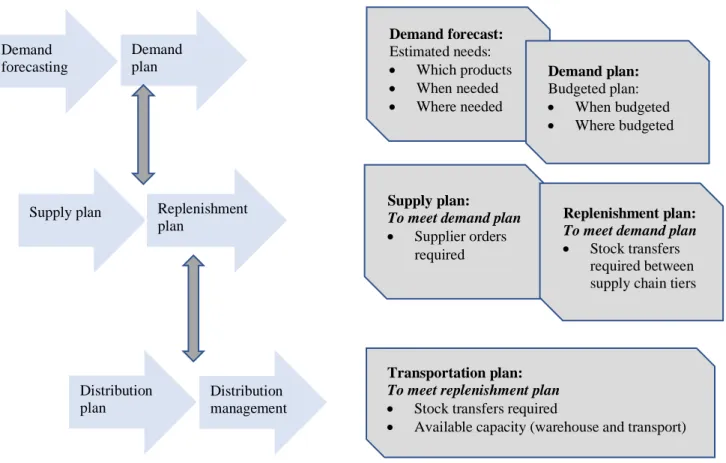
The motivation for focusing on supply planning specifically is that, under the VAN strategy, supply planning will be used to develop sourcing and replenishment plans within the supply chain, which is considered to have a significant, direct impact on product categorization for sustainable availability of medicines (Llewellyn, 2017). Therefore, the output of this research inquiry (i.e. the product categorization framework) will be used to facilitate decision making in sourcing and replenishment of pharmaceuticals in a bid to ensure sustainable availability of medicines to end-users.
The US Department of Health and Human Services (2017) defined drugs as “articles intended for use in the diagnosis, cure, mitigation, treatment, or prevention of disease in man or other animals” and
a device as “an instrument, apparatus, implement, machine, contrivance, implant, in vitro reagent, or other similar or related article, including any component, part, or accessory” used in achieving
the same purpose as a drug. The scope of this study is limited to the categorization of drugs or pharmaceuticals and excludes devices.
Assumptions, limitations, and delimitations
This thesis is limited to the pharmaceutical supply chain in the South African public healthcare sector. The focus will be on developing product-driven supply chain sourcing and replenishment strategies for VAN in the context of supply planning (thus excluding demand or distribution planning) and will be limited to two tiers, namely national and provincial supply planning.
Service SCM has two categories of supply chain systems, i.e. Product Service Supply Chains (PSSCs) and the Service Only Supply Chains (SOSCs) (Wang, Wallace, Shen, & Choi, 2015). PSSCs have both physical products and services, for example, restaurants and food retail supply chains, while in SOSCs the ‘products’ offered are pure services for example financial consultancy and psychology advice (Wang, Wallace, Shen, & Choi, 2015). This research, however, will be limited to the PSSCs as this goes along with the South African public healthcare supply chain in that the delivery of healthcare by practitioners is deemed to be the service while the medication/pharmaceuticals are the products.
Research design and methodology
According to Bryman and Bell (2014), a quantitative research approach tends to adopt the norms and practices of a model and extensively emphasizes deduction and quantification when collecting and analyzing data. In contrast, Bryman and Bell (2014) posited that a qualitative research approach is
Page | 7 principally inductive in the linkage of theory and research, with the emphasis being placed on generation rather than testing of theory. Qualitative and quantitative research approaches can also be combined to aid the researcher in capitalizing on the strengths and counterbalancing the weaknesses of each method, using a mixed-method research approach (Bryman & Bell, 2014).
For this thesis, a mixed-method research approach will be employed where secondary quantified data sources on the South African public healthcare pharmaceutical supply chain are utilized to determine and resolve the research problem. To address the multifaceted research problem, an inductive approach—where theory is an outcome of the research—is used and systems thinking is applied to analyze and synthesize literature and determine the multiple variables and parameters in developing a strategic input-output framework. The proposed framework is verified and validated to confirm the solution. The basic systems engineering approach which will be employed is shown in Figure 1.1.
Figure 1.1: A basic systems engineering approach for framework development (adapted from Mouton (2013) and van Aken, Berends, and van der Bij (2007))
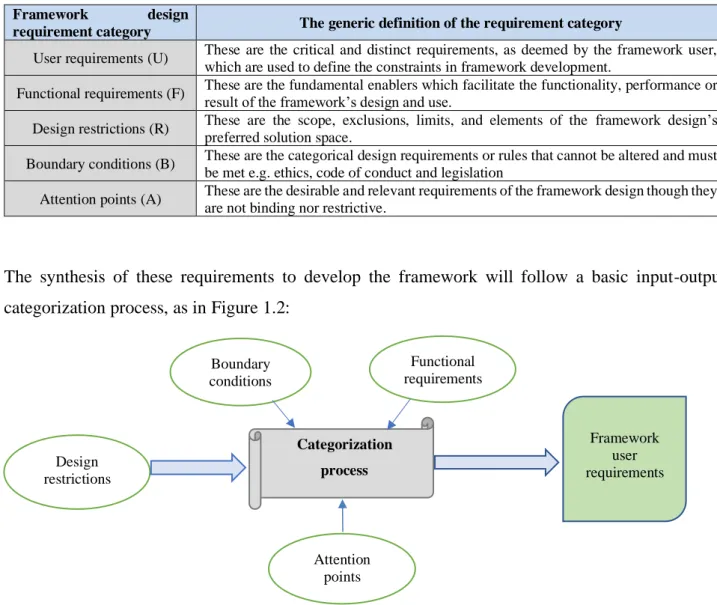
Van Aken et al. (2007) posited five categories of requirements to enable a balanced approach in the design and development of a framework, namely: user requirements (U); functional requirements (F); design restrictions (R); boundary conditions (B); and attention points (A). In line with this recommendation, the ‘design requirements’ element in Figure 1.1 will consist of these five categories of requirements. Van Aken et al. (2007) definition of each of the five categories of requirements is given in Table 1.1. Systems engineering approach Framework validation Framework verification Framework development Design requirements: • User requirements • Functional requirements • Design restrictions • Boundary conditions • Attention points
Page | 8
Table 1.1: Framework design requirement categories employed in this research (adapted from van Aken et al. (2007))
Framework design
requirement category The generic definition of the requirement category
User requirements (U) These are the critical and distinct requirements, as deemed by the framework user, which are used to define the constraints in framework development.
Functional requirements (F) These are the fundamental enablers which facilitate the functionality, performance or result of the framework’s design and use. Design restrictions (R) These are the scope, exclusions, limits, and elements of the framework design’s
preferred solution space.
Boundary conditions (B) These are the categorical design requirements or rules that cannot be altered and must be met e.g. ethics, code of conduct and legislation
Attention points (A) These are the desirable and relevant requirements of the framework design though they are not binding nor restrictive.
The synthesis of these requirements to develop the framework will follow a basic input-output categorization process, as in Figure 1.2:
Figure 1.2: Input-output transformation process (adapted from The US Department of Defense Systems Management College (2001))
Validation strategy
The product categorization framework intended to aid the VAN supply chain professionals, the South African NDoH, and ultimately the government in enhancing sustainable availability of medicines, is expected to be useful as a decision tool for VAN professionals to decide on ‘what’ product categories can be appropriately matched to ‘which’ supply chain strategies by considering ‘which’ product attributes. In establishing such a framework, it follows that principles of validity and reliability are fundamental in ensuring that the research product is valuable and useful (Jabareen, 2009).
Reliability is considered to be the extent to which the results of a study are consistent over time and whether they are an accurate representation of the total population under study (Bryman & Bell, 2014). Reliability of the findings is evaluated by verification of the study which entails the assessment
Categorization process Attention points Design restrictions Boundary conditions Functional requirements Framework user requirements
Page | 9 of whether the solution was developed in the correct manner. Verification refers to mechanisms that are employed in the framework development process to incrementally contribute to reliability and validity, and thus, demonstrate the thoroughness of the study (Srai, Alinaghian, & Kirkwood, 2013). Srai et al. (2013) further assert that verification will aid in determining whether the solution is of a high quality and complete, though it will not necessarily ensure that the solution is useful in addressing the original problem.
Validity addresses the aforementioned gap by demonstrating the integrity of the solutions from the study and ensuring that the research output truly addresses the investigated concept, providing the appropriate answers (Kothari, 2004). Srai et al. (2013) posited that the focus of validation is on the link between the purpose and the context of the research study and conclusions, thus assessing whether the developed solution addresses the defined problem. Kothari (2004) defines two forms of validity, namely external validity, which focuses on the extent to which a solution can be generalized from the view of its relevance to a larger population, and internal validation, which comprises the following three distinct concepts:
❖ Criterion validity—which evaluates the extent to which applicable features of the solution can be precisely forecasted by the theoretical concept;
❖ Face validity (also referred to as content validity)—which assesses the extent to which a solution provides adequate coverage of the topic under study; and
❖ Construct validity—which tests whether the solution addresses what it claims to solve and that the solution does not assess irrelevant attributes.
1.6.1.
Applicable validation routes
Validation is commonly achieved via three main approaches, namely: 1) interviews with subject matter experts (SMEs); 2) implementation and 3) case study application (Mouton, 2001). Each of these approaches has its own advantages and disadvantages as given below, based on Mouton (2001): • Interviews with SMEs
Definition: These are interviews where the interviewer gathers knowledge from the interviewee to disprove or validate claims made by the researcher. These interviews can be structured, semi-structured or unstructured interviews. Advantages: It provides a platform for obtaining knowledge from experts who can either
Page | 10 Disadvantages: The interviewees can only respond within their circumstances based on their
personal experiences and knowledge hence the need for special consideration in interviewee selection.
• Implementation
Definition: This denotes the full practical application of a framework in a given setting to review and validate its correctness.
Advantages: The results of the implementation are definitive and holistic.
Disadvantages: The full implementation of the framework is resource-intensive and time-consuming.
• Case studies
Definition: This is a detailed examination of an already existing case with the aim of providing descriptive, explanatory and exploratory findings.
Advantages: It provides a different perspective from which practical challenges and requirements are better understood due to similarities between case studies and reality.
Disadvantages: It is susceptible to manipulation and strongly rooted in the setting/context in which it is applied.
This study will employ interviews with SMEs—using semi-structured interviews and Likert scale rankings—followed by a case study to obtain detailed and practical insight into the validity of the framework. An overview of the validation process and roadmap is provided in the succeeding section.
1.6.2.
Validation roadmap overview
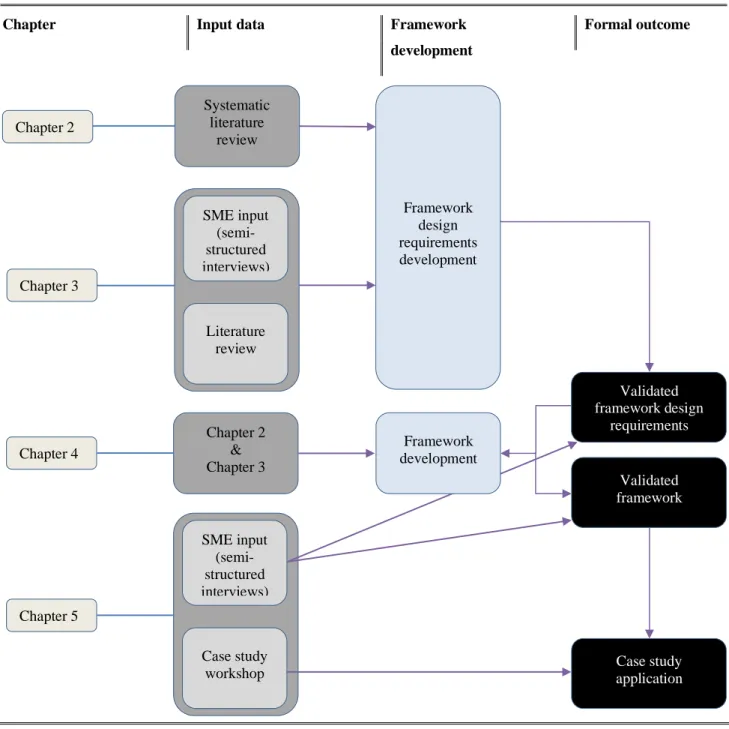
A summary of the validation strategy that will be employed in this research is provided in Figure 1.3. As discussed, this study will take a mixed methods research approach and semi-structured interviews with SMEs and a case study application will be employed as validation methods.
A triangulation approach based on three sourced of input, namely findings based on a systematic literature review, SME inputs, and the application of logical arguments and reasoning based on an understanding of SCM in public healthcare, will be used to determine the product attributes taxonomy. Using the same findings and inputs, a supply chain strategies taxonomy will be developed. Framework design requirements specifications which describe user requirements, functional requirements, design restrictions, boundary conditions and attention points, will be identified based
Page | 11 on the literature reviews and SME inputs (derived from semi-structured interviews) presented in Chapters 2 and 3.
Chapter Input data Framework
development
Formal outcome
Figure 1.3: Validation process overview
The preliminary product categorization framework will be developed based on this set of design requirements. Feedback on both the set of design requirements and the preliminary product categorization framework will then be gathered from SMEs using semi-structured interviews. This feedback will be incorporated to develop the final product categorization framework. For the purpose of maintaining the flow of the narrative and not duplicating the framework within the main document, the preliminary framework is given in Appendix D while the validated final framework (with SME feedback incorporated) is given in the main body of the thesis in Chapter 4. Systematic literature review Validated framework design requirements Framework design requirements development Chapter 3 Chapter 2 SME input (semi-structured interviews) Literature review SME input (semi-structured interviews) Case study workshop Chapter 2 & Chapter 3 Chapter 5 Chapter 4 Validated framework Case study application Framework development
Page | 12 The final product categorization framework presented in Chapter 4 will then be used to conduct a case study workshop with the main purpose of evaluating the applicability and operability of the framework.
Thesis outline
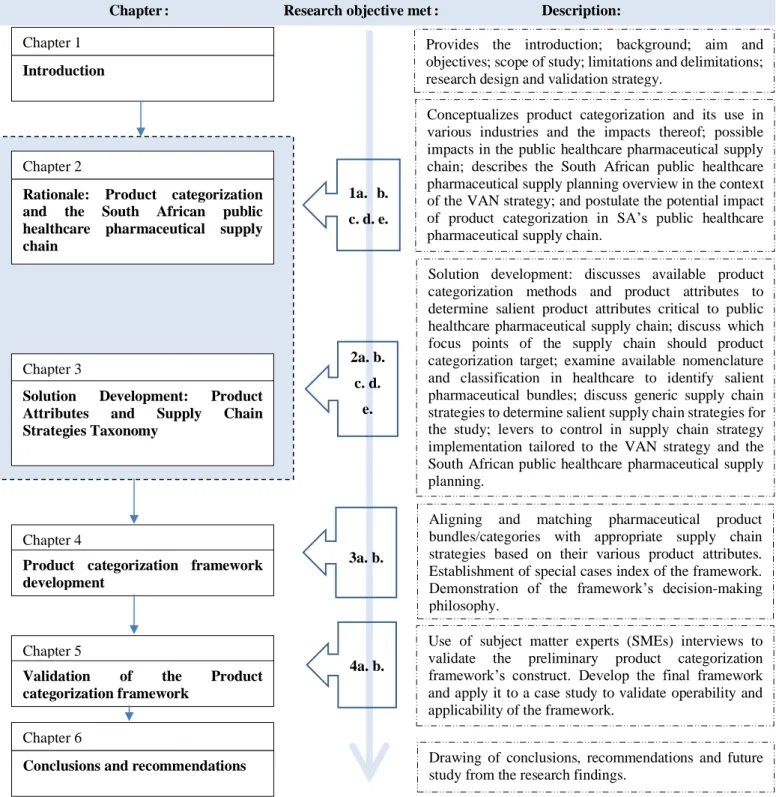
The outline and sequence of this study is summarized in Figure 1.4.
Chapter 1
Introduction
Chapter 2
Rationale: Product categorization and the South African public healthcare pharmaceutical supply chain
Chapter 3
Solution Development: Product Attributes and Supply Chain Strategies Taxonomy
Chapter 4
Product categorization framework development
Chapter 5
Validation of the Product categorization framework
Chapter 6
Conclusions and recommendations
Figure 1.4: Thesis overview
Chapter : Research objective met : Description:
1a. b. c. d. e. 2a. b. c. d. e. 3a. b. 4a. b.
Provides the introduction; background; aim and objectives; scope of study; limitations and delimitations; research design and validation strategy.
Conceptualizes product categorization and its use in various industries and the impacts thereof; possible impacts in the public healthcare pharmaceutical supply chain; describes the South African public healthcare pharmaceutical supply planning overview in the context of the VAN strategy; and postulate the potential impact of product categorization in SA’s public healthcare pharmaceutical supply chain.
Solution development: discusses available product categorization methods and product attributes to determine salient product attributes critical to public healthcare pharmaceutical supply chain; discuss which focus points of the supply chain should product categorization target; examine available nomenclature and classification in healthcare to identify salient pharmaceutical bundles; discuss generic supply chain strategies to determine salient supply chain strategies for the study; levers to control in supply chain strategy implementation tailored to the VAN strategy and the South African public healthcare pharmaceutical supply planning.
Aligning and matching pharmaceutical product bundles/categories with appropriate supply chain strategies based on their various product attributes. Establishment of special cases index of the framework. Demonstration of the framework’s decision-making philosophy.
Use of subject matter experts (SMEs) interviews to validate the preliminary product categorization framework’s construct. Develop the final framework and apply it to a case study to validate operability and applicability of the framework.
Drawing of conclusions, recommendations and future study from the research findings.
Rationale: Product categorization and the
South African public healthcare
pharmaceutical supply chain
2
Introduction to literature
This chapter presents relevant literature on the concept of product categorization—its application in various industries, evidence on its impact, and concepts used in its application. The chapter further investigates the product categorization methods that have been used in relation to SCM in the various industries. This chapter seeks to address the first objective of this thesis:
2 A significant portion of the text in Sections 2.2 and 2.3 has been reproduced from a conference article that was published as part of
this research. The article citation is: Mapowo, N., Bam, L., de Kock, I., & van Eeden, J. (2018). “Incorporating Product
Categorization to improve the performance of SA’s public healthcare supply chain: A research agenda.” In SAIIE29 Proceedings, 24th – 26th of October 2018, Spier, Stellenbosch, South Africa (pp. 391–404).
Research objective 1: To develop the rationale for the research by investigating the expected benefit of incorporating product categorization into the South African public healthcare pharmaceutical supply chain. The sub-objectives associated with research objective 1 are:
a) Provide an overview of the concept of product categorization based on literature; b) Provide an overview of the contemporary application of product categorization to
various industries, including a summary of the impact of product categorization in these industries, based on a systematic literature review;
c) Provide an overview of the operation and management of the South African public healthcare pharmaceutical supply chain;
d) Provide an overview of supply planning in line with the VAN principles in the South African public healthcare pharmaceutical supply chain; and
e) Articulate the rationale for expecting product categorization to hold benefit for the South African public healthcare pharmaceutical supply chain.
Page | 14 The intended outcome of this chapter is to derive concepts from the literature that potentially drive the feasibility and applicability of the product categorization dimensions in the South African public healthcare pharmaceutical supply chain. The chapter ends with a summary of the set of framework design requirements that are derived from the work presented.
The concept of product categorization
Fisher (1997), an acknowledged pioneer of the concept of product categorization, proposed that if products are classified based on their demand configurations, they fall into one of two categories: they are either primarily functional or primarily innovative. Furthermore, Fisher (1997) proposed that supply chains can either be physically efficient or market responsive based on the stated product distinction. He then posited a generic framework to match the product type to the appropriate supply chain strategy with functional products being matched to efficient supply chains and innovative products matched to responsive supply chains, while the converse results in a mismatch as shown in Figure 2.1
Functional Products Innovative Products
Efficient Supply Chain Match Mismatch
Responsive Supply Chain Mismatch Match
Figure 2.1: Fisher's framework, matching supply chains with products. (adapted from Fisher (1997))
Fisher (1997) asserted that functional products are the widely available products which satisfy basic needs. They are characterized by a relatively extensive lifecycle, with little change over time and little variance in their offerings. Demand for functional products is typically predictable and stable, and they tend to possess low-profit margins because of the many competitors in the market (Christopher, 2011). Inventory is used to buffer demand because the cost of functional products obsolescence is low (Harris et al., 2010).
Sullivan, Harris, Farrington, and Componation (2007) underlined that innovative products are typically distinguished as trendy and have highly volatile demand that is difficult to predict. They are associated with significantly more uncertainty than functional products. Innovative products have larger product variety and short life-cycles, but the profit margin is high, therefore lost sales (opportunity cost) exert a significant effect on company performance (Harris et al., 2010). Table 2.1 shows the demand aspects for the classification of products as either functional or innovative.
Page | 15
Table 2.1: Product demand aspects versus functional or innovative (adapted from Fisher (1997))
Demand Aspects Functional (Predictable Demand) Innovative (Unpredictable Demand)
Average stock-out rate 1% to 2% 10% to 40%
Product Variety Low (10 to 20 variants per category) High (often millions of variants per category)
Contribution to Margin 5% to 20% 20% to 60%
Product Life Cycle More than 2 years 3 months to 1 year
If products are not aligned with their appropriate supply chain strategies, this can result in overserving and overcharging functional products’ customers, and underserving and undercharging innovative products’ customers (Sullivan et al., 2007). Translating this to the public healthcare pharmaceutical supply chain, various products from the pharmaceutical product portfolio can probably be determined and categorized according to either being functional or innovative. This, as established by Fisher (1997) in Table 2.1, would be dependent on the pharmaceuticals demand aspects (e.g. average stock-out rates, product life cycle, and product variety, etc.) of each product. It can then be reasoned that chronic medication which, in the South African pharmaceutical supply chain, has been exposed to have a stock-out rate of 25% as established in Section 1.1, will possibly not be considered the same as other medication with little or no stock-outs. Chronic medication stock-outs can probably be argued to be in the innovative products category since their stock-out rate is between 10% and 40% as identified in Table 2.1. However, it can contrarily be argued that since normally chronic patients are registered and known, then chronic medication should have predictable demand and thus should be categorized as functional. This uncertainty in categorization brings the need to consider all product attributes and determine which ones are critical for matching product categories to appropriate supply chain strategies, and this is the partial aim of this thesis.
Applications of product categorization
A systematic literature review was conducted to determine previous applications of product categorization as well as the documented impacts of product categorization.
2.3.1.
Literature analysis approach
To understand the trends in research, the current applications of product categorization, and how product categorization relates to supply chain strategies, a systematic literature review was conducted. Tranfield, Denyer, and Smart (2003) posited that a systematic literature review is a scientific, transparent and replicable approach “that aims to minimize bias through exhaustive literature searches of published and unpublished studies by providing an audit trail of the reviewer’s decisions, procedures, and conclusions”. Tranfield et al. (2003) further highlighted that a systematic literature review process involves three main steps, namely: i) identifying the research questions and planning
Page | 16 the review, ii) conducting the review, and iii) reporting and dissemination. The procedure is shown in Figure 2.2:
Systematic Literature Review
1st Step
Specifying the research question(s) and planning the
review 2nd St ep Conducting the review 3rd Step Reporting and Dissemination
Figure 2.2: Systematic literature review procedure (adapted from Tranfield et al. (2003))
2.3.2.
Step 1: Specifying and planning the review
The systematic literature review consisted of firstly gathering and then analyzing research studies and publications concerning product categorization and supply chain strategies that incorporated the practice of product categorization. An overview of the application of product categorization dimensions across industries and more specifically the healthcare sector is subsequently provided. The literature review was conducted using the Scopus3 database to identify the application trends of product categorization. The literature review thus sought to address the following two research questions (RQ):
Both research questions are considered within the SCM context. Keywords from the research questions were derived and the following search line was developed:
3
Scopus is a large abstract and citation database of peer-reviewed literature: books, scientific journals and conference proceedings.
❖ RQ 1: For the past decade (2007 to 2017), what have been the trends and concepts employed in applying the product categorization dimensions?
❖ RQ 2: What are the impacts of incorporating product categorization in the various industries?
(((categori* OR segment* OR classif*) W/5 (demand* OR supply* OR distrib*)) AND ("supply chain" OR "value chain")).
Page | 17 The search line took word variations into consideration, for instance, the terms product categorization, segmentation or classification are used interchangeably in the literature. The search line also catered for variations between American English and British English. Since the aim is to consider product categorization within the context of SCM, the terms supply chain and value chain are also included as search terms as well as demand, supply, and distribution. Supply chain and value chain do not necessarily mean the same in literature, but the two terms encompass various aspects that intersect, hence both terms were incorporated into the search line.
2.3.3.
Step 2: Conducting the review
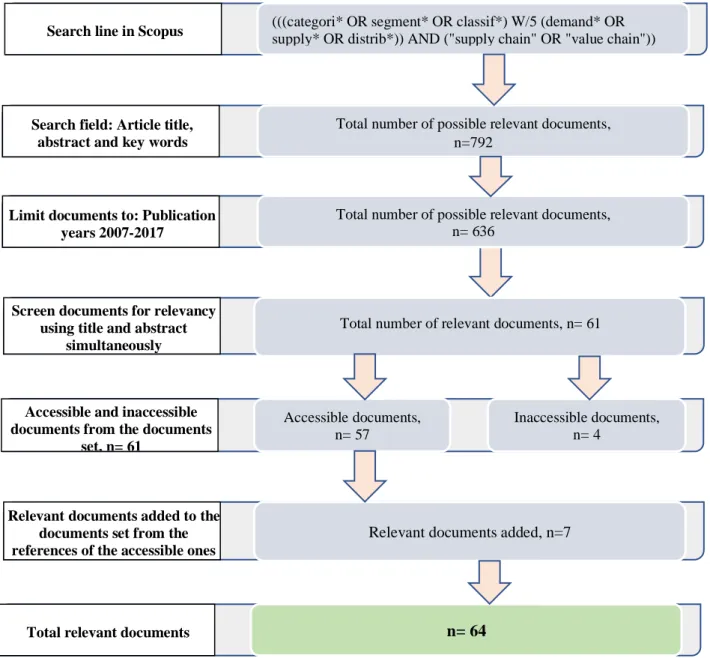
The search field included title, abstract, and keywords of items in the Scopus database and the initial search yielded 792 documents. Since the focus of the structured literature review is on contemporary applications of the concept of product categorization, the results were filtered to include only literature published over the past decade (2007-2017). This reduced the number of documents to 636. The abstracts of the 636 documents were screened for relevancy based on the following two criteria:
i. Documents that addressed the development of frameworks and models of product categorization dimensions and/or supply chain strategies were accepted; and
ii. Documents that did not describe the development of a framework or model but that did detail how and why product categorization should be applied in any setting were included too. The screening yielded 61 documents that were concerned with detailing and/or development of frameworks, models, and impacts of product categorization and/or supply chain strategies. Care was taken not to overly filter documents during the screening phase, lest important documents might be left out.
Of the 61 documents identified through the screening process, four documents were found to be inaccessible, thus reducing the number of documents included in the dataset for analysis to 57. A further seven documents were added to the dataset for analysis, based on serendipitous discovery. These documents all satisfied the screening criteria. The final dataset for analysis, therefore, consisted of 64 relevant documents. A summary of the approach followed is provided in Figure 2.3.
Page | 18
Figure 2.3: Scopus database search methodology (reproduced from Mapowo et al. (2018))
2.3.4.
Step 3: Reporting and dissemination of the systematic review
This section provides an overview from the systematic literature review of the application of the product categorization concept, firstly in other industries which are not healthcare (18 documents in the dataset document instances of industry application in general), then secondly in the healthcare industry itself (three documents in the dataset document instances of application to the healthcare industry specifically).
(((categori* OR segment* OR classif*) W/5 (demand* OR supply* OR distrib*)) AND ("supply chain" OR "value chain"))
Search line in Scopus
Total number of possible relevant documents, n=792
Search field: Article title, abstract and key words
n= 64
Inaccessible documents, n= 4
Accessible documents, n= 57
Accessible and inaccessible documents from the documents
set, n= 61
Relevant documents added, n=7 Total number of relevant documents, n= 61
Screen documents for relevancy using title and abstract
simultaneously
Total relevant documents Relevant documents added to the
documents set from the references of the accessible ones Limit documents to: Publication
years 2007-2017
Total number of possible relevant documents, n= 636
Page | 19
Figure 2.4: Percentage distribution of industry-specific documents pool
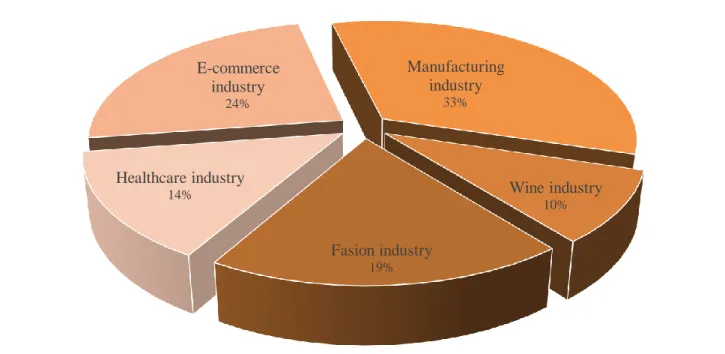
The industries that are covered in the dataset are summarized in Figure 2.4. As shown, the majority of industry-specific research has been directed at the manufacturing industry (33%) followed by e-commerce (24%). Healthcare is one of the five industries that are explicitly included in the dataset.
2.3.4.1.Application of product categorization in other industries (excluding healthcare)
The four industries (excluding healthcare) to which concept of product categorization has been applied in that dataset, share certain characteristics with the healthcare supply chain, including: ✓ Agility to seasonal and demographic variations, in the case of the fashion and retail industry; ✓ The visibility, variability, analytics and categorization of a large innovative product portfolio and
how they are supplied that underscores the need for continuous improvement, in the case of the e-commerce industry;
✓ Responsiveness to high demand, especially in the case of the wine industry; and ✓ Combination of lean and agile principles, in the manufacturing industry.
Table 2.2 below details the concepts of product categorization application in the industries and the impacts thereof. As summarized in the table, product categorization has been applied to demand planning, distribution planning, and supply planning functions in the supply chain. As stated in Section 1.3, the scope of this research is specifically focused on supply planning. The aspects of the supply chain that have been impacted include product availability, product shelf space, order cycle time, lead time to delivery, and demand variability.
Healthcare industry 14% E-commerce industry 24% Manufacturing industry 33% Wine industry 10% Fasion industry 19%
Page | 20
Table 2.2: Impacts of application of product categorization in industries (reproduced from Mapowo et al. (2018))
Industry Literature Concepts in application Impacts
Wi n e in d u str
y Wen, Tong, and Yao
(2010)
Quality Function Deployment (QFD)
Optimal determination of delivery frequencies and minimum lot sizes. Improved product and packaging management. Enhanced marketing and responsiveness to high demand peaks.
M an u fac tu r in g i n d u str y Nagashima, Wehrle, Kerbache, and Lassagne (2015)
Ordered feature evaluation analysis (OFEA); and Collaboration intensity
Enhanced demand forecasting accuracy. Naim and Gosling (2011) Lean and agile ('Leagile')
manufacturing paradigms
Optimal determination of decoupling point. Ramkumar, Subramanian,
Narendran, and Ganesh (2013)
Vendor Managed Inventory (VMI)
Reduction in lead time and demand variability. Optimal stocking quantities at warehouses. Ervolina, Ettl, Lee, and
Peters (2009)
Available-To-Sell (ATS) Optimal demand forecasting. Profitable demand response. Profitable product portfolio.
Hiremath, Sahu, and Tiwari (2013)
Outbound logistics network (OLN). Multi-objective genetic algorithm (MOGA)
Minimize the total network cost. Maximize resource utilization.
Taylor, Gan, Grunow, Gan, and Grunow (2015)
concurrent product and supply chain design (CP-SCD)
Provide managerial insights in design trade-off analysis.
Fichtinger, Chan, and Yates (2017)
Two-Echelon Dual-Channel Supply Chain
Development of profitable market segments. Micieta, Lieskovsky, and
Binasova (2016)
Group technology Improvement in quality, productivity and inventory management. Increase costing accuracy. Increase customer service. A gain in sustainable competitive advantage.
Rajan and Wang (2016) Hierarchical clustering Obsolescence reduction.
F as h ion an d r e ta il i n d u str y
Şen (2008) Efficient supply chain management practices
Production of a variety of sizes, styles, and colors in shorter lead-time. Agility to changing demand requirements. Ability to better forecast and plan future production needs.
Roscoe and Baker (2014) Supply chain segmentation Aligning of demand planning, marketing, sales, and supply chain functions.
Martínez, Errasti, and Rudberg (2015)
Pronto Moda or Rapid-Fire Fulfilment
Reduction of variety and a wide range of garments per collection. Standardizing fabrics and product platforms. Introduction of mini collections.
Sardar, Lee, and Memon (2016)
Outsourcing strategies. Goal programming
Cost-saving. Capacity flexibility.
E -c om me r ce i n d u st ry
Rofin and Mahanty (2017) Cournot model Determination of product categories' optimal dual-channel supply chain configuration for different customer online channels preference. Hofbauer, Withalm, and
Wölfel (2007)
Ontology Derivation of web ontologies. Efficient and reliable electronic product data exchange across organizations.
Liao, Chen, and Yang (2013); Murray, Agard, and Barajas (2015); Cooke (2014); and
Two-step data mining approach
Mining customer knowledge on online channels and product segments preferred. Better market segmentation.
Li and Huang (2012) Two-Echelon Dual-Channel Supply Chain
Page | 21 Considering the literature on the wine industry specifically, the incorporation of product categorization facilitates responsiveness to high demand peaks. Product categorization in the wine industry has also shown that, with delivery frequencies and minimum lot sizes determined, the cost of inbound and outbound transportation can potentially be reduced (Wen et al., 2010).
Examples from the manufacturing industry show that potential impacts of the incorporation of product categorization include determining the optimal decoupling point, reducing lead time and demand variability, optimizing stock quantities at depots, and improving the accuracy of demand forecasting. As seen in the fashion industry, a reduction of variety and a wide range of garments per delivery as well as standardizing product platforms is potentially possible through the incorporation of product categorization. The E-commerce industry shows that visibility, analytics, and categorization of a large product portfolio is likely feasible through the incorporation of product categorization. Determination of product categories' optimal multi-channel supply chain configuration for products is potentially possible too.
As discussed previously, there are shared characteristics between the four industries discussed here and the healthcare industry. It is therefore plausible that some of the same impacts that have been discussed here can potentially be reaped from incorporating product categorization in the healthcare supply chain. The expected benefit of applying product categorization to the South African public healthcare pharmaceutical supply chain is discussed in Section 2.6.
2.3.4.2.Application of product categorization in healthcare
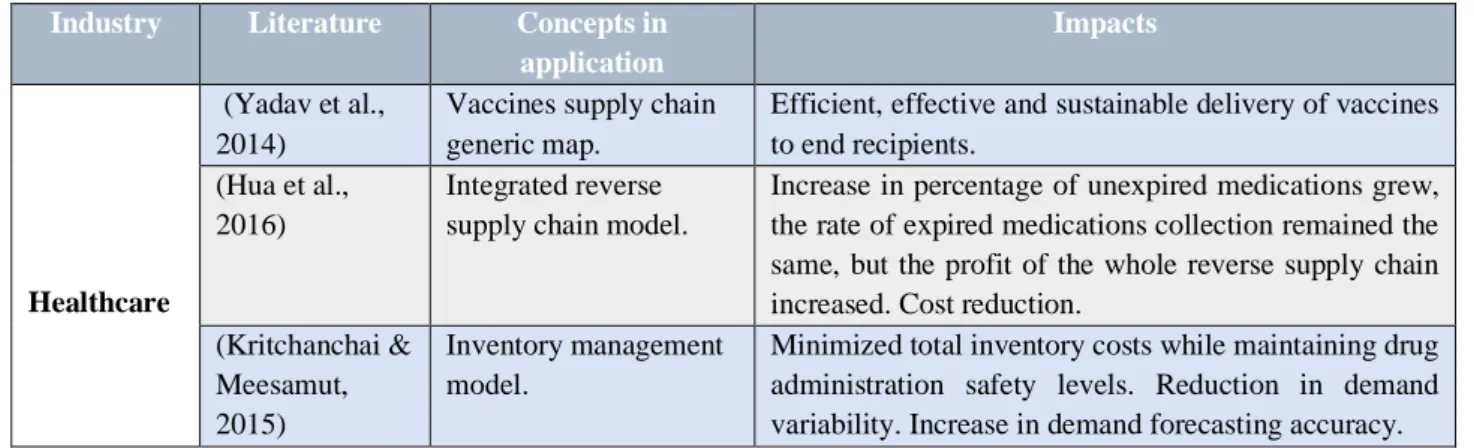
Unlike in the commercial sector where the focus is largely on profit and competitive advantage, the focus in the public healthcare sector is on effective and sustainable availability and administration of healthcare (Abdulsalam, Gopalakrishnan, Maltz, & Schneller, 2015). The dimensions of product categorization have been used in the healthcare sector by Yadav, Lydon, Oswald, Dicko, and Zaffran (2014) in developing a framework for decision making in the integration of vaccine supply chains with other health commodity supply chains. The framework enabled the optimization of immunization supply chains as vaccines were delivered to the end recipients efficiently, effectively and sustainably. Optimal product categories which aided in aligning of demand planning and supply chain functions were determined. Hua, Tang, and Wu (2016) employed the product categorization dimensions in developing an integrated reverse supply chain model. The model was meant to investigate the impact of various unwanted medications categories and government’s publicity and penalty investment on the reverse supply chain profit as well as the collection rate of expired medications. The findings showed that as the percentage of unexpired medications grew, the rate of expired medications collection remained the same, but the profit of the whole reverse supply chain
Page | 22 increased (Hua et al., 2016). Finally, Kritchanchai and Meesamut (2015) employed the dimensions of product categorization in developing an inventory management model for a hospital in Thailand. They argued that a single inventory management system cannot be used on all medicines effectively. The inventory management system they developed enabled the hospital to minimize the total inventory costs while maintaining patient drug administration safety levels. Provision for demand forecasting accuracy was made as well as a reduction in demand variability (Kritchanchai & Meesamut, 2015). The application of product categorization in healthcare according to the systematic literature review is summarized in Table 2.3.
Table 2.3: Impacts of application of product categorization in healthcare (reproduced from Mapowo et al. (2018))
Industry Literature Concepts in
application
Impacts
Healthcare
(Yadav et al., 2014)
Vaccines supply chain generic map.
Efficient, effective and sustainable delivery of vaccines to end recipients.
(Hua et al., 2016)
Integrated reverse supply chain model.
Increase in percentage of unexpired medications grew, the rate of expired medications collection remained the same, but the profit of the whole reverse supply chain increased. Cost reduction.
(Kritchanchai & Meesamut, 2015)
Inventory management model.
Minimized total inventory costs while maintaining drug administration safety levels. Reduction in demand variability. Increase in demand forecasting accuracy.
Similar to the comment made at the end of the previous section, the examples of previous applications of product categorization to the healthcare industry, as well as the documented benefits from these applications, can be used to determine potential applications of product categorization to the South African public healthcare pharmaceutical supply chain. In the two sections that follow, a general introduction to the South African public healthcare pharmaceutical supply chain (Section 2.4) as well as an overview of supply planning in this supply chain (Section 2.5) is presented. This is followed by a discussion of the expected benefit of applying product categorization to the South African public healthcare pharmaceutical supply chain in Section 2.6.
The South African public healthcare pharmaceutical
supply chain
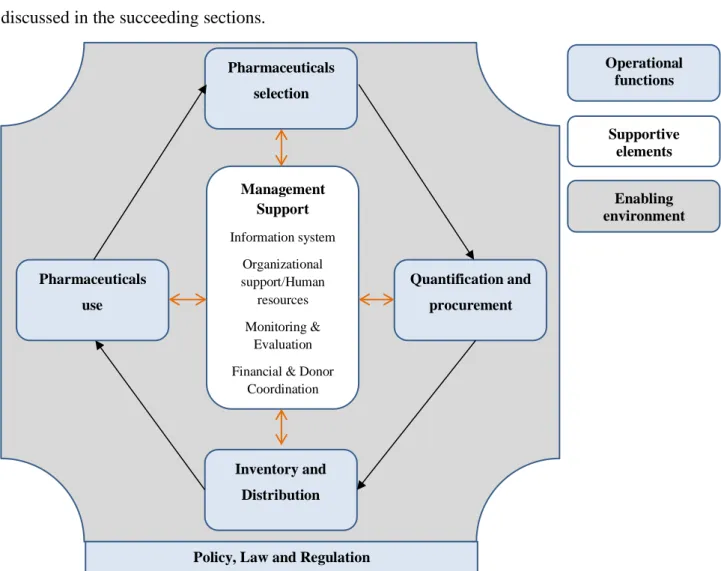
Raja and Mohammad (2004) asserted that a public healthcare pharmaceutical supply chain mainly comprises of four operational functions, namely product selection; quantification and procurement; inventory and distribution; and product use. They further posited that these operational functions exist within an enabling environment of policy and legal framework which governs the core management supporting elements. There is limited literature available on the description of exact operations within
Page | 23 the South African public healthcare pharmaceutical supply chain system, however, the work of Zuma (2016)will be largely referred to, coupled with some available additional contemporary resources.
As shown in the pharmaceutical logistics framework in Figure 2.5, the South African public healthcare pharmaceutical supply chain can be conceptualized as consisting of four operational functions, supportive elements, and an enabling environment. Each of these components will be discussed in the succeeding sections.
Figure 2.5: Pharmaceutical logistics framework (adapted from Raja and Mohammad (2004))
2.4.1.
Operational functions
Each of the four operational elements depicted in Figure 2.5 is briefly discussed in the following subsections.
2.4.1.1.Pharmaceuticals selection
The public healthcare pharmaceutical supply chain sector consists of three levels of care i.e. PHCFs, secondary hospital, and tertiary/quaternary hospital (Perumal-Pillay & Suleman, 2017). The South African NDoH in particular, comprises of a sector-wide Procurement Division mainly responsible for
Policy, Law and Regulation
Enabling environment Supportive elements Operational functions Pharmaceuticals selection Inventory and Distribution Pharmaceuticals use Quantification and procurement Management Suppor