An assessment of human–computer interaction
research in management information systems:
topics and methods
Ping Zhang*, Na Li
School of Information Studies, Syracuse University, Syracuse, NY 13244, USA
Abstract
As an emerging subfield of Management Information Systems (MIS), Human–Computer Interaction (HCI) or Human Factors studies in MISare concerned with the ways humans interact with information, technologies, and tasks, especially in business, managerial, organi-zational, and cultural contexts. To date, few studies have either synthesized existing studies or drawn an overview picture of the HCI subfield in MIS. This paper first provides a framework of broad HCI issues and concerns. It then reports an assessment of a sample of published HCI articles in two top MISjournals,MIS QuarterlyandInformation Systems Research, over a period of thirteen years (1990–2002). It identifies the main topics studied, the main research approaches utilized, the research publication patterns, and the needs for future research efforts in this subfield. The results should be of interest to researchers in this subfield, in the MISfield, and in other related disciplines for future research, collaboration, and publication.
#2003 Elsevier Ltd. All rights reserved.
Keywords:Human–computer interaction (HCI); Human factors in information systems (HFIS); Litera-ture analysis; LiteraLitera-ture assessment; Research methods
1. Introduction
Research that synthesizes existing studies to provide an overview of an emerging field is often scarce but extremely important to advance our understanding of the current status and suggest future directions of the field. This situation is especially pressing for an emerging subfield that is an overlapping or intersection of the two important disciplines, human–computer interaction (HCI) and management information systems (MIS).
Computers in Human Behavior 20 (2004) 125–147
www.elsevier.com/locate/comphumbeh
0747-5632/$ - see front matter#2003 Elsevier Ltd. All rights reserved. doi:10.1016/j.chb.2003.10.011
* Corresponding author. Tel.: +1-315-443-5617; fax: +1-315-443-5806.
As rightly recognized by Hewett and colleagues (Hewett et al., 1992), there is no agreed upon definition of the range of topics that form the area of Human– Computer Interaction. In an attempt to derive and develop educational materials, these scholars defined HCI as ‘‘a discipline concerned with the design, evaluation and implementation of interactive computing systems for human use and with the study of major phenomena surrounding them’’ (Hewett et al., 1992). It is widely recognized as an interdisciplinary field where many traditional disciplines contribute to the study of its main issues (Preece, Rogers, Sharp, Benyon, Holland, & Carey, 1994).
Management information systems (MIS) is a community of scholars interested in the development, use, and impact of information technology and systems in social and organizational settings (Zhang & Dillon, 2003). MIShas been through a steady shift from what was a techno-centric focus to a better-balanced technology/organi-zational/management/social focus (Baskerville & Myers, 2002). User attitudes, perceptions, acceptance and use of IT have been a long standing issue and a major theme of MISsince early days in computing (Lucas, 1975; Swanson, 1974).
Human–computer interaction (HCI) or Human Factors studies in MISare ‘‘concerned with the ways humans interact with information, technologies, and tasks, especially in business, managerial, organizational, and cultural contexts’’ (Zhang, Benbasat, Carey, Davis, Galletta, & Strong, 2002, p. 334). The emphases have been on both the ‘‘design, evaluation and implementation’’ aspect and the ‘‘use and impact in social and organizational settings’’ aspect of information technology for human use. Since the 1970s, MIS researchers have published abundant studies concerning HCI issues in many MISjournals. The active HCI-centered minitracks, sessions and workshops in major MISconferences, along with the newly formed AISSpecial Interest Group on HCI, have also shown high interests in HCI among MISresearchers in recent years.
With the fast development and deployment of information systems, information technology and communication technology (in this paper, we use ISor IT to repre-sent them all) into every part of our lives, HCI issues become persuasive and fundamental. They also prompt a need to re-examine what HCI is about and how to conduct research in this area.
Several studies have been conducted to systematically assess the intellectual evolution of the MISfield in terms of its theories, topics, research methods, etc. (Alavi & Carlson, 1992; Culnan, 1987). However, very few studies have drawn an overview picture of the HCI subfield up to date (Zhang et al., 2002). The purpose of this study is to reflect on the current status of the subfield in terms of research topics and research methods, to identify gaps that need to be addressed, and to point out future research directions.
Specifically, this paper will first depict a new framework of HCI issues, which is intended to capture the dynamics and richness of the interaction between human and technology. Utilizing the new framework for subject topics and an existing framework for research methods, the paper then reports an assessment of a limited collection of the published HCI articles from two main MISjournals,Management Information Systems QuarterlyandInformation Systems Research, on the following
aspects: (1) the research topics being studied, (2) the research methods being utilized, and (3) the publication patterns of the HCI type research in the two journals over time. From the findings, we identify and discuss areas of need for future research.
The results of this study can provide useful information to scholars and practi-tioners in the MISand the traditional HCI fields for future research, collaboration, publication, and practice. They can also be helpful for interested doctoral students to identify potential research topics as dissertation research.
The rest of the paper is organized as the following.Section 2introduces a frame-work of broad HCI issues.Section 3explains the methodology used in this paper for assessing the published articles.Section 4presents the assessment results.Section 5 discusses and concludes the paper.
2. A framework of broad HCI issues
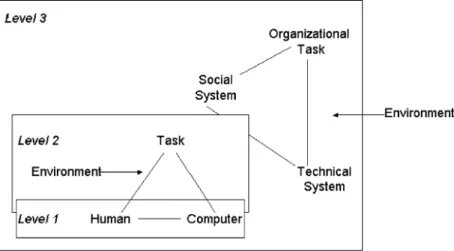
Only a few comprehensive frameworks of HCI issues and topics have been devel-oped so far. This coincides with the observation that no agreed upon definitions of the range of topics for HCI exist (Hewett et al., 1992). Among these few frame-works, Eason (1991) proposed a three-level model of HCI model, as depicted in Fig. 1.
InFig. 1, Level 1 considers human–computer interaction as a form of conversa-tion between two participants capable of processing informaconversa-tion. Level 2 broadens the framework to examine user, task, and environmental factors which may affect task performance. The next level considers the factors which are important when human–computer interaction takes place within a socio-technical systems frame-work (Eason, 1991, p. 722). In Eason’s framework, environmental factors at Level 2 mainly refer to the physical environment such as visual display terminals and physical settings in which computers are used. At Level 3, IT and the interaction
Fig. 1. A three-level model of HCI (Eason, 1991).
between human and computers have impacts on social life by changing the nature of jobs, the way organizations operate, and the way people interact with each other. How human–computer interaction related to the society and organizations is not predetermined. Instead, it is shaped by the way the IT is designed and implemented. We think this multi-level model captures the importance of contexts of HCI con-cerns in real world settings. Much emphasis of the human, however, is on cognitive ergonomics.
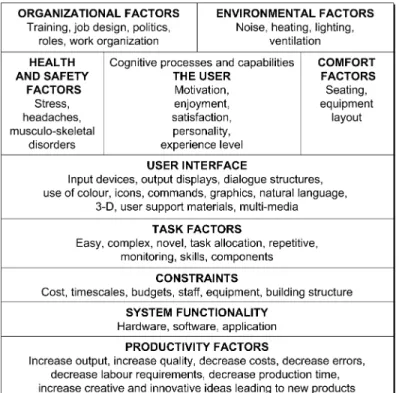
Preece and colleagues (Preece et al., 1994) outlined the components of HCI, as seen inFig. 2. The factors in HCI range from system constraints, system function-alities, productivity factors, to task factors, user interface, health and safety factors, comfort factors, the user, and organizational and environmental factors. The model is quite comprehensive in identifying all factors that contribute to HCI design. It also recognizes the user as a complex being with cognitive processes and capabilities but also with motivation, enjoyment, satisfaction, personality, and experience.
From an education perspective, Hewett and colleagues (Hewett et al., 1992, p. 16) proposed a framework (Fig. 3) that was intended to identify and tie together the building blocks of HCI curricula for Computer Science students with a HCI concentration or major.
Fig. 2. Factors in HCI (Preece et al., 1994).
The framework identifies the need to understand humans in terms of human information processing, ergonomics, and language and communication. It also includes use and context by outlining social organization and work, and human– machine fit and adaptation. The emphases of the framework are computer techni-ques for designing various system elements (devices, graphics, dialogs) for humans to interact with, and the approach and process to design, evaluate and implement interactive systems. This focus is inherent given that the framework was proposed by the ACM Special Interest Group on Computer–Human Interaction (SIGCHI).
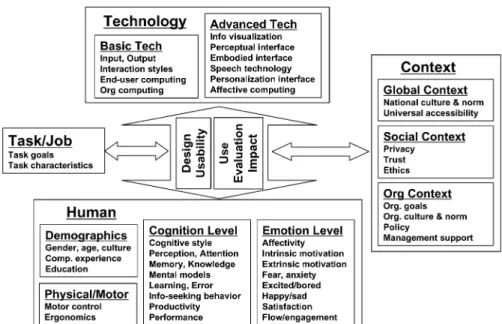
The above frameworks have all contributed to our understanding of the possible topics in HCI. Yet, in order to understand the intersection or interaction of the two disciplines (HCI and MIS) and the broad issues studied in the intersection, a new framework is in need. This framework should be relatively parsimonious, thus easy to use. It should demonstrate the major components and their relationships, the dynamic and rich nature of HCI, and the contextual factors that play an important role in HCI.Fig. 4is our attempt for such a framework of an overview of the broad HCI issues and concerns.
The first basic component is Human. There can be different ways of under-standing humans in general and their specific characteristics pertinent to their interaction with IT. One way of examining the human is as depicted inFig. 4, where four categories of issues can be explored: (1) demographics that are found in many HCI studies; (2) physical or motor skills, as those investigated in traditional
Fig. 3. ACM SIGCHI curricula for HCI (Hewett et al., 1992).
Ergonomics; (3) cognitive issues that have been examined by many HCI researchers in a good number of disciplines; and (4) emotion or affect aspect, which has started to gain attention from HCI researchers recently. The second component is the technology, broadly defined as including hardware, software, applications, data, information, knowledge, and supporting personnel and procedures.Fig. 4indicates one way of examining technological issues when studying HCI. All the topics in Fig. 4are meant to be illustrative, rather than exhaustive.
The thick vertical Interaction arrow (the ‘‘I’’ arrow) between Human and Tech-nology represents the ‘‘I’’ in the HCI. It is the core or the center of all the actions. Traditionally, HCI studies were concerned with designing and implementing inter-active systems for specified users, and the usability issues during the development process. The box ‘‘Design/Usability’’ on the left side inside the ‘‘I’’ arrow indicates this emphasis. A big chunk of existing HCI studies in the traditional HCI literature fits in this box. Its primary focus has been the issues prior to technology release and actual use. Ideally, concerns from both human and technology should influence design and usability issues. Thus the labeling is meant to be bi-directional.
We argue that this view of HCI centered on design and usability is narrow and limited. It misses the other half of the cycle that has a significant impact on this first half and the entire interaction experience a human has. John Carroll and colleagues, more than a decade ago, illustrated the task-artifact cycle by stating that a task sets requirements for the development of artifacts, and the use of an artifact often redefines the task for which the artifact was originally developed (Carroll, Kellogg, & Rosson, 1991). This cycle idea supports the evolutionary view of examining HCI
Fig. 4. A framework of broad HCI issues and concerns. 130 P. Zhang, N. Li / Computers in Human Behavior 20 (2004) 125–147
design and usability, which is depicted in the box on the right side inside the ‘‘I’’ arrow, ‘‘Use/Evaluation/Impact’’ in Fig. 4. This second half of the Interaction is concerned with the actual use of technology by users in real contexts, their eval-uation of the technology, and the impact of such use and evaleval-uation. It is important to note that design and usability studies should be informed by what we have learned from the use, evaluation and impact of the same or similar technologies. Thus the latter has implications for the former. Historically, this half has been the focal concern for the MISfield, along with organizational psychology, social psychology and social science. In the MISfield, studies on individual reactions to technology (Compeau, Higgins, & Huff, 1999), ISevaluation from both individual and organizational levels (Goodhue, 1997, 1998; Goodhue & Thompson, 1995), and user technology acceptance (Davis, 1989; Venkatesh & Davis, 2000) all fall in this area.
The picture with Human, Technology, and Interaction alone is still incomplete. Nothing happens in a vacuum. The interaction experience is relevant and important only when humans use technologies to support their primary tasks within certain contexts, being organizational, social or societal. Normally, humans use technolo-gies not for the sake of technolotechnolo-gies but for supporting their primary tasks, being job related or entertainment oriented. In addition, tasks are carried out in a certain setting or context that imposes constraints or significance for doing and completing the tasks. Three contexts are identified: organizational context, social context, and global context. The task and context boxes add the dynamic and essential meanings to the interaction experience the human has with technology. In this sense, studies on interaction are moderated by tasks and contexts. The two horizontal arrows connecting with Task and Contexts represent this fact.
3. Methodology
3.1. Article selection
Published research articles need to be selected in order for the authors to identify research topics being studied, research methods being utilized, and publication pat-terns of the HCI studies in MIS. Owing to the exploratory nature of this study, two MISjournals for a thirteen year period of 1990–2002 were considered as the sources of the articles for analysis:Management Information Systems Quarterly(MISQ) and
Information Systems Research (ISR). Only articles on research and education are considered for the analysis. Thus the pool of candidate articles excludes editorial introductions, editorial notes, executive summaries, or announcements.
Each paper in the pool was initially screened for HCI relevance by the criterion that the paper should address one or more aspects that fit the HCI framework out-lined inFig. 4. A paper is excluded if (1) it is concerned with group support systems or group decision support systems but does not approach it from human aspects either at the individual or collaborative level; (2) it is about pure system design or development methods or processes without linking to user’s considerations; or (3) it is concerned with the personnel or human resource management aspect of human P. Zhang, N. Li / Computers in Human Behavior 20 (2004) 125–147 131
factors issues related to IT. This initial screening yielded a total of 171 articles. Each paper was then coded according to the schemes to be explained below. During the coding process, each paper was evaluated again for its relevance. As a result, 20 papers were excluded and 151 were considered for the final analysis.
3.2. Classification schemes
Each of the selected articles was classified and coded in two ways: by research topic according to the HCI framework proposed inSection 2, shown asFig. 4, and by research method or type according to Alavi and Carlson’s research type frame-work (Alavi & Carlson, 1992). The latter was modified slightly to reflect the paper collection in this study.
3.2.1. Topic
In the MISfield, there are several attempts in providing a classification of topical subjects of studies. Culnan, for example, identified several research streams of MIS research by examining MISpublications during the period of 1980–1985 (Culnan, 1987). Barki and colleagues developed the MISkeyword classification scheme by examining the keywords in published MISresearch literature (Barki, Rivard, & Talbot, 1988, 1993). Despite the influence and wide use of these classifications, we note two limitations of using them for this study. First, they are intended to classify the entire MISfield, not for a single subfield. Second, they were developed more than a decade ago and have not been updated lately to reflect the development of the fields and changes of research foci.
In this paper, we classify HCI studies according to the broad HCI issues depicted byFig. 4. Specifically, at a higher level, we classify an article by whether it is about issues or concerns that occur at the design/usability stage where the technology/ artifact is still ‘‘in house’’, or whether it is concerned with issues that occur after the technology/artifact is released and in use in a certain context. Inside each category, we further divide the topics into different aspects. In addition, we identify several articles that are concerned with the general research issues such as methodology and measurement issues, in this subfield. Thus we include this type (also considering articles dealing with teaching or education aspect of this subfield) into the third broad category. Table 1 represents the topic classification scheme developed and used in this paper. It was initially pre-tested by a set of 34 papers and evolved and refined during the rest of the coding process.
3.2.2. Type/method
Alavi and Carlson’s research type framework (Alavi & Carlson, 1992) is employed in this study owing to its comprehensiveness and wide acceptance in the MIScom-munity (Pervan, 1998; Romano & Fjermestad, 2001).Fig. 5depicts the framework. At the highest level, the framework distinguishes between empirical and none-mpirical articles. The enone-mpirical articles capture the essence of research by relying on observation and are further divided into those that describe objects and those that describe events or processes. Nonempirical articles are those that are primarily based
Table 1
Research topic scheme
ID Category Description and examples
A IS/IT development Concerned with issues that occur at the stage of IS/IT development and relevant with the relationship between human and technology. Focus on the process where IS/IT is developed. The artifact is still ‘‘in house’’ and being worked on before release.
A01 Development methods and tools Structured approaches, Object-oriented approaches, CASE tools, Social-cognitive approaches for developing IS/IT A02 User analyst involvement User involvement, User participation, User-analyst difference,
User-analyst interaction
A03 Software/hardware development Programmer/analyst cognition studies, Design and development of specific or general applications or devices
A04 Software/hardware evaluation System effectiveness, System efficiency, System quality, Information quality, System reliability, System flexibility
A05 User interface design & development Interface metaphors, Information presentations, Multimedia A06 User interface evaluation Instrumental usability (e.g. ease of use, low error rate, ease of
learning, retention rate, satisfaction), Accessibility, Information presentation evaluation
A07 User training User training issues or studies during IS/IT development (prior product release and use)
B IS/IT use, evaluation, impact
Concerned with issues that occur when humans use and/or evaluate IS/IT; issues related to the reciprocal influences between IS/IT and humans. The artifact is released and in use in real context.
B01 Behavior Theory of Reasoned Action, Theory of Planed Behavior, Social Cognition Theory, Self-Efficacy, Perception, Belief (expectation), Intention, Behavior, Acceptance, Adoption, Resistance, Continue, Use
(continued on next page)
P. Zhang, N. Li / Computers in Human Behavior 20 (2004) 125–147 133
Table 1 (continued)
ID Category Description and examples
B02 Attitude Attitude, Satisfaction, Preference
B03 Learning Learning models, Learning processes, Training in general (different from user training as part of system development)
B04 Motivation Motivation (intrinsic, extrinsic), Expectancy, Incentives B05 Emotion Emotion, Affect, Hedonic quality, Flow, Enjoyment B06 Performance Performance, Productivity, Effectiveness, Efficiency B07 Trust Trust, Risk, Loyalty, Security, Privacy
B08 Ethics Ethical belief, Ethical behavior, Ethics
B09 Individual differences Personality, Trait, Cognitive style (e.g. visual vs. verbal oriented, field dependent/independent), Locus of control, Learning style B10 Individual demographics Age, Gender, Education, Cultural background, Experience,
Knowledge
B11 Interpersonal relationship Conflict, Interdependence, Agreement/Disagreement, Interference, Tension, Leadership, Influence
B12 User support Issues related to information center, end-user computing support, general user support
C Research & education Address research and education issues/concerns C01 Research C02 Education 134 P. Zhang, N. Li / Computers in Human Behavior 20 (2004) 125–147
on ideas, frameworks, and speculations rather than on systematic observation. The three italic types under empirical for events/processes inFig. 5are modifications to Alavi and Carlson’s original framework: the original ‘‘case study’’ is divided into ‘‘positivist case study’’ and ‘‘interpretive case study.’’ Individual-based ‘‘Interview’’ is added to the framework.Table 2provides the descriptions and examples for the detailed research types reflected in this study.
3.3. Procedure
Two researchers independently evaluated and coded an initial set of 34 papers to refine the topic framework and to get familiar with the coding process. All disagreements were discussed and resolved. Then, each of the remaining articles was evaluated for relevance and coded according to the two classification schemes by the two researchers independently. A coding worksheet was developed in Excel to record coding results and explanations when necessary. An article may have multi-ple subject topics as the essential inquiries proposed by the authors. Only the main topics of the paper were considered when assigning codes for subject topics. The number of topics per article ranged from one to six with a mean of 2.05 and a standard deviation of 1.06. A paper could also be assigned more than one research
Fig. 5. Research type framework. *Modifications to Alavi & Carlson’s original work.
Table 2
Research type scheme and examples
ID Category name and description Example 1 Example 2 1 Non-Empirical
1.1 Conceptual Orientation
1.1.1 Frameworks: Proposes a framework for defining the content and scope of HCI in MIScontext, and provides directions.
None
1.1.2 Conceptual model of a process or structure: presents an integrated, schematic representation of a HCI-related process, structure, behavior, activity, organization, method, etc.
George, J. F. (1996). Computer-Based Monitoring: Common Perceptions and Empirical Results.MIS Quarterly, 20(4), 459–480.
Orlikowski, W. J., & Iacono, C. S. (2001). Research Commentary: Desperately Seeking the IT in IT Research–A Call to theorizing the IT Artifact. Information Systems Research, 12(2), 121–134. 1.1.3 Conceptual overviews of ideas, theories,
concepts, etc.: contains an overview of many concepts or theories in one or more areas, and does not propound or support any individual theory, idea, or approach.
Gerlach, J. H., & Kuo, F.-Y. (1991). Understanding Human Computer Interaction for Information Systems Design.MIS Quarterly, 15(4),
527–550. 1.1.4 Theory from reference disciplines: presents
theory or theories drawn from outside the HCI sub-field but applied within an HCI context
None
(continued on next page)
136 P. Zhang, N. Li / Computers in Human Behavior 20 (2004) 125–147
Table 2 (continued)
ID Category name and description Example 1 Example 2 1.2 Illustrative
1.2.1 Opinion (pure, or supported by examples): gives advice and guidance for practice, in the form of rules and recommendations, steps or procedures to be followed, hints and warnings, etc. May be supported by examples and applications.
Pitt, L. F., Watson, R. T., & Kavan, C. B. (1997). Measuring Information Systems Service Quality: Concerns for a Complete Canvas.MIS Quarterly, 21(2), 209–221.
Alavi, M., & Leidner, D. E. (2001). Research Commentary: Technology-Mediated Learning: Call for Greater Depth and Breadth of Research. Information Systems Research, 12(1), 1–10. 1.2.2 Opinion (supported by personal experiences):
as for 1.2.1., but also describes the author’s experience in some relevant context.
None
1.2.3 Description of a tool, technique, method, model, etc.: usually highly specific and detailed, as well as technically or methodologically precise.
Tan, F. B., & Hunter, G. M. (2002). The Repertory Grid technique: A Method For The Study of Cognition in Information Systems. MIS Quarterly, 26(1), 39–57.
Gordon, M. D. and Moore, S. A. (1999) Depicting the Use and Purpose of Documents to Improve Information Retrieval,Information Systems Research, 10, 1, 23–37. 1.3 Applied Concepts
1.3.1 Conceptual frameworks and applications: contains both conceptual and illustrative elements. May present some concept or framework and then describe an application of it.
Sharda, R., & Steriger, D. M. (1996). Inductive Model Analysis Systems: Enhancing Model Analysis in Decision Support Systems. Information Systems Research, 7(3), 328–341.
Galletta, D. F., & Heckman, R. L. (1990). A Role Theory Perspective on End-User Development. Information Systems Research, 1(2), 168–187.
(continued on next page)
P. Zhang, N. Li / Computers in Human Behavior 20 (2004) 125–147 137
Table 2 (continued)
ID Category name and description Example 1 Example 2 2 Empirical
2.1 Objects
2.1.1 Descriptions of types or classes of products, technologies, systems, skills, etc.
None 2.1.2 Descriptions of a specific application,
system, installation, program, etc.
Ahrens, J. D., & Sankar, C. S. (1993). Tailoring Database Training for End Users.MIS Quarterly, 17(4), 419–439.
2.2 Events/process
2.2.1 Lab experiment: manipulates independent variable; controls for intervening variables; conducted in controlled settings.
Weber, R. (1996). Are Attributes Entities? A Study of Database Designers’ Memory Structures. Information Systems Research, 7(2), 137–162.
Yoo, Y., & Alavi, M. (2001). Media and Group
Cohesion: Relative Influences on Social Presence, Task Participation, and Group Consensus. MIS Quarterly, 25(3), 371–390.
2.2.2 Field experiment: as for lab experiment, but in a natural setting of the phenomenon under study.
Alavi, M., Marakas, G. M., & Yoo, Y. (2002). A Comparative Study of Distributed Learning Environments on Learning Objects.
Information Systems Research, 13(4), 404–415.
Piccoli, G., Ahmad, R., & Ives, B. (2001). Web-based virtual learning environments: a research framework and a preliminary assessment of effectiveness in basic IT skills training.MIS Quarterly, 25(4), 401–426.
(continued on next page)
138 P. Zhang, N. Li / Computers in Human Behavior 20 (2004) 125–147
Table 2 (continued)
ID Category name and description Example 1 Example 2 2.2.3 Field study: No manipulation of independent
variables, involves experimental design but no experimental controls, is carried out in the natural settings of the phenomenon of interest.
Barki, H., & Hartwick, J. (1994). User Participation, Conflict, and Conflict Resolution: The Mediating Roles of Influence. Information Systems Research, 5(4), 422–438.
Agarwal, R., Sambamruthy, V., & Stair, R. M. (2000). Research Report: The Evolving Relationship
Between General and Specific Computer Self-Efficacy? An Empirical Assessment. Information Systems Research, 11(4), 418–430.
2.2.4 Positivist case study: investigates one or a few cases in details from a positivist perspective, assumes an objective reality existing independent of humans, may involve hypothesis testing to discover the reality.
Yoon, Y., Guimaraes, T., & O’Neal, Q. (1995). Exploring the Factors Associated
with Expert Systems Success.MIS Quarterly, 19(1), 83–106.
Lawrence, M., & Low, G. (1993). Exploring Individual User Satisfaction Within User-Led Development.MIS Quarterly,
17(2), 195–208.
2.2.5 Interpretive case study: studies one or a few cases from an interpretive perspective, assumes interactions between researchers and the phenomenon under investigation, attempts to understand the phenomenon through assessing meanings.
George, J. F. (1996). Computer-Based Monitoring: Common Perceptions and Empirical Results.MIS Quarterly, 20(4), 459–480.
Davidson, E. J. (2002). Technology frames and framing: A socio-cognitive investigation of requirements determination.MIS Quarterly, 26(4), 329–358. 2.2.6 Survey: Involves large numbers of
observations; the research uses an experimental design but no controls.
Compeau, D. R., Higgins, C. A., & Huff, S. (1999). Social Cognitive Theory and Individual Reactions to Computing Technology:
A Longitudinal Study.MIS Quarterly, 23(2), 145–158.
Chwelos, P., Benbasat, I., & Dexter, A. S. (2001). Research Report: Empirical Test of an EDI Adoption Model.Information Systems Research, 12(3), 304-321.
(continued on next page)
P. Zhang, N. Li / Computers in Human Behavior 20 (2004) 125–147 139
Table 2 (continued)
ID Category name and description Example 1 Example 2 2.2.7 Development of instruments: description
of development of instrument/measurement or classification scheme, validation of instruments.
Agarwal, R., & Prasad, J. (1998). A conceptual and operational definition of Personal Innovativeness in the domain of information technology.Information Systems Research, 9(2), 204–215.
Palmer, J. W. (2002). Web site usability, design, and performance metrics. Information Systems Research, 13(2), 151–167.
2.2.8 Ex-post description of some project or event: interest in reporting the results of
the project develops after the project is complete (or is partially complete)
None
2.2.9 Secondary data: Uses data from secondary sources, i.e., data collected by
sources other than the researchers.
Chin, W. W., & Newsted, P. R. (1995). Research Report: The Importance of Specification in Causal Modeling: The Case of End-user Computing Satisfaction. Information Systems Research, 6(1), 73–81. Beath, C. M., & Orlikowski, W. J. (1994). The Contradictory Structure of Systems Development Methodologies: Deconstructing the IS-user Relationship in Information Engineering.Information Systems Research, 5(4), 350–377 2.2.10 Interview: conducted on an individual-base.
Straub, D. W. (1994). The Effect of Culture on IT Diffusion: E-Mail and FAX in Japan and the U.S.Information Systems Research, 5(1), 23–47.
Vandenbosch, B., & Higgins, C. (1996).
Information Acquisition and Mental Models: An Investigation
into the Relationship Between Behaviour and Learning,. Information Systems Research, 7(2), 198–214. 140 P. Zhang, N. Li / Computers in Human Behavior 20 (2004) 125–147
type if the authors utilized multiple methods. Twenty articles (13%) utilize two methods while the rest of the articles use only one method.
The inter-rater reliabilities for the entire set of 151 final articles are 64% for topic and 83% for type. 70% is normally an acceptable inter-rater reliability rate. The relatively low agreement for topic has to do with the fact that many papers have multiple topics and only the main topics should be included in the coding. For this complex coding situation (each paper has one to six topics with a mean of 2 and std of 1, compared to normal situations where each paper has one code), we believe that 64% agreement rate is reasonable. The number of papers with any disagreement is 61. All disagreement was resolved after discussions. Average independent coding time is 14 minutes per paper per coder. Average time for resolving disagreement is eight minutes per paper.
4. Results
4.1. Topic
Table 3shows the frequencies and percentages of articles on research topics.Fig. 6 summarizes the article numbers into the three sub-areas.
Among this collection of papers, the dominating studies are on IS/IT use, eval-uation and impact (82% of the overall topics). 14% of the topics fall in the sub-area of IS/IT development. Only 3% of the subject topics address general research-rela-ted issues such as methodology and measurement concerns, while no article involves education such as curriculum or study programs.
The number of studies in the IS/IT use, evaluation and impact sub-area also shows an increasing trend over the years. As shown inTable 3, the most studied topic is behavioral, including studies pertaining to perception, belief, intention, behavior, acceptance, adoption, use, resistance to use, and continued use. The topic on attitude, satisfaction, and preference follows, which is followed by the topic on performance and productivity.
The sub-area of IS/IT development takes only 14% of the collection. Among this sub-area, the most interest has been on user analyst involvement, followed by soft-ware/hardware development. User interface design, development and evaluation studies are covered only 13 out of 46 papers of this sub-area.
Overall, the results on the research topic indicate that this collection of research emphasizes a great deal on issues that occur during the stage where IS/IT artifacts have already been released and in use.
4.2. Type/method
The frequencies and percentages of research methods utilized in the articles are shown inTable 4andFig. 7.
Overall, the frequency of empirical methods (83%) dramatically exceeds that of non-empirical ones (17%). The frequency of non-empirical studies has been fairly P. Zhang, N. Li / Computers in Human Behavior 20 (2004) 125–147 141
Table 3
Results on research topic
Topic 90 91 92 93 94 95 96 97 98 99 00 01 02 Total %
IS/IT development 5 4 5 4 6 3 5 2 2 3 2 1 4 46 14.3
Development methods and tools 1 1 0.3
User analyst involvement 2 1 4 1 1 1 1 2 13 4.2
Software/hardware development 1 2 1 1 3 1 1 10 3.3
Software/hardware evaluation 1 1 0.3
User interface design & development 1 2 1 1 1 1 7 2.3
Interface evaluation 1 1 1 1 2 6 2.0
User training 2 2 1 1 6 2.0
IS/IT use, evaluation, impact 15 13 15 14 12 19 17 12 25 25 32 23 29 251 82.4
Behavior 5 7 4 5 4 7 3 5 7 8 12 7 11 85 27.7 Attitude 4 3 1 3 3 6 3 1 3 5 1 3 5 41 13.4 Learning 1 1 2 1 2 1 3 1 2 1 15 4.9 Motivation 1 1 1 2 1 2 1 1 10 3.3 Emotion 1 1 1 2 1 3 2 3 14 4.6 Performance 3 2 3 3 1 2 4 2 4 2 6 5 1 38 12.4 Trust 1 1 1 3 6 2.0 Ethics 1 1 2 4 1.3 Individual differences 1 5 1 1 2 1 4 2 1 2 20 6.5 Individual demographics 1 1 1 1 1 4 1 10 3.3 Interpersonal relationship 1 1 2 1 2 1 8 2.6 User support 1 1 2 0.7
Research & education 1 2 3 1 1 1 1 10 3.3
Research 1 2 3 1 1 1 1 10 3.3
Education 0.0
Total 20 17 20 19 18 24 22 17 28 29 34 25 34 307 100
Fig. 6. Results on research topic: sub-areas.
stable over the years. Among them, opinion with examples, applied concepts, and conceptual models have been fairly utilized.
Empirical studies have been conducted almost entirely on events/processes (versus on objects). In particular, lab controlled experiment and survey method, each counting about 25% of all the methods utilized, dominate the collection. They are followed by field study, field experiment, development of instrument, interpretive case study, secondary data, interview, and positivist case study.
It is notable that four methods (Framework, Theory from reference disciplines, Opinion with personal experience, and Description of types/classes of products) have not been utilized in this collection of papers.
4.3. Publication patterns
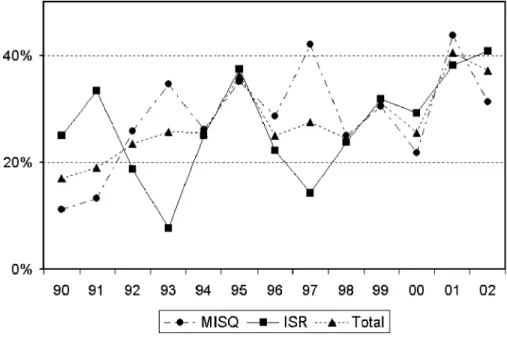
In order to demonstrate the publication rates and trends of HCI studies in the two journals, the total number of published research articles is counted.Fig. 8depicts the publication patterns of HCI studies in the two journals, and as a whole.
Table 4
Results on research type
Type 90 91 92 93 94 95 96 97 98 99 00 01 02 Total % Non-Empirical 4 3 3 1 0 2 2 3 3 3 0 3 2 29 17.0 Conceptual orientation 1 1 1 2 1 1 7 4.1 Frameworks 0.0 Conceptual model 1 1 2 1 1 6 3.5 Conceptual overview 1 1 0.6
Theory from reference disciplines 0.0
Illustrative 1 1 3 1 1 3 1 1 1 1 14 8.2
Opinion with examples 1 1 3 1 1 3 1 1 12 7.0
Opinion with personal experiences 0.0
Description of tools, techniques 1 1 2 1.2
Applied concepts 2 1 1 1 1 1 1 8 4.7
Applied concepts 2 1 1 1 1 1 1 8 4.7
Empirical 5 6 9 11 14 13 12 8 9 13 12 13 17 142 83.0
Objects 1 1 0.6
Description of types/classes of products, technologies, etc. 0.0 Description of specific applications, systems, etc. 1 1 0.6
Events/Processes 5 6 9 10 14 13 12 8 9 13 12 13 17 141 82.5 Lab experiment 1 2 4 4 2 3 3 3 2 6 7 3 3 43 25.1 Field experiment 1 2 2 1 1 2 9 5.3 Field study 2 1 1 1 2 3 2 3 15 8.8 Positivist case 1 1 2 4 2.3 Interpretive case 1 1 1 2 1 1 7 4.1 Survey 2 3 3 5 5 4 2 2 3 2 7 5 43 25.1 Develop of instrument 1 1 1 1 1 1 3 9 5.3 Secondary data 1 1 2 1 5 2.9
Interview (individual based) 1 2 1 1 1 6 3.5
Total 9 9 12 12 14 15 14 11 12 16 12 16 19 171 100.0
It shows that there is an increasing trend of percentage of HCI studies in the two journals over the years. The overall percentage of HCI studies is around 40% of all published articles in these two journals during recent years. This is an encouraging discovery for scholars conducting research in this subfield.
Fig. 8. Publication patterns.
Fig. 7. Results on research type: frequency of articles by methodology. 144 P. Zhang, N. Li / Computers in Human Behavior 20 (2004) 125–147
5. Discussion and conclusion
By examining existing HCI frameworks, proposing a new one to address the broad HCI issues and concerns, and assessing published articles, this paper contributes to our understanding of the current status of research topics, methods, and publication patterns of the HCI studies in the MISdiscipline. This understanding is important for the identification and promotion of this emerging subfield in MIS. It should of interest to researchers and young scholars for their future research, collaboration, and publication.
This paper is the first attempt to draw such an understanding of HCI studies in MISbased on the evidence of published articles. As such it is limited in scope due to the time consuming nature of such studies. In order to provide an informative picture, only the most recent 13 years of the two top MISjournals are selected as paper sources. Although the 13-year time period is reasonable for this type of research assessment, the journal selection may have had a strong influence on the assessment results. This includes the potential biases of the two journals’ emphases on publishable topics and methods. The HCI type research publication pattern may also be affected by the two journals’ characteristics.
Another limitation of the paper is the omission of other possible aspects for assessment. For example, the assessment of research can also include active researchers and institutions as some of the MISresearch assessment articles did (Pervan, 1998; Romano & Fjermestad, 2001). This can provide useful informa-tion for young scholars or doctoral students to identify potential academic homes where collaboration is highly possible, and their research interests and effort can be recognized and appreciated. We decided to omit this assessment in this paper as we realized that limiting such a study to two journals might provide a skewed picture.
Future research is planned to include relevant papers in more major MISjournals, and to provide additional assessments such as specific technologies studied, contexts where studies are conducted, and active researchers and institutions.
The fast development and pervasive use of technology prompt a need to re-examine the broad HCI issues in light of the IS/IT development, actual use, and impact on all aspects of our lives. The new framework proposed in this paper emphasizes the entire interaction cycle between humans and technology, rather than a stage or part of it. It also brings in the tasks and contextual factors. This view is intended to show the dynamic as well as the evolutional aspect of issues and concerns regarding the interactions between humans and technology.
The assessment of a limited collection of HCI studies in two top MISjournals demonstrates a wide range of research issues and topics being studied by MIS researchers over the past thirteen years. The dominating issues fall in the area of IS/ IT use, evaluation and impact. MISresearchers are more concerned with issues that occur after IS/IT is developed. These concerns are closely related to humans’ perceptions, beliefs, behavior, attitude, satisfaction, performance and productivity, and individual differences. Among the small percentage of studies focusing on the development stage, MISresearchers are concerned with user involvement and P. Zhang, N. Li / Computers in Human Behavior 20 (2004) 125–147 145
participation, user-analyst differences and interaction, programmer cognition studies, and design methods.
The assessment also shows a broad range of research methods employed. The dominating methods, however, lie in empirical studies utilizing lab experiments and surveys to examine issues on events and processes. Due to the dynamic nature of human interaction with technology, task, and context, it may indicate a need to utilize more interpretive research methods such as phenomenology, action research, ethnography, grounded theory, etc. It would help advance the subfield more if there are general instruments being developed and validated, rather than many research-ers reinventing the wheel. There are few studies focusing on providing frameworks and high-level overviews of the subfields, which indicates potential research efforts in the future.
Overall, it is exciting to see that there is an increasing number and percentage of HCI studies published in the two top MISjournals over the years. The current status of the subfield may indicate an emerging state, rather than a mature one.
Acknowledgements
The authors thank the guest editor, Dr. Henry H. Emurian, and two anonymous reviewers for their helpful comments and suggestions on an earlier version of the paper.
References
Alavi, M., & Carlson, P. (1992). A review of MISresearch and disciplinary development.Journal of Management Information Systems,8(4), 45–62.
Barki, H., Rivard, S., & Talbot, J. (1988). An information systems keyword classification scheme.MIS Quarterly,12(2), 299–322.
Barki, H., Rivard, S., & Talbot, J. (1993). A keyword classification scheme for IS research literature: an update.MIS Quarterly,17(2), 209–266.
Baskerville, R. L., & Myers, M. D. (2002). Information systems as a reference discipline.MIS Quarterly,
26(1), 1–14.
Carroll, J., Kellogg, W., & Rosson, M. B. (1991). The task–artifact cycle. In J. Carroll (Ed.),Designing interaction(pp. 74–102). Cambridge University Press.
Compeau, D. R., Higgins, C. A., & Huff, S. L. (1999). Social cognitive theory and individual reactions to computing technology: a longitudinal study.MIS Quarterly,23(2), 145–158.
Culnan, M. J. (1987). Mapping the intellectual structure of MIS, 1980–1985: a co-citation analysis.MIS Quarterly,11(3), 341–353.
Davis, F. (1989). Perceived usefulness, perceived ease of use, and user acceptance of information technology.MIS Quarterly,13(3), 319–340.
Eason, K. D. (1991). Ergonomic perspective on advances in human–computer interaction.Ergonomics,
34(6), 721–741.
Goodhue, D. L. (1997). The model underlying the measurement of the impacts of the IIC on the end-users.Journal of the American Society for Information Science,48(5), 449–453.
Goodhue, D. L. (1998). Development and measurement validity of a task-technology fit instrument for user evaluations of information systems.Decision Sciences,29(1), 105–137.
Goodhue, D. L., & Thompson, R. L. (1995). Task-technology fit and individual performance.MIS Quarterly,19(2), 213–236.
Hewett, T., Baecker, R., Card, S., Carey, T., Gasen, J., Mantei, M., Perlman, G., Strong, G., & Verplank, W. (1992).ACM SIHCHI curricula for human–computer interaction. Association for computing machinery. New York, NY: ACM.
Lucas, H. C. (1975). Performance and the use of an information system.Management Science,21(8), 908– 919.
Pervan, G. P. (1998). A review of research in Group Support Systems: leaders, approaches and directions.
Decision Support Systems,23, 149–159.
Preece, J., Rogers, Y., Sharp, H., Benyon, D., Holland, S., & Carey, T. (1994). Human–computer interaction. Addison-Wesley.
Romano, N. C., & Fjermestad, J. (2001). Electronic commerce customer relationship management: an assessment of research.International Journal of Electronic Commerce,6(2), 61–113.
Swanson, E. B. (1974). Management information systems: appreciation and involvement.Management Science,21(2), 178–188.
Venkatesh, V., & Davis, F. (2000). A theoretical extension of the technology acceptance model: four longitudinal field studies.Management Science,46(2), 186–204.
Zhang, P., Benbasat, I., Carey, J., Davis, F., Galletta, D., & Strong, D. (2002). Human–computer interaction research in the MISdiscipline. Communications of the AIS, 9(20), 334-355.
Zhang, P., & Dillon, A. (2003). HCI and MIS: Shared Concerns, Editorial Introduction.International Journal of Human–Computer Studies,59(4), 397–402.