An empirical test
Nicole Bérubé
A Thesis in
The John Molson School of Business
Presented in Partial Fulfillment of the Requirements For the degree of Doctor of Philosophy in Administration
at
Concordia University Montreal, Quebec, Canada
February 2010
Published Heritage Branch 395 Wellington Street Ottawa ON K1A 0N4 Canada Direction du Patrimoine de l'édition 395, rue Wellington OttawaONK1A0N4 Canada
Your ??ß Votre référence
ISBN: 978-0-494-67329-4 Our file Notre référence ISBN: 978-0-494-67329-4
NOTICE: AVIS:
The author has granted a
non-exclusive license allowing Library and Archives Canada to reproduce, publish, archive, preserve, conserve, communicate to the public by
telecommunication or on the Internet, loan, distribute and sell theses worldwide, for commercial or
non-commercial purposes, in microform, paper, electronic and/or any other
formats.
L'auteur a accordé une licence non exclusive permettant à la Bibliothèque et Archives Canada de reproduire, publier, archiver, sauvegarder, conserver, transmettre au public par télécommunication ou par l'Internet, prêter, distribuer et vendre des thèses partout dans le monde, à des fins commerciales ou autres, sur support microforme, papier, électronique et/ou autres formats.
The author retains copyright ownership and moral rights in this thesis. Neither the thesis nor substantial extracts from it may be printed or otherwise reproduced
without the author's permission.
L'auteur conserve la propriété du droit d'auteur et des droits moraux qui protège cette thèse. Ni la thèse ni des extraits substantiels de celle-ci ne doivent être imprimés ou autrement
reproduits sans son autorisation.
In compliance with the Canadian
Privacy Act some supporting forms
may have been removed from this
thesis.
Conformément à la loi canadienne sur la protection de la vie privée, quelques formulaires secondaires ont été enlevés de cette thèse.
While these forms may be included in the document page count, their removal does not represent any loss of content from the thesis.
Bien que ces formulaires aient inclus dans la pagination, il n'y aura aucun contenu
manquant.
1+1
ABSTRACT
Explaining the Relationships Between Age, Job Satisfaction, and Commitment: An Empirical Test
Nicole Bérubé
Concordia University, 2010
A substantial body ofresearch has established that both job satisfaction and
organizational commitment are important work attitudes. Yet, while scholars have
proposed some possible explanations for the positive relationship between age and job
satisfaction, and between age and organizational commitment, these explanations have
rarely been investigated directly. In addition, researchers who investigated reasons for
demographic differences in job attitudes measured only chronological age, not subjective
age (how old a person feels). The present study sought to redress this major shortcoming
by testing alternative explanations for age-related differences in job satisfaction and
commitment, and doing so by investigating both chronological age and subjective age.
The study investigated four proposed mediators of the relationship between age
and job satisfaction, and age and commitment. A survey was administered to 888 middle
managers in a single large organization, and 458 usable questionnaires were obtained.
The first proposed mediator, assessments about the employment relationship,
emerged as a full mediator ofthe relationships between both chronological and subjective
age, and affective commitment. In addition, it partially explained the relationship
between both age measures and overall job satisfaction, as well as satisfaction with the
relationship between age and continuance commitment because in this sample, tenure captured most of the variance in continuance commitment in the regression model.
The next proposed mediator, recognitions^o/w others about one 's experience, partially mediated the relationship between subjective age and satisfaction with the work in the present job. Next, self-recognitions about one 's work experience partially mediated the link between subjective age and affective commitment. However, recognitions by self and others did not explain the relationship between chronological age and either job satisfaction or affective commitment, emphasizing the importance of measuring subjective age in management studies.
The findings also show that compared to chronological age, subjective age was a stronger correlate of overall job satisfaction, satisfaction with the work in the present job, and affective commitment, but a weaker correlate of continuance commitment.
Subjective age contributed uniquely to predicting overall job satisfaction, satisfaction with work in the present job, and affective commitment, beyond chronological age.
ACKNOWLEDGMENTS
First and foremost, I thank my supervisor, Linda Dyer. Thank you for taking on
the challenge of guiding me through this journey. You always knew exactly what to say
to help me move forward. Thank you also for your steadfast assurance in my abilities and
for your willingness to let me pursue my own interests. I know I would not have been
able to arrive at the end of this long journey without you and I really look forward to our
continued collaboration and friendship.
Next, I acknowledge the friends I was fortunate to make throughout this journey.
First, the ones I met at the start - Usman, Wendy, Mark, Filotheos and Eric - who
provided essential support in the early phases ofthe program. Special thanks to Eric
Patton for your generous support and understanding. You always had time to listen to me
and this made such a difference in this journey. Next, the friends who came later
-Catalin, Carol-Ann, Natalia, and the many others with whom we laughed and
commiserated. I especially want to acknowledge Magda Donia and Elena Lvina, who
provided constructive feedback on my thesis and enthusiastically cheered me on at each
crucial step towards the end.
I thank the members of my extended committee - Marylène Gagné, Muhammad
Jamal, Sylvie Guerrero, Francine Schlosser and Dolores Pushkar - for their helpful
feedback and insightful questions. I am especially grateful to Marylène Gagné for her
unwavering faith in my potential, for her generous guidance, and for giving me many
opportunities to improve my research skills by working with her on various projects.
I also want to acknowledge the generous encouragement I received from Kathleen
Boies and Tracy Hecht, from the moment we met right through to the defense. Your faith
in me sustained me through this long journey.
Last but certainly not least, I thank my family - my parents, brother and sister,
nieces and nephews - for their unconditional love and support in all aspects of my life. A
very special thank you to my parents for providing me with the foundation to enable me
to keep moving forward to this point. Most ofall, I owe my endurance throughout this
journey to my husband, Pierre Bissonnette, and to his exceptional understanding, love
and devotion.
Financial support for this dissertation was provided by doctoral fellowships from
the Fonds Québécois de la Recherche sur la Société et la Culture, Concordia University,
DEDICATION
TABLE OF CONTENTS
List ofTables xi
List of Figures xiii
Chapter 1 Introduction 1
1.1 Problem statement and objectives 2
1.2 Key constructs for the direct relationships 2
1.2.1 Predictors 2
1.2.2 Outcome variables 4
1.3 Conceptual framework 9
1.3.1 Mediators 9
1.4 Importance of the topic 11
Chapter 2
Theoretical background and hypotheses
14
2.1 How this chapter is organized 14
2.2 Age and its meaning 14
2.2.1 Chronological age 15
2.2.2 Non-chronological age 17
2.2.3 Age and tenure 21
2.2.4 The "older" worker 22
2.3 Age and work attitudes 24
2.4 Age and job satisfaction 25
2.4.2 Subjective age and job satisfaction 32
2.4.3 Age and job satisfaction facets 35
2.4.4 Age and satisfaction with the work itself 36
2.4.5 Age and satisfaction with promotion opportunities .. 39
2.5 Age and organizational commitment 44
2.6
A ctoser look at explaining the relationship between
age and work attitudes 48
2.6.1 Why job satisfaction increases with age
49
2.6.2 Explaining age-commitment relationships
53
2.6.3 Explanations investigated in the present study
54
2.7 Summary of hypotheses 65
2.7. 1 Hypotheses on the relationship between age and job
satisfaction 65
2.7.2 Hypotheses on the relationship between age and
organizational commitment 66
2.7.3 Mediation hypotheses 66
Chapter 3
Methodology
69
3.1 Research design 69
3.2 Sample and data collection 69
3.3 Measures 72
3.3.1 Predictor variables 73
3.3.2 Outcome variables 74
3.3.4 Control variables 83
3.3.5 Other measures : 86
3.4 Questionnaire layout 86
Chapter 4 Results 87
4.1 How this chapter is organized 87
4.2 Demographics 87
4.3 Merging of data sets 90
4.4 Frequency distributions 92
4. 5 Descriptive statistics and bivariate correlations 94
4.6 Hypothesis tests 95
4.6. 1 Relationships between the age variables and the
outcome variables 95
4.6.2 Verification of the relationships between the mediator variables, the age variables and the focal outcome
variables in the study 96
4.7 Regression analyses 99
4.8 Mediation analyses 99
4.8. 1 Mediation tests for "assessments about the
employment relationship" 100
4.8.2 Mediation tests for "recognitions of one's
experience by others" 102
4.8.3 Mediation tests for self-recognitions about one's
work experience 104
4.9. Other findings 108
4.10 Summary ofresults Ill
Chapter 5 Discussion 1 14
5.1 Introduction to the chapter 114
5.2 Major findings 1 14
5.2.1 Overview 1 14
5.2.2 Age and job satisfaction 115
5.2.3 Age and commitment 119
5.2.4 Usefulness of investigating subjective age 125
5.3 Limitations 126
5.4 Implications for research 130
5.5 Implications for practitioners 133
5.6 Conclusion 134
References 171
LIST OF TABLES
Table 1 Rousseau's (2000) TCI items and the items adapted to measure assessments about the employment relationship in
the present study 136
Table 2 Inter-item correlations for the TCI (assessments about the
employment relationship) items 137
Table 3 Factor Analysis, Adapted TCI for measuring assessments about the employment relationship in the present study 138 Table 4 Factor Analysis, Adapted TCI for measuring assessments about the
employment relationship in the present study 139 Table 5 Factor Analysis, Adapted TCI after removing T9 140 Table 6 Demographic characteristics of survey respondents 141 Table 7 Means, standard deviations, and inter-item correlations for Phase I
of data collection 142
Table 8 Means, standard deviations, and inter-item correlations for Phase II
of data collection 143
Table 9 One-way analysis ofvariance for dependent variables and proposed
mediators across sampling phases 144
Table 10 Means, standard deviations, and zero-order inter-item correlations
Table 1 1 Table 12 Table 13 Table 14 Table 15 Table 16 Table 17
Principal Components Analysis on the affective commitment items and
adapted TCI items used to measure assessments about the employment
relationship 145
Principal Components Analysis for continuance commitment items
and adapted TCI items used to measure assessments about the employment
relationship I47
Regression analysis for the main effects ofchronological age on the
outcome variables in the study 148
Regression analysis for the main effects of subjective age on the
outcome variables in the study 149
Hierarchical regression analysis of chronological and subjective age
on outcome variables in the study 150
Results of the regression analysis of curvilinear relationships
between the age variables and the outcome variables in the study... 151
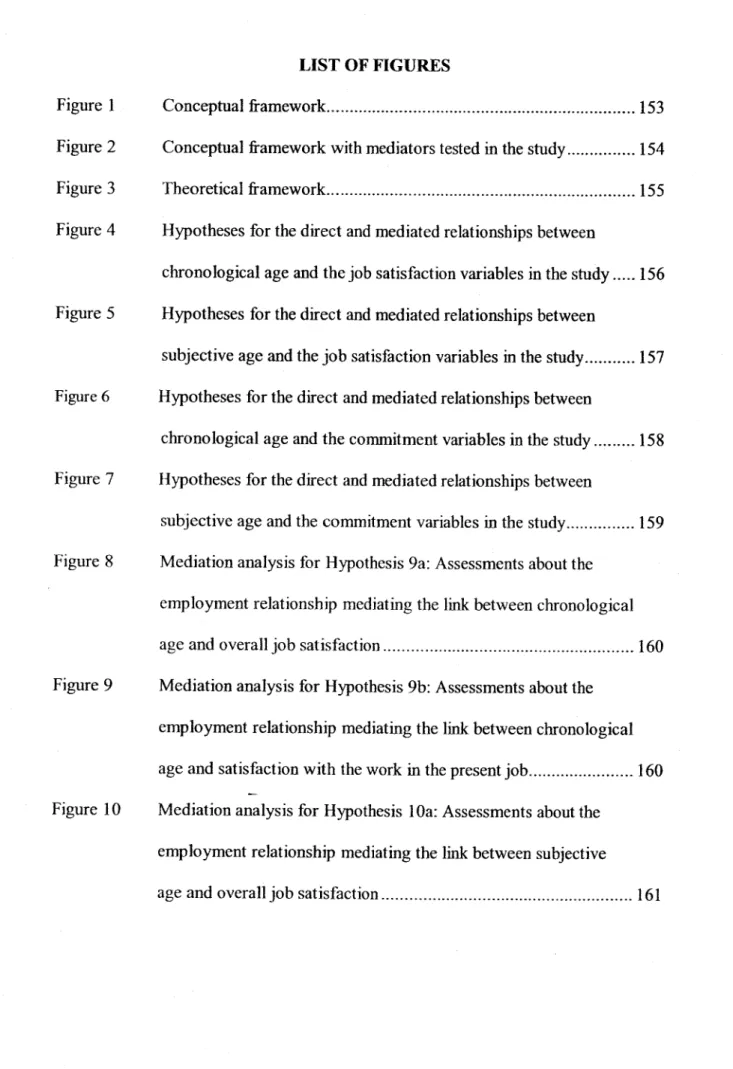
LIST OF FIGURES
Figure 1 Conceptual framework 153
Figure 2 Conceptual framework with mediators tested in the study 154
Figure 3 Theoretical framework 155
Figure 4 Hypotheses for the direct and mediated relationships between
chronological age and the job satisfaction variables in the study 156
Figure 5
Hypotheses for the direct and mediated relationships between
subjective age and the job satisfaction variables in the study 157 Figure 6 Hypotheses for the direct and mediated relationships between
chronological age and the commitment variables in the study 158
Figure 7
Hypotheses for the direct and mediated relationships between
subjective age and the commitment variables in the study 159 Figure 8 Mediation analysis for Hypothesis 9a: Assessments about the
employment relationship mediating the link between chronological
age and overall job satisfaction 160
Figure 9 Mediation analysis for Hypothesis 9b: Assessments about the employment relationship mediating the link between chronological age and satisfaction with the work in the present job 160 Figure 10 Mediation analysis for Hypothesis 10a: Assessments about the
employment relationship mediating the link between subjective
Figure 1 1 Mediation analysis for Hypothesis 10b: Assessments about the employment relationship mediating the link between subjective
age and satisfaction with the work in the present job 161 Figure 12 Mediation analysis for Hypothesis 11a: Assessments about the
employment relationship mediating the link between chronological
age and affective commitment 162
Figure 13 Mediation analysis for Hypothesis lib: Assessments about the employment relationship mediating the link between subjective
age and affective commitment 162
Figure 14 Mediation analysis for Hypothesis 13b: Recognitions from others about one's work experience mediating the link between subjective age and satisfaction with the work in the present job 163 Figure 15 Mediation analysis for Hypothesis 16b: Recognitions from others
about one's work experience mediating the link between subjective
age and affective commitment 163
Figure 16 Mediation analysis for Hypothesis 14b: Self-recognitions about one's work experience mediating the link between chronological age and satisfaction with the work in the present job 164 Figure 17 Mediation analysis for Hypothesis 15b: Self-recognitions about
one's work experience mediating the link between subjective
age and satisfaction with the work in the present job 164 Figure 1 8 Curve estimation plot for subjective age and affective
Figure 19
Mediation analysis for closure mediating the link between
chrono-logical age and satisfaction with the work in the present job 166 Figure 20 Mediation analysis for closure mediating the link between
subjective age and satisfaction with the nature of the work
in the present job 166
Figure 21
Supported hypotheses for direct and mediated relationships between
chronological age and the job satisfaction variables in the study 167
Figure 22
Supported hypotheses for direct and mediated relationships between
subjective age and the job satisfaction variables in the study 168
Figure 23
Supported hypotheses for direct and mediated relationships between
chronological age and the commitment variables in the study 169
Figure 24
Supported hypotheses for direct and mediated relationships between
CHAPTER 1
Introduction
"A man's age is something impressive, it sums up his life: maturity reached slowly and
against many obstacles, illnesses cured, griefs and despairs overcome, and unconscious
risks taken; maturityformed through so many desires, hopes, regrets, forgotten things,
loves. A man's age represents afine cargo ofexperiences and memories. "
-Antoine de Saint-Exupéry, Wartime Writings 1939-1944, translated from French by Norah
Purcell
As Antoine de Saint-Exupéry implied, the age of human beings is a highly meaningful marker; one against which people consciously or subconsciously take stock
oftheir accomplishments, desires, and goals in relation to their expected lifespan. Aging
is inevitable - and age is thus a pervasive point ofreference throughout life. As people
use age as a temporal benchmark to take stock oftheir lives, they may modify their attitudes about various aspects of life, including work.
Understanding the relationship between age and work attitudes is essential for organizational success. The purpose of this research is to investigate why age influences
work attitudes and to use this knowledge to help develop interventions to manage
1.1 Problem statement and objectives
Scholars have long been interested in age differences in work attitudes. Starting
from the premise that age constitutes a temporal and social benchmark for self-assessment (Lawrence, 1987, 1988), empirical studies have demonstrated that age accounts for variance in important work variables such as work values, satisfaction, and turnover intentions (Doering, Rhodes, & Schuster, 1983b). The present research
investigates the relationship between age and two commonly investigated work attitudes:
job satisfaction and organizational commitment.
Although scholars have discussed contextual and dispositional explanations for
the relationships between age and these important work attitudes, these explanations have
not been tested directly. Explaining the mechanisms by which these differences operate
thus constitutes a major shortcoming in our knowledge about age-related attirudinal
differences at work.
The present research specifically addresses this question by investigating
alternative explanations for these relationships, as illustrated in Figure 1 .
1.2 Key constructs for the direct relationships
1.2.1 Predictors
In management research, age is most often operationalized age as a chronological variable and most studies on age and work attitudes have followed this norm (Rhodes,
1983). Chronological age constitutes a universal signal ofthe passage oftime and since it can be easily measured simply by asking respondents how old they are, it is a convenient measure of time of life. In order to compare results with those ofprevious studies,
chronological age will be a major predictor in the present research. However, scholars agree that it may not adequately reflect age-related attitudes because individuals of identical chronological age may attach different subjective meanings to their age (Barak & Schiffinan, 1981; Cleveland, Shore, & Murphy, 1997; Sterns & Doverspike, 1989; Sterns & Miklos, 1995). In addition, the age individuals identify with may be different than their chronological age (Montepare, 1996c) and may change as people get older (Bultena & Powers, 1978). If differences in the meaning and perception of one's age are associated with differences in work outcomes, relying only on chronological age may lead investigators to underestimate the effects of age on work outcomes.
In search of a more effective operationalization of age for studies on attitudes and behaviors, gerontologists pioneered the development of non-chronological age constructs (e.g., Blau, 1956; Kastenbaum, Derbin, Sabatini, & Artt, 1972). Barak and his colleagues conducted reviews of the literature on non-chronological age measures and identified three broad categories: biological, social and social-psychological age (Barak & Gould,
1985; Barak & Schiffinan, 1981; Barak & Stern, 1986). Biological age measures are concerned with individuals' estimation of their remaining life span (e.g., Birren & Renner, 1977; Jarvik, 1975). Social age measures reflect socially-determined norms of behaviour and roles that people are expected to engage in at different stages of the life cycle, such as finishing school, starting a career, establishing a home, and retiring from work (e.g., Birren & Renner, 1977; e.g., Blau, 1956). These include measures of
(e.g., Finkelstein & Farrel, 2007; e.g., Rupp, Vodanovich, & Credè, 2006).
The present study focuses on social-psychological age, which is concerned with
how people identify with age groups and with subjective assessments ofhow old a person
generally feels, and how old individuals perceive themselves to be relative to certain age
groups. Based on the work of Kastenbaum, Derbin, Sabatini and Artt (1972), these
measures have different names, including personal age, cognitive age, psychological age,
and subjective age; however, all include four items that ask respondents about how they
look, feel, actfàehave, and which age group they have the most interests in common with.
In the present study, the term subjective age is used to describe a personal evaluation of
how old or young individuals perceive themselves to be on the basis of shared
characteristics with others (Cleveland & Shore, 1992).
1.2.2 Outcome variables
a) Job satisfaction
Job satisfaction refers to people's self-assessments about the extent to which they
like or dislike their jobs (Spector, 1997). This attitudinal construct is assessed either
globally or using facets. Globaljob satisfaction assesses an individual's overall feelings
about various aspects ofthe job, whereasfacet satisfaction focuses on specific aspects,
such as satisfaction with the work itself, with promotion opportunities, or satisfaction
with co-workers or supervisors. In addition to global job satisfaction, the present study
includes two facets as outcome variables: satisfaction with the nature ofthe work and satisfaction with promotion opportunities.
Job satisfaction is one ofthe most frequently researched concepts in management
research. Scholars have generally agreed that job satisfaction arises from the interaction
of individuals with their work environments, but have proposed different approaches to
discuss its underlying mechanisms (Locke, 1976). Earlier models argued that job
satisfaction depended on the degree of congruence or discrepancy between people's
expectations from their work environment and what they obtained (e.g., McClelland,
Atkinson, Clark, & Lowell, 1953), or that job satisfaction was a function ofneeds
fulfillment (e.g., Porter, 1962) or the attainment ofvalues or wants (Locke, 1976). More
recently, the predominant perspective has been to treat job satisfaction as an attitudinal
variable (Spector, 1997).
The importance ofjob satisfaction is well documented in a substantial body of
literature. It is positively associated with desirable work behaviours such as attending
meetings that are not mandatory, taking steps to prevent interpersonal problems,
displaying a positive attitude rather than focusing on what is wrong at work and other
organizational citizenship behaviours (McNeely & Meglino, 1994; Organ & Ryan, 1995).
Furthermore, empirical research has overwhelmingly found that people who report a high
level ofjob satisfaction have lower levels of absenteeism (Farrell & Stamm, 1988),
turnover (Judge, 1993) and counterproductive behaviours (Dormann & Zapf, 2001). They
also enjoy better physical health (Lee, Ashforth, & Bobko, 1990) and are less likely to
suffer from anxiety (Spector, Dwyer, & Jex, 1988), depression (Shaubroeck, Ganster, &
Fox, 1992) and burnout (Lee & Ashforth, 1993) than less satisfied workers. Although the
relationship between satisfaction and job performance has long been recognized as
complex, substantial evidence on the relationship between job satisfaction and other work outcomes suggests that it is and indirectly related to performance (Judge, Thoresen, Bono, & Patton, 2001). Furthermore, turnover is associated with several facets ofjob satisfaction - satisfaction with the work itself, pay, promotion, co-workers and
supervision, although the first three facets have received the strongest empirical support (Cook, Hepworth, Wall, & Warr, 1981). The multitude ofvariables with which job satisfaction has been found to be significantly associated establishes its value as a major
outcome variable.
b) Organizational commitment
Organizational commitment is a work attitude that describes various reasons employees feel loyal to their employers. Although scholars have proposed various definitions of organizational commitment, Meyer and Allen (1991) observed that these definitions agreed fundamentally in "the view that commitment is a psychological state that (a) characterizes the employee's relationship with the organization, and (b) has implications for the decision to continue membership in the organization" (p. 67). The prevailing conceptualization of organizational commitment is the tripartite model
proposed by Allen and Meyer (1990). It includes individuals' emotional attachment to the organization {affective commitment), a perception that the cost of leaving the organization is high {continuance commitment), and feelings ofmoral obligation to remain in the organization {normative commitment). These are conceptually independent constructs
-". . .the extent to which one is affectively committed does not affect the degree of
continuance commitment and vice versa" (Meyer & Allen, 1984, page 573). Meyer and
Allen (1991) noted that their conceptualization reflects the three broad themes shared by
the various definitions in their review of the commitment literature. For example, these
are similar to the three forms ofcommitment reviewed by Mathieu and Zajac (1990):
identification with and involvement in the organization {attitudinal commitment), based
on the work ofPorter and his colleagues (Mowday, Steers, & Porter, 1979; Porter, Steers,
Mowday, & Boulian, 1974); a calculation of sunk costs or side-bets {calculated
commitment), based on the work ofBecker (1960); and loyalty derived from duty to the
organization (normative commitment), as described by Weiner (1982).
Affective commitment has been most frequently studied (Wright & Bonett, 2002)
and normative commitment has received the least attention as a separate construct. In
their review, Mathieu and Zajac (1990) noted that normative commitment (Weiner, 1982)
was conceptually and empirically subsumed into the affective (attitudinal) component.
Moreover, empirical studies using Meyer and Allen's instrument (1991, 1997) generally
did not support theoretical expectations of differentiation between normative and
affective commitment (Bergman, 2006). In addition, Cooper-Hakim and Viswesvaran
(2005) used meta-analytical techniques to determine the degree of overlap between
various forms of commitment, separating in their analyses attitudinal, affective,
calculative, continuance and normative forms. They concluded that the true score
correlations between the various forms of organizational commitment suggested no
concern for overlap among the various forms, with the exception ofnormative and
affective and normative commitments are highly correlated, this study focuses on
affective and continuance commitment.
The distinction between affective and continuance commitment is important
because they imply different reasons for remaining loyal to the organization: "Employees
with strong affective commitment remain with the organization because they want to,
whereas those who have strong continuance commitment remain because they have to
(i.e., to do otherwise would be costly)" (Meyer, Bobocel, & Allen, 1991, page 718).
Affective and continuance commitment have been linked to different work attitudes and
consequently, have different implications for work behavior. For example, empirical
studies found positive relations between affective commitment and performance, but
negative relations for continuance commitment and performance (Meyer et al, 1991).
Generally, affective commitment is associated with desirable organizational
attitudes and behaviours, such as lower absenteeism, tardiness and turnover
(Cooper-Hakin & Viwesvaran, 2005; Farrell & Stamm, 1988; Mathieu & Zajac, 1990); increased
motivation, higher morale (DeCotiis & Summers, 1987), higher levels of altruism and
compliance (Shappe, 1998), organizational citizenship behaviors, and well-being
(Mowday, Porter, & Steers, 1982). Meyer and his colleagues summed up the benefits of
affectively committed employees: "Because of their attachment to, and sense of identity
with, the organization, employees with strong affective commitment are likely to behave
in a way that they view as being in the organization's best interest" (Meyer, Allen, &
Topolnytsky, 1998, p. 83). On the other hand, high levels of continuance commitment
have generally been associated with less desirable attitudes and behaviours, such as lower
job satisfaction, poorer performance, increased absenteeism and higher stress (Meyer et
al., 2002). The work-related implications of these two different forms of commitment establish them as important outcome variables.
1.3 Conceptual Framework
In the following chapter, arguments based on a review of the literature will
provide the rationale for the relationships illustrated in Figure 2. In sum, it will be argued
that the relationship between age and organizational attitudes (job satisfaction, affective
and continuance commitment) is mediated by people's shifting expectations (assessments
about the employment relationship), recognitions about their work experience, and
receiving reminders about their approaching retirement.
1.3.1 Mediators
The present study investigates three mediators. The first one is based on the
premise that people evaluate and re-assess their relationship with their employer over
time. In the present study, these assessments about the work relationship are evaluations
people make about the relationship they have with their employer during the course of
employment. It is argued here that people of different ages will feel differently about
their relationship with their employer, and that this will help explain age differences in
satisfaction and commitment.
The second mediator is based on substantial evidence from the literature on
in cognitive abilities by selecting or focusing on work or goals and by using strategies that optimize their existing knowledge and skills (Ackerman, 1996; Beier & Ackerman, 2001, 2003). Consequently, as people age, the skills and abilities acquired during the course oftheir work and life experience should become increasingly important to them. The second mediator, Recognitions about one 's work experience, includes two aspects. The first involves acknowledgments or signs of appreciation from others that one's work experience is valuable or important. The other aspect is the realization by the individual that his or her personal work experience is worthwhile or useful. It is expected that the salience ofrecognizing their own work experience, and having it recognized, will vary with age and that this will be useful to understand why satisfaction and commitment change with age.
Retirement, which is generally defined as withdrawal from the workforce in later life, has become a widespread transition, one which many older employees expect
(Moen, 1996). Although retirement is an objective life course transition, Dannefer (1984) argued that the approach of retirement is a matter of subjective developmental and social psychological transformation in identity, expectations, preferences, and meaning. Along this line of thinking, the present study investigates a third mediator: Retirement
reminders. These include events, such as someone talking about retiring or receiving information about retiring, which signal that retirement may be approaching. The salience ofthese reminders is expected to increase as workers get older and this is expected to help explain age differences in satisfaction and commitment.
1.4 Importance of the topic
Understanding the relationship between age and work attitudes is increasingly being recognized as a crucial determinant of organizational success (Bureau of Labor Statistics, 2007, 2008; Statistics Canada, 2008). Recent demographic trends emphasize our need for this information. Workers over 40 years of age currently dominate the North American workforce and we are experiencing unprecedented growth in the proportion of mature workers (Dychtwald & Baxter, 2007). In the United States, statisticians forecast that between 2006 and 2016, the labour force participation of American workers aged
between 55 and 64 will increase dramatically by 36.5%, compared to a forecasted
increase ofonly 2.4% for workers aged 25 to 54 (Bureau of Labor Statistics, 2007). In Canada, statisticians predict that by 2021, the proportion of the labour force over 55 years of age will be double what it was in the mid-1990s and therefore, about one in five workers in Canada will be over 55 years of age (Martel, Caron-Malenfant, Vezina, & Bélanger, 2007).
Although it is widely recognized that older workers are valuable human capital (Cloutier, Lefebvre, Ledoux, Chatigny, & St-Jacques, 2002; Crampton, Hodge, & Mishra, 1996; Critchley, 2004; DeLong, 2004), concerns about how to manage older workers are widespread (Schooler, Caplan, & Oates, 1998). The major driving force behind the interest in age at work is the aging of the Baby Boom cohort, born roughly between 1946 and 1964 (Foot & Stoffman, 1996), who represent a large and increasing proportion of the labour force (Bureau of Labor Statistics, 2007; Schetagne, 2001; Statistics Canada, 2008). In addition, increasing longevity, the elimination of mandatory
retirement age, the increase in the age for pension eligibility, as well as increasing cost of
living, are all expected to contribute to continued increases in the proportion of older
workers in the next few decades. At the same time, growing concern surrounds the effect
on the workforce as Baby Boomers approach retirement age. Therefore, there is currently
a great deal of interest in generating age-related management research.
Yet, a thorough review of the extant literature revealed that the surge of interest in
studying the relationship between age and job attitudes in the early 1980s (e.g., Kalleberg
& Loscocco, 1983; Rhodes, 1983) quickly waned, with few investigations published after
1986, until recently (e.g., Barnes-Farrell & Matthews, 2007; Bobko & Barishpolets,
2002; e.g., Kaliterna, Zvjezdana, & Brkljacic, 2002; Shore, Cleveland, & Goldberg,
2003). Consequently, much ofthe available literature on the relationship between age and
work attitudes is dated in light ofthe more volatile economic, social, and workplace
conditions ofthe recent years (Kanfer & Ackerman, 2004; Lindgren, 2007). For example,
overall tenure rates have been declining over the past three decades - with the most
dramatic decline affecting men aged 45-64 with median tenure declining by 37% over the
past thirty years (Färber, 2007).
Such changes mean that results of earlier studies on the relationship between age
and work attitudes, which were conducted at a time ofmuch higher job stability, may no
longer hold today, when the organizational tenure ofolder and younger employees may
not differ as much as it did two or three decades ago. In addition, with the exception of
recent attention to bridge employment (working after retirement), most research on
samples ofworkers aged 50 and older has focused on attitudes about adjusting to
retirement rather than attitudes about working (Greller & Simpson, 1999; Greller &
Stroh, 1995). These gaps in managerial knowledge justify updating our knowledge about work attitudes in samples of older workers.
The main purpose of this study is to investigate alternative explanations for the relationships between age (chronological and subjective age) and important work outcomes (job satisfaction, affective commitment and continuance commitment). The results of this study will help further the process of inquiry on managing age at work and help determine what workers ofvarious ages need to develop and maintain work attitudes that enable effective work performance.
Although scholars have proposed some possible explanations for the positive relationship between age and job satisfaction, and between age and organizational commitment, these explanations have rarely been investigated directly and have included only chronological age, not subjective age. The present study seeks to redress this major shortcoming by attempting to explain the mechanisms by which age-related differences in job satisfaction and commitment operate.
CHAPTER 2
Theoretical background and hypotheses
2.1 How this chapter is organized
This chapter contains the literature review and background explanations leading
to the hypotheses which are tested in the present study. It begins with an introduction to
how age was measured and interpreted in previous studies, focusing on the organizational
behaviour and management literature but drawing also from the gerontology literature.
Following this, the literature on the relationships between age and the focal work
attitudes in the present study will be presented: job satisfaction, affective commitment
and continuance commitment. Finally, the most common explanations for the
relationships between age and these important work attitudes will be reviewed, and the
focal mediators in the present study will be described. Hypotheses which will be tested
will be introduced throughout the chapter and summarized at the conclusion of the chapter.
2.2 Age and its meaning
Age is essentially a measure oftime which, for the individual, may constitute a
series of temporal markers that mark changing expectations. Emphasizing the importance
of context in interpreting behavior and attitudes, Johns (2001), noted that time often
substitutes for contextual changes. Therefore, age is an important measure oftime and it
is weaved surreptitiously into the work context. However, inconsistencies in the
measurement ofboth chronological and non-chronological age make difficult comparing
results across studies. To interpret the results ofpast research, it is necessary to
acknowledge the inconsistencies in the measurement ofage in earlier studies.
2.2. 1 Chronological age
In Chapter 1, chronological age was introduced as an important variable since it is
a commonly used and easily understood way ofmarking the passage oftime. From a
psychological perspective, chronological age is part ofpeople's identity (Bytheway,
2005), a benchmark for social expectations (Lawrence, 1984, 1987, 1988), and a way to
recognize milestones in the life cycle such as starting the teen years, reaching voting age,
marking the start of each decade in one's life (turning thirty, forty, fifty, etc.), or reaching
the normative age of retirement (Kohli, 1986).
Studies of age at work have commonly used age ranges, typically classifying age
in spans ofabout 10 to 15 years. When age ranges have been used, it has also been
common practice, in studies on the effects of age on work attitudes and behaviors, to
treat those over 45 years ofage as an undifferentiated group (Cohen, 1993; Rhodes, 1983;
Waldman & Avolio, 1986). Although this practice prevails in recent publications (e.g.,
Barnes-Farrell & Matthews, 2007; Cappeliez, Beaupré, & Robitaille, 2008), Sterns and
their careers, their choice set increases in complexity. Moreover, there is substantial
evidence that the midlife period, generally from age 45 to 64, is a tumultuous time
characterized by major life changes, questioning, and re-orientation (Cappeliez et al.,
2008; Greller & Stroh, 1995; Karp, 1987; Levinson, 1986). Consequently, differences in
attitudes among workers over 45 may have been underrated in previous research.
Measuring chronological age as a continuous variable may provide more meaningful
results.
Another common practice in the organizational behaviour and organizational
psychology literature has been to group respondents ofdifferent ages into generational
cohorts such as the Baby Boom (born between 1942 and 1960-64) and Generation X
(born approximately between 1960-64 and 1975-82). However, these cohorts are a better
reflection ofbirth rate than work attitudes. The Baby Boom cohort is particularly
problematic since it spans two generations. This may overly generalize work attitudes
within this cohort and reduce the meaningfulness of comparisons with other cohorts. In
addition, the Baby Boom and Generation X cohorts, which encompass the bulk of
workers in today's workforce, have lived through a period ofturbulent changes in the
work domain, such as the dramatic rise in the proportion ofwomen in the work force,
policy changes with regards to age discrimination and the timing ofretirement, increasing
economic and employment instability and rapid technological advances. Cohort
comparisons may thus be useful to assess the effects ofthese events. Although work
attitudes may be influenced by generational values and common events, they also reflect
personal beliefs and values. Consequently, generational comparisons mask individual
differences in the work attitudes of employees ofthe same age.
2.2.2 Non-chronological age
Although the majority ofresearchers have adopted the look-feel-behave and interests operationalization described by Kastenbaum and her colleagues (1972), the measurement of subjective age has generally been inconsistent across studies. Several researchers have averaged responses to these items to create an index, thus treating subjective age as a unidimensional construct (e.g., Barak & Schiffman, 1981; e.g., Cleveland & Shore, 1992; Cleveland et al., 1997; Kaliterna et al., 2002; Van Auken, 2006). Montepare (1996a, 1996b, 1996c) argued that subjective age should be treated as a
multidimensional construct and several researchers used the look-feel-behave and interest
items as separate, single-item measures (e.g., Farrell & Piotrowski, 1989; Barnes-Farrell, Rumery, & Swody, 2002; Iskra-Golec, 2002). Montepare (1996b) developed an
1 8-item multidimensional measure but used it as a unidimensional scale in a later study (Montepare & Clement, 2001).
In addition to the look, feel, act, and interests items, respondents were often asked about their "ideal" or "desired" age - the age respondents would most like to be if they could choose their age at the present time. This measure was first described by Zola (1962) but received little empirical attention until much later when Barak and his colleagues field tested various measures of ideal age (Barak, Stern, & Gould, 1988) in marketing research. Ideal age has generally been measured as a single item. Some investigators asked respondents whether their preferred age was older or younger than their chronological age (Barnes-Farrell & Piotrowski, 1989; Barnes-Farrell et al., 2002;
Iskra-Golec, 2002), while others required respondent to indicate an age (Barak et al., 1988) or age range (Cleveland & Shore, 1992; Cleveland et al., 1997; Shore et al., 2003). In most studies, desired or ideal age is a separate construct from other non-chronological age measures. However, gerontologists Joann Montepare and Margie Lachman (1989), referring to the earlier work by Kastenbaum and colleagues (1972), included ideal age in a 4-item "subjective age identity" scale in which they asked respondents to specify, in years, the age that most closely corresponded to the way they felt, the way they looked, the age ofpersons whose interests and activities were most like theirs, and the age they would like to be if they could choose their age right now. In work settings, Cleveland and Shore (1997) also based their subjective age scale on Kastenbaum and colleagues (1972) choosing four items essentially identical to those Montepare and Lachman (1989) had used in their study.
Although subjective age measures are relatively congruent relative to the items they contain, they vary widely in response format. These include age in years
(Demakakos, Gjonca, & Nazroo, 2007), bipolar scales with endpoints such as "a lot younger than my age" and "a lot older than my age"(Montepare, 1996c, 2006; Montepare & Clement, 2001) , and groups of age such as "26-35," "36-45"(Cleveland et al., 1997), or decades - for example "thirties," and "forties" (Barak & Schiffman, 1981). Several studies used response categories that were subject to interpretation, such as "young," "middle-aged" or "elderly" (e.g., Blau, 1956; Bultena & Powers, 1978; Cleveland & Shore, 1992; George, Mutran, & Pennybacker, 1980; Guptill, 1969; Peters, 1971) - an approach which Barak and Schiffman (1981) criticized as "suspect" because the meanings of the nominal age categories could vary among respondents. Although most
studies relied on ranges of age such as "36-45" for response categories, the ranges vary
across studies and Rhodes (1983) noted that the oldest category often included a very
broad age range - for example, "over 55" or "55 to 75." These differences in
measurement require a careful interpretation of subjective age results reported in various
studies.
Studies in work settings using similar measures of subjective age found
significant differences in the relationship between subjective age, job performance and
stress, compared to chronological age (Bobko & Barishpolets, 2002; Iskra-Golec, 2002;
Kaliterna et al., 2002). There appears to be consistent evidence that younger adults report
acting older than their chronological age, while middle aged and older adults tend to
report lower subjective ages than their chronological age (Barnes-Farrell & Piotrowski,
1989; Montepare, 1991, 1996b; Rubin & Berntsen, 2006; Uotinen, Rantanen, Suutama, &
Ruoppila, 2006). These differences between subjective and chronological age have
implications for understanding age differences in work outcomes, for example by
reflecting a mechanism by which people reinforce their desired self-image (Demakakos
et al., 2007; Montepare & Clement, 2001), with positive consequences such as increases
in positive affect, life satisfaction and self-esteem (Steitz & McClary, 1988; Westerhof &
Barrett, 2005). Therefore, subjective age is useful for aiding to our understanding of age
differences in work outcomes.
Another category of social-psychological age includes self-assessments, or
assessments by others, of a person's age status based on his or her looks and perceived
social roles in comparison with some normative group (Cleveland & Shore, 1992;
social age (Montepare, 1996b), comparative age (Barak & Gould, 1985), and perceived
relative age. In the work domain, perceived relative age has been a construct of interest in research which focuses specifically on perceptual age biases and age discrimination,
particularly in selection and hiring practices, where the perception ofage bias may be
more acute than among workers already established in an organization
(Armstrong-Stassen & Templer, 2004; Barak & Stern, 1986; Cleveland et al., 1997).
Although the present study does not focus on age stereotypes, the literature on this
subject can help explain the mechanisms by which people may evaluate their subjective
age. Levy (2003) discussed that age self-stereotypes are readily internalized and
reinforced through various cognitive processes. For example, the literature on age
stereotypes at work has documented that older workers are generally perceived to be
more knowledgeable and experienced. Forte and Hansvick (1999) found evidence ofjob
specific stereotyping against younger workers forjobs requiring supervisory abilities.
These qualities are especially relevant for managerial positions and may be associated
with appreciation and respect from others. Therefore, younger managers may subjectively
rate themselves as older to attribute to themselves the positive biases ofknowledge and
experience that are generally ascribed to older managers. Similarly, older individuals may
attempt to capture the advantages ofperformance biases that favour younger managers,
who are often perceived to be more adaptable and faster learners (Hassell & Perrewe,
1 995). We do not know how common this phenomenon is but it is likely to vary
contextually. Organizational contexts where negative age biases disadvantage both the oldest and youngest employees, the tendency for subjective age evaluations to move in
In such contexts, differences in subjective age may not be sufficient to establish useful
comparisons. Therefore, the extent of the difference between chronological and
subjective age is important to note when interpreting the results. However, no specific
mentions of this important issue were found in the extant literature.
2.2.3 Age and tenure
There is an ongoing debate about the relative utility oftenure and age as
predictors ofwork attitudes such as job satisfaction and organizational commitment.
Some researchers argue that tenure is the better predictor (e.g., Cohen, 1993), while
others have provided evidence that that age and tenure can have different relationships
with work attitudes. For example, Gibson and Klein (1970) found that overall job
satisfaction increased with age over all tenure levels but that it decreased with tenure at
any age. Furthermore, Meyer and colleagues found evidence that the relationship
between tenure and work attitudes is largely due to employee age (Meyer, Allen, &
Smith, 1993).
Although there is ample evidence from past research that age and tenure are
positive correlates, this may be changing as modern workplaces are increasingly
experiencing personnel changes due to the volatile economic context, global market
forces, and rapid technological change. Consequently, a person's salary, tenure or
organizational level cannot absolutely be assumed to be linearly related to age. Younger
employees could be better educated than older ones, and thus have access to higher-level
positions and higher salaries in the organization. Organizational changes leading to
downsizing and attrition may have affected age-tenure congruence. Older employees,
who have found new employment in other organizations, may have less tenure than younger employees already established in the organization. In work environments where organizational tenure is decreasing, tenure may be less useful to help understand the attitudes of those with the most work experience, and who are generally older. Therefore,
in modern workplaces, age is likely to be a more effective predictor ofwork attitudes
than tenure.
2.2.4 The "older" worker
Interest in the age ofworkers and important work outcomes has been present in
the field oforganizational behavior for several decades, but it has surged with the aging
ofthe Baby Boom cohort and forecasts about unprecedented high proportions of what has
been termed "older" workers (Claes & Van de Ven, 2008; Feldman, 2007; Rix, 1990;
Taylor & Walker, 1998; Yeatts, Folts, & Knapp, 2000). Although the term "older"
implies some relative level of aging and maturation, social definitions of "older worker"
vary widely and this is a continuing problem for industrial gerontology researchers
(Sterns & Miklos, 1995). Ashbaugh and Fay (1987) reviewed 105 studies that defined the
term "older worker" in different ways. They found little agreement on the age at which
individuals were considered "older workers" but reported that when chronological
definitions of age were provided, the mean age of an "older worker" was 53.4 years.
Later research on older workers (e.g.: Hirsch, MacPhearson, & Hardy, 2000; Moen,
that older workers refer to those over 50 years ofage. Research on age bias generally describes older workers as being between 55 and 65 years of age (Kite & Smith Wagner, 2002), and over 65 (Rupp, Vodanovich, & Credè, 2005). This may be due to the
influence ofthe widely used life stage model of adult development developed by Levinson and colleagues (Levinson, Darrow, Klein, Levinson, & McKee, 1978), which proposes that the culmination of middle adulthood begins at that age. Moreover, people are likely to be considered "older" as they approach the common retirement age range
-55 to 65.
On the other hand, recent economic trends are delaying retirement and keeping workers over 55 in the workforce. In addition, the bulk of the Baby Boom cohort, born between 1942 and 1964, is now over 55 years of age and some studies indicate that they favour working past 65, even if well-established financially (Barnes, Parry, & Lakey, 2002; Byham, 2007; Kim & Feldman, 2000). This cohort, which was long defined as a youth culture, appears to be redefining the meaning of advancing age. For example, the popular press abounds with advertisement slogans such as "50 is the new 40," which suggest that the number no longer means what it used to. The large Baby Boom cohort is undoubtedly influential in this regard. However, Newgarten (1974) noted a similar redefinition of aging at a time when the oldest Baby Boomers were only entering their thirties and the youngest were not yet in their teens. She noted that in industrialized societies, increased longevity and improved health were increasing the proportion of what she termed the "young-old" (50 to 75 years of age), and that they, the parents of Baby Boomers, were redefining earlier concepts ofaging, which previously associated the period over age 50 with physiological decline and reduced work potential. Moreover, the
soon be outmoded as people embrace the increasing trend towards delaying retirement
(Conlin, 2003; Freedman, 1999; Kim & Feldman, 2000; Marshall & Walker, 1999; Pienta
& Hayward, 2001) and focus their attention away from limitations and towards
continuing capacities and developmental achievements in later life (Wahl & Kruse,
2003).
The age norms relevant to work and career are likely to change with the increase
in the proportion ofolder workers in the workforce, as it becomes increasingly acceptable
to work, and even to establish new careers at an older age. In light ofthese trends, there
has been a lot of interest in recent years in workers over the age of 50. These
investigations, which focus on workers aged 50 and over, are restricted in range and this
makes it impossible to tell from these investigations whether the attitudes and desires
attributed to older employees are significantly different from those of young or
middle-aged employees. For example, several studies have found that older workers desire more
flexible working conditions (e.g., Armstrong-Stassen & Templer, 2004; Guérin, WiIs, &
Saba, 1997; Saba, 1995), something that other studies have found was very important to
younger generations of workers (e.g., Smola & Sutton, 2002; Zemke, Raines, & Filipczak, 2000).
2.3 Age and work attitudes
The following sections will review the direct relationships between age and two
important job attitudes: job satisfaction and organizational commitment. As introduced in
Chapter 1, this study focuses on particular forms ofjoh satisfaction and commitment. Therefore, the following sections will focus on reviewing the literature and presenting hypotheses for the links between age (chronological and subjective) and global job satisfaction, satisfaction with the nature of the work, and satisfaction with promotion opportunities. This will be followed by a review of the literature and hypotheses for the relationships between age (chronological and subjective) and both
2.4 Age and job satisfaction
Interest in the age-job satisfaction relationship has a long history in management research, dating back nearly seventy years, with Super's early work on career
development (Super, 1939). This interest has generated a substantial body of literature that generally confirms that age is a significant predictor ofjob satisfaction, and that it remains so after controlling for the effects of tenure or organizational level (Rhodes,
1983).
2. 4. 1 Chronological age and overalljob satisfaction
Empirical evidence overwhelmingly supports a positive linear relationship between chronological age and both global and facet job satisfaction (Brush, Moch, & Pooyan, 1987; Doering et al., 1983b; Dormann & Zapf, 2001; Herzberg, Mausner, Peterson, & Capwell, 1987; Rhodes, 1983). This indicates that older employees are generally more satisfied with their job than younger employees, a finding that holds
across various types of organizations, among white and blue-collar workers, across
genders (Doering et al, 1983b; Rhodes, 1983) and education levels (Herzberg et al.,
1987).
The often-found positive linear pattern is not universal, however, although
evidence ofother patterns appears less frequently in the literature. The negative linear
pattern between age and overall job satisfaction is only rarely reported and may be
associated with particular contexts or sample characteristics. For example, in her study of
U. S. Air Force pilots, Shriver (1953) reported a negative linear association between age
and job satisfaction. Shriver explained that decreasing job satisfaction was related to
various age-related changes. For example, in her sample, increasing age was associated
with declines in physical abilities, energy, resistance to fatigue, speed, accuracy, control
in emergency situations, ability and motivation to improve skills. Shriver proposed that
declining job satisfaction was probably due to the sensitivity ofAir Force pilots to
age-related physiological and cognitive changes. Later investigations on pilots revealed no
age-related differences in performance (Avolio, Waldman, & McDaniel, 1990; Waldman
& Avolio, 1986), although several studies reported age-related physiological and
psychological changes that made the job more challenging for older pilots (for details, see
Gerathewohl, 1977). Although age-related physiological changes are a natural part of the
aging process, the job of Air Force pilots is especially physically and cognitively
demanding, compared to most other jobs. While people who occupy other jobs might
have time to adapt to age-related changes and compensate by relying on strategies
acquired through work experience, the physiological, cognitive and psychological
demands ofthe Air Force pilot's job may be so intense that any decline in abilities may
not be compensated for by pilots' experience. Thus, it is possible that in this job, aging might be associated with increasing effort to maintain a steady level ofperformance. This which might explain the negative age-job satisfaction relationship Shriver (1953) found.
Some studies found evidence of a U-shaped curvilinear relationship, where satisfaction falls for several years and gradually rises through the middle years, rising sharply just before retirement (Clark, Oswald, & Warr, 1996; Handyside, 1961; Van Maanen & Katz, 1976; Zeitz, 1990). Early studies on job satisfaction found evidence that it declined sharply among workers in their twenties, then rose again as workers
approached their thirties and thereafter, increased with increasing age (Benge, 1947; Bernberg, 1954; Hull & Kolstad, 1942). Herzberg and colleagues explained the initial drop in morale among workers in their twenties to the tempering of the exceptionally high level of initial enthusiasm among young workers just starting their career (Herzberg et al., 1987). Adjustments to new jobs can create a great deal of tension, especially when the work environment is not stable and the last ones hired are most likely to be the first ones downsized. Studies on job insecurity have found strong support for its negative association with job satisfaction (Bedeian, Ferris, & Kacmar, 1992; Hunt & Saul, 1975). Tenure is generally positively associated with age (Bedeian et al, 1992; Doering et al.,
1983b), although the strength ofthis association may diminish with increasing economic instability. Nevertheless, where job security increases with seniority, older employees should feel more secure and therefore, be more satisfied than younger employees who may be more likely to experience job insecurity (Reisel, Chia, Maloles, & Slocum, 2007).
An alternative explanation is that middle age is typically a period of increasing worries and responsibilities, especially financial and vocational worries (Dykman,
Heimann, & Kerr, 1952; VanZelst & Kerr, 1951). The potential for dissatisfaction may
be greatest at a time when people form stronger attachments to family (start a family, get
married) and make a more solid commitment to a particular occupation while the
opportunities to change both occupation and specific job are still perceived to be high. If
job satisfaction decreases at this point on worker's lives, the rise in job satisfaction in
following the middle years could be partly explained by a lessening of child care
responsibilities and thus fewer work-family conflicts (Ernst Kossek & Ozeki, 1998; Warr, 1992). Past research has generally shown that conflicts between the meaning of
life, work and family have generally been shown to occur most frequently when people
reach middle age (Kalleberg & Loscocco, 1983). By comparison, younger and older people have fewer work-life constraints. However, the studies on which this conclusion is based were conducted at least two decades ago and did not take into account the
increasing importance of eldercare, which tends to become more prevalent when people
reach their late 40s and 50s (Baltes & Young, 2007).
Some scholars have proposed that the U-shaped age-job satisfaction relationship
might be due to a greater financial burden at the time most people settle down and raise
families, generally from the mid-twenties to the late forties (Clark et al., 1996; Kalleberg
& Loscocco, 1983; Warr, 1997). Presumably, greater financial responsibilities may create
feelings of dependency and insecurity relative to the job. This may increase relative
obligations to the job at a time when personal responsibilities are intensifying (e.g.,
purchasing a house, raising a family). Feelings of obligation and insecurity that arise
from the increased financial burden may in turn reduce job satisfaction at midlife. This
middle-aged individuals, something that might have been the case when many ofthe
age-job satisfaction studies were conducted, 20 or 30 years ago. However, economic and
market conditions over the past two decades have displaced many workers of various
ages, increased job insecurity, and dramatically inflated the cost of living - conditions
that have affected everyone. Moreover, although the divorce rate in Canada is only
slightly higher today than it was in 1970, a significant increase in divorce rate has
recently been observed among Canadians aged 50 and older (HRDC, 2009). This
transition is frequently associated with additional financial burdens. In addition, the
emergence ofthe boomerang generation - a term that describes adult children, returning
to their parents' home after completing university, losing a job, or divorcing (Mitchell,
2006, 2007). Consequently, we can no longer presume today that the greater financial
burden will be felt at middle age, and necessarily abate later on. This makes less probable
a curvilinear relationship between age and job satisfaction.
Some studies reported a curvilinear relationship in the shape of an inverted U,
with job satisfaction rising until around age 60, then dropping off sharply (Luthans &
Thomas, 1989; Saleh & Otis, 1964). Luthans and Thomas attributed the sharp drop in
satisfaction after age 60 to unmet expectations and targeting older workers for early
retirement in downsizing strategies. However, this finding may have been related to
mandatory retirement, since Staines and Quinn (1979) found consistent, longitudinal
evidence over a period ofthree years that workers over 66 years of age were more
satisfied with their jobs than any other age group. Evidence of an inverted-U relationship
is limited to studies that included samples ofworkers over age 60. Rhodes (1983) points
out that the rarity ofworkers over 60 years of age in studies conducted prior to 1 983
means that these studies cannot document well the level of satisfaction of workers in this
category. It is only recently that organizational demographic trends have provided an opportunity to include a larger proportion ofworkers older than 60 years of age in investigations about age and work attitudes.
Clark and colleagues (1996) pointed out that restriction of range may explain the much more frequently found linear pattern of relationship between age and job
satisfaction. In their large, diverse sample, the curvilinear pattern they found was only apparent when workers in their late teens were included. Furthermore, for the women in their sample, the curvilinear relationship between age and global job satisfaction was small in magnitude and was not significant for either satisfaction with the nature ofthe work, or satisfaction with pay.
The less frequent findings of a curvilinear chronological age-satisfaction relationship may be due to certain contextual or sample characteristics. Bedeian, Ferris and Kacmar (1992) suggested that the failure to find significant curvilinear relationships may be the result of low statistical power due to insufficient sample size, rather than to linearity. Indeed, Clark et al. (1 996) found evidence of a U-shaped age-job satisfaction relationship in a large (N > 5,000), broad sample of British employees. On the other hand, linear relationships were found, after controlling for tenure, in investigations with large sample sizes ranging from over 3,000 to close to 5,000 (e.g., Hunt & Saul, 1975; Weaver, 1 980) and non-linear age-job satisfaction relationships have been found in much smaller samples . For example, Zeitz (1990) found evidence of nonlinear age-job
satisfaction relationships in samples ranging from 97 to 434 government employees, including a U-shaped pattern for clerical staff and upward-sloping, double-bend
curvilinear pattern among professionals. Therefore, sample size does not provide a clear
explanation for the various age-job satisfaction relationship patterns.
Zeitz (1990), argued that linearity was an artifact ofresearch designs that
generally sought to uncover a universal age-satisfaction tendency based on psychological
development, independent of organizational context. He focused on public servants and
found evidence on non-linearity in the age-job satisfaction relationship. However, there is
no consistent evidence supporting the argument that organizational context explains
nonlinearity in the age-job satisfaction relationship. For example, Clark et al. (1996)
found evidence of a U-shaped age-job satisfaction relationship in a large (N > 5,000),
varied sample (for details, see Clark, 1996) that included respondents employed in
various professions (e.g., sales, management, professionals, plant operatives) and sectors
(e.g., agriculture, transportation, manufacturing, construction).
In sum, the literature provides substantial evidence of a positive, linear relationship between age and overall job satisfaction. Evidence of curvilinear
relationships is less frequently reported and ofthese, U-shaped relationships predominate,
while inverted-U patterns are exceptional. Restriction of range has been proposed as an
explanation for the predominance ofthe linear pattern between age and job satisfaction.
However, empirical evidence is inconsistent. The other commonly mentioned