Generalized Role-Based Access Control
for Securing Future Applications
Michael J. Covington
Matthew J. Moyer
Mustaque Ahamad
College of Computing
Georgia Institute of Technology
Atlanta, Georgia
Abstract
As computing technology becomes more pervasive and broadband services are deployed into residential com-munities, new applications will emerge for the home and community environment. These applications will assist people in a variety of daily activities by en-abling them to create, access, and manipulate informa-tion about the residents and resources in their homes. In a connected community, resources in the home and information about the residents of the home will be re-motely accessible to both residents and guests, as well as to potentially malicious users. These new applica-tions, as well as their users and environment, pose new security challenges. The challenges stem from two fac-tors: the nature of the home itself—a private space with a wealth of personal and sensitive information—and the limited technical knowledge and capabilities of the home’s residents.
We are addressing the problem of securing applications that will access and control information resources in the home of the future. Specifically, we are designing a security system based on a paradigm called General-ized Role-Based Access Control (GRBAC). GRBAC is an extension of traditional Role-Based Access Control (RBAC). It enhances traditional RBAC by incorporating the notion ofobject rolesandenvironment roles, with the traditional notion ofsubject roles. These new types of roles allow one to define rich, easy-to-understand security policies without having significant technical
This work was completed at the Georgia Institute of Technol-ogy’s College of Computing in Atlanta, Georgia. The research of Michael J. Covington was supported by an Intel Foundation Gradu-ate Ph.D. Fellowship. The work of Matthew J. Moyer and Mustaque Ahamad was supported in part by the industrial partners of the Geor-gia Tech Broadband Institute and NSF grant CCR-9619371.
Contact Author –[email protected]
knowledge of the underlying computer systems that im-plement those policies. In this paper, we motivate the need for GRBAC, provide a high-level description of it and demonstrate its usefulness and flexibility via several example applications.
1 Introduction
As computers become more common in the home and broadband technology is introduced into residential communities, new applications will allow a wide range of human activities (e.g., education, entertainment, so-cial and community gatherings, etc.) to be conducted over the Internet. Such applications often will use infor-mation about the residents of homes, as well as various resources inside the home. Furthermore, these applica-tions will access this sensitive information from many different locations. Therefore, the protection of private information about each home’s resources and residents is a critical concern that must be addressed before such applications can be successfully deployed. For an “al-ways connected” home, in which the residents may have very limited computer skills, this is clearly a challeng-ing task.
From a security perspective, the home is a novel envi-ronment for exploring policies that are intended to con-trol access to sensitive resources and data. We expect many future homes to feature a rich computation and communication infrastructure that includes a variety of sensors, such as video cameras and audio microphones. The information gathered by these sensors may be used to facilitate rich social interactions via the Internet. The sensors will record, manipulate and store information about the home’s residents and their activities. Clearly, such information is private and must be protected from unauthorized access. Traditionally, homes have been secured by physical devices (e.g., burglar alarms, dead-bolts, motion-activated lighting systems, etc.) that make
it difficult for intruders to gain access into the home. But in the near future, when homes have networked in-formation appliances that are accessible via the Internet and so-called “intruders” can enter the home digitally, these physical mechanisms will offer little or no protec-tion from these “virtual” attacks.
Leaving homes vulnerable to electronic “trespassers” is a legitimate concern that must be addressed be-fore security-sensitive applications can be deployed. Clearly, any compromise of the system entails the pos-sibilities of data theft and mass distribution of private information. Unlike a physical burglar, an electronic intruder can attack the home at any time, from any lo-cation. Data such as tax or medical records, the where-abouts of family members, and even the hours of the day during which the home is unoccupied, are sensitive and private, and should be protected with at least the same level of security as any physical security devices can provide.
At Georgia Tech, we are building a prototype “home of the future” that will be used to explore a variety of new applications. These applications range from remote control of appliances in the home (e.g., Cyberfridge [9]) to awareness and monitoring of each resident’s activi-ties and needs. For example, researchers are exploring how a “smart” home can help elderly residents by moni-toring their medical condition. The prototype home will have a rich computation and communication infrastruc-ture and will be connected to other homes and institu-tions in the community. A variety of sensors will be used to infer the activities of the home’s residents, and various applications will use this information to help improve their quality of life. This experimental home provides an excellent context in which to explore the se-curity needs of future applications and the system sup-port necessary to secure them.
Although considerable work has been done in secur-ing military and commercial information systems, few projects have specifically addressed the needs of a resi-dential computing infrastructure. We are developing se-curity techniques that can be used in the home and com-munity environments. More precisely, we are exploring access control models and security policies that can be used to secure next-generation home applications eas-ily and intuitively. Our access control model is called
Generalized Role-Based Access Control (GRBAC). GR-BAC builds upon traditional Role-Based Access Con-trol (RBAC) [4, 13] with two new concepts:object roles
and environment roles. This extension unifies ideas from several existing access control models into one elegant model that captures all security-relevant state in a system. The unification of all security-relevant
state into a single concept—that of a role—makes ac-cess control policies significantly easier to define and implement in GRBAC than in other models. Ease of security policy definition and implementation is a key requirement for emerging applications in the home and community, since residents in the typical home are not experts in either computers or security.
The remainder of this paper proceeds as follows: in Sec-tion 2, we briefly describe Georgia Tech’s Aware Home project and the applications being explored there within. Then, in Section 3, we discuss the security challenges presented by this environment. To meet these chal-lenges, we have developed the GRBAC model, which we describe in Section 4. In Section 5, we present ex-amples of several applications and show how GRBAC can be used to specify their security needs. We discuss related work in Section 6, and we conclude the paper in Section 7.
2 The Aware Home
The Aware Home project at Georgia Tech is the cre-ation of an interdisciplinary team of researchers who wanted to build an information-rich “home of the fu-ture” from the ground up [7]. When completed, this home will have a rich computation and communication infrastructure, including a variety of sensors and cam-eras that will make the home “aware” of its residents and their activities [10]. Various applications will ex-ploit this “awareness” to make daily living easier for the home’s residents. The new applications that will be ex-plored in the Aware Home relate to the domains of edu-cation, entertainment, physical security, inventory man-agement (e.g., for the contents of the pantry or refriger-ator), and utility management (e.g., for gas and electric-ity), as well as applications that permit rich interactions with people and institutions outside the home.
Consider some specific examples of Aware Home ap-plications. One research group is exploring how the Aware Home concept can help elderly residents remain in their homes longer, rather than having to move into assisted living communities. This application uses the home’s sensors to enable important interactions with relatives outside of the home and with care specialists, effectively providing the same level of care and super-vision that today can be found only in nursing homes and hospitals. Another class of applications will allow residents to manage inventories in the home from any location, inside or outside the home. For example, the Cyberfridge application [9] collects information about food items in a refrigerator and makes the data
acces-sible from anywhere. Cyberfridge can interface with a local food delivery service to automatically reorder food items such as milk or eggs when necessary. A third example is an application that automatically man-ages home resources such as hot water and heat, based on the residents’ preferences and daily living habits. It can, for example, choose to heat the house only when it knows there are residents inside, and it can choose to produce hot water only at times when residents usu-ally take showers or wash clothing. Such an applica-tion can even negotiate the best possible electricity rates with utility services, based on the needs and preferences of the home’s residents.
All of the applications described above share a com-mon thread: they are possible as a result of the Aware Home’s ability to gather, store and transmit useful in-formation about the state of its resources and occupants. Clearly, this information should be available only to le-gitimate users and applications. Financial loss, public embarrassment and even physical harm are just a few of the many potential negative consequences of a breach in the security of any of these applications. Therefore, from a security standpoint, the Aware Home project presents a unique opportunity to explore the support that is necessary to secure the home of the future, before the technology—and the risk that accompanies it—become widely available. The next section discusses security issues in the home in greater detail.
3 Security Challenges
in the Home
The Aware Home applications described in the previous section present new and interesting security challenges. First, the residents of a home usually know little about information security or computer technology. Despite their lack of expertise, however, they often will need to configure and manage information security policies in their homes. Therefore, system usability is critical. In short, the system must make itvery easyfor a home-owner to define and manage security policies for the applications and resources in the home; otherwise, it is likely the homeowner will not use the security features of the system at all. This requirement encompasses all aspects of usability, including learnability and the gen-eration of appropriate feedback to assure the user that she is using the system correctly. Second, the system must not intrude upon the everyday activities of resi-dents in the home. For example, it is unreasonable to expect a resident to explicitly authenticate herself to the home security system before opening the refrigerator.
Essentially, the security mechanisms must be both us-ableandnon-intrusive, or many homeowners will sim-ply avoid using them. In the remainder of this section, we explore these requirements in more detail.
Security policies in the Aware Home potentially can be quite complex, as we will demonstrate via the follow-ing examples. A policy can constrain access to infor-mation or resources based on several factors, including attributes about the subject, the resource or the environ-ment. For example, subjects can be classified as “resi-dent” or “guest,” “adult” or “child,” or even as a “pet.” Access rights then can depend on the subject’s attributes (e.g., “resident”), as well as on his or her identity. Ac-cess also may be constrained based on the subject’s lo-cation, or based on environmental factors such as the temperature or the time of day. For example, a policy might say that a repairman has access to the refriger-ator only while he is inside the home on January 17, 2000, between 8:00 a.m. and 1:00 p.m. In addition, access to information objects or resources may depend on security-relevant attributes of the object’s state. For example, a child may be prohibited from viewing any television program or movie that is not rated “G” or “PG”. As a final example, both positive and negative access rights arise naturally in the context of the home. For example, adult residents may be granted access to all appliances in the home, while children are denied access to potentially dangerous appliances. Given these simple examples, it is easy to understand how any ac-cess control system for the home must be both flexible and easy to use. In subsequent sections of this paper, we will describe why we believe that the GRBAC ac-cess model fulfills these requirements.
Another challenge presented by the home environment is relieving the user from the burden of access control decisions. Ideally, information available from sensors in the home should be used to automatically infer a sub-ject’s security-relevant attributes (e.g., identity, role or location.) For example, several technologies such as voice and face recognition are being deployed in the Aware Home to non-intrusively identify humans and track their movements. Many such techniques can es-tablish the identity of a subject with only a partial level of certainty, orconfidence level. Such “partial authen-tication” has important implications for access control models. In particular, some identification mechanisms are known to be more reliable than others. For exam-ple, an experiment might conclude that face recognition is 90% accurate, while voice recognition is only 70% accurate. This introduces a potential problem regarding the identification of subjects in the home. If one type of sensor can identify a subject with a higher degree of ac-curacy than another, then the system should permit the
definition of security policies that account for the differ-ence in accuracy. For example, consider an adult who wants to view the output of a video camera in a child’s bedroom, for the purpose of checking on the child. The security policy may state that only the child’s parents or babysitter can view the video. Perhaps a “strong” identification mechanism may provide enough authen-tication evidence to allow the user to see a streaming video, while a “weak” identification mechanism may provide only enough authentication evidence to permit the user to view a recent still image of reduced quality and definition. A security model for the home should incorporate these confidence levels for both authentica-tion and access control. In the following secauthentica-tion, we introduce GRBAC, an access model that we believe can fulfill these challenging requirements.
4 Generalized Role-Based
Access Control
In the previous section, we discussed some of the chal-lenges facing a security system for an Aware Home en-vironment. We are designing a system that we believe will meet these challenges. At the core of this system is our Generalized Role Based Access Control (GR-BAC) model. GRBAC is an extension of traditional Role Based Access Control (RBAC) that uniformly ap-plies the concept of roles not only to subjects, but also to objects and system states. In this section we introduce GRBAC. First, we review the most important features of traditional RBAC. Then, we discuss the fundamental concepts of GRBAC and describe some of the important issues relating to it.
4.1 Traditional RBAC:
A Foundation for GRBAC
Traditional Role Based Access Control (RBAC) [4, 13] is a form of mandatory (i.e., centrally administered) ac-cess control. It is based on the premise that most real-world access control decisions are determined by a per-son’s position or job title within an organization. Ac-cordingly, the purpose of RBAC is to encourage the de-sign of security policies that closely mirror the structure of organizations. In this section, we highlight the most important features of the traditional RBAC model.
4.1.1 RBAC: Basic Features and Rules
The basis of RBAC is the concept of a role. Funda-mentally, a role is a grouping mechanism that is used to categorize subjects based on various properties. Much of the RBAC model is based on the mathematics of set theory; thus, many of the constructs of the RBAC model are based on the notion of set membership. Individual users in an RBAC system are calledsubjects. Each sub-ject has anauthorized role set, which consists of all the roles that the subject has been authorized to use. We use the termrole possessionto denote that a role is in the authorized role set of a subject. In other words, we say that subject possessesrole if has been autho-rized to use .
The other two fundamental concepts in RBAC are the
objectand thetransaction. An object is any resource in a system. Example resources in the home include ap-pliances such as a dishwasher or stereo, media objects such as movies, and sensitive digital information such as medical records or income tax returns. A transac-tion is a series of one or more accesses to a set of one or more objects. A transaction in the home could be as simple as reading filefooon the family computer. In contrast, a transaction in a military setting can be as complex as aiming and firing a missile from a Navy de-stroyer. All policy rules in RBAC are linked to roles, rather than to individual subjects. Formally, each role is associated with anauthorized transactions set; this is the set of transactions that a subject may perform us-ing role . Therefore, for a subject to gain access to transaction , must demonstrate possession of a role , for which is in the authorized transactions set of . Figure 1 summarizes the basic RBAC features.
4.1.2 RBAC: Some Problems and Solutions
At its core, RBAC is quite simple; however, in practice, RBAC policies can become very complex and unwieldy. In this section, we describe some of the problems that RBAC systems face, as well as several advanced RBAC features that have been used to solve the problems. We first examine two problems that stem from the complex-ity of policies: separation of duty and role precedence. Then we discuss role activation and role hierarchies, two constructs that can help mitigate these problems.
Separation of Duty It is implicit from the previous section that a subject can possess multiple roles simul-taneously. Typically, there are no problems associated with multiple role possession; however, there are some
Definitions:
Subject a user of the system
Role a categorization primitive for subjects Object a system resource
Transaction a series of one or more accesses to one or more objects the authorized role set for subject
the authorized transaction set for role
exec trueiff subject is authorized to execute transaction
RBAC Access Mediation Rule:
exec trueiff role : ,
Figure 1: Basic RBAC Definitions and Rules
cases in which the set of access privileges granted by multiple role possession can constitute a conflict of in-terest. For example, in a financial institution, two pos-sible roles are teller and account holder. An account holder authorizes certain actions (such as withdrawals and deposits) on his account, and a teller executes those actions. If a person is a bank employee and also owns a checking account at the bank, there exists the poten-tial for that person to act as both an account holder and a teller at the same time. With the privileges of both account holder and teller, an employee may be able to perform illegal actions, such as making fraudulent de-posits, on his account.
Such scenarios occur often in RBAC systems; the cir-cumstance described above is known as aseparation of dutyproblem. There are two varieties of separation of duty: staticanddynamic. Dynamic separation of duty occurs when two roles present a conflict of interest if a subject uses them both at the same time. The conflict of interest described above is an instance of dynamic separation of duty. Note that there is no conflict of in-terest if the employee acts as a teller during one time interval and an account holder during another interval, since only when he assumes both roles simultaneously is it possible for him to abuse the system. In contrast, static separation of duty occurs when two roles present a conflict of interest that cannot be resolved by simply preventing the roles from being used simultaneously. In these cases, the two roles may never be used by the same subject. If rolesR1 andR2exhibit static sepa-ration of duty, and subject S has acted in roleR1, he may never act in roleR2.
Role Precedence Another problem that relates to multiple role possession isrole precedence. Role prece-dence stems from inconsistent access rules between two roles that a subject possesses. For example, in the home environment, suppose that userBobbyis authorized to possess the roles ofchildandfamily member. Suppose also that thefamily member role is authorized to read family medical records, but the child role is not. If
Bobby tries to read the family’s medical records, the system must decide how to resolve the inconsistency in the access policy. To solve the problem, the system must decide which access rule takes precedence over the other. There are many ways to make this decision. The simplest way would be to always give precedence to the role that denies access. Similarly, the system could always give precedence to the role that allows ac-cess. Or there could be some other predefined rule or algorithm established to decide role precedence. One approach to solving this problem, as we discuss below, is the use ofrole activation. Role precedence is a prob-lem that every RBAC system must solve.
Role Activation We discussed above the concept of an authorized role set: the set of roles that a subject is allowed to use. The problems of separation of duty and role precedence both are related to an authorized role set, because as the size of an authorized role set grows, separation of duty and role precedence become more difficult to manage. One of the most common and effective ways to handle this problem is to restrict a sub-ject’s role usage to a subset of his authorized role set at all times, so that only those roles that are necessary to perform his current duties areactive. This is calledrole activation. When role activation is used, a subject must declare which roles he intends to use at all times. The
roles that have been declared active constitute the sub-ject’sactive role set. Only roles in the active role set can be used to execute transactions. This mechanism allows the system to more easily enforce dynamic separation of duty constraints: the system simply disallows any two roles with dynamic separation of duty constraints from being active at the same time. Role activation also provides a natural mechanism for resolving role prece-dence: in case of a conflict between roles, active roles take precedence over inactive roles.
Role Hierarchies Another useful RBAC construct is the role hierarchy. Role hierarchies can help man-age role complexity through structure to exploit com-monality not only among subjects but among roles as well. For example, in an organization all managers may have a certain set of core “management privileges” even though they all work in different departments. This commonality can be exploited through a role hierarchy that makes each department manager role a sub-role of a generic “managers” role. Role hierarchies allow a pol-icy implementor to write generic access rules just once, rather than once for every role to which the rules ap-ply. This kind of structuring tool can help avoid policy “bugs”: cases in which the policy implementor has in-correctly written the policy. Hierarchies also can serve as a tool for cleaner policy design, thereby eliminat-ing some cases in which role precedence conflicts might otherwise have occurred.
4.2 The GRBAC Model
Traditional RBAC is very useful, but it suffers from subject-centric limitations that restrict the policy de-signer to a subject-oriented viewpoint. Generalized Role Based Access Control (GRBAC) is an extension of RBAC that removes the subject-centric limitation, allowing a policy designer to write the policy from a subject-centric, object-centric, or environment-centric viewpoint, or whatever combination of these is most ap-propriate for the circumstances. GRBAC removes the limitations of RBAC by using the basic concept of a role to organizeallentities in a system. It exploits the organizational power of roles for grouping environment states and objects, in addition to subjects. This sec-tion introduces our GRBAC model at an informal level. Interested readers are encouraged to consult [11] for a more formal treatment of the GRBAC model.
4.2.1 Subject Roles
Asubject rolein GRBAC is analogous to a traditional RBAC role. Each subject is authorized to assume a set of subject roles. Subject roles may be hierarchical or “flat” (single-level) in nature. The system may also use subject role activation. The only difference between GRBAC subject roles and traditional RBAC roles is the way that they are used to make access decisions. In traditional RBAC, an access decision is based entirely on the permissions associated with the set of roles that the subject possesses. In GRBAC, an access decision depends not only on subject roles, but also on environ-ment roles and object roles. We describe each of these roles below.
4.2.2 Environment Roles
There are many real-world instances in which access control depends not only on the person making the ac-cess and the object being acac-cessed, but also on the state of the environment during the access. For example, many organizations restrict access to their facilities dur-ing nights and weekends. In the military, secure com-puter systems are often restricted only to personnel in designated physical areas, such as a highly secure com-puter room. In the home, parents might restrict their children’s access to the television, allowing the kids to watch TV only after they have done their homework, and only until 9:00 p.m. In each of these instances, the access control policy depends on information from the
environment. The two most basic types of environmen-tal information are time and location, but any security-relevant information in the environment that can be ac-curately captured by the system also can be used to con-trol access to system resources.
The GRBAC model allows policy designers to specify system state through environment roles. An environ-ment role can be based on any system state that the sys-tem can accurately collect. For example, we can de-fine a role corresponding to each day of the week, or each month of the year. A policy rule such as “man-agers may edit salary data for their employees only on the first Monday of each month” is easy to implement using environment roles. Similarly, environment roles may be used to describe rules that relate access permis-sions to the locations of subjects. In the home, we can define location roles such as “upstairs,” “downstairs,” “master bedroom,” etc. We can then use these roles in policy rules; for example: “children may only use the videophone while they are in the kitchen.”
tangential issues that must be addressed before environ-ment roles can be used in real access control systems. First and foremost, the system must be able to securely and accurately collect enough system data (e.g., an ac-curate estimate of the current time, or the location of a subject in the home) to determine whether a given envi-ronment role is active. One effective approach to this problem would be to use a trusted event system that is capable of generating events based on various sys-tem state changes. Second, the syssys-tem must provide a means for policy implementors to define roles. Some basic environment interface must exist, so that policy writers can associate their environment role definitions with actual system states. Both of these issues are the subject of ongoing research and are beyond the scope of this paper.
4.2.3 Object Roles
Subject roles and environment roles allow a policy im-plementor to structure a policy based on either the prop-erties of the subjects in the system, or the system state itself. But what if the policy implementor wants to structure the policy according to the properties of the re-sourcesin the system? To accommodate this scenario, the GRBAC model also includesobject roles. Object roles allow us to capture various commonalities among the objects in a system, and use these commonalities to classify the objects into roles. Object roles can be based on any classifiable property of an object, includ-ing its date of creation, object type (image, source code, streaming video, etc.), sensitivity level (secret, top se-cret, etc.), or information about the contents of the ob-ject (for example, we could classify obob-jects based on whether they contain any content related to Microsoft Corporation). After classifying the objects, we can make access control decisions based on the classifica-tion scheme that we created.
4.2.4 Making Access Decisions with GRBAC
In Figure 1, we outline the basic algorithm for medi-ating access to objects in the traditional RBAC model. In RBAC, if subject wants to access object , must possess a role that is authorized to execute transaction , such that can access . In GRBAC, the access me-diation algorithm is similar, but slightly more complex. Subject possesses a set of subject roles, and object possesses a set of object roles. In addition, the sys-tem keeps track of a set of environment roles. For to access , must possess some subject role , such that:
1. some object role , possessed by ;
2. some environment role that is currently ac-tive;
3. some transaction that allows to access ob-jects in role when is active.
Clearly, this access mediation rule is more complex than the corresponding rule for traditional RBAC.
In Section 4.1.2, we briefly discussed separation of duty and role precedence, two of the potential problems that can arise in an RBAC system. These two problems are not confined to traditional RBAC; they also can cause difficulty in the GRBAC model. In fact, GRBAC’s gen-erality makes it even more susceptible to various types of policy conflicts and ambiguities. Our purpose in this paper is not to outline all of these potential problems, but simply to introduce the reader to the fundamental GRBAC concepts of subject roles, object roles and en-vironment roles. We do not discuss the GRBAC model in any more detail here; however, we encourage inter-ested readers to refer to [11] for a more thorough review of the model, its usage, and the problems that can arise from it.
5 GRBAC in Practice
GRBAC is a powerful and elegant model for specifying access control rules in a computationally rich environ-ment. This section shows how GRBAC can be applied in practice to the home environment. It also illustrates some of the additional security benefits that GRBAC can provide in a system.
5.1 A Simple Example
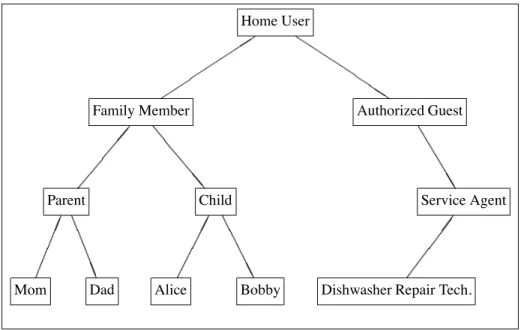
To illustrate the power and elegance of GRBAC, we be-gin by creating a subject role hierarchy, such as the one displayed in figure 2. This role hierarchy presents a graphical view of the sample household that we will consider in the following scenario. Specifically, it shows the relationships that exist between the various users and the roles that are present in the system. The figure shows that usersMomandDadhave each been assigned to theParentrole. In addition, usersAliceand
Bobbyhave been assigned to theChildrole. The system also can accommodate an authorized household guest,
Dishwasher Repair Technician.
Assume thatMomandDadhave decided to permit the children to use entertainment devices (such as the
tele-Home User Family Member Parent Mom Dad Child Alice Bobby Authorized Guest Service Agent
Dishwasher Repair Tech.
Figure 2: An Example Subject Role Hierarchy for the Home
vision and VCR) on weekdays, but only during their free time after dinner, before going to bed. To enforce this policy, the system must be configured to identify the various entities in the system and classify them into the particular roles that are relevant to the access decision being processed.
In this particular example, the system must use all three types of GRBAC roles. First, the users must be clas-sified so that a specific user identity can be mapped to a role, such asParentorChild. By mapping users to roles, the home administrator can specify an access con-trol policy for agroupof users, rather than for each in-dividual user. If the access policy requires the adminis-trator to classify a subset of users from both theParent
andChild roles, he can simply create a new role and map users into it as necessary.
In addition to subject roles, the system in this example uses an environment role namedweekdays. Weekdays
are defined by the system as the time from 12:01 a.m. on Monday to 11:59 p.m. on Friday. Also, since dinner usually is over by 7:00 p.m., and since the children have a bed time of 10:00 p.m., the environment rolefree time
is defined to be 7:00 p.m. to 10:00 p.m.
Finally, the system has a defined object role named en-tertainment devices. Objects that map to this role in-clude all televisions, stereos and home video games. If the household were to purchase a new toy or entertain-ment device, they could simply map the device to the role and it would immediately be controlled by this pre-defined access policy.
After defining all the necessary roles, the administra-tor needs to write just one rule to implement the policy. The rule in this case is “any child can use entertain-ment devicesonweekdaysduringfree time.” This ex-ample shows how GRBAC makes it easy to take a fairly complex access policy and implement it cleanly and ef-ficiently using subject, object, and environment roles.
5.2 Enhancing a System
with GRBAC
The scenario above presents some sample GRBAC roles and illustrates how role relationships can be used to es-tablish security policies for the home. As stressed ear-lier, ease of security policy definition and implemen-tation is a key requirement for applications in this do-main, because we cannot require all homeowners to fully understand information security. In addition, we have stated that the system and related security mech-anisms must be non-intrusive and easy to use. In this section, we briefly explore how GRBAC can be used to enhance a system and also fulfill these requirements. As discussed in Section 3, a system should make ac-cess decisions without placing any undue burden on the users. Unfortunately, access control without authenti-cation is usually impossible. In the home, it is gener-ally unacceptable to require users to explicitly “log in” before using a device or service. Instead, they should be identified implicitly by sensors throughout the home. These identification technologies are not perfect,
how-ever, and often may provide only “partial authentica-tion” of users based on limited sensory information. Fortunately, GRBAC makes it possible in many cases to make access decisions based on only partial authen-tication information.
Consider the following scenario. Suppose thatAliceis 11 years old and weighs 94 pounds. She has finished eating her dinner, and she wants to watch television be-fore going to bed. As she approaches the television, the Smart Floor [12] can identify her asAlicewith 75% ac-curacy by comparing the amount of weight that it senses with its internal, “official” weight forAlice, 94 pounds. Suppose that the security policy requires a person to be identified with 90% accuracy before the system will grant rights to that person. Based on this policy,Alice
should not be allowed to access any resources, because the system has received insufficient data to authenticate her at the required 90% level. But given the structure of a GRBAC security policy, the system is not limited to making access decisions based only on a specific user’s
identity. The policy specifies that anyone in theChild
role can useentertainment devices(an object role pos-sessed by the television) duringfree time. Despite the fact that the Smart Floor is able to identifyAlicewith only 75% accuracy, it may be able to authenticate her into theChildrole with 98% accuracy, because it knows (for example) the approximate weight of children in the household. Since the system can authenticateAliceinto theChildrole with higher than 90% accuracy, and there is a policy rule stating that children can use entertain-ment devices during free time on weekdays, it will grant her access to the TV when she pushes the TV power button.
6 Related Work
In this section, we briefly highlight several existing ac-cess models and compare them to GRBAC. We discuss traditional RBAC, time-based authorization, system-load-based authorization, content-based access control, and several other notable models. GRBAC allows us to express policies supported by these other models, and it also provides an elegant means of unifying all of their major concepts.
We discussed traditional RBAC [4, 13] in Section 4. Traditional RBAC is essentially GRBAC with subject roles only. The GRBAC model is more versatile and more expressive than traditional RBAC because it uses not only subject roles, but environment roles and object roles as well. GRBAC clearly is a more complex model than RBAC, but we believe that with appropriate care
for “clean” (i.e., well-structured) policy definition and the right set of constructs for creating “clean” policies, the additional expressive power provided by GRBAC justifies its additional complexity.
Bertino et al. [2, 3] have investigated support for tem-poral authorizations in database systems. They have ex-amined both periodic and non-periodic authorizations. Their access control model is discretionary, whereas GRBAC is mandatory. But in principle, their notion of temporal authorization is similar to GRBAC’s no-tion of time-based environment roles. We believe our model is better than theirs in terms of its usability and flexibility. In GRBAC, environment roles can be used to simplify temporal access rules by assigning human-understandable names to various periods of time, e.g., “Monday,” “Weekends,” or even “Weekday mornings in July.” In contrast, their authorization language is very technical, which inherently limits its usefulness to the small set of people who have the background necessary to understand it.
Similarly, in their Generalized Access Control Lan-guage (GACL), Woo and Lam [15] use the notion of
system load as a determining factor in certain access control scenarios, so that, for example, certain programs only can be executed when there is enough system ca-pacity available to handle them adequately. Given ap-propriate support for monitoring and reporting changes in system state, the GRBAC model can also support such state-based authorization decisions using environ-ment roles. In fact, the scope of GRBAC environenviron-ment roles is limited only by the level of support that the sys-tem provides for accurately reporting environmental in-formation.
Gopal and Manber [6] discuss how to integrate content-based access mechanisms into traditional file systems. Their work is based on Gifford’s Semantic File System [5]. GRBAC also supports a form of content-based ac-cess control using object roles; however GRBAC dif-fers slightly from their model in its focus. Specifically, they focus on the systems issues involved in efficiently integrating hierarchical file systems with database-like query functionality. In contrast, GRBAC focuses on el-egance, clarity of concept, and usability.
There are several other access control models that are worth noting due to their influence on the design of GRBAC; we briefly mention them here. The first re-lated model is multilevel access control [1], which tra-ditionally has been used in military computer systems for highly sensitive data. Its basic premise is to allow information to flow up the chain of security levels, but never down. The GRBAC model can be used to
im-plement multilevel access control, but the converse is not true. Another related access control model was pro-posed by Jajodia et al. [8]. It seeks to separate access policy from access mechanism by providing the policy designer with a language that is provably capable of ex-pressing any access policy. Finally, we note the work of Shen and Dewan [14]. They have developed a flexible, powerful role-based model for access control in collab-orative environments, where policies must account for concurrent operations on shared objects and other com-plex access issues.
7 Conclusion
In this paper we have introduced a new access control model, Generalized Role-Based Access Control (GR-BAC), and described why we believe it will be useful for securing applications in the highly-connected homes of tomorrow, as well as in other environments. The ma-jor benefit of GRBAC over current access control mod-els is its combination of usability and expressiveness. GRBAC is easy to use because it is based on one main concept: therole; however, the uniformity and flexibil-ity with which roles are applied to subjects, objects and environment states also makes the model very power-ful and expressive. It is important to note that GRBAC is not a complete security solution in itself. It is only an access controlmodel; to be useful in the real world, it must be integrated carefully into a trusted computer system. In the near future, we intend to explore these integration issues and build a prototype system based on GRBAC.
References
[1] D. Elliott Bell and Leonard J. LaPadula. Se-cure computer systems: Mathematical founda-tions. Technical Report MTR-2547, The MITRE Corporation, November 1973.
[2] Elisa Bertino, Claudio Bettini, Elena Ferrari, and Pierangela Samarati. Supporting periodic autho-rizations and temporal reasoning in database ac-cess control. In22nd VLDB Conference, 1996.
[3] Elisa Bertino, Claudio Bettini, Elena Ferrari, and Pierangela Samarati. A temporal access control mechanism for database systems. InIEEE Trans-actions on Knowledge and Data Engineering, vol-ume 8, 1996.
[4] David F. Ferraiolo, John F. Barkley, and D. Richard Kuhn. A role based access control model and reference implementation within a cor-porate intranet. InACM Transactions on Informa-tion Systems Security, volume 1, February 1999. [5] David K. Gifford, Pierre Jouvelot, Mark A.
Shel-don, and James W. O’Toole. Semantic file sys-tems. InProceedings of ACM SIGOPS Symposium on Operating Systems Principles (SOSP), October 1991.
[6] Burra Gopal and Udi Manber. Integrating content-based access mechanisms with hierarchical file systems. In Operating Systems Design and Im-plementation (OSDI) Sympsoium, 1999.
[7] The Future Computing Environments Research Group. The Aware Home: The BTC/FCE exper-imental house. Research Group Web Page, 1999-2000. http://www.cc.gatech.edu/fce/house/. [8] Sushil Jajodia, Pierangela Samarati, V. S.
Subrah-manian, and Elisa Bertino. A unified framework for enforcing multiple access control policies. In
Proc. of the 1997 ACM International SIGMOD Conference on Management of Data, May 1997.
[9] Jennifer Mankoff and Gregory Abowd. Domisil-ica: Providing ubiquitous access to the home. Technical Report GIT-GVU-97-17, College of Computing, Georgia Institute of Technology, May 1997.
[10] D. Moore, I. Essa, and M. Hayes. Exploiting human actions and object context for recognition tasks. InIEEE International Conference on Com-puter Vision, 1999.
[11] Matthew J. Moyer and Mustaque Ahamad. Gen-eralized role based access control. Technical Re-port GIT-CC-00-16, College of Computing, Geor-gia Institute of Technology, July 2000. Publication Pending.
[12] Robert Orr, Gregory Abowd, Chris Atkeson, Ir-fan Essa, and Robert Gregor. The smart car-pet: A mechanism for user identification and lo-cation tracking. Georgia Tech Graphics, Visual-ization, and Usability (GVU) Center Seed Grant, June 1998.
[13] Ravi S. Sandhu, Edward J. Coyne, Hal L. Fein-stein, and Charles E. Youman. Role based access control models. In IEEE Computer, volume 2, February 1996.
[14] Honghai Shen and Prasun Dewan. Access control for collaborative environments. InProceedings of the ACM Conference on Computer Supported Co-operative Work, pages 51–58, November 1992. [15] Thomas Y. C. Woo and Simon S. Lam. Designing
a distributed authorization service. InProceedings of IEEE INFOCOM, March 1998.