• No results found

The Software Industry Financial Report

N/A
N/A
Protected

Academic year: 2021

Share "The Software Industry Financial Report"

Copied!
82
0
0

Loading.... (view fulltext now)

Full text

(1)

The Software Industry

Financial Report

The Software Industry

Financial Report

(2)

SOFTWARE INDUSTRY FINANCIAL REPORT CONTENTS

About Software Equity Group

Leaders in Software M&A

4

Extensive Global Reach

5

Software Industry Macroeconomics

Global GDP

8

Global GDP

8

U.S. GDP and Unemployment

9

Global IT Spending

10

E-Commerce and Digital Advertising Spend

11

SEG Indices vs. Benchmark Indices

12

Public Software Financial and Valuation Performance

Public Software Financial and Valuation Performance

The SEG Software Index

14

The SEG Software Index: Financial Performance

15-17

The SEG Software Index: Market Multiples

18-19

The SEG Software Index by Product Category

20

The SEG Software Index by Product Category: Financial Performance

21

The SEG Software Index by Product Category: Financial Performance

21

The SEG Software Index by Product Category: Market Multiples

22

Public SaaS Company Financial and Valuation Performance

The SEG SaaS Index

24

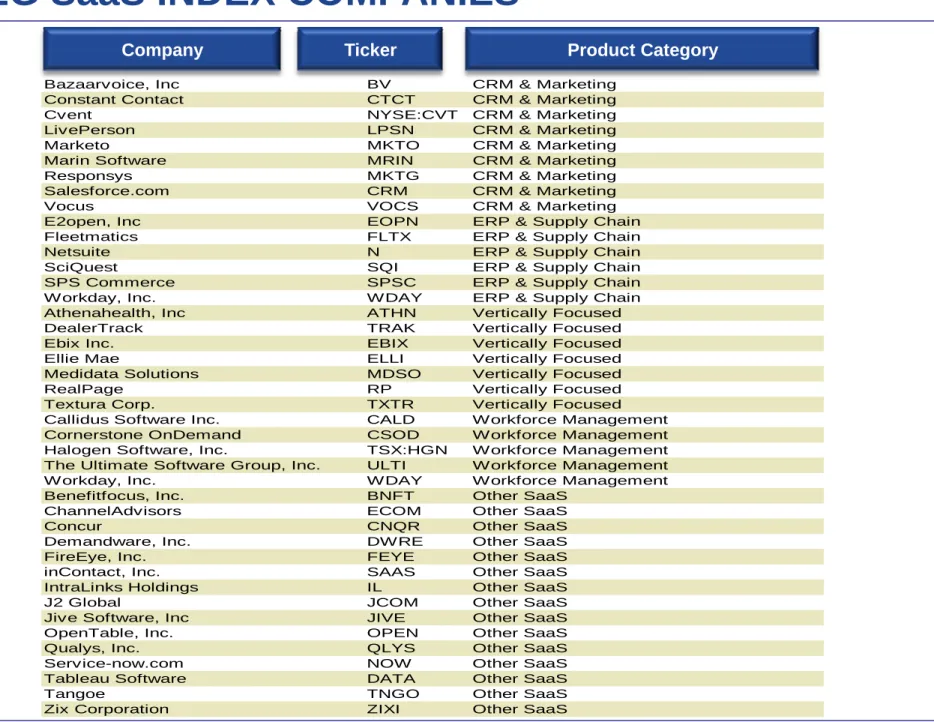
The SEG SaaS Index Detail

25

The SEG SaaS Index: Financial Performance

26-28

The SEG SaaS Index: Financial Performance

26 28

The SEG SaaS Index: Market Multiples

29-30

The SEG SaaS Index by Product Category

31

The SEG SaaS Index by Product Category: Financial Performance

32

The SEG SaaS Index by Product Category: Market Multiples

33

Public Internet Company Financial and Valuation Performance

Public Internet Company Financial and Valuation Performance

The SEG Internet Index

35

The SEG Internet Index: Financial Performance

36-38

The SEG Internet Index: Market Multiples

39-40

The SEG Internet Index by Product Category

41

The SEG Internet Index by Product Category: Financial Performance

42

The SEG Internet Index by Product Category: Financial Performance

42

The SEG Internet Index by Product Category: Market Multiples

43

(3)

SOFTWARE INDUSTRY FINANCIAL REPORT CONTENTS

Software Industry M&A Market Update

Software/SaaS M&A Deal Volume and Spending

45

Software M&A Exit Multiples

46

Software M&A by Ownership Structure and Size

47

Software M&A by Vertical and Horizontal Markets

48

Software M&A by Vertical and Horizontal Markets

48

Software M&A by Product Category

49-50

SaaS M&A Deal Volume and Exit Multiples

51

SaaS M&A by Product Category

52

SaaS M&A: 3Q13 Transactions

53-55

Internet M&A: Deal Volume and Exit Multiples

56-57

Internet M&A: Deal Volume and Exit Multiples

56 57

Appendix

The SEG Software Index Companies

58-61

The SEG SaaS Index Companies

62

The SEG Internet Index Companies

63-65

The SEG Software Index by Key Metrics

66-69

The SEG Software Index by Key Metrics

66 69

The SEG SaaS Index by Key Metrics

70

The SEG Internet Index by Key Metrics

71-73

The SEG Software Index Metrics by Product Category

74-75

The SEG SaaS Index Metrics by Product Category

76

The SEG Internet Index Metrics by Product Category

77

The SEG Internet Index Metrics by Product Category

77

3Q13 Public Sellers

78

3Q13 Software Mega Deals (>$500M)

79

(4)
(5)

Industry leading boutique investment bank founded in

LEADERS IN SOFTWARE M&A

Industry leading boutique investment bank, founded in

1992, representing public and private software and

internet companies seeking:

Strategic exit

Growth capital

We Do Deals.

Growth capital

Buyout

Inorganic growth via acquisition

Buy and sell-side mentoring

Fairness opinions and valuations

Fairness opinions and valuations

Sell-side client revenue range: $5 - 75 million

Buy-side clients include private equity firms and

NASDAQ, NYSE and foreign exchange listed companies

Clients span virtually every software technology, product

category, delivery model and vertical market

Global presence providing advice and guidance to more

th

2 000

i

t

d

bli

i

th

h

t US

than 2,000 private and public companies throughout US,

Canada, Europe, Asia-Pacific, Africa and Israel

Strong cross-functional team leveraging transaction,

operating, legal and engineering experience

Unparalleled software industry reputation and track

record.

(6)

EXTENSIVE GLOBAL REACH

Current Sell-side Representation

• SEG currently represents software companies

in the United States, Canada, France,

Recent Sell-side Representation

Germany, Australia & Saudi Arabia

• In addition to the countries listed above, SEG

has recently represented software companies

in the United Kingdom, France, Netherlands,

Israel, and South Africa

SEG Research Distribution

• SEG’s Quarterly and Annual Software Industry

Equity Reports and Monthly Flash Reports are

q

y

p

y

p

distributed to an opt-in list of 50,000 public

software company CEOs, software

entrepreneurs, private equity managing

directors, VCs, high tech corporate lawyers,

public accountants, etc. in 76 countries.

(7)

Software Equity Group is an investment bank and M&A advisory serving the software and technology sectors. Founded in 1992, our firm has guided and

ABOUT SOFTWARE EQUITY GROUP

q

y

p

y

g

gy

,

g

advised companies on five continents, including privately-held software and technology companies in the United States, Canada, Europe, Asia Pacific, Africa

and Israel. We have represented public companies listed on the NASDAQ, NYSE, American, Toronto, London and Euronext exchanges. Software Equity

Group also advises several of the world's leading private equity firms. We are ranked among the top ten investment banks worldwide for application software

mergers and acquisitions.

Our value proposition is unique and compelling We are skilled and accomplished investment bankers with extraordinary software internet and technology

Our value proposition is unique and compelling. We are skilled and accomplished investment bankers with extraordinary software, internet and technology

domain expertise. Our industry knowledge and experience span virtually every software product category, technology, market and delivery model, including

Software-as-a-Service (Saas), software on-demand and perpetual license. We have profound understanding of software company finances, operations and

valuation. We monitor and analyze every publicly disclosed software M&A transaction, as well as the market, economy and technology trends that impact these

deals. We're formidable negotiators and savvy dealmakers who facilitate strategic combinations that enhance shareholder value.

P h

t i

t

t

th

l ti

hi

'

b ilt

d th i d

t

t ti

j

S ft

E

it G

i k

d

t d b

bli l

Perhaps most important are the relationships we've built and the industry reputation we enjoy. Software Equity Group is known and respected by publicly

traded and privately owned software and technology companies worldwide, and we speak with them often. Our Quarterly and Annual Software Industry Equity

Reports are read and relied upon by more than thousands of industry executives, entrepreneurs and equity investors in sixty-one countries, and we have been

quoted widely in such leading publications as The Wall Street Journal, Barrons, Information Week, The Daily Deal, The Street.com, U.S. News & World Report,

Reuters, Mergers & Acquisitions, USA Today, Arizona Republic, Detroit Free Press, Entrepreneur Magazine, Softletter, Software Success, Software CEO

Online and Software Business Magazine.

g

To keep your finger on the pulse of the software equity markets, subscribe to our Annual and Quarterly Research Reports.

Software Equity Group is an investment bank and M&A advisory serving the software and technology sectors. For a confidential consultation without obligation,

.

[email protected]

,

2800

-509

)

858

Beible, Director, Business Development (

Kris

please contact

CONTACT INFORMATION:

Software Equity Group, L.L.C.

12220 El Camino Real, Suite 320

San Diego, CA 92130

www softwareequity com

www.softwareequity.com

p: (858) 509-2800

The information contained in this Report is obtained from sources we believe to be reliable, but no representation or guarantee is made about the accuracy or completeness of such information, or the opinions expressed herein. Nothing in

this Report is intended to be a recommendation of a specific security or company or intended to constitute an offer to buy or sell, or the solicitation of an offer to buy or sell, any security. Software Equity Group LLC may have an interest in

one or more of the securities or companies discussed herein.

Financial data provided by Capital IQ.

This Report may not be reproduced in whole or in part without the expressed prior written authorization of Software Equity Group, L.L.C.

Software Equity Group registers each Report with the U.S. Copyright Office and vigorously enforces its intellectual property rights.

(8)
(9)

GLOBAL GDP

According to the Economist Global GDP growth slowed in 2Q13 (the latest data available) retreating to 2 1% from 3 1% in

According to the Economist, Global GDP growth slowed in 2Q13 (the latest data available), retreating to 2.1% from 3.1% in

2Q12.

The global economy was constrained by the Europe’s continuing recession and slowing GDP growth in China, which is where a

major experiment is underway to shift its economy from rural to urban based and consumer driven.

Other key emerging markets struggle with social unrest from high unemployment and lackluster growth.

Other key emerging markets struggle with social unrest from high unemployment and lackluster growth.

For the year, PIMCO forecasts Global GDP to grow 2.0% - 2.5%, up slightly from previous forecasts due to strengthened

economies in the U.S. and Japan, which are hoped to offset Europe’s economic malaise and slowed growth among the larger

emerging nations.

(10)

U.S. GDP AND UNEMPLOYMENT

3 6%

5.0%

4 1%

6%

8%

10%

GDP % Growth

Unemployment Rate

3.6%

2.1%

0 7%

1.5%

2.2%

3.7%

1.7%

2.6%

3.1%

0.4%

2.5%

1.3%

4.1%

2.0%

1.3%

3.1%

0.4%

2.5%

1.8%

2.2%

0%

2%

4%

-0.7%

-2.7%

-5.4%

6 4%

-0.7%

-6%

-4%

-2%

According to August’s Federal Reserve survey of 42 economists GDP growth in 3Q13 is predicted to be 2 2% For the year

-6.4%

-8%

3Q07

3Q08

3Q09

3Q10

3Q11

3Q12

3Q13

According to August s Federal Reserve survey of 42 economists, GDP growth in 3Q13 is predicted to be 2.2%. For the year,

expectations are the U.S. economy will grow

2.0

%.

PIMCO, however, is a bit more conservative. In its 3Q13 market perspectives, PIMCO forecast U.S. GDP growth of

1.5% - 2.0

%

for the year, citing continuing strength in the housing market.

(11)

GLOBAL IT SPENDING

9.0%

6.0%

8.0%

6.0%

4.1%

5.0%

10.0%

2.0%

2.0%

0.0%

2007

2008

2009

2010

2011

2012

2013

2014


(F)


in


IT


Sp

e

n

di

ng

-10 0%

10.0%

5.0%

Yo

Y


Cha

n

ge

In July analysts lowered their earlier forecast of 3 9% increase in Global IT spending to a mere 2% increase

10.0%

15.0%

In July, analysts lowered their earlier forecast of 3.9% increase in Global IT spending to a mere 2% increase.

Estimates for 2014 are more promising, with an array of economists forecasting 4.1% growth in Global IT spending.

According to Forrester, software is garnering the largest share of Global IT dollars, $542M in 2013. Software spending is expected

to grow 3.3% in 2013, and 6.2% in 2014.

S

S

ft

di

i

j

t d t i

25% i 2013

SaaS software spending is projected to increase 25% in 2013.

Especially hot IT Software spending priorities include: collaboration (13% YoY growth), business intelligence (11%), ePurchasing

(10%), HR management (9%), and healthcare systems (8%).

(12)

E-COMMERCE AND DIGITAL ADVERTISING SPEND

illions)

llions)

Digital Advertising Revenue

E-Commerce Spending

20%

60,000

25%

30%

12,000

o

Y %

Change

rce Spending

($ M

o

Y %

Change

ng Revenue

($

Mi

l

5%

10%

15%

20 000

30,000

40,000

50,000

5%

10%

15%

20%

25%

6,000

8,000

10,000

Y

o

E-Comme

r

Y

o

Internet Advertisi

5%

0%

0

10,000

20,000

10%

5%

0%

5%

0

2,000

4,000

U.S. e-commerce retail sales totaled

$49.8B in 2Q13

(the latest

data available), just shy of a third consecutive $50B+ quarter.

Th

Q2 t t l f

li

t il

di

t d f

9 6%

f ll

U.S. digital advertising revenues totaled $10.3B in 2Q13

(the latest quarter data was available), which equates to an

18% YoY growth increase

For the first half of 2013 Internet

The

Q2 total for online retail spending

accounted for

9.6%

of all

discretionary retail dollars spent, the highest on record.

2Q13’s 16% YoY growth in online sales marks the eleventh

consecutive quarter of double-digit growth.

Other e commerce categories with at least 19% YoY growth

18% YoY growth increase

.

For the first-half of 2013, Internet

ad revenues surged to a landmark $20.1 billion.

2Q13’s strong first quarter follows on the heels of a strong

2012, when digital advertising soared 15% to $36.6B.

For the first time growth in mobile advertising revenue

Other e-commerce categories with at least 19% YoY growth

included:

Digital Content & Subscriptions, Apparel &

Accessories, Sport & Fitness, Consumer Electronics, and

Consumer Packaged Goods.

For the first time, growth in mobile advertising revenue

reached $3 billion for the first half of 2013, up 145% YoY.

(13)

SEG INDICES VS. BENCHMARK INDICES

40 0%

50.0%

60.0%

DOW

S&P

NASDAQ

SEG SaaS

SEG SW Index

SEG Internet Index

20.0%

30.0%

40.0%

0.0%

10.0%

Optimism continued to prevail on Wall Street despite repeated warnings by the Federal Reserve in Q3 that it would retreat from its

$85 billion monthly bond buying program –

which it subsequently reversed in 3Q13.

(10.0%)

Jan

Feb

Mar

Apr

May

Jun

Jul

Aug

Sep

$85 billion monthly bond buying program

which it subsequently reversed in 3Q13.

The NASDAQ posted the best stock return of the three major stock indices in Q3, finishing up 11.2%. Through three quarters, the

NASDAQ is up a whopping 24.9%.

The S&P, which returned 12.8% in the first half of the year, tacked on an additional 4.7% in 3Q.

After leading all major indices through the first half of the year with a return of 14 6% the DOW only gained an additional 1 2% in

After leading all major indices through the first half of the year with a return of 14.6%, the DOW only gained an additional 1.2% in

Q3. YTD, the DOW’s 15.8% return is still highly respectable.

Both the SEG SaaS and the SEG Internet Index benefited from investors with greater risk tolerance, posting 28.2% (SaaS) and

23.7% (Internet) returns, respectively, by close of Q3. By contrast, the SEG Software lagged well behind, returning

13.3%

in 3Q.

By close of Q3 the SEG SaaS and SEG Internet indexes have gained 50 7% (SaaS) and 48 5% (Internet) respectively

By close of Q3, the SEG SaaS and SEG Internet indexes have gained 50.7% (SaaS) and 48.5% (Internet), respectively.

(14)

PUBLIC SOFTWARE COMPANY FINANCIAL AND

PUBLIC SOFTWARE COMPANY FINANCIAL AND

VALUATION PERFORMANCE:

(15)

THE SEG SOFTWARE INDEX

SEG - Software: Median Metrics

• The SEG Software Index tracks public

software companies that primarily offer

on-premise software under a perpetual

Measure

3Q12

4Q12

1Q13

2Q13

3Q13

EV/Revenue

2.7x

2.6x

2.8x

2.7x

3.0x

EV/EBITDA

11.5x

11.8x

13.3x

12.6x

13.5x

EV/Earnings

22.6x

22.1x

24.0x

24.4x

28.0x

Gross Profit Margin

65.8%

65.9%

66.1%

66.5%

67.1%

EBITDA M

i

19 2%

19 6%

19 3%

18 6%

18 7%

license with annual M&S

• The SEG Software Index is currently

comprised of 133 public software

i

*

EBITDA Margin

19.2%

19.6%

19.3%

18.6%

18.7%

Net Income Margin

9.4%

9.9%

8.7%

8.2%

8.2%

TTM Revenue Growth

14.7%

14.0%

12.8%

11.7%

10.0%

TTM Total Revenue ($M)

$427.0

$452.3

$461.7

$471.9

$483.6

TTM EBITDA Growth

15.9%

9.4%

7.2%

5.4%

6.1%

TTM Total EBITDA ($M)

$71.2

$75.1

$76.0

$82.7

$86.0

companies*

TTM Total EBITDA ($M)

$71.2

$75.1

$76.0

$82.7

$86.0

Cash & Eq ($M)

$157.3

$159.7

$169.3

$180.9

$175.9

Current Ratio

2.0

2.0

1.9

1.9

2.0

Debt / Equity Ratio

21.3%

22.5%

25.1%

26.6%

23.1%

(16)

THE SEG SOFTWARE INDEX: FINANCIAL PERFORMANCE

70% of public on-premise software companies

had TTM revenue growth rates of 20% or below

Of the 16% of companies with TTM revenue

Revenue Performance

TTM Revenue Growth Rate Distribution

16%

$490

TTM


Total


Revenue


($M)

TTM


Revenue


Growth

31%

35%

Of the 16% of companies with TTM revenue

growth rates of 30% or more, a disproportionate

number are focused on mobility and cloud

computing

8%

10%

12%

14%

$440

$450

$460

$470

$480

$

n

ue


Gr

o

w

th

l


Re

ve

n

u

e

15%

31%

24%

14%

20%

25%

30%

o

mp

an

ie

s

0%

2%

4%

6%

8%

$390

$400

$410

$420

$430

$440

TTM


Re

ve

n

TTM


To

ta

14%

6%

10%

0%

5%

10%

15%

%


of


C

o

On-premise software companies lost market share to SaaS

providers, and continued to be buffeted by tightly constrained

IT capital budgets and macro economic headwinds The

0%

$390

3Q12

4Q12

1Q13

2Q13

3Q13

0%

<=


0%

>


0%

<=


10%

>


10%

<=


20%

>


20%

<=


30%

>


30%

<=


40%

>


40%

TTM


Revenue


Growth

IT capital budgets and macro economic headwinds. The

median TTM revenue growth rate of the SEG Software Index

dropped to

10.0%, the fourth consecutive quarterly of decline.

Perhaps as testament to how much consolidation has occurred

among on-premise providers, the median TTM revenue of the

SEG Software Index reached $

483.6M

, the highest in history,

and the highest among our three tracking indices.

We expect TTM revenue growth for most on-premise public

software companies to remain modest for the balance of the

year which portends more acquisitions and R&D spending to

year, which portends more acquisitions and R&D spending to

spur top line growth.

(17)

THE SEG SOFTWARE INDEX: FINANCIAL PERFORMANCE

TTM EBITDA Margin Distribution

EBITDA Margin Performance

Almost one in three on-premise software

companies posted EBITDA margins of

20% - 30%

18%

22%

EBITDA


Margin

TTM


EBITDA


Growth

26%

27%

30%

10%

12%

14%

16%

18%

12%

14%

16%

18%

20%

22%

D

A


Gr

o

w

th

Mar

gi

n

18%

26%

15%

20%

25%

o

mp

an

ie

s

0%

2%

4%

6%

8%

0%

2%

4%

6%

8%

10%

TT

M


EBI

TD

EBI

TD

A


10%

11%

6%

0%

5%

10%

%


of


C

o

The median EBITDA margin of public on-premise software

companies remained at historic levels, closing

3Q13 at

0%

0%

3Q12

4Q12

1Q13

2Q13

3Q13

0%

<=


0%

>


0%

<=


10%

>


10%

<=


20%

>


20%

<=


30%

>


30%

<=


40%

>


40%

TTM


EBITDA


Margin

p

,

g

Q

18.7%.

In the current scenario, it’s unlikely members of the SEG

Software Index will be able to push much more to the bottom

line. Their m

edian TTM EBITDA growth plunged from

15.9%

YoY in

3Q12 to only 5 4%

YoY growth in 3Q13

YoY in

3Q12 to only 5.4%

YoY growth in 3Q13.

(18)

THE SEG SOFTWARE INDEX: FINANCIAL PERFORMANCE

Margin Performance

Operating Ratios

25%

S&M


(%


of


Revenue)

R&D


(%


of


Revenue)

G&A


(%


of


Revenue)

80%

Gross Prof it Margin

EBITDA Margin

Net Income Margin

15%

20%

R

ev

en

u

e

40%

50%

60%

70%

M

ar

g

in

0%

5%

10%

%


of


R

0%

10%

20%

30%

%

M

Among public on-premise software compnaies, median

spending in Q3 was consistant with historical

norms: 14.9%

In

3Q13,

median gross profit, EBITDA and net income

margins were

67.1%, 18.7% and 8.2%,

respectively.

0%

3Q12

4Q12

1Q13

2Q13

3Q13

0%

3Q12

4Q12

1Q13

2Q13

3Q13

p

g

Q

for Research & Development, 23.2% for Sales & Marketing,

and 10.8% for General & Administrative.

Over the past year, S&M, R&D and G&A expenses as a

percent of revenue have remained flat.

g

,

,

p

y

Several on-premise providers achieved gross profit margins

of 89% or greater, including:

Sage Group (93.9%), Unit 4

(92.8%), SolarWinds (92.7%), Splunk (89.0%).

We anticipate EBITDA margins and net income margins will

Median S&M spending among on-premise public software

companies lagged far behind their SaaS counterparts, which

continued to invest heavily in new customer acquisition

(

39.3% for SaaS and 23.2% for on-premise).

likely decline over the next several quarters, as on-premise

software companies increase their investments in R&D to

improve products/delivery models, and in sales & marketing

to accelerate TTM revenue growth.

(19)

THE SEG SOFTWARE INDEX: MARKET MULTIPLES

EV/Revenue Multiples by Size (TTM Revenue)

EV/Revenue and EV/EBITDA Multiples

4.0x

Revenue


Greater


Than


$1


billion

Revenue


Between


$500


million


and


$1


billion

Revenue


Between


$100


million


and


$500


million

Revenue


Less


Than


$100


million

16 0x

EV/Revenue

EV/EBITDA

2 0x

2.5x

3.0x

3.5x

V

/R

ev

e

n

u

e

11.5x

11.8x

13.3x

12.6x

13.5x

8 0x

10.0x

12.0x

14.0x

16.0x

0 0x

0.5x

1.0x

1.5x

2.0x

Me

d

ian


EV

2.7x

2.6x

2.8x

2.7x

3.0x

0 0

2.0x

4.0x

6.0x

8.0x

Despite slowing growth and EBITDA erosion, the median EV/Revenue

multiple of public on-premise software companies ticked up 30 basis

points 3Q13, closing the quarter at 3.0x.

Investors in 3Q13 continued to place higher value on larger public

software companies with revenues >$100 million.

Throughout 2012 and into 3Q13 the EV/Revenue multiples of

0.0x

3Q12

4Q12

1Q13

2Q13

3Q13

0.0x

3Q12

4Q12

1Q13

2Q13

3Q13

p

,

g

q

This marks only the second time since 1Q06 that the SEG Software

Index median EV/Revenue multiple reached 3.0x or higher. The other

quarter was 2Q11 when the multiple 3.1x.

The higher EV/Revenue median multiples are most likely attributed to a

higher percentage of recurring revenue as many on premise software

Throughout 2012, and into 3Q13, the EV/Revenue multiples of

on-premise software companies with revenues <$100 million

remained markedly lower than their larger counterparts.

SEG Software Index companies with TTM revenue between

$100M

and $1B successfully balanced TTM revenue growth

(median 16 6%)

and profitability (median EBITDA of

15 3%

) and

higher percentage of recurring revenue, as many on-premise software

providers transition to subscription pricing and periodic license models.

Adobe is a great example. As the company converts to a SaaS model,

its revenue growth rate has rapidly decelerated (11.0%, 4.4%, (5.3%) in

2010, 2011, 2012, respectively) yet its EV/Revenue multiple has grown

from 2 9x to 5 8x over the same period due to a growing percentage of

(median 16.6%)

and profitability (median EBITDA of

15.3%

), and

were rewarded with the highest median EV/Revenue multiples.

from 2.9x to 5.8x over the same period due to a growing percentage of

recurring revenue.

(20)

THE SEG SOFTWARE INDEX: MARKET MULTIPLES

EV/Revenue Multiples vs. TTM EBITDA Margins

EV/Revenue Multiples vs. TTM Revenue Growth Rates

5.7x

5.6x

6.0x

6.1x

7.0x

2.8x

3.0x

3.3x

3.0x

4.0x

5.0x

E

V

/R

e

v

enue

2 6x

3.2x

3.3x

6

3 0

4.0x

5.0x

6.0x

E

V/R

e

v

e

n

u

e

1.2x

0.0x

1.0x

2.0x

M

e

d

ian

E

2.4x

2.6x

2.0x

0.0x

1.0x

2.0x

3.0x

M

e

d

ian

E

Investors awarded markedly higher market multiples to

public on premise software companies with revenue growth

Premium market multiples were awarded to the select few

on-premise software providers generating EBITDA margins north

<= 0%

> 0%

<= 10%

> 10%

<= 20%

> 20%

<= 30%

> 30%

<= 40%

> 40%

TTM Revenue Growth

0.0x

<= 0%

> 0%

<= 10%

> 10%

<= 20%

> 20%

<= 30%

> 30%

<= 40%

> 40%

TTM EBITDA Margin

public on-premise software companies with revenue growth

exceeding 20%.

Indeed, public on-premise software companies with revenue

growth rates of 20%-30% and greater than 40% closed 3Q13

with median EV/Revenue multiples of 5.7x and 5.6x,

premise software providers generating EBITDA margins north

of 40%.

Surprisingly, the EV/Revenue multiple range for most

on-premise software companies was relatively narrow, suggesting

investors were seemingly indifferent to sub 40% profitability, a

(21)

THE SEG SOFTWARE INDEX: BY PRODUCT CATEGORY

3Q12

4Q12

1Q13

2Q13

3Q13

3Q12

4Q12

1Q13

2Q13

3Q13

3Q12

4Q12

1Q13

2Q13

3Q13

3Q12

4Q12

1Q13

2Q13

3Q13

Billing & Service Management

1.3x

1.5x

1.9x

1.9x

2.3x

8.0x

8.2x

8.4x

8.3x

8.7x

9.5%

10.4%

10.4%

8.9%

16.9%

18.8%

19.8%

20.7%

18.7%

18.4%

Business Intelligence

3.7x

3.2x

3.4x

3.0x

3.3x

25.6x

17.5x

15.8x

16.5x

17.1x

13.8%

13.2%

11.8%

13.1%

14.2%

16.5%

14.7%

14.0%

13.6%

13.3%

Development Platforms

2.5x

2.5x

2.5x

2.6x

2.6x

8.2x

9.6x

9.1x

10.1x

14.2x

3.5%

1.6%

3.0%

0.6%

-0.3%

24.7%

23.5%

21.1%

20.3%

20.4%

SEG Software Index

Category

EV/Revenue

EV/EBITDA

TTM Revenue Growth

EBITDA Margin

Engineering & PLM

2.6x

2.5x

2.7x

2.7x

2.8x

12.1x

11.8x

13.4x

12.4x

13.8x

13.2%

14.0%

13.1%

11.7%

8.4%

20.5%

20.6%

20.7%

20.5%

20.3%

Enterprise Resource Planning

2.1x

2.2x

2.3x

2.5x

2.5x

9.2x

9.1x

10.1x

12.1x

12.2x

4.7%

3.4%

2.6%

1.5%

2.2%

23.2%

23.1%

22.8%

22.4%

22.2%

Financial & Accounting

2.9x

2.9x

3.1x

3.3x

3.3x

9.8x

9.8x

10.5x

11.3x

12.0x

17.2%

13.8%

8.6%

10.7%

9.5%

29.0%

28.8%

27.5%

26.6%

26.1%

Gaming

1.0x

1.0x

1.1x

1.3x

1.7x

9.1x

8.0x

7.1x

9.4x

11.3x

2.2%

0.1%

7.4%

15.1%

14.9%

14.9%

15.7%

14.9%

15.4%

14.6%

Healthcare

2.2x

2.1x

2.1x

2.1x

2.5x

12.8x

11.3x

14.8x

17.6x

16.1x

24.2%

19.6%

10.7%

11.0%

9.4%

20.6%

18.5%

13.4%

14.1%

14.3%

IT Conglomerates

2.8x

2.5x

2.5x

2.9x

2.7x

8.4x

8.0x

9.0x

8.7x

8.3x

1.5%

1.4%

0.5%

0.2%

1.2%

36.1%

34.6%

33.8%

33.8%

34.3%

Mobile Solutions/Content

3 2x

2 5x

2 7x

2 8x

3 0x

13 8x

11 9x

20 6x

13 2x

13 5x

44 9%

48 1%

44 5%

24 6%

13 2%

7 8%

6 4%

4 5%

7 9%

8 0%

Mobile Solutions/Content

3.2x

2.5x

2.7x

2.8x

3.0x

13.8x

11.9x

20.6x

13.2x

13.5x

44.9%

48.1%

44.5%

24.6%

13.2%

7.8%

6.4%

4.5%

7.9%

8.0%

Networking & Network Performance

Management

3.0x

3.0x

2.8x

2.7x

2.8x

16.4x

14.9x

15.3x

17.0x

17.0x

17.3%

14.6%

15.2%

11.0%

6.5%

16.3%

16.0%

16.1%

15.0%

14.3%

Security

4.2x

3.1x

3.5x

4.5x

4.9x

11.5x

11.9x

20.7x

16.7x

12.7x

22.8%

23.9%

23.8%

21.8%

21.2%

18.4%

17.1%

8.1%

7.3%

7.5%

Storage, Data Management &

Integration

2.5x

2.3x

2.4x

2.4x

2.7x

9.2x

8.4x

9.2x

8.8x

8.9x

6.3%

6.5%

4.8%

4.1%

3.3%

23.9%

23.8%

22.2%

21.9%

22.2%

Supply Chain Management &

Logistics

2.5x

2.9x

3.3x

3.4x

4.1x

10.5x

12.7x

14.5x

15.0x

17.1x

15.9%

11.2%

11.3%

9.3%

10.2%

17.1%

16.6%

16.0%

15.3%

19.2%

Logistics

Systems Management

6.9x

5.7x

5.6x

5.0x

5.4x

26.6x

24.6x

23.0x

20.9x

19.7x

18.7%

17.4%

17.2%

16.1%

16.4%

25.9%

25.0%

24.4%

23.8%

24.2%

Vertical - Finance

3.2x

3.0x

3.4x

3.8x

3.7x

10.6x

9.4x

10.7x

11.4x

12.6x

6.3%

7.1%

6.7%

7.6%

7.4%

26.2%

26.3%

26.5%

27.3%

26.0%

Vertical - Other

2.9x

2.9x

3.0x

3.2x

3.6x

21.2x

21.3x

22.0x

22.1x

20.8x

28.0%

19.8%

21.3%

21.0%

22.2%

14.3%

14.0%

14.1%

14.4%

15.5%

Median

2.7x

2.6x

2.8x

2.7x

3.0x

11.5x

11.8x

13.3x

12.6x

13.5x

14.7%

14.0%

12.8%

11.7%

10.0%

19.2%

19.6%

19.3%

18.6%

18.7%

• The SEG Software Index is segmented into 17 product categories

(22)

THE SEG SOFTWARE INDEX BY PRODUCT CATEGORY:

FINANCIAL PERFORMANCE

3Q13 YoY Change in Revenue Growth

3Q13 TTM Revenue Growth

3Q13 YoY Change in Revenue Growth

3Q13 TTM Revenue Growth

10%

15%

20%

25%

(20%)

0%

20%

40%

60%

80%

100%

(5%)

0%

5%

10%

e

rv

ic

e

g

en

c

e

p

me

n

t …

&

PL

M

e

rp

ri

s

e

ci

a

l &

a

mi

n

g

hc

are

e

rat

e

s

M

obi

le

k

in

g

&

e

cu

ri

ty

, D

a

ta

C

h

ai

n

s

te

m

s

n

an

c

e

Ot

h

e

r

(100%)

(80%)

(60%)

(40%)

(20%)

e

rv

ic

e

g

en

c

e

p

me

n

t …

&

PL

M

rpr

is

e

c

ia

l &

a

min

g

h

ca

re

e

ra

te

s

M

obi

le

kin

g

&

c

uri

ty

Da

ta

C

ha

in

s

te

m

s

n

an

c

e

O

th

e

r

B

ill

in

g

&

S

e

B

u

si

n

e

ss

I

n

te

ll

ig

De

v

e

lo

p

E

n

g

ine

eri

n

g

&

En

te

Fin

a

n

G

a

He

a

lt

IT

C

o

n

g

lo

m

e

M

Ne

tw

o

rk

S

e

St

o

ra

g

e

S

u

ppl

y

Sy

s

Ve

rt

ic

a

l

-F

in

Ve

rt

ic

a

l

-B

ill

in

g

&

S

e

Bu

s

in

e

s

s

In

te

lli

g

De

v

e

lo

p

E

n

g

ine

er

in

g

&

En

te

r

Fi

n

a

n

c

G

a

He

a

lt

h

IT

C

o

n

g

lo

m

e

M

Ne

tw

o

rk

Se

c

Sto

ra

g

e

,

S

u

ppl

y

C

Sy

s

Ve

rt

ic

a

l

-F

in

Ve

rt

ic

a

l

-O

3Q13 YoY Change EBITDA Margin

3Q13 TTM EBITDA Margin

25%

30%

35%

40%

(20%)

0%

20%

0%

5%

10%

15%

20%

25%

e

e

n

t …

M

e

&

g

re

e

s

le

&

ty

ta

n

m

s

e

e

r

(100%)

(80%)

(60%)

(40%)

ice

n

ce

e

nt

L

M

ris

e

l &

ing

a

re

tes

b

ile

g

&

rit

y

a

ta

a

in

ms

n

ce

h

er

B

ill

in

g

&

S

e

rv

ic

s

in

e

s

s

In

te

llig

e

n

c

D

e

v

e

lopm

e

n

ng

inee

ri

n

g

&

P

L

M

E

n

te

rp

ri

s

F

ina

nc

ia

l

&

Ga

m

in

g

He

a

lt

h

c

a

re

IT

C

o

n

g

lo

m

e

ra

te

M

obi

l

Ne

tw

o

rk

in

g

&

Se

c

u

ri

t

S

to

rag

e,

D

a

t

S

u

ppl

y

C

h

a

i

Sy

s

te

m

V

e

rt

ic

a

l

-F

in

a

n

c

Ve

rt

ic

a

l

-O

th

e

B

ill

in

g

&

S

e

rv

i

u

si

n

e

ss

In

te

lli

g

e

n

D

e

v

e

lopm

e

E

n

g

ine

er

in

g

&

P

L

En

te

rp

r

F

ina

nc

ia

Ga

m

i

He

a

lt

h

c

a

IT

C

o

n

g

lo

m

e

ra

t

Mo

b

Ne

tw

o

rk

in

g

Se

c

u

r

Sto

ra

g

e

, D

a

S

u

ppl

y

C

h

a

Sy

s

te

Ve

rt

ic

a

l

-F

in

a

n

Ve

rt

ic

a

l

-O

th

Bu

s

E

B

u

(23)

THE SEG SOFTWARE INDEX BY PRODUCT CATEGORY:

MARKET MULTIPLES

3Q13 YoY Change in Median EV/Revenue Multiples

3Q13 Median EV/Revenue Multiples

5 0x

6.0x

80%

100%

2.0x

3.0x

4.0x

5.0x

0%

20%

40%

60%

0.0x

1.0x

e

rvi

c

e

g

en

c

e

tfo

rm

s

&

PL

M

a

nn

in

g

u

nt

in

g

a

mi

n

g

thc

a

re

e

ra

te

s

o

nt

en

t

e

tw

o

rk

e

cu

ri

ty

e

me

n

t …

e

me

n

t …

e

me

n

t

n

an

c

e

Ot

h

e

r

(40%)

(20%)

g

em

en

t

li

ge

nc

e

a

tf

o

rm

s

& PL

M

ann

in

g

o

un

ti

ng

G

am

in

g

a

lt

hc

a

re

m

e

rat

es

C

on

te

nt

N

et

wo

rk

S

ec

u

rit

y

me

n

t &

e

me

n

t &

g

em

en

t

F

in

an

c

e

-O

th

e

r

B

ill

in

g &

S

e

Bu

si

n

e

ss I

n

te

ll

ig

D

e

v

e

lo

pm

en

t P

la

t

E

n

gi

ne

er

in

g

&

p

ri

se

R

e

so

u

rce

Pl

a

F

ina

nc

ia

l &

A

c

c

o

u

G

a

He

al

t

IT

C

o

n

g

lo

m

e

M

ob

il

e S

o

lu

ti

on

s

/C

o

Ne

tw

or

k

ing

&

N

e

S

e

rag

e,

Da

ta

M

a

n

a

g

e

p

pl

y

Ch

ai

n M

a

na

g

e

S

y

s

tem

s

M

a

na

g

e

Ve

rt

ic

a

l

-F

in

Ve

rt

ic

a

l

-g &

S

e

rv

ic

e M

a

na

g

Bu

si

n

e

ss I

n

te

l

De

v

e

lo

p

m

en

t P

la

E

n

gi

ne

er

in

g

rpr

is

e R

e

s

o

u

rc

e

P

l

F

ina

nc

ia

l &

A

c

c

o

G

He

a

IT

Co

ng

lo

m

M

ob

il

e S

o

lu

ti

on

s

/C

Ne

tw

or

k

ing

&

N

S

a

ge

, D

a

ta

M

a

na

ge

pl

y

Ch

ai

n M

a

na

g

e

Syst

e

m

s Ma

n

a

g

Ve

rt

ic

a

l

-F

Ve

rt

ic

a

l

In 3Q13, seven product categories achieved median EV/Revenue multiples above the SEG Software Index median of 3.0x, including

Systems Management (5.4x), Security (4.9x), Supply Chain Mgmt & Logistics (4.1x), Vertical - Finance (3.7x), Vertical - Other (3.6x),

Financial & Accounting (3.3x), Business Intelligence (3.3x).

En

te

rp

M

St

o

r

Su

p

B

ill

in

En

te

r

M

St

o

ra

Su

p

For some categories,

TTM revenue growth translated to an impressive EV/Rev market valuation (Security, Systems Mgmt), while other

categories demonstrated a curious disconnect between market valuation and top line growth (Billing & Service Mgmt, Vertical - Other).

The Systems Management product category, benefitting from the rapid shift to cloud computing and growing demand for cloud

infrastructure, achieved the highest median EV/Revenue multiple (5.4x) in 3Q13, driven by strong TTM revenue growth (16.4%) and

EBITDA

i

(24 2%)

b th b

th

di

f

th i d

(24)

PUBLIC SaaS COMPANY FINANCIAL AND

PUBLIC SaaS COMPANY FINANCIAL AND

VALUATION PERFORMANCE:

(25)

THE SEG SaaS INDEX

SEG - SaaS: Median Metrics

• The SEG SaaS Index tracks public

companies that primarily offer hosted,

on-demand software under a subscription

Measure

3Q12

4Q12

1Q13

2Q13

3Q13

EV/Revenue

5.5x

4.8x

5.3x

5.7x

6.5x

EV/EBITDA

41.5x

41.7x

35.4x

31.5x

40.6x

EV/Earnings

40.9x

40.2x

63.8x

106.1x

125.4x

Gross Profit Margin

70.5%

70.9%

70.8%

70.8%

70.3%

and/or transaction based pricing model

• The SEG SaaS Index is currently

comprised of 41 public pure-play SaaS

i

*

EBITDA Margin

6.9%

6.9%

5.7%

2.3%

2.1%

Net Income Margin

-0.9%

-0.3%

-1.8%

-4.0%

-4.5%

TTM Revenue Growth

28.7%

26.8%

25.3%

25.0%

30.6%

TTM Total Revenue ($M)

$108.1

$117.5

$127.7

$143.1

$163.8

TTM EBITDA Growth

26.0%

20.6%

7.9%

3.0%

7.2%

TTM Total EBITDA ($M)

$6 0

$6 0

$6 8

$5 1

$2 7

companies*

TTM Total EBITDA ($M)

$6.0

$6.0

$6.8

$5.1

$2.7

Cash & Eq ($M)

$67.0

$66.1

$68.0

$74.7

$89.1

Current Ratio

1.5

1.6

1.8

1.5

2.2

Debt / Equity Ratio

6.9%

5.7%

6.5%

6.4%

8.3%

(26)

THE SEG SaaS INDEX: FINANCIAL PERFORMANCE

35%

TTM Revenue Growth Rate Distribution

Revenue Performance

30% achieved TTM

35.0%

$180

TTM


Total


Revenue


($M)

TTM


Revenue


Growth

26%

29%

29%

24%

20%

25%

30%

o

mp

a

n

ie

s

30% achieved TTM

revenue growth of

40% or more

Only 3% of public

SaaS companies

generated TTM

revenue growth of

10%

l

20.0%

25.0%

30.0%

35.0%

$100

$120

$140

$160

$180

n

ue


Gr

o

w

th

l


R

e

ve

nue

0%

3%

6%

0%

5%

10%

15%

% o

f C

o

10% or less

0 0%

5.0%

10.0%

15.0%

$0

$20

$40

$60

$80

TTM


Re

ve

n

TTM


To

ta

l

0%

<=


0%

>


0%

<=


10%

>


10%

<=


20%

>


20%

<=


30%

>


30%

<=


40%

>


40%

<=


50%

>


50%

TTM Revenue Growth

After declining for four consecutive

quarters, the median TTM

revenue growth rate for the SEG SaaS Index edged up to 30.6%

0.0%

$0

3Q12

4Q12

1Q13

2Q13

3Q13

in 3Q13.

Public SaaS companies continued to grow, mature and gain

market share; Q3’s median TTM revenue exceeded $160M, up

sharply from 3Q12’s $108M.

The sharp uptick in median revenue growth is largely attributed

to a host of new market grabbing SaaS IPOs in 3Q13. Select

examples include: FireEye (109% TTM Revenue Growth;),

Tableau Software (71%), Textura (65%), Marketo (62.0%), and

Cvent (36%).

(27)

THE SEG SaaS INDEX: FINANCIAL PERFORMANCE

TTM EBITDA Margin Distribution

EBITDA Margin Performance

85% with EBITDA margins of 20% or lower

30%

8%

EBITDA


Margin

TTM


EBITDA


Growth

35%

40%

15%

20%

25%

30%

4%

6%

8%

D

A


Gr

o

w

th

Ma

rg

in

35%

30%

18%

20%

25%

30%

35%

o

mp

an

ie

s

0%

5%

10%

15%

0%

2%

4%

TT

M


EB

IT

D

EB

IT

D

A


13%

5%

0%

5%

10%

15%

%


of


C

o

After peaking in 2010, the median EBITDA margin of public

SaaS companies has declined every quarter

since.

0%

0%

3Q12

4Q12

1Q13

2Q13

3Q13

0%

<= 0%

> 0%

<= 10%

> 10%

<= 20%

> 20%

<= 30%

> 30%

TTM


EBITDA


Margin

SaaS companies has declined every quarter

since.

Ther trend continued in 3Q13 as the median EBITDA margin

was 2.1%, down from 3.0% in 2Q13.

(28)

THE SEG SaaS INDEX: FINANCIAL PERFORMANCE

Median Margin Performance

Median Operating Ratios

45%

S&M


(%


of


Revenue)

R&D


(%


of


Revenue)

G&A


(%


of


Revenue)

80%

Gross


Profit


Margin

EBITDA


Margin

Net


Income


Margin

25%

30%

35%

40%

45%

e

ve

nue

40%

50%

60%

70%

80%

arg

in

0%

5%

10%

15%

20%

%


of


R

e

0%

10%

20%

30%

40%

%


M

a

Increased spending on sales and marketing by public SaaS

companies accounted for much of the decline in median

Median gross profit margins for public SaaS companies in

3Q13 were 70.3%, and have remained steady over the past

0%

3Q12

4Q12

1Q13

2Q13

3Q13

0%

3Q12

4Q12

1Q13

2Q13

3Q13

EBITDA margin.

In 3Q13, 39.3% of total revenue was spent on sales &

marketing, relatively unchanged from the 39.7% spent in

3Q12.

,

y

p

five quarters.

Stable gross profit margins demonstrate the ability of public

SaaS companies to grow without disproportionally scaling

infrastructure and increasing application delivery costs.

R&D spending as a percent of revenue increased to 18.1% in

3Q13, compared to 16.9% in 3Q12.

With growth as their primary objective, public SaaS

companies are running close to break even, with net income

in 3Q13 of

-4.5%.

(29)

THE SEG SaaS INDEX: MARKET MULTIPLES

EV/Revenue Multiple Distribution

EV/Revenue and EV/EBITDA Multiples

41.5x

41.7x

40.6x

45.0x

EV/Revenue

EV/EBITDA

41%

40%

45%

35.4x

31.5x

20 0x

25.0x

30.0x

35.0x

40.0x

20%

25%

30%

35%

40%

C

om

pa

ni

e

s

5.5x

4.8x

5.3x

5.7x

6.5x

0.0x

5.0x

10.0x

15.0x

20.0x

0%

5%

8%

11%

5%

11%

5%

3%

11%

0%

5%

10%

15%

20%

%


of


C

Median EV/Revenue multiples for public SaaS providers

reached a breathtaking 6.5x at the close of 3Q13.

A class of Tier 1 SaaS providers is emerging within the SaaS

Index, earning premium EV/Revenue multiples from

3Q12

4Q12

1Q13

2Q13

3Q13

<=


1.0x >


1.0x

<=


2.0x

>


2.0x

<=


3.0x

>


3.0x


<=


4.0x

>


4.0x

<=


5.0x

>


5.0x

<=


6.0x

>


6.0x

<=


7.0x

>


7.0x

<=


8.0x

>


8.0x

<=


9.0x

>


9.0x

EV/Revenue

g

Q

This marks the first time since 4Q07 that the median

EV/Revenue multiples for public SaaS providers exceeded

6x.

Public SaaS providers in 3Q13 continued to trade at a

,

g p

p

investors

As testament, a whopping 41% of the companies in the SEG

SaaS Index are trading for 9x TTM revenue or greater

These leaders demonstrate high growth and a dominant

significant premium relative to their on-premise peers (6.5x

vs. 3.0x).

position in large markets with proven ability to replace

incumbent on premise providers. Examples include

Salesforce, Workday, NetSuite, etc.

30% of public SaaS providers had median EV/Revenue

multiples between 5x and 9x

(30)

THE SEG SaaS INDEX: MARKET MULTIPLES

EV/Revenue Multiples vs. TTM EBITDA Margins

EV/Revenue Multiples vs. TTM Revenue Growth Rates

14.2x

16.0x

25.0x

7.3x

8.0x

10.0x

12.0x

14.0x

EV

/R

ev

en

u

e

19.9x

15.0x

20.0x

EV

/R

ev

en

u

e

3.8x

5.1x

4.8x

0.0x

2.0x

4.0x

6.0x

Me

d

ian


0.0x

2.1x

4.0x

5.7x

8.0x

6.8x

0.0x

5.0x

10.0x

Me

d

ia

n


There is a very strong correlation between the median TTM

revenue growth rate and median EV/Revenue multiple of

There is an inverse correlation between EBITDA margins

and median EV/Revenue multiples

<=


0%

>


0%

<=


10%

>


10%

<=


20%

>


20%

<=


30%

>


30%

TTM


EBITDA


Margin

<=


0%

>


0%

<=


10%

>


10%

<=


20%

>


20%

<=


30%

>


30%

<=


40%

>


40%

<=


50%

>


50%

TTM


Revenue


Growth

revenue growth rate and median EV/Revenue multiple of

public SaaS companies.

Public SaaS companies growing TTM revenue in excess of

50% achieved a stellar median EV/Revenue multiple of

19.9x.

and median EV/Revenue multiples.

In the current market, SaaS profitability is penalized, as

investors perceive profitability to be at the expense of

growth, which they deem all important.

As proof, public SaaS companies with no profitability

Select companies with TTM growth rates of 50% or higher

include: FireEye (109% TTM revenue growth rate, 38.6x

EV/Revenue); Service-now (84.5%, 17.6x); Workday (77.4%,

33.7x); Tableau Software (71.0%, 22.1x); Textura Corp.

(65.0%, 23.2x); Marketo (62.0%, 15.1x), Cornerstone

As proof, public SaaS companies with no profitability

boasted a remarkable 14.2x median EV/Revenue multiple in

3Q13.

(

,

);

(

,

),

Figure

Tableau Software DATA Other SaaS

References

Related documents

Ques: Data analysis vs machine learning vs statistics vs theory of algorithms vs artificial intelligence (vs scientific computing vs?. computational mathematics vs

As the small off-road engine owner, you should, however, be aware that Husqvarna Forest &amp; Garden may deny you warranty coverage if your small off-road engine or a part has

Now, however, as sent spirit narratives have become a less accessible means of enacting agency, they instead provide a means to make sense of one’s lack of agency in relation

Apart from that, other scholars adopted the theory of planned behavior (TPB) [5] to examine the influence of users’ attitude, subjective norms and perceived behavioral

The Baltic area is exceptional among the lands inhabited by people of Indo-European origin in that the language and folklore have survived in a remarkably pure state, and ancient

Inhibition Testing for Placebo Materials - Growth promotion testing, in which the chosen material is tested for potential inhibition, is performed using

Factored geotechnical bearing resistance (of a foundation unit) - the factored resistance of a foundation unit, as determined by geotechnical formula using unfactored

Jika Anda berada dalam Design View mode, dan Anda menekan menu atau ikon yang dapat mempengaruhi model, SANSPRO otomatis akan menanyakan apakah Anda ingin membatalkan hasil