DefensePro Product Family
Software Version 6.09.01
Security Target
Version 0.1 April 27, 2014Prepared by:
Radware Ltd.
22 Raoul Wallenberg St.,
Tel-Aviv, Israel 69710
Prologue 4/27/2014
Document Version Control Log
Version Date Author Description
Prologue 4/27/2014
Table of Contents
1. ST Introduction ... 7 1.1. ST Reference ... 7 1.2. TOE Reference ... 7 1.3. TOE Overview ... 7 1.4. Document Organization ... 10 1.5. TOE Description ... 111.5.1. Physical Scope and Boundaries of the TOE ... 11
1.5.2. Logical Scope of the TOE... 12
2. Conformance Claims ... 19
2.1. CC Conformance Claim ... 19
2.2. Assurance Package Conformance ... 19
2.3. PP Conformance ... 19
2.4. Conformance Rationale ... 19
2.4.1. Introduction ... 19
2.4.2. Consistency of the Security Problem Definition ... 19
2.4.3. Security Objectives Conformance ... 20
2.4.4. Security Functional Requirements Conformance ... 20
2.4.5. Security Assurance Requirements Conformance... 22
3. Security Problem Definition ... 23
3.1. Threats ... 23
3.1.1. TOE Threats ... 23
3.1.2. IT System Threats ... 23
3.2. Assumptions ... 24
3.2.1. Intended Usage Assumptions ... 24
3.2.2. Physical Assumptions ... 24
3.2.3. Personnel Assumptions ... 24
3.3. Organizational Security Policies ... 25
Prologue 4/27/2014
4.1. Security Objectives for the TOE ... 26
4.2. Security Objectives for the Operational Environment ... 27
4.2.1. IT Security Objectives for the Environment ... 27
4.2.2. Security Objectives for the Environment Upholding Assumptions ... 27
4.3. Security Objectives Rationale ... 28
4.3.1. IT Security Objectives Rationale ... 28
4.3.2. Non-IT Security Objectives Rationale ... 28
5. Extended Components Definition ... 29
5.1. Class IDS: Intrusion Detection ... 29
5.1.1. IDS data analysis (IDS_ANL) ... 30
5.1.2. IDS reaction (IDS_RCT) ... 30
5.1.3. IDS data review (IDS_RDR) ... 31
5.1.4. IDS data collection (IDS_SDC) ... 32
5.1.5. IDS data storage (IDS_STG) ... 33
6. Security Requirements ... 35
6.1. Security Functional Requirements ... 35
6.1.1. Security Audit (FAU) ... 37
6.1.2. Identification and authentication (FIA) ... 38
6.1.3. Security Management (FMT) ... 39
6.1.4. Protection of the TSF (FPT) ... 40
6.1.5. IDS Component Requirements (IDS) ... 40
6.2. Security Assurance Requirements ... 42
6.3. Security Requirements Rationale ... 44
6.3.1. Security Functional Requirements Rationale... 44
6.3.2. Security Assurance Requirements Rationale ... 45
6.3.3. Dependency Rationale ... 45
7. TOE Summary Specification ... 48
7.1. SFR Mapping ... 48
7.1.1. Security Audit (FAU) ... 48
7.1.2. User identification and authentication (FIA) ... 49
7.1.3. Security Management (FMT) ... 50
Prologue 4/27/2014
7.1.5. Intrusion Detection (IDS) ... 51
7.2. Protection against Interference and Logical Tampering ... 53
7.2.1. Domain Separation... 53
7.2.2. Administrator Authentication ... 53
7.3. Protection against Bypass... 53
7.3.1. Inline Deployment ... 53 7.3.2. Protocol Normalization ... 53 7.3.3. Bypass Modes ... 53 8. Supplemental Information ... 54 8.1. References ... 54 8.2. Conventions ... 55
8.2.1. Security Environment Considerations and Objectives ... 55
8.2.2. Security Functional Requirements ... 55
8.2.3. Other Notations ... 56 8.2.4. Highlighting Conventions ... 57 8.3. Terminology ... 58 8.3.1. Glossary ... 58 8.3.2. Abbreviations ... 60
List of Tables
Table 2-1- References to Guidance on the Interpretation of Claimed PPs ... 22Table 6-1 – Security functional requirement components ... 35
Table 6-2 - Auditable Events ... 37
Table 6-3- Specification of Management Functions ... 39
Table 6-4 - System Events ... 40
Table 6-5- TOE Security Assurance Requirements ... 42
Table 6-6- Tracing of SFRs to security objectives for the TOE ... 44
Table 6-7- Security Requirements Dependency Mapping ... 45
Table 7-1 - TOE Summary Specification SFR Mapping ... 48
Table 7-2- TSS Mapping for FAU_GEN.1... 48
Prologue 4/27/2014
Table 8-1- SFR Highlighting Conventions ... 57
List of Figures
Figure 1-1 - TOE Boundary ... 9Figure 1-2 - DefensePro Device ... 11
Figure 1-3 - Fuzzy Logic Decision Surface ... 13
Figure 1-4 - Infected Client Detection ... 15
Figure 1-5 - APSolute Vision SNMP-based Management Software ... 17
Chapter 1. ST Introduction 4/27/2014
1. ST Introduction
1.1.
ST Reference
Title: DefensePro Product Family Software Version 6.09.01 Security Target ST Version: 0.1
ST Date: April 27, 2014 Author: Radware
CC Version: Common Criteria for Information Technology Security Evaluation, Version 3.1 Revision 3, July 2009
Evaluation Assurance Level (EAL):
EAL 4, augmented with ALC_FLR.3 (Systematic flaw remediation). Keywords: Intrusion Detection, IDS, IPS, Denial of Service, DOS, network security
1.2.
TOE Reference
TOE Identification:
The TOE is comprised of DefensePro version 6.09.01 (build 11) software, run-ning on one of the following supported Radware models:
• DefensePro DP-x412-NL-D-OZ device (2U with DME) • DefensePro DP-x016-NL-Q devices (1U)
• DefensePro DP-x016-NL-D-Q devices (2U)
• DefensePro DP-x016-NL-D-QF devices (2U with DME) • DefensePro DP-x06-NL-D-Q devices (1U)
1.3.
TOE Overview
The DefensePro product family is a set of network devices that are deployed inline in the network, providing real-time network based Intrusion Detection/Prevention System (IDS/IPS) and anti-Denial of Service (DoS) protections for internal applications and infrastructure.
A DefensePro device collects and analyzes network traffic flowing through the device, and can be configured to detect a wide set of attacks and suspected intrusion attempts. Detected events are recorded on the device, and can be configured to trigger reaction mechanisms such as blocking the suspected traffic and generating alarms.
The Target of Evaluation (TOE) includes the DefensePro device. Administrators use standard hardware and software that is outside of the TOE to provide management user interfaces for each of the TOE’s administration interfaces. Management interfaces may include:
Chapter 1. ST Introduction 4/27/2014 • SSH client (CLI interface)
• Web browser
• Web Services client software
• SNMPv3 manager software (e.g. Radware APSolute Vision)
User accounts are maintained in an internal database on the DefensePro device. DefensePro can be optionally configured to authenticate users with the support of an external authentication server in the IT environment, using the RADIUS protocol. Administrators manage DefensePro devices using Command Line Interpreter (CLI), Web, and/or SNMP-based administration interfaces, after first authenticating by entering a correct user name and password. Authorized System administrators can modify IDS System data collection, analysis, and reaction behavior. The devices can also support restricted administrator accounts that can only manage other product settings.
The device generates an audit trail of all access and configuration change events. Audit records are not maintained on the device. They are delivered to users via SNMP traps and/or displayed on users’ terminal interfaces. Administrators can review IDS System data stored on the device.
DefensePro can be configured to generate alarms that may be transmitted to external log and email servers using the Syslog and SMTP protocols, respectively.
DefensePro devices contain an internal hardware clock that provides timestamps for System data and security audit records. In addition, the device can be configured to synchronize its clock with an external time server in the IT environment, using the NTP protocol.
Chapter 1. ST Introduction 4/27/2014 Figure 1-1 - TOE Boundary
External Networks Internal Networks Management Networks SNMP manager SNMP manager CLI Web browser radware.com SOC NTP server NTP server RADIUS server RADIUS server SMTP/Syslog servers SMTP/Syslog servers
TOE
Chapter 1. ST Introduction 4/27/2014
1.4.
Document Organization
Section 1 provides the introductory material for the security target, including ST and TOE references, TOE Overview, and TOE Description.
Section 2 identifies the Common Criteria conformance claims in this security target. Section 3 describes the security problem solved by the TOE, in terms of the expected
operational environment and the set of threats that are to be addressed by either the technical countermeasures implemented in the TOE or through additional environmental controls identified in the TOE documentation.
Section 4 defines the security objectives for both the TOE and the TOE environment. Section 5 is intended to be used to define any extended requirements claimed in this
security target that are not defined in the Common Criteria.
Section 6 gives the functional and assurance requirements derived from the Common Criteria, Parts 2 and 3, respectively that must be satisfied by the TOE.
Section 7 explains how the TOE meets the security requirements defined in section 6, and how it protects itself against bypass, interference and logical tampering.
Section 8 provides supplemental information that is intended to aid the reader, including highlighting conventions, terminology, and external references used in this security target document
Chapter 1. ST Introduction 4/27/2014
1.5.
TOE Description
1.5.1. Physical Scope and Boundaries of the TOE
1.5.1.1. TOE Hardware, Firmware, and Software
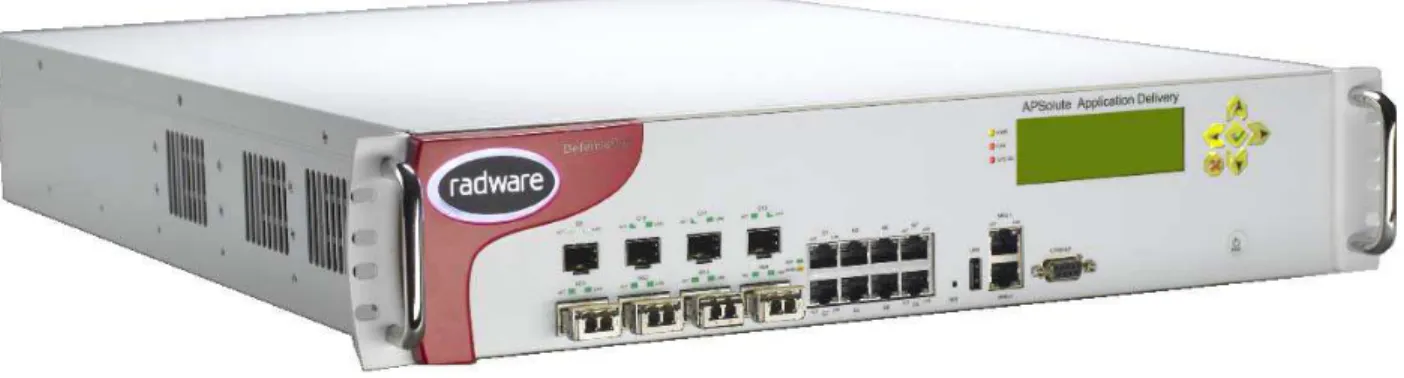
The TOE consists of the set of DefensePro devices identified in section 1.3 above. Each device is delivered to the customer pre-installed with a real-time operating system and DefensePro software. All device hardware, firmware, and software is included within the TOE.
Some of the DefensePro device models contain hardware accelerators: a DoS Mitigation Engine (DME) to prevent high volume DoS/DDoS flood attacks – without impacting legitimate traffic – and a String Match Engine (SME) to accelerate signature detection. These accelerators are included in the TOE.
Figure 1-2 - DefensePro Device
1.5.1.2. TOE Guidance
The following Radware guidance is considered part of the TOE:
Title Date Document ID
DefensePro User Guide Software Version 6.09.01
August 2013
RDWR-DP-V060901_UG1308 DefensePro Installation and Maintenance
Guide
January 2014 RDWR_DP_IG_1401 DefensePro Product Family Common Criteria
Evaluated Configuration Addendum, Software Version 5.11.01
February 26, 2012
Chapter 1. ST Introduction 4/27/2014
1.5.2. Logical Scope of the TOE
1.5.2.1. Summary of TOE Security Functionality
DefensePro is a real-time in-line network Intrusion Prevention System (IPS). It employs multiple intrusion detection engines that analyze network traffic flowing through the DefensePro device, in order to detect suspected network-based attacks and to react by generating alarms and blocking suspected traffic. The following types of intrusion analysis engines are applied to network traffic:
• Statistical Network Behavioral Analysis (NBA)
• Signature Matching Engine with proactive updates from Radware’s Security Operations Center (SOC)
• Stateful Protocol Inspection for various application protocols
• Access Control List (ACL) Match – against administrator-configurable ACLs • Connection Limit protections
• SYN Cookies (DoS protection)
When traffic is categorized as an attack, the product generates IDS System event records that are stored on the device, and generates alarms that can be configured to be delivered over: syslog protocol, SMTP (email), SNMP traps, and/or be displayed as alarms on CLI-based management interfaces. In addition, the device can take action by dropping the traffic and/or sending TCP resets to the source or destination addresses, as appropriate. Administrators manage DefensePro devices using a variety of management interfaces, supporting effective management of security functions and data. Management interfaces may include: remote CLI access via SSH, Web-based access using HTTPS, Web Services API over HTTPS, or SNMPv3-based access by management server software. Administra-tors are always identified and authenticated by user name and password before they can perform any action on the device.
An audit facility can be configured to generate audit records for all administrator access to the device. Audit records are timestamped using a reliable hardware clock in the device. Administrators can review audit records via multiple administration interfaces. The responsibility for storage and of audit records and for selectable review of audit data including sorting of audit data is levied on the IT environment.
Administrators can review IDS System data stored on the device. DefensePro devices protect stored IDS System data from unauthorized access. An alarm is generated when IDS System data storage capacity is reached.
Chapter 1. ST Introduction 4/27/2014
1.5.2.2. Network Behavioral Analysis
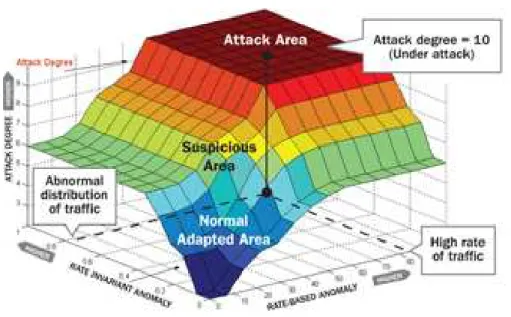
DefensePro’s multi-dimension Fuzzy Logic NBA decision engine collects traffic
characteristics parameters and assigns them an anomaly weight according to an adaptive fuzzy membership function. It then correlates these parameter weights and produces real-time decisions represented by a “degree of attack (or anomaly)” value. Based on these degrees of attack figures, the system is then able to introduce counter-measures that actively repel a perceived threat.
The Fuzzy Logic Module includes adaptive capabilities. The sensitivity of the module is being continuously tuned in order to match the characteristics of the protected network. The adaptive algorithms include Infinite Impulse Response (IIR) filters that continually average traffic parameters and shape the Fuzzy Logic membership functions accordingly. For each required protection type, the Fuzzy Logic decision collects and learns traffic parameters that are needed in order to best characterize the threat that should be identified and mitigated. Typically, the fuzzy logic decision engine uses two categories of traffic behavioral parameters to generate a degree of attack:
• Rate-based behavioral parameters such as packet rate, Mbps, connection rate, application request rate, application response rate etc.
• Rate invariant behavioral parameters such as protocol breakdown, TCP flag distributions, ratio between inbound and outbound traffic, application
re-quest/response ratio, connections distribution, URL hits probability functions and more.
Figure 1-3 below depicts an example Fuzzy Logic decision surface. The XY plane shows the fuzzy input (rate-based input and rate-invariant input). The z-axis represents the degree of attack (or anomaly).
Chapter 1. ST Introduction 4/27/2014
1.5.2.3. Elimination of False Positives
In order to eliminate false positive decisions and misdetections, the Fuzzy Logic engine correlates between both rate and rate-invariant parameters.
To illustrate this point, consider the frequent legitimate behavior of a mass crowd entering a news website in an unexpected manner. This behavior immediately causes rate-based behavioral parameters to significantly increase, thus making it look like an anomaly. If the detection engine relies only on rate-based behavioral parameters, this completely legitimate behavior will be flagged as an attack, and will be blocked. However, because rate-invariant parameters will remain unchanged (within certain boundaries) during such legitimate mass crowd behavior, correlating between both types of parameters allows the engine to flag this occurrence as a false positive.
1.5.2.4. Automatic Real-Time Signature Generation
When the Fuzzy Logic engine detects an anomaly, the system activates the automatic attack signature generation mechanism in order to find characteristic parameters of the ongoing anomaly, by distinguishing between expected and unexpected repetition of protocol-specific parameters that were studied (statistically) according to the network environment. The automatic signature generation mechanism flags unexpected values as "possible" pieces of the attack signature that represents the ongoing detected anomaly. Once values of these parameters are flagged as “abnormal”, the system transits into a signature optimization state that activates a closed-feedback loop mechanism.
The closed-feedback module is responsible for creating the narrowest, but still effective, signature blocking rule. Each one of the analyzed parameters types can include multiple values, detected by the automatic signature generation mechanism. The closed-feedback module tailors these values through AND and OR logical relationships. The more AND logical relationships that are constructed between different values and parameter types, the narrower and more accurate the blocking signature rule is considered to be.
In order to create the logical relationship rules between the detected signature values, the closed-feedback module uses the following feedback cases:
• Positive feedback: The traffic anomaly was reduced as a result of the decided blocking signature rules created by the module, the system continues to use the same action and tailors more attack characteristic parameters (i.e., signature types and values) through as many AND logical relationships as possible.
• Negative feedback: Meaning that the degree of traffic anomaly was not changed or was increased, the system stops using the last blocking signature rules and con-tinues to search for more appropriate ones.
• Attack stopped feedback: If the attack stops, then the system will stop all countermeasures immediately, i.e., remove the signature rule.
Chapter 1. ST Introduction 4/27/2014
1.5.2.5. NBA Profiles
DefensePro includes predefined NBA profiles that optimize detection and mitigation of the following types of attacks:
• DoS/DDoS flood attacks • Self-propagating worms • Horizontal and vertical scans
• Misuse of Web application resources
• Server cracking attacks (scans, brute-force, and dictionary attacks) • Infected clients
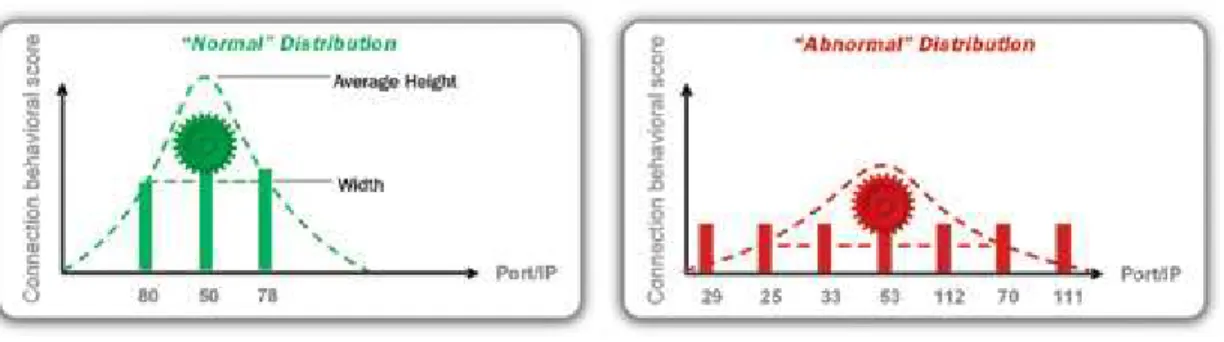
For example, Figure 1-4 depicts on the left a normal distribution curve, which represents a normal client’s traffic behavior patterns. The figure on the right represents traffic that indicates an attack (e.g. malware propagation). The distribution curves are generated by the decision engine using statistical analysis of multiple clients’ traffic parameters.
Figure 1-4 - Infected Client Detection
1.5.2.6. IPS Signature Analysis
For to the more deterministic types of threats, such as known application vulnerability exploitation attacks for which a signature is already available, Radware’s 24x7 Security Operations Center (SOC) provides subscribers with an automated, weekly delivery of new attack signature filters as well as emergency and custom delivery of signatures. The signature files can be loaded manually by the authorized System administrator into the device’s attack database, in the form of regular expressions.
1.5.2.7. Stateful Protocol Inspection
Stateful Inspection protection provides additional protection for application level attacks by ensuring that transmission and application stateful rules are enforced based on the protocol Requests for Comments (RFCs). Stateful Inspection tracks protocol state-machines and enforces RFC compliance for each protocol.
Stateful Inspection profiles prevent the injection of packets out of session and the misuse of protocol header fields.
Chapter 1. ST Introduction 4/27/2014 Protocol compliance enforcement capabilities are available for the IP, ICMP, TCP, DNS, HTTP, HTTPS, SMTP, POP3, IMAP, FTP, and SSH protocols.
1.5.2.8. ACL Matching
The Access Control List (ACL) engine matches traffic against stateful access control policies that allow or block sessions according to presumed source and destination addresses, protocol, requested service, physical interface, and VLAN tags.
System administrators can view and modify the set of ACLs.
1.5.2.9. DoS Protection
DefensePro provides an extensive set of anti-DoS protections, based on both the
Signature Match engine (DoS Shield) and the NBA engines (Behavioral DoS Protection). In addition, Connection Limit profiles defend against session-based attacks, such as half open SYN attacks, request attacks, and full connection attacks. The profiles contain attacks defined for groups of TCP or UDP application ports. DefensePro counts the number of TCP connections, or UDP sessions, opened per client, per server, or per client + server combination, for traffic that matches a Connection Limit policy attack definition. Once the number of connections per second reaches the threshold set defining an attack, any session/connection over the threshold is dropped.
DefensePro can defend against SYN floods by sending SYN cookies: particular choices of initial TCP sequence numbers, based on an device-selected secret function. Instead of forwarding client SYN requests to the server, the device generates a SYN cookie and returns it to the client. The device does not allocate resources to queue the SYN requests, thereby protecting itself and the target server from a potential SYN flood. A valid client will complete the TCP handshake, returning the SYN cookie to the device. The device validates the cookie, and then starts forwarding the traffic (as a transparent proxy) between the client and the server.
1.5.2.10. Management
DefensePro supports1 multiple administration interfaces, including: • SSH access to CLI
• HTTPS access to Web-based interface (WBM) • Web Services API over HTTPS
• SNMPv3
1 The SSH, HTTPS, and SNMPv3 protocols are supported management interfaces. The protocol definitions for these
interfaces include the use of cryptographic algorithms; however, no cryptographic mechanisms are being claimed in this ST as security functionality, and no cryptographic algorithms or protocols are being evaluated in the context of this ST.
Chapter 1. ST Introduction 4/27/2014 All management interfaces interact with the DefensePro MIB stored on the device, and provide equivalent functionality.
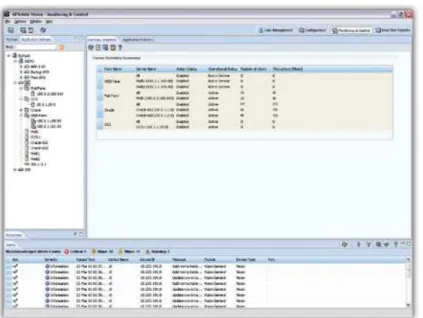
Figure 1-5 below is a screen shot from Radware’s APSolute Vision management
software, which uses the SNMPv3 protocol to access the DefensePro MIB and to receive and display SNMP traps generated as DefensePro alarms. Note that APSolute Vision (or any other management client) is supported by the TOE but considered to be outside of the TOE boundary.
Figure 1-5 - APSolute Vision SNMP-based Management Software
All administrator interfaces require the user to authenticate using a password prior to allowing access to the device. Password verification can be configured locally, or by querying a RADIUS server in the IT Environment.
1.5.2.11. Security Audit
DefensePro can be selectively configured to generate security audit records for all access attempts to the device, and for all configuration changes, via any management interface. The records are delivered to users via SNMP traps and/or displayed on users’ terminal interfaces (i.e. SSH sessions).
1.5.2.12. Time Synchronization
DefensePro devices contain a reliable hardware clock that provides secure timestamps for audit records and for IDS System data records. In order to provide support for clock synchronization of multiple TOE devices and/or external IT entities, DefensePro includes an NTP polling agent that can be configured to interact with a remote time synchroniza-tion server in the IT environment.
Chapter 1. ST Introduction 4/27/2014
1.5.2.13. Functionality Excluded from the TOE Evaluated Configuration
The following DefensePro functionality is excluded from the evaluated configuration: • Bypass Modes - the DefensePro product supports bypass modes that provide
degraded security functionality when the device is overloaded or powered down. TOE evaluated configuration guidance requires that these modes be disabled, in order to ensure that claimed security functionality cannot be bypassed.
• SNMPv1 and SNMPv2 – while the DefensePro product supports SNMPv1, SNMPv2, and SNMPv3 as administration interfaces, only SNMPv3 User Security Model (USM) may be enabled in the evaluated configuration, because it supports the IDS System Protection Profile requirements for user identification and authen-tication.
• Telnet and HTTP Management Interfaces – DefensePro devices can be managed over the Telnet protocol, using a CLI interface, and over the HTTP pro-tocol, using a Web browser. These two protocols are disabled by default, and should not be enabled in the evaluated configuration. Equivalent management functionality can be obtained using the SSH and HTTPS protocols, respectively. • Statistics Reporting Protocol (SRP) – the DefensePro product supports a
proprietary monitoring protocol for efficient transmission of statistical data from the device to Radware APSolute Vision management servers. This interface is disabled by default, and should not be enabled in the evaluated configuration. • Out-of-Path Deployment – DefensePro devices can be deployed out-of-path as
an IDS, receiving traffic from a switch mirror port. Out-of-path deployment, in-specting mirrored traffic, is not included in the evaluated configuration, in order to be able to provide a traffic blocking reaction capability.
Chapter 2. Conformance Claims 4/27/2014
2. Conformance Claims
2.1.
CC Conformance Claim
The TOE is conformant with the following CC specifications:
• Common Criteria for Information Technology Security Evaluation Part 2: Security functional requirements, Version 3.1, Revision 3, July 2009, CCMB-2009-07-002, extended (CC Part 2 extended)
• Common Criteria for Information Technology Security Evaluation Part 3: Security assurance requirements, Version 3.1 Revision 3, July 2009, CCMB-2009-07-003, conformant (CC Part 3 Conformant)
2.2.
Assurance Package Conformance
The TOE is package-name augmented with the following assurance package: • Evaluation Assurance Level (EAL) 4 - augmented with ALC_FLR.3.
2.3.
PP Conformance
The TOE is Protection Profile Conformant with the following Protection Profile:
• U.S. Government Protection Profile Intrusion Detection System System for Basic Robustness Environments, Version 1.7, July 25, 2007
2.4.
Conformance Rationale
2.4.1. Introduction
This section is intended to demonstrate that the statements of the security problem definition, security objectives, and security requirements in this ST are consistent with the PP for which conformance is being claimed: [IDSSPP].
The claimed protection profile is a CCv3.1 PP that require demonstrable PP conform-ance.
2.4.2. Consistency of the Security Problem Definition
The security problem definition in this ST is equivalent to the security problem definition of the claimed PP. This is established by reproducing all of the assumptions, threats, and OSPs defined in the claimed PP in this ST, with the following exceptions:
• The [IDSSPP] identifies three threats that are to be defined only if the TOE contains a Scanner: T.SCNCFG, T.SCNMLC, and T.SCNVUL. As the TOE does not contain a Scanner, these threats have not been included in this ST.
Chapter 2. Conformance Claims 4/27/2014
2.4.3. Security Objectives Conformance
The statement of security objectives in this ST is equivalent to the security objectives defined in [IDSSPP]. This is established by reproducing all of the security objectives for the TOE and for the environment defined in the claimed PP in this ST, with the following exceptions:
• O.IDSCAN - The [IDSSPP] requires that a conformant TOE must include at least one Sensor or Scanner (see [IDSSPP] application note for IDS_SDC.1), but not both. DefensePro provides a Sensor that inspects traffic flowing through the TOE, but does not actively scan protected hosts for vulnerabilities.
• O.EXPORT - Omitted as per the guidance given by [PD-0097].
• OE.IDAUTH – Introduced in support of O.IDAUTH for configurations in which the TOE authenticates users with the support of an external authentication server in the IT environment. This is consistent with the guidance given by [PD-0151] as well as [PD-0115].
2.4.4. Security Functional Requirements Conformance
The TOE demonstrably meets and exceeds all security requirements of the claimed [IDSSPP], except for the FAU_STG.4, FIA_AFL.1, FPT_ITA.1, FPT_ITC.1, and FPT_ITI.1 requirements that are inapplicable to the TOE, and for FAU_SAR.3 and FAU_STG.2 which are treated in this ST as IT Environment SFRs (see rationale below). All security requirements from the claimed PP have been restated in this ST, except for the SFRs listed above as exceptions. For some requirements, a hierarchical component was selected in place of one or more of the PPs' requirements; by definition a TOE meeting the hierarchical requirement would meet the original requirement as well. Similarly, requirements have been qualified, within the bounds set by the PPs. Permitted operations performed on PP security functional requirements are identified in Table 6-1. The following subsections provide conformance rationale for individual SFRs that were omitted as exceptions or refined in respect to the claimed PP, clarifying the relationship of an SFR to the claimed PP.
2.4.4.1. FAU_SAR.3
The [IDSSPP] levies the FAU_SAR.3 Selectable audit review requirement for the ability to perform sorting of audit data on the TOE; however, this contradicts the mapped [IDSSPP] objective OE.AUDIT_SORT, which states that the sorting capability shall be provided by the IT environment. This ST will treat FAU_SAR.3 as an IT Environment SFR.
This interpretation is compatible with the Errata Sheets appended to [IDSSPPv1.6] (from which the [IDSSPP] was derived), which state that the FAU_SAR.3 requirement may be moved to the IT environment, and OE.AUDIT_SORT be levied on the IT environment. Note: [PD-0152] discusses an equivalent [IDSSPP] inconsistency relating to FPT_STM.1 and OE.TIME. It allows the designation of FPT_STM.1 to the IT Environment.
Chapter 2. Conformance Claims 4/27/2014
2.4.4.2. FAU_STG.2
The [IDSSPP] levies the FAU_STG.2 Guarantees of audit data availability requirement for the protection of stored audit records on the TOE; however, this contradicts the mapped [IDSSPP] objective OE.AUDIT_PROTECTION, which states that the IT Environment shall be responsible for protecting audit data. This ST will treat FAU_STG.3 as an IT Environment SFR.
This interpretation is compatible with the Errata Sheets appended to [IDSSPPv1.6] (from which the [IDSSPP] was derived), which state that the FAU_STG.2 requirement may be moved to the IT environment, and OE.AUDIT_PROTECTION be levied on the IT environment.
See also corresponding discussion above in relation to FAU_SAR.3.
2.4.4.3. FAU_STG.4
The [IDSSPP] FAU_STG.4 Prevention of audit data loss requirement is intended to uphold the O.OFLOWS and O.AUDITS security objectives for the TOE.
O.OFLOWS states that the TOE must appropriately handle potential audit storage overflows. O.AUDITS states that the TOE must record audit records. Although the TOE does record audit records (see FAU_GEN.1), it does not store them within the TOE, but provides them to users for storage outside the TOE. See discussion above in relation to FAU_STG.2 for why this is demonstrably conformant with the [IDSSPP].
Because audit records are not stored within the TOE, there is no potential for audit storage overflows, and FAU_STG.4 is therefore not applicable to the TOE. This ST will treat FAU_STG.4 as an IT Environment SFR.
2.4.4.4. FIA_AFL.1
The [IDSSPP] FIA_AFL.1 Authentication failure handling requirement relates to external IT products that might authenticate to the TOE.
This SFR has been omitted as per the guidance given in [PD-0097], which states that this requirement was incorrectly included in the system PP.
2.4.4.5. FIA_UID.1 and FIA_UAU.1
This ST claims FIA_UID.2 and FIA_UAU.2, which are hierarchical to the corresponding [IDSSPP] FIA_UID.1 and FIA_UAU.1 SFRs.
2.4.4.6. FMT_SMF.1
Chapter 2. Conformance Claims 4/27/2014
2.4.4.7. FPT_ITA.1, FPT_ITC.1, and FPT_ITI.1
These SFRs have been omitted as per the guidance given in [PD-0097], which states that these requirements were incorrectly included in the system PP.
2.4.4.8. Applicable NIAP Precedent Decisions
The following precedent decisions have been used as guidance for interpreting demonstrable conformance with the claimed PP, in relation to claimed SFRs:
Table 2-1- References to Guidance on the Interpretation of Claimed PPs
Reference Affected SFRs and objectives Description [PD-0097] O.EXPORT, FPT_ITA.1, FPT_ITC.1, FPT_ITI.1, FIA_AFL.1
Incorrectly included in the System PP – must be removed from the PP
[PD-0152] FAU_SAR.3,
FAU_STG.2
Inconsistency in the [IDSSPP] tracing TOE SFRs to objectives for the IT Environment – FAU_SAR.3 and FAU_STG.2 are treated in this ST as being levied on the IT Environment.
2.4.5. Security Assurance Requirements Conformance
The claimed [IDSSPP] requires a minimum assurance level of EAL 2, augmented with ALC_FLR.3.
The level of assurance chosen for this ST is that of EAL 4, augmented with ALC_FLR.3. The assurance requirements in this ST are therefore clearly hierarchically stronger than the ones required by the claimed PP.
Chapter 3. Security Problem Definition 4/27/2014
3. Security Problem Definition
3.1.
Threats
This section describes the threats that are addressed either by the TOE or the environment (identical2 to the corresponding threats described in [IDSSPP], provided here for the benefit of the reader of the ST):
3.1.1. TOE Threats
T.COMINT An unauthorized user may attempt to compromise the integrity of the data collected and produced by the TOE by bypassing a security mechanism. T.COMDIS An unauthorized user may attempt to disclose the data collected and
produced by the TOE by bypassing a security mechanism.
T.LOSSOF An unauthorized user may attempt to remove or destroy data collected and produced by the TOE.
T.NOHALT An unauthorized user may attempt to compromise the continuity of the System’s collection and analysis functions by halting execution of the TOE.
T.PRIVIL An unauthorized user may gain access to the TOE and exploit system privileges to gain access to TOE security functions and data.
T.IMPCON An unauthorized user may inappropriately change the configuration of the TOE causing potential intrusions to go undetected.
T.INFLUX An unauthorized user may cause malfunction of the TOE by creating an influx of data that the TOE cannot handle.
T.FACCNT Unauthorized attempts to access TOE data or security functions may go undetected.
3.1.2. IT System Threats
T.FALACT The TOE may fail to react to identified or suspected vulnerabilities or inappropriate activity.
T.FALREC The TOE may fail to recognize vulnerabilities or inappropriate activity based on IDS data received from each data source.
T.FALASC The TOE may fail to identify vulnerabilities or inappropriate activity based on association of IDS data received from all data sources.
2 The [IDSSPP] identifies three threats that are to be defined only if the TOE contains a Scanner: T.SCNCFG,
T.SCNMLC, and T.SCNVUL. As the TOE does not contain a Scanner, these threats have not been included in this ST.
Chapter 3. Security Problem Definition 4/27/2014 T.MISUSE Unauthorized accesses and activity indicative of misuse may occur on an
IT System the TOE monitors.
T.INADVE Inadvertent activity and access may occur on an IT System the TOE monitors.
T.MISACT Malicious activity, such as introductions of Trojan horses and viruses, may occur on an IT System the TOE monitors.
3.2.
Assumptions
The following conditions are assumed to exist in the operational environment (identical to the set of assumptions made in [IDSSPP], provided here for the benefit of the reader of the ST):
3.2.1. Intended Usage Assumptions
A.ACCESS The TOE has access to all the IT System data it needs to perform its functions.
A.DYNMIC The TOE will be managed in a manner that allows it to appropriately address changes in the IT System the TOE monitors.
A.ASCOPE The TOE is appropriately scalable to the IT System the TOE monitors3.
3.2.2. Physical Assumptions
A.PROTCT The TOE hardware and software critical to security policy enforcement will be protected from unauthorized physical modification.
A.LOCATE The processing resources of the TOE will be located within controlled access facilities, which will prevent unauthorized physical access.
3.2.3. Personnel Assumptions
A.MANAGE There will be one or more competent individuals assigned to manage the TOE and the security of the information it contains.
A.NOEVIL The authorized administrators are not careless, willfully negligent, or hostile, and will follow and abide by the instructions provided by the TOE documentation.
A.NOTRST The TOE can only be accessed by authorized users.
3 A.ASCOPE is an assumption that is upheld by the OE.INTROP objective for the environment. Per the guidance
Chapter 3. Security Problem Definition 4/27/2014
3.3.
Organizational Security Policies
The following OSPs are defined in [IDSSPP]. [IDSSPP] does not identify which
organization and which organizational security policy any of these OSPs are drawn from. P.DETECT Static configuration information that might be indicative of the potential
for a future intrusion or the occurrence of a past intrusion of an IT System or events that are indicative of inappropriate activity that may have result-ed from misuse, access, or malicious activity of IT System assets must be collected.
P.ANALYZ Analytical processes and information to derive conclusions about
intrusions (past, present, or future) must be applied to IDS data and appro-priate response actions taken.
P.MANAGE The TOE shall only be managed by authorized users.
P.ACCESS All data collected and produced by the TOE shall only be used for authorized purposes.
P.ACCACT Users of the TOE shall be accountable for their actions within the IDS. P.INTGTY Data collected and produced by the TOE shall be protected from
modification.
P. PROTCT The TOE shall be protected from unauthorized accesses and disruptions of TOE data and functions.
Chapter 4. Security Objectives 4/27/2014
4. Security Objectives
4.1.
Security Objectives for the TOE
This section describes the TOE security objectives (identical4 to the corresponding set of TOE security objectives described in [IDSSPP], provided here for the benefit of the reader of the ST):
O.PROTCT The TOE must protect itself from unauthorized modifications and access to its functions and data.
O.IDSENS The Sensor must collect and store information about all events that are indicative of inappropriate activity that may have resulted from misuse, access, or malicious activity of IT System assets and the IDS.
O.IDANLZ The Analyzer must accept data from IDS Sensors or IDS Scanners and then apply analytical processes and information to derive conclusions about intrusions (past, present, or future).
O.RESPON The TOE must respond appropriately to analytical conclusions.
O.EADMIN The TOE must include a set of functions that allow effective management of its functions and data.
O.ACCESS The TOE must allow authorized users to access only appropriate TOE functions and data.
O.IDAUTH The TOE must be able to identify and authenticate users prior to allowing access to TOE functions and data.
O.OFLOWS The TOE must appropriately handle potential audit and System data storage overflows.
O.AUDITS The TOE must record audit records for data accesses and use of the System functions.
O.INTEGR The TOE must ensure the integrity of all audit and System data.
4 [IDSSPP] security objectives omitted from this ST: O.IDSCAN was omitted because the TOE does not contain a
Chapter 4. Security Objectives 4/27/2014
4.2.
Security Objectives for the Operational Environment
4.2.1. IT Security Objectives for the Environment
The following security objectives for the IT Environment are defined in [IDSSPP]: OE.AUDIT_PROTECTION The IT Environment will provide the capability to protect
audit information.
OE.AUDIT_SORT The IT Environment will provide the capability to sort the audit information
OE.TIME The IT Environment will provide reliable timestamps to the TOE.
In addition, the following objective for the IT environment is introduced in support of O.IDAUTH for configurations in which the TOE authenticates users with the support of an external authentication server in the IT environment:
OE.IDAUTH The IT Environment must be able to authenticate users prior to allowing access to TOE functions and data.
4.2.2. Security Objectives for the Environment Upholding Assumptions
The assumptions made in this ST about the TOE's operational environment must be upheld by corresponding security objectives for the environment.
The following security objectives are intended to be satisfied without imposing technical requirements on the TOE. That is, they will not require the implementation of functions in the TOE hardware and/or software. Thus, they are intended to be satisfied largely through application of procedural or administrative measures.
OE.INSTAL Those responsible for the TOE must ensure that the TOE is delivered, installed, managed, and operated in a manner which is consistent with IT security.
OE.PHYCAL Those responsible for the TOE must ensure that those parts of the TOE critical to security policy are protected from any physical attack.
OE.CREDEN Those responsible for the TOE must ensure that all access credentials are protected by the users in a manner which is consistent with IT security. OE.PERSON Personnel working as authorized administrators shall be carefully
selected and trained for proper operation of the System. OE.INTROP The TOE is interoperable with the IT System it monitors.
Chapter 4. Security Objectives 4/27/2014
4.3.
Security Objectives Rationale
4.3.1. IT Security Objectives Rationale
The security problem description and security objectives in this ST are equivalent to the corresponding elements stated in the [IDSSPP], as established in sections 2.4.2 and 2.4.3 above. See section 6.1 of [IDSSPP] for the IT security objectives rationale.
OE.IDAUTH has been introduced in this ST in support of O.IDAUTH for configurations in which the TOE authenticates users with the support of an external authentication server in the IT environment. OE.IDAUTH thus acts in support of O.IDAUTH in relation to threats T.COMINT, T.COMDIS, T.LOSSOF, T.NOHALT, T.PRIVIL, T.IMPCON, and to OSPs P.MANAGE, P.ACCESS, and P.ACCACT.
4.3.2. Non-IT Security Objectives Rationale
Chapter 5. Extended Components Definition 4/27/2014
5. Extended Components Definition
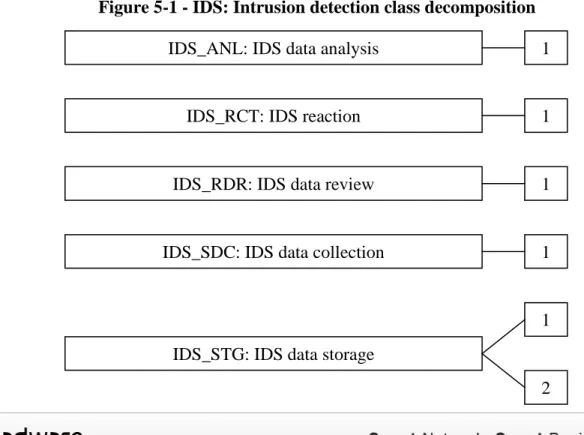
This security target contains the following extended security requirements defined in [IDSSPP]: IDS_SDC.1, IDS_ANL.1, IDS_RCT.1, IDS_RDR.1, IDS_STG.1,
IDS_STG.2.
Extended security functional requirements are not drawn from [CC] Part 2 components. The [IDSSPP] provides the following explanation for why these requirements cannot be clearly expressed using existing components, and in particular why the FAU class could not be refined to achieve the same result. Note that FAU deals with events that are internal to the TOE, whereas IDS deals with events occurring in the IT environment.
“A family of IDS requirements was created to specifically address the data col-lected and analyzed by an IDS. The audit family of the CC (FAU) was used as a model for creating these requirements. The purpose of this family of requirements is to address the unique nature of IDS data and provide for requirements about collecting, reviewing and managing the data.”
The Extended Components Definition presented here defines an extended component for each extended security requirement, using the existing CC components, families, classes, and methodology as a model for presentation.
5.1.
Class IDS: Intrusion Detection
This class is used to satisfy security objectives that pertain to intrusion detection and prevention (IDS/IPS) systems. These include data collection and analysis, automatic reaction capabilities, review, and protection of IDS System data.
Figure 5-1 - IDS: Intrusion detection class decomposition
IDS_SDC: IDS data collection 1
IDS_ANL: IDS data analysis 1
IDS_RCT: IDS reaction 1
IDS_RDR: IDS data review 1
IDS_STG: IDS data storage
1
Chapter 5. Extended Components Definition 4/27/2014
5.1.1. IDS data analysis (IDS_ANL)
Family Behavior
This family defines requirements for automated means that analyze IDS System data looking for possible or real security violations.
The actions to be taken based on the detection can be specified using the IDS reaction (IDS_RCT) family as desired.
Component levelling
IDS_ANL: IDS data analysis 1
In IDS_ANL.1 Analyzer analysis, statistical, signature, or integrity based analysis is required.
Management: IDS_ANL.1
The following actions could be considered for the management functions in FMT: a) Maintenance (deletion, modification, addition) of the parameters of the analytical
functions.
Audit: IDS_ANL.1
The following actions should be auditable if IDS_ANL IDS data analysis is included in the PP/ST:
a) Minimal: Enabling and disabling of any of the analysis mechanisms.
5.1.1.1. IDS_ANL.1 Analyzer analysis
Hierarchical to: No other components.
Dependencies: IDS_SDC.1 System data collection
IDS_ANL.1.1 The System shall perform the following analysis function(s) on all IDS data received:
a) [selection: statistical, signature, integrity]; and b) [assignment: any other analytical functions].
IDS_ANL.1.2 The System shall record within each analytical result at least the following information:
a) Date and time of the result, type of result, identification of data source; and b) [assignment: any other security relevant information about the result].
5.1.2. IDS reaction (IDS_RCT)
Family Behavior
Chapter 5. Extended Components Definition 4/27/2014
Component levelling
IDS_RCT: IDS reaction 1
At IDS_RCT.1 IDS reaction, the TSF shall send an alarm and take action when an intrusion is detected.
Management: IDS_RCT.1
The following actions could be considered for the management functions in FMT: a) the management (addition, removal, or modification) of actions.
Audit: IDS_RCT.1
The following actions should be auditable if IDS_RCT IDS reaction is included in the PP/ST:
a) Minimal: Actions taken due to detected intrusions.
5.1.2.1. IDS_RCT.1 Analyzer react
Hierarchical to: No other components.
Dependencies: IDS_ANL.1 Analyzer analysis
IDS_RCT.1.1 The System shall send an alarm to [assignment: alarm destination] and take [assignment: appropriate actions] when an intrusion is detected.
5.1.3. IDS data review (IDS_RDR)
Family Behavior
This family defines the requirements for tools that should be available to authorised users to assist in the review of IDS System data.
Component levelling
IDS_RDR: IDS data review 1
IDS_RDR.1 IDS data review, provides the capability to read information from the System data and requires that there are no other users except those that have been identified as authorized users that can read the information.
Management: IDS_RDR.1
The following actions could be considered for the management functions in FMT: a) Maintenance (deletion, modification, addition) of the group of users with read access
right to the System data.
Audit: IDS_RDR.1
The following actions should be auditable if IDS_RDR IDS data review is included in the PP/ST:
Chapter 5. Extended Components Definition 4/27/2014 a) Basic: Reading of information from the System data.
b) Basic: Unsuccessful attempts to read information from the System data.
5.1.3.1. IDS_RDR.1 Restricted data review
Hierarchical to: No other components.
Dependencies: IDS_SDC.1 System data collection
IDS_RDR.1.1 The System shall provide [assignment: authorized users] with the capability to read [assignment: list of System data] from the System data.
IDS_RDR.1.2 The System shall provide the System data in a manner suitable for the user to interpret the information.
IDS_RDR.1.3 The System shall prohibit all users read access to the System data, except those users that have been granted explicit read-access.
5.1.4. IDS data collection (IDS_SDC)
Family Behavior
This family defines requirements for recording information from the targeted IT System resource(s).
Component levelling
IDS_SDC: IDS data collection 1
IDS_SDC.1 IDS data collection, defines the information to be collected from the targeted IT System resource(s), and specifies the data that shall be recorded in each record.
Management: IDS_SDC.1
There are no management activities foreseen.
Audit: IDS_SDC.1
There are no auditable events foreseen.
5.1.4.1. IDS_SDC.1 System data collection
Hierarchical to: No other components.
Dependencies: FPT_STM.1 Reliable time stamps
IDS_SDC.1.1 The System shall be able to collect the following information from the targeted IT System resource(s):
a) [selection: Start-up and shutdown, identification and authentication events, data accesses, service requests, network traffic, security configuration changes, data introduction, detected malicious code, access control configu-ration, service configuconfigu-ration, authentication configuration., accountability policy configuration, detected known vulnerabilities]; and
Chapter 5. Extended Components Definition 4/27/2014 b) [assignment: other specifically defined events].
IDS_SDC.1.2 At a minimum, the System shall collect and record the following information: a) Date and time of the event, type of event, subject identity, and the outcome
(success or failure) of the event; and b) [assignment: other additional information].
5.1.5. IDS data storage (IDS_STG)
Family Behavior
This family defines requirements for protecting IDS System data after it is recorded and stored by the TOE.
Component levelling
IDS_STG: IDS data storage
1
2
At IDS_STG.1 Guarantees of System data availability, specifies the guarantees that the TSF maintains over the system data given the occurrence of an undesired condition. IDS_STG.2 Prevention of System data loss, specifies actions in case of exceeded storage capacity.
Management: IDS_STG.1
a) maintenance of the parameters that control the System data storage capability.
Management: IDS_STG.2
a) Maintenance (deletion, modification, addition) of the actions to be taken in case of storage failure.
Audit: IDS_STG.1, IDS_STG.2
There are no auditable events foreseen.
5.1.5.1. IDS_STG.1 Guarantees of System data availability
Hierarchical to: No other components.
Dependencies: IDS_SDC.1 System data collection
IDS_STG.1.1 The System shall protect the stored System data from unauthorized deletion. IDS_STG.1.2 The System shall protect the stored System data from modification.
IDS_STG.1.3 The System shall ensure that [assignment: metric for saving System data] System data will be maintained when the following conditions occur: [selection: System data storage exhaustion, failure, attack].
Chapter 5. Extended Components Definition 4/27/2014
5.1.5.2. IDS_STG.2 Prevention of System data loss
Hierarchical to: No other components.
Dependencies: IDS_STG.1 Guarantees of system data availability
IDS_STG.2.1 The System shall [selection: 'ignore System data', 'prevent System data, except those taken by the authorized user with special rights', 'overwrite the oldest stored System data '] and [assignment: other actions to be taken in case of storage failure] if the storage capacity has been reached.
Chapter 6. Security Requirements 4/27/2014
6. Security Requirements
6.1.
Security Functional Requirements
The functional security requirements (SFRs) for this ST consist of the following components from CC Part 2, summarized in Table 6-1. All SFRs were taken from [IDSSPP], except for FMT_SMF.1, which was introduced in this ST in order to satisfy FMT class dependencies.
Subjects, objects, and operations are as defined in the [IDSSPP].
The CC defined operations of assignment, selection, and refinement were applied in relation to the PP requirements as described in column 3 of Table 6-1 below.
Table 6-1 – Security functional requirement components
Functional Component CC Operations Applied
FAU_GEN.1 Audit data generation None
FAU_SAR.1 Audit review Assignment
FAU_SAR.2 Restricted audit review None
FAU_SEL.1 Selective audit Assignment
FIA_ATD.1 User attribute definition Assignment, refinement
FIA_UAU.2 User authentication before any action Hierarchical FIA_UID.2 User identification before any action Hierarchical FMT_MOF.
1
Management of security functions behaviour
None FMT_MTD.
1
Management of TSF data Assignment
FMT_SMF.1 Specification of management functions Assignment FMT_SMR.
1
Security roles Assignment, refinement
FPT_STM.1 Reliable time stamps None
IDS_ANL.1 Analyser analysis Selection, assignment
IDS_RCT.1 Analyser react Assignment
IDS_RDR.1 Restricted Data Review Assignment
IDS_SDC.1 System Data Collection Selection, assignment
IDS_STG.1 Guarantee of System Data Availability Assignment, selection IDS_STG.2 Prevention of System data loss Selection
Chapter 6. Security Requirements 4/27/2014
6.1.1. Security Audit (FAU)
6.1.1.1. Audit data generation (FAU_GEN.1)
FAU_GEN.1.1 The TSF shall be able to generate an audit record of the following auditable events: a) Start-up and shutdown of the audit functions;
b) All auditable events for the basic5 level of audit; and
c) Access to the System and access to the TOE and System data. Table 6-2 - Auditable Events
Functional Component
Auditable Event Details
FAU_GEN.1 Start-up and shutdown of audit functions FAU_GEN.1 Access to System
FAU_GEN.1 Access to the TOE and System Data Object IDS, Requested access
FAU_SAR.1 Reading of information from the audit records FAU_SAR.2 Unsuccessful attempts to read information from the
audit records
FAU_SEL.1 All modifications to the audit configuration that occur while the audit collection functions are operating
FIA_UAU.2 Any use of the authentication mechanism. User identity, location FIA_UID.2 All use of the user identification mechanism User identity, location FMT_MOF.1 All modifications in the behavior of the functions of
the TSF
FMT_MTD.1 All modifications to the values of TSF data
FMT_SMR.1 Modifications to the group of users that are part of a role.
User identity FAU_GEN.1.2 The TSF shall record within each audit record at least the following information:
a) Date and time of the event, type of event, subject identity, outcome (success or failure) of the event; and
b) For each audit event type, based on the auditable event definitions of the functional components included in the PP/ST, the additional information specified in the Details column of Table 6-2 - Auditable Events.
Chapter 6. Security Requirements 4/27/2014
6.1.1.2. Audit review (FAU_SAR.1)
FAU_SAR.1.1 The TSF shall provide authorized administrators and authorized System
administrators with the capability to read all audit information from the audit
rec-ords.
FAU_SAR.1.2 The TSF shall provide the audit records in a manner suitable for the user to interpret the information.
6.1.1.3. Restricted audit review (FAU_SAR.2)
FAU_SAR.2.1 The TSF shall prohibit all users read access to the audit records, except those users that have been granted explicit read-access.
6.1.1.4. Selective audit (FAU_SEL.1)
FAU_SEL.1.1 The TSF shall be able to include or exclude auditable events from the set of audited events based on the following attributes:
a) event type; b) severity.
6.1.2. Identification and authentication (FIA)
6.1.2.1. User attribute definition (FIA_ATD.1)
FIA_ATD.1.1 The TSF shall maintain the following list of security attributes belonging to individual users:
a) User identity;
b) Authentication data; and c) Authorizations6.
6.1.2.2. User authentication before any action (FIA_UAU.2)
FIA_UAU.2.1 The TSF shall require each user to be successfully authenticated before allowing any other TSF-mediated actions on behalf of that user.
6.1.2.3. User identification before any action (FIA_UID.2)
FIA_UID.2.1 The TSF shall require each user to be successfully identified before allowing any other TSF-mediated actions on behalf of that user.
6 FIA_ATD.1.1 subsection d) assignment ‘any other security attributes’ is completed as ‘None’; the component has
Chapter 6. Security Requirements 4/27/2014
6.1.3. Security Management (FMT)
6.1.3.1. Management of security functions behavior (FMT_MOF.1)
FMT_MOF.1.1 The TSF shall restrict the ability to modify the behavior of the functions of System data collection, analysis and reaction to authorized System administrators7.
6.1.3.2. Management of TSF data (FMT_MTD.1)
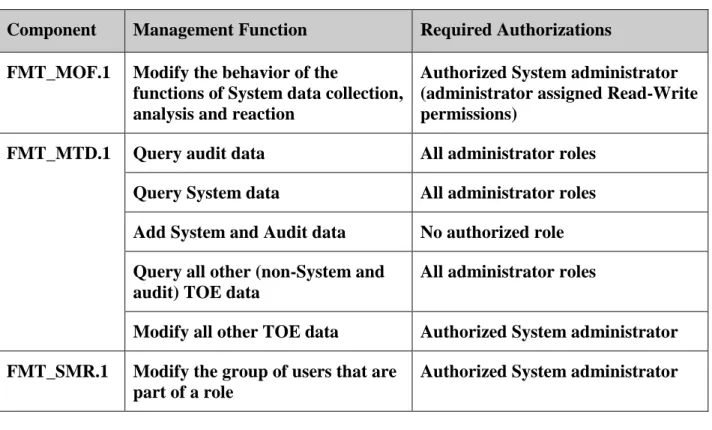
FMT_MTD.1.1 The TSF shall restrict the ability to query and add System and audit data, and shall restrict the ability to query and modify all other TOE data to authorized roles as
specified in Table 6-3 below.
6.1.3.3. Specification of Management Functions (FMT_SMF.1)
FMT_SMF.1.1 The TSF shall be capable of performing the following security management functions: as specified in Table 6-3.
Table 6-3- Specification of Management Functions
Component Management Function Required Authorizations
FMT_MOF.1 Modify the behavior of the
functions of System data collection, analysis and reaction
Authorized System administrator (administrator assigned Read-Write permissions)
FMT_MTD.1 Query audit data All administrator roles
Query System data All administrator roles
Add System and Audit data No authorized role Query all other (non-System and
audit) TOE data
All administrator roles
Modify all other TOE data Authorized System administrator FMT_SMR.1 Modify the group of users that are
part of a role
Authorized System administrator
6.1.3.4. Security roles (FMT_SMR.1)
FMT_SMR.1.1 The TSF shall maintain the following roles: authorized administrator, authorized System administrators8.
7 In this ST, the authorized System administrator role is defined as an administrator role that is assigned Read/Write
Chapter 6. Security Requirements 4/27/2014 FMT_SMR.1.2 The TSF shall be able to associate users with roles.
6.1.4. Protection of the TSF (FPT)
6.1.4.1. Reliable time stamps (FPT_STM.1)
FPT_STM.1.1 The TSF shall be able to provide reliable time stamps for its own use.
6.1.5. IDS Component Requirements (IDS)
6.1.5.1. System Data Collection (IDS_SDC.1)
IDS_SDC.1.1 The System shall be able to collect the following information from the targeted IT System resource(s):
a) service requests, network traffic9.
IDS_SDC.1.2 At a minimum, the System shall collect and record the following information: a) Date and time of the event, type of event, subject identity, and the outcome
(success or failure) of the event; and
b) The additional information specified in the Details column of Table 6-4 – System Events.
Table 6-4 - System Events
Component Event Details
IDS_SDC.1 Service Requests Specific service, source address, destination address
IDS_SDC.1 Network traffic Protocol, source address, destination address
6.1.5.2. Analyser analysis (IDS_ANL.1)
IDS_ANL.1.1 The System shall perform the following analysis function(s) on all IDS data received:
a) statistical, signature; and b) stateful protocol inspection;
c) ACL match;
d) Connection Limiting; and
e) SYN cookies.
8
FMT_SMR.1.1 assignment ‘other authorized identified roles’ is completed as ‘None’; the component has been refined to omit this assignment for clarity.
9 IDS_SDC.1.1 subsection b) assignment ‘other specifically defined events’ is completed as ‘None’; the component
has been refined to omit subsection b) for clarity. In addition, Table 6-4 has been tailored to omit all PP event descriptions not selected for IDS_SDC.1.1 a).
Chapter 6. Security Requirements 4/27/2014 Application Note: Statistical analysis involves identifying deviations from normal patterns of
behavior. For example, it may involve mean frequencies and measures of var-iability to identify abnormal usage. Signature analysis involves the use of pat-terns corresponding to known attacks or misuses of a System. For example, patterns of System settings and user activity can be compared against a data-base of known attacks. Integrity analysis involves comparing System settings or user activity at some point in time with those of another point in time to detect differences.
IDS_ANL.1.2 The System shall record within each analytical result at least the following information:
c) Date and time of the result, type of result, identification of data source; d) Identification of destination address;
e) Severity;
f) Action taken; and
g) Attack details.
6.1.5.3. Analyzer react (IDS_RCT.1)
IDS_RCT.1.1 The System shall send an alarm to authorized System administrator-defined
syslog, SMTP, SNMP, or terminal alarm destinations and take action to block and/or reset applicable network traffic when an intrusion is detected.
6.1.5.4. Restricted Data Review (IDS_RDR.1)
IDS_RDR.1.1 The System shall provide authorized administrators and authorized System
administrators with the capability to read all information from the System data.
IDS_RDR.1.2 The System shall provide the System data in a manner suitable for the user to interpret the information.
IDS_RDR.1.3 The System shall prohibit all users read access to the System data, except those users that have been granted explicit read-access.
6.1.5.5. Guarantee of System Data Availability (IDS_STG.1)
IDS_STG.1.1 The System shall protect the stored System data from unauthorized deletion. IDS_STG.1.2 The System shall protect the stored System data from modification.
IDS_STG.1.3 The System shall ensure that up to 2.500 log record entries of System data will be maintained when the following conditions occur: System data storage exhaustion.
6.1.5.6. Prevention of System data loss (IDS_STG.2)
IDS_STG.2.1 The System shall overwrite the oldest stored System data and send an alarm if the storage capacity has been reached.
Chapter 6. Security Requirements 4/27/2014
6.2.
Security Assurance Requirements
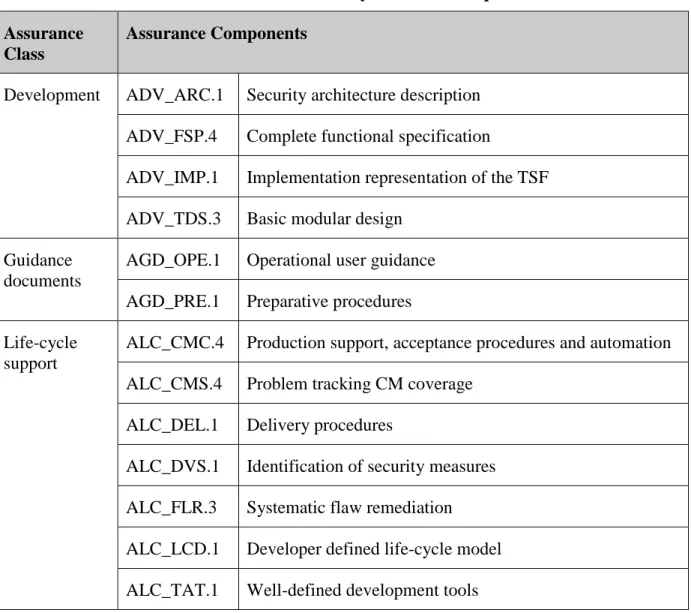
The security assurance requirements for the TOE are the Evaluation Assurance Level (EAL) 4 components defined in Part 3 of the Common Criteria, augmented with the Part 3 component ALC_FLR.3.
No operations are applied to any assurance component.
Table 6-5- TOE Security Assurance Requirements Assurance
Class
Assurance Components
Development ADV_ARC.1 Security architecture description ADV_FSP.4 Complete functional specification
ADV_IMP.1 Implementation representation of the TSF ADV_TDS.3 Basic modular design
Guidance documents
AGD_OPE.1 Operational user guidance AGD_PRE.1 Preparative procedures Life-cycle
support
ALC_CMC.4 Production support, acceptance procedures and automation ALC_CMS.4 Problem tracking CM coverage
ALC_DEL.1 Delivery procedures
ALC_DVS.1 Identification of security measures ALC_FLR.3 Systematic flaw remediation ALC_LCD.1 Developer defined life-cycle model ALC_TAT.1 Well-defined development tools
Chapter 6. Security Requirements 4/27/2014 Assurance Class Assurance Components Security Target evaluation
ASE_CCL.1 Conformance claims
ASE_ECD.1 Extended components definition ASE_INT.1 ST introduction
ASE_OBJ.2 Security objectives
ASE_REQ.2 Derived security requirements ASE_SPD.1 Security problem definition ASE_TSS.1 TOE summary specification Tests ATE_COV.2 Analysis of coverage
ATE_DPT.1 Testing: basic design ATE_FUN.1 Functional testing
ATE_IND.2 Independent testing – sample Vulnerability
assessment
Chapter 6. Security Requirements 4/27/2014
6.3.
Security Requirements Rationale
6.3.1. Security Functional Requirements Rationale
See section 6.3 of [IDSSPP] for the rationale for all PP-derived SFRs. The following is rationale for the SFRs added to this ST in addition to [IDSSPP] SFRs:
• FMT_SMF.1 was introduced to satisfy CCv 3.1 dependencies for FMT_MOF.1 and FMT_MTD.1, as identified in Table 6-7. It can therefore be seen to support the security objective O.ACCESS in which these two requirements are grounded. FMT_SMF.1 also directly supports O.EADMIN, in that it includes a set of func-tions that allow effective management of TOE funcfunc-tions and data.
Table 6-6 summarizes the rationale. It maps security functional requirements to security objectives described in section 4.1. The table clearly demonstrates that each objective is met by at least one SFR and that each SFR meets at least one objective.
Table 6-6- Tracing of SFRs to security objectives for the TOE
O .P R O T C T O .I D S E N S O .I D A N L Z O .R E S P O N O .E A D M IN O .A C C E S S O .I D A U T H O .O F L O W S O .A U D IT S O .I N T E G R FAU_GEN.1 FAU_SAR.1 FAU_SAR.2 FAU_SEL.1 FIA_ATD.1 FIA_UAU.2 FIA_UID.2 FMT_MOF.1 FMT_MTD.1 FMT_SMF.1 FMT_SMR.1 FPT_STM.1 IDS_SDC.1 IDS_ANL.1 IDS_RCT.1