QUT Digital Repository:
http://eprints.qut.edu.au/
Sullivan, Karen A. and Bowden, Stephen C. (1997) Which tests do neuropsychologists
use? Journal of Clinical Psychology, 53(7). pp. 657-661.
Which Tests Do Neuropsychologists Use?
Karen Sullivan and Stephen C. Bowden
Abstract
A nationwide survey of accredited neuropsychologists in Australia was conducted to examine test use. Clinicians were asked to list the tests they give most often. Results are expressed as endorsement frequencies for tests. Comparisons with international surveys of test use are provided. Suggestions for clinicians and others concerned with test use are included to demonstrate how survey results can be used to improve neuropsychological services.
Several investigations of test use by psychologists who provide neuropsychological services have recently been conducted in America (e.g., Butler, Retzlaff, & Vanderploeg, 1991; Guilmette, Faust, Hart, &Arkes, 1990; Hartlage, 1985; Piotrowski & Lubin, 1990; Sellers & Nadler, 1992; Slick & Craig, 1991). Similar investigations have been carried out in Hong Kong (Tsoi & Sundberg, 1989), and South Africa (Bassa & Schlebusch, 1984). These studies represent published work conducted over the last 20 years on test use in clinical
neuropsychology. In most cases information on test use has been collected as part of larger surveys, addressing issues of clinical practice.
In seven of the eight studies listed above, the most frequently administered tests are Wechsler’s intelligence scales (WIPPSI/WIPPSI-R, WISC/WISC-R/WISC-III, and WAIS/ WAIS-R). Other tests that are most often used include Wechsler’s Memory Scales (WMS and WMS-R), the Halstead–Reitan Battery (HRB), the Minnesota Multiphasic Personality
Inventory (MMPI or MMPI-II), and the Bender–Gestalt Test (e.g., Butler et al., 1991). The purpose of this study was to examine test use in Australia. Apart from enabling international comparisons, this information has applications for those who develop, administer, and regulate test use.
METHOD Subjects
After pilot testing, a survey was mailed to all members of the Australian Psychological Society College of Clinical Neuropsychologists (CCN) listed in the 1994 Membership Directory. Membership of CCN is the highest professional credential in clinical neuropsychology in Australia.
Two hundred and fourteen people from all states in Australia were contacted, including student members (n 5 7), associates (n 5 20), affiliates (n 5 81), and full members (n 5 106). All CCN members received a letter of invitation to participate. The letter explained how they were selected and the purpose of the survey and guaranteed the anonymity of participants. One week later the survey was distributed. Participants were given one month to
respond.Afollow-up letter was sent to everyone contacted, three weeks after receiving the survey.
Procedure
To characterise the sample, clinicians were asked to complete a brief section about their work setting. Respondents were asked to indicate major referral sources, the age of most of their clients, the main purpose for assessment, and the way they divide their time between various professional activities, such as conducting research or teaching. The format of these
questions was similar to that used by Guilmette et al. (1991). In this study, however, participants were asked to express their answers as a function of time allocated to various activities, using a response scale which ranged from 0 to 100% of total work time.
To inquire about test use, CCN members were provided with a list of 20 popular measures, compiled after extensive pilot testing. Participants were asked to indicate which tests they give “most often.” Three blank spaces at the bottom of the list were provided to list “other” frequently administered tests. The information reported here was collected as part of a larger study investigating use ofWechsler’s Memory Scales and Logical Memory in particular. These results will be published separately. Copies of the survey are available from the authors on request.
RESULTS
One hundred thirteen replies were received. Four surveys were returned undelivered, six responses were from members not currently practicing, and one person returned all materials unanswered. One hundred two useable replies were received, yielding a response rate of 48%. This was calculated by dividing the number of useable responses by the number of surveys distributed, and is comparable to response rates attained in similar surveys involving members of professional neuropsychological organizations (e.g., Bassa & Schlebusch, 1984; Butler et al., 1991; Hartlage, 1985).
The results from items designed to elicit typical practice characteristics were as follows. Although most participants answered the items on the age of clients seen (n 5 84) and referral sources (n 5 83) using the scale provided, fewer people answered the items inquiring about professional activities (n 5 78) and the purpose of assessment (n 5 72). Results indicate that most practitioners (77.4%) work with adults some of the time. Very few clinicians work exclusively with children (3.6%), adolescents (1.2%), or the elderly (3.6%). Almost all clinicians (91.6%) receive referrals from multiple sources, and half of the sample (50.5%) receive referrals from neurologists. A small number of practitioners receive referrals solely from neurologists (1.2%), psychiatrists (1.2%), other psychologists (1.2%), lawyers (2.4%), or other medical specialists such as cardiologists (2.4%).
In response to the item concerning professional activities, most people (76.9%) indicated they spend over half of their time conducting assessments. Less than one third of the sample spend their time supervising students on clinical placement (28.2%), or conducting research (29.5%), and very few practitioners engage in teaching (14.1%). Most clinicians (86%) have multiple reasons for testing which include conducting assessments to investigate the degree of organic involvement, describe current functioning, assist with rehabilitation programs, or provide information in medico-legal cases.
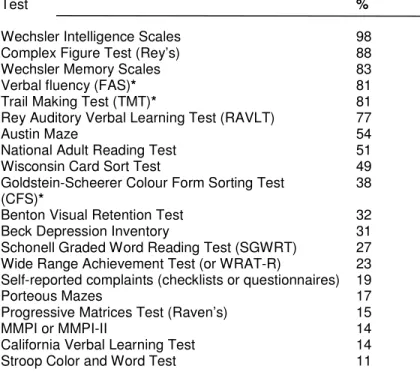
Results for the questionnaire item regarding test use are presented in Table 1 and discussed below. Clinicians were asked to indicate which tests they “give often” using the list provided. Endorsement frequencies for these tests including responses from the open ended section of this question are reported in Table 1, if more than 10% of the sample used the test. The 10% inclusion criterion for the table is arbitrary but was selected to simplify presentation of the data.
Where possible the tests names used in Table 1 are consistent with names given in Buros Institute publications, which include the Tests in Print series (e.g., Mitchell, 1983) and Mental Measurements Yearbooks (e.g., Kramer & Conoley, 1992). Three of the tests included in Table 1 (the NART, the Austin Maze, and the RAVLT; see Table 1 for abbreviations) were not listed in these publications, but appear in Lezak’s (1983) compendium of tests.
Table 1. Endorsement Frequencies for Tests Used by More than 10% of the Sample
Test %
Wechsler Intelligence Scales 98 Complex Figure Test (Rey’s) 88 Wechsler Memory Scales 83 Verbal fluency (FAS)* 81 Trail Making Test (TMT)* 81 Rey Auditory Verbal Learning Test (RAVLT) 77
Austin Maze 54
National Adult Reading Test 51 Wisconsin Card Sort Test 49 Goldstein-Scheerer Colour Form Sorting Test 38 (CFS)*
Benton Visual Retention Test 32 Beck Depression Inventory 31 Schonell Graded Word Reading Test (SGWRT) 27 Wide Range Achievement Test (or WRAT-R) 23 Self-reported complaints (checklists or questionnaires) 19
Porteous Mazes 17
Progressive Matrices Test (Raven’s) 15 MMPI or MMPI-II 14 California Verbal Learning Test 14 Stroop Color and Word Test 11
Note.—Responses were generated using a list of 20 popular tests which included space for “other” measures. Participants were asked to tick the boxes next to the measures they “give often.” Test names conform to names given in Buros Institute Publications (e.g., Kramer & Conoley, 1992; Lezak, 1983; Mitchell, 1983).
*Tests marked with an asterisk are subtests of batteries, and battery names are listed in Buros Institute publications. The FAS is a subtest of the Multilingual Aphasia Exam. The TMT is a subtest of the Halstead Reitan Battery. The CFS is a subtest of the Weigl-Goldstein-Scheerer Tests of Abstraction and Concrete Thinking. The SGWRT is a subtest of the Schonell Reading Test.
Interestingly, despite careful piloting, over half of the sample (n 5 60) used the open ended section of the test use item to supply the names of 84 tests that were not included on our original list. Most of these measures were used by less than 10% of the sample however, and have not been included in Table 1. The exception is the Stroop, which was listed by 11% of the sample and therefore appears in the Table. Interestingly, more than half of the tests (n 5 50) volunteered in the “other” category do not appear in Buros Institute publications (e.g., Kramer & Conoley, 1992; Mitchell, 1983) or could not be unambiguously identified because of poor labeling.
Tests in Table 1 are presented in order of frequency of use. This differs from the format chosen by Butler et al. (1991), where tests of similar abilities were listed together. Listing tests by popularity provides information about which tests clinicians use, in a logical order.
However, as has been noted by others, this type of ranking does not address the separate issues of test validity and the appropriateness of test use (see Butler et al., 1991; Kaufman, 1991).
DISCUSSION
The results of this study are consistent with previous surveys of test use conducted elsewhere for Wechsler’s tests of intelligence and memory. As with previous studies, Wechsler’s
intelligence scales rate as the most frequently administered tests. Similarly, the WMS and WMS-R appear in the top 10 in seven out of the eight studies reviewed previously (e.g., Butler et al., 1991) and rated as the third most frequently administered tests used by Australian clinicians.
Tests which have rated highly in studies conducted elsewhere but were less popular with Australian neuropsychologists, include the Bender–Gestalt and the MMPI (cf. Piotrowski & Lubin, 1990). For example, less than 15% of Australian neuropsychologists give the MMPI, compared to 73% of Piotrowski and Lubin’s (1990) American sample. The HRB also rated in the top 10 in most previously published studies, but did not rate highly among Australian clinicians. In Australia, the Trail Making Test which is part of the HRB, was the fifth most frequently administered test, but the full HRB was used by less than 10% of respondents. Tests that have not rated highly in studies elsewhere but are used often in Australia include Rey’s Complex Figure Test, the FAS, the Austin Maze, the CFS, the RAVLT, and the New Adult Reading Test (cf. Butler et al., 1991). The extent to which these measures satisfy commonly accepted criteria for evaluating tests varies substantially (e.g., American Psychological Association, 1985). Clearly, the most popular tests are not equally well developed and standardized.
This raises important issues for test developers and demonstrates the need to investigate why clinicians choose to administer particular tests. Differences in rates of use for tests among practitioners may reflect divergent models of practice for neuropsychology between Australia and other countries, with Australian neuropsychologists placing greater reliance on other health professionals to deal with issues concerning the assessment of personality, psychopathology, and motor skills. The effects of litigation on clinical practice may also partly account for differences between American neuropsychologists use of tests and the use of tests by practitioners elsewhere, given that the number of medicolegal cases involving American neuropsychologists has increased and this may influence test selection decisions (Matarazzo, 1990). It is important to remember that the reasons for these differences remains a matter for speculation, given that the main purpose of this survey was to describe test use in Australia and the design used precludes scientific analysis of the reasons for these differences.
Fifty unknown or unpublished measures were listed by some clinicians as tests they give often. The number of tests in this category was partly due to difficulty determining whether clinicians were referring to the same test when abbreviations, acronyms, or local names were used. Buros (1972) has noted that there are often multiple names for tests in circulation and
the lack of definitive labels can be confusing. These results make a strong case for establishing a standard test nomenclature to encourage accurate labeling of assessment materials. The issue of test nomenclature should be taken up collaboratively by professional associations that are in the best position to consult clinicians regarding standard test names. The Buros Institute texts may be a good starting point, given that these references are updated regularly and provide a cumulative index for commercially available tests (e.g., Kramer & Conoley 1992; Mitchell 1983).
REFERENCES
American Psychological Association (1985). Standards for educational and psychological testing.
Washington, DC: Author.
Bassa, F.M., & Schlebusch, L. (1984). Practice preferences of clinical psychologists in South Africa.
South African Journal of Psychology, 14, 118–123.
Buros, O.E. (Ed). (1972). The seventh mental measurements yearbook. Volumes I and II. Highland Park, NJ: Gryphon Press.
Butler, M., Retzlaff, P., & Vanderploeg, R. (1991). Neuropsychological test usage. Professional Psychology: Research and Practice, 22, 510–512.
Guilmette, T.J., Faust, D., Hart, K., & Arkes, H.R. (1990). A national survey of psychologists who offer neuropsychological services. Archives of Clinical Neuropsychology, 5, 373–392. Hartlage, L.C. (1985). Neuropsychology and private practitioner. Psychotherapy in Private Practice, 3,
61–64.
Kaufman, A.S. (1991). Assessing adolescent and adult intelligence. Boston: Allyn & Bacon. Kramer, J.J., & Conoley, J. (Eds.). (1992). The eleventh mental measurements yearbook. Lincoln, NE:
Buros Institute.
Lezak, M.D. (1983). Neuropsychological assessment (2nd ed.). New York: Oxford University Press. Matarazzo, J.D. (1990). Psychological assessment versus psychological testing. American Psychologist,
45, 999–1017.
Mitchell, J.V. (Ed.). (1983). Tests in print III. Lincoln, NE: Buros Institute.
Piotrowski, C., & Lubin, B. (1990). Assessment practices of health psychologists: Survey of APA division 38 clinicians. Professional Psychology: Research and Practice, 21, 99–106. Sellers, A.H., & Nadler, J.D. (1992). A survey of current assessment procedures used for different age
groups. Psychotherapy in Private Practice, 11, 47–57.
Slick, D.J., & Craig, P.L. (1991). Neuropsychological assessment in public psychiatric hospitals: The changing state of the practice—1979 to 1989. Archives of Clinical Neuropsychology, 6, 73–80. Tsoi, M.M., & Sundberg, N.D. (1989). Patterns of psychological test use in Hong Kong. Professional
Karen Sullivan completed this study as part of research towards a doctoral dissertation undertaken at the University of Melbourne, Australia. Stephen C. Bowden, Ph.D., received his degree in psychology from the University of Melbourne in 1988 and is now senior lecturer in Psychology at Melbourne University. The authors would like to thank members of the Australian Psychological Society College of Clinical Neuropsychologists for their generous cooperation with this project. Thanks also to Simon Smith and Sue Finch for constructive comments during the writing of this paper. This work was supported in part by an Australian Postgraduate Research Award to Karen Sullivan.