Table of Contents
Executive Summary ...1
1 Introduction and Background ... 3
1.1 Purpose and Scope of this Document ... 3
1.2 Background ... 3
1.2.1 Butte Area One (BAO) Site Background and Injury Overview ... 3
1.2.2 Overview of 2008 Settlement Agreement on Butte Area One Injured Resources ... 7
1.2.3 Overview of the BNRC Butte Area One Restoration Planning Process ... 8
1.3 Public Participation ... 9
1.4 Criteria for Decision Making ... 10
1.4.1 Stage 1 Legal Criteria ... 10
1.4.2 Stage 2 Policy Criteria ... 12
2 Restoration Project Categories ... 14
2.1 Restoration of the Upper Silver Bow Creek Corridor ... 14
2.2 Waste Cover Improvements/Revegetation ... 15
2.3 Stream Restoration ... 17
2.4 Municipal Water System Improvements ... 20
2.5 Storm Water Controls... 21
2.6 Recreation... 23
2.7 Small/Miscellaneous Projects ... 25
3 Restoration Project Alternatives ... 26
3.1 No Action Alternative ... 27
3.2 BNRC Restoration Recommendation ... 27
3.2.1 Restoration of the Upper Silver Bow Creek Corridor ... 27
3.2.2 Waste Area Improvements/Revegetation ... 29
3.2.3 Stream Restoration ... 30
3.2.4 Municipal Water System Improvements ... 31
3.2.5 Storm Water ... 32
3.2.6 Recreation ... 32
3.2.8 BNRC Restoration Recommendation Cost Summary ... 33
3.3 Restoration Alternative 1 ... 33
3.3.1 Parrot Tailings Removal ... 33
3.3.2 Diggings East and Northside Tailings Removal ... 34
3.3.3 Butte Chamber of Commerce Tailings ... 34
3.3.4 Waste Area Improvements ... 34
3.3.5 Restoration Alternative 1 Cost Summary ... 34
3.4 Restoration Alternative 2 ... 34
3.4.1 Basin Creek Water Treatment Plant ... 35
3.4.2 Basin Creek Dam Improvements ... 35
3.4.3 Water Transmission Line Replacement ... 36
3.4.4 Waste Area Improvements ... 36
3.4.5 Restoration Alternative 2 Cost Summary ... 37
4 Comparative Analysis of Restoration Alternatives ... 37
4.1 Technical Feasibility ... 37
4.2 Cost-Effectiveness and Cost-Benefit ... 38
4.3 Additional Criteria... 38
4.4 Cost – Benefit Determination ... 43
5 Conclusions and Recommendations ... 43
6 Restoration Plan Implementation ... 44
List of Figures Figure 1 Map of Silver Bow Creek Watershed ... 5
Figure 2 Map of Butte Area One ... 6
List of Tables Table 1 BNRC Restoration Recommendation waste area improvement/revegetation funding summary ... 30
Table 2 BNRC Restoration Recommendation Stream restoration projects funding summary ... 31
Table 3 BNRC Restoration Recommendation Cost Summary ... 33
Attachments
Attachment A: Definitions
Attachment B: BNRC Membership
Attachment C: BNRC Meeting Summaries
Appendices
List of Acronyms
ARCO Atlantic Richfield Company
BAO Butte Area One
BNRC Butte Natural Resource Damage Restoration Council BPSOU Butte Priority Soils Operable Unit
BSB Butte-Silver Bow City-County Government
CD Consent Decree
CERCLA Comprehensive Environmental Response Compensation and Liability Act DCRP Draft Conceptual Restoration Plan
DEQ Montana Department of Environmental Quality DOI U.S. Department of Interior
EPA U.S. Environmental Protection Agency FWP Montana Fish, Wildlife and Parks
LAO Lower Area One
MBMG Montana Bureau of Mines and Geology MOA Memorandum of Agreement
MOU Memorandum of Understanding MSD Metro Storm Drain1
NRDP Natural Resource Damage Program ROD Record of Decision
RPPC UCFRB Restoration Plan Procedures and Criteria TRC Trustee Restoration Council
CSKT Confederated Salish and Kootenai Tribes UCFRB Upper Clark Fork River Basin
1
Metro Storm Drain (MSD) is a term used to describe the realigned and reconstructed channel of Silver Bow Creek from Texas Avenue to its confluence with Blacktail Creek.
Executive Summary
The 2008 Montana v. ARCO Consent Decree allocated $28.1 million (M), plus interest, to restore, replace or acquire the equivalent of the injured groundwater and surface water of Butte Area One. The Governor created the Butte Natural Resource Damage Restoration Council (BNRC) to give the citizens of Butte a strong voice on how this fund should be spent. This nine member volunteer council, with assistance from the Montana Natural Resource Damage Program (NRDP), has developed this restoration plan to guide the expenditure of these funds. The BNRC recognizes that this important task must be accomplished with limited funds and resources.
Restoration typically follows remedy and goes beyond remedial actions in an effort to restore the injured natural resources. The BNRC started meeting in April 2010 with the expectation that their Butte Area One Restoration Plan would follow the anticipated Consent Decree for the Butte Priority Solis Operable Unit. It was also their desire to produce a restoration plan in time for Governor Schweitzer to consider it prior to the end of his term. At this time a Consent Decree finalizing the remedial actions for Butte Priority Solis Operable Unit has not been reached, however, in keeping with their goal, the BNRC has produced this restoration plan in time for the Governor’s consideration. Since the final Butte Priority Solis Operable Unit remedy plan is unknown, this restoration plan is not as specific as the council had desired. Instead, it offers enough flexibility that it should complement the future remedy and not take its place.
In order to develop this restoration plan, the BNRC, with assistance from the NRDP, first produced the Butte Area One Final Restoration Process Planning Document. This document contains the legal criteria and policy criteria by which projects/alternatives would be evaluated. That document was subject to public review and was approved by the Governor in March 2012. The provisions in the planning document were followed during the production of this Butte Area
One Final Restoration Plan. Throughout their course, the BNRC conducted a transparent
decision-making process that allowed numerous opportunities for citizens to have direct input into the plan development, including multiple project scoping sessions. It became clear that the desire of the council and the community was to concentrate efforts primarily on direct restoration of the injured natural resources in Area One. As a result, the focal point of this restoration plan is “the BNRC Restoration Recommendation” which concentrates on the “restoration of the Upper Silver Bow Creek Corridor” from Texas Ave. to Montana St.
The BNRC Restoration Recommendation devotes these funds, approximately $32M, into the following restoration categories: Restoration of the Upper Silver Bow Creek Corridor - $10M; Water System Improvements - $10M; Waste Cap Improvements/Revegetation - $6M; Stream Restoration - $4M; Storm Water Controls - $ 0; Recreation - $1M; and Small/Miscellaneous Projects - $1M.
It is a requirement of Superfund Law, 43 CFR 11.82(a), that a reasonable number of possible alternatives for the restoration, rehabilitation or replacement of the injured natural resources be developed and considered. The alternatives produced in this restoration plan: “no action,” “Alternative 1,” and “Alternative 2” were originally developed by the NRDP for the
alternative restoration actions in this plan. The merits of each alternative were compared using both the legal and BNRC policy criteria. Out of the four restoration alternatives considered, the “BNRC Restoration Recommendation” more completely achieves the goals of these criteria, produces the greatest benefits to the injured resources and replaces more of the services lost because of the injury, and aligns with the priorities of the Butte community; therefore, the BNRC Restoration Recommendation is the preferred alternative.
1
Introduction and Background
1.1 Purpose and Scope of this DocumentThis Butte Area One Final Restoration Plan describes the restoration plan the State of Montana will implement to restore the injured groundwater and surface water resources of Butte Area One. The Butte Natural Resource Damage Restoration Council (BNRC), with assistance from the State of Montana, Department of Justice, Natural Resource Damage Program (NRDP), developed this document for public consideration in fall 2012. Following consideration of public comment,1 the BNRC recommended this final version of this plan in December of 2012 for consideration of the Trustee Restoration Council (TRC) and approval of the Governor. The Governor approved this plan in December 2012.
This Final Restoration Plan is organized as follows:
This introductory Section 1 describes the purpose and scope of this document and provides background on the Butte Area One site and the restoration planning steps that led to the development of this plan, including public involvement.
Section 2 describes the restoration project categories the BNRC developed as a result of a public scoping process and used to generate restoration project alternatives.
Section 3 describes the proposed restoration project alternatives.
Section 4 provides a comparative analysis of the proposed restoration project alternatives.
Section 5 identifies the BNRC’s preferred and recommended restoration alternative (referred to herein as the “BNRC Restoration Recommendation”) based on this analysis.
Section 6 is a summary of the restoration plan implementation process. 1.2 Background
1.2.1 Butte Area One (BAO) Site Background and Injury Overview2
The deposition of wastes in the City of Butte from mining and mineral-processing operations has resulted in injury to groundwater resources and the surface water of Silver Bow Creek. Figure 1 depicts the Silver Bow Creek watershed in the headwaters area of the Upper
1 This description of the BAO site is provided in the NRDP’s February 2008 “Summary of 2008 Settlement of Clark Fork River Remediation and Natural Resource Damage Claims and Related Restoration Plans,” available from the NRDP website at : http://doj.mt.gov/lands/naturalresource/resources/claims/settlementfactsheet2008.pdf.
2 See “Final Response to Public Comment on the Draft Butte Area One Restoration Plan,” prepared by the NRDP, December 2012.
Clark Fork River Basin. The injured alluvial groundwater and surface water in Butte is located in the south central portion of the Butte Priority Soils Operable Unit (BPSOU) referred to as “Area One.” Area One is depicted in the red-outlined area on Figure 2. Many of the wastes in Area One are associated with five facilities – the Parrot Smelter, the Metro Storm Drain (MSD),3 the Butte Reduction Works, the Colorado Smelter, and the Berkeley Pit.
Injury to groundwater in Butte Area One has been demonstrated by the occurrence of concentrations of heavy metals (including cadmium, zinc, iron, lead, and copper), arsenic, and sulfate that exceed drinking water standards in the alluvial aquifer. The areal extent of the known contamination above drinking water standards of the alluvial aquifer is about a square mile and extends from the Parrot Tailings area down gradient along the historic Silver Bow Creek channel. The highest known concentrations of dissolved constituents in groundwater coincide with wastes from the Parrot mill and smelter. These leachable wastes have a volume of approximately 590,000 cubic yards.4 Other areas known as the Diggings East and Northside Tailings also contain contaminants that are most likely leaching metals into the groundwater and potentially to surface waters. In Lower Area One, west of Montana Street, most of the tailings were previously removed by ARCO; however, some slag and tailings from the Butte Reduction Works and Colorado Smelter remain in place and have the potential to leach metals to ground and/or surface water.
The discharge of contaminated groundwater and contaminated surface runoff to Silver Bow Creek in Butte Area One results in surface water and streambed contamination. The contaminated alluvial aquifer potentially discharges to Silver Bow Creek and Blacktail Creek. Surface runoff from storms and snowmelt can carry hazardous substances from hundreds of dispersed waste sources to Silver Bow Creek through surface drainages and the Butte storm water collection system.
3 Metro Storm Drain (MSD) is a term used to describe the realigned and reconstructed channel of Silver Bow Creek from Texas Avenue to its confluence with Blacktail Creek.
! ! ! ! ! ! ! ! ! ! ! ! ! ! ! ! ! ! !! ! ! ! ! ! ! ! ! !! ! ! ! ! ! ! ! ! ! ! ! ! ! ! ! ! ! ! ! ! ! ! ! ! ! !! ! ! ! ! ! ! ! ! ! ! ! ! ! ! ! ! ! ! ! !! ! !! ! ! ! ! ! ! ! !! !! ! ! ! ! ! ! ! ! ! ! ! ! ! ! ! ! ! ! !! !!!! !! ! ! !! ! ! ! ! ! ! ! ! ! ! ! ! !! !! ! ! ! ! ! ! ! ! ! ! ! ! ! ! ! ! ! ! !! ! ! !! ! ! ! ! ! ! ! ! ! ! ! ! ! ! !! ! ! ! ! ! ! !! ! ! ! ! ! ! ! ! ! ! ! ! ! ! ! ! ! ! ! ! ! ! ! ! ! ! ! ! ! ! ! ! !! !! !!!! !! !!!! !! !! !! !! !! !! !! ! ! ! ! ! ! ! ! ! ! ! ! ! ! ! ! ! ! ! ! !! ! ! ! ! ! ! !! !! !! !! !! !! !! !!!! !! !! !! ! ! ! ! ! ! !! ! ! ! ! !! !! !! !! !! !! ! ! ! !! !!!! !! !!!! !!!!!! !! !! !! !!!!!! !!!! ! ! !! !! !!!! !!! ! ! ! !! ! ! ! ! ! ! ! ! ! ! !! !! !! ! ! ! ! !! !! ! ! ! ! ! ! !! ! ! !! !! !! !! ! ! !! !! !! ! ! !! ! ! !! !!!! !! !! !! !! !! !! !!!! !!!! !! !! ! ! ! ! !! ! ! !! !!!! !!!! ! ! ! ! !! !! !! ! ! !! ! ! ! ! !! !! !!!!! !! !! ! ! !! !! !! !!!! !!!! !!!! !! !! !! !! !! ! ! !!! ! !! ! ! !! !! ! ! ! ! ! ! !! !! !! !! !!! ! !! ! ! !! !! !! ! ! !! !! !! !!!!!! !! !! !! !! !! !! !! ! ! !! !! !! !! !! !! !! !! !! !! ! ! !!! ! !! !! !!!! ! ! !!!! ! ! !! !! !! !!! ! ! ! !! !! ! ! ! ! ! ! ! ! ! ! ! ! !! !! ! ! !! ! ! ! ! !! ! ! ! ! ! ! ! ! !! ! ! ! ! !! !! !! !! !! !! !! ! ! ! ! !!! ! !!! ! !! ! ! ! ! ! ! ! ! ! ! ! ! ! ! ! ! ! ! ! ! ! ! ! ! ! ! !!! ! ! ! !! !!! ! ! ! !! ! ! ! ! ! ! ! ! !! !! !! ! ! ! ! ! ! ! ! ! ! ! ! ! !!! ! ! !! !!!! ! ! ! !!! ! ! ! ! ! ! ! ! ! ! !! ! ! ! ! !! ! !! ! ! ! !! ! ! !! ! ! ! !! ! !! !! ! ! ! !!! ! ! !! !! !! ! ! ! ! !! ! ! ! ! !! ! ! ! ! ! ! ! ! ! ! !! ! ! ! ! !! !! !!!!!! !! !! ! ! ! ! !! !! ! ! !! ! !!! ! ! ! ! !! ! ! ! ! ! ! ! ! !! ! ! ! ! ! ! ! ! ! ! ! ! ! ! ! ! ! ! ! ! ! ! ! ! ! ! ! !! ! ! ! !! ! ! ! ! !! ! ! ! ! ! ! ! ! ! ! !! ! ! ! ! ! ! ! ! ! ! ! ! ! ! ! ! !! !! ! ! ! ! !! ! ! ! ! ! ! ! !! ! ! ! ! ! ! !!! ! ! ! ! ! ! ! ! ! ! ! ! !! ! ! ! !!! !! ! ! ! ! ! ! ! ! ! ! !! ! ! ! ! ! ! ! ! ! ! ! ! ! ! ! ! ! ! ! ! !! ! ! ! ! ! ! ! ! ! ! ! ! ! ! ! ! ! ! ! ! ! ! ! ! ! ! ! ! ! ! ! ! !! ! ! ! ! ! ! ! ! ! ! ! ! ! ! ! ! ! ! ! ! ! ! ! ! ! ! !! !! ! ! ! ! ! ! ! ! ! ! ! ! ! ! ! ! ! ! ! ! ! ! ! ! ! ! ! ! ! ! ! ! ! ! ! ! ! ! ! ! ! ! ! ! ! ! ! ! ! ! ! ! ! ! ! ! ! ! ! ! ! ! ! ! !!! ! !! ! !! ! !!! ! ! !! ! ! !! ! ! ! ! ! ! ! ! ! ! ! ! ! ! ! ! ! ! !! ! ! !! !!!! !! ! ! !! ! ! !! ! ! ! ! ! ! ! !! !! ! ! ! ! ! ! ! ! ! ! ! ! ! ! ! ! ! ! ! ! ! ! ! ! ! ! ! ! ! ! ! ! ! ! ! ! ! ! ! ! ! ! ! ! ! ! ! ! ! ! ! ! ! ! ! ! ! ! ! ! ! ! ! ! ! ! ! ! ! ! ! ! ! !! !! !! !! ! ! ! ! !! ! ! ! ! ! ! ! ! ! ! ! ! !! !! ! ! ! ! !! !! !! !!!! !!!! !! !!!! !! !! !! !! ! ! !! ! ! ! ! ! ! !! !! !! ! ! ! ! ! !!! !! ! ! & & & &
§
¨
¦
90§
¨
¦
90 Divide Waterloo Ramsay Butte§
¨
¦
15§
¨
¦
15 N o rto n C ree k Ge rm an G ulc h C re ek N F o rk D ivid e C reekWarm Springs Creek
Warm Springs
Ponds
Oro Fino Gulch
Silver B ow Creek & & Oppo rtu nity Anaconda Big Hole R iver Mill C reek Fish Cre ek S il v e r B o w C re e k B as in C ree k Cree k Moose Creek Je rry Cre ek Div ide Cre ek B la c k ta il C ree k S a n d C re e k B ro w n s G u lch C re e k Willow Creek Soap Cre ek Tu ck er Cre ek Beefstraight C reek Pin k G ulc h
Bull Run Creek
Grov
e Gul
ch C
reek
City and County of Butte-Silver Bow
and Vicinity
Interstate \ Divided Highway
Continental Divide !! !! County Boundary City or Town Mine Tailings Berkeley Pit Lake or Impoundment
%
Silver Bow Creek Watershed Boundary
Perennial Stream State \ Secondary Highway
Approximate Elevation Range (Feet) 4200 - 5300 5300 - 6400 6400 - 8000 8000 - 10500 Scale in Miles 0 1 2 3 4 5 N
1.2.2 Overview of 2008 Settlement Agreement on Butte Area One Injured Resources In 1983, the State of Montana filed a lawsuit in Federal District Court against the Atlantic Richfield Co. (ARCO) for injuries to the natural resources in the Upper Clark Fork River Basin (UCFRB), which extends from Butte to Milltown. The Montana v. ARCO lawsuit, brought under federal and state Superfund laws, sought damages from ARCO, contending that decades of mining and smelting in the Butte and Anaconda areas had greatly harmed natural resources in the basin and deprived Montanans of their use. In 1989, the Environmental Protection Agency (EPA) filed another lawsuit to establish ARCO’s liability for remedial cleanup in the UCFRB.
In 1995, the State produced the 1995 Restoration Determination Plan, which analyzed restoration alternatives and selected specific restoration and/or replacement alternatives for each of the nine injured resource areas covered under Montana v. ARCO, including Butte Area One, using U.S. Department of Interior (DOI) legal criteria.5
In 2005, the State produced the final Silver Bow Creek Watershed Restoration Plan, which identified and prioritized restoration needs in the Silver Bow Creek watershed, to serve as a guide to restoring natural resources in the watershed.6 Development of the plan involved extensive public input, and data collection and analysis, and identified 61 significant restoration needs within eight planning areas in the watershed.
In 2007, the State produced restoration plans for the Butte Area One, Smelter Hill Uplands, and Clark Fork River sites that were incorporated into the 2008 Consent Decree, which finally settled Montana v. ARCO.7 These plans included an analysis of restoration alternatives and selection of a preferred alternative that essentially revised the 1995 RDP’s restoration alternatives analysis for these three sites.
The State settled Montana v. ARCO through a series of settlement agreements, or consent decrees, completed and approved by the court in 1999, 2005 and 2008.8 One of the three injured areas in the UCFRB covered under the 2008 settlement agreement was the Butte Area One injured groundwater and surface water site, which is the focus of this restoration plan.
The 2008 Montana v. ARCO Consent Decree specifically allocated $28.1 million in natural resource damages, plus interest, to restore, replace, or acquire the equivalent of injured natural resources at the BAO site, as provided for in the 2007 “Butte Ground and Surface Water
5Restoration Determination Plan for the UCFRB, prepared by the NRDP, with assistance from Rocky Mountain Consultants, Inc., dated October 1995.
6Final Silver Bow Creek Watershed Restoration Plan prepared by the NDRP, dated December 2005. This plan is available from the NRDP website at:
https://files.doj.mt.gov/wp-content/uploads/2011/06/silverbowcreekrestorationplanfinal.pdf. 7
Butte Ground and Surface Water Restoration Planning Process and Draft Conceptual Restoration Plan, prepared by the NDRP, dated November 2007; Revised Restoration Plan for the Clark Fork River Aquatic and Riparian Resources, prepared by the NRDP, dated November 2007; Draft Conceptual Smelter Hill Uplands Resource Restoration Plan, prepared by the NRDP, dated December 2007. These plans are available from the NRDP website at: https://doj.mt.gov/lands/lawsuit-history-and-setttlements-2/.
8 These settlements are summarized on the NRDP’s website at: http://www.doj.mt.gov/lands/naturalresource/lawsuithistory.asp
Restoration Planning Process and Draft Conceptual Restoration Plan,”9 (hereafter referred to as the “2007 BAO Draft Conceptual Restoration Plan.”) The requirements of the Consent Decree
are consistent with the natural resource damage provisions of the federal Superfund law and associated regulations which specify that any damages recovered from natural resource damage lawsuits may only be used to restore, replace, or acquire the equivalent of the injured natural resources that were the subject of the lawsuit (42 U.S.C. 9607). Attachment A provides the general definitions and examples of these terms.
The 2007 BAO Draft Conceptual Restoration Plan, which was “conceptual” in nature, generally set forth a restoration planning process to determine how the $28.1 million settlement, plus interest, will be expended to restore or replace the injured resources. Under the process set forth in the conceptual restoration plan:
1. A final restoration plan will be developed based, in large part, on local input, subject to requirements of the law. This plan would allocate the entire $28.1 million, plus interest, for Butte restoration projects;
2. A Butte Natural Resource Damage Restoration Council (BNRC) would be created for purposes of developing and recommending for approval the final restoration plan, in accordance with a specific planning process developed by the BNRC, subject to public comment, and approved by the Governor.
The Governor as trustee of the settlement money would approve a final BAO restoration plan, after considering public input and the recommendations of the BNRC, NRDP, and Trustee Restoration Council.
1.2.3 Overview of theBNRC Butte Area One Restoration Planning Process
The BNRC was created in early 2010, with six members appointed by Butte-Silver Bow Chief Executive Paul Babb and three members appointed by Governor Brian Schweitzer. Attachment B provides a list of BNRC members. The BNRC held its first meeting in April 2010.
The BNRC focused its efforts in its first year on becoming knowledgeable about the BAO site and the related remediation and restoration processes. The BNRC then developed a draft restoration planning process document in spring 2011 for consideration by the public. The BNRC revised the process document in January 2012 based on public comment. In March 2012, the revised process document was recommended for approval by the Trustee Restoration Council and approved by the Governor. This document, the Butte Area One Final Restoration Process
Planning Document,10 hereafter referred to as the BAO Process Plan, describes the procedures to
9 The 2007BAO Draft Conceptual Restoration Plan, along with the Consent Decree, is available on the NRDP’s website at:
DCRP:http://www.doj.mt.gov/lands/naturalresource/resources/claims/butteareaonerestorationplan2008.pdf; Link to 2008 Consent Decree: http://doj.mt.gov/lands/naturalresource/resources/claims/consentdecree2008.pdf 10 The BAO Final Restoration Process Planning Document is available on the NRDP’s website at:
be followed and the criteria to be used in developing and obtaining approval of a final BAO restoration plan and the role of the major entities involved in that process.
From April 2010 through November 2012, the BNRC held 42 meetings and went on several field trips to further develop its knowledge of the remediation and restoration processes specific to the Butte Area One site and to develop this restoration plan. Attachment C provides a summary of the BNRC meetings to date and lists the major topics covered at each meeting.
In the spring of 2012, the BNRC solicited the public for restoration project ideas and alternatives to be considered for the expenditure of BAO settlement funds. The BNRC also conducted extensive public outreach about this solicitation process and held two workshops in March of 2012. In response to these outreach efforts, the public submitted approximately 100 BAO restoration project ideas. Appendix A provides a summary table of the ideas submitted by the public.
In May 2012, the NRDP, at the request of the BNRC, screened the possible restoration ideas to determine whether they met the legal threshold of restoring or replacing the injured natural resources of the Butte Area One site, namely groundwater and the aquatic resources of Silver Bow Creek, that were the subject of the $28.1 million claim recovered from ARCO. The BNRC then met several times to consider and categorize the ideas that met the legal threshold. In June 2012, the BNRC conducted a “straw poll” to allocate restoration funding for seven different restoration categories. The BNRC allocated the $32 million, which was the approximate BAO Settlement Fund balance as of December 31, 2011.
Following the June 2012 meeting, the BNRC held five additional meetings in July and August of 2012 to evaluate its initial funding allocations. At these “working sessions,” public participation and comment was solicited and considered at various points during these meetings. The BNRC’s final category fund allocations decided upon at its August 30, 2012 meeting were as follows:
Restoration of the Upper Silver Bow Creek Corridor - $10 million; Water system improvements - $10 million;
Waste cap improvements/revegetation - $6 million; Stream restoration - $4 million;
Storm water controls - $ 0; Recreation - $1 million;
Small/Miscellaneous projects - $1 million.
The BNRC Restoration Recommendation described and analyzed in Section 3 of this Restoration Plan is based on the above allocations.
1.3 Public Participation
The BNRC designed the restoration planning and decision making methods outlined in
the BAO Process Plan with numerous opportunities for public comment in order to ensure that
restoration plan is just one of the many opportunities that have been provided to the public for participating in this restoration planning effort.
The State of Montana and the BNRC recognize the importance of public input and participation in the restoration planning process. Involving the public in restoration planning promotes better decision making.
The BNRC serves as an important voice of the citizens of Butte and Montana on matters related to the restoration of the injured natural resources of Butte Area One. The Council facilitates public dialogue on and promotes public understanding of restoration and remediation issues of Butte Area One. In accomplishing its mission, the BNRC’s decisions can be viewed as part of the meaningful public participation in the Butte Area One restoration planning process. 1.4 Criteria for Decision Making
The 2012 BAO Process Plan outlined the criteria that will be used to analyze restoration alternatives and to decide on the preferred alternative(s). The criteria are grouped into two sets reflecting their derivation from two different sources: legal and policy. The “Stage 1 Legal Criteria” are derived primarily from the criteria set forth in the U.S. DOI natural resource damage assessment regulations, which trustees are to use when selecting restoration projects. The Stage 1 Criteria also include a criterion reflecting the additional factors the State is to consider under the Memorandum Of Agreement with the Confederated Salish and Kootenai Tribes and the U.S. DOI. The “Stage 2 Policy Criteria” have been developed by the BNRC to promote the goals important to them. The BAO Process Plan’s description of both Stage 1 and 2 criteria is listed below. An evaluation of alternatives based on these criteria is found in chapter 4.
In applying these criteria to evaluate proposed restoration projects, the criteria will be evaluated qualitatively rather than quantitatively. The importance of each criterion as applied to individual alternatives will vary depending upon the nature of the alternatives.
1.4.1 Stage 1 Legal Criteria
The Stage 1 Legal Criteria that the BNRC, with assistance from the NRDP, used to evaluate restoration alternatives are as follows:
Technical Feasibility: This criterion evaluates the degree to which a project employs well-known and accepted technologies and the likelihood that a project will achieve its objectives. Obviously, projects that are technologically infeasible will be rejected. However, projects that are innovative or that have some element of uncertainty as to their results may be approved. Different projects will use different methodologies with varying degrees of feasibility. Accordingly, application of this criterion will focus on an evaluation of a project’s relative technological feasibility.
Relationship of Expected Costs to Expected Benefits: This criterion examines whether a project’s costs are commensurate with the benefits provided. In doing so, the costs associated
with a project, including costs other than those needed simply to implement the project, and the benefits that would result from a project, will be determined. Application of this criterion is not a straight cost-benefit analysis, nor does it establish a cost-benefit ratio that is by definition unacceptable. While it is possible to quantify costs, quantifying benefits is more difficult. Requiring projects to meet some established cost-benefit ratio would likely result in the rejection of many worthwhile projects because of the difficulty in quantifying the benefits to resources and services resulting from the implementation of the projects.
Cost-effectiveness: This criterion evaluates whether a particular project accomplishes its goal in the least costly way possible. To apply this criterion in a meaningful fashion, all of the benefits a project would produce must be considered, not just cost; otherwise the focus would be too narrow. Take the example of a project that would fully restore a given resource in a short period of time compared to another project that would restore the same resource at less cost but over a longer period of time. Considering only that the second project is less expensive than the first project ignores the benefits resulting from a relatively shorter recovery period. In this example, since an accelerated recovery time is a benefit, it would need to be factored into a determination of cost-effectiveness.
Results of Response Actions: This criterion considers the results or anticipated results of response actions underway, or anticipated, in the Upper Clark Fork River Basin. Numerous response actions are ongoing and additional response actions are scheduled to begin in the next several years, continuing for many years into the future. Application of this criterion will require assessment of response actions at an adequate level of detail, given the inherent uncertainties associated with this task, in order to make projections as to their effects on resources and services. Consideration of response actions will occur in two principal contexts:
Evaluating what is necessary in the way of restoration of resources and services in light of the ongoing and planned response actions.
Evaluating the degree of consistency between a project and a response action looking at whether a project builds on a response action or, at the other end of the spectrum, seeks to undo a response action. Those projects that do the former as opposed to the latter will generally be favored.
Adverse Environmental Impacts: This criterion weighs whether, and to what degree, a project will result in adverse environmental impacts. Specifically, there will be an evaluation of significant adverse impacts, which could arise from a project, short term or long term, direct or indirect, including those that involve resources that are not the focus of the project. To do so, the dynamics of a project and how that project will interact with the environment must be understood.
Recovery Period and Potential for Natural Recovery: This criterion evaluates the merits of a project in light of whether the resource is able to recover naturally and, if a resource can recover naturally (i.e., without human intervention), how long that will take. This will place a project’s benefits in perspective by comparing the length of time it will take for the resource to recover if the project were implemented, with the length of time for natural recovery. (The term
“recovery” refers to the time it will take an injured natural resource to recover to its “baseline,” i.e., pre-injury condition.) If a resource will not recover without some action or if natural recovery will take a long time, a restoration action may very well be justified. Conversely, if a resource is expected to recover on its own in a short period of time, a restoration action may not be justified.
Human Health and Safety: This criterion evaluates the potential for a project to have adverse effects on human health and safety. Such a review will be undertaken not only to judge a particular project but also to determine if protective measures should be added to the project to ensure safety.
Federal, State, and Tribal Policies, Rules and Laws: This criterion considers the degree to which a project is consistent with applicable policies of the State of Montana and applicable policies of the federal government and Tribes (to the extent the State is aware of those policies and believes them to be applicable and meritorious). In addition, projects must be implemented in compliance with applicable laws and rules, including the consent decrees and this restoration planning process.
Resources of Special Interest to the Tribes and DOI: This criterion considers whether an alternative is consistent with the provisions of the State’s Memorandum of Agreement (MOA) with the Department of Interior and Confederated Salish and Kootenai Tribes.11 Pursuant to the MOA, the State is to pay particular attention to natural resources of special interest to the Tribes and/or DOI, including attention to natural resources of special environmental, recreational, commercial, cultural, historic, or religious significance to either the Tribes or the United States. The MOA also provides for the State to pay particular attention to “Tribal Cultural Resources” or “Tribal Religious Sites,” as those terms are defined in the MOA.
1.4.2 Stage 2 Policy Criteria
In addition to the legal criteria, the BNRC has selected the following policy criteria that will be applied when considering prospective restoration projects for Butte Area One. Prospective projects need not meet all of these criteria to be recommended for implementation; however, generally (all else being equal), projects that address these criteria will be ranked higher than those that do not. These policy criteria are reflective of the BNRC’s goals (see Attachment B) and listed in order of importance to the BNRC.
Restoration of Injured Resources: This criterion will examine whether and to what extent a project directly restores injured resources. Preference will be given to restoration over replacement of injured resources and to restoration activities that integrate with remediation activities.
11
Memorandum of Agreement among the State of Montana, Confederated Salish and Kootenai Tribes and United States Department of Interior Regarding Restoration, Replacement, or Acquisition of Natural Resources in the Clark Fork River Basin, dated November 1998. This agreement is available from the NRDP website at http://doj.mt.gov/lands/naturalresource/grantapplications.asp#guidance.
Public Support: This criterion will assess the level of public support for a project. Preference will be given to those projects with demonstrated public support over those without such demonstrated support.
Benefits to Butte Area One: This criterion will examine the benefits that will occur specifically to the injured groundwater and surface water resources of Butte Area One. Preference will be given to projects that offer benefits to these injured natural resources and the services they provide over projects that benefit resources and associated services outside of Butte Area One.
Silver Bow Creek Ecosystem Health: This criterion examines the relationship between a particular project and overall resource conditions in the Silver Bow Creek Watershed. Preference will be given to projects that fit within a broad ecosystem concept in that they improve a resource problem(s) when viewed on a watershed scale (including how it helps protect the downstream areas of Silver Bow Creek from further releases of hazardous substances), are sequenced properly from a watershed management approach, and are likely to address multiple resource problems in the Silver Bow Creek watershed. As part of the evaluation of this criterion, priorities and projects that meet the legal threshold identified through other relevant documents, including but not limited to those listed in Attachment D, will be considered.
Long-Term Effectiveness: The long-term effectiveness of a project will be evaluated. Preference will be given to projects that offer benefits in the long-term over those that offer short-term benefits.
Matching Funds and Cost Sharing: This criterion examines whether and to what degree a project, or the selected portion of a project proposed for restoration funding, has funding from another source. Leveraging the recovered natural resource damages produces obvious efficiencies.
Coordination and Integration: The degree to which a restoration project is coordinated or integrated with other ongoing or planned actions in Butte and the surrounding area of the Silver Bow Creek watershed will be examined. This is in addition to the coordination with EPA response actions, which is separately addressed under the “Results of Response Actions” criterion. Projects that can be efficiently coordinated with other actions may achieve additional cost savings.
Normal Government Functions: This criterion evaluates whether a project involves activities for which a governmental agency would normally be responsible or that would receive funding in the normal course of events and would be implemented if recovered natural resource damages were not available. BAO settlement funds may be used to augment funds available to government agencies, if such cost sharing would result in the implementation of a restoration project that would not otherwise occur through normal government function. Based strictly on this criterion, a project involving activities that would fall within normal government responsibilities may be ranked lower than a project that does not fall within this category.
2
Restoration Project Categories
Project ideas received by the BNRC from the public, Butte-Silver Bow agencies, and the NRDP staff were each assigned into broad restoration categories: Upper Silver Bow Creek corridor restoration; mining waste area improvements and revegetation; stream restoration; Butte-Silver Bow municipal water system improvements; storm water controls; recreation; and small/miscellaneous projects. Appendix A summarizes these project ideas by category. The following sections describe the project ideas evaluated for each restoration category and provide a preliminary screening.
Generally, projects not considered further in this analysis did not meet one or more legal or policy criteria described in the 2012 BAO Process Plan. In instances where a project idea would interfere with ongoing or future remedial actions, the idea was also screened from further consideration in this Plan. Section 3 presents the restoration project alternatives which include projects proposed by the public, Butte-Silver Bow, and the NRDP.
2.1 Restoration of the Upper Silver Bow Creek Corridor
A total of 30 ideas related to mine waste removal and restoring the Upper Silver Bow Creek corridor were received from the public in the spring of 2012. Thirteen of these ideas were related to removing remaining tailings from Silver Bow Creek and the remainder of the ideas generally involved the removal of the Parrot Tailings, Diggings East, or Northside Tailings. Below is a summary description of the 30 proposed ideas that focused on removing mining wastes within or near Butte Area One.
Public ideas #1 and 87 through 99 would remediate and restore Silver Bow Creek from Texas Avenue to Montana Street by removing mining wastes left in place in or near the creek and on adjacent lands. The ideas viewed removal of mining wastes as a fundamental first step towards restoring Silver Bow Creek to a fully functioning fishery. These ideas could be coordinated with the stream restoration components of Public Idea #1, which calls for restoration in Butte Area One with the goal of being a restored fishery.
Public idea #11 also supported the concept of removing tailings and other mine wastes from Silver Bow Creek within Butte Area One. The letter of support referenced the Parrot Tailings, Diggings East and Northside Tailings, and the need for removal of those wastes and restoration of the areas. This idea shares a common theme with public idea #18 which also proposes removal of tailings remaining in the Silver Bow Creek corridor.
Public idea #12 supported the removal of the Parrot Tailings, Northside Tailings and the Diggings East, the restoration of Silver Bow and Blacktail Creeks, and construction of a park/trail/interpretation center in Lower Area One west of Montana Street. The proponent advocated negotiating additional response action monies from ARCO for the tailings removal. Public ideas #16, 17, 22, 25, and 41 all advocated removal of the Parrot Tailings. Several of the proponents stated that the tailings removal should be completed with a funding source outside of
the Butte Area One NRD funding. The NRD funds would then be used to revegetate and otherwise restore the area.
Public ideas #29, 49, 53, and 54 advocated removing mine waste contaminated material throughout the BAO (including all of Diggings East and Northside Tailings) to protect water quality, improve local fisheries, and to protect human health.
Public idea #50 was to stop organic contaminants from entering Silver Bow Creek near Montana and Front Streets by excavating and removing petroleum contaminated subsurface soils south of the old Holland Rink. The organic contamination noted in this idea may be the subject of further investigation by the Montana Department of Environmental Quality Waste and Underground Tank Management Bureau. Because there are regulatory tools available for addressing petroleum contamination, this idea will not be considered further in this restoration plan.
Public idea #63 would remove mine wastes in the wetland areas near the Butte Chamber of Commerce building and on both sides of Interstate 90. This idea could be coordinated with the stream restoration alternative idea of developing the shallow pond near the Butte Chamber of Commerce and Blacktail Creek into a fishing pond, and with public idea #37 to develop the wetland south of Interstate 90 and west of Elizabeth Avenue into publicly accessible recreation area.
Public idea #71 was to remove slag and mine waste dumps along Moulton Road just north of the Moulton Water Treatment Plant. This site is located outside of the Butte Priority Soils Operable Unit in an area known as the Westside Soils Operable Unit. The EPA has not completed their remedial investigation of this operable unit, and has not issued its record of decision for the site. Since future Superfund response actions could possibly address these sites, it is premature to commit restoration funds to address these wastes; therefore, this idea will not be considered further in this restoration plan.
2.2 Waste Cover Improvements/Revegetation
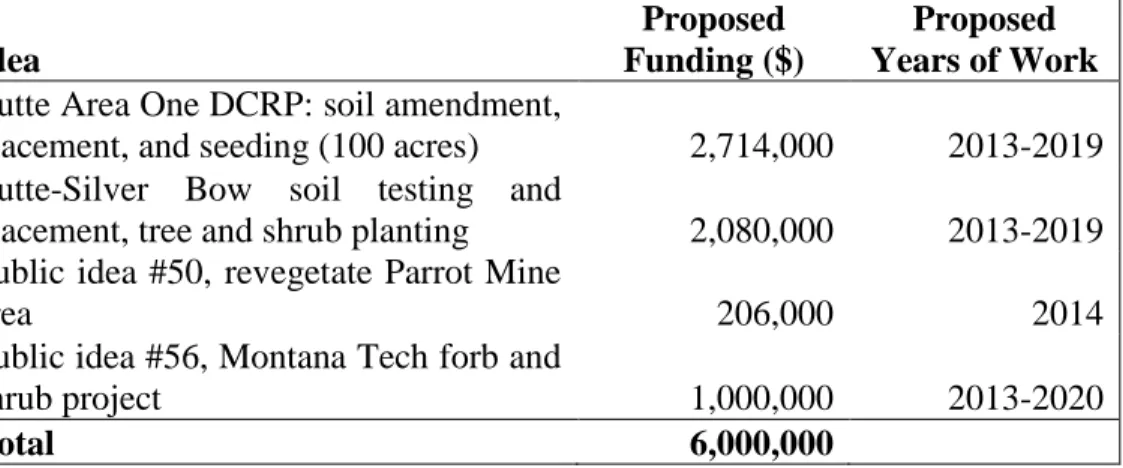
A total of 11 waste area improvements/revegetation project ideas were received from the public in April of 2012. These are areas where waste was left in place and covered under the Superfund remedy. Also, the NRDP proposed conducting a sizable restoration effort for the waste covers in its 2007 BAO Draft Conceptual Restoration Plan; and likewise, the local government submitted a “Butte Tree Planting Project” to the BNRC in February of 2012. Below is a description of the 13 proposed ideas to revegetate and/or improve waste areas that have various depths of soil covers.
In the 2007 Draft Conceptual Restoration Plan, the NRDP proposed placement of up to 12 inches of growth medium (topsoil, fertilizer, compost, mulch and/or other soil amendments) on previously un-reclaimed or poorly reclaimed waste sites that are protected from future development (areas designated by Butte-Silver Bow County as “open space”). This project involves placement of growth medium and a diverse seed mix on approximately 100 acres. This
plan identifies several discrete areas within the Butte Priority Soils Operable Unit that comprise the 100 acres and provides detailed cost estimates for performing the work.
Butte-Silver Bow’s proposal calls for testing soil properties and potentially adding soil to increase the depth up to 24 inches to make it more suitable for planting forbs and shrubs. Up to 48 inches of soil would be placed in areas for planting trees. Compost and other soil amendments would be used where needed to enhance soil properties to promote plant growth. Mature trees would be planted and a diverse seed mix would be applied to complete revegetation in open space areas on Butte Hill and in Butte Area One.
Public idea #4 involves revegetating a community park at Britannia Boulevard. The park grounds are situated on the reclaimed workings of the Britannia Mine and currently do not support healthy vegetation. This project calls for covering the disturbed areas with growth medium; applying seed, fertilizer, and mulch; and, possibly planting sapling trees. This proposal could be coordinated with the revegetation and soil cover improvements components of the 2007 NRDP Conceptual Restoration Plan and proposed Butte-Silver Bow tree planting project.
Public ideas #14, 15, 23, and 59 all propose a combination of planting trees, shrubs, native grasses, and forbs in reclaimed areas, fields and parks, and in other un-reclaimed areas. Some areas could also require soil amendments to promote plant growth. The Missoula Gulch area was noted as one particular area in need of restoration efforts. Most of these projects have significant overlap with the revegetation and soil cover improvements components of the NRDP Conceptual Restoration Plan and with the tree planting project proposed by Butte-Silver Bow. Both the NRDP restoration plan and the Butte-Silver Bow tree planting project are more fully developed as conceptual restoration projects; therefore, the more general project ideas will not be considered as stand-alone ideas, but rather they could be incorporated into one of the two major revegetation plans.
Public idea #39 was to plant trees and shrubs in McGruff Park. The proponent noted that the park is 2.3 acres, but only 15 trees are present. The proponent proposed planting 30 to 50 additional trees and perimeter shrubs and hedges. It was also observed that this proposal could be coordinated with the tree planting project proposed by Butte-Silver Bow, with a focus on restoration rather than beautification. This project was sponsored by Northwestern Energy and implemented by the Urban Forestry Board and volunteers in September 2012.
Restoration project idea #50 proposes planting native aspen, Swedish Aspen, and flowering shrubs on a 6.26 acre tract of land owned by Butte-Silver Bow, Montana Resources, and ARCO. The tract of land is the approximate south slope of the reclaimed Parrot Mine dump. Nearly 5,000 native aspen, 376 Swedish aspen, and an unspecified quantity of shrubs as seed would be planted over a three year period. Montana Resources and ARCO would be asked to fund the plantings on their respective properties. There is a nearby water supply, and the project sponsor proposed the installation of a water delivery system for tree watering. This restoration effort could possibly be coordinated with the tree planting project proposed by Butte-Silver Bow. The proponent, however, does suggest a discreet area for the work and a specific mix of trees designed to produce a visual context for historical Finntown, which would need to be limited to restoration only.
Public idea #56 was submitted by personnel at Montana Tech and proposes ten years of funding for an active demonstration project titled “Restoring Native Plant Diversity in the Upper Clark Fork Basin.” The initial demonstration project was funded by the NRDP using Upper Clark Fork River Basin settlement funds in 2008. This proposal asks for a continuation of that effort for 10 more years. Key components of the proposal included continued maintenance of a forb orchard, production of forb sods, collection of seeds, and expansion and maintenance of greenhouses for plant overwintering. The forbs and forb products (seed and sod) would be planted on reclaimed waste areas on the Butte Hill and within Butte Area One to stabilize soils and reduce potential sediment transport. The greenhouse and forb orchard are located on the Montana Tech campus. This proposal was also submitted to the NRDP for consideration as an UCFRB terrestrial project.
Public idea #64 proposes to plant native grasses, plants, and trees in an open space area behind Hillcrest Elementary School. This proposal could also be coordinated with the revegetation and soil cover improvements components of the NRDP Conceptual Restoration Plan and with a tree planting project proposed by Butte-Silver Bow.
Public idea #72 is a University of Montana proposal promoting native plant diversity in the BPSOU through planting diverse and weed resistant mixes of native species and by applying biochar and solarization weed control methods. Similar to public idea #56, this project proposed establishing a forb orchard and utilizing greenhouses to start plants for replanting at locations within Butte Area One and on the Butte Hill. Missoula, Montana is the proposed location for the forb orchard and greenhouse trials. The forbs and seed produced by these facilities would be used to maintain existing demonstration plots. University of Montana requests funding over a ten year period beginning in 2013. This idea has significant technical similarities to public idea #56, but its out-of-town location makes it less cost effective than idea #56.
Public idea #81 is a demonstration project for developing soil-free grass, forb, and shrub mats. The mats would compare three different seed sources, including seed produced by Montana Tech. The project goal is to commercialize plant mats for establishing metals/acid tolerant native plant communities. This idea overlaps with Public idea #56 for restoring native plant diversity. Because it overlaps with Public idea #56 for restoring native plant diversity, and because it does not have the established performance record of idea #56, public ideas #72 (University of Montana native plant diversity proposal) and #81 (development of vegetation mats) will not be considered further in this restoration plan as stand-alone project ideas.
2.3 Stream Restoration
A total of 11 ideas related to stream/water features restoration were received during the public solicitation process. Five additional ideas were generated by Butte-Silver Bow and by the BNRC. Below is a summary of those 16 proposed stream restoration ideas.
Public idea #13 would use water from the Basin Creek Reservoir to provide increased flows in Silver Bow Creek for the purpose of improving the fishery. The Butte-Silver Bow Water Utility Division has gone on record that they plan to build a water treatment plant for the
Basin Creek system, so it is unlikely that this source of water could be used to augment in-stream flows for Silver Bow Creek; therefore, this idea will not be considered further in this restoration plan.
Public idea #30 is to construct a storm water retention pond in the Silver Bow Creek stream channel just before its confluence with Blacktail Creek. The retention pond would be maintained as a small recreational fishing pond. The BNRC and the NRDP believes there will be additional remedial actions in the area proposed for this idea. In light of that potential conflict, this idea will not be considered further in this restoration plan.
Public idea #36 involves replacing culverts with a bridge where the Pony Express Trail crosses over Browns Gulch Creek just north of Ramsay. The streambed in this area would also be restored. The project location is over five miles downstream from Butte Area One. Given that the restoration needs in Butte Area One far exceed the funds available, the BNRC developed a policy criterion that gives preference to projects that directly impact the injured resources of Butte Area One; therefore this project, as well as others with no direct ties to this injured area, will not be considered for implementation using BAO restoration funds.
Public idea #42 would implement recommendations from the “2005 Silver Bow Creek
Watershed Restoration Plan” (NRDP, 2005) and the “2009 Current Status of Blacktail Creek,
Recommendations for Habitat Improvement, and Suggested Implementation Plan” funded by the
Mile High Conservation District & City-County of Butte-Silver Bow. This project would implement recommendations from the 2009 study which analyzed a 6.3 mile section of Blacktail Creek from the Nine Mile to the northern end of the Butte Country Club golf course and the Interstate 15/90 crossing. The study examined opportunities for improving substrate quality, improving stream flow conditions, addressing fish barriers, improving land use practices, increasing woody plant densities within the riparian corridor, and physically manipulating the channel. The goals of future projects were to reestablish Westslope Cutthroat Trout fishery, enhance in-stream flows, and contribute to a functioning stream channel and habitat system. The study produced two primary recommendations: to improve historical diversions of the creek, and to coordinate the varied land management practices of the 70-plus landowners along this stretch of the creek. The project would also provide public access to portions of Blacktail Creek owned by Butte-Silver Bow by constructing a trail and an interpretation system beginning at the north end of the Butte Country Club and continuing south to connect with the Continental Drive Trail near the High Altitude Speed Skating Center.
Public idea #47 would restore the Blacktail Creek (a.k.a. Bell Creek) through Father Sheehan Park to a pre-disturbance condition. This idea is considered an extension of the Blacktail Creek restoration ideas #42, so it will not be considered as a stand-alone restoration idea.
Public idea #52 would restore a portion of Horse Canyon Creek adjacent to Farrel Street. This creek section is on the northern side of Farrel Street, beginning at Texas Street and continuing along Continental Drive to Grand Ave. This reach is approximately 1.5 miles and historically it was a tributary to Silver Bow Creek. The upper reaches of Horse Canyon Creek are currently cut off by the Continental Pit. Re-routing of surface water through this area will be
addressed under the Mine Flooding Consent Decree. Contaminated soil and sediment in Horse Canyon Creek streambed from Texas Avenue to the Montana Resource’s guard shack is being addressed by remedy under the 2011 Unilateral Administrative Order issued by the EPA. Because of the pending remedy and response action, this idea will not be considered further in this restoration plan.
Public idea #58 would help restore Silver Bow Creek to a natural fishery which supports salmonids, benthic organisms, and aquatic insects. Water quality would be improved by diverting water from the top reach of Silver Bow Creek above Moulton Reservoir to the lower reach at Texas Avenue or by discharging Silver Lake water to Silver Bow Creek at Texas Ave. The concept of increasing flows in Silver Bow Creek using Moulton Reservoir drainage or Silver Lake water conflicts with municipal water supplies and other water. Also, the Mine Flooding Consent Decree will address diversion of surface water around the Yankee Doodle Tailings Pond once current mining operations cease. Therefore, this idea will not be considered further in this restoration plan.
Public idea #61 would restore Basin Creek along its reach through the airport authority property at Bert Mooney Airport. The project would eliminate areas where Basin Creek floods on airport property. Based on BNRC’s policy criterion that gives preference to work in BAO and limited funding, this project will not be considered further in this restoration plan as a stand-alone project idea. Improvements in this reach of Basin Creek that may directly benefit Blacktail Creek and Silver Bow Creek in Butte Area One such as increased in-stream flow and reduced sedimentation are considered a sub-component of other Blacktail Creek restoration ideas.
Idea #73 submitted by Butte-Silver Bow is a proposal to study the maximum feasible beneficial public use for surface and near-surface water bodies in and around Butte Area One. The study would involve evaluation of water bodies through a study of soil toxicity, ground and surface water toxicity, property ownership, zoning and growth policy status, and potential site improvements. Maximum beneficial uses for each water body may include stream restoration, revegetation, mine waste removal, recreation, water systems improvements, and storm water controls. Water bodies and riparian areas would be evaluated through soil and water sampling and analysis of potential engineered improvements. Specific improvement recommendations for each water body would be proposed at the end of the study.
Public idea #100 would involve restoration of approximately 1,300 feet of Basin Creek through the Butte Country Club. The Butte Country Club proposed to install a drainage system on hole #8 and to extend another drain system recently installed. Because of the new drains, the Butte Country Club believes that significantly increased flows would be expected in Basin Creek and that the creek channel and its banks will need to be altered or protected to reduce erosion. Based on BNRC’s policy criterion that gives preference to work in BAO and limited funding, this project will not be considered further in this plan as a stand-alone project idea. Improvements in this reach of Basin Creek that may directly benefit Blacktail Creek and Silver Bow Creek would be evaluated by public idea #42.
Idea #2 from the Silver Bow Creek Watershed Restoration Plan was to protect Yankee Doodle Creek from potential pollution sources and activities that may threaten water quality.
This idea received a “very high” ranking in the Watershed Restoration Plan. However, because the Mine Flooding Consent Decree and future response actions will address surface water upstream from the Yankee Doodle Tailings Pond once current mining operations cease, this idea will not be considered further in this plan.
Idea #4 from the 2005 Silver Bow Creek Watershed Restoration Plan also received a “very high” importance ranking and would support activities to protect Westslope Cutthroat Trout in the upper reaches of Basin Creek. The proposal would evaluate Westslope Cutthroat Trout habitat above Basin Creek Reservoir and in other parts of Basin Creek. The cutthroat trout fishery in upper Basin Creek is isolated from the lower watershed by fish passage barriers, and it is unlikely that this project would benefit the injured resources of Butte Area One. Because the BNRC policy criteria for restoration decision making gives preference to projects which directly benefit BAO injured groundwater and surface water resources, this idea will not be considered further in this restoration plan.
Idea #16 from the 2005 Silver Bow Creek Watershed Restoration Plan received a “high” importance ranking and would support activities to protect Westslope Cutthroat Trout in the upper reaches of Blacktail Creek. The proposal would evaluate Westslope Cutthroat Trout habitat and habitat improvement projects in Blacktail Creek. This idea is considered a sub-component of other Blacktail Creek restoration ideas; therefore, it will not be considered further in this restoration plan as a stand-alone idea.
Several of the public ideas for stream restoration involve revegetation and enhancing woody vegetation within the Blacktail Creek riparian corridor. The BNRC proposed incorporating a program to establish woody vegetation on portions of the Blacktail Creek, its smaller tributaries, and the Silver Bow Creek riparian corridors. This idea would complement other ideas for stream restoration involving pollution control and fisheries improvement.
2.4 Municipal Water System Improvements
The public submitted a total of three ideas with a drinking water supply component in March and April of 2012. Butte-Silver Bow also submitted a proposal for at least $10 million for a Basin Creek water treatment plant. The Butte-Silver Bow proposal is consistent with the Basin Creek Reservoir water treatment upgrade alternative detailed in the 2007 BAO Draft Conceptual
Restoration Plan and in the 2012 Butte-Silver Bow water system master plan update. Below is a
summary description of the five proposed ideas to incorporate a waste water or drinking water project into Butte Area One restoration alternatives. One project request was submitted for infrastructure improvements at the World Museum of Mining which did not meet the NRDP legal criteria and cannot be considered for restoration funding. The legal threshold criterion that a project must restore or replace the injured resources of alluvial groundwater and surface water in Butte Area One, or replace a lost service that the injured resource provided, was not evident in this proposal.
Public idea #8 would use Silver Lake water for Butte’s domestic water system. The use of Silver Lake water for municipal use was considered by Butte-Silver Bow in the 2012 Master Plan as an alternative, however, Butte-Silver Bow has chosen treatment of the Basin Creek water
supply to supplement municipal water needs with that of the Big Hole River water supply. A request for at least $10 million for a water treatment plant for Basin Creek Reservoir water was made to the BNRC in a presentation by the Butte-Silver Bow Chief Executive at the June 26, 2012 BNRC meeting. Because of the ongoing efforts for Basin Creek Reservoir water to be utilized as a municipal supply, the idea for use of Silver Lake water will not be considered further in this plan.
Public idea #31 is to build a treatment facility for the groundwater in Butte Area One. The treated groundwater would be used to increase flows in Silver Bow Creek and to irrigate parks or sports fields. Using groundwater to irrigate parks and sports fields would reduce demand on Butte’s domestic water system. Using existing groundwater to irrigate parks in Butte is also discussed in public idea #34. Capturing and treating alluvial groundwater in Butte Area One is the selected remedy in the EPA’s 2006 Record of Decision for the BPSOU. Therefore ARCO and the other BPSOU responsible parties are obligated perform this duty. Captured groundwater is treated with lime at the Butte Treatment Lagoons located in Lower Area One, and the cleaned water is discharged to Silver Bow Creek. Since this is a remedy issue, this idea will not be considered further in this restoration plan.
Public idea #34 is similar to public idea #40 in the small/miscellaneous projects category because it involves drilling wells and using groundwater to irrigate park lands, sports complexes, and other open spaces to reduce demand on Butte’s domestic water system. Like public idea #40, it will not be considered further.
Butte-Silver Bow is proposing to build a 7 million gallon per day treatment plant for Basin Creek Reservoir. Butte-Silver Bow’s Water Utility Division manager stated that additional water delivery capacity is currently needed for Butte to meet peak spring and summer demands and for possible future population growth. The project would consist of the design and construction of a new water treatment plant that employs a three step process. The raw water would be treated using enhanced coagulation for color, turbidity and Total Organic Carbon removal. The next step would be filtration for finished turbidity removal followed by disinfection using chlorine. The plant would be fitted with sludge removal and handling facilities. This proposal is documented as Alternative 1 in the 2012 Butte-Silver Bow Water
Master Plan and is consistent with the Basin Creek Reservoir water treatment plant upgrade
alternative detailed in the 2007 BAO Draft Conceptual Restoration Plan. NRDP determined that the project replaces lost surface water and groundwater, and is technically feasible since it may be accomplished with proven and readily available technologies. Given the range of alternatives for Butte water supply, it is also cost effective. Butte-Silver Bow Chief Executive Paul Babb requested funding for this project at the June 26, 2012 meeting of the BNRC with a follow up request in a letter dated July 3, 2012.
2.5 Storm Water Controls
A total of ten project ideas with a storm water component were received from the public as shown in Appendix A. Below is a summary description of the ten proposed ideas.