1
A Framework to Develop Content for Improving Agromet Advisories
M. Mahadevaiah, D. Raji Reddy, G. Sashikala, G. Sreenivas
Agro Climate Research Centre,
Acharya NG Ranga Agricultural University, Hyderabad, India. E-mail: [email protected]
P. Krishna Reddy, B.Bhaskar Redddy and K.Nagarani
IT for Agriculture and Rural Development Research Centre,IIIT Hyderabad (IIIT-H)-500032, India E-mail: [email protected]
L.S. Rathore, K.K. Singh, N. Chattopadhyay
India Meteorological Department, IndiaE-mail: [email protected]
ABSTRACT
India Meteorological Department (IMD) is providing Agro-meteorological Advisory Service (AAS) to Indian farming community through about 130 Agro Meteorological Field Units (AMFUs) spread all over India. Based on the weather prediction, the AAS bulletins are prepared and delivered by AMFUs twice in a week around the year. The AAS bulletins contain the possible risk mitigation steps for all the weather sensitive agricultural operations for the crops grown in the area/region of AMFU. The IMD is making research efforts to improve the quality of agromet bulletins. In this paper, after explaining the components of agromet bulletin, we propose the content development framework. The proposed content development framework allows the development of content related location-specific weather sensitive crop operations to improve the quality of agromet bulletins.
Key words:
agromet bulletin, risk management, farm management, extension serviceReference: M.Mahadevaiah, D.Raji Reddy, G.Sashikala, G.Sreenivas, P.Krishna Reddy, B. Bhaskar Redddy, K.Nagarani, L.S.Rathore , K.K. Singh, N.Chattopadhyay: A framework to develop content for improving agromet advisories. The 8th Asian Federation for In formation Technology in Agriculture (AFITA 2012), Taipei, September 3-6, (2012)
1. INTRODUCTION
India Meteorological Department (IMD) [1, 2]
is providing agro-meteorological advisory
bulletins, called agromet advisory bulletins, based on medium range weather forecast since 2007.
Agromet advisory bulletin is an agricultural advice bulletin given to the farming community for a
given region regarding weather sensitive agricultural operations besides weather based risk mitigation
measures on crop cultivation and livestock production. It is prepared by considering information about
weather prediction and existing crop/livestock condition. The agromet advisory information is very
much useful for the farming community and other stakeholders in agriculture.
Rathore and Maini [5] have discussed the process of agromert service and reported the impact
evaluation results. Krishna Reddy et al., [3] have explained the effort by IMD to develop an IT-based
agro meteorological system, called eAgromet, to improve the process of agromet bulletin process by
exploiting the developments in information and communication technologies.
In the ongoing system, a
group of interdisciplinary agricultural scientists under the leadership of agromet scientist prepare
agromet bulletin. As the preparation of agromet advice is human dependent, there is a possibility that
the quality of agromet bulletin varies based on the knowledge level of agricultural scientists including
agromet scientists. To improve the quality, in this paper, we propose a content development
framework. The content developed under the proposed framework becomes a referral resource for
2
agricultural/agromet scientists. It will also help in standardizing the process of preparation of agromet
bulletin.
2. OVERVIEW OF AGROMET ADVISORY SERVICE
In the year 1976, India Meteorological Department (IMD) has started Agro-Meteorological Advisory Service (AAS) in collaboration with Agriculture Departments of the respective State Governments. Currently, IMD is providing AAS service to Indian farming community through about 130 Agro Meteorological Field Units (AMFUs) spread all over India. At present national, state and district level agromet advisory bulletins are being issued. Further it is contemplated to provide agromet advisories at mandal/block level in the country in the near future. The agromet advisory bulletins provided by IMD are very unique and complement other efforts of improved agriculture technology transfer methods.
The process of agromet advice preparation involves four parts viz., weather forecast by IMD (input), preparation of agromet advisory bulletin, dissemination to stakeholders and feedback from stakeholders and scientists.
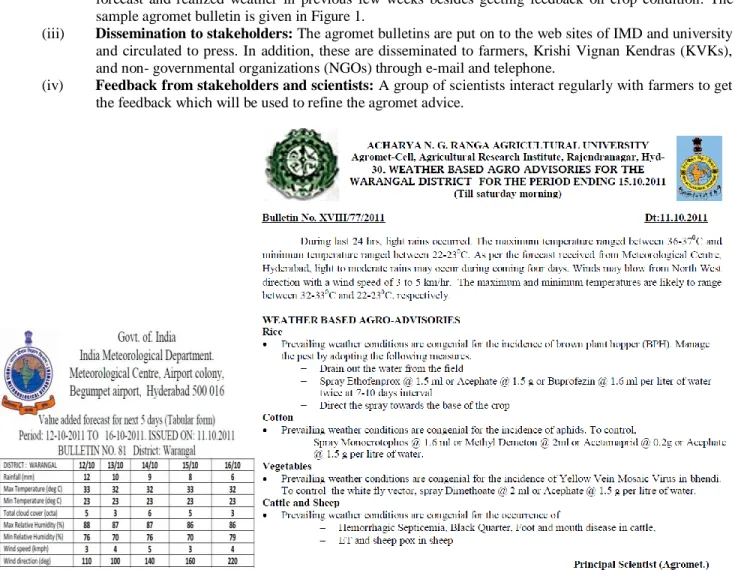
(i) Weather forecast by IMD (input): Twice in a week (Tuesday and Friday), IMD communicates the weather forecast for five days and each district to about 130 Agro Meteorological Field Units (AMFUs). Typical weather forecast is shown in Figure 1. It consists of predicted values for the following variables concerning each AMFU: minimum temperature (Tmin), maximum temperature (Tmax), relative humidity (RH), rainfall (RF), cloud cover (CC)/ solar radiation (SR), wind speed (WS) and wind direction (WD). (ii) Preparation of agromet advisory bulletin: The expert team at AMFUs consisting of scientists
from different disciplines prepares the agromet advisories for each district by analyzing the weather forecast and realized weather in previous few weeks besides geeting feedback on crop condition. The sample agromet bulletin is given in Figure 1.
(iii) Dissemination to stakeholders: The agromet bulletins are put on to the web sites of IMD and university and circulated to press. In addition, these are disseminated to farmers, Krishi Vignan Kendras (KVKs), and non- governmental organizations (NGOs) through e-mail and telephone.
(iv) Feedback from stakeholders and scientists: A group of scientists interact regularly with farmers to get the feedback which will be used to refine the agromet advice.
3
3. COMPONENTS OF AGROMET ADVISORY BULLETIN
The agromet advisory bulletin basically contains information on weather: current and past
week; crop information and weather based advisories.
i. Agro Meteorological Field Unit (AMFU) details: It contains the following details: Agro climatic region viz., state, district, mandal/block/sub set of micro level agro climatic region, date of forecast and advice valid period.
ii. Weather Deviation Summary: Weather deviation summary of the preceding weeks of realized weather or since last bulletin (till forecast date) and predicted weather of next 5 days (after the forecast received date) which includes salient weather features like heavy rain, cyclones, depressions, freezing temperatures etc., have to be closely spelled out for the knowledge of interdisciplinary team of scientists to suggest risk mitigation measures in the agro advisories.
iii. Weather-based agro advisory
For major crops of the concerned region, the following kinds of advices are provided.
Crop planning advice: How the weather influenced the choice of crop. Information on crop planning, selection of proper sowing/harvesting time etc. and any other crop husbandry operations are to be included.
Crop management advice: The phenophase of the crop is identified. The weather-based agromet advisory is prepared by considering how the change in the weather could influence field preparation, sowing/planting, irrigation scheduling, fertilizer application, weed management, pest and disease incidence, virulence and their management operations, harvest and post-harvest handling of crop produce etc.,
Crop management under malevolent weather: The advisories contain possible mitigation steps for extreme weather events such as extreme temperatures, heavy rains, floods, and strong winds etc. It should contain special steps for taking appropriate measures for saving the crop from malevolent weather.
(iv) Weather-based live stock advisory: How the weather influences the livestock health (poultry, cattle and buffaloes) and the corresponding management steps.
4.0 CONTENT DEVELOPMENT FRAMEWORK
4.1 Importance of Content Development
Agriculture being is location and site specific,
the preparation of agromet advisory bulletin is a
complicated task.
Similarly the affect of weather on the crops vary based on location. Farming
practices vary spatially and temporally with respect to weather conditions.
Region specific crop related
content development has become an important input to enhance the weather based agro advice delivery
system.
It is better to support agromet expert with the specific content which contains weather
dynamics on the crop developed by eminent experts.
In addition,
a new agromet scientist is unable to deliver effective and more focused agromet
advisories due to lack of knowledge about location specific crop weather relationship. In addition, a
scientist may not have expertise about the influence of weather on all crops and the same crop in
several regions.
This content support framework serve as referral to agricultural scientists including agromet
scientists and provide the information about region specific agro climatology of the crop and
contingency crop management practices to mitigate extreme aberrant weather situations. This content
helps to reduce the effort of local agromet scientist while preparation of agromet advisory bulletin and
it was developed to provide weather related agro advisories which are location and crop specific.
4.2
Proposed Content Development Framework
4
The content development framework should be such that it is easy to develop, learn and apply.
The content regarding weather-based dynamics on the crop mainly constitutes the following aspects:
crop related information and weather-based influences on the crop. In addition, the agriculture is
location-specific. So overall the process of content development can be divided into following parts:
crop-related information, weather-based influences on the crop, and region-specific crop and weather
related dynamics. In addition, the content should be developed by considering malevolent weather.
Overall, given a crop, we have divided the process of content development into four parts.
General overview of the crop, agro-climatology of the crop, region-specific agro-climatology of the
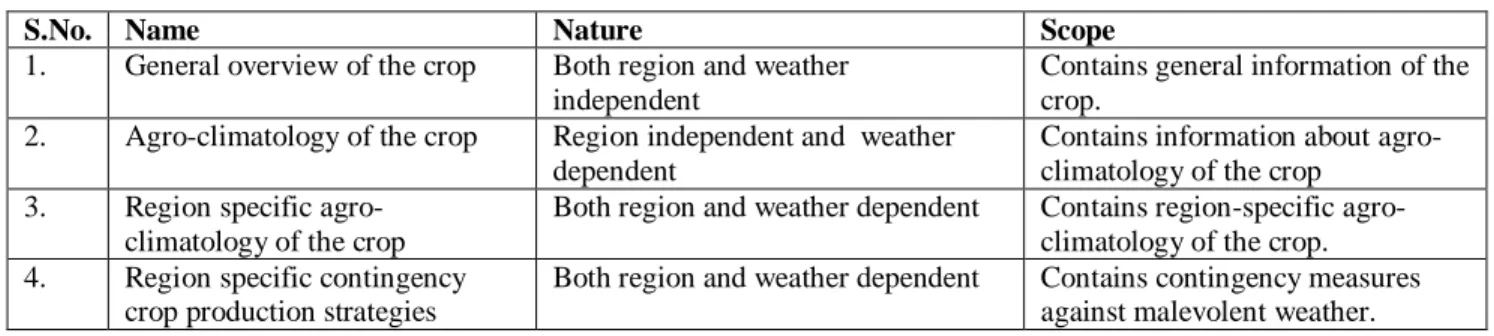
crop and region-specific contingency crop production strategies. The nature and scope of each
document is given in Table 1. We discuss the overview of the contents of each part.
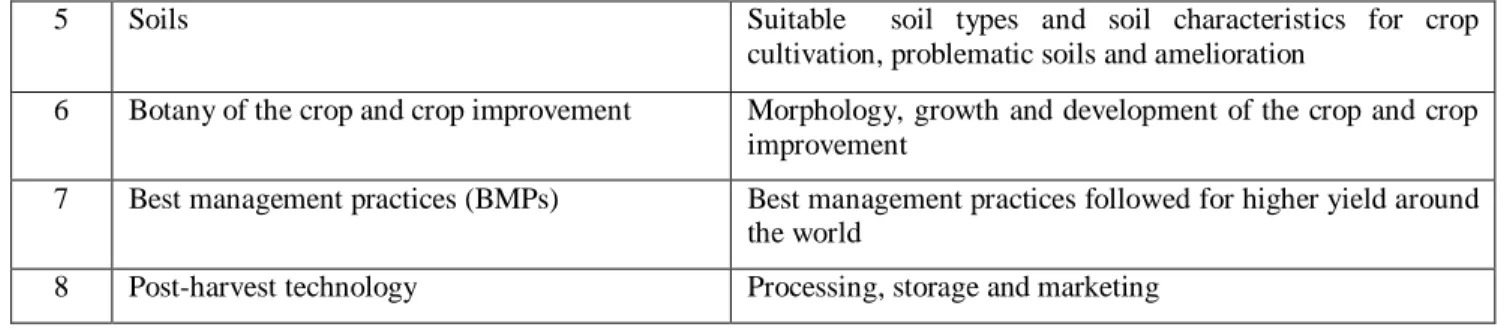
(i) General overview of the crop: It contains general information about area, production, productivity of the crop, suitable climate, season and soils, botany of the crop and crop improvement, best management practices (BMPs) followed for higher yield and post-harvest technology. The contents and the corresponding description are given in Table 2.
(ii) Agro-climatology of the crop: It contains information about optimum climatic conditions, effect of weather elements on crop growth and pests (insect pests, diseases and weeds). It also contains about crop and pest management practices. The information about agro meteorological services available for crop production will be provided. The contents and the corresponding description are given in Table 3.
(iii) Region specific agro-climatology of the crop: It contains information about weather conditions experienced in the region, main crop growing seasons, characteristic features of weather elements during crop growing season, climatic constraints, farming situations and farming situation based advisories. The contents and the corresponding description are given in Table 4.
(iv) Region specific contingency crop production strategies: It contains information about alternative crops, contingency crop management practices and effects of extreme weather events. The contents and the corresponding description are given in Table 5.
Table 1: Four parts of content development framework
S.No. Name Nature Scope
1. General overview of the crop Both region and weather independent
Contains general information of the crop.
2. Agro-climatology of the crop Region independent and weather dependent
Contains information about agro-climatology of the crop
3. Region specific agro-climatology of the crop
Both region and weather dependent Contains region-specific agro-climatology of the crop. 4. Region specific contingency
crop production strategies
Both region and weather dependent Contains contingency measures against malevolent weather.
Table 2: General overview of the crop
S.No. Name of the topic Description
1 Common names and Scientific name Crop common names and scientific name
2 Introduction Origin and spread across the world, important crop growing regions in the world and importance of the crop
3 Area, Production and Productivity of the crop Summary of World wide production
4 Climate and Season Favorable weather conditions (Temperature, Rainfall, Relative Humidity, Sunshine hours etc.) for crop growth and development, cropping seasons, Ecosystems/Crop Ecology, Crop adaptation, Cropping pattern and Crop rotation
5
5 Soils Suitable soil types and soil characteristics for crop cultivation, problematic soils and amelioration
6 Botany of the crop and crop improvement Morphology, growth and development of the crop and crop improvement
7 Best management practices (BMPs) Best management practices followed for higher yield around the world
8 Post-harvest technology Processing, storage and marketing
Table 3: Agro climatology of the crop
S.No. Name of the topic Description
1. Potential crop growing regions Agro climatic conditions in the potential crop growing regions in the world, country/region
2. Optimum climatic conditions Optimum climatic conditions required for better crop growth, yield; pest and disease, weed suppression in India
3. Effect of weather elements on crop growth
Individual and combined effect of weather elements on crop growth and development during different phenophases of crop growth including land preparation to post harvest handling of the produce
4. Effect of weather elements on pests
Individual and combined effect of weather elements/parameters on incidence, virulence/suppression of crop insect pests, diseases and weeds
5. Crop management practices Crop management practices under various crop growing situations/ regions 6. Pest management practices Pest management practices under various crop growing environments/
regions
7. Agro meteorological services Agro meteorological services available for crop production in the world
Table 4: Region specific Agro climatology of the crop
S.No. Name of the topic Description
1. Crop name Common names and Scientific name
2. State and agro climatic zone Respective region comes under which State and agro climatic zone 3. Crop statistics Area, Production and Productivity of the crop in the region/state 4. Overview of weather conditions Overview of weather conditions experienced in the region 5. Crop growing seasons Main crop growing seasons in the region/state
6. Characteristic features of weather elements
Characteristic features of weather elements during crop growing seasons/periods
7. Climatic constraints Region specific climatic constraints and their impact - Phenophase wise individual and combined effect of weather parameters on crop growth and development and also incidence, virulence/suppression of pests (insect pests, diseases and weeds
8. Farming situations Various crop growing situations/environments in the region 9. Farming situation based
advisories
6
Table 5: Region specific contingency crop production strategies
S.No. Name of the topic Description
1. Alternative crops Choice of crops and varieties under aberrant rainfall and other weather situations in main crop growing seasons
2. Contingency cop management practices
Contingency cop management practices to mitigate extreme aberrant weather situations (to some extent) in a given crop at different phenophases of crop growth
3. Effects of extreme weather events
Effects of extreme weather events like delayed onset of monsoon, prolonged dry spells, early recession of monsoons; severe droughts; floods; water logging; heat wave; cold wave; cyclones; typhoons; tsunami; hail storms etc at different phenophases of crop
5. SUMMARY AND CONCLUSIONS
The agromet advices under AAS of IMD contain risk mitigation suggestions about crop planning and management. The agriculture is location-specific. For preparing quality agromet bulletin, we should have a content with location specific weather sensitive crop dynamics. We have made an effort to develop a framework to prepare such content. The proposed content development framework reduces the effort of agromet scientist for preparing agromet bulletins. The agromet bulletins can be prepared in a focused and comprehensive manner by covering all the aspects of risk mitigation measures caused by weather aberrations, which are region and crop specific. The developed content helps to standardize the process of preparation of effective region specific agromet advisory bulletin.
The content under the proposed framework is easy to develop, learn, and apply. Once developed, it acts as a ready made reference to agromet scientists which need to be updated from time to time based on the new technologies developed. In that, general overview of the crop and agro-climatology of the crop contents are same for all AMFUs, but, each AMFU should develop specific agro-climatology of the crop and region-specific contingency crop production strategies for their respective regions. We have developed the corresponding contents by considering rice and cotton crops of North and South Telangana agro-climatic zones and found that the content developed under the proposed framework reduces the effort of local agromet scientists besides enabling focused agromet bulletins preparation. The IMD with the cooperation of all state agricultural universities and ICAR institutes should make efforts to develop content for all the crops and regions of India under the proposed framework. The scientists of each AMFU should develop region specific crop weather relationship content bulletins to act as reference material. The IMD should also build an information system to provide the contents to all the stakeholders in an online manner.
ACKNOWLEDGEMENTS
The work is carried out as a part of the research project entitled “eAgromet: ICT-enabled Integrated Agro-Meteorological Advisory System” funded by India Agro-Meteorological Department.
REFERENCES
[1] Agro-Meteorological Advisory Service (AAS), http://www.imd.gov.in/services/agromet/agromet-advisory-services.htm, July 2012.
[2] Andhra Pradesh Agromet Advisory Services, http://agromet.ap.nic.in/, 25 July 20012.
[3] eAgromet: An IT-based Agro-Meteorological Advisory System, http://eagromet.in, , 25 July 2012.
[4] Krishna Reddy, P., Bhaskar Reddy, B., Gowtham Srinivas, P., Satheesh Kumar, D., Raji Reddy, D., Sreenivas, G., Rathore, L.S., Singh, K.K., Chattopadhyay, N., (2012), ‘eAgromet: An Overview of the Architecture, International Conference on Geospatial Technologies and Applications (geomatrix2012)’, 26-29 February 2012, Mumbai, India. [5] Rathore.L.S and Parvinder Maini, (2008), ‘Economic Impact Assesment of Agro-Meteorological Advisory Service of
NCMRWF’ Report No. NMRF/PR/01/2008, 104pp, Published by NCMRWF, Ministery of Earth Sciences, Government of India.