Calhoun: The NPS Institutional Archive
Theses and Dissertations Thesis Collection
2012-06
From Progressive to Flat: How Tax
Reform would Affect the Military
Singleton, Major L.
Monterey, California. Naval Postgraduate School
NAVAL
POSTGRADUATE
SCHOOL
MONTEREY, CALIFORNIA
MBA PROFESSIONAL REPORT
From Progressive to Flat:
How Tax Reform would Affect the Military
By: Major L. Singleton, II
June 2012
Advisors: David Henderson Jeremy Arkes
REPORT DOCUMENTATION PAGE Form Approved OMB No. 0704–0188
Public reporting burden for this collection of information is estimated to average 1 hour per response, including the time for reviewing instruction, searching existing data sources, gathering and maintaining the data needed, and completing and reviewing the collection of information. Send comments regarding this burden estimate or any other aspect of this collection of information, including suggestions for reducing this burden, to Washington headquarters Services, Directorate for Information Operations and Reports, 1215 Jefferson Davis Highway, Suite 1204, Arlington, VA 22202–4302, and to the Office of Management and Budget, Paperwork Reduction Project (0704–0188) Washington DC 20503.
1. AGENCY USE ONLY (Leave blank) 2. REPORT DATE June 2012
3. REPORT TYPE AND DATES COVERED
MBA Professional Report
4. TITLE AND SUBTITLE From Progressive to Flat: How Tax Reform would Affect the Military
5. FUNDING NUMBERS 6. AUTHOR(S) Major L. Singleton, II
7. PERFORMING ORGANIZATION NAME(S) AND ADDRESS(ES)
Naval Postgraduate School Monterey, CA 93943–5000
8. PERFORMING ORGANIZATION REPORT NUMBER
9. SPONSORING /MONITORING AGENCY NAME(S) AND ADDRESS(ES)
N/A
10. SPONSORING/MONITORING AGENCY REPORT NUMBER
11. SUPPLEMENTARY NOTES The views expressed in this thesis are those of the author and do not reflect the official policy or position of the Department of Defense or the U.S. Government. IRB Protocol number ______N/A________.
12a. DISTRIBUTION / AVAILABILITY STATEMENT Approved for public release; distribution is unlimited
12b. DISTRIBUTION CODE
A
13. ABSTRACT (maximum 200 words)
This thesis provides a quantitative analysis of the impact of a flat tax rate on military members. The flat tax-rate proposal is the most popular alternative to our progressive tax system. The foremost experts on this topic are Robert E. Hall and Alvin Rabushka. They have made several claims regarding the flat tax; however, insufficient research has been conducted to determine the impact of the flat tax rate on the income of military members. This thesis will address the claims of Hall and Rabushka and provide a quantitative analysis of the effect of a flat tax rate on military members of various pay grades.
14. SUBJECT TERMS Flat Tax, Tax Reform, Progressive Tax 15. NUMBER OF PAGES 83 16. PRICE CODE 17. SECURITY CLASSIFICATION OF REPORT Unclassified 18. SECURITY CLASSIFICATION OF THIS PAGE Unclassified 19. SECURITY CLASSIFICATION OF ABSTRACT Unclassified 20. LIMITATION OF ABSTRACT UU
NSN 7540–01–280–5500 Standard Form 298 (Rev. 2–89)
Approved for public release; distribution is unlimited
FROM PROGRESSIVE TO FLAT:
HOW TAX REFORM WOULD AFFECT THE MILITARY
Major L. Singleton, II, Lieutenant, United States Navy
Submitted in partial fulfillment of the requirements for the degree of
MASTER OF BUSINESS ADMINISTRATION from the
NAVAL POSTGRADUATE SCHOOL June 2012 Authors: ____________________________________ Major L. Singleton, II Approved by: ____________________________________ David R. Henderson ____________________________________ Jeremy Arkes _____________________________________ William R. Gates, Dean
FROM PROGRESSIVE TO FLAT:
HOW TAX REFORM WOULD AFFECT THE MILITARY
ABSTRACT
This thesis provides a quantitative analysis of the impact of a flat tax rate on military members. The flat tax-rate proposal is the most popular alternative to our progressive tax system. The foremost experts on this topic are Robert E. Hall and Alvin Rabushka. They have made several claims regarding the flat tax; however, insufficient research has been conducted to determine the impact of the flat tax rate on the income of military members. This thesis will address the claims of Hall and Rabushka and provide a quantitative analysis of the effect of a flat tax rate on military members of various pay grades.
TABLE OF CONTENTS
EXECUTIVE SUMMARY ...1
I. INTRODUCTION...3
II. BACKGROUND AND LITERATURE REVIEW ...7
A. HISTORY OF THE INCOME TAX ...7
B. HISTORY OF THE FLAT TAX ...12
C. ARGUMENTS FOR HALL AND RABUSHKA’S FLAT TAX ...17
D. ARGUMENTS AGAINST HALL AND RABUSHKA’S FLAT TAX ...20
III. METHODOLOGY ...23
IV. THE IMPACT OF THE FLAT TAX RATE ON MILITARY MEMBERS ...29
V. RECOMMENDATIONS AND CONCLUSIONS ...59
LIST OF REFERENCES ...61
LIST OF FIGURES
Figure 1. Hall and Rabushka tax form (1981) ...13
Figure 2. Progressive income tax comparison...15
Figure 3. Notable flat-tax related proposed legislation ...17
Figure 4. Individual wage tax form ...27
Figure 5. U.S. Individual income tax form 1040 (Johnson) ...31
Figure 6. Individual wage tax form (Johnson) ...32
Figure 7. U.S. Individual income tax form 1040 (Washington) ...35
Figure 8. Individual wage tax form (Washington) ...36
Figure 9. U.S. Individual income tax form 1040 (Ashton) ...39
Figure 10. Individual wage tax form (Ashton) ...40
Figure 11. Figure 11: U.S. Individual income tax form 1040 (Goslar) ...43
Figure 12. Individual wage tax form (Goslar) ...44
Figure 13. Figure 13: U.S. Individual income tax form 1040 (Turner) ...47
Figure 14. Individual wage tax form (Turner) ...48
Figure 15. U.S. Individual income tax form 1040 (Ryan) ...51
Figure 16. Individual wage tax form (Ryan) ...52
Figure 17. U.S. Individual income tax form 1040 (Kessler) ...55
LIST OF TABLES
Table 1. Historical highest marginal tax rates...10
Table 2. Military base pay chart 2012...24
Table 3. Federal income tax rate ...26
Table 4. Summary of key parameters ...27
Table 5. Tax payment with flat tax rate applied to Adjusted Gross Income ...57
LIST OF ACRONYMS AND ABBREVIATIONS
AGI Adjusted Gross Income
AL Alabama
BAH Bachelor Allowance for Housing BAS Bachelor Allowance for Subsistence
CAPT Captain
CPO Chief Petty Officer
D Democrat
DFAS Defense Financial Accounting System
EGTRRA Economic Growth and Tax Relief Reconciliation Act ERTA Economic Recovery Tax Act
FSA Family Separation Allowance
IRS Internal Revenue System
LCDR Lieutenant Commander
LT Lieutenant
MHA Military Housing Area
MO Missouri
OBRA Omnibus Budget Reconciliation Act OCOLA Overseas Cost of Living Allowance PO1 Petty Officer First Class
PO2 Petty Officer Second Class
R Republican
Ret Retired
SA Seaman Apprentice
TDY Temporary Duty
TRA Tax Reform Act
ACKNOWLEDGMENTS
I would like to thank my Lord and Savior, Jesus Christ, for the many blessings that he has given me. You are the creator of all that is good and perfect and I am nothing without you. Thank you for your mercies being new every morning, for directing my path, and for giving me the strength and ability to perfect that which you have placed in my heart. For every mountain you’ve brought me over and for every trial you’ve seen me through I give you praise. Thank you for orchestrating people, circumstances, and events to bless me.
To my beautiful wife, Cheryl: Thank you for your unswerving support of me. Convincing you to marry me is my single greatest accomplishment. Thank you for being my life partner, a wonderful mother to our children, and my soul mate. You keep me focused and grounded, and you are the perfect mate.
To my sons, Keane, MJ, and Aiden: Keane, you are a joy to my heart and a constant inspiration for me to be the man that you need to see. I am proud of you and the young man that you are becoming. MJ, your smile and playful attitude brightens my day and you bring happiness and joy situation. I am blessed that God has entrusted your development to me. Aiden, I can’t wait to meet you. Thank you for not coming into the Earth early and giving me an opportunity for finish this thesis. I promise to be the father that you need me to be.
To my advisors, Dr. David Henderson and Dr. Jeremy Arkes: Thank you for helping me through this process and giving me your time and energy. Your realistic insights into economic, political, and world matters are thought provoking and evoke critical thought. If I ever pursue a career in politics and I need someone to validate my beliefs, Dr. Henderson, you will be the first person I call and if I need to figure out what those Democrats on the other side of the aisle could possibly be thinking, Dr. Arkes, I know you’re just a phone call away. Again, thank you!
EXECUTIVE SUMMARY
Robert Hall and Alvin Rabushka are the foremost experts and advocates of switching to a flat tax-rate system in lieu of our progressive tax system. In their book, The Flat Tax, they claim that “adopting the flat tax would improve the overall performance of the economy. Housing and charitable giving would flourish. Everyone’s after tax income would rise” (Hall & Rabushka, 2007). But, as this study shows, a flat tax would substantially increase income taxes paid by enlistees and officers in the U.S. Navy. In fact, moving to a flat tax would increase the effective tax rate of seven fictional members by an average of 9.4 percent.
This impact on military members is mostly due to the fact that up to 50 percent of the military members’ income is not taxed. A significant portion of each military member’s pay is received in allowances. These allowances provide housing, food, and incentive pay for each member, dependent upon their years of service and pay grade. Under Hall and Rabushka’s proposal, all income above the personal exemption would be taxed at the same rate, regardless of the source. This means that allowances that are received tax free under the progressive tax system would be added to the tax basis of each member and taxed at a 19 percent marginal rate.
The largest impact was seen on military members at the lower end of the rank structure (lowest income) with zero dependents. Military members with personal and rental property also saw an increase in their tax rate because under the Hall-Rabushka plan, rental income must be reported but taxpayers are not allowed to deduct the interest rate on mortgages. Military households with a relatively high income saw an increase in their effective tax rate, but the increased burden would likely not be as significant because of their relative ability to pay. The flat tax rate proposed by Hall and Rabushka would most certainly mean an increase in tax burden for people in the military unless special provisions are put in place.
I.
INTRODUCTION
Tax reform is one of the most debated topics in our society. Many complain that the wealthy bear a disproportionate amount of the tax burden while others complain that the wealthy do not pay enough. President Barrack Obama has made this discussion a staple of his fiscal platform by introducing the Buffet Rule. It is named after the second-richest man in America, Warren Buffet, whose net worth is approximately $39 billion (Forbes). Its intent is to prevent millionaires and billionaires like Buffet from paying a lower tax rate than some of those in the middle class, as Buffet claims he did. The president has advertised this rule as being fair; however, the definition of fair is different depending on the perspective of the advocate or critic. There are those who do not believe it is fair that 47 percent of Americans pay no federal income tax (Williams, 2009). This contributes to the argument that the poor and middle class do not pay enough and they have “no skin in the game” concerning how government allocates funds.
The largest portion of the United States government’s discretionary budget funds national defense. When considering economic theory and the willingness to pay, it certainly seems logical that those with the highest income should pay the most in taxes in terms of absolute dollars. Citizens with a high income level are those who have the most assets and would lose the most in the event of a lapse in defense; therefore, they should be willing to pay the most in taxes. However, many wealthy citizens typically argue against raising their taxes. This means that they prefer to keep their money rather than pay more for national defense and many other things that the U.S. government spends on.
One of most popular proposals for tax reform is the flat rate tax. It proposes that every person pay an equal percentage of his or her income in taxes. While this proposal is attractive to some, little research has been done to determine the impact of a flat tax rate on military members. One of the little known benefits for military members is the relatively low percentage of the member’s income that is subject to taxation by the federal government. The Federal government does not tax military allowances. Table two (2) of the Armed Forces Tax Guide (Publication 3) states that allowances should not be
included in the service member’s taxable income. The genesis of this treatment is Chapter 26 of the United States Code – Section 134, which specifically states:
Gross income shall not include any qualified military benefit. In general the term ‘qualified military benefit’ means any allowance or in kind benefit which is received by any member or former member of the uniformed services. (U.S. government, 2011)
According to the IRS, an allowance is viewed the same as a reimbursement or a “benefit-in-kind”; a term often referred to as a perk. These allowances, which include Basic Allowance for Housing (BAH), Overseas Cost of Living Allowance (OCOLA), Basic Allowance for Subsidies (BAS), and Family Separation Allowance (FSA) can account for more than fifty percent of a military member’s income.
The Basic Allowance for Housing (BAH) enables military members to live off base comfortably and comparably to their civilian counterparts. The military works with officials in the Military Housing Area (MHA) to determine the median cost of rent in the respective area. BAH is calculated based on the rents within a one-hour commute of the assigned military base. The BAH rate is based on a service member’s pay grade, dependency status, and location. It can range from $1,100/month for an E-4 in the Norfolk, Virginia, area to $3,000/month for an O-7 in San Diego, California. To determine the actual rate paid to each pay grade, the military looks at how civilians in a comparable pay grade live. BAH is not expected to cover the cost of owning a home. It is intended to cover to cost of renting a home, including utilities and renters’ insurance. (DTMO, 2011) The IRS does acknowledge that many service members do use their BAH to purchase a home. Publications 3 states, “You can still deduct mortgage interest and real estate taxes on your home if you pay these expenses with your BAH” (Department of the Treasury, 2010).
BAS is given to the service member to offset the cost of meals. This allowance is adjusted based upon the increase of the price of food as measured by the USDA food cost index. The BAS is adjusted annually and is currently set at a monthly payment of $239.96 for officers and $348.44 for enlisted personnel. FSA of $250/month is awarded to service members who, because of a military assignment, are not able to live with their
dependents. These reasons can include situations where a member is on a ship deployed away from its homeport for 30 days or longer, the member is on TAD (temporarily assigned duty) for 30 days or more, or the member is assigned to an area where dependents are not authorized. OCOLA (Overseas Cost of Living Allowance) is a cost of living allowance that is given to members who reside outside the contiguous United States for the purpose of a military assignment. The amount the member receives is based on rank, time in service, and the geographic location where the member is stationed.
In most flat tax proposals, all military allotments will be taxed; therefore, the effective and marginal tax rate of military members could increase significantly. In addition to these allowances being taxed, the child tax credit, earned income tax credit, and the home interest deduction could be eliminated. This could create higher taxes for many families. This thesis provides a quantitative analysis of the tax burden placed on military members due to a flat tax rate.
II.
BACKGROUND AND LITERATURE REVIEW
A. HISTORY OF THE INCOME TAX
When the colonists left England and settled in America, there was little concern for taxes in the new world. There were few public services (national defense, schools, highways, etc.) that needed to be funded by the government. This changed in the shift to frontier warfare during the French-American War. Land (2009) states that the high economic price of the Seven Years’ War provided the catalyst for America’s independence. Britain attempted to recoup the cost of the war by raising taxes on the colonies. The colonies eventually rebelled, leading to the Revolutionary War.
During the revolution, the Americans adopted many “British” policies at the state level. Initially, the colonies enacted an early form of the flat tax known as the head or poll tax. This was a tax levied on each adult. There was public objection to the poll tax because poor and middle income citizens were required to pay the same amount as wealthy citizens (as determined by the amount of land owned). Tax reformers then adopted a view that focused on citizen’s “ability to pay.” This belief focused on the notion that every citizen should pay taxes proportional to their income. Those with a high income would pay more in real dollars; however, they would still pay the same portion of their income as poor and middle income citizens. There were some wealthy citizens that supported the reform in an effort to relieve social tension; however, they were the minority among the affluent (Brownlee, 2004).
While taxation was normal at the state level, it was virtually nonexistent at the federal level. Requests for funding were sent to the states by the Continental Congress but the states rarely responded. This changed very little when the Articles of Confederation were penned in 1777. Article eight addressed national defense and public programs. In regards to taxes needed to fund wars and social initiatives, the article vaguely stated that “the taxes for paying that proportion shall be laid and levied by the authority and direction of the legislatures of the several States within the time agreed upon by the United States in congress assembled” (Mount, 2010). By the time the
Constitution was written, founders, specifically James Madison and Alexander Hamilton, were wresting with ideas for government as well as the debt left behind from the Revolutionary War. The Constitution was written to give the federal government more power to tax citizens than the Articles of Confederation did. Article 1 Section 8 gave Congress the authority “to lay and collect Taxes, Duties, imposts and excises, to pay the Debts and provide for the common defense and general welfare of the United States.” Furthermore, it gave Congress the power “to borrow money on the credit of the United States” (Mount, 2010).
Although these words were written by the founding fathers, there was not widespread agreement on how, when, or at what rate citizens should be taxed. Then, as well as today, citizens lied, cheated, and elected members to Congress who would support their interest and lower their taxes. Taxes were a common subject of contention amongst the general public. Political figures and authors in early America attempted to form public opinion about fiscal policy with books, articles, and other publications. Adam Smith argued in The Wealth of Nations that “the subjects of every state ought to contribute towards the support of the government, as nearly as possible, in proportion to their respective abilities.” While this wording may not raise too many eyebrows, Smith went on to state, “it is not very unreasonable that the rich should contribute to the public expense, not only in proportion to their revenue, but something more than in proportion” (Smith, 1990).
The Civil War brought with it a need to raise more government revenue than ever before. The demand for funds was so great in 1862 that the Union created the Office of the Commissioner of Internal Revenue to focus specifically on ambitious programs to raise taxes. The high tariffs and excise taxes that were so heavily opposed in previous years were accepted without resistance by a people that wanted to show their loyalty to the Union. For the first time in the nation’s history, a sales tax was placed on all consumer goods. This tax was regressive: those with a lower income paid a higher percentage of their income than those with a high income. The Republicans searched for a more equitable solution to this problem due to political pressure. In 1861, Representative Justin S. Morrill of Vermont introduced legislation for America’s first
income tax. The first income tax was essentially a flat tax rate of three percent of a person’s income above $800 (approximately $31,000 in today’s dollars). Over the next three years, the exemption amount would be decreased to $600 (approximately $18,000 in today’s dollars) and income over $5,000 (approximately $150,000 in today’s dollars) would be taxed at ten percent. This was very unpopular among the wealthy who supported the tax during the war but resented it afterwards. The war time taxes were eventually repealed and in the late 1890’s the government returned to its reliance on tariffs and excise taxes for revenue. Gordon (2011) writes:
In 1894, with Democrat Grover Cleveland in the White House and Democratic majorities in both houses of Congress, a federal income tax became law. The new tax, however, was very different from the Civil War income tax, which had exempted only the poor. The new tax hit only the rich, imposing a 2 percent tax on incomes above $4,000. Less than 1 percent of American households in 1894 met that threshold.
In the early 1900s, President Howard Taft determined a way to solidify the income tax in America history. He decided to include the provisions for an income tax as an amendment to the Constitution. The sixteenth amendment was ratified in February of 1913. It states that “the Congress shall have power to lay and collect taxes on incomes, from whatever source derived, without apportionment among the several States, and without regard to any census or enumeration.” After Taft left office, President Woodrow Wilson signed the personal income tax into law. The tax was graduated with the lowest rate set at one percent on incomes above $3,000 (approximately $70,000 in today’s dollars) and the highest rate set at seven percent on incomes over $500,000 (approximately $11,000,000 in today’s dollars); however, there were deductions which lowered American’s taxable income amount. Many of the deductions and exclusions that exist today were put in place by Congress in 1913 including the deduction for tax payments to state and local government, home interest deduction, and the exclusion on municipal bonds (Slemrod & Bakija, 2008). In 1917, Congress added the deduction for charitable contributions. The top marginal tax rate began at seven percent, but the rates didn’t stay this low for very long. By 1916, Americans with the highest income saw their marginal tax rate more than double to 15 percent (Table 1).
Table 1. Historical highest marginal tax rates (After Tax Policy Center, 2011)
With the expansion of the government’s role, the government wanted more revenue. In 1939, approximately 4 million people were required to pay income taxes. Congress knew that it needed to revise the method of collecting taxes in order to fund the upcoming war. Prior to 1943, citizens would report their income and then pay taxes due after the fact. During World War II, the United States government introduced employee withholding and remitting of income taxes, ensuring that the government would receive the taxes due with minimum evasion by citizens. The number of people paying income taxes rose from 4 million people to 43 million people. “Americans who earned as little as $500 (approximately $6,900 in today’s dollars) per year paid income taxes at a 23 percent rate, while those who earned more than $1 million (approximately $13,000,000 in today’s dollars) per year paid a 94 percent [marginal] tax rate” (Tassava, 2010). After the war,
Year Top Percentage Rate Year Top Percentage
Rate Year Year Year
Top Percentage Rate 1913 7 1931 25 1951 91 1971 70 1991 31 1914 7 1932 63 1952 92 1972 70 1992 31 1915 7 1933 63 1953 92 1973 70 1993 39 1916 15 1934 63 1954 91 1974 70 1994 39 1917 67 1935 63 1955 91 1975 70 1995 39 1918 77 1936 79 1956 91 1976 70 1996 39 1919 73 1937 79 1957 91 1977 70 1997 39 1920 73 1938 79 1958 91 1978 70 1998 39 1921 56 1939 79 1959 91 1979 70 1999 39 1922 56 1940 81 1960 91 1980 70 2000 39 1923 56 1941 81 1961 91 1981 69 2001 38 1924 46 1942 88 1962 91 1982 50 2002 38 1925 25 1943 88 1963 91 1983 50 2003 35 1926 25 1944 94 1964 77 1984 50 2004 35 1927 25 1945 94 1965 70 1985 50 2005 35 1928 25 1946 86 1966 70 1986 50 2006 35 1929 24 1947 86 1967 70 1987 38 2007 35 1930 25 1948 82 1968 75 1988 28 2008 35 1949 82 1969 77 1989 28 2009 35 1950 91 1970 71 1990 31 2010 35 2011 35 2012 35 Top Percentage Rate Top Percentage Rate
the marginal tax rate decreased but remained well over 80 percent. From 1950–1963 the rate topped out at 91 percent except in 1952 and 1953 where the rate was one percentage point higher (see Table 1).
The notion that Democratic presidents enact only tax policy that helps the poor at the expense of the rich is not true. In 1964 President Lyndon B. Johnson signed radical tax reform that would reduce the tax rate from 91 percent to 70 percent when fully implemented in 1966. The next big change in our tax system came in the 1980s during the administration of Republican President Ronald Reagan. Reagan campaigned on being fiscally conservative and promised sweeping changes to the tax code once in office. True to his word, in 1981 he signed into law the Economic Recovery Tax Act (ERTA). At the time, the top tax rate was 70 percent. ERTA would reduce the top rate to 50 percent by 1982. Additionally, it would decrease the other tax brackets by 23 percent over the next three years. This reduced the tax burden of high income earners and it relieved middle income earners as they had experienced bracket creep over the previous ten years. Inflation had slowly driven their incomes slightly higher and while they did not benefit from an increase in buying power, they were placed in a higher tax bracket and forced to pay higher taxes. ERTA went a step further by allowing for tax bracket increases based on inflation starting in 1985. Reagan would again reduce the top marginal tax rate in 1986. The Tax Reform Act (TRA) was designed to maintain the economic distribution of the tax burden across all income classes. The top marginal tax rate was again reduced, from 50 percent to 28 percent. This again heavily benefited high income citizens but the TRA also included provisions to raise the personal exemptions and standard deductions that benefited poor and middle income earners.
Just as the stereotype regarding Democratic presidents and taxes is not true, conversely, the notion that Republican presidents always enact tax policy to benefit high-income people is not always true. The 41st president of the United States, George Bush, campaigned on the phrase, “Read My Lips: No New Taxes,” but in 1990, he raised the tax rate from 28 percent to 31 percent. President Bill Clinton, as part of the Omnibus Budget Reconciliation Act of 1993 (OBRA-1993) increased the top tax rate to 39.6 percent and erased the efforts of the ERTA to reduce the tax burden on the highest
income earners. In 2001, when President George H. W. Bush took office he set his sights on the tax code. He re-established many of the tax provisions set in place by President Reagan. “The Economic Growth and Tax Relief Reconciliation Act (EGTRRA) featured substantial reductions in marginal income tax rates and the introduction of a new 10 percent rate (down from 15 percent) for low-income families” (Slemrod & Bakija, 2008). The top tax rate was set at 35 percent and remains at that level today; however, there are many complaints that the tax code is so convoluted and confusing that many Americans require a tax professional to ensure that they are in compliance.
B. HISTORY OF THE FLAT TAX
Many Americans respond to a flat rate tax proposal as if it is unprecedented although the first income tax America ever knew was flat. It was signed into law in 1861 by President Abraham Lincoln. Although the tax was later repealed, the administration of President Grover Cleveland signed the nation’s second flat tax rate into law in 1894. The two percent rate for income over $4,000 was later repealed because it was deemed unconstitutional in the landmark case Pollock v. Farmers’ Loan and Trust Co.
The flat rate tax has often been called unfair; however, many economists have argued that it is the most equitable tax for America. Sixty-eight years after the repeal the Cleveland Administration’s flat tax, renowned economist and Nobel Prize winner, Milton Friedman made a strong argument for a flat rate tax in his book Capitalism and Freedom:
All things considered, the personal income tax structure that seems to me best is a flat-rate tax on income above an exemption, with income defined very broadly and deductions allowed only for strictly defined expenses of earning income. An exemption, it seems to me, can be a justified degree of graduation. It is very different for 90 percent of the population to vote taxes on themselves and an exemption for 10 percent than for 90 percent to vote punitive taxes on the other 10 percent – which is in effect what has been done in the United States. (Friedman, 1962)
Although Friedman illustrated the effect of a 23.5 percent flat tax rate in his book, he did not specifically state that this is the flat tax rate that should be implemented.
Wall Street Journal in December of 1981. They proposed a 19 percent flat tax rate on all individuals and businesses, excluding families of four making less than $25,500. Their original article pointed out that:
Most income in the U.S. is compensation for work. In the proposed tax, compensation is broadly defined as anything of value received by workers from employer, including cash wages and salaries, the market value of fringe benefits and contributions to public and private pension plans. (Hall & Rabushka, 1981)
Hall and Rabushka’s plan had the following allowances: $5,000 for married couples; $3,000 for singles; $4,500 for single head of household; and $600 for each dependent. Their plan was incredibly simple and they heavily emphasized the fact that one could complete all of his or her taxes on a postcard (Figure 1). While their plan was simple, it would take another decade for politicians to catch on to their vision and introduce legislation for the tax reform.
Figure 1. Hall and Rabushka tax form (1981) (From Hall & Rabushka, 1981)
The flat tax rate movement began to pick up steam in the 1990s with seven different flat tax proposals by both Democrats and Republicans. The proposals began to vary significantly from Hall and Rabushka’s original idea in an attempt by the proponents
to make the plans more sellable to their political counterparts. The first was drafted by Governor Jerry Brown (R-CA) in 1992. This was part of Brown’s plan as he launched his candidacy for the Democratic presidential nomination. He called for a 13 percent tax on all personal and business income. Additionally, he advocated the repeal of the Social Security Tax. His plan did allow for exemptions for mortgage interest, rent, or contributions to charity. When House Majority Leader Richard Armey (R-TX) and Senator Richard Shelby (R-AL) drafted their 17 percent flat tax rate proposal in 1995, they proposed eliminating the exemption for home mortgage interest. Their plan did allowed standard exemptions of $13,100 for singles, $26,200 for couples and $5,000 for dependent children. Investment income would be taxed only at the corporate level.
Later that year, House Minority Leader, Richard Gephardt (D-MO) introduced a “hybrid” flat tax. He proposed a 10 percent flat tax for three fourths of Americans (those making $40,200 per year or less). The remaining quarter of American households would pay taxes based on a graduated system that would move up progressively, climaxing at a 34 percent rate for families making over $264,150. The mortgage interest deduction would remain but all others, including the exemption for charitable donations, would be eliminated. Senator Arlen Specter (R-PA) responded to Gephardt’s plan in the Wall Street Journal criticizing it for not being properly structured. He wrote:
A properly structured flat tax system – embodying one rate for all types of income, eliminates complexity and loopholes, and removes the burden of a second bite of taxation from savings and investments – represents the fairest kind of tax system for all Americans, particularly lower- and middle-class Americans. (Specter, 1995)
He went on to state that the flat rate needed to be 20 percent in order to maintain the revenue stream for the government. Specter again illustrated the problem with Gephardt’s and most flat tax rate proposals. They often vary from Hall and Rabushka’s plan in such a manner that they minimize the impact of a pure flat tax rate. While there has been a natural trend towards a flat tax rate, there has been insufficient political backing to pass it into law. The difference between the highest marginal tax rate and the lowest marginal tax rate has gotten “flatter” over time. Figure 2 shows how the slope of the line plotting the lowest tax rate to the highest tax rate of our tax system has changed
historically as viewed during six key points in our nation’s history: 1913, when the tax was first implemented; 1918, during World War I; 1944, during World War II; 1978, just ahead of the reform movement; 1988, after the implementation of the Tax Reform Act of 1986 (TRA); and today.
Figure 2. Progressive income tax comparison (From Teller, 2011)
The push for a flat tax rate continued in January of 1996 with two separate proposals. Republican Presidential Candidate Steve Forbes proposed a 17 percent flat tax rate with a standard exemption of $8,000 per person plus $5,000 for each dependent. Forbes’s plan did not allow exemptions for home mortgage interest or charitable contributions. The National Commission on Economic Growth and Tax Reform, led by Republican Representative Jack Kemp, proposed a single, low, flat tax but failed to specify a rate. Kemp independently said that he preferred a 19 percent rate which was in
line with Hall and Rabushka’s proposal. The panel vaguely recommended eliminating all deductions but did not state specifics regarding charitable contributions and the home mortgage interest deduction.
Senator Phil Gramm (R-TX) then proposed a 16 percent flat tax rate on all forms of income to include investment income. His plan allowed for deductions for mortgage interest and charitable contributions. He also would have allowed a $22,000 standard exemption for families and $5,000 for each dependent child. Gramm’s proposal was the last flax tax rate to be publicly debated until 2011 when four Republican presidential candidates all advocated a flat tax rate: Jon Huntsman, Rick Perry, Herman Cain, and Newt Gingrich. Herman Cain’s “9–9-9” plan called for an equal tax rate of 9 percent on income, sales, and corporations. Newt Gingrich stated that he would like to have an optional flat tax of “no more than 15 percent” where citizens could choose if they would like to file their taxes under the current progressive system or the flat tax-rate system. Huntsman and Perry did not release details for their plan before exiting the race for the Republican candidacy; however, Huntsman did state that he would like to see a “flatter, fairer, simpler tax code” and Rick Perry stated that he would like to see an optional 20 percent flat tax rate. For all the public advocating of the flat tax rate, the nearly routine congressional proposals have made little headway. This author would argue that the proposals are intended only to push an individual’s or a party’s political agenda closer to their ideal position with no real intention or belief that their proposals will survive congressional debate. Figure 3 shows the most notable flat tax rate proposals since 1994. Most of them never made it out of committee and none of them was fully implemented.
Figure 3. Notable flat-tax related proposed legislation (From Teller, 2011)
C. ARGUMENTS FOR HALL AND RABUSHKA’S FLAT TAX
One of the most important components in tax reform is measuring how reform affects incentives to work. Hall and Rabushka (2007) state that there is a consensus among economists that that all groups of workers would respond to the flat tax rate by raising their work effort. The current progressive tax code places a disproportionate burden on the highest income earners. This burden (theoretically) could stifle economic growth by potentially providing a disincentive for workers on the margin to work more. Under our current code, a person with a relatively high marginal tax rate has a disincentive to work more due to the amount of extra earnings he or she will keep after
taxes. Hall and Rabushka argue that reducing the top marginal tax rate from a 35 percent to 19 percent will create more hours of work for the economy. Furthermore, they make an argument for the most underutilized sources of our economy: married women.
There is no doubt about the sensitivity of married women to economic incentives. Studies show a systematic tendency for women with low tax wages and high-income husbands to work little. Those with high after-tax wages and lower-income husbands work a lot. It is thus reasonable to infer that sharply reduced marginal tax rates on married women’s earnings will further stimulate their interest in the market.
Actually, their inference is not the only one possible. They are changing three factors in their comparison, so the greater work for the latter group may be due to the higher wages for the women earn or the low income for the husbands. Another plausible inference is that low-wage women married to high-income husbands work little because the husbands’ incomes make that much easier to do and the wives’ incomes would not make much difference to the family income with or without high marginal tax rates.
However, some historical evidence supports Hall and Rabushka’s claim. Eissa (1995) analyzed how married women at or above the 99th percentile of income distribution responded to the TRA of 1986, which lowered the top marginal rate by 44 percent but lowered the marginal rate for lower income earners by a much lower percent. When compared to the control group, women at or below the 75th percentile, she found that high-income, married women increased their work hours after the TRA of 1986 went into effect. The elasticity of labor supply reported by Eissa, 0.8, is likely not relevant today as the responsiveness of married women has decreased over the past two decades. The elasticity is likely closer to 0.4 as found by Blau & Kahn (2006). Regardless of married women’s exact level of sensitivity to a net increase in wages, both studies support Hall and Rabushka’s contention that the labor supply of married women would increase if their marginal tax rate was reduced.
According to Hall and Rabushka, the full impact of the flat tax rate on work incentives may take up to seven years to be fully realized but they assert that the “bottom line is unambiguous” and their flat tax rate would have a favorable impact on total work effort. But some economists argue that Hall and Rabushka are ignoring counter-acting
effects that lower taxes could have on labor supply. People who see their marginal rate rise may work more in an effort to make up the difference. In this situation, the lower tax rate would have the opposite effect of reducing the incentive to work because a family could now afford to work less from being taxed less. Hall and Rabushka are also ignoring the fact that some people would pay a higher tax rate under their plan.
Another argument in favor of the flat tax rate is one of equity or fairness. A flat tax rate would ensure that each worker pays an equal portion of his or her income in taxes. All citizens would benefit from the exemption; however, the exemption would also ensure that the lowest income earners would not be taxed at all. With the Hall and Rabushka flat tax rate method applied, every citizen would pay 19 percent of his income above the exemption. Because of the exemption, no person would actually pay an effective tax rate of 19 percent. When the entire income of each person is considered, higher income citizens still pay an effective tax rate closer to the flat rate percentage of the tax while lower income citizens pay a lower effective tax rate. In this way the flat tax rate is progressive.
Another problem that would be eliminated with the Hall and Rabushka’s flat tax rate proposal is double taxation of people who own shares in corporations. Currently, corporations pay a 35 percent tax rate. After the corporation is taxed, dividends are received by shareholders and the individual must then pay personal income tax at rates up to 35 percent. The combined marginal tax rate on an individual in the 35 percent tax bracket is then 57.75 percent. (One dollar taxed at the 35 percent corporate rate nets 65 cents to the corporations. When this 65 cents is paid out in dividends to a taxpayer in the top 35 percent bracket, he nets 42.25 cents.) Although there are proposals that include dividends as income, under Hall and Rabushka’s proposal, corporations would pay a 19 percent tax rate and income from dividends would not be taxed as personal income. This way, double taxation for shareholders would be eliminated. Professor Jeremy Arkes argues that this would not necessarily reduce an inequity, as workers effectively are double taxed because corporate income taxes reduce their wages.1
The biggest bipartisan argument in favor of the flat tax rate is the decrease (if not elimination) in the amount of lobbying by special interest groups. The result is a tax code that is incredibly complex because of its heavily laden with loopholes. The flat tax would eliminate deductions, exemptions, and credits while reducing compliance costs and contributing to fairness. Additionally, deductions such as the mortgage interest deduction overwhelmingly favor high income tax payers. It should be noted that if these loopholes are eliminated, it will also affect low- and middle-income tax payers in the form of an increased tax burden. They would not receive deductions for pension benefits, employer-provided health care, mortgage interest, property taxes, or charitable contributions. D. ARGUMENTS AGAINST HALL AND RABUSHKA’S FLAT TAX
Possibly the biggest argument against the flat tax is that it would disproportionately benefit high income earners. This brings us back to the issue of equity or fairness. Lowering the top marginal tax rate from 39 percent to a flat tax rate of 19 percent (20 percentage points) would certainly mean that higher income earners would pay less in taxes while the relative tax burden would be shifted to middle income earners. This is because the elimination of loopholes, where high income earners “hide” their money, would be eliminated, but some of those loopholes (deductions, exemptions, and credits) overwhelmingly benefit low and middle income earners. Therefore, the flat tax rate would increase the tax rate that low income earners pay. The lowest tax rate is currently 10 percent. Enacting a 20 percent flat tax rate would nearly double the marginal tax rate paid by low income earners while decreasing the marginal rate paid by top income earners from 35 percent to 20 percent. Large basic deductions would lessen the impact on low income earners and further decrease the effective tax rate paid by high income earners. Inevitably, the burden of the income tax would be shifted towards middle income earners.
Another argument against Hall and Rabushka’s planned flat rate tax has to do with the elimination of the charitable contribution deduction. Under our current system, charitable contributions are deductible and result in nonprofit organizations giving significant aid to the poor and needy. Some theorize that a pure flat rate tax would actually decrease the amount that people give to charity, causing some organizations to
end operations and alienate the poor. Hall and Rabushka admit that this may be a temporary side effect of a flat tax but allege that “later, as the economy surges forward under the impetus of improved incentives for productive activity, giving will recover and likely exceed its current levels” (Hall & Rabushka, 2007). They go on to note that most charitable contributions are actually made by the wealthy to universities, symphonies, opera companies, ballets, and museums. Organizations supported by the socially elite are the leaders against reform that would eliminate charitable deductions. Churches or organizations that people perceived as worthy are likely to see little change in giving because most people who currently give identify an inherent good in them.
The home mortgage interest deduction is one of the many benefits that most Americans cite for owning a home. Under Hall and Rabushka’s plan, all interest deductions, including the home mortgage interest deduction, would be eliminated. Anti-flat tax advocates say that this would cripple the housing market and/or make owning a home unaffordable for most Americans. Hall and Rabushka “freely concede that there is a significant issue here.” They assert that in the long run, the price of homes is based on supply and demand. If the flat tax rate is enacted, the price of homes would be lower as the demand for homes would be lower. Additionally, Hall and Rabushka argue that as the demand for homes falls, interest rates on home loans would fall, thus increasing the amount demanded. In reality, this is a very narrow view of interest rates. It is possible that interest rates on homes remain the same or increase due to other economic factors, such as rapid economic growth. The authors also propose a transitional period in which the borrower may deduct 90 percent of the interest paid on a mortgage but the lender must treat 100 percent of the interest received as taxable income. The bank would have an incentive to renegotiate the mortgage in order to avoid paying taxes on the interest received. The borrower would forgo his or her right to deduct the mortgage interest in exchange for a lower mortgage.
Many people believe that a flat tax rate would decrease revenue for the government. One of the reasons that there is so much disagreement among proponents of the tax regarding the rate at which the flat tax rate should be set is that congressmen and economists are trying to predict government revenue at the proposed rate. If government
revenue decreases due to a flat rate tax, social programs that benefit the poor would be one likely target of cuts. This would further exacerbate the burden on low-income earners. Some also argue that the flat tax rate is not fixed and the need for increased government revenue over time would result in raising the rate. This would place further stress on low income earners who saw their marginal rates adjust from 10 percent to the initial flat tax to yet an even higher flat tax rate. High income earners who saw their marginal rates decrease from 35 percent to the original flat tax rate to yet a higher flat tax rate would not experience the same effect because the flat tax rate would still likely remain lower than their marginal rate under the progressive system.
Finally, there is the argument that reductions in the marginal tax rate for those with a high income do not benefit the economy as much as tax cuts targeted at the poor and middle class. This position was highlighted in December of 2010 after Congress reached a deal that would extend the Bush Tax Cuts for two additional years. The Economist stated:
The economic impact per dollar of revenue reduction from the full extension would be smaller than that from partial extension because a greater proportion of the tax savings from the full extension would go to relatively high income households, which tend to spend less of an increase in income than lower-income households do. (M.S., 2010)
According to the Keynesian model, the marginal propensity to consume is higher among the poor and middle class; therefore, tax cuts for low and middle income earners are more likely to result in higher aggregate demand. This assumes, of course, that people consume according to their current income. But, according to Milton Friedman’s permanent income hypothesis and Franco Modigliani’s life-cycle hypothesis, people’s consumption depends on their permanent (Friedman) or life-cycle (Modigliani) income.
III.
METHODOLOGY
The effective tax rate and marginal tax rate of each military member were computed under the current tax code. The effective tax rate is defined as the tax payment divided by total income while the marginal tax rate is defined as the tax rate paid on the last dollar of taxable income. The following parameters were used to determine the flat tax rate effect on each military member.
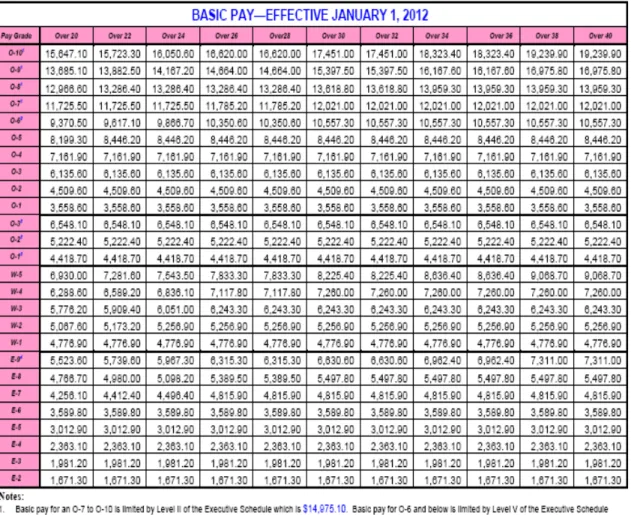
• Base pay is calculated using the 2012 pay charts as listed by Defense Finance and Accounting Service (DFAS) (Table 2).
• All seven sailors live in the same geographical region. BAH awarded to sailors vary based on the area in which they live; all sailors live in the largest fleet concentration area, Norfolk, Virginia.
• If a sailor is deployed to a combat zone, he or she receives Hazardous Duty Pay in the amount of $250 per month. Additionally, their pay while in the combat zone is not taxed. This would significantly affect the results of the study; therefore, the assumption is made that none of the sailors deployed to a combat zone during the year unless specifically stated.
• Active duty sailors received BAS and BAH as scheduled but did not receive any other allowances, incentive pay, medical pay, or career bonuses.
• Unless specifically stated, either members did not pay state taxes or their states did not require them to file state taxes in the previous year; therefore, there is no deduction for taxes paid to a state or local government.
• No member incurred moving or relocation expenses in the current year.
• Unless specifically stated, no members paid tuition fees or paid for books.
• No member made retirement contributions.
• Social Security Taxes are disregarded.
• All homes are assumed to be in Norfolk, Virginia and property taxes are $1.11 per $100 of the assessed value. (City of Norfolk Office of the Treasury, 2011)
• All members made charitable contributions. The amount was estimated based on the average contribution in each member’s AGI in accordance with Figure C of the IRS Statistics of Income Bulletin: Individual Noncash Contributions 2008. (Liddell & Wilson, 2011)
• All married service members filed “married filing joint.”
• The percentage of Navy personnel each member represents was
determined using the Department of the Navy’s Justification for Budget Estimates which outlines the number of people in each pay grade. (Department of the Navy, 2012)
Table 2. Military base pay chart 2012
The impact of changing from our progressive tax system to a flat tax-rate system as proposed by Hall and Rabushka is assessed by analyzing seven fictional members of the U.S. Navy.
• Seaman Apprentice (E-2) Johnson: He recently enlisted in the Navy. He is 18 years old, has no children and is single. He does not own a home and he made $2,157 in charitable contributions. Johnson represents approximately 5 percent of Navy personnel and 6 percent of Navy enlisted personnel.
• Petty Officer Second Class (E-5) Washington: She is single and she owns a home with a mortgage of $130,000 at 5.75 percent interest. She has been enlisted for eight years in the Navy. PO2 Washington made $1,913 in charitable contributions last year. Washington represents approximately 19 percent of Navy personnel and 23 percent of Navy enlisted personnel.
• Petty Officer First Class (E-6) Ashton: He is married to a stay-at-home mother and they have three children (ages 1, 3, and 5). He has been in the Navy for ten years. PO1 Ashton deployed to a combat zone last year; therefore, he received hazardous duty pay for each of the five months he was deployed and his income was not taxed during this five month period. He does not own a home and he made $1,913 in charitable contributions last year. Ashton represents approximately 14 percent of Navy personnel and 17 percent of Navy enlisted personnel.
• Lieutenant (O-3E) Goslar: He is married to a college professor who makes $80,000 per year. They have three children (ages 3, 6, and 10) and Goslar has been in the Navy for sixteen years. They own a home with a mortgage of $220,000 at 4 percent interest and made $4,644 in charitable contributions last year. Goslar represents approximately 6 percent of Navy personnel and 35 percent of Naval Officers.
• Lieutenant Commander (O-4) Turner: He is married to a stay-at-home mother and they have four children (ages 9, 11, 14, and 17). They own a home with a mortgage of $320,000 at 5.35 percent. Additionally, they own a rental property with a mortgage of $210,000 at 7 percent. The tenant pays $1,615.89 per month which covers the mortgage payment on the rental home. He has been in the Navy for twenty-six years and they made $2,075 in charitable contributions last year. Turner represents approximately 3 percent of Navy personnel and 20 percent of Naval Officers.
• Captain (O-6) Ryan: He is single and owns three homes. His primary residence has a mortgage of $380,000 at 4 percent. His two rental homes have mortgages of $130,000 and $90,000 at interest rates of 4.25 percent and 5 percent, respectively. The income received from the rental homes
naval service. He made $2,293 in charitable contributions last year. Ryan represents 1 percent of Navy personnel and 7 percent of Naval Officers.
• Retired Chief Petty Officer (E-7 (Ret.)) Kessler: He is married to a manager at a retail store whose income is $44,000 per year. They have two children (ages 17 and 18). During the tax year, they paid approximately $1,500 in tuition and fees to help their 18 year old daughter attend a local university. They are homeowners with no mortgage on their residence, which is valued at $250,000. He retired after twenty years of naval service and has no other source of income. They made $1,856 in charitable contributions last year.
All applicable forms of the IRS tax code, tax software, and the federal income tax table (Table 3) were used to determine the taxes due for each member based on the current tax code. A summary of taxes is displayed for each member on IRS U.S. Individual Income Tax Return Form 1040. Once the tax payment was computed under the current progressive tax system, the Individual Wage-Tax Form (Figure 4) from Hall and Rabushka’s The Flat Tax was used to document the tax payment if Hall and Rabushka’s version of the flat tax rate were enacted. Table 4 contains a summary of key parameters.
Table 3. Federal income tax rate (From Internal Revenue Service, 2011)
Figure 4. Individual wage tax form (From Hall & Rabushka, 2007)
Table 4. Summary of key parameters
Member Base Pay BAH BAS
Hazardous Duty Pay Spouse Income Rental Income Charitable Contributions Number of Children Mortgage Interest Paid Property Taxes Paid
SA Johson $20,056 $13,032 $4,181 N/A N/A N/A $2,157 0 $0 $0
PO2 Washington $34,142 $14,472 $4,181 N/A N/A N/A $1,913 0 $7,475 $1,443
PO1 Ashton $38,920 $20,052 $4,181 $1,250 $0 N/A $1,913 3 $0 $0
LT Goslar $76,349 $23,328 $2,676 N/A $80,000 N/A $4,644 3 $8,800 $2,442
LCDR Turner $85,943 $26,028 $2,676 N/A $0 $19,391 $2,075 4 $17,120 $5,883
CAPT Ryan $124,207 $22,392 $2,676 N/A N/A $19,222 $2,293 0 $15,200 $6,660
IV.
THE IMPACT OF THE FLAT TAX RATE ON MILITARY
MEMBERS
Seaman Apprentice (E-2) Johnson
Seaman Apprentice (SA) Johnson’s base pay or Adjusted Gross Income (AGI) totaled $20,055.60 for the year. SA Johnson also received BAH in the amount of $1,086.00 per month ($13,032 per year). In addition to his BAH being untaxed, he also received BAS in the amount of $348.44 per month ($4,181.28 per year) tax free. Johnson also benefits from the Federal Standard Deduction in the amount of $5,800 and he received a personal exemption of $3,700.
Figure 5 shows a summary of Johnson’s 2011 taxes. His taxable income totaled $10,555. When this amount is applied to Figure 4, Johnson pays 10 percent in taxes on the first $8,500 of his taxable income and 15 percent on the income above $8,500. This would mean that his tax payment would total $1,184. Under the current tax system Johnson’s effective tax rate is 5.79 percent and his marginal income tax rate is 15 percent.
Figure 6 illustrates the effect of Hall and Rabushka’s 19 percent flat rate tax rate on Johnson’s income. In contrast to our current system where BAH and BAS are not taxed, Hall and Rabushka consider all forms of income as wages; therefore, Johnson’s reported income would be $37,268.88 vice $20,055. His deductions under the progressive and flat tax-rate systems are exactly the same. Once the $9,500 deduction is subtracted from his tax basis, Johnson’s taxable compensation of $27,768.88 would be taxed at 19 percent. Assuming no withholdings by the federal government during the year, Johnson would owe $5,276.08 in taxes. That is an increase of over 340 percent. His marginal tax rate would rise from 15 percent to 19 percent and his effective tax rate would increase from 5.8 percent to 14.2 percent.
Figure 5. U.S. Individual income tax form 1040 (Johnson) (From Intuit, 2012)
Figure 6. Individual wage tax form (Johnson) (After Hall and Rabuska, 2007)
37268 88 00 37268 00 00 9500 00 00 00 00 9500 00 27768 88 5276 08 00 5276 08 SEAMAN APPRENTICE PERFECT APT NORFOLK, VIRGINIA MILITARY X
Petty Officer Second Class (E-5) Washington
Washington’s total pay base pay for the year is $34,142.40. Washington’s BAH payments for the year total $14,472 and, like Johnson, her BAS also totals $4,181.28. Under the current tax system, Washington itemized her deductions and deducted $1,913 that she made in charitable deductions; $7,475 she paid in interest on her home; $1,443 in property taxes; $388 in sales tax deductions; and she was able to take advantage of the $3,700 personal exemption. Figure 7 displays Washington’s tax summary under the progressive tax system.
Under Hall and Rabushka’s system (Figure 8), Washington would be able to subtract a personal exemption of $9,500 vice $3,700, but the benefits would end there. She would not be able to deduct her charitable contributions, interest on her home, or property taxes, or take advantage of the sales tax deduction. Additionally, Washington’s BAH and BAS would become part of her tax basis causing her taxable income to increase from $19,223 to $43,295. Her tax burden would increase 227 percent from $2,459 to $8,226.17. Washington’s marginal tax rate would rise from 15 percent to 19 percent and her effective tax rate would increase from 13.2 percent to 15.6 percent.
Figure 7. U.S. Individual income tax form 1040 (Washington) (From Intuit, 2012)
Figure 8. Individual wage tax form (Washington) (After Hall and Rabuska, 2007)
52795 68 00 52795 68 00 9500 00 00 00 00 9500 00 43295 68 8226 17 00 8226 17 PETTY OFFICER 1153 NEW HOME NORFOLK, VIRGINIA MILITARY X
Petty Officer First Class (E-6) Ashton
No member highlights the differences between the progressive system and the flat tax-rate system more than PO1 Ashton. His total base pay for the year is $38,919.60; however, he was deployed to a tax free combat zone for five months of the calendar year. This means that his tax basis is only $22,703.10. His BAH is $1,617 per month ($20,052 per year) and his BAS is $4,181.28 per year.
Under the progressive system, Ashton receives $18,500 in personal exemptions, $561 in sales tax deductions, and a standard deduction of $11,600, which brings his taxable income to zero. Ashton then takes advantage of tax credits intended to aid low income families although he actually made nearly $65,000. He receives the child tax credit in the amount of $2,955 and the earned income tax credit in the amount of $5,550. FIGURE 9 illustrates that after all of these deductions and credits in Ashton’s favor, he would receive a tax refund of $ 8,505.
Figure 9. U.S. Individual income tax form 1040 (Ashton) (From Intuit, 2012)
Although Ashton received a refund under the progressive system, his income taxes would reveal a different result under Hall and Rabushka’s system (Figure 10). His income for the year would be reported at $64,402, not $22,703. Although the total deductions and credits received under each system differ by only $100, it would appear that Hall and Rabushka’s method of counting all income as wages or salary regardless of the source significantly impacts Ashton. After Ashton deducts the allowances prescribed under the flat tax-rate system, he would be left with taxable compensation of $34,402 which would then be taxed at 19 percent. This would leave the family with a tax payment of $6,536.38.
The disparity between the two systems is quite significant. Under the progressive system, the Ashtons enjoyed a negative 13.2 percent effective tax rate while under Hall and Rabushka’s system they would experience a 10.1 percent effective tax rate. His marginal tax rate would spike from zero under the progressive system to 19 percent under the flat tax-rate system.
Figure 10. Individual wage tax form (Ashton) (After Hall and Rabuska, 2007)
64402 88 00 64402 88 16500 00 00 00 13500 00 03 30000 00 34402 88 6536 38 00 6536 38 PETTY OFFICER FIRST CLASS & WIFE
22O2 FULL HOUSE ROAD NORFOLK, VIRGINIA
MILITARY
Lieutenant (O-3E) Goslar
Lieutenant Goslar’s tax situation illustrates the impact on military members with a relatively high household income. His base pay for the year totals $76,348.80 ($6,362.40 per month) and his BAH is $1,944 per month or $23,328 per year. The Lieutenant’s BAS totals $2,676.48 annually ($223.04 per month). Additionally, LT Goslar’s wife is a professor at a local college and her income is $80,000 per year. Under the progressive system (Figure 11), their AGI is $156,349. Because they own a home, they itemize their deductions and subtract the mortgage interest on their home ($8,800), charitable donations ($4,644), $18,500 in personal exemptions, $2,442 in property taxes, and a sales tax deduction of $919 leaving them with a taxable income of $121,044. The child tax credit brings their taxes due down to $22,294. They are left with a marginal tax rate of 28 percent and an effective tax rate of 12 percent.
If their income were applied to the flat tax-rate system (Figure 12), they would see their deductions for charitable donations, mortgage interest, sales tax, and property tax disappear. The personal allowances would nearly double (from $18,500 to $30,000) but the total for all deductions and credits would decrease by 17 percent ($35,955 to $30,000). Their total tax payment would increase from $22,294 to $28,947.12 (30 percent) and although their marginal tax rate would decrease from 28 percent to 19 percent, their effective tax rate would increase from 12.2 percent to 15.9 percent.
Figure 11. Figure 11: U.S. Individual income tax form 1040 (Goslar) (From Intuit, 2012)
Figure 12. Individual wage tax form (Goslar) (After Hall and Rabuska, 2007)
182353 28 00 182353 28 16500 00 00 00 13500 00 03 30000 00 152353 28 28947 12 00 28947 12 LIEUTENANT & WIFE GOSLAR
682 ROLLING DOUGH NORFOLK, VIRGINIA MILITARY X PROFESSOR
Lieutenant Commander (O-4) Turner
Lieutenant Commander Turner’s base pay is $7,161.90 per month ($85,942.80 per year). His BAH is $2,169 per month ($26,028 per year) and his BAS is $2,676.28 per year. Recall that LCDR Turner owns two properties. One is his primary residence and the other is a rental property. Under the progressive system, he is allowed to deduct the interest on both homes from his AGI of $84,361. His deductions are $2,075 for charitable donations, $17,120 for mortgage interest on both homes, $22,000 in personal exemptions, $5,883 in property taxes, and $751 in sales tax deduction. His taxable income is $36,332. After deducting $3,000 in child tax credits, his tax payment is $1,631 (Figure 13).
The flat tax-rate system requires Turner to report all streams of income. Particularly impacting Turner is the requirement to report rental income while he is not allowed to deduct the loan interest from his taxes. Turner’s income would be reported much higher at $134,037.76. That’s an increase of 59 percent. Under the progressive system he receives $51,029 in deductions and credits; however, under the flat tax-rate system he receives only $35,400 in personal exemptions. The result is a dramatic increase in Turner’s tax payment from $1,631 to $18,912 (Figure 14). Turner would have $134,036 in total income, a 25 percent marginal tax rate, and a 1 percent effective tax rate. Switching to the flat tax-rate system would result in his marginal tax rate decreasing to 19 percent but his effective tax rate would increase from 1.2 percent to 14.1 percent.
Figure 13. Figure 13: U.S. Individual income tax form 1040 (Turner) (From Intuit, 2012)
Figure 14. Individual wage tax form (Turner) (After Hall and Rabuska, 2007)
134037 76 00 134037 76 16500 00 00 00 18000 00 04 34500 00 99537 76 18912 17 00 18912 17 LIEUTENANT COMMANDER & WIFE
1146 FREEDOM ST NORFOLK, VIRGINIA
MILITARY
Captain (O-6) Ryan
Captain Ryan’s total income for the year is $124,207.20 ($10,350.60 per month). His BAH is $22,392 per year ($1,866 per month) and his BAS totals $2,676.48 annually. Additionally, Captain Ryan receives income from two rental properties totaling $1,351.83 per month. Under the progressive system (Figure 15), Ryan deducts $2,293 in charitable contributions, $15,200 in mortgage interest, a $3,700 personal exemption, $6,660 in property taxes, and $620 in sales tax. This leaves Ryan with a tax burden of $21,138. His marginal tax rate is 28 percent and his effective tax rate is 13 percent.
Like LCDR Turner, CAPT Ryan receives rental income wherein he is required to report the income but he does not get the benefit of deducting the interest under the flat tax-rate system. According to Hall and Rabushka’s income reporting requirements, Ryan’s income under their system would be $165,497 vice $125,320. While Ryan would get $28,473 in deductions under the progressive plan, because he is single with no children, he would receive only $9,500 in personal exemptions. Again, the military member sees his reported income increase while seeing his deductions significantly decrease. The result for Ryan is an increase in tax payment from $21,138 to $29,639. His marginal income tax rate would decrease from 28 percent to 19 percent while his effective tax rate would increase from 12.8 percent to 18 percent.
Figure 15. U.S. Individual income tax form 1040 (Ryan) (From Intuit, 2012)