Business Process
Framework
Enhanced Telecom Operations Map ® (eTOM)
Addendum B
Release 7.0
GB921 Addendum B
TM Forum Approved Version 7.2
Notice
This document has been through review cycles, however, due to the inherent complexity in the design and implementation of software and systems, no liability is accepted for any errors or omissions or for consequences of any use made of this document.
Under no circumstances will the TM Forum be liable for direct or indirect damages or any costs or losses resulting from the use of this specification. The risk of designing and
implementing products in accordance with this specification is borne solely by the user of this specification.
This document is a copyrighted document of TM Forum. A company may make copies of this document (paper or electronic) for their own internal use but they must not distribute the document to any third party without the permission of the CTO of the TeleManagement Forum.
This document is governed by all of the terms and conditions of the Agreement on Intellectual Property Rights between TM Forum and its members, and may involve a claim of patent rights by one or more TM Forum members or by non-members of TM Forum. Interested parties should contact the TM Forum office to obtain notice of current patent rights claims subject to this document.
Direct inquiries to the TM Forum office: 240 Headquarters Plaza,
East Tower – 10th Floor,
Morristown, NJ 07960 USA Tel No. +1 973 944 5100 Fax No. +1 973 944 5110
Table of Contents
Notice ... 2
Table of Contents ... 3
List of Figures ... 5
Preface ... 6
eTOM Business Process Framework ... 6
1.Introduction ... 7
2.The emergence of E-BUSINESS within the ICT Market ... 8
2.1 What is e-business? ... 8
2.2 Implications of e-business for Service Providers ... 9
2.3 How can a Service Provider migrate towards e-business? ...10
2.4 A Conceptual Model for a Service Provider e-business ...11
2.4.1 Customer ...11
2.4.2 Service Provider ...12
2.4.3 Complementor ...12
2.4.4 Intermediary ...12
2.4.5 Supplier ...13
3.Main B2B initiatives and concepts ...14
3.1 Shared public process ...15
3.2 ‘Regulated’ versus ‘unregulated’ B2B ...16
3.2.1 B2B using Web pages ...16
3.2.2 Call centers ...16
3.3 RosettaNet Conceptual Model ...16
3.4 ebXML what is it? ...18
3.4.1 Introduction ...18
3.4.2 Concept...18
3.4.3. ebXML Technical Architecture ...19
3.4.4. ebXML Registry/Repository ...20
3.4.5 Elements of Immediate Interest ...20
3.5 What does eTOM need to address? ...21
4.Extending ETOM for Business to Business Interactions ...22
4.1 Modeling Regulated B2B Processes between instances of the eTOM ...22
4.2 eTOM extensions ...25
4.3 eTOM Public B2B Business Operations Map ...28
4.3.1 Relevance to B2B for the eTOM ...29
4.4 eTOM Public B2B Business Operation Map (ePBOM) ...30
4.4.1. B2B External Environment - Process components ...30
4.4.2. B2B Environment - Information Entities ...31
4.4.3. RosettaNet Business Operations Map (BOM) Overview ...32
4.4.4. Vertical Telecomm industry B2B Business Operations Map ...34
4.5 eTOM Public B2B BOM-Level 0 Process Area ...34
5.Summary ...37
6.1 Referenced Organizations ... 38
6.2 Citations ... 38
7. Annex A: Overview of RosettaNet and ebXML ... 40
7.1. Concepts ... 40
7.2. Defining public processes ... 40
7.3. The B2B Transaction Patterns ... 41
7.4. Binary Collaborations ... 41
7.5. General structure of a Business Transaction ... 43
7.6. Example Transaction Pattern – Request Response ... 45
7.7. Message Flows ... 45
7.8. Example Transaction Pattern – Notification ... 46
8. Annex B: B2B Terminology Used In This DOCUMENT ... 48
8.1. RosettaNet and ebXML terms ... 48
8.2. General e-Business Terminology ... 50
9.Annex C: RosettaNet Business Operations Map ... 54
10. Annex D: Acronyms ... 60
11. Administrative Appendix ... 62
11.1 About this document ... 62
11.2 Document Life Cycle ... 62
11.3 How to comment on this document ... 62
11.4 Document History ... 63
11.4.1. Version History ... 63
11.4.2. Release History ... 63
List of Figures
Figure 2.1 The Service Provider Conceptual Model for e-business 11
Figure 3.1 Concept of a public process 15
Figure 3.2 RosettaNet Conceptual Model 17
Figure 3.3 ebXML Concept 19
Figure 4.1 B2B Environment for modeling ICT Value Chain 23
Figure 4.2 eTOM B2B Reference Model 24
Figure 4.3 Mapping of ebXML Process Steps on eTOM Business Process Framework 28
Figure 4.4 eTOM Public B2B BOM – Public Processes 30
Figure 4.5 eTOM Public B2B BOM - Information 31
Figure 4.6 RosettaNet Business Operations Map - Clusters 33
Figure 4.7 RosettaNet Business Operations Map – Cluster 3 Order Management 34
Figure 4.8 eTOM Public B2B Business Operations Map Level 0 and 1 35
Figure A. 1 BPSS Model Business Transactions 42
Figure A. 2 From multipart Collaborations to Business Transactions 42
Preface
eTOM Business Process Framework
The eTOM Business Process Framework is a reference framework for categorizing all the business activities that a service provider will use. This is done through definition of each area of business activity, in the form of process components or Process Elements that can be decomposed to expose progressive detail. These process elements can then be positioned within a model to show organizational, functional and other relationships, and can be combined within process flows that trace activity paths through the business.
The eTOM can serve as the blueprint for standardizing and categorizing business activities (or process elements) that will help set direction and the starting point for development and integration of Business and Operations Support Systems (BSS and OSS respectively). An important additional application for eTOM is that it helps to support and guide work by TM Forum members and others to develop NGOSS solutions. For service providers, it provides a Telco industry-standard reference point, when considering internal process reengineering needs, partnerships, alliances, and general working agreements with other providers. For suppliers, the eTOM framework outlines potential boundaries of process solutions, and the required functions, inputs, and outputs that must be supported by process solutions.
1. Introduction
While eTOM is the global de facto Business Process Framework at the Enterprise Level for the Telecommunications Industry, specific process frameworks and good practice guides have also been developed for use between enterprises in other industries. Examples include the Supply Chain Council, RosettaNet, Electronic Business XML (ebXML) process frameworks and the Balanced Scorecard.
This document is part of a set of documents showing how the frameworks and best practices developed and used by other industry sectors can be used together with the eTOM Business Process Framework to provide a richer and more complete Enterprise Business Process Framework.
The key business problem addressed by this document is to provide an answer to the question:
‘What processes does an organization have to put in place in order to deliver automated Business to Business interfaces with its trading partners?’
The key business technical and business issue is:
‘How to define the internal processes within an organizations’ jurisdiction, and practically link them to public industry B2B processes defined by industry groups?’
This document introduces e-business, what it is, and the impact that its emergence is having on Service Providers.
A simple model is presented in Chapter 2 that helps clarify the main concepts that relate to e-business. Chapter 3 introduces some of the standardization related activities that have emerged in response to this phenomenon. Chapter 4 summarizes the main consideration in extending the eTOM Business Process Framework to support inter-enterprise integration using B2B.
2. The emergence of E-BUSINESS within the ICT Market
The application of the latest technologies is transforming access to information, which in turn is revolutionizing the ways enterprises can share the information, and can use it to interact with their customers and suppliers. This enhanced ability to share information is resetting customer expectations; and, as they experience and adapt to this new way of conducting business, with its improvements in both service and levels of control, they are becoming increasingly intolerant of enterprises that are incapable of delivering to these new standards.
In this new paradigm, success depends on creating new ‘product offerings and experiences’ in which customers see value. Value is now defined in terms of the whole customer experience including things such as fulfillment and repair times. Customers value one-stop shopping, selection choices, personalization of service, and the empowerment gained from self-service. The common denominator is making life easier, simpler and complete for the customer.
To meet and deliver against these new customer expectations, information-centric business designs have to be developed and investment in technology is required to support their implementation. Priorities include the need to integrate and share data with partners and suppliers to give both a better integration of the supply chain, and a unified approach to processes such as order entry, fulfillment delivery, support, and billing.
2.1 What is e-business?
E-business is understood as the interaction amongst business partners with the help of information technologies. It refers not only to buying and selling over the Internet (or other computer network), but also to servicing customers and collaborating with business partners.
The term e-business has often been interchanged with the term e-commerce. However, it is becoming increasingly accepted that the use of e-commerce should be restricted to referring to just the subset of web transactions (mainly business-to-consumer) which are used whilst buying and selling services and goods over the Internet.
An e-business enterprise is an enterprise that utilizes Internet and related technologies to compete effectively in its business space. The technologies enable it to act more efficiently and effectively by facilitating better customer interactions, streamlining interfaces with partners and suppliers and in general, improving the quality and competitiveness of their offerings.
E-business’s can be characterized as communities of complementary enterprises linked together to create unique virtual business entities that are easy to re-configure
in response to evolvingcustomer needs. The central theme of e-business becomes
the delivery of “value” by creating and utilizing end-to-end value streams that are based on an integrated and customer-centric technological foundation. Communities of complementary enterprises are tied by these streams and form an extended enterprise that is transparent to the customer.
A core focus for e-business is therefore on automating relationships between
enterprises1
In this document value network represents the end-end set of processes and transactions, established between the various suppliers and partners, to create, deliver, bill and support the “product” offered to the customer.
, in part, because relationships that were previously not possible, are now economically and technically feasible; but also because it also makes possible the streamlining and automation of the existing value network, resulting in significant productivity gains for all parties.
2.2 Implications of e-business for Service
Providers
As new technologies and markets emerge, enterprises have to adapt or die. Technologies affect customer needs, while customer needs influence business designs. As new business designs emerge, they affect processes. In turn processes influence customer expectation, and thus the demands on the next generation of technology.
In response to this new paradigm, it is imperative that enterprises integrate business activities, technology and processes. They must redefine the way in which they operate by using new technology-based business organizational designs and processes, creating new inter-enterprise processes, and integrating these with operational processes to support changing customer requirements. A Service Provider’s business management team has to understand what can be enabled by the application of technology to their business processes and then realize a strategy that can underpin the indicated transition. Failure to do so will result in an inability to meet changing customer demands, offerings that lack in quality and perception of value by the customers, and ever increasing costs. Competition from more agile and efficient rivals will lead to the enterprise’s demise.
The three principal reasons Service Providers must integrate e-business with traditional business processes are therefore:
Customer expectations and the need to move to an approach
that focuses on the management of Customer Relationships and the importance of improving customer retention and increasing the value customers attribute to the enterprise;
1
These methods may also be used to form relationships between organizational units within an enterprise where distinct business roles are performed, such as occurs between retails and wholesale businesses of a regulated Service Provider.
Productivity gains and the need to ensure that these can continue to be obtained; and
Provision of a broader range of products and services to
customers - this, for the Information and Communications Technology industry (more than almost any other industry) requires a focus on better collaboration between suppliers and partners and integration of the end-end processes.
The capabilities and performance requirements of the end-end processes required in an e-business environment are fundamentally different from those in a traditional business environment. An enterprise that is to transition successfully to e-business must determine the processes they implement based on criteria such as:
Their relevance to their customers’ needs;
The contribution they make to providing an integrated and unique
identity for the enterprise; and
How critical they are to the enterprise’s operational performance.
Other considerations that should influence process design include:
Exceptions should be handled excellently. I.e. process problems
are identified in real time, and actions to support the customer are taken real time;
Business rules should be easily configured and applied
automatically; and
The ability to treat a process as an asset that can be assessed,
replaced, and outsourced, as appropriate, to improve the operation of the enterprise.
2.3 How can a Service Provider migrate
towards e-business?
There are several alternative approaches to implementing e-business:
Some enterprises are managing e-business (and e-commerce)
aspects within separate units;
Some are overlaying e-business on traditional business
operations; and
Yet other enterprises are approaching e-business as a
replacement of traditional business channels.
The most successful e-business enterprises integrate e-business and traditional business channels where cost, quality and profit can be best rationalized. This requires much more than just throwing together a set of web pages to front-end an enterprise, although integrating storefront and Web operations is clearly a key part of the model for some enterprises.
The integration of e-business and traditional business channels is the model that is judged most applicable to Information and Communications Service Providers.
Undertaking such integration is typically a substantial exercise. The use of systematic Business Process Frameworks as a basis for structuring the existing business processes (intra-enterprise integration) can have major benefits as it makes it easier to implement and deploy automated e-business channels for inter-enterprise integration.
2.4 A Conceptual Model for a Service
Provider e-business
E-business involves increasingly complex networks of relationships.
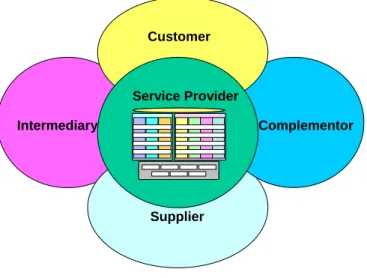
Figure 2.1 depicts the sets of relationship groupings involved in a value network in the ICT industry. The value network must operate with the efficiency of a self-contained enterprise, which requires managing the value network as an end-end process rather than only from the perspective of a single enterprise. The model explicitly shows the use of the eTOM Business Process Framework by the Service Provider at its core. It is only shown here to simplify the figure and its presence is not intended to imply that its use by the Service Provider is prescribed, just that the Service Provider would probably benefit from its use. Likewise, it is not intended to preclude the use of the eTOM Business Process Framework by the other entities shown within the value network. These entities may or may not make use of the eTOM Business Process Framework. Intermediary Supplier Complementor Customer Service Provider
Figure 2.1 The Service Provider Conceptual Model for e-business
The roles of the entities shown in Figure 2.1 - the Service Provider Conceptual Model for e-business - are described below.
2.4.1 Customer
The Customer is responsible for ordering, using and (usually) paying for the Service
Provider’s products. The Customer may represent an end Customer, where the product delivered by the value network is consumed, or a wholesale Customer that
resells the product provided, usually with some added value. Depending on the Customer’s activities, there may be a further refinement of this role as follows:
The Subscriber role is responsible for concluding contracts for
the Service Provider’s products subscribed to and for paying for these products.
The End User role makes use of the products.
2.4.2 Service Provider
The Service Provider presents an integrated view of their products to the Customer.
It is responsible for the contractual interface with the Customer to sell products to the Customer, provide the Customer with contact and support, and bill the Customer for the products supplied. The Service Provider can deliver some or all of a product to the Customer itself, or it might subcontract out provision of parts, or even all, of the product to other service providers while maintaining the Customer-facing role of the one-stop shop. The Service Provider is responsible for acting on behalf of the value network that it represents in relationships with Intermediaries as well as with the Customer.
2.4.3 Complementor
The Complementary Provider extends the product provided by the Service Provider and offers additional capability that the Service Provider is not itself offering to the Customer, i.e. it complements the product being provided by the Service Provider and adds value to it, but is not essential for provision of the product itself. It could act, for instance, as a specialist Content Provider to a Service Provider that is operating a mobile phone service. The Complementary Provider is in a partnership with the Service Provider and can enhance the Service Provider’s product to the Customer with its own products, thus making interactions with the Service Provider more attractive and convenient for the Customer. A business relationship between the Complementary Provider and the Customer may exist, depending on the nature of the product being provided and possibly on the business culture of the environment. Frequently, products offered by a Complementary Provider are co-branded.
2.4.4 Intermediary
The Intermediary supplies a service for a fee. For example, a localized selling function in a market where the Service Provider has a limited presence and/or understanding of, is a typical service provided by an intermediary. The service provided could be an information service enabling Customers to locate Service Providers most appropriate to their specific needs, or the provision of an environment in which providers can make their products known to Customers in an electronic marketplace or trading exchange (infomediary).
At a time of Internet globalization an Intermediary can play an important role as it can promote market transparency by overcoming the geographic constraints that used to
limit knowledge about the products available. Functional intermediaries provide a specific function, such as selling, electronic payment or authentication.
2.4.5 Supplier
The supplier interacts with the Service Provider in providing hardware, software, solution and services, which are assembled by the Service Provider in order to deliver its solutions or services to the Customer. The Service Provider is bounded by its Suppliers’ ability to deliver.
Note that individual enterprises can adopt multiple roles in different value networks and also multiple roles within a specific value network, e.g. one role as a retail Service Provider and another role as a wholesale Service Provider (often required by the regulator). For example a service provider may be the customer-facing service provider in one value network and a complementor or intermediary in another. In today’s fast-moving marketplace, these relationships can be very short-lived compared with the more static relationships of the traditional telecommunications market.
3. Main B2B initiatives and concepts
The idea of automating inter-enterprise business processes is not a new concept. The EDI (Electronic Data Interchange) standard, which has its roots in the 1970’s, represents the first generation of electronic business collaboration systems. Unfortunately it saw relatively limited adoption due to the complexity and cost of the software required to implement the standard.
Development of the Internet has brought new attempts at establishing e-business standards. One of the most successful is that of the RosettaNet consortium, formed in 1998, which provides open platform e-business standards in XML, allowing trading partners to exchange business information via the Internet. Originally the standard was designed for high-tech industry (IT and electronics), but the developed approach also started to serve as a model for other industries. The RosettaNet standards are being successfully implemented by a number of enterprises, e.g. Intel Corporation
has been an early adopter of RosettaNet2
Another approach for standardizing e-business world was prepared under the auspices of UN/CEFACT and OASIS and was named ebXML. It provides the technical basis of B2B interfaces. ebXML inherited concepts from both EDI and RosettaNet, but so far has achieved only partial support from the industry. Annex A provides a more detailed overview of both RosettaNet and ebXML.
.
Web Services developed by World Wide Web Consortium (W3C) are one of the newest initiatives on e-business. They represent a request/response type of communication with no business process semantics.
There is an ongoing discussion on how ebXML and Web Services are related. Most experts claim that these technologies are complementary. The main strengths of ebXML are in inter-enterprise business process integration, while the main advantage of Web Services is in location-independent integration of request/response type message services.
The following sections present the main concepts and definitions developed by the initiatives mentioned above, which impact the approach that single enterprises using the eTOM Business Process Framework need to consider, when also implementing inter-business processes.
2
3.1 Shared public process
Work by RosettaNet and ebXML have developed the concept of a shared public process to describe the business process framework developed to support inter-business or multi-inter-business processes.
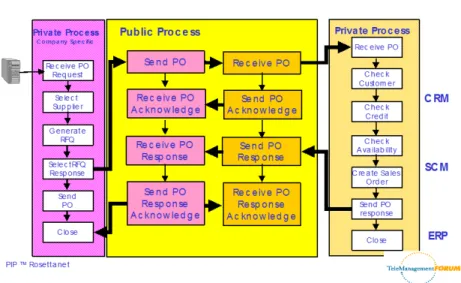
Figure 3.1 Concept of a public process
Figure 3.1 shows an example of a purchasing process. On the left side is a buyer that runs a set of private procurement processes, and on the right side is a seller that runs a set of private supply processes. In this definition, private is used in the context of processes operating within a single enterprise, and not made visible to other enterprises.
The buyer is concerned with selecting a supplier and prices, and the seller is concerned with selling and manufacturing products for supply (e.g. Supply Chain Management, Enterprise Resource Planning).
The public process comprises a set of standardized, published steps, known as Partner Interchange Processes (PIP™ RosettaNet), which both buyer and seller support. A specific collaborative agreement between a buyer and seller will specify the PIPs to be used (from amongst a large number circa 120 currently in the RosettaNet Business Operations Map) and the rules for sequencing them, sometimes known as choreography.
In this approach what is standardized are these small atomic process steps not the end-to-end process. The set of small process steps and their amalgamation to create an agreed end-end business process between a specific pair of trading parties are captured as part of a Collaboration Profile Agreement between the two parties. The concept can be extended to multiple parties.
3.2 ‘Regulated’ versus
‘unregulated’ B2B
An alternative approach to the shared process, which is sometimes referred to the ‘regulated’ approach, is the ‘unregulated approach’. This approach is characterized by the nascent work on Web Services. The ’unregulated approach’ focuses on very loose collaborations of individuals and enterprises where only weak agreements between trading parties are established. There is clearly going to be convergence in the technology of these two approaches.
3.2.1 B2B using Web pages
In the B2B world those solutions that are based on Web pages also fall in to the category of unregulated processes. The supplying party creates the Web page structure and input definitions, and the purchaser simply has to conform to that which is implemented by the supplier. Often there is no technical definition of the interface by the supplier. The problem with this technical approach is that it may be difficult for the purchasers to integrate with their automated internal processes since error conditions may not be declared; and functional specifications such as non-repudiation, and time to perform may also be absent; and behavior may be ambiguous, or undefined.
3.2.2 Call centers
The eTOM Business Process Framework uses examples of process interfaces to the suppliers and the customers in the form of process events such as ‘the customer calls the operator to report a fault’, ‘the operator informs the customer that the fault has been cleared’.
These are also examples of unregulated processes since the operator’s process is not shared with the customer, and the customer is not constrained to run a specific process with the operator e.g. only report the fault once.
3.3 RosettaNet Conceptual Model
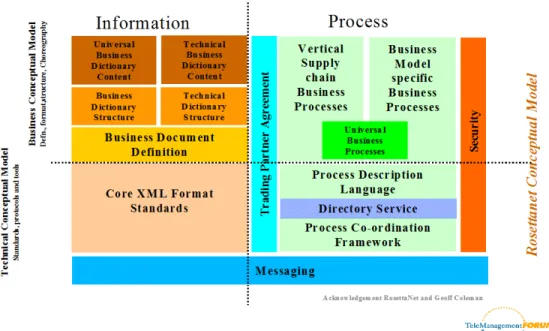
RosettaNet has developed the general scoping model for B2B interfaces. It is presented in Figure 3.2.
Figure 3.2 RosettaNet Conceptual Model
The RosettaNet Conceptual Model outlines the requirements for enterprises to conform to the definition of the public processes, for example those as defined by RosettaNet or ebXML. The model provides an overview of all the technical and business aspects that have to be agreed to specify an interoperable B2B interface. There are essentially four main Quadrants. The model is horizontally divided between the Technical and Business Conceptual Models, and vertically between Process and Information aspects.
The Technical Conceptual Models are largely the domain of integration activities such as NGOSS and are substantially based on work within the W3C Consortium.
From a TMF perspective the process aspects in the Business Conceptual Models are relevant to the eTOM Business Process Framework, and the Information aspects to the SID Models.
Both the Information and the Process aspects of the Business Conceptual Model are divided into what is called Horizontal or Universal industry, and Vertical industry aspects.
In the case of processes, Horizontal processes are the focus of ebXML and RosettaNet and address cross industry sector public processes such as ordering, order progression, invoicing catalogues and prices list exchange between enterprises.
The eTOM Business Process Framework has been developed as a complete process framework representing the set of processes used by Service Providers in
the ICT industry. It captures a high level view of the vertical processes required by the RosettaNet Conceptual Model as well as additional processes not yet contemplated in the RosettaNet Conceptual Model. ICT and Telecom vertical processes include Assurance – Repair Trouble Ticketing, SLA Management - and some aspects of billing such as real time hot billing, settlements, rebates, etc. It also captures high level perspectives of the horizontal processes which have traditionally been the focus of RosettaNet and ebXML. For instance the eTOM Business Process Framework was developed with the perspective that transaction occur between the Service Provider and external parties.
The challenge is to appropriately link the pre-defined eTOM Business Process Framework with the relevant aspects of the already identified RosettaNet horizontal processes and equivalent processes from other industry groups such as: ebXML/OASIS, TIPHON, ITU-T. Currently GB921C captures the likely sources of those horizontal and vertical processes that need to be linked into the eTOM Business Process Framework.
Other aspects covered by the RosettaNet Conceptual Model are reliable Messaging, Security and Trading Partner Agreements also known as Collaborative Partner Agreements (CPA).
The specific needs of Telecom vertical processes are discussed in more detail in the VC-MC Issues paper. [Ref 8]
3.4 ebXML what is it?
3.4.1 Introduction
The following section provides an overview of the ebXML Technical Architecture and the elements of immediate interest. A glossary of terms is at the end of the document. Much of the conceptual basis of ebXML has come from RosettaNet and OASIS.
3.4.2 Concept
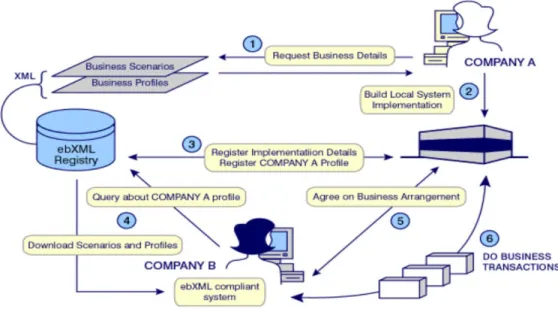
Figure 3.3 ebXML Concept
The notion is as follows:
1. Company A can request specifications of e-Business services offered by Company B and others
2. Company A builds their half of the e-Business interface and public process.
3. Company A registers their implementation
4. Company B acquires details of Company A’s implementation 5. Company A and B form an agreement to trade via their respective
interfaces
6. Enterprises commence exchange of business documents.
3.4.3. ebXML Technical Architecture
The elements of the ebXML technical architecture that facilitate this process are. 1. An ebXML Registry/ Repository based on an agreed information
model and variety of services to manage data within registries. 2. A Business Process Specification Schema supporting the description
of B2B public processes in a declarative fashion.
3. An information model for Collaboration Protocol Profiles and Agreements supporting the description of a trading partner’s
capabilities, and the role they play in B2B public processes, together with the forming of agreements between parties to participate in instances of such public processes.
4. A messaging service supporting the secure and reliable exchange of business documents between partners participating in such public processes.
3.4.4. ebXML Registry/Repository
The previous sections showed how organizations use the ebXML Repository. However there is an issue of how the Repository is created, and what content is contained within it.
ebXML has only partially addressed the requirements for content of the ebXML Repository:
Core Components: These are components, which appear in many different circumstances of business information and in many different areas of business. A core component is a common or “general” building block that basically can be used across several business sectors. It is therefore context free. It also represents a way to align the process development of the eTOM team, with the Information and Data modeling of the SID team.
Universal Business Library (UBL) that is organized around Business Message types such as Order, Order Response, Order Cancellation, Receipt Advice, Dispatch Advice, Invoice. These Business Transactions also record Business Information Entities (BIE) relevant to the UBL Business Transactions.
ebXML assumes that their core work will be extended to support vertical industry segments. However no specific arrangements have been put in place to achieve this goal.
In the IT and software industries RosettaNet has extended these definitions.
RosettaNet has defined a Business Operations Map categorizes that provides the taxonomy of Business Transactions.
Currently no equivalent of the RosettaNet Business Operations Map (BOM) has been created by the ICT industry.
Application Note GB921C provides an initial proposal for such an ICT B2B Business Operations Map. It is expected that this BOM will be adopted by either the TMF on behalf of the ICT industry or by means of some collaboration amongst industry organizations such as the TMF, RosettaNet, and ITU-T SG4 (Generic Telecom Data Dictionary).
3.4.5 Elements of Immediate Interest
The ebXML family of standards is designed to allow piecemeal implementation. The standards of immediate appeal are:
1. ebXML Messaging Service as a means of transferring business
documents (both XML and non-XML) securely over the Internet via https or SMTP.
2. The Business Process Specification Schema (BPSS) as a means of documenting Telecomm B2B public processes as a sequence of Business Transactions.
3. Core Components (CC) as a means of documenting Information related to Business Transactions and capturing the semantics of models, relations and data in a standardised and agreed way.
3.5 What does eTOM need to address?
The eTOM Business Process Framework has been extended to explicitly identify the processes required to link to an externally-oriented inter-enterprise process framework that is a sound basis for understanding e-business oriented organizational structures and which facilitates transitions from, or extensions of, existing Business channel structures towards those that embrace e-business.
In order to meet these goals, the eTOM Business Process Framework extensions at Level 3 specifically address the inter-enterprise trading B2B relationships. The approach more explicitly recognizes the notion of a public process, a concept used within the existing work of RosettaNet and the UN CEFACT ebXML. This provides a sound conceptual and technical basis for automating the inter-enterprise interfaces. The following section describes how the eTOM Business Process Framework can be extended to support e-business based on the principle of Public Processes. Part of this requires extension of the eTOM Business Process Framework to support all the process flows described in Fig 3.3, and agreement on the content of the ebXML Repository to be used in conjunction with these extensions of the eTOM. The current candidates for the content of this repository is called the eTOM Public B2B Business Operations Map and is documented in GB921C [Ref 9]. Currently there is a mismatch between the level of detail needed for the ebXML repository and the eTOM L3 analysis. The B2B Business Operation Map provides the lowest level transaction detail at around level 5/6 of the eTOM and is documented separately in this version. Integration with the main eTOM GB921 D should be possible once the eTOM level 4 CIM and S/PIM detail has been completed.
Chapter 4 describes these extensions to the eTOM Business Process Framework and analyzes the linkages between them and other work in the industry.
4. Extending ETOM for Business to Business Interactions
In the evolving ICT industry the traditional vertically integrated Telecomm industry structure is breaking down and being replaced by an arrangement of horizontal structured trading partners that supply competitive services to one another to form a ‘Value Chain’.
De-regulation, a common trend across most of the developed world is requiring operators to open up their networks and provide a number of Wholesale products to others in the ICT value chain, including their own new bushiness units in these adjacent industries.
This brings the need to maintain the same levels of process efficiency and automation between enterprises as is being developed within a single organization. This, coupled with the regulatory pressure on interconnect prices, means that there is a strong and growing business case for automating B2B interfaces between enterprises to maintain efficiency, and lower costs for end customers.
The Value Chain Market Center document on ‘Value Chain Issues facing the ICT industry’ TR 128 [ref 8] has carried out an impact analysis of B2B trends on the TMF technical work including the eTOM Business Process Framework.
To operate end-to-end processes across multiple trading partners it is necessary to have a process design approach to combining and linking B2B public processes with the internal processes of co-operating trading partners.
4.1 Modeling Regulated B2B Processes
between instances of the eTOM
The eTOM provides a process framework to describe and structure the scope of processes relevant to ICT organizations, including processes which extend beyond the enterprise organization boundary.
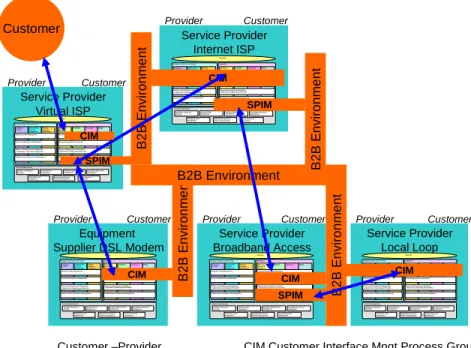
In the following diagram an example is shown of a set of ICT organizations operating a value chain amongst themselves for the supply of a service to a Customer. Each relationship between each ICT organization is in the form of a customer-supplier relationship.
The customer relationship in the Value Chain is provided by the S/PIM process group of the eTOM and the supplier relationship is support by the CIM process group of the eTOM. These are also referred in the literature on B2B as ‘Buy Side’ and ‘Sell Side’
respectively. Underpinning these relationships is a B2B Environment that provides the B2B infrastructure such as those standardized by ebXML and RosettaNet.
B 2B E nv ir onm ent B 2B E nv ir onm ent Customer
Enterprise Man agement Strateg y, Infrastru cture & Pr oduct Operation s
FulfillmentAssur an ce Billing Product Lifecycle Management Infrastructure Lifecycle Management Operation s Support & Readin ess Customer R elation ship Man agem ent Service Man agem ent & Operations Resour ce Manag em ent & Oper ations Supplier/ Partner R elationshi p Manag em ent
Strateg y & Commit
Marketing & Offer Man agem ent Service D evelopm ent & Manag ement Resour ce Develop ment & Man agem ent Suppl y C hain D evelopm ent & Manag em ent
(Application, Computing an d Net work) (Application, Computing an d Net work)
Customer
Enterprise Effectiveness Management
Knowl edg e & Resear ch Management Enterprise Ri sk Management Strategic & Enterp rise Planning
Financi al & Asset
Management Stakehold er & Extern alRelation s Manag em ent Human R esour cesManagement
Service Provider Virtual ISP
Provider Customer
Enterprise Man agement Strateg y, Infrastru cture & Pr oduct Operation s
Fulfillment Assur an ce Billing Product Lifecycle Management Infrastructure Lifecycle Management Operation s Support & Readin ess Customer R elation ship Man agem ent Service Man agem ent & Operations Resour ce Manag em ent & Oper ations Supplier/ Partner R elationshi p Manag em ent
Strateg y & Commit
Marketing & Offer Man agem ent Service D evelopm ent & Manag ement Resour ce Develop ment & Man agem ent Suppl y C hain D evelopm ent & Manag em ent
(Application, Computing an d Net work) (Application, Computing an d Net work)
Customer
Enterprise Effectiveness Management Knowl edg e & Resear ch
Management Enterprise Ri sk Management Strategic & Enterp rise Planning
Financi al & Asset Management
Stakehold er & Extern al Relation s Manag em ent
Human R esour ces Management
Service Provider Internet ISP
Provider Customer
Enterprise Man agement Strateg y, Infrastru cture & Pr oduct Operation s
Fulfillment Assur an ce Billing Product Lifecycle Management Infrastructure Lifecycle Management Operation s Support & Readin ess Customer R elation ship Man agem ent Service Man agem ent & Operations Resour ce Manag em ent & Oper ations Supplier/ Partner R elationshi p Manag em ent
Strateg y & Commit
Marketing & Offer Man agem ent Service D evelopm ent & Manag ement Resour ce Develop ment & Man agem ent Suppl y C hain D evelopm ent & Manag em ent
(Application, Computing an d Net work) (Application, Computing an d Net work)
Customer
Enterprise Effectiveness Management Knowl edg e & Resear ch
Management Enterprise Ri sk Management Strategic & Enterp rise Planning
Financi al & Asset Management
Stakehold er & Extern al Relation s Manag em ent
Human R esour ces Management
Service Provider Broadband Access
Provider Customer
Enterprise Man agement Strateg y, Infrastru cture & Pr oduct Operation s
FulfillmentAssur an ce Billing Product Lifecycle Management Infrastructure Lifecycle Management Operation s Support & Readin ess Customer R elation ship Man agem ent Service Man agem ent & Operations Resour ce Manag em ent & Oper ations Supplier/ Partner R elationshi p Manag em ent
Strateg y & Commit
Marketing & Offer Man agem ent Service D evelopm ent & Manag ement Resour ce Develop ment & Man agem ent Suppl y C hain D evelopm ent & Manag em ent
(Application, Computing an d Net work) (Application, Computing an d Net work)
Customer
Enterprise Effectiveness Management Knowl edg e & Resear chManagement Enterprise Ri sk Management Strategic & Enterp rise Planning
Financi al & Asset Management
Stakehold er & Extern al Relation s Manag em ent
Human R esour ces Management
Service Provider Local Loop
Provider Customer
Enterprise Man agement Strateg y, Infrastru cture & Pr oduct Operation s
Fulfillment Assur an ceBilling Product Lifecycle Management Infrastructure Lifecycle Management Operation s Support & Readin ess Customer R elation ship Man agem ent Service Man agem ent & Operations Resour ce Manag em ent & Oper ations Supplier/ Partner R elationshi p Manag em ent
Strateg y & Commit
Marketing & Offer Man agem ent Service D evelopm ent & Manag ement Resour ce Develop ment & Man agem ent Suppl y C hain D evelopm ent & Manag em ent
(Application, Computing an d Net work) (Application, Computing an d Net work)
Customer
Enterprise Effectiveness Management Knowl edg e & Resear ch
Management Enterprise Ri sk Management Strategic & Enterp rise Planning
Financi al & Asset Management
Stakehold er & Extern al Relation s Manag em ent
Human R esour ces Management Equipment Supplier DSL Modem Provider Customer CIM B2B Environment SPIM CIM SPIM B 2B E nv ir onm ent CIM SPIM CIM B 2B E nv ir onm ent CIM Customer –Provider Relationships
CIM Customer Interface Mngt Process Group SPIM Supplier Partner Mngt Process Group
Figure 4.1 B2B Environment for modeling ICT Value Chain
For example a Broadband internet service might be provided by a combination of a virtual ISP, an actual Internet ISP with physical resources a Broadband Access provider and a metallic loop provider (Unbundled Local Loop –ULL).
Figure 4.1 more explicitly identifies the external process interactions by conceptualizing the two specific types of B2B interactions that an enterprise can engage in.. It captures in the upper limb the ‘Sell’ side of the B2B processes between the Service Provider and it’s customers and in the lower limb the ‘Buy’ side of the B2B Processes between the Service Provider and it’s suppliers. These interactions, depending on their specific nature, occur with either the Market & Offer Management/Customer Relationship Management horizontal process grouping in the case of customer or sell side interactions, or with the Supply Chain Development/Supplier/Partner Relationship Management horizontal process groupings in the case of supplier or buy side interactions
Normally, in regulated B2B, the definition of the detailed B2B process interactions and the B2B components are agreed by an industry process. In this case the ownership of the specific details of these B2B interactions is with the industry and not with either of two collaborating organizations. However in the case of the ICT industry, the TM Forum, through eTOM and SID developments, has gone a long way to defining the industry framework in which to define the specific content that would be used within the B2B interactions. A successful public B2B process definition for the ICT industry
thus requires strong collaboration between the public organizations and the TM Forum.
The detailed B2B process interactions follow six well defined Business Transaction Patterns (see Annex C) which require that in the context of a specific set of transactions that the customer and supplier on each end of the transaction operate in lockstep.
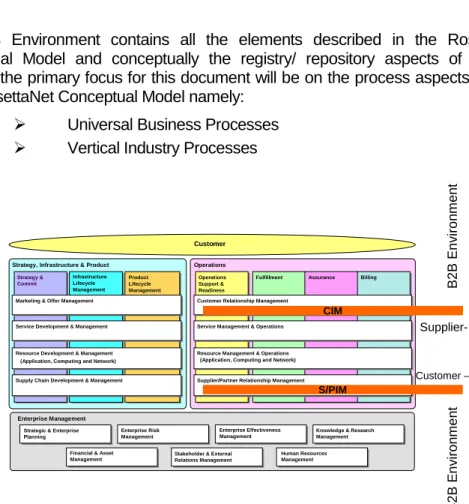
The B2B Environment contains all the elements described in the RosettaNet Conceptual Model and conceptually the registry/ repository aspects of ebXML. However the primary focus for this document will be on the process aspects defined in the RosettaNet Conceptual Model namely:
Universal Business Processes
Vertical Industry Processes
Enterprise Management
Strategy, Infrastructure & Product Operations
Fulfillment Assurance Billing Product Lifecycle Management Infrastructure Lifecycle Management Operations Support & Readiness
Customer Relationship Management
Service Management & Operations
Resource Management & Operations
Supplier/Partner Relationship Management
Strategy & Commit
Marketing & Offer Management
Service Development & Management
Resource Development & Management
Supply Chain Development & Management
(Application, Computing and Network) (Application, Computing and Network)
Customer
Enterprise Effectiveness Management
Knowledge & Research Management Enterprise Risk
Management Strategic & Enterprise
Planning
Financial & Asset
Management Stakeholder & ExternalRelations Management
Human Resources Management
CIM
S/PIM
Supplier- Sell Side
Customer – Buy Side
B2 B En v iro n m e n t B2 B En v iro n m e n t
Figure 4.2 eTOM B2B Reference Model
Figure 4.2 shows the canonical model for regulated relationships in the eTOM. Each organization in the supply chain may support either the sell side or Buy side capability. In either case each is connected into the B2B Environment. However each Organization will establish relationships with other organizations – although there are examples of one organization trading between operating divisions using the same B2B mechanisms –such as when a licensed Network Operator has both Unregulated and Regulated business units where the Regulated business has to provide Equivalence of Access to all organizations.
4.2 eTOM extensions
Much of the conceptual basis for extending the eTOM Business Process Framework comes from integrating the frameworks used for B2B interactions, notably those based on the work of RosettaNet and the UN CEFACT ebXML groups, with the eTOM Business Process Framework.
B2B implies a certain structure and discipline in the way that B2B transactions are structured, defined and sequenced. Moreover, they focus solely on the processes between enterprises whereas the eTOM Business Process Framework to date has focused primarily upon the internal processes needed within a single enterprise, whilst recognizing the need to support external interactions within the single enterprise view.
Trading partners may or may not be using an internal process model based upon the e-TOM Business Process Framework, but this is not important for the development of successful end-end process interactions. Essentially the B2B public processes are synchronizing the internal processes of two different trading enterprises. A particular challenge for B2B is to maintain the integrity of the B2B public process between two badly behaved trading partner internal business processes/applications.
The eTOM Business Process Framework has been extended to explicitly recognize the process synchronization and external mediation required to allow an enterprise to participate in an external public process. Specifically both the Customer Interface Management and S/P Interface Management Level 2 process areas have been extended to include new Level 3 process elements which incorporate these new process requirements.
However, in order for the eTOM Business Process Framework to more fully support B2B transactions based on ebXML and RosettaNet Public Processes further extensions are required:.
Further decomposition/extension of the eTOM may be required to
ensure that the external interactions with the ebXML and
RosettaNet public processes as indicated in shown in Fig 3.3 are fully supported; and
Further definition and decomposition of existing eTOM process
decompositions and extension of the SID will be required to identify the specific process and content detail required for the specific B2B interaction. This extension will need to be
undertaken on an interaction type, i.e. ordering interaction, basis. There may be a specific tailoring required of the public process models and definitions held in the external repositories to facilitate trading within the ICT industry (given that these models and definitions were initially developed to support other industries). This tailoring of either the public definitions or of the way that the eTOM and SID are further defined and/or decomposed will need to be determined on a case by case basis.
A potential extension is to develop an initial proposal of the
Map (BOM) relevant to the support of the eTOM Inter-Enterprise viewpoint. This would represent an extracted subset of the more fully developed eTOM Business Process Framework to expose those details that all parties to the B2B interaction need to be aware of, particularly those that have not adopted the eTOM Business Process Framework internally. It would also include the relevant low-level interaction/transactional detail, from public process frameworks such as RosettaNet or ebXML. In this document this is referred to as the eTOM Public B2B Business Operations Map (ePBOM).
As an example of the potential extensions required, in the ebXML there are a number of public processes supported and/or used by potential and actual Trading Partners to establish, and then use, the trading relationship. For those trading partners using the eTOM Business Process Framework, Table 4.1 indicates the parts of the eTOM Business Process Framework level 1 process groupings which would be responsible for the ebXML e-business Integration Process Steps described in Fig 3.3. Company A (Fig 3.3) is considered to be the ‘Seller’ and Company B the ‘Buyer’. Note, however, that the actual interface for the exchange of the relevant messages would be through either the Customer Interface Management or S/P Interface Management processes.
The following table is a preliminary mapping based on V5.0 of GB 921 Addendum D
ebXML e-business Integration Process Steps (From Fig 3.3)
eTOM Process Grouping supporting this function
Request Business Details For Company A: SIP:
Marketing and Offer Management
For Company B: SIP: Supply Chain Development and Management
Note both of these retrieve content from the ebXML repository which in this context is the eTOM Public B2B Business Operations Map (ePBOM)
Build Local Implementation: Company A builds their half of the e-business interface and public process
Company A: SIP: Resource
Development & Management, plus SIP:
Infrastructure Lifecycle Management
implementation. Chain Development & Management (SCD&M) Processes: Supply Chain Capability Delivery
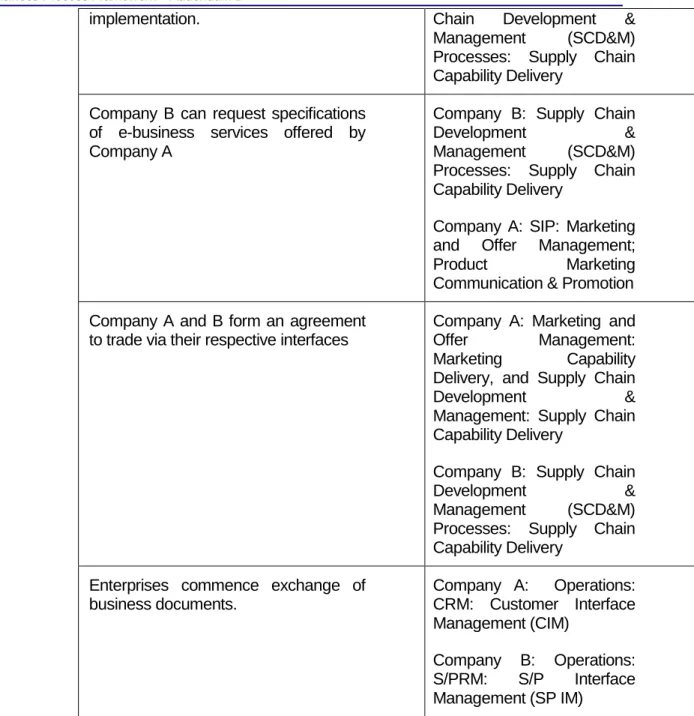
Company B can request specifications of e-business services offered by Company A
Company B: Supply Chain
Development & Management (SCD&M)
Processes: Supply Chain Capability Delivery
Company A: SIP: Marketing and Offer Management;
Product Marketing Communication & Promotion
Company A and B form an agreement to trade via their respective interfaces
Company A: Marketing and
Offer Management: Marketing Capability Delivery, and Supply Chain
Development & Management: Supply Chain
Capability Delivery
Company B: Supply Chain
Development & Management (SCD&M)
Processes: Supply Chain Capability Delivery
Enterprises commence exchange of business documents. Company A: Operations: CRM: Customer Interface Management (CIM) Company B: Operations: S/PRM: S/P Interface Management (SP IM)
Table 4.1 Mapping of ebXML Process Steps to eTOM Level 1 process groupings
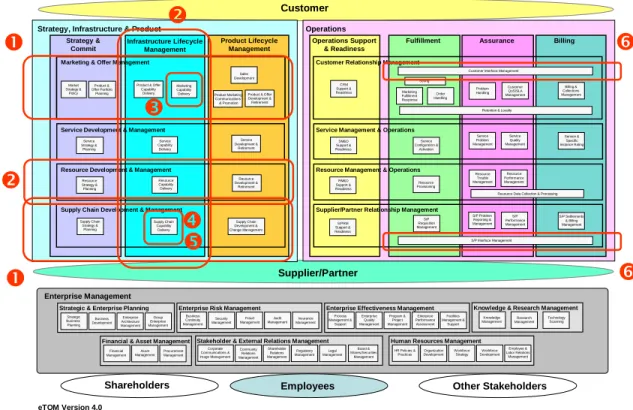
The following figure of the eTOM Business Process Framework shows where B2B impacts the detailed eTOM Business Process Framework processes groupings.
Customer
Enterprise Management
Strategic & Enterprise Planning Service Development & Management
Resource Development & Management
Supply Chain Development & Management Marketing & Offer Management
Product Lifecycle Management Strategy &
Commit
Strategy, Infrastructure & Product
Product & Offer Capability Delivery Product & Offer Portfolio Planning Market Strategy & Policy Operations
Fulfillment Assurance Billing Operations Support
& Readiness
Customer Relationship Management
Service Management & Operations
Resource Management & Operations
Supplier/Partner Relationship Management
Marketing Capability Delivery Infrastructure Lifecycle Management Product Marketing Communications & Promotion
Product & Offer Development & Retirement Sales Development
Customer Interface Management
Billing & Collections Management Customer QoS/SLA Management Problem Handling Selling Order Handling Marketing Fulfillment Response CRM Support & Readiness
Retention & Loyalty
Service Strategy & Planning Service Capability Delivery Service Development & Retirement Resource Strategy & Planning Resource Capability Delivery Resource Development & Retirement Service Configuration & Activation Service Problem Management Service Quality Management Service & Specific Instance Rating SM&O Support & Readiness Resource Provisioning Resource Trouble Management Resource Performance Management RM&O Support & Readiness
Resource Data Collection & Processing Supply Chain Strategy & Planning Supply Chain Development & Change Management Supply Chain Capability Delivery S/P Interface Management S/P Requisition Management S/P Problem Reporting & Management S/P Settlements & Billing Management S/P Performance Management S/PRM Support & Readiness Supplier/Partner Strategic Business Planning Business Development Enterprise Architecture Management Group Enterprise Management
Enterprise Risk Management
Business Continuity Management Security Management Fraud Management Audit Management Insurance Management
Enterprise Effectiveness Management
Process Management & Support Enterprise Quality Management Program & Project Management Enterprise Performance Assessment Facilities Management & Support
Knowledge & Research Management
Knowledge Management ManagementResearch
Technology Scanning
Financial & Asset Management
Financial Management Asset Management Procurement Management
Stakeholder & External Relations Management
Corporate Communications & Image Management Community Relations Management Shareholder Relations Management Regulatory Management Legal Management Board & Shares/Securities Management
Human Resources Management
HR Policies & Practices Organization Development Workforce Strategy Workforce Development Employee & Labor Relations Management
Employees Other Stakeholders Shareholders eTOM Version 4.0
Figure 4.3 Mapping of ebXML Process Steps on eTOM Business Process Framework
The numbers that appear in Figure 4.3 refer to ebXML e-business Integration Process Steps of Table 4.1.
It can be seen that the main areas of responsibility for the ebXML Process Steps are in the SIP Area of eTOM v5.0 rather than the Operations Area. , However, all of the actual electronic exchange of information should occur through either the Customer Interface Management or S/P Interface Management processes in the Operations process area
4.3 eTOM Public B2B Business
Operations Map
The ebXML RosettaNet model for Public Processes presumes the existence of a repository. Conceptually this repository is owned by an industry group. The Value Chain Market Centre ‘Issues Facing players in the ICT industry’ [Ref 8] has identified that the main industry libraries do not yet give adequate coverage of the B2B public processes needed for ICT.
B2B public processes have so far been based upon B2B standards being developed outside the TM Forum and are, therefore, partially under the design control of external authorities. This has mainly been driven by the lack of pre-existing industry frameworks which could be used as the basis of the B2B standards. In the ICT industry, significant progress has been made on agreeing a set of B2B frameworks. B2B standards therefore can be developed for the ICT industry using these frameworks as a starting point. The TM Forum, as the owner of these frameworks, therefore needs to be part of any public process development process.
This section proposes the development of a public eTOM B2B Business Operations Map that is the conceptual repository used for holding public B2B Business Transactions or PIPs.
The TMF in cooperation with other organizations might chose in the future to establish a role to develop and manage such a repository.
4.3.1 Relevance to B2B for the eTOM
The main areas relevant to the creation of an eTOM Public B2B BOM are the Process and Information areas of the RosettaNet Conceptual Model – see Figure 3.2. In the RosettaNet Partner Interchange Process -PIPs™ - it is presumed that the technical framework is based upon the RosettaNet Implementation Framework (RNIF), and also that Business Documents and Public Processes are defined in each PIP.
ebXML is following the same conceptual ,model as RosettaNet but with some improvements.
Specifically:
Business Process Specification Schema (BPSS) that describes
how a multiparty multi-stage process can be decomposed into Business Transaction Activities that align with the RosettaNet PIP concept of an atomic process component;
The Business Transaction Activities comply with six business
transaction patterns that cover request reply and notification functions, with varying levels of non-repudiation, and reliability;
The modeling of business documents is separated from the
Business Transactions which allows existing e-commerce libraries to evolve e.g. CBL and OAGIS; and
Recent work on Core Components and Assembly Documents are
providing a flexible way of creating and extending business documents based upon fragments of specifications that are individually registered.
More information on ebXML and RosettaNet is contained in Annex A.
The eTOM Public B2B BOM would contain all the elements described in the RosettaNet Conceptual Model and conceptually the registry/ repository aspects of
ebXML. However the primary focus for this document will be on the process aspects namely:
Universal Business Processes; and
Vertical Industry Processes for the ICT industry.
4.4 eTOM Public B2B Business Operation
Map (ePBOM)
In the main part of GB921 the concept of an external environment was introduced for establishing and operating inter organizational processes. The B2B External Environment is a specific form of inter-organizational processes that are based on the use of e-commerce methods and technologies. The RosettaNet Conceptual Model presented in section 3.3 describes all of the aspects that need to be addressed by the B2B External Environment.
The main focus for the eTOM Public B2B BOM is the Business Conceptual Model. The issues addressed in the RosettaNet Technical Conceptual Model, which focuses on technical matters such as XML specification languages, process specifications are not addressed in this document. The details of such topics are more appropriate to NGOSS.
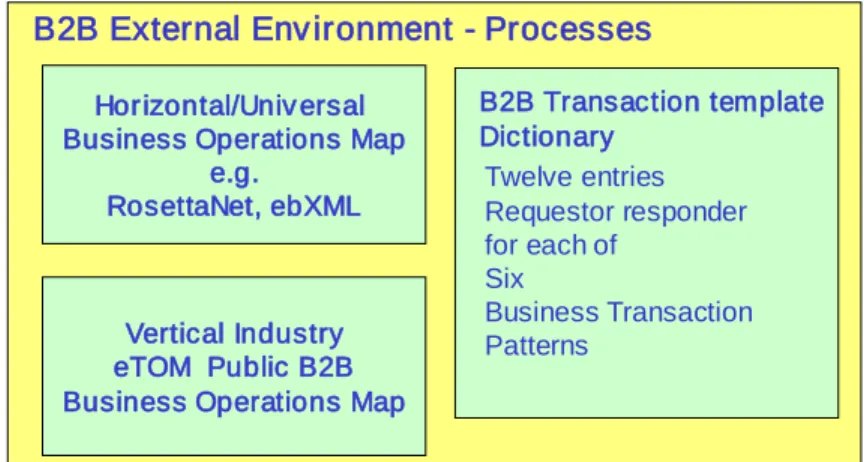
4.4.1. B2B External Environment - Process components
Vertical Industry eTOM Public B2B Business Operations Map
B2B External Env ironment - Processes
B2B Transaction template Dictionary Twelve entries Requestor responder for each of Six Business Transaction Patterns
Hor izontal/Univ ersal Business Operations Map
e.g. RosettaNet, ebXML
Figure 4.4 eTOM Public B2B BOM – Public Processes
Using the RosettaNet model there are three main process aspects that need to be captured and modeled in the public B2B External Environment.
The B2B Transaction Pattern templates – RosettaNet and ebXML
These utilize six basic transaction patterns. As each Business Transaction Pattern has a supplier and a seller side this corresponds to 12 process templates.
Horizontal /Universal Business Operations Map. This area has to
provide a public process decomposition hierarchy for public process component / Business Transactions that are cross industry. The obvious approach in this area is to use the pre-existing RosettaNet and ebXML Business Operations Maps that cover mostly Ordering and Invoicing processes. Any detailed decomposition of the eTOM Business Process Framework in the ordering and invoicing areas should consider the use of the Rosettanet and OASIS decompositions if applicable.
Vertical Industry Business Operations Map. This area has to
provide an extract of the eTOM Business Process Framework which is required to support the .public process component / Business Transactions that are specific to the telecommunications and ICT industry: examples are Assurance Service Level
Agreement Management and Billing (beyond simple invoicing). Many of the issues Identified by the VC_MC work are related to missing Vertical Industry public process components.
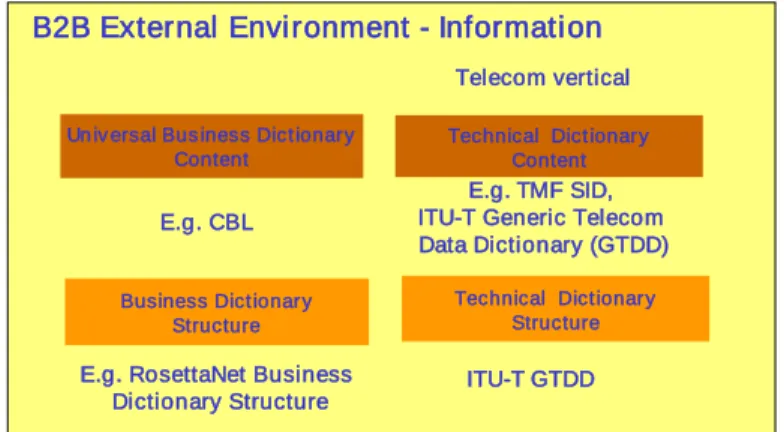
4.4.2. B2B Environment - Information Entities
Experience with Process modeling shows that it is also necessary to specify and document information entities at some level. This aligns with the RosettaNet experiences. The Information that needs to be specified includes:
Horizontal /Universal Business Dictionaries, structure and content
covering general business information, company identifiers, currency codes, country codes etc.
Technical or Vertical Dictionary, structure and content covering
ICT specific information such as telephone numbers, circuit Identifiers, locations, etc.
B2B External Environment - Information
Business Dict ionar y Structure
Technical Dict ionar y Structure Un iv ersal Bus iness Dict ionar y
Content
Technical Dict ionar y Content
E.g. CBL
E.g. TMF SID, ITU-T Generic Telecom Data Dictionary (GTDD) E.g. RosettaNet Business
Dictionary Structure
ITU-T GTDD Telecom vertical
In these areas there are significant practical difficulties in making specific and concrete selections.
For Horizontal /Universal dictionaries several commercial
universal XML based dictionaries are in place, for example, the Commerce One Common Business Library (CBL) and work in the OAGIS group. For the moment ebXML has not produced a specific dictionary other than the definition of general trade terms in its parent organization UN CEFACT. It has not defined specific XML tags, which are important for interoperability.
For Technical Dictionaries the work of RosettaNet has focused on
the definitions in the fulfillment area with the well established needs of the IT and Electronics industry that also provides partial coverage of the ICT industry needs – specifically ordering and provisioning some physical equipment. What it does not cover are terms needed for ICT services such as interconnection point, locations designation and many other service related parameters. These missing information definitions may be addressed by the ITU-T tML initiatives in Study Group 4. The ITU work on a Generic Telecom Data Dictionary GTDD is also relevant to the vertical Telecomm Dictionary structure.
The structuring and choice of the Dictionary structures is obviously dependent on the appropriate choices for Universal and Technical Dictionaries. However at this stage of the eTOM Public B2B BOM development these information aspects are secondary to the process aspects. The structuring and definitions of B2B information entities in the eTOM Public B2B BOM is not considered further at this time. It is expected that this will be addressed when the eTOM Public B2B Business Operations Map has been developed further.
The remainder of this chapter focuses solely on the process component aspects of the B2B External Environment.
4.4.3. RosettaNet Business Operations Map (BOM) Overview
RosettaNet has approved the structuring and organization of its process components- Partner Interchange Processes PIPs™ - using an arrangement called a Business Operation Map (BOM) which is conceptually identical to many of the eTOM Process Groupings and decompositions, except it has been produced specifically to support inter-enterprise process interactions. ebXML also uses the term BOM to classify process components.
The structure of this map is to divide the problem domain firstly into Clusters and then to divide Clusters into Segments that contain the PIPs. The purpose of the BOM is to provide a classification structure that can evolve and provide the basis for evolving the elementary process components.
Figure 4.6 RosettaNet Business Operations Map - Clusters
RosettaNet defines eight clusters that cover a part of the eTOM Public B2B BOM process requirements.
Each Cluster is further subdivided into segments that enumerate the elementary process components (PIP™ and are equivalent to the ebXML Business Transaction Activities (BTA).). These Clusters correspond to eTOM Business Process Framework Level 1 processes
An example of the 3A segment of the Cluster 3 is shown below. The things to note are that the Cluster would support external B2B interactions with the Fulfillment Process Group of the eTOM Business Process Framework and also has the concept of covering the pre-order and order phases.
Cluster 3: Order Management
• Segment 3A: Quote and Order Entry
Allows partners to exchange price and availability information, quotes, purchase orders and order status, and enables partners to send requested orders, or shopping carts, to other partners
– PIP 3A1: Request Quote
– PIP 3A2: Request Price and Availability – PIP 3A3: Request Shopping Cart Transfer – PIP 3A4: Request Purchase Order – PIP 3A5: Query Order Status – PIP 3A6: Distribute Order Status – PIP 3A7: Notify of Purchase Order Update – PIP 3A8: Request Purchase Order Change – PIP 3A9: Request Purchase Order Cancellation – PIP 3A10: Notify of Quote Acknowledgement – PIP 3A11: Notify of Authorization to Build – PIP 3A12: Notify of Authorization to Ship – PIP 3A13: Notify of Purchase Order (Information) – PIP 3A14: Distribute Planned Order
Figure 4.7 RosettaNet Business Operations Map – Cluster 3 Order Management
The RosettaNet BOM classifies the PIPs in a way that may or may not be convenient for users in the ICT industry. This means that if the RosettaNet public process components are adopted for the eTOM Public B2B BOM, and therefore ultimately need to be linked to the eTOM Business Process Framework, then some form of mapping between the RosettaNet public process components and the single enterprise version of the eTOM Business Process Framework is necessary.
4.4.4. Vertical Telecomm industry B2B Business Operations Map
At the present time there is no comprehensive ICT/ Telecom Business Operations Map. The work of the ITU- SG4 tML and GTDD activities, and national groups such as the ANSI T1 tML group and the UK Telco B2B Forum seem to be natural places for standardizing the vertical Telecomm industry B2B BOM. From the perspective of defining these public processes, the eTOM Business Process Framework can form a major contribution to this work.
4.5 eTOM Public B2B BOM-Level 0
Process Area
A major requirement is to develop a structure that allows the inclusion of public process hierarchy structures brought in from cross Industry groups such as
RosettaNet and ebXML AND to inc