of
t
ransport and logistics networks
D1.4
Analysis of ICT solutions
employed in transport and logistics
Project Number 285598
Work Package WP1 Domain Characterization and Requirements Analysis
Lead Beneficiary Kühne + Nagel
Editors Michael Zahlmann Kühne + Nagel Cyril Alias Univ. Duisburg-Essen Contributors Jiři Hloska Univ. Duisburg-Essen Zhangzhu Li Univ. Duisburg-Essen
Øyvind Olsen NCL
Agathe Rialland MARINTEK Stefan Seysen Kühne + Nagel
Guy Sharon IBM
Michael Stollberg SAP Evert-Jan van Harten AFKL
Reviewers Bülent Erbaş KoçSistem
Åsmund Tjora MARINTEK
Dr. Rod Franklin Kühne + Nagel Dissemination Level PU
Contractual Delivery Date March 31st, 2012 Actual Delivery Date March 30th, 2012 Version 1.2
Abstract
International transport and logistics operations are concerned with the planning and execution of the world-wide shipment of goods and people. The FInest project addresses this domain as a useful example for the Future Internet. Within this domain the FInest project has identified three different use case scenarios that characterize different aspects of transport and logistics operations.
This study shall provide an overview about the ICT employed today in the transport and logistics domain. The different solutions in covering the domain specific requirement shall be documented. This analysis facilitates consistency in evaluating which solutions are available today and what is the gap to the FInest approach.
This document is being submitted as specified in the FInest Description of Work (DoW) as part of deliverable D1.4 – Analysis of ICT solutions employed in the transport and logistics domain. The FInest ICT Analysis will be revised and updated throughout the lifespan of the project as the work in the project progresses and insights and feedback regarding the domain is obtained.
Disclaimer
The content of the publication herein is the sole responsibility of the publishers and it does not necessarily represent the views expressed by the European Commission or its services.
While the information contained in the documents is believed to be accurate, the author(s) or any other participant in the FInest consortium make no warranty of any kind with regard to this material including, but not limited to the implied warranties of merchantability and fitness for a particular purpose.
Neither the FInest Consortium nor any of its members, their officers, employees or agents shall be responsible or liable in negligence or otherwise howsoever in respect of any inaccuracy or omission herein.
Without derogating from the generality of the foregoing neither the FInest Consortium nor any of its members, their officers, employees or agents shall be liable for any direct or indirect or consequential loss or damage caused by or arising from any information advice or inaccuracy or omission herein.
Document History
Version Date Comments
V0.1 03-02-2012 First Draft
V0.2 21-02-2012 Second Revised Draft
V0.3 16-03-2012 Third Revised Draft
V0.4 21-03-2012 Fourth Revised Draft
V0.5 22-03-2012 First Completed Version
V0.6 26-03-2012 First Reviewed Version
V0.7 27-03-2012 Second Completed Version
V0.8 29-03-2012 Second Reviewed Version
V0.9 29-03-2012 Third Completed Version
Table of Contents
Abstract ... 3 Disclaimer ... 4 Document History ... 5 Table of Contents ... 6 Table of Figures ... 8 Acronyms ... 9 1. Introduction... 121.1. Work Package 1: Domain Characterization and Requirements Analysis ... 12
1.2. Task 1.3: Analysis of ICT Solutions employed in Transport and Logistics ... 13
1.3. Deliverable D1.4: Analysis of ICT solutions employed in T&L ... 14
1.4. Relationship with other Work Packages ... 15
1.5. Framework for the ICT Analysis ... 16
1.6. Methodology of the ICT Analysis ... 20
2. Information and communication technologies in the transport and logistics domain ... 22
2.1. Introduction ... 22
2.2. Enterprise Resource Planning Systems ... 25
2.3. Supply Chain Management Systems ... 27
2.4. Transportation Management Systems ... 32
2.5. Warehouse Management Systems ... 36
3. Dedicated features and solutions addressing special problems in the transport and logistics domain ... 39
3.1. Solutions for foodstuffs and perishables ... 40
3.2. Solutions for hazardous material ... 42
3.3. Solutions for pharmaceuticals and chemicals ... 43
3.4. Systems for handling embargo goods ... 45
3.5. Security-related ICT systems ... 45
3.6. Airport terminal software ... 47
3.7. Port terminal software ... 49
3.8. Systems and procedures for handling customs and trade affairs ... 52
3.9. Planning systems in transportation and logistics ... 54
3.10. Simulation software for transport, logistics and SCM ... 56
3.11. Tender management systems and collaboration platforms ... 57
3.12. Business Intelligence & Data Warehousing in the T&L domain ... 59
3.13. B2B online platforms ... 60
3.14. Middleware platforms for standardized data exchange ... 62
3.16. Cloud computing in the T&L domain ... 65
4. Assignment of existing solutions to the framework of the analysis ... 67
5. Trends in the ICT landscape of the T&L domain ... 70
6. Next steps ... 80
Table of Figures
Figure 1: Interactions between WP1-WP3 and WP5-WP8 ... 15
Figure 2: FInest domain mapping approach ... 16
Figure 3: Generic requirements identified in Deliverable D1.1 – Analysis of the T&L domain .. 19
Figure 4: TMS functional reference model and domains ... 34
Figure 5: Magic Quadrant for Transportation Management Systems ... 36
Figure 6: Traditional communication vs. Port Community System ... 50
Figure 7: Scope of Single Window and International Supply Chain ... 54
Figure 8: Design of a B2B market place ... 61
Acronyms
ACP Air Cargo Pool
ADR Accord européen relatif au transport international des marchandises Dangereuses par Route
AEO Authorised Economic Operator AFRA Air Freight Rates Application APS Advanced Planning System
ASEAN Association of Southeast Asian Nations
ATLAS Automatisches Tarif- und Lokales Zollabwicklungssystem
AWB Air Waybill
B/L Bill of Lading
BI Business Intelligence
C2K Cargo 2000
CASS Cargo Accounts Settlement System CBP Customs and Border Protection
CCS Cargo Community System
CEP Complex Event Processing
CMS Cargo Management System
COARRI Container Discharge/ Loading Report message CODECO Container Gate-in/ Gate-out Report message
COMPASS Computer-orientierte Methode für Planung und Ablauf-Steuerung im Seehafen
CRM Customer Relationship Management system CSI Container Security Initiative
CSR Corporate social responsibility
C-TPAT Customs-Trade Partnership Against Terrorism CUSCAR Customs Cargo Report message
CUSDEC Customs Declaration message DGR Dangerous Goods Regulations DGVs Dangerous Goods Vehicles DLP Data Leak Protection DoW Description of Work e-AWB Electronic Air Waybill
EAI Enterprise Application Integration
EC European Commission
ECC Enhanced Crypto Cards
ECS Export Control System EDI Electronic Data Interchange
EMCS Excise Movement and Control System EMPI Enterprise Master Person Index
ERP Enterprise Resource Planning system ETS Electronic Tendering System
EU European Union
FInest Future Internet Enabled Optimisation of transport and Logistics Business Networks
FIPS Federal Information Processing Standard publication FMCG Fast Moving Consumer Goods
GEGIS GEfahrGutInformationsSystem HAWB House Air Waybill
HIE Health Information Exchange IaaS Infrastructure-as-a-Service
IATA International Air Transport Association ICT Information and Communication Technology IMDG International Maritime Dangerous Goods Code IML Fraunhofer Institut für Materialfluss und Logistik IMO International Maritime Organisation
INVOIC Invoice message IoC Internet of Contents IoS Internet of Services IoT Internet of Things
ISST Fraunhofer Institut für Software- und Systemtechnik
IT Information technology
JEE Java Enterprise Edition KPI Key Performance Indicator LSP Logistics Service Provider
MAQS Mobile Auftrags- und Quittungssystem MES Manufacturing Execution System MFAG Medical First Aid Guide
MPP Massively Parallel Processing NCTS New Computerized Transit System NRR Neutron Resonance Radiography
NVOCC Non-Vessel Operating Common Carriers PaaS Platform-as-a-Service
PCS Port Community System
PKI Public Key Infrastructure RFID Radio Frequency Identification RIA Rich Internet Application
RID Règlement concernant le transport international ferroviaire de marchandises dangereuses
S&OP Sales and Operations Planning SaaS Software-as-a-Service
SCE Supply Chain Execution
SCM Supply Chain Management
SCMS Supply Chain Management System SCP Supply Chain Planning
SEED System of Exchange of Excise Data SLA Service Level Agreement
SLED Shelf-life expiration date
SME Small- and medium-sized enterprises SOA Service-Oriented Architecture
SQAS Safety & Quality Assessment System SRM Supplier Relationship Management system SSL Secure Sockets Layer
SST Smart and Secure Tradelanes T&L Transport & Logistics
TEU Twenty-Foot Equivalent Unit
TMS Transportation Management System
UN/CEFACT United Nations Centre for Trade Facilitation and Electronic Business UNECE United Nations Economic Commission for Europe
UNIBOOK Universelle Buchungsplattform
USDOT United States Department of Transport
VAT Value Added Tax
VATT Value Added Tracking & Tracing
VMI Vendor-Managed Inventory
WCO World Customs Organisation
WMS Warehouse Management System
WP Work Package
XML eXtenisble Markup Language
ZAPP Zoll-Ausfuhrüberwachung im Paperless Port
ZODIAK Zoll-Dienstleistungssystem für die Importanwendung und Kommunikation
1.
Introduction
The Future Internet Public Private Partnership (FI-PPP) focuses on the development of innovative open network and service platforms with generic common enablers serving a multiplicity of demand-driven use cases in "smart applications". The work in Objective FI.ICT-2011.1.8: Use Case scenarios and early trials, focuses on vertical use case scenarios whose intelligence, efficiency, sustainability and performance can be radically enhanced through a tighter integration with advanced Internet-based network and service capabilities. The work includes use case characterization, specification of platform requirements, development and technological validation prototypes, and large scale experimentation and validation.
In the FInest (Future Internet Enabled Optimisation of transport and Logistics Business Networks) project we aim at developing such an infrastructure on the basis of the Future Internet technologies for the Transport and Logistics (T&L) domain. Modern transport and logistics is often a highly distributed inter-business activity spanning across several countries with each of the involved business partners aiming at optimizing their individual, commonly complex supply and production chains.
The FInest project addresses international transport and logistics businesses that are concerned with the planning and execution of world-wide shipment of goods. These companies operate in a highly competitive industry, one that demands novel ICT solutions for enhancing their inter-organizational collaboration in cooperative business networks.
1.1.
Work Package 1: Domain Characterization and Requirements
Analysis
The overall goal of Work Package 1: Domain Characterization and Requirements Analysis is to determine the business requirements for the next generation of ICT solutions for the transport and logistics domain, and to ensure the suitability of the technological solution that shall be designed by the project team for satisfying these business needs. In the context of the FInest project, logistics is considered to be the summation of single tasks and actions within the supply chain. It includes all supply activities from planning through execution and delivery completion.
To ensure a common understanding by all users of the results of the FInest project, the domain analysis has been conducted with a view towards the development of a shared understanding of the central domain elements. The identified business requirements will form the foundation for designing the technological solution to be developed in WP3 of the project and the conceptual prototypes to be designed in WP5 – WP8. The use case scenarios, defined in WP2 of the project, will be used to demonstrate the ability of these technical artefacts to address the identified business requirements. The specific objectives of this work package are, therefore, to:
Establish a common understanding of the important elements of the transport and logistics domain,
Identify the business challenges arising in transport and logistics, and define a detailed set of business requirements for the next generation of ICT solutions,
Provide a comprehensive state-of-the-art analysis on ICT solutions for collaboration and integration that are currently employed in the transport and logistics domain,
Review and assess the design of the envisioned technological solution with respect to its suitability for satisfying the identified business requirements, and
Investigate business models and identify business opportunities for the envisioned technological solution for involved industries.
1.2.
Task 1.3: Analysis of ICT Solutions employed in Transport and
Logistics
The logistics and transport domain covers all factors associated with the transport and storage of goods. Within this domain a number of actors perform different roles as goods are sourced, shipped, stored and delivered. The modes of transport used in the domain have evolved over centuries of use. Parallelly to technological progress, advanced shippers have moved from human and animal carriage, to wheeled conveyances, ships (human powered, to wind, steam and diesel power), trains, motorized vehicles, and aircraft. Future evolutions may include rocket powered transports as commercial services in space develop.
As trade advanced and demand for goods from increasingly distant locations arose, trade lanes developed. These lanes inevitably crossed borders and the practice of collecting tolls and declaring what was being transported developed. The ad hoc evolution of these practices led to stark differences in how goods were handled at border crossings and these differences persist today.
The complexity of trading between towns, regions, states and different parts of the globe has led to the development of intermediaries that provide services that attempt to ease the burden of shipping goods around town or around the globe. These Logistics Service Providers (LSPs) provide customs clearance services, customs brokerage services, freight forwarding and consolidation services, contracting services, planning services, visibility to freight movements, transport and storage of goods and a host of other services to buyers and sellers of goods. Such actors, whether third parties or in-house entities, have developed the expertise to allow trade to grow and consumers to benefit from ever increasing product diversity and decreasing costs. These entities provide the knowledge necessary to facilitate what has come to be called today global supply chain management.
To better address the complexities involved in sourcing, shipping and consuming goods on a global basis, complex ICT solutions have been developed by LSPs to manage supply chain operations. These solutions have generally been developed by individual LSPs to address particular problems peculiar to their business models and thus are
as the cost of integrating several LSPs into an organization’s IT infrastructure is very high so customers tend to become locked in to one or only a few service providers. Smaller, less well financed service providers are thus disadvantaged by this fact. The aim of the FInest project is to design a cloud-based ICT platform that facilitates the real time collaboration amongst supply chain partners in an easy to use and low cost manner so that the all players, whether small or large, can participate in a supply network. One of the key activities that the project will undertake in the design of this platform is the identification of the current capabilities of commercially available supply chain management ICT. This analysis is part of the deliverable D1.4 from the project that is due in month twelve of the project. This domain analysis will form the system boundary within which this ICT analysis will occur.
The Task 1.3 – Analysis of ICT Solutions employed in Transport and Logistics will document the current technologies used by transport and logistics companies in performing shipments either domestically or internationally.
Current state-of-the-art technologies for tracking and tracing, planning, event management, information exchange and collaboration will be analysed to determine both their capabilities and shortcomings.
This analysis will provide additional insights and input into the development of the technical infrastructure architecture and support elements that will become parts of the collaboration and services infrastructure that shall be designed in the project.
1.3.
Deliverable D1.4: Analysis of ICT solutions employed in T&L
The DeliverableD1.4 – Analysis of ICT solutions employed in Transport and Logisticswill document the current information and communication technologies used by transport and logistics companies in performing shipments either domestically or internationally. Current state-of-the-art technologies for the management of warehouses, transport processes, enterprises as a whole and even entire supply chains are to be presented in this document, including aspects of tracking and tracing, planning, event management, information exchange and collaboration. Moreover, the trends of such solutions and of the entire ICT landscape in the transport and logistics domain are part of the document as well.
Apart from describing the various systems applied in the transport and logistics domain, such as ERP, WMS, TMS and SCMS, there are dedicated solutions presented addressing special challenges and business requirements related to the use cases which have been examined in detail in the FInest project, more precisely in work package no. 2. Furthermore, a classification of the solutions into the four phases of a standard logistics process is conducted in order to understand the (limited) scope of each of the systems fully. Moreover, the trends undergoing in the landscape of ICT systems in transport and logistics domain are to be illustrated.
1.4.
Relationship with other Work Packages
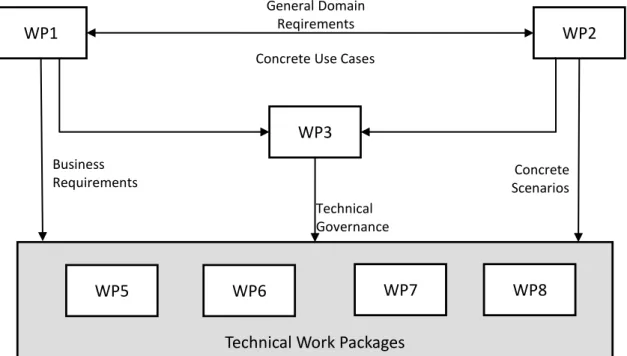
Work packages 1 and 2 (WP1 and WP2) of the FInest project are concerned with collecting general domain requirements from the domain partners involved in the project. Domain requirements are relevant throughout the entire project as the FInest project is – in contrast to many other research projects – not technology driven, but domain driven. This means that domain requirements define the need for certain technical services (they “pull” the proper technology from designers). These services are not pre-defined and “pushed” onto the domain partners who are then forced to fit them to their business requirements if they can. Additionally, WP1 and WP2 define concrete use cases that will be used to demonstrate the effectiveness of the FInest extension to the FI PPP Core platform and that address the business requirements of the transport and logistics domain. WP1 and WP2 provide the essential inputs for all other work packages in the FInest project as displayed in Figure 1.
Figure 1: Interactions between WP1-WP3 and WP5-WP8
WP1 is concerned with eliciting and documenting business requirements and to understand the ‚State-of-Affairs’ of current ‚ICT systems for collaboration’. Those business requirements provide the overall design goals and rationale for the development of the technical solutions in WP3, 5-8.
WP2 is concerned with the definition of use case scenarios, which serve two main purposes: They support the refinement and illustration of the business requirements and “state of affairs” (from WP1) and they are used as demonstration, test and evaluation scenarios for assessment of prototypes (in WP3) and the design of the experimental setup (in WP4). In addition, WP2 provides a methodology, that is used by WP5-8 to provide a refined “as-is“ and “to-be“ situation analysis.
Technical Work Packages
WP2 WP6 WP7 WP8 WP1 WP5 WP3 General Domain Reqirements Concrete Use Cases
Technical Governance Business
1.5.
Framework for the ICT Analysis
The FInest project employs a process-focused approach for documenting particular domain activities. This approach segments a logistics process into four distinct activities. These activities are:
1. Sales and marketing of the service; 2. Planning execution of the service; 3. Execution of the service; and 4. Completion of the service.
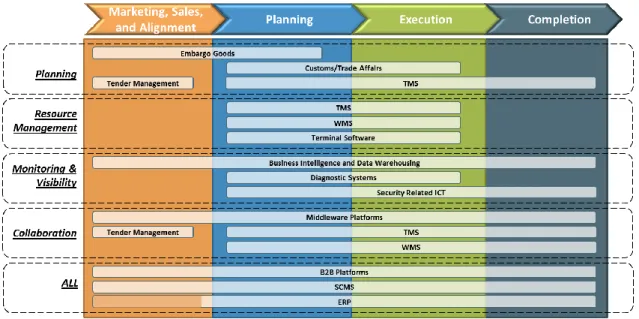
An example of how this approach is used for organization of information concerning domain processes is shown in Figure 2 following.
Figure 2: FInest domain mapping approach
Marketing, Sales, and Alignment
Marketing, Sales, and Alignment processes are concerned with creating contact between actors that have a need for transport or logistics services and those who can offer transport and logistics services that fulfil the demand. This activity consists of the following steps:
• publishing of needs or offered services, • establishing contact between the parties,
• agreeing on the terms of the service and • sale of the service.
As discussed in the previous section of this report, these steps are the same steps employed by most road freight exchanges.
Planning
The provision of transport and logistics services is planned and managed based on actual and forecast demand, information about the transportation network infrastructure, and traffic conditions.
Planning includes decisions about: • routes,
• schedules,
• service types, and • utilisation of resources.
Shipping consolidation and load/trip planning is the planning of the physical loads for placement in a transport unit (truck trailer, sea freight container, ULD, etc. depending on the mode of transport). This type of planning assigns shipments or goods to a transport mode, taking constraints like pickup and delivery time windows and allowed combination of goods into account. The trip planning is used to define the most optimal trip, based on geographical maps and plans. Combining both load and trip planning is necessary to create the most optimal transportation trip.
Load design refers to stowage planning and means to plan how the goods will be stored in the container three dimensionally. Design is done based on criteria such as sequence of loading and unloading and stackability of the products. This process can include load design for pallets using alternative stacking patterns, driven by product, customer and transport unit data/constraints.
Route planning is based on the created trip. The actual route is determined by customer delivery requirements, carrier network design and more granular information depending on the type of transport being used.
In case the planner’s own equipment is used to execute the actual shipment, the planning process needs to allocate loads appropriate to the equipment and schedule the correct operating personnel to the equipment and routes. Constraints that typically can be taken into account are operating hours, the current location of personnel, equipment and the condition of the transport equipment.
Carrier selection can include transport mode selection and the selection of the actual carrier. In its most basic form the planner assigns a transport mode and/or carrier to the shipment. Decision rules might be used that simply represent the selection criteria such as having an approved carrier for each mode or lane. It is also
possible that carrier selection is supported by tendering of loads amongst contract carriers or via public tendering on the web as discussed for freight exchanges.
Execution
The Execution phase begins when work processes are initiated in accordance with the execution plans and ends when the execution is completed or cancelled. The execution of the operations includes movement of goods, cargo handling, document handling, monitoring and control of operations and goods, supporting effective coordination and accomplishment of the whole transport chain. This may include transport and terminal operations managed by several logistics service providers (LSPs). This phase also deals with detection and management of deviations.
Order entry and consolidation is the registration, validation and management of orders. The exact content differs considerably depending on the user role: either shippers, LSPs or carriers. For a shipper, it is the key to register the relation between the customer order and the transportation/orders/deliveries that are being created as part of the fulfilment process.
A logistics service provider typically receives transportation orders from customers, either by phone, fax, email or electronically. Depending on the activities being outsourced and the IT solutions used, LSPs and carriers might only get a transportation order, possibly with a reference to a client customer order.
When dispatching the carriers or internal execution resources need to be informed. Confirmation may need to be obtained, especially when subcontracted carriers are used. At this point additional information, such as vehicle identification and operator information might be part of the confirmation.
The process used to record order status information related to the pick-up/collection and delivery of shipments is sometimes called the visibility or track and trace process. This process is used to monitor the execution of transportation and logistics services for every order. Information captured during this process can be used for financial settlement later.
Global logistic execution/customs and transport documentation generation processes support international transportation with trade compliance information for import and export. These processes provide compliance information about rules and regulations and support printing of specific import/export documents.
Completion
The completion phase includes the agreed completion of the services (e.g. delivery of the transported goods at the destination), handling of payment and claims when the actual service has deviated from the agreed terms. Also, while the handling of payment for services may come at any time in the process (e.g. pre-payment), it fits in the completion phase from a logical viewpoint.
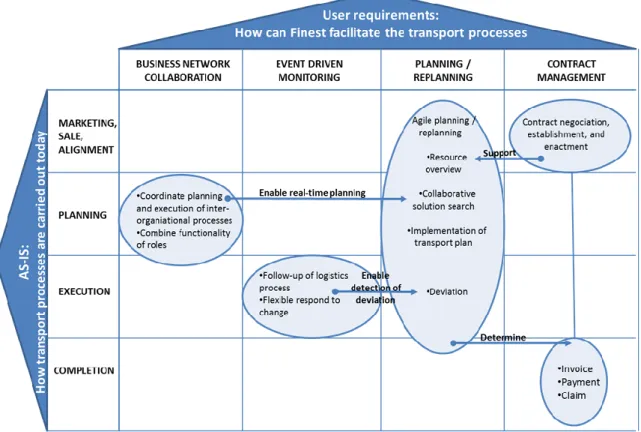
In the Deliverable D1.3,a detailed business requirements analysis is provided and the central results of the domain analysis presented. The domain analysis forms the major foundation for design of both technology and use case scenarios. Derived from an identification of generic high-level requirements in the Deliverable D1.1, a detailed analysis of the generic requirements has been executed.
Figure 3: Generic requirements identified in Deliverable D1.1 – Analysis of the T&L domain
Mainly, these generic requirements refer to the following four topics: planning, resource management, monitoring and visibility and collaboration.
Consisting of the two major parts ‘business alignment and contracting’ and ‘technical communication and cooperation’, collaboration in a supply chain network is a major generic requirement for today’s and tomorrow’s domain. For the conduct of business, cloud-based ICT solutions are said to be helpful with regard to the attraction of new business partners and the conduct of negotiations. In terms of technical collaboration, the flow and exchange of information between systems needs to be addressed.
Planning aims at safeguarding the availability of all resources required and, simultaneously, mitigating risks and challenges by means of enabling all tasks serving the goal such as monitoring of stocks and the automated trigger of proposals for procurement. Planning has to be both effective and efficient.
Being a key factor for a successful management of supply chain networks,
resource management is considered as a company’s capability of effective and
efficient deployment of any of its resources according to the own needs. For this purpose, forecasting of demands and supply patterns by sophisticated methods and innovative tools based on new technologies can help.
Holding the role a mandatory requirement for the vast majority of involved partners, monitoring & visibility is strongly related to timeliness and correctness of the input. Real-time updates on events, statuses, progresses and entire processes are highly desirable as they enhance the scope of action and reactions, in case of deviations and emergencies. The events to be monitored in a supply chain may vary from party to party.
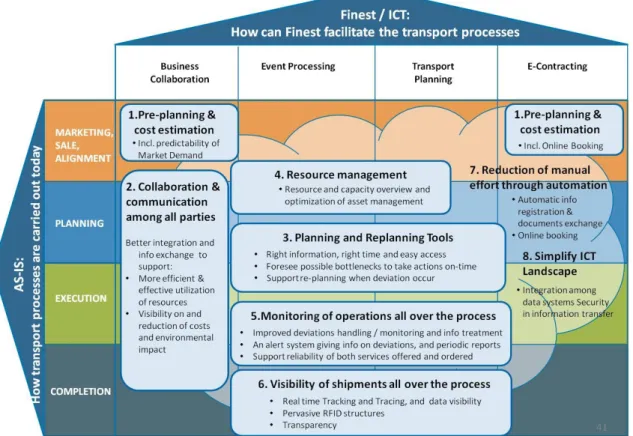
Relatedly, the following initial requirements have been identified and are pursued for the FInest components:
centralized and improved exchange of information (right information, right time, easy access, security in transfer),
higher coordination among all involved actors,
adaptation to surrounding systems currently in place,
event-driven monitoring and real time tracking of logistic processes,
standardized communication interfaces between all participants,
enabled transparency,
predictability of market demand,
preparedness (foresee possible bottlenecks and prepare action),
improved resource and capacity overview,
more automation of information registration,
resource and capacity overview,
higher flexibility,
safe and efficient transfer of documents,
facilitation of re-planning, and
facilitation of measures on carbon emission reduction.
The examined solutions in the following chapters are to be assigned to this framework consisting of the four-phase model on the one hand and the generic requirement categories on the other.
1.6.
Methodology of the ICT Analysis
This analysis will provide an introduction into the general topic and cover the historic developments of ICT solutions along with their changing role in the transport and logistics domain.
In the following, four categories of systems, that is to say Enterprise Resource Planning systems (ERP), Supply Chain Management Systems (SCMS), Transportation Management Systems (TMS) and Warehouse Management Systems (WMS), will be presented, their core and additional functionalities explained and their market and vendors illustrated.
For the presentation of these categories of systems, a multitude of studies and several systems themselves have been examined. From both kinds of sources, common characteristics and features of the respective category of systems have been derived. Next, special features or even dedicated solutions for particular fields of operation, which are represented in the FInest use cases or used involved partners therein, will be presented. These dedicated solutions cover quite a variety of aspects, ranging from foodstuffs and hazardous material over terminal software for ports and airports to B2B online platforms and middleware layers for information exchange.
Examples of these systems have been examined and presented in the text.
As a result of both above-mentioned sections, the solutions considered and examined are assigned to the framework of this analysis, which consists of a four-phase process model and the generic requirements undergoing the transport and logistics domain at present.
Finally, current trends with regard to ICT solutions in the domain and their impact on future domain activities will be named and explained in detail.
2.
Information and communication technologies in the
transport and logistics domain
2.1.
Introduction
Information and communication technology (ICT) plays an important role in logistics nowadays because it forms a major contribution in support of enabling a smooth process. However, this view has not always been widely prevalent. Considering the history of the industry and the accompanying developments among information systems, a considerable leap can be recognized. Originally regarded merely as a service provider and a cost-raiser, ICT solutions focused on logistics have soon developed towards an image of a value-added service for the support of business processes. Later, that image changed towards the one of an innovation for existing business fields allowing for increase in sales, turnover and profit. The innovative image was replaced by the image of a ‘business enabler’ according to which ICT supports the opening-up of new business fields. The future development will be characterized by the integration of users and their actual requirements in future software engineering and in the development of solutions. [BVL 2012, p. 7, 8; Krupp et al. 2010, p. 15, 16; LogPrax 2007, p. 99-101, 103-105]
While individual software-based solutions were used in practice in the 1950s and 60s for the provision of classic transfer operations in order to promote automation in the industry, the following decades were dedicated to the coordinative and cross-section-oriented role of logistics which became evident through the increased integration of different fields of operation and the higher demand for interfaces and coordination systems. [Krupp et al. 2010, p. 16-18]
The 1990s were characterized by the fostering of the integration of business functions which led to the evolvement of Enterprise Resource Planning systems and the focus on process-based thinking, supply chain management (SCM) and globalization. In the wake of these developments, ERP systems were to support Electronic Data Interchange (EDI) for transactions between supplier and customer as much as data integration and standard solutions for resource planning. [Krupp 2010, p. 16-18; LogPrax 2010, p. 80]
The new millennium brought the thinking of flow management, active process management and supply chain network collaboration to light which again is reflected by the evolvement of Supply Chain Management Systems for the handling of transaction data in cross-company supply chain networks. Furthermore, Advanced Planning Systems (APS), Customer Relationship Management systems (CRM) and Supplier Relationship Management systems (SRM) gained in popularity and prevalence as well as web-based applications using Extensible Markup Language (XML). [Krupp et al. 2010, p. 16-18]
The current decade is moving towards adaptive network management which considers a single enterprise no more individually, but as an integral part of one or several supply chains which again leads to high complexity of planning and control operations with
changing actors. As a preliminary result, both synchronization and a reduction of internal and external supply chains are sought. In addition, the major challenges of today, such as the pursuit of sustainability and environment protection and the intensified prevention of legal violations like terrorist acts, are aspired. In order to obtain the desired results, business intelligence systems for an integrated management support are sought as well as web services, cloud computing, decentralized SCMS architectures and IT-based pool management for the management and control of an ever-changing pool supply chain partners. [Krupp et al. 2010, p. 16-18; LogPrax 2007, p. 97-101; LogPrax 2011, p. 19-23]
Information and communication technology has managed to play an important role in logistics nowadays. Moreover, it is also a decisive factor for competitiveness. According to a new study by German-based Fraunhofer Institute for Material Flows and Logistics (IML) from 2012, it is expected for the coming years that IT technologies and the logistics domain will align with each other even stronger. Furthermore, a dynamic development within information technology is to be expected due to a multitude of innovations yet to come. [BVL 2012, p. 7]
Logistics today is about more than the traditional process. It is about more efficient and quicker search of relevant customer information and effective collaboration with the right people across your business network in order to accomplish your business goals. On-demand solutions and new technologies such as cloud computing, ubiquitous computing are to be designed for the way the logistics processes are handled today, providing all necessary input for smart work, better distribution, reduction of acquisition and higher profits. Thereby, the customer will be capable of a quick adoption to access real-time information to enhance supply chain functionality, optimize results, and increase efficiency. [BVL 2012, p. 7]
The definition of ERP systems have continued to vary within both research and industry, but usually comprehend the covering of most, or even all, business functions of an enterprise. ERP consider operations not individually, but as elements of a process and value chain.
Many modules and functions have established themselves as integral parts in a standard ERP package, containing much functionality for a majority of business needs. Additional functionalities, such as dedicated modules for niche applications, do not belong to the standard package. Recently, risk management and incident management functions have been integrated into the system and taken as standard functionality. It is expected that internet and on-demand technology will change ERP systems and their use completely and enhance reliability in the processes. [BVL 2012, p. 7; Krupp et al. 2010, p. 10; LogPrax 2007, p. 103-105]
Originally stemming from conventional freight forwarding software, Transport Management Systems provide a support for the planning, analysis and control of transport logistics processes. Major customers, like industry and retail business,
increasingly seek to connect their systems to other systems used, such as ERP or SCMS. Therefore, a smooth interoperability of systems is primarily required both for the operative control and for strategic planning. [BVL 2012, p. 7; Krupp et al. 2010, p. 15] For a comprehensive view of the respective status of the single processes and the entire business, a viable connection of the back-end side is required, including the maximum feasible equipment of the mobile elements of the logistics chain, like people and objects, with appropriate modern technologies like smart phones, tablet PCs, telematics, RFID tags or various sensors. By connecting the back-end side to the TMS, the user is to be provided with the right amount of ergonomically prepared information and knowledge. [BVL 2012, p. 7; LogPrax 2011, p. 102-108]
Regarding strategic planning of transports and material flows, complex planning functionality is required for enabling and safeguarding flexibility to design and shape global, robust and multi-modal transport logistics chains while taking multiple variable factors into consideration. Moreover, the design of the access to TMS, e.g. via cloud computing, has evolved in the course of these requirements. [BVL 2012, p. 7; LogPrax 2011, p. 30-33]
As indicated earlier, the market of ICT solutions in logistics has developed towards cross-company solutions like SCMS. Within the SCMS market, two segments have emerged: systems for the strategic design of supply chains and systems for tactical planning tasks in supply chains. While the earlier are categorized into supply chain design systems or SCD software, the latter are referred to as supply chain planning systems or SCP software. [BVL 2012, p. 7, 8]
SCP software requires the presence of ERP systems. Due to a strong overlap of SCP software with the planning functions in ERP systems, recent studies expect the SCP software market to completely merge into the ERP market in the medium-term. Sometimes, the SCP solutions are considered as extensions of ERP systems due to the expansion of planning activities onto the complete supply chain.
The pertaining market for such solutions has considerably shrunk over the past years due to a range of corporate takeovers, leaving Oracle and SAP as the major players remaining with almost over 20% of the worldwide SCM software revenues each. [Hribernik/Hans 2011, p. 13, 14; BVL 2012, p. 7, 8; LogPrax 2007, p. 99-102]
Among supply chain design systems or SCD software, the focus is laid on optimization of network structures. This segment of the SCM software market exhibits a small size and currently a small number of niche providers. Recent studies predict a rather small share of sales and little use of future SCD software which again is likely to be offered predominantly by niche provider. [BVL 2012, p. 7, 8; LogPrax 2007, p. 125-128]
Following a persistent trend towards individualized standard solutions, Warehouse Management Systems nowadays offer modular structures and sector-neutral standard functions which can be customized according to the respective desires and needs. The functional support provided by WMS covers standard processes in logistics, ranging from goods receipt to issue and has continuously grown to a significant level over the years. The support of planning tasks and the control of resources and process
statuses have also been integrated into WMS over the past years. Simultaneously, functional support for logistics service providers has been expanded largely since they form a substantial part of WMS customer base. [BVL 2012, p. 7]
Warehouse Management Systems are expected to follow the trend towards e-commerce and multi-channel-retail business by addressing the issues of returns handling as well. Such developments clearly indicate that WMS will exhibit overlaps with ERP, TMS and SCMS in future. The global market of WMS is dominated by German and Central European providers, not least because of their intensified global marketing efforts. [BVL 2012, p. 7]
While ERP systems are applied on the planning level for procurement, production, distribution and reverse logistics as much as for procurement, production and distribution on execution level, SCMS are to be found on a strategic level of planning and design as well – in addition to the planning of procurement and production operations and the execution of distribution activities. SCMS are to be found in many business functions through the planning and execution of transport and intermediate storage processes in a supply chain whereas TMS are oftentimes restricted to the pure transport operations – predominantly in the context of distribution – both on planning and on execution level. [BVL 2012, p. 15; LogPrax 2007, p.99-102; LogPrax 2011, p.114-117]
2.2.
Enterprise Resource Planning Systems
Enterprise Resource Planning systems used to be applied by large enterprises which aimed at applying the system in various divisions whereas small- and medium-sized enterprises (SME) used mostly individual professional systems for resource planning, production planning and scheduling, warehouse management and financial accounting. The main idea is to assign the correct resources in the correct size and manner at the correct time while considering restrictions from both suppliers’ and customers’ sides. It was the significant reduction of costs for both hardware and software that helped to make ERP systems affordable and attractive for SMEs as well. In recent years, ERP systems have been continuously enhanced in their functionality, for instance, through the integration of further business functionalities and expert systems. [BVL 2012, p. 11; Hribernik/Hans 2011, p.10, 11; LogPrax 2008, p. 102, 103] Today, an ERP system is an integrated software system for comprehensive planning and coordination of corporate tasks, particularly in business management. The software is capable of optimization of a company’s available resources in order to attain higher efficiency. The system offers logistics features like inventory management or disposition as much as programs for almost all other tasks of a company, from finance and accounting over controlling to manufacturing and product development. Modern ERP systems need to follow the dynamic business processes easily and develop flexible software solutions with open technical standards. [BVL 2012, p. 11; LogPrax 2007, p. 103-105]
The market of ERP systems is a heterogeneous one in which many providers of all sizes with many products and different functional scopes act. After a phase of rapid growth and massive functional expansion and technical innovation in the 1990s and a phase of consolidation, takeovers and minor recession in the 2000s, the trends exhibit a reinforced market growth. [BVL 2012, p. 23, 24]
The ERP market consists of a large multitude of companies, of which not each offers a self-developed ERP system. According to a range of renowned publications in German and English language, providers of such systems belong to different categories which can be distinguished between generalists, resellers, suite providers and implementation partners.
Developers or producers develop their own products and take care of both the technological base and the functional enlargement. Developers can be sub-categorized even further into generalists, production-borne developers and retail-borne producers. The generalists among the producers offer functionalities for each area and thereby provide the full range of basic functions of an enterprise, regardless of their industry focus or orientation. This again leads to a considerable demand for customization according to the individual needs and desires. Producers focusing on companies from the area of production must often have a dedicated orientation to the respective areas to serve, such as automotive, machinery and equipment or process manufacturing of food or chemicals with their diverse characteristics and business needs. Such sector-specific characteristics (and the related abandonment of additional customization effort) are the main advantage of sector-related producers over generalists. Same applies for the third sub-category, the retail-borne producers, who cover the specific requirements in ERP software for companies engaged in retail business. This includes, for example, the adherence to storage and transport conditions of perishable goods like foodstuffs. [BVL 2012, p. 23, 24; LogPrax 2007, p. 98-102; LogPrax 2008, p. 94-97; LogPrax 2010, p. 88-91]
Apart from developers or producers, there exist further types of providers: Resellers act as a partner of the developer or producer and sell the software including implementation at the customer’s. Oftentimes, resellers are present in those regions where the producer or developer has no own sales and consulting department. Suite providers go beyond the resellers’ activities by extending the standard ERP software with additional industry-specific modules or functions and presenting the functionality in a homogeneous surrounding without any system breaks. Implementation partners eventually introduce ERP software at customers’ and offer consultancy services during the phase. The role of an implementation partner can be taken by a producer, reseller or suite provider as well. [BVL 2012, p. 23, 24]
Largest vendors of ERP systems are Microsoft, Oracle, SAP, Atos, Sage Group, Infor and Software AG. Moreover, there exist further renowned players such as PSI Logistics, Aldata Solution, CSB System, and IFS. [BVL 2012, p. 22]
Apart from supporting business processes by functionality, technological change alters the market of ERP systems. The use of the Internet and web-based business services
increasingly gains importance for future operational scenarios of ERP systems as well, not least because of their ubiquitous availability and lower hardware and software requirements on the user’s side. Moreover, mobile data collection and processing, cloud computing and software-as-a-service are just some topics having begun to affect the industry. [BVL 2012, p. 23, 24; LogPrax 2007, p. 103-105]
In general, the functionality of ERP systems can be divided to core functions and additional features.
To the core functions of an ERP system belong features of sales, purchasing, production, warehouse management, controlling, and finance & accounting. Moreover, demand planning, construction and design, quality management, customer service, and HR management belong to the major core features of a standard ERP system. Other standard features of ERP systems include material planning, order & capacity planning, supply and order management, and product data management. Likewise, e-procurement, wages & salary management, and master data administration are part of standard ERP systems as much as spare parts business and multi-site & multi-company management are.
Functionalities of marketing, contract management including long-term frame contracts, supplier evaluation and supplier relationship management, returns handling, transport management belong to the additional features of an ERP system. Besides, goods receipt and goods issue, order control, storage & stock control, inventory tracking as well as test plans and procedures, batch management & traceability and in-process inspections are named as additional features of ERP systems. Finally, several features like KPI management, planning/control/monitoring, reporting, staff development, document management, and revision control can be counted as standard parts of (some) ERP systems as well.
Some of the additional features become manifest in individual modules or systems, such as Manufacturing Execution Systems (MES), Customer Relationship Management (CRM), modules for plant data collection and space management as well as Management Information Systems and e-commerce solutions. [BVL 2012, p. 11; Hribernik/Hans 2011, p. 12, 13; LogPrax 2010, p. 81-85]
2.3.
Supply Chain Management Systems
Different definitions of SCM software result from the various views on supply chain management itself. In general, SCM can be understood as design, operational planning and monitoring of material and information flow within and across company borders. One perception is that SCM includes planning and monitoring functions in procurement, production and distribution of a company. Another interpretation defines a supply chain as a corporate network that covers all procurement, transport, manufacturing and distribution processes from the supplier of raw material to the end customer as well as service and redistributions processes in the field of after-sales. [BVL 2012, p. 14; LogPrax 2007, p. 126]
As a result, SCMS serve as a support for all logistical planning and control tasks in the company-wide value added networks, partly including functions for the integration of suppliers and customers. A broader definition describes SCMS as a software system for the design of supply chains, for all planning tasks in supply chains and even for the support of operational tasks across and within company borders. Although there are providers for all planning and control tasks, the corresponding systems often cannot be used universally and company-wide in this sense. Following this orthodox interpretation, a universal SCM system would not be available today. Nevertheless, it is the desire of some providers to achieve such universality of their systems. [BVL 2012, p. 14; LogPrax 2007, p. 125-128; LogPrax 2010, 108-110]
With ever increasing globalization and growing interdependencies in worldwide trade,
the requirements for SCMS grow constantly both in quantity and complexity refer to both security and transparency issues. Apart from legal requirements, business needs add to the complexity of SCMS with their needs for diverse features. End-to-end-visibility and transparency with regard to processes and the flow goods and information is as much demanded as solutions to ensure security and robustness of supply chains.
Numerous challenges can be named as the most crucial ones for supply chain managers these days which again have to be supported or even solved by SCMS. Given increasing wages in many production countries and an ever rising oil price, supply chain managers seek to reduce costs in order to maintain or even increase profit margins.
They also aim at the reduction of capital lockup in the supply chain which is caused by the directive of timely satisfaction of demand. This on-time reactivity is facilitated by decentralized inventory structures and, thus, elevated stock levels.
In spite of globally dispersed supply chain participants, long transport distances and even a high oil price, on-time deliveries are aspired by supply chain managers. Effective software tools are drawn on to realize correct demand and sales forecasts and an effective planning of production and distribution across the supply chain network. In addition, managers need to improve their supply chain processes since they generally hold considerable potential for optimization which can be exploited by embedding technology and automation and by adopting best-practice solutions. For that, identification, evaluation and quantification, and a careful selection of eligible processes are to be carried out. Furthermore, the processes need to be adapted to those of the suppliers and customers.
Issues regarding compliance and corporate social responsibility have begun to appear on managers’ agenda. These cover environmental aspects as much as questions of compliance with product safety and human rights regulations.
SCMS are used to support supply chain managers in their daily operations and to assist them in strategic and tactical questions among which the above-mentioned challenges are ranked with increased regularity. [LogPrax 2008, p. 130-138; LogPrax 2010, 38-46]
One of the major challenges in supply chain management is the lack of visibility which is often explained with high complexity of operations and network structure as well as a low degree of automation throughout the entire chain and, thus, a lack of transparency. Either the supply chain actors have only little access to the requirement or they drown in a massive abundance of data at many different ends. Whereas the first case can be solved with an adequate equipment of the respective processes with suitable and sensible information sources, the second case is based on a multitude of processes supported by ICT solutions like CRM, WMS, TMS, SCMS and ERP and geared towards enabling collaboration, integration and flexibility. However, each of the systems creates and contains own data and own views of the processes. This leads to a large pool of information bits and views in which the respective information has to be sought in for the identification of interrelations and links. [LogPrax 2007, p. 120-124] As one of the ultimate goals of transport and logistics in the 21st century, the domain actors have identified holistic planning and control of supply chain networks. A single central system in order to achieve the above-mentioned goals, i.e. collaboration, integration and flexibility, has oftentimes been considered as utopia by actors in the transport and logistics domain. This applies to vendors of central systems as much as to one-system-solutions because the earlier raises evident economic concerns regarding dependency of a system supplier and the latter requires all partners in a supply chain network to shift their existing information systems and data and communication standards. Moreover, such a central solution implies a shift of control from the individual supply chain partner to a coordinative authority which might pose an additional barrier for broad acceptance. [LogPrax 2007, p. 120-124]
The domain has expressed its hope in the form of a platform solution enabling supply chain network management with the help of internet-based technologies. The platform is to provide the participating partners with all important information from all supply chain partners at the correct time and to empower them to control their supply chain operations proactively and, thereby, to enhance their scope of operations for an efficient supply chain performance. A platform transfers the goals of collaboration, integration and flexibility into the ability to collaborate, integrate and adapt. [LogPrax 2007, p. 120-124]
As a result, supply chain visibility solutions are to be based completely on internet services and solutions since the internet is the perfect and most powerful marketplace for the exchange of already existing data and information. The information currently contained in local forms, spreadsheets and tables are to be captured in web-based forms to allocate them for future platform solutions. Monitoring of supply chain events may take place permanently whereas alerting is required in case of critical deviations only. [LogPrax 2007, p. 120-124; LogPrax 2008, p. 27-32]
Another challenge refers to end-to-end supply chain optimization considering structural changes of the flow of goods in order to achieve goals, such as the 7Rs in logistics (the right product with the right quality in the right quantity has to be delivered at the right time and right place to the right customer at the right cost). By displaying the supply chain from the beginning to the end, network structures and
global optimization potentials can be identified and evaluated transparently instead of local improvement efforts. Operative SCMS do act and try to optimize within existing structures rather than scrutinizing the structures themselves. End-to-end optimization is said to be attainable with little effort with regard to time, work and capital which is related to powerful ERP systems in use and dedicated tools for such optimization. [LogPrax 2007, p. 125-128]
Further challenges can be identified in connection with ensuring security and robustness of supply chains. Several requirements resulting from mandatory regulations and from voluntary initiatives refer to novel security issues, such as terrorism, theft, piracy and smuggling. Moreover, the complex and variable field of customs and trade affairs and certain product traceability requirements have to be included adequately in the software solutions for an efficient supply chain management. Several regulations deal with these issues, like the above-mentioned C-TPAT, the Container Security Initiative (CSI) with its 24-Hour Advance Manifest Rule in the United States of America as well as the European Community Customs Code (Regulation (EEC) No. 2913/92), the earlier-mentioned AEO, the Export Control System (ECS), the Excise Movement and Control System (ECMS), ISO 28000 (security management systems for the supply chain) or traceability requirements for foodstuffs as part of the General Food Law (Regulation (EC) No. 178/2002) in the European Union.
Proactive investment into the enhancement of security in supply chains and into the preparation of countermeasures in case of emergencies is supposed to be supported by SCMS and to pay off via large savings due to an efficient deviation management. [Kummer 2009, p. 105-107; LogPrax 2008, p. 38-47; LogPrax 2010, p. 38-41; LogPrax 2011, p. 118-122]
Regarding the functional range of a standard SCMS, a bunch of features are considered as central. To these belong statistical sales forecasting and sales planning considering causal factors in order to estimate and calculate the expected demand.
Location-specific planning of both stock and capacity is part of standard SCMS as much as the network-wide stock and capacity planning. The planning of stock ranges in one location and in the entire network as well as the calculation and consideration of available-to-promise and capable-to-promise is enabled and supported by SCMS as well.
In addition, the comparison of forecast with the program planning including the settlement of both belongs to the core SCMS functionalities as the selection and parameterization of planning and scheduling methods do.
Furthermore, SCMS encompass planning and monitoring both of procurement and distribution operations, the optimization of lot sizes and production monitoring. Likewise, scheduling, sequencing and monitoring of orders are an integral part of SCMS functionality.
There exist standard interfaces to ERP and WMS as well in order to retrieve data from these systems as input and to feed them with output.
Besides some SCMS offer additional features to address particular needs and requirements. Oftentimes, these refer to the strategic design of the supply chain network and to collaboration features with other members of the network, which again partly lead to functionality overlaps with WMS, TMS and ERP systems.
Regarding to the earlier category, vendor- and supplier-managed inventory is supported in some SCMS as much as collaborative sales planning, collaborative demand and capacity management and collaborative procurement planning are. To the latter category belong the choice and the dimensioning of location, the allocation of products to the locations, the selection of transport modes and the dimensioning of the traffic relations, and, not least, the allocation of customers. Additionally, SCMS sometimes offer the management of planning master data and EDI interfaces. [BVL 2012, p. 14; LogPrax 2007, p. 99-102, 125-128; LogPrax 2008, p. 44-46, 130-133]
Since the early 1990s supply chain management software has been available in the market. Compared to ERP systems, this market is very small. The sales volume of supply chain management systems market and related software vendors is oftentimes diluted and blurred since SCM providers publish turnover figures that encompass more than the pure sales volume of SCMS which generally is far smaller than the figures often shown. Because it is possible to manage supply chains with ERP systems, many ERP vendors see themselves as SCM vendors. In reality, there do exist overlaps between ERP and SCMS, particularly in terms of production planning functionality. SCMS solutions are differentiated in the way that they usually apply APS methods. However, inventories and capacities are determined simultaneously in SCMS whereas they are determined sequentially in ERP systems. The APS functionality in SCMS may cause higher efforts of implementation but yields better resource utilization and more reliability of the delivery dates. [BVL 2012, p. 28, 29]
As has been mentioned at an earlier stage, Supply Chain Management Systems can be sub-categorized in SCD and SCP systems. While SCD operate on strategic level and mainly aim at optimization of network structures, SCP solutions are situated on the tactical level and deal with planning tasks in supply chains.
SCD systems typically cover location decisions and the dimensioning of transport relations, which explains their customer base mainly consisting of trading companies and logistics service providers. The few providers of SCD software often have to compete with ad-hoc solutions based on Excel.
SCP systems, on the contrary, contain all tactical planning tasks of SCM, such as sales forecasts, network-wide inventory and capacity planning as well as production and distribution planning. Although not being published explicitly, SCP market is said to have a notably larger size than the SCD segment. [BVL 2012, p. 28, 29]
According to recent a study in Germany, the global turnover of the SCMS solutions has amounted to 6.8 bn US$ in 2010, with SAP SCM and Oracle being the largest players on the market exhibiting market shares of 19.5% and 17.9%, respectively, and further
providers like JDA Technologies getting far lower shares with approx. 5.4%. While some providers sell SCMS solutions as a side product of their standard product, others focus on supply chain management solutions. This results in different market strategies and different significance levels of the SCMS share of the companies’ overall turnover amounts. [BVL 2012, p. 28, 29]
With regard to the SCP segment, a dramatic change during the past two decades can be made out, transforming a market with formerly strong pure SCMS providers to one of large ERP providers offering additional SCMS solutions after a number of mergers and acquisitions. [BVL 2012, p. 28, 29]
2.4.
Transportation Management Systems
TMS generally enable the planning, management and control as well as optimization of transport networks and supply chains. This includes the planning and optimization of procurement and distribution structures while considering further constraints like those related with costs or time, the planning of multimodal transport chains, the optimization of delivery transport as well as the control and monitoring of the implementation and execution of the resulting transport processes. A prerequisite for the effective management and control is a certain level of integration of mobile units like transport means or loading equipment, as ordinary telematics modules exhibit. Prior to a wider prevalence of IT-based TMS, transport logistics used to be covered usually by a freight forwarding software of the logistics service providers whereas shippers relied on the simple functional elements integrated in ERP systems. Some complex problems were solved by additional route planning software.
From the late 1990s onwards, the need of comprehensive transportation management systems in order to manage these complex transport chains with all functional requirements grew parallelly to the steadily increasing complexity of global and closely connected supply chains. Therefore, a certain degree of congruency with SCMS is predetermined. [BVL 2012, p. 13; CapGemini 2011, p. 36; Gartner 2010, p. 4, 5]
Especially the security-related restrictions in the early 2000s pose a massive obstacle to easy import and export operations with initiatives like Customs-Trade Partnership Against Terrorism (C-TPAT) in the United States and Authorized Economic Operator (AEO) in the European Union, to name only two. Growing business due to global expansion and mergers & acquisitions can lead to limited visibility in the value chain; changed processes in the handling of documents and cases of non-compliance in import/export business. The need for organizations coordinating the administrative and the process side is becoming more and more evident. One possible solution is the so-called ‘Freight Control Tower’ supporting both global trade compliance and freight management and ultimately directed to operational excellence in export processes by directly addressing the major challenges in today’s global business. In detail, the Freight Control Tower is to support freight procurement, collaborative capacity management, freight order management, load planning and shipment execution, event management and visibility and freight payment, audit and customer billing as
![Figure 4: TMS functional reference model and domains [CapGemini 2011, p. 47]](https://thumb-us.123doks.com/thumbv2/123dok_us/9613191.2448476/34.892.136.766.160.648/figure-tms-functional-reference-model-domains-capgemini-p.webp)
![Figure 5: Magic Quadrant for Transportation Management Systems [Gartner 2010, p. 4]](https://thumb-us.123doks.com/thumbv2/123dok_us/9613191.2448476/36.892.190.702.171.746/figure-magic-quadrant-for-transportation-management-systems-gartner.webp)
![Figure 6: Traditional communication vs. Port Community System [Smit 2012]](https://thumb-us.123doks.com/thumbv2/123dok_us/9613191.2448476/50.892.143.762.906.1084/figure-traditional-communication-vs-port-community-smit.webp)
![Figure 7: Scope of Single Window and International Supply Chain [Vivekanantham 2011]](https://thumb-us.123doks.com/thumbv2/123dok_us/9613191.2448476/54.892.139.763.222.523/figure-scope-single-window-international-supply-chain-vivekanantham.webp)
![Figure 8: Design of a B2B market place [Hepp and Schnitzer 2003-2011]](https://thumb-us.123doks.com/thumbv2/123dok_us/9613191.2448476/61.892.131.764.157.565/figure-design-b-b-market-place-hepp-schnitzer.webp)