A Performance Study of Uplink Scheduling Algorithms
in
Point to Multipoint WiMAX Networks
by
Pratik Dhrona
A thesis submitted to the School of Computing in conformity with the requirements for
the degree of Master of Science
Queen’s University Kingston, Ontario, Canada
December, 2007
Abstract
Applications such as video and audio streaming, online gaming, video conferencing, Voice over IP (VoIP) and File Transfer Protocol (FTP) demand a wide range of QoS requirements such as bandwidth and delay. Existing wireless technologies that can satisfy the requirements of heterogeneous traffic are very costly to deploy in rural areas and “last mile” access. Worldwide Interoperability for Microwave Access (WiMAX) provides an affordable alternative for wireless broadband access supporting a multiplicity of applications. The IEEE 802.16 standard provides specification for the Medium Access Control (MAC) and Physical (PHY) layers for WiMAX. A critical part of the MAC layer specification is scheduling, which resolves contention for bandwidth and determines the transmission order of users.
It is imperative for a scheduling algorithm to have a multi-dimensional objective of satisfying QoS requirements of the users, maximizing system utilization and ensuring fairness among the users. In this thesis, we categorize and study various scheduling algorithms for the uplink traffic in WiMAX in view of these objectives. The algorithms are studied under different mixes of traffic and for various characteristics of the IEEE 802.16 MAC layer such as uplink burst preamble, frame length, bandwidth request mechanisms etc. Simulation results indicate that legacy algorithms are not suitable for the multi-class traffic in WiMAX as they do not explicitly incorporate the WiMAX QoS parameters. We provide recommendations for enhancing existing scheduling schemes in WiMAX, and shed light on some of the open issues that need to be addressed.
Acknowledgements
This work would never have been possible without support from people too many to name. However, I would like to thank the following.
I would like to thank Queen’s University and the School of Computing for giving me the opportunity and financial assistance to pursue the Masters program. I am very thankful to my supervisor Dr.Hossam Hassanein for giving me the opportunity to be part of the Telecommunications Research Lab (TRL) and work under his guidance. His invaluable technical assistance, moral support and motivation are the main reasons for timely completion of such a challenging project. His wonderful personality and most of all encouragement during difficult times in my research kept me going.
I am also very grateful to my co-supervisor Dr.Najah Abu Ali of the UAE University for her technical assistance and moral support throughout the course of this work. Her assistance right from the topic selection to the analysis of the results was invaluable in successful completion of the work. Her deep-rooted knowledge of the system and experience in this field enabled me to produce a high quality work and gain valuable knowledge in conducting research.
It has been an honor to have worked with a talented group of students and collaborators at TRL. I would like to thank Kashif Ali for his assistance with NS-2 and Linux. I am also grateful for the valuable feedback of my thesis from Kashif and Afzal Mawji that helped me to improve it by a great deal. I am thankful for all the guidance and friendship of my colleagues at the TRL group. Thanks to everyone at the School of
Computing and all those who asked “how is your thesis going?” These memories at the School of Computing will always be cherished.
I am grateful for the emotional, financial and nutritional support of my family. Without their continuous support and prayers, this work would not have been accomplished. Mom and Dad, thank you for directing me in my academic and professional life. I am thankful to my sister for the support during difficult times and sharing my success when things were going well. I express my deepest gratitude to my uncle, aunt and brother for providing me with guidance and supporting all my decisions. I am grateful for all the life lessons learned from my grandmother and late grandfather, which are the cornerstones of my success. I know his blessings will always be with me in all my endeavors and I dedicate this success to him.
TABLE OF CONTENTS
Abstract ... i
Acknowledgements... ii
List of Tables ... vi
List of Figures ... vii
List of Acronyms ... ix
Chapter 1. Introduction ... 1
1.1 Thesis Contribution... 5
1.2 Thesis Organization ... 6
Chapter 2. Background ... 8
2.1 Worldwide Interoperability of Microwave Access (WiMAX) ... 8
2.1.1 The Evolution of IEEE 802.16 standard ... 9
2.1.2 IEEE 802.16 PHY Layer... 11
2.1.3 IEEE 802.16 MAC Layer ... 14
2.1.4 IEEE 802.16 Service Classes... 19
2.2 Packet scheduling for uplink traffic in WiMAX... 21
2.2.1 Homogeneous scheduling algorithms ... 23
2.2.2 Hybrid scheduling algorithms... 26
2.2.3 Opportunistic scheduling algorithms ... 29
2.3 Summary ... 32
Chapter 3. Representative WiMAX uplink scheduling algorithms ... 33
3.1 Homogeneous Algorithms ... 36
3.1.1 Weighted Round Robin (WRR)... 37
3.1.2 Earliest Deadline First (EDF) ... 38
3.1.3 Weighted Fair Queuing (WFQ) ... 39
3.2 Hybrid Algorithms ... 42
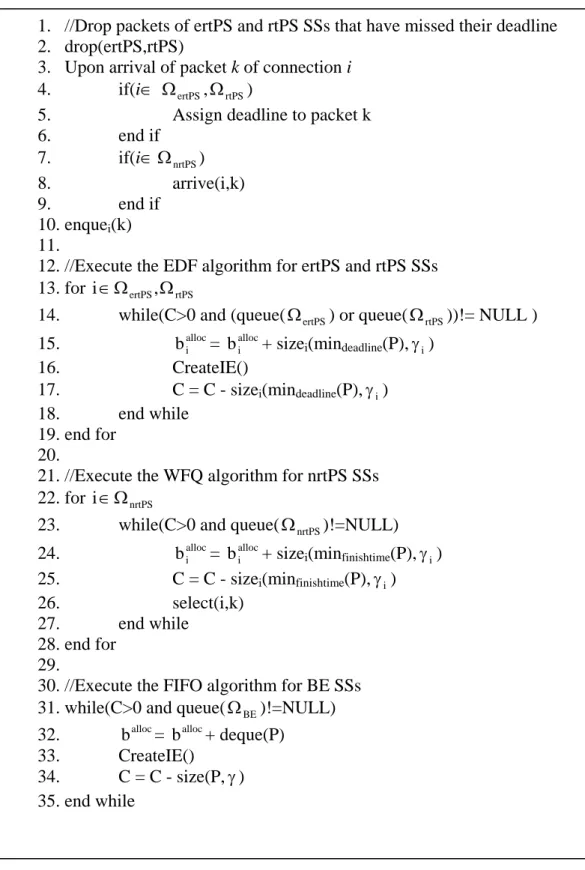
3.2.1 Hybrid (EDF+WFQ+FIFO) ... 42
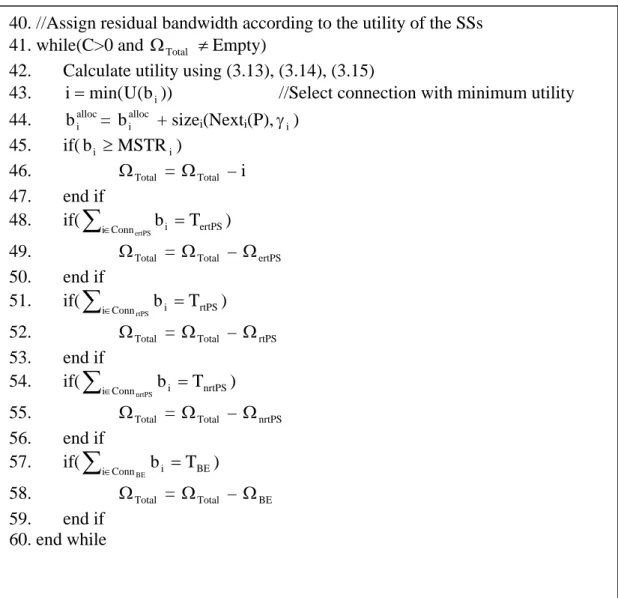
3.2.2 Hybrid (EDF+WFQ)... 44
3.3 Opportunistic Algorithms ... 46
3.3.1 Cross-Layer scheduling algorithm... 46
3.3.2 Queuing Theoretic scheduling algorithm... 49
3.4 Complexity Analysis... 54
3.5 Summary ... 56
Chapter 4. Performance Analysis ... 57
4.1 NS-2 and WiMAX ... 57 4.2 Simulation Model... 59 4.2.1 Transmission Modes ... 59 4.2.2 Traffic Model ... 60 4.2.3 Simulation Parameters ... 62 4.2.4 Performance Metrics... 63 4.3 Simulation Results ... 66
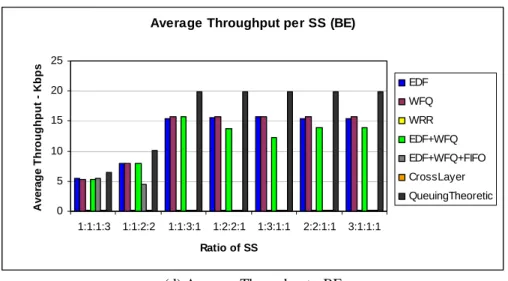
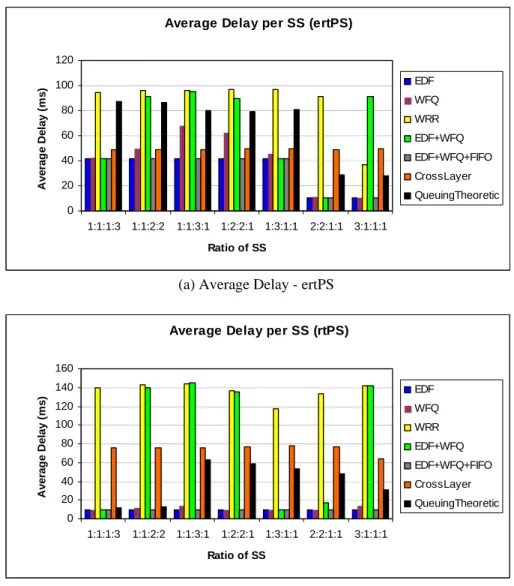
4.3.1 The effect of SS ratio ... 67
4.3.2 The effect of uplink burst preamble... 79
4.3.3 The effect of frame length... 95
4.4 Summary ... 110
Chapter 5. Conclusions and Future Work... 114
Bibliography ... 122
List of Tables
Table 2-1: Traffic classes in 802.16 and their QoS requirements... 20
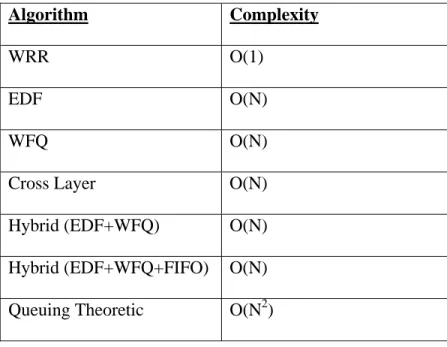
Table 3-1: Complexity of representative uplink scheduling algorithms... 55
Table 4-1: IEEE 802.16-2004 Transmission Modes... 60
Table 4-2: VoIP traffic parameters ... 61
Table 4-3: Video Streaming parameters ... 61
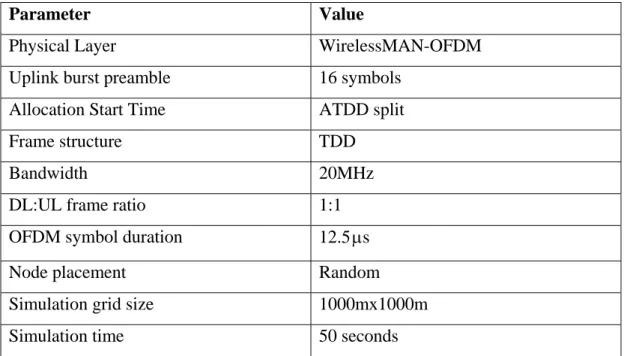
Table 4-4: Fixed Simulation parameters... 63
Table 4-5: Variable Simulation parameters ... 63
Table 4-6: The effect of SS Ratio – Parameters ... 67
Table 4-7: The effect of uplink burst preamble – Parameters (frame utilization) ... 80
Table 4-8: The effect of uplink burst preamble – Parameters ... 83
Table 4-9: The effect of frame length – Parameters (frame utilization) ... 96
Table 4-10: The effect of frame length – Parameters ... 99
Table 4-11: Bandwidth request analysis - Parameters... 104
List of Figures
Figure 1-1: Single-hop cellular network if this is not yours you need to reference it ... 2
Figure 1-2: Multi-hop cellular network ... 2
Figure 2-1: TDD Frame Structure... 18
Figure 2-2: Taxonomy of uplink scheduling algorithms in WiMAX ... 23
Figure 3-1: Pseudo-code of WRR algorithm ... 38
Figure 3-2: Pseudo-code of EDF algorithm... 39
Figure 3-3: Action upon arrival of packet k of SS i – arrive(i,k) ... 41
Figure 3-4: Action upon selection of packet k of SS i – select (i,k) ... 41
Figure 3-5: Pseudo-code of WFQ algorithm ... 41
Figure 3-6: Pseudo-code of hybrid (EDF+WFQ+FIFO) algorithm... 43
Figure 3-7: Pseudo-code of hybrid (EDF+WFQ) algorithm ... 45
Figure 3-8: Pseudo-code of Cross Layer algorithm... 49
Figure 3-9: Pseudo-code of Queuing Theoretic scheduling algorithm... 54
Figure 4-1: The effect of SS Ratio – Average Throughput ... 69
Figure 4-2: The effect of SS Ratio – Average delay... 72
Figure 4-3: The effect of SS Ratio - Packet loss... 73
Figure 4-4: The effect of SS Ratio: Intra-class Fairness – Min-max Index... 76
Figure 4-5: The effect of SS Ratio: Inter-class Fairness – Jain’s Index ... 76
Figure 4-6: The effect of uplink burst preamble – Frame Utilization... 81
Figure 4-7: The effect of uplink burst preamble – Average throughput (Light load)... 84
Figure 4-8: The effect of uplink burst preamble – Average delay (light load)... 85
Figure 4-10: The effect of uplink burst preamble: Intra-class fairness (Light load) ... 87
Figure 4-11: The effect of uplink burst preamble: Average throughput (Heavy load)... 88
Figure 4-12: The effect of uplink burst preamble: Average delay (Heavy load)... 89
Figure 4-13: The effect of uplink burst preamble: Packet loss (Heavy load) ... 89
Figure 4-14: The effect of uplink burst preamble: Intra-class fairness (Heavy load)... 91
Figure 4-15: The Effect of Frame Length – Frame utilization ... 97
Figure 4-16: The effect of frame length: Average delay (Light load) ... 99
Figure 4-17: The effect of frame length: Packet loss (Light load) ... 100
Figure 4-18: The effect of frame length: Average delay (Heavy load) ... 101
Figure 4-19: The effect of frame length: Packet loss (Heavy load)... 101
Figure 4-20: Uplink sub-frame structure: Contention Request Mechanism... 104
Figure 4-21: Bandwidth request analysis – Light load ... 106
Figure 4-22: Bandwidth request analysis – Heavy load ... 107
Figure A-1: The effect of SS ratio: Intra-class fairness………...127
Figure A-2: The effect of uplink burst preamble: Intra-class fairness (Light load)…….127
List of Acronyms
AAS Adaptive Antenna System
AMC Adaptive Modulation and Coding
AMR Adaptive Multi-Rate
ARQ Automatic Repeat Request
ATDD Adaptive Time Division Duplex
ATM Asynchronous Transfer Mode
BE Best Effort
BER Bit Error Rate
BPSK Binary Phase Shift Keying
BS Base Station
CBR Constant Bit Rate
DCD Downlink Channel Descriptor
DHCP Dynamic Host Configuration Protocol
DRR Deficit Round Robin
DSL Digital Subscriber Line
EDF Earliest Deadline First
ertPS extended real-time Polling Service
ETSI European Telecommunication Standards Institute
FBWA Fixed Broadband Wireless Access
FDD Frequency Division Duplex
GPC Grant Per Connection
GPS Generalized Processor Sharing
GPSS Grant Per Subscriber Station
HiperMAN High performance radio Metropolitan Area Network
HRR Hierarchical Round Robin
HOL Head Of Line
IE Information Element
IEEE Institute of Electrical and Electronic Engineers LOS Line-of-Sight
MAC Medium Access Control
MAN Metropolitan Area Network
MIB Management Information Base
MRTR Minimum Reserved Traffic Rate
MSTR Maximum Sustained Traffic Rate
MUFSS Multi-class Uplink Fair Scheduling Structure
MWFQ Modified Weighted Fair Queuing
MWRR Modified Weighted Round Robin
NLOS Non-Line-of-Sight
nrtPS non real-time Polling Service
OFDM Orthogonal Frequency Division Multiplex
PDU Protocol Data Unit
PFS Proportional Fair Scheduler
PMP Point to MultiPoint
QAM Quadrature Amplitude Modulation
QoS Quality of Service
QPSK Quadrature Phase Shift Keying
RLC Radio Link Control
RR Round Robin
rtPS real-time Polling Service
SC Single Carrier
SCa Single Carrier access
SDMA Spatial Division Multiple Access
SDU Service Data Unit
SINR Signal to Interference Noise Ratio
SLA Service Level Agreement
SNMP Simple Network Management Protocol
SS Subscriber Station
STC Space Time Coding
TDD Time Division Duplex
TFTP Trivial File Transfer Protocol
UCD Uplink Channel Descriptor
UGS Unsolicited Grant Service
UNNI Unlicensed National Information Infrastructure
VoIP Voice over Internet Protocol
WFQ Weighted Fair Queuing
WF2Q Worst-case Fair Weighted Fair Queuing
WiBRO Wireless Broadband
WiMAX Worldwide Interoperability Microwave Access
WirelessHUMAN Wireless High Speed Unlicensed Metro Area Network WirelessMAN Wireless Metropolitan Area Network
Chapter 1.
Introduction
WiMAX (Worldwide Interoperability for Microwave Access), is a cell-based technology aimed at providing last-mile wireless broadband access at a cheaper cost. The “last mile” is the final leg of delivering connectivity from the service provider to the customer. This leg is typically seen as an expensive undertaking because of the considerable costs of wires and cables. The core of WiMAX technology is specified by the IEEE 802.16 standard that provides specifications for the Medium Access Control (MAC) and Physical (PHY) layers. The term WiMAX was created by the WiMAX forum that promotes conformance and interoperability of the standard. Wireless Broadband (WiBRO) is a technology developed by the Korean telecommunications industry that mirrors the specifications of the IEEE 802.16 standard. Efforts are already underway to define interoperability of WiMAX and WiBRO equipment.
Broadband wireless networks (including WiMAX) can be categorized into a single-hop, Figure 1-1 or a multi-hop network Figure 1-2. A single-hop network contains a central entity such as a Base Station (BS) that makes and delivers decisions to all the nodes such as Subscriber Stations (SSs) in its cell. A cell is a basic geographic unit of a cellular system. On the other hand, in a cellular multi-hop network, some SSs are not in direct contact with the BS For example, an object such as a building could be blocking the path from the BS to the SS. In such a network, a relay mechanism is required at intermediate SSs that will relay information to other SSs that are not in direct contact with the BS.
Figure 1-1: Single-hop cellular network
Figure 1-2: Multi-hop cellular network
In a cellular network such as WiMAX, traffic from the BS to the SSs is classified as downlink traffic while that from the SSs to the BS is classified as uplink traffic. A scheduling algorithm implemented at the BS has to deal with both uplink and downlink traffic. In some cases, separate scheduling algorithms are implemented for the uplink and downlink traffic. Typically, a Call Admission Control (CAC) procedure is also implemented at the BS that ensures the load supplied by the SSs can be handled by the network. A CAC algorithm will admit a SS into the network if it can ensure that the minimum Quality of Service (QoS) requirements of the SS can be satisfied and the QoS
of existing SSs will not deteriorate. The performance of the scheduling algorithm for the uplink traffic strongly depends on the CAC algorithm.
Packet scheduling is the process of resolving contention for shared resources in a network. The process involves allocating bandwidth among the users and determining their transmission order. Scheduling algorithms for a particular network need to be selected based on the type of users in the network and their QoS requirements. QoS requirements vary depending on the type of application/user. For real-time applications such as video conferencing, voice chat and audio/video streaming, delay and delay jitter are the most important QoS requirements. Delay jitter is the inter-packet arrival time at the receiver and is required to be reasonably stable by the real-time applications. On the other hand, for non-real time applications such as file transfer (FTP), throughput is the most important QoS requirement. Some applications, such as web-browsing and email do not have any QoS requirements. In a network, different types of applications, with diverse QoS requirements, can co-exist. A scheduling algorithm’s task in a multi-class network is to categorize the users into one of the pre-defined classes. Each user is assigned a priority, taking into account its QoS requirements. Subsequently, bandwidth is allocated according to the priority of the users as well as ensuring that fairness between the users is maintained.
Besides having a very close coupling with the QoS requirements of the users, the design of a scheduling algorithm also depends on the type of network it is intended for. Packet scheduling algorithms can usually be distinguished based on their characteristics. Some of the desirable qualities a scheduling algorithm must possess and the issues that need to be addressed by the algorithms include [1],[2]:
• Flexibility: A scheduling algorithm should be able to accommodate users with diverse QoS requirements and also meet the minimum requirements of users. Ideally, the design of a scheduling algorithm should be flexible enough so that it requires minimal changes to be deployed in a different network or even a different technology.
• Simplicity: A scheduling algorithm should be simple, both conceptually and
mechanically. Conceptual simplicity allows manageable analysis of the algorithm such that distribution or worst case analysis bound for parameters such as delay and throughput can be derived. Mechanical simplicity allows efficient implementation of the algorithm on a large scale.
• Protection: A scheduling algorithm needs to be able to protect well-behaving users
from sources of variability such as best effort traffic, misbehaving users and fluctuations in the network load. Upon admission into the network, users enter into a service level agreement (SLA) that they will adhere to (e.g., a user will specify peak and mean traffic rates). Sometimes a user will not abide by the SLA, causing unpredicted traffic fluctuations in the network. A scheduling algorithm needs to ensure that such fluctuations do not affect well-behaving users in the network.
• Fairness: Besides satisfying the QoS requirements of users, a scheduling algorithm
needs to ensure that a reasonable level of fairness is maintained among the users. Fairness measures the difference between users with respect to the resources allocated to them. In a wireless network, due to the presence of variations in channel quality, users experiencing poor channel quality might be denied service by the scheduling algorithm. This is because bandwidth allocated to users with inferior channel quality will essentially be wasted as the data will be lost or corrupted prior to reaching the
destination. A scheduling algorithm needs to have a mechanism to compensate users that have lost service and maintain fairness among all users.
• Link Utilization: A scheduling algorithm is required to assign bandwidth to the users
such that maximum link utilization is realized. Link utilization is a critical property for the service providers as it is directly linked to the revenue generated. A scheduling algorithm needs to ensure that resources are not allocated to users that do not have enough data to transmit, thus resulting in wastage of resources.
• Power conservation on the mobile device: Due to limited power available on the
mobile device, a scheduling algorithm needs to ensure that limited processing is done on the device.
• Device mobility: Different cells can have a different notion of time, i.e., the BSs of
different cells are not required to be synchronized. When a mobile device moves from one cell to another, packets need be time-stamped based on the notion of time in the new cell. Scheduling algorithms that allocate bandwidth to the users according to the time-stamp of the packets (e.g. schedule users based on their packet deadlines) will not function as expected if the packets are not stamped with the correct notion of time.
1.1
Thesis Contribution
In this thesis, we focus on evaluating scheduling algorithms for the uplink traffic in WiMAX. We evaluate a number of WiMAX uplink scheduling algorithms in a single-hop network, which is referred to as Point to Multipoint (PMP) mode of WiMAX. The main contributions of our work are:
• Survey and categorize scheduling algorithms for the uplink traffic in WiMAX. Identify the strengths and weaknesses of the algorithms based on which the algorithms will be selected for evaluation.
• Identify performance metrics that will effectively evaluate the scheduling algorithms. The scheduling algorithms will be evaluated with respect to various characteristics of WiMAX as specified in the IEEE 802.16 standard.
• Update the Network Simulator 2 (NS2) extension of WiMAX by incorporating the implementation of representative scheduling algorithms. A traffic model based on the WiMAX specifications is also implemented.
• Based on the simulation results, highlight the effects of the characteristics of WiMAX on the performance of the scheduling algorithms. We also identify open issues and provide suggestions to improve the performance of the evaluated algorithms.
1.2
Thesis Organization
The rest of the thesis is organized as follows. In chapter 2, we provide a description of the IEEE 802.16 standards with a focus on the IEEE 802.16-2004[3] standard. The IEEE 802.16-2004 standard provides specification for the PMP mode of operation of WiMAX. We also categorize and discuss scheduling algorithms for uplink traffic in WiMAX. In chapter 3, we provide detailed information about the scheduling algorithms selected for evaluation. Such information includes the pseudo-code of the algorithms and any assumptions made. In chapter 4, we describe the simulation environment, including the traffic model and values of the MAC and PHY layer parameters, and define the performance metrics to be used in evaluating the algorithms. We then discuss the results
of the experiments. In chapter 5, we highlight the shortcomings of the algorithms and propose enhancements. We also discuss some of the open issues and suggest future research directions in the area.
Chapter 2.
Background
In this chapter we will discuss the characteristics of the MAC and PHY layers as specified in the IEEE 802.16 standard. More specifically, we will describe the various scheduling services, bandwidth request mechanisms and the transmission modes in the IEEE 802.16 standard. We will then discuss packet scheduling algorithms for the uplink traffic in WiMAX Point to Multipoint (PMP) mode. We categorize the algorithms into three classes and discuss the strengths and weaknesses of each algorithm.
2.1
Worldwide Interoperability of Microwave Access
(WiMAX)
Prior to the introduction of the IEEE 802.16 standard, the most effective ways to obtain access to broadband internet service were mainly through T1, Digital Subscriber Line (DSL), or cable modem based connections. However, these wired infrastructures are considerably more expensive, especially for deployment in rural areas and developing countries. This limitation propelled the industry to devise an alternative means of obtaining broadband internet access and the approach taken was via the wireless medium. The IEEE 802.16 standard provides specification for the MAC and PHY layers for the air interface. The standard includes details about the various flavors of PHY layers supported and characteristics of the MAC layer such as bandwidth request mechanisms and the scheduling services supported.
The WiMAX forum, a consortium of about 420 members including major corporations like AT&T, Fujitsu, Intel and Siemens, was set up in June 2001 to support
the WiMAX technology and promote its commercial use. The forum is responsible for preparing profiles for systems that comply with the IEEE 802.16 standard and create interoperability tests to ensure different vendors’ implementation can work together. The first version of the IEEE 802.16 standard was completed in October 2001 and since then several version have emerged addressing issues such as Non-Line Of Sight (NLOS) operation, mobility, multiple traffic classes for QoS, operation in the licensed and unlicensed frequency bands.
2.1.1
The Evolution of IEEE 802.16 standard
The IEEE 802.16 Working Group is the body responsible for developing the IEEE 802.16 standard and its extensions. In this section, we provide an overview of some of functionalities specified in the IEEE 802.16 standard and its extensions. The following is a chronological ordering of the standards and their respective content:
IEEE 802.16a [4]: This was the first extension of the IEEE 802.16 standard that allowed
the use of licensed and license-free frequencies from 2GHz to 11GHz. Most of the industrial interest is in the unlicensed frequencies. The lower frequencies allow signals to penetrate obstacles and thus do not require a Line-Of-Sight (LOS) between the Subscriber Station (SS) and the Base Station (BS). This extension also allows mesh deployment, whereby the subscribers can act as relay points by transferring information from the BS to other SSs not in direct path of the BS.
IEEE 802.16c [5]: This extension contains specifications to allow the technology to
inter-operate in the licensed frequency band of 10GHz to 66GHz. The extension clearly identifies the mandatory and optional features of the technology so that implementation and interoperability are clearer. The extension also addresses issues such as performance
evaluation, testing and detailed system profiling along with adding support for Multiple Input Multiple Output (MIMO) antennas.
IEEE 802.16-2004 [1]: This extension of the standard, popularly known as “Fixed
WiMAX”, is the combination of 802.16a and 802.16c extensions with some modifications. The standard supports both Time Division Duplex (TDD) and Frequency Division Duplex (FDD) services. The product profile, as specified by the standard, utilizes the OFDM 256-FFT (Fast Fourier Transform) system profile. One of the enhancements in this extension is the concatenation of Protocol Data Unit (PDU) and Service Data Unit (SDU) which reduces the MAC overhead. This extension provides a substantial improvement for the polling mechanism. It allows the SS to be polled individually or in groups. It also allows piggybacking bandwidth requests over data packets thus reducing collisions and system overhead.
IEEE 802.16e-2005 [6]: This extension, known as “Mobile WiMAX”, adds mobility
support for the technology. The extension preserves the technical aspects of “Fixed WiMAX” while adding support for mobile broadband wireless access. The standard specifies the use of OFDMA technology with support for 2000-FFT, 1000-FFT, 512-FFT and 128-FFT system profiles. The OFDMA technology allows signals to be divided into many sub-channels to increase resistance to multi-path interference. The specification in the standard supports mobile device speeds up to 100 km/h.
IEEE 802.16f [7]: The extension is currently an active amendment with the intention to
support Management Information Base (MIB). A MIB is a database of information used for managing all the devices in the network. The extension aims to provide a detailed
description of the protocol for managing information between the Subscriber Stations (SSs) and the Base Station (BS).
IEEE 802.16g [8]: This extension is currently under development and it aims to improve
the co-existence mechanisms for license exempt operations. More specifically, the extension is attempting to find approaches to allow coexistence between fixed wireless access networks operating in the license exempt bands, primarily the 5GHz frequency band.
Our work is based on the 802.16-2004 standard [1], popularly known as “Fixed WiMAX”, that provides bandwidth up to 75Mbps, without mobility. This extension of the IEEE 802.16 standard is geared to providing broadband internet access to residential and commercial buildings where mobility is not a requirement. In the next few sections, we highlight some of the main features of the PHY and MAC layer as specified in the 802.16-2004 standard.
2.1.2
IEEE 802.16 PHY Layer
The purpose of the PHY layer is the physical transport of data. In the IEEE 802.16-2004 standard, the PHY layer is defined for frequencies ranging from 2 to 66 GHz with the sub-range 10-66 GHz requiring Line Of Sight (LOS) propagation and possibility of Non Line Of Sight (NLOS) propagation in the 2-11 GHz frequency range.
The principle technologies behind the PHY layer of WiMAX are Orthogonal Frequency Division Multiplexing (OFDM) and Orthogonal Frequency Division Multiple Access (OFDMA). OFDM is a multi-carrier transmission technique that has recently gained popularity for high-speed bidirectional wireless data communication [9]. OFDM
basically squeezes multiple modulated carriers together reducing the required bandwidth and at the same time keeping the modulated signals orthogonal to each other so they do not interfere with each other. OFDM is based on a technology called Frequency Division Multiplexing (FDM) that uses many frequencies to transmit signals in parallel. OFDM is more efficient than FDM as it allows sub-channels to be spaced much close to each other by finding orthogonal frequencies. On the other hand, OFDMA allows certain carriers to be assigned to different users. A group of carriers constitutes a sub-channel with each sub-sub-channel belonging to a particular SS.
Both Time Division Duplex (TDD) and Frequency Division Duplex (FDD) are specified in the IEEE 802.16-2004 standard. TDD is a technique in which the system receives and transmits within the same frequency channel, assigning time slices for transmit and receive modes. In FDD, two separate frequencies are required to transmit and receive, usually separated by 50 to 100 MHz within the operating band. The downlink and uplink frame structures in FDD are similar except they are transmitted in separate channels. When half duplex FDD (H-FDD) is used at the SSs, the BS must make sure that it does not schedule the SSs to transmit and receive at the same time.
Adaptive Antenna System (AAS) is used in WiMAX to specify the beam-forming techniques whereby a set of antennas is used at the BS to increase the gain to the SSs, at the same time reducing interference to and from other SSs. AAS can be used to enable Spatial Division Multiple Access (SDMA) so that multiple SSs that are in different space can receive and transmit on the same sub-channel simultaneously.
The IEEE 802.16-2004 standard [1] specifies 5 variants of the PHY layer distinguished by whether the PHY layer is Single Carrier (SC) or uses OFDM technology. The variants with a brief description follow:
Wireless Metropolitan Area Network – Orthogonal Frequency Division
Multiplexing (WirelessMAN-OFDM): The WirelessMAN-OFDM PHY is based on
OFDM technology designed mainly for fixed SSs, where the SSs are deployed in residential areas and businesses. The OFDM PHY supports sub-channelization in the uplink with 16 sub-channels. It also supports TDD and FDD frame structures with both FDD and H-FDD options. The modulation schemes supported are BPSK, QPSK, 16-QAM and 64-16-QAM.
Wireless Metropolitan Area Network – Orthogonal Frequency Division Multiple
Access (WirelessMAN-OFDMA): This variant is based on OFDMA technology and
offers sub-channelization in both uplink and downlink. The OFDMA PHY supports both TDD and FDD frame structures, with both FDD and H-FDD options. The variant is different from WirelessMAN-OFDM in that it supports sub-channelization in both the uplink and downlink directions resulting in broadcast messages being transmitted at the same time as data.
Wireless High Speed Unlicensed Metro Area Network (WirelessHUMAN): This
specification of the PHY layer is similar to the OFDM based layer except it is focused on Unlicensed National Information Infrastructure (UNII) devices and other unlicensed bands.
Wireless Metropolitan Area Network – Single Carrier (WirelessMAN-SC): This
Layer design supports Point to Multi-Point (PMP) architecture whereby the BS acts as the coordinator for all the SSs in its cell. In this design, the BS transmits a Time Division Multiplexing (TDM) signal in which the SSs are allocated time slots serially. This variant provides support for both TDD and FDD frame structures. Both TDD and FDD support adaptive burst profiles whereby the modulation and coding options can be dynamically assigned on a burst by burst basis.
Wireless Metropolitan Area Network - Single Carrier Access (WirelessMAN-SCa):
This variant of the PHY layer uses single carrier modulation in the 2-11GHz frequency range and it is intended for Non Line-Of-Sight (NLOS) operations. It supports both FDD and TDD frame structures with TDMA in the uplink and TDM or TDMA in the downlink. The PHY specification includes Forward Error Correction (FEC) coding for both uplink and downlink and framing structures that allow improved channel estimation performance over NLOS operations.
2.1.3
IEEE 802.16 MAC Layer
The MAC layer in WiMAX basically provides intelligence to the PHY layer. It contains 2 sub layers: service-specific convergence sub-layer and the MAC common part sub-layer. The service-specific convergence sub-layer is responsible for interfacing with upper layers while the MAC common part sub layer carriers out the key MAC functions [10].
Service specific convergence sub-layer: The IEEE 802.16-2004 standard specifies 2
types of service specific convergence sub-layers for mapping service to and from the MAC layer; the ATM sub-layer for mapping ATM services and the packet sub-layer for
mapping packet services such as IPv4, IPv6 and Ethernet. The main task of the sub-layer is to map Service Data Units (SDUs) to MAC connections, and to enable QoS and bandwidth allocation based on the parameters received from the upper layers. The convergence sub-layer also has the ability to perform more complicated tasks such as payload header compression.
MAC common part sub-layer: The MAC protocol, according to the IEEE 802.16-2004
standard, is mainly designed for Point to Multi-Point (PMP) operation. The MAC layer is connection-oriented including connection-less services mapped to a connection which allows a way of requesting bandwidth and mapping the QoS parameters of the connection. Connections contain a 16-bit Connection Identifiers (CIDs) which act as the primary addresses used for all operations. Each SS has a 48-bit MAC address which is mainly used as an equipment identifier. Upon entering the network, an SS is assigned 3 management connections in each of the uplink and downlink directions. These connections are:
Basic Connection: This connection is responsible for transferring critical MAC and Radio Link Control (RLC) messages.
Primary Management Connection: This connection is responsible for transferring longer and more delay-tolerant control messages such as those used for authentication and connection setup.
Secondary Management Connection: This connection is used for transfer of standard based management messages such as Dynamic Host Configuration Protocol (DHCP),
Trivial File Transfer Protocol (TFTP) and Simple Network Management Protocol (SNMP).
The functionalities supported by the Common Part Sub-layer are:
Channel Acquisition: The MAC protocol includes an initialization procedure that allows an SS, upon installation, to scan its frequency list to find an operating channel. Once the SS is synchronized, it will periodically search for Downlink Channel Descriptor (DCD) and Uplink Channel Descriptor (UCD) messages that inform the SS about the modulation scheme used on the channel.
Ranging and Negotiation: After determining the parameters to use for ranging, the SS will search for ranging opportunities by scanning the UL MAP messages in every frame. The ranging response from the SS allows the BS to find out the distance between itself and the SS.
SS authentication and Registration: Each SS contains a manufacturer issued digital certificate that establishes a link between the 48-bit MAC address of the SS and its public RSA key. After verifying the identity of the SS, if the SS is admitted into the network, the BS will respond to the request with an Authorization Reply containing an Authorization Key (AK), encrypted with the SS’s public key.
Bandwidth Grant and Request: The MAC layer distinguishes between 2 classes of SS, one that accepts bandwidth for a connection and the other one that accepts bandwidth for the SS. For the Grant per Connection (GPC) class, bandwidth is granted explicitly to the connection of the SS. With the Grant per SS (GPSS) class, bandwidth is granted to the SS and then it’s up to the SS on how to distribute the bandwidth among its connections. The SS can use the bandwidth for the connection that requested it or for another connection.
The IEEE 802.16-2004 standard allows SSs to request bandwidth via contention or piggyback mechanisms. In contention mechanism, the SSs will contend for a slot to send the bandwidth request while in the piggyback mechanism the SSs will attach their bandwidth request onto data packets. A bandwidth request can also be either incremental or aggregate. When the BS receives an incremental bandwidth request, it will add the quantity of the bandwidth requested to its current perception of the bandwidth needs of the SS. When the BS receives an aggregate bandwidth request, it will replace its perception of the bandwidth needs of the SS with the quantity of bandwidth requested. Piggyback bandwidth requests are always incremental.
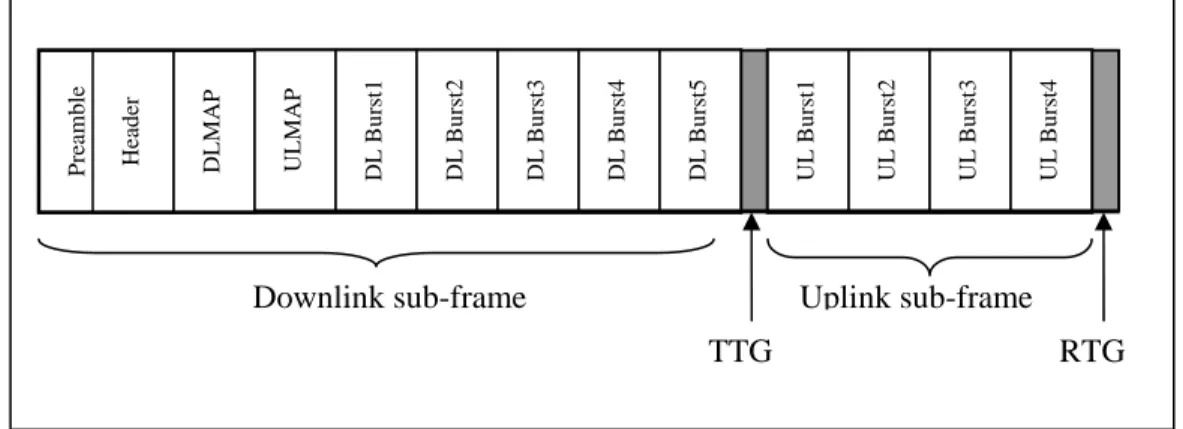
Frame structure and MAP messages: IEEE 802.16 MAC supports both TDD and FDD frame structures. The MAC starts building the downlink sub-frame with DL-MAP (Downlink MAP) and UL-MAP (Uplink MAP) messages. The DL-MAP indicates the PHY transitions on the downlink while the UL-MAP indicates bandwidth allocation and burst profiles in the uplink. In a TDD frame structure, the frame is divided into uplink and downlink sub-frames along the time axis (see Figure 2-1). The frame starts with the downlink sub-frame followed by a short gap called transmit/receive transition gap (TTG). The downlink sub-frame contains a preamble followed by a header and one or more downlink bursts. Following TTG, the uplink sub-frame contains one or more uplink bursts. Each uplink burst contains a preamble that allows the BS to synchronize with each SS. The uplink sub-frame is then followed by a short gap called the receive/transmit transition gap (RTG) before the BS can start transmitting again.
RTG TTG Prea mble Header DLM AP ULM A P
DL Burst1 DL Burst2 DL Burst3 DL Burst4 DL Burst5 UL Burst1 UL Burst2 UL Burst3
Uplink sub-frame Downlink sub-frame
UL Burst4
Figure 2-1: TDD Frame Structure
Packing and Fragmentation of MAC SDUs: This functionality is executed in tandem with the bandwidth allocation process to maximize efficiency, flexibility and effectiveness. Fragmentation is the process by which a MAC SDU is divided into one or more SDU fragments. Packing is the process in which multiple MAC SDUs are packed into a single MAC PDU payload. Either functionality can be initiated by the BS in the downlink or by the SS in the uplink.
Scheduling Services: The Common Part Sub-layer maps each connection to a scheduling service, where a scheduling service is associated with pre-determined QoS parameters. The IEEE 802.16-2004 standard specifies four scheduling services: Unsolicited Grant Service (UGS), real-time Polling Service (rtPS), non-real time Polling Service (nrtPS) and Best Effort (BE). The bandwidth allocation mechanism for the UGS service as specified in the IEEE 802.16-2004 standard [1] requires the BS to send fixed size grants to the SSs periodically.
2.1.4
IEEE 802.16 Service Classes
The IEEE 802.16-2004 standard [1] specifies the provision of four scheduling services:
• Unsolicited Grant Service (UGS): This scheduling service is designed to support
applications that generate fixed-size data packets periodically such as T1/E1 and VoIP without silence suppression. To support the real-time needs of such applications and reduce overhead by the bandwidth request-grant process, the BS allocates fixed size data grants without receiving explicit requests from the SS. The size of the grants is based on the maximum rate that can be sustained by the application and is negotiated at connection setup.
• real-time Polling Service (rtPS): This scheduling service is designed to support
real-time applications that generate variable size packets on a periodic basis such as MPEG video or VoIP with silence suppression. The BS allows the SSs to make periodic unicast requests and allows them to specify the size of the desired grant. Since a dedicated grant request is contention-free, the bandwidth request is guaranteed to be received by the SS in time. SSs belonging to this class are prohibited from using contention request opportunities.
• non real-time Polling Service (nrtPS): nrtPS is designed to support non-real time
applications that require variable size data grant bursts on a regular basis. This scheduling service supports applications that are delay tolerant but may need high throughput such as File Transfer Protocol (FTP) applications. The BS allows the SS to make periodic unicast grant requests, just like the rtPS scheduling service, but the requests are issued at longer intervals. This will ensure that the SSs receive request
opportunities even during network congestion. SSs of this class are also allowed to use contention request opportunities.
• Best Effort (BE): This traffic class contains applications such as telnet or World
Wide Web (WWW) access that do not require any QoS guarantee. The bandwidth request by such applications is granted on space-available basis. The SS is allowed to use both contention-free and contention based bandwidth requests, although contention-free is not granted when the system load is high.
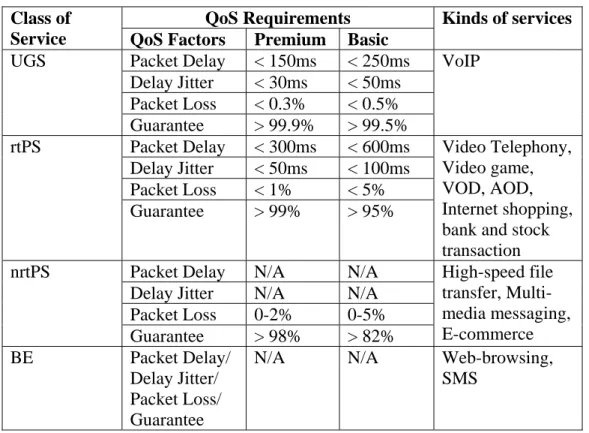
In Table 2-1, we list some of the applications belonging to each class, including suggested delay guarantees that they require under both premium and basic service [11].
Table 2-1: Traffic classes in 802.16 and their QoS requirements
QoS Requirements Class of
Service QoS Factors Premium Basic
Kinds of services Packet Delay < 150ms < 250ms Delay Jitter < 30ms < 50ms Packet Loss < 0.3% < 0.5% UGS Guarantee > 99.9% > 99.5% VoIP Packet Delay < 300ms < 600ms Delay Jitter < 50ms < 100ms Packet Loss < 1% < 5% rtPS Guarantee > 99% > 95% Video Telephony, Video game, VOD, AOD, Internet shopping, bank and stock transaction
Packet Delay N/A N/A
Delay Jitter N/A N/A
Packet Loss 0-2% 0-5% nrtPS Guarantee > 98% > 82% High-speed file transfer, Multi-media messaging, E-commerce BE Packet Delay/ Delay Jitter/ Packet Loss/ Guarantee
N/A N/A Web-browsing, SMS
2.2
Packet scheduling for uplink traffic in WiMAX
Packet scheduling algorithms are implemented at both the BS and SSs. A scheduling algorithm at the SS is required to distribute the bandwidth allocation from the BS among its connections. A scheduling algorithm at the SS is not needed if the BS grants bandwidth to each connection of the SS separately i.e. the Grant Per Connection (GPC) procedure is followed. If the Grant Per Subscriber Station (GPSS) procedure is followed, the scheduling algorithm at the SS needs to decide on the allocation of bandwidth among its connections. The scheduling algorithm implemented at the SS can be different than that at the BS.
The focus of our work is on scheduling algorithms executed at the BS for the uplink traffic in WiMAX i.e. traffic from the SSs to the BS. A scheduling algorithm for the uplink traffic is faced with challenges not faced by an algorithm for the downlink traffic. An uplink scheduling algorithm does not have all the information about the SSs such as the queue size. An uplink algorithm at the BS has to coordinate its decision with all the SSs where as a downlink algorithm is only concerned in communicating the decision locally to the BS.
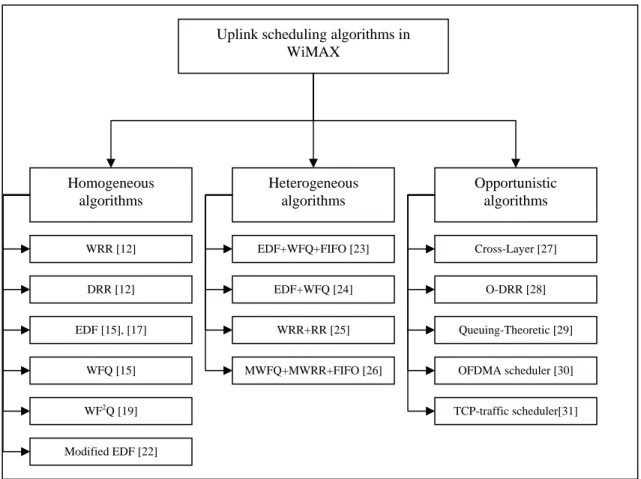
Based on our comprehensive survey, we have classified scheduling algorithms for the uplink traffic in WiMAX into three categories (see Figure 2-2):
• Homogeneous scheduling algorithms: These are legacy scheduling algorithms that
attempt to address issues such as providing QoS, flow isolation and fairness. The algorithms were originally proposed for wired networks but are used in WiMAX principally to satisfy QoS requirements of the four traffic scheduling services. Algorithms in this category do not address the issue of link channel quality.
• Hybrid scheduling algorithms: This category contains algorithms that use a combination of legacy scheduling algorithms in an attempt to satisfy QoS requirements of the four scheduling services. Some of the algorithms in this category also address the issue of variable channel conditions in WiMAX. An important aspect of algorithms in this category is the overall allocation of bandwidth among the scheduling services. Once bandwidth has been assigned to each class, a legacy algorithm is executed for SSs of the class to determine the bandwidth allocation in that class.
• Opportunistic scheduling algorithms: Scheduling algorithms in this category are
primarily focused on exploiting the variability in channel conditions in WiMAX. The algorithms also attempt to satisfy QoS requirements of the four scheduling services and maintain fairness between the SSs.
Uplink scheduling algorithms in WiMAX Homogeneous algorithms Heterogeneous algorithms Opportunistic algorithms
Figure 2-2: Taxonomy of uplink scheduling algorithms in WiMAX
2.2.1
Homogeneous scheduling algorithms
Most of the legacy scheduling algorithms can be classified into this category. We will only discuss those that have been proposed and evaluated in WiMAX. Weighted Round Robin (WRR) and Deficit Round Robin (DRR) algorithms are evaluated on a WiMAX system in [12]. WRR is evaluated for the uplink traffic while DRR is evaluated for the downlink traffic. WRR is an extension of the Round Robin (RR) algorithm. It is a work-conserving algorithm in that it will continue allocating bandwidth to the SSs as long as they have backlogged packets. The WRR algorithm assigns weight to each SS and the bandwidth is then allocated according to the weights. The algorithm was originally proposed for ATM networks that have fixed size packets [13]. Since the
WRR [12] EDF+WFQ+FIFO [23] Cross-Layer [27] DRR [12] EDF+WFQ [24] O-DRR [28] EDF [15], [17] WRR+RR [25] Queuing-Theoretic [29] OFDMA scheduler [30] WFQ [15] WF2Q [19] Modified EDF [22] MWFQ+MWRR+FIFO [26] TCP-traffic scheduler[31]
bandwidth is assigned according to the weights only, the algorithm will not provide good performance in the presence of variable size packets. It has been discussed in [12] that weight to a SS can be assigned to reflect its relative priority i.e. a higher weight assigned to SSs of the rtPS class compared to the weight assigned to SSs of the nrtPS and BE classes. DRR, a variation of RR, is also a work-conserving algorithm with a constant processing time [14]. DRR is similar to the RR algorithm in that a quantum of service is assigned to each SS. The difference between the two algorithms is that when a SS is not able to send a packet, the remainder quantum is stored in a deficit counter. The value of the deficit counter is added to the quantum in the following round. The algorithm is flexible enough as it allows provision of quanta of different sizes depending on the QoS requirements of the SSs. DRR is mostly suited for datagram networks where packet sizes vary. Since the DRR algorithm requires accurate knowledge of packet size, it is not suitable for the uplink traffic.
N. Ruangchaijatupon et al. [15] evaluate the performance of the Earliest Deadline
First (EDF) algorithm. EDF is a work conserving algorithm originally proposed for real-time applications in wide area networks [16]. The algorithm assigns deadline to each packet and allocates bandwidth to the SS that has the packet with the earliest deadline. Deadlines can be assigned to packets of a SS based on the SS’s maximum delay requirement. The EDF algorithm is suitable for SSs belonging to the UGS and rtPS scheduling services, since SSs in this class have stringent delay requirements. Since SSs belonging to the nrtPS service do not have a delay requirement, the EDF algorithm will schedule packets from these SSs only if there are no packets from SSs of UGS or rtPS
class. With a large number of SSs from the UGS or rtPS class, SSs from the nrtPS or BE class can potentially starve.
T. Tsai et al. [17] propose an uplink scheduling algorithm and a token bucket
based Call Admission Control (CAC) algorithm. The CAC algorithm assigns thresholds to each class to avoid starvation of lower priority classes. The EDF scheduling algorithm is used for the rtPS class. The scheduling algorithm first grants bandwidth to SSs of the UGS class. The algorithm will then allocate bandwidth to SSs of the rtPS class using the EDF algorithm and restricting the allocation to the maximum grant size. Finally, the algorithm will allocate minimum required bandwidth to SSs of the nrtPS and BE classes in order. Each SS is controlled by a token rate and bucket size. A mathematical model is proposed that estimates the appropriate token rate based on the queuing delay and the packet loss requirements, for both finite and infinite queue length.
N. Ruangchaijatupon et al. [15] also evaluate Weighted Fair Queuing (WFQ) for
the uplink traffic in WiMAX. WFQ is a packet-based approximation of the Generalized Processor Sharing (GPS) algorithm [18]. GPS is an idealized algorithm that assumes a packet can be divided into bits and each bit can be scheduled separately. This is an impractical assumption since a packet needs to be scheduled in its entirety. WFQ is a practical implementation of GPS as it assigns finish times to packets and selects packets in increasing order of their finish times. The finish times of packets of a SS are calculated based on the weight assigned to the SS and the size of the packets. The WFQ algorithm results in superior performance compared to the WRR algorithm in the presence of variable size packets. The finish time of a packet is essentially the time the packet would have finished service under the GPS algorithm. The disadvantage of the WFQ algorithm
is that it will service packets even if they wouldn’t have started service under the GPS algorithm. This is because the WFQ algorithm does not consider the start time of a packet.
Y. Shang and S. Cheng in [19] propose a hierarchical model for packet scheduling based on the proposal of J. Bennet and H. Zhang in [20]. The model is comprised of three scheduling servers: a hard-QoS scheduling server, a soft-QoS scheduling server and a best effort scheduling server. The UGS traffic is mapped to the hard-QoS server and the rtPS traffic is mapped to the soft-QoS server. The nrtPS traffic can be mapped to either the soft-QoS server or the best effort server. All the servers implement the Worst-case Fair Weighted Fair Queuing (WF2Q) scheduling algorithm [21]. WF2Q is another extension of GPS that addresses the issue of the WFQ algorithm servicing packets even if they wouldn’t have started service under the GPS scheme. O. Yang and J. Lu in [22] propose a joint CAC and scheduling algorithm based on the concept of EDF to satisfy the QoS requirements of real-time video applications in IEEE 802.16 networks. The algorithm claims to cover throughput requirement, delay constraint and maintain fairness among the SSs simultaneously.
2.2.2
Hybrid scheduling algorithms
The hybrid class of scheduling algorithms uses a combination of legacy scheduling algorithms to satisfy QoS requirements of the multi-class traffic as specified in the IEEE 802.16-2004 standard [1]. The most critical part of hybrid algorithms is the distribution of uplink bandwidth among different traffic classes.
K. Wongthavarawat and A. Ganz propose a hybrid scheduling algorithm in [23] that combines EDF, WFQ and FIFO scheduling algorithms. The overall allocation of
bandwidth is done in a strict priority manner i.e. all the higher priority SSs are allocated bandwidth until they do not have any packets to send. The EDF scheduling algorithm is used for SSs of the rtPS class, WFQ is used for SSs of the nrtPS class and FIFO for SSs of the BE class. Besides the scheduling algorithm, an admission control procedure and a traffic policing mechanism are also proposed. All these components together constitute the proposed QoS architecture. A drawback of this algorithm is that lower priority SSs will essentially starve in the presence of a large number of higher priority SSs due to the strict priority overall bandwidth allocation.
K. Vinay et al. [24] propose a hybrid scheme that uses EDF for SSs of the rtPS
class and WFQ for SSs of the nrtPS and BE classes. This algorithm differs from the one in [23] in a couple of ways. First, the WFQ algorithm is used for SSs of both nrtPS and BE classes. Secondly, the overall bandwidth allocation is not done in a strict priority manner. Although the details of overall bandwidth allocation are not specified, it is briefly mentioned that the bandwidth is allocated among the classes in a fair manner. Since SSs of the BE class do not have any QoS requirements, using a computationally complex algorithm such as WFQ for them is not needed.
M.Settembre et al. [25] propose a hybrid scheduling algorithm that uses WRR and
RR algorithms with a strict priority mechanism for overall bandwidth allocation. In the initial portion of the algorithm, bandwidth is allocated on a strict priority basis to SSs of the rtPS and nrtPS classes only. After that the WRR algorithm is used to allocate bandwidth among SSs of rtPS and nrtPS classes until they are satisfied. If any bandwidth remains, it is distributed among the SSs of the BE class using the RR algorithm. The hybrid algorithm is opportunistic in nature as the WRR and RR algorithms select the SSs
with the most robust burst profiles. This algorithm will starve lower priority SSs in the presence of a large number of higher priority SSs. The algorithm can also result in low fairness among SSs as it selects SSs with the most robust burst profiles first.
J. Lin and H. Sirisena [26] propose an architecture called Multi-class Uplink Fair Scheduling Structure (MUFSS) to satisfy throughput and delay requirements of the multi-class traffic in WiMAX. The proposed scheduling discipline at the BS is Modified Weighted Round Robin (MWRR), although details of the modifications to the WRR discipline are not provided by the authors. The model is based on Grant Per Subscriber Station (GPSS) bandwidth grant mode and thus schedulers are implemented at the SSs to distribute the bandwidth granted among their connections. At the SS, Modified WFQ (MWFQ) is used for UGS and rtPS connections, MWRR is used for nrtPS connections and FIFO is used for BE connections.
Normally, implementing the scheduling algorithms to cater to all the service classes and on a per connection basis is not a trivial task. The IEEE 802.16 standard supports changing a connection’s QoS parameters during its lifetime. Thus, the scheduling algorithms are required to adapt to these changes by reassigning the slots. For instance, in the case of the WFQ algorithm, dynamic weights may be the solution, which considerably increases the algorithm’s complexity and renders its implementation challenging. The standard also requires the frame size to be constant. This would result in some of the time slots not being utilized, which makes the performance of the algorithms closer to that of non work-conserving schedulers, whereas the proposed homogeneous and hybrid algorithms are work-conserving. Therefore, most of the proposals make significant assumptions that simplify the implementation of the algorithms. In [12], the
authors implement DRR as the downlink scheduler, without considering the WiMAX QoS parameters, and WRR as the uplink scheduler with constant weights, without clarifying how the weights are chosen, or providing justification for adopting constant weights.
2.2.3
Opportunistic scheduling algorithms
Opportunistic scheduling algorithms proposed for WiMAX exploit variations in channel quality giving priority to users with better channel quality, while attempting to satisfy the QoS requirements of the multi-class traffic.
A cross-layer scheduling algorithm is proposed in [27] whereby each SS is assigned a priority based on its channel quality and service status. The SS with the highest priority is scheduled each time. SSs of the UGS class are assigned a fixed number of time slots based on their required rate. The priority function for the rtPS class takes the deadline and waiting time of the HOL packet as input while the priority function for the nrtPS class takes the average throughput and the minimum required throughput as inputs. The priority function for the BE class only takes the channel quality of the SS as input. A coefficient is included in the priority functions to reflect the relative priority of the classes, i.e., a higher coefficient is used for the rtPS class compared to the coefficients of nrtPS and BE classes. One of the drawbacks of this algorithm is that it results in poor channel utilization since it schedules only one SS every frame. This will also result in low average throughput and higher average delay as SSs will have to wait for longer period of time before they are scheduled.
H. Rath et al. [28] propose to use an opportunistic extension of the Deficit Round Robin (DRR) algorithm with the purpose of satisfying delay requirements of multi-class
traffic in WiMAX. The proposed algorithm uses a deficit counter and a quantum size just like the DRR algorithm. A critical part of the algorithm is the polling interval. At the beginning of a polling interval, a set of schedulable SSs are selected that forms a schedulable set. Until the next polling interval, SSs are selected only from the schedulable set. SSs that are not selected will have their quantum accumulated in the deficit counter. A major limitation of this algorithm is selecting an appropriate polling interval. If a large polling interval is selected, it will result in some of the SSs being denied service for a long period of time. Even if a SS becomes eligible to be added to the schedulable set, it will not be considered until the next polling interval.
D. Niyato and E. Hossain [29] propose a joint bandwidth allocation and connection admission control algorithm based on queuing theory. In order to limit the amount of bandwidth allocated per class, a bandwidth threshold is assigned to each class. Each SS is assigned a utility and bandwidth is allocated to the SS with the least utility. Utility for SSs of the rtPS and nrtPS classes is calculated using a sigmoid function that takes the average delay and maximum latency for the rtPS class and average throughput and minimum required throughput for the nrtPS class as inputs. SSs of the BE class are assigned the highest utility as long as 1 unit of bandwidth is assigned to them. The unit of bandwidth used in the algorithm is a fixed size packet called a Protocol Data Unit (PDU). In the initial stages of the algorithm, minimum bandwidth is allocated to the SSs in a strict priority order. Afterwards, the algorithm assigns the residual bandwidth in PDU units to the SSs. SSs are sorted in ascending order based on their utility and they are allocated the PDUs based on a water filling mechanism until the bandwidth of each class exceeds the class threshold. The thresholds for the classes are calculated such that QoS
requirements of the SSs are met and the system revenue is maximized. If a packet is too large and the minimum bandwidth allocated to the SS is not enough to transmit the large packet, the allocation will essentially be wasted. Another drawback of the algorithm is that it will result in maximum MAC and PHY layer overhead since it selects all the SSs in the network based on the first phase of the algorithm as aforementioned.
V. Singh and V. Sharma [30] propose scheduling algorithms for the OFDMA system with a TDD frame structure for both uplink and downlink traffic in WiMAX. An optimization problem is first formulated for the allocation of resources to the SSs. The formulation considers the channel quality in terms of bytes/slot a SS can send on a channel, the number of slots allotted to the SS and the total bandwidth demanded by the SS. A linear programming solution to the optimization problem is devised that will maximize the throughput of the SSs. Due to the high complexity of the linear programming solution, a heuristic algorithm is considered that provides close to optimal performance. The heuristic algorithm will maximize the throughput of the SSs but is not fair which leads to the design of fair versions of the algorithm. A definition of fairness is also proposed that requires assigning bandwidth to a SS proportional to its throughput requirement. The bandwidth allocation among the scheduling services is done on a priority basis, similar to that of the hybrid algorithm proposed in [23]. More specifically, the BS first attempts to satisfy the requirements of UGS connections followed by the requirements of rtPS and nrtPS connections. Finally, any residual bandwidth is distributed among the BE connections. This mechanism of allocating bandwidth might lead to fairness among the connections but can result in starvation of lower priority connections in the presence of a large number of high priority connections.
S.Kim and I.Yeom propose an uplink scheduling algorithm for TCP traffic for the BE class [31]. The proposed algorithm does not require explicit bandwidth request from a SS. It estimates the amount of bandwidth required by the SS based on the current sending rate of the connection at the SS. The purpose of the algorithm is to provide reasonable fairness among the SSs based on the max-min fairness criteria while providing high frame utilization. To provide fairness, the algorithm requires knowing the demand of each SS. The demand is defined as the amount of bandwidth requested for achieving the maximum throughput so as not to be limited by the channel bandwidth. It is shown via simulation that the algorithm provides reasonable fairness among SSs of the BE class.
2.3
Summary
In this chapter we provide details of the MAC and PHY layer characteristics according to the specifications in the IEEE 802.16-2004 standard [1]. We then categorize and discuss various proposals of uplink scheduling algorithms for WiMAX. The homogeneous class of algorithms contains legacy algorithms that were originally proposed for wired networks. The algorithms proposed in this category attempt to satisfy the QoS requirements of the multi-class traffic by assigning deadlines to packets or weights to the SSs. The hybrid class of algorithms contains schemes that basically combine two or more legacy algorithms. An important aspect of hybrid algorithms is the allocation of bandwidth among the traffic classes, which can significantly affect the QoS received by the SSs. The opportunistic category of algorithm exploits variations in channel quality as well as attempts to satisfy QoS requirements of the multi-class traffic.
Chapter 3.
Representative WiMAX uplink scheduling
algorithms
In this chapter, we provide detailed information of the representative uplink scheduling algorithms in WiMAX. As part of the implementation details, we highlight any assumptions and implementation decisions made in the process.
The IEEE 802.16-2004 [1] standard specifies provision of four traffic classes, Unsolicited Grant Service (UGS), real time Polling Service (rtPS), non real time Polling Service (nrtPS) and Best Effort (BE). According to the standard, the BS will provide Data Grant Burst IEs to the SSs at periodic intervals based upon the Maximum Sustained Traffic Rate (MSTR) of the SS. The size of the grants will be sufficient enough to hold the fixed length data associated with the SS. The IEEE 802.16-2005 standard [6] specifies an additional scheduling service called extended real-time Polling Service (ertPS). The ertPS is a scheduling service that builds on the efficiency of both UGS and rtPS services. For SSs belonging to the ertPS class, the BS can provide unicast grants in an unsolicited manner like in UGS, thus saving the latency of a bandwidth request. The SS can also change the size of the uplink allocation by using the piggyback mechanism or explicitly requesting bandwidth. The ertPS scheduling service is designed to support real-time applications that generate variable size data packets on a periodic basis, such as VoIP with silence suppression. Since the bandwidth allocation mechanism is specified for UGS connections, the implementation details in this chapter focus on ertPS, rtPS, nrtPS and BE traffic classes only. The standard requires each SS to be associated with certain
QoS parameters, whose values are specified by the SS upon admission into the network. These parameters are:
• Minimum Reserved Traffic Rate (MRTR): This parameter specifies the minimum
rate reserved for the SS. The rate is usually expressed in bits per second and specifies the minimum amount of data to be transported on behalf of the SS when averaged over time. The MRTR rate will only be honored when sufficient data is available for scheduling. When insufficient data exists, the requirement of this parameter will be satisfied by transmitting the available data as soon as possible.
• Maximum Sustained Traffic Rate (MSTR): This parameter specifies the peak
information rate of the SS. The value, expressed in bits per second, does not limit the instantaneous rate of the SS but it is used to police the SS to ensure that it conforms to the value specified, on average, over time.
• Maximum Latency (dreqi ): This parameter specifies the maximum latency between
the reception of a packet by the SS on its network interface and the forwarding of the packet to its RF interface.
• Packet Loss (L): This parameter, expressed as a percentage, indicates the percentage
of packets dropped from the queue as a result of exceeding the maximum latency. Packet dropping is performed only for SSs with real-time needs as for such SSs delayed packets are useless.
The SSs specify values for all four parameters except the maximum latency and packet loss, which are specified by SSs of ertPS and rtPS classes only.
Following are variables/functions used in the pseudo-code for the scheduling algorithms:
• ΩTotal: the set of all admitted SSs
• ΩertPS: set of all SSs belonging to the ertPS class. • ΩrtPS: set of all SSs belonging to the rtPS class • ΩnrtPS: set of all SSs belonging to the nrtPS class.
• ΩBE: set of all SSs belonging to the BE class.
• alloc i
b : bandwidth allocated to SS i.
• dequei(P): remove packet P from the queue of SS i. • enquei(P): insert packet P in the queue of SS i.
• sizei(P,γi): retrieve the size of packet P from the queue of SS i. Convert the size of
the packet to number of symbols based on the Signal to Interference Noise Ratio (SINR (γi)), of SS i.
• HOL
i
P :Head Of Line (HOL) packet of SS i.
• CreateIE (sizei(P,γi), i): create an Information Element (IE) for SS i with sizei(P,γi)
number of symbols. After creation, the Information Element (IE) is added to the ULMAP message.
• Nexti(P): Retrieve the next packet from the queue of SS i.
• drop (ertPS, rtPS): drop packets from the queue of all SSs of ertPS and rtPS class. Due to the open-ended nature of the standard and ambiguity of some of the proposals, we have made some implementation decisions. To ensure that the number of SSs and their minimum required bandwidth do not exceed the channel capacity, we perform an admission control calculation as follows:
symbols data uplink total ) symbols in MRTR ( n 1 i i ≤
∑
= (3.1)The number of uplink symbols available for data is calculated by subtracting overhead symbols (preamble, bandwidth request symbols and symbols for contention request opportunity) from the total uplink capacity.
Each SS can have multiple connections, all of them of the same traffic class. The number of connections per SS will be varied in the experiments so that the load per SS can be changed. Even though a SS can have multiple connections, bandwidth requests will be granted to a SS and not to each connection separately i.e. Grant Per SS (GPSS) is implemented. One slot per SS is reserved for bandwidth request and contention request opportunity.
A Time Division Duplex (TDD) frame structure is adopted, where the BS and SS each transmit on the same frequency separated in time. The IEEE 802.16-2004 standard [1] specifies the use of Information Elements in the Uplink MAP (ULMAP) message. For our purpose, the most important components of an IE are the Connection ID (CID) and the number of symbols allocated to the SS. The list of IEs constitutes the ULMAP message that is broadcast to all the SSs. In the pseudo-codes that follow, the function that creates the ULMAP message will be referred to as CreateIE().
3.1
Homogeneous Algorithms
This category contains scheduling algorithms originally proposed for wired networks, but have also been widely adopted by cellular technologies such as GSM, UMTS and WiMAX. We have chosen to implement Weighted Round Robin (WRR), Earliest Deadline First (EDF) and Weighted Fair Queuing (WFQ) schemes. The three