2010
A Selective Sampling Method for Imbalanced Data
Learning on Support Vector Machines
Jong Myong Choi
Iowa State University
Follow this and additional works at:https://lib.dr.iastate.edu/etd Part of theIndustrial Engineering Commons
This Dissertation is brought to you for free and open access by the Iowa State University Capstones, Theses and Dissertations at Iowa State University Digital Repository. It has been accepted for inclusion in Graduate Theses and Dissertations by an authorized administrator of Iowa State University Digital Repository. For more information, please [email protected].
Recommended Citation
Choi, Jong Myong, "A Selective Sampling Method for Imbalanced Data Learning on Support Vector Machines" (2010).Graduate Theses and Dissertations. 11529.
by
Jong Myong Choi
A dissertation submitted to the graduate faculty
in partial fulfillment of the requirements for the degree of
DOCTOR OF PHILOSOPHY
Major: Industrial Engineering
Program of Study Committee: John K. Jackman, Major Professor
Sigurdur Olafsson Douglas D. Gemmill
Dianne H. Cook Anthony M. Townsend
Iowa State University
Ames, Iowa
2010
TABLE OF CONTENTS LIST OF TABLES ... iv LIST OF FIGURES ... v ACKNOWLEDGEMENTS ... vi ABSTRACT…. ... vii CHAPTER 1 INTRODUCTION ... 1
CHAPTER 2 LITERATURE REVIEW ... 4
2.1 Handling the Class Imbalance Problem ... 4
2.1.1 Changing class distributions ... 5
2.1.2 Adjusting classifiers to imbalanced data sets ... 9
2.1.2 Ensemble learning methods ... 12
2.2 Performance Measures for Imbalanced Data Learning ... 14
2.3 Summary and Research Scope ... 17
CHAPTER 3 CLASS IMBALANCE PROBLEM WITH SUPPORT VECTOR MACHINE LEARNING ... 19
3.1 Support Vector Machine (SVM) Classifier ... 19
3.2 SVMs and the Skewed Boundary ... 26
3.3 Problems associated with SVM classifier for imbalanced data ... 28
3.4 Effectiveness of rebalancing class distribution ... 29
3.5 Hypotheses ... 34
CHAPTER 4 SELECTIVE SAMPLING USING A GENETIC ALGORITHM ... 35
4.1 SVMs for Large-Scale Datasets ... 35
4.2 Genetic Algorithm for Under-sampling of the Majority Class ... 36
4.3 Experiments ... 41
4.3.1 Experimental Design ... 41
4.3.2 Approaches for imbalanced data learning ... 43
4.4 Experimental Results and Discussion ... 47
CHAPTER 5 SMALLER LEARNING SETS for IMBALANCED DATA LEARNING with SVMs ... 49
5.1 A new method to reduce learning time ... 49
5.1.1 Stage1. Rough elimination of support vectors of the majority class in kernel space ... 51
5.1.2 Stage2. Selection of majority instance support vectors ... 53
5.2 Demonstration of GA-SS ... 59
5.2.2 Gaussian radial-based kernel function case ... 62
5.3 Experiments with real datasets... 64
5.4 Summary and Discussions ... 68
CHAPTER 6 CONCLUSIONS ... 73
APPENDIX A. EXPERIMENTAL IMBALANCED TRAINING SETS ... 77
APPENDIX B. PARAMETER C AND
SETTING THROUGH 5-FOLD CROSS VALIDATION ... 82APPENDIX C. INITIAL CLASSIFICATION RESULTS on SVM LEARNING WITH THE ORIGINAL TRAINING AND TEST DATASETS ... 84
APPENDIX C. INITIAL CLASSIFICATION RESULTS on SVM LEARNING WITH THE ORIGINAL TRAINING AND TEST DATASETS ... 85
APPENDIX D. MEAN DIFFERENCE BEWTEEN g-mean OF the training set IN TERMS OF THREE APPROACHES (SVM-SMOTE, SVM-RU and GA-IS) ... 86
APPENDIX E. MEAN DIFFERENCE BEWTEEN g-mean OF the training set CORRESPONDING TO ITERATIONS CHOSEN FOR INSTANCE SELECTION ... 89
APPENDIX F. SELECTED INSTANCES FOR LEARNING FROM GENETIC ALGORITHM BASED INSTACE SELECTION APPROACH ... 90
LIST OF TABLES
Table 2.1 Cost matrix ... 10
Table 2.2 Confusion matrix for performance evaluation ... 15
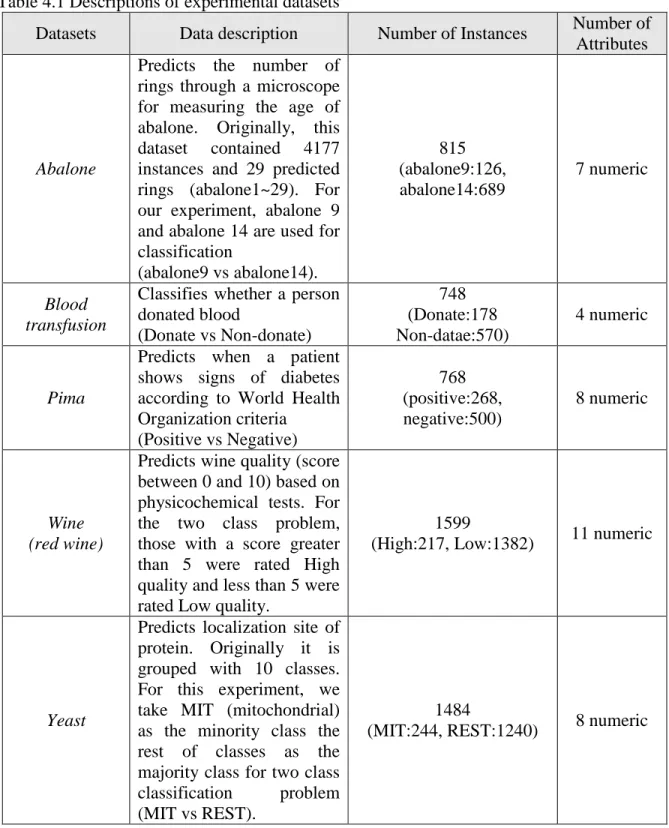
Table 4.1 Descriptions of experimental datasets ... 42
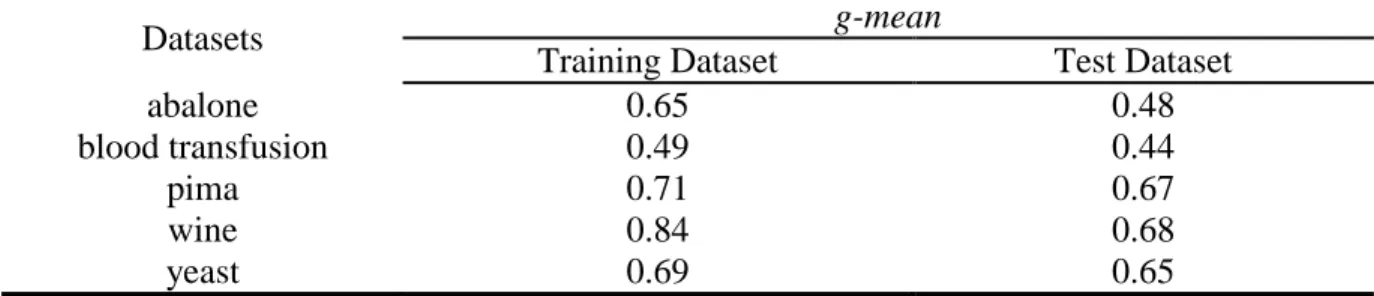
Table 4.2 G-mean values of the experimental datasets on SVM (training and test sets) ... 43
Table 4.3 Average G-mean of Training sets obtained from 4 different methods ... 47
Table 5.1 Improvement of G-mean and training set reduction after Stage2 ... 68
LIST OF FIGURES
Figure 2.1 Synthetic over-sampling example by SMOTE algorithm ... 7
Figure 3.1 Linear separating hyperplanes for the separable case ... 20
Figure 3.2 Linear separating hyperplanes for the non-separable case ... 24
Figure 3.3 Example of class imbalance problem on SVMs ... 29
Figure 3.4 Boundary movements by SMOTE algorithm ... 31
Figure 3.5 Boundary movements by random under-sampling ... 33
Figure 4.1 GA-based Instance Selection from the majority instances ... 40
Figure 4.2 Class distributions of experimental datasets (abalone and yeast) ... 43
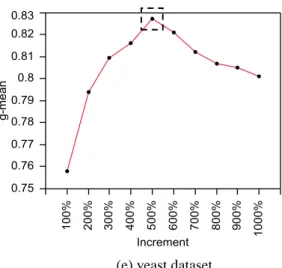
Figure 4.3 Average g-mean values of the training dataset in terms of increase of synthetic minority instances by SMOTE... 45
Figure 5.1 Stage 1 Algorithm... 53
Figure 5.2 Boundary sensitivity to removing one SV instance ... 54
Figure 5.3 GA-SS Algorithm ... 57
Figure 5.4 Boundary movement through selecting instances in Stage2 ... 57
Figure 5.5 Overall procedure of our approach for imbalanced training datasets ... 58
Figure 5.6 Decision boundaries at each iteration through selecting instances from SVs of the majority class (linear kernel function) ... 60
Figure 5.7 Mapping decision boundaries at Iteration 1 and 2 on the original training set ... 60
Figure 5.8 A decision boundary that produces the maximum G-mean for the original training set ... 61
Figure 5.9 Decision boundaries for Stage 1 iterations ... 63
Figure 5.10 Mapping decision boundaries for Iterations 2 and 3 on the original training dataset ... 63
Figure 5.11 Decision boundary that produces the maximum G-mean of the original training set through GA-SS ... 64
Figure 5.12 Trend of G-mean values of the original training set on reduction of the majority instances in Stage1 ... 65
Figure 5.13 Box plots of G-mean of the training set after Stage 2 for ... 67
Figure 5.14 Comparison of G-mean values for the training sets (average) for 5 different methods ... 70
Figure 5.15 Size of training sets ... 71
ACKNOWLEDGEMENTS
It is a pleasure to thank many people who helped me conduct research toward a Ph.D. and
write this dissertation. This work would not have been finished without their support and
patience.
First, I would like to heartily express the deepest appreciation to my adviser, Dr. John
Jackman for his encouraging way to help me whenever I am in a trouble during my graduate
school years. His persistent guidance enabled me to complete this work. I am also thankful to my
committee members, Dr. Sigurdur Olafsson, Dr. Doug Gemmill, Dr. Anthony Townsend and Dr.
Dianne Cook whose valuable and helpful comments improved this work.
I also would like to thank my family members: my parents for educating me with
unconditional support to finish my study. Especially, my special thanks goes to my wife, In Suk
Lee who always understands and encourages me with her support, patience and endless love
ABSTRACT
The class imbalance problem in classification has been recognized as a significant research
problem in recent years and a number of methods have been introduced to improve classification
results. Rebalancing class distributions (such as over-sampling or under-sampling of learning
datasets) has been popular due to its ease of implementation and relatively good performance.
For the Support Vector Machine (SVM) classification algorithm, research efforts have focused
on reducing the size of learning sets because of the algorithm‟s sensitivity to the size of the
dataset. In this dissertation, we propose a metaheuristic approach (Genetic Algorithm) for
under-sampling of an imbalanced dataset in the context of a SVM classifier. The goal of this approach
is to find an optimal learning set from imbalanced datasets without empirical studies that are
normally required to find an optimal class distribution. Experimental results using real datasets
indicate that this metaheuristic under-sampling performed well in rebalancing class distributions.
Furthermore, an iterative sampling methodology was used to produce smaller learning sets by
removing redundant instances. It incorporates informative and the representative under-sampling
mechanisms to speed up the learning procedure for imbalanced data learning with a SVM. When
compared with existing rebalancing methods and the metaheuristic approach to under-sampling,
this iterative methodology not only provides good performance but also enables a SVM classifier
to learn using very small learning sets for imbalanced data learning. For large-scale imbalanced
datasets, this methodology provides an efficient and effective solution for imbalanced data
CHAPTER 1 INTRODUCTION
The imbalanced learning problem in data mining has attracted a significant amount of
interest from the research community and practitioners because real-world datasets are
frequently imbalanced, having a minority class with relatively few instances when compared to
the other classes in the dataset. Standard classification algorithms used in supervised learning
have difficulties in correctly classifying the minority class. Most of these algorithms assume a
balanced distribution of classes and equal misclassification costs for each class. In addition,
these algorithms are designed to generalize from sample data and output the simplest hypothesis
that best fits the data. This principle is embedded in the inductive bias of many machine learning
algorithms including Decision Tree, nearest neighbor, and Support Vector Machine (SVM).
Therefore, when they are used on complex imbalanced data sets, these algorithms are inclined to
be overwhelmed by the majority class and ignore the minority class causing errors in
classification for the minority class. In other words, standard classification algorithms try to
minimize the overall classification error rate by producing a biased hypothesis which regards
almost all instances as the majority class.
Recent research on the class imbalance problem has included studies on datasets from a
wide variety of contexts such as, information retrieval and filtering (Lewis & Catlett, 1994),
diagnosis of rare thyroid disease (Murphy & Aha, 1994), text classification (Chawla et al., 2002),
credit card fraud detection (Wu & Chang, 2003) and detection of oil spills from satellite images
(Kubat et al., 1998). The degree of imbalance varies depending on the context. In intrusion
detection, typically less than 10% of the data are actual intrusions. In detection of cancerous
To illustrate the imbalance problem, consider the “Mammography Data Set”, which has
been used frequently to study the class imbalance learning problem. This data is a collection of
images obtained from a series of mammography exams conducted on a set of distinct patients.
Analyzing the images in the two classes, “cancerous” and “noncancerous” patient, it is observed
that the number of noncancerous patients greatly exceeds the number of cancerous patients.
Indeed, this data set contains 10,923 “Negative” (major class) samples and 260 “positive”
(minority class) samples. Ideally, a classifier should classify both classes with almost 100%
accuracy. However, classifiers tend to produce severely biased classification with the majority
class almost 100% accuracy and conversely the minority class having accuracies of less than
0.5% accuracy. As a result, most cancerous patients are classified as noncancerous (i.e., a Type I
error). In the classification of diagnosing patients, such a consequence would be extremely costly
because treatment would not be initiated. For these imbalanced scenarios, classifiers should
provide much higher accuracy for the minority class without a significant loss in accuracy for the
majority class.
New classification methods are needed to address the class imbalance problem in
supervised learning. In this research, we propose a new methodology for imbalanced data
learning based on the SVM classification algorithm. The remainder of the dissertation is
organized as follows. In Chapter 2, we review general approaches for imbalanced data learning
and related studies and describe the scope of this research. Chapter 3 briefly describes the SVM
classification algorithm and the causes of imbalanced learning with the SVM classifier. This is
followed by a discussion of existing methods that have been used for the class imbalance
problem based on the SVM algorithm. At the end of this chapter, the approach used in the new
„large-scale data’, and an optimization based under-sampling method using Genetic Algorithm is introduced and classification results are compared with other sampling methods using real
datasets. In Chapter 5, the new methodology that solves the class imbalance problem on SVM
with relatively small learning sets for SVM classifier is described. Finally we conclude with
CHAPTER 2 LITERATURE REVIEW
In general, a class imbalance problem is seen in two situations namely, natural imbalance
or rarity of cases (i.e., instances or samples). Underlying reasons for imbalance could be the lack
of occurrences in nature for a specific phenomena or possibly insufficient funds or time to collect
sufficient data. In recent years, many researchers have studied the class imbalance problem.
Weiss (2004) presented an overview of the field of learning from imbalanced datasets. His work
particularly focused on the problems with identifying rare objects in data mining by defining two
types of rarity: rare classes and rare cases. A rare class contains relatively smaller instances than
other classes, while a rare case indicates a small subset of the data (instance) space.
Unsupervised learning algorithms such as clustering may help to identify a rare case. More
generally, class imbalance is related to rare classes and is associated with classification
problems. In his work, Weiss argued that typical evaluation metrics do not adequately describe
the value of rarity so that data mining is not likely to handle rare classes and rare cases. Monard
et al. (2002) discussed several issues related to learning with skewed class distributions, such as
the relationship between cost-sensitive learning and class distributions, and the limitations of
accuracy and error rate in measuring the performance of classifiers.
2.1 Handling the Class Imbalance Problem
The various approaches used to deal with the class imbalance problem can be grouped
into three categories: (1) changing class distributions (modifying the data itself to rebalance
algorithms to imbalanced data sets by applying cost or weight for misclassified cases), and (3)
ensemble learning methods (using a combination of multiple classifiers with multiple datasets).
2.1.1 Changing class distributions
Changing class distributions is performed at the data level in order to modify class
distribution in the training datasets. Since many more instances belong to the majority class than
the minority class, class distribution can be balanced by under-sampling the majority class,
over-sampling the minority class, combining under-over-sampling and over-over-sampling, or some other
sampling method. Studies have shown that a balanced data set provides improved classification
performance as compared with an imbalanced data set. There have been numerous studies on
changing class distribution (Laurikkala, 2001 and Estabrooks et al., 2004). Also, Weiss (2003)
investigated the effect of class distribution on decision tree classification by changing class
distributions to achieve different ratios and measuring performance using accuracy and Area
Under the Curve (AUC). Three basic techniques are used in balancing classes namely, heuristic
and non-heuristic under-sampling, heuristic and non-heuristic over-sampling, and advanced
sampling. Japkowicz (2000) compared multiple balancing methods and concluded that both
under-sampling and over-sampling are very effective methods for dealing with the class
imbalance problem.
Over-sampling
One simple over-sampling method is random over-sampling. Its mechanism is adding a
set E of additional instances (i.e., instance duplicates) randomly sampled from the minority class
by E and as a result, the class distribution is more balanced. This provides a mechanism for
varying the degree of class distribution balance to any desired balance level. Over-sampling does
not increase information; instead by replication it raises the weight of the minority samples. The
problem with over-sampling is that an over-fitting problem will generally occur, which causes
the classification rule to become too specific; even though the accuracy for training set is high,
the classification performance for new test datasets will likely be worse. By appending
duplicated data to the original data set, some of the data copied becomes too specific and
classifiers will produce multiple clauses for the duplicate data (Kubat and Martin, 1997).
To avoid the over-fitting problem in over-sampling, Chawla et al. (2002) suggested a
heuristic over-sampling method, called Synthetic Minority Over-sampling Technique (SMOTE),
which has worked well in various applications. SMOTE is considered to be one of the
state-of-the-art approaches for imbalanced learning. This method generates synthetic data based on the
feature space similarities between existing minority instances considering the K-nearest
neighbors for each minority instance. In order to create a synthetic instance, it finds the K-nearest
neighbors of each minority instance, randomly selects one of them, and then multiplies the
corresponding feature vector difference with a random number between 0 and 1 to produce a
new minority instance in the neighborhood. Figure 1 shows an example of the SMOTE
procedure. This synthetic over-sampling avoids the over-fitting problem and also causes the
decision boundaries for the minority class to move towards the majority class. As a variant of
SMOTE, Han et al. (2005) introduced Borderline_SMOTE which only oversamples synthetic
instances of the minority class near the decision boundary since those instances are most likely to
be misclassified. Results were better when compared to standard SMOTE and random
method, Adaptive Synthetic Sampling (ADASYN), that uses a density distribution of the
minority instance as a criterion to automatically decide the number of synthetic samples
generated for each minority instance. ADASYN generates a new instance by calculating the class
ratio of the minority and majority instances in the K-nearest neighbors of each minority instance.
As a result, more synthetic instances are generated for minority class instances that are harder to
learn compared to instances that are easier to learn. This approach improved learning with
respect to the data distributions on the imbalanced data sets by reducing the bias of class
distribution and by adaptively shifting the decision boundary to put more attention on instances
difficult to learn.
( )
is a random number between 0 and 1
syn i knn i
x x x x
Figure 2.1 Synthetic over-sampling example by SMOTE algorithm
Under-sampling
While over-sampling adds instances to the original data set, under-sampling removes
instances from the majority class while keeping all instances of the minority class due to rareness Generated synthetic instance xsyn
of information. A simple method for sampling the majority class is random
under-sampling, a non-heuristic method that balances class distributions by selecting and removing
majority instances randomly. Several heuristic under-sampling methods have been proposed
from data cleaning in recent years. They are based on either of two different noise model
hypotheses: one is that instances near to a decision boundary between two classes are considered
noise, while the other considers that instances having more neighbors from different classes are
noise.
Since random under-sampling leads to losing potentially useful data, some heuristic
under-sampling methods try to remove superfluous instances which will not affect the
classification accuracy of the training set. Hart (1968) introduced a training set condensation
algorithm, Condensed Nearest Neighbor Rule (CNN), in order to find a consistent subset of a
sample set which can correctly classify all of the remaining instances in the training set. The
algorithm uses two bins, called S and T. Initially, the first sample of the training set is placed in
S, while the remaining samples of the training set are placed in T. Then one pass through T is
performed. During the scan, whenever a point in T is misclassified by using S as the training set,
it is transferred from T to S. After classification, process is repeated until no points are
transferred from T to S. The motivation for this heuristic is that misclassified data lies close to
the decision boundary. In the same manner, Tomek (1976) proposed an effective method to
eliminate data in the overlapping regions. Given two instances x and y that have a different class
label and are separated by a distance d(x,y), the pair (x, y) is called a Tomek link if there is no instance z such that d(x,z)d(x,y)or d(y,z)d(x,y). Instances participating in Tomek links
are considered either borderline or noisy. Kubat and Matin (1999) proposed one-sided sampling
minority instances since they are rare, (even though some of them can be noisy) and instead
prune out only majority instances. Initially it starts with a subset(C) of training set (S) that
contains all minority instances, C S, and using a 1-Nearest Neighbor rule using instances in
C, classify the instances in S. Afterwards, all misclassified instances are moved to C, then all
majority instances participating in Tomek links from C are removed since theyare believed to be
borderline and/or noisy. Wilson (1972) introduced the Edited Nearest Neighbor Rule (ENN) to
remove any instance whose class label is different from the class of at least two of its three
nearest neighbors. The idea behind this technique is to remove the instances from the majority
class that are near or around the borderline of different classes based on the concept of nearest
neighbor (NN) in order to increase classification accuracy of minority instances rather than
majority instances.
2.1.2Adjusting classifiers to imbalanced data sets
Rebalancing the data distribution through either over-sampling or under-sampling has
had some success, but the methods are usually computationally expensive. Also, changing class
distribution at the data level does not always lead to better classification performance. A
classifier is not always influenced by class distributions. Drummond and Holte (2003) observed
that over-sampling did not produce effective improvement in performance or there was no
change in classification. On the contrary, over-sampling prunes less than under-sampling using
the default parameters for the C4.5 algorithm. A modification of the parameter settings of C4.5
improved classification performance and avoided the over-fitting problem during over-sampling.
Thus, while sampling methods have tried to balance class distribution by considering the
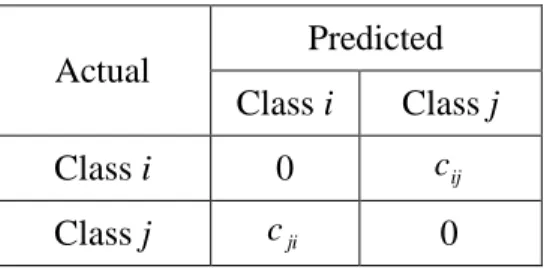
introduced for imbalanced data learning. One is the cost sensitive method, which uses a cost
matrix to penalize misclassification of instances, as shown in Table 2.1. Typically, no costs are
applied to the correctly classified cases and the cost of misclassifying minority cases is higher
than that of majority cases. The objective of this strategy is to minimize the cost of
misclassification. In some applications, cost sensitive techniques have performed better than
sampling methods (McCarthy et al., 2005 and Liu et al., 2006).
Actual Predicted Class i Class j
Class i 0 cij
Class j cji 0
Table 2.1 Cost matrix
MetaCost (Domingos, 1999) is another method related to cost-sensitive learning. It
estimates class probabilities using Bagging and then re-labels the training instances with their
minimum expected classes, and in the end, relearns a model using the modified training set.
Based on the weight update rule of AdaBoost (Freund & Schapire, 1997) for misclassified
instances at an iterative learning, Fan et al. (1999) proposed a discriminant weight update method
for misclassified instances for imbalanced datasets, which is called Adacost. Their approach is to
assign larger weights for misclassified instances belonging to the minority class than those
belonging to the majority class and as a result, Adacost has performed empirically better in
Some classifiers such as the Naïve Bayes classifier or some Neural Networks use a score
to show the degree to which an instance belongs to a class. This type of ranking can be used in
alternative classifiers by changing the threshold for an instance belonging to a class (Weiss,
2004). For biasing the discrimination procedure, Barandela et al. (2003) proposed a weighted
distance function in classification instead of altering the class distributions in terms of a nearest
neighbor (NN) classifier. Supposing that de( ) is the Euclidean metric, xnew a new instance to
classify, x0 a training sample from class i, ni the number of instances of class i and m the
dimensionality of the input variable, a weighted distance function, dw( ) is defined as:
1/
0 0
( , ) ( / ) m ( , )
w new i e new
d x x n n d x x . This could assign greater weighting factors to majority instances than minority instances; consequently, producing smaller distances to instances of the
minority class than distances to those of the majority class. As a result, the neighbors of the new
instances are found among the minority instances, increasing the value of the geometric mean
(g-mean). For the SVM classification algorithm, this biasing approach pushes a hyperplane further
away from the minority (positive) class for imbalanced datasets. Wu and Chang (2003) proposed
a biasing algorithm to change the kernel function. Biasing classification algorithms in SVM
using larger penalty constants associated with the minority class made misclassification errors
for the minority instances much costlier than errors for majority instances (Veropoulos et al.,
1999). Huang at el. (2004) proposed a Biased Minimax Probability Machine (BMPM) to resolve
learning for imbalanced datasets. Given the mean and covariance matrices of the majority and
minority classes, BMPM formulates an optimization problem to find the decision hyperplane by
adjusting the lower bound of the accuracy for the classification of the future data. For example, if
optimization tries to maximize it by setting the lower bound of the classification accuracy for
both classes. Achieving the worst case accuracy for the minority can be avoided while
maintaining the acceptable accuracy level of the majority class in imbalanced data learning.
One-class learning is an alternative to discrimination where the model is created based on
the instances of the target class alone. The main idea is that boundaries between two classes are
estimated from data of one class (the target class) so that this approach is not sensitive to the
class distribution in the training set. A boundary around the target class is defined in such a way
that most of the target objects are included and at the same time the chance of accepting outlier
objects is minimized. For instance, Kubat et al. (1998) introduced the SHRINK algorithm
following this general principle and applied it to detecting rare oil spills from satellite radar
images. The goal was to find the classification rule that best identifies the positive examples (oil
spills) using a g-mean measure. Assuming that the negative (majority) instances outnumber
positive (minority) instances, the algorithm labeled the mixed regions as positive (minority). This
alters the learner‟s focus: search for the best positive region, one with the maximum ratio of positives to negatives. Raskutti and Kowalczyk (2004) studied one-class learning with highly
imbalanced dataset learning using a SVM classifier. They showed that one-class learning is
useful for extremely imbalanced datasets with a high dimensional noisy feature space.
2.1.2 Ensemble learning methods
Ensemble learning is motivated by the information loss that occurs in under-sampling. In
ensemble learning, multiple classifiers are generated by training subsets from the original
dataset. In the end, the classifiers are combined in a learning process and the final classification
successful approaches. Most boosting algorithms use iteratively learning weak classifiers that
have been produced by placing different weights on the training instances. In each iteration,
boosting increases weights for incorrectly classified instances and decreases weights for
correctly classified ones, placing more attention on the incorrectly classified instances for the
next iteration. Rare-Boost scales false-positive instances in proportion to how well they are
differentiated from true-positive instances and scales false-positive instances in proportion to
how well they are distinguished from true-negative instances (Joshi et al., 2001). SMOTEBoost
(Chawla et al., 2003) addressed the issue that boosting may produce an over-fitting problem as in
over-sampling. Instead of updating weights to change distributions of the training dataset, it adds
new instances of the minority class using SMOTE. Chan and Stolfo (2001) proposed another
ensemble method conceptually similar to a Bagging approach. They conducted some preliminary
experiments to identify a desired class distribution that avoids the class imbalance problem, and
then resampled to make multiple training sets based on the desired class distribution. Each
training set contained all instances of the minority class and a subset of the majority instances.
To use all instances of the majority class, each majority class instance appeared in at least one
training set. Finally, the learning algorithm was applied to each training set and a composite
learner was created from the classification results of all classifiers.
Recently, two algorithms, EasyEnsemble and BalanceCascade have been introduced (Liu
et al., 2006). The strategy of these two methods is to make several training sets by keeping all the
minority instances and under-sampling several subsets from the majority class. With replacement
in sampling of the majority class, they overcome potential of information loss of the majority
class. EasyEnsemble independently samples (with replacement) from the majority class several
classifiers for the subsets. In other words, EasyEnsemble generates T balanced training sets. The
output of learning the ith training set is an AdaBoost classifier Hi (i = 1,..,T). Then all generated
classifiers, Hi=1,…,T, are combined for the final decision. The BalanceCascademethod reduces the
size of the majority class iteratively, based on the most recent classifier. This algorithm uses a
trained classifier to guide the sampling process for subsequent classifiers. Initially, it samples a
balanced training set like EasyEnsemble. After the Adaboost ensemble is trained with the initial
balanced training set, all majority instances that have been correctly classified are removed from
the majority class. In this manner, the majority training set is reduced after every AdaBoost
ensemble, Hi, is trained. This sampling strategy reduces the redundant information of the
majority class and explores as much useful information as possible.
Besides the methods already discussed, other approaches have been used to address the
class imbalance problem. For example, feature selection was used to select important features
for the minority and majority classes separately and then explicitly combine them (Zheng et al.
2004).
2.2 Performance Measures for Imbalanced Data Learning
Performance measures are used to assess the effectiveness of learning methods. In
general, accuracy (or error rate) is the most common metric for most classification tasks and is
given by ( ) ( ) TP TN Accuracy TP FN FP TN . (2.1)
For a two class classification problem, classification performance is evaluated by a confusion
However, for a skewed class distribution, accuracy is not suitable to evaluate imbalanced
data learning because the overall accuracy may be dominated by the classification accuracy of
the majority class. For this reason, other metrics have been used, namely, precision, recall,
F-measure, geometric mean (g-mean) of the accuracy on the majority class and the minority class,
and the maximum sum (MS). These metrics are based on the confusion matrix (see Table 2.2). In
this research, positive and negative correspond to the minority and majority class, respectively.
Prediction
Positive Negative Real Positive TP (True Positive) FN (False Negative)
Negative FP (False Positive) TN (True Negative)
Table 2.2 Confusion matrix for performance evaluation
Intuitively, precision is a measure of how many instances were correctly labeled as
positive and is calculated as
( ) TP precision TP FP . (2.2)
Recall is a measure of how many instances of the positive class were labeled correctly and is
defined as ( ) TP recall TP FN . (2.3)
Unlike accuracy and error, precision and recall are both less sensitive to changes in data
distributions. As an assessment of the accuracy for the positive class, precision is somewhat
instances are incorrectly classified as positive. Similarly, precision does not tell us how many
positive instances are incorrectly classified. Nevertheless, when used properly, precision and
recall can effectively evaluate classification performance in imbalanced learning scenarios.
The F-measure metric combines precision and recall as a measure of the effectiveness of
classification in terms of a ratio of the weighted importance on either recall or precision as
determined by the coefficient set by the user and is given by
2 2 (1 ) recall precision F measure recall precision . (2.4)
where is a coefficient to adjust the relative importance of precision versus recall. As a result, F-measure provides more insight into the functionality of a classifier than the accuracy metric.
Another metric, the g-mean evaluates the degree of inductive bias in terms of a ratio of
positive accuracy and negative accuracy and is defined as
TP TN
g mean
TP FN TN FP
. (2.5)
Maximum sum (MS) is used as an evaluation metric that gives equal weight to the
classification accuracy of the positive and the negative class and is given by
TP TN
MS
TP FN TN FP
. (2.6)
Receiver Operating Characteristic (ROC) analysis from signal detection theory is also
used as a metric for imbalanced data learning. The area under the ROC curve (AUC) assesses
overall classification performance (Bradley, 1997). AUC does not place more emphasis on one
(PR) curves (Davis & Goadrich, 2006) and Cost curves (Holte & Drummond, 2006) have been
used in other to evaluate imbalanced dataset learning of classifiers and also visualize the
performance.
2.3 Summary and Research Scope
Although previous methods have in some cases produced satisfactory results for
imbalanced data learning, some of them may not be practical to implement or may conflict with
a specific classification learning algorithm. Imbalanced data learning methods need to consider
performance and interaction with classification algorithms.
In this research, we examine the class imbalance problem focusing on a specific
classification algorithm, SVM and a comparison of methodologies from a perspective of
effectiveness (the ability to accurately classify an unknown dataset) and efficiency (the speed of
classifying data). Although SVM is more accurate on moderately imbalanced data compared
with other standard classifiers, an SVM is also generally prone to generate a classifier that is
extremely biased toward the majority class. To cope with the imbalance dataset learning with a
SVM, the previously discussed sampling strategies could be used, but would introduce
significant degradation in classifier performance. For example, while over-sampling keeps all
existing information of a learning dataset and solves the class imbalance problem by adding
information of the minority class, processing of learning training datasets could be costly if many
instances are over-sampled to handle imbalanced datasets.
Recent work on imbalanced learning with a SVM has focused on improving
efficiency of imbalanced data learning was not fully considered. In this research, we present a
sampling methodology for the problem of class imbalance considering both effectiveness and
efficiency in learning with a SVM. In this research, the base assumption is that classification
accuracies of both classes are equally important.
CHAPTER 3 CLASS IMBALANCE PROBLEM WITH SUPPORT VECTOR MACHINE LEARNING
3.1 Support Vector Machine (SVM) Classifier
A SVM uses a hypothesis space of linear functions in a high dimensional feature space,
trained with a learning algorithm from optimization theory that implements a learning bias
derived from statistical learning theory. This learning strategy was introduced by Vapnik (1995)
and has been widely used in the machine learning community due to its theoretical foundations
and practical performance in applications ranging from image retrieval (Tong & Chang, 2001),
handwriting recognition (Cortes, 1995) to text classification (Joachims, 1998). In classification
tasks, SVM tries to find an efficient way of learning good separating hyperplanes in a high
dimensional feature space that maximizes the margin between the two classes.
The simplest model of a SVM starts with a maximal margin classifier. It works only for
linearly separable cases in feature space, so it assumes that there is no training error. Generally it
may not be applied to separation of many real datasets. If the data are noisy, no separation exists
in feature space. Nonetheless the maximal margin classifier provides key characteristics of this
kind of learning machine. First, this can be viewed as a convex optimization problem:
minimizing a quadratic function under linear inequality constraints. Suppose that we have a
training dataset, {xi,yi} for i1,...,l, where x is a vector in the input space
N R S and
i
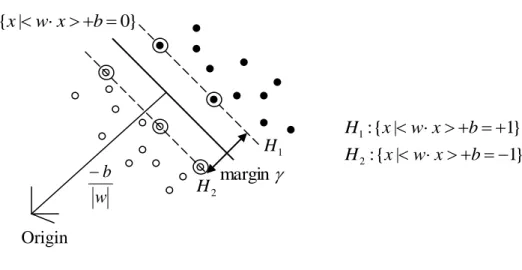
Figure 3.1 Linear separating hyperplanes for the separable case
As shown in Figure 3.1, the points x which lie on the hyperplanes satisfy
0
w x b , where w is normal to the hyperplane, b/ w is the perpendicular distance from the hyperplane to the origin, and w is the Euclidean norm of w. For the linearly separable case,
the support vector algorithm looks for the separating hyperplane with the largest margin.
Suppose that all the training data meet the following constraints.
1 x b w i for yi 1 (3.1) 1 x b w i for yi 1 (3.2) The margin is defined as distance between two hyperplanes, H1:wxib1 and
1 :
2 wx b
H i with a normal w. Since these two hyperplanes are parallel and have the same
normal, the margin distance that separates them is given by Origin } 0 | {xwxb } 1 | { : 1 x wxb H } 1 | { : 2 x wxb H w b margin 1 H 2 H
. 1 2 1 2 1 2 2 2 2 w x w x w w x w w x w w (3.3)Each instance that falls on one of the two hyperplanes is called a support vector (SV).
The SVs in Figure 3.1 are circled. Given this geometric relationship, finding the hyperplanes
with the maximum margin in feature space can be formulated as a mathematical programming
problem. For a linearly separable training data S((x1,y1),....,(xl.yl)), the hyperplane producing
maximum margin is found by formulating the minimization optimization problem as follows:
,...., 1 , 1 ) ( subject to 2 / minimize 2 l i b x w y w i i (3.4)
We now switch to a Lagrangian formulation of the problem with the Lagrange
multipliers,i 0 . By doing this, the constraints in Equation (3.4) are replaced by constraints on the Lagrangian multiplier themselves, which are easier to handle. The primal Lagrangian is given
by
l i i i i P wb w y w x b L 1 2 ] 1 ) ( [ 2 1 ) , , ( , i 0 . (3.5)Then we must minimize LP(w,b,) with respect to w and b, subject to i 0 . This is a convex quadratic programming problem since the objective function is itself convex, and those
points which satisfy the constraints also form a convex set. This indicates that this problem can
be equally solved with its corresponding dual problem, subject to the derivatives of LP(w,b,) with respect to w and b,
l i i i i x y w w b w L 1 0 ) , , ( ,
l i i i i x y w 1 (3.6)
l i i i y b b w L 1 0 ) , , ( ,
l i i i y 1 0 (3.7)also subject to the constraints, i 0 . Since these are equality constraints in the dual formulation, the dual can be substituted (3.6) into (3.5) and results in
. 2 1 2 1 ] 1 ) ( [ 2 1 ) , , ( 1 , 1 1 , 1 1 , 1 2
l j i j i j i j i l i i l j i l i i j i j i j i l j i j i j i j i l i i i i i D x x y y x x y y x x y y b w w y w b w L (3.8)The primal (LP) and dual (LD) come from the same objective function but with different constraints and the solution is found by minimizing LPor maximizing LD. Given that we want to maximizeLD with respect to i, the optimization problem can be formulated as
. ,...., 1 , 0 , 0 subject to 2 1 ) ( maximize 1 i 1 , 1 l i y x x y y L i l i i l j i j i j i j i l i i D
(3.9)In solving this problem, the positive values for each i gives
l i i i i x y w 1 * * whichgenerates the maximal margin hyperplane with margin 1/ w* 2. Those points whose i is
positive are the SVs (and are located on H1 and H2 in Figure3.1), while other points‟i are zero.
Since the value of b does not appear in the dual problem, b*is found making use of the primal constraints. The optimal solutions * , (w*,b*) must satisfy
l i b x w yi i i[ ( 1] 0, 1,..., * * *
. This is the Karush-Kuhn-Tucker (KKT)
complementary optimality condition. With this condition, b can be computed. The hyperplane
decision function can then be written as
l i j i i i y x x b sign x f 1 * * ). ( ) ( (3.10)This implies that support vectors are the critical points in the training set and lie closest to
the hyperplane producing the maximum margin of two different class labels.
So far we have considered only a separable case of training data. How can we extend
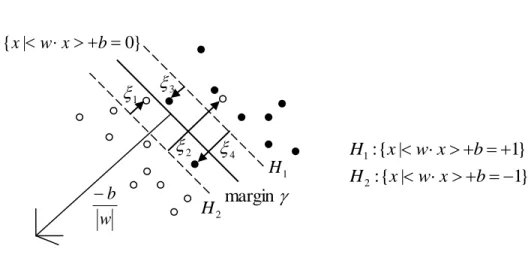
these strategies to deal with a non-separable case? This is done by introducing a positive slack
variable, i, i1,....,l. Constraints become:
i i b x w 1 for yi 1 (3.11) i i b x w 1 for yi 1 (3.12)
Figure 3.2 Linear separating hyperplanes for the non-separable case
So when an error occurs, the corresponding i must exceed unity, so
i i is the upper
bound on the number of training errors. Hence a natural way to assign an extra cost for errors is
to change the objective function to be minimized from w2 /2 (see equation 3.4) to
l
i i
C
w2/2 1 , where C is a penalty parameter chosen by the user. This is the concept behind
soft-margin SVMs. Introducing ias the Lagrange multipliers of the i, the Lagrange (primal)
function is:
l i i i l i i i i i l i i P w C y w x b L 1 1 1 2 ] 1 ) ( [ 2 1 . (3.13)For minimizing the Lagrange (primal) problem with respect to w, b, and i, setting the
respective derivatives to zero, we get equations (3.6) , (3.7) above, and
i C i i , . (3.14) 4 2 3 1 } 1 | { : 1 x wxb H } 1 | { : 2 x wxb H } 0 | { x wxb margin w b 1 H 2 H
By substituting the derivatives into the primal problem, the corresponding dual problem is formulated as . ,...., 1 , 0 , 0 subject to 2 1 ) ( maximize 1 i 1 , 1 l i C y x x y y L i l i i l j i j i j i j i l i i D
(3.15)With the derivatives and the KKT condition, equations (3.16)-(3.18), we obtain
0 } 1 ) ( { i i i i y x w b (3.16) 0 i i (3.17) 0 ) 1 ( ) ( i i i x w b y (3.18)
The solution is given by
Ns i i i iy x w 1
, where Ns is the number of SVs which non-zero coefficient ˆi. Among the SVs, some lie on the edge of the margin (ˆi 0) that is characterized by 0ˆi C from equations (3.17) and (3.14) and the remaining (ˆi 0 ) have ˆi C . Therefore, points on the wrong side of the boundary are SVs and points on the correct side of the
boundary are also SVs.
A SVM is a linear classifier, but in most cases, it is practically restrictive. SVM can be
easily extended to a nonlinear classifier by mapping the input space into a high dimensional
feature space through a kernel function, K(xi,xj) which computes the dot product of the data
points in the feature space H, that is,
) ( ). ( ) , (xi xj xi xj K . (3.19)
Functions that satisfy Mercer‟s theorem (Burges, 1998) can be used as dot products and thus can be used as kernels. Common kernel functions include Linear: K x x( ,i j)(x xi j), Polynomial:
( ,i j) ( i j 1)d
K x x x x and GaussianRadial-based:
2 2 2 / ) , ( xi xj j i x e x K .
Thus the nonlinear separating hyperplane can be found formulated as an optimization problem given by . ,...., 1 , 0 , 0 subject to ) ( 2 1 ) ( maximize 1 i 1 , 1 l i C y x x K y y L i l i i l j i j i j i j i l i i D
(3.20)The corresponding decision function is
l i j i i iyK x x b sign b z w sign x f 1 ). ) ( ( ) ) ( ) ( (3.21)3.2 SVMs and the Skewed Boundary
As noted previously, imbalanced data sets cause a bias in the results of a SVM. Akbani et
al. (2004) have summarized three reasons why a skewed boundary occurs in SVM classification
for imbalanced data sets: (1) positive (minority) instances lie further from the ideal boundary
compared with negative (majority) instances, (2) the weakness of the soft-margin SVMs and (3)
the imbalanced SV ratio. For the third reason, according to the KKT conditions in solving the
optimization problem in SVM, the values for imust satisfy 1 0 n
i i i y
. Since the values for the minority class tend to be much larger than those for the majority class and the number ofdominated by majority SVs. That means that the decision function is more likely to classify a
boundary as majority. The second reason, the weakness of the soft-margin SVMs, is an inherent
weakness in coping with imbalanced data learning. For separable cases, the imbalance of class
distribution rarely influences the performance of SVMs because all the slack variables iare
equal to zero (equations 3.11 and 3.12). Therefore, there is no contradiction between the capacity
of the SVMs and the classification error. However, for non-separable cases, soft-margin SVMs
should achieve a trade-off between maximizing the margin between two classes and minimizing
the classification error. Typically much more majority instances appear in the overlapping area
than minority ones. So, the optimal hyperplane will be skewed on the minority class side in order
to reduce the overwhelming errors of misclassifying the majority class. If C is not very large,
SVMs simply predict most of minority instances as majority instances to make the margin as
large as possible, making the total misclassification cost as small as possible.
Several methods for SVMs for imbalanced data learning have been studied (Karakoulas
& Taylor, 1999; Lin et al., 2002). At the data level, rebalancing approaches such as
over-sampling (i.e. SMOTE) and under-over-sampling have been widely used for SVM to cope with
imbalanced datasets. Veropoulos et al. (1999) suggested using different penalties for
misclassification of the classes. Amari and Wu (1999) proposed using conformal transformation
of the kernel matrix to enlarge the separation between two classes. In the first step, it finds the
separating location between two classes through standard SVM learning. In the second step, the
primary kernel matrix is conformally scaled to give a wider separation. Separation is controlled
by the SVs, so the new kernel matrix is enlarged at the position of SVs.
Another approach is the one-class SVM (Scholkoft and Smola, 2002). This uses only
of the data within a dataset. This determines a hyperplan in feature space that separates most of
the data from the origin. It completely ignores information of the majority class: Instead, only
using one class, the minority class , it defines a hyperplane that separates most of data belonging
to the class from the origin.
3.3 Problems associated with SVM classifier for imbalanced data
When focusing on approaches at the data level (rebalancing the data distribution), there
are two significant problems associated with a SVM classifier, namely,
1. Over-sampling methods significantly increase the dataset size.
2. An optimal ratio of class distribution is empirically determined by grid search.
To address these problems, we propose a new sampling method at the data level for
imbalanced data learning. Instead of rebalancing the entire imbalanced dataset, a selective
sampling method is proposed that results in a relatively small number of instances. We expect
that a small set of representative instances of an imbalanced dataset could determine the desired
decision boundary by maintaining the same or achieving even better performance for the class
imbalance problem as compared to existing rebalancing methods. The merits of this approach
include: (1) skipping empirical search that is necessary in sampling methods such as optimal
ratios of class distributions and (2) avoiding producing a large training set that would lead to
long training times for a SVM. If this approach performs well as compared to some current
methods, it will provide an alternative method to solve the class imbalance problem with the
3.4 Effectiveness of rebalancing class distribution
For imbalanced and highly overlapped class data, sampling methods such as
over-sampling or under-over-sampling are very effective in terms of the optimization process in a
soft-margin SVM. In order to illustrate the effect of sampling methods in rebalancing class
distribution, we examine the boundary movement in two common methods, SMOTE
over-sampling and Random under-over-sampling. In this example, a Gaussian kernel function is used for
SVM classification.
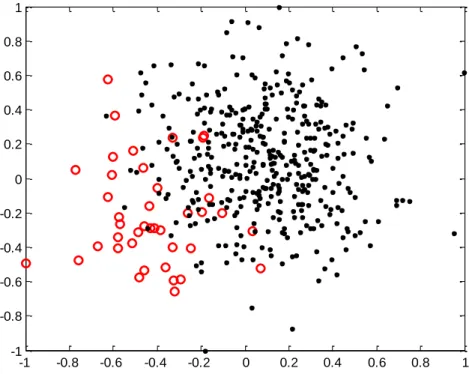
First, we generated a simple structure of a synthetic dataset showing a typical class
imbalance problem, which could be represented in 2-dimensional space as shown in Figure 3.3.
The minority class having 40 instances is marked with „o‟ and the majority having 400 instances
with „•‟ (a class ratio of 1:10).
-1 -0.8 -0.6 -0.4 -0.2 0 0.2 0.4 0.6 0.8 1 -1 -0.8 -0.6 -0.4 -0.2 0 0.2 0.4 0.6 0.8 1
After classification, almost all majority instances were correctly classified, while many
minority instances were classified as the majority class. This example illustrates a typical class
imbalance problem caused by soft-margin SVM algorithms. In other words, an optimal
hyperplane results from the trade-off between maximizing the margin of the minority and the
majority class and minimizing misclassification costs in the feature space. To improve the
accuracy for the minority class, we need to move the boundary toward the majority class side. To
illustrate this, we applied two rebalancing sampling methods, SMOTE and random
under-sampling, which will be referred to as SVM-SMOTE and SVM-RU, respectively.
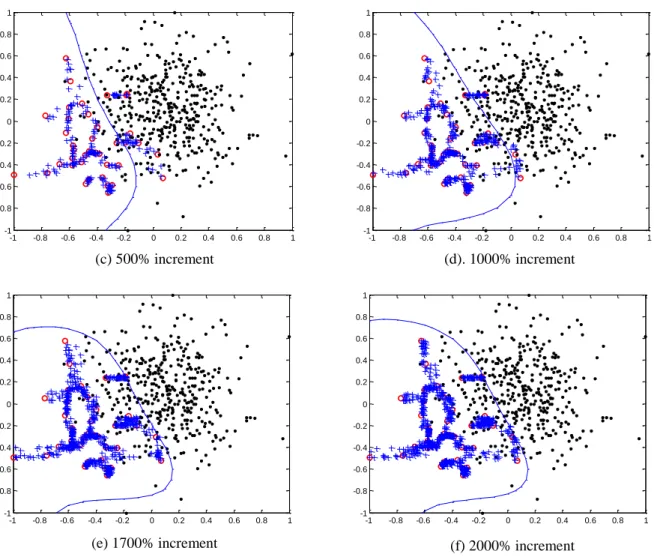
Using SVM-SMOTE, the number of synthetic instances to achieve the desired class
balance is unknown and empirical studies must be performed. Minority instances are
oversampled gradually with 100%, 300%, 500% and 1000% increases in minority instances.
After rebalancing by SMOTE, we observed that the boundary gradually shifted toward the
majority class as minority instances are increased as shown in Figure 3.4 (a) to (f).
-1 -0.8 -0.6 -0.4 -0.2 0 0.2 0.4 0.6 0.8 1 -1 -0.8 -0.6 -0.4 -0.2 0 0.2 0.4 0.6 0.8 1 -1 -0.8 -0.6 -0.4 -0.2 0 0.2 0.4 0.6 0.8 1 -1 -0.8 -0.6 -0.4 -0.2 0 0.2 0.4 0.6 0.8 1
-1 -0.8 -0.6 -0.4 -0.2 0 0.2 0.4 0.6 0.8 1 -1 -0.8 -0.6 -0.4 -0.2 0 0.2 0.4 0.6 0.8 1 -1 -0.8 -0.6 -0.4 -0.2 0 0.2 0.4 0.6 0.8 1 -1 -0.8 -0.6 -0.4 -0.2 0 0.2 0.4 0.6 0.8 1 -1 -0.8 -0.6 -0.4 -0.2 0 0.2 0.4 0.6 0.8 1 -1 -0.8 -0.6 -0.4 -0.2 0 0.2 0.4 0.6 0.8 1 -1 -0.8 -0.6 -0.4 -0.2 0 0.2 0.4 0.6 0.8 1 -1 -0.8 -0.6 -0.4 -0.2 0 0.2 0.4 0.6 0.8 1
circle(○): minority instances, dot(•): majority instances, cross(+): synthetic instances by SMOTE
Figure 3.4 Boundary movements by SMOTE algorithm
Though SVM-SMOTE shifts the decision boundary, it comes at a penalty of increasing
the size of the dataset as mentioned in the previous section. Assume that Npis the number of the positive (minority) instances and Nnthe number of the negative (majority) instances, typically
SVM takes O Np(( Nn) )3 time for learning in the worst case (Burges, 1998). For imbalanced
data learning, SVM-SMOTE will take O Np(( (1 Rsmote)Nn) )3 where Rsmoteis an optimal ratio
(c) 500% increment (d). 1000% increment
of size of increasing instances. Here Rsmoteis determined empirically. What is worse,
over-sampling also increases instances in the complex region between classes. By generating
instances near or in overlapping areas which might be misclassified, classification is more
difficult. In solving the optimization problem in the SVM algorithm, many cases can violate
KKT conditions. As a result, this will requires much more time to convergence of optimization
in SVM algorithms in spite of its good performance. So, if a dataset is extremely imbalanced and
overlapped, over-sampling through the SMOTE algorithm would not be efficient. In regard to
the problems introduced by an over-sampling approach, an under-sampling method is preferred
to over-sampling methods and is commonly used.
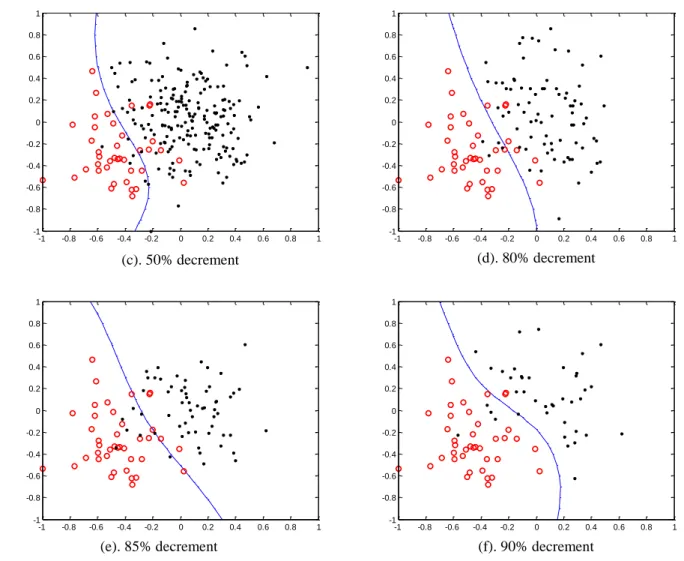
SVM-RU uses random under-sampling to rebalance the class distribution. Instead of
increasing minority instances, decreasing the number of the majority instances will make an
optimal hyperplane in terms of the trade-off between maximizing the margin and minimizing
misclassification costs. Figure 3.5 below shows the boundary movement as the number of the
majority instances removed randomly is increased.
-1 -0.8 -0.6 -0.4 -0.2 0 0.2 0.4 0.6 0.8 1 -1 -0.8 -0.6 -0.4 -0.2 0 0.2 0.4 0.6 0.8 1 -1 -0.8 -0.6 -0.4 -0.2 0 0.2 0.4 0.6 0.8 1 -1 -0.8 -0.6 -0.4 -0.2 0 0.2 0.4 0.6 0.8 1
-1 -0.8 -0.6 -0.4 -0.2 0 0.2 0.4 0.6 0.8 1 -1 -0.8 -0.6 -0.4 -0.2 0 0.2 0.4 0.6 0.8 1 -1 -0.8 -0.6 -0.4 -0.2 0 0.2 0.4 0.6 0.8 1 -1 -0.8 -0.6 -0.4 -0.2 0 0.2 0.4 0.6 0.8 1 -1 -0.8 -0.6 -0.4 -0.2 0 0.2 0.4 0.6 0.8 1 -1 -0.8 -0.6 -0.4 -0.2 0 0.2 0.4 0.6 0.8 1 -1 -0.8 -0.6 -0.4 -0.2 0 0.2 0.4 0.6 0.8 1 -1 -0.8 -0.6 -0.4 -0.2 0 0.2 0.4 0.6 0.8 1
Figure 3.5 Boundary movements by random under-sampling
Similar with SVM-SMOTE, random under-sampling causes a shift in the decision
boundary towards the majority class. Considering time complexity in learning the dataset,
SVM-RU takes O Np(( Nn R u) )3 which is quicker than SVM with the original training set since
u
Nn R is approximately equal to Nn . Because majority instances have been randomly eliminated, it may not be easy to determine an optimal size of training set for rebalancing. Also
(c). 50% decrement (d). 80% decrement
similar to SVM-SMOTE, the optimal desired class distribution for imbalanced data learning is
unknown and needs to be determined empirically
3.5 Hypotheses
Given the nature of imbalanced datasets as previously discussed, two hypotheses were
formulated to address effectiveness and efficiency issues in imbalanced data learning for SVMs.
Hypothesis 1
A relatively small number of instances from an imbalanced training set are needed to obtain good performance in solving the class imbalance problem using a SVM.
Hypothesis 2
A smaller subset within the set of support vectors can be found that produces a better boundary using a SVM.
Hypothesis 1 is related to the premise that the boundary between the major and minor
classes is strongly influenced by a relatively small number of instances. The inference is that a
potential down-sizing of learning sets will lead to significant improvements in classifier
performance. Hypothesis 2 is based on the expectation that there is a smaller group of SVs that
will provide a near optimal classification of the classes and improve the efficiency of learning. If
such a set of SVs exist, then a metaheuristic-based sampling approach could be used to select the
CHAPTER 4 SELECTIVE SAMPLING USING A GENETIC ALGORITHM
This chapter presents a selective sampling method based on a Genetic Algorithm for
imbalanced data learning with a SVM. Instead of rebalancing new training data distributions for
learning, we investigate how this selective sampling method performs on class imbalance
problems. Instance selection is a form of under-sampling in which specific instances are selected
based on some criteria. We use a Genetic Algorithm to perform selective sampling of the
majority instances and retain all minority instances because they are assumed to be informative.
4.1 SVMs for Large-Scale Datasets
Training a SVM involves solving a constrained quadratic programming (QP) problem,
requiring a large memory allocation and resulting in long training times for large-scale data. Two
issues in using SVMs with large scale data are the generation of the kernel matrix and data
overlapping. With a dataset size of N, an N×N kernel matrix is generated. Furthermore, storing
the entire kernel matrix in memory is problematic due to computer memory limitations. The
second issue is the increase in classification difficulty when many class data are overlapped.
Due to large-scale data problem associated with SVMs, many studies have examined
methods for reducing training samples to achieve relatively fast SVM classification. For
example, Shin and Cho (2003) proposed a selection method for selecting patterns from training
data near the decision boundary based on the neighborhood properties. Zhang and King proposed
a -skeleton algorithm to identify SVs. Almeida et al. (2000) employed K-means clustering to select patterns from a training set. Lee and Mangasarian (2001) selected a subset of training