Cover
Audit Report
Report Number
DR-AR-14-008
Post Office
Relocation
Process
September 2, 2014A
ppendices
R
ecommenda
tions
Findings
Ta
ble of
Contents
Highlights
Background
The U.S. Postal Service manages 31,702 post offices that provide retail services such as counter assistance, postage stamps, money orders, and Post Office boxes. The
Postal Service can relocate post offices from one place to another, typically within the same ZIP Code area, for reasons such as lease issues or space optimization.
The relocation process consists of a concept study, public notification, and site selection. The Postal Service informs local officials and the public of the proposed relocation. Both may comment on and appeal the plan to relocate retail operations. Both may also comment on the final site selection, but neither may appeal it unless it was disclosed during the initial public meeting. The vice president, Facilities, adjudicates appeals. Our objective was to assess the Postal Service’s process for relocating retail operations to other facilities.
What the OIG Found
The process for relocating facilities was not always transparent. Further, the vice president, Facilities, has conflicting
responsibilities for approving funding and adjudicating relocation appeals. We reviewed 33 of the 114 relocation projects we identified for fiscal years 2011 through 2013, and found
25 new site selections were not announced until after the public comment and appeal periods ended, and two had undetermined
announcement dates. We found that only one of the 25 appeals filed for the 114 projects was upheld, leading management to halt the relocation. Further, the Postal Service could not readily identify the number of relocations and officials did not always efficiently manage the public notification and documentation process.
These conditions occurred because some procedures were unclear and the vice president, Facilities, was authorized to approve funding and adjudicate appeals. Further, there were no requirements to track all relocations and officials did not always know the specific guidelines and processes. Consequently, the public and local officials may not have had the information they needed to make informed comments and determine the impact of a relocation, potentially harming the Postal Service’s relationship with the public.
What the OIG Recommended
We recommended the vice president, Facilities, revise regulations and guidelines to enhance transparency and public input for potential alternative site selections. We also recommended modifying the guidance to remove the official’s dual funding and adjudicating responsibilities; establishing a method to track and monitor relocations and documentation requirements and retention periods for relocation files; and training real estate specialists.
Highlights
The process for relocating
facilities was not
always transparent.
Consequently, the public and
local officials may not have had
the information they needed
to make informed comments
and determine the impact of a
relocation, potentially harming
the Postal Service's relationship
with the public.
A
ppendices
R
ecommenda
tions
Findings
Ta
ble of
Contents
Highlights
Transmittal Letter
September 2, 2014
MEMORANDUM FOR: TOM A. SAMRA
VICE PRESIDENT, FACILITIES
E-Signed by Robert Batta VERIFY authenticity with e-Sign
FROM: Robert J. Batta
Deputy Assistant Inspector General
for Missions Operations
SUBJECT: Audit Report – Post Office Relocation Process (Report Number DR-AR-14-008)
This report presents the results of our audit of the Post Office Relocation Process (Project Number 14XG005DR000).
We appreciate the cooperation and courtesies provided by your staff. If you have any questions or need additional information, please contact Rita F. Oliver, director, Delivery and Post Office Operations, or me at 703-248-2100.
Attachment
cc: Corporate Audit and Response Management
A
ppendices
R
ecommenda
tions
Findings
Ta
ble of
Contents
Highlights
Table of Contents
Cover
Highlights ...1
Background
...1
What the OIG Found ...1
What the OIG Recommended ...1
Transmittal Letter ...2
Findings ...4
Introduction ...4
Conclusion ...4
Post Office Relocation Process
...5
Announcement of New Locations ...5
Appeals ...6
Number of Relocations
...7
Relocation Process Management ...
8
Recommendations...10
Management’s Comments
...10
Evaluation of Management’s Comments
...11
Appendices ...13
Appendix A: Additional Information
...14
Background
...14
Objective, Scope, and Methodology
...14
Prior Audit Coverage ...15
Appendix B: Relocation Process Flowchart
...16
Appendix C: Appealed Relocation Projects
...17
Appendix D: Analysis of Relocations Involving Retail Operations
...
18
Appendix E: Management’s Comments
...20
Contact Information ...24
A
ppendices
R
ecommenda
tions
Findings
Ta
ble of
Contents
Highlights
Introduction
This report presents the results of our self-initiated audit of the U.S. Postal Service’s Post Office Relocation Process (Project Number 14XG005DR000). Our objective was to assess the Postal Service’s process for relocating Post Office retail operations to other facilities. See Appendix A for additional information about this audit.
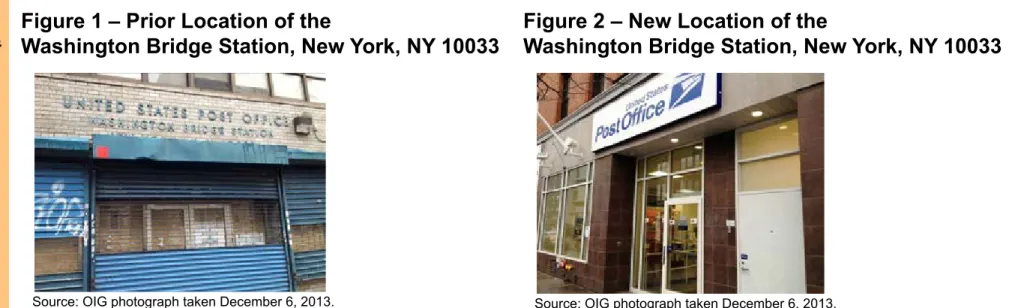
The Postal Service manages 31,702 post offices that provide retail services such as counter assistance, postage stamps, money orders, and Post Office (PO) boxes.1 The Postal Service can move a Post Office’s retail operations from one location to another, typically within the same ZIP Code area, for reasons such as lease issues and space optimization (see Figures2 1 and 2 for
images of a completed Post Office relocation). The U.S. Postal Service Office of Inspector General (OIG) identified 114 Post Office retail operation relocations that occurred for fiscal years (FY) 2011 through 2013.
Figure 1 – Prior Location of the
Washington Bridge Station, New York, NY 10033
Figure 2 – New Location of the
Washington Bridge Station, New York, NY 10033
Source: OIG photograph taken December 6, 2013. Source: OIG photograph taken December 6, 2013.
The relocation process consists of a concept study, public notification, and site selection. Facility staff prepares a node study to initiate a relocation and, once the study and funding are approved, the Postal Service informs local officials and the public of the proposed relocation. Local officials and the public can comment on and appeal the proposal to relocate retail operations. The vice president, Facilities, adjudicates these appeals. Postal Service management identifies and selects a final site. Additionally, local officials and the public can comment on the final site selection, but neither can appeal it unless it was disclosed during the initial public meeting. Title 39 of the Code of Federal Regulations (CFR) and Postal Service guidance do not require officials to announce the new sites at public meetings.3 See Appendix B for a flowchart of the relocation process.
Conclusion
The process for relocating facilities is not always transparent. Further, the vice president, Facilities, has conflicting responsibilities for approving funding and adjudicating relocation appeals. We reviewed 33 of the 114 relocation projects we identified for
FYs 2011 through 2013 and found 25 new site selections that were not announced until after the public comment and appeal 1 This total includes post offices, classified branches, stations, and annexes. Some annexes, however, may not offer retail services. For the sake of simplicity, all references
to relocations in this report refer to the movement of retail operations only.
2 The distance between the prior and new location is less than 1 mile.
3 The Postal Service must follow 39 C.F.R. §241.4 and the Postal Service’s Community Relations Regulations for U.S. Postal Service Facilities Projects for relocating
retail operations. These regulations and guidelines were established to assure increased opportunities for the public and local officials to convey their views concerning relocations and have them considered prior to any final decision. The notification requirements are the same whether the retail facility is in a postal-owned or a
leased space.
Findings
We reviewed 33 of the 114
relocation projects we identified
for FYs 2011 through 2013 and
found 25 new site selections that
were not announced until after
the public comment and appeal
periods ended and two with
undetermined announcement
dates. We also found that only
one of the 25 appeals filed for
the 114 projects was upheld,
leading the Postal Service to halt
the relocation.
A
ppendices
R
ecommenda
tions
Findings
Ta
ble of
Contents
Highlights
periods ended and two with undetermined announcement dates. We also found that only one of the 25 appeals filed for the
114 projects was upheld, leading the Postal Service to halt the relocation. Further, the Postal Service was not adequately tracking the number of relocations and could not readily identify all of them. Finally, officials did not always effectively manage the public notification and documentation process.
These conditions occurred because some procedures were unclear and the vice president, Facilities, was authorized to approve funding and adjudicate appeals. Further, Postal Service guidelines did not require tracking of all relocations and officials did not always know the specific relocation processes. Consequently, the public and local officials may not have had the information they needed to make informed comments and determine the impact of a relocation, which could harm the Postal Service’s relationship with the public.
Post Office Relocation Process
The relocation process was not always transparent. Site selection announcements were made at various times during the process and the official adjudicating appeals also approved funding for the relocation projects. Additionally, a listing of all relocations for the past 3 fiscal years was not readily available. Furthermore, there were administrative and management issues with public notification and documentation processes.
Announcement of New Locations
Generally, the Postal Service did not announce new locations until after the public comment and appeal periods had ended and it had selected and secured a new site.
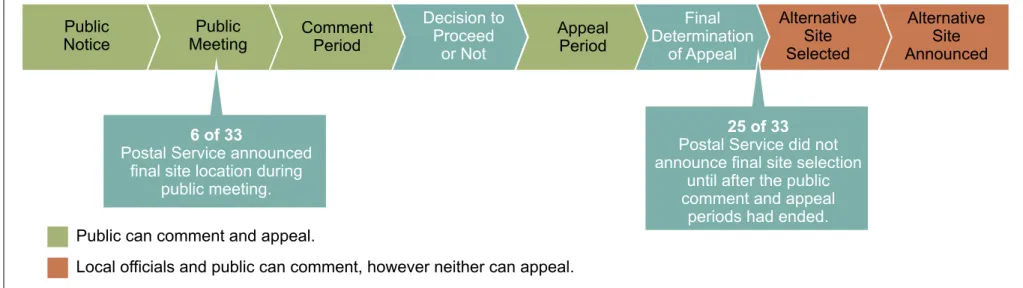
We reviewed 334 of 114 relocations5 and our analysis showed that:
■ The Postal Service did not announce the final site selection for 25 of 33 relocations (76 percent) until after the public comment
and appeal periods ended.6
■ The Postal Service announced the final site selection for six of 33 relocations (18 percent) during the public meeting or before the comment and appeal periods ended. In each case, the Postal Service planned to move the retail operation to a postal-owned location that did not have retail services, such as a carrier annex.7
■ We were unable to determine whether the Postal Service announced the final site selection for two of 33 relocations (6 percent) during the public meeting or before the comment period ended (see Figure 3).8
4 We judgmentally selected 33 retail relocations to review – seven projects were complete, 20 were ongoing, four had been canceled, and we were unable to identify the
status of two.
5 Twenty-eight of 33 were initiated to optimize or right-size facility space, one lease was terminated, and one lease was pre-empted. We were unable to identify the purpose of the remaining three due to insufficient documentation.
6 Because some relocations were ongoing, the new site locations may still not be known to the public.
7 For the seven completed relocations, three were relocated to carrier annexes that did not have retail service and three were moved to leased space not previously occupied by the Postal Service. The remaining relocation was moved concurrently with another Post Office to a single leased location not previously occupied by the
Postal Service.
8 For two of the projects, we were unable to determine this information due to a lack of documentation in the relocation files. Additionally, real estate specialists were unable
to provide any additional information regarding this matter.
A
ppendices
R
ecommenda
tions
Findings
Ta
ble of
Contents
Highlights
Figure 3 – Public Notification Phase
Public
Notice MeetingPublic Comment Period
Decision to Proceed or Not Appeal Period Final Determination of Appeal Alternative Site Selected Alternative Site Announced 6 of 33
Postal Service announced final site location during
public meeting.
25 of 33
Postal Service did not announce final site selection
until after the public comment and appeal
periods had ended.
Public can comment and appeal.
Local officials and public can comment, however neither can appeal.
Source: OIG analysis.
Note: For two of the projects, we were unable to determine this information due to a lack of documentation in the relocation files.
Neither the regulations9 nor Postal Service guidance10 require the Postal Service to notify the public of the site selection at the
public meetings or before the public comment and appeal periods end. Postal Service guidance instructs responsible personnel to use due diligence in divulging the final site location. This due diligence may include postponing notification to local officials and the public to protect the Postal Service’s negotiating leverage and control costs. On the other hand, we recognize that without knowing the final location the public cannot adequately comment on or fully assess the impact of a relocation.
Appeals
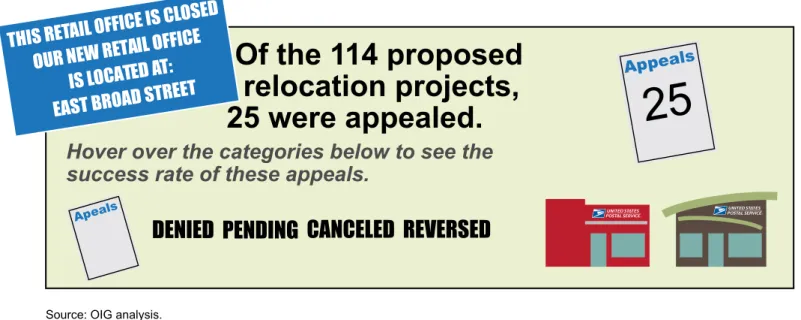
The vice president, Facilities, has conflicting responsibilities for approving funding and adjudicating relocation appeals. Of the 114 proposed relocation projects, 25 were appealed:
■ Twelve of the 33 relocations we selected for review were appealed. The Postal Service denied seven of those appeals and
proceeded with its plan to relocate the retail operations. One relocation was reversed,11 one was canceled,12 and the remaining three were pending.13
■ We requested information regarding the appeal status for the remaining 81 proposed relocation projects and learned that
13 were appealed, management denied 10 of those appeals and proceeded with relocation plans, and the remaining three were pending.14
9 39 C.F.R. §241.4.
10 Community Relations Regulations for U.S. Postal Service Facilities Projects, May 1999.
11 The reversal for the Southmore Station in Houston, TX, occurred on May 16, 2014. The vice president, Facilities, stated the decision to remain at the current location was based on several appeals and supplemental Postal Service analysis that indicated growth in Postal Service customer numbers due to expected new businesses and new housing developments in the nearby area.
12 The relocation was canceled due to falling property values prior to the issuance of an appeal determination letter.
13 The submission deadline for filing appeals ended January 29, 2014, for one facility, and March 14, 2014, for the remaining two. As of May 14, 2014, the Postal Service had
not issued a decision on any of these pending appeals.
14 The submission deadline for filing appeals ended on March 14, 2014, for these three facilities. As of May 14, 2014, the Postal Service had not issued a decision on any of
these pending appeals.
A
ppendices
R
ecommenda
tions
Findings
Ta
ble of
Contents
Highlights
Thus, for the 25 appealed relocations, there was only one instance where the public and local officials succeeded and the Postal Service halted the relocation. See Figure 4 and Appendix C for status of appeals. We did not identify any improprieties regarding the appeals we reviewed; however, because of the Facilities vice president’s conflicting responsibilities, the public may see this official as lacking objectivity to fairly adjudicate appeals. Other officials, including Operations and area management, are involved in identifying relocation projects and the appeals process. However, this is not evident to the public.
Figure 4: Status of Appeals
Source: OIG analysis.
Number of Relocations
The Postal Service could not readily identify the number of completed or ongoing relocations15 for FYs 2011 through 2013.
Management explained that individual facilities maintain relocation documentation, so it is not all easily traceable or available electronically. The OIG compiled data obtained through research, fieldwork, and documentation provided by Postal Service
Headquarters officials and area real estate specialists (RES). We identified 114 relocations that were completed or ongoing during this period.16 Management informed us that Facilities’ Optimization Planning Blue Share website contains facility relocation data; however, our review of the site revealed links to over 1,000 facility node studies and not all were related to retail relocations.17 Management also stated they tracked relocations via an implementation tracking form and that efforts to develop an electronic tracking system would outweigh the benefits. We reviewed the implementation tracking form and found it tracked more than just relocation projects and multiple terms18 were used to describe these projects. In addition, data was not consistently tracked for all
relocations.19 According to a senior official, there was no need to have the number of relocations readily available.
15 Completed indicates the relocation process was finalized and the Postal Service moved retail operations to the alternative site. Ongoing indicates the relocation process was not finalized and retail operations were not moved.
16 We cannot confirm that this total represents all retail facility relocations for FYs 2011 through 2013.
17 The site contained various node studies, including those completed for area mail processing and mail processing facility consolidations.
18 The Postal Service used 42 different terms in describing the projects including: “AQ-retail” (AQ stands for alternate quarters), “AQ-1:1,” “relocate retail,” and “retail relocations,” as well as terms related to other facilities’ actions. As a result, it was difficult to identify only retail relocation projects.
19 For example, data fields showing the dates the Postal Service met regulations requirements, such as the public meeting, were left blank for some projects and completed
for others.
Apeals
THIS RETAIL OFFICE IS CL OSED OUR NEW RETAIL OFFICE
IS LOCATED AT: EAST BROAD STREET
Hover over the categories below to see the
success rate of these appeals.
Of the 114 proposed
relocation projects,
25 were appealed.
A
ppendices
R
ecommenda
tions
Findings
Ta
ble of
Contents
Highlights
25
AppealsRelocation Process Management
Area RESs did not always effectively manage the relocation process when notifying the public and managing documentation. For example:
■ For 16 of 33 relocations (48 percent),20 the Postal Service did not issue a press release as required by the regulations.21 One area RES stated that Corporate Communications decides whether to issue a press release. One manager thought a press release was optional and that posting a notice at the impacted facility satisfied the public notification requirement.
■ For 13 of 33 relocations (39 percent), the Postal Service did not adequately solicit comments. For example, notices issued in three areas did not identify the comment due date. Two RESs did not consider the 15-day period following a public meeting to be a “comment period” but instead saw it as a required waiting period before proceeding with the next steps in the process. ■ In five instances, RESs discussed multiple relocations during one meeting:
● In March 2011, postal officials held one meeting to discuss relocations involving two post offices (the Federal and Midtown Plaza stations) in Rochester, NY.
● In March 2013, postal officials held one meeting to discuss relocations involving two post offices (the East Union and International stations) in Seattle, WA.
● In March 2013, the Postal Service asked to be put on a borough meeting agenda to present information on relocations involving three posts offices (the Old Chelsea, Peter Stuyvesant, and Triborough stations) in New York City.
● In December 2013, postal officials held one meeting for relocations affecting two different post offices (the Pratt and Times Plaza stations) in Brooklyn, NY. We attended this meeting and noted the majority of it covered Pratt Station even though the lease for the Times Plaza Station was scheduled to expire several months before the lease for the Pratt Station. ● In December 2013, postal officials held one meeting for relocations affecting six different post offices (the Memorial Park,
Julius Melcher, Greenbriar, University, Medical Center, and Southmore stations) in Houston, TX.
While regulations do not preclude addressing multiple locations at one meeting, it can be confusing and may be seen as an attempt to minimize public input. Further, meetings held to discuss multiple relocations can also impact the amount of information provided regarding each proposed relocation. According to Postal Service management, local officials asked that the New York meetings be held simultaneously.
20 We were unable to confirm whether press releases were issued for three projects because of insufficient documentation.
21 39 C.F.R. §241.4 (c)(3).
A
ppendices
R
ecommenda
tions
Findings
Ta
ble of
Contents
Highlights
■ Officials maintained insufficient supporting documentation for the following three relocations:22
● Memorial Station – no evidence of a press release, public meeting notice, or notice of decision to proceed. ● Westport PO – no evidence of a press release, public meeting notice, or notice of decision to proceed. ● Milltown PO – no evidence of a public meeting notice.
RESs stated they maintain working files for every project and when projects are complete, they transfer certain documents relating to them to other facilities’ files (see Appendix D for our analyses of retail operations relocations).
Managers are responsible for providing reliable, useful, and timely information for transparency and accountability of programs and their operations.23
These conditions occurred for several reasons:
■ The regulations and guidelines did not include:
● Timeframes for announcing a new location site to the public; however, Postal Service guidance instructs responsible personnel to use due diligence in divulging the final site selection. Due diligence may include postponing notification to local officials and the public to protect the Postal Service’s negotiating leverage and control costs.
● Requirements to track and monitor relocations nationwide.
● Requirements to maintain a complete record of the relocation notification process and a retention period for relocation file documents.
■ Guidance gives the vice president, Facilities, authority to approve funding and regulations authorize the same official to
adjudicate appeals.
■ Officials did not always know the guidelines and processes.
Consequently, the public and local officials may not always have sufficient information needed to make informed comments and determine the impact of a relocation, which could harm the Postal Service’s relationship with the public.
22 In addition, one file for the Boone Downtown Station was not available for review.
23 Government Auditing Standards: 2011 Revision, Government Accountability Office-12-331G Washington, D.C., December 2011.
A
ppendices
R
ecommenda
tions
Findings
Ta
ble of
Contents
Highlights
We recommend the vice president, Facilities:
1. Revise Postal Service regulations and guidance for the retail operations relocation process to enhance transparency and public input regarding potential alternative site selections.
2. Modify Postal Service guidance for retail operations relocations to remove dual responsibilities for approving funding and adjudicating appeals.
3. Establish a method to track and monitor retail operation relocations nationwide. 4. Establish documentation requirements and retention periods for relocation files.
5. Provide formalized training for real estate specialists to ensure they administer the relocation process appropriately.
Management’s Comments
Management generally agreed with the findings and recommendations.
Management stated that under current regulations, the anticipated site is not always identified at the initial public meeting. Management requested the report clarify that the Postal Service is not arbitrarily withholding site information, but following the regulations. Further, the due diligence in leasing is for research and investigation to determine if a site is suitable and the guidance simply tells the public that the Postal Service may complete their research and investigation before the announcement
Management disagrees that the vice president, Facilities, has conflicting responsibilities and stated that nothing in the report demonstrated a conflict. They also stated that because the OIG found no improprieties in the process, the report’s statement that “the public may see this official as lacking objectivity,” appears unfounded. Management further stated the vice president, Facilities, is exercising prudent responsibility to ensure appropriate allocation of scarce capital and has no compensation or promotional opportunities tied to the project approval or the appeals decision. His dual roles can be complementary because fair and objective reviews of the competing interests require an understanding of the public’s concerns and the Postal Service’s financial and operational requirements.
Management also stated that to make the best use of limited funds and staffing, they collect data and statistics that help them efficiently and effectively manage Postal Service operations. They have tools for managing individual relocation projects and have never needed to quantify the completed or ongoing relocations nationwide to manage Postal Service operations. Management also stated they believe real estate specialists generally manage the relocation process effectively.
Management agreed with recommendation 1 stating that prior to the audit they identified issues with the timing and substance of disclosures under current regulations governing the relocation process. They are considering revisions to the regulation to address several concerns the OIG, the public, and others have raised. They anticipate the revisions will require substantial time and
analysis. Further, revisions must follow the regulatory process for modifying federal regulations; therefore, management could not identify a completion date or commit to making any specific changes in the regulations.
Recommendations
We recommend the
vice president, Facilities, revise
regulations and guidelines to
enhance transparency and public
input for potential alternative site
selections. We also recommend
modifying the guidance to
remove the official’s dual funding
and adjudicating responsibilities;
establishing a method to track
and monitor relocations and
documentation requirements
and retention periods for
relocation files; and training
real estate specialists.
A
ppendices
R
ecommenda
tions
Findings
Ta
ble of
Contents
Highlights
Management agreed with recommendation 2 and will revise their guidance and remove dual responsibilities for approving funding and adjudicating appeals by September 30, 2014.
Management agreed with recommendation 3, stating they will modify an existing management data tool to calculate the number of ongoing and completed relocations nationwide by October 31, 2014.
Management also agreed with recommendation 4, stating they established documentation requirements and retention periods for relocation files and published internal guidance for personnel on June 19, 2014.
Management agreed with recommendation 5, stating they will provide formalized training updates to current personnel by September 30, 2014, and ensure they train future employees engaged in the relocation process.
See Appendix E for Management’s Comments in their entirety.
Evaluation of Management’s Comments
The OIG considers management’s comments responsive to the recommendations and management’s corrective actions should resolve the issues identified in the report.
Regarding recommendation 1 and the site selection announcement, the OIG Office of General Counsel reviewed management’s comments and the regulations and indicated the Postal Service takes a strict reading to what OIG believes is an ambiguous regulation. While the Postal Service has a plausible claim as to its interpretation that the regulation requires it to follow a certain chain of events, the OIG does not agree with its statement that the regulation “precludes” it from announcing the new site earlier in the process. The fact that the Postal Service has notified the public of site selections earlier in the process when relocating to an existing postal facility, even though the regulation does not address this situation, supports this. Nonetheless, we can all agree that the regulation needs clarification should the Postal Service revise it. In fact, management’s response appears to agree with recommendation 1 in our report, noting that “management identified issues with the timing and substance of disclosures under the current regulation” and is considering revisions “to address several concerns, including the concerns raised by the OIG.” On August 26, 2014, Management informed OIG of their decision to move forward with revising the retail operations relocation regulations and guidance. Management’s actions to initiate revisions regarding the timing and substance of disclosures and their clarification of Postal Service guidance regarding due diligence in divulging the final site selection should enhance transparency and public input, which satisfies the intent of this recommendation.
Regarding recommendation 2 and the conflicting roles of the vice president, Facilities, the report notes that we did not identify any improprieties regarding the appeals and that other officials — including Operations and area management — are involved in the relocation and appeals process. However, this is not evident to the public. Further, for the 25 appealed relocations, there was only one instance where the public and local officials succeeded and the Postal Service halted the relocation. Management’s action to remove dual responsibilities for approving funding and adjudicating appeals should satisfy the intent of this recommendation. Regarding recommendation 3, modification to the existing management data tool to calculate the number of ongoing and completed relocations nationwide will be beneficial in managing this process.
A
ppendices
R
ecommenda
tions
Findings
Ta
ble of
Contents
Highlights
Regarding recommendations 4 and 5, we concur with management’s response and note that they provided documentation supporting their corrective actions.
The OIG considers all recommendations significant and, therefore, requires OIG concurrence before closure. We concur that the actions taken sufficiently addressed recommendations 4 and 5 and we consider these recommendations closed with the issuance of this report.
Consequently, the OIG requests written confirmation when corrective actions are completed for recommendations 1, 2, and 3. These recommendations should not be closed in the Postal Service’s follow-up tracking system until the OIG provides written confirmation that the recommendations can be closed.
A
ppendices
R
ecommenda
tions
Findings
Ta
ble of
Contents
Highlights
Appendices
Click on the appendix title
to the right to navigate to
the section content.
Appendix A: Additional Information
...14
Background
...14
Objective, Scope, and Methodology
...14
Prior Audit Coverage ...15
Appendix B: Relocation Process Flowchart
...16
Appendix C: Appealed Relocation Projects
...17
Appendix D: Analysis of Relocations Involving Retail Operations
...
18
Appendix E: Management’s Comments
...20
A
ppendices
R
ecommenda
tions
Findings
Ta
ble of
Contents
Highlights
Background
The Postal Service has 31,702 post offices that provide retail services such as counter assistance, postage stamps, money orders, and PO boxes. The Postal Service is implementing a business strategy called Delivering, Results, Innovation, Value, and Efficiency (DRIVE). Two DRIVE initiatives (3 and 4) involve optimizing facility space, reducing costs, generating revenue, and improving customer service. In some cases, this has resulted in moving retail operations to other locations.
A Post Office relocation occurs when retail operations are moved from one location to another, typically within the same ZIP Code area. The Postal Service must follow established regulations and procedures when it needs to relocate a retail operation.24
The overall purpose of the relocation regulations is to ensure potentially affected individuals and local officials have an opportunity to comment on proposed projects and the Postal Service considers those comments prior to any final decision. The Postal Service must notify the public of the plan to relocate, hold a public meeting(s), solicit comments, allow for an appeal, and, if there is an appeal, issue a final determination of its relocation decision.
The regulations and guidance for retail relocations do not require the Postal Service to identify the new location during public meetings or before the comment and appeal periods end. The community notification requirements are the same whether the retail facility is located in a postal-owned or leased space. See Appendix B for a flowchart of the relocation process.
Objective, Scope, and Methodology
Our objective was to assess the Postal Service’s process for relocating retail operations to other facilities. Our audit scope included relocations for FYs 2011 through 2013. The Postal Service was unable to readily identify the number of completed or ongoing relocations for FYs 2011 through 2013; therefore, our scope was limited to the 114 relocations that we identified through research, fieldwork, and documentation provided by Postal Service Headquarters officials and area RESs.
To accomplish our objective, we:
■ Reviewed and analyzed applicable legislation, regulations, and other documents regarding relocating retail operations. ■ Interviewed headquarters officials and RESs in Dallas, TX; Denver, CO; Bloomingdale, IL; San Francisco, CA;
Windsor, CT; and Greensboro, NC, to gain an understanding of the relocation process for retail operations and the RESs’ roles and responsibilities.
■ Judgmentally selected and analyzed facility relocation files for 33 of 114 retail relocations. To select the sample, we grouped the identified retail facilities by area and randomly selected five facilities for each area.25 To ensure we examined the entire
process, we included both completed and ongoing projects (see Appendix D for our analysis of retail operations relocations). ■ Evaluated the appeal status of 114 retail relocations for FYs 2011 through 2013.
■ Reviewed pertinent news articles, blogs, and websites.
24 Community Relations Regulations for U.S. Postal Service Facilities Projects, May 1999.
25 During our review of the project files, we identified and excluded two projects that did not fall within the parameters of our scope.
Appendix A:
Additional Information
A
ppendices
R
ecommenda
tions
Findings
Ta
ble of
Contents
Highlights
We conducted this performance audit from November 2013 through September 2014, in accordance with generally accepted government auditing standards and included such tests of internal controls as we considered necessary under the circumstances. Those standards require that we plan and perform the audit to obtain sufficient, appropriate evidence to provide a reasonable basis for our findings and conclusions based on our audit objective. We believe that the evidence obtained provides a reasonable basis for our finding and conclusions based on our audit objective. We discussed our observations and conclusions with
management on June 17, 2014, and included their comments where appropriate.
We did not assess the reliability of any computer-generated data for the purposes of this report. We did not obtain any computer-generated data for retail relocations. We obtained retail relocation data via hard copy files provided by area RESs.
Prior Audit Coverage
Report Title Report Number Final Report Date Monetary Impact
Preservation and Disposal of
Historic Properties SM-AR-14-004 4/16/2014 None
Report Results:
The report determined the Postal Service did not know how many historic properties it owned or what it cost to preserve them, report the status of historic artwork to the National Museum of American Art, as required, when it sold 10 historic post offices, collaborate with the Advisory Council on Historic Preservation to improve its compliance with the National Historic Preservation Act, or submit its 2011 status report to the council. The vice president, Facilities, who approves funding for the relocation of retail services and disposal, also issues the final determination letter after reviewing appeals raised during the process, giving the appearance of bias. The Postal Service appropriately applied relocation procedures rather than discontinuance procedures for all properties reviewed; however, officials did not post the public meeting notification 7 days in advance for one property, as required, and could not show documentation that it met the relocation requirements for two properties. We recommended management reconcile the properties listed on the National Register of Historic Places to those in the Facilities management system, develop a process to track expenditures for preserving historic properties, and notify the National Museum of American Art about the 10 sold post offices containing historic art. Management should collaborate with appropriate organizations to improve the transparency of historic
property preservation and submit the 2011 status report to the Advisory Council on Historic Preservation. Postal Service officials generally agreed with the recommendations.
Nationwide Facility Optimization DA-AR-11-009 8/26/2011 Over $1.9 billion
Report Results:
The report statistically projected that the Postal Service maintains 67 million excess square feet nationwide. This level of excess is more than the current commercial vacancy rate of 13.4 percent. The Postal Service has a much greater opportunity to aggressively optimize excess space through disposal or leasing than its FY 2011 target for reducing interior space. To better establish strategic targets in line with presidential and congressional direction, the Postal Service needs to overcome the challenges of understanding the extent of excess space, incentivizing the effective use of facility space with the appropriate performance measures, and
enhancing the disposal process and leasing procedures. The report estimated that if the Postal Service initiated disposal action for the excess space identified, it would have an opportunity to realize at least $3.48 billion nationwide over typical and remaining lease terms. Management officials agreed that optimizing current facility infrastructure is a critical and important initiative for the Postal Service; however, they disagreed with the amount of excess space and potential monetary impact.
A
ppendices
R
ecommenda
tions
Findings
Ta
ble of
Contents
Highlights
Real Estate Specialist (RES) arranges meeting with local government official and
prepares community contact letter. Facilities staff complete Node Study.
Project concept and funding approved.
RES meets with local official and leaves dated community contact letter. Arranges
to attend or hold public meeting. Public notice posted in post office.
Attend public meeting (s). Solicit comments.
Minimum 15-day comment period.
RES evaluates comments.
RES prepares letter advising local officials of decision and appeal rights.
30-day appeal period.
If appeals received, RES collects and summarizes issues. RES consults with Legal. Legal approves
draft response.
VP Facilities reviews and signs appeal
determination letter.
Advertisement for alternate quarters/new site.
Site review committee meeting held.
RES issues letter to local officials identifying contending sites and sites
eliminated from consideration.
Site Selected.
RES notifies local officials of selected site.
Local officials and public can comment.
Project proceeds.
Source: OIG flowchart.26
26 The OIG developed the flowchart based on analysis of Title 39 C.F.R. §241.4 and Postal Service policies and procedures.
Appendix B:
Relocation Process
Flowchart
A
ppendices
R
ecommenda
tions
Findings
Ta
ble of
Contents
Highlights
Facility Name Status or Outcome of Appeal
1 Berkeley Main Post Office (MPO) Appeal Denied
2 Beverly Hills MPO Appeal Denied
3 Bronx General PO Appeal Denied
4 Coralville Sub Station Appeal Denied
5 Cornersburg Station Appeal Denied
6 El Segundo Finance Station Appeal Denied
7 La Jolla MPO Appeal Denied
8 Los Angeles West Branch Appeal Denied
9 Mount Vernon Sandford Boulevard Station Appeal Denied
10 Norristown MPO Appeal Denied
11 Reading Downtown Station Appeal Denied
12 Reading MPO Appeal Denied
13 Santa Monica MPO Appeal Denied
14 Thousand Oaks Newbury Park Branch Appeal Denied
15 Ukiah MPO Appeal Denied
16 Venice MPO Appeal Denied
17 White Flint Mall Station Appeal Denied
Total Appeals Denied 17
18 Downtown Fort Worth Station Decision Pending
19 Greenbriar Station Decision Pending
20 Julius Melcher Station Decision Pending
21 Medical Center Station Decision Pending
22 Memorial Park Station Decision Pending
23 University Station Decision Pending
Total Appeals Pending 6
24 Southmore Station Decision to relocate reversed
Total Appeals Reversed 1
25 Norwich MPO Canceled project prior to determination
Total Appeals Canceled 1
Source: OIG analysis.
Appendix C:
Appealed Relocation
Projects
A
ppendices
R
ecommenda
tions
Findings
Ta
ble of
Contents
Highlights
Facility Name Origin Status New Location Identified at Public Meeting or Before Comment Period Ended Press Release Issued Adequately Solicited Public Written
Comment Date Relocation Completed
1 Timberlyne Station Optimization Canceled No No No
-2 White Flint Mall Station Lease Ongoing No No No
-3 Silver Spring PO Optimization Complete No No No 10/22/12
4 Annapolis MPO Optimization Ongoing No No No
-5 Boone Downtown Station DetermineUnable to DetermineUnable to DetermineUnable to DetermineUnable to DetermineUnable to Determine Unable to
6 York MPO Optimization Complete No No No 7/8/13
7 Lakewood Retail Optimization Ongoing No No No
-8 Reading Downtown Station Optimization Ongoing No No No
-9 Palmer Square Finance Station Optimization Ongoing No No No
-10 Rochester Federal Station Optimization Complete No No No 5/6/13
11 Purcell Station Optimization Ongoing No No Yes
-12 Collinsville MPO Optimization Complete Yes No Yes 1/27/14
13 Memorial Station DetermineUnable to DetermineUnable to DetermineUnable to DetermineUnable to DetermineUnable to DetermineUnable to
14 Milltown PO Optimization Ongoing No Yes Yes
-15 Westport PO DetermineUnable to Complete No DetermineUnable to DetermineUnable to 1/3/12
16 Norwich MPO Optimization Canceled Yes Yes Yes
-17 Old Chelsea Station Optimization Ongoing No Yes Yes
-18 Reading MPO Optimization Ongoing No Yes Yes
-19 Anaheim Canyon Station Optimization Canceled No Yes Yes
-20 Santa Monica MPO Optimization Complete Yes Yes Yes 7/1/13
21 San Dimas MPO Optimization Canceled No Yes Yes
-22 Thousand Oaks Newbury Park Branch Optimization Complete Yes Yes Yes 6/22/13
23 Berkeley MPO Optimization Ongoing No Yes Yes
-24 Julius Melcher Station Optimization Ongoing No Yes Yes
-25 University Station Optimization Ongoing No Yes Yes
-26 Downtown Fort Worth Station Optimization Ongoing No Yes Yes
-27 Southmore Station Optimization Ongoing No Yes Yes
-28 Vero Beach Tropic Branch Lease Ongoing Yes Yes Yes
-Appendix D:
Analysis of Relocations
Involving Retail Operations
A
ppendices
R
ecommenda
tions
Findings
Ta
ble of
Contents
Highlights
Facility Name Origin Status New Location Identified at Public Meeting or Before Comment Period Ended Press Release Issued Adequately Solicited Public Written
Comment Date Relocation Completed
29 Iowa City MPO Optimization Ongoing No No No
-30 Coralville Sub Station Optimization Ongoing Yes No No
-31 East Union Station Optimization Ongoing No No No
-32 Richland MPO Optimization Ongoing No No Yes
-33 International Station Optimization Ongoing No No No
-Total No Responses 25 16 13
Note: Dash (-) indicates “not applicable.”
Source: OIG analysis of retail operations relocation files.27
27 As projects were ongoing during the OIG’s review, their status may have subsequently changed.
A
ppendices
R
ecommenda
tions
Findings
Ta
ble of
Contents
Highlights
475L’ENFANT PLAZA,SW WASHINGTON,DC 20260-1861 WWW.USPS.COM
TOM A.SAMRA
VICE PRESIDENT,FACILITIES
August 7, 2014
LORI LAU DILLARD via email ([email protected]) ACTING DIRECTOR, AUDIT OPERATIONS
SUBJECT: Draft Audit Report – Post Office Relocation Process Draft Audit Report Number DR-AR-14-DRAFT
Thank you for the opportunity to review and comment on the above referenced draft Audit Report. The Postal Service generally agrees with the OIG’s recommendations, which will help the Postal Service improve transparency, as well as its processes for handling relocations of customer service facilities.
In section A below, management addresses the OIG’s findings. In section B below, management addresses the OIG’s recommendations.
A. OIG Draft Audit Report Findings.
1. The relocation process was not always transparent. Generally, the Postal Service did not announce new locations until after the public comment and appeals periods had ended and it had selected and secured a new site. The regulation and Postal Service guidance do not require officials to announce the new sites at public meetings or before the public comment and appeal period ends. Postal Service guidance instructs
responsible personnel to use due diligence in divulging the final site selection. This due diligence may include postponing notification to local officials and the public to protect the Postal Service’s negotiating leverage and control costs.
Management Response: Management agrees that due to the current regulations’ requirements, the anticipated site is not always identified at the initial public meeting. However, even under the existing regulation, the Postal Service provides information to the public and local officials about the relocation and the contending sites for the new location, albeit not concurrently, and both the public and local officials have opportunities to comment on the relocation and the contending sites. The OIG’s draft report states that the regulations “do not require” the Postal Service to notify the public of the selected site at the public meetings. In fact, the current regulation precludes it; it requires the Postal Service first determine whether to relocate, taking into account community input, then determine the new site. Therefore, Management requests that the report make clear the Postal Service is not arbitrarily withholding site information, but following the existing regulation. Finally, the OIG cites as “Postal Service guidance” the Postal Service’s Community Relations Regulations for U.S. Postal Service Facilities Projects (May 1999) and states that the guidance “instructs responsible personnel to use due diligence in divulging the final site selection.” However, that statement does not accurately reflect the guidance’s text or intent. During the site selection phase, the current regulation requires the Postal Service to first notify local officials and the public of the contending sites. In that context, the guidance addresses an example
Appendix E:
Management’s Comments
A
ppendices
R
ecommenda
tions
Findings
Ta
ble of
Contents
Highlights
2
-where only one potential site is available by saying “[y]ou may delay notifying local officials and the public until due diligence is completed...” In real estate leasing, “due diligence” means the research and investigation a tenant undertakes in order to determine whether a site is suitable. Therefore, the Postal Service guidance is simply pointing out that the Postal Service may complete its due diligence on the site before telling officials and the public that it is a contending site.
2. The Vice President, Facilities, has conflicting responsibilities for approving funding and adjudicating relocation appeals. We did not identify any improprieties regarding the appeals we reviewed; however, because of the Facilities Vice President’s conflicting responsibilities, the public may see this official as lacking objectivity to fairly adjudicate appeals.
Management Response: As discussed below, Management agrees with revising Postal Service guidance to allow for separating project approvals from appeals adjudication. Management disagrees with the OIG’s statement that the responsibilities are conflicting and Management notes that nothing in the report demonstrates that the roles are, in fact, conflicting. Further, because the report provides no support for concluding the
responsibilities conflict and because the OIG found no improprieties in the process, the report’s statement that “the public may see this official as lacking objectivity,” therefore appears unfounded. In approving a project, the Vice President, Facilities is exercising prudent management responsibility to ensure appropriate allocation of scarce capital. He has no compensation or promotional opportunities tied to either the project approval or the appeals decision. Rather than conflicting, the roles can be complementary because a fair and objective review of the competing interests would require understanding the public’s concerns as well as the Postal Service’s financial and operational requirements. Finally, even assuming the existence of “conflicting roles,” Management finds no logical support for the OIG’s assertions in the report that such conflicting roles are a cause for the issues identified in the other findings, such as ineffective process management or insufficient record keeping.
3. The Postal Service could not readily identify the number of completed or ongoing relocations for FYs 2011 through 2013.
Management Response: In order to make the best use of limited funds and staffing, Management collects data and statistics that help Management efficiently and effectively manage Postal Service operations. The Postal Service already has tools for managing individual relocation projects and has never needed to quantify the completed or ongoing relocations nationwide in order to manage Postal Service operations. We note that the OIG’s audit report cites no financial or operational benefit from such quantification.
4. Area RES did not always effectively manage the relocation process when notifying the public and managing documentation. These conditions occurred for several reasons, including (i) officials did not always know the guidelines and processes, and (ii) the Vice President, Facilities, has authority to approve funding and adjudicate appeals.
Management Response: Management believes the RES generally manage the relocation process effectively, but agrees with the recommendations for establishing relocation records retention requirements and for providing additional formal training to the personnel involved in the relocation process. As discussed above, Management does not agree that the Vice-President’s “conflicting roles” is the reason for any shortfalls in managing the relocation process or for the absence of documentation.
A
ppendices
R
ecommenda
tions
Findings
Ta
ble of
Contents
Highlights
3
-B. OIG Draft Audit Report Recommendations.
1. Revise Postal Service regulations and guidance for the retail operations
relocation process to enhance transparency and public input regarding potential alternative site selections.
Management Response: Prior to this audit, management had identified issues with the timing and substance of disclosures under the current regulation governing the relocation process. Management is considering revisions to the regulation to address several concerns, including the concerns raised by the OIG. Management anticipates that any revision of this regulation will require substantial time and analysis to thoughtfully address the concerns of the OIG, the public and others. Additionally, any revision must follow the regulatory process for modification to Federal regulations, a process that will require, among other things, public input and the Postal Service’s careful evaluation and response to such input. Therefore, at this time, Management cannot identify a completion date or commit to making any specific changes in the regulations.
2. Modify Postal Service guidance for retail operations relocations to remove dual responsibilities for approving funding and adjudicating appeals.
Management Response: Management agrees with the recommendation and will implement it by September 30, 2014.
3. Establish a method to track and monitor retail operation relocations nationwide. Management Response: Management has determined that it can modify an existing management data tool to permit a calculation of the number of ongoing and completed relocations nationwide. Although the OIG report cites no operational or financial benefits to support the Postal Service expending scarce resources during a financial crisis to implement the OIG’s recommendation, and although Management already has tools to effectively manage relocation projects, because the management data tool modification is not a substantial change and will entail only minimal cost in terms of funds and staffing time, Management will implement this recommendation by October 31, 2014.
4. Establish documentation requirements and retention periods for relocation files. Management Response: Management agrees with this recommendation. On June 19, 2014, the Postal Service established documentation requirements and retention periods for relocation files and published internal guidance for personnel. Attached is a copy of the requirement for documentation and retention periods for relocation files.
5. Provide formalized training for real estate specialists to ensure they administer the relocation process appropriately.
Management Response: Management agrees with this recommendation. Management will provide a formalized training update for current personnel by September 30, 2014 and ensure that future employees engaged in the relocation process receive the formalized training.
A
ppendices
R
ecommenda
tions
Findings
Ta
ble of
Contents
Highlights
4
-In conclusion, management appreciates the OIG's efforts in auditing the Postal Service’s Relocation Process and preparing this Audit Report. The draft report and Management's responses do not contain information that management believes may be exempt from disclosure under the FOIA. Sincerely,
Tom A. Samra
cc: Sally K. Haring, Manager via email ([email protected]) [email protected]
A
ppendices
R
ecommenda
tions
Findings
Ta
ble of
Contents
Highlights
Contact Information
Contact us via our Hotline and FOIA forms, follow us on social
networks, or call our Hotline at 1-888-877-7644 to report fraud, waste or abuse. Stay informed.
1735 North Lynn Street
Arlington, VA 22209-2020 (703) 248-2100