Multi-instance multi-label learning in the presence of novel class instances
Anh T. Pham [email protected]
Raviv Raich [email protected]
Xiaoli Z. Fern [email protected]
School of Electrical Engineering and Computer Science, Corvallis, OR 97330-5501 USA
Jes ´us P´erez Arriaga [email protected]
Departamento de Ingenier´ıa de Comunicaciones, Universidad de Cantabria, 39005 Santander, Spain
Abstract
Multi-instance multi-label learning (MIML) is a framework for learning in the presence of label ambiguity. In MIML, experts provide labels for groups of instances (bags), instead of directly providing a label for every instance. When label-ing efforts are focused on a set of target classes, instances outside this set will not be appropri-ately modeled. For example, ornithologists la-bel bird audio recordings with a list of species present. Other additional sound instances, e.g., a rain drop or a moving vehicle sound, are not la-beled. The challenge is due to the fact that for a given bag, the presence or absence of novel instances is latent. In this paper, this problem is addressed using a discriminative probabilis-tic model that accounts for novel instances. We propose an exact and efficient implementation of the maximum likelihood approach to determine the model parameters and consequently learn an instance-level classifier for all classes including the novel class. Experiments on both synthetic and real datasets illustrate the effectiveness of the proposed approach.
1. Introduction
Multi-instance multi-label learning is a framework for learning in the presence of label ambiguity. In conventional single instance single label learning (SISL), a label is pro-vided for every instance. In contrast, in MIML learning, instances are grouped into bags and labels are provided at the bag-level. MIML learning has many applications where data is complex and the labeling process is costly. Proceedings of the32nd International Conference on Machine Learning, Lille, France, 2015. JMLR: W&CP volume 37. Copy-right 2015 by the author(s).
For instance, in birdsong recognition, instead of provid-ing a species label for each bird syllable, experts prefer to provide species labels for longer intervals, each containing multiple bird syllables (Briggs et al., 2012).
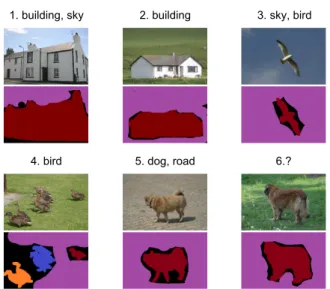
A common assumption in MIML is that the set of classes in which we are interested is a closed set and all instances we encounter in both training and testing are assumed to be-long to this fixed set of classes. However, this assumption is frequently violated in real applications. For example, in birdsong recognition, experts label long audio intervals with a fix set of bird species. Other categories of sound such as rain or car sound are not included in the labeling process. Yet, such sounds are present in the data. Another example is image annotation, as shown in Fig. 1, where the annotator considers only a fixed set of tags and ignores ‘grass’ as it is not included in the tag set. We refer to this as the novel instance problem in MIML data. Properly mod-eling the novel instances in MIML data can have positive impacts on several applications. First, it enables effective detecting of novel instances in the data. Second, by model-ing and recognizmodel-ing the novel instances in MIML data, we can better model the instances of known classes, and con-sequently improve the ability to predict the class both at the bag-level and at the instance-level.
There are several lines of work that are related to the prob-lem of MIML learning with novel instances. The probprob-lem of detecting instances from novel class has been studied under the SISL setting (Saligrama & Zhao, 2012), (Hsiao et al., 2012), (Da et al., 2014). However, a common as-sumption in the SISL setting is that we only observe in-stances from the known classes during training. In con-trast, in MIML setting, we may in fact observe instances of the novel class during training; they are just not labeled. For example, consider the2nd and4th images in Fig. 1. Even though these bag labels, which are{‘building’} and
{‘bird’}respectively, do not indicate the presence of novel instances from ‘grass’, however, two grass segments are
available during training.
(Yang et al., 2013) introduced the problem of MIML learn-ing with weak labels, where the bag-level labels may be incomplete. Different from our setting, there the missing labels are from the fixed set of known classes. Finally, (Lou et al., 2013) proposed to solve the novelty instance detec-tion problem for MIML by learning a score funcdetec-tion for each known class and predicting an instance to belong to the novel class if it scores low for all known classes. Since there is no direct modeling mechanism for the novel class in training, the process of learning the class score function is not specific to novelty detection and various methods from the MIML literature can be used to accomplish this task, e.g., (Briggs et al., 2012), (Cour et al., 2011).
In this paper, we develop a discriminative probabilistic model that explicitly models the novel class instances un-der the MIML setting. Our contributions are as follows: (i)we develop a model that accounts for presence of novel class instances(ii)we present an exact and efficient infer-ence method for the model. The advantages of the proposed framework are demonstrated by experiments on bag-level label prediction and novel class detection using both syn-thetic and real datasets.
2. Related work
Many multi-instance multi-label learning approaches fol-low the maximum margin principle (Huang et al., 2014), (Zhang & Zhou, 2008). Specifically, these approaches maximize the margin among classes and the score of a bag w.r.t. each class is computed from the score-maximizing instance in the bag. As a consequence, these methods uti-lize only a subset of the available instances in a given bag. (Briggs et al., 2012) addresses this issue by using the soft-max score considering all instances in the bag. Learning from partial label is another framework that can be used for MIML learning, as in CMM-LSB (Liu & Dietterich, 2012). CMM-LSB discards the bag structure. Instead, the label of each instance is taken from its bag label. Thus, the method ignores the relationship among instances in each bag, which may then degrade the accuracy. Recently, ORLR (Pham et al., 2014), a probabilistic approach, is pro-posed for the MIML learning. ORLR considers the class membership for every instance in each bag and enforces the constraint that the bag-level label set is formed as union of the labels of all its instances. None of the aforementioned methods directly addresses the potential problem of novel class instances present in the data.
A number of approaches have been proposed for novel class detection in the SISL setting. One solution to de-tect novel class instances is to test whether it comes from a probability distribution of known instances (Markou &
1. building, sky 2. building 3. sky, bird
4. bird 5. dog, road 6.?
Figure 1.Example of images taken from MSCV2 dataset. Below
each image, a segmentation into instances are provided. Segment ids in each image are denoted by pink, red, blue, and orange col-ors. On top of each training image (numbered from 1 to 5) is its bag label. The label for the test image (numbered 6) is unknown, denoted by ‘?’. The label ‘grass’ is novel since it is not used for any of the images but segments of this class appear in the2nd and
4th images. In the test image, there is a ‘grass’ segment, which belongs to the novel class. The challenge is to correctly annotate each segment including the novel ‘grass’ segment.
Singh, 2003). Another solution is finding the minimum set covering most of the training examples and consider remaining examples as novel instances such as (Zhao & Saligrama, 2009). In the MIML setting, we may observe instances from novel class during training, as in (Lou et al., 2013), where novel instance features are available in train-ing. Specifically, the label of the bag only contains known instance labels and ignores the novel instances. For ex-ample, in image annotation, experts may only consider the popular labels, such as ‘sky’, ‘building’, and ‘car’, and la-bel images containing segments from those lala-bels. Experts may ignore segments coming from class such as ‘fence’ or ‘door’ depend on the granularity of the labeling process. In this paper, we propose to incorporate the novel class into our model so that it can be learned directly during training.
3. Problem Formulation
Setting. We consider the MIML setting in the presence of novel class instances. The training set contains B bags, denoted as {XD,YD} = {(Xb,Yb)}B
b=1. Xb consists of nb instances xb1,xb2, . . . ,andxbnb,xbi ∈ X = R
d. Each instancexbi is associated with a latent instance label ybi ∈ {0,1,2, . . . , C}, where class0represents the novel class. The bag label Yb is a subset of the set of known classes Y = {1,2, . . . , C}. Note that the bag label does
not include0. Hence it does not provide information about the presence or absence of the novel class in the bag. In this setting, one can consider the following tasks: (i) Instance annotation: mapping an instance inX to a label in Y S
{0}, i.e., {0,1, . . . , C}. (ii) Novelty detection: mapping an instance inX to{{0},Y}, i.e., determining whether an instance belongs to the novel class or known classes. (iii)Bag level prediction: mapping a bag in2X to a label in2Y.
Example: Consider the set of images (bags) taken from MSCV2 dataset (Winn et al., 2005) in the MIML format as in Fig. 1. Additionally assume that grass is not included in the set of tags used for annotation and hence segments (instances) from grass can be regarded as novel instances. Training images are numbered from1−5. For example, in the1st image, the label is{‘building’, ‘sky’}and there are two segments in the image. However, no information mapping segments to labels is available. Note that images 2and4, which contain the novel class (‘grass’), do not in-dicate so in their bag labels. Our goal is to learn a classifier that can map a segment to one of the known classes, i.e., ‘building’, ‘sky’, ‘bird’, ‘dog’, ‘road’, or to the novel class. Note that since the classifier is never trained with the label ‘grass’, at best it is expected to map ‘grass’ segments to a novel class. The test image numbered6contains a segment from the known class ‘dog’ and a segment from the novel class ‘grass’. A key challenge is to design a classifier that can correctly predict the label for segments from known classes and recognize ‘grass’ segments as belonging to a novel class.
4. Proposed approach
In this section, we introduce a probabilistic model for MIML data that includes unlabeled novel class instances. Additionally, we present a maximum likelihood algorithm for learning the parameters of the model.
4.1. Model
The proposed model addresses the MIML problem in the presence of novel class instances using two fundamental aspects: (i)a class (c = 0) is assigned to represent novel class instances. (ii)the bag-level label removes any evi-dence of the presence of the novel class from the union of instance labels. These features of the model are designed to allow learning a class for which no label is provided during training.
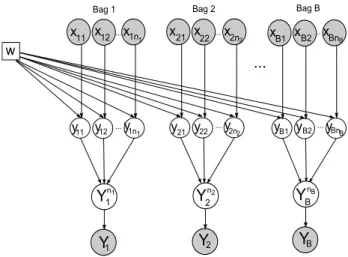
Our model is presented in Fig. 2. We assume that all bag labels and instance labels in each bag are independent. Specifically, we consider the relation between the instance
label and feature vector, including novel class, as follows
p(ybi|xbi,w) = QC c=0e I(ybi=c)wTcxbi PC c=0ew T cxbi , (1)
wherew = [w0,w1,w2, . . . ,wC] andwc ∈ Rd×1 is the weight for the cth class. For each bag, the union of its instance labels, including the novel label0, is denoted as Ynb
b =
Snb
j=1ybj. In addition, the relation between the ob-served bag labelYbandYnb
b is modeled as follows p(Yb|Ynb b ) =I(Yb=Y nb b ) +I(Yb [ {0}=Ynb b ), (2) whereYb ⊆ {1,2, . . . , C} andYnb b ⊆ {0,1,2, . . . , C}. This model implies that the bag label Yb is obtained by removing the novel class label0from the union of the in-stance labelsYnb
b if it appears in the union. HenceYb can-not reveal information about the presence of novel class instances in the bag. We illustrate the use of our notation for the example in Fig. 1 using Table 1.
Bag 2 Bag 3 Bag 4
n2= 2 n3= 2 n4= 4 y21=‘grass’ y31=‘sky’ y41=‘grass’ y22=‘building’ y32=‘bird’ y42=‘bird’
y43=‘bird’ y44=‘bird’
Y22= Y23= Y44=
{‘grass’,‘building’} {‘sky’,‘bird’} {‘grass’,‘bird’}
Y2= Y3= Y4=
{‘building’} {‘sky’,‘bird’} {‘bird’}
Table 1.Instance labels and bag labels of the proposed model for
images 2, 3, and 4 in Fig. 1.
... ... ...
... ... ...
w
y11 y12 y1n1 y21 y22 y2n2 yB1 yB2 yBnB
Bag 1 Bag 2 Bag B
...
x11 x12 x1n x21 x 22 x2n xB1 xB2 xBn 1 2 BY
2Y
BY
1Y
n11Y
2 n2Y
B nBFigure 2.Graphical model for MIML learning in the presence of
4.2. Maximum likelihood estimation using expectation maximization
To learn the model parameters, we consider maximum like-lihood inference and proceed with the evaluation of the likelihood. SinceXD is independent of the parametersw and bag labels are independent givenXD, the likelihood for the aforementioned model can be written as
p(YD,XD|w) =p(XD) B
Y
b=1
p(Yb|Xb,w), (3)
wherep(Yb|Xb,w)is computed using the law of total prob-ability as p(Yb|Xb,w) = C X yb1=0 · · · C X ybnb=0 [{I(Yb= nb [ j=1 ybj) +I(Yb[{0}= nb [ j=1 ybj)} × nb Y i=1 p(ybi|xbi,w)]. (4)
Directly maximizing the logarithm of (3), i.e., the log-likelihood, is hard. Instead, we consider the expectation maximization (Dempster et al., 1977) solution for infer-ence. Consider the instance labels y = {y1, . . . ,yB}, whereyb = [yb1, yb2, . . . , ybnb]for all1≤b ≤B, as hid-den variables. In EM, the surrogate functiong(w,w0) =
Ey[logp(YD,XD,y|w)|YD,XD,w0], i.e., the expectation w.r.t.y of the complete log-likelihood, is iteratively com-puted and maximized. The surrogate function for the pro-posed model is given by
g(w,w0) = B X b=1 nb X i=1 [ C X c=0 p(ybi=c|Yb,Xb,w0)wTcxbi −log( C X c=0 ewTcxbi)] +ζ, (5)
whereζ = Ey[logp(YD|y)|YD,XD,w0] + logp(XD)is a constant w.r.t. w. Detailed steps to obtain g(w,w0)are given in the supplementary material. The generalized ex-pectation maximization framework consists of two steps as follows
• E-step: Compute p(ybi = c|Yb,Xb,w(k)) for b = 1, . . . , Bandi= 1, . . . , nb.
• M-step: Find w(k+1) such that g(w(k+1),w(k)) ≥ g(w(k),w(k)).
A key challenge in this paper is to address the probability calculation ofybi givenYb in the presence of novel class instances. While the formulation of the problem in the EM setting appears straightforward, the computation in the E-step is nontrivial.
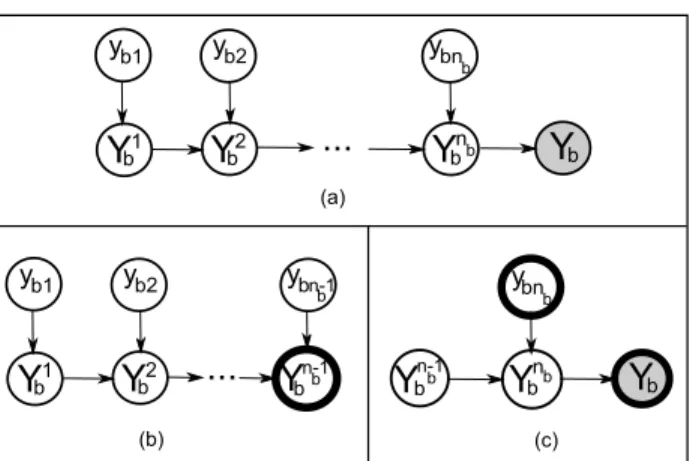
...
...
(a) (b) (c) n-1 n-1 n-1Figure 3.The process to computep(ybnb = c,Yb =L|Xb,w).
Bolded nodes are nodes which are currently computed. (a) The variables for the bth bag. (b) Dynamically compute
p(Ynb−1
b |Xb,w). (c) Computep(ybnb,Yb|Xb,w)using Propo-sition 1.
4.3. E-step
The probabilityp(ybi=c|Yb=L,Xb,w), forc∈L∪{0}, can be computed from p(ybi = c,Yb = L|Xb,w) using conditional rule as
p(ybi=c|Yb =L,Xb,w)
= P p(ybi =c,Yb =L|Xb,w) c∈L∪{0}p(ybi =c,Yb=L|Xb,w)
.
We proceed with an efficient alternative computation of p(ybi=c,Yb=L|Xb,w)as follows.
Definenbrandom variablesY1b,Y 2 b, . . . ,Y nb b , whereY i b = Si
j=1ybj, is the union of labels of the firsti instances in thebth bag. Note that this sub-bag label indicates the pres-ence or abspres-ence of all classes including the novel class in the sub-bag. Using the newly introduced random vari-ablesYib, we can replace the label portion of the graphical model in Fig. 2 for thebth bag with the chain structure in Fig. 3(a). The advantage of the new graphical model in Fig. 3(a) is that it allows for efficient computation of the desired probabilityp(ybi =c,Yb =L|Xb,w). Denote the power set ofLS
{0}excluding the empty set asP. We de-rive the following procedure for computing the probability p(ybi=c,Yb=L|Xb,w).
Consider the case i = nb where p(ybnb = c,Yb = L|Xb,w)is computed.
Step 1. Dynamically compute p(Ynb−1
b |Xb,w) using the following recursion: p(Yj+1b =L0|Xb,w) = X l∈L0 p(ybj+1=l|xbj+1,w) ×[p(Yjb=L0\l|Xb,w) +p(Yjb =L0|Xb,w)], (6)
whereL0 ⊆PandL0\l ={c∈L0|c 6=l}(the proof of (6) is given in the supplementary material). This calculation is performed sequentially for everyYjbuntilp(Ynb−1
b |Xb,w) is obtained as in Fig. 3(b). Note that the presence or absence of the novel class is taken into account when computing p(Ynb−1
b = L
0|Xb,w) since L0 may contain
class0.
Step 2.Computep(ybnb,Yb|Xb,w)fromp(Y nb−1 b |Xb,w) based on the model in Fig. 3(c), as in the following propo-sition.
Proposition 1 The probabilityp(ybnb=c,Yb=L|Xb,w)
for allc∈LS{0}
can be computed as follows.
• Ifc= 0, p(ybnb =c,Yb=L|Xb,w) =p(ybnb=c|xbnb,w)× [p(Ynb−1 b =L|Xb,w) +p(Y nb−1 b =L [ {0}|Xb,w)]. • Else ifc6= 0, p(ybnb =c,Yb =L|Xb,w) =p(ybnb=c|xbnb,w)× [p(Ynb−1 b =L|Xb,w) +p(Y nb−1 b =L [ {0}|Xb,w)+ p(Ynb−1 b =L\c|Xb,w) +p(Y nb−1 b =L\c [ {0}|Xb,w)].
Proof. The detailed proof can be found in the supplemen-tary material.
Consider the remaining terms of the formp(ybi =c,Yb = L|Xb,w) where i = 1,2, . . . , nb −1. Define Y\
i
b =
Snb
j=16=iybj. For eachi: First, swapybi andybnb to have a new order of instances; Next, compute p(Y\bi|Xb,w) using Step 1 based on the new order; Finally, compute p(ybi,Yb|Xb,w) using Step 2. By swapping the ith in-stance with the last inin-stance,p(ybi,Yb|Xb,w)is evaluated as the last instance when all instances have already been taken into account.
Pseudo code for computing the probabilityp(ybi =c,Yb = L|Xb,w) is provided in algorithm 1 in the supplemen-tary material. The computational complexity of computing p(ybi=c|Yb,Xb,w), for all1≤i≤nband0≤c≤Cis O((|Yb|+ 1)2|Yb|+1n2
b). Although the exponential depen-dence on the number of labels per bag2|Yb|+1may appear as a limitation, in practice many real MIML datasets have a fairly low number of labels per bag (Huang et al., 2014, p. 4) despite a possible large number of classes. Bags with a large number of labels pose inherent challenges since they provide limited information.
4.4. M-step
We apply gradient ascent with backtracking line search to maximizeg(w,w0)w.r.t.was follows w(k+1)c =w(k)c +∂g(w,w (k)) ∂wc w=w(k) ×η, (7) where the gradient w.r.t. wc, for allc ∈ {0,1,2, . . . , C},
∂g(w,w(k)) ∂wc , is B X b=1 nb X i=1 [p(ybi=c|Yb,Xb,w(k))xbi− ewTcxbixbi PC c=0ew T cxbi ]. (8) 4.5. Prediction
We perform instance label prediction, bag label prediction, and novel class detection as follows.
Instance annotation. For an unlabeled test instancexti, the predicted labelyˆtiis computed as follows
ˆ
yti= arg max 0≤k≤Cw
T
kxti. (9)
Bag label prediction.The bag labelYtˆ of a test bagXt, is computed from its instance labels asYtˆ = (Snt
i=1yˆti)\{0}, whereyˆtiis computed from (9).
Novelty detection. An unlabeled test instance is detected as novel instance ifp(yti= 0|xti,w)≥θ, where0≤θ ≤ 1is a manually selected threshold.
5. Experiments
In this section, we compare our approach with related methods in MIML learning using MIML data that contains novel class instances.
We compare the proposed approach (MIML-NC) with the followingalgorithms: ORed Logistic Regression (ORLR) (Pham et al., 2014), kernel scoring (Lou et al., 2013), and SIM (Briggs et al., 2012) on both real and synthetic datasets. ORLR and SIM methods have been designed for making instance-level predictions for MIML data, but can also be used for bag-level prediction and novel class detec-tion. In order to deal with the case where there are multiple novel classes and there is no fitted linear boundary to sepa-rate classes, as in Fig. 4(a), we also consider the kernel ver-sions of the proposed framework and ORLR framework by applying techniques for kernel logistic regression in (Zhu & Hastie, 2001). We use Hamming loss as theevaluation metricto compare bag-level prediction results (Zhou et al., 2012). We use AUC (area under the curve) to compare nov-elty detection results.
5.1. Instance annotation in the novel class setting In this experiment, we illustrate the rationale of our approach forinstance annotationin the MIML setting with the presence of novel class instances on a toy dataset.
Setting. We generateB = 100 bags, each bag contains nb = 10 instances, from six different regions, denoted by six rectangles, as shown in Fig. 4(a). In each bag, the number of instances belonging to each region is drawn from a Dirichlet distribution with equal parameters of 1/6 to allow for class sparseness. On average in each bag there are instances from only 2.5 regions. Note that we consider the two pink regions (top left rectangle and bottom right rectangle in Fig. 4(a)) as a novel class (labeled 0). The labels for ‘cyan’, ‘blue’, ‘red’, ‘green’ regions are1,2,3, 4, respectively. Note that all bag labels do not contain label 0 and the presence or absence of instances from the pink regions is unavailable.
Results and analysis.The boundaries learned using kernel ORLR and the kernel version of our proposed approach are illustrated as in Fig. 4(c) and 4(d). Although ORLR may classify instances from known classes correctly, it com-bines the novel class with known classes. In contrast, the proposed method correctly separates both known and un-known classes.
5.2. Experiments on novelty detection
In this experiment, our goal is to show that the proposed algorithm can be effective in detecting novel instancesin the MIML data. We compare the AUC of the kernel version of our proposed approach with that of the kernel scoring approach (Lou et al., 2013).
Datasets.We use MSCV2, Letter Carroll, and Letter Frost datasets (Briggs et al., 2012), MNIST handwritten dataset (Asuncion & Newman) in these experiments. MSCV2 is a MIML dataset containing 591 images from 23 classes. Each image (bag) contains multiple segments. Each segment is described by a 48-dimensional feature vector and is annotated with a class. The label for an image is the union of its segment labels. Letter Carroll and Letter Frost are also MIML datasets, each is taken from a poem (Briggs et al., 2012). Each word (bag) contains multiple letters. Each letter is described by a 16-dimensional feature vector and is annotated by one of 26 letter labels from ‘a’ to ‘z’. The label for each word is the union of its letter labels. MNIST is a SISL dataset containing 70,000 samples, each sample is a 28×28 handwritten digit (from 0-9) image represented by a vector of 784 features. We apply PCA to reduce the dimension of instances from 784 to 20, as in (Lou et al., 2013). 0 5 10 15 20 0 2 4 6 8 10 12 14 16 18 20
1
2
3
4
0
0
(a) 0 5 10 15 20 0 2 4 6 8 10 12 14 16 18 20 (b) 0 5 10 15 20 0 2 4 6 8 10 12 14 16 18 201
2
3
4
(c) 0 5 10 15 20 0 2 4 6 8 10 12 14 16 18 200
1
2
3
4
0
(d)Figure 4.Toy datasets experiments. (a) The classes distribution.
The labels for instances from ‘cyan’, ‘blue’, ‘red’, ‘green’ regions are1,2,3, 4, respectively, and the label for ‘pink’ regions is 0 (novel). (b) An example training bag which is labeled{1,4}. The label does not indicate the presence of novel instances from pink regions (class 0). (c) Prediction results of ORLR method. (d) Prediction results of the proposed method.
Setting. For MSCV2, Letter Frost, and Letter Carroll datasets, we consider different splits of the classes into known and unknown classes. Specifically, we consider the 1st to 4th classes as novel, the 1st to 8th classes as novel, and the 1st to 16th classes as novel. For each split, we remove the novel class labels from all bag labels, if they appear. From MNIST dataset, we generate MIML datasets containing 100 bags as follows. Each bag contains ten in-stances and the number of inin-stances sampled from each digit is drawn from a Dirichlet distribution with parameter 1/10. This setting allows sparseness in the digits for each bag. On average, each bag contains 2.6 digits. For MNIST, we consider different splits of the classes into known and unknown. Specifically, we consider three different settings with changing number of novel classes {0, 1},{0,1,2,3}, and{0,1,2,3,4,5}.
Parameter tuning. When comparing with kernel scoring, we consider the same form of regularization as in (Lou et al., 2013). Specifically, we add a regularization term λPC
c=0w T
cKwc to the objective function in (5), whereK is a kernel matrix in whichK(i, j) =e−||xi−xj||
2
δ . Adding the regularization term results in adding 2λKwc to the gradient in (8). To tune δ, we compute d¯2, the mean square distance for every pair of instances in a dataset.
Datsets MIML-NC Kernel Scoring MSCV2-1to4 0.82±0.05 0.68±0.07 MSCV2-1to8 0.80±0.04 0.60±0.04 MSCV2-1to16 0.66±0.07 0.64±0.07 LetterCarroll-1to4 0.92±0.03 0.81±0.05 LetterCarroll-1to8 0.84±0.04 0.69±0.08 LetterCarroll-1to16 0.87±0.05 0.77±0.08 LetterFrost-1to4 0.94±0.03 0.84±0.07 LetterFrost-1to8 0.81±0.05 0.69±0.08 LetterFrost-1to16 0.86±0.06 0.80±0.09 MNIST-0to1 0.90±0.03 0.83±0.06 MNIST-0to3 0.88±0.04 0.78±0.06 MNIST-0to5 0.84±0.06 0.79±0.08
Table 2.AUC results for the proposed method and kernel
scor-ing. Values that are statistically indistinguishable using the two-tailed paired t-tests at 95% confidence level with the highest per-formances are bolded.
Then, we setδ =s×d¯2, wheresis searched over the set
{1,2,5,10}. The parameter λM IM L−N C for the kernel version of the proposed approach is fixed at 10−5. The parameterλKSfor the kernel scoring approach is searched over{10−4,10−2,10−1,100}.
Results and analysis. The performance in terms of AUC of the proposed approach and kernel scoring is shown in Table 2. Note that for the MNIST dataset, we reproduced the experiments when novel class instances are 0,1 in Table 6 of (Lou et al., 2013, p. 5) and achieved similar accuracy. The AUC of the proposed approach is significantly higher than that of the kernel scoring approach. The reason is the kernel scoring approach only uses one maximizing-score instance to represent each bag w.r.t. a class. In contrast, the proposed approach takes into account all instances in each bag. Additionally, unlike the proposed method which directly models the novel class, kernel scoring does not di-rectly model the novel class. Specifically, kernel scoring works as if there are no novel class instances in training. Then, an instance is classified as novel in testing if all of its scores w.r.t. known classes are small. The condition is vio-lated when the novel class is considerably large in training.
5.3. Bag label prediction experiments
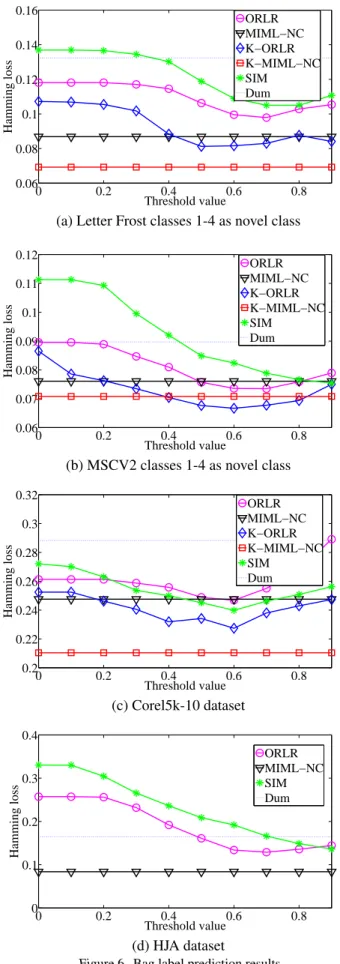
In this section, we examine the effectiveness of the pro-posed approach onbag label predictionwhen data contains novel class instances. We compare the Hamming loss per-formances of our proposed approach, the ORLR approach (Pham et al., 2014), and the SIM approach (Briggs et al., 2012). We also consider a dummy classifier where the pre-dicted bag label consists of labels appearing in more than
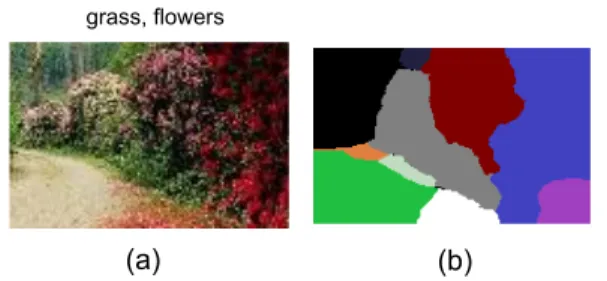
grass, flowers
(a) (b)
Figure 5.An example image (bag) with novel class instances in
Corel5k-10. (a) is the image labeled as ‘flowers’ and ‘grass’. (b) are segments from the image. The green segment is not from either ‘flowers’ or ‘grass’.
50% of training bags. The dummy approach does not rely on instance features in prediction hence is used to obtain an upper bound on the Hamming loss of all other algorithms compared.
Datasets. We use MSCV2 and Letter Frost described in Section 5.2 for these experiments. Additionally, we con-sider two more datasets Corel5k and HJA which contain real novel class instances. Corel5k (Duygulu et al., 2002) is a MIML dataset where each image is a bag and its seg-ments are instances. We sort classes based on the number of times they appear in all images. From the sorted list, we then select the top ten classes with highest values: ‘wa-ter’, ‘sky’, ‘tree’, ‘people’, ‘grass’, ‘buildings’, ‘mountain’, ‘snow’, ‘flowers’, ‘clouds’. We remove bags whose bag label contains any class outside of these ten classes. As a result, instances outside the top ten classes are consid-ered novel. An example image with novel class from the processed Corel5k dataset (Corel5k-10) is shown in Fig. 5. Another dataset is HJA (Briggs et al., 2012) which is a bird-song dataset in MIML format. Each bag is a ten second-recording labeled with a list of bird species singing in this time period. Each instance is a 38-dimensional feature vec-tor extracted from a segment of the spectrogram of the ten second-recording. Instances other than bird sounds or in-stances which are too costly or difficult to label (Briggs et al., 2012) are unlabeled. Novel class instances such as rain, wind, or insect noises are included in the set of un-labeled instances. Out of a total of 10,232 instances there are only 4,998 instances whose labels are used in forming the bag-level labels.Setting. For ORLR and SIM, the bag label is predicted as the union of its instance labels. Since ORLR and SIM are unable to directly deal with novel in-stances, we use a thresholdwhen predicting an instance label as novel. From ORLR model, the score of instance xi w.r.t. class c is p(yi = c|xi,w) and for SIM model, the score of instance xi w.r.t. classc is wTcxi. We com-pute the mean and standard deviation for these scores for all instances then normalize these scores from0to1. For each test instance, if the maximal confidence score is less
than a threshold , the instance is considered novel. For ORLR, we searchover the set of {0, 0.1, 0.2, . . . , 0.9}
and report the Hamming loss for each value of. For ker-nel ORLR, for each, we searchλandδas in Section 5.2 and report the lowest Hamming loss. For SIM, for each , we search the parameterλ(Briggs et al., 2012) over the set of{10−4,10−5, . . . ,10−9}and report the lowest Ham-ming loss. Since the matrixKfor HJA is large, we do not run the kernel version of ORLR and MIML-NC on the HJA dataset.
Results and analysis. The Hamming loss of ORLR, MIML-NC, kernel ORLR (K-ORLR), kernel MIML-NC (K-MIML-NC), and SIM are presented in Fig. 6. We ob-serve that the use of a threshold improves bag-level pre-diction for both ORLR and SIM when novel instances are present in the data. If the threshold is small, many of the novel class instances may be arbitrarily classified into any of the known classes which may lead to more false positives in the bag-level prediction. If is large, many instances whose scores are not sufficiently high will be considered novel and consequently their labels will not be included in the predicted bag label leading to many false negatives. The performance of ORLR and SIM can be im-proved by appropriately selecting the threshold . How-ever, in some datasets, for example, Letter Frost and HJA, the optimally tuned ORLR or SIM is still outperformed by the proposed approach. The reason is that ORLR and SIM assume no novel class in their model. When the number of novel instances is considerably large, the assumption is vi-olated. Instead, MIML-NC directly models the novel class that may lead to a lower Hamming loss performance. In contrast to SIM and ORLR, the performance of MIML-NC appears in straight lines since it is free of parameter tuning.
6. Conclusion
We presented a novel probabilistic model for MIML learn-ing in the presence of novel class instances. We introduced a novel efficient computational approach for inference. We illustrated the use of the proposed framework for instance annotation on a toy dataset. Moreover, the experiments on MSCV2 image dataset, letter recognition and handwrit-ten digit dataset show that the proposed method achieves a significant higher AUC compared to recent kernel scoring method in novelty detection. Experiments on datasets con-taining novel class including HJA bird song and Corel5k show that the accuracy in bag label prediction of the pro-posed approach is higher than those of recent state-of-the-art methods.
Acknowledgements This work is partially supported by the National Science Foundation grants CCF-1254218, DBI-1356792, and IIS-1055113.
0 0.2 0.4 0.6 0.8 0.06 0.08 0.1 0.12 0.14 0.16 Threshold value Hamming loss ORLR MIML−NC K−ORLR K−MIML−NC SIM Dum
(a) Letter Frost classes 1-4 as novel class
0 0.2 0.4 0.6 0.8 0.06 0.07 0.08 0.09 0.1 0.11 0.12 Threshold value Hamming loss ORLR MIML−NC K−ORLR K−MIML−NC SIM Dum
(b) MSCV2 classes 1-4 as novel class
0 0.2 0.4 0.6 0.8 0.2 0.22 0.24 0.26 0.28 0.3 0.32 Threshold value Hamming loss ORLR MIML−NC K−ORLR K−MIML−NC SIM Dum (c) Corel5k-10 dataset 0 0.2 0.4 0.6 0.8 0 0.1 0.2 0.3 0.4 Threshold value Hamming loss ORLR MIML−NC SIM Dum (d) HJA dataset
References
Asuncion, A. and Newman, D. UCI machine learning repository.
Briggs, F., Fern, X. Z., and Raich, R. Rank-loss support in-stance machines for miml inin-stance annotation. InKDD, pp. 534–542, 2012.
Cour, T., Sapp, B., and Taskar, B. Learning from partial labels.JMLR, 12:1501–1536, 2011.
Da, Q., Yu, Y., and Zhou, Z.-H. Learning with augmented class by exploiting unlabeled data. InAAAI, 2014. Dempster, A. P., Laird, N. M., and Rubin, D. B. Maximum
likelihood from incomplete data via the em algorithm. Journal of the royal statistical society. Series B (method-ological), pp. 1–38, 1977.
Duygulu, P., Barnard, K., de Freitas, J. F., and Forsyth, D. A. Object recognition as machine translation: Learn-ing a lexicon for a fixed image vocabulary. In ECCV 2002, pp. 97–112. 2002.
Hsiao, K.-J., Xu, K., Calder, J., and Hero, A. O. Multi-criteria anomaly detection using pareto depth analysis. InNIPS, pp. 845–853, 2012.
Huang, S.-J., Gao, W., and Zhou, Z.-H. Fast multi-instance multi-label learning. InAAAI, 2014.
Liu, L. and Dietterich, T. G. A conditional multinomial mixture model for superset label learning. InNIPS, pp. 557–565, 2012.
Lou, Q., Raich, R., Briggs, F., and Fern, X. Z. Novelty de-tection under multi-label multi-instance framework. In Machine Learning for Signal Processing, IEEE Interna-tional Workshop on, pp. 1–6, 2013.
Markou, M. and Singh, S. Novelty detection: a review-part 1: statistical approaches.Signal processing, 83(12): 2481–2497, 2003.
Pham, A. T., Raich, R., and Fern, X. Z. Efficient instance annotation in multi-instance learning. InStatistical Sig-nal Processing, IEEE Workshop on, pp. 137–140, 2014. Saligrama, V. and Zhao, M. Local anomaly detection. In
AISTATS, pp. 969–983, 2012.
Winn, J., Criminisi, A., and Minka, T. Object categoriza-tion by learned universal visual diccategoriza-tionary. InICCV, pp. 1800–1807, 2005.
Yang, S.-J., Jiang, Y., and Zhou, Z.-H. Multi-instance multi-label learning with weak label. In IJCAI, pp. 1862–1868, 2013.
Zhang, M.-L. and Zhou, Z.-H. M3MIML: A maximum margin method for multi-instance multi-label learning. InICDM, pp. 688–697, 2008.
Zhao, M. and Saligrama, V. Anomaly detection with score functions based on nearest neighbor graphs. InNIPS, pp. 2250–2258, 2009.
Zhou, Z.-H., Zhang, M.-L., Huang, S.-J., and Li, Y.-F. Multi-instance multi-label learning. Artificial Intelli-gence, 176(1):2291–2320, 2012.
Zhu, J. and Hastie, T. Kernel logistic regression and the import vector machine. InNIPS, pp. 1081–1088, 2001.