WORKING PAPER SERIES
When Banks Strategically React to Regulation:
Market Concentration as a Moderator for Stability
Eva Schliephake
Impressum (§ 5 TMG
)
Herausgeber:
Otto-von-Guericke-Universität Magdeburg Fakultät für Wirtschaftswissenschaft DFS Dekan
Verantwortlich für diese Ausgabe:
Otto-von-Guericke-Universität Magdeburg Fakultät für Wirtschaftswissenschaft Postfach 4120 39016 Magdeburg Germany http://www.Gww.PWHVEF/femm Eva Schliephake
When Banks Strategically React to Regulation:
Market Concentration as a Moderator for Stability
Eva Schliephakea,∗aEconomics of Business and Law, Otto-von-Guericke University, Universitätsplatz 2, 39106
Magdeburg
This version: June 17, 2013
Abstract
Minimum capital requirement regulation forces banks to refund a substantial amount of their investments with equity. This creates a buffer against losses, but also in-creases the cost of funding. If higher refunding costs translate into higher loan interest rates, then borrowers are likely to become more risky, which may destabilize the lending bank. This paper argues that, in addition to the buffer and cost effect of capital regulation, there is a strategic effect. A binding capital requirement regu-lation restricts the lending capacity of banks, and therefore reduces the intensity of loan interest rate competition and increases the banks’ price setting power as shown in Schliephake and Kirstein (2013). This paper discusses the impact of this indirect effect from capital regulation on the stability of the banking sector. It is shown that the enhanced price setting power can reverse the net effect that capital requirements have under perfect competition.
Keywords: Capital Requirement Regulation; Competition; Financial Stability
JEL: G21, K23, L13
∗Financial support from the German Research Foundation (Grant KL 1455/1–1) and the
Friedrich Naumann Stiftung für die Freiheit through grants from the Federal Ministry of Edu-cation and Research is gratefully acknowledged. I thank Matthias Held, Roland Kirstein, David Martinez-Miera, Matthias Peiss for their helplful comments and remarks, as well as the participants of the CESifo research seminar for their valuable input.
1. Introduction
This paper analyses the effect of capital requirement regulation on the stability of banks in a loan market where few oligopolistic banks compete in loan interest rates and decide on optimal loan capacities by their refunding structure.
Because bank loans are likely to be homogenous, the unregulated loan interest rate competition is fierce, and banks undercut each other in loan rates until the interest payments equal the marginal refunding cost of the asset investment - the classical Bertrand result.
However, regulating the capital structure also changes the competitive behavior of the banks, i.e., the timing of strategic decisions. Due to higher costs, banks may prefer to adapt lending rather than the capital structure when they are confronted with a binding capital requirement. In this case the introduction of a capital require-ment regulation can change Bertrand competition into a two stage game. In the first stage banks choose optimal loan capacities, and then, in the second stage, the banks choose loan interest rates to clear capacities. This idea that capital regulation creates a credible precommitment to loan interest rates, and thereby reduces the intensity of interest rate competition, was first discussed in Schliephake and Kirstein (2013).1 They develop a detailed analysis of the conditions under which capital requirement regulation changes the strategic interaction among oligopolistic banks from strategic complementarity in price setting to strategic substitutes in capacity choices. They show that higher capital requirements reduce the incentives of banks to undercut in 1For technical reasons Schliephake and Kirstein (2013) assume that borrowers have preferences
for a specific banks. This assumption allows the transformation from indirect to direct demand without the explicit definition of a certain rationing rule. However, they show that their results also hold when borrowers become close to indifference between loans such that loans are perfect substitutes.
interest rates but their model neglects any uncertainty and risk effects.
In contrast, this paper focuses on the impact of increased price setting power on the stability of the banking sector. In this paper I will call the effect of enhanced price setting power “Cournotization” effect. It creates an indirect effect of capital requirement regulation on the stability of the banking sector. In particular, it influ-ences the ability of banks to consider the risk shifting behavior of their borrowers, and thus the effect changes the optimal reaction of banks when they face increased capital requirements. This effect adds to various direct and indirect effects of capital requirement regulation and competition on the stability of the banking system that are discussed in the literature overview and summarized in Figure 1 and Table 1.
This paper shows that the cost of recapitalization and the resulting Cournotiza-tion effect may play a role in determining the net effect of capital requirement on banking stability. In particular, the results indicate that the number of oligopolistic competitors, the correlation of loan defaults, and the intensity of borrower risk shift-ing simultaneously determine whether capital requirement regulation of oligopolistic bank markets enhances or erodes the stability of the sector.
In order to analyze the effect of Cournotization on bank stability, it is necessary to establish the "missing link" between the literature on competition and stability on one hand, and the literature on capital regulation and stability, on the other hand. This is done in section 2. In section 3, the basic model of oligopolistic loan interest rate competition and capital regulation is set up. A simplified version of the model in Schliephake and Kirstein (2013) is introduced and the results derived to illustrate the Cournotization effect. In section 4, the effect of the increased price setting power on the optimal decisions and resulting effects on stability are analyzed under perfect correlation. In section 5, the results are generalized for imperfectly correlated borrower defaults. Section 6 discusses the policy implications and concludes.
2. Literature Review
The literature on competition and stability and the literature on capital regulation and stability respectively is extensive. However, only few theoretical papers exist that analyze the simultaneous effects. Figure 1 provides an overview of the main effects that capital regulation and competition have on the stability of banks. The term banking stability thereby means the probability of an individual bank to default. In particular, consider a bank that invests its equity and deposits in risky loans. The term stability then reflects the probability that the return of non-defaulting loan assets is greater or equal the bank’s liabilities to its depositors. A lower probability of an individual bank default thereby reflects higher banking stability.2
The literature on the relationship between competition and stability can be roughly divided in two streams. Representatives of the competition-instability hy-pothesis argue that more competition erodes stability because it reduces the charter value of the bank and, therefore, increases the incentives to take more risk. This charter value effect is the effect numbered (I) in Figure 1 and has been discussed, for example, by Matutes and Vives (2000), Hellmann et al. (2000), Repullo (2004) and Allen and Gale (2000). Moreover, Allen and Gale (2004) argue that a reduction in the charter value of banks also decreases incentives to spend effort on monitoring, thereby further increasing the riskiness of the bank. In general, the models on the stability enhancing charter value effect of competition focus on competition on the liability side of the bank and take the investment risk of banks as exogenous. In other words the charter value effect argues that if banks fully control their riskiness, they 2This idiosyncratic definition of banking stability does not reflect systemic risk. An analysis of
the impact of competition on the systemic risk of the banking sector is beyond the scope of this paper and left for future research.
Figure 1: The Effects of Capital Regulation and Competition on Banking Stability
The charter value effect (I) enhances stability by reducing the deposit rates to be paid on liabilities. The risk shifting effect (II) reflects the aggregate probability of asset default that is influenced by the loan interest rate. The margin effect (III) occurs when defaults are imperfectly correlated (ρ < 1) and enhances stability through higher returns on non-defaulting assets. The buffer effect (IV) reflects lower liabilities to depositors if assets are financed with more equity. Higher equity funding increases the marginal cost (V) and thereby the loan interest rate, which reinforces borrower risk shifting. The Cournotization effect (VI) may introduce price setting power of banks if recapitalization is sufficiently costly and, therefore, influences the bank’s reavtion to higher regulation.
have more incentives to decrease their risk of default the more profits they expect to make in future. If higher regulation constraints the ability of banks to invest in as-sets, banks demand less deposits resulting in lower deposit rates and higher marginal profits. Since this effect is straightforward and unambiguous, it will be neglected in the below analysis.
Boyd and De Nicolò (2005) challenge the charter value hypothesis by allowing not only banks but also borrowers to control the riskiness of the bank and its investments. In their model they consider the competition for loan assets and allow borrowers to react to higher loan interest rates. Building on the seminal work of Stiglitz and Weiss (1981), they argue that it is not only the limited liability of banks, which gives rise to risk shifting, but also that the risk of loan assets increases in the loan interest rate. Assuming perfect correlation of loan defaults, this extension actually the “conventional wisdom” that higher competition leading to instability. If risk shifting takes place in the loan asset market, increased competition can actually reduce the probability of bank failure, since lower loan rates reduce loan asset risk. This borrower risk shifting effect is labeled effect (II) in Figure 1.
Martinez-Miera and Repullo (2010) extend the Boyd and De Nicolò (2005) model and allow for imperfect correlation among the investment projects. They argue, that higher loan interest rates from lower competition increase borrower risk shifting on the one hand but also increase the margin on non-defaulting loans, labeled effect (III). The higher margins on non-defaulting loans can outweigh the borrower risk shifting. The relative strength of the margin effect thereby depends on the correlation of defaults in the bank’s asset portfolio. Their findings indicate that if all loans do not default at the same time then the impact of competition on banking stability is generally non-monotonous.
compe-tition on stability, the literature on the net effect of minimum capital regulation on stability is contradictory, as well. Higher equity funding of investment, ceteris paribus, increases the stability of banks, since equity provides a buffer against un-expected losses and reduces the moral hazard of banks similar to the charter value effect of low competition. In other words, forcing banks to refund a fixed amount of assets with higher equity decreases leverage and makes banks more stable, which is labeled effect (IV). If banks internalize all costs and benefits of bank equity, the private optimal capital structure would coincide with the socially optimal capital structure as discussed by Gale (2003). However, banks do not fully internalize the benefits of equity since they are shielded at least partly against the downside risk of their investments by the banking safety net. Setting minimum capital requirements is a regulatory instrument that shifts the risks borne by the depositors, or insured by the safety net, back to the shareholders. Hence, moral hazard and the incentive of excessive risk taking is reduced as shown by Hellmann et al. (2000), Repullo (2004), and Allen et al. (2011). Furthermore, higher capital requirements reduce the risk of contagion among banks as pointed out by Allen and Carletti (2011).
However, regulating the refunding structure of banks also changes their opti-mal investment decisions. Generally, when equity funding is costly to the bank, an increase in capital requirement regulation has multiple effects that stabilize and destabilize the banking sector.
Firstly, higher equity funding decreases the amount of deposit funding and, there-fore, reduces the states of nature in which a bank can fail, which is the above discussed buffer effect (IV).
Secondly, it increases the marginal cost of financing investments. The higher cost of funding decreases the banks profitability, which decreases the banks charter value, and thereby gives rise to higher risk taking, which destabilizes the bank. At the same
time, the higher cost of funding decreases the activity of the banks. Less activity means less lending, which results in increased loan interest rates. Higher loan interest rates lead to higher earnings on non-defaulting loans, which can offset losses from defaulting loans (II), on the one hand. On the other hand, higher loan rates reduce the earnings of borrowers, which induces risk shifting of borrowers (III). The net effect of capital requirement regulation on banking stability depends on which of the described effects prevails.
Empirical evidence on the relationship of capital requirements, competition, and financial stability is equally ambiguous. Carletti and Hartmann (2003) provide a good overview of the mixed empirical findings on the relationship between compe-tition and stability. Keeley (1990) finds that the erosion in the US banks’ market power, which resulted from deregulation, caused an increase in the bank failure rates during the 1980’s. Similarly, Beck et al. (2006) provide evidence that more concentrated banking systems are less vulnerable to systemic risk because more con-centrated banks tend to diversify their risks more. Schaeck et al. (2009) also come to the result that a more concentrated banking system is less fragile to systemic risk. In contrast, Berger et al. (2009) find that, though more competitive banking systems tend to take more risk, they also compensate the higher risk with higher equity to asset ratios and are, thus, less fragile to systemic risk. Schaeck and Cihak (2011) find empirical evidence that a bank’s capital structure is one of the chan-nels through which competition may have an impact on the stability of the banking sector. However, there is little empirical evidence that suggests that more stringent capital regulation actually improves the stability of a particular banking sector as pointed out by Barth et al. (2005).
Building on the rather mixed theoretical prediction and empirical evidence, re-cent empirical work focuses on the role that the market and institutional environment
plays in the determination of the relationship between competition and the stabil-ity of the banking sector. Beck et al. (2011) seize the theoretical suggestions on non-monotone relationships among competition and stability, and try to identify the most prominent factors that determine the amplitude and direction of the relation-ship. Based on cross-country data, they find that the relation between competition and stability is likely to be negative the stricter the capital regulation is, the more restricted banking activities are, and the more homogenous the banking sector is as a whole. In particular, they find that more binding capital regulation tends to have an amplifying effect on the competition-stability relationship, regardless of the sign of the particular relationship.
To the author’s knowledge, only two theoretical papers exist that try to simul-taneously analyze the effect that competition and capital regulation have on bank stability: Hakenes and Schnabel (2011) show that the ambiguous effect of competi-tion on banks’ risk taking translates into ambiguous effects of capital requirement on the stability of the banking sector. Though their model tries to capture the influence of correlation among loan defaults, the simplification they use in their model still implies that either all loans default at the same time or no defaults occur. Banks themselves can only influence the probability with which these defaults occur. Hence, there is no positive marginal effect of higher profits from non-defaulting loans, which could buffer losses from defaulting loans.
Martinez-Miera (2009) analyzes the impact of capital requirement regulation on the probability of bank failure under different exogenous market structures when loan defaults are imperfectly correlated. He argues that if the asset risk of the bank’s loan portfolio is not perfectly correlated, capital requirements have ambiguous effects on the stability of a bank, which is labeled effect (V). He shows that in highly concentrated loan markets the increase in price setting power resulting from
Table 1: Overview of the Main Literature and the Discussed Effects
Literature Low Competition: High Competition: Assumptions Basic Effects
No Capital Regulation
Among others: Matutes and Vives (2000),
Hellmann et al. (2000), Allen and Gale (2000)
Stabilizes Banking Destabilizes Banking Exogenous Competition for
Deposits, Bank Risk Shifting Charter Value (I)
Boyd and De Nicolò (2005) Destabilizes Banking Stabilizes Banking
Exogenous Competition for Loan Assets, Borrower Risk
Shifting
Risk Shifting (II)
Martinez-Miera and Repullo
(2010)
Perfect
Correlation Destabilizes Banking Stabilizes Banking Loan Assets, Borrower Risk Exogenous Competition for Shifting, Imperfect
Correlation
Risk Shifting (II), Margin (III), Buffer (IV) Imperfect Correlation U-shaped Relationship: Competition-Instability Capital Regulation
Hakenes and Schnabel (2011)
Regulation Destabilizes if Competition Stabilizes Regulation Stabilizes if Competition Destabilizes
Exogenous Competition for Deposits and Assets, Bank
controls „correlation“ (probability of perfectly
correlated Default)
Risk Shifting (II)
Martinez-Miera (2009) Net Effect of Capital Requirement Depends on Exogenous Competition and Correlation
Exogenous Competition for Loan Assets, Borrower Risk
Shifting, Imperfect Correlation
Risk Shifting (II), Margin (III),
Buffer (IV)
This Paper
Net Effect of Capital Requirement Depends on Cost of Recapitalization, Bank Concentration,
and Correlation
Endogenous Competition, Schliephake and Kirstein
(2013)
Risk Shifting (II), Margin (III), Buffer (IV), Cournotization (VI)
higher capital requirements can reestablish the stability enhancing effect of capital requirements even with borrower risk shifting, provided that the risk shifting effect is strong enough. The intuition is that a monopolist who anticipates the risk shifting of borrowers may find it profitable to internalize the increased marginal costs of higher capital requirement regulation.
In contrast to Martinez-Miera (2009), this paper does not take the competitive environment as given but explicitly considers changes in the competitive structure due to the strategic reaction of banks on the regulation. The Cournotization effect (VI) of capital requirement regulation reduces the incentives to undercut competitors in loan interest rates. This leads to increased price setting power, which again rein-forces the two effects of increased loan interest rates: the margin effect (III), if loan defaults are not perfectly correlated, and the risk shifting effect (II) by borrowers.
This paper shows that the net effect of fiercer regulation on banking stability depends on how much market power is gained by the Cournotization effect. In-tuitively, the increase in price setting power is higher, the more concentrated the market structure is, i.e., the less banks compete for loans.
Using a model framework adapted from Martinez-Miera (2009) the analysis sug-gests that in an economy, where a monopolist finds it optimal to internalize the increased marginal cost of capital regulation, there exists a critical market concen-tration for which the Cournot oligopolists internalize the increased costs. In this case the cost of default decreases due to lower liabilities to depositors, as well as the prob-ability of default shrinks, because the banks anticipate profit reducing risk shifting behavior of their customers. The paper therefore extends the analysis of Martinez-Miera (2009) for endogenous competition and adds an important policy implication: a regulator that wants to foster bank stability does not only have to consider the number of competitors but also the cost of recapitalization in the banking sector.
The main finding of this paper is that if low competition has a stability enhancing effect, higher capital regulation should not be accompanied by a support of recapi-talization of banks. A summary of the main literature, their crucial assumptions and differences in results is provided in Table 1.
The next section introduces the basic model assumptions and presents a simplified and generalized version of the Cournotization effect as discussed in Schliephake and Kirstein (2013).
3. The Model Setup
Consider a single-period model of n banking firms.The banks compete for risky loans L in loan interest rates r. Loans default with probability p in which case the bank receives nothing. In case of success, i.e., with probability 1−p the bank
receives the contracted repayment from the borrower. In the basic setting, I assume that loan defaults are perfectly correlated such that all projects default at the same time. In the beginning of the period, each bank has access to deposit finance (D) at a constant cost (rD ≥0). The deposits are insured at a flat insurance premium, normalized to zero without loss of generality.3 Therefore, the supply of deposits to a bank is independent of the riskiness of the bank’s asset investment.
Each bank is run by a bank owner manager, who can acquire equity ki from shareholders, which have an alternative and equally risky investment opportunity with return rK = rD +c. This fixed opportunity cost reflects the higher cost of equity compared to the insured deposit funding.
The assumption that equity funding is costly is not undisputed in the literature. In particular, Admati et al. (2010) elaborate the weaknesses of the assumption that bank equity funding is costly to society. However, in this simple model, the cost of equity is not seen from a welfare perspective, but it is rather assumed that equity funding is relatively more costly to the specific bank than deposit funding. This is a direct consequence of the deposit insurance system. The insured depositors do not expect a risk premium, while the liable equity investors do. Another interpretation is that higher opportunity cost compared to deposit funding reflects the additional benefits that deposits create to the depositors. The role of the bank as a financial intermediary is, therefore, welfare enhancing. Unnecessarily high capital requirement regulation would erode the bank’s role as a financial intermediary offering depositing services, i.e. a equity to asset ratio of 1 would not allow for financial intermediation in the sense of providing deposit services. Hence, equity is assumed to be costly to 3In alliance with the current regulatory system, this paper takes the existence of the fixed-rate
deposit insurance as given, whereas the insurance can be explicit by an ex ante financed deposit insurance or implicit by a guaranteed ex-post bail out policy.
the bank, and pure equity funding in our simple model setup would be inefficient in the absence of bank Moral Hazard.
A minimum capital requirement is defined as the requirement to refund a specific proportion of assets (of a specific risk type) with equity βli ≤ ki. In line with the theoretical and empirical findings, it is assumed that bank managers rather avoid increasing equity, but adapt their asset portfolios when facing a regulatory equity shortage.4 The assumption that there are prohibitive costs of recapitalizing im-mediately changes the sequence of decisions made, and influences the competitive environment. The Bertrand competition among banks becomes a two stage decision making process, where in the first stage, the bank has to define the capital structure, and in the second stage, competition in loan interest rates takes place.
t=1 According to minimum capital requirement regulation, banks choose optimal
ki , i= 1...n, i=j with K =
n i ki.
t=2 After observing the opponents k−i, bank i chooses optimal ri(r−i, K)
For simplicity, I assume that equity can only be raised in t = 1, i.e., the cost of immediate recapitalization is prohibitively high.5 The capital decision is sunk in stage 2. Hence, the marginal cost of equity in stage two is zero. Instead of influencing the 4Anecdotal evidence that equity constrained banks adapt assets rather than liabilities could be
found during the recent financial crisis, where many banks faced difficulties in replacing lost equity in a timely fashion. Calomiris and Herring (2012) discuss that despite banks being undercapitalized as a result of the need to write off asset losses in 2008, the financial institutions preferred to wait instead of immediately raising new equity. They argue that stock prices were so low that the issuance of significant amounts of equity, in order to cover the large losses incurred, “would have implied substantial dilution of stockholders – including existing management.” These observations suggest that bank managers try to avoid an immediate increase in equity in order to satisfy market demand, and prefer to reduce the demand for loans by increasing the loan rate.
5Schliephake and Kirstein (2013) allow for recapitalization in stage two and show that if
recap-italization is costly enough, the equity raised in the first stage becomes a binding constraint in the second stage.
marginal cost of investing in loan assets in the second stage, the regulatory minimum capital requirement sets an upper bound on the individual bank’s ability to supply loans li:
li(ri(r−i), r−i)≤
ki
β (1)
Let r(·) be the inverse demand function that is decreasing and concave in the loan quantities supplied, i.e., r(0) > rD, r(·) < 0 and r(·) ≤ 0. The optimal prices chosen in the second stage, therefore, depend on the amount of equity raised by each bank in the first stage. Therefore, the capacity constraint for loan supply puts a lower bound to equilibrium loan interest rates:
ri(r−i, K)≥rmin ki β (2) For given amount of equity, it would never be profitable to undercut rmin, because this would imply a demand above the capacity, i.e. a demand that cannot be served due to the regulatory restrictions; implying lower profits.
3.1. The Optimal Second Stage Behavior
Consider first the trivial case where all banks have raised sufficient equity to serve the loan market demand at the Bertrand price with externalized downside risk. Formally, this means that the aggregate equity on the balance sheet of all banks exceeds
K > βL(rD). (3)
The second stage pricing decision would be the same as in the unregulated case. The fierce price competition is not constrained by the first stage capital decision. Because the equity decision is sunk at the second stage, the marginal cost equal the deposit
funding cost and the non-profit condition would be:
r=rD. (4)
Consider now the case where the raised amount of equity is “sufficiently small”. The first stage amount of equity is sufficiently small if, firstly, the capacity to provide loans to borrowers from the first stage capital decision bindingly constrains the price competitionK < βL(rD). Secondly, sufficiently small assumes that the capacities are so low that, under any rationing rule, the remaining demand whenever ri < r−mini , is below the monopoly loan outputβlM
i (K)> ki fori, j, where lMi (K)is the monopoly loan amount in the residual market.
Lemma 1. (From Tirole (1988)) For “sufficiently small” capacities to lend that are set in the first stage, the second stage loan rate competition yields a unique Nash Equilibrium that is independent of any rationing rule, namely a loan interest rate that just clears capacities: r
K β
Proof. If the infimum of the loan interest rates set by the competitors equals the capacity clearing interest rate, undercutting the opponent’s price can never be prof-itable. Consider contrariwise the case where ri < r(K). Since recapitalization is assumed not to be possible in stage two, price undercutting would only lead to ex-cess demand for loans, which cannot be served due to the binding minimum capital requirement. Undercutting in loan rates is not profitable, because each bank lends already the maximum capacity to its borrowers.
Furthermore, a price increase is not profitable, since profits are assumed to be strictly convex in loan quantities and the capacity is assumed to be smaller than the residual demand monopoly quantity. For any r(K) < ri, bank i receives the residual demand, after the m other banks served the loan applicants up to their own capacity. The assumption lMi (K) > ki
β implies by definition Π(l M
i ) > Π( kj
β). The inverse demand function implies r(LM
j (ki, kj)) < r
Kj
β
. Since the resulting profit maximizing loan quantity in the residual market is higher than the small capacity, the respective profit maximizing loan rate must be lower than the constrained optimal loan rate that clears capacity. Hence, overbidding can never be profitable. Figure 2 illustrates this point.
Figure 2: The Overbidding at Competitor’s Profit with Sufficiently Low Capacities
.
The underlying assumption that capacities are chosen to be sufficiently small in the first stage seems to be quite restrictive. One sufficient condition for the choice of low capacities would be very high cost of equity. However, the seminal work of Kreps and Scheinkman (1983) shows that, for a concave inverse demand function, and efficient rationing of the residual demand, installing sufficiently low capacities is the unique sub-game perfect equilibrium of the two stage game, regardless of the investment cost of capacity, which is the private cost of equity in this model.6 Since this model focuses on the effects of a change in the competitive structure induced by capital requirement regulation on the riskiness of banks, it is assumed for simplicity that borrowers are rationed according to the efficient rationing rule, and accordingly 6Davidson and Deneckere (1986) show that this result is not robust against different rationing
rules. With alternative rationing rules, competitors find it optimal to build up capacities that are not sufficiently low, but below the demand for selling the product at marginal cost. For capacities that are not sufficiently small, sub-game perfect strategies only exist in mixed strategies. However, regardless of the specific rationing rule, the separation of decisions into capacity buildup and price competition leads to reduced incentives to undercut in prices and, therefore, positive profits.
that the result of Kreps and Scheinkman (1983) can be applied.
3.2. The Optimal First Stage Capacity Choice
Anticipating that it is the optimal behavior in the second stage to clear any ca-pacity, banks choose the individual amount of equity in the first stage that maximizes the first stage objective function:
ki∗ =argmax ki β · (1−p)· r K β −rD(1−β) −rKβ (5) This is the classical Cournot competition objective function, where rK -the cost of equity - can be interpreted as the marginal cost of investing into loan capacity. A symmetric equilibrium then consists of a vector ki which simultaneously satisfy the system of first order conditions for all banks i= 1...n.
For symmetric banks, which have identical characteristics and face the identical demand and cost functions, the Cournot equilibrium is symmetric.7 In such a sym-metric equilibrium it must hold that ki =kj =k. Therefore, it must also hold that
K =ki =nk. The first order condition for a symmetric Cournot equilibrium can thus be simplified to:
r(K)·K n + (r(K)−(1−β)rD − βrK (1−p) = 0 (6)
The first term reflects “market power rents” that result from the strategic com-mitment to Cournot capacities in the first stage. The term captures the effect of a decreasing demand that is taken into consideration when capacities are built up in the first stage. The second term reflects each bank’s expected payoff per unit of loans.
7See Tirole (1988), pp. 220 for a discussion of symmetry, existence and uniqueness of a Cournot
The Cournotization effect then describes a situation where, because of sufficiently high recapitalization costs, the actual Bertrand competition for loans is constrained by a strategic loan capacity choice. Therefore, the Bertrand competition for loans can be described by Cournot competition. If the recapitalization costs are low, such that the capacity constraint is not binding, the existing Bertrand competition can still be described in the quantity space by Cournot competition with an infinite number of competitors.
Lemma 2. If there is no Cournotization effect, because recapitalization costs are low, the unconstrained Bertrand competition can be described in the quantity space by the Cournot equilibrium with an infinite number of competitors.
Proof. If the number of competitors approaches infinity, then the market power term vanishes and the sub-game perfect outcome approaches the one stage Bertrand equi-librium outcome lim n→∞ r(K) = (1−β)rD+ βrK (1−p) . (7)
When discussing the impact of the Cournotization effect on stability of banks, I will therefore compare the situation where n → ∞ with a situation where n < ∞. This also implies that a low number of banks in the oligopolistic market leads to a relatively high increase of price setting power in the two stage game, compared to unconstrained Bertrand competition. Therefore, a high market concentration is likely to be reflected in a capacity constrained loan market competition with higher marginal profits compared to the Bertrand equilibrium.
Because in equilibrium the capital requirement will be binding, I can substitute ki
β =lisuch that each bank chooses its individual optimal loan amount. The capacity constrained objective function then reflects the Cournot decision problem in loan
quantities.8
li∗ =argmax(li[(1−p)(r(L)−rD(1−β))−rKβ]) (8) Denotingh(L) := (1−p)(r(L)−rD(1−β))as the extended indirect demand function I can write the first order condition as the general Cournot equilibrium condition:
h(L)· Ln + (h(L)−rKβ) = 0. Analogous to equation (6) the first term reflects the gained market power, which approaches zero in the unconstrained Bertrand competi-tion, i.e., if recapitalization is costless. Lemma 2 implies that such an unconstrained competition can be described in the quantity space as hypothetical increase of n to infinity.
In the following section, I will discuss how the increase of capital requirement regulationβ influences this equilibrium condition and the according default risk of a bank, given there is a Cournotization effect. Moreover, I will compare the results to the net effects in Bertrand competition and will discuss if a regulator should control for the Cournotization effect or not.
4. Constrained Competition with Risk Shifting and Perfect Correlation
The previous discussion concentrated on the changes in competitive behavior of banks when capital requirement regulation is tightened, while the risk taking behavior of borrowers was assumed to be exogenous. However, not only banks, but also borrowers are limitedly liable, and thus protected against the downside risk of investments. Higher loan interest rates reduce the profitability of borrowers investment projects, which gives incentives to search for higher yields at the cost 8Keeping equity as the decision variable does not change the qualitative results but unnecessarily
complicates the notation in the following, because the capital requirement ratebetainfluences not only the marginal equity cost but also acts as a scaling factor for the equity decision. However, this function as a scaling factor has no impact on the risk choice of the bank and is, therefore, neglected in the following.
of a higher risk of the project. The model is, therefore, extended to the optimal responses of borrowers’ to differing loan rates resulting from the tightening of capital requirement regulation.
The intuition is that the individual default probabilities of projects is partly controlled by the borrowers decision to control for risk. This could either reflect a certain costly effort that borrowers spend to enhance the success of their projects, or by the unobservable choice of the particular project the borrower invests in. The less profitable projects become that are financed by bank loans, the less effort borrowers are willing to spend, and the lower are the success rates of their projects. To model the borrower risk shifting I follow the model set up of Martinez-Miera and Repullo (2010).
A continuum of penniless entrepreneurs captured withi, who have access to risky projects of fixed size, normalized to 1. The entrepreneurs can spend effort on an indi-vidual alternative (e.g. employment) to obtain a utility levelb[0, B]. The reservation utility is continuously distributed on[0, B]with the cumulative distribution function
G(b). Let G(u) denote the measure of entrepreneurs that can obtain an alternative utility less than or equal to u.
In case of success, projects yield a risky return α(pj) and zero otherwise. The component pi is the endogenously chosen probability of default, and reflects the costly effort an entrepreneur spends on the project to enhance expected output.9
9Boyd et al. (2009) explicitly model the optimal effort choice of entrepreneurs. The projects
yield an output ofy˜+z. The total return componentyis random and distributed with the density functionf(y)and the cumulative densityF(y)on the closed interval[0, A], which is known by the bank and the borrowers. The componentzis endogenous and reflects the costly effort the borrower is willing to spend on the project to enhance output. The effort cost isc(z) a strictly increasing, twice differentiable, convex cost function. For a given contracted loan rate, a borrower defaults whenevery≤y≡r−z. Knowing the loan rate offered, the entrepreneur chooses his optimal effort in order to maximize his expected profit: max
z
´A
As in Martinez-Miera and Repullo (2010), I assume thatα(0)< α(0) in order to get interior solutions. The bank offers a standard debt contract with limited liability of borrowers: In case of project success with probability (1−pi), the bank receives the contracted loan interest r, and in case of default with probability pi, the bank receives nothing, since the project’s liquidation value is assumed to be zero.
Lemma 3. Because of the limited liability of a standard debt contract the default risk of a single loan increases in the equilibrium loan interest rate dpdr >0.
Proof. The proof is provided in Appendix A.
It is further assumed that entrepreneurs are homogenous in their objective func-tion, except for the exogenous reservation utilities uj. Hence, all entrepreneurs will choose the identical optimal default probability pj(r(L)) = p(r(L)), {j|uj ≤ u(r)} or opt for their outside option and do not borrow from banks. A bank that is lending toLi(r)borrowers, faces individual loan defaults of p(r(L)) in the portfolio.
If all projects are perfectly correlated, i.e., ρ = 1, and thus default at the same time, the bank’s portfolio risk of default is also equal to p(r(L)). Under perfect correlation, there is no margin effect, because all projects either default or not. Similarly, there is no buffer effect for a leveraged bank. A lower leverage allows the bank to absorb a higher share of defaults in the portfolio. However, with perfect correlation the share of defaults is either zero or 1. In section 5 the influence of imperfect correlation and in particular the impact of the margin and buffer effects is discussed. As before, the Cournot equilibrium is defined by the optimal choices of
yields the objective function: A+z−r−´yAF(y)dy−c(z), resulting in the first order condition: 1−F(r−z) =c(z). Total differentiation yields zRL(r) = F
(r−z)
F(r−z)−c(z) <0. Higher loan rates
imply less optimal effort, which translates into higher risk. Therefore, a riskier project (less costly effort) yields a higher success return to the borrower, i.e. α(pi)is assumed to be positive, concave and increasing inpi.
individual loan quantities:
l∗i =argmax([(1−p(r(L)))(r(L)−rD(1−β))−rKβ]) (9) For the sake of notational simplification, the extended indirect demand function is defined as: h(L, β) := (1−p(r(L)))(r(L)−rD(1−β)). Even with linear indirect demand and indirect risk shifting, the extended indirect demand function is not any more linear. However, with linear demand and risk shifting functions, h(L) has the characteristics that guarantee a unique Cournot equilibrium, i.e.: h(L) < 0 and
h(L) < 0.10 To make sure that the reaction functions intersect, I assume that
h(0)> β·rK. In other words, it is assumed that investing in risky projects is socially desirable. The first order condition, that defines a symmetric pure strategy Cournot equilibrium is then defined by:
h(L, β)·L
n + (h(L, β)−rKβ) = 0 (10)
As this paper is concerned with the stability of the banking sector in Bertrand and two stage capacity constrained competition that yields Cournot results, the question to be answered is how the probability of default of each bank is effected by changes in the exogenous parameters. Defineqas the probability of default of a single bank. For the very simplified case of perfect correlation, the probability of default of a bank is reflected by the probability of default of the borrowersq =p(r(L)). In particular, the probability of bank default increases whenever the loan interest increases, implying that a decrease in equilibrium loan supply increases the probability of a bank default.
Lemma 4. A decrease in aggregate equilibrium loan supply of perfectly correlated
10For the existence of a pure strategy Cournot equilibrium with the linear cost function, it is
sufficient that the extended demand function is concaveh(L) =−p(L)(r(L)−rD(1−β)) + (1−
risky loans increases the probability of default of the investing banks and thus desta-bilizes the banking sector.
Proof. Using Lemma 3 and the assumption of decreasing loan demand it is straight-forward that dLdq =p(r(L))r(L)<0.
Consider first the direct effect of a change in the competition level due to an exogenous change in the market concentration. As in the traditional Cournot equi-librium, a change in the competition that is reflected by an exogenous change of the number of competitors n has a positive effect on the supply of loans.
Lemma 5. Ceteris paribus, the aggregate loan supply L in equilibrium is lower in more concentrated markets, i.e.,dLdn >0.
Proof. Applying the implicit function theorem to equation (10) I show that
dL
dn =−
h(L, β)−β·rK
h(L)L+ (1 +n)h(L) >0 (11)
The denominator is negative whenever the second order condition of the bank’s objective function holds, i.e., it is clearly negative for a concave extended demand function. The numerator is positive, as long as the assumption that h(0) > β ·rK holds.
This is the result of Boyd and De Nicolò (2005). Due to the risk shifting effect, a reduction in competition that increases loan interest rates destabilizes the banking sector.
However, this paper is not concerned with the direct effect of competition on the stability of banks, but instead with the indirect effect that capital requirement has on the price setting power and its impact on banking stability. In order to analyze this impact, it is necessary to understand first the direct impact of an increase in capital requirements on banking stability, and then compare the results for Bertrand competition and two stage capacity loan interest rate competition. Applying the
implicit function theorem to equation (10) I obtain: dL dβ =− ∂2Π(L,β) ∂L∂β ∂2Π(L,β) ∂L2 =− ∂h(L,β) ∂β −rK +∂2h(L,β) ∂β∂L L n h(L)L+ (1 +n)h(L) (12)
The denominator is negative if the second order condition holds, which is in particular true for linear demand and linear risk shifting functions. Therefore, the sign of the right hand side of equation (12) is determined by the sign of the numerator. In particular, if ∂h(L,β) ∂β −rK + ∂2h(L,β) ∂β∂L L
n < 0, an increase in capital requirements results in lower aggregate supply of loans in equilibrium, and vice versa. For perfectly correlated loan defaults, the partial derivative of the extended demand function is simply:
∂h(L, β)
∂β = (1−p(r(L))·rD >0 (13)
If equity funding is costly (rK ≥rD) then it must clearly hold that(1−p(r(L)))·rD <
rK because p(r(L)) ∈ [0,1] because it is a probability.11 Therefore, the first term in brackets is negative and reflects the decreasing profitability of each unit of loan when equity funding is more expensive than deposit funding.
Applying Young’s theorem to equation (13) one obtains:
∂2h(L, β)
∂L∂β =−p
(r(L)))·r(L)·r
D >0 (14) The impact of an increase in capital requirement on each bank’s profit is thus ambiguous:
11Even if the opportunity cost of equity funding would equalr
D, the limited liability to depositors
∂2Π(L, β) ∂L∂β = ∂h(L, β) ∂β −rK <0 +∂2h(L, β) ∂L∂β · L n >0 (15)
Proposition 1. If the cost of recapitalization is sufficiently low, such that there is no binding capacity constraint on Bertrand competition, an increase in capital require-ments will unambiguously decrease the stability of banks under perfect correlation. Proof. Recall from Lemma 2 that unconstrained Bertrand competition translates in the quantity space into n → ∞ such that equation (15) becomes unambiguously negative: an increase inβ decreases the supply of loans in equilibrium. The decrease in loan supply increases the equilibrium loan interest rate and through risk shifting as the only effect this decreases the banks’ probability of default as shown in Lemma 4.
This result is similar to the argumentation of Boyd and De Nicolò (2005). With-out any price setting power the only effect of the increase in capital requirements and the resulting higher marginal funding costs is an increase in loan interest rates. The higher loan interest rate then unambiguously translates into borrower risk shifting and decreases the bank stability.
Moreover, it becomes clear that the sign of right hand side of equation (15) depends critically on n.
Lemma 6. A higher market concentration, i.e., a lower n, increases the cross partial derivative ∂2∂L∂βΠ(L,β).
Proof. Using equations (13), (14) and (15) I obtain: − rK rD −(1−p(r(L))) −p(r(L))·r(L)· L n (16)
Differentiation with respect to n yields: −p(r(L)))·r(L)· dL dn + dL dn n − L n2 ≷0 (17)
Because −p(r(L)))·r(L) > 0, the sign of the derivative depends on the terms in brackets. A lower n increases equation (15) whenever
dL dn + dL dn n − L n2 < 0. Intu-itively, this condition means that an increase in the number of competitors increases the aggregate loan supply more than it reduces the individual loan supply as con-jectured in Martinez-Miera (2009) based on simulations. Because n, the number of competitors, is strictly positive, this condition can be reduced to:
dL dn <
L
n·(n+ 1) (18)
Recalling Lemma 5, i.e., using equation (11) I obtain: − h(L, β)−β·rK
h(L)L+ (1 +n)h(L) <
L
n·(n+ 1) (19)
This can be simplified to:12
h(L, β)−β·rK <−
h(L)L2 n·(n+ 1) −h
(L)·L
n (20)
Moreover, the first order condition for the Cournot equilibrium that is given in equation (10) can be rewritten as:13
(h(L, β)−β·rK) = −h(L, β)·
L
n (21)
Substituting the right hand side in the left side of the inequality yields: − h(L)L2
n·(n+ 1) >0 (22)
This condition holds for h(L)<0as provided in our model.14 12The second order condition requires that−(h(L)L+ (1 +n)h(L))>0.
13Further modification would lead to the standard Cournot equilibrium condition
-(h(L,β)−β·rK)
(h(L,β) = 1
n
e - the Lerner Index in equilibrium equals the market share over the point price
elasticity at the equilibrium price.
14In the standard Cournot oligopoly model with linear indirect demand, this term is zero.
Im-plying that, with a linear extended demand function, the market concentration plays no role on the impact of capital requirement regulation on the stability of banks because an increase in the number of competitors increases the aggregate output exactly in the same amount as the individual
Lemma 6 shows that there exists annfor which it is not optimal for the competing banks to shift the cost of higher capital requirements to their borrowers. Anticipating the risk shifting reaction to higher loan interest rates, a bank with high price setting power prefers to keep the loan interest rate constant or even lowers it, when capital requirements are increased. Denoting LM as the optimal monopoly output and assuming that the risk shifting effect is high enough, i.e., −p(r(LM)))·r(LM)LM >
rK
rD −(1−p(r(L
M))), the following proposition can be derived.
Proposition 2. If risk shifting is high, the impact of the capital requirement on the equilibrium loan interest rate is not monotone but may depend on the number of competitors:
if n >nˆ → ∂2∂L∂βΠ(L,β) <0 → dβdr >0 if n <nˆ → ∂2∂L∂βΠ(L,β) >0 → dβdr <0 Proof. If risk shifting is high, i.e.
−pr(LM)·LM > rK
rD −(1−p(r(L
M))), a mo-nopolist finds it optimal to increase the loan interest rate, i.e., to reduce the loan supply, when he faces higher marginal cost from capital requirement regulation
(dr(L)
dβ <0). If n → ∞, the cross partial derivative is unambiguously negative such that the default probability increases with higher capital requirements drdβ(L) > 0. From Lemma 6, it becomes clear that there must exist a critical number of competi-tors nˆ for which the cross partial derivative is zero.
If banks gain price setting power through higher capital requirements, the loan interest rate is not monotonically increasing in capital requirements. If the Cournoti-zation effect is high compared to risk shifting (due to high market concentration), a capital requirement increase will increase aggregate lending. The intuition is that banks consider the risk shifting effect when setting optimal capacities. If they gain enough price setting power, they can internalize the increased marginal cost and thereby avoid the risk shifting of their borrowers.
Proposition 3. A binding capacity constraint on Bertrand competition, resulting from increased capital requirements, may stabilize the banking sector if the market is highly concentrated.
Proof. Recall from Lemma 2 that unconstrained Bertrand competition translates in
n → ∞ such that equation (15) becomes unambiguously negative: an increase in β
decreases the supply of loans in equilibrium. The decrease in loan supply increases the banks’ probability of default as shown in Lemma 4.
Note, however, that the increase in capital requirements decreases the leverage of the potentially defaulting banks. Considering that a high proportion of the social cost of a bank default is driven by the size of outstanding debt, and not only by the fact of the default, a lower debt level may mean lower cost in case of default. Therefore, an increase in capital requirements in this setting makes a bank default ex ante more likely, but may decrease the ex post cost of the default.
5. Generalization to Imperfect Correlation
If not all loan investments default at the same time, the bank can survive a certain aggregate share of loan defaults in the investment portfolio, due to the equity it invested, which is the so called buffer effect (IV), and the profit it makes on non-defaulting loans in the portfolio, which is called the margin effect (II) accordingly to Martinez-Miera and Repullo (2010) . As illustrated in Figure 1, an individual bank goes bankrupt whenever the revenue from non-defaulting loans cannot compensate the liabilities rD to its depositors D = (1−β)L. Using the introduced variables, this aggregate share of defaults that a bank can survive is implicitly defined by the following equation:
Definexˆ(L)as the critical aggregate loan failure rate that makes the non-defaulting condition binding:
ˆ
x(L) = r(L)−(1−β)rD
r(L) (24)
The bank’s probability of default is then the probability to observe an aggregate portfolio default rate above this critical value.
The probability of observing such an aggregate default rate in the portfolio is analyzed using a one-factor Gaussian copula model of time to default.15 The basic assumption is that a bank invests in a highly granulated portfolio of assets with individual probabilities of defaultp(r(L)). It is assumed that the copula correlation between each pair of homogenous borrowers is ρ < 1. The single risk factor model then assumes that the default of each individual loan investment is triggered by the random project value falling below a critical value. The random project return of a project can be described as:
Bj = √
ρ·Z +1−ρ·εj (25)
where Z is a common systematic risk factor that effects all projects and εj is an idiosyncratic risk factor that is independent among the projects. Assume that both random variables are independently standard normally distributed. The constant ρ, hence, measures the correlation between project returns, i.e., defines the proportion of systematic and idiosyncratic risk that triggers the project value. For each state of nature, which reflects a certain realization of the systemic factor, I can define a 15The IRB approach in Basel II and III is based on this model that is also known as the Vasicek
conditional probability of default:
pj(z) = P[Bj < cj|Z =z] (26)
wherecj reflects a certain threshold value, which the project return has to outweigh. In this paper’s model framework this threshold value is the borrower’s liability to the bank.
Because the project return is the sum of two independent standard normally distributed variables the return itself is alsoBj ∼N(0,1), such thatpj(z) = φ(cj)or
cj =φ−1(pj). The threshold value is the quantile for the default probability that the borrowers choose when confronted with the standard debt contract. Conditional on the realization ofZ =z, there is only one random variable left, the idiosyncratic risk that determines the conditional probability of default of a representative project:
qj(z) = P
√
ρ·z+1−ρ·εj ≤φ−1(pj)|Z =z
(27) Sinceεj ∼N(0,1), the conditional probability of default in a certain state of nature is: qj(z) = φ φ−1(pj)− √ρ·z √ 1−ρ (28) For the derivation of the cumulative distribution of the failure rate the assumption that the states of nature are also standard normally distributed,z ∼N(0,1), is used:
F(x, p) =P φ φ−1(p)−√ρ·z √ 1−ρ ≤x =P −z ≤ √ 1−ρ·φ−1(x)−φ−1(p) √ ρ =φ √ 1−ρ·φ−1(x)−φ−1(p) √ ρ (29) This gives the probability to observe an aggregate failure rate smaller or equal to
x∈[0,1].
observ-ing an aggregate failure rate, which a bank is able to survive P [x <xˆ]: F (ˆx(β, r(L)), p(r(L)) =φ √ 1−ρ·φ−1(ˆx)−φ−1(p) √ρ (30) The above equation illustrates that the correlation ρ among individual loan de-faults determines the existence and strength of the the buffer and margin effects, which are effects on the critical default ratexˆ. If the correlation is imperfect ρ <1, the bank’s stability depends on the individual loan default probabilitiesp(r(L))and the value of the aggregate failure rate the bank can survivexˆ(β, r(L))weighted with √
1−ρ. If correlation is perfect, i.e., ρ = 1, the weight becomes zero and bank stability is defined solely by φ(φ−1(p)) =pthe default probability of a single loan is equal to the default probability of the bank as it was analyzed in the section above. Bank stability with ρ < 1 directly depends on the capital requirement rate, because with higher equity a bank can absorb higher losses. This is reflected in the fact that the critical default rate is increasing in the capital requirement ∂xˆ
∂β >0.16 Moreover, the bank’s stability depends on the effect the capital requirement has on the equilibrium loan interest rate. On the one hand, an increase in the loan interest rate leads to higher profits per non-defaulting loan. This again increases the bank’s stability because with higher profits, more defaults can be absorbed. On the other hand, as discussed above, a higher loan interest rate results in the discussed risk shifting effect: the limitedly liable borrowers choose higher individual risks, which increases the bank’s probability of default.
Lemma 7. Under imperfect correlation, an increase of capital requirement affects the stability of a bank in three ways. Which effect prevails is influenced by the strength
16For notational simplicity I neglect in the following the indirect functional relationships and
of the Cournotization effect. dF(ˆx, p) dβ = ∂F(ˆx) ∂xˆ · ∂xˆ ∂β Buf f er(+) + ⎛ ⎜ ⎜ ⎜ ⎝ ∂F(ˆx) ∂xˆ · ∂xˆ ∂r M argin(+) + ∂F(p) ∂p · ∂p ∂r
Risk Shif ting(−)
⎞ ⎟ ⎟ ⎟ ⎠· dr dβ ≷0 Cournotization(±) (31)
Proof. For the formal proof see Appendix B. Intuitively, Buffer effect (IV) is posi-tive, becauseF(ˆx, p(r(L)))is a cumulative distribution function such that increasing
ˆ
x has a positive effect on bank stability ∂F(ˆx,p∂(xˆr(L))) > 0 and ∂∂βˆx = rD
r(L) is positive for strictly positive loan and deposit rates. Similarly, the Margin effect (III) is pos-itive because higher loan interest rates increase the critical default threshold level
∂xˆ ∂r =
(1−β)(rD)
(r(L))2 > 0. The Risk Shifting effect (II) is negative due to the negative first order stochastic dominance effect of an increased borrower default probability
∂F(ˆx,p(r(L)))
∂p < 0 and the positive effect of an increased loan rate on the borrowers’ default probabilities.
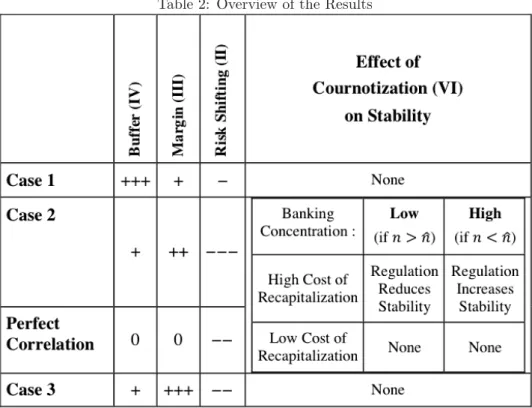
Depending on the exogenous parameters, three possible scenarios exist that de-termine the effect that the gained market power has on the impact of an increase in regulation on stability.
Case 1: |Buffer|>|(Margin+Risk Shifting)·dβdr|, the buffer effect outweighs the risk shifting and margin effect. In this case, the gained price setting power of banks does not influence the total effect that is fully driven by the buffer effect. An increase in capital requirement regulation unambiguously increases the stability of banks re-gardless of the competitive market structure. This situation reflects the traditional view on capital regulation and is not analyzed any further.
Case 2: |Buffer|<|(Margin+Risk Shifting)·dβdr|and |Margin|<|Risk Shifting|: the buffer effect is low and the risk shifting outweighs the margin effect. This is a more general case of the perfect correlation analysis above: Risk shifting is the dominant effect and an increase in capital requirements translates into higher risk. If banks have no price setting power, an increase in capital requirements unambiguously
de-creases the banks’ stability. The Cournotization effect may enhance stability because the gain of price setting power allows banks to internalize the increase in the marginal cost of equity funding. In highly concentrated markets banks are thus reluctant to in-crease the loan interest because they anticipate risk shifting of borrowers. Analogous to the discussion of perfect correlation an increase in capital requirements then can lead to lower loan interest rates if the risk shifting effect is high enough as discussed above.
Case 3: |Buffer|<|(Margin+Risk Shifting)·dβdr| and |Margin|>|Risk Shifting|: The buffer effect is small and the margin effect outweighs the risk shifting effect. In this case, a gain in price setting power that would lead to a decrease in the equi-librium loan interest rate would destroy the stability enhancing effect of an increase in equity funding. However, such a situation is not feasible in equilibrium because whenever the margin effects outweighs the Risk Shifting effect, an increase in capital requirements always increases the equilibrium loan rate, i.e., reduces the equilibrium loan supply, regardless of the number of competitors.
The following argumentation shows that the Cournotization can only influence the net effect of capital requirement regulation on stability in Case 2 but not in
Case 3.
From equation (12) it is clear that an increased capital requirement decreases the equilibrium loan interest rate, whenever the equilibrium loan supply increases, i.e., whenever the cross partial derivative of the objective function with respect toLand
β is positive.
The necessary conditions for the cross partial derivative to be positive is a low number of competitors n, as well as a positive cross-derivative of the extended
de-mand function ∂2∂L∂βh(L,β) >0.17 However, in contrast to the perfect correlation analysis, the cross partial derivative of the indirect extended demand function is not unam-biguously positive. The indirect demand function of a limitedly liable bank may now be written as: h(L, β) := ˆ x ˆ 0 ((1−xˆ)·r(L)−rD ·(1−β))dF(x, p(r(L)) (32) Partial integration yields:
h(L, β) := ˆ x ˆ 0 F(x, p(r(L)))·r(L)dx. (33) ∂h(L, β) ∂β =F(ˆx, p(r(L)))·r(L)· ∂xˆ ∂β >0 (34) Substituting ∂β∂xˆ = rD
r(L) this reduces to:
∂h(L, β)
∂β =F(ˆx, p(r(L)))·rD >0. (35)
Applying Young’s theorem, the cross partial is obtained:
∂2h(L, β) ∂L∂β =rD ⎛ ⎜ ⎜ ⎜ ⎝ ∂F(ˆx) ∂xˆ · ∂xˆ ∂r (+) + ∂F(p) ∂p · ∂p ∂r (−) ⎞ ⎟ ⎟ ⎟ ⎠· dr(L) dL (36)
The first term in brackets is theMargin effect and the second term is theRisk Shifting
effect, as defined above. With decreasing indirect demand for loans, i.e., drdL(L) < 0,
17As before, the cross partial derivative of the objective function is: ∂2Π(L,β) ∂L∂β = ∂h(L,β) ∂β −rK + ∂2h(L,β)
∂L∂β · Ln. As under perfect correlation, the first term is negative, due to the limited liability of