
Zurich Open Repository and Archive University of Zurich Main Library Strickhofstrasse 39 CH-8057 Zurich www.zora.uzh.ch Year: 2017
Digital innovation: people, practices, tools Ciriello, Raffaele Fabio
Abstract: Fostering innovation is essential to thrive and survive in the software industry. While the existing scientific literature widely assumes that companies can foster innovation by means of a centrally planned, top-down specified innovation process, little is known about the actual practices of innova-tive employees. This dissertation offers a distinct, practice-based perspecinnova-tive on digital innovation that emphasizes its bottom-up emerging character. Understanding digital innovation as a practice implies a paradigm shift from managing and controlling innovation processes to enabling and facilitating employee-driven innovation practices. The practice-based perspective is grounded in empirical insights from an in-depth qualitative case study at two software companies. By analyzing the important role of artifacts and social interaction in parallel, this dissertation contributes to a better understanding of digital inno-vation practices. Moreover, it presents tools to enable digital innoinno-vation practices by providing starting points to support employee-driven innovation with information systems.
Posted at the Zurich Open Repository and Archive, University of Zurich ZORA URL: https://doi.org/10.5167/uzh-144450
Dissertation Published Version
Originally published at:
Ciriello, Raffaele Fabio. Digital innovation: people, practices, tools. 2017, University of Zurich, Faculty of Economics.
The Faculty of Economics, Business Administration and Information Technology of the University of Zurich herewith permits the publication of the
aforementioned dissertation without expressing any opinion on the views contained therein.
Zurich, July 19, 2017*
Chairwoman of the Ph.D. committee for informatics: Prof. Elaine M. Huang, PhD
Acknowledgements
Many people supported me on this journey.First of all, I thank my doctoral thesis advisor, Prof. Dr. Gerhard Schwabe, for giving me the opportunity to conduct such a fascinating research project at the University of Zurich. I thank the Department of Informatics and everybody from the Information Management Research Group for creating an environment where studying and working was productive and enjoyable. Particularly, I thank Prof. Dr. Alexander Richter and Dr. Robinson Aschoff for the mentorship and collaboration. I further thank Prof. Dr. Jens Dibbern, University of Bern, for serving as a co-advisor of my dissertation.
Being situated in such a vibrant city as Zurich, I had an opportunity to conduct my doctoral research in close collaboration with interesting industry partners. I thank the management and employees of the two anonymous software companies, who supported this research project, for their openness and support.
Many inspiring scholars gave me valuable feedback at academic conferences, workshops, and symposia. I thank Profs. Rainer Alt, Elizabeth Davidson, Shirley Gregor, Robert Wayne Gregory, Jan Pries-Heje, Ronald Maier, Davide Nicolini, and Stefan Strecker for providing important impulses on my manuscripts.
I thank the numerous professors, lecturers, and tutors who challenged and inspired me throughout my studies at the Universities of Stuttgart, Hohenheim, Bologna, and Zurich. Particularly, I thank my bachelor thesis advisor Prof. Dr. Mareike Schoop, University of Hohenheim, for sparking my interest in information systems research. Doing research is one rewarding experience, coaching others to do it is another. I am proud to have supervised many ambitious students. I thank David Bolli, Mark Bosshardt, Sonika Coomar, Matthias Diez, Fabian Gautschi, Daniel Oettli, Luis Pena, and Annatina Vinzens for conducting parts of their bachelor/master studies within my research project.
Last but not least, I thank my wonderful partner Mengia, and my family, Nonna, Nonno, Mamma, Papa, Maria Angela, Fabio Dominik, and the whole "clan" for the invaluable emotional support during the last years. Tutto questo non sarrebbe stato possibile senza di voi!
Abstract
Fostering innovation is essential to thrive and survive in the software industry. While the existing scientific literature widely assumes that companies can foster innovation by means of a centrally planned, top-down specified innovation process, little is known about the actual practices of innovative employees. This dissertation offers a distinct, practice-based perspective on digital innovation that emphasizes its bottom-up emerging character. Understanding digital innovation as a practice implies a paradigm shift from managing and controlling innovation processes to enabling and facilitating employee-driven innovation practices. The practice-based perspective is grounded in empirical insights from an in-depth qualitative case study at two software companies. By analyzing the important role of artifacts and social interaction in parallel, this dissertation contributes to a better understanding of digital innovation practices. Moreover, it presents tools to enable digital innovation practices by providing starting points to support employee-driven innovation with information systems.
Keywords: Digital Innovation Practices, Innovation Artifact, Social Networking, Information Systems
Zusammenfassung
Innovation ist für Firmen von fundamentaler Bedeutung um in der dynamischen und sich konstant verändernden Softwareindustrie kompetitive Vorteile zu erlangen und zu erhalten. In der bestehenden wissenschaftlichen Literatur wird weitestgehend davon ausgegangen, dass Firmen Innovationen durch einen zentral geplanten, von "top-down" spezifizierten Innovationsprozess steuern können. Jedoch ist bisher wenig über die tatsächlichen Praktiken innovativer Mitarbeiter bekannt. Diese Dissertation schafft eine andere, Praktiken-basierte Perspektive auf digitale Innovationen, die deren von "bottom-up" entstehenden Charakter unterstreicht. Digitale Innovation als eine Praktik zu verstehen impliziert einen Paradigmenwechsel von der Verwaltung und Steuerung von Innovationsprozessen hin zum Ermöglichen und Unterstützen von mitarbeitergetriebenen Innovationspraktiken. Die Praktiken-basierte Perspektive stützt sich auf empirische Einblicke einer eingehenden qualitativen Fallstudie in zwei Softwareunternehmen. Durch eine parallele Analyse der zentralen Rolle von Artefakten und sozialen Interaktionen leistet diese Dissertation einen Beitrag zu einem tieferen Verständnis von digitalen Innovationspraktiken. Darüber hinaus präsentiert sie Werkzeuge um digitale Innovationspraktiken in Firmen zu ermöglichen, indem Ansatzpunkte geliefert werden, mitarbeitergetriebene Innovation mit Informationssystemen zu unterstützen.
Table of Contents
1 Synopsis ... 1
1.1 Introduction ... 1
1.2 Definitions, Research Gap, and Research Questions ... 3
1.3 Research Approach ... 12
1.3.1 Guiding Principles of Interpretive Research ... 13
1.3.2 Case Data Collection ... 15
1.3.3 Case Data Analysis ... 17
1.3.4 Structured Literature Analysis ... 18
1.3.5 Sensemaking, Interpretation, and Generation of Rich Insights ... 18
1.4 Contributions of this Dissertation ... 19
1.4.1 Understanding Digital Innovation Practices Through Artifacts ... 21
1.4.2 PowerPoint Paradoxes in Digital Innovation Practices ... 24
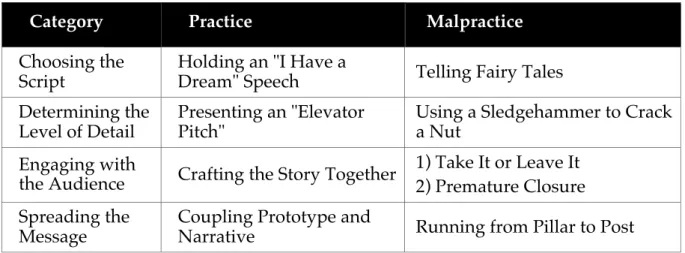
1.4.3 When Prototyping Meets Storytelling: Practices and Malpractices in Innovating Software Firms ... 27
1.4.4 Identifying Patterns of Idea Diffusion in Innovator Networks ... 29
1.4.5 Idea Hubs as Nexus of Collective Creativity in Digital Innovation ... 30
1.4.6 Communicating Ideas Purposefully: Toward a Design Theory of Innovation Artifacts ... 32
1.4.7 Enabling Intrapreneurship with an Idea Screening Framework ... 33
1.5 Conclusion ... 34
1.6 Outlook ... 39
1.7 References ... 42
2 Understanding Digital Innovation Practices Through Artifacts ... 45
2.1 Introduction ... 46
2.2 Related Work ... 48
2.2.1 Digital Innovation ... 48
2.2.2 A Practice Perspective on Digital Innovation ... 50
2.2.3 An Artifact Lens on Digital Innovation Practices ... 50
2.3 Method ... 56
2.3.1 Research Relationship ... 57
2.3.2 Data Collection ... 58
2.3.3 Data Analysis and Interpretation ... 60
2.4 Results: Digital Innovation Practices and Artifacts ... 62
2.4.1 Practice 1: Making Sense of an Idea ... 62
2.4.2 Practice 2: Aligning Mental Models ... 66
2.4.3 Practice 3: Negotiating Solution Paths ... 71
2.4.4 Practice 4: Crafting an Idea ... 76
2.5 Discussion ... 80
2.5.1 A Practice-based Model of Digital Innovation ... 80
2.5.2 Implications for Research ... 81
2.5.3 Implications for Practice ... 83
2.6 Conclusion ... 85
3 PowerPoint Paradoxes in Digital Innovation Practices ... 91
3.1 Introduction ... 92
3.2 Related Literature ... 94
3.2.1 Role of IT Artifacts in Digital Innovation Practices ... 94
3.2.2 Current State of the PowerPoint Debate ... 95
3.2.3 PowerPoint's Features ... 97
3.2.4 Paradoxes ... 99
3.3 Research Method ... 101
3.3.1 Research Relationship with the Case Companies ... 101
3.3.2 Data Collection ... 102
3.3.3 Case Data Analysis and Interpretation ... 104
3.4 Results: PowerPoint Paradoxes in Digital Innovation Practices ... 105
3.4.1 PowerPoint Paradox 1 - Freedom/Captivity ... 107
3.4.2 PowerPoint Paradox 2 - Clarity/Ambiguity ... 114
3.4.3 PowerPoint Paradox 3 - Scarcity/Abundance ... 122
3.5 Discussion ... 127
3.5.1 Implications for Research ... 128
3.5.2 Implications for Practice ... 133
3.6 Conclusions and Outlook ... 134
3.7 References ... 137
4 When Prototyping Meets Storytelling: Practices and Malpractices in Innovating Software Firms ... 141
4.1 Introduction ... 142
4.2 Related Work ... 143
4.2.1 A Practice Perspective on Innovating Software Firms ... 143
4.2.2 Software Prototyping ... 143
4.2.3 Storytelling ... 146
4.3 Research Method ... 148
4.3.1 Research Relationship with the Case Companies ... 148
4.3.2 Data Collection and Analysis ... 149
4.3.3 Structured Literature Analysis ... 150
4.4 Results ... 151
4.4.1 Choosing the Script ... 151
4.4.2 Determining the Level of Detail ... 153
4.4.3 Engaging with the Audience ... 155
4.4.4 Spreading the Message ... 158
4.5 Discussion ... 161
4.6 Conclusions and Outlook ... 163
4.7 References ... 164
5 Identifying Patterns of Idea Diffusion in Innovator Networks ... 167
5.1 Introduction ... 168
5.2 Related Work ... 171
5.2.1 Innovation Management (IM) ... 171
5.2.2 Peer Influence and Social Contagion ... 173
5.3 Research Design ... 174 5.3.1 BITS Dataset ... 175 5.3.2 Network Construction ... 176 5.3.3 Artifact Extraction ... 177 5.3.4 Network Analysis ... 177 5.4 Preliminary Results ... 178 5.5 Discussion ... 180
5.6 Intended Contributions and Future Work ... 182
5.7 References ... 183
6 Idea Hubs as Nexus of Collective Creativity in Digital Innovation ... 187
6.1 Motivation and Research Goal ... 188
6.2 Related Work ... 190
6.2.1 Digital Innovation ... 190
6.2.2 Collective Creativity ... 193
6.2.3 Idea Hubs as Nexus of Collective Creativity ... 195
6.3 Research Method and Empirical Context ... 196
6.3.1 Case Selection ... 197
6.3.2 Data Collection ... 198
6.3.3 Data Analysis and Interpretation ... 201
6.4 Results ... 203
6.4.1 Offline Idea Hubs ... 204
6.4.2 Online Idea Hubs ... 206
6.5 Discussion ... 211
6.5.1 Implications for Digital Innovation Research ... 211
6.5.2 Implications for Digital Innovation Practice ... 217
6.6 Limitations ... 218
6.7 Conclusion and Outlook ... 220
6.8 References ... 222
7 Communicating Ideas Purposefully: Toward a Design Theory of Innovation Artifacts ... 227 7.1 Introduction ... 228 7.2 Related Work ... 230 7.2.1 Innovation management ... 230 7.2.2 Boundary objects ... 231 7.3 Research Design ... 233
7.3.1 Exploratory field study ... 233
7.3.2 BITS dataset ... 233
7.3.3 Research methodology ... 236
7.4 Results ... 238
7.5 A Design Theory of Innovation Artifacts ... 243
7.5.1 Purpose and scope ... 244
7.5.2 Principles of form and function ... 245
7.6 Conclusions and Future Work ... 247
7.7 References ... 250
8 Enabling Intrapreneurship with an Idea Screening Framework ... 255
8.1 Introduction ... 256 8.2 Related Work ... 257 8.2.1 Intrapreneurship ... 257 8.2.2 Idea Screening ... 258 8.3 Research Method ... 259 8.3.1 Case Presentation ... 260
8.3.2 Case Data Collection ... 261
8.3.3 Case Data Analysis ... 262
8.3.4 Structured Literature Analysis ... 263
8.4 Problem Identification and Solution Objective ... 263
8.5 Artefact Design and Development ... 267
8.5.2 IT Artefact ... 273
8.6 Artefact Demonstration and Evaluation ... 275
8.7 Implications ... 275
8.8 Conclusions and Outlook ... 278
8.9 References ... 279
9 List of Figures ... 284
10 List of Figures ... 285
11 Curriculum Vitae ... 286
1 Synopsis
1.1IntroductionInnovation is essential to thrive and survive in a competitive market (Tidd and Bessant, 2011). This forces companies to support employees-driven ideas (Desouza, 2011), open up towards internal and external collaborators (Chesbrough, 2003, p. 2), and keep pace with rapidly evolving digital technologies (Yoo et al., 2012). According to the process-based models that prevail in the existing literature, innovation is seen as a discrete, linear, and sequential process with clearly ordered, differentiated, and consecutive phases (Chesbrough, 2003; Desouza, 2011; Fichman et al., 2014). Process-based models are largely limited to top-down specified innovations that follow a linear path, without embracing the often-serendipitous entrepreneurial practices of those people who actually innovate, and without further differentiating between characteristics of digital and traditional innovations. The goal of this dissertation is to offer a distinct, practice-based perspective on digital innovation by providing empirical insights from an in-depth qualitative-interpretive case study in two software companies.
The main contribution of this dissertation is an empirically grounded conceptualization of digital innovation practices. Through multiple in-depth analyses of the role of artifacts and social interactions, this dissertation provides a deeper understanding of digital innovation practices in software companies. Building on this understanding, it also offers a set of tools to support these practices. This has far-reaching implications for digital innovation researchers and practitioners, as it suggests a broader shift in perspective from managing and controlling top-down specified innovation processes toward facilitating and enabling bottom-up emerging innovation practices. More specifically, the contributions of this dissertation can be grouped into three parts:
1) By analyzing the role of artifacts, this dissertation specifies a set of digital innovation practices. The analysis shows that artifacts play a central role in supporting digital innovation practices, such as making sense of ideas, aligning mental models, negotiating solution paths, and crafting ideas. This informs future studies on the design and use of artifacts that support digital innovation practices by helping researchers to understand the appropriateness of artifacts in different contexts.
2) By analyzing social interactions, this dissertation specifies a set of factors that influence the development of innovative ideas in social interaction. The analysis shows
1. Synopsis 2
that material infrastructure, personal characteristics, and innovation process phases play an important role in supporting collective creativity, which is an important driver of digital innovation practices. This informs future studies on the support of social interaction in organizations about the bottom-up emergent nature of digital innovation practices, how these are enacted in the interactions between people, and how the organizational environment influences the nature of these interactions.
3) Based on the insights obtained from the above two analyses, this dissertation offers tools for enabling digital innovation practices in organizations. This informs future studies on innovation management by providing structured guidance how innovators can communicate ideas purposefully with artifacts. Moreover, it develops an idea screening framework that facilitates the evaluation, selection, and tracking of employee-driven ideas. These tools can be implemented in small and medium-sized enterprises to support innovation practices.
This dissertation's research approach is as follows. Through multiple case studies conducted over a period of more than two years at two software companies, I could study and participate in practices related to the development of innovative software products. Thereby, I obtained a deep practical understanding of the problems innovators face (Walsham, 1995a, 2006). By gathering and analyzing an extensive data set, consisting of in total 95 semi-structured interviews, 480 artifacts and digital documents, and 214 days of participant observations, the need to address digital innovation from a practice perspective emerged to better understand and conceptualize the way people innovate with and toward digital technologies. I mainly draw on qualitative methods to conceptualize digital innovation practices, but also on design science methods to develop tools.
The structure of this dissertation is as follows. Section 1.2 starts with defining the key concepts and describing the research gap and research questions that this dissertation addresses. I then present the research approach of this dissertation and give detailed insights into the case studies in section 1.3. Section 1.4 continues with explaining the contributions of this dissertation by illustrating an overview of the papers therein and summarizing their most interesting findings, along with explaining how they relate to each other. Section 1.5 then summarizes the key takeaways of this dissertation and answers the research questions explicitly. Finally, section 1.6 points to areas of future work that could build on this dissertation and discusses its limitations. The chapters that follow this synopsis contain the seven papers that constitute this cumulative dissertation. As often with cumulative dissertations, this
3 1. Synopsis
synopsis is partly redundant with the papers in chapters that draw on the same foundation (e.g. literature, methodology).
1.2Definitions, Research Gap, and Research Questions
This section reviews existing literature to identify the research gap. Based on this, it also delineates the guiding research questions. The aim is essentially to clarify the basic concepts that are used throughout the dissertation, thereby helping the reader to assess its value, understand how its single parts fit together, and how it draws on key concepts that build on each other. Specifically, four concepts will appear coherently throughout this dissertation: 1) Digital innovation 2) Practices, 3) Artifacts, 4) Social interaction. It should be noted that there are currently no consistently agreed upon definitions for any of these concepts in the scientific community. While digital innovation is a rather new term that only recently attracted the interest of the information systems (IS) community, the concept of practice has different scholarly traditions behind it, each of them with in part very different understandings. The situation is similar for the terms artifact and social interaction. Achieving universally applicable definitions for these concepts would thus go beyond the goal of this dissertation. I will rather, more modestly, provide a clarification of how they are understood in this context. Essentially, this section argues that digital innovation has unique characteristics that differentiate this new phenomenon from traditional innovation and requires a practice turn to be better understood. This is followed by arguing that analyzing artifacts and social interactions facilitates a deeper understanding of digital innovation practices.
Definition: Digital innovation (based on Fichman et al., 2014; Rogers, 2010; Yoo et al., 2010)
Digital innovation is a practice that involves information technology (IT) both as a means and an end to develop new products.
New Products: This definition emphasizes several important characteristics of digital innovation. It reveals that the focus of this dissertation is on new products. While innovation can be understood more broadly as products, processes, business models (Fichman et al., 2014, p. 330) or even ideas and objects (Rogers, 2010, p. 475), this dissertation chooses a narrower focus on digital product innovation to explore one type of innovation in depth. Another important characteristic here is that the product is new. This distinguishes the use of the term from routine development, because the product must be perceived as new by an adopter or the developing organization to
1. Synopsis 4
count as innovation (Fichman et al., 2014; Rogers, 2010). Here, the classifier 'new' comprises both entirely new developments from scratch (also called radical innovation) and substantial extensions, replacements, or refinements of modules as part of existing products (also called incremental innovation) (Desouza, 2011, p. 30).
Involvement of IT: Moreover, this definition emphasizes the involvement of information technology in the development. This is important because information technology has distinctive characteristics that differentiate digital innovation from traditional innovation. Some of these characteristics are, according to Yoo et al. (2010), reprogrammability, homogeneization of data, and self-referentiality. Reprogrammability means that information technology enables devices to perform a variety of functions through a “separation of the semiotic functional logic of the device from the physical embodiment that executes it” (p.726). This means that products have no fixed boundaries but can be continuously expanded with multiple new functionalities. Homogenization of data refers to the capability to separate the content from the medium by allowing any digital content (e.g. audio, video, text, and image) to be stored, processed, and displayed (p.726). This means that a digital product can fulfill multiple purposes. And self-reference means that digital technology requires the use of digital technology, which creates positive network externalities and “fosters further digital innovation through a virtuous cycle of lowered entry barriers, decreased learning costs, and accelerated diffusion rates.” (p.726). This means products have high scalability and low entry barriers, which allows a variety of people to participate and leads to democratized innovation (Yoo et al., 2010).
IT as means and end: Furthermore, this definition emphasizes the involvement of IT both as a means (i.e. resource, object, equipment) and an end (i.e. outcome, objective, product) of the development, because the distinctive characteristics of IT have different implications for both modes. Using IT as a means of development offers vast possibilities for innovators, for instance by gathering massive amounts of market data with business analytics tools, interacting with potential users over social media, collaborating with partners on a global scale with online collaboration or crowdsourcing platforms, and getting financial resources with crowdfunding platforms. When IT is the outcome of the development, the new product has embedded digital capabilities that allow recombination with other digital and physical artifacts, such as e-readers, smartphones, or smart cars (Yoo et al., 2012). This enables new forms of organizing, such as virtual team work, that emerge from the lower cost of communication and coordination, through which the innovation practices disperse geographically and move towards the periphery of organizations (Yoo et al., 2012).
5 1. Synopsis
First Research Gap: Taking the Practice Turn in Digital Innovation
The central point here is that the distinctive characteristics of digital innovation provide an environment of open and flexible affordances, which requires us to rethink existing views about innovation (Yoo et al., 2012). The prevailing view in the existing innovation management literature is a discrete, linear, and sequential innovation process with clearly ordered, differentiated, and consecutive phases. For instance, Tidd and Bessant (2011) divide the innovation process into search, select, implement, and capture. Chesbrough (2003) differentiates between research and development. Desouza's (2011) innovation process consists of idea generation, advocacy & screening, experimentation, commercialization, and diffusion & implementation. And Fichman et al. (2014) distinguish between discovery, development, diffusion, and impact. What these perspectives have in common is that they are all based on the assumption that the innovation process usually takes a linear path. Repetitions of single phases are a rarely necessary exception. A dogmatic implementation of the linear process perspective would prohibit to skip phases. It would also be impossible to move backwards into the process or to carry out several phases at once. One phase could only start when the previous one is fully completed. However, it throws into question whether this is actually the case with digital innovations, which are characterized by reprogrammability, homogeneization of data, and self-referentiality (Yoo et al., 2010). Can flexible and recombinable digital innovations really be specified clearly, completely, and precisely in advance? Can self-referential and democratized digital innovations really be developed exactly as specified without unanticipated technical or social constraints? And will the end user always refrain from using the malleable digital innovation in unexpected ways, or from not using it at all? The reality looks quite different (Wessel, 2014). The major disadvantage of the strictly sequential approach is that the practical benefit of the innovation can be evaluated at a very late stage only. When companies fail to notice change requests or tacit requirements in time, necessary adjustments can only be accomplished with considerable effort. As a result, a lot of innovation potential may remain unused and the success rate of innovations in the market may remain relatively low. The strict separation of single innovation process phases may therefore be an inadequate idealization in the context of digital innovation. Experience from the field of software engineering has already shown that classical linear product lifecycle models are inadequate for software-intensive product development (Pomberger et al., 1992), leading to an extensive discourse about agile development processes (Highsmith and Cockburn, 2001). This dissertation develops a practice-based model of digital innovation that provides a starting point for managing digital innovation in organizations.
The paper "Understanding Digital Innovation Practices Through Artifacts" (section 2) in this dissertation offers a more detailed argumentation for taking a practice turn in digital innovation.
1. Synopsis 6
In essence, this dissertation argues that we can overcome the limitations of process-based views on innovation when we understand digital innovation as a practice. Assuming that industries are stable and develop fixed products in a linear way would limit our understanding of the potential of digital innovation, because with embedded digital capabilities, product boundaries become more dynamic and malleable (Yoo et al., 2012). A practice perspective facilitates focusing on the work and behavioral intentions of innovating persons (Majchrzak et al., 2012), and helps us to see innovation as a continuous, ongoing, and collective accomplishment of something people do and enact (Pantzar and Shove, 2010). For instance, doctors do not only practice medicine, but are doctors because they practice medicine, and one can only become a doctor in an already existing practice of medicine (Riemer and Johnston, 2014). Accordingly, as a 'digital innovator', a person is a carrier of the practice of digital innovating. Any innovation process, whether digital or not, can only unfold as a sequence of practices and, therefore, needs to be understood as a practice. The appropriate level of analysis to capture the complexity of digital innovation is, thus, at the level of practice (Tuomi, 2002, p. 19). By making a case for digital innovation practices in two software companies, this dissertation argues for taking a practice turn in digital innovation and, referring to the above-mentioned first research gap, addresses the main research question:
Main Research Question (RQ1)
How do people practice digital innovation in the software industry?
What exactly are practices and how can we as researchers try to better understand them? The answer is not trivial, as there is currently no such thing as a unified practice theory, but rather several different scholarly traditions with quite distinct understandings (Nicolini, 2012, p. 8ff). It is thus necessary to define the term more closely and explain briefly how it is used throughout this dissertation.
7 1. Synopsis
Definition: Practice (based on Nicolini, 2012, pp.105-118)
A practice is a routinized and interdependent set of goal-oriented, artifact-mediated, and social human activities.
Definition: Artifact (based on Nicolini, 2012, p.105)
An artifact is a human-made material device that people use in practice.
Definition: Social Interaction (based on Arnold et al., 1971, p. 216)
Social interaction refers to the mutually related activities of people that act and react to those around them..
Human Activity: This definition incorporates an understanding of practices that follows the traditions of Wittgenstein, Heidegger, and Activity Theory (see Nicolini, 2012, chapters 5 and 7 for an overview). It emphasizes that the central unit of analysis for practices is human activity (Engeström, 1987; Leont’ev, 1978). Practices are carried out by humans who skillfully and purposefully conduct activities using their brains, bodies, and material objects to satisfy their needs and intentions (Kaptelinin and Nardi, 2009). In fact, practices constitute human sociality and being human means first and foremost to carry out practices as a 'doer' within a social context (cf. Nicolini, 2012, pp. 105-118).
Routinized and Interdependent: Routinization and interdependence are defining characteristics of a practice. Through repeated performance, practices are inscribed into what some authors call social memory (Nicolini, 2012, p. 167). This means that people can learn and grow into an existing practice that outlives and exists independently of single individuals (e.g. driving a car). Moreover, practices do not exist as isolated entities but are interdependent, meaning that several practices can be hierarchically nested into each other (e.g. stepping on the clutch pedal, accelerating, operating the indicator), and that one practice can be the input for another one (e.g. getting a driver's license, commuting to work).
Goal-Oriented: The main organizer that binds a system of interdependent practices together is their goal, sometimes also referred to as object (Engeström, 1987). The goal brings different people together to work toward a common purpose, and is thus a source of coherence and energy that motivates people. All practices are goal-oriented and a practice without a goal is simply inconceivable (Nicolini, 2012, p. 95). The goal of a practice can be understood as prospective outcome that motivates and directs
1. Synopsis 8
practices, around which practices are coordinated, and in which practices are crystallized when they are completed (Kaptelinin and Nardi, 2009, p. 6).
Artifact-Mediated: The relationship between people and their goal is mediated by artifacts. Through their material characteristics, artifacts set possibilities and constraints to the way people pursue the goal of a practice. Since the output of one practice may become the input of another, artifacts are the outcome of previous work, and when used in a new context, they embody the original work in the new situation (Nicolini, 2012, p.105). Thus, artifacts both make practices durable and connect them across space and time (ibid). For instance, the practice of classroom teaching is both mediated by and depends on a series of artifacts, such as the seats in the classroom, board, clock, pen and paper, etc. (Nicolini, 2012, p.4f). These artifacts are internalized by participating in practices and can fundamentally shape and transform mental functioning (Miettinen and Virkkunen, 2005). What we do and what we use fundamentally influences how we think and how we perceive the world and ourselves (Nicolini, 2012, p.107). Thus, the way in which artifacts are used in practice is crucial for both the definition of their role and function (Levina and Vaast, 2005), and for understanding the practices themselves (Nicolini et al., 2012).
9 1. Synopsis
Second Research Gap: The Role of Artifacts in Digital Innovation Practices
The essential point here is that the nature of the practices depends crucially on the mediating artifacts that people use. If we want to understand digital innovation practices, we cannot direct our attention away from the important role of artifacts therein. As Nicolini puts it, when we examine the world in terms of practices, "we cannot avoid taking into consideration the central role of artefacts (...) We cannot make sense of our practices without taking into account the materials that enter it. Objects, materials, and technology need thus to be studied 'in practice' and with reference to the practices in which they are involved." (Nicolini, 2012, p.171). However, innovation plays only a peripheral role in the existing practice literature, and the digital innovation literature, in turn, has overlooked the important role of artifacts (cf. section 2). As a result, the role of artifacts in digital innovation practices remains unclear. Hence, a key idea in this dissertation is that we can understand digital innovation practices better through studying artifacts people use. An artifact lens facilitates uncovering the “process of materialization enfolding in material-discursive practices of IS development, implementation, and use” (Cecez-Kecmanovic et al., 2014, p. 812). For instance, a carpenter who is hammering encounters a hammer as something for doing what carpenters do, namely hammering nails, and for being what carpenters are, namely craftsmen; the hammer draws its role from the carpentry practice, and draws its purpose from the practice it is used for and constitutive of, namely hammering (Riemer and Johnston, 2014). Accordingly, as digital technology exists only as technology-in-use embedded in a specific practice, the researcher may obtain a better understanding of the underlying practices through studying artifacts in use. Not unlike archaeologists, who study ancient cultures through analyzing left material traces, practice theorists argue that we can understand contemporary sociality through the ecology of artifacts that surrounds and shapes our everyday life (Knorr-Cetina, 1997).
The paper "Understanding Digital Innovation Practices Through Artifacts" (section 2) in this dissertation offers a deeper understanding of the role of artifacts in digital innovation practices. In addition, the two papers "PowerPoint Paradoxes in Digital Innovation Practices" (section 3) and "When Prototyping Meets Storytelling" (section 4) in this dissertation offer an in-depth analysis of the role of PowerPoint and prototypes in digital innovation practices, respectively.
1. Synopsis 10 Social: A practice is not a one-off moment without a history or future. Practices are always embedded in a historical and social context that gives structure and meaning to what people do (Wenger, 1998, p. 45). In this sense, practices are by definition social, and the sometimes-used term 'social practice' says the same thing twice (Nicolini, 2012, p.227). There is, in fact, no way not to be socially situated when carrying out a practice, even in perfect solitude (ibid). Even a lone jogger carries out a practice that has a collective social history (namely jogging), and involving an array of artifacts that embody the history of previous work (e.g. shoes, running clothes, fitness tracker). The jogger is indeed connected to a larger community of joggers by carrying out the practice of jogging, and by incorporating the outcome of the jogging practice (e.g. a healthier cardiovascular system, increased wellbeing, better focus) into other practices (e.g. interacting with peers, writing). Accordingly, the practice of innovating digitally is never carried out by some lone entrepreneur in an isolated quiet chamber, but should rather be seen as a collective and social accomplishment. Creative ideas often do not stem solely from ‘eureka’ moments of individual cognition, but rather from insights that emerge in social interaction, such as collaborative problem solving or simply talking about ideas. Because practices are always interdependent, creativity occurs as a confluence of ideas from multiple sources (Hargadon and Bechky, 2006, p. 486).
Third Research Gap: The Role of Social Interaction in Digital Innovation Practices
The key argument here is that if we want to understand digital innovation, we need to understand how people collectively develop ideas in social interaction. Ideas lie at the heart of each innovation. Initially, ideas exist only as an abstract conception in someone’s mental model, i.e. an intangible and volatile image in the mind of a person (Partridge, 1991, p. 303f). Only when a person communicates an idea, it meets the realm of reality and becomes a germ cell of innovation. Recent studies show that innovators are most capable who when they are well connected and have a strong personal network (Desouza, 2011, p. 72; Graf and Krüger, 2011). However, the role of social interaction in digital innovation practices remains unclear (cf. section 5). Hence, if we want to understand digital innovation practices we need to put a strong focus on the way people interact with each other.
The paper "Idea Hubs as Nexus of Collective Creativity in Digital Innovation" (section 5) in this dissertation provides a more detailed discussion about the need to study the role of social interaction in digital innovation.
11 1. Synopsis
The key idea of this dissertation is that digital innovation practices need to be studied by emphasizing the role of artifacts and social interaction in parallel. In IS research, practice-based studies have gone hand in hand with a parallel emphasis on the social and material nature of practices, where the relationship between human activity and information technology is one of mutual mediation (Leonardi, 2011; Orlikowski and Barley, 2001). As Orlikowski (2007)puts it, the practice lens unveils that “materiality is integral to organizing, positing that the social and the material are
constitutively entangled in everyday life” (p. 1437, italics in original). Practices are thus always social and material (Nicolini, 2012, p.105), and since we have seen that digital innovation should be understood as a practice, we need to emphasize the role of artifacts and social interaction in digital innovation practices together. Studying digital innovation practices from both an artifact perspective and a social interaction perspective not only yields a deeper understanding of digital innovation in general, but also lets both perspectives draw upon each other to their mutual benefit. Firstly, analyzing the role of artifacts in digital innovation practices is necessary to understand how practices are fundamentally shaped and transformed by the mediating artifacts that people use. This means that the artifact perspective allows to draw conclusions about the practices themselves and to understand them better. For instance, a researcher can reconstruct the creative process that underlies an innovation by collecting and analyzing artifacts that people use in various practices. Hence, any innovation management endeavor would benefit from an improved understanding of the important role of artifacts in digital innovation practices. Secondly, the inherently social character of practices implies a need to better understand how ideas are constructed and negotiated in social interaction. This allows the researcher to examine why and how social interactions enable the idea to evolve in the first place. Thus, the main research question can be divided into two specific ones that emphasize the role of artifacts and social interaction respectively, referring to the second and third research gap. Moreover, as outlined in the following sections, the deeper understanding of digital innovation practices that results from studying the role of artifacts and social interaction also offers an opportunity to provide actionable guidance for practitioners. Hence, a third specific research question can be derived that focuses on designing solution approaches for enabling digital innovation practices in organizations.
1. Synopsis 12
Specific Research Questions
RQ1.1 - What role do artifacts play in digital innovation practices?
RQ1.2 - What role does social interaction play in digital innovation practices? RQ1.3 - How can organizations enable digital innovation practices?
1.3Research Approach
This section details the research approach of this dissertation. Since the goal is to understand digital innovation practices from a participant’s perspective, I conducted qualitative-interpretive field studies (Klein and Myers, 1999; Walsham, 1995a, 2006). Figure 1 illustrates the overall research approach and the following sections explain the singe activities in further detail.
Figure 1-1 : Overview of Research Approach
The study of practices always starts in the middle of action. The practice researcher needs to start the investigation by zooming in on practices, directing attention to what people are doing and saying (Nicolini, 2012, p.211). The basic move here is to follow people, artifacts, and interactions wherever they go (ibid, p.231). Over the course of almost three years, from 2013 – 2015, I could zoom in and out iteratively (Nicolini, 2009) on the actual innovation practices at two companies, beginning as an intensive case study in one location and then expanding to another location by following
13 1. Synopsis
emerging relations, while playing with multiple theoretical lenses wheninterpreting them (Walsham, 2006). On several levels of detail, I defined studies and sub-studies, using the results of one study to feed the next (sub-)study. The transferability of the findings was established through concatenation - the accumulation of studies from which inductions may be made (Lofland, 1976), and through which inter-subjective concurrence on inductions may be established (Popper, 2014). This allowed me to examine the actual digital innovation practices of the case companies in detail, through which I could generate rich insights into them by merging multiple theoretical perspectives, and, conversely, testing whether existing theory helped to make sense of the empirics.
1.3.1Guiding Principles of Interpretive Research
This section summarizes the guiding principles that underpin the interpretive research tradition, and explains how I applied these throughout this dissertation. While the development of the interpretive tradition has been subject of extensive academic debate (see Walsham, 1995b for a detailed discussion), Interpretivism is today a well-accepted school of thought in IS research (Orlikowski and Baroudi, 1991; Sarker et al., 2013; Walsham, 1995a). It takes an ontological and epistemological stance in which facts and values are intertwined ingredients of scientific knowledge, and ‘reality-for-us’ is an inter-subjective social construction of the shared human cognitive apparatus (Walsham, 1995a, p. 76).
The in-depth qualitative case study is a common vehicle for interpretive field research. Walsham (2006, 1995a) discusses some philosophical, theoretical, and methodological issues of conducting interpretive case studies in IS research, and urges researchers to sensitivity of the critical role of theory. Following the widely acknowledged distinction by Eisenhardt (1989), this author argues that theory can be used as initial guide to research design and data collection, as part of an iterative data collection and analysis process, or as final product of the research. He further identifies four types of possible generalizations from interpretive case studies: 1) development of concepts, 2) generation of theory, 3) drawing of specific implications, and 4) contribution of rich insight. Interpretivism sets high standards for constructing and justifying a contribution on relevant topics through rigorous research (Walsham, 2006). Thus, I followed the guidelines by Klein and Myers (1999, p. 72) who identify the following set of seven principles for conducting interpretive field research. Table 1 summarizes how I applied these principles in this dissertation, and the following paragraph provides further explanations.
1. Synopsis 14 Table 1-1 : Principles for Conducting Interpretive Field Research (after Klein and Myers 1999) and
their Application throughout this Dissertation
Principle Application of Principle throughout this Dissertation
1: Hermeneutic Circle Collecting data from multiple sources, obtaining long-term in-depth access to multiple interpretations of the focal phenomenon.
2: Contextualization Each paper in this dissertation includes a detailed presentation of the case and provides context of the specific inquiry.
3: Interaction between
Researcher and Subjects Transparent explanation of methodology and its applications (e.g. conducted interviews, workshops, participant observations, informal contact) in respective sections of the dissertation and papers.
4: Abstraction and
Generalization Playing with multiple theories, linking findings to existing theories, and developing new concepts where theories lack.
5: Dialogical Reasoning Iterative refinement, concatenation of multiple sub-studies at various levels of detail. Presentation of research findings to scholarly audiences at conferences, workshops, and symposia.
6: Multiple
Interpretations Large sample of participants with in total 95 interviews, 480 artifacts, and 214 days of participant observations. 7: Suspicion Examining and contrasting multiple sources of evidence (interviews, artifacts, observations), critical reflection, discussion of the findings with practitioners in workshops and focus groups.
1) The Fundamental Principle of the Hermeneutic Circle asserts that all human understanding is achieved by iterations between the interdependent meaning of parts and the whole that they form. Through multiple of these iterations, a shared meaning of a larger whole emerges. This principle is a meta-principle that underpins the following six principles.
2) The Principle of Contextualization asserts that interpretive research requires critical and explicit reflection of the social and historical background of the research setting to allow the intended audience to understand how the observed phenomenon emerged. This is necessary to overcome the inherent distance between the author and the reader of a text.
3) The Principle of Interaction between the Researchers and the Subjects asserts that interpretive research requires critical and explicit reflection on how empirical data
15 1. Synopsis
was constructed in social interactions between the researchers and participants. The interpretive research tradition does not see truth to be objectively given “out there”, but rather as intersubjective social construction. The participants, just as the researchers, are interpreters who appropriate the concepts used by researchers interacting with them.
4) The Principle of Abstraction and Generalization asserts that interpretive research requires relating the details of the data interpretation to general concepts that describe the nature of human understanding and social action. The detailed documentation of unique circumstances that results from interpretive research does not exclude relating these details to theoretical abstractions and generalizations. Theoretical implications distinguish interpretive research from just anecdotes.
5) The Principle of Dialogical Reasoning asserts that interpretive research requires sensitivity to contradictions between theoretical lenses and actual data. Researchers should be aware of and explicit about the philosophical assumptions and “prejudices” that underpin their research, and look for surprising, counter-intuitive findings that require subsequent cycles of revision.
6) The Principle of Multiple Interpretations asserts that interpretive research requires sensitivity to differences in interpretations among the participants. Human practices are conditioned by a social context involving multiple agents. Seeking out and documenting multiple viewpoints allows examining the influence of the social context on the practices under study.
7) The Principle of Suspicion asserts that interpretive research requires sensitivity to possible biases and systematic distortions in the narratives collected from the participants. What participants actually do may be different from what they say they do, simply because they carry out some actions subconsciously.
1.3.2Case Data Collection
As typical for interpretive research, I used an iterative approach to data collection and analysis until a coherent picture emerged, moving back and forth between theories and the different interpretations of the case study material I obtained from social constructions such as language, shared meaning, documents, tools, and other artifacts (Klein and Myers 1999). Data collection followed the principle of triangulation (Silverman, 2006, p. 291) where I examined the research issue from different sides, compiling multiple interpretations obtained from interviews, observations, field notes, and documentary material into a coherent picture (Klein and Myers, 1999). I had an
1. Synopsis 16
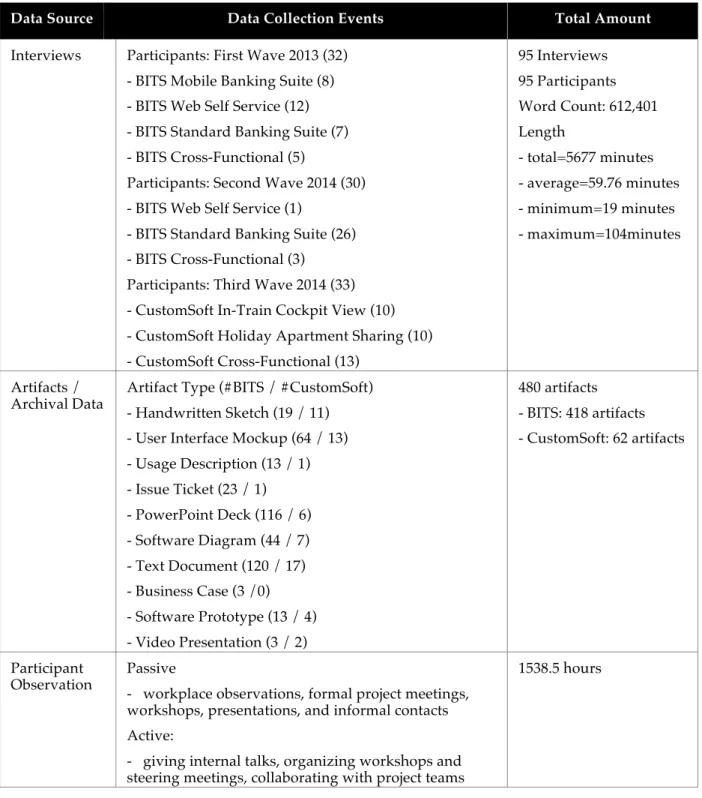
opportunity to study digital innovation practices in two software companies, here termed BITS and CustomSoft. Further relevant information about the case companies can be found in the respective papers. The company names are anonymous for privacy considerations. Table 2 provides an overview of all collected data, and the following provides an overview of how it was collected.
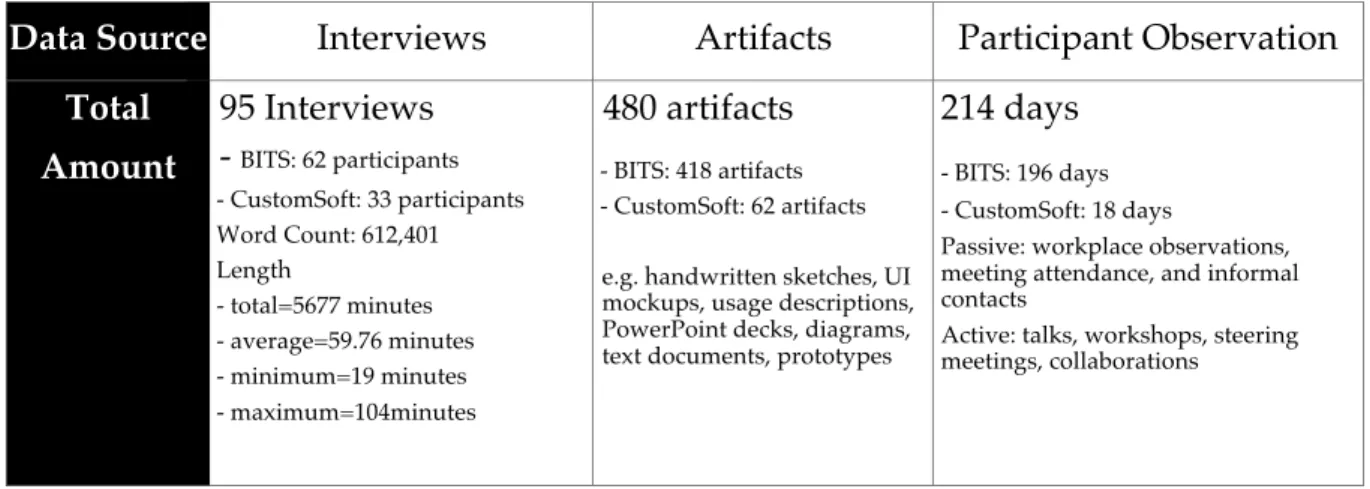
Table 1-2 - Overview of Collected Data
Data Source Interviews Artifacts Participant Observation
Total Amount 95 Interviews - BITS: 62 participants - CustomSoft: 33 participants Word Count: 612,401 Length - total=5677 minutes - average=59.76 minutes - minimum=19 minutes - maximum=104minutes 480 artifacts - BITS: 418 artifacts - CustomSoft: 62 artifacts
e.g. handwritten sketches, UI mockups, usage descriptions, PowerPoint decks, diagrams, text documents, prototypes
214 days - - BITS: 196 days - - CustomSoft: 18 days
Passive: workplace observations, meeting attendance, and informal contacts
Active: talks, workshops, steering meetings, collaborations
The style of involvement with BITS was that of a closely involved researcher having in-depth access to data, issues, and people, who was viewed as one of ‘them’, making a valid contribution to the field site (Walsham 2006). The style of involvement with CustomSoft was that of an outside observer who was not seen as having a direct personal stake in various interpretations at outcomes, with personnel being relatively frank in expressing their views (Walsham 2006). In all, I conducted and recorded 95 semi-structured interviews ranging from 19 to 104 minutes’ duration with experts involved in innovation projects at BITS and CustomSoft. By interviewing such a wide range of participants with differing roles and from different units I could seek out and document multiple interpretations of the actions under study (Klein and Myers, 1999, p. 77). I recorded and transcribed all but two interviews to capture a full description of what was said and facilitate later in-depth analysis (Weston et al., 2001). I wrote up detailed interview notes within a day to capture ideas and experiences that emerged during the interviews or events thereafter, and to share these thoughts with fellow researchers. Through these recorded interviews, it was possible for me to step back and access the interpretations of the fellow participants in more detail (Walsham, 1995a). Further information about how I conducted the interviews can be found in the respective papers of this dissertation. During these interviews, the respondents typically described common practices around concrete artifacts, of which I collected in total 480 artifacts (418 at BITS, 62 at CustomSoft) from respondents or intranet
17 1. Synopsis
platforms. I later analyzed a subset of these artifacts in more detail, as described in more detail in the respective papers. In addition, the companies provided me with office access and desk infrastructure through which I could conduct a series of participant observations at formal gatherings (meetings, workshops, presentations and fairs) and informal gatherings (lunches, impromptu meetings) in the context of the innovation projects. Where possible, photographs and field reports complemented the observations.
1.3.3Case Data Analysis
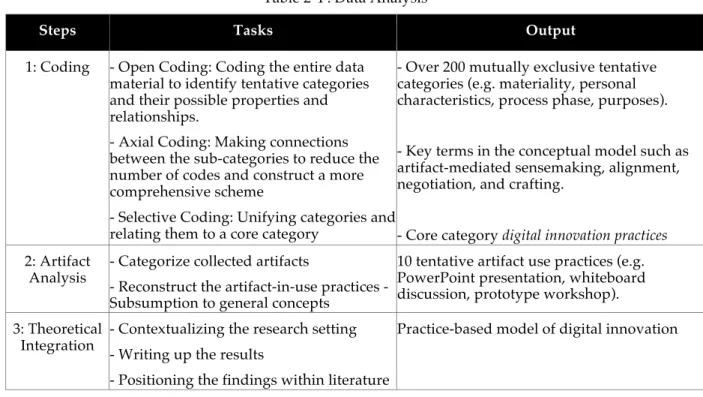
In analyzing the case data, I applied the principle of the hermeneutic circle, which suggests that “we come to understand a complex whole from preconceptions about the meanings of its parts and their interrelationships” (Klein and Myers, 1999, p. 71). As typical for interpretive research, I inductively generated shared meaning from the collected data through iterative cycles of qualitative data analyses, interactions with participants, and interactions with other researchers sharing similar interests and expertise (Walsham, 1995a). At first, I met in weekly focus groups with other involved researchers from the University of Zurich to maintain a critical distance with the views of people in the case companies, moving back and forth between data and theories, interrogating field material to check whether the data supported emerging claims and, conversely, whether theories helped us making sense of the empirics (Walsham, 2006; Yanow and Schwartz-Shea, 2006), such as field reports, interview excerpts, and artifacts.
We then cross checked the transcriptions among the research team and imported them in MAXQDA to facilitate in-depth analysis and increase confidence in the findings (DeCuir-Gunby et al., 2011). In close collaboration with one other researcher, I broke down the interview data analytically using open coding to identify interesting topics and axial coding to identify relationships between these (Corbin and Strauss, 1990). Two additional researchers then carried out coding checks to increase intercoder reliability and develop a shared conception of reflection (Weston et al., 2001). In our following analyses, we elaborated the codebook in the weekly focus groups to identify themes from various interviews and derive new codes in vivo from the data (DeCuir-Gunby et al., 2011), using selective coding techniques to identify the main phenomenon of interest (Corbin and Strauss, 1990). More detailed information about the coding process are in the respective papers of this dissertation.
1. Synopsis 18
1.3.4Structured Literature Analysis
From the start and throughout this research project, I conducted a structured literature analysis to elicit the current state of research in the field and to position my work in a larger discourse. I followed the well-established literature research framework by Vom Brocke et al. (2009) and conducted the five generic steps: 1) definition of review scope 2) conceptualization of topic 3) literature scope 4) literature analysis and synthesis 5) research agenda. More detailed information about the literature analysis are in the respective papers of this dissertation.
1.3.5Sensemaking, Interpretation, and Generation of Rich Insights
Sensemaking was mostly a collaborative endeavor involving interactions with other researchers and practitioners. In a series of workshops, meetings, and symposia, we deepened the insights obtained from the case study. This activity required an in-depth examination and further iterations of data analyses in which we interpreted the extensive field data by switching between the artifact perspective and social interaction perspective, along with an intensive examination of the scientific literature. We conducted a genre analysis in which we categorized the collected artifacts and viewed them through an artifact-in-use perspective to shed more light not just on the IT artifacts themselves, but more importantly on what role they play in innovation practices, and particularly on how they get mobilized by individuals and mediate interactions between them (Yates and Orlikowski, 1992). Genres serve as socially recognized types of communicative action that shape practices and, over time, organizing structures through their routinization in everyday work (Yates and Orlikowski, 2007). In a particular domain, such as digital innovation, genre analysis facilitates understanding the epistemic practices that produce outcomes, because “in identifying and labeling genres we try to capture the gestalt of the various components of the communicative act” (Kwasnik and Crowston, 2005, p. 82). In capturing these enacted genres in the context of innovation, we were able to identify a variety of materially mediated activities, which we could then subsume to more specific digital innovation practices. This not only allowed us to critically reflect on these practices, but also to compare the innovation techniques of a typical product company (BITS) with those of a typical engineering company (CustomSoft).
In addition, we provided the case companies with continuous feedback and opportunities to reflect on their own practice (Walsham 2006). Having key informants from the companies review our study reports and papers enabled them to reflect on
19 1. Synopsis
our findings and report any discrepancies with their interpretations. We discussed the findings of the study in multiple intensive workshops and presented them at company-internal talks to help practitioners reflect on and improve their own practices.
1.4Contributions of this Dissertation
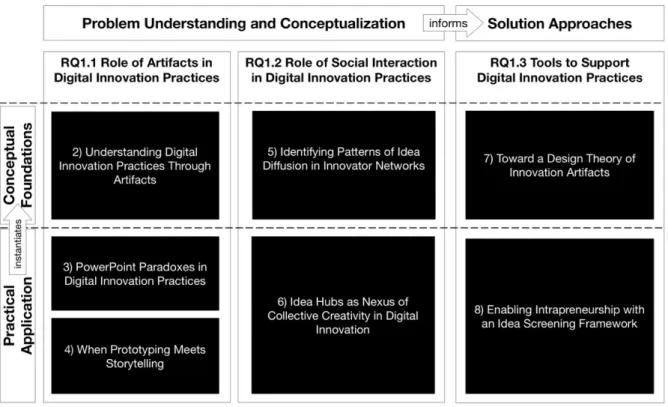
This section provides an overview of the main findings and scientific contributions of this dissertation, and explains the connections between the individual papers. Figure 2 illustrates the conceptual relationship between the dissertation’s papers. It is categorized along the main topics as specified in section 1.2, namely the role of artifacts and social interaction in, as well as tools to support digital innovation practices. Each category distinguishes between articles that focus on 1) conceptual foundations, which create knowledge contributions in the form of theories or concepts, and 2) practical applications, which create knowledge contributions by illustrating how one can derive actionable advice for practitioners from these insights.
Figure 1-2 - Overview of Relationship between Research Papers in this Dissertation
As elaborated in the previous section, this dissertation’s key idea is to study digital innovation practices from an artifact perspective and a social interaction perspective. Thus, it answers the research questions RQ1.1 (what role do artifacts play in digital innovation practices?) within three papers and RQ1.2 (what role does social interaction play in digital innovation practices?) within two papers. Two further papers design tools for
1. Synopsis 20
enabling digital innovation practices. The paper “Understanding Digital Innovation Practices Through Artifacts” (sections 1.4.1 and 2) identifies and conceptualizes four characteristic practices and clarifies the role of artifacts therein. The paper “PowerPoint Paradoxes in Digital Innovation Practices” (sections 1.4.2 and 3) provides an in-depth analysis of one specific artifact, namely PowerPoint, and its entanglement into digital innovation practices at BITS. And the paper "When Prototyping Meets Storytelling" (sections 1.4.3 and 4) examines the role of the software prototype in digital innovation practices. These three papers elaborate the artifact perspective on digital innovation, focusing on RQ1.1.
The subsequent two papers elaborate the social interaction perspective on digital innovation practices, focusing on RQ1.2. The paper “Identifying Patterns of Idea Diffusion” (sections 1.4.4 and 5) develops a research model for capturing the diffusion of innovative ideas throughout the social network of a company. Based on this conceptual understanding, the paper “Idea Hubs as Nexus of Collective Creativity in Digital Innovation” (sections 1.4.4 and 6) empirically studies the focal points of social interaction (here termed idea hubs) and identifies three influencing factors that affect individuals’ choice of idea hubs.
Such qualitative and behavioral social studies are often likely to generate theoretically relevant, novel, and interesting insights that inform further quantitative or design-oriented work. Two further papers condense the lessons learnt from directly applying that knowledge in the organizations and give actionable advice for practitioners. While the former four papers create descriptive knowledge that helps to understand a phenomenon, two further papers provide prescriptive knowledge and structured guidance. One paper presents two design principles for using artifacts to communicate ideas purposefully (section 1.4.6 and 7), and another paper presents the design of an idea screening framework that supports the evaluation, selection, and tracking of ideas in employee-driven innovation (sections 1.4.7 and 8). These two papers again provide insights from the design of artifacts that shape the use of artifacts and therefore also directly relate to RQ1.1 and RQ1.2.
In a nutshell, this dissertation
1. Conceptualizes digital innovation practices from an artifact perspective and a social interaction perspective through an in-depth qualitative-interpretive case study.
2. Provides tools to support digital innovation practices based on the insights obtained from the qualitative case study through a smaller design science research project.
21 1. Synopsis
In line with the widespread distinction between social science/behavioral IS research and engineering/design IS research (Briggs and Schwabe, 2011), this research can be classified into two streams: 1) a behavioral stream with case studies to explore, understand, and conceptualize social phenomena and their corollaries and 2) a design stream with development and implementation of tools to shape and support digital innovation practices. Whereas the design stream of this research project was insightful from a practitioner’s perspective, and further work could deeper pursue this stream, the larger share of this dissertation focuses on the behavioral stream to develop rich insights and conceptualizations of social phenomena in the context of digital innovation. These insights can then again inform future studies on the design of innovative IS that shape digital innovation practices, which is however out of the scope of this dissertation.
1.4.1Understanding Digital Innovation Practices Through Artifacts
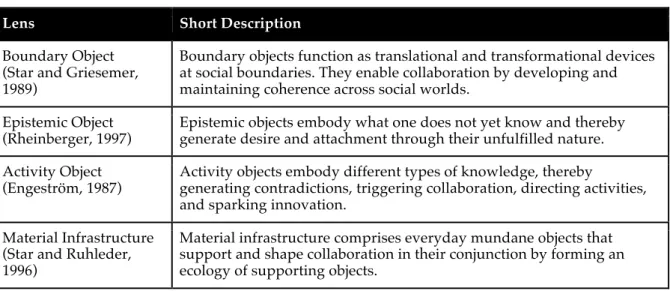
The first paper in this dissertation examines RQ1.1, namely what role do artifacts play in digital innovation practices. Because of their above-mentioned mediating role (cf. section 1.2), artifacts have the potential to radically transform the way companies innovate. This implies a growing need for deeper understanding the underlying innovation practices in which artifacts are embedded. Drawing on an in-depth qualitative examination of the empirical data obtained from the software companies BITS and CustomSoft, this paper identifies and conceptualizes four digital innovation practices, namely: making sense of an idea, aligning mental models, negotiating solution paths, and crafting an idea. We interpret each practice along a pluralist object framework, recently proposed by Nicolini et al. (2012), that comprises boundary objects, epistemic objects, activity objects, and material infrastructure.
This paper's contribution is threefold:
1) The practice-based model of digital innovation specifies a set of practices and their interrelations for enabling digital innovation in organizations that shows how people innovate with and toward artifacts. As implications for innovation management we suggest a broader shift in perspective, namely from managing and controlling top-down specified innovation processes towards facilitating and enabling bottom-up emerging innovation practices.
2) The paper provides a practical example how combining multiple artifact lenses facilitates a deep-going analysis of digital innovation practices in companies. IS scholars interested in understanding the role of artifacts in different contexts may
1. Synopsis 22
apply this approach in other settings, such as health, telecommunications, research, government, and manufacturing.
3) The paper clarifies the role of artifacts in digital innovation practices, thereby informing future studies on the design and use of information systems that support these practices.
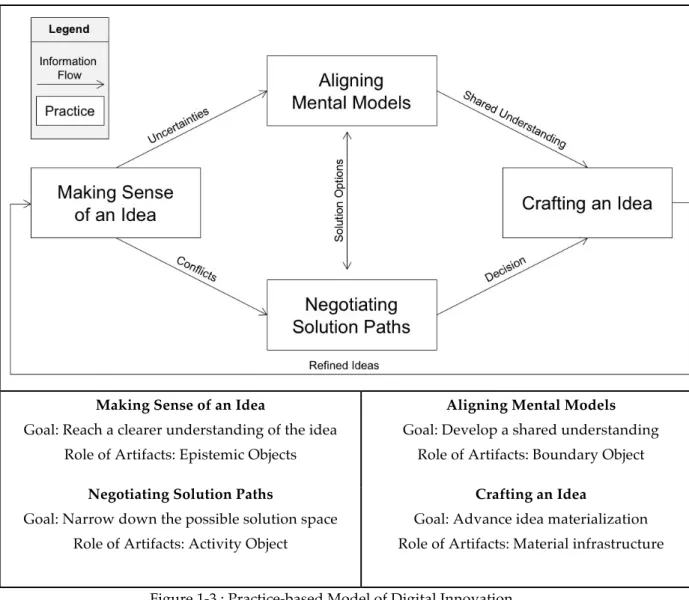
Placing a stronger focus on artifacts, this paper identifies and conceptualizes four practices through which people enact digital innovation. The conceptual model in figure 3 sets the four practices in relation to each other. Innovators strive for a clearer understanding of an idea by making sense of an idea. Thereby, they identify uncertainties (e.g. open questions or issues that need clarification) and conflicts (e.g. different and mutually exclusive possible viewpoints, competition for resources). These uncertainties and conflicts flow into aligning mental models and negotiating solution paths, respectively. In the former, stakeholders that are involved in the innovation endeavor develop a shared understanding. In the latter, the innovation teams narrow down the possible solution space and agree on necessary actions. In both practices, innovators identify and mutually exchange solution options, whereby the output of
aligning mental models is a shared understanding of and the output of negotiating solution paths is a decision on these, respectively. Both outputs flow into crafting an idea, where innovators employ necessary measures to advance idea materialization. In a learning by doing fashion, the innovator thereby obtains refined ideas, which again flow into making sense of an idea, where the whole process starts anew.
23 1. Synopsis
Making Sense of an Idea
Goal: Reach a clearer understanding of the idea Role of Artifacts: Epistemic Objects
Aligning Mental Models
Goal: Develop a shared understanding Role of Artifacts: Boundary Object
Negotiating Solution Paths
Goal: Narrow down the possible solution space Role of Artifacts: Activity Object
Crafting an Idea
Goal: Advance idea materialization Role of Artifacts: Material infrastructure
Figure 1-3 : Practice-based Model of Digital Innovation
This practice-based model extends existing knowledge in that it foregrounds the bottom-up emergence of digital innovation from an artifact-based viewpoint. It specifies a set of digital innovation practices and illustrates the requirements for which to design social and technical innovation support. IS scholars with an interest in understanding and improving digital innovation may draw on this contribution to better understand the environmental conditions under which artifacts play different roles that require different supporting measures. The goal should be to analyze and design artifacts to meet the respective requirements of the underlying practices.
In sum, this paper suggests future digital innovation research not only to appreciate the unique characteristics of digital artifacts, but also to understand digital artifacts-in-use and how people enact them in the underlying innovation practices. Innovating in the digital age requires us to better understand the process of digitalization, unfolding through the continuous production and reproduction of artifacts. While this


![Design, Synthesis and Antimicrobial Evaluation of Novel Benzoxazole Derivatives [Retracted]](data:image/gif;base64,R0lGODlhAQABAIAAAP///wAAACH5BAEAAAAALAAAAAABAAEAAAICRAEAOw==)