Prospects of Bitcoin
An evaluation of its future
Master Thesis - Spring of 2014
Lund University School of Economics & Management Department of Economics
Authors: Supervisors:
Gustav Andersson, 1989/10/09-0490 Klas Fregert
2
Abstract
The main goal of this thesis is to investigate the properties and prospects of the new digital currency, Bitcoin. How is it structured and is there a possibility of it having a substantial impact on the financial sector or today’s monetary systems? Through macroeconomic theory, financial models and academic writing we will explain the fundamentals of money, how the Bitcoin network functions and in what ways it could be used in the future. The problems lie in the many uncertainties that follow a completely decentralized currency including price instability, lack of regulation and self-policing. Will it become an established, stable currency? We believe not, but it could very well grow into being a useful complement to today’s current financial sector and drive institutions towards becoming more efficient. As this is a completely new phenomenon, many questions remain unanswered. However, what is in store for Bitcoin, only time can tell.
3
Table of Contents
Abstract ... 2
1. Introduction ... 4
1.1 Background and problem formulation ... 4
1.2 Question formulation ... 4
1.3 Intention and method ... 5
2. Theory ... 5
2.1 Requirements for a currency ... 5
2.2 Monetary standards ... 6
2.2.1 Commodity standard ... 6
2.2.2 Fiat standard ... 7
3. About Bitcoin ... 8
3.1 A brief history ... 8
3.2 The creation of bitcoins ... 9
3.3 The transaction ... 10
3.4 Trading ... 12
3.5 The applications of Bitcoin ... 13
3.6 Legal aspect ... 14 3.7 Bitcoin so far ... 16 4. Empirics ... 18 4.1 Price ... 18 4.2 Liquidity ... 20 4.3 Volatility... 23 4.4 Arbitrage possibilities ... 25 4.5 Network attributes ... 26
4.6 Similarities with a bubble? ... 28
5. Prospects ... 31
5.1 An acknowledged currency ... 31
5.2 Complement ... 32
5.3 Fading away or crashing ... 34
5.3.1 Ponzi scheme ... 35
6. Analysis ... 36
7. Conclusion ... 41
4
1. Introduction
1.1 Background and problem formulation
In the end of 2008, directly after the financial crisis following the bankruptcy of Lehmann Brothers, a nine page article (including following software) was published by Satoshi Nakamoto about Bitcoin. In the article Nakamoto spoke about the basics of the software as well as his intentions and visions for the future. It was the birth of the world’s first digital currency and it will potentially have an impact on the world financial sector. Today, five years later, Bitcoin is a hot topic. 2013 was the year it started getting attention in the media and the value of a bitcoin1 rose immensely, making many early investors multi-millionaires as the price increased hundredfold in roughly ten months.
Until about a year ago, this thesis would not have been possible as Bitcoin had not yet taken off in the same way it has today. Few people knew it even existed and if they did, chances were that they were not taking it very seriously. Today it is more established and in the focus of the public eye. This enables us to, not only draw more conclusions based on historic facts and trends, but also to analyze future possibilities that had not even appeared in the mind of the public before last year. In short, we now have more reason to write about it than ever before.
Whether you like Bitcoin or not; if you are the least interested, you are likely to have an opinion. This means that opinions are many and the Bitcoin society is split. Some are open-minded, some consider it to be doomed from the beginning and the rest are somewhere in between. Because of this divide in opinion, everyone has an argument as to why they are correct and others are not. With this comes great uncertainty and choosing which side to believe is difficult, if not nearly impossible. As in a political debate there is no clear right or wrong answer. Both sides can deliver strong arguments for their case and trash-talking tendencies are common. For this reason we believe it is very timely to further elucidate some of the questions surrounding Bitcoin.
1.2 Question formulation
What is the current situation and likely future for Bitcoin?
1
Bitcoin with a capital B refers to the network as a whole, while bitcoin with a small b refers to the currency unitsthemselves.
5
1.3 Intention and method
Our intention with this thesis is to further investigate what we believe will happen to Bitcoin in the future. To our help we will use macroeconomic and financial models to analyze the characteristics of the network and the online exchanges supplementing it. The historical data used in the thesis comes exclusively from independent websites that gather financial and technical data for both the different exchanges as well as the entire Bitcoin network. We have limited our data to 2013 and on, as pre-2013 is not relevant for this paper. Before 2013 the market capitalization for Bitcoin was substantially smaller and trade activity was performed very much in the dark. Regarding academic writing, much has yet to be published on the matter; and the limited supply that is presently published mostly concerns Bitcoin on a basic level. Besides articles such as these, we have also chosen to process facts and information from credible news agencies, statements communicated by authorities as well as bitcoin websites that gather information and news regarding Bitcoin. As laws and regulations are in continuous transformation we must reserve ourselves to eventual changes and events that might take place after writing this paper.
2. Theory
2.1 Requirements for a currency
In a barter economy, to be able to sell a good, the seller must find a buyer who is ready to pay with a good or service that the seller is ready to accept. This is a problem since the buyer and seller must have opposite endowments for a direct trade to occur. First, the buyer needs to find a person who possesses the good the buyer wants. Secondly, the buyer must have access to a good that the seller is ready to accept as payment. This is referred as “a double coincidence of wants”, expressed by the British economist Stanley Jevons. One can evade this problem by becoming a middleman. Take for example a shoemaker and a fisherman. The fisherman wants to buy a pair of shoes but the shoemaker is not interested in fish, he is interested in salt. The fisherman then turns to a third party who has access to salt and is willing to accept fish as payment. The fishermen can now buy his pair of shoes and pay the shoemaker in salt. There are, of course, many practical problems and high costs associated with this kind of system, and that is why people created money (see for example Fregert & Jonung, 2010).
The economic definition of money is unambiguous: money works as a widely accepted means of payment. The main functions of money are distinguished as:
6
• Unit of account • Store of value
• Medium of exchange
A crucial problem in the barter economy is the absence of a standard monetary unit of measurement; goods are always priced in relation to other goods. When money is used to express the value of all goods and services in an economy, it performs its function as a unit of account. Through fulfilling this function, households and businesses can make their trade decisions much faster which eases making calculations and comparing prices.
When money functions as a store of value, it means that one must be able to save, store and retrieve money over time and be sure it retains its value. In comparison with a barter economy, having to buy and sell at the same time, it is possible to separate the time when buying and selling. However, the value of money is not always constant. Because of inflation, it can lose its purchasing power, i.e. its value decreases. Other triggers might also make it fluctuate over time.
When money is used as a means of payment for goods and services, it fulfills its function as a medium of exchange. It is the most important and essential function of money since the “double coincidence of wants” no longer needs to be fulfilled. Money itself does not necessarily have to have an intrinsic value as long as the society relies on it being accepted as a means of payment and trusted by everyone else. (see for example Fregert & Jonung, 2010) Another important aspect of money is that it must be fungible. This means that mutual substitution is possible. Gold and dollars are examples of fungible assets. As one ounce of gold has the exact same value as another ounce of gold, a hundred-dollar bill must have the same value as every other hundred-dollar bill in circulation. A diamond however is not perfectly fungible to another diamond since different shapes, sizes and colors exist, making each diamond unique. (Bishop, 2009)
2.2 Monetary standards 2.2.1 Commodity standard
Historically, scarce metals such as gold and silver have been used as currency in barter economies. Everybody could use this as a medium of exchange, since it had and retained an intrinsic value and was accepted by everyone as valuable. As history progresses however, a new monetary system grew stronger; a system where, alongside of gold coins, paper money
7
was used as well. Each paper bill would then be fixed to a certain amount of gold. It started out as paper certificates that would guarantee the holder to, whenever he or she wishes, convert the bill into gold coins. This would require a central bank that would issue these bills and that would in turn have a federal gold reserve, in proportion to the certificates in circulation. Thus, the gold itself would not circulate, but merely the divided means of exchange representing it (Elwell, 2011). Pegging paper money to a precious metal was an effective way to establish a common unit of account; and thus a common, identical value for it. As the currency was limited to the supply of gold, more money could not simply be printed. This made the inflation rate during the gold standard nearly zero, as the supply would only increase solely when new gold was mined. (White, 2008)
2.2.2 Fiat standard
In the past century, there has been a switch in how we value our currencies. During the great depression in the 1930’s the Federal Reserve was not able to provide the banks with sufficient funds to meet the cash demand caused by the bank runs. This caused massive bank failures and was the start of many countries fleeing the gold standard. Instead fiat currencies were adopted and with them, in the scenario of a high money demand, it was now possible to print money. A currency like this is based on the faith in money, rather than pegging it to a certain asset. To control and stabilize the value of a fiat currency, central banks use monetary policies. This is often done by setting the interest rate with the intention to either stimulate or slow down economic activity. Expansionary monetary policy for example, is done by lowering the interest rate, which in turn increases the money supply. (Elwell, 2011).
8
3. About Bitcoin
3.1 A brief history
Already in 1999, economist and Nobel Prize winner Milton Friedman foresaw the coming of a digital currency; and the potential impact it would come to have on the world economy as a whole. He concluded in an interview:
“I think that the Internet is going to be one of the major forces for reducing the role of government. The one thing that’s missing, but that will soon be developed, is a reliable e-cash, a method whereby on the Internet you can transfer funds from A to B without A knowing B or B knowing A. The way I can take a $20 bill, hand it over to you and then there’s no record of where it came from.
You may get that without knowing who I am. That kind of thing will develop on the Internet and that will make it even easier for people using the Internet. Of course, it has its negative side. It means the gangsters, the people who are engaged in illegal transactions, will also have an easier way to carry on their business.” (NTU/F, 1999)
Nearly ten years later, his vision saw daylight. Bitcoin was first introduced to the world in November 2008 through the article “Bitcoin: A Peer-to-Peer Electronic Cash System” written by Satoshi Nakamoto, under what is believed to be a pseudonym. It is the world’s first digital currency and the first peer-to-peer network payment system. It was likely introduced as a response to the financial crisis of 2008 and Satoshi himself is nowhere to be seen since late 2010. The network is autonomous, so it is run by its users. It is open-source, meaning that everybody can download and distribute the software to anyone, for any purpose. The goal with Bitcoin was to create a digital currency, unlike a typical fiat currency, independent of involvement from third party financial institutions. Transactions would instead be made electronically and instantly, directly between the network users. (Brito & Castillo, 2013) The network is under no direct influence from monetary policies and political decisions, hence free from the potential instabilities (such as inflation) that may arise from this
(Nakamoto, 2009). While many argue that this is the advantage of Bitcoin, many people also argue that this is the very disadvantage. Although it is supposed to be free from political influence it is, for example, inevitable that political decisions affect the demand for bitcoins and in this way affect the price accordingly. For example, China’s decision to prohibit financial institutions and payment institutions to conduct business associated with bitcoins
9
had a noticeable effect on the global price. In December 2013, following the announcement of the ban, the price dropped from over $1000 to less than $500 within two weeks. (Charlton, 2013)
Bitcoins are considered a cryptocurrency. Each bitcoin is divisible to the eighth decimal and this is referred to as one Satoshi. In other words, 0.00000001 BTC = 1 Satoshi. (Velde, 2013) As there is no financial institution such as a central bank controlling the currency, Bitcoin relies on a customized cryptography to regulate the creation of bitcoins. While cash however is completely anonymous, Bitcoin transactions are traceable and linked to specific accounts. If one can identify the ownership of this account, one can also see every historical transaction that has been made with this account. For this reason, a better description would be pseudonymous rather than anonymous. (Brito & Castillo, 2013)
3.2 The creation of bitcoins
The process of creating bitcoins is referred to as “mining”. As the network is self-sustaining, it must function fully on its own and every time a transaction is made, it needs to be validated by the system before the transaction can be considered complete. Unlike a normal currency where new money can be printed when and if necessary, the software is coded to reward those who supply the computer power needed to verify the transactions – the “miners”. (Velde, 2013)
This validation happens in blocks, where each block is a bundle of transactions waiting to be verified. The software is designed so that one block is successfully added every ten minutes to the overall block chain (a public ever-growing database of all historical transactions). This block chain is absolutely crucial in order to eliminate double spending and the circulation of fake bitcoins. (Velde, 2013) Since every transaction is registered and stored, the system must know where every bitcoin is at all times. Simply mining does not reward you however. Only the miner who actually manages to process the block successfully is rewarded with newly created bitcoins by doing so. This is done by solving a complex mathematical problem that gets more difficult every two weeks. It is similar to how exploiting natural resources make them become scarcer and harder to find for others. As the mathematical problems got more difficult, more advanced computers were needed to solve them and unlike in the beginning, a “normal” computer is nowadays insufficient for this. (Brito & Castillo, 2013)
10
Figure 1:
The rate of which these new bitcoins are created (i.e. the amount of bitcoins one is rewarded with) is pre-coded to decrease by 50 percent every four years, until there are exactly 21 million coins in circulation. (Velde, 2013) This is estimated to occur in the year 2140. According to 2014 year’s calculations however, approximately 20 million bitcoins will be in circulation already year 2029. Due to the half-life characteristics of the block reward, this means that the last 5 percent of the 21 million bitcoins will take 111 years to mine, compared to only 20 years for the first 95 percent. (Brito & Castillo, 2013) Should Bitcoin survive this long, the miners’ incentives to do their work are likely to progressively change from today’s block reward system to being based purely on transaction fees. (Velde, 2013)
3.3 The transaction
The technicalities of Bitcoin transactions are extremely complex but we will try to skim the surface of this. Every Bitcoin user is given two keys, one public and one private. (Velde, 2013) The public key (your “Bitcoin address”) can be described as your bank account and the private key as your bank card reader, which allows you to authenticate online transactions. The public key can essentially be described as a glass deposit box; everybody can see exactly what is inside, but only the person with the correct key (the private key) can use the money inside. (Brito & Castillo, 2013)
The bitcoin is abstract because it is not an actual file on your computer, as with an mp3-file. One cannot simply copy the bitcoin and send it to several different accounts. The entire
11
network is a large zero-sum game, so the system is set up to keep track of all historical transactions that have been previously made (i.e. all historical deposits and withdrawals from every existing bitcoin account). In a sense, when transferring a bitcoin, one does not transfer the bitcoinitself but rather the ownership of the bitcoin. (Velde, 2013)
It very much resembles the money during a gold standard, when gold certificates could be exchanged multiple times, without touching the actual gold itself. Money in your bank account is not either physical money, but there is a trust in the fact that those numbers represent physical money. When transferring funds to someone else the money is never seen, yet the bank registers and keeps track of the transaction and thus the same transaction cannot be done twice. This is how the Bitcoin network functions as well.
Bitcoin is entirely transparent. All transactions are publicly available, so “everybody is monitoring everybody” and a transaction is not fully completed unless the whole system agrees on the transaction. That is, the exact history of each bitcoin must be agreed upon; where it has been previously and where it is now. Once the transaction is complete it cannot occur again as the system will react unanimously and deny it. A transaction within the network is irreversible, exactly as a cash transaction. In order for every transaction to be unique and non-replicable it is earmarked with a mix of several components. This is known as hashing and basically means creating a unique code, using the information history of the coin (i.e. where it has been previously) and attaching it to the new transaction. To do this, the system uses a mathematical algorithm and the next time the coin is transferred, the new hash will incorporate information of all its old addresses as well as the current one. (Velde, 2013)
Figure 2:
Since the system is always up to date and registers the most recent hash as one that is valid, then one cannot cheat it. Attempting to do so (for example through trying to transfer a bitcoin that has already been transferred before) will result in the system metaphorically telling you: “This coin is not valid, because it is no longer in your possession.” Should there be an attempt
12
to simultaneously transfer the same funds to two different accounts, the system will register the first one sent as “on hold”, until it can be fully added to the block chain. (Velde, 2013) 3.4 Trading
There are today many online exchanges for bitcoins. The market is presently dominated by a few big actors such as Bitstamp, BTC-E and Bitfinex, but many other trading platforms are available. Until recently MtGox stood strong as one of the world’s largest bitcoin exchange, but a collapse was inevitable after the platform had experienced a severe hacking of the software. The exchange platforms allow buying bitcoins for normal currency and vice versa, but they can be set up in different ways.
One kind of exchange functions as an “Ebay-like” platform where people with buying/selling intentions can find one another. The only thing required is to register on the website and announce your willingness to, for example, sell. From there, you will then be put in contact with a buyer and the rest of the interaction and organization is solely between the two parties. The website assists however, in the completion of the trade. Other websites act as foreign exchange brokers, buying up their own stashes of bitcoins and trading them at different exchange rates. The third type is a common online exchange, where market forces steer the price up or down, depending on the supply/demand. The exchange serves as an intermediary that sits on the funds of its clients. People then place buy/sell orders and as soon as someone matches your order, the transaction will be completed by the exchange. (Coindesk, n.d.2) The market is expanding rapidly. Some exchanges have even started with Bitcoin ATMs, where you can pay up front in cash and get your bitcoins instantly. This is a potential key to a wider adoption of the cryptocurrency, since it is currently relatively difficult for the average person to acquire a bitcoin. (Bradbury, 2013) Also, a derivatives market has started to emerge, enabling people to trade futures and options on Bitcoin. The first and biggest derivative trading platform www.btc.sx, surpassed $35 million in trades in January 2014. As Bitcoin is not acknowledged as a true currency however, the derivatives market of Bitcoin is entirely unregulated. Authorities realize this and have started monitoring the market more carefully than before. (Dougherty & Brush, 2014)
13
3.5 The applications of Bitcoin
Unlike normal electronic wiring of money via third parties, such as Western Union and other cash offices, unlimited bitcoins can be sent anywhere in the world almost immediately and to a nearly insignificant cost. The fee for a bitcoin transaction depends on several factors, such as network rules and the size of the transaction. However, usually the fee for a bitcoin transaction is around 0.1 mBTC (0.0001 BTC) per coin transferred. (Bitcoinfees, n.d.) This would mean that a bitcoin transfer worth $5000 can pass through the system at a cost of only 50 cents. This is naturally preferred to the cash office fee, sometimes up to around 4 percent of the amount sent, making the same fee ~$225 (Western Union, 2014). Due to this, the technology has a huge advantage compared to the old, orthodox way of doing things.
With no third-party intermediary that a bitcoin transaction has to pass through, opportunities have arisen for small businesses to lower the transaction costs associated with their businesses. (Brito & Castillo, 2013) When merchants allow customers to pay with credit cards, they first have to pay for a merchant account with each credit card company. Despite that, up to four percent of the value of each transaction is charged as a commission to the credit card company. (Visa, 2013) Charges like this significantly increases merchants cost of doing businesses. Not allowing customers to pay with credit cards would however lead to many customers choosing another merchant, but by giving consumers the possibility of paying in bitcoins, merchants diversify themselves and open up for potential sales to new market segments. (Brito & Castillo, 2013)
Overstock, an online retailer with revenues of $1.3 Billion (2013) started accepting bitcoins in January 2014. On the first day, sales in bitcoins were worth a total of $126,000 which corresponded to about four percent of their average daily sales ($3M). (Metz, 2014) The first day was however quite a surge. In March 2014, Overstock CEO Patrick Byrne stated that the average sales in bitcoin were worth about $20k-$30k. He was enthusiastic about the simplicity of accepting bitcoins as a payment method. When a customer purchases an item in bitcoin Coinbase (the bitcoin payment service used) instantly converts it to fiat money, which takes away the risk of Bitcoin’s volatility for the seller. (Love, 2014)
It is easy for merchants to integrate bitcoin payments to their businesses. One of the leading platforms today is Bitpay. They provide an all-inclusive payment service at a fixed cost of $300 a month, allowing sales up to $100,000 a day. (Bitpay, n.d.) That corresponds to a fee of 0.01 percent.
14
By not having to pay the fees charged by the credit card companies, merchants that allow payments in bitcoins can pass the savings on to the customers. Bitcoin Store, a bitcoin accepting online retailer for electronic products, has embraced this business model. They sell thousands of products at discounted prices. A Samsung laptop is for example priced $1027 on Bitcoin Store while Amazon charge $1162 for the same product. (Bitcoin Store, 2014) (Amazon, 2014)
It is also possible for consumers to purchase goods and services with bitcoins on many major retailers by using gift cards as a workaround. A company called eGifter provides this solution. On eGifter, you are able to turn your bitcoins into gift cards from over 200 brands and retailers, which you then can use on for example Amazon, Groupon and TGI Fridays. (eGifter, n.d.)
3.6 Legal aspect
The emergence of the Bitcoin network has received much attention from different legal regulators, law enforcement agencies and tax authorities around the world. The primary issues are to decide whether bitcoins should be recognized as legal, how to deal with negative impacts and how it should be viewed by the tax authorities.
In a compiled report from January 2014, The Law Library of Congress looked into the regulations of Bitcoin in 41 countries including the European Union. Brazil, Finland and China are among the few in the survey that have made specific regulations on the currency. China has prohibited financial and payment institutions from dealing in bitcoins while in Finland, instructions for taxation of bitcoins has been made by the tax authority. However, regulating authorities in most of the countries surveyed are just monitoring the development of Bitcoin but still have not made any specific regulations. A common statement is close to what the Central Bank of Argentina states; “Bitcoins are not legal currency strictly speaking, since they are not issued by the government monetary authority and are not legal tender”. The European Union’s Banking Authority (EBA), among many other countries, has issued a warning concerning the danger of dealing with Bitcoin since consumers are not protected and there are few regulations. (Law Library of Congress, 2014)
On March 25th 2014, the US Internal Revenue Service (IRS) declared that Bitcoin for tax purposes should be treated as property, not as a currency. This is positive mostly for the speculative holders, since anyone who holds a bitcoin for over a year will have to pay capital gain rates of 15-20% (instead of the individual rates at ~40%). The actual users of the
15
currency are negatively affected, because the new rules complicate things. These users now need to keep track of both how much each of their bitcoins cost and how much they were worth when they spent them. The difference between the two is what they need to report to the IRS. It is likely however, that software to keep track of this will be designed imminently. (IRS, 2014)
Despite the fact that many countries have not recognized bitcoins as legal, one may ask whether bitcoin is legal. The answer is yes, but it depends on the purpose of the usage and where one intends to use it. If the country in which the bitcoins are intended to be used has not banned it, then it can be used in the same way as foreign currencies are accepted as payment. What concerns law enforcers is the fact that bitcoins, because of anonymity, can be an instrument for money laundering and a payment alternative for illegal goods. In October 2013, Silk Road, a website functioning as a marketplace for illegal drugs and criminal activities was shut down by the Federal Bureau of Investigation (FBI). Bitcoin was the primary currency used to complete transactions and the FBI reported that more than 900,000 users traded drugs using the digital currency. Bitcoins roughly worth $3.6M were confiscated by the FBI through taking control over digital wallets that were used on Silk Road to store bitcoins. Ross William Ulbricht, owner of the website, was arrested facing charges of money laundering, drug trafficking and computer hacking. (Flitter, 2013)
Another setback for the Bitcoin community occurred when the Tokyo-based MtGox (up to then one of the biggest Bitcoin exchanges) filed for bankruptcy on the 28th of February 2014 due to years of hacking attacks unnoticed by the company. Approximately 750,000 bitcoins worth about $409 million (market price on February 28th 2014) were reported lost from customers which corresponded to nearly 7 percent of all bitcoins in circulation. (Keng, 2014) How the hacking attacks could have been unnoticed for MtGox during this whole time is not clear but it seems the hackers have been exploiting a bug that has given them access to both online and offline wallets stored on the website. (Wired, 2014) However, it is necessary to keep apart the Bitcoin network as a whole and MtGox as a specific exchange platform. Whether it occurred through MtGox’s dishonesty or incompetence does not matter. It only affected the users who actively chose to store their bitcoins on the website. Although according to MtGox it should not have been a concern, the users did expose themselves to a risk when storing bitcoins there, since it is possible to securely store them on a USB-stick.
16
3.7 Bitcoin so far
In January 2013, the price of a bitcoin was less than $15. In April, the price had increased to over $250, only to drop below $100 within a week. In late November 2013, the price peaked close $1200 while it, at the time of writing, trades between $400 and $500. It is therefore justifiable to say that the bitcoin price has been on a rollercoaster during the past 15 months. What were then the reasons behind these speculations and massive price fluctuations?
The first peak occurred in early April of 2013 when Bitcoin started to attract attention in the media due to the increased popularity in Cyprus. This popularity was mainly caused by the public’s reaction to an announcement made by the Cypriote government, stating a bail-in3
for banks. This led to a bank run as people would rush to the banks in order to save their funds before being taken from them. To prevent the government from accessing their money, many people exchanged their funds for bitcoins.
The Bitcoin market capitalization was growing slowly prior to the banking crisis on Cyprus, but the crisis can be considered a catalyst for the increased price seen in April of 2013. As the Cypriote banking crisis abated, together with hacking attacks on some of the online exchanges, speculators’ faith in Bitcoin faded, dropping the price below $100 a short time after the peak of $250.
From May to October, the bitcoin price remained relatively stable, trading around $100. The price started to increase again in October when the Chinese interest for Bitcoin surged, forcing the price to around $200. In November, the demand from Chinese investors increased even more, pushing the price over $1000 to an all-time high of $1242, on November 29th 2013. This immense Chinese demand caused large price discrepancies between the online exchanges and some days a bitcoin could cost almost twice as much on the Chinese bitcoin exchange BTC China than on MtGox and Bitstamp. (Forbes, 2013)
The high price did not last very long; on the 5th of December, the Chinese government and central bank issued a statement saying that Chinese banks and financial institutions are forbidden from conducting businesses associated with Bitcoin. The biggest Chinese exchange BTC China was then forced to refuse deposits in yuan, which lowered the Chinese demand
3 If you are a client of a bank that goes bust, your deposits or savings will be taken from you in order to be turned into shares of the bank. You do not have a say in the matter since you are, in legal terms, as a bank depositor just an unsecured creditor of the bank. This procedure is known as a “bail-in”.
17
significantly. China’s action had a noticeable impact on the bitcoin price, dropping it from over a $1000 to below $500 within two weeks. (Charlton, 2013)
Once the Chinese ban and the reaction to it had passed, the value of Bitcoin recovered slightly and traded at around $800 in January of 2014 (around 20 percent higher on MtGox because of the USD withdrawal problems described before). As MtGox in the beginning of February 2014 started to draw attention because of its halted withdrawal capability in bitcoins, the bitcoin price on MtGox fell from around $900 to below $200 within three weeks before MtGox eventually filed for bankruptcy on February 28th. (Charlton, 2014) The prices on the other major exchanges did not fall as much as on MtGox, but the situation had a negative impact, pushing down the price to around $500 in the late of February.
After MtGox filed for bankruptcy, the prices did recover slightly again and traded around $600 in March 2014. It has since then had a negative trend, at the time of writing, trading around $450.
18
4. Empirics
One of the primary reasons people think bitcoin will not become an acknowledged currency is because of its huge price fluctuations. In the middle of December 2013, the price of bitcoins dropped over 50 percent within two weeks when China prohibited financial institutions from conducting any businesses associated with bitcoin. (Charlton, 2013) However, there have also been days when the value of a bitcoin increased by over 40 percent. Why is this and what are the reasons behind these price fluctuations? First of all, as in stocks, triggers such as bad reports by the board can lead to huge speculations that will heavily affect the price. Yet, this should not be the case for a currency.
As mentioned earlier, one crucial condition that has to be fulfilled in order for a currency to work is that it functions as a store of value. That is, one must be able to save, store and retrieve money over time and be sure that it retains its value. (Fregert & Jonung 2010) Because of the lack of centralization with Bitcoin, there is no central bank that can conduct any monetary policies to deal with this. Some people argue that regulations are necessary to maintain a stable bitcoin price while others believe regulations will take away the most important component of Bitcoin, the autonomy and its independence. In this section, the volatility and liquidity on some of the biggest bitcoin exchanges as well as the entire Bitcoin network will be evaluated. Also, clarification why the price of bitcoins is not the same among the different exchanges will be examined.
Bitcoin is open source and as described earlier, all the transactions in the network are publicly accessible. The data in the following section is gathered from Blockchain.info and Bitcoincharts.com. Blockchain is a website that provides a ledger of all the transactions in the Bitcoin network. Bitcoincharts provides technical and financial data related to the Bitcoin network as well as all Bitcoin online exchanges that have chosen to integrate with Bitcoincharts.
4.1 Price
Arbitrage is a term that describes a risk-free action where an individual makes profits by taking advantage of the price differences between two identical assets, on different markets. It exists as a result of market inefficiencies. For example, you buy a good or an asset at a cheaper market and instantly sell it on a more expensive market, thus making a profit. The arbitrage activity should lead to an increasing price on the cheap market and a decreasing
19
price on the expensive market. In the long term, prices will even out on the markets, taking away the possibilities of arbitrage. This is referred as the law of one price, which states that a good or an asset should have the same price, regardless of location. (Fregert & Jonung 2010) By looking at the following diagram it can clearly be observed that the price of bitcoins differ between the exchanges.
Figure 3: Price per bitcoin on MtGox, BTC-E and Bitstamp (Please notice that all trading on MtGox stopped in the end of February 2014).
Table 1: Prices in USD on MtGox, BTC-E and Bitstamp.
Date MtGox Bitstamp BTC-E MtGox/Bitstamp MtGox/BTC-E Bitstamp/BTC-E
2013-01-01 13,34 13,01 13,2 3 % 1 % – 1 % 2013-05-01 121,05 121,86 118,69 – 1 % 2 % 3 % 2013-09-01 144,46 130,08 124,34 11 % 16 % 5 % 2013-12-01 1 041,54 945,67 865,04 10 % 20 % 9 % 2014-02-01 949,39 815,29 806,11 16 % 18 % 1 % 2014-02-21 119,34 562,79 546,2 – 79 % – 78 % 3 % 2014-04-01 - 480 482 - - -0.4 %
As can be observed, the prices on Bitstamp and BTC-E lay close to each other while MtGox lies slightly above (until late February 2014, when MtGox customers faced frozen assets and
0 200 400 600 800 1000 1200 US D Price per BTC
20
withdrawal problems4). How could it be that bitcoins, which is an identical asset traded on these exchanges, do not trade at the same price? On the 1st of December 2013, the average price of one bitcoin was traded 20 percent higher on MtGox than on BTC-E. What is it then that stops people from simply buying bitcoins at BTC-E, instantly transferring these to MtGox and selling them there? This should in theory mean a huge arbitrage profit. The price differences in other words violate the law of one price. Prices on MtGox should decrease, while the prices at BTC-E should increase until theyeven out.
Do the price differences appear because of how the exchanges are organized regarding deposits, withdrawals and trading methods? Or do indicators such as different trading volume, volatility and liquidity play a role here?
4.2 Liquidity
High and stable liquidity, even during turbulence on the market, is one of the most important components for a well-functioning market. For a market to achieve high liquidity, frequent trading between buyers and sellers is necessary. The market has to be organized in a way so that the trade can proceed without problems or inconveniences. This will in turn lead to a fair and reliable market price with a good balance between supply and demand. (Oxelheim, 1997) If a rational investor has to choose between a liquid and an illiquid asset (that has otherwise identical properties), he/she will choose the liquid one since it can be sold immediately at a fair price. Illiquidity thus means a risk for the investor, to not be able to immediately obtain a fair market price. In 2002, Professor Yakuv Amihud presented a measurement for illiquidity called ILLIQ. He proposes that “over time, the ex-ante stock excess return is increasing in the expected illiquidity of the stock market”. The price of an asset should be negative correlated to its illiquidity. Two identical assets with different liquidity properties should therefore not be priced equally. The price for the illiquid asset must be lower as a compensation for the higher illiquidity and this should in turn give a higher expected return, due to the increased risk taken on by the investor. (Amihud, 2002)
ILLIQ is defined as the average ratio of the daily absolute return divided by the trading volume on that day. Following definition is implied:
4 An explanation why the price on MtGox in February 2014 dropped far below Bitstamp and BTC-E is because people holding bitcoins on MtGox believed in the case of MtGox filing for bankruptcy, there would be a higher chance of getting funds back in dollars than in bitcoins. This lead to a decreasing demand for bitcoins, thus lowering the price.
21
∑
(1)
- Riw is the absolute return on day d of week w.
- VOLDiwis the volume on day d of week w denominated in USD.
- Dw is the days in week w.
- ILLIQwis the illiquidity of week w (Amihud 2002)
The daily ratio gives, in percent, the absolute price change per dollar of the daily trading volume. This shows the price impact of the order flow, i.e. the daily price reaction to one dollar of trading volume. Higher absolute return and lower volume corresponds to a bigger price impact and higher illiquidity. ILLIQ is just an approximate way of measuring liquidity. It is quite coarse compared to high frequent liquidity measurements. (Amihud 2002) Yet, it is an applicable method to use on the Bitcoin markets, since it only requires the daily data on returns and volumes.
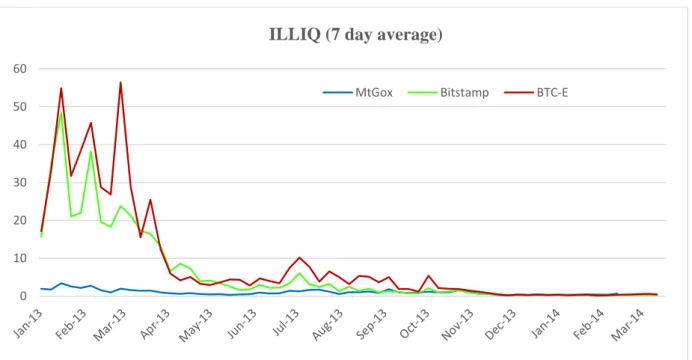
Following diagram shows the illiquidity of MtGox, Bitstamp and BTC-E, calculated on a weekly average. Because of high trading volume compared to the absolute price changes, we have multiplied the formula by 100 million to get a more convenient number on the left axis. The importance in the graph is not the value of the observations, but rather the differences between the exchanges.
Figure 4: Illiquidity on MtGox, BTC-E and Bitstamp
0 10 20 30 40 50 60
ILLIQ (7 day average)
22
As seen in the graph above, trading at MtGox involved a significantly lower illiquidity than Bitstamp and BTC-E up until May 2013 when they began to even out. An indication of high illiquidity is that it is hard to trade without affecting the price. When the price impact is smaller on a market, the volume is often higher and big trades can therefore be made without affecting the price, which was the case when trading at MtGox.
In terms of volume, MtGox almost had a monopoly on the bitcoin trading market prior to mid-2013, some days accounting for up to 80-90 percent of the total USD volume. Later on, as MtGox faced various problems5 that damaged their reliability in the Bitcoin community, Bitstamp and BTC-E gained market shares. By the end of 2013, the three exchanges accounted for about 30 percent each of the total US-dollar volume. (Bitcoincharts, 2014) As mentioned earlier, if the illiquidity on market one is higher than that of market two, it implies that the price of the identical asset should be lower as a compensation for the higher risk, with a higher expected return.
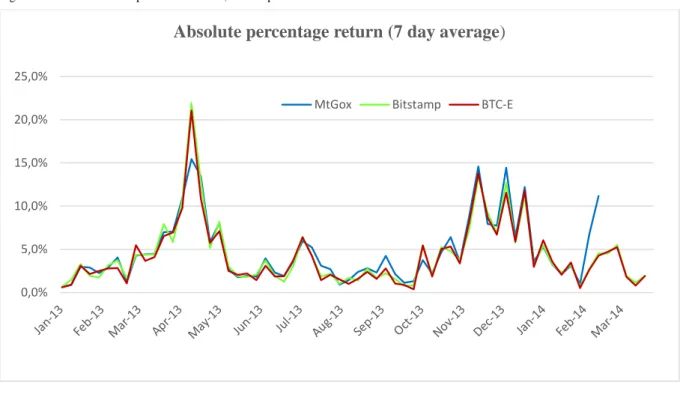
Figure 5: Absolute return in percent on MtGox, Bitstamp and BTC-E
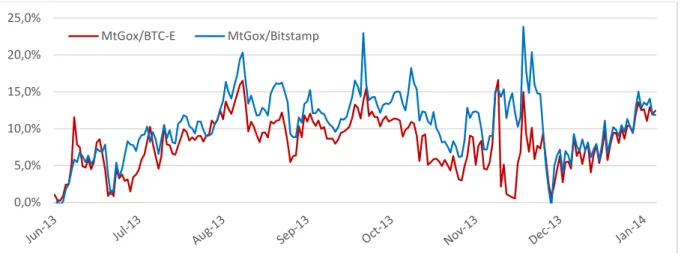
By comparing the absolute return in percent, greater swings on Bitstamp and BTC-E can be observed when their illiquidity was essentially higher which indicates a higher price impact. Sometimes the price would swing more (in percent) on MtGox, but when the price fluctuated the most, it had a bigger impact on the two inferior exchanges. Even though the illiquidity between the exchanges evened out by the mid-2013, the prices on MtGox were clearly higher
5 In mid-June 2013, MtGox temporarily suspended withdrawals in US dollars due to problems with their banks. 0,0% 5,0% 10,0% 15,0% 20,0% 25,0%
Absolute percentage return (7 day average)
23
than the ones on BTC-E and Bitstamp. It is therefore hard to ensure that different liquidity is the only factor accountable for the price differences.
Figure 6: Price ratio based on closing prices.
4.3 Volatility
Another important aspect when comparing assets is risk. Calculating an asset’s price volatility is one of the most common measures of doing this. Price volatility measures the swings and variability of the price. High volatility indicates greater swings in price and thus means a higher risk. It is related to liquidity in the way that a liquid asset usually has a lower volatility than an identical, but more illiquid asset. The price impact is lower on the liquid asset and it is therefore easier to trade without affecting the price, which contributes to a lower volatility. One way of measuring price volatility is by calculating an asset’s Average True Range (ATR). It was originally developed by J. Welles Wilder and is not a price indicator but simply a measurement for price volatility. It is calculated as a moving average (14 days) of the true ranges. Following definition is implied:
( )
(2)
TRt = True range at day t. It is the greatest of:
- the difference between today’s high and today’s low
- the absolute difference between today’s high and yesterday’s close - the absolute difference between today’s low and yesterday’s close
ATRt-1 = ATR value at day t-1
n = Number of days for which the moving average is calculated 0,0% 5,0% 10,0% 15,0% 20,0% 25,0% MtGox/BTC-E MtGox/Bitstamp
24 ATRt = ATR value at day t. (The first ATR is the average of the first 14 day’s true ranges.)
(Siegel, 2000)
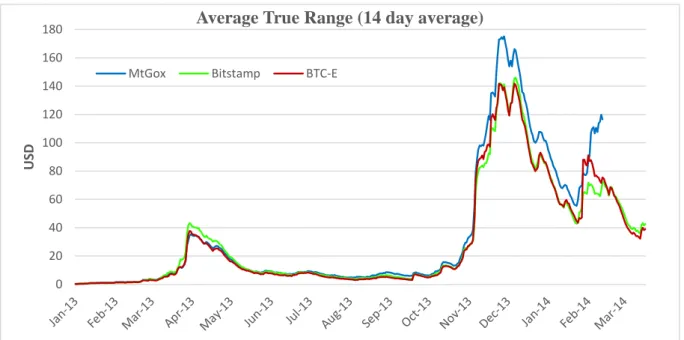
Since standard ATR is not shown as a percentage of the price, high priced assets will have higher ATR values than low priced. For example, a $400 security will have much higher ATR values than a $50 security. ATR values are therefore not comparable between different assets. Since bitcoin is an identical asset but traded on different exchanges, using ATR is an applicable method when comparing the exchanges’ volatility. Using ATR on Bitcoin shows on average how much the price of a bitcoin has been fluctuating over a period of time, in our case 14 days.
Figure 7: Volatility on MtGox, Bitstamp and BTC-E.
By analyzing the data from 2013 we can see that, in 77 percent of the observations, the ATR values were higher on MtGox than on Bitstamp. During the same period Bitstamp’s ATR values were higher than BTC-E’s in 86 percent of the observations. Since the trading price at MtGox most of the time was higher than on Bitstamp and BTC-E, it is not strange that it shows higher ATR values. A more accurate comparison would be to calculate a ratio of the ATR values and compare it to the price ratio between the exchanges.
0 20 40 60 80 100 120 140 160 180 USD
Average True Range (14 day average)
25
Table 2:
2013, Q1+Q2 MtGox / Bitstamp MtGox / BTC-E Bitstamp / BTC-E
Price ratio 1,5 % 4,2 % 2,6 %
ATR ratio 0,8 % 11,5 % 13,7 %
2013, Q2+Q3
Price ratio 8,1 % 11 % 2,8 %
ATR ratio 20,5 % 32,5 % 9,7 %
As can be seen in table 2 the ATR values in the first half of 2013 were, on average, 0.8 percent higher on MtGox than on Bitstamp. The average price was 1.5 percent higher. During the second half, the average price ratio increased to 8.1 percent while the corresponding ATR ratio increased to 20.5 percent. The same relationship goes when comparing MtGox and Bitstamp with BTC-E. The average ATR value is essentially higher than the average price ratio. For the exchanges to experience the same volatility, the price ratio and ATR ratio should be the same.
4.4 Arbitrage possibilities
Even though the exchanges experience different volume, liquidity and volatility, because of arbitrage opportunities, prices should even out. In the second half of 2013, when the liquidity and volume between the three exchanges evened out, the trading price on MtGox was still higher than on Bitstamp on BTC-E, sometimes with price differences of up to 20 percent. The reason behind this was that customers on MtGox faced problems when withdrawing funds in USD. Since it was then easier to withdraw your bitcoins than your dollars, the demand for holding bitcoins on MtGox increased. Rather than selling them and facing difficulties when trying to get the money, people would hold/buy their bitcoins from MtGox, thus pushing the price up further. As can be observed in table 2, the average price was 11 percent higher on MtGox than on BTC-E during the second half of 2013, compared to 4.2 percent during the first half.
There were however price differences prior to MtGox’s problems as well there are price discrepancies between Bitstamp and BTC-E today. So when the exchanges are well functioning, why do people not take advantage of this? A crucial condition for arbitrage trading to be possible is that the time for selling and buying can take place at the same time. Since it is not possible to transfer funds between the exchanges, an arbitrage activity must contain the following steps (given BTC price on A is cheaper than on B):
26
1. Transfer funds into exchange A 2. Buy bitcoins
3. Withdraw bitcoins to your wallet 4. Deposit bitcoins on exchange B 5. Sell bitcoins
6. Withdraw funds and do it all again
Say, for example, that a bitcoin costs 3 percent more on Bitstamp than on BTC-E. In step one, transferring funds into Bitstamp takes between 2-5 business days. If it is an international wire transfer, Bitstamp will charge you 0.1 percent (minimum fee: $15). In step two, Bitstamp will charge a maximum of 0.5 percent for the purchase depending on your monthly trading volume. (Bitstamp, n.d.) In step three and four, withdrawing and transferring bitcoins from Bitstamp to BTC-E is associated with very low costs but might take some time depending on the exchange’s administration and confirmation process. When selling your bitcoin on BTC-E, they will charge you between 0.2 – 0.5 percent. In the last step, withdrawing funds from BTC-E to your bank account costs at least 0.1 percent and takes up to five business days. (BTC-E, n.d.) Transfer them back to Bitstamp and repeat until the difference is 0 percent. There are fees in every step and a time frame of at least two weeks for the whole loop to take place and move funds back into position for sale. You might also be subject to capital gain taxes depending on where you live, thus removing some of the profit. Since the buying and selling cannot take place at the same time, one will expose oneself to risk while trying to make arbitrage profits.
4.5 Network attributes
With a higher price and more bitcoins added to the Bitcoin network, Bitcoins total market capitalization has increased from $144M in January 1st, 2013 to $6.4B in April 1st, 2014 (Bitcoin’s market capitalization peaked at $13.9B in December 4th
, 2013). When looking at the number of transactions per day, a small but upward trend can be observed. Notice that it is not possible to see the difference between a consumption transaction and an investment transaction.
27
Figure 8: Number of transactions per day
Figure 8 shows the daily number of transactions, irrespective of size. It can be a transaction corresponding to 0.01 bitcoins as well as 1000 bitcoins. By calculating the average transaction value in USD and divide it with the total market capitalization, it can be evaluated if the average size of a transaction is the same, regardless of the increasing supply and what a bitcoin is worth. The value of the observations in figure 8 is multiplied by 1 million to get a more convenient number on the y-axis.
Figure 9: Average transaction value per USD of bitcoin’s total market capitalization
During this time frame, around 2 million bitcoins have been mined and added to the network, the price has increased significantly, both contributing to a bigger market capitalization. The daily number of transactions has increased, but the average value of these transactions relative to the total market capitalization has a negative trend which can be observed in figure 9.
0 20000 40000 60000 80000 100000
Number of transactions per day
0 0,2 0,4 0,6 0,8 1 1,2
28
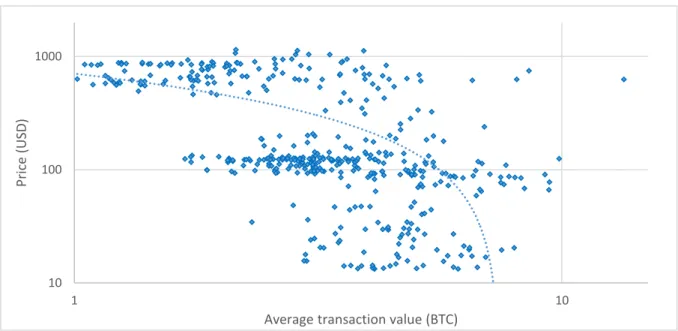
Figure 10: Correlation between the bitcoin price in USD and the average transaction value denominated in bitcoin. (Both axes are in logarithmic scales.)
From January 2013 to April 2014, the correlation between the bitcoin price and the average bitcoin transaction is negative by a value of –0.452. The p-value is <0.0001 on a one percent significance level, indicating that there is a significant correlation between the two variables. Hence, a higher Bitcoin value in USD relates to a lower average transaction value denominated in bitcoins.
4.6 Similarities with a bubble?
A professor from Hofstra University in New York by the name of Jean-Paul Rodrigue published a model charting the “phases of a bubble” that could arise from new types of goods that emerge. The model is based on hundreds of years of economic data and consists of four main stages: the stealth phase, the awareness phase, the mania phase and the blow off phase.
1. The stealth phase
The first phase is called the stealth phase. Only a few know about the emerging possibilities of this new good and the potential future appreciation of it. Since it is so new however, much caution is shown as investing money comes at a great risk. The users are this far exclusively sophisticated, meaning that only those who are the most knowledgeable of it are the only ones who dare touch it. Prices are slowly increasing, but the public does not take any further notice to this. 10 100 1000 1 10 Price (U SD)
29
2. The awareness phase
At this point in time more and more investors are hearing the buzz and the momentum starts to accumulate. This brings more money to the table and naturally, market forces further push the prices up. As soon as the price has increased noticeably it is common to witness a first sell off phase, when early investors begin to reap the first crops. As the end of the phase approaches, it starts to get more and more positive attention from the media and increasingly unsophisticated users decide to jump aboard.
3. The mania phase
By now the word has started to spread and many decide to invest. Expectations of the future are very bright and nobody really thinks twice about it. As more money flows in, even higher expectations are born and prices rise exponentially – attracting even more investors. It turns into an investing frenzy that everyone seems to be profiting from. This is known as “overtrading” (by Adam Smith) or “pure speculation” (by Charles Kindleberger) and occurs when people choose to invest, on the basis of rising prices only. As rationality and logic is non-existing here, this phase is only about group psychology. It will continue as long as the general expectations are positive, but the peak is imminent.
4. The blow off phase
Eventually, some kind of trigger is pulled and sets off a large chain reaction, in which everybody reacts almost at once. Expectations of the future become ominous and prices drop. Denial is common and many try to convince the public that it is only a temporary setback. This fools a few, but only for a short while. As people want to start selling their assets the buyers are few and far apart, since a further decline in the price is expected. The late adopters are the ones who carry the heavy weights as the early adopters have already pulled out. (Rodrigue, 2013) (Kindleberger, 2005)
30
Figure 11:
Source: Rodrigue, 2013.
Concerning Bitcoin, the first phase can be considered the one prior to the banking crisis in Cyprus. The media attention was very absent and few knew about it. The actual users were mainly those who had a deep understanding of the technology. As the media started to draw attention to the growing Bitcoin activity in Cyprus, it transformed into phase two. The buzz about Bitcoin as a potential investment spread and prices ascended. A noticeable price drop later occurred, due to a mix of the first speculators starting to cash out at the same time as the faith for Bitcoin was slightly shocked. The mania phase can be associated with the birth of the immense Chinese interest in Bitcoin, the price peaking in late November 2013 and eventually triggered by China’s decision to forbid their financial instutitions to trade with bitcoins. A short, temporary recovery did happen, but the price eventually dropped down to where we can find it today. When comparing Rodrigue’s model to the price graph in figure 2, one can see that there are clear similarities between them.
31
5. Prospects
The future of Bitcoin is very obscure. Historically, nothing like it has ever existed before. This means the evolution of Bitcoin can go in any direction; and whichever way it takes is presently and slowly unfolding before our very eyes. Many people are speculating about what the future will look like and opinions are many. Yet, when sorting out the rubble, three distinct possible outcomes rise above the rest:
1. Bitcoin becomes a globally acknowledged currency, used everywhere. Perhaps even wiping out cash and credit cards as we know it.
2. Bitcoin remains alive and well, but functioning in the background. Instead of being a main currency, it could function as an attribute and a complement to the global financial sector. In the same way English has spread across the world without wiping out every existing language in its path, Bitcoin could spread across the world as a global payment system, co-existing with other world currencies.
3. Bitcoin prices deflate to their intrinsic value. It could be through a bubble or it fades away over time. Either way it ceases to exist in the public eye and eventually gets forgotten as the years pass.
How likely each option is can be widely disputed and one must also take into account that variations of the different outcomes are possible. Below is an attempt to explain, in more depth, the different scenarios.
5.1 An acknowledged currency
Although it seems far away, there have been voices saying Bitcoin could become a global currency. In order for this to happen, the entire world has to be “on the same wave length”. This will not happen unless all the requirements for a currency are fulfilled, the three being: unit of account, medium of exchange and store of value.
Out of the three, acting as a medium of exchange is already partially achieved. There are plenty ways of spending bitcoins and a lot of different services available for the transactions to take place. Bitcoin’s technical design allows for fast transactions and since there is no third party that needs to confirm the legitimacy of the transaction, fees are low. (Economist, 2014) All goods are however not tradable on the bitcoin market, but is does not takes away the prerequisite to function as a medium of exchange.
32
The store of value function is more abstract. Bitcoin does fulfil the requirement in the sense that it can be traded and stored for future use. The difficult part is achieving stability in the value of a bitcoin, as it lacks intrinsic value and is priced entirely after demand. (Yermack, 2013) One can guess with near certainty how much 100 USD today will be worth one year from now, as we only have to take into account the current inflation. The price of a bitcoin however, is very unpredictable; and there is no guarantee that your bitcoins will be worth as much, in even a few weeks’ time. This makes the currency extremely vulnerable to speculative attacks, in other words the consequences of group psychology and collective speculation (both bull and bear markets).
Out of the three requirements, the one which is the furthest away from being fulfilled today is that it functions as a unit of account. In order for people to truly accept and adopt a currency like Bitcoin they must begin to “think in bitcoins”, i.e. asking themselves how much things cost in bitcoin, rather than bitcoin converted into dollars. If you buy a coffee for $4 and the price is changed to $2 the next day, one can say with certainty that the coffee is now half the price from what it was earlier. This does not apply to Bitcoin payments, as the value is too instable. Although priced identically (in Bitcoin) for two consecutive days, the price of the coffee during day two (in USD) could be half the price, twice the price, ten times the price or whatever the currency happens to be on that day. This means that sellers who accept Bitcoin payments constantly must adjust the prices of their goods, in order for them to represent their current value in USD. (Yermack, 2013)
A proportion of people in the world, are using Bitcoin as is intended, hoping one day it will be acknowledged as a globally accepted currency. For Bitcoin to function as a currency it is also essential that the velocity increases and more people start using it to purchase goods and services. Presently, the typical user does not. The majority of Bitcoin users so far are speculative investors who have recently seen the possibilities of an investment profit, as the media coverage increased and the price skyrocketed. According to Fred Ersham, co-founder of the digital wallet service Coinbase, approximately 80 percent of the transaction activity is related to speculation. (Goldman Sachs, 2014)
5.2 Complement
If Bitcoin could somehow become a more controlled and stable currency, this way of transferring money internationally has the potential of entirely knocking out its present competition (such as cash offices). In 2013, remittances sent by immigrants to developing
33
countries amounted to $401 billion dollars and this is projected to increase to $515 billion by 2015. (The World Bank, 2013) This money usually flows through third parties such as MoneyGram or Western Union. In Q1 of 2014 the global average total price of remittances was 8.36 percent, which was a lifetime low. (The World Bank, 2014) For this reason, Bitcoin has an immense advantage to cash offices if it is used as a medium of exchange. In this case, the volatility would not be a very big obstacle either. Money could be exchanged to bitcoins, cheaply sent across the world and exchanged back to a regular currency. Yet to do this, the recipient must have an account on an exchange platform in order to sell the bitcoin and receive the money. The exchange used must also be able to provide withdrawals in the currency wanted; and presently, many developing countries do not provide this service. One company that has specialized in remittances is Bitpesa. They are currently only operating on the Kenyan market. With them, the process of sending bitcoins is convenient for both the sender and the recipient. First, the sender sends the bitcoins to Bitpesa’s Bitcoin address. Within minutes, Bitpesa then exchanges these bitcoins to Kenyan shilling which are in turn deposited into the recipient’s mobile money account (for example M-Pesa, Orange, Airtel or Yu). The total fee for their service is 3%. (Bitpesa, n.d.)
Not only does Bitcoin have a wide range of applications, it can also give rise to new lines of products and services. One example is the possibility of payments. Until now, micro-payments of less than $1 have seen little success due to the impracticalities that follow a transaction of this kind. Bitcoin enables extremely small payments at a reasonable cost; making the market for micro-payment services very much alive, in a way they have not been before. This would enable a more convenient “pay as you go” world where people could pay very small amounts for very small services or goods. Present transaction fees (using for example Visa, MasterCard or PayPal) make these types of purchases impractical as they easily could be equal to, or even more than, the actual purchase price itself. One example of a micro-payment like this could be paying for WiFi access by the kilobyte, whenever passing a WiFi hotspot. Since mobile internet services already exist today, this specific problem has been solved, but future possibilities are manifold. (Bitcoin.org, n.d.)
Other positive characteristics of Bitcoin, besides micro-payments and the cost efficiency are the global accessibility, the possibility of multi-signature accounts and simplifying donations/crowdfunding. The global accessibility makes everyone with an internet connection allowed to take part of the network, increasing global access to commerce and potentially helping international trade flourish. Multi-signature accounts allow accounts to be shared by
34
groups of people and do not allow any transactions to take place unless all the members are unanimous about it. This could be of great value to for example a board of directors, to make sure no company money is spent without the knowledge of the rest. (Bitcoin.org, n.d.)
Crowdfunding is a type of fund raising, when members of a group each contribute with a small amount of money and collectively working towards a unanimous economic goal. This could be a project such as a non-profit, political or philanthropic campaign. (Canada Media Fund, 2012) With the technology of Bitcoin comes the possibility of even pledging money to a project, but not collecting it from anyone until the main economic target is reached.
When the website WikiLeaks announced that they were in need of donations to be able to continue their work, both Visa and MasterCard denied donations from the general public (due to political pressure), making donations in bitcoin skyrocket instead. (Matonis, 2012) This is since a bitcoin transaction cannot be stopped by any authority. Also, in case of a catastrophe, such as a natural disaster or something similar, bitcoin donations could be very useful in quickly and cheaply organizing an international response and the money would arrive long before any normal currency could.
The fact that money can be programmable opens up a world of possibilities. It could be regarded as an extrinsic value, i.e. the value assigned to an object via external factors. Things like “earmarking” money could become common in the future. This would make money impossible to spend, unless spent in the way it is intended. It might be programming economic support to third world countries so they can only be used for medical treatment/food and not for weapons. Or it might be parents programming their children’s allowances so that they cannot buy cigarettes or alcohol, but they can buy school lunches etc. This way it would have similarities with today’s system with food stamps for people on financial support in the US. Other applications for programmed money are cloud services. Money can be stored in clouds and programmed to be released, piece by piece or all at once, at a given point in time. This could be for example on your child’s 18th
birthday or after your death. (Wilhelm, 2013)
5.3 Fading away or crashing
In the event of Bitcoin dying out, it appears there are two possible ways it might do so. It either slowly dies out, as people lose hope and interest for it; or something extreme happens that makes the public interest change overnight from great to non-existent. Either way, this would have to be something so major that Bitcoin cannot fight back against it.