Civil, Construction and Environmental Engineering
Publications
Civil, Construction and Environmental Engineering
4-2017
A data-driven optimization-based approach for
siting and sizing of electric taxi charging stations
Jie Yang
Southeast University, China
Jing Dong
Iowa State University, [email protected]
Liang Hu
Iowa State University, [email protected]
Follow this and additional works at:
https://lib.dr.iastate.edu/ccee_pubs
Part of the
Civil Engineering Commons, and the
Transportation Engineering Commons
The complete bibliographic information for this item can be found at
https://lib.dr.iastate.edu/
ccee_pubs/203. For information on how to cite this item, please visit
http://lib.dr.iastate.edu/
howtocite.html.
This Article is brought to you for free and open access by the Civil, Construction and Environmental Engineering at Iowa State University Digital Repository. It has been accepted for inclusion in Civil, Construction and Environmental Engineering Publications by an authorized administrator of Iowa State University Digital Repository. For more information, please [email protected].
A data-driven optimization-based approach for siting and sizing of electric
taxi charging stations
Abstract
This paper presents a data-driven optimization-based approach to allocate chargers for battery electric vehicle (BEV) taxis throughout a city with the objective of minimizing the infrastructure investment. To account for charging congestion, anM/M/x/squeueing model is adopted to estimate the probability of BEV taxis being charged at their dwell places. By means of regression and logarithmic transformation, the charger allocation problem is formulated as an integer linear program (ILP), which can be solved efficiently using Gurobi solver. The proposed method is applied using large-scale GPS trajectory data collected from the taxi fleet of
Changsha, China. The key findings from the results include the following: (1) the dwell pattern of the taxi fleet determines the siting of charging stations; (2) by providing waiting spots, in addition to charging spots, the utilization of chargers increases and the number of required chargers at each site decreases; and (3) the tradeoff between installing more chargers versus providing more waiting spaces can be quantified by the cost ratio of chargers and parking spots.
Keywords
Electric taxis, Charging infrastructure planning, GPS trajectory data, Integer programing, Queueing model Disciplines
Civil Engineering | Transportation Engineering Comments
This is a manuscript of an article published as Yang, Jie, Jing Dong, and Liang Hu. "A data-driven optimization-based approach for siting and sizing of electric taxi charging stations."Transportation Research Part C:
Emerging Technologies77 (2017): 462-477. DOI:10.1016/j.trc.2017.02.014. Posted with permission. Creative Commons License
This work is licensed under aCreative Commons Attribution-Noncommercial-No Derivative Works 4.0 License.
1
A Data-Driven Optimization-Based Approach for Siting and Sizing of
1Electric Taxi Charging Stations
2Jie Yang
a,∗,
Jing Dong
b, Liang Hu
b3
a Development Research Institute of Transportation Governed by Law, Southeast University, Nanjing 210096, 4
China 5
b Department of Civil, Construction and Environmental Engineering, Iowa State University, Ames, IA 50011, 6
United States 7
8
Citation: Yang, J., Dong, J., & Hu, L. (2017). A data-driven optimization-based approach for siting and sizing of
9
electric taxi charging stations. Transportation Research Part C: Emerging Technologies, 77, 462-477.
10
∗ Corresponding author
Postal address: Law school, No. 2 Sipailou, Nanjing, Jiangsu, China, 210096 E-mail address: [email protected]
2
Abstract 1
This paper presents a data-driven optimization-based approach to allocate chargers for battery electric 2
vehicle (BEV) taxis throughout a city with the objective of minimizing the infrastructure investment. 3
To account for charging congestion, an
M M x s
/ / /
queueing model is adopted to estimate the 4probability of BEV taxis being charged at their dwell places. By means of regression and logarithmic 5
transformation, the charger allocation problem is formulated as an integer linear program (ILP), which 6
can be solved efficiently using Gurobi solver. The proposed method is applied using large-scale GPS 7
trajectory data collected from the taxi fleet of Changsha, China. The key findings from the results 8
include the following: (1) the dwell pattern of the taxi fleet determines the siting of charging stations; 9
(2) by providing waiting spots, in addition to charging spots, the utilization of chargers increases and 10
the number of required chargers at each site decreases; and (3) the tradeoff between installing more 11
chargers versus providing more waiting spaces can be quantified by the cost ratio of chargers and 12
parking spots. 13
3
Keywords 1
Electric taxis; Charging infrastructure planning; GPS trajectory data; Integer Programing; Queueing 2
model 3
4
1. Introduction 1
Replacing conventional gasoline vehicles (CGVs) with alternative fuel vehicles, such as battery electric 2
vehicles (BEVs), offers an appealing chance to reduce greenhouse gas (GHG) emissions and other 3
harmful pollutants in highly populated urban areas (Buekers et al., 2014; Yuksel and Michalek, 2015) . 4
However, the fear that the vehicle has insufficient range to reach the destination, referred to as range 5
anxiety, has been shown to be a significant obstacle to market acceptance of BEVs (Neubauer and 6
Wood, 2014; Rauh et al., 2014). One way to mitigate range anxiety is through the deployment of public 7
charging infrastructure, but high costs of equipment and installation limit the coverage of the charger 8
network (Agenbroad and Holland, 2014; Peterson and Michalek, 2013; Schroeder and Traber, 2012). 9
Thus, it is vital to place and size new charging stations based on charging demands, so as to best utilize 10
limited resources. 11
Various facility location models have been proposed to optimize the layout of hydrogen or gas 12
refueling stations (Aikens, 1985; Church and Velle, 1974; Kuby et al., 2009; Nicholas, Handy, and 13
Sperling, 2004; Wang and Lin, 2009). But most of the existing facility location models cannot be 14
applied to optimizing the location of charging stations for the following two reasons: (1) The placement 15
and sizing of hydrogen and gas stations are usually under certain restrictive conditions for 16
environmental, health, and safety reasons (Kuby et al., 2009), while the conditions for siting chargers 17
are more flexible. It is common to install chargers in parking garages, curbside, and in surface parking 18
lots, so that BEVs can be charged at their dwell places, such as home, work places, and commercial 19
places (Pearre et al., 2011; Tian et al., 2014; Zou et al., 2016). (2) Unlike CGVs, it generally takes a 20
long time to charge BEVs, ranging from 30 minutes to several hours, resulting in a long waiting time 21
for incoming BEVs if all the chargers are occupied (Foley et al., 2010; Li et al., 2015). Waiting for 22
charging is usually an unpleasant experience for BEV drivers. Drivers might have taken a detour and 23
traveled some extra distance to reach the charging station due to limited accessibility, creating an even 24
worse user experience. Detours and waiting times for charging hinder the adoption of BEVs. If BEVs 25
can be charged during their dwell time without behavioral changes—that is, if the time between two 26
consecutive trips can be utilized for charging—consumers are more likely to adopt the BEV technology. 27
In this paper, we investigate the following problem: given daily travel and dwell patterns (including 28
dwell locations, dwell time, and arrival rates) of a fleet of taxis, determine where to deploy new charging 29
stations and how many chargers to install at each station. The objective is to minimize the overall 30
infrastructure investment while satisfying the charging demand. Dwell patterns of potential BEVs are 31
derived from trajectories of over 7,910 taxis whose travel activities were recorded for one week. In 32
particular, to account for charging congestion, an
M M x s
/ / /
queueing model is adopted to estimate 33the waiting time and the fraction of customers who are turned away. The probability that electric taxis 34
can be charged at their dwell places during the day is considered as the model constraint, and the 35
objective is to minimize the total cost of building charging stations and installing chargers. In general, 36
optimizing the performance of queue systems is a difficult problem because of the nonlinear relationship 37
of the performance metrics as functions of the arrival and service rates, and the computational time 38
increases exponentially with the size of the problem (Bertsimas et al., 1994; Mung et al., 2002). In the 39
proposed charger location problem, hundreds of charging stations need to be sited in the city, and 40
multiple chargers need to be assigned to each station. Thus, solving the nonlinear mixed integer program 41
is computationally demanding. An approximation method is presented to transform the formulation to 42
an integer linear program (ILP), which can be solved efficiently. In summary, the main contributions 43
of this paper include the following: (1) develop queueing models to describe charging congestion based 44
on taxis’ dwell patterns observed from GPS tracked trajectory data; (2) formulate the charger allocation 45
problem as an integer linear program, considering charging congestion phenomenon; and (3) investigate 46
the tradeoff between installing more chargers versus providing more waiting spaces and the impact of 47
charger power on waiting time. 48
5
The rest of the paper is organized as follows. Section 2 presents an overview of related work, 1
followed by problem statement and assumptions in Section 3. The optimization model and the integer 2
program formulation are presented in Section 4. Results and conclusions are summarized in Section 5 3
and 6, respectively. 4
2. Literature review 5
To help policy makers and investors efficiently allocate charging resources, various mathematical 6
models have been developed for charging infrastructure planning. For example, Frade et al. (2011) used 7
a maximal covering model to optimize the location of charging stations in Lisbon, Portugal, with the 8
objective of maximizing demand coverage. Feng et al. (2012) proposed a method for charging station 9
planning using weighted Voronoi diagram. Based on the quantified cost for detour charging, the road 10
network of planning area is partitioned by Voronoi diagram so as to minimize the users’ travel cost. He 11
et al. (2016) compared three classic facility location models and found the p-median model was more 12
effective than the set covering model and the maximal covering location model for locating electric 13
vehicles (EV) charging facilities. Li et al. (2016) developed a multi-period multipath charging station 14
location model that captured the dynamics in the topological structure of network, formulated the model 15
as a mixed integer program, and solved it by genetic algorithm. He et al. (2015) formulated the problem 16
of optimally locating public charging stations within a budget limit as a bi-level mathematical program 17
and solved the problem using a genetic algorithm. Guo et al. (2016) established a network-based multi-18
agent optimization model for planning fast charging stations that simultaneously captured the selfish 19
behaviors of individual investors and travelers and their interactions. The model was solved based on 20
variational convergence theorems. Ghamami et al. (2016) developed a mixed integer program with 21
nonlinear constraint to configure charging infrastructure along highway corridors. The model minimizes 22
the total system cost and considers the realistic patterns of O–D demands and flow-dependent charging 23
delay. Based on a tour-based equilibrium framework, Wang et al. (2016) considered a special EV 24
network composed of fixed routes for an electric bus fleet and optimized the deployment of recharging 25
stations and recharging schedule so as to ensure an electric bus can be charged when it stops within a 26
pre-specified duration. 27
Travel survey data offer an insight into the charging demand and are usually taken as an indicator 28
of the deployment of charging infrastructure. With regard to the studies based on travel survey, Chen 29
et al. (2013) formulated a mixed integer programming problem to optimally allocate a constrained 30
number of charging stations based on the parking information from over 30,000 personal-trip records 31
collected by household travel survey in Seattle, Washington, United States. Assisted by three spatial 32
data sets, including the National Household Travel Survey (NHTS) data, Aultman-Hall et al. (2012) 33
identified optimal charging locations in the rural areas in Vermont, United States. In comparison with 34
traditional travel survey data, Global Positioning Systems (GPS) tracked travel survey data contain 35
more accurate information about trip length, dwell place, and dwell duration of each vehicle, thus 36
providing a way to estimate the spatial and temporal distribution of charging demand. Individual GPS 37
tracked trajectory data, collected from conventional gasoline vehicles and representing real world travel 38
activities, have been used to site public charging stations in previous studies. In Dong et al. (2014)a 39
charger location optimization problem considering daily travel activity constraints was proposed based 40
on GPS-based travel survey data collected in the greater Seattle metropolitan area. 41
Since it is common for taxis to install GPS devices for the purpose of navigation and operational 42
monitoring, taxi trajectories become a major data source to examine the market potential of BEV taxis 43
(Baert and Kort, 2013; Chrysostomou et al., 2016; Tian et al., 2014; Wang et al., 2015; Yang et al., 44
2016) and optimize the siting of public charging stations (Tu et al., 2016, Shen et al., 2016). Taxi fleet 45
has some desirable features for deploying plug-in electric vehicles. Fuel cost savings are significant, as 46
taxis are driven heavily; thus, the payback period tends to be shorter. Cai et al. (2014) demonstrated the 47
potential public charging stations by extracting public parking ‘‘hotspots” from taxi trajectory data in 48
6
Beijing, China. This research was expanded by Shahraki et al. (2015), in which an optimization model 1
was developed to determine optimal charger allocation, with the objective of maximizing electrified 2
fleet vehicle miles traveled (VMT) of plug-in hybrid electric vehicles (PHEVs). Based on an event-3
based simulation, Sellmair and Hamacher (2014) proposed an algorithm to optimize the number of 4
charging stations per taxi stand based on real world driving patterns of conventional taxis in Munich, 5
Germany. The objective was to maximize economic benefit of the entire system including BEV taxi 6
drivers and charging station investors. In Jung et al. (2014) a bi-level simulation-optimization model 7
was proposed to allocate chargers for a fleet of 600 shared-taxis in Seoul, Korea, with an objective of 8
minimizing the queue delay. Ahn and Yeo (2015) proposed an Estimating the Required Density of EV 9
Charging (ERDEC) stations model to estimate the optimal density of charging stations aiming at 10
minimizing the range anxiety based on taxi trajectories in Daejeon City, Korea, which was a pioneering 11
work considering charging queueing. Using the real-world BEV taxi trajectory data collected from 12
Shenzhen, China, Li et al. (2015) built an optimization framework to find the optimal locations to site 13
stations and the optimal assignment of chargers, which also took charging congestion into consideration. 14
The objective was to minimize the average time to find the charging stations and the waiting time for 15
an available charger. 16
In summary, the optimal layout of charging stations is mainly generated using two types of 17
approaches: (1) Without pre-defined candidate sites, the charging station location optimization is 18
considered as a set covering problem based on the configuration of the road network in the study area 19
(e.g., Frade et al., 2011, Feng et al., 2012, Ahn and Yeo, 2015). The drawback of this approach is that 20
it may be impracticable to install chargers at certain locations. (2) Given a set of candidate sites, 21
including existing charging, gas, or hydrogen refueling stations, new stations or chargers are assigned 22
to the study area with a limited budget (e.g. Cai et al., 2014, Jung et al., 2014, Li et al., 2015). As 23
mentioned above, the distribution characteristics of gas and hydrogen stations are different from those 24
of charging stations. Moreover, in the early stage of the BEV market, charging stations are scarce across 25
the city. With more BEVs on the road, more chargers will be scattered all over the city, and the model 26
complexity is increased. The reason our research focused on dwell charging is that, first, the dwell 27
places are supposed to have desired space for parking, which can be equipped with chargers; second, 28
the average dwell time can be considered as the indicator of charger power, i.e., fast chargers are 29
preferred by the stations with shorter dwell time and vice versa. 30
Charging congestion is another concern of this paper. The waiting time may be significant if all 31
the chargers are occupied during the peak hours, especially at the popular dwell sites. Hosseini and 32
MirHassani (2015) developed a recharging station location model with queue considering capacity, 33
recharging time, and waiting time, and solved the problem using a heuristic algorithm. In the context 34
of predicting EVs’ charging demand and its impacts on power grid, the charging congestion effect is 35
modeled using queueing theory. In Ghamami et al. (2016) the average waiting time for charging was 36
computed using deterministic queueing theory. The most widely-adopted queueing model is
M M s
/ /
, 37assuming that both BEV arrival rate λ and charging service rate µ follow Poisson distributions and 38
that a vehicle will join the queue no matter how long the queue is (Akbari and Fernando, 2015; Bae and 39
Kwasinski, 2012; Qiu et al., 2013; Said et al., 2013; Said, 2015). To account for limited waiting spaces, 40
Fan et al. (2015) applied an
M G x s
/ / /
queueing model, which assumes a general service time 41distribution and at most
s
BEVs can be accommodated at a station. In this paper, anM M x s
/ / /
42queueing model is adopted, which assumes Poisson-distributed arrival and service rates with
x
43chargers and
s
-x
waiting spaces. 44Due to the computational complexity of larger-scale network optimization, little research has been 45
done to study the problem of siting and sizing charging stations simultaneously considering charging 46
congestion. This paper presents a data-driven optimization-based approach for charging infrastructure 47
planning using extensive vehicle activity data. 48
7
3. Problem statement and assumptions 1
3.1. Problem statement
2
Given a set of candidate sites for installing public charging stations
J
=
{1,2, , }
N
that are favorable 3dwell places of taxi drivers, a set of BEVs
I
=
{1,2, , }
M
that need to be charged at public charging 4stations at least once a day, and the probabilities that BEVs can be charged during dwell time without 5
travel pattern changes, the problem is to find optimal locations of charging stations and optimal 6
assignment of chargers to each station, so as to minimize the total investment of public charging 7
infrastructure. 8
The charging demand is estimated based on vehicles’ dwell patterns extracted from GPS 9
trajectories of taxis in Changsha, China, collected from 0:00 on October 8, 2015, to 23:59 on October 10
14, 2015 (local time). By the end of 2014, there were 7,957 taxis operating in Changsha. It is required 11
by the local government that GPS devices are installed on all taxis for monitoring purpose. Thus, the 12
dataset includes the entire taxi fleet in Changsha, with some missing data due to data collection and 13
transmission errors. A GPS signal is captured roughly every 10 seconds for each taxi. The data include 14
time-stamped location (i.e., longitude and latitude), spot speed, azimuth, and operational status (i.e., 15
empty or occupied). All trajectories were cleaned by removing invalid points caused by data recording 16
or transmission errors. 17
The study area is partitioned into a number of equal size cells first. Each cell has a quadrate edge 18
of 0.005° latitude and longitude, approximately equivalent to 0.5×0.5 km2. If the GPS records indicate 19
a vehicle dwelling in the same cell for more than 20 minutes, a dwell event of BEV
i
in cellj
is 20labeled. The study area (i.e., 27°~29° N, 111°~115° E) is divided into 320,000 non-overlapping square 21
cells. For each cell, the number of dwell events is counted. There are 2,460 valid cells that have records 22
of taxis parked during the one-week period. It is possible that some of the dwell locations are drivers’ 23
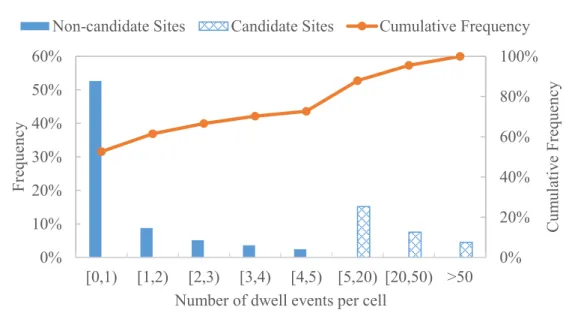
home locations, for which the number of daily dwell events is relatively low. Fig. 1 presents the 24
frequency distribution of the number of daily dwell events per cell. 72.7% of the valid cells have less 25
than 5 daily dwell events. It is comparatively uneconomical to install public charging stations in places 26
that are not attractive to taxi drivers. Thus, only the popular cells, where on average at least 5 dwell 27
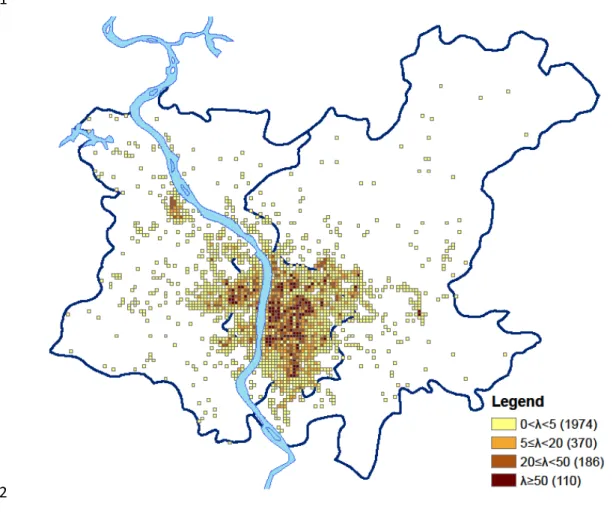
events occurred per day, are considered as candidates for installing public charging stations. Fig. 2 28
shows the spatial distribution of valid cells. There are 666 cells with a daily arrival rate no less than 5 29
veh/day on average, and these are selected as the candidate sites. The selected cells are mostly located 30
in the densely populated area of the inner city. The most popular dwell site is located near Huanghua 31
Airport and far from downtown. It has 10,777 dwell events weekly, with an average frequency of nearly 32
64 per hour. A charging queue and congestion problem might be observed if the taxi fleet is replaced 33
by BEVs. 34
Place Fig. 1 about here 35
Place Fig. 2 about here 36
A taxi with complete whole-day consecutive trip records is considered a valid sample. Identified 37
from GPS trajectories, there are 53,092 valid taxis with 185,404 dwell events occurring at the selected 38
666 cells over the one-week period. During the dwell time, taxi drivers usually have a meal, change 39
shift, or refuel the vehicle. Fig. 3 shows the number of dwell sites at which one driver would dwell in a 40
day. 15.86% of the taxis dwell at the same sites during the day. For taxis that dwell at multiple sites, if 41
they are turned away at one site, it is possible for them to be charged at the next dwell location. Thus, 42
the allocation of chargers can be optimized based on taxis’ dwell patterns. 43
Place Fig. 3 about here 44
3.2. Assumptions
8
3.2.1. Queueing theory for charging system
1
When a driver arrives at a charging station and finds all chargers are occupied, he/she can either wait 2
or decide not to charge at this location. Assume that, at each charging station, the arrival rate,λ, follows 3
a Poisson distribution and the service time,1/
µ
, follows an exponential distribution. The waiting line 4priority rule of the system is first-come, first-served. Hence, the charging congestion problem can be 5
formulated as the Markovian queueing system with a finite number of chargers,
x
, and a finite capacity, 6s
, symbolically denoted byM M x s
/ / /
. 7If
s
is equal to the number of chargers x, that is, an arriving BEV leaves the system without 8waiting for service if all chargers are busy, we denote it as
M M x x
/ / /
(i.e., no waiting spaces). Ifs
9is greater than
x
, the arriving BEV will be rejected if the maximum system capacity is reached; 10otherwise, it will wait in line for service. We denote this queueing system as
M M x K
/ / /
, whereK
11is the maximum number of customers that can be accommodated in the system (i.e., number of chargers 12
plus number of waiting spaces). The maximum queue size,
K x
−
, can be considered as the number of 13parking spaces provided for customers waiting for a charger. It is assumed that, for the
M M x K
/ / /
14queueing system, every five chargers are equipped with one parking spot for waiting. Thus, the system 15
capacity can be computed by Eq. (1), where the parameter
δ
is set as 5. 16 / K x= + xδ
(1) 17 3.2.2. Service time 18Service time, or charging time, varies based on the type of chargers. In addition, BEV drivers might not 19
move their vehicles until they finish their dwell activities even if the battery is fully charged. Therefore, 20
the average service times at cell
j
, denoted ast
j (unit: day), are estimated in two ways: (1) Drivers 21are assumed to move their vehicles when they depart; that is, the service time is estimated based on the 22
dwell time obtained from the trajectory data. The service rate, denoted as
µ
0j (unit: veh/day), is 23computed as
µ
0j =1/
t
j. (2) The service time is determined by the charging power. It is noted that 24not all the charging power can be directly transferred to battery energy, and a portion of the power is 25
lost during the charging process. Let α denote the charging efficiency. In this paper, we setα as 1.3 (Nie 26
and Ghamami, 2013). For example, if the input charging power is 104 kW, the effective charging power 27
is 80 kW. Assuming the battery capacity is 40 kWh, it takes 30 minutes to fully charge the battery if 28
using an effective charging power of 80 kW, and it takes 180 minutes with an effective charging power 29
of 13.3 kW. Six effective charging powers are taken into account: 80, 40, 26.7, 20, 16, and 13.3 kW. 30
Accordingly, the average service time of each station is assumed as 30, 60, 90, 120, 150, and 180 31
minutes, and the service rate
µ
is 48, 24, 16, 12, 9.6, and 8 vehicles per day, respectively. Since we 32do not estimate initial state of charge (SOC) of BEVs when they arrive at the stations, regardless of 33
what the SOC is after charging, in case (1) BEVs are assumed to be unplugged and removed from the 34
charger when their dwell time runs out, and in case (2) BEVs will be unplugged as soon as the assumed 35
service time runs out. 36
3.2.3. Charging demand
37
The sites where taxis frequently dwell are likely to have ample parking spaces to install chargers and 38
thus are selected as candidate sites. The number of average daily dwell events occurring at these 39
locations can be derived from the GPS trajectory data. In this paper, the average daily charging demand 40
(i.e., daily arrival rate) of cell
j
, denoted asλ
j (unit: veh/day), is assumed to be the average number 41of daily dwell events occurring in the cell. At an early market with a small number of BEV taxis on the 42
road, the charging demand is likely less than the number of dwell events. As the number of BEVs on 43
the road increases, the demand for dwell charging increases too. In particular, Beijing has recently 44
9
announced that all internal combustion engine (ICE) taxis will be replaced by BEVs by 2020 (DRC of 1
Beijing, 2016), in which case all the dwell taxis might use the chargers. Furthermore, if the chargers are 2
open to private BEVs and other commercial BEVs, the charging demand could exceed the number of 3
daily taxi dwell events. Predicting the future charging demand for each cell is beyond the scope of this 4
research. Since taxi dwell patterns represent the spatial distribution attributes of charging demand, for 5
simplicity we assume the charging demand
λ
j follows the taxis arrival patterns at the charging 6 stations. 7 4. Methodology 8 4.1. Formulation 94.1.1. Charging reject rate
10
As mentioned above, valid BEV samples are supposed to dwell at least at one candidate site during the 11
day. The factors indicating that BEVs are being charged successfully during their dwell events include 12
(1) chargers are installed at the dwell places, and (2) chargers or waiting spaces are available when 13
BEVs arrive. 14
Cell
j
is assumed as the dwell place for BEVi
. Once BEVi
arrives at cellj
, the probability 15that neither chargers nor waiting spaces are available is denoted as Rj (Rj∈[0, 1]). The probability 16
of BEV
i
being turned away at cellj
is considered as rij (rij∈[0, 1]), where rij =Rj. Obviously, 17if BEV
i
does not have the opportunity to park at cellj
during the day, the reject rate rij equals 1.18
The relationship between rij and Rj can be written by Eq. (2) 19 ij h ij j
r
=
R
(2) 20where hijis a binary variable indicating whether BEV
i
dwells at cellj
. If it does, hij =1;21
otherwise, hij =0.
22
Define
W
i as the daily reject rate of BEVi
, which is the multiplication of reject probabilities 23that BEV
i
is turned away at cellj
(∀ ∈
j
J
) (Eq. (3)). The probability of BEVi
being charged 24at least once in a day during its dwell events is then
1
−
W
i. 25 1 N i ij jW
r
==
∏
(3) 26The tradeoff between BEVs daily reject rate and charger network coverage is as follows. If
W
i=
1
, 27it is impossible for BEV
i
to take the dwell time for charging during the day because there is no 28charging station wherever it dwells. Therefore, it has no choice but to detour for charging, which 29
increases BEV drivers’ cost. As to BEV taxis, detour charging not only leads to extra travel distance 30
but also reduces the daily operating time and decreases taxi drivers’ revenue. If
W
i=
0
, wherever BEV 31i
dwells, it can always be charged because of adequate charger network coverage, which, of course, 32requires enormous infrastructure investment. The daily reject rate
W
i can be considered as a measure 33of service quality of charger coverage and can be calculated based on queueing theory. 34
10
Denote ps as the probability of a full system in which prospective BEV drivers are turned away. 1
It is widely known as Erlang’s loss formula and determined by the utilization ratio ρj =λ µj / j and
2
the number of chargers
x
j. The probability ps for anM M x s
/ / /
system is given by Gross (2008) 3 0 ! ρ − = s s s x p p x x (4) 4where p0 represents the probability that no customers are in the system, and it equals 5 1 1 1 0 0 1 1 0 (1 ) , 1 ! !(1 ) ( 1) , 1 ! !
ρ
ρ
ρ
ρ
ρ
ρ
ρ
ρ
− − + − = − − = − + ≠ − = + − + = ∑
∑
x s x n x s s n s n x x s n n x p s x n x (5) 6where
ρ
is the ratio of arrival rateλ
and service rateµ
, and ρs is the average utilization of the 7 system 8 s x x ρ λ ρ µ = = (6) 9Thus, the reject rate at cell
j
(namely,Rj) can be expressed as10 ( , ) 0 1 0
ρ
> = = s j j j j j p x x R x (7) 11The daily reject rate
W
i can be calculated using Eq. (2)–(7). Definer
max as the maximum 12allowable daily reject rate for each BEV (i.e., the probability that BEVs cannot be charged at any of the 13
dwell places during the day). The service quality constraint
W r
i≤
max(∀ ∈
i
I
) should be satisfied when 14optimize the siting and sizing of charging stations. 15
4.1.2. Optimization model
16
Let binary variable
y
j denote the deployment configuration for cellj
. Wheny
j=
1
, at least one17
charger is installed at cell
j
; otherwise, no charging station is installed at cellj
. Let integer variable 18j
x
denote the number of chargers installed at cellj
. The infrastructure cost includes a fixed cost of 19deploying a new charging station (denoted as
V
, unit: yuan per station) and the unit cost of a charger 20(denoted as
C
, unit: yuan per charger). The charger costC
varies greatly depending on the type of 21chargers. Single-port chargers with AC Level 2 capabilities cost ¥6500–13,000 excluding installation 22
and potential electrical upgrades in order to provide the appropriate outlet near the EV parking spot, 23
while the cost of DC fast chargers can be as high as ¥65,000–260,000 depending on the features and 24
brands (Delucchi et al., 2013; Schroeder and Traber, 2012). The fixed cost of deploying a new charging 25
station
V
includes the installation cost and permit fee. Unlike home stations, where hardware is the 26dominant cost, installation is the major contributor to public station cost (60% to 80% of total) 27
(Agenbroad and Holland, 2014). To minimize the investment, the total cost can be expressed as 28
11 1 1 min ( , ) N j N j j j J x y C x V y = = =
∑
+∑
(8) 1 subject to 2 max≤
iW r
,∀ ∈
i
I
(9) 30
jx
≥
, integer,∀ ∈
j
J
(10) 4 1 0 0 j 0 j j x y = x >= (11) 5 4.2. Solution method 6Optimizing the performance of queueing systems is a difficult task because of the nonlinearity of the 7
performance metrics as functions of the arrival and service rates. In general, the computational time 8
scales exponentially with the problem size. It is computationally demanding to solve the proposed 9
model with 666 queueing systems in the network. Note that the reject probability of an
M M x s
/ / /
10
system is a posynomial function, which has convexity properties (Mung et al., 2002). After a 11
logarithmic transformation, a global optimum solution can be found efficiently. Therefore, the 12
optimization model is reformulated into an integer linear program (ILP). 13
4.2.1. Regression
14
Assuming the reject rate Rj is a function of the number of chargers xj, a series of exponential 15
regression models is set up in the form of
=
b x cj j+ jj j
R a e
for the purpose of simplifying the computation 16of reject rate Rj (∀ ∈j J ). The regression coefficients aj, bj , and cj vary with system 17
utilization ρj. In the case study, since 666 cells are selected as the candidate sites for deploying 18
charging stations, 666 exponential regression models are developed to quantify the effects of charger 19
counts upon the reject rate. Table 1 lists the statistics of regression coefficients. Regardless of the 20
utilization ρj , R-squared values are all above 0.935, which indicates the exponential regression 21
formation is a suitable approximation of the relationship between dependent variables Rj and
22
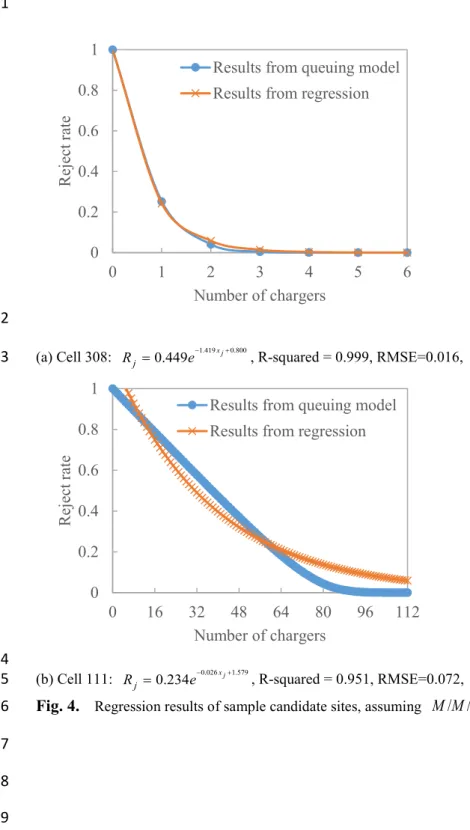
independent variables
x
j. Fig. 4plots the regression results of two example cells under the assumption 23of
M M x x
/ / /
queueing system. The system utilization ratios (i.e.,ρ
j=
λ µ
j/
0j) of Cell 308 and Cell24
111 are 0.34 and 73.82, respectively. Cell 308, located at Guzhang Park along the waterfront, is a newly 25
developed area. This less popular site generates 15 dwell events per day on average. Cell 111, located 26
near Huanghua Airport, is one of the most popular dwell sites and generates 1,540 dwell events daily 27
on average. Obviously, the busier the station is, the more chargers need to be installed so as to satisfy 28
the charging demand. 29
Place Table 1 about here 30
Place Fig. 4 about here 31
4.2.2. Logarithmic transformation
32
Using the regression models, Eq. (3) can be written as a monomial where variables and coefficients are 33
positive real numbers, and all of the exponents are real numbers: 34
12 1
(
j j j)
ij N b x c h i j jW
a e
+ ==
∏
(12) 1The constraint Eq. (9) can be replaced with its logarithm form as 2 max 1 1
ln
ln(
(
) )
= =≤
−
∑
N∏
N c hj ij j ij j j j jb h x
r
a e
(13) 3Since when xj =0, no chargers are installed at cell
j
, and all the arrival BEVs will be turned 4away, the reject rate of cell
j
, Rj, should equal 1. However, because the regression model is an5
approximation of the queueing model, there is no guarantee that when xj =0, Rj= 1. In Eq. (13) we 6
use an approximation that cj
≈
1
j
a e
and, therefore, 1ln( (
) ) 0
==
∏
N c hj ij j ja e
.
Hence, constraint Eq. (13) 7 is simplified as Eq. (14) 8 max 1 ln = ≤∑
N j ij j j b h x r (14) 9An interesting observation from Table 1is that the average values of coefficients bj gradually
10
increase with decreasing service rates, while coefficients aj and cj are roughly unchanged. This 11
supports the approximation in Eq. (14) that only coefficients bj are included as inequality constraints.
12
As expected, by increasing the number of waiting spaces in
M M x K
/ / /
system, fewer chargers are 13required in comparison with the
M M x x
/ / /
system. Thus, it is observed that the average values of bj14
in
M M x K
/ / /
systems are smaller than those inM M x x
/ / /
systems. It is speculated that bj and15 j
x are positively correlated. For example, based on the assumption of
µ µ
=
0 (i.e., when dwell time16
is considered as the service time), the average value of bj is close to that when
µ
=12 veh/day.17
Specifically, it is because the average dwell time in different candidate sites is about 109.9 minutes and, 18
accordingly, the average system service rate
µ
0 (i.e.,µ
0=(
∑
jµ
0j)/|
J
|) is equal to 13.1 veh/day.
19
The similar system utilization leads to similar configuration of charger layout, which will be further 20
illustrated in Section 5. 21
Since constraint Eq. (11) is a logic constraint where yj is binary and xj is a positive integer, a 22
Big-M reformulation is used to convert it into an internal mixed-integer problem. The reformulation is 23
illustrated in Eq. (15), where
M
is chosen as a sufficiently large value. If yj is 0 (false), xj is 24guaranteed to be 0; otherwise, xj is unconstrained.
25
j j
x
≤
My
(15)26
4.2.3. Integer programming solver
27
The optimization model is formulated in a standard form of ILP as follows: 28 1 1 min ( , ) N j N j j j J x y C x V y = = =
∑
+∑
2913 subject to 1 max 1 ln = ≤
∑
N j ij j j b h x r ,∀ ∈
i
I
2 j jx
≤
My
, ∀ ∈j J 3 0 j x ≥ , integer, ∀ ∈j J 4 0≤ yj ≤1, integer, ∀ ∈j J 5Since there are 666 candidate cells (i.e. |
J
|=666) and 53,092 valid taxi samples (i.e. |
I
|=53,092),
6the formulation leads to a large-scale ILP problem with 55,756 constraints (i.e.,
|
I
|
+4
|
J
|) and 1,332
7(i.e., 2|
J
|) decision variables. The problem is solved using MATLAB R2015b
(MathWorks, 2015) and 8YALMIP (Lofberg, 2004) as a modeling language and Gurobi 6.5.1 (Gurobi Optimization, Inc., 2016) 9
as the solver. The time spent solving such an optimization problem is about 0.67 seconds running on a 10
personal workstation with 3.50 GHz CPU and 16GB of RAM. 11
5. Results 12
5.1. Charging station siting
13
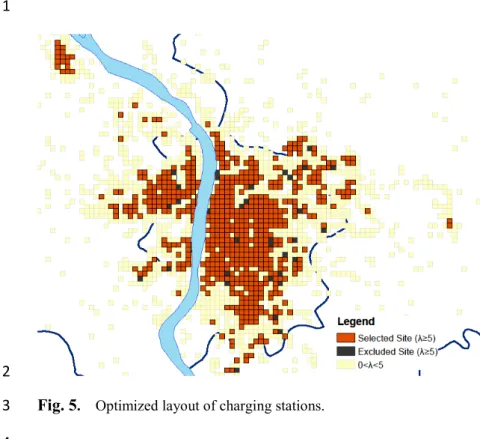
Fig. 5 shows the optimized layout of charging stations in Changsha (the map is zoomed to the inner 14
city). The red cells represent locations where charging stations should be installed, and the black cells 15
represent the candidate sites which are not selected. There are 35 black cells that are excluded from the 16
candidate sites. Various scenarios were tested with the combination of
r
max ranging from 5% to 25% 17and ratios of
C
andV
ranging from 1:0 to 1:10. WhenC V
/
equals 1:0, there is no fixed cost 18associated with a new charging station. Under ideal circumstances, proper electric outlets are already 19
available and investors do not have to pay for installation and the permit fee. However, in most cases, 20
the fixed cost
V
can hardly be avoided and varies greatly depending on the type of charger and location 21of the charging station. For example, if DC fast chargers are deployed, the fixed cost is likely to be 22
higher because of the transformer upgrades. But no matter how the scenario changes, the configurations 23
of excluded sites remain the same. It might be because the dwell patternH= hij , derived from the 24
GPS dataset, plays a determining role in charging station siting. In the most extreme case, if all the 25
candidate sites have at least one BEV taxi that only dwells once during the day, none of candidate sites 26
will be excluded. 27
Place Fig. 5 about here 28
Table 2 presents the summary statistics of the selected and excluded cells. Compared with the 29
selected candidates, the excluded cells have lower arrival rates and shorter dwell times, resulting in 30
smaller system utilization. Additionally, the selected cells are not the only charging opportunity for any 31
BEV taxis; the BEVs that dwell there can be charged at other candidate sites. As mentioned in section 32
4.2.2, we assume there is a positive correlation between the coefficients
b
and number of chargers. 33Obviously, the coefficients
b
of excluded cells are much smaller than those of selected cells. 34Place Table 2 about here 35
5.2. Charging station sizing
36
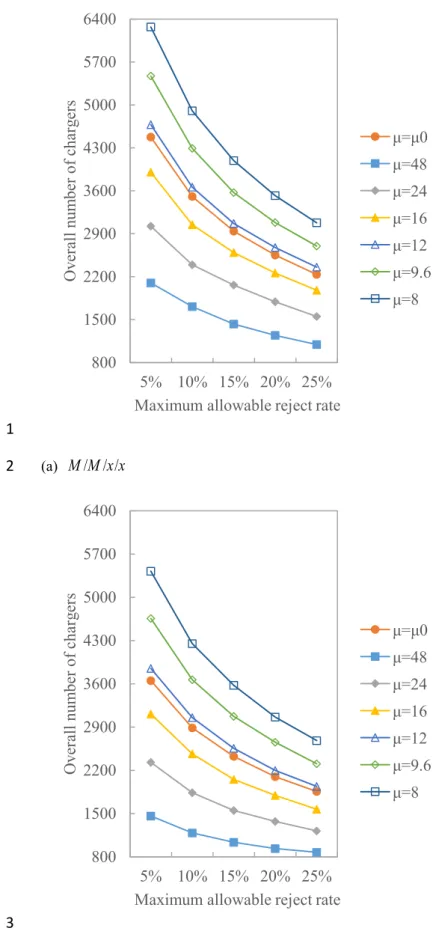
Fig. 6 compares total numbers of chargers needed under different reject rate requirements and charging 37
powers. By increasing the service rate ( i.e., increasing the charging power) or decreasing the reject rate 38
requirement, a lower number of chargers is required to satisfy the charging demand. As mentioned 39
14
earlier, the assumptions of
µ µ
=
0 andµ
=12 veh/day result in similar service rates; thus, the 1number of required chargers is close in these two scenarios. For a BEV with a range of 200 km and an 2
electricity consumption rate of 0.2 kWh/km (e.g., BYD E6), AC Level 2 chargers with an effective 3
charging power of 20 kW are recommended, assuming the BEVs stay plugged in until their dwell time 4
runs out. Since it takes about 2 hours to fully charge BEV-200km with AC Level 2 chargers, the service 5
rate
µ
is about 12 veh/day. The other observation is that, when using a lower power charger, the 6curve declines more rapidly with looser reject rate requirements. This is because according to the 7
constraint Eq. (14),the descent rate is determined by the coefficient
b
, which is much smaller at a low 8service rate than when fast chargers are adopted. 9
Place Fig. 6 about here 10
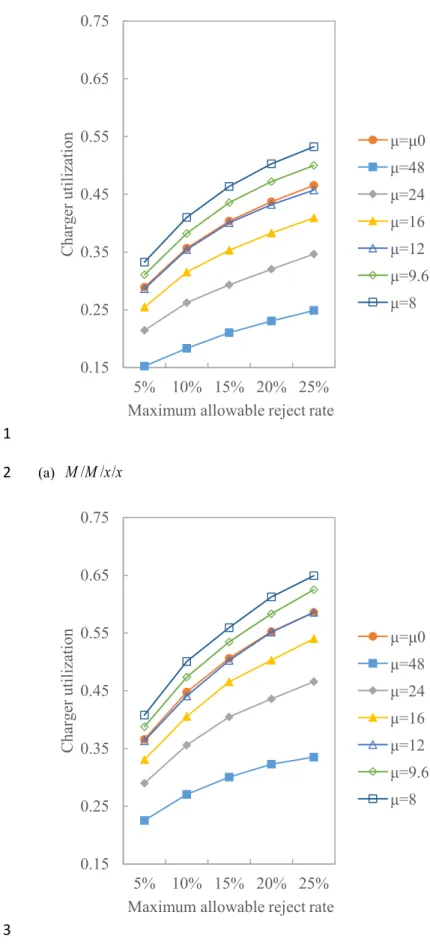
The charger utilization (denoted by
η
) is defined as the ratio of the number of average occupied 11chargers and all chargers in the system. Fig. 7 presents the results of charger utilization given different 12
scenarios. The value of
η
increases along with the increment of maximum allowable reject rate and 13the decrement of charging power. For the same maximum allowable reject rate, the queueing system of 14
/ / /
M M x K
requires significantly fewer chargers than theM M x x
/ / /
system requires. On average, 15the number of chargers is reduced by 26.7% if fast chargers (i.e.,
µ
=48) are deployed and is reduced 16by 13.1% if slow chargers (i.e.,
µ
=8) are installed. As waiting space is provided, the value ofη
17increases by 42.6% and 21.9%, respectively, with
µ
=48 andµ
=8. 18Place Fig. 7 about here 19
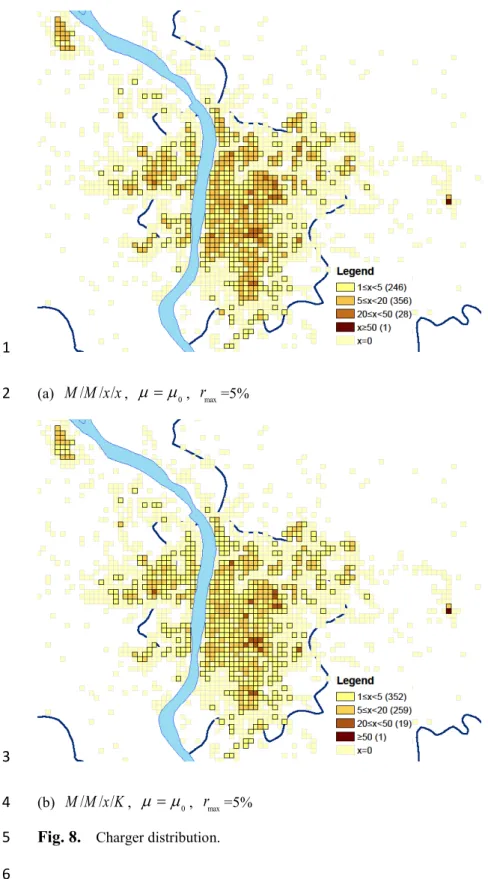
Fig. 8 presents the charger spatial distribution when
µ µ
=
0 andr
max =5%. The mid-sized 20stations where
5
≤ <
x
20
are most preferred byM M x x
/ / /
system, while the small-sized stations 21with fewer than 5 chargers are most favorable for
M M x K
/ / /
system. One super station located near 22the airport is observed that requires 117 chargers with the
M M x x
/ / /
system and 110 chargers and 22 23waiting spaces with the
M M x K
/ / /
system. On average 1,540 dwell events occurred every day at that 24candidate site, and the service rate was 17.07 veh/day. Pragmatically speaking, not all the BEV taxis 25
will charge their batteries during dwell time. However, taking account of the charging demand from 26
private BEVs or other commercial BEVs that travel a long distance to get to the airport, we believe the 27
counted dwell events provide an insight into the real state of charging demand for this area. If the 28
chargers are replaced by more powerful chargers, e.g., with charging power of 80 kW, the service rate 29
rises to 48 veh/day, and the number of chargers can be reduced to 44 units with the
M M x x
/ / /
system 30or 40 units with the
M M x K
/ / /
system. 31Place Fig. 8 about here 32
5.3. Waiting spots and waiting time
33
As can be seen from Fig. 6, the
M M x K
/ / /
system shows its advantage in fewer chargers, although it 34generates waiting time and needs more parking spaces. Fig. 9 shows the average waiting times when 35
additional parking spots for waiting are available. When
r
max=5%, since there is a plentiful supply of 36chargers to satisfy the strict reject rate requirement, the average waiting time is less than 2.5 minutes, 37
which is probably tolerable for most BEV drivers. The most powerful chargers with the service rate of 38
µ
=48 perform best, with the average waiting times ranging from 2.1 minutes (withr
max=5%) to 5.9 39minutes (with
r
max=25%). As the maximum allowable reject rate goes up, the average waiting time 40increases, especially for low power chargers. 41
Place Fig. 9 about here 42
15
In the
M M x K
/ / /
system we assume every 5five chargers equipped with one parking spot for 1waiting. Undoubtedly, one charger occupies one parking spot. Let
n
c denote the number of parking 2spots used for charging,
n
w denote the number of parking spots used for waiting, andn
sum= +
n n
c w 3denote the sum of required parking spots. We compare the value of
n
sum betweenM M x x
/ / /
and 4/ / /
M M x K
systems and present their difference in Fig. 10. From the results we can see that, despite 5the
M M x K
/ / /
system reducing the number of chargers (i.e., xx xkc c
n −n ), it requires more parking
6
spots (i.e., xk xx sum sum
n −n ). The waiting space of the system with the most powerful chargers increases
7
drastically, from 44 (with
r
max=5%) to 423 (withr
max=25%), while the fluctuation of slow chargers 8is not significant. This happens because, with the slow chargers, waiting spots are occupied for longer 9
times compared to fast charging systems and are not influenced by the reject rate. Due to the higher 10
turnover rate of waiting spots in fast charging systems, especially when fewer chargers are required 11
with
r
max=25%, more waiting space helps to reduce the possibility of BEVs being turned away. 12Place Fig. 10 about here 13
The allocation problem for charging facilities is different from that for gas or hydrogen stations. 14
For charging facilities, the question is whether or not the facility should be equipped with more chargers 15
or with enough parking spots for waiting. In general, it depends on the price of one charger (denoted by 16
c
C
) and the price of one parking spot (denoted byC
p), and the values ofC
c andC
p vary based 17on the charger type and the location of stations, respectively. To investigate this question, we define 18
β
as the ratio ofC
c andC
p andβ
0 as the trade-off parameter where 19 0 1β
= − = − − − xk xx xk sum sum w xx xk xx xk c c c c n n n n n n n (16) 20 Ifβ β
>
0, that is 21β
=
>
−
−
xk xx c sum sum xx xk p c cC
n
n
C
n
n
(17) 22it costs more to install chargers than to provide waiting space given the same required reject rate; 23
otherwise, deploying more chargers is preferred. Table 3 lists the values of
β
0 under different 24scenarios. In particular, we assume one parking spot costs ¥40,000 during a charger’s life-cycle, 25
chargers associated with
µ
=48 cost ¥120,000, and chargers associated withµ
=8 cost ¥4,000. 26Hence, it is suggested to provide more waiting spots when fast chargers are deployed since
β
=300% 27and
β
0 is smaller than 200% whenr
max≤
25%. If installing chargers with low charging power and 28setting
r
max as 25%,β
is equal to 100% thereof, and it is more economical to increase the number 29of chargers. 30
Place Table 3 about here 31
16 6. Conclusions
1
This paper presents a data-driven optimization model to allocate charging stations and chargers 2
throughout a city with the objective of minimizing overall investment. The proposed approach takes 3
vehicles’ dwell pattern as input and the probability of BEVs being charged during their dwell time as 4
constraints. Charging congestion is taken into consideration and formulated using queueing theory. By 5
means of regression and logarithmic transformation, the optimization model is transformed into an ILP 6
problem and solved by Gurobi solver efficiently. The key findings from the results include the following: 7
(1) The dwell pattern of the taxi fleet determines the siting of charging stations, and 35 out of 666 8
candidate sites do not have to install chargers after optimization. (2) When waiting space is offered, the 9
utilization of chargers can be improved and the number of chargers can be reduced by 13.1% to 26.7%, 10
compared to charging stations with no waiting space. However, it will require more parking spots and 11
increase users’ waiting time. (3) The tradeoff between installing more chargers versus providing more 12
waiting spaces depends on the cost ratio of chargers and parking spots, which varies with the charger 13
power and required reject rate as well. For 20 kW chargers, in order to satisfy at least 95% of the 14
charging demand, it is more economical to install more chargers instead of providing more waiting 15
spaces when the price of chargers is less than 23% of the cost of parking spots. 16
The main caveat of the proposed approach is that it does not account for the SOC when BEVs 17
arrive at charging stations. BEVs with high level of SOC may not charge at their dwell place. Also, 18
depending on the type of chargers and SOC, charging time may vary for different vehicles. Another 19
aspect that needs further research is the penetration rate of BEVs. The dataset tested in this paper 20
captures only the charging demand of potential BEV taxis, while trajectory data collected from other 21
kinds of private or commercial BEVs can be used to better estimate the charging demand and further 22
support the charging infrastructure planning for Changsha. Moreover, due to the lack of land use 23
information, the space limitation of charging and waiting areas at each site is not considered in the 24
model formulation. The proposed model could be further improved if information about the cost of 25
acquiring the land is available. 26
Despite these caveats, the methodology presented in this paper provides a tool for infrastructure 27
providers, city planners, and other stakeholders to determine where charging stations should be located 28
and how many chargers and waiting spaces need to be assigned. 29
Acknowledgments 30
This work was partially supported by the Social Science Foundation of Jiangsu Province of China under 31
project NO. 14FXC001. Y.J. acknowledges the support of the State Scholarship Fund from China 32
Scholarship Council. 33
References 34
Agenbroad, J., Holland, B., 2014. Pulling Back the Veil on EV Charging Station Costs. Rocky 35
Mountain Institute. April 29, 2014. 36
Ahn, Y., Yeo, H., 2015. An Analytical Planning Model to Estimate the Optimal Density of Charging 37
Stations for Electric Vehicles. PloS one 10(11), e0141307. 38
Aikens, C.H., 1985. Facility location models for distribution planning. European Journal of 39
Operational Research 22(3), 263-279. 40
Akbari, H. and Fernando, X., 2015. Modeling and optimization of PHEV charging queues. In 41
Electrical and Computer Engineering (CCECE), 2015 IEEE 28th Canadian Conference on (pp. 42
81-86). IEEE. 43
17
Aultman-Hall, L., Sears, J., Dowds, J., Hines, P., 2012. Travel Demand and Charging Capacity for 1
Electric Vehicles in Rural States: Vermont Case Study. Transportation Research Record: Journal 2
of the Transportation Research Board(2287), 27-36. 3
Bae, S., Kwasinski, A., 2012. Spatial and temporal model of electric vehicle charging demand. IEEE 4
Transactions on Smart Grid 3(1), 394-403. 5
Baert, R.S.G., Kort, H.J., 2013. Real world experience with operating electric vehicles in the 6
Netherlands, Electric Vehicle Symposium and Exhibition (EVS27), 2013 World, pp. 1-9. 7
Bertsimas, D., Ioannis Ch, P., Tsitsiklis, J.N., 1994. Optimization of Multiclass Queueing Networks: 8
Polyhedral and Nonlinear Characterizations of Achievable Performance. The Annals of Applied 9
Probability 4(1), 43-75. 10
Buekers, J., Van Holderbeke, M., Bierkens, J., Panis, L., 2014. Health and environmental benefits 11
related to electric vehicle introduction in EU countries. Transportation Research Part D: 12
Transport and Environment 33, 26-38. 13
Cai, H., Jia, X., Chiu, A.S.F., Hu, X., Xu, M., 2014. Siting public electric vehicle charging stations in 14
Beijing using big-data informed travel patterns of the taxi fleet. Transportation Research Part D: 15
Transport and Environment 33, 39-46. 16
Chen, T.D., Kockelman, K.M., Khan, M., 2013. The electric vehicle charging station location 17
problem: a parking-based assignment method for Seattle, Transportation Research Board 92nd 18
Annual Meeting pp. 13-1254. 19
Chrysostomou, K., Georgakis, A., Morfoulaki, M., Kotoula, K., Myrovali, G., 2016. Using Big Taxi 20
GPS Data to Investigate Feasibility of Electric Taxis in Thessaloniki, Greece. In Transportation 21
Research Board 95th Annual Meeting (No. 16-3467). 22
Church, R., Velle, C.R., 1974. The Maximal Covering Location Problem. Papers in Regional Science 23
32(1), 101--118. 24
Delucchi, M.A., Yang, C., Burke, A.F., Ogden, J.M., Kurani, K., Kessler, J., Sperling, D., 2013. An 25
assessment of electric vehicles: technology, infrastructure requirements, greenhouse-gas 26
emissions, petroleum use, material use, lifetime cost, consumer acceptance and policy initiatives. 27
Philosophical Transactions of the Royal Society A: Mathematical, Physical and Engineering 28
Sciences 372(2006). 29
DRC of Beijing, Development and Reform Committee of Bejing, 2016. Special planning for charging 30
infrastructure in Beijing (2016-2060). 31
http://www.bjpc.gov.cn/zwxx/tztg/201604/P020160422395177786941.pdf 32
Dong, J., Liu, C., Lin, Z., 2014. Charging infrastructure planning for promoting battery electric 33
vehicles: An activity-based approach using multiday travel data. Transportation Research Part C: 34
Emerging Technologies 38, 44-55. 35
Fan, P., Sainbayar, B., Ren, S., 2015. Operation analysis of fast charging stations with energy demand 36
control of electric vehicles. IEEE Transactions on Smart Grid 6(4), 1819-1826. 37
Feng, L., Ge, S., Liu, H., 2012. Electric Vehicle Charging Station Planning Based on Weighted 38
Voronoi Diagram, 2012 Asia-Pacific Power and Energy Engineering Conference, pp. 1-5. 39
Foley, A.M., Winning, I.J., Gallachoir, B.P.O., 2010. State-of-the-art in electric vehicle charging 40
infrastructure, 2010 IEEE Vehicle Power and Propulsion Conference, pp. 1-6. 41
Frade, I., Ribeiro, A., Gonçalves, G., Antunes, A., 2011. Optimal location of charging stations for 42
electric vehicles in a neighborhood in Lisbon, Portugal. Transportation Research Record: Journal 43
of the Transportation Research Board(2252), 91-98. 44
18
Ghamami, M., Zockaie, A., Nie, Y., 2016. A general corridor model for designing plug-in electric 1
vehicle charging infrastructure to support intercity travel. Transportation Research Part C: 2
Emerging Technologies 68, 389-402. 3
Gross, D., 2008. Fundamentals of queueing theory. John Wiley & Sons. 4
Guo, Z., Deride, J., Fan, Y., 2016. Infrastructure planning for fast charging stations in a competitive 5
market. Transportation Research Part C: Emerging Technologies 68, 215-227. 6
Gurobi Optimization, Inc., 2016. Gurobi Optimizer Reference Manual. http://www.gurobi.com. 7
He, F., Yin, Y., Zhou, J., 2015. Deploying public charging stations for electric vehicles on urban road 8
networks. Transportation Research Part C: Emerging Technologies 60, 227-240. 9
He, S.Y., Kuo, Y.-H., Wu, D., 2016. Incorporating institutional and spatial factors in the selection of 10
the optimal locations of public electric vehicle charging facilities: A case study of Beijing, 11
China. Transportation Research Part C: Emerging Technologies 67, 131-148. 12
Hosseini, M., MirHassani, S.A., 2015. Selecting optimal location for electric recharging stations with 13
queue. KSCE Journal of Civil Engineering 19(7), 2271-2280. 14
Jung, J., Chow, J.Y.J., Jayakrishnan, R., Park, J.Y., 2014. Stochastic dynamic itinerary interception 15
refueling location problem with queue delay for electric taxi charging stations. Transportation 16
Research Part C: Emerging Technologies 40, 123-142. 17
Kuby, M., Lines, L., Schultz, R., Xie, Z., Kim, J.G., Lim, S., 2009. Optimization of hydrogen stations 18
in Florida using the Flow-Refueling Location Model. International Journal of Hydrogen Energy 19
34(15), 6045-6064. 20
Li, S., Huang, Y., Mason, S.J., 2016. A multi-period optimization model for the deployment of public 21
electric vehicle charging stations on network. Transportation Research Part C: Emerging 22
Technologies 65, 128-143. 23
Li, Y., Luo, J., Chow, C.Y., Chan, K.L., Ding, Y., Zhang, F., 2015. Growing the charging station 24
network for electric vehicles with trajectory data analytics, 2015 IEEE 31st International 25
Conference on Data Engineering, pp. 1376-1387. 26
Lofberg, J., 2004. YALMIP : a toolbox for modeling and optimization in MATLAB, Computer Aided 27
Control Systems Design, 2004 IEEE International Symposium on, pp. 284-289. 28
MathWorks, 2015. MATLAB Version 8.6 (R2015b). Natick, MA, USA. 29
Nicholas, M., Handy S., and Sperling, D., 2004. Using Geographic Information Systems to Evaluate 30
Siting and Networks of Hydrogen Stations. Transportation Research Record: Journal of the 31
Transportation Research Board 1880, 126-134. 32
Mung, C., Sutivong, A., Boyd, S., 2002. Efficient nonlinear optimizations of queuing systems, Global 33
Telecommunications Conference, 2002. GLOBECOM '02. IEEE, pp. 2425-2429 vol.2423. 34
Neubauer, J., Wood, E., 2014. The impact of range anxiety and home, workplace, and public charging 35
infrastructure on simulated battery electric vehicle lifetime utility. Journal of Power Sources 257, 36
12-20. 37
Nie, Y., Ghamami, M., 2013. A corridor-centric approach to planning electric vehicle charging 38
infrastructure. Transportation Research Part B: Methodological 57, 172-190. 39
Pearre, N.S., Kempton, W., Guensler, R.L., Elango, V.V., 2011. Electric vehicles: How much range is 40
required for a day’s driving? Transportation Research Part C: Emerging Technologies 19(6), 41
1171-1184. 42
Peterson, S.B., Michalek, J.J., 2013. Cost-effectiveness of plug-in hybrid electric vehicle battery 43
capacity and charging infrastructure investment for reducing US gasoline consumption. Energy 44
Policy 52, 429-438. 45
Qiu, G.B., Liu, W.X., Zhang, J.H., 2013. Equipment Optimization Method of Electric Vehicle Fast 46
Charging Station Based on Queuing Theory. Applied Mechanics and Materials 291, 872-877. 47
Rauh, N., Franke, T., Krems, J.F., 2014. Understanding the impact of electric vehicle driving 48
experience on range anxiety. Human Factors: The Journal of the Human Factors and Ergonomics 49
Society, 0018720814546372. 50
Said, D., Cherkaoui, S., Khoukhi, L., 2013. Queuing model for EVs charging at public supply 51
stations. In 2013 9th International Wireless Communications and Mobile Computing Conference 52
(IWCMC) (pp. 65-70). IEEE. 53
19
Said, D, Cherkaoui, S., Khoukhi, L., 2015. Multi-priority queuing for electric vehicles charging at 1
public supply stations with price variation. Wireless Communications and Mobile Computing 2
15(6), 1049-1065. 3
Schroeder, A., Traber, T., 2012. The economics of fast charging infrastructure for electric vehicles. 4
Energy Policy 43, 136-144. 5
Sellmair, R., Hamacher, T., 2014. Optimization of Charging Infrastructure for Electric Taxis. 6
Transportation Research Record: Journal of the Transportation Research Board 2416, 82-91. 7
Shahraki, N., Cai, H., Turkay, M., Xu, M., 2015. Optimal locations of electric public charging stations 8
using real world vehicle travel patterns. Transportation Research Part D: Transport and 9
Environment 41, 165-176. 10
Shen, M., Li, M., He, F., Jia, Y., 2016. Strategic Charging Infrastructure Deployment for Electric 11
Vehicles. UCCONNECT Final Reports. 12
Tian, Z., Yi, W., Chen, T., Fan, Z., Lai, T., Chengzhong, X., 2014. Understanding operational and 13
charging patterns of Electric Vehicle taxis using GPS records, 17th International IEEE 14
Conference on Intelligent Transportation Systems (ITSC), pp. 2472-2479. 15
Tu, W., Li, Q., Fang, Z., Shaw, S.l., Zhou, B., Chang, X., 2016. Optimizing the locations of electric 16
taxi charging stations: A spatial–temporal demand coverage approach. Transportation Research 17
Part C: Emerging Technologies 65, 172-189. 18
Wang, I.L., Wang, Y., Lin, P.C., 2016. Optimal recharging strategies for electric vehicle fleets with 19
duration constraints. Transportation Research Part C: Emerging Technologies 69, 242-254. 20
Wang, N., Liu, Y., Fu, G., Li, Y., 2015. Cost–benefit assessment and implications for service pricing 21
of electric taxies in China. Energy for Sustainable Development 27, 137-146. 22
Wang, Y.-W., Lin, C.C., 2009. Locating road-vehicle refueling stations. Transportation Research Part 23
E: Logistics and Transportation Review 45(5), 821-829. 24
Yang, J., Dong, J., Lin, Z., Hu, L., 2016. Predicting market potential and environmental benefits of 25
deploying electric taxis in Nanjing, China. Transportation Research Part D: Transport and 26
Environment 49, 68-81. 27
Yuksel, T., Michalek, E.J., 2015. Effects of Regional Temperature on Electric Vehicle Efficiency, 28
Range, and Emissions in the United States. Environmental Science & Technology 49(6), 3974-29
3980. 30
Zou, Y., Wei, S., Sun, F., Hu, X., Shiao, Y., 2016. Large-scale deployment of electric taxis in Beijing: 31
A real-world analysis. Energy 100, 25-39. 32
20
List of Figure captions 1
Fig. 1. Frequency distribution of the number of daily dwell events per cell. 2
Fig. 2. Arrival rate distribution (unit: veh/day). 3
Fig. 3. Distribution of the number of daily dwell sites for each taxi. 4
Fig. 4. Regression results of sample candidate sites, assuming M M x x/ / / queueing system. (a) Cell 5
308: 1.419 0.800
0.449 − +
= x j
j
R e , R-squared = 0.999, RMSE=0.016, ρj= 0.34; (b) Cell 111: 0.026 1.579
0.234 − + = x j j R e , 6 R-squared = 0.951, RMSE=0.072, ρj=73.82. 7
Fig. 5. Optimized layout of charging stations. 8
Fig. 6. Overall number of chargers. (a) / / /M M x x; (b) / / /M M x K. 9
Fig. 7. Charger utilization. (a) / / /M M x x;(b) / / /M M x K. 10
Fig. 8. Charger distribution. (a) M M x x/ / / , µ µ= 0, rmax=5%;(b) M M x K/ / / , µ µ= 0, rmax=5%. 11
Fig. 9. Average waiting time. 12
Fig. 10. Increased parking spots of
M M x K
/ / /
system. 1321
List of Table captions 1
Table 1 Characteristic of regression coefficients. 2
Table 2 Statistics of selected and excluded cells attributes. 3
Table 3 Values of trade-off parameters. 4
22
Figures 1
2
3
Fig. 1. Frequency distribution of the number of daily dwell events per cell. 4 5 0% 20% 40% 60% 80% 100% 0% 10% 20% 30% 40% 50% 60% [0,1) [1,2) [2,3) [3,4) [4,5) [5,20) [20,50) >50 Cum ul at iv e F re que nc y Fr eque nc y
Number of dwell events per cell
23 1
2
Fig. 2. Arrival rate distribution (unit: veh/day). 3
24 1
2
Fig. 3. Distribution of the number of daily dwell sites for each taxi. 3 4
0%
5%
10%
15%
20%
25%
30%
1
2
3
4
5
>5
Per
cen
tag
e