Referring Expression Generation under Uncertainty:
Algorithm and Evaluation Framework
Tom Williams and Matthias Scheutz Human-Robot Interaction Laboratory
Tufts University
[email protected], [email protected]
Abstract
For situated agents to effectively engage in natural-language interactions with humans, they must be able to refer to entities such as people, locations, and objects. While classicreferring expression generation(REG) algorithms like the Incremental Algorithm (IA) assume perfect, complete, and acces-sible knowledge of all referents, this is not always possible. In this work, we show how a previously presentedconsultantframework (which facilitates reference resolution when knowledge is uncertain, heterogeneous and distributed) can be used to extend theIA to produce DIST-PIA, a domain-independent algorithm for REG under uncertain, hetero-geneous, and distributed knowledge. We also present a novel framework that can be used to evaluate such REG algorithms without conflating the performance of the algorithm with the performance of classifiers it employs.
1 Introduction
For situated agents to effectively engage in natural-language interactions with humans, they must be able torefer to those entities of interest to their in-terlocutors, such as people, locations, and objects. This task, known asreferring expression generation (REG)is typically split into two sub-tasks: content determination(deciding which properties to use to describe a target), andlinguistic realization, (choos-ing which words to use to communicate those prop-erties) (Krahmer and Van Deemter, 2012). In keep-ing with tradition, we refer to content determination algorithms as REG algorithms.
Traditionally, REG algorithms make use of a do-main (comprised of target referentm and a set of distractorsX), where each entity in that domain is represented by anattribute setof properties and re-lations that hold for that entity (Dale and Reiter, 1995). The most traditionally successful such al-gorithm has been Dale and Reiter’sIncremental Al-gorithm (IA), which additionally takes apreference orderingPin which attributes are to be considered. A variety of factors prevent manysituatedagents from using algorithms from this tradition. Crucially, to check whether an entity has a certain attribute,IA
simply checks whether that attribute is a member of that entity’s attribute set, producing a clear and un-ambiguous answer. But for many agents, it is imper-ative to represent theuncertaintyof knowledge. The knowledge bases (KBs) of these agents may thus be
unableto definitively state whether or not a given attribute holds for a given entity.
While there have been previous approaches to generating referring expressions (REs) under un-certainty, those algorithms have been explicitly de-signed to refer to objects in visual scenes, and as such are tightly integrated with visual classi-fiers (Zarrieß and Schlangen, 2016; Roy, 2002; Meo et al., 2014). This is problematic for least two rea-sons: First, intelligent agents may need to generate REs for a much wider class of entities than those appearing in a visual scene (e.g., agents, locations, ideas, utterances), which may not be possible if an REG algorithm is tightly coupled withvisual classi-fiers. Second, due to this tight coupling, the evalu-ation of these algorithms conflates the performance of the REG algorithms themselves with the
mance of the visual classifiers they employ. For these reasons, previous algorithms for generating REs under uncertainty have only been evaluated rel-ative to different versions of themselves, and not to other algorithms or to humans. We believe it is im-portant to be able to talk separately about the design, efficacy, and integration of REG algorithms and the design, efficacy, and integration of property classi-fiers used by those algorithms. In this paper we present an REG algorithm that is not tightly inte-grated with specific property classifiers, but is easily extensible to allow for arbitrary property classifiers to be utilized within a general framework.
In addition to these two primary concerns, we raise a third, specific to the realities of modern inte-grated agent architectures. In many inteinte-grated agent architectures, such as DIARC (Scheutz et al., 2013) and ROS (Quigley et al., 2009), information may be distributed across a number of architectural compo-nents, rather than being stored in a single centralized KB, meaning that no central attribute set can be ex-pected to be ready and available for use by an REG algorithm. While there has been much research on merging disparate knowledge bases (Lin, 1996; Lib-eratore and Schaerf, 1998; Konieczny, 2000), this is not always feasible or even desirable in integrated architectures (Williams and Scheutz, 2016).
In this paper, we address three main research chal-lenges. First and most crucially, we address the need for REG algorithms that take into account the gener-ator’s uncertainty regarding entities’ attributes, and which are not tied to a particular domain (e.g., vis-ible objects). Second, we address the lack of a rig-orous evaluation framework for systematically eval-uating such algorithms, in a way that allows REG algorithms in this class to be compared to both each other and to humans. Finally, we address the need for such algorithms to take into account the realities of the distributed knowledge representation schemes used by modern integrated agent architectures.
To address these challenges, we present DIST-PIA: an IA-inspired REG algorithm designed to operate within our previously presented consultant framework (Williams and Scheutz, 2016), which provides access to uncertain, heterogeneous, and distributed knowledge. Furthermore, we present a novel two-stage evaluation framework in which hu-man participants first assess the uncertainty that
var-ious attributes hold within a domain and to gen-erate novel REs, and then evaluate the effective-ness of REs created from both human- and machine-generated sets of properties within that domain.
2 Previous Work
“Referring” has been referred to as the “fruit fly” of language due to the amount of study it has at-tracted (Van Deemter, 2016). The bulk of such study has focused on the content determination stage of REG. As previously noted, classic REG algorithms (e.g., Full Brevity, the Greedy Algorithm (Dale, 1989), and the aforementioned Incremental Algo-rithm (Dale and Reiter, 1995)) operate under a number of simplifying assumptions (such as certain knowledge on the part of both speaker and listener) that are not tenable in realistic interaction scenarios. In this section, we will not attempt to survey the full scope of REG algorithms developed in the past few decades (for an excellent primer, we recommend Van Deemter (2016)’s recent book on the subject), but will instead focus on REG algorithms that have relaxed the constraint of certain knowledge.
Horacek (2005) presents an algorithm that rea-sons about the certainty thata listenerwill be able to recognize that a target referent has certain attributes, choosing an utterance that minimizes recognition failure. This is an example of audience design in which thelistener’sknowledge and capabilities are taken into account. Horacek’s algorithm does not, however, take into account the uncertainty of the
agent’s knowledge, which we argue must be taken into account before audience design is considered.
“The person on the right of a person who is not Asian and has eye glasses and is smiling and has bangs and whose mouth is not closed”).
Finally, Fang et al. (2013) (see also (Fang et al., 2015)) present an approach which more systemati-cally handles attributes by expanding a hypergraph of properties until the selected properties disam-biguate the target referent. When choosing how to expand this hypergraph, Fang chooses the attribute of minimal cost, taking into account the uncertainty of the agent’s knowledge as well as the preference of that attribute (in the sense used by theIA). While this approach moves in the right direction, it once again assumes the exclusive use of computer vision classifiers, that all entities are objects in a visual scene, and that information about all such entities is stored in a single, centralized data structure.
3 Consultant Framework
We previously presented a framework of “con-sultants” that allows information about entities to be assessed when knowledge is uncertain, hetero-geneous, and distributed (Williams and Scheutz, 2016). Specifically, each consultant c facilitates access to one KBk, and must be capable of at least four functions:
1. providing a setcdomainof atomic entities fromk, 2. advertising a listcconstraintsof constraints that can
be assessed with respect to entities fromcdomain, 3. assessing constraints fromcconstraintswith respect
to entities fromcdomain, and
4. adding, removing, or imposing constraints from
cconstraintson entities fromcdomain.
While these capabilities were designed to facil-itate reference resolution, they can also facilfacil-itate REG, which requires a set of distractors to rule out (Capability 1), a list of constraints that can be used to rule out those distractors (Capability 2), and a means of checking whether those constraints do in fact rule out distractors (Capability 3).
Recall, however, that theIAconsiders constraints according to apreference ordering. For example, it may be more preferable to use an entity’s type to describe it than to use itscolor, more preferable to use color rather than size, and so on. To use the aforementioned consultant framework for REG, we thus require a more specific second capability:
2. advertising a listcconstraintsof constraints that can
be assessed with respect to entities fromcdomain,
and that is ordered by descending preference.
With this modification, we now have a framework which provides access to uncertain knowledge from different domains and of heterogeneous representa-tion which is distributed throughout a robot architec-ture, and which is configured to interface well with theIA. In the next section, we describe how we have similarly modified theIAin order to take advantage of this framework.
4 Algorithm and Walkthrough
In this section, we present DIST-PIA, the Dis-tributed, Probabilistic Incremental Algorithm1,
a modified version of the Incremental Algo-rithm (IA) (Dale and Reiter, 1995). For each property p in the list of properties attributed to the target referent, IA checks whether p is not
attributed to any distractors; if so,pis added to the list of properties to communicate, and the ruled-out distractors are removed from the set of distractors. This process terminates when all distractors are eliminated or there are no properties left to consider. When information is uncertain and distributed across multiple KBs, however, the assumptions made by theIA are unlikely to hold. It is unlikely, for example, that the set of properties that hold for each entity will have been helpfully precomputed. As such, an REG algorithm operating under un-certain and distributed knowledge cannot rely on simple set-membership checks, but must instead explicitly check how probable it is that an entity has a particular property.
In this section, we present DIST-PIA, the Dis-tributed, Probabilistic Incremental Algorithm which uses the aforementioned consultant framework to do just that. And we provide a walkthrough of this al-gorithm in an example scenario. Each step of this walkthrough is summarized in a row of Tab. 1 and denoted in the walkthrough in bold (e.g.,(1)).
To illustrate the behavior of DIST-PIA, we will use an architectural configuration with three dis-tributed consultants C for representing people (p), locations (l), and objects (o). IfDIST-PIA(DP here-after) is required, using this architecture, to refer to entitym=p5, it will begin by creating an empty
Notation
C A set ofconsultants{c0, . . . , cn}
cΛ
m The set of formulae {λ0, . . . , λn} advertised by the
consultantc∈Cresponsible form.
M A robot’sworld modelof entities{m0. . . mn}found
in the domains provided byC.
D The incrementally built up description, comprised of mappings from entitiesM to sets of pairs(λ,Γ)of formulae and bindings for those formulae.
DM The set of entitiesm∈Mfor which sub-descriptions have been created.
dM The set of entitiesm∈Minvolved in sub-description d.
P The set of candidate (λ,Γ)pairs under consideration for addition to a sub-description.
Q The queue of referents which must be described. X The incrementally pruned set of distractors
Algorithm 1DIST-PIA(m, C)
1: D=new Map() //The Description 2: Q=new Queue(m) //The Referent Queue 3: whileQ6=∅do
4: //Consider the next referent 5: m0= pop(Q)
6: //Craft a descriptiondfor it 7: d=DIST-PIA-HELPER(m0, C)
8: D=D∪ {m→d} 9: //Find all entities used ind 10: for allm00 ∈dM\keys(D)do
11: //And add undescribed entities to the queue 12: push(Q, m00)
13: end for
14: end while
15: return D
scriptionD=∅and a queue of referents to describe
Q = {p5}(Tab. 1 Row (1); Algorithm 1, Lines
1-2). Because there are still referents left to describe (Line 5),DPcalls on its helper function DIST-PIA-HELPER(DPHhereafter) to craft a sub-description forp5, which is popped off ofQ(Line 7).
DPH begins by asking the consultant respon-sible for p5 for a set of distractors X (e.g.,
{p1, p2, p3, p4}) and a set of properties P to
con-sider (e.g., cΛ
m = jim(X-p), jill(X-p), man(X-p), woman(X-p), lives-in(X-p,Y-l)), each of which
DPH pairs with an empty set of bindings (Algo-rithm 2, Lines 1- 4). From this list, DPH pops the first unconsidered property (i.e., jim(X −p)) and its (empty) set of bindings. jim(X −p) has exactly one unbound variable, soDPH will use(2)
consultantp’sapplymethod (as per Capability 3) to
Algorithm 2DIST-PIA-HELPER(m, C)
1: d=∅//The Sub-Description 2: X=M\m//The Distractors
3: //Initialize a set of properties to consider: those advertised by the consultantcresponsible form
4: P= [∀λ∈cΛ
m: (λ,∅)]
5: //While there are distractors to eliminate or properties to consider
6: whileX6=∅andP6=∅do
7: (λ,Γ) =pop(P)
8: //Find all unbound variables in the next property 9: V =find_unbound(λ,Γ)
10: if|V|>1then
11: //If there’s more than one, create copies of that prop-erty under all possible variable bindings that leaving unbound exactly one variable of the same type as the target referent
12: for allΓ0 ∈cross_bindings(λ,Γ, C)do
13: //And push them onto the property list 14: push(P,(λ,Γ0))
15: end for
16: // Otherwise, if it is sufficiently probable that the property applies to the target referent...
17: else ifapply(cm, λ,Γ∪(v0→m))> τdphthen
18: //And it’s sufficiently probable that it doesnotapply to at least one distractor...
19: X¯ = [x∈X|apply(cx, λ,Γ∪(v0→x))> τdph]
20: // Then bind its free variable to the target referent, and add it to the sub-description...
21: ifX¯6=∅then
22: //And remove any eliminated distractors 23: d=d∪(λ,Γ∪(v0→m))
24: X=X\X¯ 25: end if
26: end if
27: end while
28: return d
ask how probable it is thatjim(X−p)applies top5.
Suppose the returned probability is above threshold
τdph (e.g., 60%). Because the chosen property does indeed apply to the target referent, DPH uses the same method to determine whether it also applies to any distractor x in X. Suppose this is only the case forp2. The remaining distractors {p1, p3, p4} (3) will be removed from X and (4) jim(p5) will
be added to sub-descriptiond(Lines 17- 26).
DPHwill then repeat this process with other prop-erties. Suppose it is insufficiently probable that
jill(X−p) holds(5): it will be ignored. Suppose it is sufficiently probable that man(X −p) holds
# Act Description m Sub-description Distractors Property Property List
1 P ∅ p5 ∅ {p1, p2,
p3, p4}
∅ {jim(X-p), jill(X-p), man(X-p), wom(X-p), l-in(X-p, Y-l)}
2 A ∅ p5 ∅ {p1, p2,
p3, p4}
jim(X-p) {jill(X-p), man(X-p), wom(X-p), l-in(X-p, Y-l)}
3 E ∅ p5 ∅ {p2} jim(X-p) {jill(X-p), man(X-p), wom(X-p),
l-in(X-p, Y-l)}
4 d ∅ p5 {jim(p5)} {p2} ∅ {jill(X-p), man(X-p), wom(X-p),
l-in(X-p, Y-l)}
5 A ∅ p5 {jim(p5)} {p2} jill(X-p) {man(X-p), wom(X-p), l-in(X-p, Y-l)}
6 A ∅ p5 {jim(p5)} {p2} man(X-p) {wom(X-p), l-in(X-p, Y-l)}
7 E ∅ p5 {jim(p5)} {p2} man(X-p) {wom(X-p), l-in(X-p, Y-l)}
8 A ∅ p5 {jim(p5)} {p2} wom(X-p) {l-in(X-p, Y-l)}
9 B ∅ p5 {jim(p5)} {p2} l-in(X-p, Y-l){l-in(X-p, l1), l-in(X-p, l2), l-in(X-p, l3)}
10 A ∅ p5 {jim(p5)} {p2} l-in(X-p, l1) {l-in(X-p, l2), l-in(X-p, l3)}
11 E ∅ p5 {jim(p5)} ∅ l-in(X-p, l1) {l-in(X-p, l2), l-in(X-p, l3)}
12 d ∅ p5 {jim(p5),
l-in(p5, l1)}
∅ ∅ {l-in(X-p, l2), l-in(X-p, l3)} 13 D {jim(p5), l-in(p5, l1)} ∅ ∅ ∅ ∅ ∅
14 P {jim(p5), l-in(p5, l1)} l1 ∅ {l2, l3} ∅ {som(X-l), cam(X-l), mass(X-l),
in(X-l, Y-l)}
15 A {jim(p5), l-in(p5, l1)} l1 ∅ {l2, l3} som(X-l) {cam(X-l), mass(X-l), in(X-l, Y-l)}
16 E {jim(p5), l-in(p5, l1)} l1 ∅ ∅ som(X-l) {cam(X-l), mass(X-l), in(X-l, Y-l)}
17 d {jim(p5), l-in(p5, l1)} l1 {som(l1)} ∅ ∅ {cam(X-l), mass(X-l), in(X-l, Y-l)}
18 D {jim(p5), l-in(p5, l1),
[image:5.612.77.538.52.347.2]som(l1)} ∅ ∅ ∅ ∅ ∅
Table 1: WALKTHROUGHSUMMARY.
Column Two summarizes action taken:Prepare,Assess,Eliminate,Bind,d-append, orD-append. Some predicates are abbreviated, and predicate/binding tuples are rewritten as bound predicates.
be ignored. Suppose it is insufficiently probable that
woman(X −p) holds (8): it will be ignored. Fi-nally, DPH will considerlives-in(X −p, Y −l). Unlike the previous properties, this has two unbound variables. DPH will thus use (9) cross_bindings
to create a set of candidate variable bindings for this property, each of which leaves exactly one vari-able for whichpis responsible unbound. Supposel
knows of locationsl1, l2, andl3: cross_bindings
will return (lives-in(X −p, Y − l),{Y → ls1}), (lives-in(X−p, Y−l),{Y →ls2}), and(lives-in(X−
p, Y −l),{Y → ls3}), each of which will be added
ontoP forDPHto consider. (Lines 10- 15).
Suppose it is sufficiently probable (10) that (lives-in(X −p, l1)) applies to p5 but not to the
lone remaining distractor (p2), allowing p2 to be
ruled out (11). lives-in(X − p, Y − l) will be added (12) to d and {p2} will be removed from
X. Since X is now empty, the sub-description
p5 → {jim(p5), lives-in(p5, l1)} will be
re-turned (13) to DP (Line 28). Notice that this sub-description refers to an entity (l1) which itself
needs to be described. Accordingly,l1will be added
toQ (14), and because it is the only entity on the queue, immediately popped and sent back toDP H. As before, DPH begins by asking the consul-tant responsible for l1 for a set of distractors X
(e.g., {p2, l3}) and a set of properties P to
con-sider (e.g., cΛ
m = somerville(X-l), cambridge(X-l), massachusetts(X-cambridge(X-l), in(X-l,Y-l)), which it con-siders one at a time. Suppose it is sufficiently probable thatsomerville(X−l)applies tol1 (15)
but not to distractors l2 or l3 (16): it will be
added (17) to d, {l2, l3} will be removed from
X, and l1 → {somerville(l1)} will be returned (18) to DP. Finally, since Q is empty, DP will return {p5 → {jim(p5), lives-in(p5, l1)}, l1 →
{somerville(l1)}} (Algorithm 1, Line 15). It will
be the responsibility of the next component of the natural language pipeline to translate this into an RE along the lines of “Jim, who lives in Somerville”2.
5 Evaluation
Traditional REG evaluation metrics (e.g.,Dice(Gatt et al., 2007) andMASI(Passonneau, 2006)) compare algorithm- and human-chosen attributes by mea-suring the distance (e.g., set difference) between machine- and human-generated attribute sets. Re-cently, however, this methodology has come under criticism, as the semantic similarity of two attribute sets does not imply similarity between the effec-tiveness of those two sets. That is, this methodol-ogy does not necessarily assess how well a gener-ated RE actually allows a target to be picked out by a hearer – the presumed purpose of REG algo-rithms (Van Deemter and Gatt, 2009). Recently, there has been a shift towardstask-basedevaluations (e.g., (Byron et al., 2009; Koller et al., 2010; Viethen and Dale, 2006)), in which algorithms are compared by how well they allow some task to be achieved.
The previously discussed uncertainty-handling REG algorithms have mainly used task-based evaluations in which an image provided to par-ticipants is also provided to the algorithm. This necessarily conflates the evaluation of the algorithm with the evaluation of the visual classifiers used to process that image. Furthermore, it prevents direct comparison between the algorithm and both other algorithms (unless they use identical classifiers) and humans. It is thus imperative to develop anew
evaluation framework that allows an REG algorithm to receive information about attribute uncertainty without visually processing the scene.
We will now present an evaluation framework that achieves this goal through two stages. In Stage One, participants are shown an environment, and are asked to provide (1) an RE referring to an indicated entity, and (2) probability judgments that particular attributes hold for indicated entities. The probability judgments can be used to train REG algorithms to assess whether various attributes hold without com-mitting to particular classifiers. In Stage Two, new participants are shown the same environments, along with either human- or machine-generated REs, and asked to indicate the described entity. This frame-work thus allows REG algorithms to be compared to both other algorithms and humans under uncertainty.
5.1 Stage One
In the first stage of the evaluation, participants were each shown three randomly-ordered scenes (a kitchen, an office, and a near-featureless room, as seen in Fig. 1)3, one of which contained a red
bound-ing box around an object. This object was either an object that only appeared in that scene, an object for which an identical object appeared in a different scene, or an object for which one of the same type (but, for example, of a different color) appeared in a different scene, yielding five task-relevant objects in each scene. Each image also contained around five salient irrelevant objects. Finally, because each par-ticipant was simultaneously shown three scenes, the rooms themselves also serve as anchors with respect to which referents could be described.
Participants were told to imagine that a future par-ticipant would tour the three rooms shown in the pic-tures in a random order, and in one of the rooms, re-ceive a description of an object. Participants were told to write the description that the future partici-pant should receive. After each participartici-pant provided a description, they were asked to evaluate how well the target object matched each of twenty attributes (randomly selected from a total of 52 informally col-lected attributes such as “is blue”, “is a marker”, and “is in the kitchen” by re-positioning [0-100] sliders from an initial position of 50.
Participants (56 male, 33 female; mean age 35 (sd=11.65)) were recruited through Amazon Me-chanical Turk and paid small cash. Each participant was shown a random target object, providing us with an average of 10 REs per target object and 3.8 prob-ability judgments for each attribute for each object. Gold standard semantic parses (i.e., sets of logical formulae representing properties and relations) were then crafted for each human-generated RE.
Next, two consultants were created which were provided with, respectively, a subset of the objects and locations found in the three scenes. When these consultants are asked for the probability that an en-tity has a particular attribute, they return the mean probability judgment provided by participants. Fi-nally, each consultant was provided with a prefer-ence ordering over properties. While this ordering
Figure 1: Scenes Shown to Participants
In the scene to the left, the possible target referents in the two evaluation stages were the waterbottle, headphones, and mug; in the middle scene, these were the laptop, chair, and notebook; in the right scene, these were the briefcase, book, and marker.
was hand constructed, we would eventually like to learn similar orderings from data.
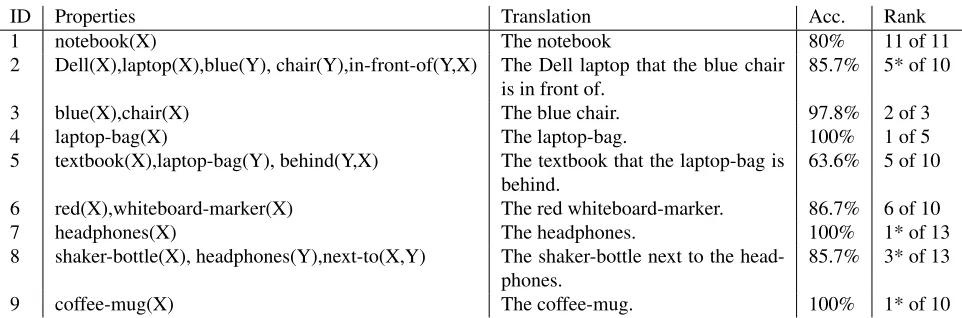
DIST-PIAwas then used to generate attribute sets for each of the nine target referents, as shown in Tab. 2. We then combined these with the attribute sets derived from human utterances, yielding an av-erage of 9.56 (sd=3.13) unique sets of attributes per target object. For each attribute set, we crafted one RE using a predefined template. This conversion from REs to logical form and back allows us to con-trol for consistent phrasing. Because one RE was produced for each unique property set, an average of 9.56 (sd=3.13) REs were created per target object.
5.2 Stage Two
In the second stage, a new set of participants were shown the same images, but without bounding boxes, shown a randomly selected human- or machine-driven RE for that referent, and asked to click on the described object. After each image, participants were notified as to whether they had clicked on the correct object.
Participants were recruited through Amazon Me-chanical Turk (62 male, 46 female; mean age 35.07 (sd=10.14)) and paid small cash. Each of the 85 unique REs was thus shown to an average of 11.44 participants. Recall, however, that these utterances were crafted based on property sets either chosen by
DIST-PIAor extracted from the utterances collected from participants in Stage One. Because some of these property sets were identical, each of the unique REs in this section really corresponds to aclusterof human- or machine-driven property sets. We thus computed how accurately each property set allowed the true target referent to be picked out. Ranking clusters by accuracy, we can then compute an overall
accuracy percentile for DIST-PIA, i.e., the percent of RE generators (in this case, humans) compared to whichDIST-PIAachieved higher accuracy.
5.3 Results and Discussion
Overall,DIST-PIAallowed successful identification in 91.4% of cases. On average, the REs crafted using DIST-PIA-chosen properties were as or more successful than those crafted using the properties chosen by 45.7% (sd=23.9) of human participants, suggesting thatDIST-PIAwas nearly as effective as humans in choosing properties. DIST-PIA’s perfor-mance would further improve if given more sophis-ticated consultants. To fairly evaluateDIST-PIA, we provided it with consultants that only made judg-ments based on the attributes used in our pilot study. Even simple knowledge of what relations were sym-metricwould have increased performance.
It is important to note that because DIST-PIA is domain independent, it does not compete with the classifiers used by previous approaches, which could be integrated into our framework as consultants, al-lowing for direct comparison of disparate classifiers. And, while our evaluationpresentedall information visually (as we needed participants to be able to un-ambiguously select referents in an intuitive, static, online environment) it is critical to point out that our evaluation avoidedrelianceon specific visual clas-sifiers: the generality of our consultant framework means that, like theIA(but unlike previous REG al-gorithms which have handled uncertainty), we could easily use consultants that assess non-visual traits (e.g., object costs, utterance sentiments, people pro-fessions, room temperatures).
Table 2: Properties Chosen byDIST-PIA
ID Properties Translation Acc. Rank
1 notebook(X) The notebook 80% 11 of 11
2 Dell(X),laptop(X),blue(Y), chair(Y),in-front-of(Y,X) The Dell laptop that the blue chair
is in front of. 85.7% 5* of 10
3 blue(X),chair(X) The blue chair. 97.8% 2 of 3
4 laptop-bag(X) The laptop-bag. 100% 1 of 5
5 textbook(X),laptop-bag(Y), behind(Y,X) The textbook that the laptop-bag is
behind. 63.6% 5 of 10
6 red(X),whiteboard-marker(X) The red whiteboard-marker. 86.7% 6 of 10
7 headphones(X) The headphones. 100% 1* of 13
8 shaker-bottle(X), headphones(Y),next-to(X,Y) The shaker-bottle next to the
head-phones. 85.7% 3* of 13
9 coffee-mug(X) The coffee-mug. 100% 1* of 10
“Accuracy” denotes percent of participants who chose the correct object when given the machine-driven RE. “Rank” compares this with human-driven REs. * denotes a tie. For example, when “The notebook” was used, 80% of participants chose the correct object, but all other REs for that object yielded higher accuracy. In contrast, “The textbook that the laptop-bag is behind” had only 63.6% accuracy, but this was a higher than was achieved by all but four of the unique human-driven REs for that object.
DIST-PIA’s choice of simply notebook(X) for the first target object achieved 80% success rate, but had the lowest ranking for that object, in part because most humans used descriptions involvingred(X)to draw the eye away from distractors like the green book. The traditionalIAcaptures this effect by plac-ing colors at a high priority. However, unlike the traditionalIA, we chose to handle the object’s “type” (e.g., “bottle”) and variants thereof (e.g., “waterbot-tle”) just like any other properties, so that we would not need to specify an additional mandatory consul-tant capability (i.e., the ability to provide the “type” of a candidate object). This required us to place these type-like properties at the top of the preference orderings, to make sure that typewas always used. When presented the trade-off, we chose generality of architectural mechanisms over performance gain. 6 Conclusion
In this paper, we make three main contributions. First, we presented a domain independent algo-rithm for REG under uncertainty, which separates the problems of referring expression generation and reference resolution from the task of property as-sessment. Second, we presented a novel evaluation framework which allows REG algorithms designed for uncertain contexts to be evaluated without con-flating the performance of the algorithm with the performance of theclassifiers used by the algorithm, and which uses human probability judgments to
bet-ter facilitate comparison to human performance. Us-ing this framework, we showed that DIST-PIA ex-hibited REG capabilities comparable to those of hu-mans. Finally, we have taken the realities of modern integrated agent architectures into account through our consultant framework, which allows informa-tion to be distributed across multiple heterogeneous KBs (Williams and Scheutz, 2016).
In future work, our thresholds should be learned from data, and Dempster-Shafer Theoretic uncertainty representations should be used to better handle ignorance (Williams et al., 2015).
DIST-PIA should also be modified to incorpo-rate audience design considerations, similar to Horacek (2005). Finally, DIST-PIA should be modified to use use Givenness-Hierarchy Theoretic mechanisms (Williams et al., 2016) in conjunction with a multi-modal reference model to generate deictic and anaphoric REs.
Acknowledgments
References
Donna Byron, Alexander Koller, Kristina Striegnitz, Jus-tine Cassell, Robert Dale, Johanna Moore, and Jon Oberlander. 2009. Report on the first NLG chal-lenge on generating instructions in virtual environ-ments (GIVE). InProceedings of the 12th European Workshop on Natural Language Generation (ENLG), pages 165–173. Association for Computational Lin-guistics.
Robert Dale and Ehud Reiter. 1995. Computational interpretations of the gricean maxims in the gener-ation of referring expressions. Cognitive Science, 19(2):233–263.
Robert Dale. 1989. Cooking up referring expressions. InProceedings of the 27th annual meeting on Associ-ation for ComputAssoci-ational Linguistics (ACL), pages 68– 75.
Rui Fang, Changsong Liu, Lanbo She, and Joyce Y Chai. 2013. Towards situated dialogue: Revisiting referring expression generation. In Proceedings of Empirical Methods on Natural Language Processing (EMNLP), pages 392–402.
Rui Fang, Malcolm Doering, and Joyce Y Chai. 2015. Embodied Collaborative Referring Expression Gen-eration in Situated Human-Robot Interaction. In Proceedings of the 10th International Conference on Human-Robot Interaction (HRI), pages 271–278. Albert Gatt, Ielka van der Sluis, and Kees van Deemter.
2007. Evaluating algorithms for the generation of referring expressions using a balanced corpus. In Proceedings of the Eleventh European Workshop on Natural Language Generation (ENLG), pages 49–56, Stroudsburg, PA, USA. Association for Computational Linguistics.
Helmut Horacek. 2005. Generating referential descrip-tions under condidescrip-tions of uncertainty. InProceedings of the 10th European Workshop on Natural Language Generation (ENLG), pages 58–67.
Alexander Koller, Kristina Striegnitz, Andrew Gargett, Donna Byron, Justine Cassell, Robert Dale, Johanna Moore, and Jon Oberlander. 2010. Report on the sec-ond NLG challenge on generating instructions in vir-tual environments (GIVE-2). InProceedings of the 6th International Conference on Natural Language Gen-eration (INLG), pages 243–250. Association for Com-putational Linguistics.
Sébastien Konieczny. 2000. On the difference between merging knowledge bases and combining them. In Proceedings of Knowledge Representation (KR), pages 135–144.
Emiel Krahmer and Kees Van Deemter. 2012. Compu-tational generation of referring expressions: A survey. Computational Linguistics, 38(1):173–218.
Paolo Liberatore and Marco Schaerf. 1998. Arbitration (or how to merge knowledge bases). IEEE Transac-tions on Knowledge and Data Engineering, 10(1):76– 90.
Jinxin Lin. 1996. Integration of weighted knowledge bases. Artificial Intelligence, 83(2):363–378.
Timothy Meo, Brian McMahan, and Matthew Stone. 2014. Generating and resolving vague color refer-ences. Proceedings of The 18th Workshop on the Se-mantics and Pragmatics of Dialogue (SemDial), pages 107–115.
Rebecca Passonneau. 2006. Measuring agreement on set-valued items (MASI) for semantic and pragmatic annotation. In In Proceedings of the International Conference on Language Resources and Evaluation (LREC).
Morgan Quigley, Josh Faust, Tully Foote, and Jeremy Leibs. 2009. ROS: an open-source robot operating system. InICRA Workshop on Open Source Software. Deb K Roy. 2002. Learning visually grounded words and syntax for a scene description task. Computer Speech & Language, 16(3):353–385.
Amir Sadovnik, Andrew Gallagher, and Tsuhan Chen. 2013. Not everybody’s special: Using neighbors in referring expressions with uncertain attributes. In Pro-ceedings of the IEEE Conference on Computer Vision and Pattern Recognition Workshops (CVPR), pages 269–276.
Matthias Scheutz, Gordon Briggs, Rehj Cantrell, Evan Krause, Tom Williams, and Richard Veale. 2013. Novel mechanisms for natural human-robot interac-tions in the DIARC architecture. In Proceedings of the AAAI Workshop on Intelligent Robotic Systems. Kees Van Deemter and Albert Gatt. 2009. Beyond
DICE: measuring the quality of a referring expression. In n Proceedings of the Workshop on Production of Referring Expressions: Bridging Computational and Psycholinguistic Approaches (preCogSci-09).
Kees Van Deemter. 2016. Computational Models of Re-ferring: A Study in Cognitive Science. MIT Press. Jette Viethen and Robert Dale. 2006. Towards the
eval-uation of referring expression generation. In Pro-ceedings of the 4th Australasian Language Technology Workshop, pages 115–122, Sydney, Australia. Tom Williams and Matthias Scheutz. 2016. A
frame-work for resolving open-world referential expressions in distributed heterogeneous knowledge bases. In Pro-ceedings of the 30th AAAI Conference on Artificial In-telligence (AAAI), pages 3958–3964.
Robotics: Interaction, Physiological Integration and Autonomy.
Tom Williams and Matthias Scheutz. 2017b. Resolution of referential ambiguity in human-robot dialogue us-ing dempster-shafer theoretic pragmatics. In Proceed-ings of Robotics: Science and Systems (RSS).
Tom Williams, Gordon Briggs, Bradley Oosterveld, and Matthias Scheutz. 2015. Going beyond command-based instructions: Extending robotic natural language interaction capabilities. InProceedings of 29th AAAI Conference on Artificial Intelligence, pages 1387– 1393.
Tom Williams, Saurav Acharya, Stephanie Schreitter, and Matthias Scheutz. 2016. Situated open world refer-ence resolution for human-robot dialogue. In Proceed-ings of the 11th ACM/IEEE International Conference on Human-Robot Interaction, pages 311–318. Sina Zarrieß and David Schlangen. 2016. Towards