Bank of Canada
Banque du Canada
Working Paper 2003-42 / Document de travail 2003-42
A Structural VAR Approach to the Intertemporal
Model of the Current Account
by
ISSN 1192-5434
Bank of Canada Working Paper 2003-42
December 2003
A Structural VAR Approach to the Intertemporal
Model of the Current Account
by
Takashi Kano
International Department
Bank of Canada
Ottawa, Ontario, Canada K1A 0G9
The views expressed in this paper are those of the author.
No responsibility for them should be attributed to the Bank of Canada.
iii
Contents
Acknowledgements. . . iv
Abstract/Résumé . . . v
1.
Introduction . . . 1
2.
The Model and Its Predictions . . . 3
2.1
An intertemporal, small open-economy model. . . 4
2.2
Derivation of the predicted responses. . . 7
3.
The SVMA and Identification Issues. . . 10
4.
Empirical Results . . . 12
4.1
Data, estimation of RFVAR and SVAR, and test statistics . . . 12
4.2
Joint test of the PVM’s restrictions. . . 14
4.3
Impulse-response analysis . . . 15
4.4
Testing the hypotheses . . . 16
4.5
Analysis of forecast error variance decomposition. . . 18
5.
Conclusion . . . 19
References. . . 21
Tables . . . 24
Figures. . . 28
Appendix A: Derivation of Cross-Equation Restrictions Hcp and Hcs . . . 32
iv
Acknowledgements
I would like to thank Jim Nason for research direction and discussion. I am also grateful to
Jeannine Bailliu, Paul Beaudry, Paul Bergin, John Cragg, Mick Devereux, Francisco Gonzalez,
Chang Sik Kim, Glenn Otto, Larry Schembri, Akihisa Shibata, conference participants at the
2001 fall meeting of the Japanese Economics Association at Hitotsubashi University, and seminar
participants at the Bank of Canada, the Bank of Japan, Hitotsubashi University, Kobe University,
and the University of British Columbia for helpful comments. Previous versions of this paper
were presented and circulated under the title “A Structural VAR Approach to Test the Present
Value Model of the Current Account.” I am solely responsible for any errors or misinterpretations.
v
Abstract
The intertemporal current account approach predicts that the current account of a small open
economy is independent of global shocks, and that responses of the current account to
country-specific shocks depend on the persistence of the shocks. The author shows that these predictions
impose cross-equation restrictions (CERS) on a structural vector autoregression (SVAR). To test
the CERs, the author develops identification schemes of the SVAR that exploit the orthogonality
of the world real interest rate to country-specific shocks as well as the lack of a long-run response
of net output to transitory shocks. Tests of the SVAR reveal two puzzling aspects of the Canadian
and U.K. current account: (i) the response of the current account to a country-specific transitory
shock is too large, and (ii) the fluctuations in the current account are dominated by
country-specific transitory shocks that explain almost none of the fluctuations in net output growth.
JEL classification: F32, F41
Bank classification: Balance of payments and components
Résumé
Selon l’approche intertemporelle, la balance courante d’une petite économie ouverte n’est pas
influencée par les chocs mondiaux et sa réaction aux chocs nationaux dépend de la persistance de
ceux-ci. L’auteur montre que ces prédictions impliquent l’imposition de contraintes
interéquations à un vecteur autorégressif structurel (VARS). Pour tester ces contraintes, il élabore
des schémas d’identification qui présupposent l’orthogonalité du taux d’intérêt réel mondial aux
chocs nationaux et l’absence d’une réaction à long terme de la production nette aux chocs
passagers. L’auteur étudie l’évolution des balances courantes du Canada et du Royaume-Uni. Les
tests qu’il effectue sur les VARS font ressortir deux illogismes : i) le solde de la balance courante
de ces deux pays réagit de façon excessive aux chocs nationaux transitoires; ii) les fluctuations de
ce solde sont principalement attribuables à des chocs nationaux transitoires qui n’expliquent à peu
près aucune des variations de la croissance de la production nette.
Classification JEL : F32, F41
1.
Introduction
The intertemporal current account approach provides an analytical framework within which to study the
current account movements of a small open economy by emphasizing the forward-looking behaviour of
economic agents.1 The key message of the intertemporal approach is that the current account reflects
the behaviour of consumers in a small open economy who smooth consumption against country-specific
shocks by borrowing and lending in international capital markets. A global shock, however, does not
give consumers an opportunity to smooth consumption, given that all economies are assumed to be
homogeneous and to react symmetrically to the shock. Thus, a global shock has no effect on the current
account of a small open economy in this framework.
The present value model (PVM) of the current account clearly expresses this consumption-smoothing
motive in current account fluctuations as a linear closed-form solution of the intertemporal model.2 With
the assumption of a constant, exogenous world real interest rate, the PVM predicts that the response of
the current account to a country-specific shock depends on the persistence of the shock. For instance,
when domestic consumers face a temporary rise in income due to a country-specific shock, they lend out
to the rest of the world to smooth consumption, and therefore the current account moves into surplus. On
the other hand, if a rise in income is expected to be permanent, the current account should not change,
because a permanent shock to net output cannot be smoothed away.
This paper tests and evaluates the predictions of the intertemporal approach to the current account and
the PVM regarding current account responses to three shocks to net output (i.e., output net of investment
and government spending): global, country-specific permanent, and country-specific transitory. For this
purpose, the paper provides its own identification schemes. The three shocks are identified by a structural
vector autoregression (SVAR) with two restrictions. The first restriction stems from the assumption of
a small open economy. This assumption restricts the world real interest rate to be orthogonal to any
country-specific shock at all forecast horizons. Together with the assumption of a small open economy,
allowing the world real interest rate to vary stochastically makes it possible to identify global and
country-specific shocks. The second restriction stems from the assumption that transitory shocks have no
long-1The small open-economy optimal growth model of Hamada (1966) is an explicit precursor to the intertemporal approach
to the current account. Obstfeld and Rogoff (1995) provide an excellent review of this approach.
2Sheffrin and Woo (1990), Otto (1992), Ghosh (1995), and Bergin and Sheffrin (2000) jointly test the cross-equation
restrictions the PVM formula imposes on an unrestricted vector autoregression, by applying the methodology originally developed by Campbell (1987) and Campbell and Shiller (1987) to test theories of consumption and stock prices. Their tests statistically reject the basic PVM’s cross-equation restrictions in the G-7 economies, except for the United States.
run effect on net output. This long-run restriction, based on Blanchard and Quah (1989), decomposes
country-specific shocks into permanent and transitory components.
The assumption of a small open economy and the long-run restriction provide two identification
schemes for an SVAR that contains the world real interest rate, the first difference of the log of net
output, and the current account-net output ratio as the endogenous variables. The identified SVAR, in
turn, makes it possible to test jointly the predictions of the current account responses to the three shocks
— the cross-equation restrictions (CERs) that the intertemporal approach and the PVM impose on the
SVAR. The CERs are derived by augmenting the basic PVM with the stochastic world real interest rate,
as in Bergin and Sheffrin (2000).
These CERs are conditional on the identification of the SVAR. In that sense, the tests described in
this paper differ from the traditional test of the PVM, which is conducted by Sheffrin and Woo (1990),
Otto (1992), Ghosh (1995), and Bergin and Sheffrin (2000): they test the CERs of the PVM imposed
on the reduced-form VAR. The SVAR approach used in this paper also differs from that of an influential
study by Nason and Rogers (2002), in both the information set and the identification restrictions. In a
bivariate SVAR with the first differences of investment and the current account, Nason and Rogers (2002)
identify global and country-specific shocks by using one of the following empirical results of Glick and
Rogoff (1995): a non-stationary global technology shock, a stationary country-specific technology shock, a
causal ordering that investment is prior to the current account, and no effect of a global technology shock
on the current account. On the other hand, the trivariate SVAR of this paper includes the stochastic
world real interest rate in its information set. Because a couple of recent small open economy-real business
cycle studies, by Blankenau, Kose, and Yi (2001) and Nason and Rogers (2003), claim that the stochastic
real interest rate is important in explaining Canadian trade balance-current account movements, the
information set examined in this paper potentially yields a better specification of the stochastic process
of the current account. Furthermore, the trivariate SVAR allows the small open-economy assumption to
be used explicitly as a restriction to identify global and country-specific shocks, and to jointly test the
predictions of the intertemporal approach and the PVM regarding the responses of the current account
to the shocks (i.e., the CERs imposed on the SVAR). To my knowledge, this is the first paper in this
literature that jointly tests these CERs imposed on the SVAR.
This paper uses post-war quarterly data of two small open economies: Canada and the United
King-dom. The main results of this paper are summarized as follows. First, in the two economies, the directions
of the impulse responses of the current account to the identified shocks are consistent with the
shock, and a positive response to a positive, country-specific transitory shock. This result supports the
intertemporal current account approach and the PVM. Second, an asymptoticχ2 test jointly rejects the
CERs imposed on the SVAR. In particular, this test shows that the hypothesis that the current account
does not respond to a global shock is sensitive to identification, as observed by Nason and Rogers (2002).
As the third and fourth results, this paper reveals two puzzles that are hard to reconcile with canonical
small open-economy models. The first puzzle is that, given the identification, the response of the current
account-net output ratio to country-specific transitory shocks is found to begreater than implied by the
PVM. This is a puzzle because it implies that consumption responds negatively to a positive income
shock.3 The second puzzle is that the forecast error variance decompositions (FEVDs) of the current
account reveal that country-specific transitory shocks dominate current account fluctuations in both the
short run and long run, as Nason and Rogers (2002) find using a different identification. At the same
time, however, the FEVDs of this paper show that the country-specific transitory shocks explain almost
none of the fluctuations in net output. This result violates the PVM, since the PVM predicts that current
account fluctuations are explained by the shocks that dominate net output fluctuations in the short run
as well as the long run.
Section 2 introduces the model and develops the predictions of the intertemporal approach and the
PVM as cross-equation restrictions on a structural vector moving average (SVMA) process. Identification
issues are discussed in section 3. Section 4 reports the empirical results. Section 5 concludes.
2.
The Model and Its Predictions
This paper considers a world that consists of many small open economies. Following Glick and Rogoff
(1995), this paper assumes that all the economies are homogeneous with respect to preferences,
endow-ments, and technologies. Furthermore, international financial markets are assumed to be incomplete, in
that no household in a small open economy can buy state-contingent claims to diversify away
country-3
Glick and Rogoff (1995) find, using G-7 data, that the impact response of the current account to the identified country-specific technology shock is smaller in absolute terms than that of investment. Based on augmented Dickey-Fuller (ADF) tests, they infer that the country-specific technology shock is permanent. This is puzzling, however, because if the identified country-specific technology shock is permanent, the intertemporal approach predicts that the current account should respond to the shock more than investment does in absolute terms. Glick and Rogoff resolve this puzzle by mentioning the possibility that the country-specific technology shock is highly persistent but not permanent. This paper finds a similar puzzle, in that the impact response of the current account to a country-specific transitory shock is greater than implied by the PVM, even when a country-specific shock is decomposed into permanent and transitory components.
specific shocks. Only riskless bonds, which are denominated in terms of the single consumption good, are
traded internationally.4
2.1 An intertemporal, small open-economy model
Consider an infinitely lived representative consumer in a small open economy. The assumption behind the
small open economy is that it faces the world real interest rate, rt, determined in international financial markets. The standard PVM of the current account (for example, Sheffrin and Woo 1990; Otto 1992; and
Ghosh 1995) assumes that the world real interest rate is exogenous and constant. This paper, because it
exploits stochastic variations in the world real interest rate to identify global and country-specific shocks,
allows the world real interest rate to vary stochastically, as in Bergin and Sheffrin (2000). In addition,
this paper assumes that the world real interest rate is covariance stationary.
Let Ct be consumption at period t, u(C) the period utility function of the consumer, and β the subjective discount factor taking a value between 0 and 1, respectively. The consumer’s expected lifetime
utility function at periodtis then given as
Et
∞
X
i=0
βiu(Ct+i), (1)
whereEt is the conditional expectation operator upon the information set at period t. Further defining
Bt,Qt,It, andGtto be international bond holdings, output, investment, and government expenditure at periodt, respectively, gives the following consumer’s budget constraint:
Bt+1 = (1 +rt)Bt+Qt−It−Gt−Ct. (2)
The optimization problem of the representative consumer is to maximize equation (1) subject to
equation (2). The first order-necessary conditions of this optimization problem comprise the budget
constraint (2), the Euler equation,
u0(Ct) =βEt(1 +rt+1)u0(Ct+1), (3)
and the transversality condition,
lim
i→∞EtRt,iBt+i= 0, (4)
4
Incompleteness in international financial markets is one of the maintained assumptions in the intertemporal approach (see, for example, Obstfeld and Rogoff 1995 and Glick and Rogoff 1995) and in small open-economy real business cycle models (see, for example, Mendoza 1991 and Cardia 1991). By contrast, two-country real business cycle models (see, for example, Backus, Kehoe, and Kydland 1992 and Baxter and Crucini 1993) assume complete financial markets. In this literature, agents in the two countries can pool all idiosyncratic risks by trading contingent claims.
whereRt,i is the ex-post market discount factor at periodtfor periodt+iconsumption, which is defined as Rt,i ≡ 1/ Qt+i j=t+1(1 +rj) ifi≥1, 1 ifi= 0. (5)
For simplicity, let N Ot denote net output at period t: N Ot ≡ Qt−It−Gt. Taking the infinite future sum of the consumer’s budget constraint (2) and using the transversality condition (4) yields the ex-ante
intertemporal budget constraint of the consumer:
∞ X i=0 EtRt,iCt+i = (1 +rt)Bt+ ∞ X i=0 EtRt,iN Ot+i. (6)
To derive the present value model of the current account measure, this paper takes a log-linear
approximation of the Euler equation (3) and a linear approximation of the intertemporal budget constraint
(6).5 The approximation begins by dividing the intertemporal budget constraint (6) byN Ot. After several steps of algebra, equation (6) can be rewritten as:
Ct N Ot 1 + ∞ X i=1 Etexp t+i X j=t+1 (∆ lnCj−ln(1 +rj)) = exp{ln(1 +rt)−∆ lnN Ot} Bt N Ot−1 + 1 + ∞ X i=1 Etexp t+i X j=t+1 (∆ lnN Oj−ln(1 +rj)) .
Letc,b,γc,γ, and µdenote, respectively, the unconditional means of the consumption-net output ratio,
Ct/N Ot; the net foreign asset-net output ratio,Bt/N Ot−1; the first difference of the log of consumption,
∆ lnCt; the first difference of the log of net output, ∆ lnN Ot; and the log of the gross world real interest rate ln(1 +rt). Equation (6) is then linearly approximated by taking a first-order Taylor expansion around these means. For any variableXt, let ˜Xt denote the deviation from its unconditional mean. The
5
Bergin and Sheffrin (2000) also conduct a linear approximation of the intertemporal current account model, to incorporate stochastic variations of both world real interest rates and real exchange rates into the standard PVM. Although they follow Huang and Lin’s (1993) log-linear approximation, this paper develops an alternative linear approximation, to derive a closed-form solution of the optimal current account-net output ratio.
linear-approximated intertemporal budget constraint is given as gCt N Ot ≈ 1−α κ ^Bt N Ot−1 +1−α κ bln(1 +^rt)− 1−α κ b∆ ln^N Ot −c ∞ X i=1 αiEt n ^ ∆ lnCt+i−ln(1 +^rt+i) o +1−α 1−κ ∞ X i=1 κiEt n ^ ∆ lnN Ot+i−ln(1 +^rt+i) o , (7)
whereα= exp(γc−µ)<1 and κ= exp(γ−µ)<1.6
Note that equation (7) makes the consumption-net output ratio depend on the expected future path
of consumption growth. To characterize the process of consumption growth, the Euler equation (3) is
approximated log-linearly. Suppose that the period utility function is given as a power functionu(C) =
C1−1/σ/(1−1/σ), whereσ is the elasticity of intertemporal substitution. This specification of the utility function yields the Euler equation 1 = βEt
Ct+1 Ct −1σ (1 +rt+1)
. As Campbell and Mankiw (1989)
and Campbell (1993) show, when the world real interest rate and consumption are jointly conditionally
homoscedastic and log-normally distributed, the above Euler equation can be rewritten as
Et∆ lnCt+1 =δ+σ(lnβ+µ) +σEt[ln(1 +rt+1)−µ], (8)
whereδ is a constant term that includes the variances of ∆ lnCt+1 and ln(1 +rt+1) and the covariance
between the two terms.7
Finally, to derive an approximate solution of the current account-net output ratio, recall the current
account identity:
CAt≡rtBt+N Ot−Ct. (9)
6The conditions α <1 andκ <1 are required to satisfy boundedness of the expected present discounted value terms of
equation (7). Through the following analysis, this paper assumes these conditions: the mean growth rates of consumption and net output are lower than the mean of world real interest rates, respectively. These conditions imply that, on the
balanced growth path, the economy isdynamically efficient.
7
It is important to note from the log-linearized Euler equation (8) that perfect consumption smoothing, which was common
in previous studies, is not the case in this model. First, unlessδ+σ(lnβ+µ) = 0, the log of consumption has a deterministic
trend, as shown by the first two constant terms in the right-hand side (RHS) of equation (8). Second, the last term shows the substitution effect of variations of the world real interest rate on the consumption profile. A rise in the world real interest rate makes current consumption more expensive in terms of future consumption. Hence, the representative consumer is
induced to shift consumption toward the future with elasticityσ. These two effects together produce a consumption profile
that deviates from a perfectly smoothed one. Furthermore, a caveat of the log-linearized Euler equation (8) is that only the first moments of the logs of consumption and the world real interest rate enter the equation. Higher moments of the two series are assumed to be constant.
Assuming that the economy possesses a balanced growth path, α = κ, and using the approximation
ln(1 +rt)≈rt, equations (7), (8), and (9), together, give the present value representation of the current account-net output ratio:
g CAt N Ot =bert+ [(σ−1)c+ 1] ∞ X i=1 κiEtert+i− ∞ X i=1 κiEt∆ ln^N Ot+i. (10)
Equation (10) is the optimal path of the current account-net output ratio, which is represented as a linear
present value relation among the current account-net output ratio, the first difference of the log of net
output, and the world real interest rate.
Equation (10) states that the optimal current account-net output ratio is determined by three factors.
The first term of the RHS of equation (10) is a consumption-tilting factor. A variation in the world
real interest rate changes the net interest payment from abroad. The direction of the change in the
net interest payment is determined by the economy’s net international asset position; for example, a
rise in the world real interest rate increases the net interest payment from (to) abroad if the economy
is a net creditor (debtor). This change in the net interest payment prompts the consumer to alter the
current account-net output ratio from its consumption-smoothing level. The second term represents
an additional consumption-tilting factor due to expected variations in the world real interest rate. The
coefficient (σ−1)c+1 on the second term captures the intertemporal substitution effect, the income effect,
and the wealth effect, respectively. If the world real interest rate is expected to change in the future, the
representative consumer wants to deviate consumption from its smoothed path through the three effects.
Finally, the third term of the RHS of equation (10) captures a consumption-smoothing motive. It implies
that the representative consumer changes the current account-net output ratio to smooth consumption
in response to expected changes in the future path of net output growth.
2.2 Derivation of the predicted responses
This subsection derives the testable restrictions that the PVM (10) imposes on responses of the
cur-rent account measure to three orthogonal shocks to net output: global, country-specific permanent, and
country-specific transitory. Letgt, cpt , and cst denote global, specific permanent, and country-specific transitory shocks, respectively, all orthogonal to each other. This paper assumes that the first
difference of the log of net output is linearly decomposed into three infinite-order moving average (MA)
components attributed to the three orthogonal shocks:
^ ∆ lnN Ot= Γnog (L) g t + Γnocp(L) cp t + Γnocs(L)cst , (11)
where Γno
i (L) fori={g, cp, cs}is an invertible, infinite-order polynomial with respect to the lag operator,
L, in which the impact coefficient, Γno
i (0), is not restricted to one.8 Similarly, the process of the world real interest rate is linearly decomposed into three infinite-order MA components attributed to the three
orthogonal shocks: e rt= Γrg(L) g t + Γ r cp(L) cp t + Γ r cs(L)cst , (12)
where Γri(L) fori={g, cp, cs}is an invertible, infinite-order polynomial with respect to the lag operator,
L.
Given the processes of the first difference of the log of net output and the world real interest rate,
equations (11) and (12), the PVM (10) yields the predictions on the impulse responses of the current
account-net output ratio to the three shocks through the Wiener-Kolmogorov formula, which is
well-known as Hansen and Sargent’s (1980)distributed predicted leads formula. As explained in Appendix A,
the following structural moving average (SMA) representation of the current account-net output ratio
yields the predictions:
g
CAt
N Ot
= Γcag (L)gt + Γcacp(L)cpt + Γcacs(L)cst , (13)
where Γcai (L) for an indexi∈ {g, cp, cs}is an invertible, infinite-order polynomial with respect to the lag operator. The testable hypotheses examined in this paper are based on the SMA (13).
The first hypothesis is that a global shock does not affect the current account at any forecast horizon.
Under the homogeneity assumption across economies, every economy has the same excess demand for
international riskless bonds. In this case, as argued by Razin (1993) and Glick and Rogoff (1995), no
economy can alter its net foreign asset position following a global shock, because all the other economies
react to the shock symmetrically. Therefore, a global shock has no effect on the current account at any
forecast horizon. All that occurs is that the world real interest rate adjusts. LetHi
g denote the impulse response ofCAt togt−i. Then, the first null hypothesis is given as
H0 : Hig =
∂CAt
∂gt−i = 0 for any i≥0. (Hypothesis 1)
To test this hypothesis, this paper estimates the impulse-response functions (IRFs) of the level of the
current account to a global shock from the IRFs of the current account-net output ratio and the log of
net output.9
8Note that equation (11) is a structural moving average (SMA) representation of the process ∆ lnN O
t, rather than the
Wold representation with the impact coefficient equal to one. Instead of being restricted to one, the impact coefficient is estimated.
9
Next, consider the impact responses of the current account-net output ratio to the country-specific
shockscpt andcs
t : Γcacp(0) and Γcacs(0) in equation (13). To derive the second and third hypotheses, recall the small open-economy assumption of the intertemporal approach. This assumption requires that a
small open economy have no influence on the world real interest rate: a country-specific shock does not
matter for the world real interest rate at any forecast horizon. In other words, this assumption implies
that zero restrictions are imposed on the coefficients of the infinite-order polynomials related to the two
country-specific shocks in the world real interest rate process (12). For anyi≥0,
Γrcp,i= Γrcs,i = 0 (small open-economy assumption), (14)
where Γrcp,iand Γrcs,iare the i-th coefficients of the infinite-order polynomials Γcpr (L) and Γrcs(L) in equation (12), respectively.
As shown in Appendix A, under the small open-economy assumption (14), Γcacp(0) and Γcacs(0) should satisfy the following CERs, respectively:
Γcacp(0) = Γnocp(0)−Γnocp(κ), (Rcp)
and
Γcacs(0) = Γnocs(0)−Γnocs(κ), (Rcs)
where, for an indexi∈ {cp, cs}, Γnoi (κ) is the infinite polynomial Γnoi (z) evaluated atz=κ.
The CERs Rcp and Rcs state that the impact response of the current account ratio to a country-specific shock should be given as the difference between the impact and the discounted long-run responses
of ∆ ln^N Ot to the shock. The current account identity (9) implies that the current account-net output ratio is negatively related to the consumption-net output ratio. Therefore, if a country-specific shock
raises net output above (below) consumption, the current account-net output ratio rises (falls). Γnocp(0) in Rcp captures the impact effect of the shock cpt on net output, while Γnocp(κ) shows the impact effect of the shock on consumption.10 Hence, the impact effect of the shock on the current account-net output
ratio, Γca
cp(0), is given as the difference Γnocp(0)−Γnocp(κ). The same explanation is applicable for Rcs. Define the statisticsHcpandHcs asHcp≡Γcacp(0)−Γnocp(0)+Γcpno(κ) andHcs≡Γcacs(0)−Γnocs(0)+Γnocs(κ), respectively. The CERsRcp and Rcs then provide the following null hypotheses:
H0 :Hcp= 0, (Hypothesis 2)
if a global shock has a positive impact on lnN Ot and the mean value ofCAt/N Ot is positive, then the current account-net
output ratio should respond negatively to the shock.
10
The fact that consumption is determined by permanent income yields the result that the impact response of consumption is given as the discounted long-run response of the first difference of the log of net output. See, for example, Quah (1990).
and
H0:Hcs = 0. (Hypothesis 3)
By construction, if Hi 6= 0 for i ∈ {cp, cs}, the prediction of the PVM on the impact response of the current account-net output ratio to the shockit is rejected, because the observed response is considered to be greater or lesser than the prediction.
3.
The SVMA and Identification Issues
Hypotheses 1 to 3 are constructed conditionally on identification of the three shocks. Testing the
hypothe-ses discussed in the last section requires that the three shocks be identified. To do so, this paper exploits
the SVAR methodology. In this paper, as implied by the small open-economy assumption, country-specific
shocks are identified as shocks that are orthogonal to the world real interest rate in either the short run
or the long run. Furthermore, country-specific shocks are decomposed into permanent and transitory
components by Blanchard and Quah’s (1989) long-run restriction.
To see this, consider a stationary column vector,Xt= [ret ∆ ln^N Ot CA^t/N Ot]
0. Let the probability
distribution of the vector, Xt, be characterized by a p-th order unrestricted VAR. Since the vector Xt is stationary, it has a Wold-vector moving average (VMA) representation, VMA(∞), Xt = C(L)υt, whereC(L) is an invertible, infinite-order matrix polynomial with respect to the lag operatorL and, in
particular, the coefficient matrix of L0 is the identity matrix. The reduced-form disturbance vector, υ
t,
has a symmetric positive definite variance-covariance matrix, Σ.
Stacking equations (11), (12), and (13) vertically implies that the vectorXthas the following structural VMA (SVMA) representation:
e rt ^ ∆ lnN Ot ^ CAt/N Ot = Γrg(L) Γrcp(L) Γrcs(L) Γno g (L) Γnocp(L) Γnocs(L) Γca g (L) Γcacp(L) Γcacs(L) gt cpt cs t or Xt= Γ(L)t, (15)
where t is the structural shock vector given as t = [gt cp
t cst ]0. In particular, following the standard exercise in the SVAR literature, this paper assumes that the variance-covariance matrix of the structural
shock vector is given as the identity matrix: Et0t=I.11
The SVMA (15) is identified as follows. The small open-economy assumption (14) implies that
Γrcp(L) = Γrcs(L) = 0 in the SVMA (15). Furthermore, to decompose country-specific shocks into
perma-11
That is, the structural shocks are orthogonal at all leads and lags and each shock has a unit variance. Therefore, in this paper, the IRF of a variable is interpreted as the response to a unit standard error shock.
nent and transitory components, this paper imposes on the SVMA (15) a restriction that the
country-specific transitory shock cs
t has no long-run effect on the log of net output. This long-run restriction is given as
Γnocs(1) = 0 (long-run restriction). (16)
Hence, the small open-economy assumption (14) and the long-run restriction (16) make the impact and
long-run matrices, Γ(0) and Γ(1), of the SVMA (15) be
Γ(0) = Γrg(0) 0 0 Γnog (0) Γnocp(0) Γnocs(0) Γcag (0) Γcacp(0) Γcacs(0) and Γ(1) = Γrg(1) 0 0 Γnog (1) Γnocp(1) 0 Γcag (1) Γcacp(1) Γcacs(1) .
The SVMA with the impact and long-run matrices Γ(0) and Γ(1) is overidentified. To see this, note that
the small open-economy assumption (14) and the long-run restriction (16) impose an infinite number of
restrictions on the coefficients in the SVMA (15): two impact restrictions, three long-run restrictions, and
an infinite number of restrictions on IRFs. On the other hand, comparing the reduced-form VMA with
the SVMA provides the relation Σ =C(1)−1Γ(1)[C(1)−1Γ(1)]T. Given estimates of Σ and C(1), if one does not impose any restriction on the long-run matrix Γ(0), there are six linear independent equations
and nine unknowns in the above relation. Therefore, only three restrictions, instead of an infinite number
of theoretical restrictions, are needed for the SVMA (15) to be just-identified. Following the identification
strategy examined by King and Watson (1997) and Nason and Rogers (2002), this paper investigates two
different identification schemes consisting of three restrictions from all the overidentifying restrictions
to just-identify the system, collect sample information conditional on the identification, and check the
robustness of the empirical results by comparing the two identification schemes.
The first identification exploits the lower triangularity of the long-run matrix Γ(1). The maintained
assumptions in this paper provide three long-run restrictions. The zero restrictions on the (1, 2)th and (1,
3)th elements of Γ(1) reflect the small open-economy assumption that requires country-specific permanent
and transitory shocks to have no long-run effect on the world real interest rate, respectively. The zero
restriction on the (2, 3)th element of Γ(1) implies that a country-specific transitory shock has nolong-run
effect on the log of net output, which is explicitly shown as the long-run restriction (16). Therefore, the
lower triangular long-run matrix Γ(1) is just-identified and the impact matrix can be recovered through
the relation Γ(0) =C(1)−1Γ(1). Hereafter, this Blanchard and Quah (1989)-style identification is called
identification scheme I.
The other identification scheme exploits two impact restrictions in Γ(0) and the long-run restriction
assumption that requires country-specific permanent and transitory shocks to have no instantaneous
effect on the world real interest rate. The zero restriction on the (2, 3)th element of Γ(1) implies that a
country-specific transitory shock has no long-run effect on the log of net output.
The long-run restriction (16) can be rewritten as an impact restriction. To show this, letAi,j denote the (i, j)th element in any matrixA. The zero restriction on the (2,3)th element in Γ(1), together with the
zero restriction on the (1, 3)th element in Γ(0), implies the restrictionC(1)2,2Γ(0)2,3+C(1)2,3Γ(0)3,3 = 0.
SinceC(1)2,2 andC(1)2,3 are estimated, this restriction can be considered as the impact restriction that
makes it possible to just-identify Γ(0) together with the two impact restrictions shown in Γ(0). Hence,
the second identification scheme of this paper follows Gal´ı’s (1992) method that exploits the impact and
long-run restrictions in concert. Hereafter, this identification is referred to as identification scheme II.
Table 1 summarizes the two identification schemes of this paper.
4.
Empirical Results
This section describes the data, estimation methods, tests, and empirical results of this paper.
4.1 Data, estimation of RFVAR and SVAR, and test statistics
This paper studies quarterly data of two prototype small open economies: Canada and the United
King-dom. All data used in this paper are real, seasonally adjusted at annual rates, and span the period
1960Q1-1997Q4.12 The estimation is based on the 1963Q2-1997Q4 sample, with the data prior to 1963Q2
used to construct lags. The world real interest rate is a weighted average of ex-ante real interest rates
across the G-7 economies. This follows the way in which Barro and Sala-i-Martin (1990) and Bergin and
Sheffrin (2000) construct rt. Net output and the current account are generated from the appropriate national accounting data. Appendix B provides information on the source and construction of the data.
The standard ADF tests provide evidence that the vectorXtfollows a stationary process.13 Since the VMA is invertible, it has an infinite-order VAR representation. The infinite-order VAR is approximated
by truncating at a finite lag length. To select an optimal lag length, both the AIC and BIC criteria are
12This sample period is close to those of related papers: it almost overlaps that of Bergin and Sheffrin (2000)(1960Q1 to
1996Q2) and includes that of Nason and Rogers (2002)(1973Q1-1995Q4).
13This paper constructs the demeaned series of the world real interest rate, the change in the log of net output, and the
current account-net output ratio (i.e.,ert,∆ ln^N Ot, andCA^t/N Ot), and performs unit root tests for them based on the ADF
τ-test. The ADF tests reject the unit-root null in all series at least at the 5 per cent significance level. From this evidence,
calculated with a maximum lag length of fifteen. Both criteria select the first lag length for each economy.
Therefore, the first-order reduced-form VAR (RFVAR),Xt=BXt−1+vt, is estimated by ordinary least squares (OLS).14Let ˆB, ˆΣ, andCˆ(1) denote the OLS estimates of the RFVAR coefficient matrix,B, the
variance-covariance matrix, Σ, and the infinite sum of the VMA coefficient matrices,C(1)≡[I3−B]−1,
through the following analysis. The estimates ˆΣ and Cˆ(1) then make it possible to identify the impact
matrix Γ(0) with each of the identification schemes. This paper recovers the impact matrix Γ(0) by the
full-information maximum-likelihood (FIML) procedure.15
The correlations among the identified structural shocks are consistent with prior ones, thus suggesting
that the identification scheme in this paper is appropriate and successful. Note that the global shocks
identified with the SVARs of the two economies should be highly positively correlated with each other, and
this is in fact the case: the estimate of the correlation coefficient between the identified global shocks of
Canada and the United Kingdom is 0.802 in identification scheme I and 0.975 in identification scheme II.
On the other hand, the identified country-specific permanent and transitory shocks should be uncorrelated
across the two economies. This is also the case. In identification scheme I, the estimate of the correlation
coefficient of the identified country-specific permanent shocks between Canada and the United Kingdom
is -0.019, while it is -0.022 in identification scheme II. The estimate of the correlation coefficient of the
identified country-specific transitory shocks between Canada and the United Kingdom is -0.020, while
it is 0.146 in identification scheme II. Therefore, the identification of this paper is fairly successful with
respect to the correlations among the identified structural shocks.
Tests of Hypotheses 1, 2, and 3 are constructed as the Wald statistics. Let W1, W2, andW3 denote
the Wald statistics for the nullsH0
g = 0,Hcp= 0, and Hcs = 0. In addition, letW4 and W5 be the Wald
statistics for the joint nullsH0
g =Hcp=Hcs = 0 andH0g =H1g =H2g =H3g = 0. In particular,W5is based
on the hypothesis that a global shock does not matter for the current account up to a year after impact. For
example, the Wald statisticW1 for Hypothesis 1 is constructed asW1 = ˆH0g
∂H0 g ∂Bˆ Vˆ ∂H0 g ∂Bˆ 0−1 ˆ H0 g, where ˆH0g is the point estimate of the statisticH0
g. The asymptotic theory states thatW1followsχ2(1).16 To derive
14This paper conducts the portmanteau test for the autocorrelations of the residual vectorv
t, as discussed in L¨utkepohl
(1991, chapter 4). In both Canada and the United Kingdom, theχ2test cannot reject the hypothesis that the autocorrelations
of the residual vector up to 8 lags (i.e., 2 years) are jointly zero at the 5 per cent significance level. This provides evidence that the residual vector follows a white-noise process.
15
Because of the lower triangular long-run matrix, a numerical maximization procedure is not needed to recover the impact matrix in identification scheme I. In identification scheme II, the impact matrix is numerically recovered through the FIML procedure. See Amisano and Giannini (1997) and Hamilton (1994, chapter 11) for the FIML estimation of the SVAR models.
16To obtain the estimates ˆHi
Wald statistic W4 for the joint null H0g =Hcp =Hcs = 0, construct a row vector λ= [ ˆH0g Hˆcp Hˆcs]. Then the Wald statistic for the joint null is given asW4=λh∂λ
∂Bˆ
ˆ
V ∂λ
∂Bˆ
0i−1
λ0. According to the asymptotic
theory, W4 asymptotically follows χ2(3). The same argument is applicable to the construction of Wald
statisticW5.
As in the standard exercise of the SVAR literature, the IRFs and the FEVDs of the endogenous
variables to the identified shocks are estimated. The empirical standard errors of the IRFs and the FEVDs
are calculated by generating 10,000 non-parametric bootstrapping replications based on the reduced-form
disturbances. The 10,000 replications of the statistics Hcp and Hcs that the bootstrapping exercise generates provide the empirical joint distribution ofHcp and Hcs.
4.2 Joint test of the PVM’s restrictions
Before the results of the SVAR exercise are reported, the traditional joint test of the CERs that the PVM
(10) imposes on the RFVAR will be conducted by following Sheffrin and Woo (1990), Otto (1992), Ghosh
(1995), and Bergin and Sheffrin (2000). Let a 1×3 vector, ei, be the ith row of the 3×3 identity matrix,
I3. The PVM (10) then implies the following CERs on the RFVAR coefficient matrix, ˆB, conditional on
the parametersb,c,κ, and σ:
e3 =e1 n
b+ [(σ−1)c+ 1]κBˆ[I3−κBˆ]−1
o
−e2κBˆ[I3−κBˆ]−1. (17)
Then define a statistick(B) such thatk(B)≡e1
b+ [(σ−1)c+ 1]κB[I3−κB]−1 −e2κB[I3−κB]−1−
e3. Under the null of k(B0) = 0, the Wald statistic W ≡ k( ˆB)[k0( ˆB) ˆVk0( ˆB)T]−1k( ˆB)T asymptotically
follows theχ2(3).
Recall that the Wald statisticWis constructed conditional on the parametersκ,c,b, andσ. Following
the definitions of the parameters, this paper calibrates κ, c, and b directly from the data: κ = 0.993,
can be rewritten as linear restrictions on the impact matrix Γ(0). Let [A]ri and [A]ci denote the ith row and column
vectors of matrix A, respectively. Furthermore, let R and Ri for an index i ≥ 0 be the 1×3 row vectors such that
Ri=CA/N OCA [Ci]r3+CA
Pi
s=0[Cs]r2andR= [C(κ)2,1 C(κ)2,2−1 C(κ)2,3+ 1], whereCi,CA/N O,CAandC(κ)i,jdenote
the coefficient matrix ofLiin the VMA, the mean of the current account-net output ratio, the mean of the current account,
and the (i, j)th element of the matrixC(κ), respectively. It can then be easily shown that the statisticsHi
g,Hcp, andHcs
are given asHi
g =Ri[Γ(0)]c1 fori≥0,Hcp=R[Γ(0)]c2, andHcs=R[Γ(0)]c3. Note that the statisticsH
i
g,Hcp, andHcs are
constructed from the IRFs recovered from the just-identified SVAR. Since the IRFs are non-linear functions of the RFVAR
parameters, as shown in Hamilton (1994, section 11.4), the asymptotic standard errors of the estimates ˆHi
g, ˆHcp, and ˆHcs
are obtained by using the asymptotic standard errors of the RFVAR parameters and the Delta method. Similarly, the
asymptoticχ2statistics for the hypotheses can be constructed from knowledge of the asymptotic distribution of the RFVAR
c= 0.983,b=−0.712 for Canada;κ= 0.990,c= 0.988,b= 0.377 for the United Kingdom. The elasticity
of intertemporal substitution,σ, is calibrated by matching the predictions of the PVM (10) on the current
account-net output ratio with the actual series. The predictionsCA/N Oft are constructed as a function ofσ byCA/N Oft =F(σ)Xt, where F(σ) =e1 n b+ [(σ−1)c+ 1]κBˆ[I3−κBˆ]−1 o −e2κBˆ[I3−κBˆ]−1.
The elasticity of intertemporal substitution σ is then calibrated by minimizing the mean squared error
of the prediction: T−1PT
t=1[CA/N Ot− F(σ)Xt]
2
. The resultingσ is 0.001 for Canada, and 0.08 for the
United Kingdom. The small values of the elasticity of intertemporal substitution are close to the estimates
of Bergin and Sheffrin (2000) in their two-goods model. The first four rows of Table 2 summarize the
calibrations in this paper.
The last two rows of Table 2 report the Wald statistics for the joint test of the CERs (17), and the
corresponding p-values based on the χ2 distribution for Canada and the United Kingdom. In the two
economies, the Wald statistics are so large that the CERs are jointly rejected at any standard significance
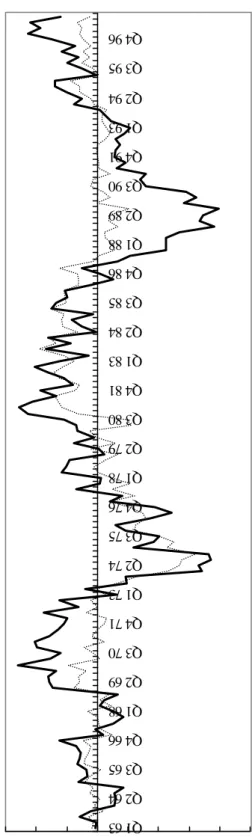
level. Figures 1(a) and (b) draw the actual series of the current account-net output ratio and the PVM’s
predictions CA/N Oft for Canada and the United Kingdom, respectively. Even though σ is chosen to minimize the mean squared error, the PVM’s predictions are much smoother than the actual series in
Canada. The result is much better in the United Kingdom, but the PVM still cannot capture the large
deficits that occurred through the end of the 1980s and the beginning of the 1990s.
In summary, the CERs that the PVM imposes on the RFVAR are jointly rejected across the two
economies. The predicted series from the PVM closely tracks the U.K. series for the current account-net
output ratio with the exceptional periods of the end of the 1980s and the beginning of the 1990s, but they
are still too smooth to match the Canadian series. This result suggests that, particularly for the case of
Canada, the source of the rejection of the PVM can be attributed to something other than the fluctuations
in net output, as well as the world real interest rate: even if it is augmented with the stochastic world
real interest rate, the PVM is still too simple to identify the factors that lead to a better explanation for
the Canadian current account.
4.3 Impulse-response analysis
Figure 2 shows the IRFs of the current account across the two economies under identification scheme
I. In each window, the dark line represents the point estimate and the dashed lines exhibit 95 per cent
impulse-response analysis are summarized as follows. For both Canada and the United Kingdom, this paper finds
that
• The IRFs of the current account to a global shock are not significant across any of the 40 periods
after impact.17
• The IRFs of the current account to a country-specific permanent shock are positive but insignificant.
• The IRFs of the current account to a country-specific transitory shock are positive and significant.
The positive responses remain significant for at least three years.
These results support the basic predictions of the intertemporal approach and the PVM: no response
of the current account to a global shock, no response to a country-specific permanent shock, and a
positive response to a positive, country-specific transitory shock. Figure 3 shows the IRFs of the log of
net output in Canada and the United Kingdom under identification scheme I. Note that, in each economy,
the response of the log of net output to a country-specific permanent shock is almost flat after the jump
at impact. This observation is consistent with the PVM’s prediction that if a country-specific shock is
random walk, the current account has no response to the shock.
The impulse-response analysis, therefore,qualitatively supports the basic predictions of the
intertem-poral approach and the PVM: the predicted shapes of the impulse responses of the current account to the
three shocks are consistent with the data. Although not reported, the same results are also observed even
under identification scheme II. Hence, this empirical result is robust to the two identification schemes.
4.4 Testing the hypotheses
The qualitative validity of the predictions does not necessarily mean that the quantitative requirements
of the intertemporal approach and the PVM – the CERs imposed on the SVMA – are supported at the
same time. Testing Hypotheses 1 to 3 provides information about the validity of the CERs.
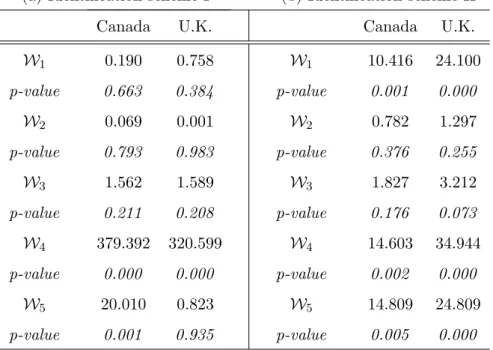
Tables 3(a) and (b) report the results of the asymptotic Wald tests under identification schemes I
and II, respectively. Each table shows the Wald statistics and the corresponding p-values generated by
asymptoticχ2 distributions under the null hypotheses. The following results are observed:
• The single null H0
g= 0 is not rejected in Canada and the United Kingdom in identification scheme I, but it is rejected in the two economies in identification scheme II.
17
A caveat is that the IRFs and the associated confidence bands are not a joint test statistic for Hypothesis 1. They provide pointwise information about the response of the current account to a global shock.
• The single null Hcp= 0 is not rejected in Canada and the United Kingdom across the two identifi-cation schemes.
• The single null Hcs= 0 is not rejected in Canada and the United Kingdom across the two
identifi-cation schemes.
• The joint null H0
g =Hcp=Hcs = 0 is rejected in Canada and the United Kingdom across the two identification schemes.
• In Canada, but not in the United Kingdom, the joint null H0
g = H1g = Hg2 = H3g = 0 is rejected across the two identification schemes.
These results lead to the following inferences: (i) the validity of the hypothesis that the current account
does not respond to a global shock is sensitive to the identification and the economy being studied, (ii)
the PVM succeeds in making quantitative predictions on the impact responses of the current account to
country-specific shocks, and (iii) the response predictions of the intertemporal approach and the PVM
are jointly rejected.
Recall that the IRFs support the hypothesis that the current account does not respond to a global
shock. From the two different tests (i.e., the IRFs and the Wald statistics), this paper observes no robust
evidence for this hypothesis. This confirms the inference drawn by Nason and Rogers (2002) that the
hypothesis is sensitive to identification. On the other hand, the IRFs and the asymptotic Wald tests
consistently support the predictions of the PVM on the responses of the current account to the
country-specific shocks. Finally, the observation that the predictions of the PVM on the impact responses of the
current account to the three shocks are jointly rejected reinforces the rejection of the CERs that the PVM
imposes on the RFVAR; see section 4.2.
A potential drawback of the test based on the Wald statistics is that it depends on the asymptoticχ2
distribution, and with a small sample the Wald statistic does not necessarily follow theχ2 distribution.
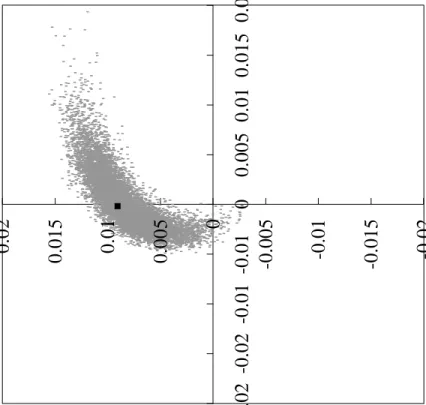
Figure 4 shows the scatter plots of 10,000 pairs of the statisticsHcp andHcs replicated by non-parametric bootstrapping resamples under identification scheme I. In each window, the darkest square represents the
point estimate and the joint null is given by the origin. Observe that, in the two economies, the scatter
plots have strikingly similar shapes and almost all replicated pairs are concentrated on the upper regions
of the windows. Therefore, the empirical distributions of the statisticsHcpandHcs provide evidence that the null hypothesisHcs = 0 is not satisfied.
in the upper region means that, in Canada and the United Kingdom,
Γcacs(0)>Γnocs(0)−Γnocs(κ). (*)
Under Hypothesis 3, the above equation (*) must be satisfied with equality. Hence, the data indicate
that,in Canada and the United Kingdom, the impact responses of the current account-net output ratio to
a country-specific transitory shock are too large to support the PVM.The same observation is obtained in
identification scheme II.
Since the calibrated values of κ in the two economies are very close to one (Table 3), the long-run
restriction (16) requires that the term Γnocs(κ) be almost zero. Hence, the above inequality (*) says that the impact response of the current account to a country-specific transitory shock is greater than that of
net output. This observation is actually a puzzle. The current account identity requires that the impact
response of the current account to a country-specific shock be the difference between the responses of net
output and consumption. Hence, the fact that the response of the current account to a country-specific
transitory shock is greater than the response of net output implies thatconsumption responds negatively
to a positive country-specific shock to net output. This inference violates the basic intertemporal approach
to the current account. This puzzle is a challenge for the current account literature.
4.5 Analysis of forecast error variance decomposition
Another way to examine the effects of the three shocks on the current account is to look at the forecast
error variance decompositions (FEVDs) of the current account. The FEVD provides information about
the share of current account fluctuations that can be explained by an identified shock.
Table 4(a) reports the FEVDs of the current account attributed to the three shocks in Canada and the
United Kingdom under identification scheme I. The table shows that, a quarter after impact, a
country-specific transitory shock can explain almost 70 per cent of fluctuations in the current account for the two
economies. Even a year after impact, the shock can significantly explain 81 and 71 per cent of fluctuations
in the current account in Canada and the United Kingdom, respectively. Therefore, the country-specific
transitory shock can be considered as the dominant driving force of the current account in the short run.
A striking fact revealed by the FEVDs is that, even in the long run, the country-specific transitory
shock dominates fluctuations in the current account in the two small open economies. For example, 40
quarters (10 years) after impact, about 80 per cent of fluctuations in the Canadian current account is
attributed to the country-specific transitory shock. Similarly, at the same forecast horizon, the shock
observation.
The result that country-specific transitory shocks dominate current account fluctuations not only in
the short but in the long run echoes the finding of Nason and Rogers (2002). In their SVAR approach to
studying the joint dynamics of investment and the current account, they report the persistent dependence
of the current account on country-specific transitory shocks across the G-7 economies. As they argue, there
is no consensus intertemporal model that generates persistence in the current account to country-specific
transitory shocks.
Table 4(b) shows the FEVDs of the log of net output. Note that, in the two economies, a
country-specific transitory shock cannot significantly explain fluctuations in the log of net output at any forecast
horizons. The second puzzle of this paper is that a country-specific transitory shock that has no significant
effect on net output dominates fluctuations in the current account in the short and the long run. This
observation violates the standard PVM as well as the augmented PVM with the stochastic world real
interest rate, because in these models current account fluctuations need to be explained by a
country-specific shock that dominates the fluctuations in net output; i.e., the consumption-smoothing behaviour
of the consumer. Combined with the joint rejection of the full CERs that the PVM (10) imposes on the
RFVAR, this puzzling observation suggests the importance of the consumption-tilting motive — which
is induced by country-specific shocks but is not identified with the PVM (10) — in explaining current
account movements in small open economies.
5.
Conclusion
When the world real interest rate is allowed to vary stochastically, the intertemporal approach and its
well-known closed-form solution, the PVM of the current account, jointly provide a new identification
scheme for an SVAR. The small open-economy assumption of the intertemporal approach gives the SVAR
a restriction to identify global and specific shocks, because the assumption requires any
country-specific shock to be orthogonal to the world real interest rate. By exploiting this orthogonality condition
as well as Blanchard and Quah’s decomposition, this paper has developed two identifying schemes for the
SVAR and recovered its global, country-specific permanent, and country-specific transitory shocks.
The identified SVAR based on Canadian and U.K. data yields tests of the predictions that the
in-tertemporal approach and the PVM make on the current account responses to the three shocks. A part
of the results of these tests have reaffirmed the results of past studies. Even though the test jointly rejects
some aspects of current account movements. In fact, the IRFs of this paper are consistent with the
theoretical counterparts of the intertemporal approach and the PVM. Thus, this paper contributes to
the current account literature by providing further evidence that small open-economy models based on
forward-looking economic agents are useful in understanding current account dynamics.
This paper has also revealed two puzzles that challenge the intertemporal approach. First, the response
of the current account-net output ratio to a country-specific transitory shock is too large to support the
PVM. This observation, in turn, draws a puzzling inference that consumption responds negatively to a
positive income shock. The second puzzling aspect is that current account fluctuations are dominated by
country-specific transitory shocks that explain almost none of the fluctuations in net output in the short
and the long run. This puzzle implies that the consumption-tilting motive induced by country-specific
shocks, rather than the consumption-smoothing behaviour emphasized by past studies, is important in
accounting for current account movements. These failures of the intertemporal approach to the current
account suggest that more research into its theoretical structure is needed. For example, more general
utility functions, non-tradable goods, and endogenous risk premiums may yield resolution of these puzzles.
A future task of the current account literature is to seek valid modifications of the basic intertemporal
References
Amisano, G. and C. Giannini. 1997. Topics in Structural VAR Econometrics, 2nd edition. Berlin:
Springer-Verlag.
Backus, D., P. Kehoe, and F. Kydland. 1992. “International Real Business Cycles.” Journal of Political
Economy 101: 745–75.
Barro, R.J. and X. Sala-i-Martin. 1990. “World Real Interest Rates.” InNBER Macroeconomics Annual
1990, edited by O.J. Blanchard and S. Fischer, pages 15–61. Cambridge, MA: MIT Press.
Baxter, M. and M.J. Crucini. 1993. “Explaining Saving-Investment Correlations.” American Economic
Review83: 416–36.
Bergin, P.R. and S.M. Sheffrin. 2000. “Interest Rates, Exchange Rates and Present Value Models of the
Current Account.” The Economic Journal 110: 535–58.
Blanchard, O.J. and D. Quah. 1989. “The Dynamic Effects of Aggregate Demand and Supply
Distur-bances.” American Economic Review79: 655–73.
Blankenau, W., M.A. Kose, and K-M. Yi. 2001. “Can World Real Interest Rates Explain Business Cycles
in a Small Open Economy?” Journal of Economic Dynamics and Control 25: 867–89.
Campbell, J.Y. 1987. “Does Saving Anticipate Declining Labor Income? An Alternative Test of the
Permanent Income Hypothesis.” Econometrica55: 1249–73.
———— 1993. “Intertemporal Asset Pricing without Consumption Data.” American Economic Review
83: 487–512.
Campbell, J.Y. and N.G. Mankiw. 1989. “Consumption, Income, and Interest Rates: Reinterpreting the
Time Series Evidence.” In NBER Macroeconomics Annual 1989, edited by O.J. Blanchard and S.
Fischer, pages 185–216. Cambridge, MA: MIT Press.
Campbell, J.Y. and R. Shiller. 1987. “Cointegration and Tests of Present Value Models.” Journal of
Political Economy 95: 1062–88.
Cardia, E. 1991. “The Dynamics of a Small Open Economy in Response to Monetary, Fiscal, and
Gal´ı, J. 1992. “How Well Does the IS-LM Model Fit Postwar U.S. Data?” Quarterly Journal of Economics
107: 709–38.
Ghosh, A.R. 1995. “International Capital Mobility Amongst the Major Industrialised Countries: Too
Little or Too Much?” The Economic Journal 105: 107–28.
Glick, R. and K. Rogoff. 1995. “Global versus Country-Specific Productivity Shocks and the Current
Account.” Journal of Monetary Economics 35: 159–92.
Hamada, K. 1966. “Economic Growth and Long-Term International Capital Movements.”Yale Economic
Essays 6: 49–96.
Hamilton, J.D. 1994. Time Series Analysis. Princeton, NJ: Princeton University Press.
Hansen, L.P. and T.J. Sargent. 1980. “Formulating and Estimating Rational Expectations Models.”
Journal of Economic Dynamics and Control 2: 7–46.
Huang, C. and K.S. Lin. 1993. “Deficits, Government Expenditures, and Tax Smoothing in the United
States: 1929-1988.” Journal of Monetary Economics31: 317–39.
King, R.G. and M.W. Watson. 1997. “Testing Long-Run Neutrality.” Economic Quarterly, Federal
Reserve Bank of Richmond, 83: 69–101.
L¨utkepohl, H. 1991. Introduction to Multiple Time Series Analysis. Berlin: Springer-Verlag.
Mendoza, E.G. 1991. “Real Business Cycles in a Small Open Economy.” American Economic Review81:
797–818.
Nason, J.M. and J.H. Rogers. 2002. “Investment and the Current Account in the Short Run and Long
Run.” Journal of Money, Credit, and Banking34: 967–86.
———— 2003. “The Present-Value Model of the Current Account Has Been Rejected: Round
Up the Usual Suspects.” Federal Reserve Bank of Atlanta Working Paper No. 2003-7,
http://www.frbatlanta.org/filelegacydocs/wp0307.pdf.
Obstfeld, M. and K. Rogoff. 1995. “The Intertemporal Approach to the Current Account.” InHandbook
of International Economics, volume 3, edited by G.M. Grossman and K. Rogoff. New York: North
Otto, G. 1992. “Testing a Present-Value Model of the Current Account: Evidence from US and Canadian
Time Series.” Journal of International Money and Finance11: 414–30.
Quah, D. 1990. “Permanent and Transitory Movements in Labor Income: An Explanation for Excess
Smoothness in Consumption.” Journal of Political Economy98: 449–75.
Razin, A. 1993. “The Dynamic-Optimizing Approach to the Current Account: Theory and Evidence.”
NBER Working Paper No. 4334.
Sheffrin, S.M. and W.T. Woo. 1990. “Present Value Tests of an Intertemporal Model of the Current
Table 1: Identification Schemes
(a) Identification scheme I
Economic meaning Restriction A country-specific permanent shock has no long-run effect Γ(1)1,2= 0
on the world real interest rate
A country-specific transitory shock has no long-run effect Γ(1)1,3= 0
on the world real interest rate
A country-specific transitory shock has no long-run effect Γ(1)2,3= 0
on the log of net output
(b) Identification scheme II
Economic meaning Restriction A country-specific permanent shock has no instantaneous Γ(0)1,2= 0
effect on the world real interest rate
A country-specific transitory shock has no instantaneous Γ(0)1,3= 0
effect on the world real interest rate
A country-specific transitory shock has no long-run effect Γ(1)2,3= 0
on the log of net output
Note 1: In addition to three restrictions, each identification scheme requires that the structural shocks be orthogonal and have unit variances.
Note 2: Γ(0) and Γ(1) are the impact and the long-run matrices of the SVMA, respectively. Ai,j shows the (i, j)th
Table 2: Calibrated Parameters and Joint Test of the Present Value Restrictions
Canada U.K. κ 0.993 0.990 c 0.983 0.988 b -0.712 0.377 σ 0.001 0.080 W 18.193 23.224 p-value 0.000 0.000Note 1: To calibratebrequires the data of international bond holdings,Bt. ForBt, this paper uses the international
net investment position (IIP) in the balance-of-payment statistics. Statistics Canada (http://www.statcan.ca) distributes the annual IIP for Canada from 1926 to 2001. This paper converts the annual series to quarterly series, divides the resulting series by nominal net output and takes the sample average from 1963Q1-1997Q4 to construct b. On the other hand, National Statistics (http://www.statistics.gov.uk) provides the annual IIP series of the United Kingdom only from 1966. Nevertheless, the value ofb for the United Kingdom is calibrated by applying the same method as in the Canadian case for the whole sample period 1966-97.
Note 2: The elasticity of intertemporal substitution,σ, is calibrated by minimizing the mean squared error of the PVM prediction on the current account-net output ratio.
Note 3: The Wald statistic, W, is calculated conditionally on the calibrated parameters κ, c, b, and σ. The correspondingp-value is based on the chi-squared distribution with the third degree of freedom.
Table 3: Asymptotic Wald Tests for the Cross-Equation Restrictions
(a) Identification scheme I (b) Identification scheme II Canada U.K. Canada U.K.
W1 0.190 0.758 W1 10.416 24.100 p-value 0.663 0.384 p-value 0.001 0.000 W2 0.069 0.001 W2 0.782 1.297 p-value 0.793 0.983 p-value 0.376 0.255 W3 1.562 1.589 W3 1.827 3.212 p-value 0.211 0.208 p-value 0.176 0.073 W4 379.392 320.599 W4 14.603 34.944 p-value 0.000 0.000 p-value 0.002 0.000 W5 20.010 0.823 W5 14.809 24.809 p-value 0.001 0.935 p-value 0.005 0.000
Note 1: The nulls ofW1,W2, andW3 are Hypotheses 1, 2, and 3, respectively.
Note 2: The null ofW4 is that Hypotheses 1, 2, and 3 are jointly satisfied.
Note 3: The null ofW5 is that Hypothesis 1 is satisfied up to a year.
Table 4(a): The FEVDs of the Current Account under Identification Scheme I
Canada U.K. Periods g cp cs Periods g cp cs 1 0.056 0.174 0.770 1 0.242 0.059 0.698 (0.153) (0.154) (0.197) (0.214) (0.113) (0.218) 2 0.054 0.154 0.792 2 0.239 0.049 0.712 (0.152) (0.144) (0.189) (0.213) (0.106) (0.212) 3 0.049 0.149 0.802 3 0.238 0.047 0.715 (0.149) (0.142) (0.186) (0.211) (0.105) (0.211) 4 0.046 0.146 0.809 4 0.237 0.046 0.717 (0.147) (0.141) (0.184) (0.210) (0.105) (0.209) 12 0.034 0.138 0.828 12 0.232 0.046 0.722 (0.138) (0.136) (0.173) (0.206) (0.105) (0.204) 20 0.039 0.136 0.825 20 0.231 0.047 0.722 (0.139) (0.134) (0.171) (0.206) (0.104) (0.204) 40 0.044 0.135 0.821 40 0.231 0.048 0.721 (0.141) (0.132) (0.171) (0.208) (0.104) (0.204)Table 4(b): The FEVDs of the Log of Net Output under Identification Scheme I
Canada U.K. Periods g cp cs Periods g cp cs 1 0.010 0.852 0.138 1 0.103 0.851 0.046 (0.108) (0.327) (0.321) (0.090) (0.221) (0.220) 2 0.011 0.864 0.125 2 0.111 0.851 0.039 (0.101) (0.320) (0.315) (0.089) (0.208) (0.209) 3 0.011 0.876 0.114 3 0.118 0.850 0.032 (0.095) (0.311) (0.307) (0.090) (0.195) (0.198) 4 0.010 0.886 0.104 4 0.125 0.848 0.027 (0.089) (0.299) (0.295) (0.093) (0.184) (0.187) 12 0.006 0.939 0.054 12 0.185 0.805 0.009 (0.098) (0.193) (0.158) (0.134) (0.151) (0.111) 20 0.005 0.959 0.037 20 0.225 0.769 0.006 (0.131) (0.166) (0.096) (0.166) (0.169) (0.075) 40 0.007 0.973 0.020 40 0.280 0.717 0.003 (0.187) (0.189) (0.044) (0.210) (0.208) (0.035)
Note 1: g, cp, and cs represent global, country-specific permanent, and country-specific transitory shocks, respec-tively.
Note 2: The numbers in parentheses denote the standard errors based on 10,000 non-parametric bootstrapping resamples.
Figure 1: PVM Predictions on Actu
al Current Account-Net Output Ratio
(a) Canada
(b)
U
.K
.
-0.06 -0.04 -0.02 0 0.02 0.04 0.06 Q1 63 Q2 64 Q3 65 Q4 66 Q1 68 Q2 69 Q3 70 Q4 71 Q1 73 Q2 74 Q3 75 Q4 76 Q1 78 Q2 79 Q3 80 Q4 81 Q1 83 Q2 84 Q3 85 Q4 86 Q1 88 Q2 89 Q3 90 Q4 91 Q1 93 Q2 94 Q3 95 Q4 96 PVM Prediction Actual -0.1 -0.08 -0.06 -0.04 -0.02 0 0.02 0.04 0.06 Q1 63 Q2 64 Q3 65 Q4 66 Q1 68 Q2 69 Q3 70 Q4 71 Q1 73 Q2 74 Q3 75 Q4 76 Q1 78 Q2 79 Q3 80 Q4 81 Q1 83 Q2 84 Q3 85 Q4 86 Q1 88 Q2 89 Q3 90 Q4 91 Q1 93 Q2 94 Q3 95 Q4 96Figure
2
: Impulse
-Response
Fu
nc
tio
ns
of the C
u
rr
en
t
A
cc
ou
nt
under Identification Scheme I
Responses to a Glabal Shock
Responses to a Country-Specific Permanent Shock
Responses to a Country-Specific Transitory Shoc
k
Canada U.K.
Note: The dark line shows the point estimates. The dashed lines represent 95
pe
r c
en
t confidence intervals based on 10
,000 non -parametric bootstrapping resamples. -4000 -3000 -2000 -1000 0 1000 2000 13579 1 1 1 3 1 5 1 7 1 9 2 1 2 3 2 5 2 7 2 9 3 1 3 3 3 5 3 7