ADBI Working Paper Series
Regulating Systemic Risk
Masahiro Kawai and Michael Pomerleano
No. 189
January 2010
Markets,” held in Washington, DC on 22–23 October 2009, and to the Federal Reserve Bank of Chicago and the World Bank conference, “The International Financial Crisis: Have the Rules of Finance Changed?” held in Chicago on 24–25 September 2009. The authors are thankful to Charles Calomiris, David Mayes, Larry Wall, and other
conference participants for comments and Barnard Helman for excellent editorial assistance.
The findings, interpretations, conclusions, and views expressed in this paper are the views of the authors and do not necessarily reflect the views or policies of ADBI, the Asian Development Bank (ADB), the World Bank, their respective executive directors, their Board of Directors, or the governments they represent. ADBI does not guarantee the accuracy of the data included in this paper and accepts no responsibility for any consequences of their use. Terminology used may not necessarily be consistent with ADB official terms.
The Working Paper series is a continuation of the formerly named Discussion Paper series; the numbering of the papers continued without interruption or change. ADBI’s working papers reflect initial ideas on a topic and are posted online for discussion. ADBI encourages readers to post their comments on the main page for each working paper (given in the citation below). Some working papers may develop into other forms of publication.
Suggested citation:
Kawai, M., and M. Pomerleano. 2010. Regulating Systemic Risk. ADBI Working Paper 189. Tokyo: Asian Development Bank Institute. Available:
http://www.adbi.org/working-paper/2010/01/27/3447.regulating.systemic.risk
Asian Development Bank Institute Kasumigaseki Building 8F 3-2-5 Kasumigaseki, Chiyoda-ku Tokyo 100-6008, Japan Tel: +81-3-3593-5500 Fax: +81-3-3593-5571 URL: www.adbi.org E-mail: [email protected]
ADBI Working Paper 189 Kawai and Pomerleano
Abstract
The failure to spot emerging systemic risk and prevent the current global financial crisis warrants a reexamination of the approach taken so far to crisis prevention. The paper argues that financial crises can be prevented, as they build up over time due to policy mistakes and eventually erupt in “slow motion.” While one cannot predict the precise timing of crises, one can avert them by identifying and dealing with sources of instability. For this purpose, policymakers need to strengthen top-down macroprudential supervision, complemented by bottom-up microprudential supervision. The paper explores such a strategy and the institutional setting required to implement it at the national level. Given that the recent regulatory reforms that have been undertaken to address systemic risks are inadequate to prevent and combat future crises, the paper argues that national measures to promote financial stability are crucial and that the Westphalian principles governing international financial oversight should be rejected. The paper proposes that while an effective national systemic regulator should be established, strong international cooperation is indispensable for financial stability.
1. Introduction... 1
2. Importance of Crisis Prevention ... 1
2.1 Policy mistakes behind the global financial crisis ... 1
2.2 Principles of Crisis Containment... 3
2.3 Macroeconomic and Financial Surveillance and Macroprudential Supervision4 3. Systemic Stability Regulation: Principles... 6
3.1 Clear Objectives and Mandates of a Systemic Stability Regulator... 6
3.2 Sufficient Regulatory Resources to Fulfill Responsibilities... 7
3.3 Effective Implementation by the Systemic Stability Regulator... 8
3.4 Effective Organization of a Systemic Stability Regulator... 9
4. Alternative Models of Systemic Stability Regulation... 10
4.1 Global Practices of Central Banks in Financial Stability ... 10
4.2 Reform Proposals in the US, the UK, and the European Union ... 13
4.3 Alternative Models... 14
5. Conclusions... 15
ADBI Working Paper 189 Kawai and Pomerleano
1. INTRODUCTION
With a few notable exceptions, central bankers, financial supervisors/regulators, other policymakers, international organizations, the private sector, and academic economists failed to predict the current global financial crisis and underestimated its severity. Such a dramatic failure of the entire financial community warrants soul searching: Is it possible to prevent a systemic crisis? In this paper we argue that this is indeed possible and that the best way to prevent a financial crisis is to identify and act on systemic risk or sources of financial instability.
Using a new database, developed by Laeven and Valencia (2008), on the occurrence of systemic banking crises and policy responses to resolve them, one can see that all of the crises have two elements in common. Virtually all of the countries that suffered a crisis had made serious policy mistakes, and accumulated significant structural vulnerabilities and financial imbalances. In virtually all instances, the crisis was slow to unfold and could have been “spotted” in its early stages and managed better. In all instances, there were underlying vulnerabilities. The financial markets were very forgiving and often provided policymakers with the benefit of doubt. When it became obvious that policymakers were unable or unwilling to address the underlying problems, the financial markets were damaged by a loss of confidence, which eventually led to crises.
The devastating global financial crisis of 2007–2009 offers a set of initial lessons. The new lessons learned are more substantial than those learned in the past, as what was considered as the best financial systems—the United States (US), the United Kingdom (UK) and Continental Europe—all went wrong. The objective of this paper is to explore how to spot signs of systemic risk and prevent a financial crisis. We argue that an effective framework for systemic stability regulation should be established in each country, but that such a national effort would not be sufficient without the US and the UK—hosts to global financial centers and where the crisis originated—making a full political commitment to systemic stability regulation.
The paper is organized as follows. In Section 2 we discuss the importance of crisis prevention and argue that effective macroprudential supervision—a top-down approach complemented by bottom-up microprudential supervision—can effectively spot and prevent crises. In Section 3, we provide basic principles in establishing a systemic financial regulator from the perspectives of objectives and mandates, resources, implementation, and structure. Section 4 reviews recent reform proposals considered nationally and internationally to address systemic risk, and recommends that each country create a framework for systemic stability regulation or even an independent financial stability regulator. Section 5 concludes with recommendations for future action.
2. IMPORTANCE OF CRISIS PREVENTION
2.1
Policy mistakes behind the global financial crisis
The root cause of the global financial crisis of 2007–09 traces back to the buildup of excessive optimism—created by a long period of world-wide high economic growth, low real interest rates and subdued volatility of financial prices—as well as the flood of
liquidity. With these benign macroeconomic and financial environments, investors around the world were prompted to search for yield and underestimated the risks of investment, especially those in new financial products. From this perspective, the IMF (2009a) summarized causes of the global financial crisis in three dimensions: flaws in financial regulation and supervision; failure of monetary policy to address the buildup of systemic risk; and a weak global financial architecture.
2.1.1 Flaws in Financial Regulation and Supervision
Several excellent reviews of what went wrong in financial regulation (Group of Thirty 2009; Brunnermeier, et. al. 2009; de Larosiere Group 2009) point to the fact that there were regulatory and supervisory deficiencies, including inadequate macroprudential supervision.
Essentially, national financial regulators and supervisors failed to see the large buildup of systemic risks. In the US, the regulatory and supervisory framework was highly fragmented and its scope was narrowly focused on insured deposit-taking institutions and did not cover all financial activities that posed economy-wide risks. As a result, the “shadow banking” system grew among investment banks, mortgage-brokers and originators, special investment vehicles, insurance companies, and other private asset pools, as they had long been lightly regulated by a patchwork of agencies and generally not supervised prudentially.1
Due to the propensity to focus on individual institutions, supervisors around the world failed to recognize interconnections and links across financial firms, sectors, and markets due to the lack of a macroprudential approach. Supervisors only focused on their own piece of the puzzle, overlooking the larger problem. Shin (2009) pointed out a fallacy of aggregation: “mis-educated” supervisors and examiners were focused on individual institutions, without regard to the impact on the system. There is thus growing realization that a macroprudential approach to supervision and an effective systemic stability regulator are needed to complement microprudential measures. 2.1.2 Failure of Monetary Policy to Contain Financial Imbalances
The latest IMF analysis pointed to “macroeconomic policies, which did not take into account building systemic risks”2 and states that, “a key failure during the boom was
the inability to spot the big picture threat of a growing asset price bubble.” Clearly, the US Federal Reserve underestimated the buildup of financial imbalances coming from housing price bubbles, high leverage of financial institutions, and interconnections between financial markets. In addition, Taylor (2009) argued that the Federal Reserve policies brought excessive liquidity and low interest rates to the US and that the federal funds rate was kept too low for too long, fueling the housing boom and other economic imbalances. The Federal Reserve may well have assumed that even if the asset price boom collapsed, the impacts on the financial system and the economy could be mitigated by lower interest rates.3
1 Tobias and Shin (2008) estimate that the "shadow banking" system was as large as US$10.5 trillion,
comprising US$4 trillion assets of the large investment banks, $2.5 trillion in overnight repos, US$2.2 trillion in structured investment vehicles, and another US$1.8 trillion in hedge fund assets. This should be compared with US$10 trillion in assets held in the conventional US banking system, which meant that system leverage was at least double what was reported.
2 IMF (2009b).
3 Wessel (2009) provided a well-documented and insightful account of the thinking of US policymakers
ADBI Working Paper 189 Kawai and Pomerleano
In theory, tighter prudential regulation could have been mobilized to contain systemic risk, but in practice, before the authorities realized it, huge systemic risks had accumulated below the regulators’ radar, in the shadow banking system. Given the failure of prudential supervisory action to prevent a buildup of systemic risk, the central bank, as a macro-supervisor, should have reacted to credit booms, rising leverage, sharp asset price increases, and the buildup of systemic vulnerabilities by adopting tighter monetary policy.
2.1.3 Weak Global Financial Architecture
There were deficiencies in the global financial architecture—the official structure that facilitates global financial stability and the smooth flow of goods, services and capital across countries. There are three issues.
First, global institutions—like the International Monetary Fund (IMF), the Bank for International Settlements (BIS), and the Financial Stability Forum—failed to conduct effective macroeconomic and financial surveillance of systemically important economies, that is, they did not clearly identify the emerging systemic risk in the US, the UK and the Euro Area, send clear warnings to policymakers, or provide practical policy advice on concrete measures to reduce the systemic risk.4 Their analysis clearly
underestimated the looming risk in the shadow banking system, interconnections across financial institutions, markets, and countries, and global macroeconomic-financial links.
Second, there was considerable discussion of global payments imbalances during 2002–2007. The IMF in particular warned repeatedly, particularly through the newly established Multilateral Consultation process, that global imbalances posed a serious risk to global financial stability. However, the global imbalance discussion may have diverted policymakers’ attention away from US “domestic” financial imbalances toward “global” imbalances, the risk of dollar collapse, and the need to revalue the People’s Republic of China’s currency.
Third, the crisis has revealed the ineffectiveness of fragmented international arrangements for regulation, supervision, and resolution of internationally active financial institutions. The problem became particularly acute when such institutions showed signs of failing. Although home country authorities are mainly responsible for resolving insolvent institutions, host-country authorities were often quick to ring-fence assets in their jurisdictions because of the absence of clear international rules governing burden sharing mechanisms for losses due to failure of financial firms with cross-border operations.
2.2
Principles of Crisis Containment
The most fundamental approach to a financial crisis should be to prevent one from taking place in the first place. Once a crisis breaks out, however, efficient crisis management and resolution policies become important.
bankers—Bernanke, King, Trichet, and their colleagues—did not see the crisis coming and for too long ignored the advice of those who did.
4 The IMF (2009a) admitted that “official warnings both within and outside the Fund were insufficiently
specific, detailed, or dire to gain traction with policymakers.” IMF surveillance often echoed the conventional view that advanced countries—such as the US and the UK—with relatively low stable inflation together with profitable and well-capitalized banking sectors could withstand the unwinding of the bubble in housing and capital markets.
The key principle should be: ”Crisis prevention is better than cure.” This entails the prevention or mitigation of the buildup of vulnerabilities that could lead to systemic risk and eventually a financial crisis. The major preventive mechanisms should include: (i) establishment of effective regulation and supervision that monitors and acts on economy-wide systemic risk; (ii) a sound macroeconomic management framework (for monetary, fiscal, and exchange rate policies) that can counteract the buildup of systemic vulnerabilities such as asset price bubbles; and (iii) creation of a strong international financial architecture that can send pointed early warnings and induce effective international policy coordination to reduce systemic risk internationally. In the prevention exercise, the macroprudential approach is becoming increasingly important. Once a financial crisis breaks out, it is necessary to adopt comprehensive policy measures so that the crisis does not magnify or prolong itself. Crisis management tools include: (i) provision of timely and adequate liquidity; (ii) rigorous examination of financial institutions’ balance sheets, including through stress tests; (iii) support of viable but ailing financial institutions through guarantees, nonperforming loan removal, and recapitalization; and (iv) adoption of appropriate macroeconomic policies to mitigate the adverse feedback loop between the financial sector and the real economy, reflecting the specific conditions and reality of the economy. An important challenge is how to ensure that such management policies do not create moral hazard problems. Finally if a financial crisis evolves into a full-blown economic crisis, with systemic damages to the financial, corporate, and household sectors, it is vital to quickly resolve the problem. Crisis resolution measures include: (i) use of mechanisms for restructuring financial institutions’ impaired assets and, hence, corporate and household debt; (ii) use of well-functioning domestic insolvency procedures for nonviable financial institutions; and (iii) use of international mechanisms for resolving nonviable internationally active financial institutions, including clear burden sharing mechanisms. Without a clearly-defined regime for the resolution of financial institutions domestically and internationally, the crisis management process can create international conflict, such as ring-fencing of foreign bank assets.
It is noted that the nature of a crisis resolution mechanism affects crisis management policies and the degree of moral hazard for financial institutions. Later in this section we summarize the discussion by arguing that a systemic stability regulator with sufficient powers should be established at the national level that focuses on all the three dimensions: crisis prevention, management, and resolution. Given that the role of the global stability regulator—the IMF and the Financial Stability Board (FSB)—may be limited, the role of a national stability regulator will be critical.
2.3
Macroeconomic and Financial Surveillance and
Macroprudential Supervision
Several excellent reports that have addressed the need to improve financial regulation and supervision from systemic perspectives agree on the following:5 the financial regulatory frameworks around the world have paid too little attention to “systemic risk”; current financial regulations have tended to encourage procyclical risk taking, which
5 These include: the Volker recommendations in the Group of Thirty Report (2009); the Geneva Report on
the World Economy (Brunnermeier et al. 2009); the de Larosière report (2009) on financial supervision and stability in the European Union; and papers by a group from New York University’s Stern School (e.g., Acharya and Richardson 2009).
ADBI Working Paper 189 Kawai and Pomerleano
increases the likelihood of financial crises and their severity when they occur; and current regulations do not deal adequately with “large complex financial institutions”— financial intermediaries engaged in some combination of commercial banking, investment banking, asset management, and insurance—whose failure poses a systemic risk or “externality” to the financial system as a whole (Haldane 2009). They also point to the danger induced by implicit “too big to fail” or “too interconnected to fail” problems.
The traditional bottom-up supervision addressing the soundness of individual institutions is founded on the assumption that making each bank safe will make the whole system safe. The focus on individual institutions and the inadequate attention paid to the overall system evident in this approach explains how global finance has become so ripe for contagion without sounding regulatory alarms. Crisis prevention necessitates taking a macroprudential approach to complement the existing microprudential supervisory rules.
To understand the nature of macroprudential supervision, it is useful to consider the examples of a broad agenda to address systemic risk, outlined by Bernanke (2009) and Tarullo (2009). Box 1 lists a set of issues that effective supervisors and regulators should bear in mind. In our view, the financial stability monitoring agenda summarized in the Box might be suited to the US, but it is too narrow for emerging market economies. The objects of systemic oversight should be broader, including the corporate and household sector, as well as macroeconomic elements, such as capital flows and external debt.
Box 1: Agenda to Address Systemic Risk
Undertake consolidated supervision of all systemically important financial firms;
Monitor large or rapidly increasing exposures, such as to subprime mortgages, across firms and markets, rather than only at the level of individual firms or sectors;
Assess the potential systemic risks implied by evolving risk management practices, broad-based increases in financial leverage, or changes in financial markets or products;
Analyze possible spillovers between financial firms or between firms and markets, such as the mutual exposures of highly interconnected firms;
Ensure that each systemically important firm receives oversight commensurate with the risks that its failure would pose to the financial system;
Provide a resolution mechanism to safely wind down failing, systemically important institutions, such as the development of an orderly resolution of systemically important non-bank financial firms;
Assign uniform and robust authority for the prudential supervision of systemically important payment and settlement systems to ensure that the critical financial infrastructure—including the institutions that support trading, payments, clearing, and settlement—is robust, such as arrangements for clearing and settling credit default swaps (CDS) and other over-the-counter (OTC) derivatives;
Work to mitigate procyclical features of capital regulation and other rules and standards; Identify possible regulatory gaps, including gaps in the protection of consumers and investors
that pose risks for the system as a whole;
Work to mitigate the risk of sudden stops in capital flows triggering an exchange rate correction with adverse impact on banks, households, and corporations with large unhedged liabilities;
Share findings in a regional and global stability forum; and
Issue periodic reports on the stability of the financial system, in order to ensure market discipline through transparency as well as informed debate.
Source: Bernanke (2009) and Tarullo (2009).
Essentially the aim of macroprudential supervision is to preserve systemic financial stability by identifying vulnerabilities in a country’s financial system and calling for policy and regulatory actions to address those vulnerabilities in a timely and informed manner to prevent a crisis. In contrast to microprudential supervision, which takes a “bottom-up” approach that focuses on the health and stability of individual institutions, macroprudential supervision takes a “top-down” approach that focuses on the economy-wide system in which financial market players operate, and helps assess sources of risks and incentives. It requires the integration of detailed information on banks, nonbank financial firms, corporations, households, and financial markets.
3. SYSTEMIC STABILITY REGULATION: PRINCIPLES
We propose that each country should establish an effective, powerful systemic stability regulator that is in charge of crisis prevention, management and resolution. Using the methodology first presented by Carmichael and Pomerleano (2003) to address the role of a systemic stability regulator, this section presents a rigorous framework that systematically reviews the following four components:
Objectives and mandates—i.e., what the stability regulator expects to achieve;
Resources—i.e., the political backing, legal support, and human and financial resources to enable the stability regulator to carry out its objectives and mandates effectively;
Implementation—i.e., the instruments, tools, and techniques that the stability regulator uses to achieve its objectives; and
Structure and organization—i.e., the organizational structure of the stability regulator that is able to perform the delegated financial stability responsibilities in the most effective way.
3.1
Clear Objectives and Mandates of a Systemic Stability
Regulator
Regulatory objectives and mandates are what the systemic stability regulator expects to achieve. When a systemic crisis takes place, financial authorities are forced to be intensively involved in managing and resolving the crisis. However, those actions take place after the onset of a crisis. One of the most important functions of the systemic stability regulator is to monitor, anticipate, and intervene prior to a crisis. Such an approach and methodology would aim to preserve systemic financial stability by spotting vulnerabilities in a country’s financial system, so that, if necessary, actions could be taken in a timely and informed manner to prevent a buildup of systemic risk and an eventual crisis from occurring. The role of the systemic stability regulator would be to strengthen, not displace, examinations and supervision focused on individual institutions.
The major objectives and mandates can be summarized as:
•
Monitoring systemic risks—such as large or growing credit exposure to real estate—across firms and markets;•
Assessing the potential for deficiencies in risk management practices, broad-based increases in financial leverage, or changes in financial markets and products, creating systemic risk;ADBI Working Paper 189 Kawai and Pomerleano
•
Analyzing possible spillovers between financial firms or between firms andmarkets—for example through the mutual exposures of highly interconnected firms;
•
Identifying possible regulatory gaps—including gaps in the legal regime governingthe insolvency of financial institutions—that pose risks for the system as a whole;
•
Curtailing systemic risks across the entire financial system encompassingcorporations, households, and capital inflows as well as arrangements for crisis management and financial institution resolution—through legislative action, prudential measures, advising on monetary policy, and intervention in individual institutions; and
•
Issuing periodic reports on the stability of the financial system.The stability regulator needs to have a clear mission mandate addressing expectations and responsibilities. It must conduct a macro-financial surveillance and take a macroprudential approach to supervision that addresses risks to the financial system as a whole in an effort to enhance economy-wide financial stability and prevent systemic crises. This would include the monitoring of corporate finance and household debt, which have implications for monetary policy and financial stability, as well as international banking flows which bear on systemic stability due to the risks of sudden stops.6
The stability regulator would also organize the immediate response to a crisis, the strategy for coordinated financial and corporate sector restructuring, and the orderly resolution of failed corporations and financial institutions. The stability regulator is thus charged with express responsibility for containing systemic risks in the financial system.
3.2
Sufficient Regulatory Resources to Fulfill Responsibilities
The systemic stability regulator needs sufficient political, legal, legislative, human and financial resources to carry out its objectives and mandates effectively. It would need substantial analytical capabilities and resources to identify the types of information needed, collect the required information, analyze the information obtained, and develop and implement the necessary policy, supervisory and regulatory response. The stability regulator should be allowed to obtain information from assessments and programs of the central bank (if the central bank does not have the full responsibility of systemic stability regulation) and other financial supervisors whenever possible. It would further need broad authority to obtain information—through data collection and reports or, when necessary, examinations—from a range of financial market participants, including banking organizations, securities firms, and key financial market intermediaries.In some countries, the stability regulator might be able to rely on private companies (for example, credit bureaus and rating agencies) to collect corporate data or might assign this responsibility to bank supervisors. To collect the necessary data the stability regulator would have to operate in a system that provides the capacity to enforce compliance or exact a commensurate penalty when companies are found to be in violation of laws. This includes the authority to craft an orderly resolution of systemically important financial firms and benchmarks to limit leverage. Essentially, the stability regulator would require knowledge and expertise across a wide range of
6 In emerging markets a corporate sector that is highly leveraged and unprofitable or that is prone to
currency mismatches (as in Indonesia and the Republic of Korea in 1997) can lead to massive problems. See Kawai (2000).
financial firms and markets to offer a comprehensive and multi-faceted approach to systemic risk.
3.3
Effective Implementation by the Systemic Stability
Regulator
The systemic stability regulator should possess the entire implementation arsenal—the instruments, tools, and techniques to be used to achieve its objectives and mandates. These include macroprudential supervisory tools to reduce systemic risk, such as the ability to impose capital and liquidity requirements, limit leverage ratios, loan-to-value ratios and debt-to-income ratios, as well as setting the policy interest rate and introducing (or revising) legislation concerning insolvency regimes for nonviable financial firms.
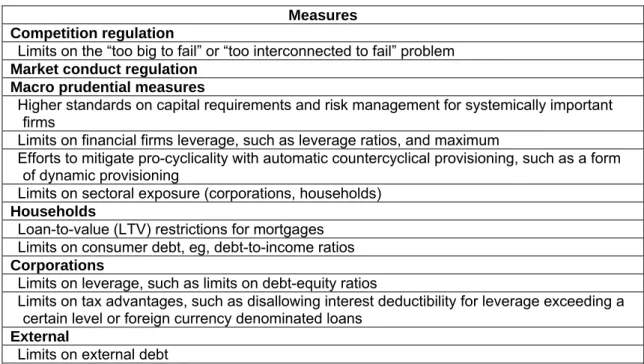
The systemic stability regulator would need to set the standards for capital, liquidity, and risk management practices for financial firms, given the importance of these matters for the aggregate level of risk within the financial system. A comprehensive list of macroprudential measures is discussed in Borio and Shim (2007). Table 1 offers a partial list of such measures.
Table 1: Macroprudential Supervisory Measures Measures
Competition regulation
Limits on the “too big to fail” or “too interconnected to fail” problem
Market conduct regulation Macro prudential measures
Higher standards on capital requirements and risk management for systemically important firms
Limits on financial firms leverage, such as leverage ratios, and maximum
Efforts to mitigate pro-cyclicality with automatic countercyclical provisioning, such as a form of dynamic provisioning
Limits on sectoral exposure (corporations, households)
Households
Loan-to-value (LTV) restrictions for mortgages Limits on consumer debt, eg, debt-to-income ratios
Corporations
Limits on leverage, such as limits on debt-equity ratios
Limits on tax advantages, such as disallowing interest deductibility for leverage exceeding a certain level or foreign currency denominated loans
External
Limits on external debt
Limits on currency and maturity mismatches
Source: Authors’ summary.
Boris and Shim (2007) suggest that macroprudential actions may be taken in a gradual, sequenced manner in the face of a buildup of vulnerabilities and systemic risk. For example, once a sign of built-up vulnerabilities is identified, a stability regulator would need to issue warnings. When vulnerabilities worsen but the problem is largely limited to a certain sector of the economy—such as commercial real estate and household mortgages—targeted tools could be mobilized, including sector-focused stress tests, tightening lending and underwriting standards, and limiting loan-to-value ratios and/or debt-to-income ratios. If the problem were to become more generalized and threaten systemic stability, then raising minimum capital requirements could be called for; and if the problem were built through markets and unregulated institutions, as opposed to
ADBI Working Paper 189 Kawai and Pomerleano
banks, then tightening monetary policy by raising policy interest rates could be more effective.
Inadequate information, in part due to limited data capture—inadequate efforts and excessive parsimony in expenditures on human resources and databases—is possibly the biggest obstacle to adequate monitoring, analysis, and macroprudential supervision.
3.4
Effective Organization of a Systemic Stability Regulator
The organizational structure of the systemic stability regulator must be designed in the most effective way possible to carry out the delegated responsibilities of financial stability. The focus of the stability regulator should be on the macro-financial surveillance of the system, which is an analysis of an economy’s macroeconomic and financial developments, as well as macroprudential supervision which is a top-down approach that helps assess sources of economy-wide risks. Such an organization would require political independence, credibility, and transparency as well as an adequate level of staffing, who possess knowledge, expertise, and experience across a wide range of financial institutions and markets.An important issue is whether the systemic stability regulator should be a single entity or a collective effort among different national financial authorities, each with a different specific responsibility. Key financial authorities include: the central bank, financial supervisor(s), and the finance ministry. The central bank is critical to financial stability as the monetary policymaker to set the policy interest rate in response to the emergence of systemic vulnerabilities as well as the outbreak of a crisis, and as the lender of last resort to protect a country’s payments system. A finance ministry should also be involved in stability regulation as crisis resolution invariably entails fiscal outlays—whose costs should be made transparent and accounted for explicitly in the fiscal budget.
First, a fully consolidated stability regulator, combining all the functions of central banking, financial supervision and regulation, and treasury—as in the case of Singapore—could be the ideal arrangement from the perspective of maintaining financial stability.7 This option requires the establishment of a new national agency in
charge of systemic stability regulation, absorbing all the macroprudential functions and monetary policymaking from other authorities. However, because of the heightened emphasis on central bank independence, this model is not a realistic option for many developed countries.
The second option would be for the central bank to play the systemic stability regulator function by taking over macroprudential supervisory and regulatory powers. However, an argument can be made that a central bank is not in the best position to take sole responsibility of maintaining financial stability—as this responsibility requires much broader expertise and culture than traditional central banking. This arrangement could also expose the central bank to the risk of political interventions once the eruption of a crisis requires management and resolution policies.
7 Singapore has not had significant financial crises. Japan had a land price bubble in the late 1980s and a systemic banking crisis in the late 1990s, despite the fact that the finance ministry had the power to supervise and regulate banks and the central bank was not independent (see Kawai 2005). So the most important element of success or failure may not be in the organizational structure of such a systemic stability regulator, but in how it functions.
The third option would be to establish a coordinated systemic stability regulatory council, comprising the finance minister, the central bank governor and the head(s) of national financial supervisors. An independent, powerful working group that supports this council, may be chaired by a reputable expert (like former Federal Reserve Chairman Paul Volcker) and include finance and central bank deputies, head(s) of supervisors and other relevant parties as active members, with authority to engage in crisis prevention, management, and resolution. The working group would provide recommendations for policy actions to the council which would make the ultimate decision. In this instance a country’s central bank may assume a secretariat role, given its usual advantages in analysis of macro-financial surveillance for systemic stability.
4. ALTERNATIVE MODELS OF SYSTEMIC STABILITY
REGULATION
4.1
Global Practices of Central Banks in Financial Stability
The role of a country’s central bank is critical to promote financial stability. There is a view that the central bank should be responsible for financial stability in addition to the usual responsibility of price stability. There are several reasons for making such a recommendation. First, in the US, full employment and price stability are the dual mandates conferred by Congress on the Federal Reserve in the conduct of monetary policy. Financial stability is an essential element in achieving those objectives. Second, there are important synergies between the systemic stability regulation and monetary policy, as insights garnered from performing one of those functions inform the performance of the other. Third, close familiarity with private credit relationships, particularly among the largest financial institutions and through critical payment and settlement systems, enables the central bank better able to anticipate how its actions could affect the economy. Finally, the lender of last resort function of the central bank is a natural link between the central bank and the emergence and reduction of systemic risk.Table 2 summarizes information on the structure of financial supervision and regulation and the role of central banks in prudential supervision. Of the 84 countries listed in the table, 30 have an integrated prudential supervisor, 20 have supervisory agencies in charge of two types of financial intermediaries, and 34 have multiple sectoral supervisors. The central banks of 48 countries (57% of the total) have the authority of banking supervision, and of these 48 countries 39 (81%) are developing and emerging economies. It is informative to note that in countries with multiple sectoral supervisors, central banks almost always have this supervisory authority.
Table 3 summarizes the central bank mandates of the G20 members and a few Asian economies. In all cases the central bank is in charge of price stability as well as payment system stability, and in some cases it is in charge of supervising and regulating securities and insurance firms—in addition to banks. Close to half of the central banks have financial stability committees and most of them do publish financial stability reports, suggesting the presence of their analytical capacity to conduct macro-financial surveillance. Also the central banks of Saudi Arabia and Singapore hold the responsibility of macroprudential supervision, and the majority of the world’s central banks do not.
ADBI Working Paper 189 Kawai and Pomerleano
Table 2: Economies with Single, Semi-Integrated, and Sectoral Prudential Supervisory Agencies, 2009 (a) Agency Supervising Two Types of Financial
Intermediaries Single Prudential Supervisor
for the Financial System (year of establishment) Banks and securities firms Banks and insurers Securities firms and insurers
Multiple Sectoral Supervisors (at least one for banks, one for
securities firms, and one for insurers) Australia (1998) Austria (2002) Bahrain* (2002) Belgium (2004) Bermuda* (2002) Cayman Islands* (1997) Denmark (1988) Estonia (1999) Germany (2002) Gibraltar (1989) Guernsey (1988) Hungary (2002) Iceland (1988) Ireland* (2002) Japan (2001) Kazakhstan* (1998) Korea, Republic of (1997) Latvia (1998) Maldives* (1998) Malta* (2002) Netherlands* (2004) Nicaragua* (1999) Norway (1986) Singapore* (1984) South Africa* (1990) Sweden (1991) Taipei,China (2004)
United Arab Emirates* (2000) United Kingdom (1997) Uruguay (1993) Total - 30 Finland Luxembourg Mexico Switzerland Uruguay Total - 5 Canada Colombia Ecuador El Salvador Guatemala Malaysia* Peru Venezuela Total - 8 Bolivia Bulgaria* Chile Jamaica* Mauritius* Slovak Rep.* (b) Ukraine* Total - 7 Albania* Argentina* Bahamas, The* Barbados* Botswana* Brazil* Croatia* Cyprus* Czech Republic (b) Dominican Rep.* Egypt* France * Greece *
Hong Kong, SAR* India * Indonesia * Israel * Italy * Jordan* Lithuania* New Zealand* Panama Philippines* People’s Republic of China (PRC) Poland* Portugal* Russia* Slovenia* Sri Lanka* Spain * Thailand * Tunisia * Uganda * United States * Total - 34 Notes: (a) The table focuses on prudential supervision, not on business supervision (which can be carried out by the same agencies or by separate agencies, even in the integrated model). Also, the table does not consider deposit insurers, even though they play an important role in banking supervision in a number of countries and can do so under any regulatory model. (b) The authorities announced plans to integrate prudential supervision in their central banks in 2006. (c) An asterisk (*) indicates that banking supervision is conducted by the central bank.
Source: Čihák and Podpiera (2006). Updated by the authors.
Table 3: Mandates for the World's Major Central Banks
Financial system stability
Regulation and supervision of
Country/Region De jure independence Price stability Payment system regulation & supervision
Banking Securities Insurance
Macro prudential surveillance Financial stability committee Financial system stability analysis/repor t
Argentina Yes Yes Yes Yes -- -- --- -- Yes
Australia Yes Yes Yes -- -- -- -- Yes Yes
Brazil Yes Yes Yes Yes Yes -- -- -- Yes
Canada No Yes Yes -- -- -- -- -- Yes
China (PRC) No Yes Yes -- -- -- -- Yes Yes
Euro Zone Yes Yes Yes -- -- -- -- Yes Yes
Hong Kong,
China No Yes Yes Yes -- -- -- Yes Yes
India No Yes Yes Yes Yes Yes -- Yes Yes
Indonesia Yes Yes Yes Yes -- -- -- -- Yes
Japan Yes Yes Yes Yes -- -- -- -- Yes
Korea, Republic
of Yes Yes Yes -- -- -- -- -- Yes
Malaysia No Yes Yes Yes Yes Yes -- -- Yes
Mexico Yes Yes Yes -- -- -- -- -- Yes
Philippines Yes Yes Yes Yes -- -- -- Yes --
Russia Yes Yes Yes Yes -- -- -- Yes --
Saudi Arabia No Yes Yes Yes Yes Yes Yes Yes Yes
Singapore No Yes Yes Yes Yes Yes Yes Yes Yes
South Africa Yes Yes Yes Yes -- -- -- -- Yes
Switzerland Yes Yes Yes Yes Yes -- -- -- Yes
Thailand No Yes Yes Yes Yes Yes -- Yes --
Turkey Yes Yes Yes -- -- -- -- -- Yes
United Kingdom Yes Yes Yes -- -- -- -- Yes Yes
United States Yes Yes Yes Yes -- -- -- Yes --
Note: “—”means no role or in coordination with other agencies.
ADBI Working Paper 189 Kawai and Pomerleano
4.2
Reform Proposals in the US, the UK, and the European Union
National efforts to address systemic risk and promote financial stability are proceeding in the US and the UK, while regional efforts are under discussion in the European Union (EU). 4.2.1 US Stability Reform PlanIn the US, the Obama administration has proposed that the Federal Reserve become the nation’s financial stability overseer. The central bank would gain both the power to monitor risks across the financial system and the authority to examine any firm that could threaten financial stability, even though normally the Federal Reserve would not supervise the institution. The nation’s biggest and most interconnected firms would be subject to heightened oversight. The Fed would more tightly regulate systemically important financial institutions (“Tier 1 institutions”), even if they are not banks in the traditional sense (such as General Electric). The administration’s proposal calls for a “rapid resolution plan.” It mandates that systemically important financial firms be required to file a “funeral plan” regularly—a set of instructions for how the institution could be liquidated in an orderly and timely fashion should the need to do so arise. Finally, a new insolvency regime to be introduced will cover all such firms, modeled on the scheme run by the Federal Deposit Insurance Corporation (FDIC) for ordinary banks.
Against this Federal Reserve-led model there is a competing view that a “Financial Services Oversight Council” should be created to provide macroprudential oversight of the system, that is, to oversee systemic risk issues, develop prudential policies, and mitigate systemic risks. This council would include the Fed, regulators/supervisors, FDIC and the Treasury. This model could become effective if the council could clarify its objectives and mandates and acquire sufficient resources and implementation tools. Also the fragmentation of financial regulation and supervision would have to be eliminated by consolidating these functions into a single authority. This would help harmonize prudential regulatory standards for financial institutions, products and practices to prevent regulatory arbitrage and, hence, systemic risk.
4.2.2 UK Stability Reform Plan
The UK Treasury has proposed regulatory reforms as well. A “Council for Financial Stability” would be created to bring together the Bank of England (BOE), Financial Services Authority (FSA) and the Treasury. The FSA would be in charge of both macroprudential and microprudential supervision and address systemic risks, such as rapid credit surges, for example by requiring more bank capital. The BOE would have statutory responsibility for financial stability and would be given new powers to deal with troubled banks. However, the BOE objects that it does not have the tools it needs to maintain financial stability.
The opposition party makes a very different proposal. It advocates the abolition of the FSA and the enlargement of the BOE mandate to absorb all of the FSA’s supervisory functions. Essentially this would transform the BOE into a key systemic stability regulator, signifying a return to the pre-1998 financial services regulation in the UK. Prior to 1998, responsibility for banking supervision was with the BOE, and the supervisory functions were transferred to the newly established FSA beginning in 1998.
4.2.3 European Union Reforms
In Europe, forging a robust approach to coordination is a big challenge, in particular on issues related to regional financial and macroeconomic stability. A high-level expert group headed by Jacques de Larosière (2009) proposed establishing two supra-national structures to deal with cross-border aspects of financial stability:
national supervisors with three new sectoral EU-level authorities (for banking, insurance, and securities markets), and
A European Systemic Risk Council, which would monitor systemic risks and address them through coordinated policy responses from EU member states.
The European Commission favors a systemic risk board to sound the alarm when it perceives a critical buildup of risk. It has drafted a proposal to establish a European Systemic Risk Board (ESRB) that is in charge of EU-level macroprudential regulation and supervision. It would be headed by the president of the European Central Bank (ECB). Although the ESRB would identify risks with a systemic dimension, issue risk warnings, and, if necessary, recommend specific actions to avoid the buildup of wider problems, it would not have any binding power to impose measures on member states, that is, its recommendations would not be legally binding. In addition, the role of monetary policy in financial stability is not clearly specified particularly when the demands of price stability and financial stability clash. These limitations could significantly weaken the role and performance of the ESRB as Europe’s regional systemic stability regulator.
The EU recognized a second problem as well: the system for supervising cross-border banks is flawed, and the question of who should be in charge of Europe-wide bank oversight remains unanswered. The European Commission has drafted a proposal to establish a European supervisory authority to carefully monitor large cross-border financial institutions. Finally, new European Union laws are likely to require banks to strengthen capital cushions, liquidity, and counter-cyclicality.
4.3
Alternative Models
There are several models for systemic stability regulation, including a fully integrated model, a la Singapore; a central bank-led model as in the pre-1998 UK; and a coordinated “council” model. Although the fully integrated model could be ideal from the perspective of promoting financial stability, its establishment is now increasingly difficult due the rising demand for central banks to be independent from the government and political process. The central bank-led model is also possible, but it bears the risk of government interference particularly at the time of crisis management and resolution, threatening the independence of the central bank. However, in countries—particularly in many developing and emerging economies— where the central bank is not independent, this model will likely remain viable.
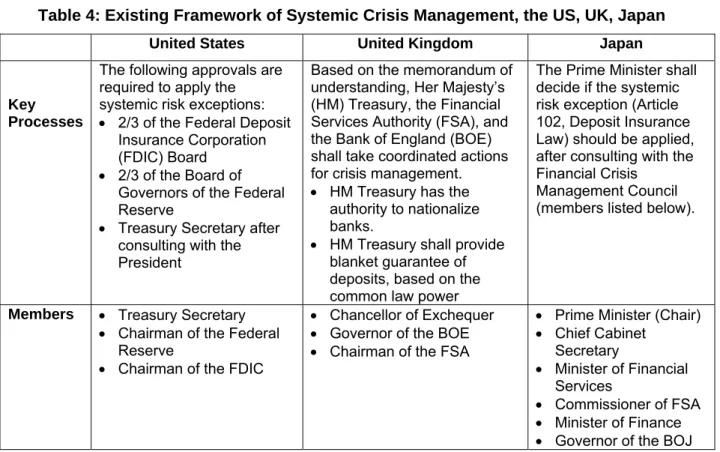
A realistic approach for most developed countries would be to establish a workable “council” approach, where the national financial authorities (the central bank, supervisor(s), and finance ministry) work collectively, as if they formed a single systemic stability regulator, to perform the stability regulation function. There exist frameworks for financial crisis management in the US, the UK and Japan (see Table 4). The “council” approach would be, in a sense, an expansion of this framework to address broader issues of crisis containment, including crisis prevention. But this should not be a mere expansion of the existing frameworks.
ADBI Working Paper 189 Kawai and Pomerleano
Table 4: Existing Framework of Systemic Crisis Management, the US, UK, Japan
United States United Kingdom Japan
Key Processes
The following approvals are required to apply the systemic risk exceptions: 2/3 of the Federal Deposit
Insurance Corporation (FDIC) Board
2/3 of the Board of Governors of the Federal Reserve
Treasury Secretary after consulting with the President
Based on the memorandum of understanding, Her Majesty’s (HM) Treasury, the Financial Services Authority (FSA), and the Bank of England (BOE) shall take coordinated actions for crisis management. HM Treasury has the
authority to nationalize banks.
HM Treasury shall provide blanket guarantee of deposits, based on the common law power
The Prime Minister shall decide if the systemic risk exception (Article 102, Deposit Insurance Law) should be applied, after consulting with the Financial Crisis
Management Council (members listed below).
Members Treasury Secretary Chairman of the Federal
Reserve
Chairman of the FDIC
Chancellor of Exchequer Governor of the BOE Chairman of the FSA
Prime Minister (Chair) Chief Cabinet Secretary Minister of Financial Services Commissioner of FSA Minister of Finance Governor of the BOJ
Source: Financial Services Agency, Japan.
For such a “council” approach to function successfully, the collective objectives and mandates as well as the division of labor among the authorities should be clearly defined, sufficient capacities and resources should be provided collectively, and all the necessary macroprudential tools should be made available for use. Most importantly a culture of sharing information should be developed and there should be intensive dialogue among the financial authorities.
The central bank has a comparative advantage in macro-financial surveillance and may or may not have macroprudential authority (particularly tools). If the central bank does not have macroprudential authority, then it could still suggest the supervisor(s) to take certain macroprudential actions (such as an increase in capital adequacy ratios, a reduction of loan-to-value ratios, etc) to contain a buildup of systemic risk. Similarly, the supervisor(s) can suggest that the central bank alter monetary policy to contain systemic risk.
5. CONCLUSIONS
Our starting point is that a financial crisis is not an “unknown unknown,” though its precise timing and the magnitude of its severity might be. A crisis builds up over time in response to policy mistakes and investor herd behavior. While markets tend to be forgiving for a long time, the unsustainable imbalance is eventually corrected. By identifying and dealing with systemic risk—or sources of financial vulnerabilities—before it creates critical instability, policymakers could prevent a financial crisis. For this purpose, macro-financial surveillance and macroprudential supervision are vital, and a systemic stability regulator—or relevant financial authorities under a collective framework for systemic stability regulation—must act to avoid the buildup of large vulnerabilities and imbalances in each jurisdiction. In our experience, an inadequate effort to capture and analyze data is a key obstacle to conducting adequate macroprudential supervision.
Several models are possible to choose from in creating a systemic stability regulator, including a fully integrated model a la Singapore, a central bank-led model of the pre-1998
realistic approach would be to take a “council” model, where (i) all financial authorities (central bank, supervisors, and finance ministry) work in a coordinated manner, including intensive information exchange and consultation, and (ii) the central bank conducts macroeconomic and financial surveillance while the supervisors take macroprudential actions in addition to microprudential supervision. It is highly desirable for supervisors to consolidate their supervision over banks, nonbank financial institutions, and markets.
Even if such a framework for national systemic risk regulation is established, financial stability may be at risk without a global strategy to address financial crisis prevention, management and resolution. A successful international financial order can be constructed only with a binding set of minimum international standards. In the absence of such standards, the differences in national policies in accounting, information transparency, regulating leverage, and capital standards will likely lead to a regulatory arbitrage race to the bottom, with the competition from more pliant jurisdictions undermining more stringent regulatory regimes, and “exporting” financial instability.
In this sense, the Westphalian principles of sovereignty that govern international financial oversight are not suited to the realities of an interconnected financial system in the 21st
century. If the financial authorities in major economies—such as the US, the UK, and the Euro Area—do not make progress in the creation of a binding global financial order, the prospects for attaining global financial stability are limited. The financially integrated world would have to continue to live with regulatory fragmentation, with all of its attendant risk to stability. In order to be successful, the recent reforms at the global level—that focus on the newly created Financial Stability Board—require that the US and the UK make strong political commitments to national and international financial stability regulation.
ADBI Working Paper 189 Kawai and Pomerleano
REFERENCES
Acharya, V. V., and M. Richardson, editors. 2009. Restoring Financial Stability. NYU-Stern Report. New York: John Wiley and Sons.
Bernanke, B. S. 2009. Financial Reform to Address Systemic Risk. Speech at the Council on Foreign Relations, Washington, DC.10 March.
Borio, C. E. V., and I. Shim. 2007. What Can (Macro-) Prudential Policy Do to Support Monetary Policy? BIS Working Paper 242. Geneva: Bank for International Settlements.
Brunnermeier, M., A. Crockett, C. Goodhart, A. Persaud, and H. S. Shin. 2009. The Fundamental Principles of Financial Regulation. Geneva and London: International Center for Monetary and Banking Studies (ICMB), and Centre for Economic Policy Research (CEPR), London.
Carmichael, J., and M. Pomerleano. 2002. The development and regulation of non-bank financial institutions. Washington, DC: The World Bank.
Caruana, J. 2003. Banking Provisions and Asset Price Bubbles. In Asset Price Bubbles and Their Implications for Monetary Policy and Financial Stability, edited by C. Hunter, G. Kaufman, and M. Pomerleano. Cambridge, MA: MIT Press.
Cihak, M., and R. Podpiera. 2006. Is One Watchdog Better than Three?: International Experience with Integrated Financial Sector Supervision. Czech Journal of Economics and Finance 56 (3–4): 102–126.
de Larosiere Group. 2009. Report on Financial Supervision: High-Level Group on Financial Supervision in the EU (February).
Available:www.ec.europa.eu/internal_market/finances/docs/de_larosiere_report_en.p df.
Fujii, M., and M. Kawai. 2009. Lessons from Japan’s Banking Crisis, 1991-2005. Mimeographed, ADBI, Tokyo.
Group of Thirty. 2009. Financial Reform: A Framework for Financial Stability. Washington, DC. Available: www.group30/pubs/reformreport.pdf
Haldane, A. G. 2009. Rethinking the Financial Network. Speech delivered at the Financial Student Association, Amsterdam, April.
the Chancellor of Exchequer by Command of Her Majesty, London, 8 July. Available: http://www.hm-treasury.gov.uk/reforming_financial_markets.htm
Hüpkes, E. 2009. Crisis Resolution: Where We Stand and How to Improve It? A paper for the conference “After the Storm: The Future Face of Europe’s Financial System,” IMF, Brussels, 23 March.
IMF. 2009a. Initial Lessons of the Crisis for the Global Architecture and the IMF. Prepared by the Strategy, Policy, and Review Department. Washington, DC: IMF. Available: http://www.imf.org/external/np/pp/eng/2009/021809.pdf
———. 2009b. Global Financial Stability Report. Washington, DC: IMF. Available:http://imf.org/external/pubs/ft/gfsr/2009/01/pdf/chap3.pdf.
Kawai, M. 2000. The Resolution of the East Asian Crisis: Financial and Corporate Sector Restructuring. Journal of Asian Economics 11: 133–168.
———. 2005. Reform of the Japanese Banking System. International Economics and Economic Policy 2 (4): 307–335.
Laeven, L. A., and F. V. Valencia. 2008. Systemic Banking Crises: A New Database. IMF Working Paper WP/08/224. Washington, DC: International Monetary Fund. Mayes, D. G. 2006. Financial Stability in a World of Cross-Border Banking: Nordic and
Antipodean Solutions to the Problem of Responsibility without Power. Journal of Banking Regulation 8 (1): 20–39. Available:
https://secure.palgrave-journals.com/jbr/journal/v8/n1/abs/2350034a.html
Mayes, D. G., M. J. Nieto, and L. Wall. 2008. Multiple Safety Net Regulators and Agency Problems in the EU: Is Prompt Corrective Action Partly the Solution? Journal of Financial Stability 4: 232–257.
Morris, S., and H. S. Shin. 2008. Financial Regulation in a Systemic Context. Brookings Papers on Economic Activity (Fall): 229–275.
Rosengren, E. S. 2009. Could a Systemic regulator have Seen the Current Crisis? A paper for the 10th Seoul International Financial Forum, Seoul, 15 April.
Shin, H. S. 2009. It Is Time for a Reappraisal of the Basic Principles of Financial Regulation. 31 January. Available: http://www.voxeu.com/index.php?q=node/2949
ADBI Working Paper 189 Kawai and Pomerleano
19
Tarullo, D. K. 2009. Modernizing Bank Supervision and Regulation. Before the Committee on Banking, Housing, and Urban Affairs, US Senate, Washington, DC, 19 March. Taylor, J. B. 2009. Getting off Track: How Government Actions and Interventions Caused,
Prolonged, and Worsened the Financial Crisis. Stanford, CA: Hoover Institution Press. Tobias, A. and H. S. Shin. 2008. Money, Liquidity and Monetary Policy. A paper for the
American Economic Association Meetings, December.
US Department of the Treasury. 2009. Financial Regulatory Reform: A New Foundation— Rebuilding Financial Supervision and Regulation. Washington, DC: US Department of the Treasury. Available: www.treasury.gov/press/releases/tg72.htm
Viñals, J. 2009. Financial Stability and the Design of a New Rule Book. Keynote remarks at the Brussels Economic Forum, Brussels, 15 May.
Available:http://www.imf.org/external/np/speeches/2009/051509a.htm
Wessel, D. 2009. In Fed We Trust: Ben Bernanke’s War on the Great Panic. New York: Crown Business.