Vol. 7, No. 3, October 2019, pp.1459-1467 Available online at: http://pen.ius.edu.ba
Texture features extraction based on GLCM for face retrieval system
Sundos Abdulameer Alazawi1, Narjis Mezaal Shati2, Amel H. Abbas31,2,3Departement of Computer Sciences, Mustansiriyah University
Article Info ABSTRACT
Received, 2019
Texture features play an important role in most image retrieval techniques to obtain results of high accuracy. In this work, the face image retrieval method considering texture analysis and statistical features has been proposed. Textile features can also be extracted using the GLCM tool. In this research, the GLCM calculation method involves two phases, first: some of the previous image processing techniques work together to get the best results to determine the big object of the face image (center of face image) then, the gray level co-occurrence matrix GLCM is computed for gray face image and then some statistical texture features with second order are extracted. The second phase, the facial texture features are retrieved by finding the minimum distance between texture features of an unknown face image with the texture features of face images which are stored in the database system. The experimental results show that the proposed method is capable to achieve high accuracy degree in face image retrieval.
Keyword: Face retrieval Texture Feature GLCM Pattern Recognition Corresponding Author:
Sundos Abdulameer Alazawi, Departement of Computer Sciences, Mustansiriyah University,
Baghdad, Iraq.
Email: [email protected] 1. Introduction
The texture is a property that clarifies the structure of an image or defined as an organized recurrence of pixels or pattern on the exterior. it is complex optical patterns that are collections of pixels, or objects within patterns with the properties of bright effect, colors, shapes, etc. [1, 2]
In order to understand the images of the human face, it is important to understand the characteristics of the face and how it appears. Faces vary over different times, but these differences can be divided into two parts: differences in shapes and differences in texture as pixel's patterns for humans. The differences in shapes and textures come from the differences between individual of society from another community, and it comes from the difference in the way of expression, such as sadness, joy, etc., in addition to the difference in image capture with certain lighting. One of the most important methods used primarily in the retrieval or recognition of face image is the algorithms and methods of image processing and computer vision such as segmentation of an image to objects of the concept serve the work, there are several methods of segmentation, including dependence on the threshold and the detection of the edges of the main parts of the image, detection of discontinuities, and region growing techniques.[3] A fixed texture in an image appears as set of its features that are fixed, progressively variable or periodical, it may be seen as a similarity aggregate in an image [4]. Texture analysis recognized the spatial variation of image pattern based on some mathematical operations and some mathematical models to obtained information from it and statistical models of assess of texture that considers the spatial relationship of pixels is the gray-level co-occurrence matrix (GLCM)[5]. The GLCM
operations determine the texture of the image by computing how much two-pixel with fixed values and in a fixed spatial relationship come in an image, that dong by GLCM to the computing of statistical measures from GLCM[6, 7]. According to co-occurrence matrix, Haralick [8, 9].
Face recognition by computers is a robust tool, same of fingerprint operations. The face retrieval issue is an important computer vision issues in more of trades and security applications. The great motivation for utilizing texture features is that it supplies further features in an image to use it in pattern recognition applications [10-12].
The requirement for effective texture-based image retrieval has increased highly in numerous applications fields such as biometric, warlike, business, learning, and Web image classification and search problems [11, 13].
Two main groups of biometric recognition approach:[14, 15] External Features such as palm print, face, and fingerprint Essential Features such as palm, hand, and finger veins.
As any other biometrics solutions, the facial recognition techniques are used for measurement and matching of unique features required by the identification or authentication system[16] .
In recent years recognition and retrieval for the human face has received big interesting from researchers in biometrical issue, patterns recognition, and computer vision fields, for examples Abdullah et a. (2019) [17] their work on images of Department of Computer Science students in Tikrit University, they depend on the HSI color model by RGB transformation to obtain the layer's saturation, PCA algorithm is used to extract the feature, when they experimental the result of face recognition by Elman neural network, the accuracy rate is 94%. Alazawi and Al-A'meri (2013) [18] extract a shape feature for face image based on moments values from central moment in gray images after extract objects of essential features for face images such as mouth, nose, and eyes. To recognize an image, they compare 28 features values between each face's features in the system's database. Dixit and Shirdhonkar (2018) [19] work on retrieval face documents based on a GLCM to extract face features vector for retrieval of document then that stored features documents are compared with the database features documents. Mahalanobis distance is been implemented for face retrieval. Lu et al (2017) [20] propose a method of retrieval of the face by fused shape and texture features. Texture features are extracted by using SDM extract face texture information. In the retrieval stage, fused result is used to gain the result. Ahmed et al. (2018) [21] proposed system implements on the low resolution and the feature was extracted by LBPH histogram, their method work on face angles for identifying results by face tracking. LR500 is a dataset uses for training and classification. Reddy et al. (2015) [22] present method for face recognition by deriving an eight texture features on the face using LBP-L, LBPH, and LBP Low and High combination, and various drag values. This method suffers from lighting problems and some problems with dark regions.
Researchers rarely rely on facial recognition and retrieval on skin color or on standard mathematical properties. But when a face image is capture at a different time, and the skin texture may have some new scars, in this case, we can be considering texture features. From this standpoint, the texture features for face recognition was adopted in this research. In this proposed method, edge detection technique is used to represent the data in 0/1 that gained from the threshold operation on the gray image, a technique detects pixels at edges of image to obtained of big region (center of face image), some of preprocessing operations like enhancement, thinning and limitation for B/W image are work together for extracting of texture features at end of first phase in our method, the texture features are extracted based on GLCM features for face object resulted from preprocessing operations. Finally, the results of the first phase of the proposed method will be used in the process of retrieving the face image based on the minimum distance between the texture features of an unknown image with face images stored in the database system.
2. Pre-Processing Operations
To extracted texture features, some of pre-processing and enhancement operations are needed to an obtained good result [23] such as color conversion, edge detection, enhancement, and some of traditional methods are important to facilitate the pattern analysis of the image for the texture features extraction. When face is a color
then gray level image is convert to binary image (B/W) based on threshold and edge detection techniques. The next operations is thinning of the edge for a black and white objects result, for origin face image, segment the image into small and large regions, the greatest region of the image is a center of the face, at last, drawing a rectangle shape to edging of the center of the face that to use it in last fitting operation on the origin gray image.
2.1. Texture Feature Extreaction using GLCM
Texture analysis is used in a very broad range of fields and applications, from texture classification such as remote sensing, biometric issues, and pattern recognition for image retrieval. For each of these image processing operations, it is needful to extract significant features that perform the texture features, that can be obtained by GLCM to helpful in extracted that features [8, 24].
In image analysis, texture feature is the result from the observed groups of the intensity in specific locations statistical distribution relative to each other from image [2, 7, 25].
The GLCM is a matrix of how oftentimes several sets of a pixel in grey levels exist in an image GLCM is computed for a selected pair of distance and angle. For a specific pair of distance and angle relative recurrences are computed of that pair of each pixel and its neighboring as shown in Fig.1. The gained matrix is split by the summation of all the indecisions in order to gain a normalized matrix [8].
Horizontal direction (00) Vertical direction (900) Diagonal direction:
Bottom left to top right (-450) Top left to bottom right (-1350)
Figure1. Angle relative of interesting pixel and its neighboring.
Out of 13 Haralick’s features, in general, the prominently used four of thus features such as contrast, entropy, homogeneity, and energy [26, 27]
The four features: contrast, entropy, homogeneity, and energy, are extracted from GLCM and summarize as follow:[28-30]
1. The gray level difference in the GLCM matrix is appeared by contrast. It is compute the intensity the pixel and its neighbor.
2. Energy feature, compute the local homogeneity, it refer to the Entropy. Its value ranges from 0 to 1
3. Homogeneity feature, Compute the not-zero in the GLCM, it is the inverse of contrast weight.. Its value ranges from 0 to 1
4. Entropy Feature, the quantity of energy.
3. Face Retrieval System
The proposed system including two main phases: Texture Features Extraction phase, and Face retrieval phase.
First phase of texture feature extraction is summarized as shown in algorithm (1): Algorithm(1)
Input: Gray level of face image
Output: Saved the texture features for each face in database system. Step 1: Smoothing Image.
Step 2: Segment Binary image using edge detection and Threshold techniques.
Step 3: Thinning its boundary and limitation for largest objects (Facial features as center of image). Step 4: fitting the largest object obtained from Step 3 on the origin Gray image.
Step 5: Find GLCM values for Four Angles (0o, 45o, 90o, and 135o).
Step 6: Compute The four Features values, by Compute each feature (Eq. 1, 2, 3 and 4) with result of GLCM from step two, that we have four values (features) for each input medical image.
Step 7: Compute the feature values from step three, for each image, that values are saved in our database system and uses to recognized of new face image
In second phase of our work, retrieval algorithm is based on four values from the Texture Feature Extraction phase, that is summarized in algorithm (2).
Algorithm (2)
Input: Unknown of new face image.
Output: recognized of entry image belong of face image database in DB system.
Step 1: Applied Algorithm (1) on new Unknown input image, to extract four Texture Features
Step 2: Compare the texture features for Unknown face image produced from step 1 within each texture features for stored face images in our database using minimum distance, by similarity Euclidian Distance [31], suppose that image P is stored face image in database and query image Q is unknown face image, that can be given as equation (5)
Where
And are the texture features values of image P from the database, and Query image Q for four texture features contrast, correlation, energy, and homogeneity
Step 3: From step2 results, Retrieve the relevant images based on minimum SED value to decide any of the features in the database is retrieved for unknown new face image to recognize it.
4. Experimental Results
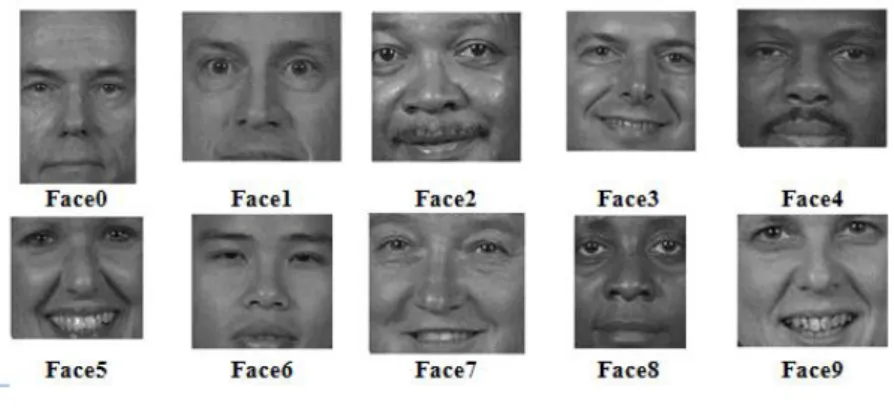
From GLCM in Algorithm(1), we get GLCM values at each angle for face image, in order to shorten the understanding of the proposed method, we took 10 closest samples in order to show the results clearly, that Ten images named Face0, Face1, … Face9.
That ten face images are shown in Fig.2.
Figure2: Ten simple face images
An example of Preprocessing steps that applied on Face3, Fig3 show the result of Preprocessing steps in Algorithm (1).
Figure3: Preprocessing result for Face3.
When apply Face3 on Gray level co-occurrence matrix in our proposed method, eight values will be result for each angles (0o, 45o, 90o, and 135o), and then use it in texture features extraction stage to extract four features. Table (1) show the result of GLCM for Face3 image, and this result will be used in feature extraction steps.
Table 1: GLCM values for Face1 0o 45o 90o 135o 4035 198 5 0 302 977 317 11 1 291 1861 409 0 5 351 1307 0 0 5 311 0 0 0 1 0 0 0 0 0 0 0 0
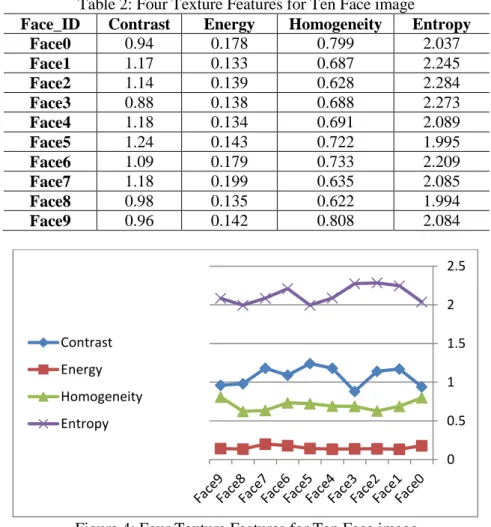
Four texture feature Values obtained from Algorithm (1) by calculate Eq.(1 to 4) on face images for all face database, that four features relations for ten face images are shown in Fig4, and Table (2) contain of Four texture features for each ten images.
Table 2: Four Texture Features for Ten Face image
Face_ID Contrast Energy Homogeneity Entropy
Face0 0.94 0.178 0.799 2.037 Face1 1.17 0.133 0.687 2.245 Face2 1.14 0.139 0.628 2.284 Face3 0.88 0.138 0.688 2.273 Face4 1.18 0.134 0.691 2.089 Face5 1.24 0.143 0.722 1.995 Face6 1.09 0.179 0.733 2.209 Face7 1.18 0.199 0.635 2.085 Face8 0.98 0.135 0.622 1.994 Face9 0.96 0.142 0.808 2.084
Figure 4: Four Texture Features for Ten Face image
When a new unknown face image is input into the system for identifying it, the texture features values are calculated, the results are as in Table(3):
Table 3: Four Texture Features for Unknown Face image
Face_ID Contrast Energy Homogeneity Entropy
Unknown 1.08 0.178 0.734 2.198
Then compared it with all face images in the database based on the SED equation 5, When
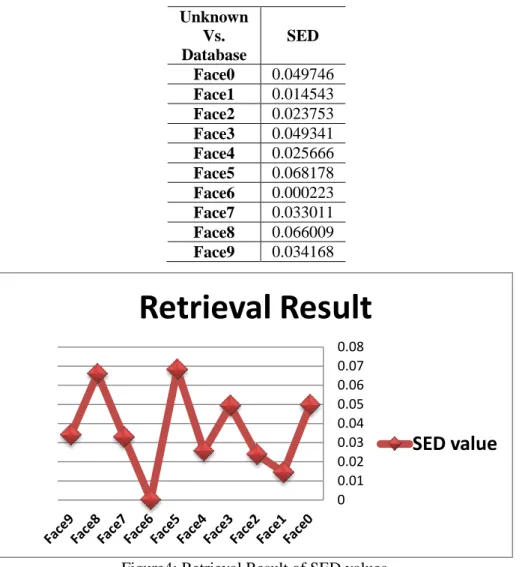
Table (4) shows the values of SED between each of samples 10 face images with new unknown face image where the minimum SED is close to 0 for Face6 (0.000223), and Fig4 show the retrieval result and it is clear that Unknown Face is retrieval to Face6.
0 0.5 1 1.5 2 2.5 Contrast Energy Homogeneity Entropy
Table 2: SED value between Unknown Image and Ten Face image
Figure4: Retrieval Result of SED values.
5. Conclusion
In this paper, Face image types will be identifier based on its texture features. This method has been used to extract the features values using statistical technique called as GLCM. In the event that the input image was taken at a different time, and maybe that skin texture of the face has some new scars, that why we considering texture features.
One of the ways to do that image retrieval by comparing input test face texture features entry with texture features saved in database, so the stored image has minimum distance value is the image that test image entry related it. The experimental results shows ability of proposed method to achieve high accuracy degree in face retrieval from for more features, we suggest uses color information to fusion with texture features, it possible to merge the texture features with color information for new retrieval method, and can used our method for other types of images.
Acknowledgements (11 PT) (Optional)
The author's thankful Department of Computer Science, Collage of Science, Mustansiriyah University for supporting this work.
0 0.01 0.02 0.03 0.04 0.05 0.06 0.07 0.08
Retrieval Result
SED value
Unknown Vs. Database SED Face0 0.049746 Face1 0.014543 Face2 0.023753 Face3 0.049341 Face4 0.025666 Face5 0.068178 Face6 0.000223 Face7 0.033011 Face8 0.066009 Face9 0.034168References
[1] G. Srinivasan and G. Shobha, "Statistical texture analysis," in Proceedings of world academy of
science, engineering and technology, 2008, vol. 36, pp. 1264-1269.
[2] M. Tuceryan and A. K. Jain, "Texture analysis," in Handbook of pattern recognition and computer
vision: World Scientific, 1993, pp. 235-276.
[3] J. C. Russ and J. C. Russ, Introduction to image processing and analysis. CRC press, 2017.
[4] T. N. Pappas, D. L. Neuhoff, H. De Ridder, and J. Zujovic, "Image analysis: Focus on texture similarity,"
Proceedings of the IEEE, vol. 101, no. 9, pp. 2044-2057, 2013.
[5] X. Zhang, J. Cui, W. Wang, and C. Lin, "A study for texture feature extraction of high-resolution
satellite images based on a direction measure and gray level co-occurrence matrix fusion algorithm,"
Sensors, vol. 17, no. 7, p. 1474, 2017.
[6] B. Pathak and D. Barooah, "Texture analysis based on the gray-level co-occurrence matrix
considering possible orientations," International Journal of Advanced Research in Electrical,
Electronics and Instrumentation Engineering, vol. 2, no. 9, pp. 4206-4212, 2013.
[7] P. Mohanaiah, P. Sathyanarayana, and L. GuruKumar, "Image texture feature extraction using GLCM
approach," International journal of scientific and research publications, vol. 3, no. 5, p. 1, 2013.
[8] M. Hall-Beyer, "GLCM texture: a tutorial," National Council on Geographic Information and Analysis
Remote Sensing Core Curriculum, vol. 3, 2000.
[9] R. M. Haralick and K. Shanmugam, "Textural features for image classification," IEEE Transactions on
systems, man, and cybernetics, no. 6, pp. 610-621, 1973.
[10] S. G. Young, K. Hugenberg, M. J. Bernstein, and D. F. Sacco, "Perception and motivation in face
recognition: A critical review of theories of the cross-race effect," Personality and Social Psychology
Review, vol. 16, no. 2, pp. 116-142, 2012.
[11] F.-H. Kong, "Image retrieval using both color and texture features," in 2009 International Conference
on Machine Learning and Cybernetics, 2009, vol. 4: IEEE, pp. 2228-2232.
[12] N. Bagri and P. K. Johari, "A comparative study on feature extraction using texture and shape for
content based image retrieval," International Journal of Advanced Science and Technology, vol. 80,
no. 4, pp. 41-52, 2015.
[13] N. Ghosh, S. Agrawal, and M. Motwani, "A survey of feature extraction for content-based image
retrieval system," in Proceedings of International Conference on Recent Advancement on Computer
and Communication, 2018: Springer, pp. 305-313.
[14] S. S. Jumaa and K. Zidan, "Finger vein recognition using two parallel enhancement ppproachs based
fuzzy histogram equalization," Periodicals of Engineering and Natural Sciences, vol. 7, no. 1, pp.
514-529, 2019.
[15] S. A. Shawkat, K. S. L. Al-badri, and A. I. Turki, "The new hand geometry system and automatic
identification," Periodicals of Engineering and Natural Sciences, vol. 7, no. 3, pp. 996-1008, 2019.
[16] R. Bhatia, "Biometrics and face recognition techniques," International Journal of Advanced Research
in Computer Science and Software Engineering, vol. 3, no. 5, 2013.
[17] A. S. Abdullah, M. A. Abed, and I. Al Barazanchi, "Improving face recognition by elman neural
network using curvelet transform and HSI color space," Periodicals of Engineering and Natural
Sciences, vol. 7, no. 2, pp. 430-437, 2019.
[18] S. A. H. Alazawi and J. H. Al-A'meri, "Face Feature Recognition System Considering Central
Moments," Int. J. Comput. Eng. Res, vol. 3, no. 1, pp. 52-57, 2013.
[19] U. D. Dixit and M. Shirdhonkar, "Face-based Document Image Retrieval System," Procedia computer
science, vol. 132, pp. 659-668, 2018.
[20] Z. Lu, J. Yang, and Q. Liu, "Face image retrieval based on shape and texture feature fusion,"
Computational Visual Media, vol. 3, no. 4, pp. 359-368, 2017.
[21] A. Ahmed, J. Guo, F. Ali, F. Deeba, and A. Ahmed, "LBPH based improved face recognition at low
[22] K. S. Reddy, V. V. Kumar, and B. E. Reddy, "Face Recognition Based on Texture Features using Local
Ternary Patterns," International Journal of Image, Graphics & Signal Processing, vol. 7, no. 10, 2015.
[23] P. Gumaste and V. Bairagi, "Feature Extraction of the Brain Tumours with the help of MRI, based on
Symmetry and partitioning," Periodicals of Engineering and Natural Sciences, vol. 7, no. 3, pp.
1102-1113, 2019.
[24] A. Humeau-Heurtier, "Texture feature extraction methods: A survey," IEEE Access, vol. 7, pp.
8975-9000, 2019.
[25] D. Arya, R. S. Singh, A. Kumar, and H. Mandoria, "TEXTURE, SHAPE AND COLOR BASED
CLASSIFICATION OF SATELLITE IMAGES USING GLCM & GABOR FILTER, FUZZY C MEANS AND SVM," 2018.
[26] M. Hall-Beyer, "GLCM Texture: A Tutorial v. 3.0 March 2017," 2017.
[27] A. A. Gade and A. J. Vyavahare, "Feature Extraction using GLCM for Dietary Assessment Application,"
2018.
[28] A. Khan et al., "Statistical Analysis of GLCM Texture Features and Microstructures in SEM Images of
Crossostrea virginica Exposed to Atrazine," in Proceedings of 11th International Conference, 2019,
vol. 60, pp. 170-180.
[29] A. Eleyan and H. Demirel, "Co-occurrence matrix and its statistical features as a new approach for
face recognition," Turkish Journal of Electrical Engineering & Computer Sciences, vol. 19, no. 1, pp.
97-107, 2011.
[30] F. H. Mahmood and W. A. Abbas, "Texture Features Analysis using Gray Level Co-occurrence Matrix
for Abnormality Detection in Chest CT Images," Iraqi Journal of Science, vol. 57, no. 1A, pp. 279-288,
2016.
[31] H. Kekre, S. D. Thepade, T. K. Sarode, and V. Suryawanshi, "Image Retrieval using Texture Features
extracted from GLCM, LBG and KPE," International Journal of Computer Theory and Engineering, vol.