Hypothesis testing via a comparator
Yury Polyanskiy
Abstract—This paper investigates the best achievable perfor-mance by a hypothesis test satisfying a structural constraint: two functions are computed at two different terminals and the detector consists of a simple comparator verifying whether the functions agree. Such tests arise as part of study of fundamental limits of channel coding, but are also useful in other contexts. A simple expression for the Stein exponent is found and applied to showing a strong converse in the problem of multi-terminal hypothesis testing with rate constraints. Connections to the G´acs-K¨orner common information and to spectral properties of condi-tional expectation operator are identified. Further tightening of results hinges on findingλ-blocks of minimal weight. Application of Delsarte’s linear programming method to this problem is described.
I. INTRODUCTION
A classical problem in statistics and information theory is that of determining which of the two distributions, P or Q, better fit an observed data vector. As shown by Neyman and Pearson, the binary hypothesis testing (in the case of simple hypotheses) admits an optimal solution based on thresholding the relative density ofPwith respect toQ(a Radon-Nikodym derivative). The asymptotic behavior of the tradeoff between the two types of errors has also been well studied by Stein, Chernoff, Hoeffding and Blahut. Knowledge of this tradeoff is important by itself and is also useful for other parts of information theory, such as channel coding [1, Section III.E] and data compression [2, Section IV.A].
The problem becomes, however, much more complex with the introduction of structural constraints on the allowable tests. For example, it may happen that observations consist of two parts, say Xn = (X
1, . . . , Xn) and Yn = (Y1, . . . , Yn),
which need to be compressed down to nR bits each before the decision is taken. Even the memoryless case, in which under either hypothesis the pairs(Xi, Yi)are independent and identically distributed (i.i.d.) according toPXY orQXY, is a
notoriously hard problem with only a handful of special cases solved [3]–[6]. Formally, this problem corresponds to finding the best test of the form
T = 1{(f(Xn), g(Yn))∈A}, (1) where optimization is over functionsf andg with finite co-domains of cardinality 2nR and critical regions A. Here and
below T = 1 designates the test choosing the distribution P
andT = 0 the distributionQ.
Another rich source of difficult problems is the distributed case, in which observations are taken by spatially separated sensors (whose measurements are typically assumed to be The author is with the Department of Electrical Engineering and Computer Science, MIT, Cambridge, MA 02139 USA. e-mail:[email protected].
The research was supported by the Center for Science of Information (CSoI), an NSF Science and Technology Center, under grant agreement CCF-09-39370.
correlated in space but not in time). The goal is then to optimize the communication cost by designing (single letter) quantizers and a good (single or multi round) protocol for exchanges between the sensors and the fusion center; see [7]– [9] and references therein. These problems can again be restated in the form of constraining the allowable tests similar to (1).
In this paper we consider tests employing a comparator, namely those satisfying the constraint:
T = 1{f(Xn) =g(Yn)}, (2) where the cardinality of the common co-domain off andg is unrestricted. This constraint is motivated by the meta-converse method [1, Section III.E], which proves a lower bound on probability of error by first using a channel code as a binary hypothesis test and then comparing its performance with that of an optimal (Neyman-Pearson) test. However, so constructed test necessarily satisfies the structural constraint (2) and thus it is natural to investigate whether imposing (2) incurs expo-nential performance loss.
Another situation in which tests of the form (2) occur naturally is in the analysis of parallel systems, such as in fault-tolerant parallel computers, that under normal circumstances perform a redundant computation of a complicated function with high probability of agreement, while it is required to lower bound the probability of agreement when the fault occurs (modeled as PXY changing to QXY). Yet another
case is in testing hypotheses of biological nature based on the observation of zygosity of cells only (in eukaryotes).
The main result is that in the memoryless setting Stein exponent of tests satisfying (2) can indeed be quite a bit smaller thanD(PXY||QXY)and in fact is given by
E=△ min
VX=PX,VY=PY
D(VXY||QXY), (3)
where D(·||·) is the Kullback-Leibler divergence, and the optimization is over all joint distributionsVXY with marginals matching those of PXY. In particular,E= 0 if (and only if)
the marginals ofQXY coincide with those ofPXY.
In fact, for the latter case, the hypothesis testing with constraint (2) turns out to be intimately related to a problem of determining the common informationC(X;Y)in the sense of G´acs and K¨orner [10]. Using a technique pioneered by Witsenhausen [11] we show that the error probability cannot decay to zero at all (even subexponentially). Unfortunately, this is only shown under the condition that the confidence level is sufficiently high. Extending to the general case appears to be surprisingly hard. For a special case of binary X andY
we describe a bound based on Delsarte’s linear programming method [12] and demonstrate promising numerical results. However, we have not yet been able to identify a convenient
polynomial, such as found in [13] for the coding in Hamming space, admitting an asymptotic analysis.
The exponent E has appeared before in the context of hypothesis testing with rate constraints (1), see [4, Theorems 5 and 8], and distributed detection [8, Theorem 2]. We identify the reasons for this below and also use this correspondence to prove the strong converse for the results in [4].
II. BACKGROUND AND NOTATION
Consider a distributionPXY onX ×Y. We denote a product distribution on Xn× Yn by Pn
XY and by PXY >0 the fact
thatPXY is non-zero everywhere onX × Y.
Fix some PXY and QXY. For each integer n ≥ 1 and 0 ≤α≤ 1 the performance of the best possible comparator hypothesis test of confidence level αis given by
˜
βα(PXYn , QnXY)= inf△ Q[T = 1],
where infimum is over all (perhaps, randomized) maps f : Xn →Randg:Yn→Rsuch that
P[T = 1]≥α ,
where T is defined in (2). Here and below we follow the agreement that P and Q denote measures on some abstract spaces carrying random variables (Xn, Yn) distributed as
Pn
XY andQnXY, resp..
For a finite X × Y and a given distribution PXY we
define a bipartite graph with an edge joining x ∈ X to
y ∈ Y if PXY(x, y) > 0. The connected components of this graph are called components of PXY and the entropy
of the random variable indexing the components is called the common information of X and Y, cf. [10]. If the graph is connected, then PXY is called indecomposable. In particular
indecomposability impliesPX >0 andPY >0.
We also define a maximal correlation coefficient S(X;Y) between two random variables X andY as
S(X;Y) = sup
f,g
E[f(X)g(Y)]
supremum taken over all zero-mean functions of unit vari-ance. For finite X × Y indecomposability of PXY implies
S(X;Y) < 1 and (under assumption PX > 0,PY > 0) is equivalent to it.
Finally, we recall [10] that a pair of sets A ∈ Xn and B ∈ Ynis called aλ-block forPn
XY ifPXn[A]>0,PYn[B]>0
and
P[Xn∈A|Yn∈B]≥λ , P[Yn ∈B|Xn ∈A]≥λ .
An elegant theorem of G´acs and K¨orner states
Theorem 1 ([10]): Let PXY be an indecomposable
distri-bution on a finite X × Y. Then for every λn ≥exp{−o(n)} there exists a sequence νn = o(n) such that for all n any
λn-block (A, B) forPXYn satisfies
PXYn [A×B]≥exp{−νn}.
III. MAIN RESULTS
A. Stein exponent
Theorem 2: Consider an indecomposablePXY on a finite
X × Y. Then for an arbitraryQXY and any 0 < α <1 we have lim n→∞ 1 nlog ˜βα(P n XY, QnXY) =−E ,
where E is defined in (3). Moreover, if E = ∞ then there existsn0(α)such thatβ˜α(PXYn , QnXY) = 0 for alln≥n0.
Proof: Achievability:Consider functions
f(xn) = 1{xn6∈T[nPX]}, (4)
g(yn) = 2·1{yn6∈T[nPY]}, (5)
whereTn
[P]denotes the set ofP-typical sequences [14, Chapter
2] over the alphabet ofP. Then, on one hand by typicality: P[f(Xn) =g(Yn)] = PXYn [T[nPX]×T
n
[PY]] (6)
≥ 1−o(1). (7) On the other hand, using joint-type decomposition it is straightforward to show that the set Tn
[PX]×T n [PY] under the product measureQn XY satisfies QnXY[T[nPX]×T n [PY]] = exp{−nE+o(n)}. (8)
For the case of E < ∞, this has been demonstrated in the proof of [4, Theorem 5]. For the case E = ∞, we need to show that for alln≥n0 we have
QnXY[T[nPX]×T
n
[PY]] = 0.
Indeed, assuming otherwise we find a sequence of typical pairs (xn, yn) with positive Q
XY-probability. But then the
sequence of the joint typesVXY(n)associated to(xn, yn)belongs to the closed set of joint distributions{VXY :VXY ≪QXY} and by compactness must have a limit point V¯XY. By the δ-convention [14, Chapter 2], the accumulation point must have marginals V¯X = PX and V¯Y = PY and thus E ≤ D( ¯VXY||QXY)<∞– a contradiction.
Converse: We reduce to the special case of the theorem, stated as Theorem 3 below. If E =∞ then there is nothing to prove, so assume otherwise and take an arbitraryVXY with
VX =PX, VY =PY andD(VXY||QXY)<∞. Our goal is
to show that ˜
βα(PXYn , QnXY)≥exp{−nD(VXY||QXY) +o(n)}. (9) If VXY 6> 0 then we can replace VXY with (1−ǫ)VXY + ǫPXPY, which is everywhere positive on X × Y, and then
take a limit asǫ→0 in (9). Thus we assumeVXY >0. Denote
An=△{f(Xn) =g(Yn)}.
By the special case of the theorem we have
VXYn [An]≥exp{−o(n)}. (10)
Then, by a standard change of measure argument, we must have
QnXY[An]≥exp{−nD(VXY||QXY) +o(n)}. (11)
Optimizing the choice of VXY in (11) proves (9) and the Theorem.
It remains to consider the case of matching marginals:
Theorem 3 (Special caseE= 0): Let PXY be indecom-posable, QXY > 0 and QX = PX, QY = PY. Then for any0< α <1we have
˜
Proof: First we show that any test of level α must contain a λ-block with λ≥α
2. Indeed, each pair({f(X
n) = i},{g(Yn) = i}) is a λi-block for some λi (chosen to be
maximum possible). Then, by the Bayes rule andmax{x, y} ≤
x+y we get
P[f(Xn) =g(Yn) =i]≤λi(P[f(Xn) =i]+P[g(Yn) =i]).
Summing this overishows that at least one λi≥ α
2.
By the G´acs-K¨orner effect (Theorem 1) the probability of thisλ-block is subexponentially large:
P[f(Xn) =g(Yn) =i]≥exp{−o(n)}.
Therefore, in particular we have (since the marginals of Xn
andYn underPandQcoincide)
Q[f(Xn) =i]≥exp{−o(n)}, (13) Q[g(Yn) =i]≥exp{−o(n)}. (14) Thus, the sets {f(Xn) =i} and {g(Yn) = i} must occupy
a subexponential fraction of typical sets T[nPX] andT
n
[PY]. In
view of (8) it is natural to expect that
Q[f(Xn) =g(Yn) =i]≥exp{−o(n)} (15) (note that marginals match and thusE= 0as per (3)). Under the assumption QXY > 0 it is indeed straightforward to show (15) by an application of blowing-up lemma; see [6, Theorem 3].
Finally, (15) completes the proof because Q[T = 1]≥Q[f(Xn) =g(Yn) =i]. B. Discussion
It should be emphasized that although intuitively one imag-ines that the behavior ofβα˜ should markedly depend on how the connected components of PXY andQXY relate to each
other, Theorem 2 demonstrates that the Stein exponent is not sensitive to the decomposition of QXY.
The assumption of indecomposability of PXY in
Theo-rem 2, however, is essential. Indeed, consider the case of X =Y ={0,1}and X =Y uniform (underPXY) vs X, Y
independent uniform (underQXY). Clearly a test{Xn=Yn}
demonstrates ˜
β1(PXYn , QnXY)≤2
−n, (16)
while according to the definition (3) we haveE= 0. We also remark that the case of E = ∞ is possible. For example, let X, Y be binary with PXY(0, y) = 12 −
PXY(1, y) = p2 forp > 1
2, andQXY(x, y) = 121{x=y}.
C. Hypothesis testing with a 1-bit communication constraint
The exponent E in (3) is related to hypothesis testing under the communication constraint (1). In fact, Theorem 2 extends [4, Theorem 5] to the entire range 0 < ǫ < 1, thereby establishing the full strong converse. This result has been obtained in [6] under different assumptions onPXY and QXY1.
1Namely, we do not requireD(P
XY||QXY)<∞or positivity ofQXY,
but require indecomposability ofPXY.
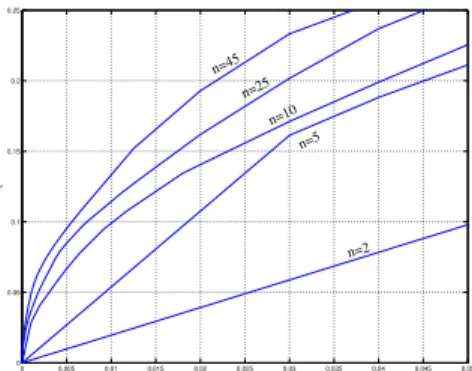
0 0.005 0.01 0.015 0.02 0.025 0.03 0.035 0.04 0.045 0.05 0 0.05 0.1 0.15 0.2 0.25 p=P[A] λ n=45 n=25 n=10 n=5 n=2
Fig. 1. Linear programming upper bound onλas a function ofp. Uniform XandY connected by theBSC(δ),δ= 0.3.
Corollary 4: Consider a hypothesis testing between an in-decomposable PXY and an arbitrary QXY with structural restriction on tests of the form
T = 1{(f(Xn), Yn)∈A} (17) with binary-valuedf. Then for any0< ǫ <1 we have
infQ[T = 1] = exp{−nE+o(n)},
where infimum is over all tests satisfying P[T = 1]≥1−ǫ
andE is given by (3).
Proof: Clearly, any test with binary-valued f and g of the form (2) is also a test of the form (17). Thus Theorem 2 establishes the achievability part. Conversely, for any test of the form (17) we may find sets A0 andA1 such that
P[T = 1] = P[{Yn∈A0, f(Xn) = 0}
∪{Yn∈A1, f(Xn) = 1}] (18)
≥ 1−ǫ . (19)
Then without loss of generality assume that the first set in the union hasP-probability larger than 1−2ǫ. Define the following function g(yn) = 1{yn∈A1\A0}+ 21{yn6∈A0∪A1} Then since{f =g} ⊇ {yn∈A 0, f(Xn) = 0} we have P[f(Xn) =g(Yn)]≥ 1−ǫ 2 , (20)
and thus by Theorem 2 we conclude thatQ[T = 1]is at least exp{−nE+o(n)}.
We remark that the correspondence between the hypothesis tests with 1-bit compression and those of interest in this paper (2) does not hold in full generality. In particular, it was shown in [4, Theorem 5] that the exponent E in (3) is still optimal in the 1-bit scenario without the requirement of indecomposability of PXY, while example (16) demonstrates the contrary for our setup.
IV. NON-VANISHING LOWER BOUNDS
By Theorem 3 in the case when marginals of PXY and
QXY coincide the error cannot decay to zero exponentially. In fact, weconjecturethat in the cases of matching marginals
˜
βα(PXYn , QnXY) does not vanish at all. In this section we prove the conjecture under additional assumptions and discuss potential methods for extending to the general case.
Theorem 5: Consider aPXY andQXY =PXPY such that S =△ S(X;Y)< 12 (under PXY). Then for any α∈ (2S,1] we have
lim
n→∞
˜
βα(PXYn , QnXY)>0.
Proof: As in the proof of Theorem 3 given a test {f(Xn) = g(Yn)} of level α we can extract a λ-block (A, B)withλ > α2. We want to show that for some constant
p=p(α)>0 and all nat least one of the marginalsPn X[A]
orPYn[B] can be bounded away from zero:
max{PXn[A], PYn[B]} ≥p . (21) Indeed, then we have
Q[T = 1]≥Pn X[A]PYn[B]≥ α 2p 2 (22) which follows because in a λ-block the smaller of the two probabilities in (21) should still be larger than the joint prob-abilityPXYn [A×B] which is≥λp. Finally, the estimate (21) follows from the next result.
Lemma 6: Consider aλ-block (A, B)forPn
XY. Then, max{PXn[A], PYn[B]} ≥min 1 2, λ−S 1−S , (23) wheneverS=S(X;Y)<1.
Proof: Consider an operator Tn : L2(Yn, PYn) →
L2(Xn, PXn)defined as follows:2
(Tnh)(xn)
△
=E[f(Yn)|Xn=xn], (24)
where the expectation is over the distribution PXYn . Note that the second largest singular value of Tn is precisely the maximal correlation coefficient S(X;Y) (under PXY),
see [15]. Thus, for any zero-mean functionsh∈L2(Xn)and
h′∈L
2(Yn)we have
E[h(Xn)h′(Yn)] = (Tnh′, h)≤S(X;Y)||h||2||h′||2. (25)
Denote pA =PXn[A],pB =PYn[B] and assume pB ≥pA. If pB ≥ 1
2 then there is nothing to prove, so assume otherwise.
Then, we have λpB ≤ PXYn [A×B] (26) ≤ pApB+S p pA(1−pA)pB(1−pB) (27) ≤ p2B+SpB(1−pB), (28) where (26) is by the definition of a λ-block, (27) is by (25) applied to h(xn) = 1{xn ∈ A} −p
A and h′ = 1{yn ∈ B} −pB; and (28) is becausepA ≤pB ≤ 1
2. Canceling pB
on both sides in (28) we obtain (23).
Next, we discuss what is required to extend Theorem 5 to full generality. To handle a general QXY one needs a non-vanishing lower bound independent of non
λmin(p, QnXY) = min A,BQ
n
XY[A×B],
where the minimization is over Qn
X[A], QnY[B] ≥ p. For QXY =PXPY this problem is void sinceλmin(p, Pn
XPYn) = 2The idea to use the maximal correlation to relate marginals and the joint
distribution was first proposed by Witsenhausen [11] in the context of a slightly different problem.
p2. Nevertheless, even the case of Q
XY = PXPY is far
from being resolved as we need to extend to the full range 0< α <1. We discuss this second problem further.
A. More on spectral methods
In a nutshell, the proof of Theorem 5 consisted of two steps. First, we identified a Markov chain
F →Xn→Yn →G , (29) where we denotedF=△f(Xn),G△=g(Yn). Note that by the
data-processing for maximal correlation we have
S(F;G)≤S(Xn;Yn) =S(X;Y).
Second, for largeαwe showed a lower bound Q[F =G] =X
i
P[F =i]P[G=i]≥const>0 under conditions: a)P[F =G]≥αand b)S(F;G)≤S. Can a lower bound be tightened so that it does not vanish for all
α >0?
The answer is negative. Indeed, consider a distributionPF G
on[M]×[M]: PF G(i, j) = α M1{i=j}+ 1−α M(M −1)1{i6=j}. (30) Then we have S(F;G) =α− 1−α
M−1. That is, such PF G
sat-isfies theα-constraint and the maximal correlation constraint wheneverα≤S(X;Y)and achieves
X
i
P[F =i]P[G=i] = 1
M →0
as M → ∞.
It may appear that as a workaround one may consider higher spectral invariants in addition to S(X;Y). Formally, to any joint distributionPn
XY we associate the operatorTn as in (24).
Let the singular values ofTn sorted in decreasing order be
1 =σn,0≥σn,1≥σn,2≥ · · · ≥0,
where σ1,1 = S(X;Y). Since Tn = T1⊗n the singular
spectrum of Tn consists of all possible products of the form Qn
t=1σ1,jt and in particular
1 =σn,0≥σn,1=· · ·=σn,n=S(X;Y).
Moreover, it is easy to show that if one has a Markov chain (29) then singular values{µj, j= 1, . . .}associated with
PF G are related to those ofPn
XY via the following
“spectral-processing” inequalities: k Y j=1 µj ≤ k Y j=1 σn,j k= 1, . . . . (31)
Clearly this extends the data-processing for maximal correla-tion used in the proof of Theorem 5. Does it lead to a lower-bound non-vanishing for all α?
Alas, the answer is negative. Indeed, in the example (30) the singular spectrum associated to PF G consists of 1 and M1−−α1 (of multiplicityM −1). This spectrum satisfies (31) as long as α≤S(X;Y) and M ≤ n+ 1. Thus, forα ≤S(X;Y), inequalities (31) can not rule out the possibility that
Q[F =G]≤ 1
B. λ-blocks of minimal weight
Another method to extend the range ofαin Theorem 5 is to find a non-vanishing (asn→ ∞) lower bound on the marginal probabilityPXn[A]of aλ-block(A, B). In fact, it is enough to
consider the case ofPXY withX =YandPX =PY. Indeed,
consider an arbitraryλ-block (A, B)and construct a Markov kernel W : X → X as composition W = PX|Y ◦PY|X, namely W(x1|x0) = X y∈Y PX|Y(x1|y)PY|X(y|x0).
Then distributionPXis a stationary distribution of the Markov
chain associated with W (and operator of conditional expec-tation (24) is self-adjoint). Moreover, we clearly have
Wn(A|A)≥PXn|YPYn|X(B|A)≥λ2. (32) And hence, it is enough to lower boundPn
X[A]among all A
with the requirement that (A, A)be aλ2-block forW :X →
X. In other words:
Problem (λ-blocks of minimal weight): Given a Markov kernel W : X → X with stationary distributionPX determine
λ∗(p) = lim
n→∞A:Pmaxn X[A]≤p
Wn(A|A).
In fact, for the purpose of extending Theorem 5 we only need to showλ∗(0+) = 0.
In the remaining we consider a special case of X =Y = {0,1} and W(0|1) = W(1|0) = δ – a binary symmetric channel, BSC(δ). First, let us consider sets A ⊂ {0,1}n
which are linear subspaces, then denoting byZna vector with
i.i.d. Bernoulli(δ) components, we can easily argue that
Wn(A|A) =PZn[A]≤(1−δ)n−dimA,
whereas on the other handPn
X[A] = 2dimA−n. Therefore, the λ-ptradeoff achievable with linear sets satisfies
λ≤plog21−1δ.
For the general case, consider an arbitrary setA⊂ {0,1}n
of cardinality|A| ≤p2n. Define its weight distribution as αd= 1
|A| · |{(x, y) :x∈A, y∈A, d(x, y) =d}|, whered(x, y)is the Hamming distance. Then,
Wn(A|A) = n X d=0 αd(1−δ)n−dδd (33) Defineβv(α) =Pn
x=0Kv(x)αx, a dual weight distribution of
A, withKv(x)– Krawtchouk polynomials; e.g. [13, Appendix A]. By Delsarte’s theorem [12], βv(α)≥0 and in fact by the
cardinality constraint
β0(α)≤p2n. (34)
Thus, we get the following linear-programming bound
λ∗n(p)≤max
n
X
d=0
αd(1−δ)n−dδd, (35)
where maximum is over all non-negative{αd}such thatα0=
1,βv(α)≥0 and (34).
To give the dual formulation of (35) say that a polynomial
P(x)of degree not larger than nis admissible if
P(x) =
n
X
v=0
pvKv(x),
andpv ≥(1−2δ)v for allv= 0, . . . , n. Then, we have λ∗n(p)≤min 2−nP(0) + (p−2−n) max x=1,...,nP(x) ,
where minimum is over all admissible polynomials. The bound of Lemma 6 states
λ∗n(p)≤1 + 2δ(p−1), (36) and corresponds to choosing
P(x) = K0(x) + (1−2δ)
n
X
v=1
Kv(x) (37)
As numerical evaluation of (35) shows, see Fig. 1, the bound (36) can be significantly improved. Finding a suitable admissible polynomialP(x)remains an open problem.
REFERENCES
[1] Y. Polyanskiy, H. V. Poor, and S. Verd´u, “Channel coding rate in the finite blocklength regime,”IEEE Trans. Inf. Theory, vol. 56, no. 5, pp. 2307–2359, May 2010.
[2] V. Kostina and S. Verd´u, “Fixed-length lossy compression in the finite blocklength regime,”Arxiv preprint arXiv:1102.3944, 2011.
[3] R. Ahlswede and I. Csisz´ar, “Hypothesis testing with communication constraints,”IEEE Trans. Inf. Theory, vol. 32, no. 4, pp. 533–542, Jul. 1986.
[4] T. S. Han, “Hypothesis testing with multiterminal data compression,”
IEEE Trans. Inf. Theory, vol. 33, no. 6, pp. 759–772, Nov. 1987. [5] T. S. Han and K. Kobayashi, “Exponential-type error probabilities for
multiterminal hypothesis testing,”IEEE Trans. Inf. Theory, vol. 35, no. 1, pp. 2–14, Jan. 1989.
[6] H. Shalaby and A. Papamarcou, “Multiterminal detection with zero-rate data compression,”IEEE Trans. Inf. Theory, vol. 38, no. 2, pp. 254–267, mar 1992.
[7] J. Tsitsiklis, “Decentralized detection by a large number of sensors,”
Math. Contr. Signals, Syst., vol. 1, no. 2, pp. 167–182, 1988. [8] H. Shalaby and A. Papamarcou, “A note on the asymptotics of
dis-tributed detection with feedback,”IEEE Trans. Inf. Theory, vol. 39, no. 2, pp. 633–640, Mar. 1993.
[9] W. Tay and J. Tsitsiklis, “The value of feedback for decentralized detection in large sensor networks,” inProc. 2011 Int. Symp. Wireless and Pervasive Comp. (ISWPC), Hong Kong, China, Feb. 2011, pp. 1–6. [10] P. G´acs and J. K ¨orner, “Common information is far less than mutual information,”Prob. Contr. Inf. Theory, vol. 2, no. 2, pp. 149–162, 1973. [11] H. Witsenhausen, “On sequences of pairs of dependent random
vari-ables,”SIAM J. Appl. Math., vol. 28, pp. 100–113, 1975.
[12] P. Delsarte, “An algebraic approach to the association schemes of coding theory,”Philips Research Rep. Supp., no. 10, p. 103, 1973.
[13] R. McEliece, E. Rodemich, H. Rumsey, and L. Welch, “New upper bounds on the rate of a code via the Delsarte-MacWilliams inequalities,”
IEEE Trans. Inf. Theory, vol. 23, no. 2, pp. 157–166, 1977.
[14] I. Csisz´ar and J. K ¨orner, Information Theory: Coding Theorems for Discrete Memoryless Systems. New York: Academic, 1981. [15] O. V. Sarmanov, “A maximal correlation coefficient,”Dokl. Akad. Nauk