Applying the Levels of Conceptual Interoperability Model
in Support of Integratability, Interoperability, and Composability
for System-of-Systems Engineering
Andreas TOLK, Saikou Y. DIALLO, Charles D. TURNITSA Virginia Modeling Analyses & Simulation Center, Old Dominion UniversityNorfolk, VA 23529, USA
+1.757.686.6200 (Phone), +1.757.6214 (Fax), [atolk,cturnits,sdiallo]@odu.edu
ABSTRACT
The Levels of Conceptual Interoperability Model (LCIM) was developed to cope with the different layers of interoperation of modeling & simulation applications. It introduced technical, syntactic, semantic, pragmatic, dynamic, and conceptual layers of interoperation and showed how they are related to the ideas of integratability, interoperability, and composability. The model was successfully applied in various domains of systems, cybernetics, and informatics.
Keywords: Integratability, Interoperability, Composability, Syntax, Semantics, Pragmatics, Dynamics
1. INTRODUCTION
Until recently, the support of decision makers often focused on representing data. However, the advent of intelligent software agents using the Internet introduced a new quality to decision support systems. While early systems were limited to simple situations, the examples given by Phillips-Wren and Jain [1] show that state-of-the-art decision support is based on agent-mediated environments. Today, real-time and uncertain deci-sion problems can be supported to manage the decideci-sion making process in a highly dynamic and agile sphere. Simple data mining and presentation is no longer sufficient: based on his-toric data, trend analysis and possible development hypotheses must be developed and compared. This requires a purposeful abstraction of reality and the implementation of the resulting concept to make it executable on computers. These processes are better known as “modeling,” the purposeful abstraction of reality and capturing of assumptions and constraints, and “simulation,” the execution of a model on a computer. Model-ing & simulation (M&S) becomes more and more a backbone of operational research to cope with highly complex and dy-namic environments and decision challenges that are often ill- or semi-structured in nature, in particular when such M&S systems utilize knowledge management and agent directed simulation to enable intelligent decision technologies, such as agent mediated decision support.
While such enriched M&S systems are valuable contributors to the decision makers toolbox, the task to compose them in a meaningful way is everything but trivial. The challenge is not to exchange data between the system: the technical side is suf-ficiently dealt with by interoperability standards. The problem is that the concepts of the underlying models – or the
imple-mented world view captured in the model – need to be aligned as well. Currently, various organizations are coping with the task to develop a theory of composability. Petty and Weisel [2] formulated the current working definition: “Composability is the capability to select and assemble simulation components in various combinations into simulation systems to satisfy specific user requirements. The defining characteristic of composability is the ability to combine and recombine components into differ-ent simulation systems for differdiffer-ent purposes.” In order to be able to apply engineering methods to contribute to a compos-able solution, several models have been developed and applied. However, at the end a machine readable and understandable implementation based on data and metadata is needed to enable agents to communicate about situations and the applicability of M&S applications. They must share a common universe of discourse in support of the decision maker, which requires a common language rooted in a formal specification of the con-cepts. A formal specification of a conceptualization, however, is a working definition of a common ontology. This ontology can then be applied to derive conceptually aligned and orches-trated configurations for conceptually composable, technically interoperable, and integrated solutions.
This paper shows how various layered composability ap-proaches contributed to the definition of the Levels of Con-ceptual Interoperability Model (LCIM) and how the results can be used to derive implications and requirements for ontologies describing the universe of discourse in which intelligent agents serve to mediate between agile applications in order to com-pose the individual systems into a meaningful system of sys-tems. Cybernetics shows that simple methods often are to lim-ited to be applied in complex environments like the system-of-system integration as envisioned here. The described method is therefore phased and combines bottom-up and top-down ap-proaches: The information exchange requirements are identi-fied by top-down analysis of the business processes to be sup-ported and the informatics be applied. This is followed by a bottom up approach leading to a common ontology represent-ing the various aspects of participatrepresent-ing systems in phase two. Finally, the composition and integration of systems is orches-trated using top-down means in phase III.
The rest of this paper is organized following these ideas. After a short motivation why we need agent mediated decision sup-port and how the work presented here fits into this vision, sec-tion 3 will introduce the LCIM. The three phases are described in sections 4 to 6. Section 7 gives an application example be-fore we will give a summary.
2. MOTIVATION FOR AGENT MEDIATED DECISION SUPPORT
Before going into the details of LCIM and the three-phased method, this section deals with the rationale for working on agent-mediated support and how this is applicable in the broader context of complex business operations to be supported by agile systems. For the military application domain, Alberts and Hayes [3] define the quality of support by decision support systems in net-centric environments using the net-centric value chain, which distinguishes four categories. They are easily applicable in the broader context as well.
• The value chain starts with Data Quality describing the information within the underlying command and control system. This definition can be generalized to be applicable to decision support systems.
• Information Quality tracks the completeness, correctness, currency, consistency, and precision of the data items and information statements available.
• Knowledge Quality deals with procedural knowledge and information embedded in the decision support system such as templates for behavior, assumptions about capabilities of entities, and domain specific assumptions, often coded as rules.
•
Finally, Awareness Quality measures the degree of using the information and knowledge embedded within the deci-sion support system. Awareness is explicitly placed in the cognitive domain.Data representing decision support systems were only able to reach the data quality. By bringing the data of heterogeneous systems together into a common situation display adds the necessary context needed for information. Instead of endless lists of data and messages, a common operational picture be-comes possible. However, this picture is still only a snapshot. In order to reach the next level of knowledge, procedural knowledge is needed. This procedural knowledge can be pro-vided in form of simulation services, as simulations are based on models, which are purposeful abstractions of reality, and simulations are the means to execute a model over time. We therefore move from the common operational picture to the common operation model. While a picture says more than 1,000 words (or the 1,000 pieces of enumerated data), an ex-ecutable M&S application says more than 1,000 pictures! Finally, if data and metadata enables software agents to select different M&S components and compose them to evaluate alternative hypotheses, even the cognitive domain of awareness can be supported. However, in order to enable agents to be-come the ambassadors for M&S components (or other agile and dynamic processes and services), the agent must be aware of the assumptions and constraints underlying the model. This task is everything but trivial, as shown in [3a, 3b] and other publications. However, in order to support the cognitive do-main of awareness, this knowledge must be captured in meta data interpretable by intelligent software agents. Yilmaz [6] evaluates these ideas of agent-mediated composition further.
3. LEVELS OF CONCEPTUAL INTEROPERABILITY The underlying work on composability of M&S applications conducted by the authors is mainly based on military applica-tions, in particular within the domain of using simulation sys-tems for training and experimentation in support of armed forces. Nonetheless the results are easy to be generalized for other application domains, such as complex business scenarios, traffic flow [7], or medical emergencies [8].
Models for Composability
The composability discussion started with Harkrider and Lunceford [9] making the case that technical integration of systems is necessary but not sufficient. Based on similar obser-vations, Dahmann [10] distinguished between technical inter-operability and substantive interinter-operability. Petty [11] extended the technical interoperability layer and introduced hardware, communication, and protocol layer. However, while the com-munity focused on implementation questions, it became obvi-ous that many challenges are on higher levels: the underlying concepts and models that have to be aligned in the process of federating systems. While most current standardization efforts, such as IEEE 1278 [12] and IEEE 1516 [13], are focused on the implementation level, standardization must be aimed at the modeling level to ensure interoperability between systems. Page et al. [14] introduced the idea to differentiate between technical layers for integratability, implementation layers for interoperability, and modeling layers for composability. There-fore, the LCIM detailed the substantive interoperability level in order to cope with these challenges explicitly.
Overview of the LCIM
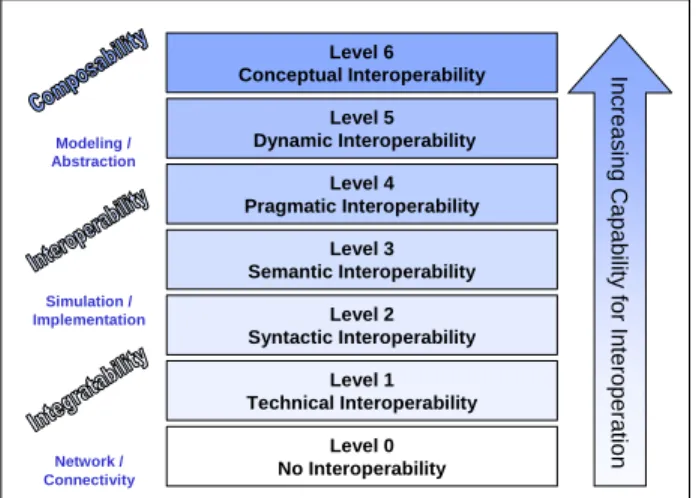
The research on composability conducted at the Virginia Mod-eling Analysis & Simulation Center resulted in the LCIM, which underwent several improvements since its first publica-tion [15]. The current version of LCIM as depicted in Figure 1 is documented in [16]. Level 5 Dynamic Interoperability Level 4 Pragmatic Interoperability Level 3 Semantic Interoperability Level 2 Syntactic Interoperability Level 0 No Interoperability Level 1 Technical Interoperability Level 6 Conceptual Interoperability In c re a s ing C apab ilit y fo r I n te ro p e ra tion Modeling / Abstraction Simulation / Implementation Network / Connectivity
Figure 1: Levels of Conceptual Interoperability Model
The different levels are characterized as follows:
• Level 0: Stand-alone systems have No Interoperability.
• Level 1: On the level of Technical Interoperability, a com-munication protocol exists for exchanging data between
participating systems.1 On this level, a communication infrastructure is established allowing it to exchange bits and bytes, the underlying networks and protocols are un-ambiguously defined.
• Level 2: The Syntactic Interoperability level introduces a common structure to exchange information, i.e., a com-mon data format is applied. On this level, a comcom-mon pro-tocol to structure the data is used; the format of the infor-mation exchange is unambiguously defined.
• Level 3: If a common information exchange reference model is used, the level of Semantic Interoperability is reached. On this level, the meaning of the data is shared; the content of the information exchange requests are un-ambiguously defined.
• Level 4: Pragmatic Interoperability is reached when the interoperating systems are aware of the methods and pro-cedures that each other are employing. In other words, the use of the data – or the context of its application – is un-derstood by the participating systems; the context in which the information is exchanged is unambiguously defined.
• Level 5: As a system operates on data over time, the state of that system will change, and this includes the assump-tions and constraints that affect its data interchange. If systems have attained Dynamic Interoperability, then they are able to comprehend the state changes that occur in the assumptions and constraints that each other is making over time, and are able to take advantage of those changes.2 In particular when interested in the effects of operations, this becomes increasingly important; the effect of the infor-mation exchange within the participating systems is un-ambiguously defined.
• Level 6: Finally, if the conceptual model – i.e. the assumptions and constraints of the meaningful abstraction of reality – are aligned, the highest level of interoperabil-ity is reached: Conceptual Interoperability. This requires that conceptual models will be documented based on en-gineering methods enabling their interpretation and evaluation by other engineers. In other words, on this we need a “fully specified but implementation independent model” as requested in Davis and Anderson [19] and not just a text describing the conceptual idea.
It should be pointed out that these layers of operations are still driven by implementations of agile systems that should be de-scribed in order to enable intelligent software agents to evalu-ate their applicability to support a decision and their compos-ability with other solutions. As such, it is a typical bottom-up approach. The objective is to generate a usable and sufficient description based on data and metadata supporting the
1
Some early alternatives distinguish furthermore between hardware level and communication level when analyzing the domains of technical interoperability.
2
Methods that enable such interoperability can be (documented) open source, reference implementations, or adequate documentation, such as complete UML models or DEVS models [17]. Tolk and Muguira [18] proposed an initial framework based on the LCIM merging several engineering approaches, including UML and DEVS, to insure consistent interoperation of services.
sition of applicable agile components and systems to support the decision maker; it is not to generate a general and complete description of the problem sphere. We are well aware of alter-native top-down approaches that start with a common under-standing to derive necessary implementations; however, the application domain we are focusing on in this paper uses al-ready implemented agile systems to support a higher goal of the decision maker, so capturing the capabilities and constraints of available services, applications, and systems was the primary driver behind this effort. To what degree the bottom-up ap-proach can be merged with top-down apap-proaches, such as the coherence/correspondence approach described by Sousa-Poza [20] is topic of ongoing research.
The LCIM was applied in various domains successfully and featured as a reference model in various journal contributions and book chapters. The originally intended use is described in [21]: applying the ideas to support composable M&S service for net-centric command and control applications. The Interop-erability Framework for future U.S. Department of Energy solutions for the Power-Grid described in [22] uses a derivate of the model. How to apply the LCIM to align smart applica-tions is the topic of [23]. Finally, the recent book on model and simulation-based data engineering uses the LCIM to show functionality and supported concepts of their solution [24]. The study of Carnegie Mellon University on System of Systems mentions the LCIM as one of the candidates for successful evaluation of approaches [25].
4. THE MODEL-BASED APPROACH TO SYSTEM OF SYSTEMS ENGINEERING
The following advantages of model driven approaches to reach alignment of heterogeneous decision-making processes are well known in the domain of cybernetics and informatics. They have been published in [26]. The idea is to use the first phase to understand the business processes and the supporting informa-tion technology (IT) soluinforma-tions and capture them in a common model. The use of models is important, because:
• Models help the decision makers understand the key mechanisms of an existing process. A model provides a clear picture of acting entities, roles, relations, and tasks. This is needed to understand the processes of the allies as well as the processes of the non-military partners and vice versa.
• Models act as the basis for creating suitable information systems that support the process. The model comprises descriptions of process that can be used to identify neces-sary support. Furthermore, the sub-processes already sup-ported by IT in the various participating organizations are displayed. This includes systems’ interfaces as well as their information capability that is available information that can be delivered to other systems as well as suitable information that can be computed to deliver new insights. Therefore, the model puts the various existing systems into their place within the federated system of systems supporting the overarching operations and also serves as the requirement driver for additional IT support.
• Models can be used to improve the current structure and operation. By creating a common description of the over-all operation, participating organizations and supporting systems, redundancies as well as bottlenecks become
ob-vious. Necessary changes can be identified and solutions can be derived and agreed on based on a common model.
• Models show the structure of innovated solutions. The model becomes the basis for a common action plan sup-porting radical as well as incremental changes. The de-sired end state and the necessary steps leading from the status quo to this end state are part of the model. The model itself becomes an important management instru-ment that orchestrates the necessary improveinstru-ments in par-allel and distributed events.
• Models can serve as a basis to evaluate new ideas. Mod-els can be used to copy other structures, and evaluate processes used by other partners – or opponents – in the environment in which the operation takes place. As the model comprises the necessary detail needed to derive a conceptual or functional model of the mission space, sup-port by M&S directly becomes possible. Respective ex-periments can help evaluate such future concepts. An ap-propriate model can be used to orchestrate respective ef-forts and helps create a common understanding of all par-ticipating institutions.
• Models facilitate the identification of potential reuse of existing solutions. Although every operation is special and unique, many processes are supported by standard solu-tions. Additionally, when using a common model, the identification of processes supported in other operations and that can be modified easily to support the current ef-fort becomes feasible with minimal efef-fort.
These arguments show that models play a pivotal role in gain-ing a common understandgain-ing of what processes have to be supported and which systems can help in these processes. As a product of this analysis, the supporting IT infrastructures, inter-faces between systems and services, and the information that needs to be exchanged are identified.
Therefore, the first step of phase 1 entails identification of the organizations that will participate in satisfying a particular operation. This involves not only each organization, but also an understanding of what each organization is contributing to the operation, as well as what systems the organization has to sup-port that contribution. The second step in this top-down ap-proach is to construct a conceptual model of how each of the contributing organizations will make their contribution to the operation being discussed. Such a model will be based upon the doctrine of the contributing organizations. This model is based on the different modeling strengths described above, as it can result in not only a picture of what is expected to happen, but also provides a basis for showing how the different processes will interact with each other. This model is a conceptual model. Standard methods of systems engineering can be used in sup-port of this task. The third and final step of phase 1 is the iden-tification of information exchange events between the proc-esses. While the second step resulted in conceptual models of all processes supported by each participating organization, we are now looking at the new overarching and common processes in support of the overall enterprise. In this process, the analysts identify the conceptual data domains and data element concepts needed to describe the information exchange necessary be-tween the processes on the conceptual level.
The result of the top down approach is the conceptual under-standing what information exchanges occur when, between which processes, what are the business objects into which the atomic information elements are composed or aggregated, and which organizations – and hence which supporting IT systems – contribute as source or target systems to this system-of-sys-tems supporting enterprise wide applications.
5. ONTOLOGIES FOR COMPOSABILITY The top-down use of models in understanding the alignment of different processes in phase 1 must be accompanied by an analysis of required information exchange between the proc-esses resulting in data exchange requirements between the underlying IT systems and than used to compose the solutions in phase 2. The result of this activity is an ontology that is able to satisfy the information exchange requirements of the partici-pating systems based on the concepts, relationships, and rules identified in phase 1.
Our working definition is that “an ontology is a formal specifi-cation of a conceptualization.” As mentioned at the end of the section on the LCIM, this definition is not aimed at the defini-tion of an upper ontology describing everything within a possi-ble universe of discourse, but to describe the information ex-change requirements and means for orchestration and choreog-raphy of highly agile, independently developed systems into a supported framework mediated by intelligent agents.
Enabling systems to interoperate based on a merging of each system’s own ontological representation can be accomplished by a number of different methods [32]. The method suggested here is based on federating ontologies of different systems, which will allow for the exchange of meaning between the different world-views that the systems each have. This method is based, loosely, on the idea of federating databases, with the nature of ontological representation addressing some improve-ments to the method.
Federated Databases
Taken as the model for federating ontological representations, we take the approach of federated databases [33]. This ap-proach is applicable when there is a requirement for an outside system to access a single data model that is representative of a merging of a number of distinct data models.
Within the world of databases, this idea of created a merged database, based on merged data models, while allowing the original components to remain distinct and intact has been accepted for some time: federated databases. The objective of such a data federation is to merge different data sources, which are – and remain – distributed, heterogeneous, and autono-mous.
In order to meet this objective, Sheth and Larson introduce a new five level architecture [33], shown in Figure 2. Every ap-plication has its own data view, the external schema. They are based however, on a so-called “federated schema” being the common “data exchange” data model for all participants. Dif-ferent from the conceptual schema of distributed homogeneous data bases, the federated schema only comprises the shared data elements, and doesn’t deal with all details of the local autonomous data bases.
Local Schema Component Schema Export Schema Federated Schema External Schema 1 Local Schema Component Schema Export Schema External Schema N
Figure 2: 5-Level-Architecture for Federated Databases
The local databases contribute to this federated schema their part via export schemata comprising the data to be shared by the local data base with other data bases. Each export schema is part of a local component schema, which is a common presen-tation of the data elements being comprised in the local, system dependent schema. Therefore, the five levels are external, fed-erated, export, component, and local schemata.
The architecture shown in Figure 2 enables the evolutionary growing of the common data exchange model based on the actual information exchange request being formulated between the global applications and the local data bases. The moment, a new piece of data is needed in a global application; it becomes part of the federated schema. However, the local data bases don’t have to be changed as long as that piece of data is already comprised in one of them.
In practice, the local schemata of the 5-level-architecture can be interpreted as the conceptual data model of the 3-level-ar-chitecture of the component model—the federate database. Additionally, export schema and component schema are often swapped. The reason is, that it seems not to be worth to trans-late all the tables of the local schema into the component schema, but only the parts of the data model that have to be used for the data to be exchanged during the federation execu-tion.
Generally, two concepts have to be used to implement a feder-ated database:
• Schema Transformation – The concept of schema transformation maps two data models onto each other in a semantically consistent way.
• Schema Integration – The concept of schema integration merges several different transformed schemata into a common resulting schema comprising data elements for every piece of information that is part of at least one of the original schemata.
As per Conrad [34], at least four rules have to be met to do the transformation and integration properly:
• Completeness – All concepts being comprised in one local schema must be comprised in the federated schema also.
• Correctness – All concepts in the federated schema must have either a semantically equivalent local concept or must be a new inter-schema-relation that may not be in contradiction to any local schema.
• Minimality – Logically and semantically equal concepts of the local schemata may be represented only once in the federated schema.
• Understandability – The federate schema must be logical and well documented (including semantics as well as sources, constraints, mappings, etc.) to facilitate the work of the users, as well as of the database administrators. The problem of semantic heterogeneity was realized, in the mid-1990s as a major problem to federated databases, in that each data base is likely to have different semantic values for the objects it represents, and the relationships between those objects. An overview of this problem is described in [35]. While this problem may have existed for federated database instantiations, we will see below how an ontological representation method within a federated ontology may avoid this problem, by accomodating semantic heterogenous valuations of entities.
Federated Ontologies
Taking the approach recommended for layering federated data-bases, the ability to federate the worldviews of multiple dis-tinctive ontological representations into a single ontological representation should be possible. The approach of federating ontologies is not a new one, and has been addressed several times in recent literature. One of the better known efforts was presented in [36], and proposes a layer of different ontological representations similar to the way a federated database system has a number of layered data schema.
The five layers, when applied to a federation of ontological representations, are as follows:
• Local Ontology – This is the ontological representation of each local system.
• Component Ontology – This is a transformed version of the Local Ontology, where each is represented using a similar representation method.
• Export Ontology – This is a subset of the Component Ontology, where only the subset of the Component Ontol-ogy that is relevant. Federated OntolOntol-ogy – This is a merge of all the Export Ontologies into single ontological repre-sentation that includes all aspects of the local ontologies.
• External Ontology – This is the portion of the Federated Ontology that might be of interest to an outside system that might have to interact with the system of systems. As with federated database systems, each of these layers may need to have the principles of integration or transformation applied in order to derive it. In addition to integration and transformation, the method for arriving at both the Export On-tology and the External OnOn-tology (which are possibly subsets of, respectively the Component Ontology and the Federated Ontology) requires a method of reducing the source ontology into some subset. This represents a third principle, that of sub-setting.
For the discussion of a federated ontology, we will define these principles separately from how they were introduced for feder-ated databases.
• Ontology Transformation – Transforming the ontological knowledge from one representation type into another. A current approach is presented in [37].
• Ontology Integration – This is commonly referred to as either merging or mapping of ontologies. A review and critique of many reported techniques is presented in [38].
• Ontology Sub-setting – Selecting only the ontological entities, attribution of those entities, and relationships, subject to requirements of the representation method em-ployed, that are relevant to a sub-area of interest of the original ontology representation reduced from. Ap-proaches, for selecting such a subset, are presented in [39] based on syntactic selection, and in [40] based on seman-tic selection.
The four rules of [34] – completeness, correctness, minimality, and understandability – should be equally applied to Ontology Transformation, Integration, and Sub-setting.
An effort in showing how federated ontologies may be con-structed is presented in [36]. The approach described there is based on a series of source documents that may be relevant to several (two or more) ontologies. The principles of Formal Concept Analysis are applied to produce a merged structure of concepts from both ontologies, and then an algorithm (TITANIC) is applied to reduce that combined structure to a manageable new, merged ontology.
Ontological Entities
In order to access the conceptualization that an ontology is a formal specification of, it is necessary to break that specifica-tion up into accessible components. The first three types of components that are discussed are entities, relations and rules. Entities and relations are quite familiar to the data modeling community, and also appear within most modern ontological engineering theories. Rules, however, are an additional compo-nent that assists with the ontology model being useful to sys-tems, and will be described here in more detail. A fourth com-ponent, concepts, is essential to the other component types and will be addressed in its own section, below.
As this paper is addressing ontology of information systems, and more specifically, ontology for the purpose of assisting interoperability between information systems, entities become quite easy to define. As they are revealed in [27], it can be seen that they are easy to recognize within a model. Entities are the exchangeable symbols (words, data elements, etc) that repre-sent the things of which our systems can address. Things are further defined as being not only physical things, but also eve-rything, which can be addressed by systems (things, both physical and otherwise; phenomena, including both processes and events; modifiers for both of these).
Entities, in order to satisfy the specification presented here, need to be represented as both types and instances. Entity-types may be divided up further into subtypes, but each child of an entity-type (whether a true instance, or a subtype) retains all of the identity of the parent type. This idea of terms of
under-standing being less generally defined than their parents is known in the knowledge representation and artificial intelli-gence communities as sub-sumption and a treatment of the topic can be found in [28]. The organization of all of an ontol-ogy model’s entities into an interconnected graph is referred to as a taxonomical model.
Different entities, originating from different systems, may have the same “name”, or symbol, representing them and have dif-ferent characteristics. This leads to a situation making the en-ablement of interoperability very difficult. Additionally, diffi-culties in enablement would arise when differently named enti-ties are meant to represent the same thing from our limited universe of discourse. In both situations, and as hinted at above, it can be seen that entities differ from each other based on their characteristics. These characteristics are defined by the primitives of meaning that the entities can exhibit. This is dis-cussed further, below.
The type-subtype-instance relationship (of the taxonomical model) is not the only class of relations between entities that can exist. Relations can provide a semantic link between enti-ties in any number of different ways. The enumeration of par-ticular relation types is potentially unique for each universe of discourse [29].
System-to-system interoperability requires exchange of data, and that data (in order to move past what the LCIM refers to as Level 1) must have a syntactic form. Further, to proceed to even higher levels of conceptual interoperability, semantics are required of the data interchange. In both cases, and for further extension, a rule set, or grammar, is required to control the syntax and semantics of the data exchanged. But the data within a system undergoes certain operations defined by that system. A set of rules defining the syntax and semantics of those operations is also required.
The existence of an taxonomical model that systems can refer-ence allows for the specific identification of entities referred to during system-to-system communications [30]. A set of rules can provide for a semantically meaningful method for com-bining those entities into communications that satisfy the sys-tem-to-system communications supporting interoperability up to the semantic level. Internal relations identified among the entities of a system’s data model even allow, in effect, infer-ence to be made within the interoperability supporting data exchanges between systems3. What is still missing from our ontology, although it was mentioned several times above, is the specific characterization of our entities. This characterization provides for definition of our entities, and also allows for the application of the relations and rules defined above. Primitives of meaning, which are exhibited by entities, provide this char-acterization.
Primitives of Meaning: Atomic Elements of Understanding Primitives of meaning, or just “primitives”, are the basis for giving entities definition and characterization. They are the most difficult component of the ontology to define. They are also often difficult to see within the entities that exhibit them. It
3
Internal relations, as defined here, support inference in this way – if a semantic exchange of data is made referring to the entities of a system, and those entities have internal relations semantically linking to other entities, then the chain of related entities is affected, via inference of the semantic links, by the semantic exchange.
is helpful to have a good definition of what is meant by concept in order to see how the ontology model requires them. One aspect of primitives to consider during the definition of the term is that primitives are the only component of our ontology that exists within actual items. They are the link between a data representation of an item, and the actual item itself. The con-cepts behind, for instance, a truck, and the data representation (within an information system) of a truck are the same [31]. These concepts are what we are calling primitives.
Each ontological entity has a unique collection of primitives of meaning. Within the domain that the systems in question come from, the primitives of meaning must be universally recognized and accepted. However, each system’s ontological representa-tion may have a different collecrepresenta-tion of primitives that make up the various entities it entails. This gives the different morphol-ogy of similarly named entities, and is where the defined dif-ference may be found between the different system’s world-views. As each system is a different abstraction of potentially the same reality, the difference is in which primitives of meaning each system assumes are involved in the make up of their ontological entities.
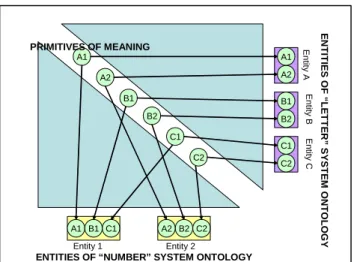
Following this reliance on primitives of meaning, if we have an ontological representation method that exposes these primi-tives, and this representation method is used for the Ontology Transformation between the Local Ontology and the Compo-nent Ontology, then the federated database problem of seman-tic heterogeneity should be solved. A trivial example which illustrates this point is given in Figure 3.
If the primitives, which give identity to an entity, are known, and captured within the ontology, then regardless of any ambi-guities with the entity’s name (or symbol), it can still be clearly identified by using exactly these concepts [31]. Similarly, proper definition of the primitives that give definition to the entities of two different systems interoperating with each other can show where there may be conceptual gaps or misalignment between those entities.
Apparent Ontologies defined by Interface Specifications By looking at the agreed to interface specification (which have been identified as a source for external rules, for the purposes of the ontology definition), we can help to understand the ap-parent ontology of a system supporting the interface. The
proc-ess of revealing this apparent ontology, in the same language (using the same component structure) as other systems interop-erating with can help to identify gaps (to be filled, if possible) in conceptual support of entities exchanged, and can also assist with the assessment as to the strength of the overall system-of-systems is concerned.
A definition of apparent ontology may be helpful before pro-ceeding. Many of the existing systems, and systems yet to be developed, will have been constructed without a formal ontol-ogy being recorded. This does not mean that the system archi-tects did not have an ontological view of the system’s universe of discourse in mind when the design was taking place. Rather, this ontology is inherent in the (1) data model of the system, in the (2) assumptions concerning the structure and meaning of that model, and in the (3) operational functions and transfor-mations that the system makes on that data. By examining the data elements of the system, this apparent ontology can be revealed, and described in an accessible artifact, so that it can assist with system-to-system interoperability.
To reveal this apparent ontology, it is helpful to begin with the interface specification. As mentioned, this suffices as the exter-nal rules for the ontology of the system, as it provides an effec-tive grammar for the system to communicate.
From the interface specification, we can enumerate and codify the types and possible instances of entities coming from within the system. Any semantic relations between these entities will now suggest themselves, including any hierarchical structure (leading to an entity-model).
The entities of the system and their functional transformation that take place within the system exhibit the properties and property values. These characteristic properties allow for the identification of the underlying primitives of meaning. Once this is accomplished, we have a partial view of the apparent ontology of the system.
Working with the revealed apparent ontology allows us to compare, at the concept level, the sufficiency of meaning and depth of understanding of the exchanged entities. The enu-meration of rules and relations reveals the inferred meanings of those entities, and the operation up on those entities within the system, thus revealing what may be needed in support from a foreign system to fully support interoperability to the semantic level, and perhaps to move beyond.
A1 A2 B1 B2 C1 C2 Entity 1 Entity 2 A1 B1 C1 A2 B2 C2 A1 A2 B1 B2 C1 C2 Enti ty A Enti ty B E nti ty C E NT IT IE S OF “LE T T E R” SYST E M ON T O L O G Y
ENTITIES OF “NUMBER” SYSTEM ONTOLOGY PRIMITIVES OF MEANING
Figure 3: Primitives of Meaning
The existence of the revealed apparent ontology is itself useful for future developments of interfaces and evaluation of the soundness of combining the system with others. There is also value, however, in the process of revealing the apparent ontol-ogy, as it assists with evaluating the internal rules, the relations, and the entities of the system being investigated.
The result of this phase is an ontological description of the information exchange model derived from the common con-ceptual model. This is more than just a data model. The onto-logical representation formally specifies the concepts regarding their property meanings (syntax and semantics), the contexts in which they are exchanged (pragmatics), and the business rules that need to be applied in form of axioms.
6. ONTOLGY-BASED SERVICE LANGUAGES In principle, the ontology derived in phase 2 is sufficient to compose the contributing systems into a system of systems able to provide the IT infrastructure and services identified in the conceptual model. However, in order to support the engineers with more help, the third phase produces communication pro-tocols and information exchange specifications applicable in the domain of service-oriented architectures.
In general, service-oriented architectures promise easier inte-gration of functionality in the form of services into operational systems than is the case with interface-driven system-oriented approaches. However, although the Extensible Markup Lan-guage (XML) enables a new level of interoperability among heterogeneous systems, XML alone does not solve all interop-erability problems users contend with when integrating services into operational systems. In addition, XML is often managed using underlying databases, which are less ambiguous than flat tag structures. But even when using data bases, the rules for accessing them appropriately need to be captured separately. Using an ontology as derived in phase 2 facilitates this process significantly: because all necessary information can be derived from one common model, the often observed inconsistencies between information exchange model and common reference model is avoided. The axioms of the ontology lead to business rules. The concepts, entities, relations, entities, and properties are mapped to table and attribute definitions, which are used to derive the XML schema.
The second advantage of this approach is that the information exchange requirements are based on the information exchange capabilities of the systems. Current practice is to define an information exchange model as a common language between the services. The model resulting at the end of phase 2, how-ever, is based on the definition of exchangeable information identified in phase 1. In other words: the model is by design part of these systems: (a) what needs to be exchanged is part of this model, and (b) what is part of this model needs to be ex-changed. A simulation system specific view of this approach has been published in [41].
7. APPLICATION EXAMPLE
Our application example is rooted in the idea to generate a common language between operational entities, simulated enti-ties, and robots operating in the same application domain to generate orders and plans from planning organizations to the executing entities as well as to generate reports contributing to the awareness of the current developments from these entities to the planning organization. The underlying application is the international Coalition Battle Management Language (C-BML) effort discussed by Sudnikovich et al. [42]. Tolk et al. [43] describe the technique used to implement the ideas.
The different levels of interoperability are supported by the application of complementary standards and processes.
• C-BML uses the service-oriented architectures executed on the Internet – or the military counterpart called the Global Information Grid (GIG) – to exchange information elements. TCP/IP ensures that the elements can communi-cate with each other on the technical level.
• C-BML targets operational command and control systems, military simulation systems, and robotics. All these do-mains have domain-specific solutions, such as IEEE 1278 [12] and IEEE 1516 [13] for distributed simulation sys-tems, but there are not many common standards. How-ever, all systems can support web services, so XML be-comes a common basis for structuring the data, hence we support the syntactical level.
• C-BML identified a common information exchange refer-ence data model with broad acceptance. This common ref-erence model comprises all concepts identified to share tasks and reports, hence we support the semantic level. Tolk and Diallo [44] show how these ideas can be gener-ally used to not exclusively support military operations but other domains as well, such as complex business scenar-ios, traffic flow, medical emergencies, and other elements of critical importance for decision makers.
• In the implementation depicted in Figure 2, we used open sources and open standards to construct a web-based on-tology-driven service-oriented architecture for information exchange and storage. In order to achieve pragmatic inter-operability, the concepts captured in the common infor-mation exchange reference data model were accessible via atomic web services. Following the rules, these concepts are combined into entities and relations of the apparent ontologies of the participating systems, resulting in com-posed web services which incorporate the business rules and objects of the targeted systems.
The ontological constructs entities and relations are used to describe the information exchange requirements of the partici-pating systems, in the figure referred to as systems A and B, based on the implicitly defined apparent ontologies. How they are populated or how they disseminate information is captured in the construct rules. The common elements with a common interpretation in the universe of discourse and supporting the decisions are modeled as concepts. All these concepts can be accessed individually, so that all every possible composition can be generated based on the rules. In addition, commonly accepted business object comprising of more than one concept can be defined as well.
In practice, this effort has some limitations if using a common information exchange data model that is already established for operational use to exchange data between real system, as such a model usually already comes with in intended business logic to support. In other words, we already have a couple of business objects that comprise more than concepts. The developer is faced with mandatory fields that may be only of tangential interest for his application.4 In a perfect world, such business objects are exclusively defined via rules. In practice, estab-lished information exchange data models can still be applied to model the necessary concepts as long as it is possible to insert, update, and access concepts individually via atomic web ser-vices.
4
In military command and control systems, the timestamp and origin of a report is of essential interest in order to be able to evaluate how to use the message when contributing to the situational awareness, therefore such fields are mandatory for the command and control domain. M&S applications have another focus for information exchange, so that they often not even support such fields.
The next step of our research will focus on the remaining two levels of interoperability: dynamic and conceptual. Currently, we are evaluating the use of UML and capturing the informa-tion using XML Metadata Interchange (XMI) to generate the necessary metadata. In particular when embedded into the higher constructs of OMG’s Model Driven Architecture (MDA). However, the current state of our prototype only im-plements the levels up to pragmatic. Also, the use of intelligent software agents is under investigation and not yet a broadly accepted idea, but it works in related domains, in particular in the domain of semantic web applications such as described in Pohl [45], which is at least encouraging for the application domains dealt with in this paper.
8. SUMMARY
Our research showed that meaningful interoperability requires much more than technical layers of interoperability. The LCIM identifies the technical, syntactical, semantic, pragmatic, dy-namic, and conceptual layers of interoperation. Ontologies have been shown to be a potential contributor on the semantic and the pragmatic level. To what degree they can support the dynamic and conceptual layer, however, is topic of ongoing research. In connection with web services, first implementa-tions showed the potential.
We assume that the research we are contributing to with this paper will enable discussions on the objective beyond the Se-mantic Web, as envisioned in [46]: Our view is that we are moving towards a “Dynamic Web,” supporting the orchestra-tion and alignment of agile components at least up to the dy-namic layer with standardized metadata and clearly going be-yond the currently discussed concept of choreography based on business process languages [47]. These developments will enable us to support not only higher levels of interoperability, but also to contribute significantly to knowledge and awareness quality within agent mediated decision support system, as envi-sioned in [1]. While this doesn’t solve the challenge of system 0f systems engineering, as originally formulated in [48], the work contributes to potential solutions.
9. REFERENCES
[1] G.E. Phillips-Wren and L.C. Jain (Eds.), Intelligent Deci-sion Support Systems in Agent-Mediated Environ-ments, Volume 115 Frontiers in Artificial Intelligence and Applications, IOS Press, 2005
[2] M.D. Petty, E.W. Weisel, ”A Composability Lexicon,”
Proceedings IEEE Spring Simulation Interoperability Workshop, IEEE CS Press, 2003
[3] D.S. Alberts, R.E. Hayes, Power to the Edge, Command and Control in the Information Age, CCRP press, 2003 [4] M. Spiegel, P.F. Reynolds, D.C. Brogan, "A Case Study
of Model Context for Simulation Composability and Reusability," Proceedings of the IEEE Winter Simula-tion Conference, IEEE CS Press, 2005
[5] R. King, “Towards Conceptual Linkage of Models and Simulations,” Proceedings IEEE Fall Simulation Inter-operability Workshop, IEEE CS Press, 2007
[6] L. Yilmaz, S. Paspuletti, “Toward a Meta-Level Frame-work for Agent-supported Interoperation of Defense Simulations,” Journal Defense Modeling and Simula-tion 2 (3):161-175, 2005
[7] J.A. Sokolowski, R. Mielke, “Supporting Evacuation Planning with Modeling and Simulation,” Proceedings IEEE Spring Simulation Interoperability Workshop, IEEE CS Press, 2006
[8] F. Agrò, I. Giuliano, F.A. Montecchia,
”A new human-dynamic simulator (Air Man) for airway training in emergency situations,” Am J Emerg Med. 2002 Sep; 20(5):495.
[9] S.M. Harkrider, W.H. Lunceford, “Modeling and Simula-tion Composability,” Proceedings Interservice/Industry
Training, Simulation and Education Conference (I/ITSEC), 1999
[10] J.S. Dahmann, F. Kuhl, and R. Weatherly, “Standards for Simulation: As Simple as Possible But Not Simpler: The High Level Architecture for Simulation,” Simulation, Journal, Vol. 71, No. 6, 1998
[11] M.D. Petty, “Interoperability and Composability,” M&S Curriculum of Old Dominion University: Short Course Presentation, Old Dominion University, 2002
[12] IEEE Standard Group 1278: Distributed Interactive Simulation (Revision 2002), IEEE CS Press
[13] IEEE Standard Group 1516: High Level Architecture (Revision 2000), IEEE CS Press
[14] E.H. Page, R. Briggs, J.A. Tufarolo, “Toward a Family of Maturity Models for the Simulation Interconnection Problem,” Proceedings IEEE Spring Simulation Inter-operability Workshop, IEEE CS Press, 2004
[15] A. Tolk, J.A. Muguira, “The Levels of Conceptual Interoperability Model (LCIM),” Proceedings IEEE Fall Simulation Interoperability Workshop, IEEE CS Press, 2003
[16] C.D. Turnitsa, “Extending the Levels of Conceptual Inter-operability Model,” Proceedings IEEE Summer Com-puter Simulation Conference, IEEE CS Press, 2005 [17] B.P. Zeigler, H. Praehofer, T.G. Kim, Theory of
Model-ing and Simulation. 2nd Edition, Academic Press, 2000 [18] A. Tolk, J.A. Muguira, “M&S within the Model Driven
Architecture,” Proceedings Interservice/Industry Training, Simulation and Education Conference (I/ITSEC), 2004
[19] P.K. Davis, R.H. Anderson, Improving the Composabil-ity of Department of Defense Models and Simulations. RAND, National Defense Research Institute Report, 2003 [20] A.A. Sousa-Poza, “Pragmatic Idealism as the Basis for
Understanding,” Proceedings International Conference on Systems, Man and Cybernetics, IEEE Press, 2005 [21] A. Tolk, S.Y. Diallo, C. Turnitsa, L.S. Winters,
“Compos-able M&S Web Services for Net-centric Applications,” Journal Defense Modeling and Simulation 3 (1):27-44, 2006
[22] GridWise Architecture Council Interoperability Framework Team, “Interoperability Context-Setting Framework,” V1.0, July 2007
[23] P. Dobrev, O. Kalaydjiev, G. Angelova, “From Conceptual Structures to Semantic Interoperability of Content,” Bookchapter in Conceptual Structures: Knowledge Ar-chitectures for Smart Applications, pp. 192-205, Springer Verlag, 2007
[24] B.P. Zeigler, P.E. Hammonds, “Modeling & Simulation-Based Data Engineering: Introducing Pragmatics into Ontologies for Net-Centric Information Exchange,” Aca-demic Press, 2007
[25] E.
Morris, L. Levine, C. Meyers, P. Place, D.
Pla-kosh, “System of Systems Interoperability (SOSI),
Final Report”, Software Engineering Institute,
Carnegie Mellon University, Pittsburgh, PA, 2004
[26] A. Tolk, “Beyond Technical Interoperability - Introducinga Reference Model for Measures of Merit for Coalition Interoperability,” Proceedings of the Command and Control Research and Technology Symposium, CCRP Press, 2004
[27] P.P. Chen, "The Entity-Relational Model – Toward a Uni-fied View of Data," ACM Transactions on Database Systems, 1,1, pp. 9--36, March, 1976.
[28] R. Brachman and J. Schmolze, “An Overview of the KL-ONE Knowledge Representation System,” Cognitive Sci-ence, 9(2): 171–216, 1985
[29] B. Smith, W. Ceusters, B. Klagges, J. Kohler, A. Kumar, J. Lomax, C. Mungall, F. Neuhaus, A. Rector, C. Rosse, “Relations in biomedical ontologies,” Genome Biology, April 2005
[30] G. Zhang and B.P. Zeigler, "The system entity structure: Knowledge representation for simulation modeling and design," in Artificial Intelligence, Simulation and Mod-eling, L. E. Widman, K. A. Loparo, and N. R. Nielsen, Eds. New York: Wiley, 1989, pp. 47-73.
[31] J. Sowa, “Ontology, Metadata, and Semiotics”, Published in B. Ganter & G. W. Mineau, eds., Conceptual Struc-tures: Logical, Linguistic, and Computational Issues, Lecture Notes in AI #1867, Springer-Verlag, Berlin, 2000, pp. 55-81
[33] Sheth, A. P., and Larson, J. A. 1990. Federated database systems for managing distributed, heterogeneous and autonomous databases. ACM Computing Surveys 22: 183-236.
[34] Conrad, S. 1997. Föderierte Datenbanksysteme. Berlin: Springer.
[35] Colomb, R. M. 1997. Impact of Semantic Heterogeneity on Federating Databases. The Computer Journal 40(5):235-244.
[36] Stumme, G., and Maedche, A. 2001. Ontology Merging for Federated Ontologies on the Semantic Web. In Pro-ceedings of the International Workshop for Foundations of Models for Information Integration. Viterbo, Italy. [37] Mostowfi, F., and Fotouhi, F. 2006. Improving Quality of
Ontology: An Ontology Transformation Approach. In Proceedings of the 22nd International Conference on Data Engineering Workshops. 61-61. Atlanta GA.
[38] Kalfoglou, Y., and Shorlemmer, M. 2003. Ontology Mapping: The State of the Art. The Knowledge Engineer-ing Review. 18: 1-31
[39] Chopra, S., Parikh, R., and Wassermann, R. 2000. Ap-proximate belief revision. In Proceedings of the Work-shop on Language, Logic and Information, 2000.
[40] Budanitsky, A., and Hirst, G. 2001. Semantic distance in wordnet: An experimental,application-oriented evaluation of five measures. In Proceedings of the Workshop on WordNet and Other Lexical Resources, Pittsburgh, PA., 2001.
[32] Kalfoglou, Y., and Shorlemmer, M. 2003. Ontology Mapping: The State of the Art. The Knowledge Engineer-ing Review. 18: 1-31
[41] A. Tolk, C.D. Turnitsa, “Conceptual Modeling of Information Exchange Requirements based on Ontological Means,” Proceedings of the IEEE Winter Simulation Conference, IEEE CS Press, 2007
[42] W.P. Sudnikovich, J.M. Pullen, M.S. Kleiner, S.A. CareyExtensible Battle Management Language as a
Trans-formation Enabler. Simulation Journal, Vol. 80, pp. 669-680, 2004
[43] A. Tolk, S.Y. Diallo, K. Dupigny, B. Sun, C.D. Turnitsa, “A Layered Web Services Architecture to Adapt Legacy Systems to the Command & Control Information Ex-change Data Model (C2IEDM),” Proceedings ACM European Simulation Interoperability Workshop, ACM Press, 2005
[44] A. Tolk, S.Y. Diallo, “Model-Based Data Engineering for Web Services,” IEEE Internet Computing, Vol. 9, Nr. 4, 2005
[45] J. Pohl, “The Evolution of Intelligent Computer Software and the Semantic Web,” Proceedings 16th International Conference on Systems Research, Informatics and Cy-bernetics; Intelligent Software Systems for the New Infostructure, pp. 11-34, 2004
[46] M. Daconta, L. Obrst K. Smith, The Semantic Web: A Guide to the Future of XML, Web Services, and Knowledge Management, Wiley, Indianapolis, IN., 2003 [47] A. Tolk, “What comes after the Semantic Web – PADS
Implications for the Dynamic Web,” Proceedings 20th ACM/IEEE/SCS* Workshop on Principles of Ad-vanced and Distributed Simulation, IEEE/ACM Press, 2006
[48] C. Keating, R. Rogers, R. Unal, D. Dryer, A. Sousa-Poza, R. Safford, W. Peterson, G. Rabadi, “System of Systems Engineering,” Engineering Management Journal Vol. 15 No. 3, pp. 36- September 2003