An ISP-Friendly Hierarchical Overlay
for P2P Live Streaming
Mengjuan Liu, Fei Lu, Xucheng Luo, and Zhiguang Qin
Computer Science & Engineering, University of Electronic Science and Technology of China Chengdu, China
Abstract—P2P live streaming systems tend to generate a
tremendous amount of inter-ISP traffic for establishing large number of random inter-ISP connections. Recent studies have demonstrated that overlay localization can reduce the inter-ISP traffic efficiently, however, fully localized overlays generally impair the streaming quality. In this paper, we first investigate the effect of overlay localization and then present a novel ISP-friendly three-tier overlay, termed HOLES, to achieve a favorable tradeoff between the inter-ISP traffic and the streaming quality. In HOLES, the logical connectivity of all ISP domains is determined by the top-layer; and the inter- and intra-ISP connections are built by the mid- and bottom-layer respectively. Simulation results indicate that under various scenarios a significant reduction in the inter-ISP traffic is achievable while the streaming quality is enhanced by shrinking the delivery latency.
Keywords—P2P streaming; ISP-friendly; traffic locality; Hierarchical Overlay
I. INTRODUCTION
During the past years, P2P live streaming systems, such as PPLive and PPStream, have been widely deployed over the Internet and attracted millions of users. However, most existing P2P systems are network-agnostic, which lead the peers that participate in the P2P overlays inherently establish random connections crossing different ISP domains. This results in producing significant amounts of unnecessary inter-ISP traffic [1], entailing huge costs and risks for the Internet
Service Providers. In order to alleviate inter-ISP traffic, many
approaches have been proposed. One kind of approaches bias overlay neighbor selection through collaboration between P2P and ISPs, such as Oracle [2], P4P [3], and IMP [4]. The other kind of approaches suggest localization methods which maintain a loacality-aware overlay so as to shrink the inter-ISP traffic by minimizing the number of inter-ISP connections. However, most of these approaches have focused on file sharing system, such as BitTorrent.
For P2P live streaming applications, how to reduce the inter-ISP traffic is more challenging than file sharing systems, since live streaming applications must ensure a minimum streaming rate and, more importantly, must receive chunks within a short delay from delivers. A subset of proposed techniques [5], [6] for live streaming systems have tackled this problem by traffic locality, but do not make any investigation of the relationship between inter-ISP traffic and streaming quality.
In this paper, we first investigate the effect of inter-ISP connections on the streaming quality and the inter-ISP traffic. Then we describe the connectivity of all ISP domains as a
multi-constraints problem. Based on the analysis, we propose a novel ISP-friendly three-tier overlay (HOLES), to construct the inter- and intra-ISP connections. In the abstraction top-layer, we propose an algorithm for building the logical inter-ISP connections for optimizing the inter-inter-ISP delivery latency, where the depth of the delivery path and the incoming external connections of each ISP domain are constrained. The mid-layer incorporates not only a super peer selection algorithm but also a construction algorithm of inter-ISP connections according to the logical connectivity of all ISPs which is determined by the top-layer. At last, the bottom-layer implements the intra-ISP connections within the same ISP. Finally, we evaluate the performance of HOLES by using three metrics, such as the average delivery latency, the chunk loss ratio, and the inter-ISP traffic ratio. We perform the simulations in various scenarios, and the simulation results show that HOLES can greatly reduce inter-ISP traffic with minimal impact on the streaming quality.
The remaining sections are organized as follows. Section II surveys the related work. In Section III, we study the effect of overlay localization and give a description of the logical connectivity of all ISPs. Next, a hierarchical overlay (HOLES) is introduced in Section IV and evaluated in Section V. Concluding remarks are presented in Section VI.
II. RELATEDWORK
A few prior studies have concentrated on live P2P streaming using locality-aware techniques for content delivery. There are two schemes closely related with our research. [5] proposed a scheme for ISP-friendly mesh-based live streaming with two-level overlay, in which each peer maintains primary edges created between nearby peers and secondary edges connecting random peers. Peers periodically adjust neighborhoods to create an optimal overlay, while dynamically adapt secondary edges’ receive rate according to the state of local buffer. [7] proposed an ISP-friendly P2P streaming mechanism for live video, namely OLIVES, which maintains a fully localized overlay and incorporates a two-tier scheduling scheme to reduce the cross-ISP traffic and to improve the delivered quality. In OLIVES, the localized overlay is constructed by two tiers where the bottom tier is formed by connections within each ISP and the top tier is composed by external connections between ISPs. Each peer requests data from its local ISP and resorts to other ISPs only when data is not available locally. Although, this technology reduces inter-ISP traffic, it does not take into account the adverse impact of long delivery path and the delay of inter-ISP connections.
III. PROBLEMDESCRIPTION
In this section, we study the relationship between the overlay localization and the streaming quality based on simulations. Furthermore, we give a description of the logical connectivity of all ISPs, to improve the streaming quality by shrinking the delivery latency.
A. Effects of Overlay Localization
Recent studies [7], [8] have shown the adverse effects of the localization on the performance of live streaming applications. Existing schemes reduce the inter-ISP traffic by minimizing the inter-ISP connections, however, in which the delivery paths and the latency caused by inter-ISP connections typically become excessively long. Therefore, the delivery latency is increased, which is very sensitive as to live streaming. To verify this argument, we first quantify the level of the localization which depicts the number of inter-ISP connections, and use the redundancy as the metric to measure the level of the localization in the overlay. Redundancy is defined as Eq.(1), which is inversely proportional to the level of the localization. min min ( ) ( ) ( ) in i D i D i R D i − = (1) WhereRiis the redundancy of ISPi and D iin( ) denotes the
amount of incoming inter-ISP connections of ISPi. Dmin( )i is the minimum number of incoming inter-ISP connections of
i
ISP, defined as follows: min( ) VR D i BAN ⎡ ⎤ =⎢ ⎥ ⎢ ⎥ (2)
WhereVRis the streaming rate andBAN is the average bandwidth of ISPi. So for a fully localized overlay, Ri =0 (D iin( )=Dmin). 10 20 30 40 50 60 70 80 90 100110 1.8 2.0 2.2 2.4 2.6 2.8 3.0 3.2 3.4 3.6 R = 0.5(Din=3) R = 1 (Din=4) R = 1.5(Din=5) D el iv e ry L a te n cy (S e c)
Number of ISP domains (a) 10 20 30 40 50 60 70 80 90 100 110 0.0 0.5 1.0 1.5 2.0 2.5 3.0 3.5 R = 0.5(Din=3) R = 1 (Din=4) R = 1.5(Din=5) Los s R a tio (% )
Number of ISP domains (b) 10 20 30 40 50 60 70 80 90 100110 1.5 2.0 2.5 3.0 3.5 R = 0.5(Din=3) R = 1 (Din=4) R = 1.5(Din=5) D ept h
Number of ISP domains (c) 10 20 30 40 50 60 70 80 90 100 110 30 35 40 45 50 55 60 65 70 75 80 85 R = 0.5(Din=3) R = 1 (Din=4) R = 1.5(Din=5) In te r-IS P tr a ff ic r a tio
Number of ISP domains (d)
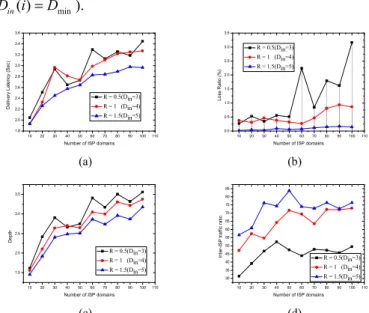
Fig. 1 The relationship of redundancy, the streaming quality and the inter-ISP traffic (In the simulation, there are 300 peers in each ISP domain, VR=1Mbps,
BAN=1.6Mbps, and Inter-ISP connections are built randomly)
We evaluate the effect of localization on the streaming quality through a simulation shown in Fig. 1. The results show that the average delivery latency and the average chunk loss ratio decrease as the redundancy increasing, while the inter-ISP traffic increases conversely, which are consistent with the previous argument. However, with a further increase in
redundancy, the improvement of the streaming quality is minimal, while the inter-ISP traffic increases significantly. Therefore, we can conclude that with an appropriate redundancy, a favorable trade-off can be achieved between the inter-ISP traffic and the streaming quality, while the redundancy is related with the number of ISP domains.
B. Description the Logical Connectivity of all ISP domains
From above simulation, we observe that building the inter-ISP connections randomly, can increase the depth of the delivery path from the source ISP to any other ISPs and prolong the delivery latency, as the ISP domains increase. Where the depth only means the number of ISP domains that the delivery path traverses and the delivery latency means the sum of delay of inter-ISP connections that the delivery path includes. Therefore, when designing the overlay construction algorithm, we need to consider how to build inter-ISP connections efficiently. For this purpose, we model the logical connectivity of all ISP domains as an optimal problem of the delivery latency with multi-constraints. The first constraint is the incoming inter-ISP connections of each ISP (record as in-degree of an ISP). In our model, we set that the in-in-degree of all ISPs are Din, so that the number of inter-ISP connections is (Din⋅ NISP−1), where NISP indicates the amount of ISPs in the overlay. The second constraint is the delivery depth and the maximum depth is given:
max logD ISP 1
d = N + (3) Where D is the average outgoing connections of each ISP. In this paper, our goal is to optimize the delivery latency from the source ISP to any other ISPs, while subjecting to above two constraints.
IV. SYSTEM DESIGN A. Hierarchical Overlay: Overview
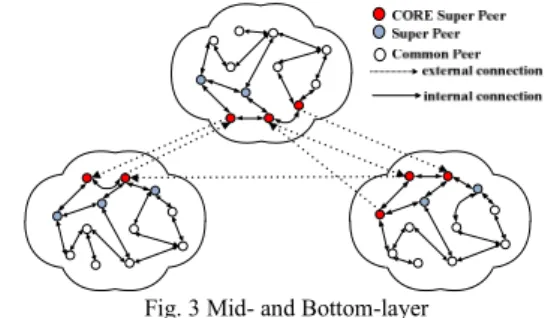
In this subsection, we present an overview of HOLES which is an ISP-friendly overlay for P2P live streaming. HOLES adopts a three-tier architecture to achieve the locality-aware overlay. The three layers are the top-layer that is a logical layer (shown in Fig.2), the mid-layer that is composed of all inter-ISP connections and the bottom-layer that consists all intra-ISP connections in the same ISP (shown in Fig. 3).
Fig. 2 Top-layer Overlay
The top-layer maintains a virtual network constituted by the logical connectivity of all ISPs, where each ISP domain is regarded as a node. The logical connection is unidirectional and the direction of the edge represents the delivery direction of chunks. As the arguments in Section III, based on the two constraints, we design an algorithm to construct inter-ISP logical connections, called Optimal Inter-ISP Connectivity Algorithm (OICA). OICA attempts to establish a number of delivery paths from the source ISP to any other ISPs with the minimum inter-ISP transmission latency.
Fig. 3 Mid- and Bottom-layer
In HOLES, real inter-ISP connections are built by the mid-layer. To construct the connections between ISPs, we first divide the participating peers into two classes: super peers and common peers. Super peers can connect to peers not only in the same ISP but also in other ISPs, while common peers are only connected to peers in the same ISP. Then we propose a super peer selection algorithm which considers not only the population of peers in the ISP but also the number of external connections. HOLES selects a number of super peers within each ISP and assign them to connect to super peers in other ISPs based on the logical connections in the top-layer.
The intra-ISP connections are all implemented in the bottom-layer. For this purpose, the super peers with at least one incoming or outgoing external connections are defined as CORE super peerswhich pull the chunks in or out the ISP. In the bottom-layer, the CORE super peers act as the parents for others. Moreover, the intra-ISP connections in the bottom-layer are bidirectional. In addition, we assume that the in- and degree are even for each common peers, while the out-degree of super peers is limited to avoid the congestion.
Since prior studies [6], [9], [10] have displayed that most-recent-first scheduling achieves the optimal streaming quality, we implement such a scheme named latest scheduling where peers pull the latest new chunks from the partners. Furthermore, an emergency scheduling policy and a chunk retransmission mechanism are adopted in our scheduling scheme to improve the quality of live streaming. In the retransmission mechanism, we retransmit unreceived chunks after a period. Besides, the emergency scheduling is implemented to increase the scheduling priority of chunks which are marked as urgent.
B. Top-layer Construction
In this subsection, we develop an optimal inter-ISP logical connectivity algorithm (OICA) to construct a directed virtual top-layer, which tends to optimize the delivery latency from source ISP to any other ISPs under two constraints. The first constraint is the incoming inter-ISP connections for each ISP domain (Din). The other one is that the depth of each shortest delivery path from the source ISP to any other ISPs does not exceed the maximum depth (dmax).
We assume that the latency between any two ISP domains is known, defined by the matrix Delay. For example, Delayi,j
means the latency fromISPi toISPj. To minimize the total latency, we adopt the vertices-constrained shortest path algorithm [11] to find the shortest path from source ISP to other ISPs, the depth of which should be less than the depth threshold dmax . Then, the prior ISP in shortest path is connected to the target ISP. We repeat the vertices-constrained shortest path algorithm to find the all precursor ISPs of ISPi.
Let link_graph represent the connectivity of all ISPs in the overlay. If ISPjconnected toISPi, _link graph j i[ ][ ] 1= . Let
[ ]
len i be the shortest latency from ISP0(the source ISP) to
i
ISP and [ ][ ]pre k i be the direct precursor ISP ofISPi in the
k thcycles. We denote pLen i[ ] as the previous shortest path of ISPi. The pseudo-code of OICA is shown in Algorithm 1. Finally, we get a matrix link_graph representing the connectivity of all ISPs in the overlay.
Algorithm 1: Optimal Inter-ISP logical Connectivity Algorithm (OICA) 1: Delay is initialized to the delay between any two ISPs and all elements in
link_graph are initialized to 0 2: for each ISPk in the overlay do 3: while D kin( )<Dindo 4: initialize the parameters: len i[ ]=Delay[0][ ]i
[0][ ] 0
pre i =
[ ] [ ]
pLen i =len i (0< <i NISP )
5: for m=1,...,dmax−1do 6: fori=1,...,NISP−1do 7: for j=1,...,NISP−1do
8: if len i[ ]> pLen j[ ]+Delay j i[ ][ ]do 9: if !(i k= & &link graph j i_ [ ][ ] 1)= do 10: pre m i[ ][ ]= j
[ ] [ ] [ ][ ]
len i = pLen j +Delay j i 11: end if 12: end if 13 end for 14: iflen i[ ]= pLen i[ ]do 15: pre m i[ ][ ]= pre m[ −1][ ]i 16: end if 17: end for
18: pLen n[ ]=len n[ ](0 n< <NISP)
19: end for
20: link graph pre m k k_ [ [ ][ ]][ ] 1= 21: end while
22: end for
C. Mid-layer Construction 1) Super Peers Selection
To obtain a localized overlay and construct the mid-layer, we propose a super peers selection algorithm which solves the following two problems: 1) who can be selected as super peers in an ISP; 2) how many peers should be chosen to act as super peers. For simplicity, we choose the peers with high upload bandwidth as super peers, assuming that there are no churns in the overlay. In practice, more stable peers are preferred to be selected as super peers for each ISP so as to minimize churns in the overlay.
Next, we discuss how many super peers should be chosen considering not only the number of external connections but also peer population in the ISP. Initially, we consider the inter-ISP connections of ISPi and let band pi( ) be the upload bandwidth of peer p in ISPi, the overall super peers satisfy the following Inequality:
( ) ( ) ( ) max{ ( ), ( )} SP i i out in p SP i band p α D i D i VR ∈
∑
≥ × × (4) Where ( )SP i and VRare the set of super peers in ISPi and the streaming video rate, respectively. Dout( )i and D iin( ) are the number of outgoing and incoming inter-ISP connections. We introduce the notation α (α>1) be the enlargement coefficient which is proportional to the number of super peers.On the other hand, we determine the amount of super peers according to the total number of peers in the ISP. The number of super peers (Nb i( )) is as follows:
( ) | ( ) | / log(| ( ) |)
Nb i = P i ×β P i (5) ( )
P i is the set of all peers of ISPi and β is the selection coefficient which indicates the number of super peers to be selected, 0< <β 1. Finally, the number of super peers is
max{Nb i( ), ( ) }SP i .
2) Inter-ISP connection Construction Algorithm
Inter-ISP connections (also called external connections) are built by the mid-layer. In our design, the best scheme is that each super peer is associated with one incoming external connection so that there are multiple ISPs as the providers to supply chunks. Thus, the overlay is robust when the super peers leave the system. On the other hand, the capacities of inter-ISP connections should meet the requirement of the streaming rate so that the super peers can avoid congestion and ensure the inter-ISP delivery quality.
First, we determine which ISP domains need to establish external connections according to the logical connectivity of ISPs. If ISPi need to build an outgoing external connection to
j
ISP, we first chose a super peer as the starting node which has no outgoing external connection from the super peer set of
i
ISP. Then, we build the new external connection to a super peer of ISPj that does not establish any incoming external
connection preferably. If all super peers have outgoing or incoming external connections, super peers are randomly selected to be connected. In HOLES, all inter-ISP connections are one-way and the data chunks only flow from the starting node to the terminal node.
D. Bottom-layer Construction
The overlay connections within each ISP domain form the bottom-layer overlay which is designed to deliver chunks to all other peers in the same ISP. First, we define that the super peers which have at least one incoming or outgoing external links are named CORE super peers. The other super peers only connect to other peers in the same ISP and assist the CORE super peers to deliver the chunks to other peers. In essence, each CORE super peer that has incoming inter-ISP connections is treated as the local designated source that it pulls chunks into the ISP. The intra-ISP connections are bidirectional and randomly connected. To avoid receiving duplicate chunks from other ISPs, we assume that all CORE super peers of an ISP are aware of each other to perform coordination in chunk scheduling. Furthermore, to prevent CORE super peers from being congested to impact the streaming quality, we constrain their out-degree according to their upload bandwidth. CORE super peers randomly connect
to the other super peers and the other peers (excluding CORE super peers) are randomly connected to each other.
V. EVALUATION
In this section, we evaluate the performance of HOLES in various scenarios through simulations and further illustrate the design trade-offs between inter-ISP traffic and streaming quality in P2P live streaming applications.
A. Experimental Settings
We build a prototype of HOLES based on P2PTVSim [12], an event-driven p2p TV simulator. We firstly assume that all ISPs are homogeneous with the same distribution of peer bandwidth and peer population in each ISP. The overall simulation settings are as follows. The streaming rate of each video is set to 1Mbps and the streaming is divided into 1000 chunks which is 0.1MB. We consider an overlay of 10,000 peers uniformly allocated to 10 ISPs with the degree of each peer set to 10. The download capacity of each peer is not limited because it is never the bottleneck. However, the upload bandwidth of all peers are limited and heterogeneous that 10% of the peers have high upload bandwidth of 5Mbps, 10% of the peers have upload capacity of 3Mbps, and the rest are equal to the video rate of 1Mbps and the average capacity is 1.6Mbps.
We set the number of the incoming external connections to each ISP domain is 3 (i.e. Din=3 ). The delay between any two ISPs randomly selecting from the following range: [10ms, 50ms]. Additionally, A pull strategy is used to deliver the streaming content periodically.
We propose three metrics to measure the performance of HOLES. There are the average delivery latency, the chunk loss ratio and inter-ISP traffic ratio ( ITR). The average delivery latency is the expected delivery latency of each chunk for all peers in the overlay which indicates the interval time that chunk traverses from the stream source to a receiver. The chunk loss ratio equals the fraction of the expected chunks received by each peer in the overlay before their playback deadlines. In our simulation, a new metric (inter-ISP traffic ratio) is introduced, which is proportional to the number of inter-ISP traffic and is given by:
min min total IT IT ITR IT − = (6) Where ITtotal is the inter-ISP traffic generated by the
streaming application and ITmin is the theoretical minimum
inter-ISP traffic.
B. Impact of Peer Population
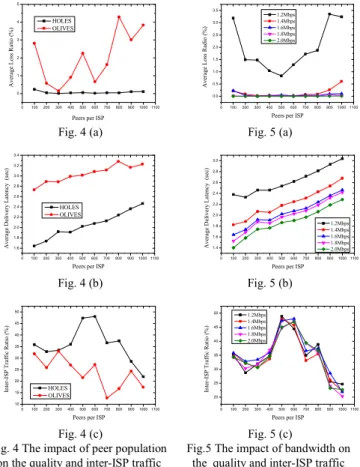
In this subsection, we examine the effect of the number of peers in each ISP. We compare HOLES with another scheme named OLIVES, which maintains a fully-localized overlay to reduce the volume of inter-ISP traffic and incorporates a two-tier inter-ISP and intra-ISP scheduling scheme to maximize the delivered quality to individual peers. The simulation results are shown in Fig. 4.
Fig. 4 (a) depicts the average loss ratio as a function of the population of peers. We can see that the loss ratio decreases as the population of peers increases, and the average loss ratio of HOLES is less than OLIVES and is more stable than OLIVES.
Fig. 4(b) shows the average latencies of both schemes increase. This is because that the depths of the delivery paths become more length as the number of peers increasing. Concretely the average latency of HOLES is significantly lower than OLIVES, which displays that QoE of HOLES is better than OLIVES. The reason for this is that our design reduces the delivery latency by constraining the depth and inter-ISP latency of delivery paths while OLIVES does not. In Fig. 4 (c), we observe that significant reduction of inter-ISP traffic is achieved in both two schemes. From the performance of reducing the inter-ISP traffic, OLIVES is slightly better than that of HOLES. Based on the above results, we can conclude that HOLES outperforms OLIVES in ensuring the streaming quality while keeping the inter-ISP traffic in low level. 0 100200300400500600 7008009001000 1100 0 1 2 3 4 5 A ver age L oss R at io ( % )
Peers per ISP HOLES OLIVES Fig. 4 (a) 0 100200300400500600700800 9001000 1100 0.0 0.5 1.0 1.5 2.0 2.5 3.0 3.5 A ver age L oss R adi o ( % )
Peers per ISP
1.2Mbps 1.4Mbps 1.6Mbps 1.8Mbps 2.0Mbps Fig. 5 (a) 0 100 2003004005006007008009001000 1100 1.6 1.8 2.0 2.2 2.4 2.6 2.8 3.0 3.2 3.4 A ver age D el iver y L at en cy (s ec)
Peers per ISP HOLES OLIVES Fig. 4 (b) 0 100200300 4005006007008009001000 1100 1.4 1.6 1.8 2.0 2.2 2.4 2.6 2.8 3.0 A ver age D el iver y L at enc y (s ec)
Peers per ISP
1.2Mbps 1.4Mbps 1.6Mbps 1.8Mbps 2.0Mbps Fig. 5 (b) 0 100200300400500600 7008009001000 1100 10 15 20 25 30 35 40 45 50 In te r-IS P T ra ffi c R ati o ( % )
Peers per ISP HOLES OLIVES
Fig. 4 (c)
Fig. 4 The impact of peer population on the quality and inter-ISP traffic
0 100200300 4005006007008009001000 1100 20 25 30 35 40 45 50 In te r-IS P T ra ffi c R ati o ( % )
Peers per ISP
1.2Mbps 1.4Mbps 1.6Mbps 1.8Mbps 2.0Mbps Fig. 5 (c)
Fig.5 The impact of bandwidth on the quality and inter-ISP traffic C. Impact of heterogeneous bandwidth
In this subsection, we compare the average loss ratio, average delay and inter-ISP traffic ratio when varying the upload bandwidth of peers and the amount of peers in the streaming application. Fig. 5 (a) demonstrates the effect of the number of peers for the average loss ratio in diverse bandwidth scheme. This result reveals that the average loss ratio decreases as the bandwidth increases. The average loss ratio is too nearly zero to be negligible when the average bandwidth is larger than 1.4Mbps. In low bandwidth settings of 1.2 Mbps, there is only a fractional decline in the performance of HOLES where the max loss ratio is 3.8%. These results enlighten us that HOLES can be applied in the practical system with limited upload bandwidth. In Fig. 5 (b), we can see that the average latency is inversely proportional to the bandwidth. The results are obvious since the high
bandwidth can deliver the chunks in a little latency and large number of peers leads to the great depth of delivery paths so that increases the latency.
In Fig. 5 (c) we investigate the inter-ISP traffic ratio in the case of various numbers of peers for distinct classes of upload bandwidth. The results show that the distribution of the inter-ISP traffic ratio with different bandwidth is similar. Therefore, we can conclude that the bandwidth and the number of peers have a little impact on the performance of HOLES.
VI. CONCLUSION
In this paper, we studied the effect of localization on the performance of the P2P live streaming application and analyzed underlying reasons for this adverse impact. We investigated the optimization problems of inter-ISP connections to reduce the inter-ISP delivery delay. Derived from these insights, we propose a novel ISP-friendly hierarchical overlay for P2P live streaming application named HOLES. HOLES maintains a three-layer overlay to surmount the adverse effects of the fully localized overlay. Our evaluation demonstrated that HOLES successfully reduces the inter-ISP traffic and ensures high streaming quality through wide simulations. Future research is to study and find more optimal solutions for the balance between the localization and high streaming quality and to implement HOLES in real-world system.
ACKNOWLEDGMENT
This research was supported by the NSFC under grant No. 61202445, 61001084, and 61272527.
REFERENCES
[1] D. Tomozei and L. Massouliè, “Flow control for cost-efficient peer-to-peer streaming,” in Proc. IEEE INFOCOM, 2010, pp. 1–9.
[2] V. Aggarwal, A. Feldmann, and C. Scheideler. “Can ISPs and P2P users cooperate for improved performance?” ACM SIGCOMM Computer Communication Review, vol. 37, pp. 29-40, July 2007.
[3] H. Xie, R. Yang, A. Krishnamurthy, Y. Liu, and A. Silberschatz, “P4P: Provider portal for applications,” in Proc. SIGCOMM, 2008, pp. 351– 362.
[4] D.R. Choffnes and F. E. Bustamante, “Taming the Torrent: A Practical Approach to Reducing Cross-ISP Traffic in Peer-to-Peer Systems,” In Proc. of SIGCOMM, 2008, pp. 363-374.
[5] F. Picconi and L. Massoulié, “ISP-Friend or foe? Making P2P live streaming ISP-aware,” in Proc. IEEE ICDCS, 2009, pp. 413–422. [6] D. Tomozei and L. Massouliè, “Flow control for cost-efficient
peer-to-peer streaming,” in Proc. IEEE INFOCOM, 2010, pp. 1–9.
[7] N. Magharei, R. Rejaie, I. Rimac, V. Hilt, and M. Hofmann, “ISP-Friendly Live P2P Streaming”, IEEE/ACM Transactions on Networking, vol. 22, no. 1, pp. 244-256, February, 2014.
[8] Z. Shen and R. Zimmermann, “ISP-Friendly P2P Live Streaming: A Roadmap to Realization,” ACM Transactions on Multimedia Computing, Communications and Applications, vol. 8, no. 1S, February, 2012.
[9] X. Zhang, J. Liu, B. Li, and T. Yum, “CoolStreaming/DONet: A datadriven overlay network for peer-to-peer live media streaming,” in Proc. IEEE INFOCOM, 2005, vol. 3, pp. 2102–2111.
[10] N. Magharei and R. Rejaie, “PRIME: Peer-to-peer receiver-driven mesh-based streaming,” in Proc. IEEE INFOCOM, 2007, pp. 1415–1423. [11] Q. Sun, and Z.Y. Yang, “A new algorithm for vertices-constrained
shortest path,” in Computer Engineering, vol. 28, pp. 73-74, 2002. [12] http://napa-wine.eu/cgi-bin/twiki/view/Public/P2PTVSim.