Analysing the Current State of a Warehouse
-A Framework Based on VSM, Activity Profiling and
Benchmarking
Ida Wessman and Maja Bärring
Master Thesis for M.Sc. in Mechanical Engineering
Faculty of Engineering, Department of Industrial Management and Logistics
Acknowledgements
This thesis is conducted during the spring of 2014 as a final part of our Master’s Degree in Mechanical Engineering at Lund University, Sweden. The thesis has been conducted on behalf of Lund University and Alfa Laval AB.
We would like to thank our supervisor Joakim Kembro at the Department of In-dustrial Management and Logistics, Lund University for valuable comments and feedback during the project. We would also like to thank all employees at Alfa Laval that have been a part of this project. A special thank to Bertil Ljungberg, Lean Manufacturing Specialist at Alfa Laval for the support during the project and the Friday meetings’ attendees for initiating the project.
Lund, May 2014
Abstract
The 21st century has brought significant changes to the market. The ability to de-liver the right product at the right time with the right price is no longer just crucial for a company’s competitive success, in the long-term perspective it will decide if the company will survive on the market at all. A warehouse has a major impact on a firm’s service levels, response times and overall cost. To meet customer re-quirements and to keep up with the ever-changing market there is a need of im-proving warehouse operations.
For this study, a framework with Value Stream Mapping (VSM) in combination with Activity Profiling and Benchmarking is developed. VSM visualises the flow of material and information in a process and it is a concept commonly used for industrial improvements. The use of VSM in warehouses is however lagging be-hind. Activity Profiling is used to understand the activities and operations con-nected to a warehouse and Benchmarking is the process of gathering and sharing assessments of performance. It is believed that the combination will give a more comprehensive result compared to applying only one of the concepts. To meet the purpose of the thesis a case company is used, Alfa Laval in Lund. Alfa Laval has two warehouses at the site that will be used to examine and evaluate the frame-work. The purpose of the study is to investigate how the framework is applicable to present a current situation analysis of a warehouse. The aim of combining the three different concepts is to create a framework that takes several aspects into account in order to establish a fair picture of the warehouse state.
For this study “the research process onion” servesas an outline for the methodolo-gy. Data collection is in the centre of the model and the core of this method. Inter-views, observation and secondary data have been used for the data collection to receive a fair picture of the current state in the two warehouses at Alfa Laval. With the framework data are analysed and improvement areas are identified. A proposal is given of where Alfa Laval could build a new warehouse at the site. It is then analysed how the three concepts contributed to given recommendations and identified improvements. The three concepts complement each other in many ways and it is recommended to use them together when evaluating the current ware-house state and to find areas of improvement.
Key Words: Value Stream Mapping, Activity Profiling, Benchmarking, Warehous-ing, Warehouse design, Lean warehouse, Distribution centre and Warehouse management
Sammanfattning
Under 2000-talet har betydande förändringar skett på marknaden. Ett företags förmåga att leverera rätt produkt, i rätt tid och till rätt pris är inte längre bara viktigt för företagets framgång utan kommer också vara avgörande för företagets långsiktiga överlevnad på marknaden. Med hjälp av ett lager kan företaget påverka sina servicenivåer, svarstider och kostnader. För att möta kundernas krav och för att hålla jämna steg med den ständigt föränderliga marknaden finns det ett behov hos företag att förbättra sin lagerverksamhet.
Under detta examensarbete har ett ramverk baserat på Value Stream Mapping (VSM), Activity Profiling och Benchmarking utvecklats. De tre koncepten är kombinerade för att ta hänsyn till flera aspekter och för att kunna presentera en verklighetstrogen bild av hur lagerverksamheten fungerar. VSM är ett verktyg som kartlägger flödena av material och information. Konceptet är vanligt förekom-mande för utvärdering av tillverkningsprocesser men användningen av konceptet i logistik- och lagersammanhang är inte lika utbrett. Activity Profiling används för att förstå de operationer och aktiviteter som ingår i en lagerverksamhet. Bench-marking innebär att man samlar in information om sin verksamhet och jämför mot ett idealt värde. Kombinationen av koncepten antas bidra till ett bättre helhetsre-sultat än om bara ett av koncepten hade använts. Syftet är att utvärdera ramverkets lämplighet för att presentera en nulägesanalys av ett lager. För att kunna utvärdera ramverket har det applicerats på Alfa Lavals två lager i Lund.
För denna studie har en forskningsmetodik som kallas för ”the research process onion” använts. Intervjuer, observationer och andrahandsdata har använts som datainsamlingsmetoder för att få en verklighetstrogen bild av lagerverksamheten på Alfa Laval i Lund.
Med hjälp av ramverket analyseras sedan nuläget och förbättringsområden identi-fieras. Ett förslag ges också på var Alfa Laval skulle kunna placera ett nytt lager. Vidare analyseras hur de tre koncepten bidragit till det givna förslaget och till att ge förslag på förbättringar. De tre koncepten kompletterade varandra på ett givan-de sätt ungivan-der studien och rekommendationen är att givan-de tre koncepten ska användas tillsammans för att få en helhetsbild av en lagerverksamhet.
Sökord: Value Stream Mapping, Activity Profiling, Benchmarking, Warehousing, Warehouse design, Lean warehouse, Distribution centre och Warehouse manage-ment.
Table of Contents
1
Introduction ... 1
1.1
Background ... 1
1.2
Purpose and Research Questions ... 2
1.3
Description of Case Company ... 3
1.4
Delimitations ... 4
1.5
Structure of Thesis ... 4
2
Methodology ... 5
2.1
Introduction ... 5
2.2
Research Philosophy ... 6
2.3
Research Approach ... 7
2.4
Research Strategy ... 8
2.4.1
Case Study Design ... 9
2.5
Time Horizon ... 11
2.6
Data Collection Methods ... 12
2.7
How the Study was Performed ... 13
2.8
Credibility in Research ... 17
2.8.1
Qualitative and Quantitative Data ... 17
2.8.2
Reliability ... 18
2.8.3
Validity ... 18
2.8.4
Generalizability ... 19
2.8.5
Objectivity ... 19
3
Frame of Reference ... 20
3.1
Warehouse Operations ... 20
3.2
Explanation of the Framework ... 21
3.3
Value Stream Mapping ... 22
3.3.1
Waste ... 22
3.3.2
Product Family Matrix ... 24
3.3.3
Map the Current State ... 25
3.3.4
Map the Future State ... 26
3.3.5
Why VSM? ... 27
3.4
Actvity Profiling ... 28
3.4.1
Customer Order Profiling ... 29
3.4.3
Item Activity Profiling ... 30
3.4.4
Inventory Profile ... 31
3.4.5
Calendar-Clock Profile ... 31
3.4.6
Activity Relationship Profile ... 32
3.4.7
Investment Profile ... 33
3.5
Benchmarking ... 33
3.5.1
Warehouse Performance Measures ... 33
3.5.2
The Gap Analysis ... 35
3.6
How to Adapt the Framework ... 37
4
Identifying the Current State ... 39
4.1
Introducing the Case ... 39
4.1.1
Identified Problem Areas in the Warehouses ... 40
4.2
VSM ... 41
4.2.1
Identification of Customers and Suppliers ... 41
4.2.2
Mapping the Current State ... 43
4.3
Activity Profiling ... 49
4.3.1
Utilisation ... 56
4.4
Benchmarking ... 58
4.4.1
In-time Delivery Accuracy ... 58
4.4.2
Picking Accuracy ... 59
4.4.3
Receiving Accuracy and Supplier Quality ... 59
4.4.4
Picking Productivity ... 60
4.4.5
Warehouse Cost ... 61
5
Identifying Areas of Improvement ... 62
5.1
The Warehouse Performance Gap Analysis ... 62
5.2
VSM ... 63
5.3
Activity Profiling ... 65
5.4
Benchmarking ... 67
5.4.1
World-Class Measures ... 69
6
Recommendations ... 70
6.1
VSM ... 70
6.2
Activity Profiling ... 71
6.3
Benchmarking ... 72
6.4
The Combination of the Concepts ... 73
6.5
A Suggestion for the Future State ... 73
6.6
The Gap Analysis for a Future State ... 76
7.1
VSM ... 77
7.2
Activity Profiling ... 78
7.3
Benchmarking ... 79
7.4
The Framework ... 80
8
Conclusions ... 83
8.1
Answering the Research Questions ... 83
8.2
Future research ... 88
References ... 89
Appendix A ... 92
List of figures
Figure 1 - The research process onion (Saunders et al., 2003: 83) ... 5 Figure 2 - The research philosophy is divided into three areas shown in the figure: positivism, realism and interpretivism (Saunders et al., 2003: 83-85) ... 6 Figure 3 - The three prevailing research approaches within logistics: inductive, deductive and abductive (Kovács and Spens, 2005) ... 7 Figure 4 - Case study design (Voss et al., 2002) ... 10 Figure 5 - Three data collection methods were used during this study and those are: observations, interviews and secondary data (Saunders et al., 2003) ... 13 Figure 6 - A description of how the study was performed ... 15 Figure 7 - The three concepts that will be used in order to evaluate a warehouse and the warehouse operations ... 21 Figure 8- A product family matrix (Rother and Shook, 2004: 4) ... 24 Figure 9 - Different symbols used when mapping a value stream (Bicheno, 2009: 66-74; Rother and Shook, 2004: 9-34) ... 25 Figure 10 - An example of VSM (Rother and Shook, 2004: 9-34) ... 26 Figure 11- An example of activity relationship profile (Frazelle, 2002a: 42-43). . 32 Figure 12 - An example of a warehouse performance gap analysis (Frazelle, 2002a: 55-58) ... 35 Figure 13 - How to adapt the framework and what each concept contributes with37 Figure 14 - A PHE and the different products included ... 39 Figure 15 - The figure presents customers and suppliers for warehouse A
(Workshop with warehouse A) ... 41 Figure 16 - Customers and suppliers for warehouse B are presented (Workshop with warehouse B) ... 42 Figure 17 - Presents the material flows at the site in Lund (Participant observations in the warehouses and at the yard) ... 43 Figure 18 - VSM of warehouse A (VSM with warehouse A) ... 45 Figure 19 - Placement of activities in warehouse A (VSM with warehouse A) .... 45 Figure 20 - VSM of warehouse B (VSM with warehouse B) ... 47 Figure 21 - Shows were different activities are located in warehouse B (VSM with warehouse B) ... 47 Figure 22 – Item popularity distribution warehouse B ... 49 Figure 23 - Item popularity distribution warehouse B ... 50
Figure 24 - The different colours describe how often one pallet position in the
warehouse is visited ... 51
Figure 25 - Warehouse A: first level ... 51
Figure 26 - Warehouse A: second level ... 52
Figure 27 - Warehouse A: third level ... 52
Figure 28 - Warehouse B: first level ... 53
Figure 29 - Warehouse B: second level ... 53
Figure 30 - Warehouse B: third level ... 53
Figure 31 - Lines per order distribution warehouse A ... 55
Figure 32 - Lines per order distribution warehouse B ... 55
Figure 33 - Suppliers delivering products with poor quality ... 60
Figure 34 - Warehouse Performance Gap analysis for warehouse A and B ... 62
Figure 36 - Steps that should be removed in warehouse B according to the VSM 64 Figure 35 - Steps that should be removed in warehouse A according to the VSM 64 Figure 37 - How to store products warehouse A ... 66
Figure 38 - How to store products warehouse B ... 66
Figure 39 - A future state for the warehouse at Alfa Laval ... 74
Figure 40 - Warehouse layout inside the warehouse ... 75
Figure 41 - Warehouse performance gap analysis of the future state ... 76
Figure 42 - Describes how the framework should be applied ... 81
Figure 43 - Wastes identified by each concept and the order that the framework should be performed ... 84
Figure 44 - Which of the concepts that evaluate the different warehouse operations ... 85
List of tables
Table 1 - Description and purpose of the different research strategies ... 8
Table 2 - Timeline and persons involved in the process of collecting data ... 17
Table 3 - The seven wastes (Hines and Rich, 1997; Liker and Meier, 2006: 36; Bicheno, 2009: 20) ... 23
Table 4 - Translation of wastes for a warehouse ... 24
Table 5 - Identified gaps of VSM applications in a warehouse ... 27
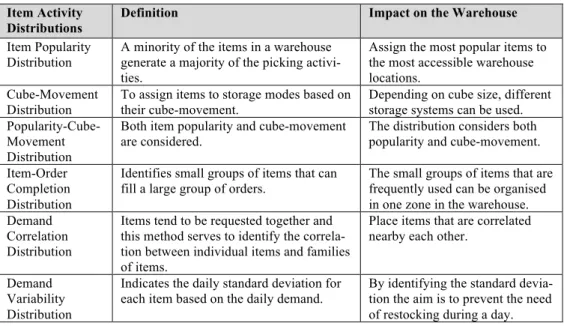
Table 6 - Customer order profiling (Frazelle, 2002a: 15-44) ... 29
Table 7 - Item activity distributions (Frazelle, 2002a: 30-37; Bartholdi and Hackman, 2010: 221) ... 31
Table 8 - Key Performance Indicators (KPI) (Bartholdi and Hackman, 2010: 239) ... 33
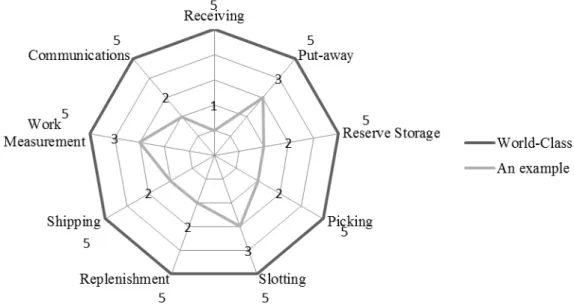
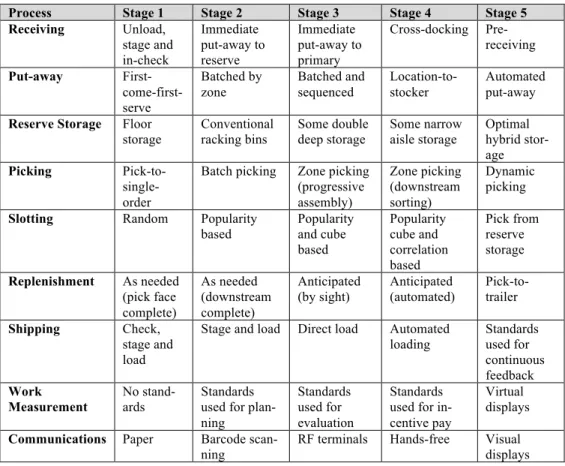
Table 9 - Performance measures (Frazelle, 2002a: 54-55; Manzini, 2012: 11-12) 34 Table 10 - Frazelle’s model over warehouse operation practices (Frazelle, 2002a: 67) ... 36
Table 11 - Information about the different activities and storage areas in warehouse A (VSM with warehouse A) ... 46
Table 12 - Information about the storage areas and activities in warehouse B (VSM with warehouse B) ... 48
Table 13 - Wastes identified for both warehouses (VSM with warehouse A and VSM with warehouse B) ... 48
Table 14 - Information about the two warehouses related to the Activity Profiling ... 49
Table 15 - Order increment distribution for warehouse A ... 54
Table 16 - Order increment distribution for warehouse B ... 54
Table 17 - The activity relationship profile for warehouse A ... 56
Table 18 - The activity relationship profile for warehouse B ... 56
Table 19 - Presents the total amount of pallet positions in both warehouses and the utilisation ... 57
Table 20 - Presents the utilisation of plastic bins in the two warehouses ... 57
Table 21 - Presents the utilisation in the three tents ... 58
Table 22 - Summarises the utilisation for storage in the two warehouses and in the three tents ... 58
Table 23 - Reasons for delays for warehouse B ... 59
Table 25 - Waiting and overproduction identified for both warehouses ... 63
Table 26 - An example of a product that is stored in six different locations ... 67
Table 27 - Reasons for delays to one of warehouse B’s customer ... 69
Table 28 - The two warehouses are positioned against world-class ... 69
1
Introduction
The introduction includes a background description of the research topic, the pur-pose and the research questions for this thesis. A description of the case company is given and the delimitations for the thesis are presented.
1.1
Background
Smaller shipments, faster deliveries, higher quality, increased variety and availa-bility; these factors are all by now taken for granted by the customer (New, 1993; Manzini, 2012: 2). The ability to deliver the right product, at the right time with the right price is no longer just crucial for a company’s competitive success. In the long-term perspective it will decide if the company will survive on the market at all (Christopher and Towill, 2001). The 21st century has brought significant changes to the market - the uncertainty has grown rapidly, the competition has become even more crucial, a product’s life cycle is shortened, the customer de-mand is inconsistent and uncertain and the suppliers are unreliable (Rimiené, 2011). The present situation states the importance of a well-functioning supply chain to meet customer requirements and expectations (Christopher and Towill, 2001). The supply chain is the chain of activities that includes planning, coordinat-ing and controllcoordinat-ing the flow of information, material, parts and finished goods from the supplier to the customer (Stevens, 1989).
Frazelle (2002a: 5) argues that the warehouse plays a key role in the success, or failure, of modern supply chains. A warehouse has a major impact on a firm’s service levels, response times and overall costs (Bozer, 2012: xii; Bartholdi and Hackman, 2010: 5). To meet customer requirements there is a need of improved warehouse operations, which involve receiving, put-away, storage, picking, and shipping of goods (Constantino et al., 2012). Despite the stated importance of warehouse operations, they are considered as both costly and time consuming (Bartholdi and Hackman, 2010: 3). For this reason firms are limiting warehouse resources in terms of labour, equipment and space. With many actors and decision makers, warehouses are rather complex things to deal with (Manzini, 2012: viii). The prevailing situation calls for new ways to evaluate warehouses and reduce warehouse costs.
One concept that has been widely used for improvements in the manufacturing sector over the last decades is lean. Lean is today one of the most widely used approaches for industrial improvements; the focus is mainly on the elimination of
wastes and costs (Liker and Meier, 2006: 33). In this setting wastes are all activi-ties that do not add any real customer value (Liker and Meier, 2006: 34). Even though this concept has been widely used in the manufacturing sector, its applica-tion in warehouses is lagging behind (Bartholomew, 2008). Dotoli et al. (2013) propose that the lean principles could be used in order to manage a warehouse more efficient. One concept that originates from the lean principles is Value Stream Mapping, abbreviated VSM. VSM visualises the flow of material and in-formation in a process. According to Dharmapriya and Kulatunga (2011) there is a potential to apply VSM to a warehouse. Identified gaps in the literature show there is an opportunity to investigate how VSM is applicable to a warehouse.
For this study, a framework with VSM in combination with two already estab-lished concepts for warehouse investigation, Activity Profiling and Benchmarking, is developed. Activity Profiling is used to understand the activities and operations connected to a warehouse (Bartholdi and Hackman, 2010: 235). In alignment with VSM, Activity Profiling includes both the information and material flow (Frazelle, 2002a: 27). Since VSM only visualises the activities involved and not how they actually operate, Activity Profiling serves the purpose to conduct more detailed information about the different activities involved in the warehouse. Benchmark-ing is the process of gatherBenchmark-ing and sharBenchmark-ing assessments of performance (Hackman et al., 2001; Frazelle, 2002b: 65; Gu et al., 2010) and has been successfully ap-plied to a variety of business functions and industries (Frazelle, 2002b: 65).
1.2
Purpose and Research Questions
The purpose of this study is to investigate how a framework constituted by VSM, Activity Profiling and Benchmarking is appropriate to present a current situation analysis of a warehouse. The idea is to combine the benefits of VSM, which can visualise the material flows in the warehouse, with Activity Profiling and Bench-marking that are previously used concepts for examining a warehouse (Frazelle, 2002b: 65, 231-241; Balk and de Koster, 2008). The purpose and aim of combin-ing the three different concepts, is to create a framework that takes several aspects into account in order to establish a fair picture of the current situation in a ware-house. It is believed that the combination gives a more comprehensive result com-pared to applying only one of them. In order to understand how the framework contributes to new knowledge and how it should be used, it is tested and examined on a case company in order to gain real-life experiences of how it operates. The aim is to identify the current state at the case company, find areas of improvement and develop a proposal for how a warehouse could be improved with the help of the framework. The research questions are:
RQ1: How do the three concepts complement each other and why should they be used together in order to evaluate a warehouse?
RQ2: How do the three concepts overlap and were there any complications with using them together?
RQ3: Why should VSM be included in the framework and what benefits were found by applying this concept?
1.3
Description of Case Company
To answer the research questions and meet the purpose of the thesis, a case com-pany is used to evaluate and examine the framework. The case comcom-pany selected for this study is Alfa Laval. Alfa Laval has developed products since 1833 and their products are involved in reducing carbon emissions, treating water and min-imising energy consumptions. They launch between 35 and 40 products every year, holds over 1,900 patents and their financial goal is to grow with 12 % yearly. Production is spread on several continents, 32 major manufacturing units, and customers are all over the world. They manufacture products such as heat ex-changers, separators, pumps and valves. Of those plate heat exchangers have the strongest market position with a share of more than 30 %. Priorities for Alfa Laval are safety, quality, delivery and costs (www.alfalaval.com).
One of the 32 manufacturing units is situated in Lund. There are two larger ware-house locations at the site, hereinafter referred to as wareware-house A and B. Those locations are used to store raw materials and semi-finished goods. These kinds of facilities are known as production warehouses and cover the vast majority of warehouses (van Den Berg, 1999). Therefore, the manufacturing unit in Lund is an appropriate choice of case for this study. Space in both warehouses are utilised to a high extent and because of the space limitations some components are stored out-side and in temporary tents, resulting in a number of problems. Components are damaged by rust, barcodes detach from the product, sheets get stuck together in the production, and pallets are moist and bring in water and dirt in the production. Going back and forth to the tents contributes also to excessive transportations at the site and extra handling of material. Picking and inspection are performed man-ually and most components are stored in pallet racks. The number of stocked items at the plant increases constantly and the site is in need of an investigation of how the activities are operating and where potential improvements can be identified. It is believed that there are possibilities to utilise the current space in a more profita-ble way. If the space crunch has no solution Alfa Laval is thinking of building a new warehouse. Another objective for Alfa Laval to initiate this project is a desire to release more space in the factories for workshop areas with the long-term goal to complement with new production at the site.
1.4
Delimitations
Handling of raw material is not included in the project, while a plan already exists of how to store raw material in the future. Goods arrival, goods departure, work in process and the organisation is not either included. Storage, retrieval and restock-ing policies are not included and nor is the Warehouse Management System, WMS. All information flows are excluded from the research due to the time limi-tation of this project.
1.5
Structure of Thesis
The structure of the report clarifies what each chapter and section includes. The second chapter, the methodology, explains how the study was accomplished. Dif-ferent approaches and theories connected to research are introduced. The third chapter presents the frame of reference including a comprehensive explanation of the three concepts to be evaluated in this study. The first concept explained is VSM: definition of waste, how to map current and future state. It is important to understand waste in order to interpret the VSM. Activity Profiling is the second concept to be explained. Different profiles are explained that will help to under-stand how e.g. customers place their orders and the dependency between different activities in a warehouse. Benchmarking is the last concept to be explained. The part about Benchmarking presents performance measures used for warehouses and how a warehouse could be evaluated by a gap analysis. The fourth chapter, identi-fying the current state,presents the current situation in the two warehouses identi-fied by the three concepts. In the fifth chapter areas of improvement are presented. Recommendations and a final suggestion are discussed in chapter six. The sugges-tion is based on informasugges-tion gained from the three concepts. Finally the three con-cepts are evaluated and conclusions are presented.
2
Methodology
The chapter gives an explanation of different approaches and theories connected to methodology for research studies. The methodology presented serves the pur-pose to guide and explain the chosen approach for this study and give a back-ground for how the study was accomplished.
2.1
Introduction
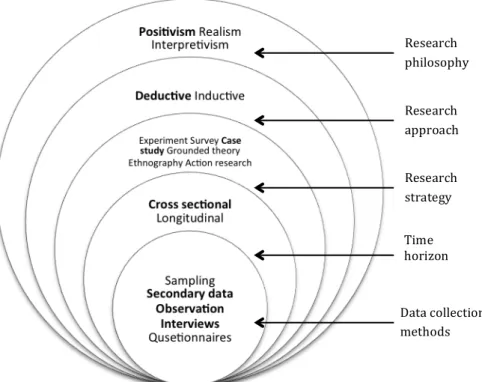
There are numerous methods and theories applicable for research. For this study “the research process onion”, initial introduced by Saunders et al. (2003: 83), serves as an outline. In the centre of the model are the data collection methods, see figure 1. Research philosophy Research strategy Time horizon Research approach Data collection methods
The chosen research titles for this study are marked bold in the figure. The onion has five layers: research philosophy, research approach, research strategy, time horizon and data collection methods. Every layer will guide the researcher in the right direction, so that the final data set answers the stated research questions. Eve-ry layer will be further explained with the intention to give a comprehensive back-ground for chosen methodology.
2.2
Research Philosophy
Before determining research strategy and method, the philosophy has to be settled according to Saunders et al. (2003: 83-85). In this model the philosophy is divided into three areas: positivism, realism and interpretivism, see figure 2. Positivism is comparable to the philosophy of natural science. A positivistic philosophy implies that the observations can serve as basis for generalizable laws applicable on other situations with the same circumstances. The researcher shall not have any impact on the research; neither shall the subject of the research affect the researcher. Con-trary, interpretivism states that generalizable laws cannot describe the social world of business and management as for the natural science. A business situation is far more complex and unique to be explained by a law. A research that has an inter-pretivistic position aims to explain the subjective meanings why people act in a specific way in a situation and the generalizability of the research is not as crucial as for the positivistic position. An additional step in understanding peoples’ moti-vation to act in one way is to adapt the position of realism. With this philosophy, the researcher aims to explain the environment that influences a person’s actions unconsciously. It is social constructions and factors that will be vital for a person’s views and behaviour.
Figure 2 - The research philosophy is divided into three areas shown in the figure: positivism, realism and interpretivism (Saun-ders et al., 2003: 83-85) Research Philosophy Positivism Natural science Realism Social science Interpretivism Business and management
The aim of this study is to investigate and examine how a framework based on three different concepts is applicable for a warehouse at a manufacturing compa-ny. The study gives generalizable suggestions and recommendations on how to use this framework and how each of the concepts contributes. The aim with the study is to investigate and present recommendations and guidelines for how to use this framework for future investigations of a warehouse. The positivistic philosophy is selected, since the results give generalizable laws for future applications.
2.3
Research Approach
Three research approaches within logistics are prevailing according to Kovács and Spens (2005). These are the inductive, deductive and abductive approach, see fig-ure 3. Research within logistics has historically mainly applied either a deductive or inductive approach. The deductive approach begins with theory and applies it on the specific case. The inductive approach contrariwise, starts with a specific case to end up with a general law. The abductive approach is a combination of deductive and inductive. It is initiated with a theory, which is applied on the case and ends up with a result. Arbnor and Bjerke (2009: 15-19)declare thatabduction starts from fact in the same way as induction, but is anyhow closer to deduction since it does not ignore theoretical knowledge at a start as for induction.
At an initial stage in this study a comprehensive literature review was performed. The purpose was to gather information within the field and find existing gaps in the literature. Based on the literature study, a framework was established. In order to understand how the framework contributes to new knowledge and how it should be used, it is tested and examined on a case company in order to gain real-life ex-periences of how it operates. From this examination conclusions can be drawn and recommendations can be presented. How this study was performed is very much in alignment with how a deductive approach is performed. Therefore, a deductive research approach is chosen.
Deductive Theory → Case Inductive Case → Result Research Approach Abductive Theory → Case → Result
Figure 3 - The three prevailing research approaches within logistics: inductive, deductive and abductive (Kovács and Spens, 2005)
2.4
Research Strategy
The main objective of a research is to be able to answer the initial stated research questions according to Saunders et al. (2003). A research strategy can be viewed as a general plan for how the data collection should be performed to answer the research questions. The strategy involves decisions about sources for data collec-tion, clear objectives and delimitations for the research. Research strategies in-cluded in the onion are: experiment, survey, case study, grounded theory, ethnog-raphy and action research. An overview of each strategy is provided in table 1.
Table 1 - Description and purpose of the different research strategies
Research strategy Description Purpose
Experiment
(Denscombe, 2009: 75-77)
Derives from natural science and involves testing and evaluating estab-lished theory.
Identify causes to a phenomenon and observe the influence of special factors on the research object.
Survey
(Denscombe, 2009: 25-26;Saunders et al., 2003: 92)
A large set of data is collected from a predetermined target group in a standardised procedure. Enables comparable results.
Measure some aspects of a social phenomenon or trend and test theory.
Case study
(Denscombe, 2009: 59-73;Yin, 2009)
In-depth investigation of a situation in its real-life environment using multiple source of evidence.
Understand the complex rela-tions between factors influenc-ing a social settinfluenc-ing.
Grounded theory
(Denscombe, 2009: 125-147; Saunders et al., 2003: 93)
Aims to explain what really happens in real-life situations instead of test-ing existtest-ing theories.
Explore a new subject to provide new insights and theories. Can also clarify concepts.
Ethnography
(Saunders et al., 2003: 93)
Study a social subject in its natural environment over an extended time period.
Describe cultural practices and traditions for a social phenome-non.
Action research
(Denscombe, 2009: 169-181; Saunders et al. 2003: 93-95)
The researcher takes an active role in the organisation for the study and aims to change it simultaneously.
Solve problems of more practi-cal character and set guidelines for best practice.
Experiment implies that the researcher shall be able to influence and manipulate parameters included in the research. This is not the situation in this study and ex-periment is therefore disregarded as a research strategy. So are survey, grounded theory and ethnography. Survey is neglected since the study does not require statements from a large target group, grounded theory since the study is a deduc-tive research based on theory and ethnography is neglected because the study is time constrained. The question that remains is whether a case study or action search shall be used. Important aspects for this study are to participate in the re-search subject to understand how it operates. This would justify an action rere-search. It is however neglected because it requires a cyclic procedure. Planning,
mentation, monitoring and evaluation should be done in cycles during the study and that is not an appropriate procedure for this study (Saunders et al., 2003: 95). Yin (2009: 8-14) explains that the form of the question is an important factor when deciding research strategy. The form refers to who, what, where, how and why. A case study is the most appropriate research strategy to apply when the researcher aims to answer how and why. Since that is the situation in this study, a case study should be the best option. The case study will give a rich understanding of the processes at the site in Lund, which is sought, and various data collection methods can be used. With a case study existing theories can be explored and challenged, which is of interest for this study. It can even provide the researcher with new hypothesis (Saunders et al., 2003: 93). Based on these arguments, a case study is chosen as research strategy.
2.4.1
Case Study Design
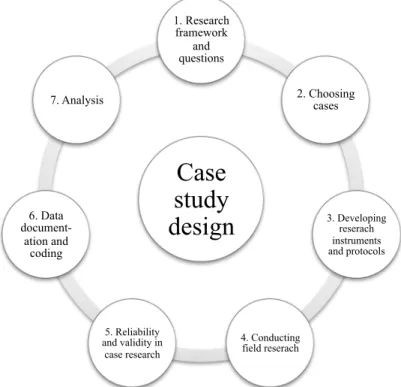
The procedure of establishing a case study follows a number of steps that can be seen in figure 4. All steps and how the case for this study was designed are ex-plained in this paragraph. The first step is to settle the framework and the research questions for the study. The framework serves the purpose to highlight what is important for the study and forces the researcher to decide at an early stage which aspects and variables that shall be included. It is important to formulate the re-search questions appropriate from the start to guide the collection of data in the right direction (Voss et al., 2002). For this study a framework was established after an extensive literature review. Based on background, problem description, purpose of the study and the framework, the research questions were formulated.
For the next step in designing a case study, the assignment is to choose one or multiple cases and also the type of case (Voss et al., 2002; Yin, 2009: 46-62). In this study one case was chosen: Alfa Laval’s site in Lund. Even though two ware-houses are included in this study they are considered as one case. They have some differences, but are anyhow relatively equal and they will constitute a good base for the Benchmarking. VSM is a well-established concept within production de-velopment and therefore a production unit was searched for this study. The pro-duction unit in Lund suits this precondition very well in order to investigate how the framework is applicable for a production unit. The site has complex inbound material flows and one of the most important customers to the warehouses is the production line, which are circumstances that are desired for this study.
The third step is to develop research instruments and protocols for collecting data. For a case study the primary sources of data are interviews, structured respectively unstructured. To conduct an interview in a desirable way, questions and subjects that shall be covered are formulated in a protocol. The number of respondents
shall also be decided; it is a trade-off between efficiency and richness of data (Voss et al., 2002). An initial action in this research was to spend time in the warehouses to gain an understanding of how each organisation is structured. These observations were crucial for the upcoming steps in the study. Another crucial aspect when collecting data was to involve personnel with diverse area of exper-tise and responsibility. Therefore time was devoted to contact the right persons to participate in focus interviews and when mapping the VSMs. Questions were for-mulated in advance and the procedure was identical for both warehouses; the same questions were asked at both occasions. The interview guide is to be found in ap-pendix A. Other sources of data used in this study are explained in the section “Data Collection Methods”.
When conducting the field research, the researcher must decide on whom to con-tact. A principle informant, well informed about the data anticipated, is preferred. The situation may however be that the organisation is not aware about who is to be referred to as the principle informant. In that case it is vital to get in contact with a person that can provide the researcher with access and put the researcher in contact with the right persons (Voss et al., 2002). In this study the supervisor at Alfa Laval was an important person for communicating the right contacts, both at an initial stage and throughout the entire study. As previous stated, interviews were one data
Figure 4 - Case study design (Voss et al., 2002)
Case
study
design
1. Research framework and questions 2. Choosing cases 3. Developing reserach instruments and protocols 4. Conducting field reserach 5. Reliability and validity in case research 6. Data document-ation and coding 7. Analysis
collection method and can be performed by a single investigator. To be multiple investigators may however increase the confidence in the findings and also en-hance the creative potential of the team stresses Eisenhardt (1989). Two investiga-tors performed the study, which will increase the confidence in the findings. While collecting data, notes shall be taken and participants shall be given the opportunity to take part of the notes afterwards and give comments (Voss et al., 2002). This was also performed throughout the study. The next step in the procedure of de-signing a case study is “Reliability and validity in case research”. Since this is explained more into depth in the section “Credibility in Research Process”, this is not further explained here.
After collecting data, the set should be documented and coded. The first step is to perform a detailed documentation according to what is defined in the protocol. It can include writing down notes and/or transcription of tapes. It can also imply gathering documents and other material from the field or through other sources. Ideas and insights that arise while conducting data shall also be documented (Voss et al., 2002). For this study no case visits or interviews were recorded, but notes were taken. These notes were discussed and documented afterwards. Ideas and impressions were also included in the documents. To increase the accuracy, partic-ipants at the occasions were given the opportunity to give comments on the docu-ments. While drawing the VSMs a portable white board was used to document notes and comments. Everyone involved could then agree on the accuracy in the comments and that the documentation was done correctly.
For the analysis Eisenhardt (1989) suggests two steps: analysis within case data and searching for cross-case patterns. The first step is to analyse the pattern of data within each case. It is of importance to investigate each case as a stand-alone enti-ty before the researcher tries to generalize the patterns to other cases. The central idea is to compare theory with data repetitively. A close fit between theory and data is significant, as mentioned, to yield an empirically valid theory (Eisenhardt, 1989). Case research can both test stated hypotheses and develop new hypotheses (Voss et al., 2002). For this study a single case was chosen, Alfa Laval’s site in Lund. Therefore, only analysis of a single case can be performed and to search for cross-case patterns is not relevant. The aim is to find patterns and give recommen-dations on how to apply this framework. It will provide generalizable laws for future use.
2.5
Time Horizon
It is of significance for a researcher to decide the time horizon of the study. The question to be asked is whether the study should reflect only a short sequence of time, referred to as cross sectional, or if the study is carried out for an extended
time period, longitudinal. A cross sectional time horizon is common to adapt, since most studies are time constrained. The longitudinal horizon has the ad-vantage that it will obtain changes and developments over an extended time hori-zon. The cross sectional time horizon is adapted in this study (Saunders et al., 2003:95). The study reflects only a short period of time and it is time constrained.
2.6
Data Collection Methods
Data collection is the core subject of the research onion. Secondary data, observa-tions and interviews are data collection methods used in this study. Sampling and questionnaires are also data collection methods included in the onion. The ad-vantage of applying sampling and questionnaire is that the researcher can gather opinions and perceptions from a large group of people in a standardised way and this will enable comparison (Saunders et al., 2003). This is however not crucial for this study and they are therefore not used for data collection.
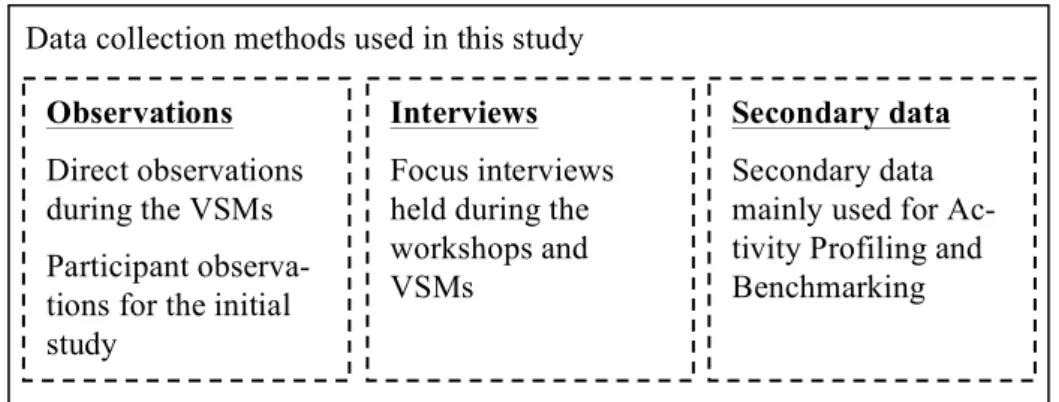
An observation implies that the researcher observes e.g. while a task is performed. The purpose of an observation is to receive real-life experience, which will support the understanding of how something behaves or appears. An observation can be either a direct observation or a participant observation. For a participant observa-tion the researcher participates in the activities and is not only observing, which is what distinguishes participant observation from direct observation (Yin, 2009: 109-113). For this study initial observations, in accordance with participant obser-vation, were crucial for the understanding of how the warehouses at Alfa Laval operate. These were performed meanwhile the literature study was performed and the research questions were formulated in order to give the study a depth. When it was decided that VSM was one of the concepts in the framework, observations were required once again. A VSM is an observation and investigation of the actu-ality, a direct observation.
Interview is an essential source of information for the case study. There are differ-ent types of interviews depending on purpose: in-depth interview, focused-interview and formal focused-interview. An in-depth focused-interview is not restricted to one sin-gle event and the interviewee is asked about key information and personal opin-ions. A focused-interview is restricted to one occasion and previous gained infor-mation is validated. Therefore it is of importance to not ask leading questions. Focus interview is the most formal interview of them and it provides the research-er with a structured way to ask questions. It provides the researchresearch-er with quantita-tive data (Yin, 2009: 106-109). When performing the VSMs it was important that everyone involved were well informed about the procedure of a VSM and what was expected. Therefore two preparatory workshops were held before the VSMs were performed. Since the material and the agenda for the workshops were
ed and prepared in advance, the workshops were equivalent to focus interviews. The interview guide and additional information are to be found in appendix A. Secondary data are already collected data for another purpose that can be reana-lysed for the purpose of the study in order to answer the research questions (Saun-ders et al., 2003: 188). In this study, files with large data sets were requested from different persons at Alfa Laval. The files contained order data for a longer period, in most cases more than one year. Secondary data were mainly used for the Activi-ty Profiling and Benchmarking. The data collection methods applied are summa-rised in figure 5.
2.7
How the Study was Performed
In some degree the methodology applied for this study has already been explained, but this section aims to explain it more in detail including the precise procedure for how the research was performed. It is a detailed explanation in order to enable a reconstruction of the study and to give a rich understanding of how the thesis was carried out. At the very first step for this study the scope of the project was decided. It was determined together with personnel working at Alfa Laval: Bertil Ljungberg, Bengt Larsson, Håkan Nilsson, Jens Richter and Tobias Augustsson. These persons are considered to have a broad overview of the factory and the warehouses as well as knowledge of which areas that are in need of investigation. Together with these persons the project and the delimitations for the study were set. Every second week a meeting together with this group of people was held to make sure that the thesis was moving in the right direction. Bertil Ljungberg was the supervisor at Alfa Laval and he introduced a number of people that would be helpful for the study; people familiar with Alfa Laval’s information system and personnel in the warehouse organisations. These contacts were helpful during the collection of secondary data and when performing the mapping.
Data collection methods used in this study
Observations
Direct observations during the VSMs Participant observa-tions for the initial study
Secondary data
Secondary data mainly used for Ac-tivity Profiling and Benchmarking
Interviews
Focus interviews held during the workshops and VSMs
Figure 5 - Three data collection methods were used during this study and those are: observations, interviews and secondary data (Saunders et al., 2003)
To receive a deeper understanding of the current situation in the warehouses with respect to material flows and handling, time was dedicated to meet personnel working in the warehouses and to take part of the daily operations, participant observations. Two days were spent in warehouse A and one day in warehouse B. Experiences gained from these visits in the warehouses and the factory were help-ful to comprehend the problem scenario. Based on experiences gained from the visits a map was done visualising the flows of material within and between the warehouses. Team Manager for warehouse B validated the map and he is consid-ered to have profound knowledge about the material flows over the whole plant. He was asked to comment the data, to add missing information and to correct any errors.
The literature study was an essential part from the start of the project and was commenced in an early stage. For the literature study Google scholar and Lovisa (lub.lu.se) served as Internet search engines. Published papers have been the pri-mary literature source because they are peer reviewed. Peer reviewed means that one or more persons review the article with equal competence within the field before publishing. Key words while searching have been Value Stream Mapping, Warehouse Design, Lean Warehouse, Distribution Centre, Activity Profiling, Benchmarking and Warehouse Management. Books have been used as a supple-ment for compiling the methodology chapter and the frame of reference. For the frame of reference a number of books have been used: World-Class Warehousing and Material Handling and Supply Chain Strategy written by Edward H. Frazelle. They have mainly complemented the sections about Activity Profiling and Benchmarking. Frazelle is a president and CEO of Logistics Recourse Internation-al and he is Internation-also a founder of The Logistics Institute at Georgia Institute of Tech-nology (Frazelle, 2002b: 358). Frazelle’s books are considered as reliable sources and have been recommended by the supervisor at Lund University. For the section about VSM a book named Learning to See: Value Stream Mapping to Add Value and Eliminate MUDA written by Mike Rother and John Shook has been an im-portant information source. Warehouse & Distribution Science written by John J. Bartholdi and Steven T. Hackman has also served as a complementary source of information for the frame of reference. This book is used as course literature at Lund University and therefore considered as a reliable source.
From the literature review some gaps could be identified, presented in the intro-duction, and this has been a motivation for the selected concepts constituting the framework. The first gap identified was that lean principles and VSM could be used in warehouses in a wider extent. The second gap was that methods that could evaluate how a warehouse operates and how the activities in a warehouse depend on each other were needed. A decisive part of the study was also to formulate ap-propriate research questions, abbreviated RQs. The literature study in combination with knowledge gained by visits in the factory served the purpose to finally
Step 1. Defining the project scope Step 2. Visits to the warehouse Step 3. Literature study 1 Step 4. Identified gaps Step 5. Literature study 2 Step 6. Develop the framework Step 7. Formulate the RQs Step 8. Applying the framework Step 9. Analyse the framework Step 10. Conclusions • Performing the VSMs • Collecting secondary data
• Performing the Activity Profiling and Benchmarking • Identify areas of improvement based on the framework • Present recommendations and a suggestion for the future state
Figure 6 - A description of how the study was performed
late the RQs and they were vital for the result. The RQs were also discussed to-gether with the supervisor at Lund University and at Alfa Laval. The task formu-lated by Alfa Laval has been to evaluate the current situation in the warehouses and also to give recommendations whether a new warehouse would be necessary or if they could handle all the components by just doing some changes of the current situation. These thoughts will be answered and a suggestion will be given.
So far the information presented has mainly concerned the preparatory work for the study. As mentioned, participant observations were done in order to gain an understanding for how the site in Lund functions. Therefore the next step in the study was to collect the data required for the empirical part of the study. This in-volved performing the VSMs and hosting the workshops. Workshops were held with the purpose to inform about the project and to define focus areas. Customers and suppliers to the warehouse were identified as well as their expectations and requirements. This in order to make sure that everyone had the same idea about VSM and what the goal with the project was. After the information was given some questions were asked, presented in appendix A. The same questions were asked to both groups. The attendees defined what they thought were important for their own processes. At the end of the workshops a brain storming method called affinity diagram was used to identify problems in the warehouses. The purpose was to find problem areas to focus on during the study. The attendees wrote their thoughts on post-its. They were allowed to write anything they could think of as a problem, at least three things. All thoughts were then discussed and the post-its were divided into groups. One group of post-its contained thoughts that mainly meant the same thing. The workshop and the answers given were compiled as well as the affinity diagrams. The compilations were sent to all attendees for validation.
Team Manager and Unit Manager attended the workshop for warehouse A. A se-cond workshop was held for people working in warehouse B. Team Leader Re-ceiving and Shipping, Team Manager and Unit Manager attended that workshop. Team Leader for warehouse B was also asked to attend the workshop but was not available.
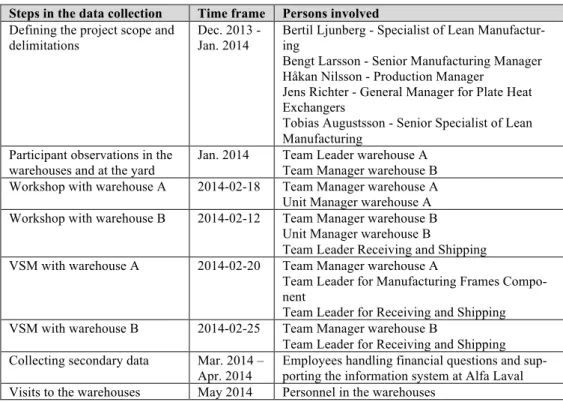
Subsequently the next step when collecting data was to perform the actual VSMs. Two separate occasions, one for each of the warehouses, were scheduled. Ques-tions for every step in the mapping were prepared in protocols, securing that noth-ing was forgotten while mappnoth-ing and also that the same questions would be asked at the two different occasions. The protocol can be found in appendix A. A porta-ble white board was brought to the warehouses together with some additional equipment necessary for the mapping. The VSMs were done in groups and each occasion lasted for about three hours. At the first occasion Team Leader, Team Leader Receiving and Shipping and an employee in the warehouse were participat-ing in completparticipat-ing the VSM in warehouse A and to answer the questions. The warehouse employee is working with inspection in warehouse A and he is well familiar with the material flows since he has been working in the warehouse for a longer period. Team Manager and Team Leader Receiving and Shipping helped to complete the VSM in warehouse B. Since it was not feasible to map all the exist-ing material flows, focus was on the material flows from the largest customers for both warehouses. The personnel provided the team with this information. Some flows could also be mapped as one group because the personnel handled them almost in the same way. The mapping started at the customer and the material flows were followed counter current. Personnel involved and the time frame for the study are summarised in table 2.
After conducting the current state map, information was needed in order to com-plete the maps and in order to present some additional findings about the ware-house functions. For this purpose, secondary data were requested from the person-nel at Alfa Laval. Data were mainly necessary for accomplishing the Activity Pro-filing and Benchmarking. Employees handling financial questions and supporting the information system at Alfa Laval were contacted. They helped by gathering order data and other information concerning the warehouses and the products stored. Data were also collected through email by some of the persons mentioned in this section.
When the secondary data needed for the next step were collected, Activity Profil-ing and BenchmarkProfil-ing were initiated. For the Activity ProfilProfil-ing it involved inter-preting the order data files and presenting the findings in an appropriate way. Benchmarking was completed by gathering information about each warehouse that can be compared against each other and against what is considered as world-class standards. The results from this step will eventually be analysed and help to an-swer the RQs. Finally the analysis and conclusions remained as the last steps in
this study. The analysis was completed based on findings done during the empiri-cal study. Conclusions were made and the RQs were answered.
Table 2 - Timeline and persons involved in the process of collecting data
Steps in the data collection Time frame Persons involved
Defining the project scope and delimitations
Dec. 2013 - Jan. 2014
Bertil Ljunberg - Specialist of Lean Manufactur-ing
Bengt Larsson - Senior Manufacturing Manager Håkan Nilsson - Production Manager
Jens Richter - General Manager for Plate Heat Exchangers
Tobias Augustsson - Senior Specialist of Lean Manufacturing
Participant observations in the
warehouses and at the yard Jan. 2014 Team Leader warehouse A Team Manager warehouse B Workshop with warehouse A 2014-02-18 Team Manager warehouse A Unit Manager warehouse A Workshop with warehouse B 2014-02-12 Team Manager warehouse B
Unit Manager warehouse B
Team Leader Receiving and Shipping VSM with warehouse A 2014-02-20 Team Manager warehouse A
Team Leader for Manufacturing Frames Compo-nent
Team Leader for Receiving and Shipping VSM with warehouse B 2014-02-25 Team Manager warehouse B
Team Leader for Receiving and Shipping Collecting secondary data Mar. 2014 –
Apr. 2014 Employees handling financial questions and sup-porting the information system at Alfa Laval Visits to the warehouses May 2014 Personnel in the warehouses
2.8
Credibility in Research
When gathering data for the empirical study, there are some aspects that are im-portant to take into account to ensure the credibility in the research. In this chapter qualitative respectively quantitative data, reliability, validity, generalizability and objectivity in research are discussed.
2.8.1
Qualitative and Quantitative Data
There are some distinctions between qualitative and quantitative data. Most studies involve some numerical data that need to be quantified before analysing it. This is referred to as quantitative data and it can imply e.g. the frequency of occurrences or more complex data. The collection results in numerical and standardised data that can be presented with the use of diagrams and statistics (Saunders et al., 2003: 378). In this study quantitative data are used, mainly for the Activity Profiling.
Large data files are gathered and examined with the aim to present data for the analysis of how the warehouses are organised. Qualitative data are collected as well. Qualitative data are based on meanings expressed through words and the collection is not standardised as for quantitative data. Since it is not standardised, the results need to be categorised (Saunders et al., 2003: 378). In this study quali-tative data are gathered mainly at the workshops and when mapping the VSMs. Warehouse personnel are asked about their opinions and experiences, their an-swers are then categorised into different groups.
2.8.2
Reliability
Saunders et al. (2003) define three conditions to be crucial for the study to fulfil the requirements of reliability. First of all, the study has to be reproducible at an-other occasion and give the same result. Secondly, anan-other observer shall obtain the same observations as the researcher. Thirdly, there should be a sense in how conclusions were drawn from the conducted data. If all these aspects are fulfilled, the study can be seen as reliable. The first condition is fulfilled since information about how the study was accomplished is recorded and documented throughout the study. This will ensure the reproducibility of the study. The second condition can be seen as fulfilled as well, since the report has been peer reviewed both by other master thesis students and by the supervisor at Lund University. Also the last condition is fulfilled with the same arguments as for condition two.
2.8.3
Validity
The purpose of validity is to make sure that the results really measure what was intended to be measured. If the data set is able to answer the research questions is in this matter significant. Validity concerns also the accuracy in the data collec-tion. By adapting triangulation validity can be increased (Denscombe, 2009: 184-190). Depending on intention with the study, different combinations can be estab-lished with two or more sources: data triangulation, investigators triangulation, methodological triangulation, theoretical triangulation or analytical triangulation according to Thurmond (2001). Data source triangulation means that data are col-lected from different sources. Data should not be colcol-lected from one single person and not be restricted to one occasion or one place. In this study many visits were done to the warehouses and different persons took part in the interviews. Investi-gators triangulation means that more than two researchers should take part in in-terviews and observations. Discussion and confirmation of data leads to greater credibility. This requirement is fulfilled since there are two researcher involved in this study. To achieve methodological triangulation multiple data collections methods should be used. In this case observations, interviews and secondary data
are used and therefore the requirement for methodological triangulation is achieved. Theoretical triangulation may refer to the procedure of testing and ana-lysing the same data set with different theories. This is done in this study when comparing the three concepts VSM, Activity Profiling and Benchmarking. Analyt-ical triangulation is when two or more methods are used to analyse data. Accord-ing to Thurmond (2001) analytical triangulation could be to validate the collected data. Validation of data is done in all cases in this study.
2.8.4
Generalizability
When conducting a study, it will be questionable if the results have any meaning for future research. Saunders et al. (2003: 102-103) refer to this matter as a re-search’s generalizability. If the findings are applicable for other cases or organisa-tions the research can be considered as generalizable. The aim of this study is to evaluate how a framework combining VSM, Activity Profiling and Benchmarking is applicable for the warehouses in this study. This is the primary aim, but another expected result is to investigate whether this framework is applicable for other warehouses with similar conditions as in this case. A desired outcome from this study is that the results shall be generalizable for future research. In order to in-crease the generalizability in this research a positivistic research philosophy has been chosen. This philosophy will likely give generalizable results. In qualitative research the participants shall be selected purposefully for the contribution they can make to the research that will also contribute to the generalizability (Morse, 1999).
2.8.5
Objectivity
To ensure that the researcher’s subjective thoughts are excluded and not have any impact on the result, it is important to investigate the objectivity in the research states Denscombe (2009: 379). An objective research is not biased and the collect-ed data can be seen as neutral and accurate for the study. To obtain objectivity Roberts et al. (2006) say that the researcher should try to achieve an analytical distance to the research and that the researcher should be non-reactive to the re-search.
3
Frame of Reference
The frame of reference outlines the theoretical foundation that is used as a refer-ence and guide throughout the research process. The chapter is introduced with an explanation of warehouse operations with the aim to give the reader a basic understanding for this topic. Thereafter VSM, Activity Profiling and Benchmark-ing are presented and explained.
3.1
Warehouse Operations
The most common operations in a warehouse are receiving, put-away, storage, picking and shipping. At the receiving department the arriving products are noti-fied and inspected. Damages, incorrect quantities and other errors are noted. Re-ceived products are registered so that they are known to be available and payments are dispatched (Bartholdi and Hackman, 2010: 22). Tasks performed at the receiv-ing department have an impact on the sequencreceiv-ing activities in the warehouse states Frazelle (2002a: 74). Incorrect received products will complicate put-away, stor-age, picking and shipping. Before put-away, a storage location must be determined for the product. Storage locations that are available, how much weight they can bear and how large they are must be known at all times. The storage locations should be scanned to record where the products are placed (Manzini, 2012: 2). For the issue of storing, there are two aspects to take into account. On the one hand, pallet storage system should be chosen with the aim to maximise volume utilisa-tion and density in the warehouse. On the other hand, the pallet retrieval system should be designed as beneficial as possible for the picking activities. These two aspects stand in contradiction to each other and both of them are of high priority for a world-class warehouse (Frazelle, 2002a: 85-108).
Picking operations are very cost intensive activities and the topic has been investi-gated in numerous papers. There are different ways to perform this operation: sin-gle order picking, batch picking, zone picking, pallet picking and free-form ing. Single order picking is when orders are completed one at a time. Batch pick-ing is when orders are batched and items are picked from pallet positions as they are visited by the picker. Zone picking is when a picker is dedicated to a picking zone. Workload has to be balanced among the zones. When zones are automatical-ly adjusted to keep balance this is named a bucket brigade and when an order is passed from zone to zone this is named a pick and pass system. In free-form pick-ing, the picker is free to pick from any location (Manzini, 2012: 4-5). Further it is
possible to do broken case picking, case picking or pallet picking. An example of broken case picking would be if 12 bolts would be picked out of a cartoon contain-ing 50 bolts. Case pickcontain-ing is when 50 bolts would be picked, which is the whole cartoon. An example of pallet picking is when 1000 bolts would be picked and a pallet contains 20 cases, which is the whole pallet. After the picking operation products are packed, loaded into freight carriers and transported to the customer. Those are the activities included in the shipping operation. Bartholdi and Hackman (2010) explain warehouse operations in their book and it is recommended for fur-ther reading.
3.2
Explanation of the Framework
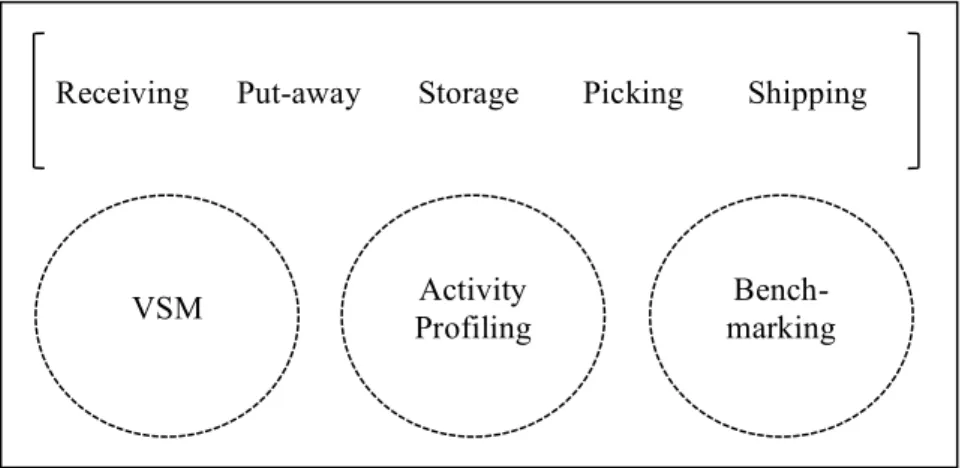
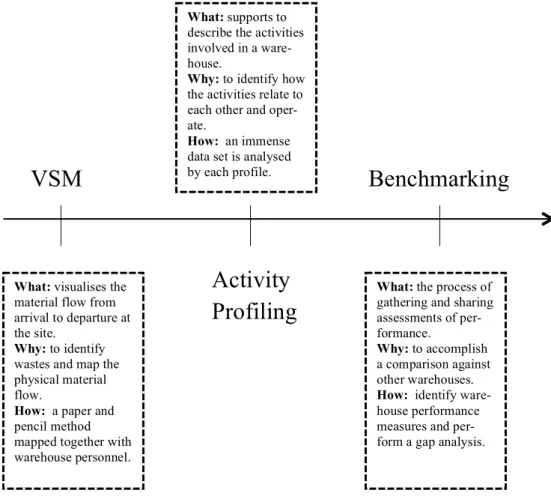
In this study a framework based on the three concepts VSM, Activity Profiling and Benchmarking is developed.The basis for the framework can be seen in figure 7. The purpose of the framework is to enable an extensive investigation and evalua-tion of the current situaevalua-tion in a warehouse. Each concept will be further explained in this chapter.
The three concepts will provide information about how the warehouse operations perform and where potential improvements are to be found. The understanding of how the warehouse operates and the dependency between activities is important to be able to improve the warehouse.
Activity Profiling
Bench-marking VSM
Receiving Put-away Storage Picking Shipping
Figure 7 - The three concepts that will be used in order to evaluate a warehouse and the warehouse operations